An Architect Breaks Down the Design of New York City Subway Stations, from the Oldest to Newest
With 26 lines and 472 stations, the New York City subway system is practically a living organism, and way too big a topic to tackle in a short video.
Architect Michael Wyetzner may not have time to touch on rats, crime track fires, flooding, night and weekend service disruptions, or the adults-in-a-Peanuts-special sound quality of the announcements in the above episode of Architectural Digest’s Blueprints web series, but he gives an excellent overview of its evolving design, from the stations themselves to sidewalk entrances to the platform signage.
First stop, the old City Hall station, whose chandeliers, skylights, and Guastavino tile arching in an alternating colors herringbone pattern made it the star attraction of the just-opened system in 1904.
(It’s been closed since 1945, but savvy transit buffs know that they can catch a glimpse by ignoring the conductor’s announcement to exit the downtown 6 train at its last stop, then looking out the window as it makes a U‑turn, passing through the abandoned station to begin its trip back uptown. The New York Transit Museum also hosts popular thrice yearly tours.)
Express tracks have been a feature of New York’s subway system since the beginning, when Interborough Rapid Transit Company enhanced its existing elevated line with an underground route capable of carrying passengers from City Hall to Harlem for a nickel fare.
Wyetzner efficiently sketches the open excavation design of the early IRT stations — “cut and cover” trenches less than 20’ deep, with room for four tracks, platforms, and no frills support columns that are nearly as ubiquitous white subway tiles.

For the most part, New Yorkers take the subway for granted, and are always prepared to beef about the fare to service ration, but this was not the case on New Year’s Day, 2017, when riders went out of their way to take the Q train.
Following years of delays, aggravating construction noise and traffic congestion, everyone wanted to be among the first to inspect Phase 1 of the Second Avenue Subway project, which extended the line by three impressively modern, airy column-free stations.
(The massive drills used to create tunnels and stations at a far greater depth than the IRT line, were left where they wound up, in preparation for Phase 2, which is slated to push the line up to 125th St by 2029. (Don’t hold your breath…)
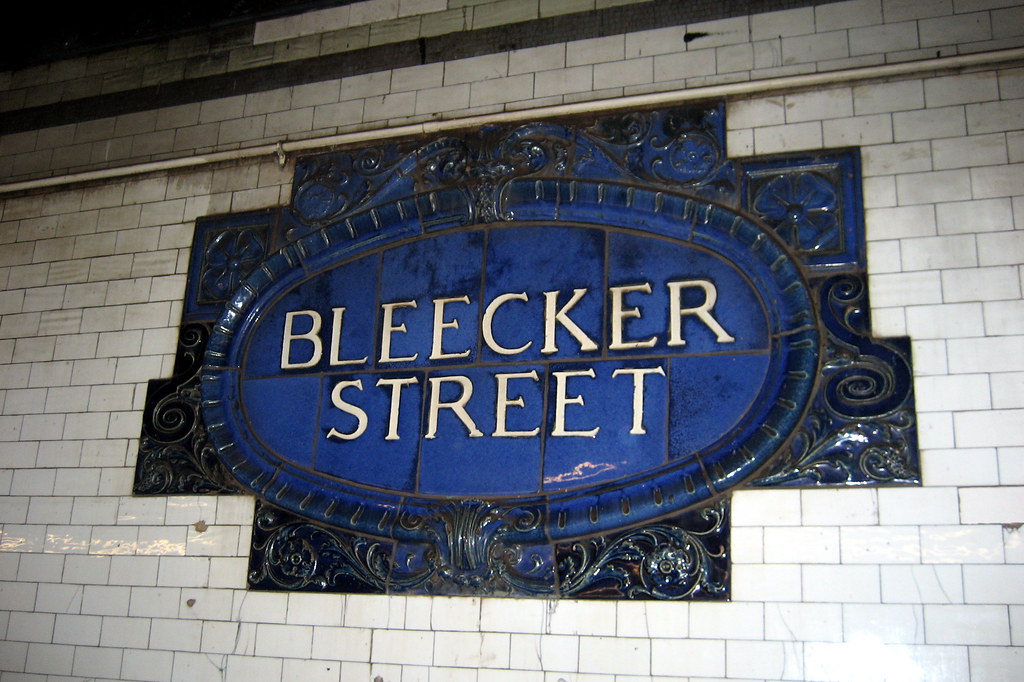
The designers of the subway placed a premium on aesthetics, as evidenced by the domed Art Nouveau IRT entrance kiosks and beautiful permanent platform signs.
From the original mosaics to Beaux Arts bas relief plaques like the ones paying tribute to the fortune John Jacob Astor amassed in the fur trade, there’s lots of history hiding in plain sight.



The mid-80s initiative to bring public art underground has filled stations and passageways with work by some marquee names, like Vik Muniz, Chuck Close, William Wegman, Nick Cave, Tom Otterness, Roy Lichtenstein and Yoko Ono.
Wyetzner also name checks graphic designer Massimo Vignelli who was brought aboard in 1966 to standardize the informational signage.
The white-on-black sans serif font directing us to our desired connections and exits now seems like part of the subway’s DNA.
Perhaps 21st-century innovations like countdown clocks and digital screens listing real-time service changes and alternative routes will too, one of these days.
If Wyetzner is open to filming the follow-up viewers are clamoring for in the comments, perhaps he’ll weigh in on the new A‑train cars that debuted last week, which boast security cameras, flip-up seating to accommodate riders with disabilities, and wider door openings to promote quicker boarding.
(Yes, they’re still the quickest way to get to Harlem…)
Related Content
A Subway Ride Through New York City: Watch Vintage Footage from 1905
Designer Massimo Vignelli Revisits and Defends His Iconic 1972 New York City Subway Map
– Ayun Halliday is the Chief Primatologist of the East Village Inky zine and author, most recently, of Creative, Not Famous: The Small Potato Manifesto and Creative, Not Famous Activity Book. Follow her @AyunHalliday.
Read More...A New Dutch Reality TV Show Challenges Contestants to Paint Like Vermeer–and It’s a Hit!
Jokes about “reality television” being a contradiction in terms go as far back in pop-culture history as the format itself. But the fact remains that, deliberately or otherwise, its programs do reflect certain characteristics of the societies that produce them. Before turning into one of the most globally successful franchises of this century’s reality-TV boom, the once-controversial strangers-in-a-house show Big Brother premiered in the Netherlands. It will be left as an exercise to the reader what that says about the Dutch, who have been tuning in to a very different kind of reality programming in the past month: De Nieuwe Vermeer, or The New Vermeer.
Aired in conjunction with the Rijksmuseum’s largest Vermeer exhibition ever staged, the show invites “two professional painters and dozens of amateur artists to compete to reinvent the lost works of the 17th-century master,” writes the New York Times’ Nina Siegal.
“The results are judged by Vermeer experts from the Rijksmuseum, the Dutch national museum in Amsterdam, and from the Mauritshuis, a collection of old masters in The Hague.” The professionals face such tasks as faithfully reconstructing Vermeer’s lost works, whether they vanished centuries ago or in the Isabella Stewart Gardner Museum theft of 1990. The amateurs work in their own media, including “stained glass, printmaking and even Lego.”
All this has made The New Vermeer “an instant sensation in the Netherlands, with 1.3 million viewers (in a country of 17 million) tuning in for the first episode.” Like any successful reality TV show these days, it has also inspired a wealth of supplementary content, including a podcast and an online gallery showing all the artwork created by the contestants. “You can’t currently watch the series in the U.S., writes Artnet’s Sarah Cascone, “but the network is streaming a weekly YouTube ‘Masterclass’ ” offering “step-by-step instructions on how to create your own Vermeer canvas.” At the moment, those videos are available only in Dutch, presumably on the assumption that The New Vermeer won’t travel well outside the Netherlands. But if, by some slim chance, it turned into a Big Brother-scale phenomenon, imagine the golden age of reality TV that would lie ahead.
Related content:
A Guided Tour Through All of Vermeer’s Famous Paintings, Narrated by Stephen Fry
What Makes Vermeer’s The Milkmaid a Masterpiece?: A Video Introduction
Master of Light: A Close Look at the Paintings of Johannes Vermeer Narrated by Meryl Streep
Meet Notorious Art Forger Han Van Meegeren, Who Fooled the Nazis with His Counterfeit Vermeers
Based in Seoul, Colin Marshall writes and broadcasts on cities, language, and culture. His projects include the Substack newsletter Books on Cities, the book The Stateless City: a Walk through 21st-Century Los Angeles and the video series The City in Cinema. Follow him on Twitter at @colinmarshall or on Facebook.
Read More...Wabi-Sabi: A Short Film on the Beauty of Traditional Japan
We’ve featured the work of Spanish filmmaker Cristóbal Vila before: His short film “Inspirations” celebrated the mathematical art of M.C. Escher. “Fallingwater” animated one of Frank Lloyd Wright’s finest creations. And “Nature by Numbers” showed us geometrical and mathematical formulas found in nature.
Today, we bring you Vila’s “Wabi-Sabi: A Handful of Memories from Traditional Japan.” As he notes on his site, the animation captures the “aspects that interest me the most about traditional Japan,” featuring “scenes inspired by nature, gardens, architecture, interior scenes, etc.” And it attempts to “create a calm and balanced atmosphere through the use of light, composition, materials, movement… and the choice of the motifs themselves.”
Above, you can watch “Wabi-Sabi,” a Japanese term that refers to “the [aesthetic] beauty of the impermanent, the imperfect, the rustic, and the melancholy,” as explains The School of Life video below. If you’re entranced by Vila’s short film, also watch the “Making of” video (middle).
If you would like to support the mission of Open Culture, consider making a donation to our site. It’s hard to rely 100% on ads, and your contributions will help us continue providing the best free cultural and educational materials to learners everywhere. You can contribute through PayPal, Patreon, and Venmo (@openculture). Thanks!
Related Content:
Frank Lloyd Wright’s Fallingwater Animated
Inspirations: A Short Film Celebrating the Mathematical Art of M.C. Escher
Read More...Bored at Work? Here’s What Your Brain Is Trying to Tell You
That we spend much, if not most, of our lives working is, in itself, not necessarily a bad thing — unless, that is, we’re bored doing it. In the Big Think video above, London Business School Professor of Organizational Behavior Dan Cable cites Gallup polls showing that “about 70 percent of people are not engaged in what they do all day long, and about eighteen percent of people are repulsed.” This may sound normal enough, but Cable calls these perceptions of work as “a thing that we have to get through on the way to the weekend” a “humanistic sickness”: a bad condition for people, of course, but also for the “organizations who get lackluster performance.”
Cable traces the civilizational roots of this at-work boredom back to the decades after the Industrial Revolution. In the mid-nineteenth century, a shoe-shopper would go to the local cobbler. “Each of the people in the store would watch the customer walk in, and then they’d make a shoe for that customer.” But toward the end of the century, “we got this different idea, as a species, where we should not sell two pairs of shoes each day, but two million.”
This vast increase of productivity entailed “breaking the work into extremely small tasks, where most of the people don’t meet the customer. Most of the people don’t invent the shoe. Most of the people don’t actually see the shoe made from beginning to end.”
It entailed, in other words, “removing the meaning from work” in the name of ever-greater scale and efficiency. The nature of the tasks that result don’t sit well with a part of our brain called the ventral striatum. Always “urging us to explore the boundaries of what we know, urging us to be curious,” it sends our minds right out of jobs that no longer offer us the chance to learn anything new. One solution is to work for smaller organizations, whose members tend to play multiple roles in closer proximity to the customer; another is to engage in big-picture thinking by staying aware of what Cable calls “the why of the work,” its larger impact on the world, as well as how it fits in with your own purpose. But then, boredom at work isn’t all bad: a bout of it may well, after all, have led you to read this post in the first place.
Related content:
The Benefits of Boredom: How to Stop Distracting Yourself and Get Creative Ideas Again
The Philosophy of “Optimistic Nihilism,” Or How to Find Purpose in a Meaningless Universe
How to Take Advantage of Boredom, the Secret Ingredient of Creativity
Based in Seoul, Colin Marshall writes and broadcasts on cities, language, and culture. His projects include the Substack newsletter Books on Cities, the book The Stateless City: a Walk through 21st-Century Los Angeles and the video series The City in Cinema. Follow him on Twitter at @colinmarshall or on Facebook.
Read More...Essential Japanese Cinema: A Journey Through 50 of Japan’s Beautiful, Often Bizarre Films
In 2018, Hirokazu Kore-eda’s Shoplifters won the Palme d’Or at Cannes. The award itself came as less of a surprise than did the fact that Shoplifters was the first of Kore-eda’s films to win it, given how long he’d been the most widely acclaimed Japanese filmmaker alive. And though it had been more than twenty years since the Palme last went to a Japanese movie — Shomei Imamura’s The Eel, in 1997 — Japan had long since established itself at Cannes as the Asian country to beat. Imamura’s The Ballad of Narayama had won the Palme in 1983, Akira Kurosawa’s Kagemusha in 1980, and Teinosuke Kinugasa’s Gate of Hell in 1954, when Western cinephiles were only just starting to appreciate Japanese cinema.
Why has that appreciation proven so enduring? This is one question investigated by “The Essential Japanese Cinema,” a video essay from The Cinema Cartography. Narrator Luiza Liz Bond emphasized the “heightened aesthetic sensibility” of Japanese filmmakers, on display in “the tender observation of Ozu’s Tokyo Story, the poetic rhapsody of Kurosawa’s Dreams, the harrowing feminine gaze of Videophobia.” But one can find examples just as rich and even more various in lesser-known films from Japan such as Shūji Terayama’s engagé experimental drama Throw Away Your Books, Rally in the Streets, Kaizō Hayashi’s oneiric silent-film pastiche To Sleep as to Dream, and Gakuryū Ishii’s subtly psychedelic and science-fictional coming-of-age tale August in the Water.
The video organizes these films and many others under a rubric of philosophical concepts drawn from Japanese culture. These include bushidō, the code of the samurai Westerners came to know through the pictures of Akira Kurosawa and Masaki Kobayashi; wabi-sabi, an ideal of beauty centered on imperfect things; mono no aware, a sensitivity to the transient and the ephemeral; and guro, which pushes the unsettling to its outer limits. Their heightened aesthetic sensibility “grants Japanese filmmakers the ability to be fine-tuned to the grotesque and the gruesome,” Bond notes. They understand that we all enjoy beauty, but an appreciation of ugliness is necessary to magnify this process. The beauty and the ugly are not opposites, but different aspects of the same thing.”
Of course, one need not be familiar with these ideas in order to enjoy Japanese cinema. The texture-intensive eroticism of Hiroshi Teshigahara’s Woman in the Dunes, the junkyard body horror of Shinya Tsukamoto’s Tetsuo: The Iron Man, the relentlessly bizarre inventiveness of Nobuhiko Obayashi’s House: these could only be delivered by filmmakers who understand first that they work in a medium of visceral power. Even the work of Yasujirō Ozu, famed for its imperturbable restraint, resonates more deeply than ever with us six decades after his death. “It is impossible to speak of the sublime without speaking of his portrayal of human fragility,” says Bond. “Ozu is never too sentimental, never too ornamental.” Would that more modern-day filmmakers, from Japan or anywhere else, looked to his example.
Related content:
How One Simple Cut Reveals the Cinematic Genius of Yasujirō Ozu
Hayao Miyazaki Meets Akira Kurosawa: Watch the Titans of Japanese Film in Conversation (1993)
How Master Japanese Animator Satoshi Kon Pushed the Boundaries of Making Anime: A Video Essay
Wabi-Sabi: A Short Film on the Beauty of Traditional Japan
A Page of Madness: The Lost Avant Garde Masterpiece from Early Japanese Cinema (1926)
Based in Seoul, Colin Marshall writes and broadcasts on cities, language, and culture. His projects include the Substack newsletter Books on Cities, the book The Stateless City: a Walk through 21st-Century Los Angeles and the video series The City in Cinema. Follow him on Twitter at @colinmarshall or on Facebook.
Read More...Hear De La Soul’s Highly Acclaimed & Influential Hip-Hop Albums Streaming Free for the First Time
If you don’t listen to rap, you’ve heard the same questions over and over in response to that confession. One of the most common is “But have you heard De La Soul?” — which in recent years was easier said than done, at least on streaming platforms. “What kept De La’s tunes out of rotation was a frustrating morass of outdated contracts and record label parsimony,” writes Oliver Wang at NPR. One complication had to do with sampling, a standard hip hop practice conducted in such a far-reaching, freewheeling, and elaborate manner by De La Soul that the prospect of renegotiating each and every sonic snippet they’d cleared in the CD-and-tape era inspired untold corporate intransigence.
But as of this month, “all this has finally been rectified. The group’s most important recordings are now legally available on the internet.” None of them is more important than their debut, 3 Feet High and Rising, originally released in 1989 and added to the Library of Congress’ National Recording Registry in 2010.
As Wang writes, the album “reshaped the public imagination of what hip-hop could be. The core trio — Posdnuos, Trugoy and DJ Pasemaster Mase — assisted by mentor/producer Prince Paul all came straight outta the wilds of suburban Long Island, rapping about advice-spouting crocodiles, Martian transmissions, and an artistic meta-concept they dubbed The D.A.I.S.Y. (Da Inner Soul, Y’all) Age.”
Clearly, De La Soul had a set of artistic priorities all their own. “Sample-hungry rap producers had spent the previous few years mining the James Brown and P‑Funk catalogs and though De La sampled from both on their debut, they were more likely to create memorable musical moments from children’s television songs (‘The Magic Number’), obscure doo-wop singles (‘Plug Tunin”) and classic ’80s pop hits (‘Say No Go’),” to say nothing of a learn-at-home French record. The first time I remember hearing De La Soul was when an early-morning college-radio DJ put on the 3 Feet High track “Eye Know,” which samples Steely Dan — as well as the Mad Lads, Lee Dorsey, and Otis Redding.
As if 3 Feet High and Rising weren’t enough of a cavalcade of wonders, it comes as only one of six De La Soul albums newly available to stream. On the group’s official Youtube channel and other streaming platforms, you can also hear De La Soul Is Dead (1991), Buhloone Mindstate (1993), Stakes Is High (1996), and the Art Official Intelligence pair Thump and Bionix (2001), each of which marks an expansion of the group’s already considerable ambitions. They all join the already-streamable albums released over the twenty years up to the death of founding member David “Trugoy” Jolicoeur last month, an event that may put end to De La Soul as a recording entity. But if you do listen through their expansive and inventive body of work, be prepared for another question: have you heard A Tribe Called Quest?
Related content:
How Jazz Became the “Mother of Hip Hop”
The Birth of Hip Hop: How DJ Kool Herc Used Turntables to Change the Musical World (1973)
Based in Seoul, Colin Marshall writes and broadcasts on cities, language, and culture. His projects include the Substack newsletter Books on Cities, the book The Stateless City: a Walk through 21st-Century Los Angeles and the video series The City in Cinema. Follow him on Twitter at @colinmarshall or on Facebook.
Read More...
1400 Engravings from the 19th Century Flow Together in the Short Animation “Still Life”
Composed of over 1000 engravings from the 19th century, the short animation Still Life (above) is “a meditation on subject/object dualism,” exploring “the idea that we live in a world of objects and a world of objects lives within us.” It’s created by Conner Griffith, an experimental L.A. filmmaker who likes working “with collections to explore the universal stories that can emerge from visual choreography and the relationship between sound and image.” For anyone interested, Griffith has made available the 1400 images used here in a Google Drive doc. You can find more of his short films on Vimeo.
If you would like to support the mission of Open Culture, consider making a donation to our site. It’s hard to rely 100% on ads, and your contributions will help us continue providing the best free cultural and educational materials to learners everywhere. You can contribute through PayPal, Patreon, and Venmo (@openculture). Thanks!
Related Content
Vintage Book & Record Covers Come to Life in a Mesmerizing Animated Video
Read More...The Dos & Don’ts of Driving to West Berlin During the Cold War: A Weird Piece of Ephemera from the 1980s
As generations have come of age with few or no memories of the existence of the Soviet Union, a common misconception about Berlin has become more common. Because the German capital was divided between the former East and West Germany, it’s easy to assume that it must have lay on the border between the two states. In fact, the whole of Berlin, East and West, was completely surrounded by East Germany, and to drive from West Germany to West Berlin entailed more than 100 miles on the autobahn through Soviet territory. How, exactly, this was done is fully explained in “Destination Berlin,” the 1988 video from the Royal Military Police above.
“You do not need to worry about the trip,” says the northern-accented narrator, an announcement that rather undercuts it own intended message. And few drivers, affiliated with the British military or otherwise, could watch the material that follows without speculating on the host of false moves that could result in an involuntary extended stay on the wrong side of the Iron Curtain.
You must never pull off at a rest stop. If you break down on the highway, you must accept assistance only from Allied drivers. When saluted by any of the Soviet officers inevitably encountered along the journey, “you must, irrespective of your sex, status, or form of dress, return his salute.”
“Should you be spoken to by a Soviet or East German national,” the narrator explains, “you must do the following: remember as much detail about the conversation as you can, as well as the physical description, dress, and rank of the individual. Remain non-committal throughout, and do not agree to anything.” (And remember, “you only attract attention to yourself by speaking in Russian to the Soviet checkpoint personnel, so don’t do it.”) These stern warnings evoke the Cold War era as powerfully as the audiovisual production of “Destination Berlin” itself, even in the minds of those who didn’t live through it. Could anyone watching back in 1988 — anxious about just which documents to present at which guard stations, to say nothing of the potential geopolitical consequences of a fender-bender — have imagined that the Berlin Wall would fall the very next year?
via Metafilter
Related content:
Louis Armstrong Plays Historic Cold War Concerts in East Berlin & Budapest (1965)
Protect and Survive: 1970s British Instructional Films on How to Live Through a Nuclear Attack
The Psychedelic Animated Video for Kraftwerk’s “Autobahn” from 1979
Based in Seoul, Colin Marshall writes and broadcasts on cities, language, and culture. His projects include the Substack newsletter Books on Cities, the book The Stateless City: a Walk through 21st-Century Los Angeles and the video series The City in Cinema. Follow him on Twitter at @colinmarshall or on Facebook.
Read More...Gordon Ramsay’s Ultimate Cookery Course: Free Video Lessons
Our definition of budget cookery may differ from celebrity chef Gordon Ramsey’s.
True, the world famous restauranteur and cookbook author speaks of cheap cuts with messianic zeal, but the episode of Gordon Ramsey’s Ultimate Cookery Course dedicated to Food on a Budget, above, also finds him paying a call to Lina Stores’ SoHo location to discuss ham, sausages, and salami with the late “deli maestro” Antonio Saccomani.
It’s not exactly Costco.
Nor can we buy bone-in Lamb with fried bread as a cost conscious dish, though the accompanying milk soaked fried bread — homemade croutons really — will cost slightly less to make this year, as the USDA is predicting that dairy prices will fall after 2022’s historic levels.
As long as we’re at peace with the idea that the man is not ever going to be found stretching rice and beans to feed a family of four for a week when there’s leftover risotto to be resurrected as arancini, the series is a goldmine for chefs of all budgets and experience levels.
It’s not so much the final dishes, as the short cuts and best practices on the journey.
His “chef in Paris” might indeed kill him for uglying up a dish with deliciously humble pan scrapings, but his ironclad maxims to waste nothing and use available ingredients will benefit home chefs with an eye on the bottom line, as well as pros in high end restaurants where profit margins turn on a knife’s edge.
In an age when any fool can Google up dozens of foolproof methods for cooking rice, sometimes it’s reassuring to get this sort of intel straight from the lips of a globally recognized expert. (We’re big fans of Julia Child’s scrambled eggs…)
How does your method measure up against Ramsey’s freely shared secret for cooking perfect rice?
Weigh out 400 grams of rice on a kitchen scale
Rinse with cold water
Season with salt and pepper, and — going up the food chain a bit — 3 pierced cardamom pods and a star anise
Add 600 grams of water (that’s a 1:1.5 ratio for those playing along without kitchen scales or the metric system)
Bring to a boil, and steam, covered for 8–10 minutes
No peeking!
Remove pot from heat and fluff
Such universal tips are the most persuasive reason to stick with the series.
Ramsey’s rapid fire delivery and lack of linked recipes may leave you feeling a bit lost in regard to exact measurements, temperatures, and step by step instructions, but keep your ears peeled and you’ll quickly pick up on how to extend fresh herbs’ shelf life and keep cut potatoes, apples and avocados looking their best.
Other episodes reveal how to grease cake tins, prevent milk from boiling over, remove baked-on residue, peel kiwis and mangos, determine a pineapple’s ripeness, seed pomegranates, skin tomatoes, and keep plastic containers stain-free…
Seriously, who needs TikTok when we have Gordon Ramsey 2012?
Ramsey’s advice to bypass expensive wine when cooking those comparatively cheap cuts of meat low and slow gets a chef’s kiss from us. (In full disclosure, we would happily swig his braising vintage.)
As to the slow-cooked duck, truffles and caramelized figs with ricotta, we must remind ourselves that the series is over 10 years old. These days even eggs feel like a splurge..
Perhaps some stress free cooking tips will lower our stress level over this week’s grocery expenditures?
Here too, there seems to be some discrepancy in Ramsey’s definition and the general public’s. His idea of stress free is achieved through lots of prepwork
If your idea of de-stressing involves skinning & deboning a salmon or making homemade fish stock, you’re in luck.
Obviously the end product will be delicious but the phrase “chili chicken with ginger & coriander” activates both our salivary glands and our impulse to order out…
Watch a full playlist of Gordon Ramsay’s Ultimate Cookery Course here.
Related Content
Watch Anthony Bourdain’s First Food-and-Travel Series A Cook’s Tour Free Online (2002–03)
Watch 26 Free Episodes of Jacques Pépin’s TV Show, More Fast Food My Way
– Ayun Halliday is the Chief Primatologist of the East Village Inky zine and author, most recently, of Creative, Not Famous: The Small Potato Manifesto and Creative, Not Famous Activity Book. Follow her @AyunHalliday.
Read More...Discover Pemmican, The Power Bar Invented Centuries Ago by Native American Tribes
Outdoor enthusiasts of a non-vegetarian stripe, do you weary of garden variety energy bars and trail mix?
Perhaps you’re feeling adventurous enough to make your own pemmican, variously described by Tasting History’s Max Miller, above, as “history’s Power Bar” and “a meaty version of a survival food that has a shelf life not measured in months but in decades, just like hard tack.”
Perhaps you’re already well acquainted with this low-carb, ketogenic portable provision, a culinary staple of the upper half of North America long before the first European traders set foot on the land. Many indigenous communities across North America are still producing pemmican for both personal and ceremonial consumption.
Back in 1743, Hudson’s Bay Company fur trader James Isham was one of the first to document pemmican production for an English readership:
[Meat] beat between two Stones, till some of itt is as small as Dust…when pounded they putt itt into a bag and will Keep for several Years, the Bones they also pound small and Boil them…to Reserve the fatt, which fatt is fine and sweet as any Butter…Reckon’d by some Very good food by the English as well as Natives.
Perhaps now would be a good time to give thanks for the plentiful food options most of us have access to in the 21st-century (and pay it forward with a donation to an organization fighting food insecurity…)
A time may come when knowing how to make pemmican could give us a leg up on surviving, but for now, execution of this recipe is likely more of a curiosity satisfier.
To be fair, it’s not designed to be a delicacy, but rather an extremely long lasting source of calories, four times as nourishing as the same weight of fresh meat.
If you want to try it, lay in 2 pounds of meat — bison is historically the most popular and most documented, but deer, elk, moose, beef, fish, or fowl work well too.
You’ll also need an equal amount of suet, though heed Miller’s advice and add just enough to make things stick.
Bump the flavor up a notch with ground dried berries, sugar, or salt.
(Miller went the traditional route with chokeberries, procured in an extremely 21st-century manner.)
In terms of appliances, feel free to use such modern conveniences as your oven, your blender, and a small pan or mold.
(Please report back if you take the old school route with fire, direct sunlight, mortar, pestle, and a bag formed from undressed hide.)
Given Miller’s response to the finished dish, we’re hunching most of us will rest content to feast on historical context alone, as Miller digs into the Pemmican Proclamation of 1814, the Seven Oaks Incident and the unique role the biracial, bilingual Métis people of Canada played in the North American fur trade…
Those still up for it should feel free to take their pemmican to the next level by boiling it with wild onions or the tops of parsnips, to produce a rubaboo or rechaud, as bushcrafter Mark Young does below.
You can also get a taste of pemmican by ordering the Tanka Bars that Oglala Lakota-owned small business produces on South Dakota’s Pine Ridge Reservation.
Watch more of Max Miller’s Tasting History videos here.
– Ayun Halliday is the Chief Primatologist of the East Village Inky zine and author, most recently, of Creative, Not Famous: The Small Potato Manifesto and Creative, Not Famous Activity Book. Follow her @AyunHalliday.
Read More...Support Us
We're hoping to rely on loyal readers, rather than erratic ads. Please click the Donate button and support Open Culture. You can use Paypal, Venmo, Patreon, even Crypto! We thank you!

About Us

Open Culture scours the web for the best educational media. We find the free courses and audio books you need, the language lessons & educational videos you want, and plenty of enlightenment in between.
Advertise With Us
FREE UPDATES!
GET OUR DAILY EMAIL
Get the best cultural and educational resources on the web curated for you in a daily email. We never spam. Unsubscribe at any time.
FOLLOW ON SOCIAL MEDIA
Open Culture editor Dan Colman scours the web for the best educational media. He finds the free courses and audio books you need, the language lessons & movies you want, and plenty of enlightenment in between.
Advertise With Us

