How Pulp Fiction ’s Dance Scene Paid Artistic Tribute to the Classic Dance Scene in Fellini’s 8½
An auteur makes few compromises in bringing his distinctive visions to the screen, but he also makes no bones about borrowing from the auteurs who came before. This is especially true in the case of an auteur named Quentin Tarantino, who for nearly thirty years has repeatedly pulled off the neat trick of directing large-scale, highly individualistic movies that also draw deeply from the well of existing cinema — deeply enough to pull up both the grind-house “low” and art-house “high.” Tarantino’s first big impact on the zeitgeist came in the form of 1994’s Pulp Fiction, which put the kind of common, sensationalistic material suggested by its title into cinematic forms picked up from the likes of Jean-Luc Godard and Federico Fellini.
Few clips of Tarantino’s work could distill this inspirational polarity as well as Pulp Fiction’s twist contest at Jack Rabbit Slim’s. In a film almost wholly composed of memorable scenes, as I wrote when last we featured it here on Open Culture, this one is quite possibly the most memorable.
Tarantino has explained his intent to pay tribute to dancing as it occurs in films like Godard’s Bande à part, the namesake of Tarantino’s production company. “My favorite musical sequences have always been in Godard because they just come out of nowhere,” he once said. “It’s so infectious, so friendly. And the fact that it’s not a musical but he’s stopping the movie to have a musical sequence makes it all the more sweet.”
But as these comparison videos reveal, Godard isn’t the only midcentury European auteur to whom Pulp Fiction’s dance scene owes its effectiveness. “This scene is a direct steal from Fellini’s 8½ and there’s no real effort to hide it,” writes No Film School’s Jason Hellerman. “Aside from the location change, the moves and camera angles are almost the same.” In 8½ the dancers are Marcello Mastroianni’s besieged filmmaker Guido and his estranged wife Luisa, played by Anouk Aimée. This occurs in another of the precious few pictures in cinema history comprising memorable scenes and memorable scenes only; the others include vivid spectacles outlining the middle-aged Guido’s artistic struggle and voyages of memory back into his prelapsarian childhood.
Childhood, writes poet James Fenton, was “a time of pure inventiveness” when “everything we did was hailed as superb.” (In this sense, a young filmmaker who makes his first Hollywood hit enjoys a second childhood, albeit usually a brief one.) In Fenton’s words, Washington Post art critic Sebastian Smee finds a key to the elaborate and enrapturing but at times bewildering 8½. With growth, alas, comes “the primal erasure, when we forget all those early experiences, and it is rather as if there is some mercy in this, since if we could remember the intensity of such pleasure it might spoil us for anything else. We forget what happened exactly, but we know that there was something, something to do with music and praise and everyone talking, something to do with flying through the air, something to do with dance.”
Related Content:
Federico Fellini Introduces Himself to America in Experimental 1969 Documentary
Fellini’s Fantastic TV Commercials
Based in Seoul, Colin Marshall writes and broadcasts on cities, language, and culture. His projects include the Substack newsletter Books on Cities, the book The Stateless City: a Walk through 21st-Century Los Angeles and the video series The City in Cinema. Follow him on Twitter at @colinmarshall or on Facebook.
Read More...Take a Journey Through 933 Paintings by Salvador Dalí & Watch His Signature Surrealism Emerge
Salvador Dalí made over 1,600 paintings, but just one has come to stand for both his body of work and a major artistic current that shaped it: 1931’s The Persistence of Memory, widely known as the one with the melting clocks. By that year Dalí had reached his late twenties, still early days in what would be a fairly long life and career. But he had already produced many works of art, as evidenced by the video survey of his oeuvre above. Proceeding chronologically through 933 of his paintings in the course of an hour and a half, it doesn’t reach The Persistence of Memory until more than seventeen minutes in, and that after showing numerous works a casual appreciator wouldn’t think to associate with Dalí at all.
It seems the young Dalí didn’t set out to paint melting clocks — or flying tigers, or walking villas, or any of his other visions that have long occupied the common conception of Surrealism. And however often he was labeled an “original” after attaining worldwide fame in the 1930s and 40s, he began as nearly every artist does: with imitation.
Far from premonitions of the Surrealist sensibility with which he would be forever linked in the public consciousness, dozens and dozens of his early paintings unabashedly reflect the influence of Renaissance masters, Impressionists, Futurists, and Cubists. Of particular importance in that last group was Dalí’s countryman and idol Pablo Picasso: it was after they first met in 1926 that the changes in Dalí’s work became truly dramatic.
Viewers may be less surprised that Dalí did so much before The Persistence of Memory than that he did even more after it. Though he would never return to the relatively straightforward depictions of reality found among his work of the 1920s, the dreamscapes he realized throughout the last half-century of his life are hardly all of a piece. (This in addition to plenty of work on the side, including a tarot deck, a cookbook, and even television commercials.) To appreciate the variations he attempted in his art even after becoming popular culture’s idea of an “almost-crazy” Surrealist requires not just seeing his work in context, but spending a proper amount of time with it. Not to say that fans of The Persistence of Memory — especially fans in a suitable state of mind — haven’t spent hours at a stretch in fruitful contemplation of those melting clocks alone.
Related Content:
Walk Inside a Surrealist Salvador Dalí Painting with This 360º Virtual Reality Video
When Salvador Dalí Created a Surrealist Funhouse at New York World’s Fair (1939)
Salvador Dalí’s Tarot Cards, Cookbook & Wine Guide Re-Issued as Beautiful Art Books
When Salvador Dalí Created Christmas Cards That Were Too Avant Garde for Hallmark (1960)
Salvador Dalí Explains Why He Was a “Bad Painter” and Contributed “Nothing” to Art (1986)
Based in Seoul, Colin Marshall writes and broadcasts on cities, language, and culture. His projects include the Substack newsletter Books on Cities, the book The Stateless City: a Walk through 21st-Century Los Angeles and the video series The City in Cinema. Follow him on Twitter at @colinmarshall or on Facebook.
Read More...A Charlie Watts-Centric View of the Rolling Stones: Watch Martin Scorsese’s Footage of Charlie & the Band Performing “Jumpin’ Jack Flash” and “All Down the Line”
Update: Two weeks after bowing out of the upcoming Rolling Stones tour, Charlie Watts has sadly passed away at age 80.
According to Charlie Watts — the Rolling Stones’ drummer and rock’s best dressed man — his playing is nothing special. “I sit there, and I hear what’s going on, and if I can make it, that’s fine,” he said in 1973. There are no false notes in his modesty. “You have to be a good drummer to play with the Stones,” he later remarked in 2000, “and I try to be as good as I can.” But he admits he’s not a technical player; it’s all about the feel. “It’s terribly simple what I do, actually…. I play songs.”
According to the rest of the band, Watts is indispensable, one of a kind, the “engine” of the Rolling Stones, says Ronnie Wood. He’s the only white drummer who can swing, Keith Richards swears: “Charlie’s always there, but he doesn’t want to let everybody know. There’s very few drummer’s like that. Everybody thinks Mick and Keith are the Rolling Stones. If Charlie wasn’t doing what he’s doing on drums, that wouldn’t be true at all. You’d find out that Charlie Watts IS the Stones.”
Audiences of the band’s upcoming tour will find out, since Watts announced he’s sitting this one out to recover from a medical procedure, to be temporarily replaced by understudy Steve Jordan. Watts is probably “not bothered,” Wayne Blanchard writes at Drum Magazine. He’s had a decades-long love-hate relationship with touring life. (Watts has made drawings of every hotel room he’s ever stayed in to stave off boredom). In the studio, “as long as a track gets recorded and sounds great, Charlie doesn’t seem to care who is on the drums.”
Other drummers have played on several key Stones tracks, including Faces drummer Kenney Jones on “It’s Only Rock ‘N’ Roll” and Stones producer Jimmy Miller on “Happy,” “Tumbling Dice,” “You Can’t Always Get What You Want,” and “Shine a Light.” None of this means, however, that Watts is replaceable or that the Rolling Stones would try to carry on without him. He has not only been the band’s engine, but its anchor, ballast, maybe, its quiet captain. “When Charlie plays,” said drummer Steve White, “it looks to me that he knows who runs the band on stage, despite what the singer might think.”
Watts resists talk of his importance to the Stones. “We have a huge crowd of people who like us,” he said in 1998, because “they just love looking at Keith Richards and looking at Mick wiggling his arms. They’ve been doing it for 30 years.” But he is just as much a draw as the other Stones who have made up the core trio of the band since its inception in 1962. Here’s hoping he recovers well. In the meanwhile, we can see the Stones play “Jumpin’ Jack Flash” and “All Down the Line,” further up, from Charlie’s calm, cool point of view, as shot by Martin Scorsese in 2006 at New York’s Beacon Theatre.
The footage shows “how Watts has quietly served as the backbone of The Rolling Stones for the past 58 years,” Andy Greene writes at Rolling Stone. And it provides a rare look at rock’s most understated drummer. “The only time I love attention is when I walk onstage,” Watts once said, “but when I walk off, I don’t want it.” In the video just above, he’s in especially rare form — joking on camera about a wiggly dance he does before he goes on, a demonstration of the rituals and in-jokes that have knit rock’s longest-running band together for over half a century. When they’ve all finally quit for good, says Keef, “I want to be buried next to Charlie Watts.”
via Rolling Stone
Related Content:
Josh Jones is a writer and musician based in Durham, NC. Follow him at @jdmagness
Read More...The Only Footage of Bruce Lee Fighting for Real (1967)
Two years after the release of Quentin Tarantino’s Once Upon a Time in Hollywood, people are still arguing about its brief portrayal of Bruce Lee. Whether it accurately represented his personality is one debate, but much more important for martial-arts enthusiasts is whether it accurately represented his fighting skills. This could easily be determined by holding the scene in question up against footage of the real Bruce Lee in action, but almost no such footage exists. While Lee’s performances in films like Enter the Dragon and Game of Death continue to win him fans 48 years after his death, their fights — however physically demanding — are, of course, thoroughly choreographed and rehearsed performances.
Hence the way, in Once Upon a Time in Hollywood, Brad Pitt’s rough-hewn stuntman Cliff Booth dismisses screen martial artists like Lee as “dancers.” Those are fighting words, and indeed a fight ensues, though one meant to get laughs (and to illuminate the characters’ opposing physical and emotional natures) rather than seriously to recreate a contest between trained martial artist and simple bruiser.
As for how Lee handled himself in actual fights, we have no surviving visual evidence but the clips above, shot during a couple of matches in 1967. The event was the Long Beach International Karate Championships, where three years earlier Lee’s demonstration of such improbable physical feats as two-finger push-ups and one-inch punches got him the attention in the U.S. that led to the role of Kato on The Green Hornet.
In these 1967 bouts, the now-famous Lee uses the techniques of Jeet Kune Do, his own hybrid martial-arts philosophy emphasizing usefulness in real-life combat. “First he fights Ted Wong, one of his top Jeet Kune Do students,” says Twisted Sifter. “They are allegedly wearing protective gear because they weren’t allowed to fight without them as per California state regulations.” Lee is the one wearing the gear with white straps — as if he weren’t identifiable by sheer speed and control alone. Seen today, his fighting style in this footage reminds many of modern-day mixed martial arts, a sport that might not come into existence had Lee never popularized the practical combination of elements drawn from all fighting styles. Whether the man himself was as arrogant as Tarantino made him out to be, he must have suspected that martial-arts would only be catching up with him half a century later.
Related Content:
Bruce Lee’s Only Surviving TV Interview, 1971: Lost and Now Found
Bruce Lee Auditions for The Green Hornet (1964)
The Philosophy of Bruce Lee Gets Explored in a New Podcast
The Poetry of Bruce Lee: Discover the Artistic Life of the Martial Arts Icon
Watch 10-Year-Old Bruce Lee in His First Starring Role (1950)
Based in Seoul, Colin Marshall writes and broadcasts on cities, language, and culture. His projects include the Substack newsletter Books on Cities, the book The Stateless City: a Walk through 21st-Century Los Angeles and the video series The City in Cinema. Follow him on Twitter at @colinmarshall or on Facebook.
Read More...The First Museum Dedicated to Mary Shelley & Her Literary Creation, Frankenstein, Opens in Bath, England
Halloween came early this year!
Last week, Mary Shelley’s House of Frankenstein opened its doors in Bath, England, mere steps from the infinitely more staid Jane Austen Centre.
Both authors had a connection to Bath, a popular tourist destination since 43 CE, as evidenced by the ruins of the Roman thermal spa that give the city its name and UNESCO World Heritage Site status.
Austen lived there between 1801 and 1806, and used it as a setting for both Persuasion and Northanger Abbey.
The teenaged Shelley’s residence was briefer, but eventful, and creatively fertile.
It was here that she wed poet Percy Bysshe Shelley, learned of the suicides of his pregnant first wife and her own half-sister, attended the birth of her illegitimate step-niece (daughter of Lord Byron), attended lectures on galvanism, or reanimation via electrical current… and wrote the majority of Frankenstein.
Bath has long mined its connection to Austen, but in embracing Shelley, it stands to diversify the sort of literary pilgrims it appeals to.
Visitors to the Jane Austen Centre can try on bonnets, exchange witty repartee with one of her characters, nibble scones with Dorset clotted cream in the tea room, and participate in an annual costume promenade.
Meanwhile, over at the House of Frankenstein, expect ominous, unsettling soundscapes, shocking special effects, ghoulish interpreters in blood-spattered aprons, “bespoke scents,” a “dank, foreboding basement experience” and an 8‑foot automaton of you-know-who.
(No, not Mary Shelley!)
Coming soon — Victor Frankenstein’s “miserable attic quarters” repackaged as an escape room “strewn with insane equations, strange artefacts, and miscellaneous body parts.”
Co-founder Chris Harris explains the creators’ immersive philosophy:
We are trying to play on people’s fears, but we’re not taking ourselves massively seriously. With Mary Shelley’s House of Frankenstein, we are creating an experience that, hopefully, people will really enjoy in a visceral way. We want them to come out feeling that the experience was unnerving, but also feeling happy. That’s the ultimate aim.
The BBC reports that the attraction also promises to explore Shelley’s “tragic personal life, literary career and the novel’s continuing relevance today in regards to popular culture, politics, and science.”
May not be suitable for children (or timorous Austen fans) as it contains “ominous and foreboding audio and visual effects, darkened environments and some scenes and depictions of a disturbing nature.”
Lovers of Pride and Prejudice and Zombies, however, should be sure to exit through the gift shop.
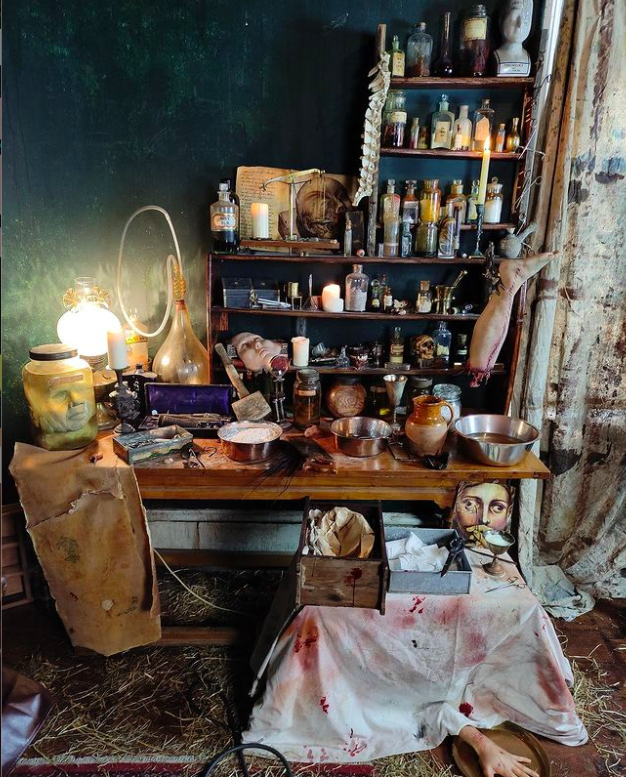
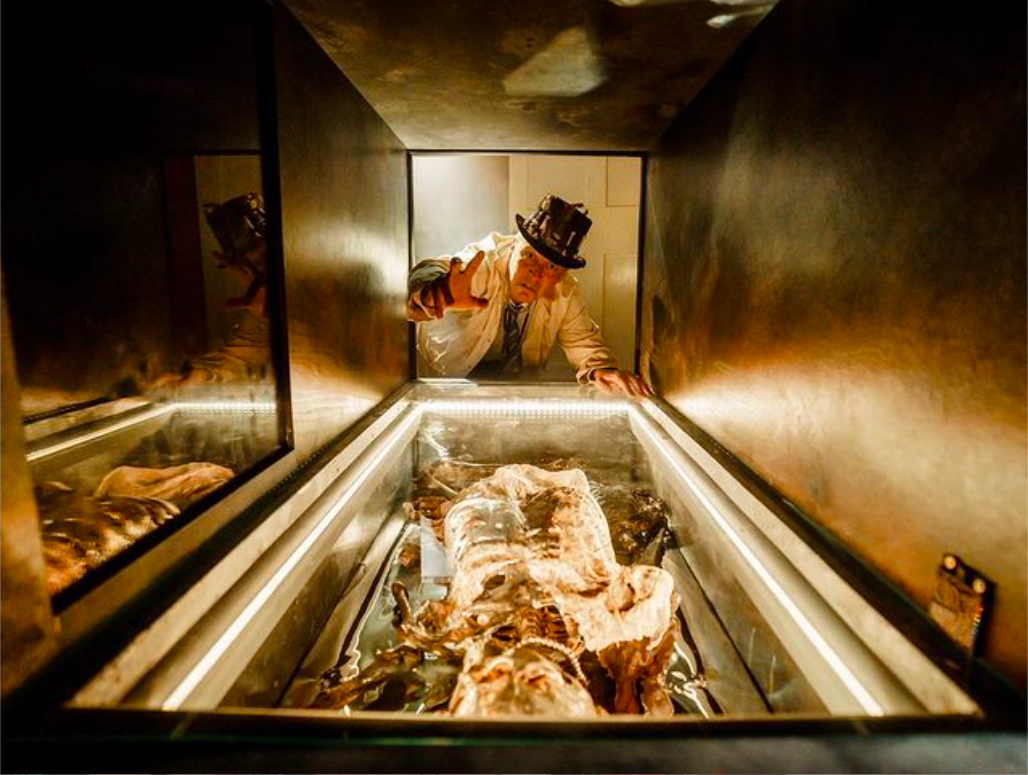
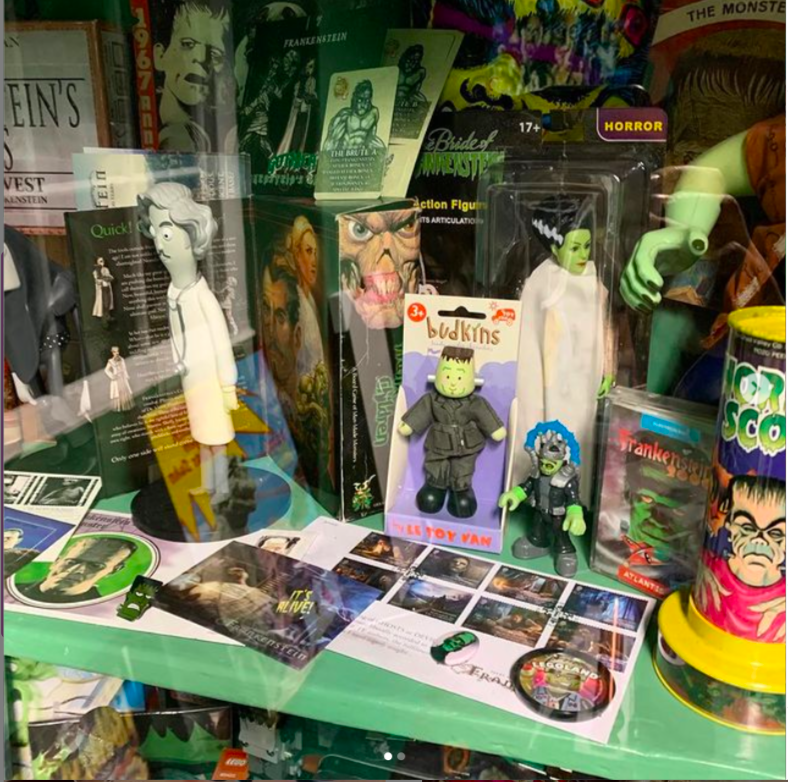
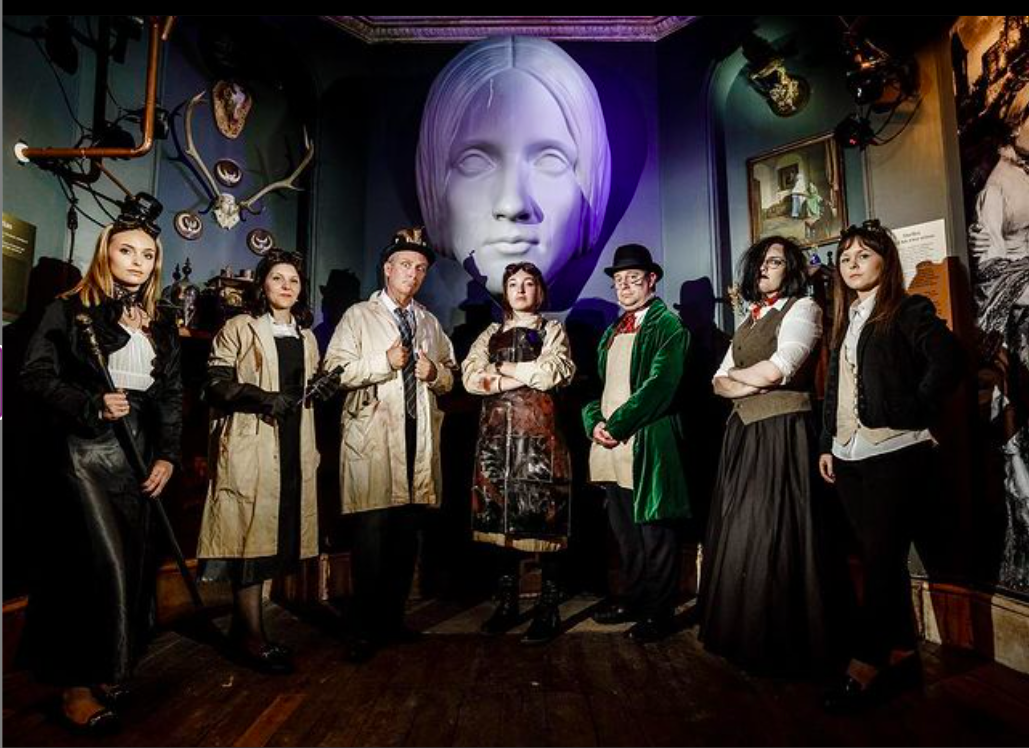
Visit the House of Frankenstein on Instagram where the weekly #FrankensteinFollowerFriday should appeal to monster movie buffs of all ages.
Related Content:
Ayun Halliday is an author, illustrator, theater maker and Chief Primatologist of the East Village Inky zine. Follow her @AyunHalliday.
Read More...Jocelyn Bell Burnell Changed Astronomy Forever; Her Ph.D. Advisor Won the Nobel Prize for It
A few years back, we highlighted a series of articles called The Matilda Effect — named for the feminist Matilda Joslyn Gage, whose 1893 essay “Woman as an Inventor” inspired historians like Cornell University’s Margaret Rossiter to recover the lost histories of women in science. Those histories are important not only for our understanding of women’s contributions to scientific advancement, but also because they tell us something important about ourselves, whoever we are, as filmmaker Ben Proudfoot suggests in his “Almost Famous” series of short New York Times documentaries.
Proudfoot casts a wide net in the telling, gathering stories of an unknown woman N.B.A. draftee, a would-be first Black astronaut who never got to fly, a man who could have been the “next Colonel Sanders,” and a former member of the Black Eyed Peas who quit before the band hit it big. Not all stories of loss in “Almost Famous” are equally tragic. Jocelyn Bell Burnell’s story, which she herself tells above, contains more than enough struggle, triumph, and crushing disappointment for a compelling tale.
An astronomer, Bell Burnell was instrumental in the discovery of pulsars — a discovery that changed the field forever. While her Ph.D. advisor Antony Hewish would be awarded the Nobel Prize for the discovery in 1974, Bell Burnell’s involvement was virtually ignored, or treated as a novelty. “When the press found out I was a woman,” she said in 2015, “we were bombarded with inquiries. My male supervisor was asked the astrophysical questions while I was the human interest. Photographers asked me to unbutton my blouse lower, whilst journalists wanted to know my vital statistics and whether I was taller than Princess Margaret.”
In the film, Burnell describes a lifelong struggle against a male-dominated establishment that marginalized her. She also tells a story of supportive Quaker parents who nurtured her will to follow her intellectual passions despite the obstacles. Growing up in Ireland, she says, “I knew I wanted to be an astronomer. But at that stage, there weren’t any women role models that I knew of.” She comments, with understandable anger, how many people congratulated her on her marriage and said “nothing about making a major astrophysical discovery.”
Many of us have stories to tell about being denied achievements or opportunities through circumstances not of our own making. We often hold those stories close, feeling a sense of failure and frustration, measuring ourselves against those who “made it” and believing we have come up short. We are not alone. There are many who made the effort, and a few who got there first but didn’t get the prize for one unjust reason or another. The lack of official recognition doesn’t invalidate their stories, or ours. Hearing those stories can inspire us to keep doing what we love and to keep pushing through the opposition. See more short “Almost Famous” documentaries in The New York Times series here.
Related Content:
How the Female Scientist Who Discovered the Greenhouse Gas Effect Was Forgotten by History
Josh Jones is a writer and musician based in Durham, NC. Follow him at @jdmagness
Read More...Footage of Cities Around the World in the 1890s: London, Tokyo, New York, Venice, Moscow & More
It is called the Belle Époque, a phrase which brings to mind stylish graphic advertising posters, the baroque Art Nouveau style of Alphonse Mucha, the Beaux Arts architectural monuments of Paris, Chicago, and Newport. These images seem static, backward-looking. Despite their popularity on the poster market, they cannot capture (how could they?) the full expression of what cultural historians also call the fin de siècle. The term is French for “end of the century,” but it describes a period of radical change in global culture in ways that will be with us for another hundred years or more..
In other words, there was a lot happening in the 1890s. As one description of the period puts it, “change became the nature of things, and people believed that further improvement was not only possible but inevitable.” So much of this change manifested in the arts. In France, for example, Impressionism began receiving its due in art world circles, leading to two Impressionist works on display at the 1900 World’s Fair, which also saw the opening of the Eiffel Tower. In 1895, Paul Verlaine published Arthur Rimbaud’s complete works, posthumously, and Symbolist poetry broke Victorian literary traditions irrevocably.
In English, popular genre fiction exploded, as the Gothic novel reached its apotheosis in Bram Stoker’s Dracula and the rise of detective fiction began with Arthur Conan Doyle’s Sherlock Holmes stories. These works paralleled a rising interest in the occult and the early stirrings of New Age spirituality. Meanwhile, Russian Modernism took shape in the radical work of Vladimir Mayakovsky; the Argentine Tango began to express its “worldview of conflicting national dislocations”; Meiji era Japan began rapidly industrializing and importing “jazz, cinema… automobiles, airplanes, and avant-gardes, from futurism to surrealism,” writes Christopher Bush, even as the West devoured all things Japanese; African art began to transform the work of painters like Picasso.…
The revolutions of fin de siècle Vienna were so world-changing as to warrant a major study of the period titled Fin-De-Siècle Vienna. Even in the still quite-provincial U.S., where robber barons built Beaux Arts palaces, modernist revolutions gestated in the Arts & Crafts movement. The world was changing too quickly for some, not quickly enough for others. For millions more, life went on more or less as it had a half-century earlier. It would be decades before many people around the world experienced either the material improvements or the radical cultural dislocations of the era.
You can see the faces, smiling, scowling, going about their business, of a few thousand city-dwellers around the world from the period in a montage of film footage above. Most of the passersby captured on film could not have known they lived in a time of unprecedented change — the all-important fin de siècle of cultural history. How could they? But they did live in a time of unprecedented anxiety about change, a time in which many keenly felt “the discrepancy between material advance and spiritual dejection,” notes Harvard University Press. “For most people the period was far from elegant.”
Only time will tell what critical historians of the future make of our era. But even as we experience incredible levels of anxiety about change, perhaps few of us are truly aware of just how radical the changes of our time will turn out to be a century or so from now.
Related Content:
The Oldest Known Footage of London (1890–1920) Features the City’s Great Landmarks
Josh Jones is a writer and musician based in Durham, NC. Follow him at @jdmagness
Read More...Is the Viral “Red Dress” Music Video a Sociological Experiment? Performance Art? Or Something Else?
Before it set itself on fire, HBO’s Game of Thrones resonated deeply with contemporary morality, becoming the most meme-worthy of shows, for good or ill, online. Few scenes in the show’s run — perhaps not even the Red Wedding or the nauseating finale — elicited as much gut-level reaction as Cersei Lannister’s naked walk of shame in the Season 5 finale, a scene all the more resonant as it happened to be based on real events.
In 1483, one of King Edward IV’s many mistresses, Jane Shore, was marched through London’s streets by his brother Richard III, “while crowds of people watched, yelling and shaming her. She wasn’t totally naked,” notes Mental Floss, “but by the standards of the day, she might as well have been,” wearing nothing but a kirtle, a “thin shift of linen meant to be worn only as an undergarment.”
What are the standards of our day? And what is the punishment for violating them? Sarah Brand seemed to be asking these questions when she posted “Red Dress,” a music video showcasing her less than stellar singing talents inside Oxford’s North Gate Church. In less than a month, the video has garnered well over half a million views, “impressive for a musician with hardly any social media footprint or fan base,” Kate Fowler writes at Newsweek.
“It takes only a few seconds,” Fowler generously remarks, “to realize that Brand may not have the voice of an angel.” Or, as one clever commenter put it, “She is actually hitting all the notes… only of other songs. And at random.” Is she ludicrously un-self-aware, an heiress with delusions of grandeur, a sad casualty of celebrity culture, forcing herself into a role that doesn’t fit? Or does she know exactly what she’s doing…
The judgments of medieval mobs have nothing on the internet, Brand suggests. “Red Dress” presents what she calls “a cinematic, holistic portrayal of judgment,” one that includes internet shaming in its calculations. Given the amount of online rancor and ridicule her video provoked, it “did what it set out to do,” she tells the BBC. And given that Brand is currently completing a master’s degree in sociology at Oxford University, many wonder if the project is a sociological experiment for credit. She isn’t saying.
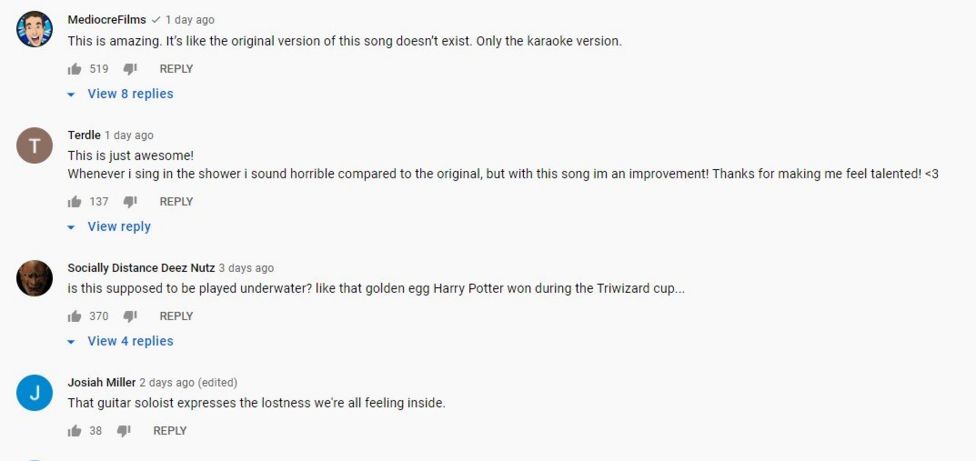
Jane Shore’s walk ended with years locked in prison. Brand offered herself up for the scorn and hatred of the mobs. No one is pointing a pike at her back. She paid for the privilege of having people laugh at her, and she’s especially enjoying “some very, very witty comments” (like those above). She’s also very much aware that she is “no professional singer.”
The style in which I sing the song was important because it reflected the story. The vocals don’t seem to quite fit, they seem out of place and they make people uncomfortable… and the video is this outsider doing things differently and causing discomfort and eliciting all this judgement.
All of this is voluntary performance art, in a sense, though Brand has shown previous aspirations on social media to become a singer, and perhaps faced similar ridicule involuntarily. “Part of what this project deals with,” she says, is judgment “overall as a central theme.” She credits herself as the director, producer, choreographer, and editor and made every creative decision, to the bemusement of the actors, crew, and studio musicians. Yet choosing to endure the gauntlet does not make the gauntlet less real, she suggests.
The shame rained down on Shore was part misogyny, part pent-up rage over injustice directed at a hated better. When anyone can pretend (or pretend to pretend) to be a celebrity with a few hundred bucks for cinematography and audio production, the boundaries between our “betters” and ourselves get fuzzy. When young women are expected to become brands, to live up to celebrity levels of online polish for social recognition, self-expression, or employment, the lines between choice and compulsion blur. With whom do we identify in scenes of public shaming?
Brand is coy in her summation. “Judgmental behavior does hurt the world,” she says, “and that is what I’m trying to bring to light with this project.” Judge for yourself in the video above and the … interesting… lyrics to “Red Dress” below.
Came to church to praise all love
Sitting, coming for someone else
It didn’t stew well for me
But I said it was a lover’s deedDidn’t trust my own feels
Let someone else behind my wheel
Said it was love driving me
But the only one who should steer is meCuz what they saw
They see me in a red dress
Hopping on the devil fest
Thinking of lust
As they judge in disgust
What are you doing here?They see me in a red dress
Hopping on the devil fest
Thinking of lust
As I judge in disgust
What am I doing here?Lettin’ someone else steer
I saw a love, precious and fine
Thought I should do anything for time
Time to change the hearts and minds
Of people not like me in break or strideShouldn’t be me, trying to change
Thought I’d be something if I remained
It just ain’t me singing of sins
Watching exclusion getting its winsCuz what they saw
They see me in a red dress
Hopping on the devil fest
Thinking of lust
As they judge in disgust
What are you doing here?They see me in a red dress
Hopping on the devil fest
Thinking of lust
As I judge in disgust
What am I doing here?Lettin’ someone else steer
Came to church
To praise love
Coming for
Someone elseBut all the eyes
Judging in disguise
They don’t see me
Just the liesThey see me in a red dress
No different from the rest
Starting to trust
As they join in a rush
What are we doing here?They see me in a red dress
No different from the rest
Starting to trust
As I lose my disgust
What am I doing here?Striking the fear
They see me in a red dress
Related Content:
Hear the Experimental Music of the Dada Movement: Avant-Garde Sounds from a Century Ago
Brian Eno Explains the Loss of Humanity in Modern Music
Josh Jones is a writer and musician based in Durham, NC. Follow him at @jdmagness
Read More...Pretty Much Pop: A Culture Podcast — Season One Wrap: What Have We Learned? (#102)

After 101 episodes and a bit over two years, OpenCulture’s first podcast offering is moving into a new phase. Here your hosts Mark Linsenmayer, Erica Spyres, and Brian hirt reflect on what we’ve learned and set a course for the future.
Our overarching concern with this podcast has been how and why we consume. We may not have learned a great deal about this issue in a general sense, but we’ve certainly been shown the appeal of many forms that we might not have considered before, and we’ve theorized about why people like drama or horror, or what makes for compelling sci-fi or gaming, etc.
We’ve stretched over these episodes into some unexpected areas for a pop culture podcast, like the philosophy of photography and why people obsess over conspiracy theories. The current discussion takes this on through a re-consideration of what pop culture is. Of course, the title of the podcast has “pretty much” in it, which allows a certain amount of leeway, but the source of that ambiguity is not just that I want the freedom to bring in any topic that interests me, but because of two points covered in this episode:
- Functionally, individuals entertain themselves with a variety of things; they are our cultural food, and can include many obsessions that have nothing to do with manufactured media at all. If such fascinations are also used by multiple people to bond over, then that’s culture, and insofar as bonding over that object is common, then it’s pop culture.
- There’s a continuum between creation and spectating. Creators are first of all consumers and create largely through imitating and tweaking past works. Though this podcast focuses largely on the consumer side of the equation, some of audience appreciation is a matter of respect for the craft, which increases through understanding and (at least vicarious) participation in the activity. Though it’s not always the case that we get enjoyment through sympathy with the artistic choices a creator makes (sometimes we just marvel uncomprehendingly), this is a significant dynamic in fandom. Viewers who liked Game of Thrones had many ideas about how it should have ended even if they had no opportunity or even talent to really provide an alternative.
It all comes down to the dimensions of mimesis, which means reflection. We enjoy storytelling largely because it reflects us, either how we are, how we might like to be, or how we fear we could be. We get some of our ideas about who we are from these media reflections. Marketers guess at who they think we are (again, in part based on media) and create products to market at us. Artists create works reflected from other works which attempt to reflect us (or distort us based on knowledge of a reflection). Who we are as a culture may be very much storytelling all the way down. So political myths are an essential part of this, as are sexual mores, ideas about what leisure activities (and jobs, for that matter) are respectable, manners taken more generally, how we deal with our legacies of racism and sexism, what we find funny and how that changes over time, and much much more.
Thanks, all, for listening. We’ll be back in a few weeks.
This episode includes bonus discussion you can access by supporting the podcast at patreon.com/prettymuchpop.
This podcast is part of the Partially Examined Life podcast network.
Pretty Much Pop: A Culture Podcast is the first podcast curated by Open Culture. Browse all Pretty Much Pop posts.
Read More...How West Magazine Created a Southern-California Pop-Culture Aesthetic with the Help of Milton Glaser, Gahan Wilson, and Others (1967–1972)
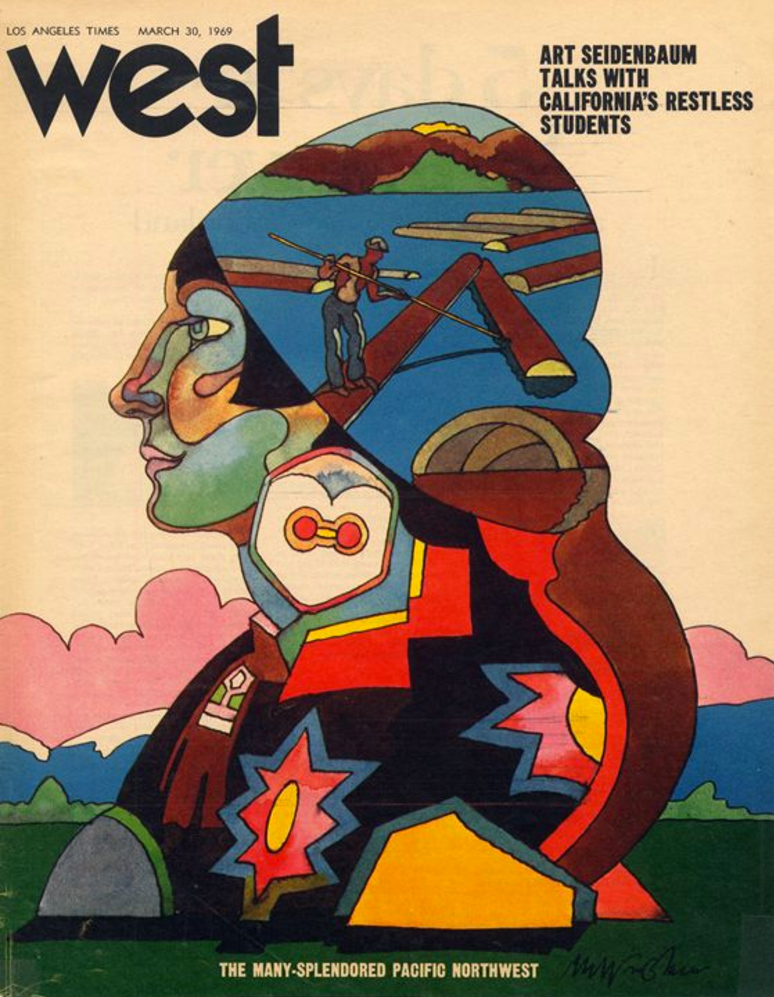
In the late 1960s, a counterculture-minded media professional could surely have imagined more appealing places to work than the Los Angeles Times. Widely derided as the official organ of the Southern California Babbitt, the paper also put out a bland Sunday supplement called West magazine. But West had the potential to evolve into something more vital — or so seemed to think its editor, Jim Bellows. The creator of “the original New York magazine in the early 1960s,” writes Design Observer’s Steven Heller, Bellows convinced a young adman named Mike Salisbury, “who worked for Carson Roberts Advertising in L.A. (where Ed Ruscha and Terry Gilliam worked), to accept the job as art director.”
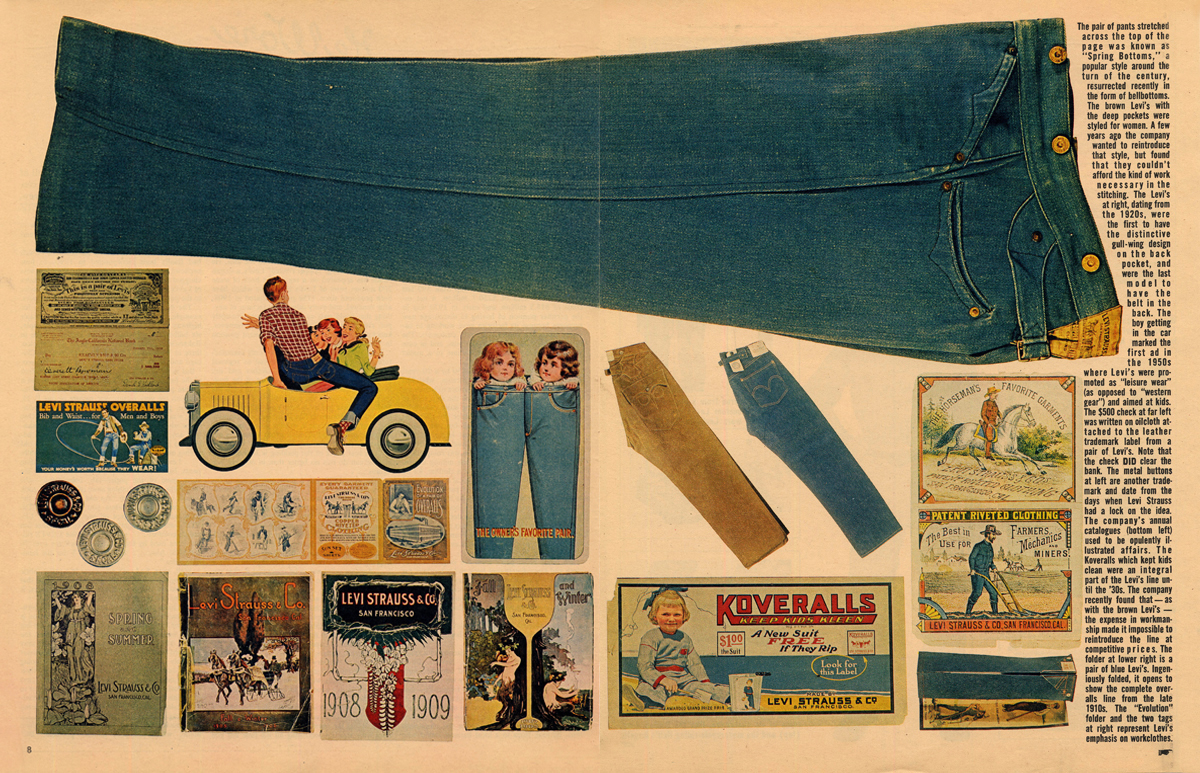
Salisbury injected West “with such an abundance of pop culture visual richness that it was more like a miniature museum than weekly gazette.” Its weekly issues “covered a wide range of themes — mostly reflecting Salisbury’s insatiable curiosities — from a feature on basketball that illustrated the tremendous size of center forwards by showing a life-size photograph of Wilt Chamberlin’s Converse sneaker, to a pictorial history of movie star pinups with a bevy of gorgeous silhouettes fanning on the page, to an array of souped-up VW Beetles in all shapes and sizes.”
On any given Sunday, subscribers might find themselves treated to “the history of Mickey Mouse, Coca-Cola art (the first time it was published as ‘art’), the visual history of Levis, Hollywood garden apartments, Raymond Chandler locations, and Kustom Kars.”
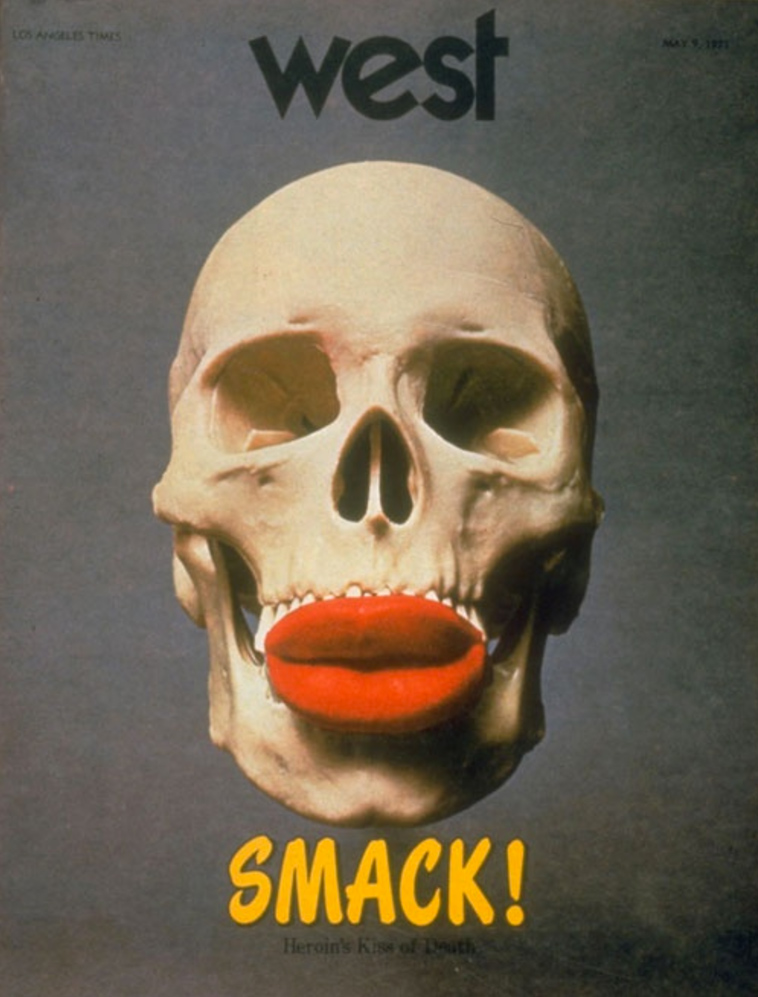
“I was the writer on the Coca-Cola ‘art’ piece as well as the first ‘programmatic’ architecture article to see print,” says a commenter under the Design Observer retrospective named Larry Dietz. He also claims to have written the feature on Raymond Chandler’s Los Angeles; much later, he adds, Chinatown screenwriter “Robert Towne said that he was inspired to learn about L.A. history from that piece, but that the writing was crappy.” But then, the main impact of Salisbury’s West was never meant to be textual. Heller quotes Salisbury as saying that “design was not my sole objective: cinema-graphic information is a better definition.” Of all the covers he designed, he remembers the one just above, promoting an exposé on heroin, as having been the most controversial: “Don’t give me too much reality over Sunday breakfast,” he heard readers grumbling.
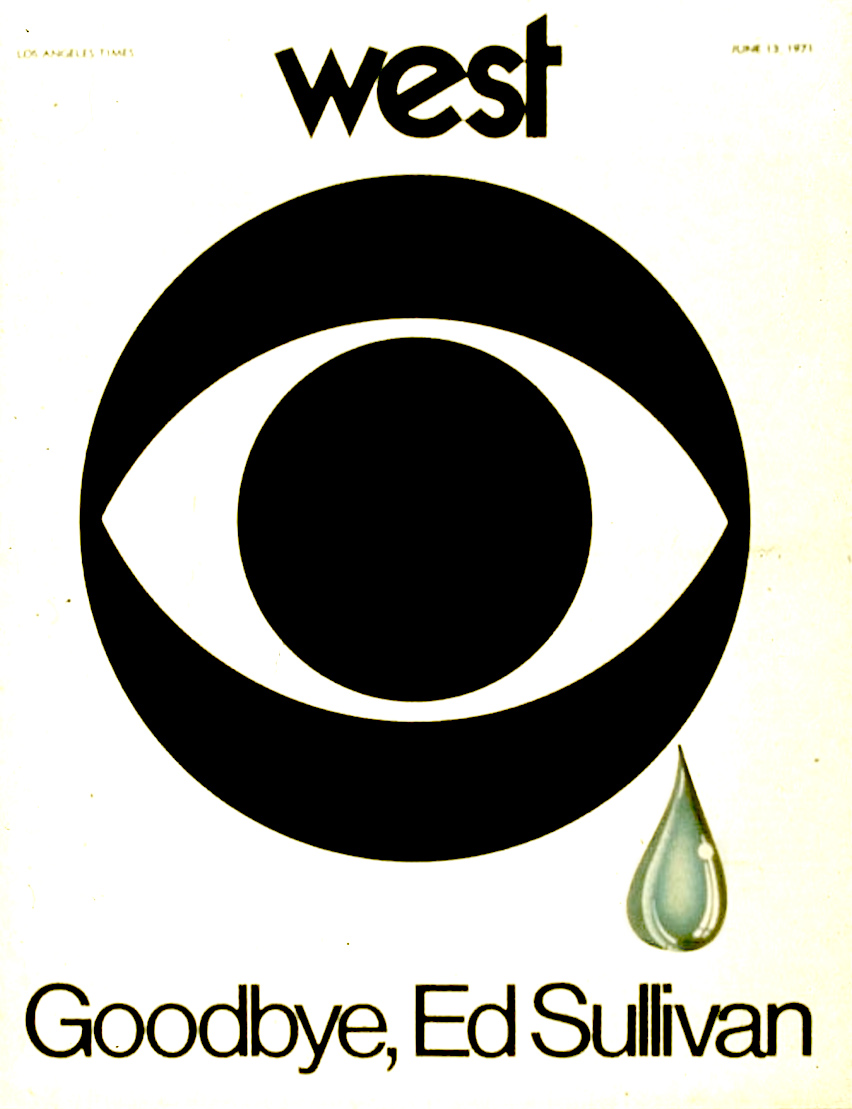
Other memorable West covers include the magazine’s tribute to the just-canceled Ed Sullivan show in 1971, as well as contributions by artists and designers like Victor Moscoso, Gahan Wilson, John Van Hamersveld, and Milton Glaser, all figures who did a great deal to craft the American zeitgeist of the 1960s and 70s. The magazine as a whole consolidated the Southern Californian pop-cultural aesthetic of its period, as distinct from what Salisbury calls the “quasi-Victorian” look and feel of San Francisco to the north and the “Rococo or Baroque” New York to the east. Los Angeles, to his mind, was “streamline,” emblematized by the culture and industry of motorcycle customization and its “belief in Futurism.”
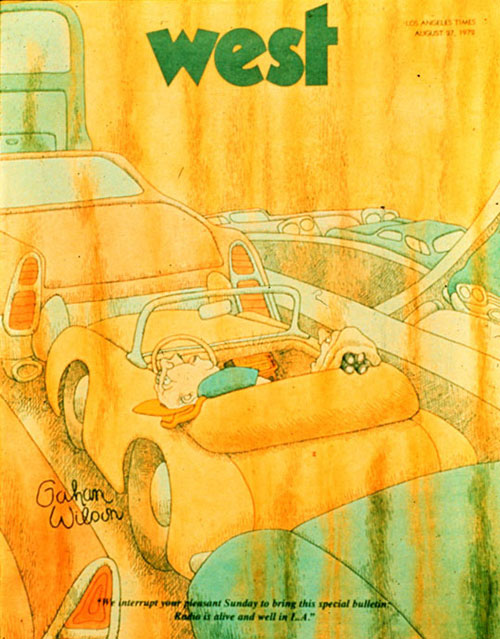
West was a product of the Los Angeles Times under Otis Chandler, publisher from 1960 to 1980, who dedicated his career to expanding the scope and ambition of the newspaper his great-grandfather had once run. His labors paid off in retrospect, especially from readers as astute as Joan Didion, who praised Chandler’s Times to the skies. But by 1972, West seemed to have become too much of an extravagance even for him. After the magazine’s cancellation, Salisbury moved on to Rolling Stone, then in the process of converting from a newspaper to a magazine format. No small part of that magazine’s pop-cultural power in the 70s must have owed to his art direction.
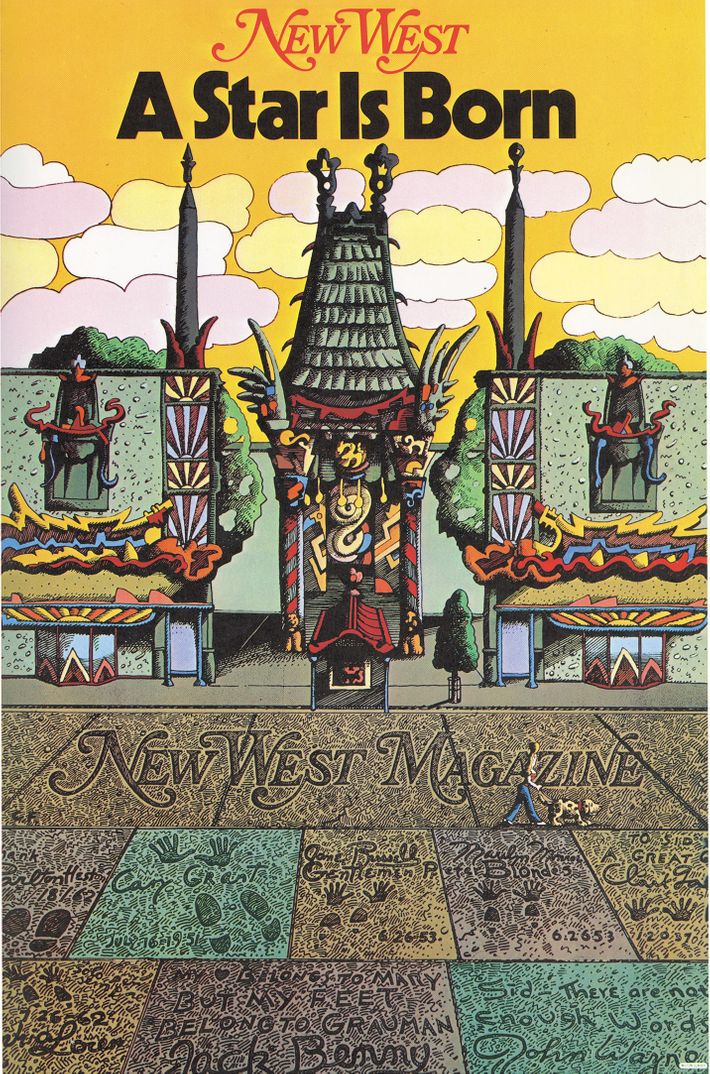
Later in the decade, both Salisbury and Glaser would bring their talents to the just-launched New West magazine. It had no direct connection with West or the Los Angeles Times, but was conceived as the sister publication of New York Magazine, which itself had been re-invented by Glaser and publisher Clay Felker in the mid-1960s. Its debut cover, just above, featured Glaser’s artwork; three years later, in 1979, Salisbury designed a cover on California’s water crisis that the American Institute of Graphic Arts’ Steven Brower calls “prescient.” At that same time, he notes, Salisbury “worked with Francis Ford Coppola on the set design for Apocalypse Now; he designed Michael Jackson’s breakthrough album, Off the Wall,” and he even collaborated with George Harrison on his eponymous album.” But when “veteran magazine art directors” get together and “reminisce about the glory years,” writes Heller, it’s West they inevitably talk about.
Related Content:
Milton Glaser’s Stylish Album Covers for The Band, Nina Simone, John Cage & Many More
Based in Seoul, Colin Marshall writes and broadcasts on cities, language, and culture. His projects include the Substack newsletter Books on Cities, the book The Stateless City: a Walk through 21st-Century Los Angeles and the video series The City in Cinema. Follow him on Twitter at @colinmarshall or on Facebook.
Read More...Support Us
We're hoping to rely on loyal readers, rather than erratic ads. Please click the Donate button and support Open Culture. You can use Paypal, Venmo, Patreon, even Crypto! We thank you!

About Us

Open Culture scours the web for the best educational media. We find the free courses and audio books you need, the language lessons & educational videos you want, and plenty of enlightenment in between.
Advertise With Us
FREE UPDATES!
GET OUR DAILY EMAIL
Get the best cultural and educational resources on the web curated for you in a daily email. We never spam. Unsubscribe at any time.
FOLLOW ON SOCIAL MEDIA
Open Culture editor Dan Colman scours the web for the best educational media. He finds the free courses and audio books you need, the language lessons & movies you want, and plenty of enlightenment in between.
Advertise With Us


