The Sound of Subways Around the World: A Global Collection of Subway Door Closing Announcements, Beeps & Chimes
The next L train is now arriving on the Manhattan bound track. Please stand away from the platform edge.
Thus begins Brooklyn saxophone-percussion trio Moon Hooch’s “Number 9.”
Anyone who’s taken the train into the city from Bushwick or Williamsburg two or three times, you should be able to chant along with no trouble.
“Mind the gap!” is a sentimental favorite of both native Londoners and first time visitors navigating The Tube with freshly purchased Oyster Cards.
Residents of Montreal are justly proud that their Metro’s closing doors signal is a near twin of Aaron Copland’s “Fanfare for the Common Man.”
Civil engineer Ted Green has been documenting the mass transit sounds that cue passengers that the subway doors are about to close since 2004, when he logged 26 seconds on the Piccadilly Line in London’s Russell Square Station:
In 2003 I used the Russell Square station daily for a week and it’s the first announcement that caught my attention… Back then the Piccadilly Line did not have on-train station and door closing announcements, it had the beeps, but the stations in central London had automatic announcements from platform speakers aimed at the open train door. Once the Piccadilly Line received on-train announcements a few years later, this announcement was phased out.
Over the course of a decade, the project has expanded to encompass announcements on suburban rail, railways, trams, and light rail.
His travels have taken him to Asia, Australia, Europe, and North America, where curiosity compels him to document what happens during “dwell time,” the brief period when a train is disgorging some riders and taking on others.
Whether the canned recording is verbal or non-verbal, the intent is to keep things moving smoothly, and prevent injuries, though passengers can become blasé, attempting to force their way on or off by thrusting a limb between closing doors at the absolute last minute.
Green’s incredibly popular video compilations aren’t nearly so harrowing.
As he told The New York Times’ Sophie Haigney and Denise Lu:
I think the appeal is the simplicity. You wonder, how can there be so many different variations of beeps? And then you listen, and they’re all so different.
The pandemic only increased his audience, as locked down commuters found themselves longing for the soundtrack of normal life.
It’s the same impulse that led software developer Evan Lewis to make an app of New York City subway sounds.
For those who want to bone up on their lines, information designer Ilya Birman, author of Designing Transit Maps, has scripted lists of London Underground and New York City subway announcements.
And Brooklyn-based Metropolitan Transit Authority worker Fred Argoff’s zine Watch the Closing Doors ushered civilians behind the scenes, sometimes exploring other cities’ subway systems or, in the case of Cincinnati, lack thereof.
Readers, do you have a fondness for a particular underground sound? Tell us what and why in the comments.
Related Content:
Designer Massimo Vignelli Revisits and Defends His Iconic 1972 New York City Subway Map
Ayun Halliday is an author, illustrator, theater maker and Chief Primatologist of the East Village Inky zine. Follow her @AyunHalliday
Read More...Carl Sagan Answers the Ultimate Question: Is There a God? (1994)
Some public intellectuals associated with science court disagreement with religious believers; others cultivate suites of rhetorical techniques expressly in order to avoid it. While Carl Sagan didn’t shrink from, say, debating a creationist on talk radio, he always engaged with characteristic aplomb. But dealing with belligerent callers-in is easier, in a way, than responding to an earnest, straightforwardly expressed curiosity about one’s own religious beliefs. In the Q&A clip above, taken from his 1994 “lost lecture,” Sagan receives just such a question: “What is your personal religion? Is there any type of God to you? Like, is there a purpose, given that we’re just sitting on this speck in the middle of this sea of stars?”
“Now, I don’t want to duck any questions,” Sagan replies, “and I’m not going to duck this one.” Nevertheless, he requests a trifling clarification: “What do you mean when you use the word God?” Pressed by none other than Carl Sagan to define God, few of us would presumably hold up well.
Here the questioner changes his angle, drawing on Sagan’s own definition in Pale Blue Dot of the “Great Demotions,” those “down-lifting experiences, demonstrations of our apparent insignificance, wounds that science has, in its search for Galileo’s facts, delivered to human pride.” And so, “given all these demotions,” the man asks, “why don’t we just blow ourselves up?”
“If we do blow ourselves up,” Sagan asks, “does that disprove the existence of God?” This is an intriguing reversal, but Sagan doesn’t simply reply to questions with questions. Scientific knowledge increasingly leaves us “on our own,” he says, which is a state “much more responsible than hoping someone will save us from ourselves.” What if we’re wrong, and a deity does indeed step in to save us? “Okay, that’s all right, I’m for that; we, you know, hedged our bets. It Pascal’s bargain run backwards.” The problem lies with God itself, “a word so ambiguous, that means so many different things,” and one used “to seem to agree with someone else with whom you do not agree.” Despite its importance, not least for “social lubrication,” no term can be useful to truth that encompasses so many different personal conceptions — billions and billions of them, one might say.
Related Content:
Carl Sagan, Stephen Hawking & Arthur C. Clarke Discuss God, the Universe, and Everything Else
Carl Sagan Explains Evolution in an Eight-Minute Animation
Ted Turner Asks Carl Sagan “Are You a Socialist?;” Sagan Responds Thoughtfully (1989)
Based in Seoul, Colin Marshall writes and broadcasts on cities, language, and culture. His projects include the Substack newsletter Books on Cities, the book The Stateless City: a Walk through 21st-Century Los Angeles and the video series The City in Cinema. Follow him on Twitter at @colinmarshall or on Facebook.
Read More...Watch an Exquisite 19th Century Coffee Maker in Action
Coffee snobbery may seem like a recent phenomenon, but the quest for the perfectly brewed cup has been going on for a very long time.
Behold the Continental Balancing Siphon, above — a completely automatic, 19th-century table top vacuum brewer.
There’s an unmistakable element of coffee making as theater here… but also, a fascinating demonstration of physical principles in action.
Vintage vacuum pot collector Brian Harris breaks down how the balancing siphon works:
Two vessels are arranged side-by-side, with a siphon tube connecting the two.
Coffee is placed in one side (usually glass), and water in the other (usually ceramic).
A spirit lamp heats the water, forcing it through the tube and into the other vessel, where it mixes with the coffee.
As the water is transferred from one vessel to the other, a balancing system based on a counterweight or spring mechanism is activated by the change in weight. This in turn triggers the extinguishing of the lamp. A partial vacuum is formed, which siphons the brewed coffee through a filter and back into the first vessel, from which is dispensed by means of a spigot.
(Still curious? We direct you to Harris’ website for a lengthier, more eggheaded explanation, complete with equations, graphs, and calculations for saturated vapor pressure and the approximate temperature at which downward flow begins.)
The balancing siphon was to 1850’s Paris and Vienna what Blue Bottle’s three-foot tall Japanese slow-drip iced coffee-making devices are to early 21st-century Brooklyn and Oakland.
Does the flavor of coffee brewed in a balance siphon merit the time and, if purchased in a cafe, expense?
Yes, according to Maria Tindemans, the CEO of Royal Paris, whose 24-carat gold and Bacarrat glass balancing siphon retails for between $17,500 and $24,000:
The coffee from a syphon can best be described as “crystal clear,” with great purity of flavor and aroma and no bitterness added by the brewing process.
More affordable balancing siphons can be found online, though be forewarned, all siphons are a bitch to clean, according to Reddit.
If you do invest, be sure to up the coffee snobbery by telling your captive audience that you’ve named your new device “Gabet,” in honor of Parisian Louis Gabet, whose 1844 patent for a counterweight mechanism kicked off the balancing siphon craze.


Related Content:
How to Make the World’s Smallest Cup of Coffee, from Just One Coffee Bean
The Life Cycle of a Cup of Coffee: The Journey from Coffee Bean, to Coffee Cup
Wake Up & Smell the Coffee: The New All-in-One Coffee-Maker/Alarm Clock is Finally Here!
Ayun Halliday is an author, illustrator, theater maker and Chief Primatologist of the East Village Inky zine. Follow her @AyunHalliday
Read More...Why Civilization Collapsed in 1177 BC: Watch Classicist Eric Cline’s Lecture That Has Already Garnered 7.6 Million Views
Eric Cline is a man of the Bronze Age. “If I could be reincarnated backwards,” he says in the lecture above, “I would choose to live back then. I’m sure I would not live more than about 48 hours, but it’d be a good 48 hours.” He may give himself too little credit: as he goes on to demonstrate in the hour that follows, he has as thorough an all-around knowledge of life in the Bronze Age as anyone alive in the 21st century. But of course, his prospects for survival in that era — or indeed anyone’s — depend on which part of it we’re talking about. The Bronze Age lasted a long time, from roughly 3300 to 1200 BC — at the end of which, ancient-history specialists agree, civilization collapsed.
What the specialists don’t quite agree on is how it happened. Cline makes his own case in the book 1177 BC: The Year Civilization Collapsed. The title, which seems to have been the result of the publishing industry’s invincible enthusiasm for naming books after years, may soon need an update: as Cline admits, it reflects a convention among scholars about how to label the titular event that has just been revised, and has since been revised back. And in any case, the collapse of civilization among the distinct but interconnected Egyptians, Hittites, Canaanites, Cypriots, Minoans, Mycenaeans, Assyrians, and Babylonians of the Bronze Age took not a year, he explains, but more like a century.
This complicated process has no one explanation — and more to the point, no one cause. Many flourishing cities of Bronze Age civilization were indeed destroyed by 1177 BC or soon thereafter. The “old, simple explanation” for this was that “a drought caused famine, which eventually caused the Sea Peoples to start moving and creating havoc, which caused the collapse.” Cline opts to include these factors and others, including earthquakes and rebellions, whose effects spread to afflict all parts of this early “globalized” part of the world. The result was a “systems collapse,” involving the breakdown of “central administrative organization,” the “disappearance of the traditional elite class,” the “collapse of the centralized economy,” as well as “settlement shifts and population decline.”
Systems collapses have also happened in other places and at other times. Given the enormous intensification of globalization since the Bronze Age and the continued threats issued by the natural world, could another happen here and now? Pointing to the climate change, famines and droughts, earthquakes, rebellions, acts of bellicosity, and economic troubles in evidence today, Cline adds that “the only thing missing are the Sea Peoples” — and even then suggests that ISIS and refugees from Syria could be playing a similarly disruptive role. Given that this talk has racked up more than seven and a half million views so far, it seems he makes a convincing case, though the appeal could owe as much to his jokes. Not all of us, he acknowledges, will accept the relevance of the subject: “It’s history,” as we reassure ourselves. “It never repeats itself.”
Related Content:
The History of Civilization Mapped in 13 Minutes: 5000 BC to 2014 AD
Get the History of the World in 46 Lectures: A Free Online Course from Columbia University
M.I.T. Computer Program Alarmingly Predicts in 1973 That Civilization Will End by 2040
Based in Seoul, Colin Marshall writes and broadcasts on cities, language, and culture. His projects include the Substack newsletter Books on Cities, the book The Stateless City: a Walk through 21st-Century Los Angeles and the video series The City in Cinema. Follow him on Twitter at @colinmarshall or on Facebook.
Read More...Every Christmas, Peruvians Living in the Andes Settle Their Scores at Fist-Fighting Festivals
As Chris Hedges discovered as a battle-hardened reporter, war is a force that gives us meaning. Whether we sublimate violence in entertainment, have paid professionals and state agents do it for us, or carry it out ourselves, human beings cannot seem to give up their most ancient vice; “we demonize the enemy,” Hedges wrote, “so that our opponent is no longer human,” and “we view ourselves, our people, as the embodiment of absolute goodness…. Each side reduces the other to objects — eventually in the form of corpses.” Each new generation inherits old hatreds, and so forth.…
Maybe one way to break cycles of violence is with controlled violence — using bare fists to settle scores, and walking away with only bruises, a little hurt pride, but no lasting wounds? That’s the idea behind Takanakuy, an Andean festival that takes place each year at Christmas in the province of Chumbivilcas, in the mountains of Peru. The region has a police force made up of around three officers, the nearest courthouse is “a stomach-wrecking 10-hour drive through the mountains,” notes Vice, who bring us the video above. Potentially explosive disputes naturally arise, and must be settled outside the law.
Rather than rely on state intervention, residents wait to slug it out on Takanakuy. The name of the festival come from Quechua — the region’s indigenous language — and means “to hit each other” or, more idiomatically, “when the blood is boiling.” But combatants have had upwards of twelve months to cool before they step into a ring of cheering spectators and go hand-to-hand with an opponent. Fights are also officiated by referees, who do crowd control with short rope whips and call a fight as soon as someone goes down. Takanakuy is ritualized combat, not bloodsport. Although traditionally dominated by men, women, and children also participate in fights, which usually only last a couple minutes or so.
“Some traditionalists disapprove of female participation in Takanakuy,” writes photojournalist Mike Kai Chen at The New York Times, but “an increasing number of women in Chumbivilcas are defying convention and stepping up to fight in front of their community.” Male fighters wear boots, flashy leather chaps, and elaborate, hand-sewn masks with taxidermied birds on top. Women wear elegant dresses with fine embroidery, and wrap their wrists in colorful embroidered cloth. “The ultimate aim is to begin the new year in peace. For this reason every fight… begins and ends with a hug”… or, at the very least, a handshake.
The festival also involves much dancing, eating, drinking, craft sales, and Christmas celebrations. Suemedha Sood at BBC Travel compares Takanakuy to Seinfeld’s “Festivus,” the alt-winter holiday for the airing of grievances and feats of strength. But it’s no joke. “The festival seeks to resolve conflict, strengthen community bonds and hopefully, arrive at a greater peace.” Libertarian economists Edwar Escalante and Raymond March frame Takanakuy as “a credible mechanism of law enforcement in an orderly fashion with social acceptance.” For indigenous teacher and author and participant Victor Laime Mantilla, it’s something more, part of “the fight to reclaim the rights of indigenous people.”
“In the cities,” says Mantilla, “the Chumbivilcas are still seen as a savage culture.” But they have kept the peace amongst themselves with no need for Peruvian authorities, fusing an indigenous music called Huaylia with other traditions that date back even before the Incas. Takanakuy arose as a response to systems of colonial oppression. When “justice in Chumbivilcas was solely administered by powerful people,” Mantilla says, “people from the community always lost their case. What can I do with a justice like that? I’d rather have my own justice in public.”
See the costumes of the traditional Takanakuy characters over at Vice and see Chen’s stunning photos of friendly fistfights and Takanakuy fun at The New York Times.
Related Content:
Peruvian Singer & Rapper, Renata Flores, Helps Preserve Quechua with Viral Hits on YouTube
Speaking in Whistles: The Whistled Language of Oaxaca, Mexico
Josh Jones is a writer and musician based in Durham, NC. Follow him at @jdmagness
Read More...What Ancient Greece Really Looked Like: See Reconstructions of the Temple of Hadrian, Curetes Street & the Fountain of Trajan
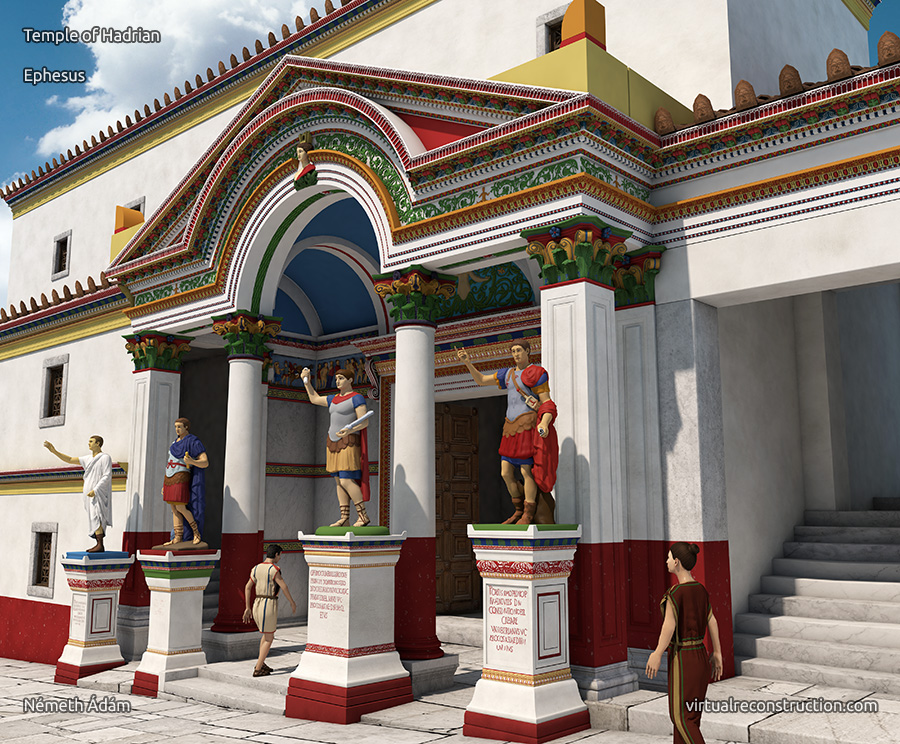
Ancient Greeks did not live among ruins. This is, of course, an obvious truth, but one we run the risk of forgetting if we watch too many historical fantasies set in their time and place as popularly imagined. That Western civilization as we know it today came to know Ancient Greece through the ravaged built environments left behind has colored its modern-day perception — or, rather drained it of color. In recent years, a big deal has been made about the finding that Ancient Greek statues weren’t originally pure white, but painted in bright hues that faded away over the centuries. What does that imply for the rest of the place?
We don’t have a time machine in which to travel back to Ancient Greece and have a look around. We do, however, have the digital reconstructions of artist Ádám Németh. “My archaeological renderings are accurate to the time period, due to extensive research on references and reviews of sources found online, in libraries and in museums, and also ongoing discussions with archaeologists,” he writes.
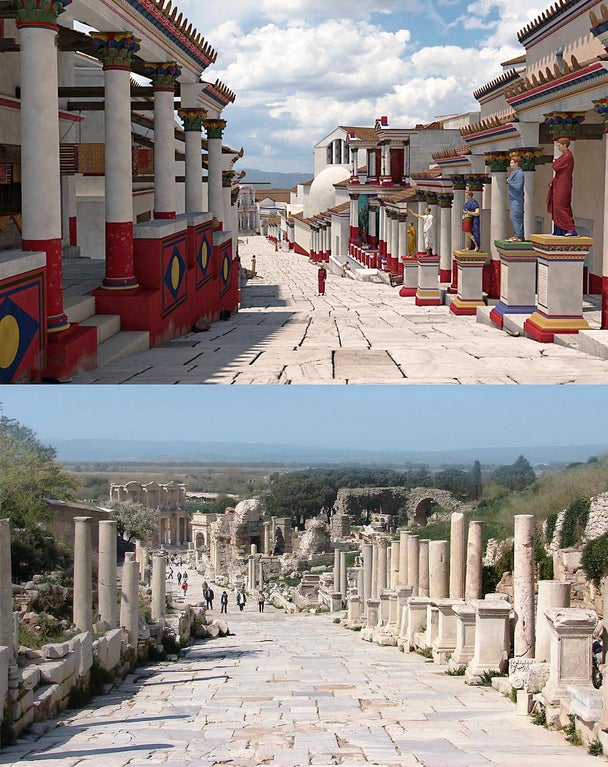
“My main goal, through reconstructions, is to make history interesting and accessible for everybody.” Even those more or less ignorant of the ancient world can take a glance at his images of an intact and colorful Temple of Hadrian, Curetes Street, and Fountain of Trajan.
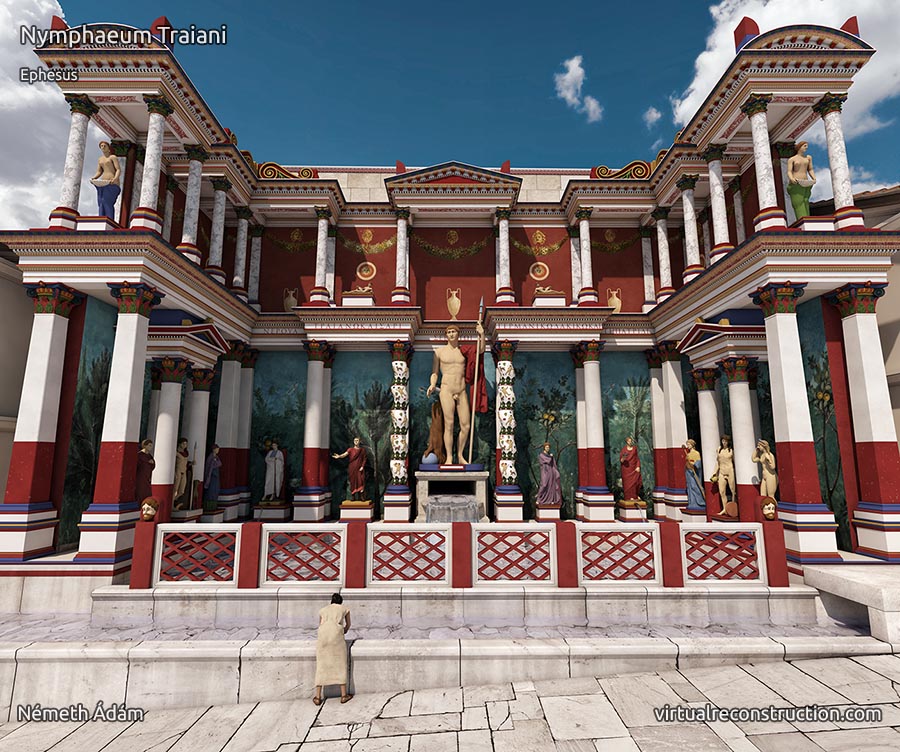
All of these sites were located in the Ancient Greek city of Ephesus, now a part of Turkey. Though it doesn’t draw quite the numbers of, say, Hagia Sophia, Ephesus stands nevertheless as a pillar of Turkish tourism. Indeed, you can go there and examine its actual pillars, none of which have come through the ages standing anything like as mightily Németh depicts them. Comparisons posted by Marina Amaral on Twitter put former glory alongside current ruin, though even the Temple of Hadrian, Curetes Street, and the Fountain of Trajan as they are today have been pieced together into a somewhat more complete state than that in which they were rediscovered. Even real antiquity, in other words, is to some degree a reconstruction. See more of Németh’s reconstructions here.
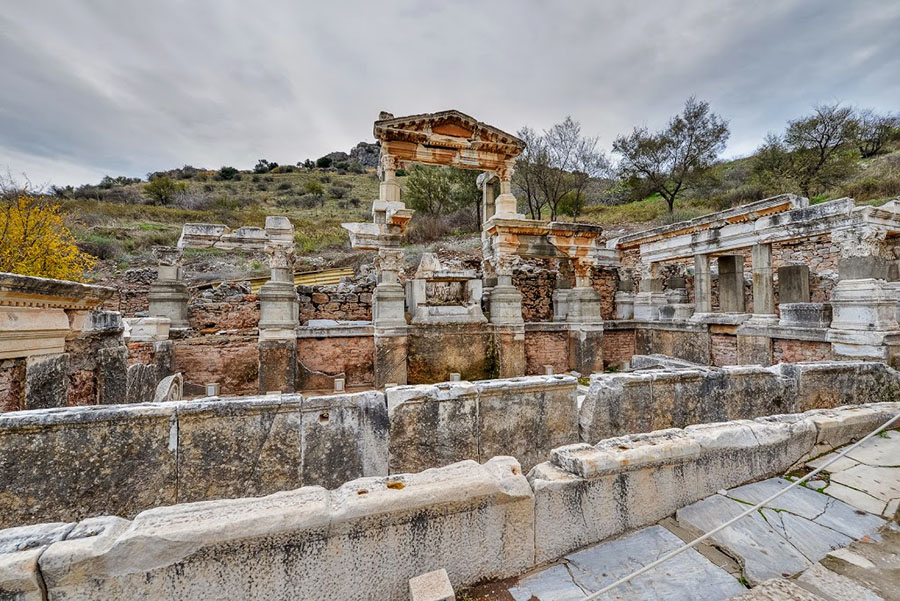
via Marina Amaral
Related Content:
How Ancient Greek Statues Really Looked: Research Reveals Their Bold, Bright Colors and Patterns
Watch Art on Ancient Greek Vases Come to Life with 21st Century Animation
What Did Ancient Greek Music Sound Like?: Listen to a Reconstruction That’s ‘100% Accurate’
Based in Seoul, Colin Marshall writes and broadcasts on cities, language, and culture. His projects include the Substack newsletter Books on Cities, the book The Stateless City: a Walk through 21st-Century Los Angeles and the video series The City in Cinema. Follow him on Twitter at @colinmarshall or on Facebook.
Read More...Kurt Vonnegut’s Recipes in Deadeye Dick: Polka-Dot Brownies, Linzer Torte & Haitian Banana Soup
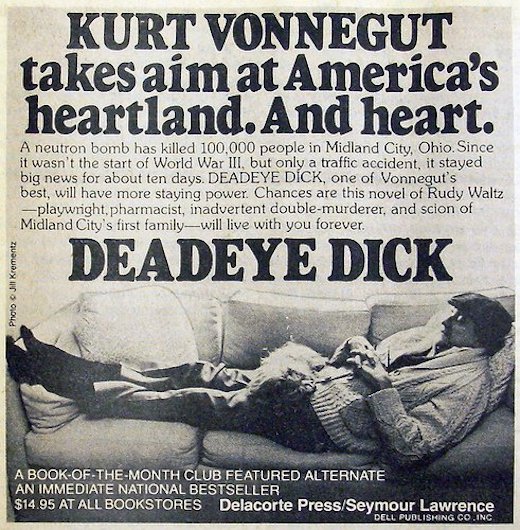
Author Kurt Vonnegut incorporated several recipes into his 1982 novel Deadeye Dick, inspired by James Beard’s American Cookery, Marcella Hazan’s The Classic Italian Cook Book, and Bea Sandler’s The African Cookbook.
He writes in the preface that these recipes are intended to provide “musical interludes for the salivary glands,” warning readers that “no one should use this novel for a cookbook. Any serious cook should have the reliable originals in his or her library anyway.”
So with that caveat in mind…
Early on, the narrator/titular character, née Rudy Waltz, shares a recipe from his family’s former cook, Mary Hoobler, who taught him “everything she knew about cooking and baking”:
MARY HOOBLER’S CORN BREAD
Mix together in a bowl half a cup of flour, one and a half cups of yellow corn-meal, a teaspoon of salt, a teaspoon of sugar, and three teaspoons of baking powder.
Add three beaten eggs, a cup of milk, a half cup of cream, and a half cup of melted butter.
Pour it into a well-buttered pan and bake it at four hundred degrees for fifteen minutes.
Cut it into squares while it is still hot. Bring the squares to the table while they are still hot, and folded in a napkin.
Barely two paragraphs later, he’s sharing her barbecue sauce. It sounds delicious, easy to prepare, and its placement gives it a strong flavor of Slaughterhouse-Five’s “so it goes” and “Poo-tee-weet?” — as ironic punctuation to Father Waltz’s full on embrace of Hitler, a seeming non sequitur that forces readers to think about what comes before:
When we all posed in the street for our picture in the paper, Father was forty-two. According to Mother, he had undergone a profound spiritual change in Germany. He had a new sense of purpose in life. It was no longer enough to be an artist. He would become a teacher and political activist. He would become a spokesman in America for the new social order which was being born in Germany, but which in time would be the salvation of the world.
This was quite a mistake.
MARY HOOBLER’S BARBECUE SAUCE
Sauté a cup of chopped onions and three chopped garlic cloves in a quarter of a pound of butter until tender.
Add a half cup of catsup, a quarter cup of brown sugar, a teaspoon of salt, two teaspoons of freshly ground pepper, a dash of Tabasco, a tablespoon of lemon juice, a teaspoon of basil, and a tablespoon of chili powder.
Bring to a boil and simmer for five minutes.
Rudy’s father is not the only character to falter.
Rudy’s mistake happens in the blink of an eye, and manages to upend a number of lives in Midland City, a stand in for Indianapolis, Vonnegut’s hometown.
His family loses their money in an ensuing lawsuit, and can no longer engage Mary Hoobler and the rest of the staff.
Young Rudy, who’s spent his childhood hanging out with the servants in Mary’s cozy kitchen, finds it “easy and natural” to cater to his parents in the manner to which they were accustomed:
As long as they lived, they never had to prepare a meal or wash a dish or make a bed or do the laundry or dust or vacuum or sweep, or shop for food. I did all that, and maintained a B average in school, as well.
What a good boy was I!
EGGS À LA RUDY WALTZ (age thirteen)
Chop, cook, and drain two cups of spinach.
Blend with two tablespoons of butter, a teaspoon of salt, and a pinch of nutmeg.
Heat and put into three oven-proof bowls or cups.
Put a poached egg on top of each one, and sprinkle with grated cheese.
Bake for five minutes at 375 degrees. Serves three: the papa bear, the mama bear, and the baby bear who cooked it—and who will clean up afterwards.
By high school, Rudy’s heavy domestic burden has him falling asleep in class and reproducing complicated desserts from recipes in the local paper. (“Father roused himself from living death sufficiently to say that the dessert took him back forty years.”)
LINZER TORTE (from the Bugle-Observer)
Mix half a cup of sugar with a cup of butter until fluffy.
Beat in two egg yolks and half a teaspoon of grated lemon rind.
Sift a cup of flour together with a quarter teaspoon of salt, a teaspoon of cinnamon, and a quarter teaspoon of cloves. Add this to the sugar-and-butter mixture.
Add one cup of unblanched almonds and one cup of toasted filberts, both chopped fine.
Roll out two-thirds of the dough until a quarter of an inch thick.
Line the bottom and sides of an eight-inch pan with dough.
Slather in a cup and a half of raspberry jam.
Roll out the rest of the dough, make it into eight thin pencil shapes about ten inches long. Twist them a little, and lay them across the top in a decorative manner. Crimp the edges.
Bake in a preheated 350-degree oven for about an hour, and then cool at room temperature.
A great favorite in Vienna, Austria, before the First World War!
Rudy eventually relocates to the Grand Hotel Oloffson in Port au Prince, Haiti, which is how he manages to survive the — SPOILER — neutron bomb that destroys Midland City.
Here is a recipe for chocolate seafoams, courtesy of one of Midland City’s fictional residents:
MRS. GINO MARTIMO’S SPUMA DI CIOCCOLATA
Break up six ounces of semisweet chocolate in a saucepan.
Melt it in a 250-degree oven.
Add two teaspoons of sugar to four egg yolks, and beat the mixture until it is pale yellow.
Then mix in the melted chocolate, a quarter cup of strong coffee, and two tablespoons of rum.
Whip two-thirds of a cup of cold, heavy whipping cream until it is stiff. Fold it into the mixture.
Whip four egg whites until they form stiff peaks, then fold them into the mixture.
Stir the mixture ever so gently, then spoon it into cups, each cup a serving.
Refrigerate for twelve hours.
Serves six.
Other recipes in Rudy’s repertoire originate with the Grand Hotel Oloffson’s most valuable employee, headwaiter and Vodou practitioner Hippolyte Paul De Mille, who “claims to be eighty and have fifty-nine descendants”:
He said that if there was any ghost we thought should haunt Midland City for the next few hundred years, he would raise it from its grave and turn it loose, to wander where it would.
We tried very hard not to believe that he could do that.
But he could, he could.
HAITIAN FRESH FISH IN COCONUT CREAM
Put two cups of grated coconut in cheesecloth over a bowl.
Pour a cup of hot milk over it, and squeeze it dry.
Repeat this with two more cups of hot milk. The stuff in the bowl is the sauce.
Mix a pound of sliced onions, a teaspoon of salt, a half teaspoon of black pepper, and a teaspoon of crushed pepper.
Sauté the mixture in butter until soft but not brown.
Add four pounds of fresh fish chunks, and cook them for about a minute on each side.
Pour the sauce over the fish, cover the pan, and simmer for ten minutes. Uncover the pan and baste the fish until it is done—and the sauce has become creamy.
Serves eight vaguely disgruntled guests at the Grand Hotel Oloffson.
HAITIAN BANANA SOUP
Stew two pounds of goat or chicken with a half cup of chopped onions, a teaspoon of salt, half a teaspoon of black pepper, and a pinch of crushed red pepper. Use two quarts of water.
Stew for an hour.
Add three peeled yams and three peeled bananas, cut into chunks.
Simmer until the meat is tender. Take out the meat. What is left is eight servings of Haitian banana soup.
Bon appétit!
The recipe that closes the novel is couched in an anecdote that’s equal parts scatology and epiphany.
As a daughter of Indianapolis who was a junior in high school the year Deadeye Dick was published, I can attest that Polka-Dot Brownies would have been a hit at the bake sales of my youth:
POLKA-DOT BROWNIES
Melt half a cup of butter and a pound of light-brown sugar in a two-quart saucepan. Stir over a low fire until just bubbly.
Cool to room temperature.
Beat in two eggs and a teaspoon of vanilla.
Stir in a cup of sifted flour, a half teaspoon of salt, a cup of chopped filberts, and a cup of semisweet chocolate in small chunks.
Spread into a well-greased nine-by-eleven baking pan.
Bake at two hundred and thirty-five degrees for about thirty-five minutes.
Cool to room temperature, and cut into squares with a well-greased knife.
Enjoy, in moderation of course.
I was wearing my best suit, which was as tight as the skin of a knackwurst. I had put on a lot of weight recently. It was the fault of my own good cooking. I had been trying out a lot of new recipes, with considerable success. — Rudy Waltz
Related Content:
Why Should We Read Kurt Vonnegut? An Animated Video Makes the Case
Watch a Sweet Film Adaptation of Kurt Vonnegut’s Story, “Long Walk to Forever”
The Recipes of Iconic Authors: Jane Austen, Sylvia Plath, Roald Dahl, the Marquis de Sade & More
Ayun Halliday is an author, illustrator, theater maker and Chief Primatologist of the East Village Inky zine. Follow her @AyunHalliday
Read More...Benedict Cumberbatch Reads Kurt Vonnegut’s Letter of Advice to People Living in the Year 2088
A few years ago we posted Kurt Vonnegut’s letter of advice to humanity, written in 1988 but addressed, a century hence, to the year 2088. Whatever objections you may have felt to reading this missive more than 70 years prematurely, you might have overcome them to find that the author of Slaughterhouse-Five and Breakfast of Champions single-mindedly importuned his fellow man of the late 21st century to protect the natural environment. He issues commandments to “reduce and stabilize your population” to “stop preparing for war and start dealing with your real problems,” and to “stop thinking science can fix anything if you give it a trillion dollars,” among other potentially drastic-sounding measures.
Commandment number seven amounts to the highly Vonnegutian “And so on. Or else.” A fan can easily imagine these words spoken in the writer’s own voice, but with Vonnegut now gone for well over a decade, would you accept them spoken in the voice of Benedict Cumberbatch instead?
First commissioned by Volkswagen for a Time magazine ad campaign, Vonnegut’s letter to 2088 was later found and republished by Letters of Note. The associated Letters Live project, which brings notable letters to the stage (and subsequently internet video), counts Cumberbatch as one of its star readers: he’s given voice to wise correspondence by the likes of Sol LeWitt, Albert Camus, and Alan Turing.
Cumberbatch even has experience with letters by Vonnegut, having previously read aloud his rebuke to a North Dakota school board that allowed the burning of Slaughterhouse-Five. Vonnegut’s work makes clear that he didn’t suffer fools gladly, and that he considered book-burning one of the infinite varieties of folly he spent his career cataloging. In light of his letter to 2088, the same went for humanity’s poor stewardship of their planet. Vonnegut may not have been a conservationist, exactly, but nor, in his view, was nature itself, a force that needs “no help from us in taking the planet apart and putting it back together some different way, not necessarily improving it from the viewpoint of living things.” This is, of course, the personifying view of a novelist, but a novelist who never forgot his sense of humor — nor his tendency to play the prophet of doom.
Related Content:
The Graphic Novel Adaptation of Kurt Vonnegut’s Slaughterhouse-Five
Based in Seoul, Colin Marshall writes and broadcasts on cities, language, and culture. His projects include the Substack newsletter Books on Cities, the book The Stateless City: a Walk through 21st-Century Los Angeles and the video series The City in Cinema. Follow him on Twitter at @colinmarshall or on Facebook.
Read More...How Pulp Fiction ’s Dance Scene Paid Artistic Tribute to the Classic Dance Scene in Fellini’s 8½
An auteur makes few compromises in bringing his distinctive visions to the screen, but he also makes no bones about borrowing from the auteurs who came before. This is especially true in the case of an auteur named Quentin Tarantino, who for nearly thirty years has repeatedly pulled off the neat trick of directing large-scale, highly individualistic movies that also draw deeply from the well of existing cinema — deeply enough to pull up both the grind-house “low” and art-house “high.” Tarantino’s first big impact on the zeitgeist came in the form of 1994’s Pulp Fiction, which put the kind of common, sensationalistic material suggested by its title into cinematic forms picked up from the likes of Jean-Luc Godard and Federico Fellini.
Few clips of Tarantino’s work could distill this inspirational polarity as well as Pulp Fiction’s twist contest at Jack Rabbit Slim’s. In a film almost wholly composed of memorable scenes, as I wrote when last we featured it here on Open Culture, this one is quite possibly the most memorable.
Tarantino has explained his intent to pay tribute to dancing as it occurs in films like Godard’s Bande à part, the namesake of Tarantino’s production company. “My favorite musical sequences have always been in Godard because they just come out of nowhere,” he once said. “It’s so infectious, so friendly. And the fact that it’s not a musical but he’s stopping the movie to have a musical sequence makes it all the more sweet.”
But as these comparison videos reveal, Godard isn’t the only midcentury European auteur to whom Pulp Fiction’s dance scene owes its effectiveness. “This scene is a direct steal from Fellini’s 8½ and there’s no real effort to hide it,” writes No Film School’s Jason Hellerman. “Aside from the location change, the moves and camera angles are almost the same.” In 8½ the dancers are Marcello Mastroianni’s besieged filmmaker Guido and his estranged wife Luisa, played by Anouk Aimée. This occurs in another of the precious few pictures in cinema history comprising memorable scenes and memorable scenes only; the others include vivid spectacles outlining the middle-aged Guido’s artistic struggle and voyages of memory back into his prelapsarian childhood.
Childhood, writes poet James Fenton, was “a time of pure inventiveness” when “everything we did was hailed as superb.” (In this sense, a young filmmaker who makes his first Hollywood hit enjoys a second childhood, albeit usually a brief one.) In Fenton’s words, Washington Post art critic Sebastian Smee finds a key to the elaborate and enrapturing but at times bewildering 8½. With growth, alas, comes “the primal erasure, when we forget all those early experiences, and it is rather as if there is some mercy in this, since if we could remember the intensity of such pleasure it might spoil us for anything else. We forget what happened exactly, but we know that there was something, something to do with music and praise and everyone talking, something to do with flying through the air, something to do with dance.”
Related Content:
Federico Fellini Introduces Himself to America in Experimental 1969 Documentary
Fellini’s Fantastic TV Commercials
Based in Seoul, Colin Marshall writes and broadcasts on cities, language, and culture. His projects include the Substack newsletter Books on Cities, the book The Stateless City: a Walk through 21st-Century Los Angeles and the video series The City in Cinema. Follow him on Twitter at @colinmarshall or on Facebook.
Read More...Take a Journey Through 933 Paintings by Salvador Dalí & Watch His Signature Surrealism Emerge
Salvador Dalí made over 1,600 paintings, but just one has come to stand for both his body of work and a major artistic current that shaped it: 1931’s The Persistence of Memory, widely known as the one with the melting clocks. By that year Dalí had reached his late twenties, still early days in what would be a fairly long life and career. But he had already produced many works of art, as evidenced by the video survey of his oeuvre above. Proceeding chronologically through 933 of his paintings in the course of an hour and a half, it doesn’t reach The Persistence of Memory until more than seventeen minutes in, and that after showing numerous works a casual appreciator wouldn’t think to associate with Dalí at all.
It seems the young Dalí didn’t set out to paint melting clocks — or flying tigers, or walking villas, or any of his other visions that have long occupied the common conception of Surrealism. And however often he was labeled an “original” after attaining worldwide fame in the 1930s and 40s, he began as nearly every artist does: with imitation.
Far from premonitions of the Surrealist sensibility with which he would be forever linked in the public consciousness, dozens and dozens of his early paintings unabashedly reflect the influence of Renaissance masters, Impressionists, Futurists, and Cubists. Of particular importance in that last group was Dalí’s countryman and idol Pablo Picasso: it was after they first met in 1926 that the changes in Dalí’s work became truly dramatic.
Viewers may be less surprised that Dalí did so much before The Persistence of Memory than that he did even more after it. Though he would never return to the relatively straightforward depictions of reality found among his work of the 1920s, the dreamscapes he realized throughout the last half-century of his life are hardly all of a piece. (This in addition to plenty of work on the side, including a tarot deck, a cookbook, and even television commercials.) To appreciate the variations he attempted in his art even after becoming popular culture’s idea of an “almost-crazy” Surrealist requires not just seeing his work in context, but spending a proper amount of time with it. Not to say that fans of The Persistence of Memory — especially fans in a suitable state of mind — haven’t spent hours at a stretch in fruitful contemplation of those melting clocks alone.
Related Content:
Walk Inside a Surrealist Salvador Dalí Painting with This 360º Virtual Reality Video
When Salvador Dalí Created a Surrealist Funhouse at New York World’s Fair (1939)
Salvador Dalí’s Tarot Cards, Cookbook & Wine Guide Re-Issued as Beautiful Art Books
When Salvador Dalí Created Christmas Cards That Were Too Avant Garde for Hallmark (1960)
Salvador Dalí Explains Why He Was a “Bad Painter” and Contributed “Nothing” to Art (1986)
Based in Seoul, Colin Marshall writes and broadcasts on cities, language, and culture. His projects include the Substack newsletter Books on Cities, the book The Stateless City: a Walk through 21st-Century Los Angeles and the video series The City in Cinema. Follow him on Twitter at @colinmarshall or on Facebook.
Read More...Support Us
We're hoping to rely on loyal readers, rather than erratic ads. Please click the Donate button and support Open Culture. You can use Paypal, Venmo, Patreon, even Crypto! We thank you!

About Us

Open Culture scours the web for the best educational media. We find the free courses and audio books you need, the language lessons & educational videos you want, and plenty of enlightenment in between.
Advertise With Us
FREE UPDATES!
GET OUR DAILY EMAIL
Get the best cultural and educational resources on the web curated for you in a daily email. We never spam. Unsubscribe at any time.
FOLLOW ON SOCIAL MEDIA
Open Culture editor Dan Colman scours the web for the best educational media. He finds the free courses and audio books you need, the language lessons & movies you want, and plenty of enlightenment in between.
Advertise With Us

