J. R. R. Tolkien Admitted to Disliking Dune “With Some Intensity” (1966)
One can easily imagine a reader enjoying both The Lord of the Rings and Dune. Both of those works of epic fantasy were published in the form of a series of long novels beginning in the mid-twentieth century; both create elaborate worlds of their own, right down to details of ecology and language; both seriously (and these days, unfashionably) concern themselves with the theme of what constitutes heroic action; both have even inspired multiple big-budget Hollywood spectacles. The reader equally dedicated to the work of J. R. R. Tolkien and Frank Herbert turns out to be a more elusive creature than we may expect, but perhaps that shouldn’t surprise us, given Tolkien’s own attitude toward Dune.
“It is impossible for an author still writing to be fair to another author working along the same lines,” Tolkien wrote in 1966 to a fan who’d sent him a copy of Herbert’s book, which had come out the year before. “In fact I dislike DUNE with some intensity, and in that unfortunate case it is much the best and fairest to another author to keep silent and refuse to comment.”
That lack of elaboration has, if anything, only stoked the curiosity of Lord of the Rings and Dune enthusiasts alike, as evidenced by this thread from a few years ago on the r/tolkienfans subreddit. Was it the materialism and Machiavellianism implicit in Dune’s worldview? The preponderance of invented names and coinages that surely wouldn’t meet the etymological standard of an Oxford linguist?
Maybe it was the aristocratic isolation — a kind of anti-fellowship — of its protagonist Paul Atreides, who comes to possess the equivalent of Tolkien’s Ring of Power. “In Dune, Paul willingly takes the (metaphorical) ring and wields it,” writes Evan Amato at The Culturist. “He leads, transforms, and conquers. The universe bends to his vision. He suffers for it, yes, and questions it, but he never truly rejects the call to rule. Contrast this with the world of Middle-earth, where all Tolkien’s heroes do the opposite. When Frodo offers the Ring to Aragorn, he refuses. Even Samwise, humble as he is, feels the surge of the Ring’s power, and lets it go.” Assuming he managed to get through the first Dune novel, Tolkien could hardly have approved of the narrative’s moral arc. Whether his or Herbert’s vision puts up the more realistic allegory for humanity’s lot is another matter entirely.
Related Content:
Frank Herbert Explains the Origins of Dune (1969)
J. R. R. Tolkien Writes & Speaks in Elvish, a Language He Invented for The Lord of the Rings
Based in Seoul, Colin Marshall writes and broadcasts on cities, language, and culture. His projects include the Substack newsletter Books on Cities and the book The Stateless City: a Walk through 21st-Century Los Angeles. Follow him on the social network formerly known as Twitter at @colinmarshall.
Read More...
Brian Eno’s Book & Music Recommendations
If you’re a regular listener, you know that Ezra Klein wraps up his podcast interviews with a familiar question: what three books would you recommend to the audience? When Klein interviewed Brian Eno in October, the producer had these three books to offer.
First up was Printing and the Mind of Man, a catalog from an exhibition held at the British Museum in 1963. “It was about the history of printing, but actually, the book is about the most important books in the Western canon and the impact that they had when they were released.” “It’s such a fascinating book because you really start to understand where the big, fundamental ideas that made Western culture came from.”
Next came A Pattern Language by the architect Christopher Alexander. “It’s really a book about habitat, about what makes spaces welcoming and fruitful, or hostile and barren.” Eno has returned to the book again and again over the years. “Over the course of my life, I’ve bought, I would say, 60 copies of that book because I always give it to anyone who is about to renovate a house or about to build a house. It’s a great read, and you would love it.”
His third recommendation was Naples ’44, a war diary kept by Norman Lewis, a British intelligence officer sent to Naples during World War II. “He kept a diary, and this is the most fabulous diary you’ll ever read. It’s just hilariously funny, deeply moving, and totally confusing—and you realize that Naples was, like, another planet.”
Understandably, Klein couldn’t let the interview end without also asking what albums influenced Eno most. In response, Eno offered The Rural Blues, a series of recordings of Black American music from the 1920s, 30s, and 40s. It’s the same music that later inspired pop and rock musicians in England when Eno came of age. He also pointed to the Velvet Underground’s self-titled third album, calling it a “beautiful, beautiful record, beautifully controversial in many ways.” He then added: “In fact, probably without that record, I wouldn’t have been a pop musician.” Many other musicians have said the same.
And finally, despite being an atheist, Eno selected a gospel recording act known as The Consolers, best known for their 1955 track “Give Me My Flowers.” You can listen to more of their greatest hits here.
Alongside his musical and literary influences, Eno recently shared his own ideas in the book What Art Does: An Unfinished Theory.
Related Content
Brian Eno on the Loss of Humanity in Modern Music
A 6‑Hour Time-Stretched Version of Brian Eno’s Music For Airports: Meditate, Relax, Study
Brian Eno Creates a List of 20 Books That Could Rebuild Civilization
Jump Start Your Creative Process with Brian Eno’s “Oblique Strategies” Deck of Cards (1975)
Read More...How Far Back in History Can You Start to Understand English?
It’s easy to imagine the myriad difficulties with which you’d be faced if you were suddenly transported a millennium back in time. But if you’re a native (or even proficient) English speaker in an English-speaking part of the world, the language, at least, surely wouldn’t be a problem. Or so you’d think, until your first encounter with utterances like “þat troe is daed on gaerde” or “þa rokes forleten urne tun.” Both of those sentences appear in the new video above from Simon Roper, in which he delivers a monologue beginning in the English of the fifth century and ending in the English of the end of the last millennium.
An Englishman specializing in videos about linguistics and anthropology, Roper has pulled off this sort of feat before: we previously featured him here on Open Culture for his performance of a London accent as it evolved through 660 years.
But writing and delivering a monologue that works its way through a millennium and a half of change in the English language is obviously a thornier endeavor, not least because it involves literal thorns — the þ characters, that is, used in the Old English Latin alphabet. They’re pronounced like th, which you can hear when Roper speaks the sentences quoted earlier, which translate to “The tree is dead in the yard” and “The rooks abandoned our town.”
The word translate should give us pause, since we’re only talking about English. But then, English has undergone such a dramatic evolution that, at far enough of a remove, we might as well be talking about different languages. What Roper emphasizes is that the changes didn’t happen suddenly. Non-Scandinavian listeners may lack even an inkling that his farmer of the year 450 is talking about sheep and pigs with the words skēpu and swīnu, but his final lines, in which he speaks of possessing “all the hot coffee I need” and “friends I didn’t have in New York” in the year 2000, will pose no difficulty to Anglophones anywhere in the world. Even his list of agricultural wealth around the early thirteenth century — “We habben an god hus, we habben mani felds” — could make you believe that a trip 600 years in the past would be, as they said in Middle English, no trouble.
Related Content:
Tracing English Back to Its Oldest Known Ancestor: An Introduction to Proto-Indo-European
Hear the Evolution of the London Accent Over 660 Years: From 1346 to 2006
What Shakespeare’s English Sounded Like, and How We Know It
Where Did the English Language Come From?: An Animated Introduction
A Brief Tour of British & Irish Accents: 14 Ways to Speak English in 84 Seconds
The Entire History of English in 22 Minutes
Based in Seoul, Colin Marshall writes and broadcasts on cities, language, and culture. His projects include the Substack newsletter Books on Cities and the book The Stateless City: a Walk through 21st-Century Los Angeles. Follow him on the social network formerly known as Twitter at @colinmarshall.
Read More...How to Jumpstart Your Creative Process with William S. Burroughs’ Cut-Up Technique
The inner critic creates writer’s block and stifles adventurous writing, hems it in with safe clichés and overthinking. Every writer has to find his or her own way to get free of that sourpuss rationalist who insists on strangling each thought with logical analysis and fitting each idea into an oppressive predetermined scheme or ideology. William S. Burroughs, one of the most adventurous writers to emerge from the mid-20th century, famously employed what he called the cut-up method.
Developed by Burroughs and painter Brion Gysin, this literary take on the collage technique used by avant-garde artists like Georges Braque originated with Surrealist Tristan Tzara, who “proposed to create a poem on the spot by pulling words out of a hat.” The suggestion was so provocative, Burroughs claims in his essay “The Cut-Up Method,” that cut-ups were thereafter “grounded… on the Freudian couch.”
Since Burroughs and Gysin’s literary redeployment of the method in 1959, it has proved useful not only for poets and novelists, but for songwriters like David Bowie and Kurt Cobain. And any frustrated novelist, poet, or songwriter may use it to shake off the habitual thought patterns that cage creativity or choke it off entirely. How so?
Well, it’s best at this point to defer to the authority, Burroughs himself, who explains the cut-up technique thus:
The method is simple. Here is one way to do it. Take a page. Like this page. Now cut down the middle and cross the middle. You have four sections: 1 2 3 4 … one two three four. Now rearrange the sections placing section four with section one and section two with section three. And you have a new page. Sometimes it says much the same thing. Sometimes something quite different–(cutting up political speeches is an interesting exercise)–in any case you will find that it says something and something quite definite. Take any poet or writer you fancy. Heresay, or poems you have read over many times. The words have lost meaning and life through years of repetition. Now take the poem and type out selected passages. Fill a page with excerpts. Now cut the page. You have a new poem. As many poems as you like.
Burroughs gives us “one way” to do it. There may be infinite others, and it’s up to you to find what works. I myself have pushed through a creative funk by making montages from scraps of ancient poetry and phrases of modern pop, clichés ripped from the headlines and esoteric quotes from obscure religious texts—pieced together more or less at random, then edited to fit the form of a song, poem, or whatever. Virtual cut-and-paste makes scissors unnecessary, but the physical act may precipitate epiphanies. “Images shift sense under the scissors,” Burroughs writes; then he hints at a synesthesia experience: “smell images to sound sight to sound sound to kinesthetic.”
Who is this method for? Everyone, Burroughs asserts. “Cuts ups are for everyone,” just as Tzara remarked that “poetry is for everyone.” No need to have established some experimental art world bona fides, or even call oneself an artist at all; the method is “experimental in the sense of being something to do.” In the short video at the top, you can hear Burroughs explain the technique further, adding his occult spin on things by noting that many cut-ups “seem to refer to future events.” On that account, we may suspend belief.
As Jennie Skerl notes in her essay on Burroughs, cut-up theory “parallels avant-garde literary theory” like Jacques Derrida’s Deconstruction. “All writing is in fact cut ups,” writes Burroughs, meaning not that all writing is pieced together with scissors and glue, but that it’s all “a collage of words read heard overheard.” This theory should liberate us from onerous notions of originality and authenticity, tied to ideas of the author as a sui generis, all-knowing god and the text as an expression of cosmically ordered meaning. (Another surrealist writing method, the game of Exquisite Corpse, makes the point literal.) All that metaphysical baggage weighs us down. Everything’s been done—both well and badly—before, Burroughs writes. Follow his methods and his insistent creative maxim and you cannot make a mistake—“Assume that the worst has happened,” he writes, “and act accordingly.”
Note: An earlier version of this post appeared on our site in 2016.
Related Content:
How David Bowie, Kurt Cobain & Thom Yorke Write Songs With William Burroughs’ Cut-Up Technique
The “Priest” They Called Him: A Dark Collaboration Between Kurt Cobain & William S. Burroughs
Josh Jones is a writer and musician based in Durham, NC.
Read More...Salvador Dalí’s Surreal Jewelry Designs: From Throbbing Heart Necklaces to Medusa Brooches
Upon hearing the name of Salvador Dalí, even a total layman in the art world is bound to get visions of melting clocks. Surprisingly, for an artist who showed so much self-marketing savvy, Dalí never brought an actual timepiece in that distinctively, even canonically surreal shape to market. But that hardly stopped Cartier from putting out the Crash, whose distorted shape may have always brought The Persistence of Memory to mind, but whose name hints at the inspiration of a watch smashed up in a car wreck. The Crash came out in swinging-sixties London at its very height, by which time Dalí himself had been designing real jewelry for more than a quarter century.
?si=v8xd7w6Tr3ZQzIIq
You can see a few of Dalí’s jewels in the 1960 British Pathé clip at the top of the post. Unsurprisingly, they occupy a realm apart from, or at least orthogonal to, that of conventional jewelry. Some of them move: Living Flower, for instance, which “opens to reveal stamen and petals paved with diamonds. The mechanism is embedded in malachite from the Congo, which to Dalí represents the unknown, latent forces, while the gold and diamond flowers, known beauty and creativity.”
Angel Cross, by contrast, embodies “the hypoxiological concept of existence — whatever that means.” Certainly, Dalí never claimed to play to the sensibility of the British, though some of them might go in for The Royal Heart, with its “pulsating rubies representing our queen, heart beating constantly for her people, while the nugget gold symbolizes the people sheltering and protecting their ruler.”
The segment’s outtakes feature more footage of these pieces, giving us a longer look at works like The Eye of Time, embedded with a small clock signed by Dalí, and the “leaf-veined hands” he described as “reaching out to the future.” Other of his vivid jewelry designs include the Medusa brooch, completed with a nest of ruby-eyed gold snakes, and a construction that literalizes — and, at the same time, surrealizes — the expression “ruby lips and teeth like pearls.” Realized in collaboration with the well-regarded jewelers Carlos Alemany, Eric Ertman, and Henryk Kaston, and often inspired by his wife and muse Gala, they may be overshadowed by Dalí’s paintings and drawings, but haute couture does pay them occasional homage. What else — indeed, who else — could have inspired the throbbing heart-shaped rhinestone necklace seen on Schiaparelli’s models last summer at Paris Fashion Week?
via Messy Nessy
Related content:
Salvador Dalí’s Surreal Cutlery Set from 1957
The Tarot Card Deck Designed by Salvador Dalí
When Salvador Dalí Created a Surrealist Funhouse at New York World’s Fair (1939)
Captivating Collaboration: Artist Hubert Duprat Uses Insects to Create Golden Sculptures
Based in Seoul, Colin Marshall writes and broadcasts on cities, language, and culture. His projects include the Substack newsletter Books on Cities and the book The Stateless City: a Walk through 21st-Century Los Angeles. Follow him on the social network formerly known as Twitter at @colinmarshall.
Read More...Discover the First Depiction of Santa Claus (and Its Origins in Civil War Propaganda)
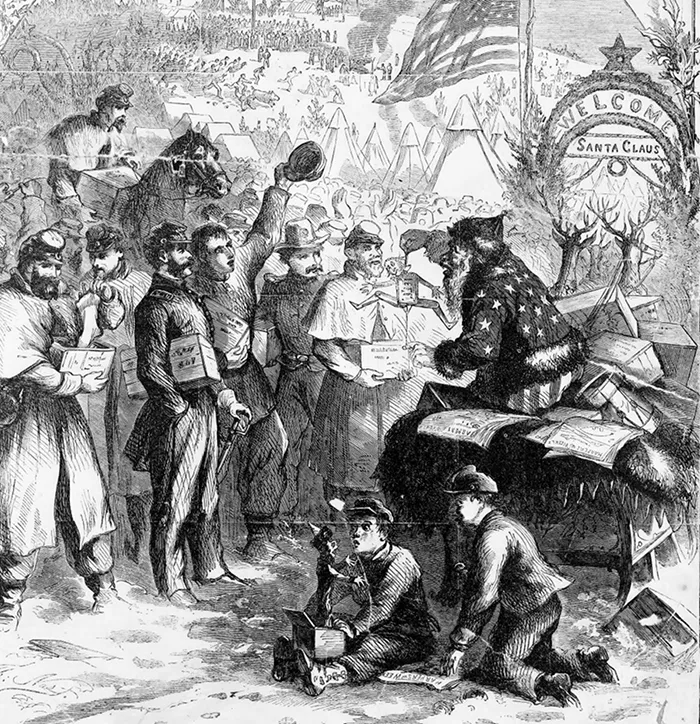
It will no doubt come as a relief to many readers that Santa Claus appears to have been a Union supporter. We know this because he appears distributing gifts to soldiers from that side of the Mason-Dixon in one of his earliest depictions. That illustration, “Santa Claus in Camp” (above), first appeared in the Harper’s Weekly Christmas issue of 1862, when the American Civil War was still tearing its way through the country. Its artist, a Bavarian immigrant named Thomas Nast, is now remembered for having first drawn the Democratic Party as a donkey and the Republican Party as an elephant, but he also did more than anyone else to create the image of Santa Claus recognized around the world today: more than Norman Rockwell, and more, even, than the Coca-Cola Company.
Santa Claus is an Anglicization of Sinterklaas, a Dutch name for Saint Nicholas, who lived and died in what’s now Turkey in the third and fourth centuries, and who’s been remembered since for his kindness to children. Few of us would recognize him in his portrait from 1294 that is included in the Public Domain Review’s pictorial history of Santa Claus, but with the passing of the centuries, his images became mixed with those of other flying, winter-associated characters from Germanic and Norse myth. In 1822, Clement Moore performed a defining act of rhyming synthesis with his poem “A Visit from St. Nicholas” (often called “ ‘Twas the Night Before Christmas”): in its verses we find the bundle of toys, the rosy cheeks, the white beard, the belly shaking like a bowl full of jelly.
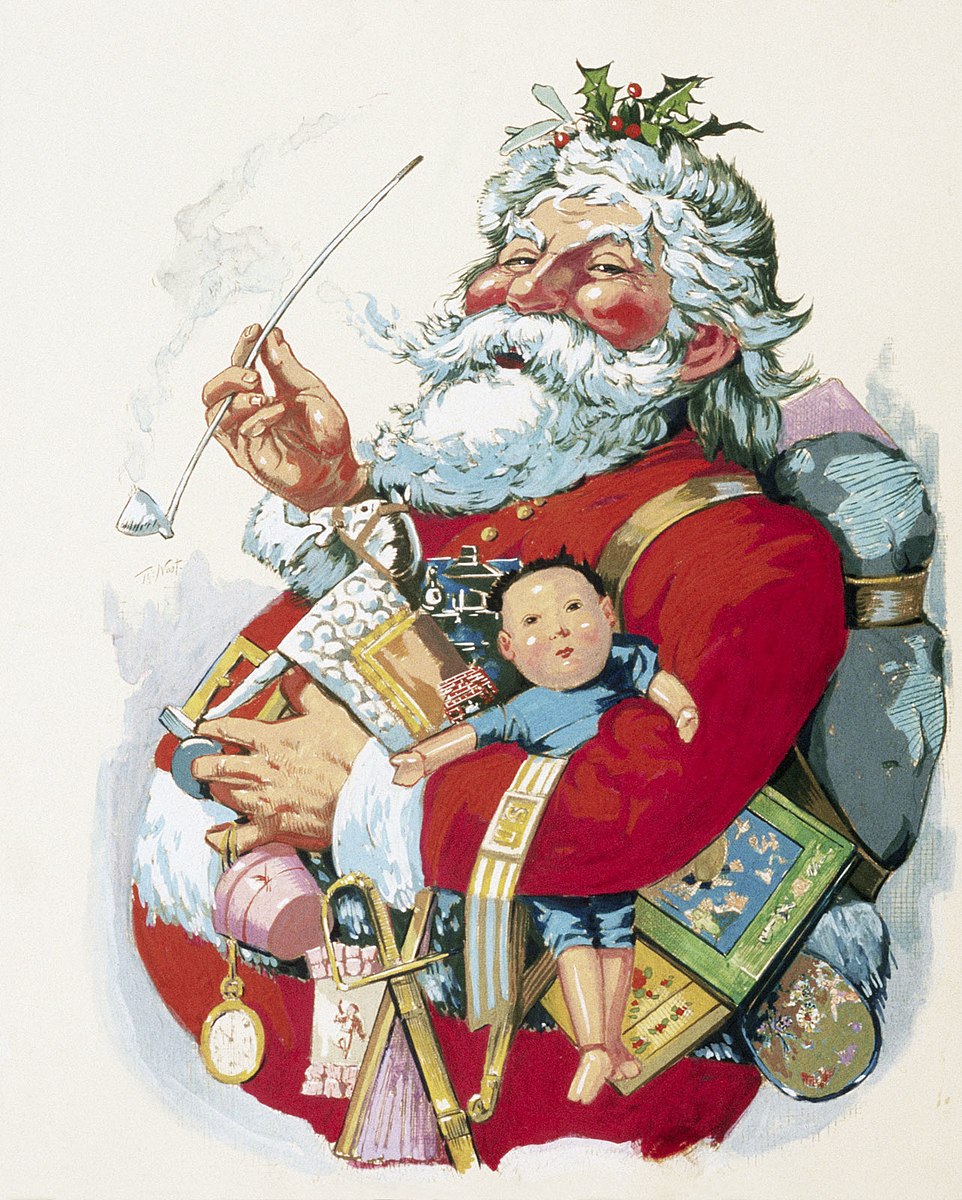
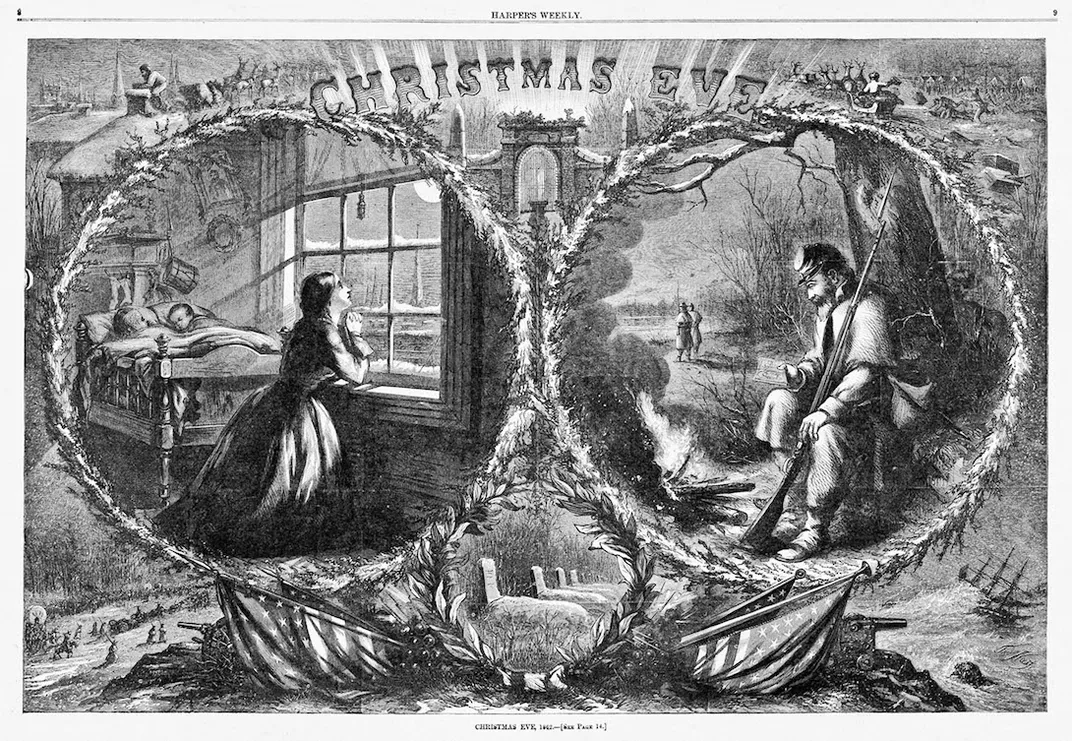
Nast clearly understood not just the appeal of Moore’s description, but also the character’s propaganda value. His very first renditions of Santa Claus appear in the upper corners of an 1862 Harper’s Weekly illustration of a praying wife and her Yankee soldier husband. Nearly two decades later, Nast drew the cartoon “Merry Old Santa Claus” (immediately above), whose central figure remains immediately recognizable to us today, even as its motivating political cause of higher wages for the military has become obscure. In the twentieth century, the iconic Father Christmas would be enlisted again to lend public support to U.S. efforts in World War I and II, in the very decades when Rockwell was further refining and cementing his image in popular culture. The once-unlikely result was an American Santa Claus: “the symbol of our empire,” in the words of The New Yorker’s Adam Gopnik, “as much as Apollo was of the Hellenic one.”
Related Content:
Watch Santa Claus, the Earliest Movie About Santa in Existence (1898)
Hear “Twas The Night Before Christmas” Read by Stephen Fry & John Cleese
Bob Dylan Reads “ ‘Twas the Night Before Christmas” On His Holiday Radio Show (2006)
Slavoj Žižek Answers the Question “Should We Teach Children to Believe in Santa Claus?”
Based in Seoul, Colin Marshall writes and broadcasts on cities, language, and culture. His projects include the Substack newsletter Books on Cities and the book The Stateless City: a Walk through 21st-Century Los Angeles. Follow him on the social network formerly known as Twitter at @colinmarshall.
Read More...Discover 20 Historical Christmas Recipes: Fruitcake, Gingerbread, Figgy Pudding & More
One can hardly consider the Christmas season for long, at least in the English-speaking world, without the work of Charles Dickens coming to mind. That owes for the most part, of course, to A Christmas Carol, the novella that revived the public culture of a holiday that had been falling into desuetude by the mid-nineteenth century. Whatever its literary shortcomings, the book offers a host of memorable images, not least culinary ones: Mrs. Cratchit’s pudding, for instance, which Dickens likens to “a speckled cannon-ball, so hard and firm, blazing in half or half-a-quartern of ignited brandy, and bedight with Christmas holly stuck into the top.”
In the Tasting History video at the top of the post, host Max Miller teaches you how to make just such a holiday pudding — and indeed a figgy one, a confection whose name we all recognize from no less a standard carol than “We Wish You a Merry Christmas,” even if we don’t know that pudding, in the Victorian sense, refers to a kind of cake.
The figgy pudding Miller makes from an original 1845 recipe looks, and seems to taste, more like an alcohol-soaked version of the fruitcakes many of us still receive come Christmastime. Despite its reputation for leaden undesirability, reinforced by decade after decade of Johnny Carson gags, the fruitcake has a rich history, which Miller reveals in the video just above, and culinary strengths beyond its extreme shelf life.
This playlist of 20 Christmas-themed videos offers many more such delights: Turkish delight, for instance, as well as Victorian sugar plums, medieval gingerbread, and historical versions of such still-common comforts and joys as eggnog and pumpkin pie. And if you’ve ever wondered to what wassail — as a noun or a verb — actually refers, have a look at the video above, in which Miller explains it all while making a pot of the stuff, which turns out to be a kind of applesauce-enriched ale. Wassail, too, is a favorite Dickens reference, and not just in A Christmas Carol. His first novel The Pickwick Papers includes a Christmas feast with “a mighty bowl of wassail, something smaller than an ordinary wash-house copper, in which the hot apples were hissing and bubbling with a rich look, and a jolly sound, that were perfectly irresistible”: the kind of image that, nearly two centuries later, still makes readers want to go a‑wassailing.
Related content:
Eudora Welty’s Handwritten Eggnog Recipe, and Charles Dickens’ Recipe for Holiday Punch
Try George Orwell’s Recipe for Christmas Pudding, from His Essay “British Cookery” (1945)
Charles Mingus’ “Top Secret” Eggnog Recipe Contains “Enough Alcohol to Put Down an Elephant”
How Eating Kentucky Fried Chicken Became a Christmas Tradition in Japan
Based in Seoul, Colin Marshall writes and broadcasts on cities, language, and culture. His projects include the Substack newsletter Books on Cities and the book The Stateless City: a Walk through 21st-Century Los Angeles. Follow him on the social network formerly known as Twitter at @colinmarshall.
Read More...The Life and Work of Afrobeat Creator Fela Kuti Explored by Radiolab’s Jad Abumrad
When discussing a musician like Fela Kuti, many of our usual terms fail us. They fail us, that is, if we came of age in a musical culture in which artists and bands put out an album of ten or so lyrics-forward songs every two or three years, promoting it on tour while also playing their biggest hits. Fela — as all his fans refer to him — could put out six or seven albums in a single year, and refused to play live any material he’d already recorded. Even the word song, as we know it, doesn’t quite reflect the nature of his compositions, which got expansive enough that two or three of them (or just one, half of it on each side) could fill a long-playing record.
Walter Benjamin said of great literary works that they either dissolve a genre or invent one, and Fela’s musical works invented the genre of Afrobeat. The sound of that genre, as explained by Noah Lefevre in the Polyphonic video above, reflects the distinctive formation of Fela himself, who was born and raised in Nigeria, studied at the Trinity College of Music in London, and came of age during the end of Africa’s era of decolonization. To a listener reared on Anglo-American popular music, his signature mixture of West African rhythms with jazz and funk textures sounds familiar enough — at least for the first ten or fifteen minutes, after which time the listening experience ascends to a different state entirely.
Sometimes it takes Fela just about that long to start singing, and when he does, he’s given to proclamations, chants, calls-and-responses, and political exhortations delivered in the kind of English that sounds highly unfamiliar to non-African listeners. Not that it’s always alienating: indeed, this particular combination of words and music has captivated generations of listeners from far outside its place of origin. One of them is David Byrne, who used Talking Heads’ Remain in Light as more or less a medium for channeling the musical spirit of Fela. Not that he himself was gone yet: indeed, he had almost two decades of his eventful life to go, one you can learn much more about from Fela Kuti: Fear No Man, a twelve-part biographical podcast by Jad Abumrad.
Brought into Fela’s world by a family connection, that former Radiolab host conducted dozens and dozens of interviews on the relationship between the man, his music, and the political context in which he found himself. The facts, as any Fela fan knows, don’t always align comfortably with mainstream sensibilities of the twenty-twenties — the charges range from essentialism to polygamy — but as Lefevre reminds us, an artist should be interpreted through the lens of his own culture and history. However many of us consider him a “problematic fave” today, Fela Kuti will always be the man who invented Afrobeat — and since nobody else has quite managed to replicate his grooves in their simultaneous tightness and looseness, bluntness and subtlety, perhaps also the man who dissolved it.
Related Content:
When Afrobeat Legend Fela Kuti Collaborated with Cream Drummer Ginger Baker
Zamrock: An Introduction to Zambia’s 1970s Rich & Psychedelic Rock Scene
The Awe-Inspiring But Tragic Story of Africa’s Festival In The Desert (2001–2012)
Stream 8,000 Vintage Afropop Recordings Digitized & Made Available by The British Library
Based in Seoul, Colin Marshall writes and broadcasts on cities, language, and culture. His projects include the Substack newsletter Books on Cities and the book The Stateless City: a Walk through 21st-Century Los Angeles. Follow him on the social network formerly known as Twitter at @colinmarshall.
Read More...What Pompeii Looked Like Hours Before Its Destruction: A Reconstruction
However celebrated by historians, scrutinized by archaeologists, and descended-upon by tourists it may be, Pompeii is not exceptional — not even in the fate of having been buried in ash by Mount Vesuvius in the year 76, which also happened to the nearby town of Herculaneum. Rather, it is the sheer ordinariness of that medium-sized provincial Roman city that we most value today, inadvertently preserved as it was by that volcanic disaster. The new Lost in Time video above reconstructs Pompeii as it must have looked at the very end of its days, taking a look at everything from its homes to its aqueducts, its forum to its basilica, and its wine and perfume production facilities to its gladiatorial arena.
Unsurprisingly, the Amphitheatre of Pompeii is much smaller than the Colosseum. But it was actually built 140 years earlier, at a time when local leaders across the empire were already starting to feel that any self-respecting Roman town ought to have its own venue for spectacles involving one-on-one combat, feats of athleticism, exotic animals, and even public executions.
The same ultimately went for all the types of facilities unearthed in the entombed city’s public spaces and private homes alike, including baths, snack bars, and dining rooms. To that extent, Pompeii had it all, even if life there lacked the potential for advancement and intrigue offered only by the Eternal City.
As the video gives its tour of a still-thriving Pompeii, it counts down to the eruption of Vesuvius, which lasted about two days. “Why didn’t people leave the city?” asks the narrator. “Historians claim that about 2,000 people lost their lives in Pompeii that day, meaning about 10,000 managed to escape.” It is to the writings of one such escapee, Pliny the Younger, that we owe much of what we know about the experience of the catastrophe itself — and to centuries of examination since its rediscovery as an archaeological site that we have the kind of knowledge about the place that goes into a reconstruction like this one. Those efforts have fed our understanding of life in the ancient world as a whole, for in its afterlife, Pompeii has become not just a medium-sized provincial Roman city, but the medium-sized provincial Roman city.
Related Content:
Take a High Def, Guided Tour of Pompeii
Based in Seoul, Colin Marshall writes and broadcasts on cities, language, and culture. His projects include the Substack newsletter Books on Cities and the book The Stateless City: a Walk through 21st-Century Los Angeles. Follow him on the social network formerly known as Twitter at @colinmarshall.
Read More...Langston Hughes’ Homemade Christmas Cards From 1950
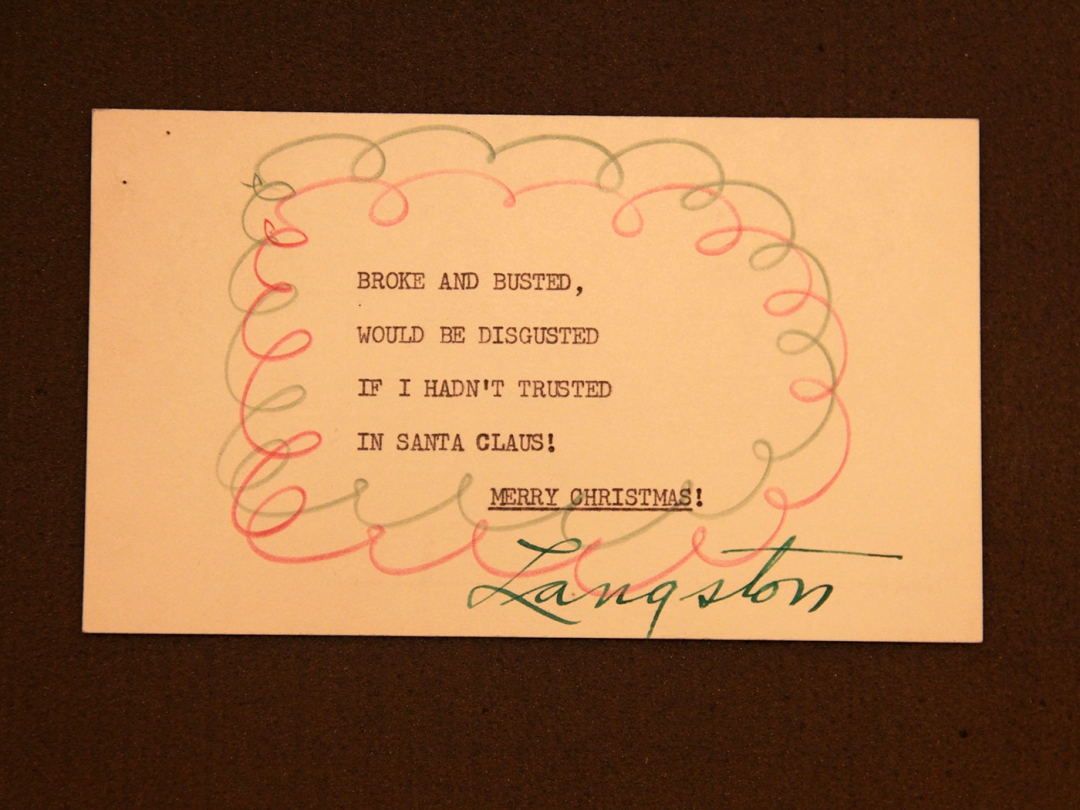
Who doesn’t treasure a handmade present?
As the years go by, we may begin to offload the ill-fitting sweaters, the never lit sand cast candles, and the Styrofoam ball snowmen. But a present made of words takes up very little space, and it has the Ghost of Christmas Past’s power to instantly evoke the sender as they once were.
Seventy years ago, poet Langston Hughes, too skint to go Christmas shopping, sent everyone on his gift list simple, homemade holiday postcards. Typed on white cardstock, each signed card was embellished with red and green pencils and mailed for the price of a 3¢ stamp.
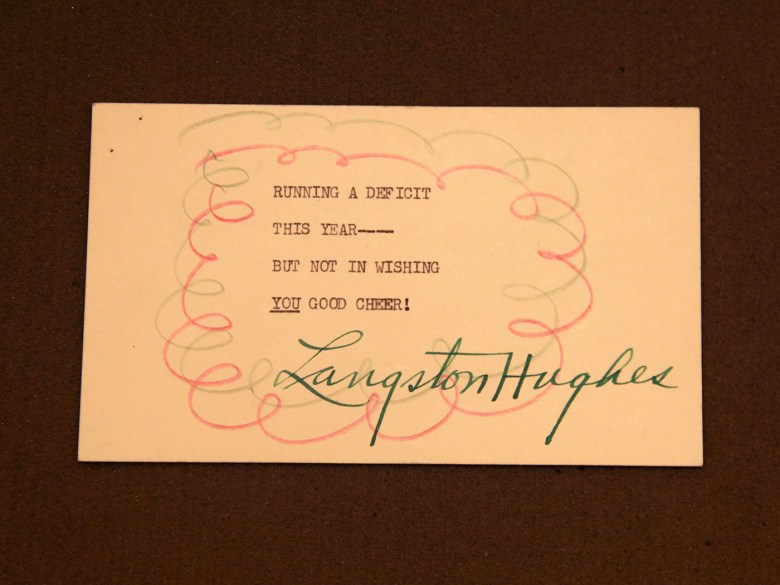
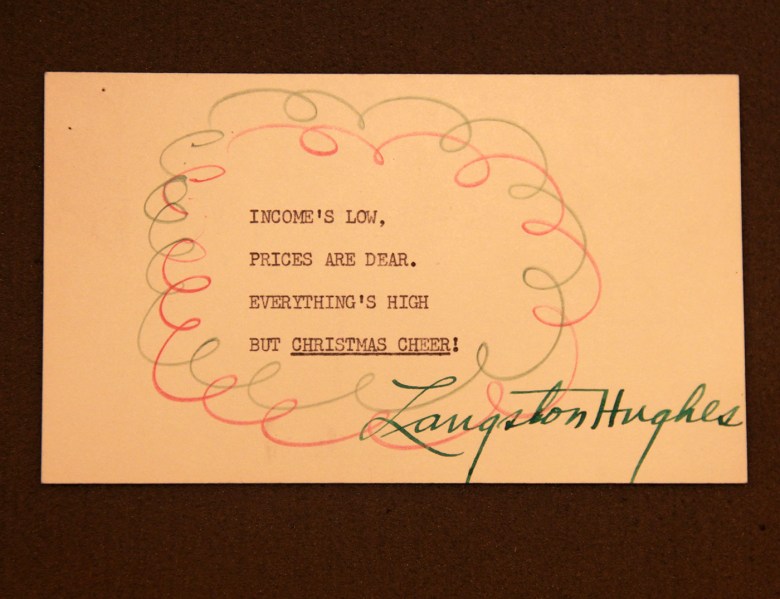
As biographer Arnold Rampersad notes:
The last weeks of 1950 found him nevertheless in a melancholy mood, his spirits sinking lower again as he again became a target of red-baiting.
The year started auspiciously with The New York Times praising his libretto for The Barrier, an opera based on his play, Mulatto: A Tragedy of the Deep South. But the opera was a commercial flop, and positive reviews for his book Simple Speaks His Mind failed to translate into the hoped-for sales.
Although he had recently purchased an East Harlem brownstone with an older couple who doted on him as they would a son, providing him with a sunny, top floor workspace, 1950 was far from his favorite year.
His typewritten holiday couplets took things out on a jaunty note, while paying light lip service to his plight.
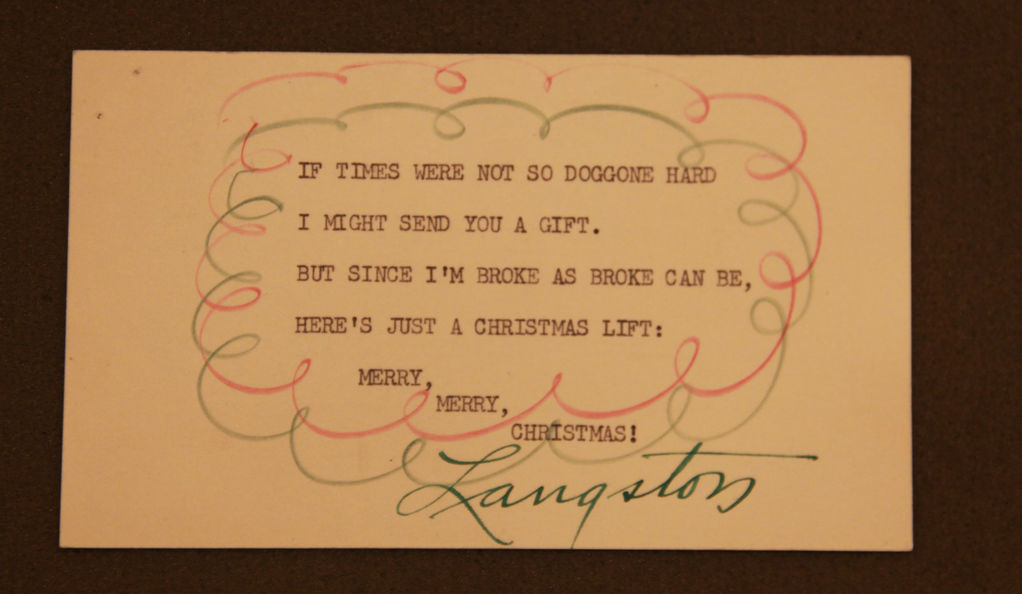
Maybe we can aspire to the same…
Hughes’ handmade holiday cards reside in the Langston Hughes Papers in Yale’s Beinecke Rare Book and Manuscript Library, along with holiday cards specific to the African-American experience received from friends and associates.
via the Beinecke Rare Book and Manuscript Library at Yale University
Related Content:
Langston Hughes Reads Langston Hughes
A Simple, Down-to-Earth Christmas Card from the Great Depression (1933)
Hear Neil Gaiman Read A Christmas Carol Just as Dickens Read It
How Joni Mitchell’s Song of Heartbreak, “River,” Became a Christmas Classic
Ayun Halliday is an author, illustrator, and theater maker in NYC.
Read More...Support Us
We're hoping to rely on loyal readers, rather than erratic ads. Please click the Donate button and support Open Culture. You can use Paypal, Venmo, Patreon, even Crypto! We thank you!

About Us

Open Culture scours the web for the best educational media. We find the free courses and audio books you need, the language lessons & educational videos you want, and plenty of enlightenment in between.
Advertise With Us

FREE UPDATES!
GET OUR DAILY EMAIL
Get the best cultural and educational resources on the web curated for you in a daily email. We never spam. Unsubscribe at any time.
FOLLOW ON SOCIAL MEDIA

Open Culture editor Dan Colman scours the web for the best educational media. He finds the free courses and audio books you need, the language lessons & movies you want, and plenty of enlightenment in between.
Advertise With Us


