How Frank Lloyd Wright Became Frank Lloyd Wright: A Video Introduction
Frank Lloyd Wright is unlikely to be displaced as the archetype of the genius architect anytime soon, at least in America, but even he had to start somewhere. At nine years old, as architecture YouTuber Stewart Hicks explains in the video above, Wright received a set of blocks from his mother, who hoped that “her son would grow up to become a great architect, and she thought the creativity unlocked and practiced with these blocks could kick-start his journey.” Evidently, she wasn’t wrong: “by the time Wright attempted to design his first building years later, he spent countless hours arranging the blocks,” familiar as he was with “proportion, symmetry, balance, and other principles of design well before he ever picked up a pencil.”
Of course, most of us played with blocks in childhood, and few of us now bear much comparison to the man who designed Fallingwater and the Guggenheim. But his mother’s toy selection was just one of many factors that influenced the architectural development that continued throughout Wright’s long life.
In fifteen minutes, Hicks explains as many of them as possible: his early opportunity to work on “shingle-style” homes, whose cruciform layout he would adapt into his own designs; his arrival in a Chicago that was still rebuilding after its great fire of 1871, when there were vast skyscraper interiors to be created; the new Midwestern manufacturing money prepared to commission homes from him; and his inspiring encounters with Japanese aesthetics, both at home and in Japan itself.
After returning from a 1905 Japan trip, Wright got to work on Unity Temple in Oak Park, Illinois. He had it built with the relatively new material of reinforced concrete, thus getting “in on the ground floor of a technology that could completely transform what buildings could do,” making possible “soaring cantilevers, graceful curves,” and other elements that would become part of his architectural signature. A few decades later, the United States’ suburb-building boom made Wright’s rural-urban “Usonian” homes and “Broadacre City” plan look prescient; indeed, “almost every single house inside of a postwar suburb bears his trace.” His willingness to appear in print and on film, radio, and television kept him in the American public consciousness, and he made sure to instill his principles into generations of students. Frank Lloyd Wright may be long gone, but he made sure that his vision of America would live on.
Related content:
A Beautiful Visual Tour of Tirranna, One of Frank Lloyd Wright’s Remarkable, Final Creations
What Frank Lloyd Wright’s Unusual Windows Tell Us About His Architectural Genius
What It’s Like to Work in Frank Lloyd Wright’s Iconic Office Building
Frank Lloyd Wright Reflects on Creativity, Nature and Religion in Rare 1957 Audio
Frank Lloyd Wright Creates a List of the 10 Traits Every Aspiring Artist Needs
How Frank Lloyd Wright’s Son Invented Lincoln Logs, “America’s National Toy” (1916)
Based in Seoul, Colin Marshall writes and broadcasts on cities, language, and culture. His projects include the Substack newsletter Books on Cities and the book The Stateless City: a Walk through 21st-Century Los Angeles. Follow him on the social network formerly known as Twitter at @colinmarshall.
Read More...When Neapolitans Used to Eat Pasta with Their Bare Hands: Watch Footage from 1903
Even if you don’t speak Italian, you can make a decent guess at the meaning of the word mangiamaccheroni. The tricky bit is that maccheroni refers not to the pasta English-speakers today call macaroni, tubular and cut into small curved sections, but to pasta in general. Or at least it did around the turn of the twentieth century, when i mangiamaccheroni still had currency as a nickname for the inhabitants of the pasta-production center that was Naples. That identity had already been long established even then: Atlas Obscura’s Adee Braun quotes Goethe’s observation, on a trip there in 1787, that pasta “can be bought everywhere and in all the shops for very little money.”

Some especially hard-up Neapolitans could even eat it for free, or indeed get paid to eat it, provided they were prepared to do so at great speed, in full public view — and, as was the custom at the time, with their bare hands. “Many tourists took it upon themselves to organize such spectacles,” Braun writes. “Simply tossing a coin or two to the lazzaroni, the street beggars, would elicit a mad dash to consume the macaroni in their characteristic way, much to the amusement of their onlooking benefactors.” As you can see in the Edison film above, shot on the streets of Naples in 1903, their maccheroni came in long strands, more like what we know as spaghetti. (Fortunately, if that’s the word, tomato sauce had yet to catch on.)
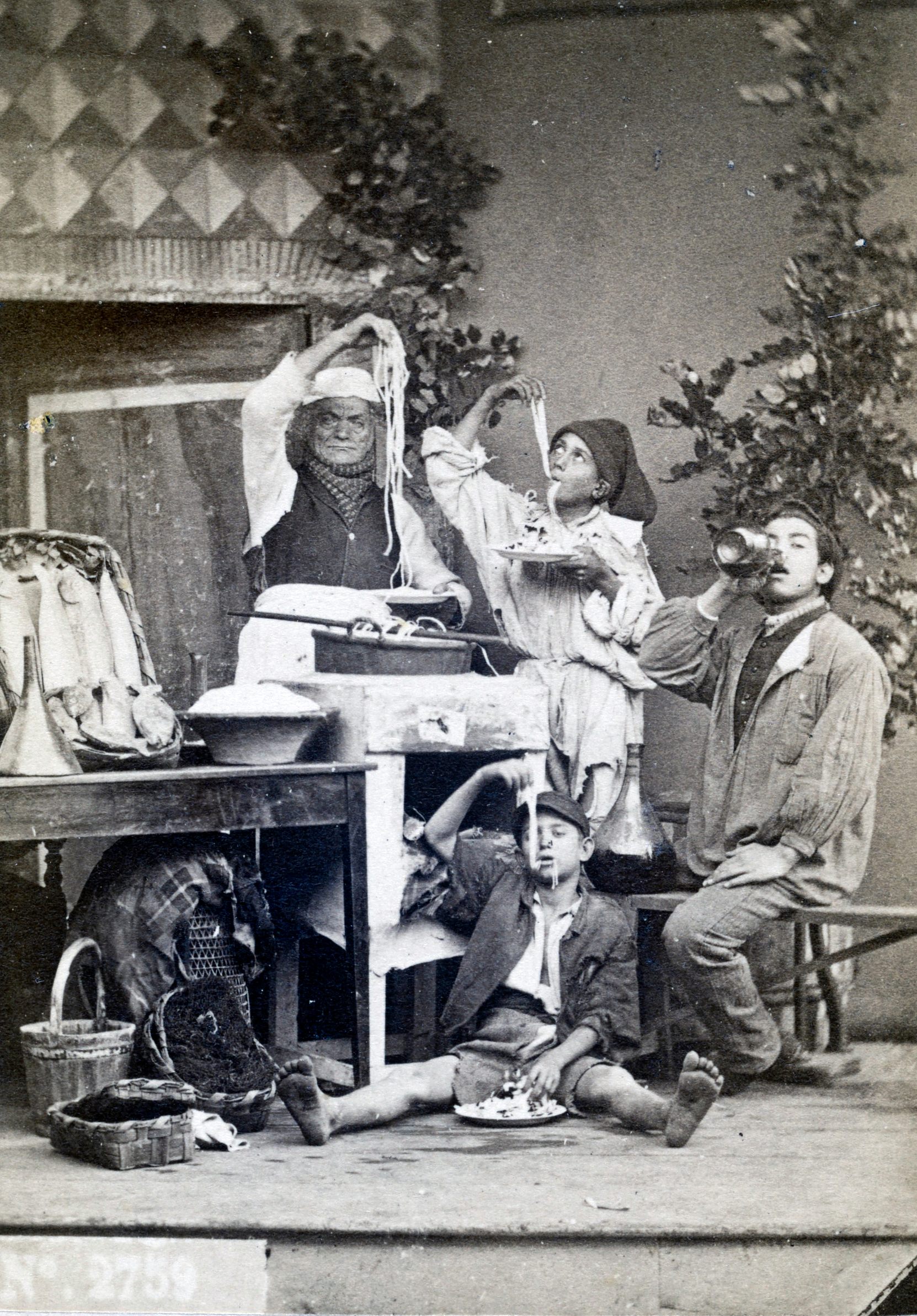
“On my first visit there, in 1929, I acquired a distaste for macaroni, at least in Naples, for its insalubrious courtyards were jungles of it,” writes Waverley Root in The Food of Italy. “Limp strands hung over clotheslines to dry, dirt swirled through the air, flies settled to rest on the exposed pasta, pigeons bombed it from overhead,” and so on. By that time, what had been an aristocratic dish centuries earlier had long since become a staple even for the poor, owing to the proto-industrialization of its production (which Mussolini would relocate and greatly increase in scale). Nowadays, it goes without saying that Italy’s pasta is of the highest quality. And though Italians may not have invented the stuff, which was originally brought over from the Middle East, perhaps they did invent the mukbang.
Related content:
When Italian Futurists Declared War on Pasta (1930)
A Free Course from MIT Teaches You How to Speak Italian & Cook Italian Food All at Once
Julia Child Shows Fred Rogers How to Make a Quick & Delicious Pasta Dish (1974)
Historical Italian Cooking: How to Make Ancient Roman & Medieval Italian Dishes
Based in Seoul, Colin Marshall writes and broadcasts on cities, language, and culture. His projects include the Substack newsletter Books on Cities and the book The Stateless City: a Walk through 21st-Century Los Angeles. Follow him on the social network formerly known as Twitter at @colinmarshall.
Read More...Benedict Cumberbatch Reads a Letter to a Man Blow-Drying His Balls at the Gym
We have featured Benedict Cumberbatch reading letters by Kurt Vonnegut, Alan Turing, Albert Camus, and Nick Cave, along with passages from Kafka’s Metamorphosis and Melville’s Moby Dick. It’s all pretty heady stuff. And now it’s time for something completely different. Above, we have Mr. Cumberbatch reading, with classic British understatement, a comical letter written by Ross Beeley, back in 2011. The reading will help you get through another dystopian day.
Cumberbatch read this letter at an event called Letters Live, held in London’s Royal Albert Hall, in December 2024.
Related Content
Benedict Cumberbatch Reads Kurt Vonnegut’s Letter of Advice to People Living in the Year 2088
Benedict Cumberbatch Reads Nick Cave’s Beautiful Letter About Grief
Read More...How Erik Satie’s ‘Furniture Music’ Was Designed to Be Ignored and Paved the Way for Ambient Music
Imagine how many times someone born in the eighteen-sixties could ever expect to hear music. The number would vary, of course, depending on the individual’s class and family inclinations. Suffice it to say that each chance would have been more precious than those of us in the twenty-first century can easily understand. Our ability to hear practically any song we could possibly desire on command has changed our relationship to the art itself. Most of us now relate to it not as we would a special, even momentous event, but as we do to the water and electricity that come out of our walls — or, to put it in mid-nineteenth-century terms, as we do to our furniture.
Despite having been born in 1866 himself, Erik Satie understood humanity’s need to listen to music without really listening to it. The Inside the Score video above tells the story of how he developed musique d’ameublement, or “furniture music.” The artist Fernand Léger, a friend of Satie’s, recalled that after the two of them had been subjected to “unbearable vulgar music” in a restaurant, Satie spoke of the need for “music which would be part of the ambience, which would take account of it. I imagine it being melodic in nature: it would soften the noise of knives and forks without dominating them, without imposing itself.” The result was five deliberately ignorable compositions, each tailored to an ordinary space, which he wrote between 1917 and 1923.
Regarded in his lifetime less as a respectable composer than an unserious eccentric, he only managed to get one of those pieces played — and even when he did, everyone ignored his instructions to chat instead of listening. It was well after his death (in 1925) that such also-unconventional musical figures as John Cage and Brian Eno became famous for works similarly premised on a re-imagination of the relationship between music and listener. Eno, in particular, is now credited with the development of “ambient music” thanks to his albums like Music for Airports. Their popularity surely wouldn’t have surprised Satie; whether he could have foreseen ten-hour mixes of “chill lo-fi beats to study to” is another question entirely.
Related content:
Hear the Very First Pieces of Ambient Music, Erik Satie’s Furniture Music (Circa 1917)
The Velvet Underground’s John Cale Plays Erik Satie’s Vexations on I’ve Got a Secret (1963)
When Erik Satie Took a Picture of Debussy & Stravinsky (June 1910)
Brian Eno Explains the Origins of Ambient Music
Based in Seoul, Colin Marshall writes and broadcasts on cities, language, and culture. His projects include the Substack newsletter Books on Cities and the book The Stateless City: a Walk through 21st-Century Los Angeles. Follow him on the social network formerly known as Twitter at @colinmarshall.
Read More...A 1933 Profile of Frida Kahlo: “Wife of the Master Mural Painter Gleefully Dabbles in Works of Art”
Walter Keane—supposed painter of “Big Eyed Children” and subject of a 2014 Tim Burton film—made a killing, attaining almost Thomas Kinkade-like status in the middlebrow art market of the 1950s and 60s. As it turns out, his wife, Margaret was in fact the artist, “painting 16 hours a day,” according to a Guardian profile. In some part, the story may illustrate how easy it was for a man like Walter to get millions of people to see what they wanted to see in the picture of success—a charismatic, talented man in front, his quiet, dutiful wife behind. Burton may not have taken too much license with the commonplace attitudes of the day when he has Christoph Waltz’s Walter Keane tell Margaret, “Sadly, people don’t buy lady art.”
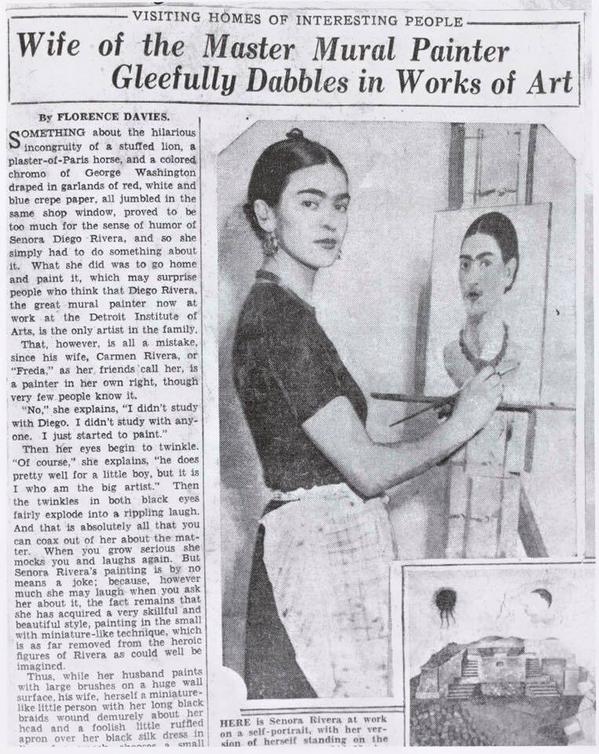
And yet, far from the Keanes’ San Francisco, and perhaps as far as a person can get from Margaret’s frustrated acquiescence, we have Frida Kahlo creating a body of work that would eventually overshadow her husband’s, muralist Diego Rivera. Unlike Walter Keane, Rivera was a very good painter who did not attempt to overshadow his wife. Instead of professional jealousy, he had plenty of the personal variety. Even so, Rivera encouraged Kahlo’s career and recognized her formidable talent, and she, in turn, supported him. In 1933, when Florence Davies—whom Kahlo biographer Gerry Souter describes as “a local news hen”—caught up with her in Detroit, Kahlo “played the cheeky, but adoring wife” of Diego while he labored to finish his famous Detroit mural project.
That may be so, but she did not do so at her own expense. Quite the contrary. Asked if Diego taught her to paint, she replies, “’No, I didn’t study with Diego. I didn’t study with anyone. I just started to paint.’” At which point, writes Davies, “her eyes begin to twinkle” as she goes on to say, “’Of course, he does pretty well for a little boy, but it is I who am the big artist.’” Davies praises Kahlo’s style as “skillful and beautiful” and the artist herself as “a miniature-like little person with her long black braids wound demurely about her head and a foolish little ruffled apron over her black silk dress.” And yet, despite Kahlo’s confidence and serious intent, represented by a prominent photo of her at serious work, Davies—or more likely her editor—decided to title the article, “Wife of the Master Mural Painter Gleefully Dabbles in Works of Art,” a move that reminds me of Walter Keane’s patronizing attitude.
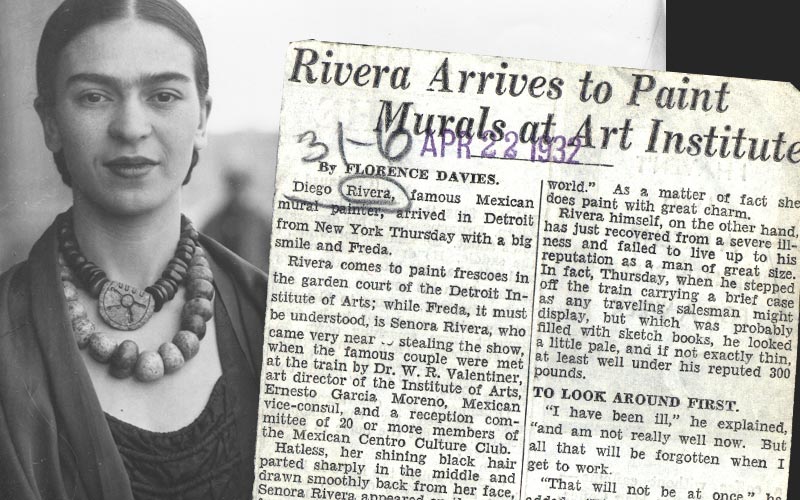
The belittling headline is quaint and disheartening, speaking to us, like the unearthed 1938 letter from Disney to an aspiring female animator, of the cruelty of casual sexism. Davies apparently filed another article on Rivera the year prior. This time the headline doesn’t mention Frida, though her fierce unflinching gaze, not Rivera’s wrestler’s mug, again adorns the spread. One sentence in the article says it all: “Freda [sic], it must be understood, is Senora Rivera, who came very near to stealing the show.” Davies then goes on to again describe Kahlo’s appearance, noting of her work only that “she does paint with great charm.” Six years later, Kahlo would indeed steal the show at her first and only solo show in the United States, then again in Paris, where surrealist maestro Andre Breton championed her work and the Louvre bought a painting, its first by a twentieth-century Mexican artist.
And Margaret Keane? She eventually sued Walter and now reaps her own rewards. You can buy one of her paintings here.
Note: An earlier version of this post appeared on our site in 2015.
Related Content:
Photos of a Very Young Frida Kahlo, Taken by Her Dad
A Brief Animated Introduction to the Life and Work of Frida Kahlo
Josh Jones is a writer and musician based in Durham, NC. Follow him at @jdmagness
Read More...Noam Chomsky Defines What It Means to Be a Truly Educated Person
There may be no more contentious an issue at the level of local U.S. government than education. All of the socioeconomic and cultural fault lines communities would rather paper over become fully exposed in debates over funding, curriculum, districting, etc. But we rarely hear discussions about educational policy at the national level these days.
You’ll hear no major political candidate deliver a speech solely focused on education. Debate moderators don’t much ask about it. The United States founders’ own thoughts on the subject are occasionally cited—but only in passing, on the way to the latest round of talks on war and wealth. Aside from proposals dismissed as too radical, education is mostly considered a lower priority for the nation’s leaders, or it’s roped into highly charged debates about political and social unrest on university campuses.
This situation can seem odd to the student of political philosophy. Every major political thinker—from Plato to John Locke to John Stuart Mill—has written letters, treatises, even major works on the central role of education. One contemporary political thinker—linguist, anarchist, and retired MIT professor Noam Chomsky—has also devoted quite a lot of thought to education, and has forcefully critiqued what he sees as a corporate attack on its institutions.
Chomsky, however, has no interest in harnessing education to prop up governments or market economies. Nor does he see education as a tool for righting historical wrongs, securing middle class jobs, or meeting any other agenda.
Chomsky, whose thoughts on education we’ve featured before, tells us in the short video interview at the top of the post how he defines what it means to be truly educated. And to do so, he reaches back to a philosopher whose views you won’t hear referenced often, Wilhelm von Humboldt, German humanist, friend of Goethe and Schiller, and “founder of the modern higher education system.” Humboldt, Chomsky says, “argued, I think, very plausibly, that the core principle and requirement of a fulfilled human being is the ability to inquire and create constructively, independently, without external controls.” A true education, Chomsky suggests, opens a door to human intellectual freedom and creative autonomy.
To clarify, Chomsky paraphrases a “leading physicist” and former MIT colleague, who would tell his students, “it’s not important what we cover in the class; it’s important what you discover.” Given this point of view, to be truly educated means to be resourceful, to be able to “formulate serious questions” and “question standard doctrine, if that’s appropriate”… It means to “find your own way.” This definition sounds similar to Nietzsche’s views on the subject, though Nietzsche had little hope in very many people attaining a true education. Chomsky, as you might expect, proceeds in a much more democratic spirit.
In the interview above from 2013 (see the second video), you can hear him discuss why he has devoted his life to educating not only his paying students, but also nearly anyone who asks him a question. He also talks about his own education and further elucidates his views on the relationship between education, creativity, and critical inquiry. And, in the very first few minutes, you’ll find out whether Chomsky prefers George Orwell’s 1984 or Aldous Huxley’s Brave New World. (Hint: it’s neither.)
Note: An earlier version of this post appeared on our site in 2016.
Related Content:
1,700 Free Online Courses from Top Universities
Noam Chomsky Spells Out the Purpose of Education
Josh Jones is a writer and musician based in Durham, NC. Follow him at @jdmagness
Read More...Where Do You Put the Camera? Every Frame a Painting Presents Insights from Famous Directors
Whether or not we believe in auteurhood, we each have our own mental image of what a film director does. But if we’ve never actually seen one at work, we’re liable not to understand what the actual experience of directing feels like: making decision after decision after decision, during the shoot and at all other times besides. (Wes Anderson made light of that gauntlet in an American Express commercial years ago.) Not all of these decisions are easily made, and it can actually be the simplest-sounding ones that cause the worst headaches. Where, for example, do you put the camera?
That’s the subject of the new video essay above from Taylor Ramos and Tony Zhou’s YouTube channel Every Frame a Painting, which considers how the decision of camera placement has been approached by such famous directors like Steven Soderbergh, Greta Gerwig, Guillermo del Toro, and Martin Scorsese, as well as master cinematographer Roger Deakins.
Technology may have multiplied the choices available for any given shot, but that certainly hasn’t made the task any easier. Some filmmakers find their way by asking one especially clarifying question: what is this scene about? The answer can suggest what the camera should be looking at, and even how it should be looking at it.
Having become filmmakers themselves during Every Frame a Painting’s hiatus, Ramos and Zhou now understand all this as more than an intellectual inquiry. “Sometimes, the thing in our way is equipment,” says Zhou. “Sometimes it’s the weather. Sometimes it’s a lack of resources. And sometimes, the thing in our way is us.” Any director would do well to bear in mind the bracing advice once given by John Ford to a young Steven Spielberg, as dramatized (with a truly astonishing casting choice) in the latter’s autobiographical picture The Fabelmans: “When the horizon’s at the bottom, it’s interesting. When the horizon’s at the top, it’s interesting.” As for what it is when the horizon is in the middle, well, you’ll have to watch the movie.
Related content:
The History of the Movie Camera in Four Minutes: From the Lumiere Brothers to Google Glass
Signature Shots from the Films of Stanley Kubrick: One-Point Perspective
Based in Seoul, Colin Marshall writes and broadcasts on cities, language, and culture. His projects include the Substack newsletter Books on Cities and the book The Stateless City: a Walk through 21st-Century Los Angeles. Follow him on the social network formerly known as Twitter at @colinmarshall.
Read More...Revisit Pop-Up Video: The VH1 Series That Reinvented Music Videos & Pop Culture
In the eighties, people lamented the attention-span-shortening “MTV-ization” of visual culture. By the mid-nineties, networks were trying to figure out how to get viewers to sit through music videos at all. A solution arrived in the form of Pop-Up Video, a program pitched by creators Woody Thompson and Tad Low to VH1 when that much-less-cool MTV clone found itself struggling to stay carried by cable providers. It had an appealingly low-budget concept: take existing music videos, and spice them up with text bubbles containing facts about the artists, behind-the-scenes anecdotes, and amusing (if semi-relevant) trivia.
“We got a lot of resistance from VH1. They owned Blockbuster Video at the time, so they knew no one rented foreign films because no one wanted to read the TV.” So recalls Low in a Billboard interview about the history of the show, which originally ran from 1996 to 2002 (with a brief revival in 2011 and 2012). Like many cultural phenomena beloved of millennials, Pop-Up Video has received the oral-history treatment more than once: Uproxx also did one a couple years earlier. These articles are entertaining in the same way as Pop-Up Video itself, opening up the doors of the factory and offering a glimpse of how pop-cultural sausage gets made.
Launched well before the age of Wikipedia, Pop-Up Video required intensive research. That meant not just internet searches, but phone calls to directors, production designers, hairstylists, carpenters, caterers, and anyone else who might have worked on a particular music video (if not the musicians, few of whom knew how their videos were made, and even fewer of whom were willing to dish dirt on themselves). These often complicated, rushed, and otherwise troubled productions tended to produce memorable stories, which participants turned out to be happy to tell years later — not that the network or the artists’ management were always happy with the results.
Also like many cultural phenomena beloved of millennials, the show was saturated with the famously irreverent sensibility of Generation X. Tasked with delivering fun facts, its writers didn’t hesitate to knock celebrities off their pedestals while they were at it, and with a sense of humor that came to be recognized as deceptively intelligent. (Head writer Alan Cross has spoken of being inspired by Hunter S. Thompson, and Low by a favorite writer who made “extensive use of footnotes,” which brings another three-initial name to mind.) You can watch over 100 “popped” music videos on this Youtube playlist, with more at the Internet Archive. Alas, many have never come available online, but then, Pop-Up Video did make a virtue of ephemerality.
Related content:
The Complete History of the Music Video: From the 1890s to Today
The 50 Greatest Music Videos of All Time, Ranked by AV Club
Watch the First Two Hours of MTV’s Inaugural Broadcast (August 1, 1981)
Based in Seoul, Colin Marshall writes and broadcasts on cities, language, and culture. His projects include the Substack newsletter Books on Cities and the book The Stateless City: a Walk through 21st-Century Los Angeles. Follow him on the social network formerly known as Twitter at @colinmarshall.
Read More...Watch an Avant-Garde Bauhaus Ballet in Brilliant Color, First Staged in 1922
We credit the Bauhaus school, founded by German architect Walter Gropius in 1919, for the aesthetic principles that have guided so much modern design and architecture in the 20th and 21st centuries. The school’s relationships with artists like Paul Klee, Wassily Kandinsky, Laszlo Moholy-Nagy, and Ludwig Mies van der Rohe mean that Bauhaus is closely associated with Expressionism and Dada in the visual and literary arts, and, of course, with the modernist industrial design and glass and steel architecture we associate with Frank Lloyd Wright and Charles and Ray Eames, among so many others.
We tend not to associate Bauhaus with the art of dance, perhaps because of the school’s founding ethos to bring what they saw as enervated fine arts and crafts traditions into the era of modern industrial production. The question of how to meet that demand when it came to perhaps one of the oldest of the performing arts might have puzzled many an artist.
But not Oskar Schlemmer. A polymath, like so many of the school’s avant-garde faculty, Schlemmer was a painter, sculptor, designer, and choreographer who, in 1923, was hired as Master of Form at the Bauhaus theatre workshop.
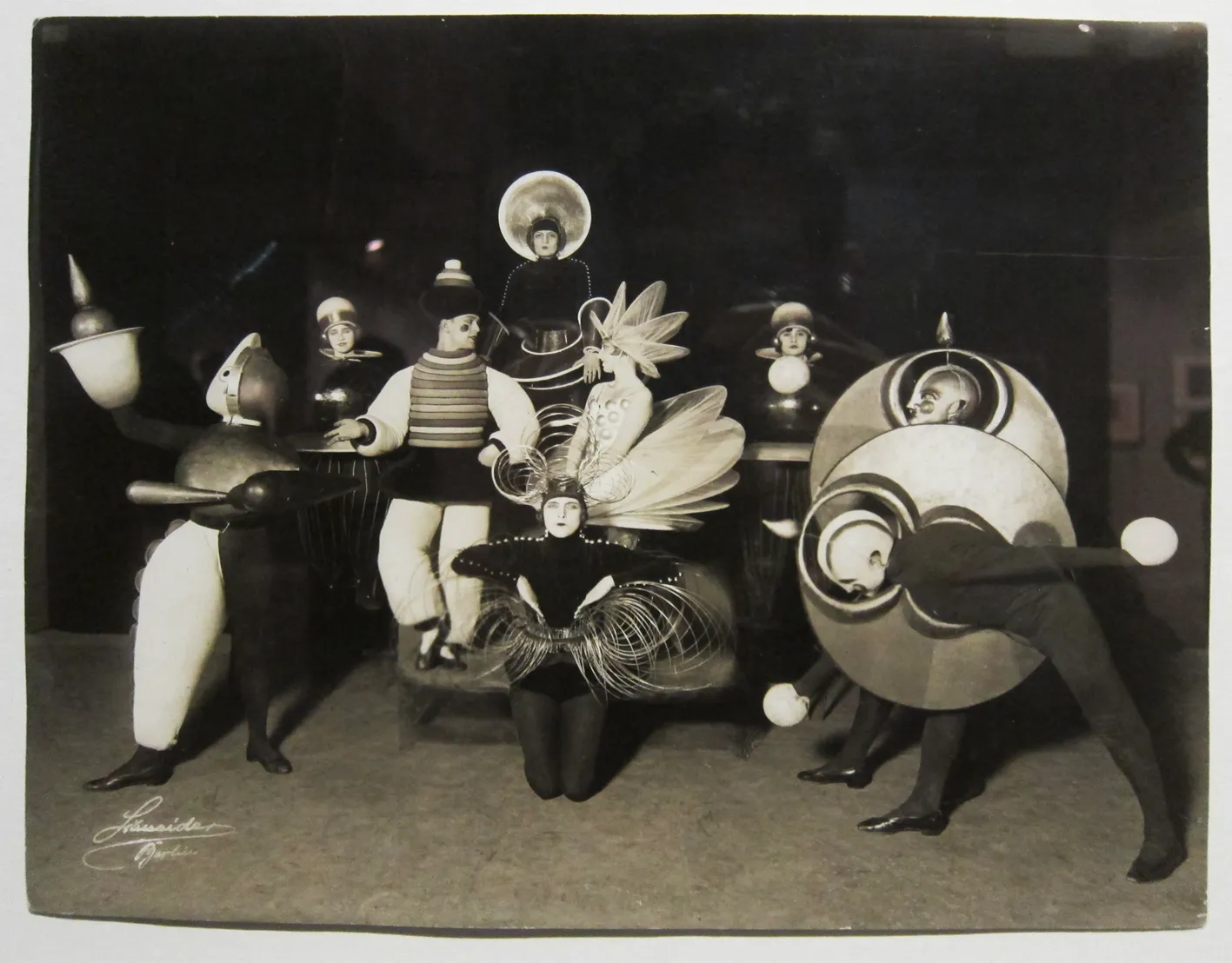
Before taking on that role, Schlemmer had already conceived, designed, and staged his most famous work, Das Triadische Ballett (The Triadic Ballet). “Schlemmer’s main theme,” says scholar and choreographer Debra McCall, “is always the abstract versus the figurative and his work is all about the conciliation of polarities—what he himself called the Apollonian and Dionysian. [He], like others, felt that mechanization and the abstract were two main themes of the day. But he did not want to reduce the dancers to automatons.” These concerns were shared by many modernists, who felt that the idiosyncrasies of the human could easily become subsumed in the seductive orderliness of machines.
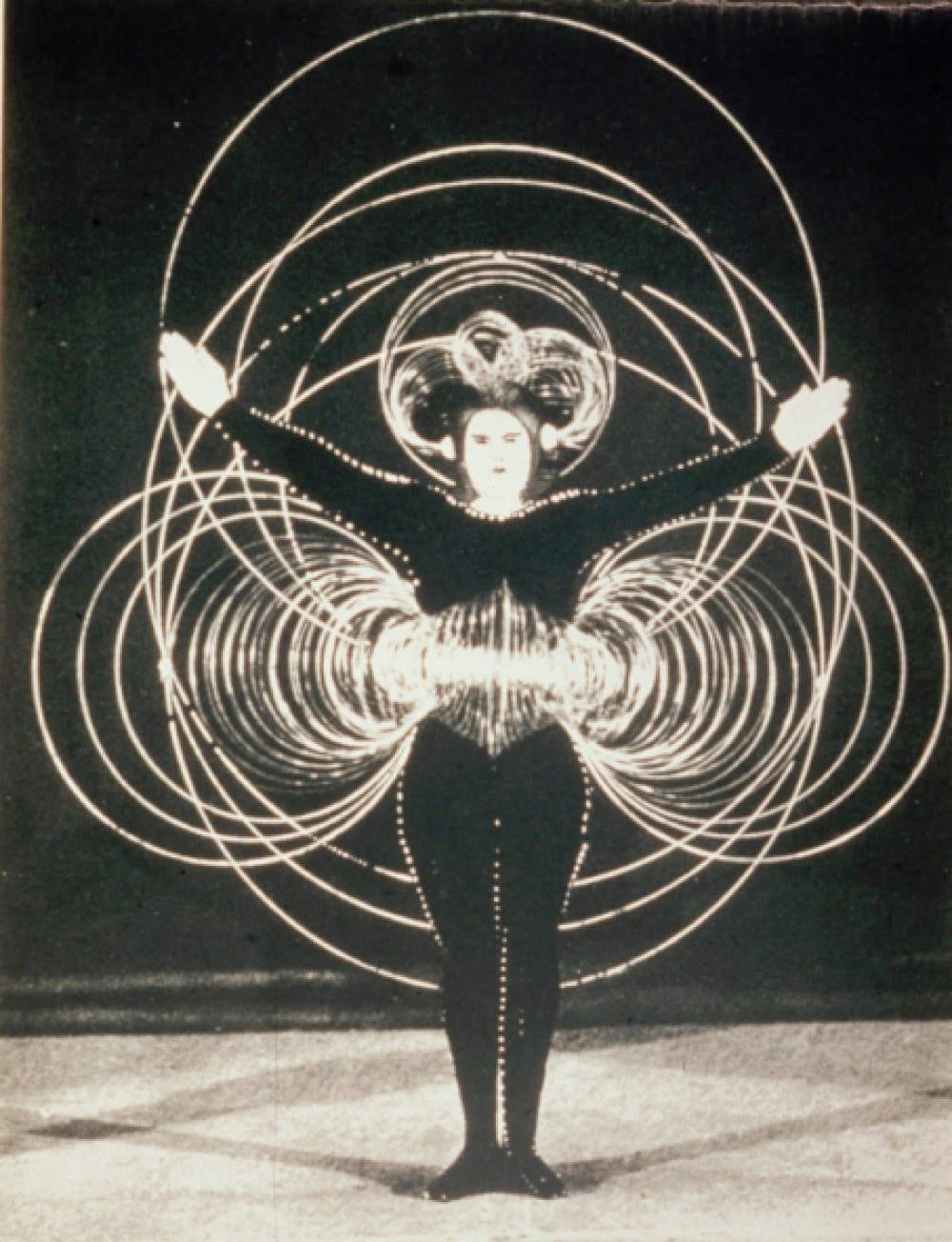
Schlemmer’s intentions for The Triadic Ballet translate—in the descriptions of Dangerous Minds’ Amber Frost—to “sets [that] are minimal, emphasizing perspective and clean lines. The choreography is limited by the bulky, sculptural, geometric costumes, the movement stiflingly deliberate, incredibly mechanical and mathy, with a rare hint at any fluid dance. The whole thing is daringly weird and strangely mesmerizing.” You can see black and white still images from the original 1922 production above (and see even more at Dangerous Minds). To view these bizarrely costumed figures in motion, watch the video at the top, a 1970 recreation in full, brilliant color.
For various reasons, The Triadic Ballet has rarely been restaged, though its influence on futuristic dance and costuming is considerable. The Triadic Ballet is “a pioneering example of multi-media theater,” wrote Jack Anderson in review of a 1985 New York production; Schlemmer “turned to choreography,” writes Anderson, “because of his concern for the relationships of figures in space.” Given that the guiding principle of the work is a geometric one, we do not see much movement we associate with traditional dance. Instead the ballet looks like pantomime or puppet show, with figures in awkward costumes tracing various shapes around the stage and each other.
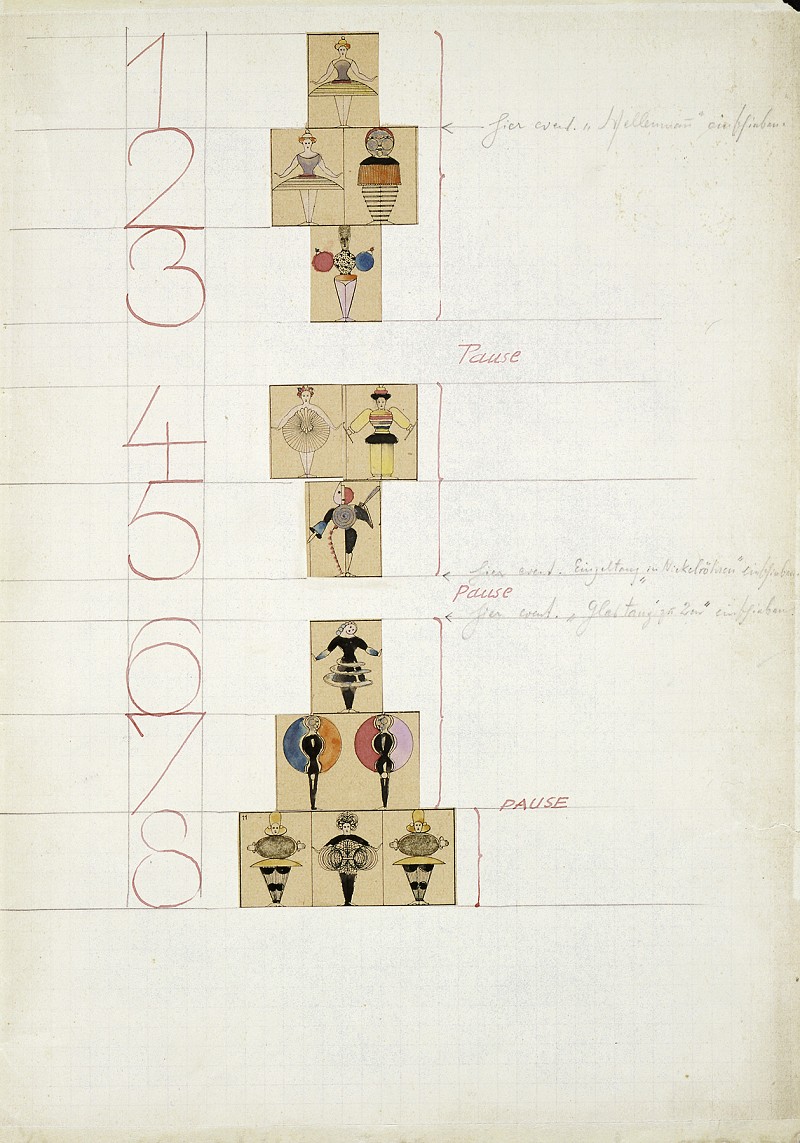
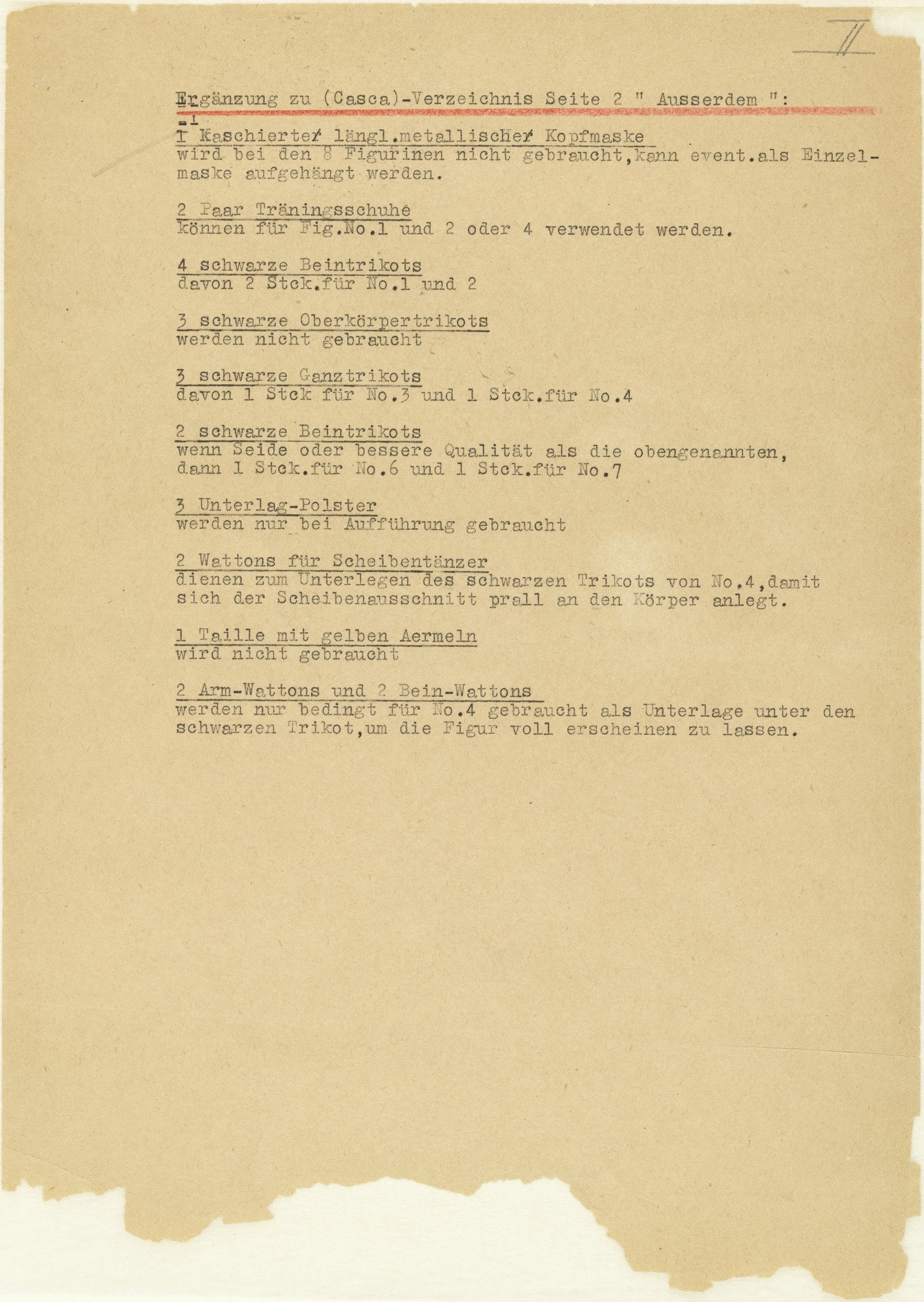
As you can see in the images further up, Schlemmer left few notes regarding the choreography, but he did sketch out the grouping and costuming of each of the three movements. (You can zoom in and get a closer look at the sketches above at the Bauhaus-archiv Museum.) As Anderson writes of the 1985 revived production, “unfortunately, Schlemmer’s choreography for these figures was forgotten long ago, and any new production must be based upon research and intuition.” The basic outlines are not difficult to recover. Inspired by Arnold Schoenberg’s Pierrot Lunaire, Schlemmer began to see ballet and pantomime as free from the baggage of traditional theater and opera. Drawing from the stylizations of pantomime, puppetry, and Commedia dell’Arte, Schlemmer further abstracted the human form in discrete shapes—cylindrical necks, spherical heads, etc—to create what he called “figurines.” The costuming, in a sense, almost dictates the jerky, puppet-like movements of the dancers. (These three costumes below date from the 1970 recreation of the piece.)
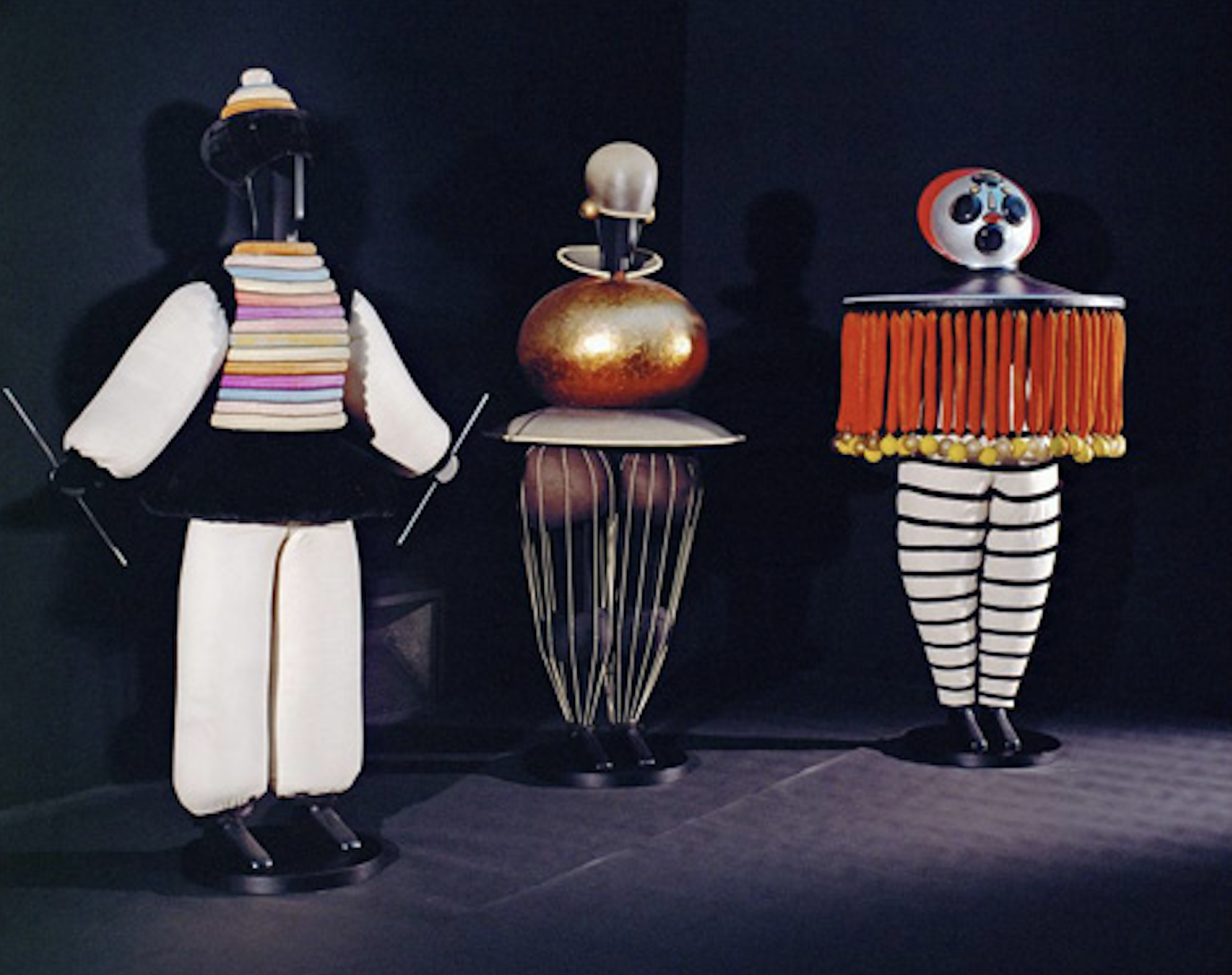
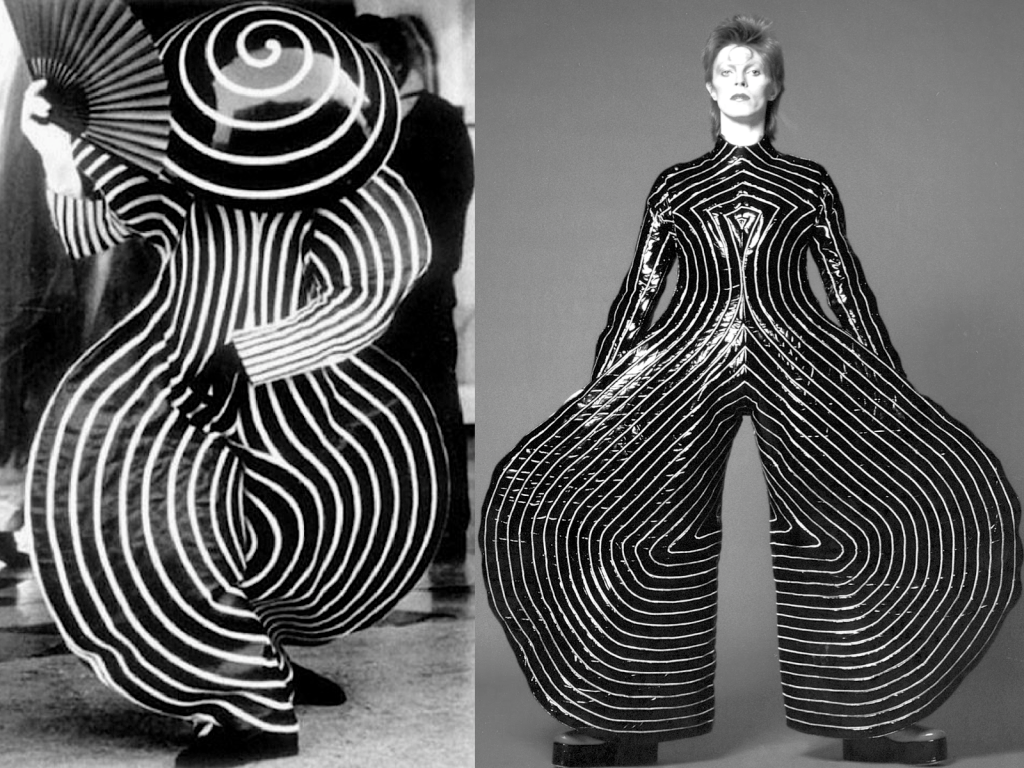
Schlemmer’s radical production has somehow not achieved the level of recognition of other avant-garde ballets of the time, including Schoenberg’s Pierrot Lunaire and Stravinsky’s, Nijinsky-choreographed The Rite of Spring. The Triadic Ballet, with music composed by Paul Hindemith, toured between 1922 and 1929, representing the ethos of the Bauhaus school, but at the end of that period, Schlemmer was forced to leave “an increasingly volatile Germany,” writes Frost. Revivals of the piece, such as a 1930 exhibition in Paris, tended to focus on the “figurines” rather than the dance. Schlemmer made many similar performance pieces in the 20s (such as a “mechanical cabaret”) that brought together industrial design, dance, and gesture. But perhaps his greatest legacy is the bizarre costumes, which were worn and copied at various Bauhaus costume parties and which went on to directly inspire the look of Fritz Lang’s Metropolis and the glorious excesses of David Bowie’s Ziggy Stardust stage show.
Note: An earlier version of this post appeared on our site in 2016.
Related Content:
32,000+ Bauhaus Art Objects Made Available Online by Harvard Museum Website
Bauhaus Ballet: A Dance of Geometry
Josh Jones is a writer and musician based in Durham, NC. Follow him at @jdmagness
Read More...The Story of How Quentin Tarantino Became a Filmmaker and Created Pulp Fiction, as Told by Quentin Tarantino
For a film, explained a young Quentin Tarantino in one interview, “the real test of time isn’t the Friday that it opens. It’s how the film is thought of thirty years from now.” It just so happens that Pulp Fiction, which made Tarantino the most celebrated director in America practically on its opening day, came out thirty years ago last fall. That provided the occasion for the video essay from YouTuber Dodford above, which tells the story of how Tarantino became a filmmaker, assembled for the most part out of Tarantino’s own words — and in the not-quite-linear chronology with which people still associate him.
As Tarantino’s body of work has grown, it’s come to seem less defined by such sliced-and-diced timelines, or even by the obsessions with pop culture or graphic violence the media tended to exaggerate when first he rose to fame. “They thought it was far more violent than it was,” he says of the public reaction to his first feature Reservoir Dogs in a Charlie Rose interview from which this video draws. He could take that as a testament to his understanding of cinema, a form that draws its power just as often from what it doesn’t show as what it does.
Tarantino began cultivating that understanding early, throughout his movie-saturated childhood and his stint as a video-store clerk in Manhattan Beach. Contrary to popular belief, however, Video Archives didn’t make him a movie expert: “I was already a movie expert; that’s how I got hired.” It was during that period that he commenced work on My Best Friend’s Birthday, which he meant to be his first film. Though he never completed it even after three years of work, he did notice the artistic development evident in a comparison between its amateurish early scenes and its more effective later ones.
That failed project turned out to be “the best film school a person could possibly have,” and it prepared him to seize the opportunities that would come later. After writing and selling the script for True Romance, he was in a position to work on Reservoir Dogs, which eventually made it to production thanks to the interest of Harvey Keitel, who would play Mr. White. When that picture got attention at Sundance and became an indie hit, Tarantino went off on a European sojourn, ostensibly in order to work on his next script — and to figure out how to beat “the dreaded sophomore curse,” something with which he’d had much second-hand experience as a disappointed moviegoer.
The fruit of those labors, a crime-story anthology called Pulp Fiction, first seemed, incredibly, to promise little box-office potential. But one senses that Tarantino knew exactly what he had, because he knew his audience. It’s not that he’d commissioned intensive market research, but that, as he once put it, “It’s me; I’m the audience.” And so he’s remained over the past three decades, drawing ever closer to completing what, as he’s often said, will ultimately constitute a ten-picture filmography. Actually stopping there would, of course, risk the disappointment of his many fans, who only want more. But when a filmmaker keeps at it too long, as the cinephile in Tarantino well understands, he runs the far more dire risk of disappointing himself.
Related content:
Quentin Tarantino Explains How to Write & Direct Movies
My Best Friend’s Birthday, Quentin Tarantino’s 1987 Debut Film
An Analysis of Quentin Tarantino’s Films Narrated (Mostly) by Quentin Tarantino
Quentin Tarantino & Roger Avary Rewatch Cult-Classic Movies on Their New Video Archives Podcast
Why Quentin Tarantino Will Only Make 10 Movies
Based in Seoul, Colin Marshall writes and broadcasts on cities, language, and culture. His projects include the Substack newsletter Books on Cities and the book The Stateless City: a Walk through 21st-Century Los Angeles. Follow him on the social network formerly known as Twitter at @colinmarshall.
Read More...
Support Us
We're hoping to rely on loyal readers, rather than erratic ads. Please click the Donate button and support Open Culture. You can use Paypal, Venmo, Patreon, even Crypto! We thank you!

About Us

Open Culture scours the web for the best educational media. We find the free courses and audio books you need, the language lessons & educational videos you want, and plenty of enlightenment in between.
Advertise With Us

FREE UPDATES!
GET OUR DAILY EMAIL
Get the best cultural and educational resources on the web curated for you in a daily email. We never spam. Unsubscribe at any time.
FOLLOW ON SOCIAL MEDIA

Open Culture editor Dan Colman scours the web for the best educational media. He finds the free courses and audio books you need, the language lessons & movies you want, and plenty of enlightenment in between.
Advertise With Us

