9‑Year-Old Edward Hopper Draws a Picture on the Back of His 3rd Grade Report Card
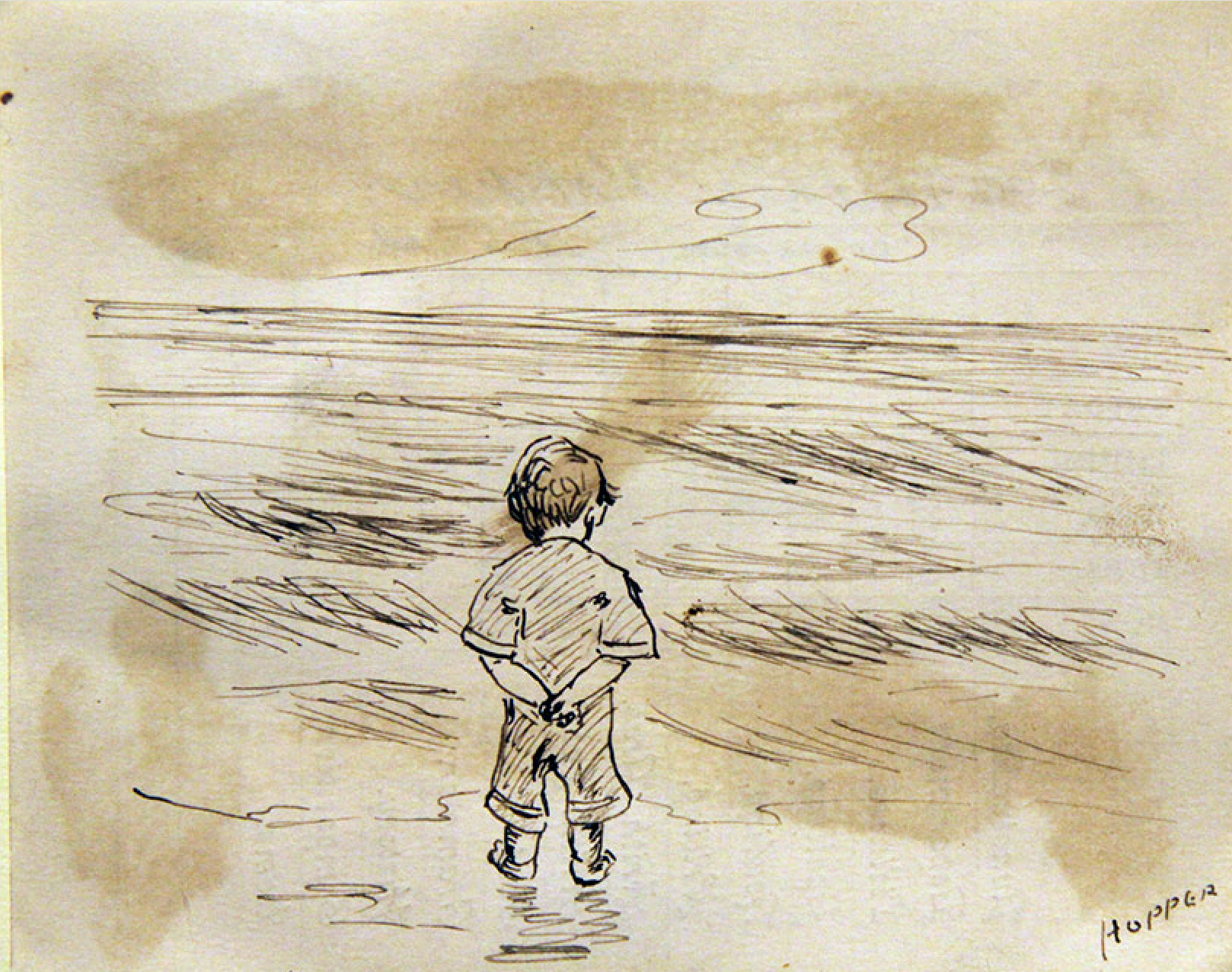
In a 2017 press release, the Edward Hopper House announced that it would receive over 1,000 artifacts and memorabilia documenting Edward Hopper’s family life and early years. The collection “consists of juvenilia and other materials from the formative years of Hopper’s life and includes original letters, drawings from his school years … photographs, original newspaper articles, and other items that allow visitors to experience firsthand how Hopper’s childhood and home environment shaped his art.”
Above you can find Exhibit A from the collection. A picture that young Hopper, only 9 years old, drew on the back of his 3rd grade report card in 1891. A sure early sign of his talents.
If you would like to support the mission of Open Culture, consider making a donation to our site. It’s hard to rely 100% on ads, and your contributions will help us continue providing the best free cultural and educational materials to learners everywhere. You can contribute through PayPal, Patreon, and Venmo (@openculture). Thanks!
Related Content:
What Makes Edward Hopper’s Nighthawks a Great Painting?: A Video Essay
How Edward Hopper “Storyboarded” His Iconic Painting Nighthawks
Edward Hopper’s Iconic Painting Nighthawks Explained in a 7‑Minute Video Introduction
Read More...The First Professional Footage of Pink Floyd Gets Captured in a 1967 Documentary (and the Band Also Provides the Soundtrack)
British filmmaker and novelist Peter Whitehead has been credited with inventing the music video with his promo films for the Rolling Stones in the mid-60s. According to Ali Catterall and Simon Wells, authors of Your Face Here, a study of “British Cult Film since the Sixties,” Whitehead was “a trusted confidant of the Rolling Stones… and a member of the inner circle.” In addition to the Stones, Whitehead had access to a surprising number of important figures in the countercultural scene of 60s London, including actors Michael Caine and Julie Christie, artist David Hockney, and a just-emerging (and then unknown) psychedelic band called Pink Floyd. All of these characters show up in Whitehead’s 1968 documentary Tonite Let’s All Make Love in London. Catterall and Wells describe the film thus:
If any one film truly reveals “Swinging London,” it is Peter Whitehead’s little-seen documentary Tonite Let’s All Make Love In London (1968). Beautifully shot, with a Syd Barrett-led Pink Floyd supplying the soundtrack, it is perhaps the only true masterpiece of the period, offering a visually captivating window on the ‘in’ crowd. Revealing, often very personal interviews with the era’s prime movers — Michael Caine, Julie Christie, David Hockney and Mick Jagger — are interspersed by dazzling images of the ‘dedicated followers of fashion’, patronising the clubs and discotheques of the day.
Departing from typical documentary styles, Tonite eschews neat narrative packaging and voice-over, and opts instead for a sometimes jarring montage of scenes from the London clubs and streets, rare footage of performances by the Stones, the Floyd (in one of their first-ever gigs at the UFO club), and others, and political rallies (with Vanessa Redgrave singing “Guantanamera”)–all intercut with the abovementioned interviews. One of the best of the latter is with a very young and charming David Hockney (below), who compares London to California and New York, and debunks ideas about the “swinging London” nightlife (“you need too much money”).
Overall, Tonite Let’s All Make Love in London is a unique portrait of the era and its rising stars, and Whitehead’s visual style replicates an insider’s perspective of watching (but not participating) as a new cultural moment unfolds. Whitehead, who “never missed a 60s happening,” has a knack for recording such moments. His 1965 Wholly Communion (see here) captures the spirited Albert Hall Poetry Festival in 65 (presided over by doyen Allen Ginsberg), and 1969’s The Fall documents some of the most incendiary political action of late-60s New York.
Josh Jones is a writer and musician based in Durham, NC. Follow him at @jdmagness
Related Content
Pink Floyd’s Debut on American TV, Restored in Color (1967)
Read More...Monty Python’s Michael Palin Presents His Favorite Painting, J. M. W. Turner’s Rain, Steam and Speed
Of all the English comedians to have attained worldwide fame over the past half-century, Sir Michael Palin may be the most English of them all. It thus comes as no surprise that the National Gallery would ring him up and invite him to make a video about his favorite painting, nor that his favorite painting would be by Joseph Mallord William Turner. “Most people aren’t interested in railways and the history of railways,” he explains, but Turner’s Rain, Steam and Speed has great significance to a train-lover such as himself precisely “because it is about the birth of the railway.”
Rain, Steam and Speed was painted in 1844, when train transport “was still a new thing, and a thing that frightened so many people. They thought it was going to destroy the countryside.” (Bear in mind that this was the time of Dickens, who didn’t set so many of his novels before the arrival of the railway by accident.) For all of Turner’s Romanticism, “he must’ve been excited by it. Maybe a bit alarmed.” His painting declares that “this is a new world that’s been opened up by the railways, and it’s got enormous possibilities, and people are going to have to adapt to it.”
In this video, Palin introduces himself as “a traveler, an actor, and a general hack.” His many and varied post-Monty Python projects have also included several television documentaries on artists like Anne Redpath, Artemisia, the Scottish Colourists, Henri Matisse, Vilhelm Hammershøi, and Andrew Wyeth. In the video below, he appears at the National Gallery in 2017 to share a selection of his favorite paintings, from Duccio’s The Annunciation and Geertgen tot Sint Jans’ The Nativity at Night to Bronzino’s An Allegory with Venus and Cupid (the source of Monty Python’s signature animated foot) and Turner’s The Fighting Temeraire, a reproduction of which hung in his childhood home.
“It’s just about that period where steam is beginning to come in, and the old sailing ship is no longer needed,” Palin says of The Fighting Temeraire. “On the horizon, there is a ship in full sail” — a “powerful, strong image” in itself — and in the front, the “noisy, belching fumes of the modern steam tug.” Thus Turner captures “the changeover from sail to steam,” much as he would capture the changeover from horse to train a few years later. Like any good painting, Palin explains, these images “make you feel differently about the world from the way you did before you saw it” — and make you consider what eras are ending and beginning around you even now.
Related content:
Trains and the Brits Who Love Them: Monty Python’s Michael Palin on Great Railway Journeys
Free: Read 9 Travel Books Online by Monty Python’s Michael Palin
Based in Seoul, Colin Marshall writes and broadcasts on cities, language, and culture. His projects include the Substack newsletter Books on Cities, the book The Stateless City: a Walk through 21st-Century Los Angeles and the video series The City in Cinema. Follow him on Twitter at @colinmarshall or on Facebook.
Read More...Medieval Cats Behaving Badly: Kitties That Left Paw Prints … and Peed … on 15th Century Manuscripts
“The more things change, the more they stay the same.”
–Jean-Baptiste Alphonse Karr (1808–90)
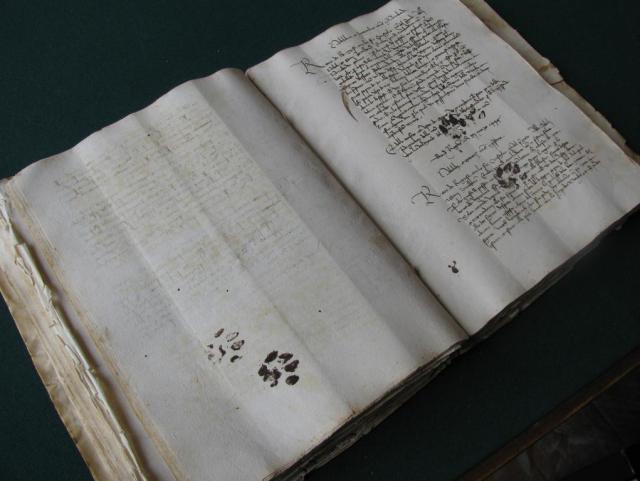
When Emir O. Filipovic, a medievalist at the University of Sarajevo, Bosnia and Herzegovina, visited the State Archives of Dubrovnik, he stumbled upon something that will hardly surprise anyone who lives with cats today: a 15th-century manuscript with inky paw prints casually tracked across it.
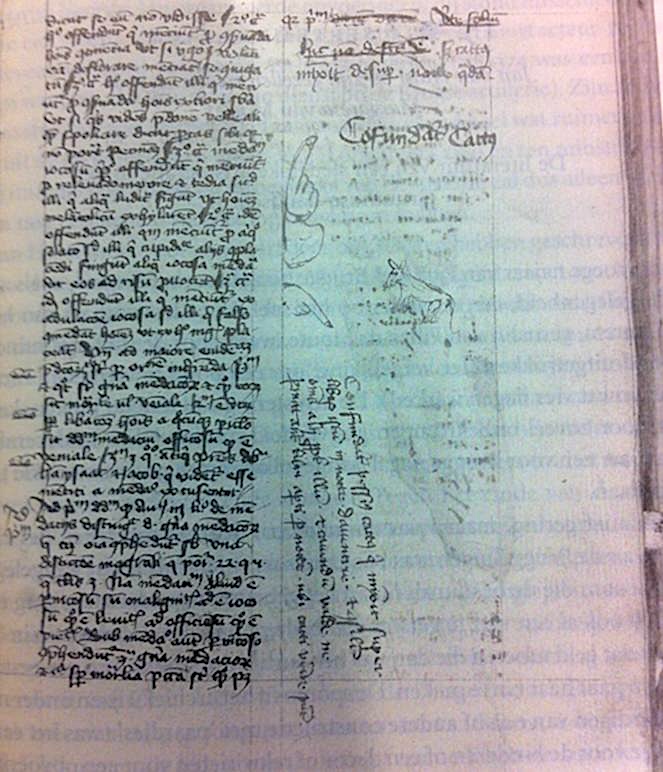
And here’s another purrpetrator. The Historisches Archiv in Cologne, Germany houses a manuscript with an interesting history. According to the blog MedievalFragments, “a Deventer scribe, writing around 1420, found his manuscript ruined by a urine stain left there by a cat the night before. He was forced to leave the rest of the page empty, drew a picture of a cat, and cursed the creature with the following words:”
Hic non defectus est, sed cattus minxit desuper nocte quadam. Confundatur pessimus cattus qui minxit super librum istum in nocte Daventrie, et consimiliter omnes alii propter illum. Et cavendum valde ne permittantur libri aperti per noctem ubi cattie venire possunt.
Here is nothing missing, but a cat urinated on this during a certain night. Cursed be the pesty cat that urinated over this book during the night in Deventer and because of it many others [other cats] too. And beware well not to leave open books at night where cats can come.
What I would sincerely love to know is whether, almost 600 years later, the urine smell has left the page. Cat owners, you’ll know what I mean.
Related Content:
Cats in Medieval Manuscripts & Paintings
Cats Migrated to Europe 7,000 Years Earlier Than Once Thought
Cats in Japanese Woodblock Prints: How Japan’s Favorite Animals Came to Star in Its Popular Art
Read More...Why Medieval Bologna Was Full of Tall Towers, and What Happened to Them
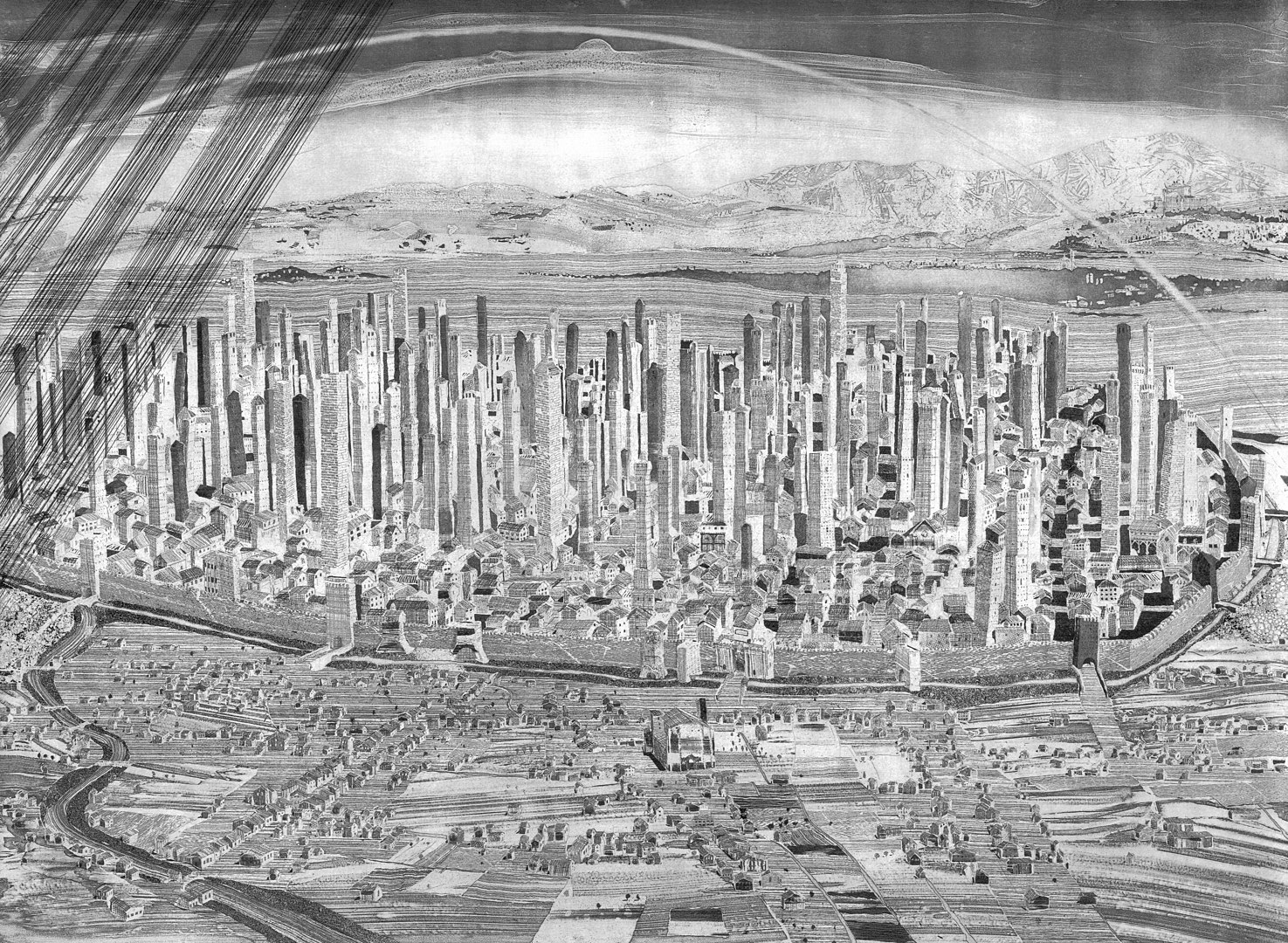
Image by Toni Pecoraro, via Wikimedia Commons
Go to practically any major city today, and you’ll notice that the buildings in certain areas are much taller than in others. That may sound trivially true, but what’s less obvious is that the height of those buildings tends to correspond to the value of the land on which they stand, which itself reflects the potential economic productivity to be realized by using as much vertical space as possible. To put it crudely, the taller the buildings in a part of town, the greater the wealth being generated (or, at times, destroyed). This is a modern phenomenon, but it also held true, in a different way, in the Bologna of 800 years ago.
There exists a work of art, much circulated online, that depicts what looks like the capital of Emilia-Romagna in the twelfth or thirteenth century. But the city bristles with what look like skyscrapers, creating an incongruous but enchanting medieval Blade Runner effect. Bologna really does have towers like that, but only about 22 of them still stand today. Whether it ever had the nearly 180 depicted in this particular image, and what happened to them if it did, is the question Jochem Boodt investigates in the Present Past video below.
In the era these towers were built, Bologna had become “one of the largest cities in Europe. It’s a time of huge, ambitious projects. Cities built cathedrals, town halls, and public squares — and some people built towers.” Those people included noble families who held to aristocratic traditions, not least violent feuding. Given that “the city is no place to build castles,” they instead inhabited urban complexes whose townhouses surrounded towers, which were “more like panic rooms” than actual living spaces. References to these prominent structures appear in subsequent works of art and literature: Dante, for instance, wrote of a leaning “tower called Garisenda.”
The etching that set Boodt on this journey to Bologna in the first place turns out to be the relatively recent work of an Italian artist called Toni Pecoraro, who heightened — in every sense — images of a 1917 model of the city by the shoemaker and “strange self-taught artist-scientist” Angelo Finelli. Finelli, in turn, drew his inspiration from a study by the nineteenth-century archaeologist Giovanni Gozzadini, himself a scion of one of those very families who competed to have the tallest tower, then got bored and pursued other status symbols instead. Perhaps Bologna is no longer the center of aristocratic and mercantile intrigue it used to be, judging by the sparseness of its current skyline, but then, there’s something to be said for not needing a fortified tower in which to hide at a moment’s notice.
Related content:
Why Europe Has So Few Skyscrapers
Why the Leaning Tower of Pisa Still Hasn’t Fallen Over, Even After 650 Years
Venice Explained: Its Architecture, Its Streets, Its Canals, and How Best to Experience Them All
Based in Seoul, Colin Marshall writes and broadcasts on cities, language, and culture. His projects include the Substack newsletter Books on Cities, the book The Stateless City: a Walk through 21st-Century Los Angeles and the video series The City in Cinema. Follow him on Twitter at @colinmarshall or on Facebook.
Read More...Isaac Asimov Predicts the Future of Online Education in 1988–and It’s Now Coming True in the Age of AI & Smartphones
“I have never let my schooling interfere with my education.” Though that line probably originated with a Canadian novelist called Grant Allen, it’s long been popularly attributed to his more colorful nineteenth-century contemporary Mark Twain. It isn’t hard to understand why it now has so much traction as a social media-ready quote, though during much of the period between Allen’s day and our own, many must have found it practically unintelligible. The industrialized world of the twentieth century attempted to make education and schooling synonymous, an ambition sufficiently wrongheaded that, by the nineteen-eighties, no less powerful a mind than Isaac Asimov was lamenting it on national television.
“In the old days you used to have tutors for children,” Asimov tells Bill Moyers in a 1988 World of Ideas interview. “But how many people could afford to hire a pedagogue? Most children went uneducated. Then we reached the point where it was absolutely necessary to educate everybody. The only way we could do it is to have one teacher for a great many students and, in order to organize the situation properly, we gave them a curriculum to teach from.” And yet “the number of teachers is far greater than the number of good teachers.” The ideal solution, personal tutors for all, would be made possible by personal computers, “each of them hooked up to enormous libraries where anyone can ask any question and be given answers.”
At the time, this wasn’t an obvious future for non-science-fiction-visionaries to imagine. “Well, what if I want to learn only about baseball?” asks a faintly skeptical Moyers. “You learn all you want about baseball,” Asimov replies, “because the more you learn about baseball the more you might grow interested in mathematics to try to figure out what they mean by those earned run averages and the batting averages and so on. You might, in the end, become more interested in math than baseball if you follow your own bent.” And indeed, similarly equipped with a personal-computer-as-tutor, “someone who is interested in mathematics may suddenly find himself very enticed by the problem of how you throw a curve ball.”
The trouble was how to get every household a computer, which was still seen by many in 1988 as an extravagant, not necessarily useful purchase. Three and a half decades later, you see a computer in the hand of nearly every man, woman, and child in the developed countries (and many developing ones as well). This is the technological reality that gave rise to Khan Academy, which offers free online education in math, sciences, literature, history, and much else besides. In the interview clip above, its founder Sal Khan remembers how, when his internet-tutoring project was first gaining momentum, it occurred to him that “maybe we’re in the right moment in history that something like this could become what Isaac Asimov envisioned.”
More recently, Khan has been promoting the educational use of a technology at the edge of even Asimov’s vision. Just days ago, he published the book Brave New Words: How AI Will Revolutionize Education (and Why That’s a Good Thing) and made a video with his teenage son demonstrating how the latest version of OpenAI’s ChatGPT — sounding, it must be said, uncannily like Scarlett Johansson in the now-prophetic-seeming Her — can act as a geometry tutor. Not that it works only, or even primarily, for kids in school: “That’s another trouble with education as we now have it,” as Asimov says. “It is for the young, and people think of education as something that they can finish.” We may be as relieved as generations past when our schooling ends, but now we have no excuse ever to finish our education.
Find a transcript of Asimov and Moyers’ conversation here.
Related content:
1,700 Free Online Courses from Top Universities
Arthur C. Clarke Predicts the Future in 1964 … And Kind of Nails It
Noam Chomsky Spells Out the Purpose of Education
The President of Northwestern University Predicts Online Learning … in 1934!
Salman Khan Returns to MIT, Gives Commencement Speech, Likens School to Hogwarts
Based in Seoul, Colin Marshall writes and broadcasts on cities, language, and culture. His projects include the Substack newsletter Books on Cities, the book The Stateless City: a Walk through 21st-Century Los Angeles and the video series The City in Cinema. Follow him on Twitter at @colinmarshall or on Facebook.
Read More...Hear Leo Tolstoy Read From His Last Major Work in Four Languages, 1909
In years past, we’ve brought you rare recordings of Sigmund Freud and Jorge Luis Borges speaking in English. Today we present a remarkable series of recordings of the great Russian novelist Leo Tolstoy reading a passage from his book, Wise Thoughts for Every Day, in four languages: English, German, French and Russian.
Wise Thoughts For Every Day was Tolstoy’s last major work. It first appeared in 1903 as The Thoughts of Wise Men, and was revised and renamed several times before the author’s death in 1910. Eventually banned by the Soviet regime, the book reappeared in 1995 as a bestseller in Russia. Then, in 1997, the text was translated into English by Peter Sekirin and published as A Calendar of Wisdom. The book is a collection of passages from a diverse group of thinkers, ranging from Laozi to Ralph Waldo Emerson. “I felt that I have been elevated to great spiritual and moral heights by communication with the best and wisest people whose books I read and whose thoughts I selected for my Circle of Reading,” wrote Tolstoy in his diary.
As an old man (watch video of him shortly before he died) Tolstoy rejected his great works of fiction, believing that it was more important to give moral and spiritual guidance to the common people. “To create a book for the masses, for millions of people,” wrote Tolstoy, “is incomparably more important and fruitful than to compose a novel of the kind which diverts some members of the wealthy classes for a short time, and then is forever forgotten.”
Tolstoy arranged his book for the masses as a calendar, with a series of readings for each day of the year. For example under the date, May 9, Tolstoy selects brief passages from Immanuel Kant, Solon, and the Koran. Underneath he writes, “We cannot stop on the way to self-perfection. As soon as you notice that you have a bigger interest in the outer world than in yourself, then you should know that the world moves behind you.”
The audio recordings above were made at the writer’s home in Yasnaya Polyana on October 31, 1909, when he was 81 years old. He died just over a year later. Tolstoy apparently translated the passage himself. The English version sounds a bit like the King James Bible. The words are hard to make out in the recording, but he says:
That the object of life is self-perfection, the perfection of all immortal souls, that this is the only object of my life, is seen to be correct by the fact alone that every other object is essentially a new object. Therefore, the question whether thou hast done what thou shoudst have done is of immense importance, for the only meaning of thy life is in doing in this short term allowed thee, that which is desired of thee by He or That which has sent thee into life. Art thou doing the right thing?
Tolstoy is known to have made several voice recordings in his life, dating back to 1895 when he made two wax cylinder recordings for Julius Block. Russian literary scholar Andrew D. Kaufman has collected three more vintage recordings (all in Russian) including Tolstoy’s lesson to peasant children on his estate, a reading of his fairy tale “The Wolf,” and an excerpt from his essay “I Cannot be Silent.”
Related Content:
The Last Days of Leo Tolstoy Captured on Video
Leo Tolstoy Creates a List of the 50+ Books That Influenced Him Most (1891)
Leo Tolstoy’s 17 “Rules of Life:” Wake at 5am, Help the Poor, & Only Two Brothel Visits Per Month
Read More...“The Virtues of Coffee” Explained in 1690 Ad: The Cure for Lethargy, Scurvy, Dropsy, Gout & More
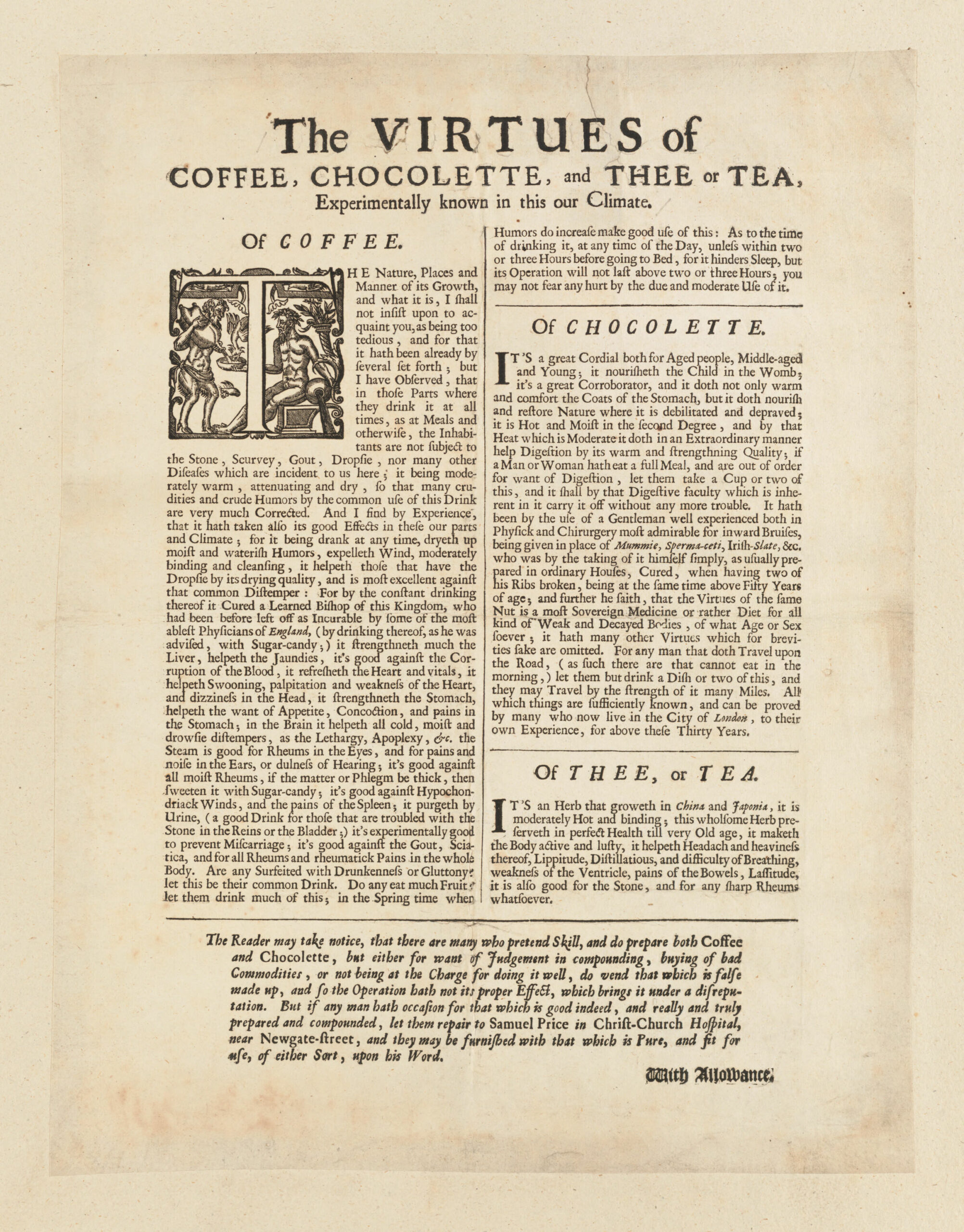
According to many historians, the English Enlightenment may never have happened were it not for coffeehouses, the public sphere where poets, critics, philosophers, legal minds, and other intellectual gadflies regularly met to chatter about the pressing concerns of the day. And yet, writes scholar Bonnie Calhoun, “it was not for the taste of coffee that people flocked to these establishments.”
Indeed, one irate pamphleteer defined coffee, which was at this time without cream or sugar and usually watered down, as “puddle-water, and so ugly in colour and taste [sic].”
No syrupy, high-dollar Macchiatos or smooth, creamy lattes kept them coming back. Rather than the beverage, “it was the nature of the institution that caused its popularity to skyrocket during the seventeenth and eighteenth centuries.”
How, then, were proprietors to achieve economic growth? Like the owner of the first English coffee-shop did in 1652, London merchant Samuel Price deployed the time-honored tactics of the mountebank, using advertising to make all sorts of claims for coffee’s many “virtues” in order to convince consumers to drink the stuff at home. In the 1690 broadside above, writes Rebecca Onion at Slate, Price made a “litany of claims for coffee’s health benefits,” some of which “we’d recognize today and others that seem far-fetched.” In the latter category are assertions that “coffee-drinking populations didn’t get common diseases” like kidney stones or “Scurvey, Gout, Dropsie.” Coffee could also, Price claimed, improve hearing and “swooning” and was “experimentally good to prevent Miscarriage.”
Among these spurious medical benefits is listed a genuine effect of coffee—its relief of “lethargy.” Price’s other beverages—“Chocolette, and Thee or Tea”—receive much less emphasis since they didn’t require a hard sell. No one needs to be convinced of the benefits of coffee these days—indeed many of us can’t function without it. But as we sit in corporate chain cafes, glued to smartphones and laptop screens and mostly ignoring each other, our coffeehouses have become somewhat pale imitations of those vibrant Enlightenment-era establishments where, writes Calhoun, “men [though rarely women] were encouraged to engage in both verbal and written discourse with regard for wit over rank.”
Related Content:
“The Vertue of the COFFEE Drink”: An Ad for London’s First Cafe Printed Circa 1652
Philosophers Drinking Coffee: The Excessive Habits of Kant, Voltaire & Kierkegaard
How Humanity Got Hooked on Coffee: An Animated History
The Birth of Espresso: The Story Behind the Coffee Shots That Fuel Modern Life
Josh Jones is a writer and musician based in Durham, NC. Follow him at @jdmagness.“The Virtues of Coffee” Explained in 1690 Ad: The Cure for Lethargy, Scurvy, Dropsy, Gout & More
Read More...RIP David Sanborn: See Him Play Alongside Miles Davis, Randy Newman, Sun Ra, Leonard Cohen and Others on His TV Show Night Music
It’s late in the evening of Saturday, October 28th, 1989. You flip on the television and the saxophonist David Sanborn appears onscreen, instrument in hand, introducing the eclectic blues icon Taj Mahal, who in turn declares his intent to play a number with “rural humor” and “world proportions.” And so he does, which leads into performances by Todd Rundgren, Nanci Griffith, the Pat Metheny Group, and proto-turntablist Christian Marclay (best known today for his 24-hour montage The Clock). At the end of the show — after a vintage clip of Count Basie from 1956 — everyone gets back onstage for an all-together-now rendition of “Never Mind the Why and Wherefore” from H.M.S. Pinafore.
This was a more or less typical episode of Night Music, which aired on NBC from 1988 to 1990, and in that time offered “some of the strangest musical line-ups ever broadcast on network television.” So writes E. Little at In Sheep’s Clothing Hi-Fi, who names just a few of its performers: “Sonic Youth, Miles Davis, the Residents, Charlie Haden and His Liberation Orchestra, Kronos Quartet, Pharoah Sanders, Karen Mantler, Diamanda Galas, John Lurie, and Nana Vasconcelos.”
One especially memorable broadcast featured “a 15-minute interview-performance by Sun Ra’s Arkestra that finds the composer-pianist-Afrofuturist at the peak of his experimental powers, moving from piano to Yamaha DX‑7 and back again while the Arkestra flexes its cosmic muscles.”
“Sanborn hosted the eminently hip TV show,” writes jazz journalist Bill Milkowski in his remembrance of the late saxman, who died last weekend, “not only providing informative introductions but also sitting in with the bands.” One night might see him playing with Al Jarreau, Paul Simon, Marianne Faithfull, Bootsy Collins, the Red Hot Chili Peppers, Dizzy Gillespie, — or indeed, some unlikely combination of such artists. “The idea of that show was that genres are secondary, an artificial division of music that really isn’t necessary; that musicians have more in common than people expect,” Sanborn told DownBeat in 2018. “We wanted to represent that by having a show where Leonard Cohen could sing a song, Sonny Rollins could play a song, and then they could do something together.”
Having wanted to pursue that idea further since the show’s cancellation — not the easiest task, given his ever-busy schedule of live performances and recording sessions across the musical spectrum — he created the YouTube channel Sanborn Sessions a few years ago, some of whose videos have been re-uploaded in recent weeks. But much also remains to be discovered in the archives of the original Night Music for broad-minded music lovers under the age of about 60 — or indeed, for those over that age who never tuned in back in the late eighties, a time period that’s lately come in for a cultural re-evaluation. Thanks to this YouTube playlist, you can watch more than 40 broadcasts of Night Music (which was at first titled Sunday Night) and listen like it’s 1989.
Related content:
How American Bandstand Changed American Culture: Revisit Scenes from the Iconic Music Show
All the Music Played on MTV’s 120 Minutes: A 2,500-Video Youtube Playlist
When Glenn O’Brien’s TV Party Brought Klaus Nomi, Blondie & Basquiat to Public Access TV (1978–82)
Based in Seoul, Colin Marshall writes and broadcasts on cities, language, and culture. His projects include the Substack newsletter Books on Cities, the book The Stateless City: a Walk through 21st-Century Los Angeles and the video series The City in Cinema. Follow him on Twitter at @colinmarshall or on Facebook.
Read More...A Playlist of the 3,300 Best Films & Documentaries on Youtube, Including Works by Hitchcock, Kubrick, Errol Morris & Other Auteurs
?si=yCx1pqpcATHND90L
Once upon a time, the most convenient means of discovering movies was cable television. This held especially true for those of us who happened to be adolescents on a break from school, ready and willing morning, midday, or night to sit through the commercial-laden likes of Corvette Summer, Transylvania 6–5000, BMX Bandits, or Freejack. Click on any of those links, and you can watch the relevant picture free on Youtube; click on the link to this playlist, and you’ll find 3,000 of the best films now available on that platform (the exact number may vary depending on your region of the world), as curated by Learnoutloud.com.
?si=rXFzge1fowoHfHxR
Not all these movies belong in the cheap-thrills bin. You’ll also find the work of celebrated auteurs like Alfred Hitchcock (The Man Who Knew Too Much, The 39 Steps), Stanley Kubrick (Fear and Desire, Barry Lyndon), Akira Kurosawa (Dersu Uzala, Dreams), and Woody Allen (Mighty Aphrodite, Cassandra’s Dream).
Then here are the documentaries, gathered here on their own playlist, including Errol Morris’ Gates of Heaven and The Thin Blue Line and Werner Herzog’s The Great Ecstasy of Woodcarver Steiner and Lessons of Darkness. You can even find related pictures across genres: consider following Lost in La Mancha, which documents Terry Gilliam’s thwarted efforts to make The Man Who Killed Don Quixote, with The Man Who Killed Don Quixote.
?si=iEzCzwxZXCYcw8Up
“Almost all of these movies are free with ads,” writes Learnoutloud.com’s David Bischke, though YouTube Premium subscribers will be able to watch ad-free. “Like any streaming service, the rights to these movies change frequently, especially on YouTube’s official Movies and TV channel. So if you see a movie you really want to watch, then check it out soon!” If you’ve been meaning to get into Raise the Red Lantern and To Live by director Zhang Yimou, to learn about artists and musicians like Jackson Pollock and Glenn Gould, or to behold a young Arnold Schwarzenegger’s early appearances in Pumping Iron and Hercules in New York, now’s the time. And with Vice Versa and Dream a Little Dream currently available, why not revisit the subgenre of the eighties body-switch comedy while you’re at it?
P.S. In case you’re wondering about the legality of the films, the Learnoutloud site notes: To make the playlist, “the movies had to be legally free on YouTube either from YouTube’s official Movies and TV channel, from a YouTube channel legally distributing the movie, or from a movie on YouTube that is in the public domain.” Just thought you might want to know…
Related content:
4,000+ Free Movies Online: Great Classics, Indies, Noir, Westerns, Documentaries & More
Watch More Than 400 Classic Korean Films Free Online Thanks to the Korean Film Archive
Download 6600 Free Films from The Prelinger Archives and Use Them However You Like
Based in Seoul, Colin Marshall writes and broadcasts on cities, language, and culture. His projects include the Substack newsletter Books on Cities, the book The Stateless City: a Walk through 21st-Century Los Angeles and the video series The City in Cinema. Follow him on Twitter at @colinmarshall or on Facebook.
Read More...Support Us
We're hoping to rely on loyal readers, rather than erratic ads. Please click the Donate button and support Open Culture. You can use Paypal, Venmo, Patreon, even Crypto! We thank you!

About Us

Open Culture scours the web for the best educational media. We find the free courses and audio books you need, the language lessons & educational videos you want, and plenty of enlightenment in between.
Advertise With Us
FREE UPDATES!
GET OUR DAILY EMAIL
Get the best cultural and educational resources on the web curated for you in a daily email. We never spam. Unsubscribe at any time.
FOLLOW ON SOCIAL MEDIA
Open Culture editor Dan Colman scours the web for the best educational media. He finds the free courses and audio books you need, the language lessons & movies you want, and plenty of enlightenment in between.
Advertise With Us


