Back in 2015, President Obama joined Marc Maron on the WTF podcast, marking the first time a sitting president took part in this new kind of broadcasting format. It was a watershed moment—a moment when podcasting went mainstream and became, soon enough, a big business. A decade later, and after nearly 1,700 episodes, Marc Maron has decided to bring WTF to an end, saying: “It really comes down to the fact that we’ve put up a new show every Monday and Thursday for almost sixteen years and we’re tired. We’re burnt out. And we are utterly satisfied with the work we’ve done. We’ve done great work.” On Monday, Maron dropped his final episode, bringing things full circle and talking once again with Barack Obama. If you’re going to leave your audience, especially during these dystopian times, it’s nice to leave them with some perspective and hope, and that’s what Obama does best. Watch the final episode above.
Boomer lives. Monkey and Lafonda. Cat angels everywhere.
In 1973, Peter Tompkins and Christopher Bird’s The Secret Life of Plants became a bestseller. Drawing from the results of scientific studies about whose replicability we may now feel certain doubts, the book suggested that emotion, and indeed sentience, belong not just to humans and animals, but also to, say, the potted fern in your living room. Many of Tompkins and Bird’s readers must have owned such a plant, and probably a variety of others besides, given the nineteen-seventies’ fad for domestic vegetation. Though ridiculed in the major media, The Secret Life of Plants proved sufficiently in tune with its time to inspire a feature-length documentary film with a high-tech soundtrack by none other than Stevie Wonder.
Did Wonder ever hear the album Mother Earth’s Plantasia? Subtitled Warm Earth Music for Plants… and the People Who Love Them, the album also features electronic compositions — exclusively electronic compositions, in fact, performed entirely with a Moog synthesizer. Its composer Mort Garson had been a versatile professional in the world of what was then called “easy listening,” and worked on the writing, arrangement, or production of popular songs like Brenda Lee’s “Dynamite,” Ruby & The Romantics’ “Our Day Will Come,” The Sandpipers’ “Guantanamera,” and Bill Withers’ “Three Nights and a Morning.” Upon meeting Robert Moog himself at a convention in 1967, Garson seems to have undergone a conversion, becoming one of the first composers to dedicate himself to exploring the musical potential of the then-novel synthesizer technology.
The music Garson went on to make with his Moog reflects the zeitgeist: there was Electronic Hair Pieces, with versions of numbers from the musical Hair, a series of twelve discs based on the signs of the zodiac, and even the score that accompanied the Apollo 11 moon landing broadcast. Of particular interest to early electronic music buffs is Black Mass, for which Garson took the pseudonym Lucifer, and which ought to be worth adding to one’s library with Halloween coming up.
Mother Earth’s Plantasia was released in 1976, three years before the Secret Life of Plants movie, though released may not be the right word: it could only be obtained free with purchase of either a houseplant from a shop called Mother Earth on Melrose Avenue in Los Angeles or a Simmons mattress from Sears. As music YouTuber David Hartley explains in his latest video, Garson was asked to create an album of music conducive to plant growth by Mother Earth’s owners, Lynn and Joel Rapp.
For decades thereafter, Mother Earth’s Plantasia could presumably be encountered by serious crate-diggers: the Pharcyde, for example, sampled one of its tracks on “Guestlist” in 2000. But it was only in the twenty-tens, after the establishment of YouTube and its obscure-music-uploading culture, that the album found an audience appreciative enough to inspire a proper release. (Its rediscovery played out similarly to that of Mariya Takeuchi’s “Plastic Love,” the golden tip of the Japanese city pop revival.) Its tracks eventually even appeared in ad campaigns for TurboTax and the French supermarket chain Intermarché. To listeners today, they may sound uncannily like video game music as it would take shape in the eighties, albeit with a soft-edged analog texture. As far as whether it actually helps plants grow, even Joel Rapp’s liner notes can only manage the promise that “it couldn’t possibly hurt.” But I can report that it does a decent job putting my infant twins to sleep.
Based in Seoul, Colin Marshall writes and broadcasts on cities, language, and culture. His projects include the Substack newsletterBooks on Cities and the book The Stateless City: a Walk through 21st-Century Los Angeles. Follow him on the social network formerly known as Twitter at @colinmarshall.
My Penguin Classics copy of Mark Twain’s Life on the Mississippi sits alone atop an overfull shelf. There is a bookmark on page 204, exactly halfway through, torn from an in-flight duty-free catalog—whiskey and fancy pens. It tells me “hey, you forgot to finish this, you [various obscenities].” And I shrug. What can I say? I went to grad school, where I learned to read ten books at once and never finish one. Good thing Mark Twain didn’t write that way, or we might not have Life on the Mississippi.
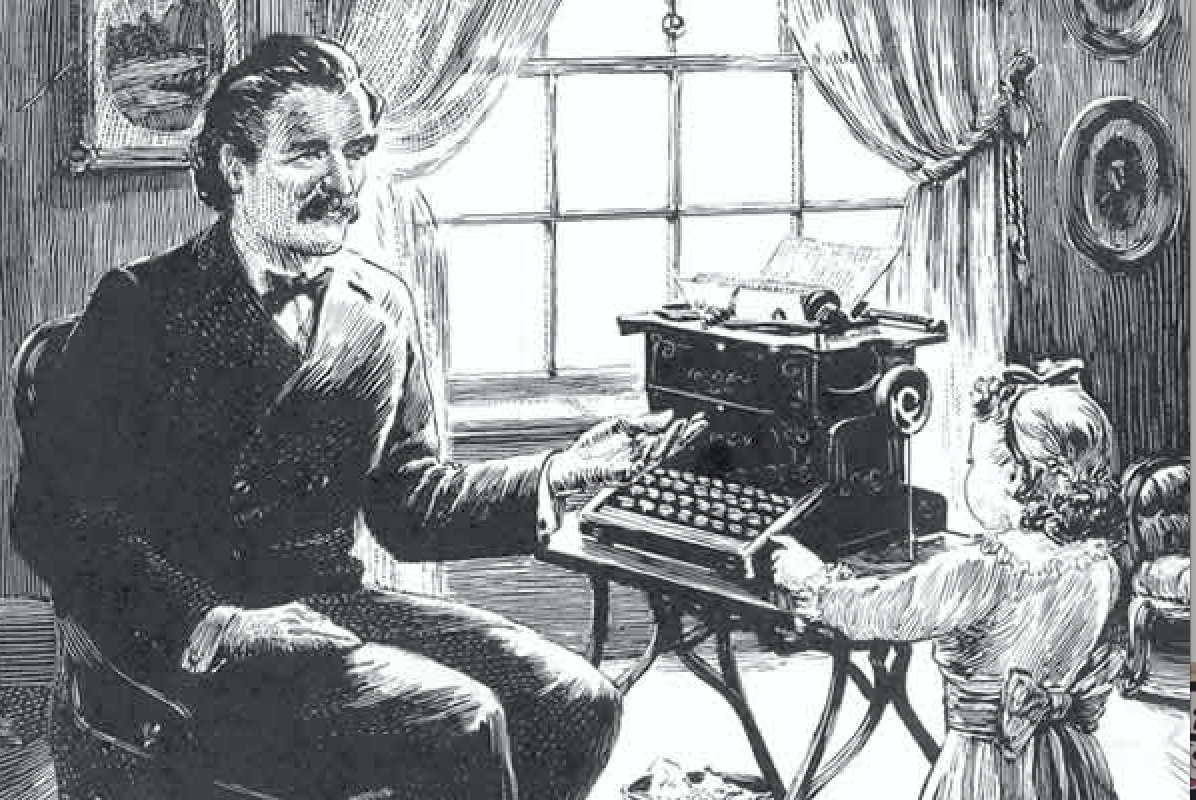
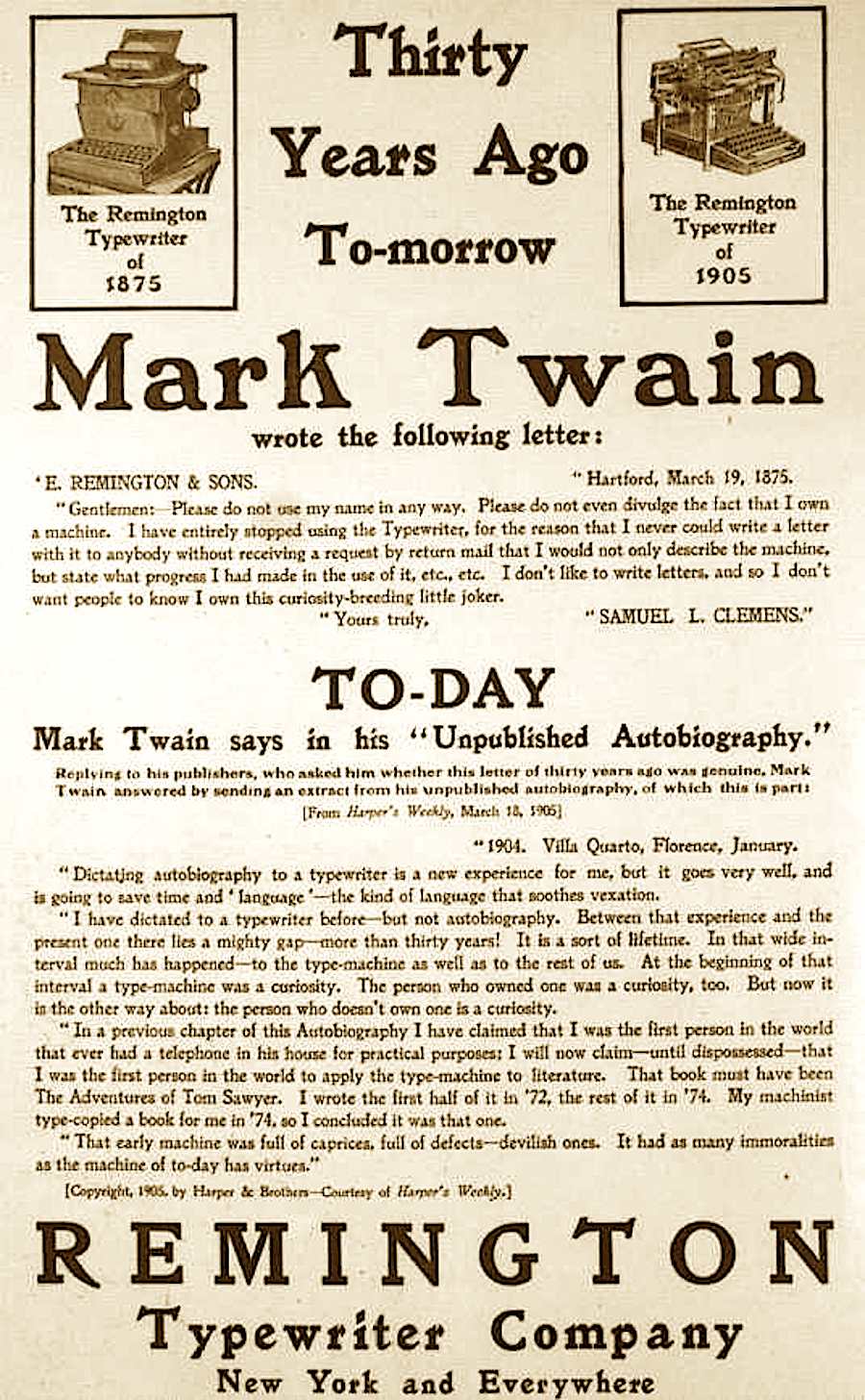
Twain was a diligent and conscientious writer with a memory like a bear trap, or at least that’s what he wanted us to think. But somewhere in his reminiscence he may have been confused. Twain wrote in his 1904 autobiography that his first novel written on a typewriter—the first typewritten novel at all—was Tom Sawyer.
Was this so? Twain purchased his first typewriter (which probably looked like the Sholes and Glidden seen here) in 1874 for $125. In 1875, he writes in a letter to the Remington company that he is no longer using his typewriter; it corrupts his morals because it makes him want to swear. He gives the infernal machine away, twice. It returns to him each time.
The year after Twain’s moral trouble with his Remington, Tom Sawyer is published from handwritten manuscript, not typed. Then, seven years later, Life on the Mississippi (1883) comes to the publisher in typescript. Twain did not type it himself—he had presumably renounced the act—but he dictated the memoir to a typist from a handwritten draft. Now, I can hear you quibbling… Life on the Mississippi isn’t a novel at all! Well, okay, fair enough. Let’s just say it’s the first typewritten book and call it a day, eh? Go read this excellent New Yorker piece on the early life of the typewriter and leave me alone. I’ve got a book to finish.
Note: An earlier version of this post appeared on our site in 2013.
If you would like to support the mission of Open Culture, consider making a donation to our site. It’s hard to rely 100% on ads, and your contributions will help us continue providing the best free cultural and educational materials to learners everywhere. You can contribute through PayPal, Patreon, and Venmo (@openculture). Thanks!
Brian Eno once said of the Velvet Underground that their first album sold only 30,000 copies, but everyone who bought one started a band. Joy Division’s debut Unknown Pleasures sold only 20,000 copies in its initial period of release, but the T‑shirt emblazoned with its cover art — an image of radio waves emanating from a pulsar taken from an astronomy encyclopedia— has long since constituted a commercial-semiotic empire unto itself. That speaks to the vast subcultural influence of the band, despite their only having been active from 1976 to 1980. When we speak of the genre of post-punk, we speak, in large part, of Joy Division and the artists they influenced.
Less than a year after the 1979 release of Unknown Pleasures, Joy Division’s lead singer Ian Curtis committed suicide. The band had already recorded Closer, their second and last album (at least before the subsequent, more successful reformation as New Order). Scant though it may be, their studio discography has only drawn more and more critical acclaim over the decades.
Still, fans who weren’t around to witness the rise of Joy Division first-hand will suspect they’ve missed out on something essential. “Live, Joy Division were heavy,” remembers band historian Jon Savage. “Performers — and David Bowie is a good example – know exactly what to give and what to withhold, but Ian Curtis didn’t have that stagecraft. He just came on and gave everything.”
That sort of intensity, Savage adds, is “not infinitely reproducible”; even at the time, it seems that those who witnessed Joy Division in concert understood that their peculiarly compelling energy was driving toward some kind of final combustion. You can get a taste of it in the collection of the group’s every televised performance, originally aired on BBC2 and Granada TV in 1978 and 1979, at the top of the post; just above, we have a 70-minute compilation of all their filmed live shows. Much of it consists of footage shot over two nights at the Apollo Theatre in 1979, which the uploader describes as of poor quality — but “according to people who were there, the gig’s quality was poor in person too.” As much as generations of fans have done to mythologize the band’s brief existence over the past 45 years, here is evidence that even Joy Division had an off night once in a while.
Based in Seoul, Colin Marshall writes and broadcasts on cities, language, and culture. His projects include the Substack newsletterBooks on Cities and the book The Stateless City: a Walk through 21st-Century Los Angeles. Follow him on the social network formerly known as Twitter at @colinmarshall.
For thousands of years, ordinary people all over the world not only worked side-by-side with domestic animals on a daily basis, they also observed the wild fauna around them to learn how to navigate and survive nature. The closeness produced a keen appreciation for animal behavior that informs the folk tales of every continent and the popular texts of every religion. Our delight in animal stories survives in children’s books, but in grown-up language, animal comparisons tend to be nasty and dehumanizing. The demeaning adjective “bestial” conveys a typical attitude not only toward people we don’t like, but toward the animal world as well. Orwell’s Animal Farm and Kafka’s Metamorphosis have become the standard references for modern animal allegory.
Early literature shows us a range of different attitudes, where animals are treated as equals, with character traits both good and bad, or as noble messengers of a god or gods rather than livestock, moving scenery, or exploitable resources.
We might refer in an eastern context to the Jataka Tales, fables of the Buddha’s many rebirths in the human and animal worlds that provide their readers with moral lessons. In the Christian west, we have the medieval bestiary—compendiums of animals, both real and mythological—that introduced readers to a moral typology through “reading” what early Christians thought of as the “book of nature.”
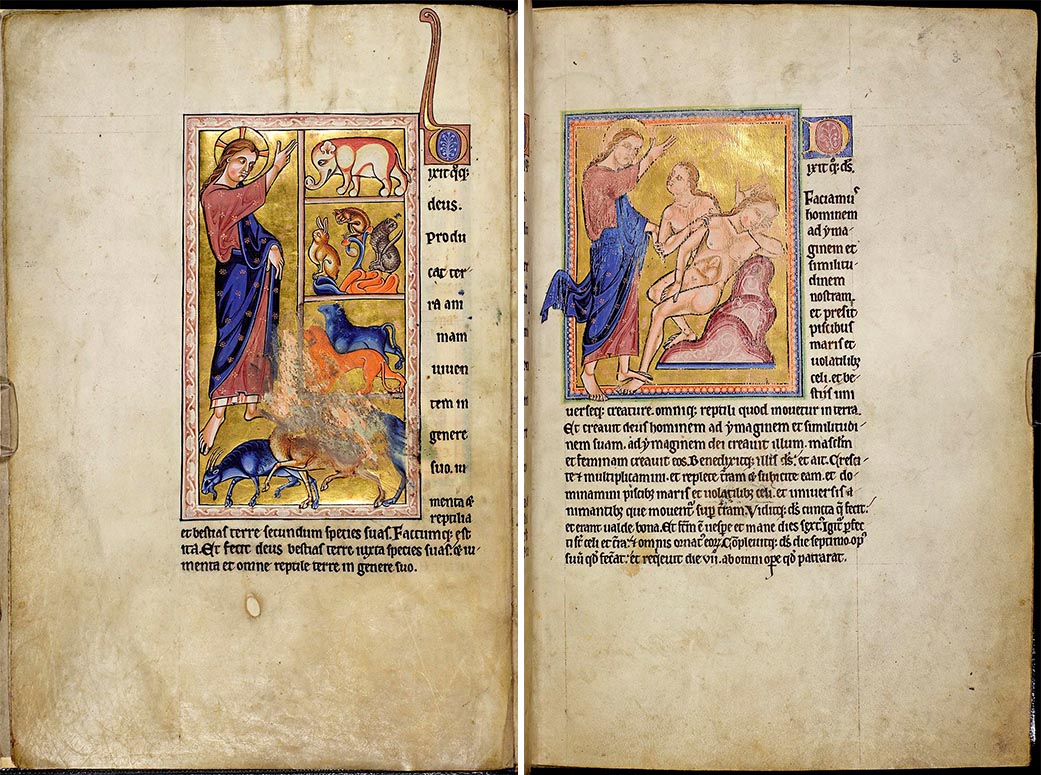
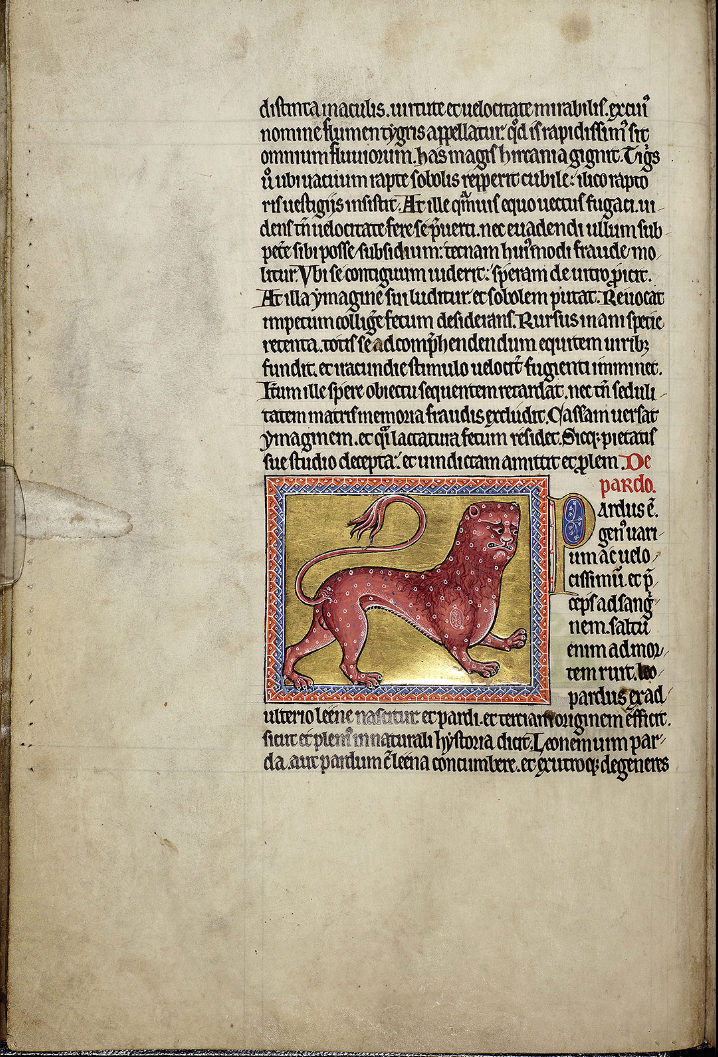
The most lavish of them all, the Aberdeen Bestiary, which dates from around 1200, was once owned by Henry VIII. Now, the University of Aberdeen has digitized the text and made it freely available to readers online. Beginning with the key creation stories from the book of Genesis, the book then dives into its descriptions of animals, beginning with the lion, the pard (panther), and the elephant.
You’ll notice that these are not animals that your typical medieval European reader would have encountered. One important difference between the bestiary and the fable is that the former draws many of its beasts from hearsay, conjecture, or pure fiction. But the intent is partly the same. These “were teaching tools,” notes Claire Voon at Hyperallergic, and the Aberdeen Bestiary contains illustrated “lengthy tales of moral behavior.”
Like the stories of Aesop, the bestiary presents important lessons, mixing in the fabulous with the naturalist. As Voon describes the Aberdeen Bestiary:
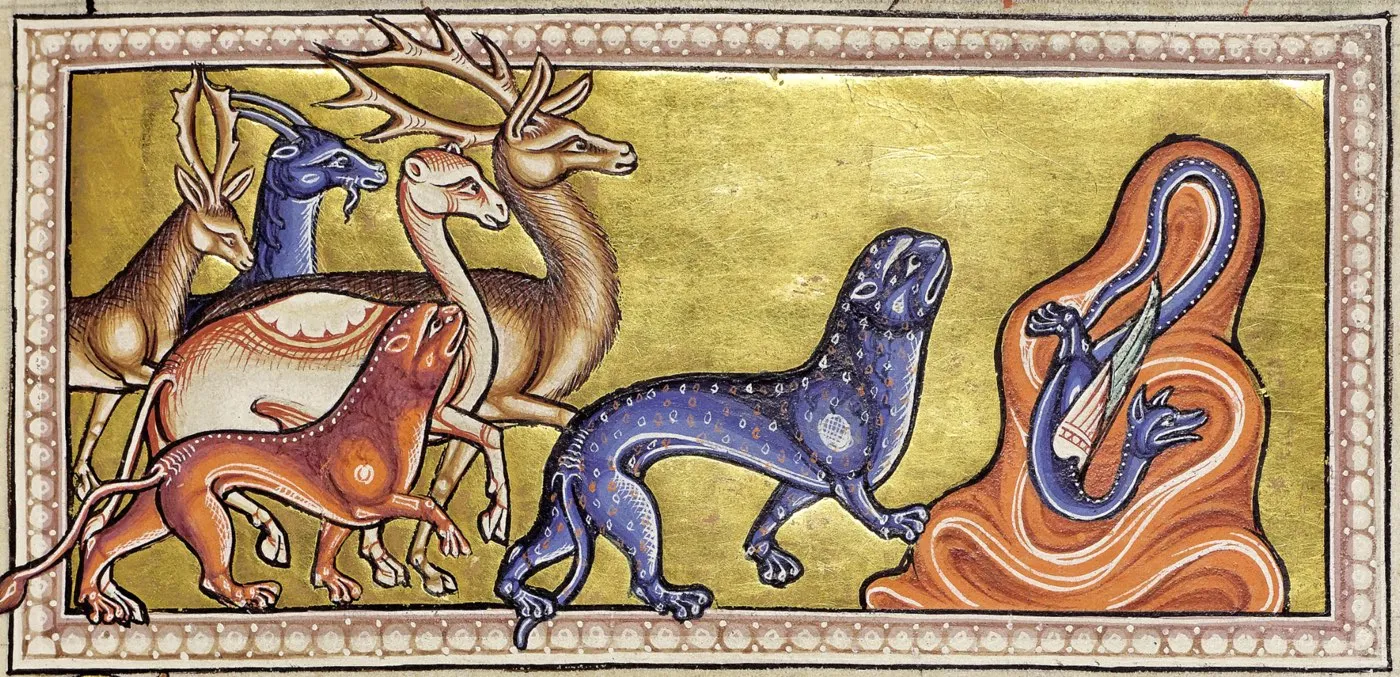
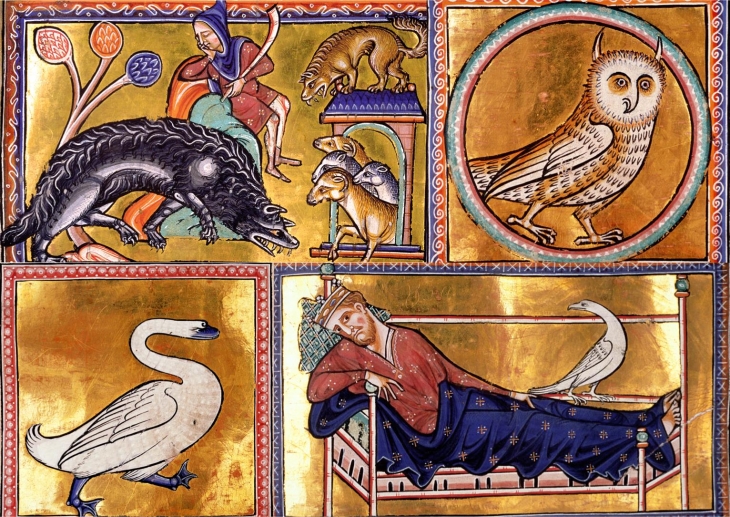
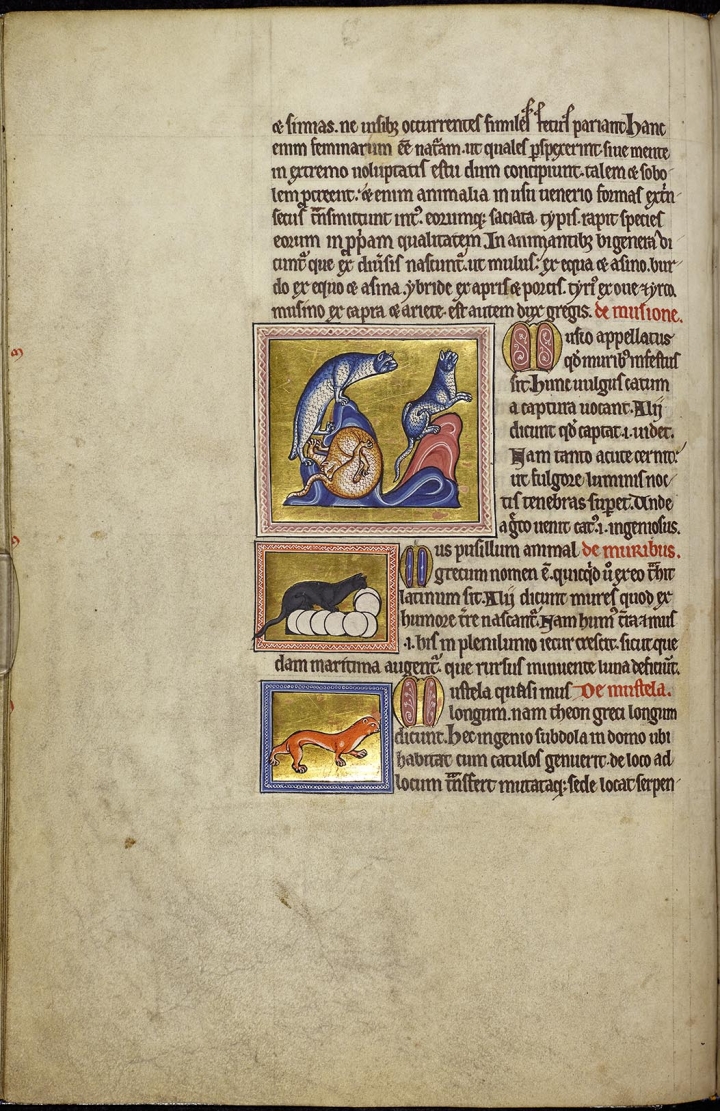
The illustrations are impressively varied, depicting common animals from tiny ants to elephants, as well as fantastic beasts, from the leocrota to the phoenix. Even the moral qualities of the humble sea urchin are honored with paragraphs of discussion. Beyond this array of creatures, the bestiary details the appearances and qualities of various trees, gems, and humans. Some of these may seem comical to 21st-century eyes: a swarm of bees, for instance, resembles an orderly line of shuttlecocks streaming into their hives. Yet other paintings are impressive for their near-accuracy, such as one image of a bat that shows how its membranous wings connect its fingers, legs, and tail. All of these rich details would have helped readers better understand the natural world as it was defined at the time of the book’s creation.
Incredibly ornate and bearing the marks of dozens of scribal hands, the book, historians believe, was originally produced for a wide audience, then taken by Henry’s librarians from a dissolved monastery. Never fully completed, it remained in the Royal Library for 100 years after Henry. “I doubt if the Tudor monarchs took it out for a regular read,” says Aberdeen University professor Jane Geddes. Now an open public document, it returns to its “original purpose of education,” writes Voon, “although for us, of course, it illuminates more about the past than the present.” See the high res scans here.
Note: An earlier version of this post appeared on our site in 2017.
Thinking of taking a trip abroad? Or maybe relocating for good? Americans would do well, even 150 years hence, to attend to Mark Twain’s satirical account of U.S. travelers journeying through Europe and Palestine, The Innocents Abroad. The “Americans who are painted to peculiar advantage by Mr. Clements” (sic), as fellow American satirist William Dean Howells wrote at the time, still roam the Earth—including travelers like one who “told the English officers that a couple of our gunboats could come and knock Gibraltar into the Mediterranean Sea.” The tactlessness and belligerence Twain skewered do not feel historically so far from home.
Twain’s portraits—“somewhat caricatured… or carefully and exactly done”—proved so popular with readers that he followed up with an unofficial sequel, 1880s A Tramp Abroad, a somewhat more serious fictionalized travelogue of Americans journeying through Europe; this time but two, Twain and his friend “Harris.” In the previous book, complained Howells, the reader learns “next to nothing about the population of the cities and the character of the rocks in the different localities.” Here, without his comedy troupe of traveling companions, Twain directs his focus outward with minute descriptions of his surroundings. He is, as usual, supremely curious, often perplexed, but mostly delighted by his experiences. Except when it comes to the food.
Growing “increasingly tired of an abundance of what he described as ‘fair-to-middling’ food,” writes Lists of Note, Twain comments: “The number of dishes is sufficient; but then it is such a monotonous variety of UNSTRIKING dishes […] Three or four months of this weary sameness will kill the robustest appetite.” Having never spent so long a time away, I cannot speak to Twain’s gustatory ennui, but I can relate, as no doubt can you, reader, to missing one or two familiar comfort foods (as well as “sincere and capable” ice water). Twain, perhaps not as adventurous an eater as he was a traveler—and in that sense also very much a modern American—made “an enormous list of the foods he’d missed the most, of which were to be consumed when he arrived home.”
The list, below, is itself a kind of travelogue, through the varieties of 19th century American cuisine, East, West, North, and South, including such delicacies as “’Possum” “Canvas-back-duck from Baltimore,” “Virginia bacon, broiled,” “Prairie hens, from Illinois,”and “Brook trout, from Sierra Nevadas.” While we might pine for a regional delicacy or favorite processed food, Twain conjured up in his mind’s gut a whole continent of food to come home to. What kinds of food do you find yourself missing when you travel? And how long a list might you find yourself making after several months tramping around in foreign lands? Tell us in the comments section below. For now, here’s Twain’s list:
Radishes. Baked apples, with cream Fried oysters; stewed oysters. Frogs. American coffee, with real cream. American butter. Fried chicken, Southern style. Porter-house steak. Saratoga potatoes. Broiled chicken, American style. Hot biscuits, Southern style. Hot wheat-bread, Southern style. Hot buckwheat cakes. American toast. Clear maple syrup. Virginia bacon, broiled. Blue points, on the half shell. Cherry-stone clams. San Francisco mussels, steamed. Oyster soup. Clam Soup. Philadelphia Terapin soup. Oysters roasted in shell-Northern style. Soft-shell crabs. Connecticut shad. Baltimore perch. Brook trout, from Sierra Nevadas. Lake trout, from Tahoe. Sheep-head and croakers, from New Orleans. Black bass from the Mississippi. American roast beef. Roast turkey, Thanksgiving style. Cranberry sauce. Celery. Roast wild turkey. Woodcock. Canvas-back-duck, from Baltimore. Prairie hens, from Illinois. Missouri partridges, broiled. ‘Possum. Coon. Boston bacon and beans. Bacon and greens, Southern style. Hominy. Boiled onions. Turnips. Pumpkin. Squash. Asparagus. Butter beans. Sweet potatoes. Lettuce. Succotash. String beans. Mashed potatoes. Catsup. Boiled potatoes, in their skins. New potatoes, minus the skins. Early rose potatoes, roasted in the ashes, Southern style, served hot. Sliced tomatoes, with sugar or vinegar. Stewed tomatoes. Green corn, cut from the ear and served with butter and pepper. Green corn, on the ear. Hot corn-pone, with chitlings, Southern style. Hot hoe-cake, Southern style. Hot egg-bread, Southern style. Hot light-bread, Southern style. Buttermilk. Iced sweet milk. Apple dumplings, with real cream. Apple pie. Apple fritters. Apple puffs, Southern style. Peach cobbler, Southern style Peach pie. American mince pie. Pumpkin pie. Squash pie. All sorts of American pastry. Fresh American fruits of all sorts, including strawberries which are not to be doled out as if they were jewelry, but in a more liberal way. Ice-water—not prepared in the ineffectual goblet, but in the sincere and capable refrigerator.
Note: An earlier version of this post appeared on our site in 2016.
When it was announced that SARS-CoV‑2, the virus at the center of the COVID-19 pandemic, had evolved into an even more contagious variant called Omicron, public reactions varied. For those of us with long memories of computer and video gaming, it brought to mind a title we hadn’t thought about in quite some time: Omikron: The Nomad Soul, released for Windows in 1999 and the Sega Dreamcast in 2000. More than a few gamers know it as the debut of controversial designer David Cage, whose studio Quantic Dream has gone on to produce various games of considerable cinematic and emotional ambit (if also an often frustrating eccentricity). But it made a wider cultural impact at the time by incorporating the performance of none other than David Bowie.
Or rather, it incorporated performances, plural, by David Bowie: in the game, he used motion capture technology to play both Boz, the wholly digital leader of an ancient religious order, and the lead singer of the band The Dreamers, whose concerts (shown in the video above) the player can view here and there around the dystopian cyberpunk city of Omikron.
Originally, the developers had only gone to Bowie in order to license his songs for the game’s soundtrack, but, as explained in the mrixrt video below, the project so appealed to his technophilia that he proposed a much deeper involvement. That included recording a set of original songs, later included on his album Hours… (which is itself notable in the history of technology and culture for being one of the first downloadable releases by a major artist).
Among its many novel qualities, including pioneering the “open world” environment now standard in big-budget games, Omikron grants the player — as the titular “nomad soul” — the ability to inhabit the bodies of a host of other characters (including one played by Bowie’s wife Iman). It isn’t hard to imagine the concept’s appeal for a performer who made his name with frequent changes of identity — and who even suggested, at one point, that he leave that name behind in the reality of the game, re-emerging into public life as David Jones. By the time he died, the better part of two decades later, his role in gaming was mostly forgotten, but one of the many tributes paid to him included a free re-release of Omikron. Those who took the chance to revisit the game would have remembered the feeling it first gave them that its digital world continued even when they weren’t playing — accompanied by a sense that, somehow, Bowie continues to live within it.
Based in Seoul, Colin Marshall writes and broadcasts on cities, language, and culture. His projects include the Substack newsletterBooks on Cities and the book The Stateless City: a Walk through 21st-Century Los Angeles. Follow him on the social network formerly known as Twitter at @colinmarshall.
Give Dr. Andrew Weil three minutes, and he can teach you a 60-second technique for falling asleep. Above, the alternative medicine guru walks you through the 4–7‑8 breathing method. As he demonstrates, it “takes almost no time, requires no equipment and can be done anywhere.” And once you master it, you can use the 4–7‑8 breathing technique (explained and demonstrated in greater detail here ) to lower your anxiety levels (useful these days!), navigate tension-filled moments, and deal with food cravings.
Elsewhere, Weil has said, “If I had to limit my advice on healthier living to just one tip, it would be simply to learn how to breathe correctly.” Hence why he created an audio recording, Breathing: The Master Key to Self Healing, which you can still purchase online.
If you would like to support the mission of Open Culture, consider making a donation to our site. It’s hard to rely 100% on ads, and your contributions will help us continue providing the best free cultural and educational materials to learners everywhere. You can contribute through PayPal, Patreon, and Venmo (@openculture). Thanks!
Albert Einstein is the rare figure who’s universally known, but almost entirely for his professional achievements. Few of us who can explain the theory of relativity can also say much about the personal life of the man who came up with it, though that doesn’t owe to a lack of documentation. Thanks to science YouTuber Toby Hendy, we have, for example, some of the love letters he wrote to the women who constituted a veritable parade through his life. Also, in another video for her channel Tibees, Hendy reads the letters he wrote in the process of divorcing his first wife, the Serbian physicist and mathematician Mileva Marić.
Einstein married Marić in January 1903, says Hendy, “after they had been together for around five years. The relationship was in its prime, and so was the academic productivity. It was in 1905 that Einstein would publish his four major papers that would change the face of physics. By 1912, however, Einstein had started having an affair with his cousin,” Elsa Lowenthal.
By 1914, Einstein wrote to Marić a letter “detailing some conditions of them continuing to live together,” if not quite as man and wife. The conditions read as follows:
CONDITIONS
A. You will make sure:
1. that my clothes and laundry are kept in good order; 2. that I will receive my three meals regularly in my room; 3. that my bedroom and study are kept neat, and especially that my desk is left for my use only.
B. You will renounce all personal relations with me insofar as they are not completely necessary for social reasons. Specifically, You will forego:
1. my sitting at home with you; 2. my going out or travelling with you.
C. You will obey the following points in your relations with me:
1. you will not expect any intimacy from me, nor will you reproach me in any way; 2. you will stop talking to me if I request it; 3. you will leave my bedroom or study immediately without protest if I request it.
D. You will undertake not to belittle me in front of our children, either through words or behavior.
Though they agreed to put this stringent plan into effect, less than two weeks later, he wrote to Elsa, “Yesterday my wife left for good with the children” — and “you, dear little Elsie, will now become my wife and become convinced that it is not at all so hard to live by my side.”
Einstein did marry Lowenthal in 1919, and the union, though hardly characterized by ideal faithfulness, did last until her death in 1935. There would be plenty of other women, but none who played quite the same role in his life as Marić, not only the mother of his children, but also — according to some historians — a collaborator on some of his accomplishments in physics. According to Lost Women of Science, “there is little tangible evidence to support the claims that Marić was a co-author of Einstein’s first major work. That said, there are plenty of personal testimonies from those who knew Marić and Einstein that her involvement was likely.” One condition of their divorce settlement, at any rate, held that Marić receive his Nobel Prize money, were he to win it, which he went on to do a couple of years later. This makes clear that, whatever the importance of her own scientific work, she must’ve had a good head on her shoulders.
Based in Seoul, Colin Marshall writes and broadcasts on cities, language, and culture. His projects include the Substack newsletterBooks on Cities and the book The Stateless City: a Walk through 21st-Century Los Angeles. Follow him on the social network formerly known as Twitter at @colinmarshall.
If you happen to be a high school student in Florida who’s eager to read A Clockwork Orange, that urge may turn out to be harder to satisfy than you imagine. Anthony Burgess’ harrowing, linguistically inventive novel of a grim near future has come out on top in PEN America’s latest ranking of banned books: that is, books removed or prevented even from entering public school libraries, most commonly in the state of Florida, with Texas and Tennessee as runners-up. Further down the list appears another widely known dystopian saga, Margaret Atwood’s The Handmaid’s Tale; Toni Morrison’s tale of Depression-era race relations The Bluest Eye; and even such long-popular “young adult” standards as Judy Blume’s Forever… and Stephen Chbosky’s The Perks of Being a Wallflower.
Since its publication in 1962, “A ClockworkOrange has faced multiple book banning attempts due to the sexual violence it depicts,” says Carnegie Mellon University’s Banned Books Project. “In 1973, a bookseller in Orem, Utah, was arrested for selling the novel along with two other ‘obscene’ books.”
Bans followed “in 1976 in Aurora, Colorado, in 1977 in Westport, Connecticut, and in 1982 in Anniston, Alabama. As recently as 2019, members of the Florida Citizens Alliance” — in yet another example of the surprising tendency toward cultural authoritarianism in the Sunshine State — “have lobbied to ban the book along with almost one hundred other ‘pornographic’ novels.”
The notoriety of A Clockwork Orangein this regard probably owes something to the steely luridness of Stanley Kubrick’s film adaptation, which was banned in England by Kubrick himself. It makes, in any case, for an ironic object of a book ban, given its themes. Burgess was inspired to write this novel of juvenile ultra-delinquency, as he explains in the interview clip above, by “talk in the nineteen-sixties of the possibility of getting these young thugs and not putting them in jail, because jail is needed for professional criminals, but rather putting them through a course of conditioning” to make them behave less like organisms than machines: the “clockwork oranges” of the title. The state, it seemed, “was all too ready to take over our brains and turn us into good little citizens without the power of choice” — a process that plausibly begins by restricting the choice of reading material.
Based in Seoul, Colin Marshall writes and broadcasts on cities, language, and culture. His projects include the Substack newsletterBooks on Cities and the book The Stateless City: a Walk through 21st-Century Los Angeles. Follow him on the social network formerly known as Twitter at @colinmarshall.
No historical figure better fits the definition of “Renaissance man” than Leonardo da Vinci, but that term has become so overused as to become misleading. We use it to express mild surprise that one person could use both their left and right hemispheres equally well. But in Leonardo’s day, people did not think of themselves as having two brains, and the worlds of art and science were not so far apart as they are now.
That Leonardo was able to combine fine arts and fine engineering may not have been overly surprising to his contemporaries, though he was an extraordinarily brilliant example of the phenomenon. The more we learn about him, the more we see how closely related the two pursuits were in his mind.
He approached everything he did as a technician. The uncanny effects he achieved in painting were the result, as in so much Renaissance art, of mathematical precision, careful study, and firsthand observation.
His artistic projects were also experiments. Some of them failed, as most experiments do, and some he abandoned, as he did so many scientific projects. No matter what, he never undertook anything, whether mechanical, anatomical, or artistic, without careful planning and design, as his copious notebooks testify. As more and more of those notebooks have become available online, both Renaissance scholars and laypeople alike have learned considerably more about how Leonardo’s mind worked.
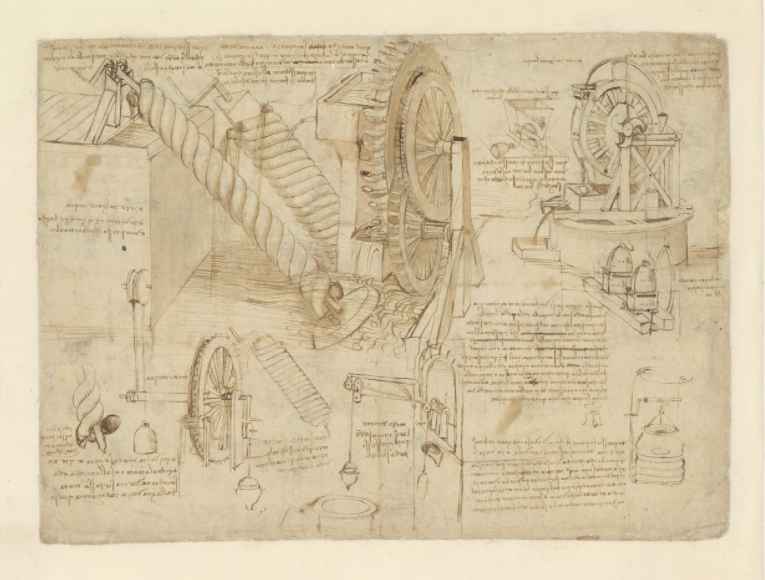
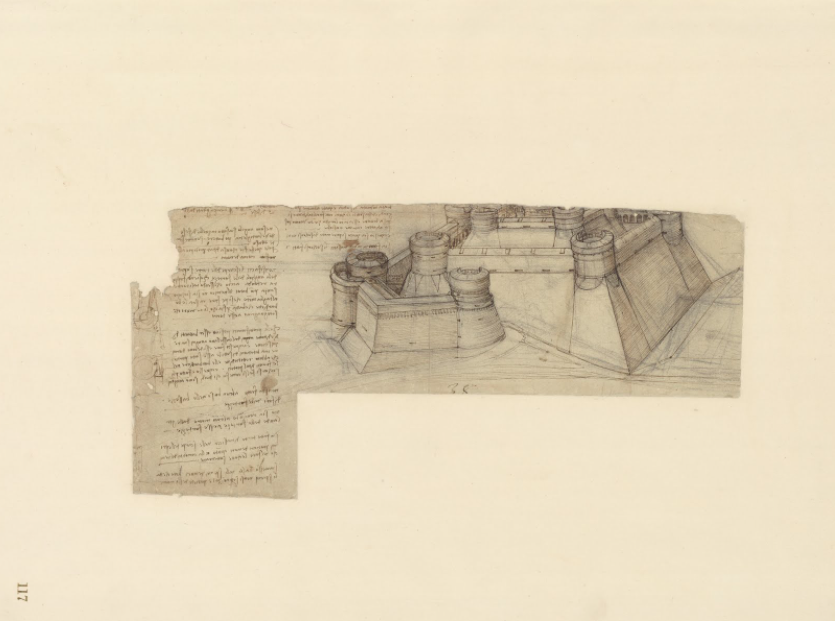
“No other collection counts more original papers written by Leonardo,” notes Google. The Codex Atlanticus “consists of 1119 papers, most of them drawn or written on both sides.” Its name has “nothing to do with the Atlantic Ocean, or with some esoteric, mysterious content hidden in its pages.” The 12-volume collection acquired its title because the drawings and writings were bound with the same size paper that was used for making atlases. Gathered in the 16th century by sculptor Pompeo Leoni, the papers descended from Leonardo’s close student Giovan Francesco Melzi, who was entrusted with them after his teacher’s death.
The history of the Codex itself makes for a fascinating narrative, much of which you can learn at Google’s Ten Key Facts slideshow. The notebooks span Leonardo’s career, from 1478, when he was “still working in his native Tuscany, to 1519, when he died in France.” The collection was taken from Milan by Napoleon and brought to France, where it remained in the Louvre until 1815, when the Congress of Vienna ruled that all artworks stolen by the former Emperor be returned. (The emissary tasked with returning the Codex could not decipher Leonardo’s mirror writing and took it for Chinese.)
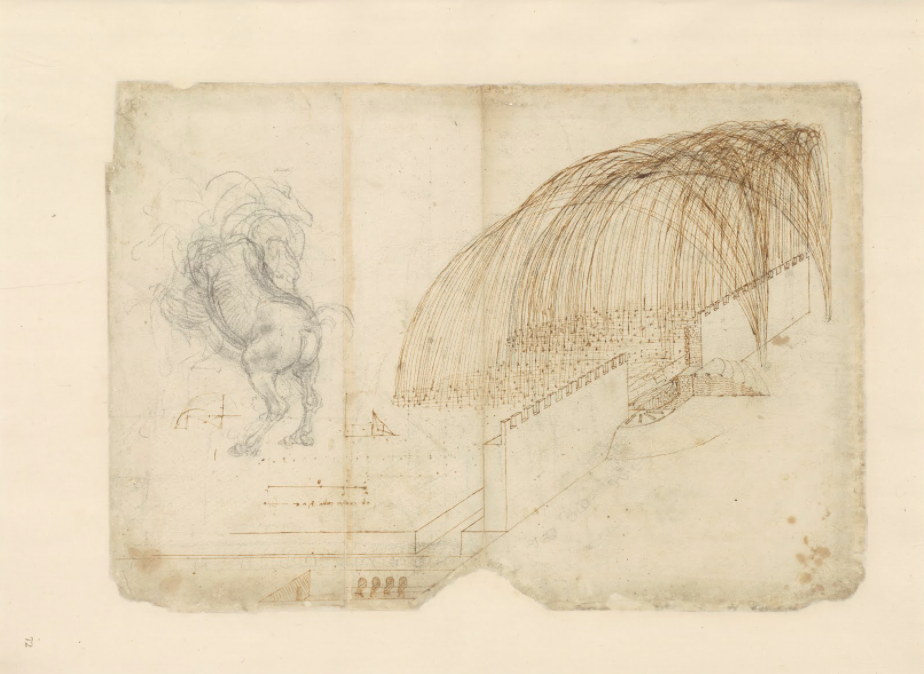
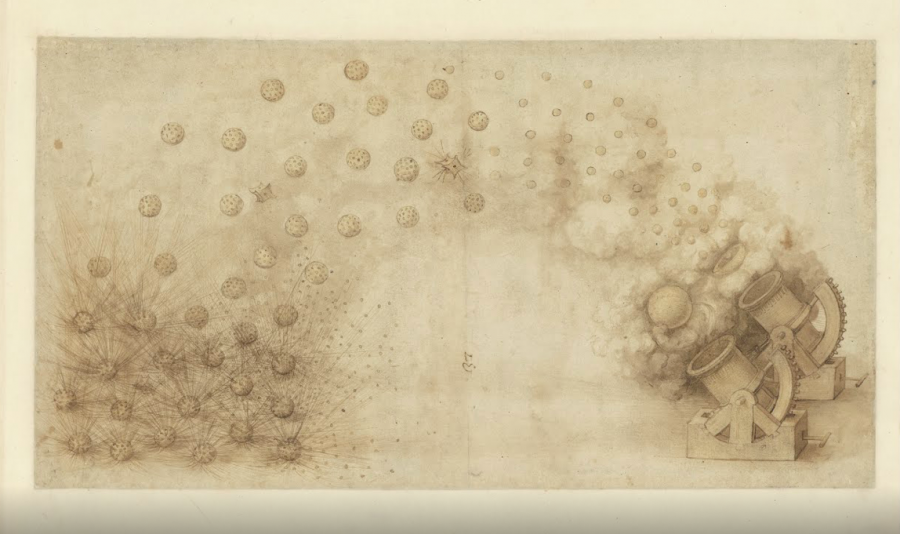
The Codex contains not only engineering diagrams, anatomy studies, and artistic sketches, but also fables written by Leonardo, inspired by Florentine literature. And it features Leonardo’s famed “CV,” a letter he wrote to the Duke of Milan describing in nine points his qualifications for the post of military engineer. In point four, he writes, “I still have very convenient bombing methods that are easy to transport; they launch stones and similar such in a tempest full of smoke to frighten the enemy, causing great damage and confusion.”
As if in illustration, elsewhere in the Codex, the drawing above appears, “one of the most celebrated” of the collection.” It was “shown to traveling foreigners visiting the Ambrosiana [the Biblioteca Ambrosiana in Milan, where the Codex resides] since the 18th century, usually arousing much amazement.” It is still amazing, especially if we consider the possibility that its artistry might have been something of a byproduct for its creator, whose primary motivation seems to have been solving technical problems—in the most elegant ways imaginable.
We're hoping to rely on loyal readers, rather than erratic ads. Please click the Donate button and support Open Culture. You can use Paypal, Venmo, Patreon, even Crypto! We thank you!
Open Culture scours the web for the best educational media. We find the free courses and audio books you need, the language lessons & educational videos you want, and plenty of enlightenment in between.