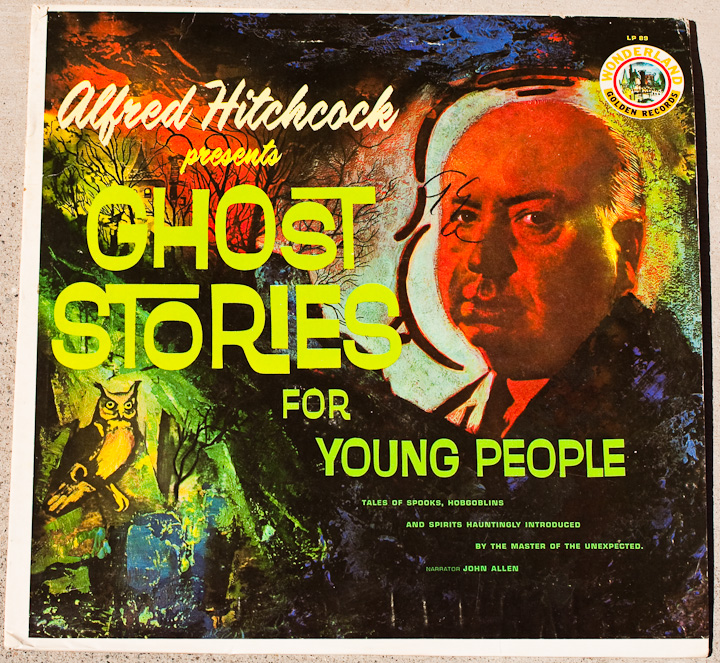
“Now of course, the best way to listen to ghost stories is with the lights out,” says the inimitable Alfred Hitchcock, as he introduces his 1962 vinyl release Alfred Hitchcock Presents: Ghost Stories for Young People. “There is nothing like a dark room to attract ghosts and you may like to have some of our mutual friends come and listen with you.”
Just in time for Halloween, we are shining a flickering light on this album, released once before on CD and now on Spotify. (You can also find it on YouTube.) It will either take listeners back to when they were kids, or frighten a new generation of young ones for the first time.
Though Hitchcock’s films toyed with spirits-—Rebecca and Vertigo among them-—he never really made straight up monster movies or ghost stories. (Psycho and The Birds are the closest he ever got.) But once he became a television host and personality in the 1950s, his mischievous character and his macabre voice made him a natural to present all sorts of ghoulish anthologies, resulting in numerous paperbacks and hardbacks, most of which he had little to do with but simply bore his name as a stamp of frightening authority.
And even before that, Hitchcock was putting his name to short suspense story collections, and a mystery magazine that was started in 1956 and continues to this day. We talk about him as one of the best film directors of all time, but he was also a one-man suspense and terror industry in his day, a canny creator who knew the worth of licensing his name.
Of the six stories here, the two given writer’s credit are “Jimmy Takes Vanishing Lessons” by Walter R. Brooks (a children’s author who created the talking horse character Mr. Ed) and “The Open Window” by Edwardian writer Saki.
Judging from the YouTube comments for the crackly recording posted there, these stories have haunted these listeners since their childhood. Kids these days might prefer a dish of creepypasta, but there’s no denying the power of a voice, creepy music, and sudden sound effects, all delivered by way of headphones…with the lights off.
Ted Mills is a freelance writer on the arts who currently hosts the FunkZone Podcast. You can also follow him on Twitter at @tedmills, read his other arts writing at tedmills.com and/or watch his films here.
At a Green Day concert in Chicago, a fan held up a sign, “I can play every song on Dookie.” So Billie Joe Armstrong let him pop on stage to play “When I Come Around.” And the fan didn’t disappoint, from the moment he climbed on the amp and kicked things off, to his stage dive back into the crowd. The footage was recorded on October 23rd. Enjoy.
Philip K. Dick, titling the 1968 novel that would provide the basis for Blade Runner, asked whether androids dream of electric sheep. But what goes on in the “mind” of an artificial intelligence designed specifically to watch movies? Terence Broad, a computing researcher at Goldsmiths, University of London, took on a form of that question for his master’s dissertation, using “artificial neural networks to reconstruct films — by training them to reconstruct individual frames from films, and then getting them to reconstruct every frame in a given film and resequencing it.”
“Neural networks” sounds like a term straight out of one of Dick’s influential science-fiction novels, but you’ve almost certainly heard quite a bit about them in recent years of real life. A neural network, in the words of neurocomputer pioneer Dr. Robert Hecht-Nielsen, “is a computing system made up of a number of simple, highly interconnected processing elements, which process information by their dynamic state response to external inputs.” These systems, in other words, imitate the problem-solving methods of the human brain as we currently understand them, and can, when provided with suitable data, “learn” from it.
One thinks less of the Replicants, Blade Runner’s lethally engineered superhumans, than of Number 5, the artificially intelligent robot star of Short Circuit (co-designed, incidentally, by Blade Runner’s “visual futurist” Syd Mead), with his constant demands for “input.” When it came out in the mid-1980s, that goofy comedy once looked like by far the more successful film, but over the intervening three decades Ridley Scott’s one-time bombhas become perhaps the most respected work of its kind. “The first ever film remade by a neural network had to be Blade Runner,” Terence Broad told Vox, pointing in his explanation of his project to the movie’s prescient treatment of the theme “that the task of determining what is and isn’t human is becoming increasingly difficult, with the ever-increasing technological developments.”
Dick, as his generations of readers know, had deep concerns about the difference between the real and the unreal, and how human beings can ever tell one from the other. He tackled that issue again, from a very different angle, in his 1977 novel A Scanner Darkly. Richard Linklater turned that book into a movie almost thirty years later, one which Broad also fed as input into his neural network, which then attempted to reconstruct it. Though still thematically appropriate, its colorful rotoscoped animation posed more of a challenge, and “the results are less temporally coherent than the Blade Runner model.” But “on the other hand, the images are incredibly unusual and complex, once again producing video with a rich unpredictability.”
At the top of the post, you can watch Broad’s Blade Runner-trained neural network reconstruct Blade Runner’s trailer, and below that his A Scanner Darkly-trained neural network reconstruct A Scanner Darkly’s trailer. Curiosity demanded, of course, that Broad let a neural network trained to watch one film have a go at reconstructing the other, and just above we have the A Scanner Darkly-trained neural network’s reconstruction of Blade Runner. He’s also given Scott’s famous 1984-themed Super Bowl Apple ad and Godfrey Reggio’s Koyaanisqatsi theneural-network treatment. We read so often, these days, about artificial intelligence’s growing ability to out-think, out-work, and one day even out-create us. What on Earth, the Philip K. Dicks of our day must wonder, will the neural networks come up with when they can finally out-watch us?
Jonathan Lethem knows a thing or two about storytelling as well as about caped comic-book characters, and on a recent podcast appearance he accused films about the latter of an inability to do the former: “I think one of the least satisfying film genres I’ve ever encountered is the contemporary superhero movie, which just seems to me kind of dead on arrival. I can’t even get into the hair-splitting about, ‘Oh, but there are three or four good ones.’ I just don’t see any life there.” How can such big productions filled with so much action play out so lifelessly on the screen? Perhaps the work of Akira Kurosawa, known in his day as the “Emperor” of Japanese film, can show us the answer.
“Wouldn’t scenes that display the pinnacle of physicality work better,” asks video essayist Lewis Bond over images of the Avengers battling towering monsters in the centers of major cities, Spider-Man swinging huge arcs through some kind of smoke-and-spark factory, and Batman beating up Superman, “if they also conveyed an emotional intensity to match this? Action and emotion need not be separated by a chasm as they so often are, and this is where the greatness of Seven Samurai lies.” He shows us in “Drama Through Action,” a study of how Kurosawa’s best-known picture delivers its action with impact, which appeared earlier this month on Channel Criswell, previously the source of video essays on such masters of cinema as Yasujirō Ozu and Andrei Tarkovsky.
Bond points to several different factors that make the action in Kurosawa’s 1954 epic adventure of the Sengoku era, despite its technological impoverishment compared to the superhero blockbusters of the 21st century, feel so much more meaningful. A focus less on the action itself and the protagonists performing it than on the consequences of that action meaning that “death carries significance.” A “situational awareness” and clear portrayal of “the characters’ short-term objectives” means that the audience can follow, and thus feel, their successes and failures. A clear establishment of geography enables viewers to place the combatants, and themselves, on the battlefield. A sparing use of cutting and slow motion keeps emotionally charged moments charged.
These and other techniques skillfully employed by Kurosawa and his collaborators ensure that, in Seven Samurai, “every moment of action communicates a sense of urgency” — exactly the quality lacked, in other words, by the expensive and furious yet strangely dull superhero spectacles of today. “To me, Seven Samurai is still the most forward-thinking piece of cinema ever created,” says Bond. “What it did for the way action is photographed can still be seen today. And when it isn’t seen, it probably should be.” Take heed, young directors slated to take on the next wave of superhero-franchise cinematic reboots: to make your entries stand out, you have only to learn from the Emperor.
Since his breakout early days directing commercials and music videos for the likes of Fatboy Slim, Weezer, Daft Punk, and the Breeders, Spike Jonze has honed a quirky visual sensibility that translated almost seamlessly to feature film. But even at his quirkiest, Jonze hasn’t been about quirk for quirk’s sake. His characters—highly emotional robots, dog-headed men with broken legs, tormented puppeteers, enthusiastic amateur dance troops—are underdogs, weirdos, figures on the fringes who make us question what it means to be people: to be lonely, in love, creatively obsessed, and emotionally scrambled.…
There is a paradox inherent in Jonze’s films and videos. Their oddball plots and characters cut through the cynical veneer of cool that keeps us from asking hard questions about our emotional lives, but they do so in stylistic exercises that in some cases themselves become emblems of pop-culture cool. Not so the short film “Mourir auprès de toi” (“To Die by Your Side”), which takes its title from one of the most achingly heartbreaking of Smiths’ songs. This is a love story for the bookish and the crafty, set in Paris’ famed Shakespeare and Company bookstore and featuring animated book covers made from embroidered felt cutouts.
Co-written and with a look inspired by designer Olympia Le-Tan, the short is “an absolutely beautiful stop-motion animation for book-lovers that’s part This Is Where We Live, part Going West, part creative magic only Spike Jonze can bring.” So writes Maria Popova at The Atlantic, summarizing the ups and downs of the plot and alluding to a “happily-ever-after ending” that “comes only after an appropriately dark and grim twist.”
Watch “To Die by Your Side” at the top of the post, then, just above, see a short behind-the-scenes teaser video. “You just start with what the feeling is,” Jonze told Nowness in an interview, “Me and Olympia both wanted to make a love story.… It evolved naturally and it all just started with the feeling. From there you entertain yourself with ideas that excite you.” The quote explains why Jonze’s films and videos—for all their visual inventiveness and imaginative whimsy—nearly always stay grounded in candid emotional realism. However far and wide Jonze’ cinematic and narrative imagination takes us, his films always start with the feeling.
“Mourir auprès de toi” (“To Die by Your Side”) first appeared on our site in October, 2011.
We’ve featured the work of Spanish filmmaker Cristóbal Vila before: His short film “Inspirations” celebrated the mathematical art of M.C. Escher. “Fallingwater” animated one of Frank Lloyd Wright’s finest creations. And “Nature by Numbers” showed us geometrical and mathematical formulas found in nature.
Today, we bring you Vila’s latest “Wabi-Sabi: A Handful of Memories from Traditional Japan.” As he notes on his site, the animation captures the “aspects that interest me the most about traditional Japan,” featuring “scenes inspired by nature, gardens, architecture, interior scenes, etc.” And it attempts to “create a calm and balanced atmosphere through the use of light, composition, materials, movement… and the choice of the motifs themselves.”
Above, you can watch “Wabi-Sabi,” a Japanese term that refers to “the [aesthetic] beauty of the impermanent, the imperfect, the rustic, and the melancholy,” as explains The School of Life video below. If you’re entranced by Vila’s short film, also watch the “Making of” video (middle).
If you would like to support the mission of Open Culture, consider making a donation to our site. It’s hard to rely 100% on ads, and your contributions will help us continue providing the best free cultural and educational materials to learners everywhere. You can contribute through PayPal, Patreon, and Venmo (@openculture). Thanks!
The vicious, vitriolic imagery and rhetoric of this election season can seem overwhelming, but as even casual students of history will know, it isn’t anything new. Each time historic social change occurs, reactionary counter-movements resort to threats, appeals to fear, and demeaning caricatures—whether it’s anti-Reconstruction propaganda of the 19th century, anti-Civil Rights campaigns 100 years later, or anti-LGBT rights efforts today.
At the turn of the century, the women’s suffrage movement faced significant levels of abuse and resistance. One photograph has circulated, for example, of a suffrage activist lying in the street as police beat her. (The woman in the photo is not Susan B. Anthony, as many claim, but a British suffragist named Ada Wright, beaten on “Black Friday” in 1910.) It’s an arresting image that captures just how violently men of the day fought against the movement for women’s suffrage. [It’s also worth noting, as many have: the early suffrage movement campaigned only for white women’s right to vote, and sometimes actively resisted civil rights for African-Americans.]
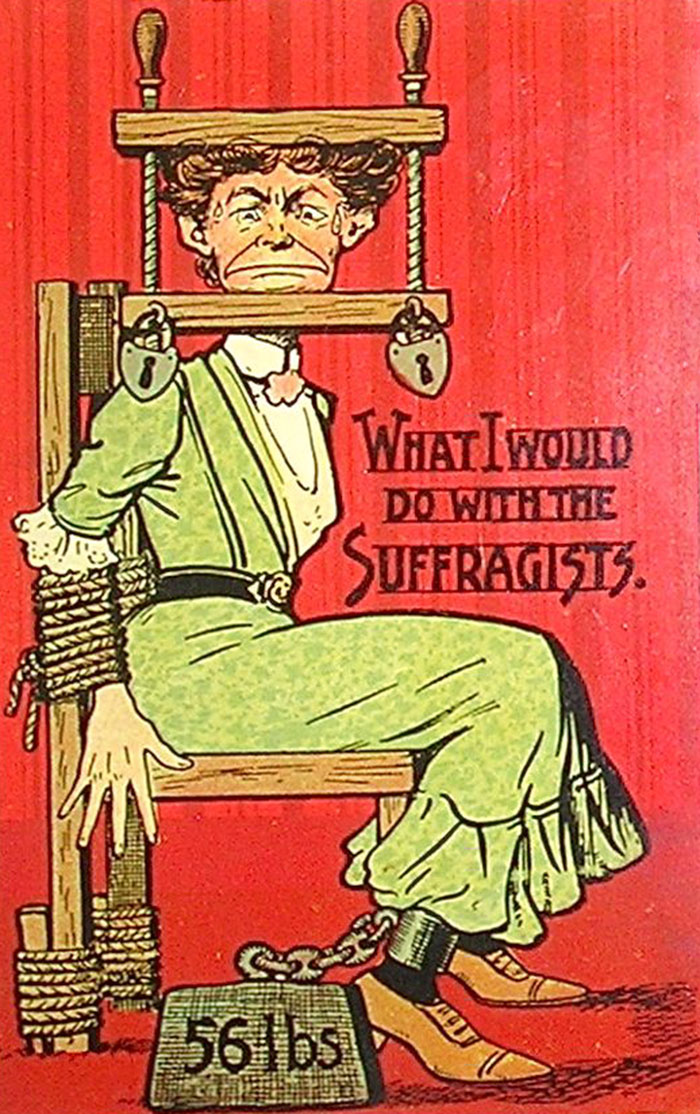
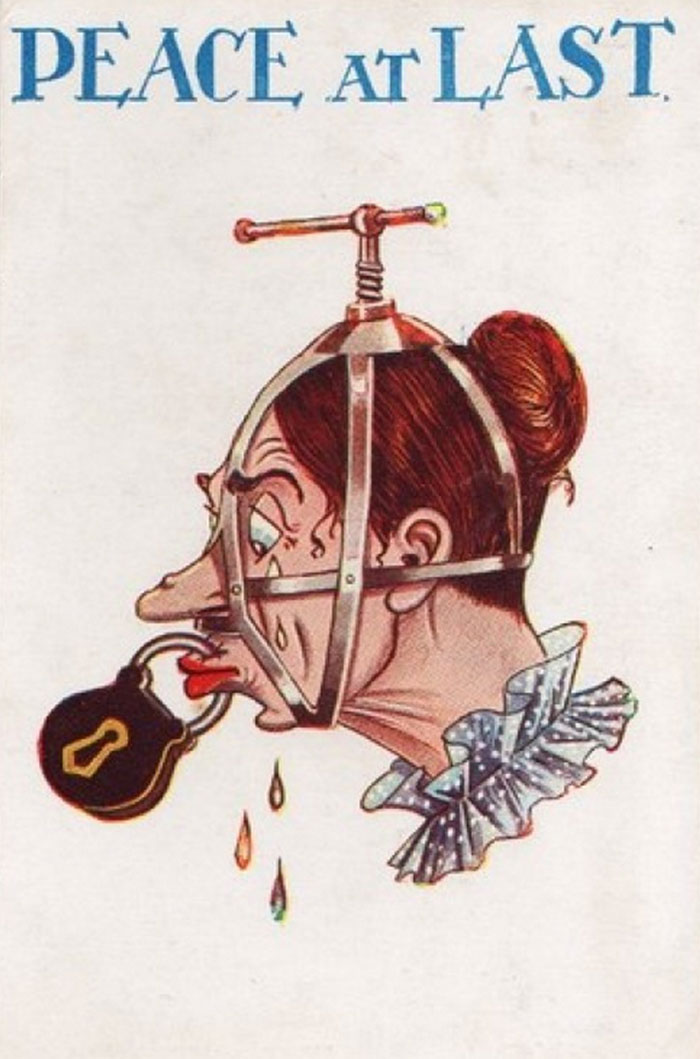
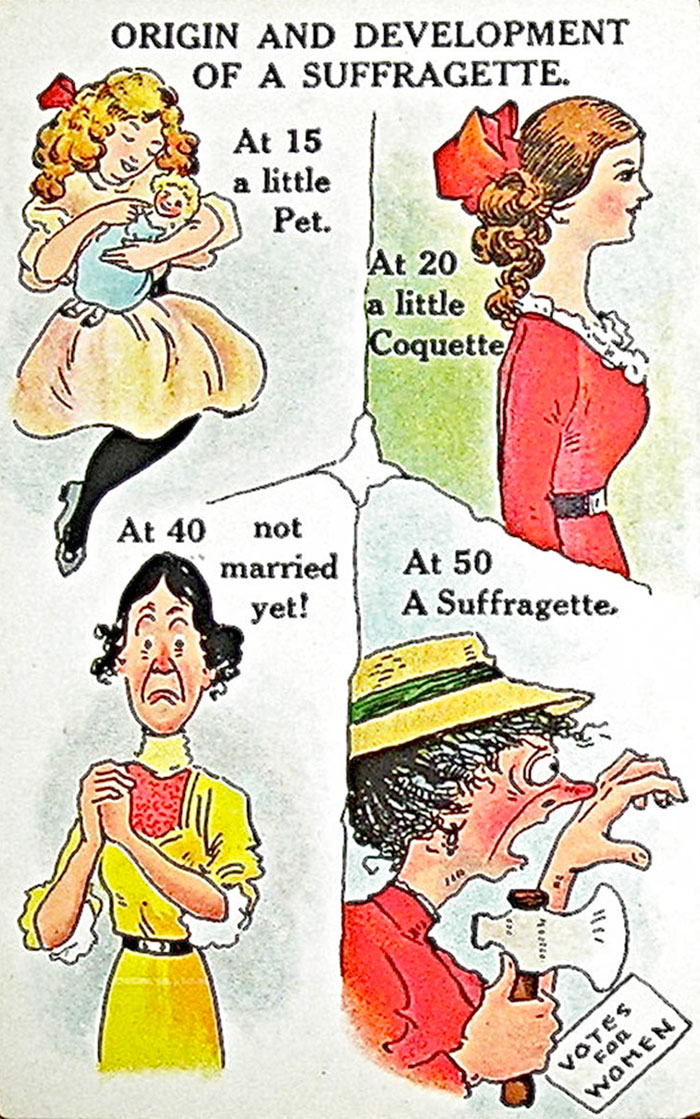
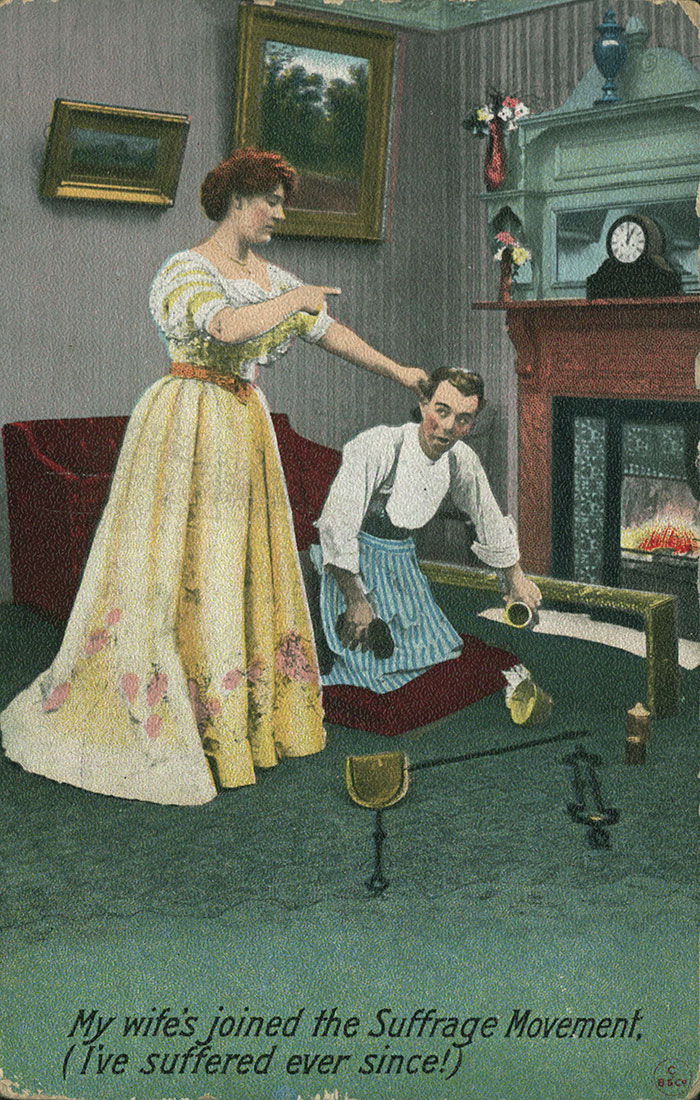
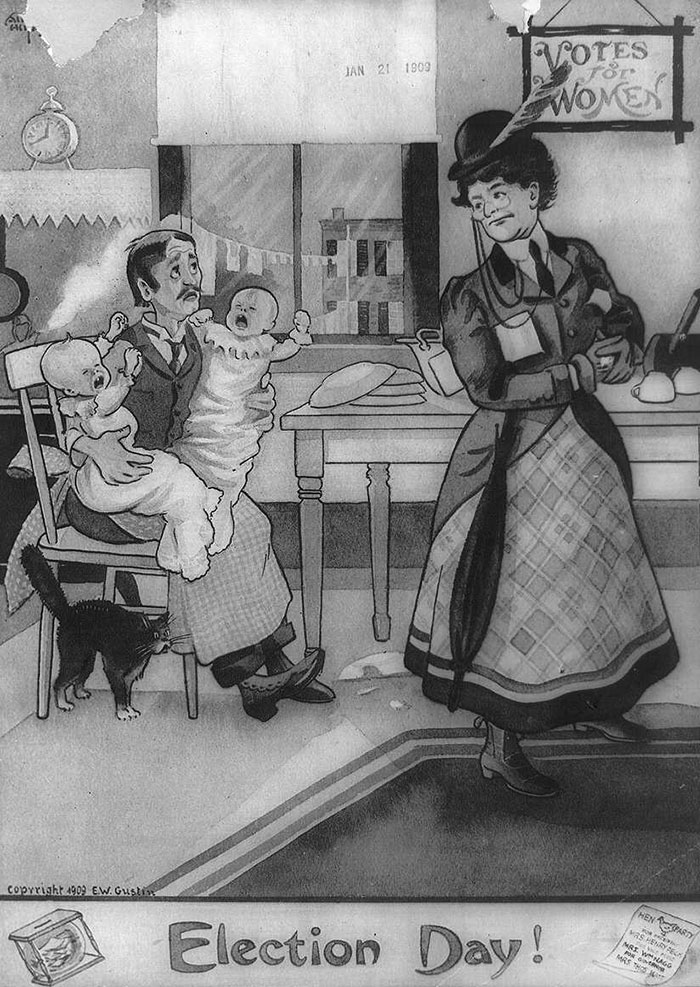
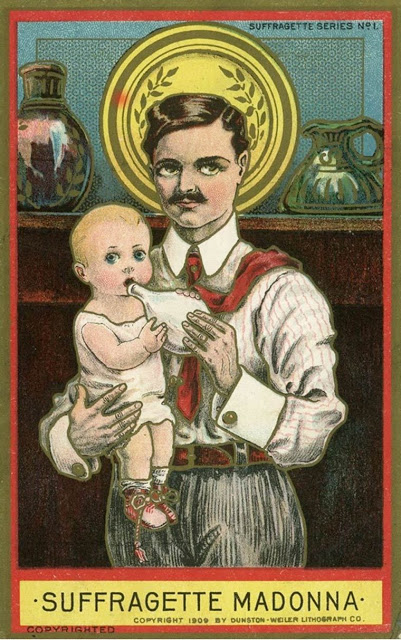
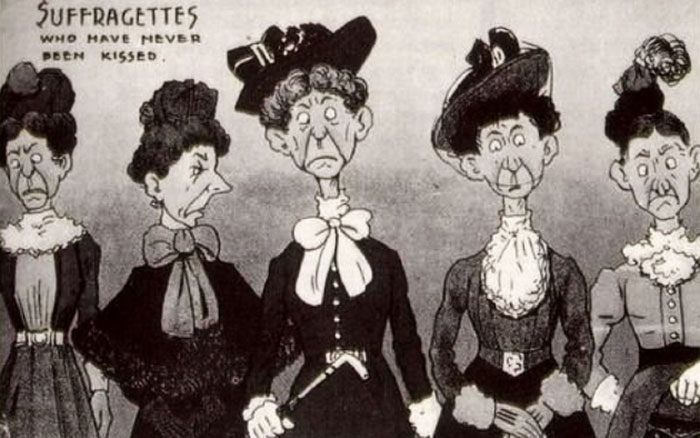
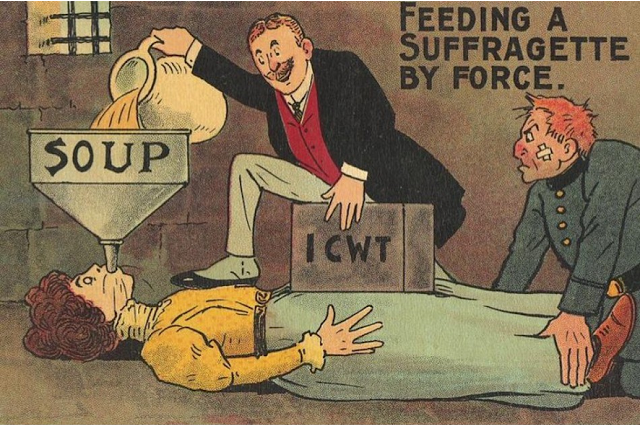
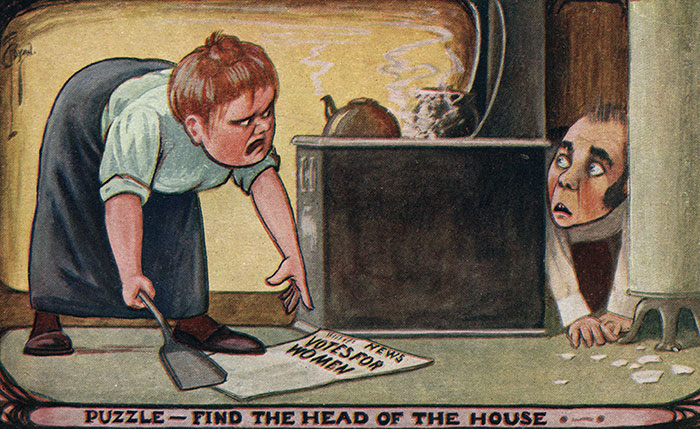
As you can see from the sample anti-suffrage postcards here—dating from the late 19th to early 20th centuries— propaganda against the women’s vote tended to fall into three broad categories: Disturbingly violent wish-fulfillment involving torture and physical silencing; characterizations of suffragists as angry, bitter old maids, hatchet-wielding harridans, or domineering, shrewish wives and neglectful mothers; and, correspondingly, depictions of neglected children, and husbands portrayed as saintly victims, emasculated by threats to traditional gender roles, and menaced by the suggestion that they may have to care for their children for even one day out of the year!
These postcards come from the collection of Catherine Palczewski, professor of women’s and gender studies at the University of Northern Iowa. She has been collecting these images, from both the U.S. and Britain, for 15 years. On her website, Palczewski quotes George Miller’s comment that postcards like these “offer a vivid chronicle of American political values and tastes.” Palczewski describes these particular images as “a fascinating intersection [that] occurred between advocacy for and against woman suffrage, images of women (and men), and postcards. Best estimates are that approximately 4,500 postcards were produced with a suffrage theme.”
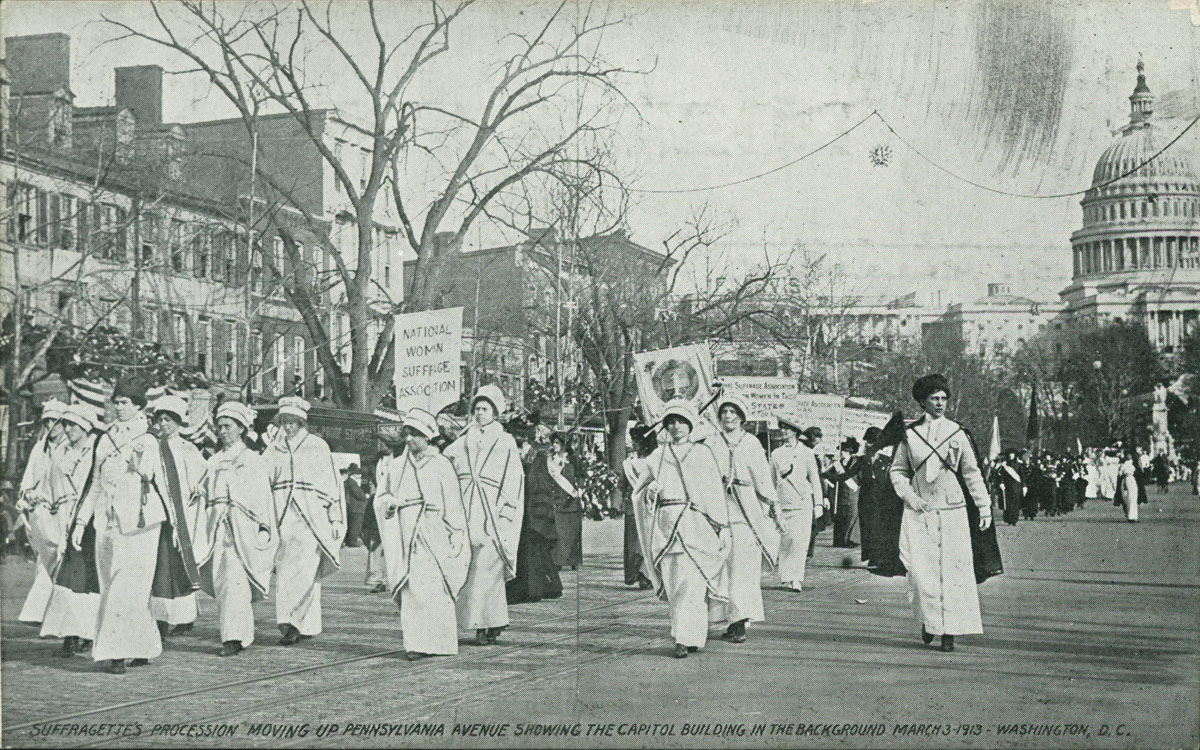
As she notes in the quote above, the postcards printed during this period did not all oppose women’s suffrage. “Suffrage advocates,” writes Palczewski, “recognized the utility of the postcard as a propaganda device” as well. Pro-suffrage postcards tended to serve a documentary purpose, with “real-photo images of the suffrage parades, verbal messages identifying the states that had approved suffrage, or quotations in support of extending the vote to women.” For all their attempts at presenting a serious, informative counterweight to incendiary anti-suffrage images like those you see here, suffrage activists often found that they could not control the narrative.
As Lisa Tickner writes in The Spectacle of Women: Imagery of the Suffrage Campaign 1907–1914, postcard producers without a clear agenda often used photos and illustrations of suffragists to represent “topical or humorous types” and “almost incidentally” undercut advocates’ attempts to present their cause in a newsworthy light. The image of the suffragette as a trivial figure of fun persisted into the mid-twentieth century (as we see in Glynis Johns’ comically neglectful Winifred Banks in Walt Disney’s 1964 Mary Poppins adaptation).
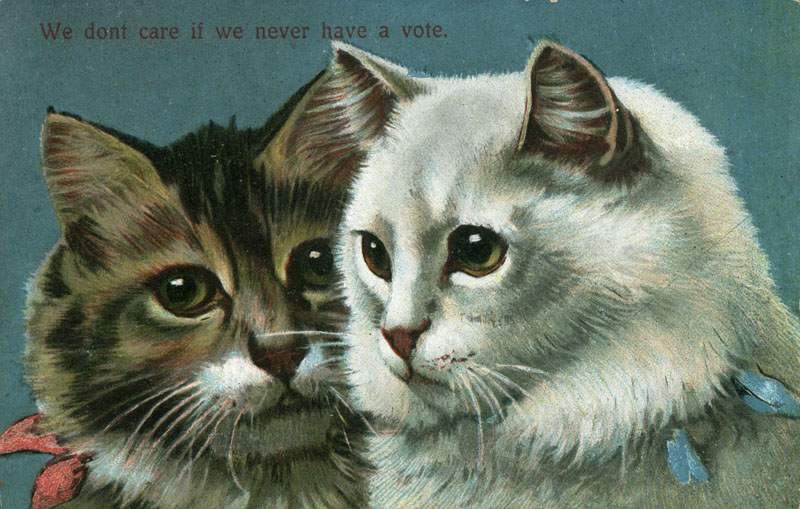
Palczewski’s site offers a brief history of the “Golden Age” (1893–1918) of political postcards and organizes the collection into categories. One variety we might find particularly charming for its use of cats and kittens actually has a pretty sinister origin in the so-called “Cat-and-Mouse Act” in the UK. Jailed suffragists had begun to stage hunger strikes, and journalists provoked public outcry by portraying force-feeding by the government as a form of torture. Instead, striking activists were released when they became weak. “If a woman died after being released,” Palczewski explains, “then the government could claim it was not to blame.” When a freed activist regained her strength, she would be rearrested. “On November 29, 1917,” Palczewski writes, “the US government announced it plans to use Britain’s cat and mouse approach.”
You can see many more historical pro- and anti-suffrage postcards at Palczewski’s website, and you are free to use them for non-commercial purposes provided you attribute the source. You are also free, of course, to draw your own comparisons to today’s hyperbolic and often violently misogynist propaganda campaigns.
Back in 2011, the Los Angeles Timesran a profile on Sarah Tubert, then a 17-year-old student who lost her hearing as a young child. With the help of her family, Sarah persevered, became a star water polo and volleyball player in high school, and earned a full scholarship to Gallaudet University–all with the hope of one day becoming an instructor for deaf and hearing-impaired students.
Five years later, Sarah is making good on her promise. Above, Sarah performs “Alexander Hamilton,” the opening number of the Broadway show, in American Sign Language (ASL). On Twitter, the Hamilton star Lin-Manuel Miranda called it “beautiful.” And it’s hard not to agree.
If you would like to support the mission of Open Culture, consider making a donation to our site. It’s hard to rely 100% on ads, and your contributions will help us continue providing the best free cultural and educational materials to learners everywhere. You can contribute through PayPal, Patreon, and Venmo (@openculture). Thanks!
There will never not be a market for the cookbook, with all its various subcategories, from fad diet to celebrity chef. While The Onion’s proposed “Nietzschean Diet” (which “lets you eat whatever you fear most”) may never catch on, one unusual cookbook niche does involve the recipes of famous writers, artists, musicians and other high- and pop-culture figures. The genre flourished in the sixties and seventies, with Swingers & Singers in the Kitchen in 1967, Salvador Dalí’s Les Diners de Gala in 1973, and the MoMA’s Artists’ Cookbook in 1978.
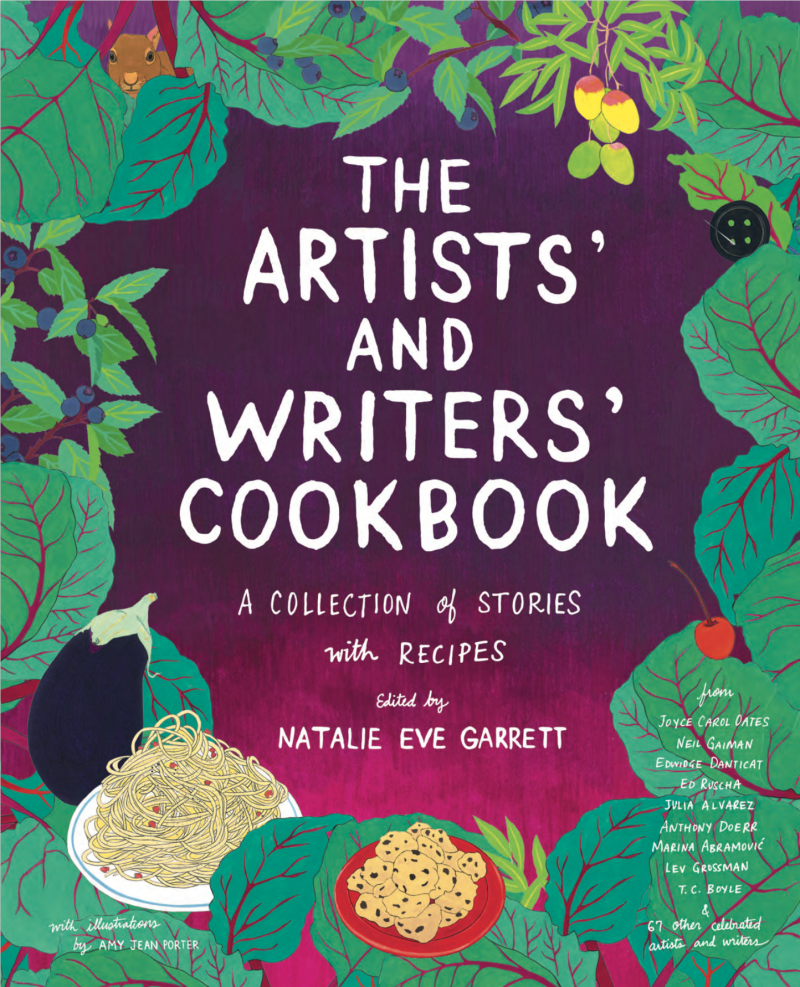
Predating these celebrity recipe books, The Artists’ & Writers’ Cookbook appeared in 1961. Brain Pickings describes the book as “a lavish 350-page vintage tome, illustrated with 19th-century engravings and original drawings by Marcel Duchamp, Robert Osbourn, and Alexandre Istrati.” It featured 220 recipes by painters, novelists, poets, and sculptors like Man Ray, John Keats, Robert Graves, Harper Lee, Georges Simenon, and more. What’s old has become new again, with the recent reprinting of Dalí’s cookbook by Taschen and, on October 11th, the publication of an updated Artists’ and Writers’ Cookbook, edited by Natalie Eve Garrett and illustrated by Amy Jean Porter.
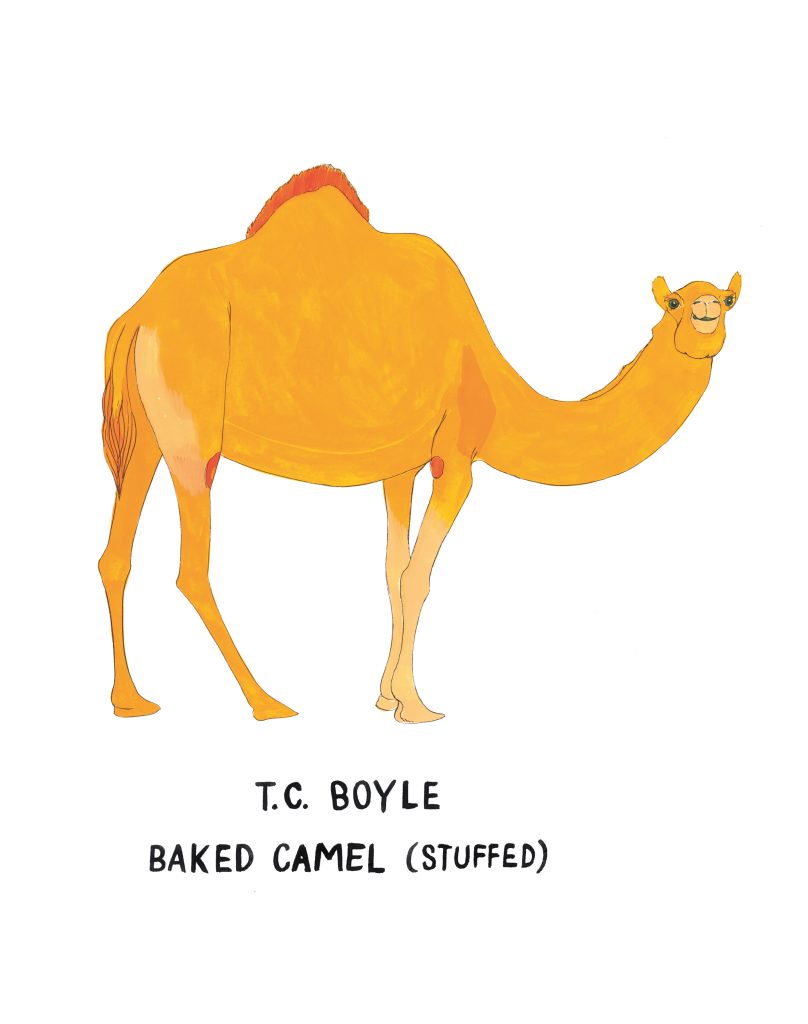
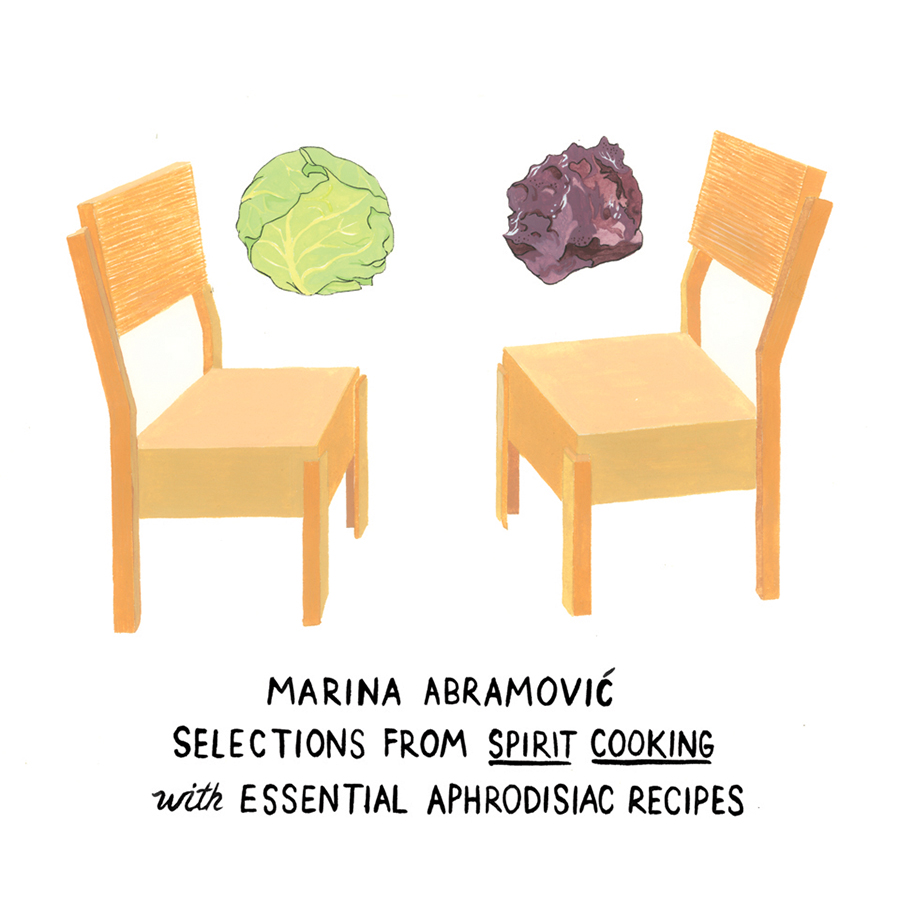
The 2016 version includes recipes from such living artists as Edwidge Danticat, Ed Ruscha, Neil Gaiman, Joyce Carol Oates, James Franco, Nikki Giovanni, Marina Abramović, and many more. The recipes range from the whimsical (see T.C. Boyle’s “Baked Camel (Stuffed)” further up) to the thoroughly metaphorical (as in Abramović’s “Essential Aphrodisiac Recipes,” above). In-between, we have such standard fare as “The Utilitarian, American-Style PB&J: An Artist’s Best Friend,” courtesy of Franco, which calls for the following ingredients:
wheat bread
peanut butter
jelly
ginger ale (optional)
pickles (optional)
Haitian novelist Edwidge Danticat takes a serious approach with a traditional recipe for “Soup Joumou.” She prefaces this more extensive dish with a poetic description of its national importance, concluding that it is consumed “as a sign of our independence, as a celebration of a new beginning.…” The recipe may send you to the grocery, but—especially this time of year—you’ll find all of the ingredients at your nearest chain store:
1 pumpkin between 2–3 pounds, peeled and cut into small pieces
1 pound cabbage, sliced and chopped
4 carrots, peeled and sliced
3 stalks celery, sliced and chopped
1 large onion, cut into small pieces
5 potatoes, peeled and cubed
2 turnips, peeled and cubed (optional)
1 lime cut in half and squeezed for a much juice as you can get from it
¼ pound macaroni
3 garlic cloves, crushed or cut into small pieces
1 sprig thyme
1 sprig parsley
2 teaspoons salt
2 teaspoons ground pepper
1 Scotch bayonet pepper
Sounds delicious.
Neil Gaiman keeps things very simple with “Coraline’s Cheese Omelette,” introduced with an excerpt from that dark children’s fantasy. For this, you likely have all you need on hand:
2 eggs
butter
cheese
1 tablespoon milk
a pinch of salt
The essays and narratives in the new The Artists’ and Writers’ Cookbook are “at turns,” writes editor Natalie Eve Garrett, “comedic and heart-wrenching, personal and apocalyptic, with recipes that are enchanting to read and recreate.” As you can see from the small sampling here, you need not have any pretentions to haute cuisine to follow most of them. And as the book’s subtitle—“A Collection of Stories with Recipes”—suggests, you needn’t cook at all to find joy in this diverse assemblage of artists and writers’ associations with food, that most personal and intimate, yet also culturally defining and communal of subjects. Pick up a copy of The Artists’ and Writers’ Cookbook on Amazon.
How do we create a just society? 50,000 years or so at it and humanity still has a long way to go before figuring that out, though not for lack of trying. The four animated videos of “What Is Justice?”—a miniseries within BBC Radio 4 and the Open University’s larger projectof animating the ideas of philosophers throughout history and explaining them in the voices of various famous narrators—tell us what John Rawls, Henry David Thoreau, and the Bible, among other sources, have to say on the subject of justice. Stephen Fry provides the voice this time as the videos illustrate the nature of these ideas, as well as their complications, before our eyes.
Imagine you had to create a just society yourself, but “you won’t know what kind of a person you’ll be in the society you design.” This thought experiment, first described by Rawls in his 1971 book A Theory of Justiceas the “veil of ignorance,” supposedly encourages the creation of “a much fairer society than we now have. There would be extensive freedom and equality of opportunity. But there wouldn’t be extremes of high pay, unless it could be shown that the poorest in society directly benefited as a result.” An intriguing idea, but one easier articulated than agreed upon, let alone realized.
Much earlier in history, you find the simpler principle of “an eye for an eye and a tooth for a tooth,” an “ancient form of punishment known as lex talionis, or the law of retaliation.” Any reader of the Bible will have a strong sense of this idea’s importance in the ancient world, though we’d do well to remember that back then, it “was a way of encouraging a sense of proportion — not wiping out a whole community in retaliation for the killing of one man, for example.” While harsh punishment could, in theory, deter potential criminals, “severe legal violence can create martyrs and increase society’s problems.” The rule of law, naturally, has everything to do with the creation and maintenance of a just society, though not every law furthers the cause.
But you’ve no doubt heard of one that has: habeas corpus, the legal principle mandating that “no one, not even the president, monarch, or anyone else in power, can detain someone illegally.” Instead, “they need to bring the detainee in question before a court and allow that court to determine whether or not this person can legally be held.” Yet not every authority has consistently implemented or upheld habeas corpus or other justice-ensuring laws. At times like those, according to Thoreau, you must engage in civil disobedience: “follow your conscience and break the law on moral grounds rather than be a cog in an unjust system.” It’s a dirty job, creating a just society, and will remain so for the foreseeable future. And though we may not all have given it as much thought as a Rawls or a Thoreau, we’ve all got a role to play in it.
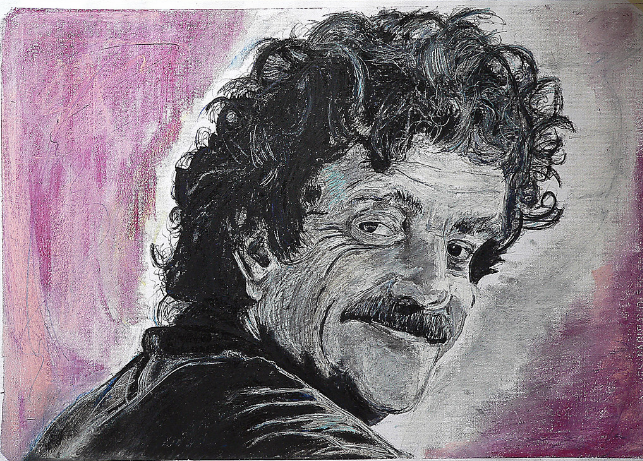
Vonnegut fans long for this level of access, which is why we are doubly grateful to writer Suzanne McConnell, who took Vonnegut’s “Form of Fiction” (aka “Surface Criticism” aka “How to Talk out of the Corner of Your Mouth Like a Real Tough Pro”) course at the Iowa Writers’ Workshop in the mid-60s.
The goal was to examine fiction from a writer’s perspective and McConnell (who is soon to publish a book about Vonnegut’s advice to writers) preserved one of her old teacher’s term paper assignments—again in letter form. She later had an epiphany that his assignments were “designed to teach something much more than whatever I thought then… He was teaching us to do our own thinking, to find out who we were, what we loved, abhorred, what set off our tripwires, what tripped up our hearts.”
(A decade and a half later, Vonnegut would subject his own novels to the same treatment.)
A noted humanist, Vonnegut instructed the class to read these stories not in an overly analytical mindset, but rather as if they had just consumed “two ounces of very good booze.”
The ensuing letter grades were meant to be “childishly selfish and impudent measures” of how much—or little—joy the stories inspired in the reader.
Next, students were instructed to choose their three favorite and three least favorite stories, then disguise themselves as “minor but useful” lit mag editors in order to advise their “wise, respected, witty and world-weary superior” as to whether or not the selected stories merited publication.
Here’s the full assignment, which was published in Kurt Vonnegut: Letters(Delacorte Press, 2012). And also again in Slate.
Beloved:
This course began as Form and Theory of Fiction, became Form of Fiction, then Form and Texture of Fiction, then Surface Criticism, or How to Talk out of the Corner of Your Mouth Like a Real Tough Pro. It will probably be Animal Husbandry 108 by the time Black February rolls around. As was said to me years ago by a dear, dear friend, “Keep your hat on. We may end up miles from here.”
As for your term papers, I should like them to be both cynical and religious. I want you to adore the Universe, to be easily delighted, but to be prompt as well with impatience with those artists who offend your own deep notions of what the Universe is or should be. “This above all …”
I invite you to read the fifteen tales in Masters of the Modern Short Story (W. Havighurst, editor, 1955, Harcourt, Brace, $14.95 in paperback). Read them for pleasure and satisfaction, beginning each as though, only seven minutes before, you had swallowed two ounces of very good booze. “Except ye be as little children …”
Then reproduce on a single sheet of clean, white paper the table of contents of the book, omitting the page numbers, and substituting for each number a grade from A to F. The grades should be childishly selfish and impudent measures of your own joy or lack of it. I don’t care what grades you give. I do insist that you like some stories better than others.
Proceed next to the hallucination that you are a minor but useful editor on a good literary magazine not connected with a university. Take three stories that please you most and three that please you least, six in all, and pretend that they have been offered for publication. Write a report on each to be submitted to a wise, respected, witty and world-weary superior.
Do not do so as an academic critic, nor as a person drunk on art, nor as a barbarian in the literary market place. Do so as a sensitive person who has a few practical hunches about how stories can succeed or fail. Praise or damn as you please, but do so rather flatly, pragmatically, with cunning attention to annoying or gratifying details. Be yourself. Be unique. Be a good editor. The Universe needs more good editors, God knows.
Since there are eighty of you, and since I do not wish to go blind or kill somebody, about twenty pages from each of you should do neatly. Do not bubble. Do not spin your wheels. Use words I know.
poloniøus
McConnell supplied further details on the extraordinary experience of being Vonnegut’s student in an essay forthe Brooklyn Rail:
Kurt taught a Chekhov story. I can’t remember the name of it. I didn’t quite understand the point, since nothing much happened. An adolescent girl is in love with this boy and that boy and another; she points at a little dog, as I recall, or maybe something else, and laughs. That’s all. There’s no conflict, no dramatic turning point or change. Kurt pointed out that she has no words for the sheer joy of being young, ripe with life, her own juiciness, and the promise of romance. Her inarticulate feelings spill into laughter at something innocuous. That’s what happened in the story. His absolute delight in that girl’s joy of feeling herself so alive was so encouraging of delight. Kurt’s enchantment taught me that such moments are nothing to sneeze at. They’re worth a story.
Ayun Halliday is an author, illustrator, theater maker and Chief Primatologist of the East Village Inky zine. Her play Zamboni Godot is opening in New York City in March 2017. Follow her @AyunHalliday.
We're hoping to rely on loyal readers, rather than erratic ads. Please click the Donate button and support Open Culture. You can use Paypal, Venmo, Patreon, even Crypto! We thank you!
Open Culture scours the web for the best educational media. We find the free courses and audio books you need, the language lessons & educational videos you want, and plenty of enlightenment in between.