We tend to imagine old paintings as having a muted, yellow-brown cast, and not without reason. Many of the examples we’ve seen in life really do look that way, though usually not because the artist intended it. As Julian Baumgartner of Chicago’s Baumgartner Fine Art Restoration explains in the video above, these paintings’ colors have changed over the decades, or in any case appeared to change, because of the layer of resin on top of them. When that kind of coating is first applied, it actually makes the hues underneath look richer. As time passes, alas, chemical changes and the accumulation of dirt and grime can result in a dull, even sickly appearance.
“A lot of people say that the varnish should never be removed, “that that’s a patina that is on the surface of the painting and that it adds to the painting’s quality: it makes the painting look better, it makes it look more serious,” says Baumgartner.
“Those are all interesting opinions, but they’re all inaccurate. If the artist wanted to apply a patina to their painting, they could apply a patina and tone down the colors. But most artists, when they apply a varnish, do not envision that that varnish will ever become yellow or brown, or will crack or become cloudy.” The idea is to get the colors back to how the artist would have seen them when the work first attained its finished state.
Therein lies the difference between a painting and, say, a cast-iron skillet. But on some level, the actual labor of cleaning a work of art — as Baumgartner demonstrates, sped-up, in the video — differs less than one might imagine from that of cleaning a kitchen implement. The result, however, can certainly be more striking, especially with a canvas like this one, whose twin-sister subjects provide an ideal means of showing the contrast between colors long covered by varnish and those same colors newly exhumed. Though there now exist formulas that don’t turn yellow in quite the same way, more than a few artists stick to the classic damar varnish, which does have advantages of its own — not least keeping a few more generations of conservators in business.
Based in Seoul, Colin Marshall writes and broadcasts on cities, language, and culture. His projects include the Substack newsletterBooks on Cities and the book The Stateless City: a Walk through 21st-Century Los Angeles. Follow him on the social network formerly known as Twitter at @colinmarshall.
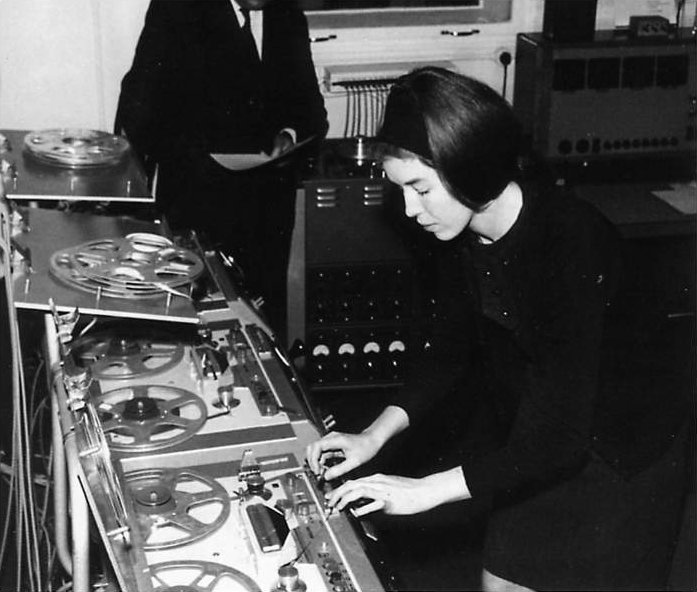
You may hear the phrase “electronic music” and think of superstar dubstep DJs in funny helmets at beachside celebrity parties. Alternatively, you may think of the mercurial compositions of Karlheinz Stockhausen, the musique concrete of Pierre Henry, or the otherworldly experimentalism of François Bayle. If you’re in that latter camp of music nerd, then this post may bring you very glad tidings indeed. Ubuweb—that stalwart repository of all things 20th-century avant-garde—now hosts an extraordinary compilation: the 476-song History of Electronic/Electroacoustic Music, originally a 62 CD set. (Hear below Stockhausen’s “Kontact,” Henry’s “Astrologie,” and Bayle’s spare “Theatre d’Ombres” further down.)
Spanning the years 1937–2001, the collection should especially appeal to those with an avant-garde or musicological bent. In fact, the original uploader of this archive of experimental sound, Caio Barros, put these tracks online in 2009 while a student of composition at Brazil’s State University of São Paulo. Barros’ “initiative,” as he writes at Ubuweb, “became some sort of legend” among musicophiles in the know.
And yet, Ubuweb reposts this phenomenal collection with a disclaimer: “It’s a clearly flawed selection,” they write:
There’s few women and almost no one working outside of the Western tradition (where are the Japanese? Chinese? etc.). However, as an effort, it’s admirable and contains a ton of great stuff.
Take it with a grain of salt, or perhaps use it as a provocation to curate a more intelligent, inclusive, and comprehensive selection
It’s a fair critique, though Barros points out that the exclusions mostly have to do with “the way our society and the tradition this music represent works” (sic). And yet, as disciplinary boundaries expand all the time, and histories broaden along with them, that description no longer holds. It would be a fascinating exercise, for example, to listen to these tracks alongside the history of women in electronic music, 1938–2014 that we posted recently.
Also, there’s clearly much more to electronic music than either celebrity DJs or obscure avant-garde composers. Many hundreds of popular electronic composers and musicians—like Brian Eno, Kraftwerk, Bruce Haack, or Clara Rockmore—fall somewhere in-between the worlds of pop/dance/performance and serious composition, and their contributions deserve representation alongside more experimental or classical artists.
All that said, however, there’s no reason you can’t curate your own playlist of the history of electronic music as you see it—drawing from the astounding wealth of music available free at The History of Electroacoustic Music. Or consider this collection a fully immersive course in “traditional, western avant-garde electronic music” from “the area of Europe-America,” as Barros puts it. As that, it succeeds admirably.
Note: An earlier version of this post appeared on our site in 2016.
In the decades after the Second World War, many countries faced the challenge of rebuilding their housing and infrastructure while also having to accommodate a fast-arriving baby boom. The government of the Netherlands got more creative than most, putting money toward experimental housing projects starting in the late nineteen-sixties. Hoping to happen upon the next revolutionary form of dwelling, it ended up funding designs that, for the most part, strayed none too far from established patterns. Still, there were genuine outliers: by far the most daring proposal came from artist and sculptor Dries Kreijkamp: to build a whole neighborhood out of Bolwoningen, or “ball houses.”
The idea may bring to mind Buckminster Fuller’s geodesic domes, which enjoyed a degree of utopian vogue in the nineteen-sixties and seventies. Like Fuller and most other visionaries, Kreijkamp labored under a certain monomania. His had to do with globes, “the most organic and natural shape possible. After all, roundness is everywhere: we live on a globe, and we’re born from a globe. The globe combines the biggest possible volume with the smallest possible surface area, so you need minimum material for it.” The 50 Bolwoningen built in ‘s‑Hertogenbosch, better known as Den Bosch, were quickly fabricated on-site out of glass fiber reinforced concrete. It wasn’t the polyester Kreijkamp had at first specified, but then, polyester wouldn’t have lasted 40 years.
Since they were put up in 1984, the Bolwoningen have been continuously inhabited. In the video at the top of the post, Youtuber Tom Scott pays a visit to one of them, whose occupant seems reasonably satisfied. (It seems they’re “cozy” in the wintertime.)
Like geodesic domes, their round walls make it difficult to use their theoretically generous interior space efficiently, at least without commissioning custom-made furniture; leaking windows are also a perennial problem. While each Bolwoning can comfortably house one or even two simple-living people, only the most utopia-minded would attempt to raise a family in one of them. As with other round or circular home designs, expansion would be physically impractical even if it were legally possible.
Used as social housing by the local government, the Bolwoningen now enjoy a protected historic status. (As well they might, given their connection with the art and industry of Dutch glassblowing: it was while working in a glass factory that Kreijkamp first began proselytizing for spheres.) And unlike most aesthetically radical housing developments, they haven’t gone to seed, but rather received the necessary maintenance over the decades. The result is an appealing neighborhood for those whose lifestyles are suited to its unusual structures and its contained bucolic setting, of which you can get an idea in the walking video tour just above. By the time Kreijkamp died in 2014, he perhaps felt a certain degree of regret that mass-produced globular homes didn’t prove to be the next big thing. But he did live to see the emergence of the “tiny house” movement, which should retroactively adopt him as one of its leading lights.
Based in Seoul, Colin Marshall writes and broadcasts on cities, language, and culture. His projects include the Substack newsletterBooks on Cities and the book The Stateless City: a Walk through 21st-Century Los Angeles. Follow him on the social network formerly known as Twitter at @colinmarshall.
In 1976 and 1977 an inspired music teacher in the small school district of Langley Township, British Columbia, a suburb of Vancouver, recorded his elementary school students singing popular songs in a school gym. Two vinyl records were produced over the two years, and families were invited to pay $7 for a copy. The recordings were largely forgotten — just another personal memento stored away in a few homes in Western Canada — until a record collector stumbled across a copy in a thrift store in 2000.
Enthralled by what he heard, the collector sent a sample to a disc jockey at WFMU, an eclectic, listener-supported radio station in New Jersey. The station began playing some of the songs over the airwaves. Listeners were touched by the haunting, ethereal quality of the performances. In 2001, a small record company released a compilation called The Langley Township Music Project: Innocence & Despair.
The record became an underground hit. The Washington Post called it “an album that seems to capture nothing less than the sound of falling in love with music.” Spin said the album “seems to sum up all the reasons music is holy.” And Dwight Gamer of The New York Times wrote that the music was “magic: a kind of celestial pep rally.” Listeners were moved by the ingenuousness of the young voices, the strange authenticity of performances by children too young to understand all of the adult themes in the lyrics. As Hans Fenger, the music teacher who made the recordings, writes in the liner notes:
The kids had a grasp of what they liked: emotion, drama, and making music as a group. Whether the results were good, bad, in tune or out was no big deal — they had élan. This was not the way music was traditionally taught. But then I never liked conventional “children’s music,” which is condescending and ignores the reality of children’s lives, which can be dark and scary. These children hated “cute.” They cherished songs that evoked loneliness and sadness.
You can learn the story of Fenger’s extraordinary music project in the 2002 VH1 documentary above, which includes interviews and a reunion with some of the students. And listen below for a few samples of that touching quality of loneliness and sadness Fenger and others have been talking about.
David Bowie’s ‘Space Oddity’:
One of the most widely praised songs from Innocence & Despair is the 1976 recording of David Bowie’s “Space Oddity.” In a 2001 interview with Mike Appelstein for Scram magazine, Fenger explained the sound effects in the recording. “When I first taught ‘Space Oddity,’ ” he said, “the first part I taught after the song was the kids counting down. They loved that: they’d go ‘TEN!’ They couldn’t say it loud enough; the countdown in the song was the big winner. But as soon as they got to zero, nothing happened. So I brought this old steel guitar. Well, one of the little guys whose name I’ve forgot, I put him on this thing and said, ‘Now listen, when they get to zero, you’re the rocket. So make a lot of noise on this. He’s fooling around with this steel guitar, and I didn’t even think of this, but he intuitively took out a Coke bottle from his lunch and started doing this (imitates a bottle running up and down the fretboard). I just cranked up the volume and turned down the master volume so it was really distorted. And that was the ‘Space Oddity’ sound effect.”
The Beach Boys’ ‘In My Room’:
The children recorded “In My Room” by the Beach Boys in 1977. Fenger told Appelstein it was the ultimate children’s song. “It’s the perfect introspective song for a nine-year-old,” he said, “just as ‘Dust in the Wind’ is the perfect philosophy song for a nine-year-old. Adults may think it’s dumb, but for a child, it’s a very heavy, profound thought. To think that there is nothing, and it’s expressed in such a simple way.”
The Eagles’ ‘Desperado’:
Several of the recordings feature soloists. A young girl named Sheila Behman sang the Eagles’ “Desperado” in 1977. “With ‘Desperado,’ ” said Fenger, “you can see it as a cowboy romantic story, but that’s not the way Sheila heard it. She couldn’t articulate metaphorically what the song was about, but in that sense, I think it was purer because it was unaffected. It’s not as if the kids were trying to be somebody else. They were just trying to be who they were, and they’re doing this music and falling in love with it.”
Note: An earlier version of this post appeared on our site in 2013.
We can learn much about how a historical period viewed the abilities of its children by studying its children’s literature. Occupying a space somewhere between the purely didactic and the nonsensical, most children’s books published in the past few hundred years have attempted to find a line between the two poles, seeking a balance between entertainment and instruction. However, that line seems to move closer to one pole or another depending on the prevailing cultural sentiments of the time. And the very fact that children’s books were hardly published at all before the early 18th century tells us a lot about when and how modern ideas of childhood as a separate category of existence began.
“By the end of the 18th century,” writes Newcastle University professor M.O. Grenby, “children’s literature was a flourishing, separate and secure part of the publishing industry in Britain.” The trend accelerated rapidly and has never ceased—children’s and young adult books now drive sales in publishing (with 80% of YA books bought by grown-ups for themselves).
Grenby notes that “the reasons for this sudden rise of children’s literature” and its rapid expansion into a booming market by the early 1800s “have never been fully explained.” We are free to speculate about the social and pedagogical winds that pushed this historical change.
Or we might do so, at least, by examining the children’s literature of the Victorian era, perhaps the most innovative and diverse period for children’s literature thus far by the standards of the time. And we can do so most thoroughly by surveying the thousands of mid- to late 19th century titles at the University of Florida’s Baldwin Library of Historical Children’s Literature. Their digitized collectioncurrently holds over 10,000 books free to read online from cover to cover, allowing you to get a sense of what adults in Britain and the U.S. wanted children to know and believe.
Several genres flourished at the time: religious instruction, naturally, but also language and spelling books, fairy tales, codes of conduct, and, especially, adventure stories—pre-Hardy Boys and Nancy Drew examples of what we would call young adult fiction, these published principally for boys. Adventure stories offered a (very colonialist) view of the wide world; in series like the Boston-published Zig Zag and English books like Afloat with Nelson, both from the 1890s, fact mingled with fiction, natural history and science with battle and travel accounts. But there is another distinctive strain in the children’s literature of the time, one which to us—but not necessarily to the Victorians—would seem contrary to the imperialist young adult novel.
For most Victorian students and readers, poetry was a daily part of life, and it was a central instructional and storytelling form in children’s lit. The A.L.O.E.’s Bible Picture Book from 1871, above, presents “Stories from the Life of Our Lord in Verse,” written “simply for the Lord’s lambs, rhymes more readily than prose attracting the attention of children, and fastening themselves on their memories.” Children and adults regularly memorized poetry, after all. Yet after the explosion in children’s publishing the former readers were often given inferior examples of it. The author of the Bible Picture Book admits as much, begging the indulgence of older readers in the preface for “defects in my work,” given that “the verses were made for the pictures, not the pictures for the verses.”
This is not an author, or perhaps a type of literature, one might suspect, that thinks highly of children’s aesthetic sensibilities. We find precisely the opposite to be the case in the wonderful Elfin Rhymes from 1900, written by the mysterious “Norman” with “40 drawings by Carton Moorepark.” Whoever “Norman” may be (or why his one-word name appears in quotation marks), he gives his readers poems that might be mistaken at first glance for unpublished Christina Rossetti verses; and Mr. Moorepark’s illustrations rival those of the finest book illustrators of the time, presaging the high quality of Caldecott Medal-winning books of later decades. Elfin Rhymes seems like a rare oddity, likely published in a small print run; the care and attention of its layout and design shows a very high opinion of its readers’ imaginative capabilities.
This title is representative of an emerging genre of late Victorian children’s literature, which still tended on the whole, as it does now, to fall into the trite and formulaic. Elfin Rhymes sits astride the fantasy boom at the turn of the century, heralded by hugely popular books like Frank L. Baum’s Wizard of Oz series and J.M. Barrie’s Peter Pan. These, the Harry Potters of their day, made millions of young people passionate readers of modern fairy tales, representing a slide even further away from the once quite narrow, “remorselessly instructional… or deeply pious” categories available in early writing for children, as Grenby points out.
Where the boundaries for kids’ literature had once been narrowly fixed by Latin grammar books and Pilgrim’s Progress, by the end of the 19th century, the influence of science fiction like Jules Verne’s, and of popular supernatural tales and poems, prepared the ground for comic books, YA dystopias, magician fiction, and dozens of other children’s literature genres we now take for granted, or—in increasingly large numbers—we buy to read for ourselves. Enter the Baldwin Library of Historical Children’s Literature here, where you can browse several categories, search for subjects, authors, titles, etc, see full-screen, zoomable images of book covers, download XML versions, and read all of the over 10,000+ books in the collection with comfortable reader views.
Note: This is an updated version of a post that originally appeared on our site in 2016.
When Albert Camus won the Nobel Prize, he wrote a letter to one of his old schoolteachers. “I let the commotion around me these days subside a bit before speaking to you from the bottom of my heart,” the letter begins. “I have just been given far too great an honor, one I neither sought nor solicited. But when I heard the news, my first thought, after my mother, was of you.” For it was from this teacher, a certain Louis Germain, that the young, fatherless Camus received the guidance he needed. “Without you, without the affectionate hand you extended to the small poor child that I was, without your teaching and example, none of all this would have happened.”
Camus ends the letter by assuring Monsieur Germain that “your efforts, your work, and the generous heart you put into it still live in one of your little schoolboys who, despite the years, has never stopped being your grateful pupil.”
In response, Germain recalls his memories of Camus as an unaffected, optimistic pupil. “I think I well know the nice little fellow you were, and very often the child contains the seed of the man he will become,” he writes. Whatever the process of intellectual and artistic evolution over the 30 years or so between leaving the classroom and winning the Nobel, “it gives me very great satisfaction to see that your fame has not gone to your head. You have remained Camus: bravo.”
It isn’t hard to understand why Camus’ letter to his teacher would resonate with the footballer Ian Wright, who reads it aloud in the Letters Live video at the top of the post. A 2005 documentary on his life and career produced the early viral video above, a clip capturing the moment of Wright’s unexpected reunion with his own academic father figure, Sydney Pigden. Coming face to face with his old mentor, who he’d assumed had died, Wright instinctively removes his cap and addresses him as “Mr. Pigden.” In that moment, the student-teacher relationship resumes: “I’m so glad you’ve done so well with yourself,” says Pigden, a sentiment not dissimilar to the one Monsieur Germain expressed to Camus. Most of us, no matter how long we’ve been out of school, have a teacher we hope to do proud; some of us, whether we know it or not, have been that teacher.
Based in Seoul, Colin Marshall writes and broadcasts on cities, language, and culture. His projects include the Substack newsletterBooks on Cities and the book The Stateless City: a Walk through 21st-Century Los Angeles. Follow him on the social network formerly known as Twitter at @colinmarshall.
It was at the 1965 Newport Folk Festival that Bob Dylan famously “went electric,” alienating certain adherents to the folk scene through which he’d come up, but also setting a precedent for the kind of quick-change musical adaptation that he’s kept up into his eighties. At the 1964 Newport Folk Festival, however, all that lay in the future. Yet even then, the young Dylan wasn’t shy of making controversial choices. Take, for example, the choice to play “Mr. Tambourine Man,” a song that — however redolent of the mid-nineteen-sixties when heard today — would hardly have been topical enough to meet the expectations of folk fans who regarded the music’s topicality as its main strength.
At the top of the post, you can watch colorized footage of Dylan’s performance of “Mr. Tambourine Man” at the 1964 Newport Folk Festival; the original black-and-white clip appears below. Consider the resonances it could have set off in the minds of his youthful, clean-cut audience: Rimbaud? Fellini? Lord Buckley? Mardi Gras? Confessions of an English Opium-Eater? Dylanologists have suggested all these sources of inspiration and others. It is possible, of course, that — as Dylan himself once said — the lyrics’ central image is that of guitarist Bruce Langhorne, who played on the song as recorded for Bringing It All Back Home, a musician then known for his ownership of a gigantic tambourine.
Despite its lack of references to the issues of the day, “Mr. Tambourine Man” reflects its historical moment with a clarity that few songs ever have. (Some would say that’s even truer of The Byrds’ cover version, a radio hit that came out just a month after Dylan’s original.) Dylan himself must have sensed that it marked not just the peak of an era, but also that of his own compositional and performative efforts in this particular musical style. Though he did attempt to write a follow-up to the song, its failure to cohere showed him the way forward. Dylan still plays it in concert today, and to enthusiastic reception from his audiences, but in such a way as to reinvent it each time — knowing that he both is and is not the same man who took the stage at Newport those sixty years ago, and that “Mr. Tambourine Man” both is and is not the same song.
Based in Seoul, Colin Marshall writes and broadcasts on cities, language, and culture. His projects include the Substack newsletterBooks on Cities and the book The Stateless City: a Walk through 21st-Century Los Angeles. Follow him on the social network formerly known as Twitter at @colinmarshall.
Religions take the cast and hue of the cultures in which they find root. This was certainly true in Tibet when Buddhism arrived in the 7th century. It transformed and was transformed by the native religion of Bon. Of the many creative practices that arose from this synthesis, Tibetan Buddhist music ranks very highly in importance.
As in sacred music in the West, Tibetan music has complex systems of musical notation and a long history of written religious song. “A vital component of Tibetan Buddhist experience,” explains Google Arts & Cultures Buddhist Digital Resource Center, “musical notation allows for the transference of sacred sound and ceremony across generations. A means to memorize sacred text, express devotion, ward off feral spirits, and invoke deities.”
Some of these features may be alien to secular Western Buddhists focused on mindfulness and silent meditation, but to varying degrees, Tibetan schools place considerable value on the aesthetic experience of extra-human realms. As University of Tulsa musicologist John Powell writes, “the use of sacred sound” in Tibetan Buddhism, a “Mantrayana” tradition, acts “as a formula for the transformation of human consciousness.”
Tibetan musical notations, Google points out, “symbolically represent the melodies, rhythm patterns, and instrumental arrangements. In harmony with chanting, visualizations, and hand gestures, [Tibetan] music crucially guides ritual performance.” It is characterized not only by its integration of ritual dance, but also by a large collection of ritual instruments—including the long, Swiss-like horns suited to a mountain environment—and unique forms of polyphonic overtone singing.
The examples of musical notation you see here came from the appropriately-named Twitter account Musical Notation is Beautiful and typeface designer and researcher Jo De Baerdemaeker. At the top is a 19th century manuscript belonging to the “Yang” tradition, “the most highly involved and regarded chant tradition in Tibetan music,” notes the Schoyen Collection, “and the only one to rely on a system of notation (Yang-Yig).”
The curved lines represent “smoothly effected rises and falls in intonation.” The notation also “frequently contains detailed instructions concerning in what spirit the music should be sung (e.g. flowing like a river, light like bird song) and the smallest modifications to be made to the voice in the utterance of a vowel.” The Yang-Yig goes all the way back to the 6th century, predating Tibetan Buddhism, and “does not record neither the rhythmic pattern nor duration of notes.” Other kinds of music have their own types of notation, such as that in the piece above for voice, drums, trumpets, horns, and cymbals.
Though they articulate and elaborate on religious ideas from India, Tibet’s musical traditions are entirely its own. “It is essential to rethink the entire concept of melody and rhythm” to understand Tibetan Buddhist chant, writes Powell in a detailed overview of Tibetan music’s vocal and instrumental qualities. “Many outside Tibetan culture are accustomed to think of melody as a sequence of rising or falling pitches,” he says. “In Tibetan Tantric chanting, however, the melodic content occurs in terms of vowel modification and the careful contouring of tones.” Hear an example of traditional Tibetan Buddhist chant just above, and learn more about Tibetan musical notation at Google Arts & Culture.
Note: An earlier version of this post appeared on our site in 2019.
Most scientists are prepared to answer questions about their research from other members of their field; rather fewer have equipped themselves to answer questions from the general public about what Douglas Adams called life, the universe, and everything. Carl Sagan was one of that minority, an expert “science communicator” before science communication was recognized as a field unto itself. In popular books and television productions, most notably Cosmos and its accompanying series Cosmos: A Personal Voyage, he put himself out there in the mass media as an enthusiastic guide to all that was known about the realms beyond our planet. More than a few members of his audience might well have asked themselves where does God fit into all this.
One such person actually put that question to Sagan, at a Q&A session after the latter’s 1994 “lost lecture” at Cornell, titled “The Age of Exploration.” The questioner, a graduate student, asks, “Is there any type of God to you? Like, is there a purpose, given that we’re just sitting on this speck in the middle of this sea of stars?”
In response to this difficult line of inquiry, Sagan opens a more difficult one: “What do you mean when you use the word God?” The student takes another tack, asking, “Given all these demotions” — defined by Sagan himself as the continual humbling of humanity’s self-image in light of new scientific discoveries — “why don’t we just blow ourselves up?” Sagan comes back with yet another question: “If we do blow ourselves up, does that disprove the existence of God?” The student admits that he guesses it does not.
The question eventually gets Sagan considering how “the word ‘God’ covers an enormous range of different ideas.” That range “runs from an outsized, light-skinned male with a long white beard, sitting in a throne in the sky, busily tallying the fall of every sparrow,” for whose existence Sagan knows of no evidence, to “the kind of God that Einstein or Spinoza talked about, which is very close to the sum total of the laws of the universe,” and as such, whose existence even Sagan would have to acknowledge. There’s also “the deist God that many of the founding fathers of this country believed in,” who’s held to have created the universe and then removed himself from the scene. With such a broad range of possible definitions, the concept of God itself becomes useless except as “social lubrication,” a means of seeming to “agree with someone else with whom you do not agree.” Terms of that malleable kind do have their advantages, if not to the scientific mind.
Based in Seoul, Colin Marshall writes and broadcasts on cities, language, and culture. His projects include the Substack newsletterBooks on Cities and the book The Stateless City: a Walk through 21st-Century Los Angeles. Follow him on the social network formerly known as Twitter at @colinmarshall.
In 22 lectures, Yale historian Paul Freedman takes you on a 700-year tour of medieval history. Moving from 284‑1000 AD, this free online course covers “the conversion of Europe to Christianity, the fall of the Roman Empire, the rise of Islam and the Arabs, the ‘Dark Ages,’ Charlemagne and the Carolingian renaissance, and the Viking and Hungarian invasions.” And let’s not forget St. Augustine and the “Splendor of Byzantium.”
You can stream all of the lectures above. Or find them on YouTube and this Yale website.
If you would like to sign up for Open Culture’s free email newsletter, please find it here. It’s a great way to see our new posts, all bundled in one email, each day.
If you would like to support the mission of Open Culture, consider making a donation to our site. It’s hard to rely 100% on ads, and your contributions will help us continue providing the best free cultural and educational materials to learners everywhere. You can contribute through PayPal, Patreon, and Venmo (@openculture). Thanks!
In his lifetime, Jackson Pollock had only one successful art show. It took place at the Betty Parsons Gallery in New York in November 1949, and afterward, his fellow abstract expressionist Willem de Kooning declared that “Jackson has finally broken the ice.” Perhaps, according to Louis Menand’s book The Free World: Art and Thought in the Cold War, he meant that “Pollock was the first American abstractionist to break into the mainstream art world, or he might have meant that Pollock had broken through a stylistic logjam that American painters felt blocked by.” Whatever its intent, de Kooning’s remark annoyed art critic and major Pollock advocate Clement Greenberg, who “thought that it reduced Pollock to a transitional figure.”
It wasn’t necessarily a reduction: as Menand sees it, “all figures are transitional. Not every figure, however, is a hinge, someone who represents a moment when one mode of practice swings over to another.” Pollock was such a hinge, as, in his way, was Greenberg: “After Pollock, people painted differently. After Greenberg, people thought about painting differently.”
When they made their mark, “there was no going back.” Gallerist-YouTuber James Payne examines the nature of that mark in the new Great Art Explained video above, the first of a multi-part series on Pollock’s art and the figures that made its cultural impact possible. Even more important than Greenberg, in Payne’s telling, is Pollock’s fellow artist — and, in time, wife — Lee Krasner, whose own work he also gives its due.
We also see the paintings of American regionalist Thomas Hart Benton, Pollock’s teacher; Mexican muralist David Alfaro Siqueiros, in whose workshop Pollock participated; and even Pablo Picasso, who exerted subtle but detectable influences of his own on Pollock’s work. Other, non-artistic sources of inspiration Payne explores include the psychological theory of Carl Gustav Jung, with whose school of therapy Pollock engaged in the late nineteen-thirties and early forties. It was in those sessions that he produced the “psychoanalytic drawings,” one of several categories of Pollock’s work that will surprise those who know him only through his large-canvas, wholly abstract drip paintings. Each represents one stage of a complex evolutionary process: Pollock may have been the ideal artist for the new, post-war American world, but he hardly came fully formed out of Wyoming.
Based in Seoul, Colin Marshall writes and broadcasts on cities, language, and culture. His projects include the Substack newsletterBooks on Cities and the book The Stateless City: a Walk through 21st-Century Los Angeles. Follow him on the social network formerly known as Twitter at @colinmarshall.
We're hoping to rely on loyal readers, rather than erratic ads. Please click the Donate button and support Open Culture. You can use Paypal, Venmo, Patreon, even Crypto! We thank you!
Open Culture scours the web for the best educational media. We find the free courses and audio books you need, the language lessons & educational videos you want, and plenty of enlightenment in between.