Some YouTuber posted online a pretty nice clip of an espresso shot being pulled from a La Marzocco FB80 espresso machine at 120 frames per second. They recommend muting the sound, then putting on your own music. I gave it a quick shot with the famous soundtrack for Kubrick’s 2001: A Space Odyssey. And I’ll be damned, it syncs up pretty well. Have a better soundtrack to recommend? Feel free to let us know in the comments section below.
If you would like to support the mission of Open Culture, consider making a donation to our site. It’s hard to rely 100% on ads, and your contributions will help us continue providing the best free cultural and educational materials to learners everywhere. You can contribute through PayPal, Patreon, and Venmo (@openculture). Thanks!
The South Korean capital of Seoul, where I live, has in the 21st century astonished visiting Westerners with its technology, its infrastructure, and its sheer urban vitality. It strikes many of those Westerners (and I include myself among them) as considerably more developed than anywhere in the countries they came from. But however much Seoul may feel like the future, nowhere in Korea has the past wholly vanished. Take the bulbous earthenware jars still visible on more than a few of the country’s terraces and rooftops, meant to hold condiments like soybean and red pepper paste as well as that world-famous symbol of not just Korean cuisine but Korean culture itself, the fermented cabbage known as kimchi.
Commonly called hangari, or more traditionally onggi, these jars essential to the fermentation of kimchi and other Korean foods are today produced in large numbers with industrial methods. But there are also Korean potters who’ve stuck to the old ways — and in a select few cases, the very old ways indeed. Take Jin-Gyu, the subject of the video above, a short documentary from Eater’s “Handmade” series.
“I’m the youngest of the intangible cultural assets in Korea,” he says, referring to the official list of Important Intangible Cultural Properties introduced to protect long-standing traditions in music, dance, and craft just as the country began its unprecedented surge into modernity. The making of onggi itself, a process Jin-Gyu demonstrates from start to finish in the video, is Important Intangible Cultural Property No. 96.
After pounding his clay into shape while describing how its soil first flows down from the mountains, Jin-gyu places it onto his wheel and gives it the distinctive shape recognizable from all those terraces and rooftops. This requires constant use of his hands, occasional use of his feet, and even the application of traditional tools that he also made himself. The contrast with traditional Japanese pottery, its emphasis on small-scale elegance and near-existentialist attitude toward the final product, is instructive: the Korean variety, as Jin-gyu practices it, has a different energy, more of an emotional and physical rusticity. “This makes me so happy,” he says after removing finished jar from the kiln originally built by his onggi-potter father. “After 300 years, it’ll return to the soil.” But there are plenty of hearty meals to be had in the meantime, none of them without kimchi.
Based in Seoul, Colin Marshall writes and broadcasts on cities, language, and culture. His projects include the Substack newsletterBooks on Cities, the book The Stateless City: a Walk through 21st-Century Los Angeles and the video series The City in Cinema. Follow him on Twitter at @colinmarshall or on Facebook.
Do you think you would recognize a coffee plant if you came across one in the wild? Not that it’s likely outside the so-called “coffee belt,” the region of the world most rich in soil, shade, mild temperatures, and copious rainfall. Farmed coffee plants “are pruned short to conserve their energy,” the National Coffee Association notes, but they “can grow to more than 30 feet (9 meters) high. Each tree is covered with green, waxy leaves growing opposite each other in pairs. Coffee cherries grow along the branches. Because it grows in a continuous cycle, it’s not unusual to see [white] flowers, green fruit and ripe [red] fruit simultaneously on a single tree.”
That’s a festive image to call to mind when you brew—or a barista brews—your coffee beverage of choice. After watching the TED-Ed video above, you’ll also have a sense of the “globe-spanning process” between the coffee plant and that first cup of the morning. “How many people does it take to make a cup of coffee?” the lesson asks. Far more than the one it takes to push the brew button…. The journey begins in Colombia: forests are clear-cut for neat rows of shrub-like coffee trees. These were first domesticated in Ethiopia and are still grown across sub-Saharan Africa as well as South America and Southeast Asia, where low-wage workers harvest the coffee cherries by hand.
The cherries are then processed by machine, sorted, and fermented. The resulting coffee beans require more human labor, at least in the example above, to fully dry them over a period of three weeks. Further machine sorting and processing takes place before the beans reach a panel of experts who determine their quality and give them a grade. More hands load the coffee beans onto container ships, unload them, transport them around the country (the U.S. imports more coffee than any other nation in the world), and so on and so forth. “All in all, it takes hundreds of people to get coffee to its intended destination, and that’s not counting the people maintaining the infrastructure that makes the journey possible.”
Many of the people in that vast supply chain are paid very little, the video points out. Some are paid nothing at all. The history of coffee, like the histories of other addictive commodities like sugar and tobacco, is filled with stories of exploitation and social and political upheaval. And like the supply chains of every other contemporary staple, the story of how coffee gets to us, from plant to cup, involves the stories of hundreds of thousands of people connected by a global chain of commerce, and by our constant need for more caffeine.
Once upon a time, not so long ago, First Fridays at the Frick were a gracious way for New Yorkers to kick off the weekend. Admission was waived, participants could take part in open sketching sessions or enjoy live performance, and curators were on hand to give mini lectures on the significance and historical context of certain prized paintings in the collection.
Rather than pull the plug entirely when the museum closed due to the pandemic, the Frick sought to preserve the spirit of this longstanding tradition with weekly episodes of Cocktails with a Curator, matching each selection with recipes for make-at-home themed drinks, with or without alcohol.
Much as we miss these communal live events, there’s something to be said for enjoying these wildly entertaining, educational mini-lectures from the comfort of one’s own couch, drink in hand, no need to crane past other visitors for a view, or worry that one might keel over from locking one’s knees too long.
But the greatest delight is Salomon’s talent for imbuing 19th-century art world gossip with a sense of immediacy.
Sip a sake highball (or a virgin sangria-style refresher of plum juice and mint) and chew on the true nature of the artist’s relationship with his shipping magnate patron’s wife.
Sake Highball sake (of your choice) club soda (as much/little as needed) lots of ice
Alternative Mocktail plum juice ice cut orange, lemon and apple (sangria style) mint leaves sugar (as needed)
Commissioned in 1755 to serve as over-door decorations for King Louis XV’s mistress Madame de Pompadour, they now reside in the Frick’s ornate Boucher Room.
Salomon draws comparisons to another swooning Frick favorite, Jean-Honoré Fragonard’s series Progress of Love. While the romantic nature of these works is hardly a secret, Salomon is able to speak to the erotic significance of dolphins, grapes, and tiny 18th-century shepherdess bonnets.
Those who are respecting COVID protocols by courting outdoors this winter will welcome Salomon’s thoughts on Winter’s central figure, a coquette riding in a sleigh driven by a well-bundled man in Tartar dress:
Her hands may be warmed by a muff, but her upper body is completely exposed. It’s a combination of luxury and seduction typical of Boucher, all treated in a fanciful, even humorous manner.
Also, is it just us, or is Curator Salomon taking the opportunity to enjoy his Proust-inspired Time Regained cocktail in a kimono? (A perk of the virtual office…)
Time Regained 2 oz. Scotch whisky 0.75 oz. Dry vermouth 0.5 oz. Pisco 0.25 oz. Jasmine tea syrup (equal parts of jasmine tea and sugar)
Alternative Mocktail Cold jasmine tea One spoonful of golden syrup Top with tonic water
Salomon hands hosting duties to colleague Aimee Ng for Vermeer’s Mistress and Maid, one of three works by the Dutch Master in the Frick’s collection.
Here the drama is less explicitly informed by the boudoir, though there’s a big reveal around the 10 minute mark, thanks to recent advances in infrared reflectography and some well-coordinated art sleuthing.
As to the contents of the message the maid proffers her ermine trimmed mistress, we’ll never know, although those of us with ready access to the Dutch spirit genever can have fun speculating over a glass of Genever Brûlée.
Genever Brûlée 2 oz genever 1 teaspoon brown sugar A few dashes of classic bitters A dash of orange bitters A splash of sparkling water Garnished with a caramelized orange slice
Alternative Mocktail
Juice of half an orange 2 dashes orange blossom water A splash of sparkling water Garnished with a caramelized orange slice
Ayun Halliday is an author, illustrator, theater maker and Chief Primatologist of the East Village Inky zine. She most recently appeared as a French Canadian bear who travels to New York City in search of food and meaning in Greg Kotis’ short film, L’Ourse. Follow her @AyunHalliday.
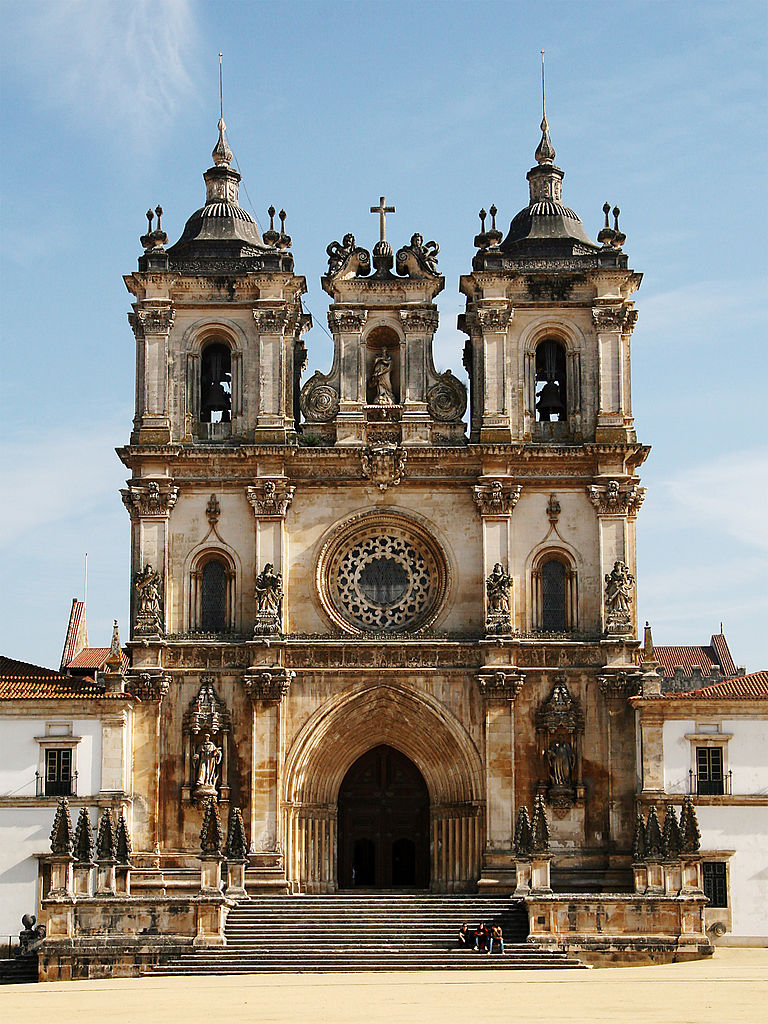
Apparently, the Monastery of Alcobaça’s resident monks were eating plenty of other things, too.
Eventually their reputation for excessive plumpness became problematic.
A hefty physique may have signified prosperity and health in 1178 when construction began on the UNESCO World Heritage site, but by the 18th-century, those extra rolls of flesh were considered at odds with the Cistercian monks’ vows of obedience, poverty and chastity.
Its larders were well stocked, thanks in part to the rich farmland surrounding the monastery.
On one side, loads of game and venison were heaped up; on the other, vegetables and fruit in endless variety. Beyond a long line of stoves extended a row of ovens, and close to them hillocks of wheaten flour whiter than snow, rocks of sugar, jars of the purest oil, and pastry in vast abundance, which a numerous tribe of lay brothers and their attendants were rolling out and puffing up into a hundred different shapes, singing all the while as blithely as larks in a corn-field.
Later he has the opportunity to sample some of the dishes issuing from that kitchen:
The banquet itself consisted of not only the most excellent usual fare, but rarities and delicacies of past seasons and distant countries; exquisite sausages, potted lampreys, strange messes from the Brazils, and others still stranger from China (edible birds’ nests and sharks’ fins), dressed after the latest mode of Macao by a Chinese lay brother. Confectionery and fruits were out of the question here; they awaited us in an adjoining still more spacious and sumptuous apartment, to which we retired from the effluvia of viands and sauces.
Later in his travels, he is taken to meet a Spanish princess, who inquires, “How did you leave the fat waddling monks of Alcobaça? I hope you did not run races with them.”
Perhaps such tattle is what convinced the brass that something must be done.
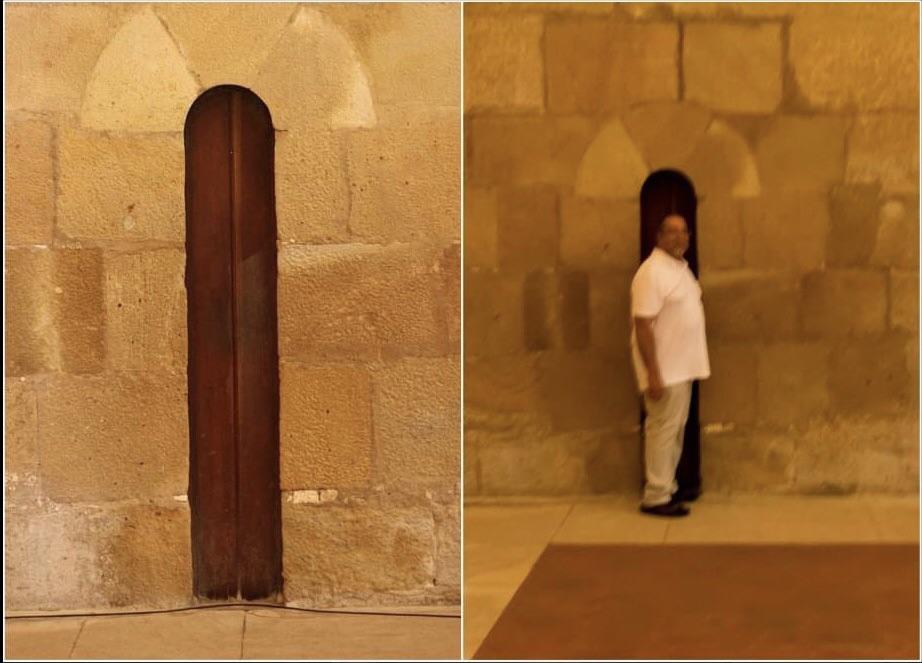
The remedy took the form of a porta pega-gordo (or “fat catcher door”), 6′ 6″ high, but only 12.5” wide.
Allegedly, each monk was required to pass through it from the refectory to the kitchen to fetch his own meal. Those who couldn’t squeeze through were out of luck.
Did they have to sit in the refectory with their faces to the walls, silently eating the sins of the people (respicite quia peccata populi comeditis) while their slimmer brethren filled their bellies, also silently, face-to-the-wall, as a reader read religious texts aloud from a pulpit?
History is a bit unclear on this point, though Beckford’s enthusiasm waned when he got to the refectory:
…a square of seventy or eighty feet, begloomed by dark-coloured painted windows, and disgraced by tables covered with not the cleanest or least unctuous linen in the world.
According to a German Wikipedia entry, the monks passed through the porta pega-gordo monthly, rather than daily, a more manageable mortification of the flesh for those with healthy appetites.
Image via Wikimedia Commons
If you are assembling a bucket list of destinations for when we can travel freely again, consider adding this beautiful Gothic monastery (and the celebrated pastry shop across the street). Your choice whether or not to suck it in for a photo in front of the porta pega-gordo.
Ayun Halliday is an author, illustrator, theater maker and Chief Primatologist of the East Village Inky zine. She most recently appeared as a French Canadian bear who travels to New York City in search of food and meaning in Greg Kotis’ short film, L’Ourse. Follow her @AyunHalliday.
Have you ever wondered what generations hundreds or thousands of years hence will make of our strip malls, office parks, and sports arenas? Probably not much, since there probably won’t be much left. How much medium-density fibreboard is likely to remain? The colorful structures that make the modern world seem solid, the grocery shelves, fast food counters, and shiny product displays, will return to the sawdust from which they came.
Back in antiquity, on the other hand, things were built to last, even through the fires and devastation of the eruption of Mount Vesuvius in 79 AD. Archaeologists will be discovering for many more years everyday features of Pompeii that survived a historic disaster and the ordinary ravages of time. In 2019, a team fully unearthed what is known as a thermopolium, a fancy Greek word for a snack bar that “would have served hot food and drinks to locals in the city,” the BBC reports. The find was only unveiled this past Saturday.
You can see the excavation in a subtitled virtual tour at the top conducted by Massimo Osanna, Pompeii’s general director and the “mastermind,” Smithsonian writes, behind the Great Pompeii Project, a “$140 million conservation and restoration program launched in 2012.”
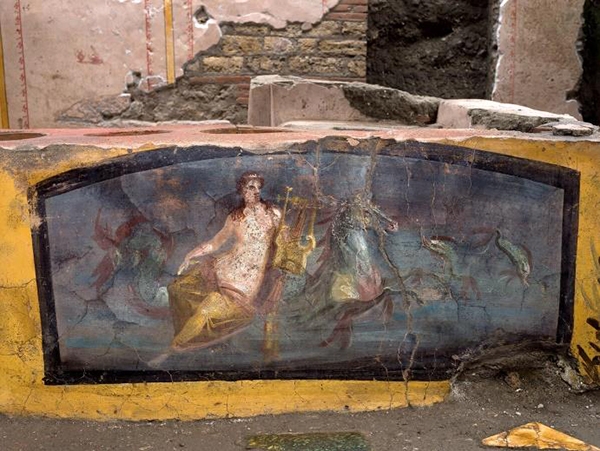
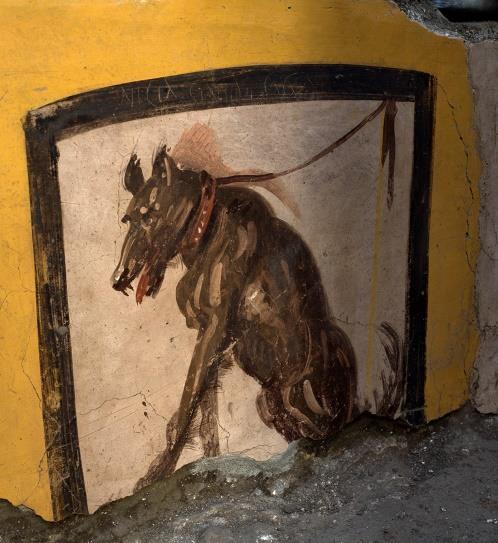
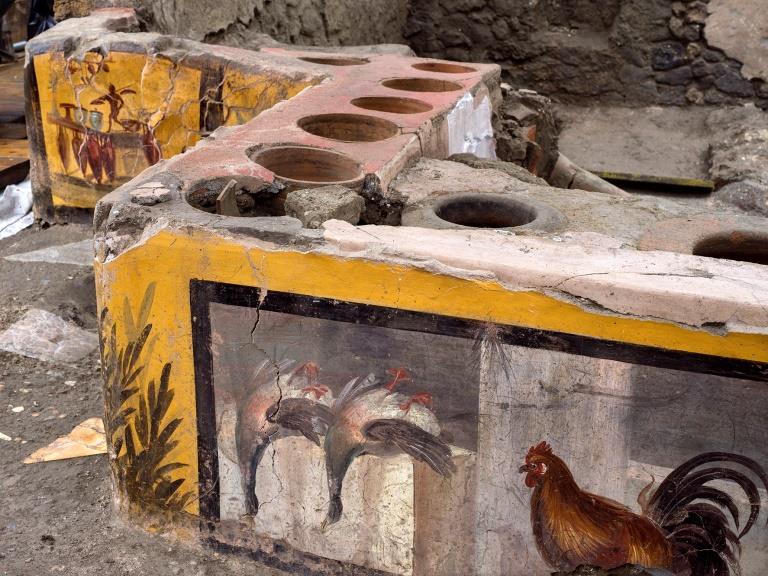
Richly decorated with brightly-colored paintings, preserved by ash, the Thermopolium of Regio V, as it’s known, features a scene of a nereid riding a sea-horse. Surrounding her on all sides of the counter are illustrations of the food for sale, including “two mallard ducks shown upside down, ready to be cooked and eaten,” notes the official Pompeii site, “a rooster,” and “a dog on a lead, the latter serving as a warning in the manner of the famed Cave Canem.”
Undeterred and spurred on by the Romans’ famed love of graffiti, someone scratched a “mocking inscription” into the frame around the dog: “NICIA CINAEDE CACATOR—literally ‘Nicias (probably a freedman from Greece) Shameless Shitter!’” The message may have been left by a disgruntled worker, “who sought to poke fun at the owner.” Also found at the site were bone fragments in containers belonging to the animals pictured, as well as human bones and “various pantry and transport materials” such as amphorae, flasks, and other typical Roman containers.
Despite its elaborate design and the excitement of its discoverers, the thermopolium was nothing special in its day. Such counters were like Starbucks, “widespread in the Roman world, where it was typical to consume the prandium (the meal) outside the house. In Pompeii alone there are eighty of them.” Will future archaeologists thrill over the discovery of a Cinnabon in a thousand years’ time? We’ll never know, but somehow I doubt it. Learn much more about this discovery at the official site for Pompeii, which hopes to reopen to visitors in the Spring of 2021. All images come via Pompeiisites.org.
You need never endeavor to make any of the recipes world renowned chef Jacques Pépin produced on camera in his 2008 series More Fast Food My Way.
The helpful hints he tosses off during each half hour episode more than justify a viewing.
The menu for the episode titled “The Egg First!,” above, includes Red Pepper Dip, Asparagus Fans with Mustard Sauce, Scallops Grenobloise, Potato Gratin with Cream, and Jam Tartines with Fruit Sherbet so simple, a child could make it (provided they’re set up with good quality poundcake in advance.)
Delicious… especially when prepared by a culinary master Julia Child lauded as “the best chef in America.”
And he’s definitely not stingy with matter-of-fact advice on how to peel asparagus, potatoes and hard boiled egg, grate fresh nutmeg with a knife, and dress up store bought mayo any number of ways.
Many of the dishes harken to his childhood in World War II-era Lyon:
When we were kids, before going to school, my two brothers and I would go to the market with my mother in the morning. She had a little restaurant… There was no car, so we walked to the market—about half a mile away—and she bought, on the way back, a case of mushrooms which was getting dark so she knew the guy had to sell it, so she’d try to get it for half price… She didn’t have a refrigerator. She had an ice box: that’s a block of ice in a cabinet. In there she’d have a couple of chickens or meat for the day. It had to be finished at the end of the day because she couldn’t keep it. And the day after we’d go to the market again. So everything was local, everything was fresh, everything was organic. I always say my mother was an organic gardener, but of course, the word ‘organic’ did not exist. But chemical fertilizer did not exist either.
If you have been spending a lot of time by yourself, some of the episode themes may leave a lump in your throat—Dinner Party Special, Game Day Pressure, and Pop Over Anytime, which shows how to draw on pantry staples and convenience foods to “take the stress out of visitors popping in.”
The soon to be 85-year-old Pépin (Happy Birthday December 18, Chef!) spoke to Zagat earlier about the pandemic’s effect on the restaurant industry, how we can support one another, and the beauty of home cooked meals:
People—good chefs—are wondering how they will pay their rent. It is such a terrible feeling to have to let your employees go. In a kitchen, or a restaurant, we are like a family, so it is painful to separate or say goodbye. That said, it is important to be optimistic. This is not going to last forever.
Depending on where you are, perhaps this is a chance to reconnect with the land, with farmers, with the sources of food and cooking. This is a good time to plant a garden. And gardening can be very meditative. Growing food is not just for the food, but this process helps us to reconnect with who we are, why we love food, and why we love cooking. With this time, cook at home. Cook for your neighbor and drop the food off. Please your family and your friends and your own palate with food, for yourself. This is not always easy for a chef with the pressure of running a restaurant. Cooking is therapeutic…
Many people now are beginning to suffer economically. But if you can afford it, order take-out, and buy extra for your neighbors. If you can afford it, leave a very large tip. Think about the servers and dishwashers and cooks that may not be able to pay their rent this month. If you can be more generous than usual, that would be a good idea. We need to do everything we can to keep these restaurants in our communities alive.
…this moment is a reassessment and re-adjustment of our lives. Some good things may come of it. We may have the opportunity to get closer to one another, to sit as a family together at the table, not one or two nights a week, but seven! We may not see our friends, but we may talk on the phone more than before. Certainly, with our wives and children we will be creating new bonds. We will all be cooking more, even me. This may be the opportunity to extend your palate, and to get your kids excited about cooking and cooking with you.
Ayun Halliday is an author, illustrator, theater maker and Chief Primatologist of the East Village Inky zine. She most recently appeared as a French Canadian bear who travels to New York City in search of food and meaning in Greg Kotis’ short film, L’Ourse. Follow her @AyunHalliday.
We must fight against puddles of sauce, disordered heaps of food, and above all, against flabby, anti-virile pastasciutta. —poet Filippo Tommaso Marinetti
Odds are Filippo Tommaso Marinetti, the father of Futurism and a dedicated provocateur, would be crestfallen to discover how closely his most incendiary gastronomical pronouncement aligns with the views of today’s low-carb crusaders.
In denouncing pasta, “that absurd Italian gastronomic religion,” his intention was to shock and criticize the bourgeoisie, not reduce bloat and inflammation.
He did, however, share the popular 21st-century view that heavy pasta meals leave diners feeling equally heavy and lethargic.
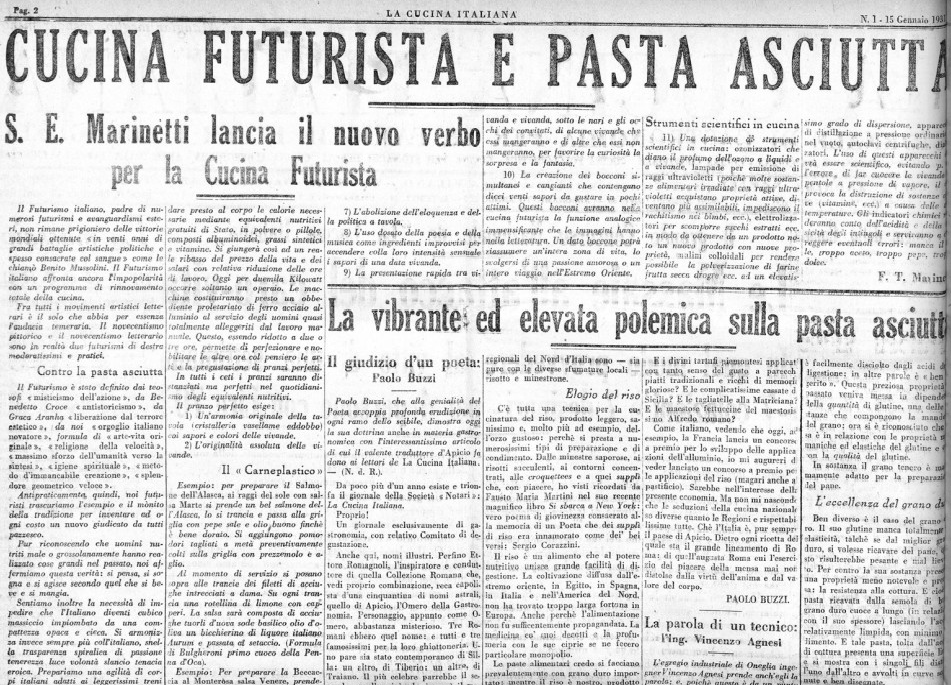
Futurist cooking will be free of the old obsessions with volume and weight and will have as one of its principles the abolition of pastasciutta. Pastasciutta, however agreeable to the palate, is a passéist food because it makes people heavy, brutish, deludes them into thinking it is nutritious, makes them skeptical, slow, pessimistic… Any pastascuittist who honestly examines his conscience at the moment he ingurgitates his biquotidian pyramid of pasta will find within the gloomy satisfaction of stopping up a black hole. This voracious hole is an incurable sadness of his. He may delude himself, but nothing can fill it. Only a Futurist meal can lift his spirits. And pasta is anti-virile because a heavy, bloated stomach does not encourage physical enthusiasm for a woman, nor favour the possibility of possessing her at any time.
Bombast came naturally to him. While he truly believed in the tenets of Futurism—speed, industry, technology, and the cleansing effects of war, at the expense of tradition and the past—he gloried in hyperbole, absurdity, and showy pranks.
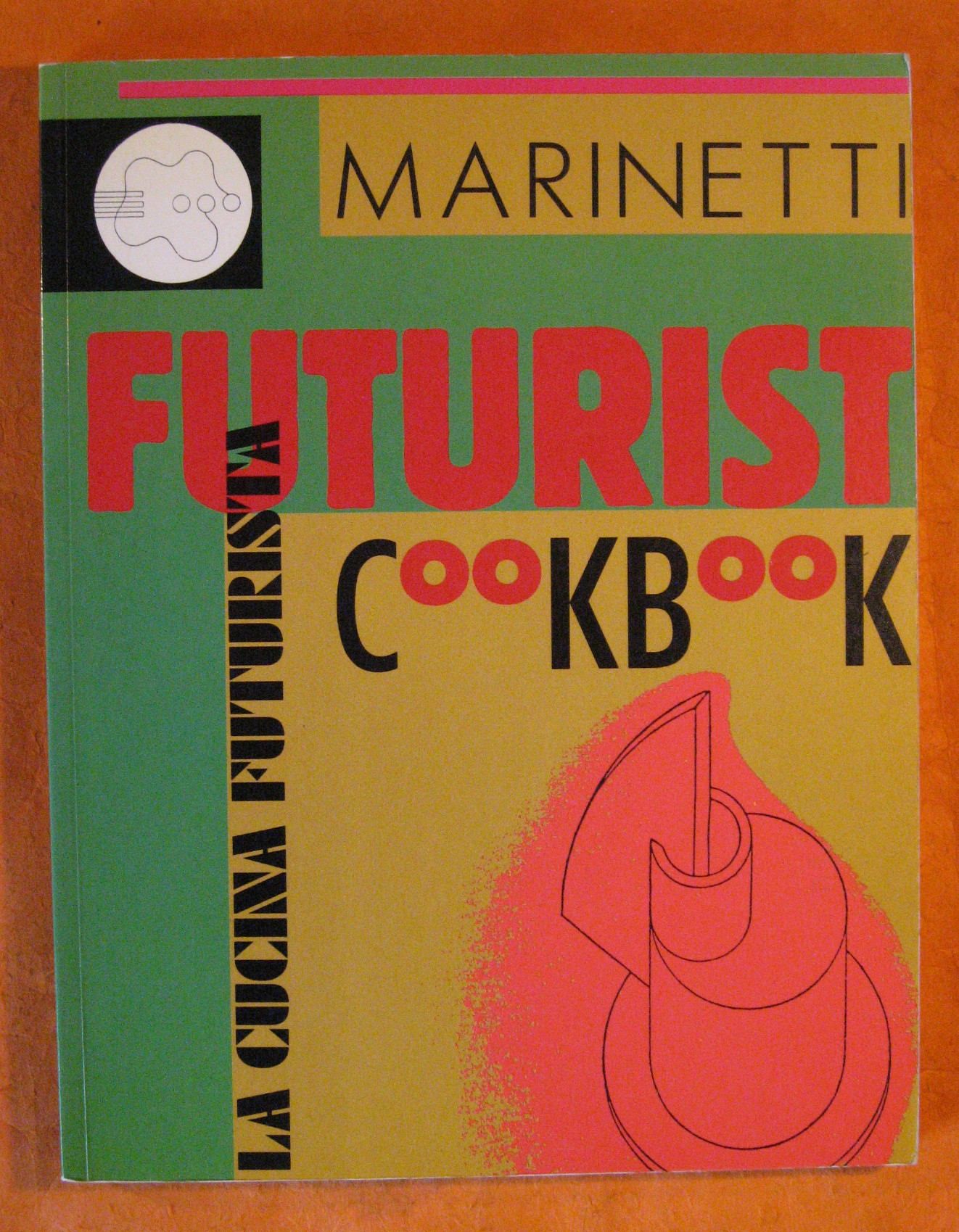
The Futurist Cookbookreflects this, although it does contain actual recipes, with very specific instructions as to how each dish should be served. A sample:
RAW MEAT TORN BY TRUMPET BLASTS: cut a perfect cube of beef. Pass an electric current through it, then marinate it for twenty-four hours in a mixture of rum, cognac and white vermouth. Remove it from the mixture and serve on a bed of red pepper, black pepper and snow. Each mouthful is to be chewed carefully for one minute, and each mouthful is divided from the next by vehement blasts on the trumpet blown by the eater himself.
Intrepid host Trevor Dunseith documents his attempt to stage a faithful Futurist dinner party in the above video.
Guests eat salad with their hands for maximum “pre-labial tactile pleasure” before balancing oranges stuffed with antipasto on their heads to randomize the selection of each mouthful. While not all of the flavors were a hit, the party agreed that the experience was—as intended—totally novel (and 100% pasta free).
Marinetti’s anti-pasta campaign chimed with Prime Minister Benito Mussolini’s goal of eliminating Italy’s economic dependence on foreign markets—the Battle for Grain. Northern farmers could produce ample supplies of rice, but nowhere near the amount of wheat needed to support the populace’s pasta consumption. If Italians couldn’t grow more wheat, Mussolini wanted them to shift from pasta to rice.
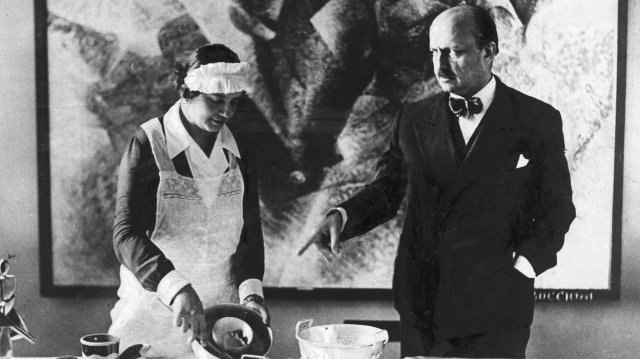
F.T. Marinetti by W. Seldow, 1934
Marinetti agreed that rice would be the “patriotic” choice, but his desired ends were rooted in his own avant-garde art movement:
… it is not just a question of replacing pasta with rice, or of preferring one dish to another, but of inventing new foods. So many mechanical and scientific changes have come into effect in the practical life of mankind that it is also possible to achieve culinary perfection and to organize various tastes, smells and functions, something which until yesterday would have seemed absurd because the general conditions of existence were also different. We must, by continually varying types of food and their combinations, kill off the old, deeply rooted habits of the palate, and prepare men for future chemical foodstuffs. We may even prepare mankind for the not-too-distant possibility of broadcasting nourishing waves over the radio.
Futurism’s ties to fascism are not a thing to brush off lightly, but it’s also important to remember that Marinetti believed it was the artist’s duty to put forward a bold public personae. He lived to ruffle feathers.
Mission accomplished. His anti-pasta pronouncements resulted in a tumult of public indignation, both locally and in the States.
The Duke of Bovino, mayor of Naples, reacted to Marinetti’s statement that pasta is “completely hostile to the vivacious spirit and passionate, generous, intuitive soul of the Neapolitans” by saying, “The angels in Heaven eat nothing but vermicelli al pomodoro.” Proof, Marinetti sniped back, of “the unappetizing monotony of Paradise and of the life of the Angels.”
He agitated for a futuristic world in which kitchens would be stocked with ”atmospheric and vacuum stills, centrifugal autoclaves (and) dialyzers.”
His recipes, as Trevor Dunseith discovered, function better as one-time performance art than go-to dishes to add to one’s culinary repertoire.
Marinetti supported Fascism to the extent that it too advocated progress, but his allegiance eventually wavered. To Marinetti, Roman ruins and Renaissance paintings were not only boring but also antithetical to progress. To Mussolini, by contrast, they were politically useful. The dictator drew on Italian history in his quest to build a new, powerful nation—which also led to a national campaign in food self-sufficiency, encouraging the growing and consumption of such traditional foods as wheat, rice, and grapes. The government even funded research into the nutritional benefits of wheat, with one scientist claiming whole-wheat bread boosted fertility. In short, the prewar dream of futurist food was tabled yet again.
Ayun Halliday is an author, illustrator, theater maker and Chief Primatologist of the East Village Inky zine. See her as a French Canadian bear who travels to New York City in search of food and meaning in Greg Kotis’ short film, L’Ourse. Follow her @AyunHalliday.
We're hoping to rely on loyal readers, rather than erratic ads. Please click the Donate button and support Open Culture. You can use Paypal, Venmo, Patreon, even Crypto! We thank you!
Open Culture scours the web for the best educational media. We find the free courses and audio books you need, the language lessons & educational videos you want, and plenty of enlightenment in between.