The Library of Alexandria has been physically gone for about eighteen centuries now, but the institution endures as a powerful symbol. Today we have the internet, which none can deny is at least well on its way to becoming a digital store of all human knowledge. But despite having emerged from an ever more enormously complex technological infrastructure, the internet is difficult to capture in a legible mental picture. The Library of Alexandria, by contrast, actually stood in Egypt for some 300 years after its commissioning by Ptolemy I and II, and early in the second century B.C. it bid fair to hold practically all written knowledge in existence within its walls (and those of its “daughter library” the Serapeum, constructed when the main building ran out of space).
Interesting enough as a lost work of ancient architecture, the Library of Alexandria is remembered for its contents — not that history has been able to remember in much detail what those contents actually were. “Some ancient authors claimed that it contained 700,000 books,” says ancient-history scholar Garret Ryan in the video above.
“Books, in this context, meaning papyrus scrolls,” and their actual number was almost certainly smaller. By the time the Library itself — or at least part of it — was burned down by Julius Caesar in 48 B.C., it had been falling into disuse for quite some time. “It is sometimes said that the destruction of the Library of Alexandria set civilization back by centuries,” Ryan tells us. “This is a wild exaggeration.”
The Library of Alexandria might have been the most impressive intellectual repository in the ancient world, but it was hardly the only one. Most of the works in its collection, Ryan explains, would also have been held by other libraries, though they would also decline along with the general interest in classical culture. “Although there were certainly many works of mathematics and physics, the most important of these were widely disseminated elsewhere. What perished with the Library were, overwhelmingly, lesser-known works of literature and philosophy, commentaries and monographs: all the residue and introspection of an extremely sophisticated literary culture.” To scholars of ancient literature, of course, such a loss is incalculable. And in our own culture today, we’ll still do well to hold up the Library of Alexandria as an image of what it is to amass human knowledge — as well as what it is to let that knowledge decay.
Based in Seoul, Colin Marshall writes and broadcasts on cities, language, and culture. His projects include the Substack newsletterBooks on Cities, the book The Stateless City: a Walk through 21st-Century Los Angeles and the video series The City in Cinema. Follow him on Twitter at @colinmarshall or on Facebook.
Anita Berber, the taboo-busting, sexually omnivorous, fashion forward, frequently naked star of the Weimar Republic cabaret scene, tops our list of performers we really wish we’d been able to see live.
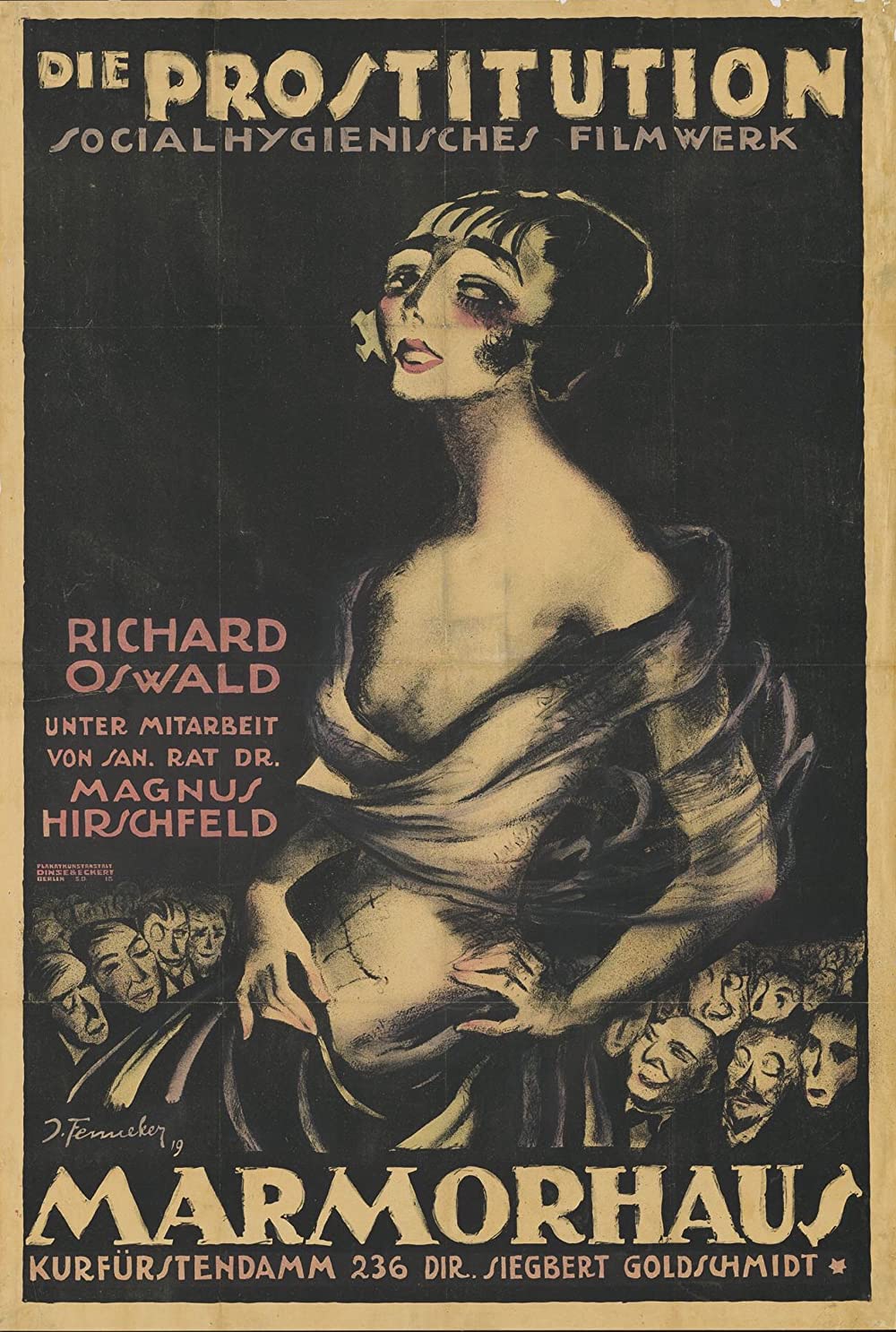
While Berber acted in 27 films, including Prostitution, director Fritz Lang’s Dr. Mabuse: The Gambler, and Different from the Others, which film critic Dennis Harvey describes as “the first movie to portray homosexual characters beyond the usual innuendo and ridicule,” we have a strong hunch that none of these appearances can compete with the sheer audacity of her stage work.
Audiences at Berlin’s White Mouse cabaret (some wearing black or white masks to conceal their identities) were titillated by her Expressionistic nude solo choreography, as well as the troupe of six teenaged dancers under her command.
Berber had been known to spit brandy on them or stand naked on their tables, dousing herself in wine whilst simultaneously urinating… It was not long before the entire cabaret one night sank into a groundswell of shouting, screams and laughter. Anita jumped off the stage in fuming rage, grabbed the nearest champagne bottle and smashed it over a businessman’s head.
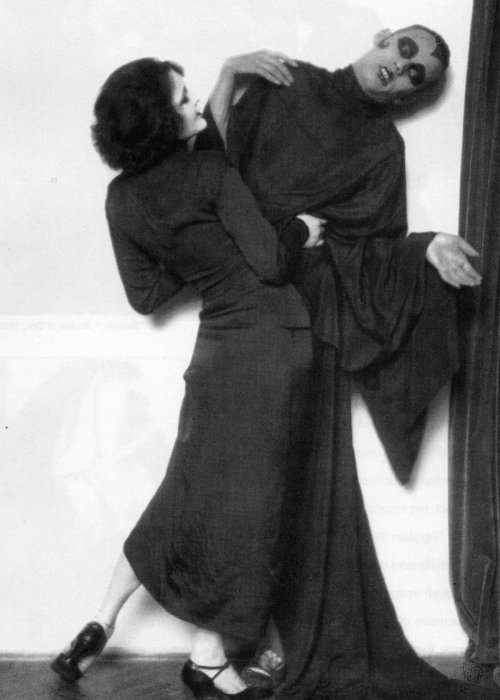
Her collaborations with her second husband, dancer Sebastian Droste, carried Berber into increasingly transgressive territory, both onstage and off.
According to translator Merrill Cole, in the introduction to the 2012 reissue of Dances of Vice, Horror and Ecstasy, a book of Expressionist poems, essays, photographs, and stage designs which Droste and Berber co-authored, “even the biographical details seduce:”
…a bisexual sometimes-prostitute and a shady figure from the male homosexual underworld, united in addiction to cocaine and disdain for bourgeois respectability, both highly talented, Expressionist-trained dancers, both beautiful exhibitionists, set out to provide the Babylon on the Spree with the ultimate experience of depravity, using an art form they had helped to invent for this purpose. Their brief marriage and artistic interaction ended when Droste became desperate for drugs and absconded with Berber’s jewel collection.
This, and the description of Berber’s penchant for “haunt(ing) Weimar Berlin’s hotel lobbies, nightclubs and casinos, radiantly naked except for an elegant sable wrap, a pet monkey hanging from her neck, and a silver brooch packed with cocaine,” do a far more evocative job of resurrecting Berber, the Weimar sensation, than any wordy, blow-by-blow attempt to recreate her shocking performances, though we can’t fault author Karl Toepfer, Professor Emeritus of Theater Arts at San Jose State University, for trying.
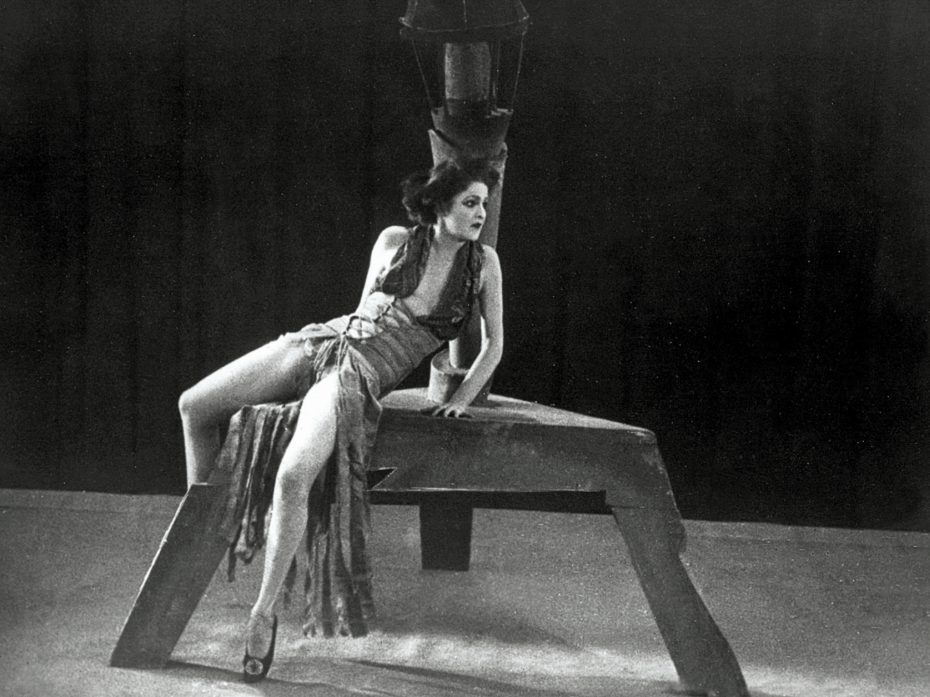
In Empire of Ecstasy: Nudity and Movement in German Body Culture, 1910–1935, Toepfer draws heavily on Czech choreographer Joe Jenčík’s eyewitness observations, to reconstruct Berber’s most notorious dance, Cocaine, beginning with the “ominous scenery by Harry Täuber featuring a tall lamp on a low, cloth-covered table:”
This lamp was an expressionist sculpture with an ambiguous form that one could read as a sign of the phallus, an abstraction of the female dancer’s body, or a monumental image of a syringe, for a long, shiny needle protruded from the top of it…It is not clear how nude Berber was when she performed the dance. Jenčík, writing in 1929, flatly stated that she was nude, but the famous Viennese photographer Madame D’Ora (Dora Kalmus) took a picture entitled “Kokain” in which Berber appears in a long black dress that exposes her breasts and whose lacing, up the front, reveals her flesh to below her navel.
In any case, according to Jenčík, she displayed “a simple technique of natural steps and unforced poses.” But though the technique was simple, the dance itself, one of Berber’s most successful creations, was apparently quite complex. Rising from an initial condition of paralysis on the floor (or possibly from the table, as indicated by Täuber’s scenographic notes), she adopted a primal movement involving a slow, sculptured turning of her body, a kind of slow-motion effect. The turning represented the unraveling of a “knot of flesh.” But as the body uncoiled, it convulsed into “separate parts,” producing a variety of rhythms within itself. Berber used all parts of her body to construct a “tragic” conflict between the healthy body and the poisoned body: she made distinct rhythms out of the movement of her muscles; she used “unexpected counter-movements” of her head to create an anguished sense of balance; her “porcelain-colored arms” made hypnotic, pendulumlike movements, like a marionette’s; within the primal turning of her body, there appeared contradictory turns of her wrists, torso, ankles; the rhythm of her breathing fluctuated with dramatic effect; her intense dark eyes followed yet another, slower rhythm; and she introduced the “most refined nuances of agility” in making spasms of sensation ripple through her fingers, nostrils, and lips. Yet, despite all this complexity, she was not afraid of seeming “ridiculous” or “painfully swollen.” The dance concluded when the convulsed dancer attempted to cry out (with the “blood-red opening of the mouth”) and could not. The dancer then hurled herself to the floor and assumed a pose of motionless, drugged sleep. Berber’s dance dramatized the intense ambiguity involved in linking the ecstatic liberation of the body to nudity and rhythmic consciousness. The dance tied ecstatic experience to an encounter with vice (addiction) and horror (acute awareness of death).
A noble attempt, but forgive us if we can’t quite picture it…
And what little evidence has been preserved of her screen appearances exists at a similar remove from the dark subject matter she explicitly referenced in her choreographed work — Morphine, Suicide, The Corpse on the Dissecting Table…
Cole opines:
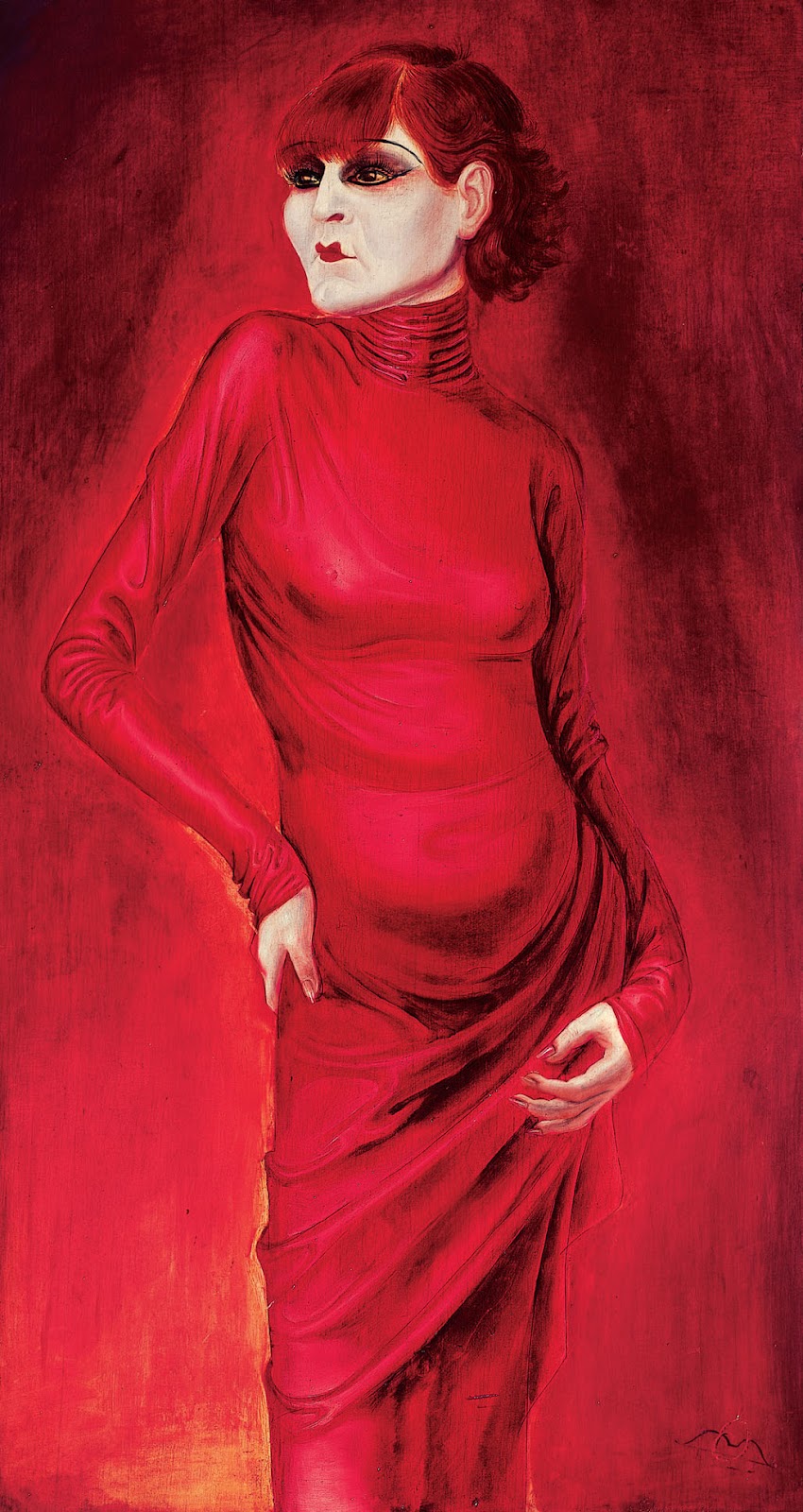
There are a number of narrative accounts of her dances, some pinned by professional critics, and almost all commending her talent, finesse, and mesmerizing stage presence. We also have film images from the various silent films in which she played bit parts. There exist, too, many still photographs of Berber and Droste, as well as renditions of Berber by other artists, most prominently the Dadaist Otto Dix’s famous scarlet-saturated portrait. In regard to the naked dances, unfortunately, we have no moving images, no way to watch directly how they were performed.
For a dishy overview of Anita Berber’s personal life, including her alleged dalliances with actress Marlene Dietrich, author Lawrence Durrell, and the King of Yugoslavia, her influential effect on director Leni Riefenstahl, and her sad demise at the age of 29, a “carrion soul that even the hyenas ignored,” take a peek at Victoria Linchong’s biographical essay for Messy Nessy Chic, or better yet, Iron Spike’s Twitter thread.
Berber was addicted to alcohol, cocaine, opium, and morphine. But one of her favorite drugs was chloroform and ether, mixed in a bowl. She would stir the bowl with the bloom of a white rose, and then eat the petals.
The video above shows us Jack Kerouac giving a reading, accompanied by the jazz piano stylings of evening television variety-show host Steve Allen. In other words, if you’ve been looking for the most late-nineteen-fifties clip in existence, your journey may have come to an end. Earlier in that decade, Allen says (sprinkling his monologue with a few notes here and there), “the nation recognized in its midst a social movement called the Beat Generation. A novel titled On the Roadbecame a bestseller, and its author, Jack Kerouac, became a celebrity: partly because he’d written a powerful and successful book, but partly because he seemed to be the embodiment of this new generation.”
As the novelists and poets of the Beat Generation were gradually gaining renown, Allen was fast becoming a national celebrity. In 1954, his co-creation The Tonight Show made him the first late-night television talk show host, and consequently applied pressure to stay atop the cultural currents of the day. Not only did he know of the Beats, he joined them, at least for one collaboration: “Jack and I made an album together a few months back in which I played background piano for his poetry reading.” That was Poetry for the Beat Generation, the first of Kerouac’s trilogy of spoken-word albums that we previously featured here on Open Culture back in 2015.
“At that time I made a note to book him on this show,” Allen says, “because I thought you would enjoy meeting him.” After answering a few “square questions” by way of introduction — it took him three weeks to write On the Road, he spent seven years on the road itself, he did indeed type on a continuous “scroll’ of paper, and he would define “Beat” as “sympathetic” — Kerouac reads from the novel that made his name, accompanied by Allen’s piano. “A lot of people have asked me, why did I write that book, or any book,” he begins. “All the stories I wrote were true, because I believed in what I saw.” This is, of course, not poetry but prose, and practically essayistic prose at that, but here it sounds like a literary form all its own.
If you’d like to hear the music of Kerouac’s prose without actual musical accompaniment, have a listen to his acetate recording of a half-hour selection from On the Roadthat we posted last weekend. The occasion was the 100th anniversary of his birth, which elsewhere brought forth all manner of tributes and re-evaluations of his work and legacy. 65 years after On the Road’s publication, how much resemblance does today’s America bear to the one crisscrossed by Sal Paradise and Dean Moriarty? It’s worth considering why the country no longer inspires writers quite like Jack Kerouac — or for that matter, given the passage of his own little-noted centenary last December, television hosts like Steve Allen.
Based in Seoul, Colin Marshall writes and broadcasts on cities, language, and culture. His projects include the Substack newsletterBooks on Cities, the book The Stateless City: a Walk through 21st-Century Los Angeles and the video series The City in Cinema. Follow him on Twitter at @colinmarshall or on Facebook.
Last year, the fates handed the New York Times’ Maria Cramer an enviably striking lede: “Humanity is 100 seconds away from total annihilation. Again.” That we all know immediately what she was writing about speaks to the power of graphic design. Specifically, it speaks to the power of graphic design as practiced by Martyl Langsdorf, who happened to be married to ex-Manhattan Project physicist Alexander Langsdorf. This connection got her the gig of creating a cover for the June 1947 issue of the Bulletin of the Atomic Scientists. She came up with a simpleimage: the upper-left corner of a clock, its hands at seven minutes to midnight.
Asked later why she set the clock to that time in particular, Langsdorf explained that “it looked good to my eye.” That quote appears in a post at the Bulletin addressing frequently asked questions about what’s now known as the Doomsday Clock, “a design that warns the public about how close we are to destroying our world with dangerous technologies of our own making. It is a metaphor, a reminder of the perils we must address if we are to survive on the planet.” In the 75 years since its introduction, its minute hand has been moved backward eight times and forward sixteen times; currently it still stands where Cramer reported it as having remained last January, at 100 seconds to midnight.
To the public of 1947, “midnight” signified above all the prospect of humanity’s self-destruction through the use of nuclear weapons. But as technology itself has advanced and proliferated, the means of auto-annihilation have grown more diverse. This year’s Doomsday Clock statement cites not just nukes but carbon emissions, infectious diseases, and “internet-enabled misinformation and disinformation.” Earlier this month, the Bulletin reminded us that even as 2022 began, “we called out Ukraine as a potential flashpoint in an increasingly tense international security landscape. For many years, we and others have warned that the most likely way nuclear weapons might be used is through an unwanted or unintended escalation from a conventional conflict.”
Now that “Russia’s invasion of Ukraine has brought this nightmare scenario to life,” many have found themselves glancing nervously at the Doomsday Clock once again. This also happened after the election of Donald Trump, which prompted the Vox video above on the Clock’s history and purpose. Its iconic status, as celebrated in the new book The Doomsday Clock at 75, has long outlasted the Cold War, but the device itself isn’t without its critics. Bulletin co-founder Eugene Rabinowitch once articulated the latter as meant “to preserve civilization by scaring men into rationality,” a somewhat controversial intention. One could also raise objections to using an inherently linear and unidirectional concept like time to represent a probability resulting from human action. Yet somehow more technically suitable images — “100 centimeters from the edge,” say — don’t have quite the same ring.
Based in Seoul, Colin Marshall writes and broadcasts on cities, language, and culture. His projects include the Substack newsletterBooks on Cities, the book The Stateless City: a Walk through 21st-Century Los Angeles and the video series The City in Cinema. Follow him on Twitter at @colinmarshall or on Facebook.
Last week we featured the recent discovery of Ernest Shackleton’s ship Endurance, which has spent more than a century at the bottom of the Weddell Sea off Antarctica. It sank there in 1915, after having been entrapped and slowly crushed by pack ice for the most of a year. That marked the end of what had started as the 1914–1917 Imperial Trans-Antarctic Expedition, but it certainly wasn’t the end of the story. When it had become clear that there was no hope for Endurance, writes Rain Noe at Core77, “Shackleton and five of the crew then sailed 800 miles in a lifeboat to Stromness, an inhabited island and whaling station in the South Atlantic, where they were able to organize a rescue party. Shackleton located and rescued his crew four months later.”
Today we can watch the Endurance’s demise on film, as shot by expedition photographer Frank Hurley. “How is it possible that the film footage survived this ordeal?” Noe writes. “After the crew abandoned ship, food was the main thing to be carried away by the men, and Hurley had to decide which photo negatives and film reels to salvage.” Hurley himself later described this agonizing process, at the end of which “about 400 plates were jettisoned and 120 retained. Later I had to preserve them almost with my life; for a time came when we had to choose between heaving them overboard or throwing away our surplus food — and the food went over!”
Even relatively early in the era of cinema, Hurley must have understood the power of the image — as, it seems, did his captain. The footage Hurley could salvage retained a striking clarity, and it went into 1919’s South, which is now considered to be the very first documentary feature. “South was first exhibited by Ernest Shackleton in 1919 to accompany his lectures,” writes Ann Ogidi at the BFI’s Screenonline, “and it has some of the quality of a lecture. Excerpts of the journey are interspersed with scientific and biological observations.” And “just when the dramatic tension reaches its height, there are almost 20 inexplicable minutes of nature footage, showing sea lions gamboling, penguins and other birds.”
Crisply restored in the 1990s, South “is best thought of as that multi-media documentary lecture that Shackleton would have presented with stills, paintings, film and music woven together to spin the yarn, and for Hurley’s exquisite photography that keeps alive the story of that group of extraordinary men.” So writes BFI curator Bryony Dixon in a recent piece on the miraculous survival of not just Shackleton and his men, but of Hurley’s handiwork. And it was Hurley who then went right back out to the island of South Georgia to “take wildlife footage that the newspaper editor Ernest Perris, who sponsored the film, was convinced was needed to make the film interesting to the public.” Perris was daring enough to fund the first documentary feature, but also prescient in his conception of the form — a conception proven definitively right, more than eighty years later, by the box-office performance of March of the Penguins.
Based in Seoul, Colin Marshall writes and broadcasts on cities, language, and culture. His projects include the Substack newsletterBooks on Cities, the book The Stateless City: a Walk through 21st-Century Los Angeles and the video series The City in Cinema. Follow him on Twitter at @colinmarshall or on Facebook.
There was a period in the late 20th-century when having hair long enough to sit on was considered something of an accomplishment.
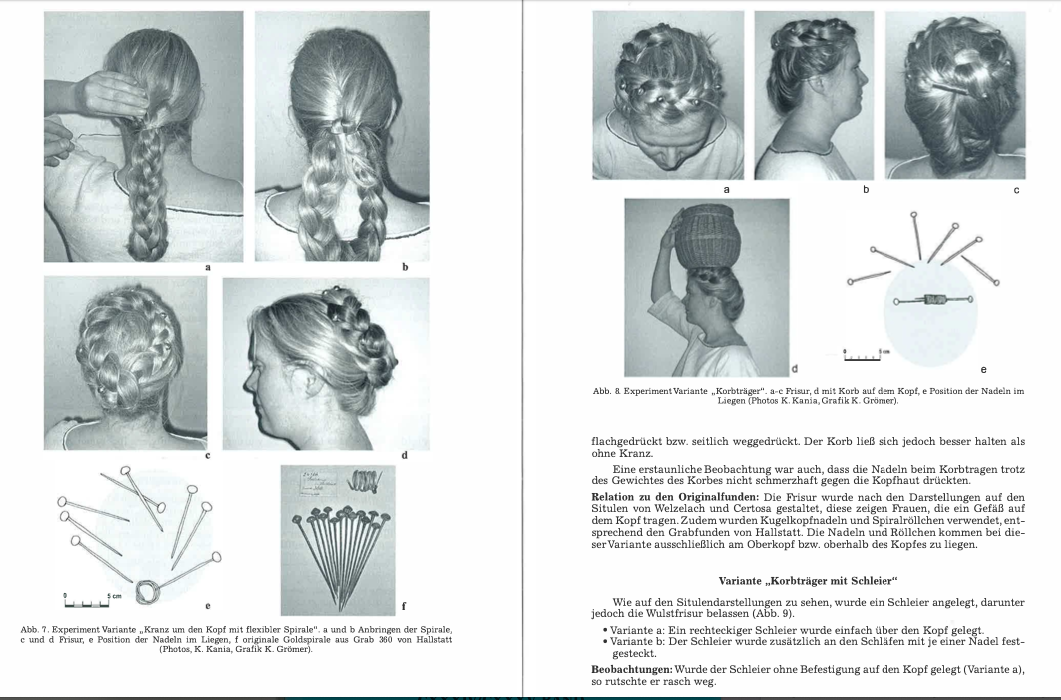
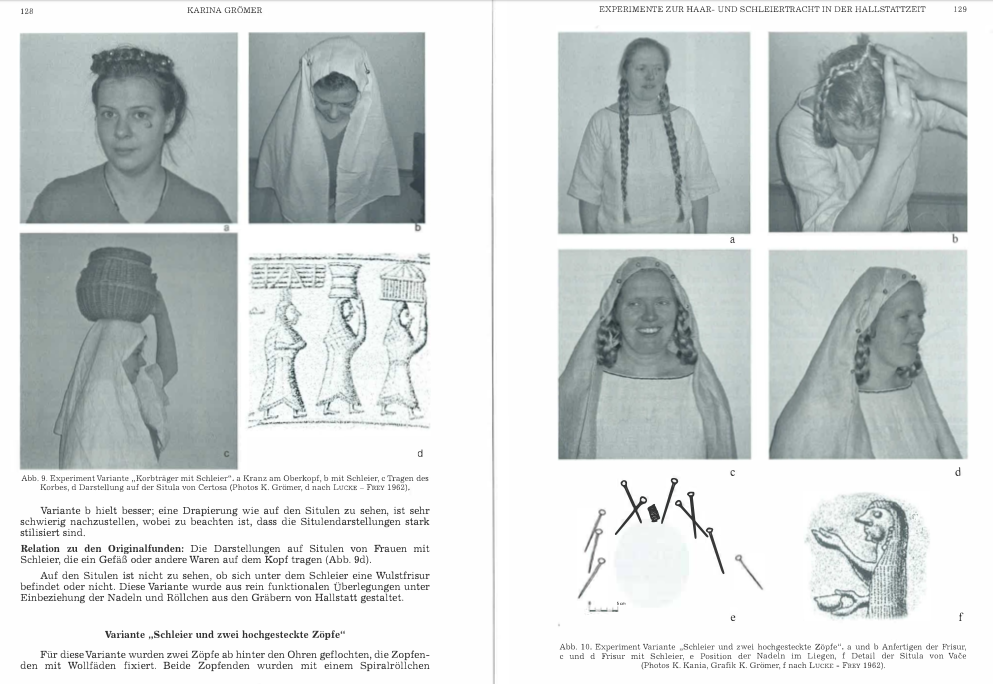
Judging by the long hair pins unearthed from Austria’s Hallstatt burial site, extreme length was an early Iron Age hair goal, too, possibly because a coronet of thick braids made it easier to balance a basket on your head or keep your veil securely fastened.
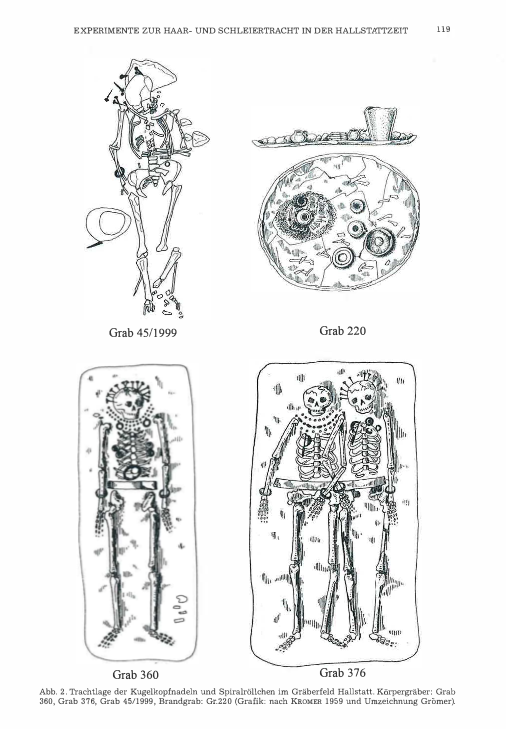
Gromer, the vice-head of the Vienna Natural History Museum’s Department of Prehistory, published precise diagrams showing the position of the hair ornaments in relation to the occupants of various graves.
For example, the skeleton in grave 45, below, was discovered with “10 bronze needles to the left of and below the skull, (and) parts of a bronze spiral roll in the neck area.”
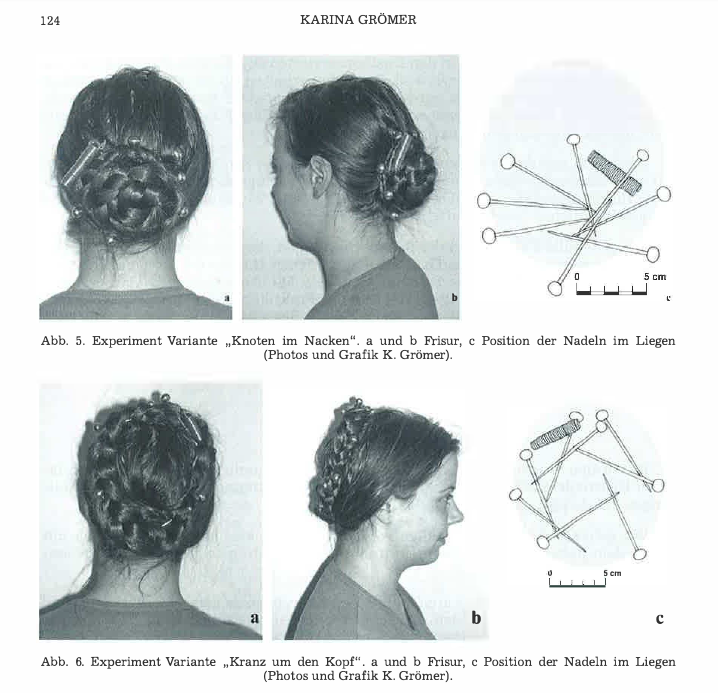
Although no hair fibers survive, researchers cross-referencing the pins’ position against figural representations from period artifacts, have made a pretty educated guess as to the sort of hair do this individual may have sported in life, or more accurately, given the context, death.
As to the “bronze spiral roll” — which Donner persists in referring to as a spiral “doobly doo” — it functioned much like a modern day elastic band, preventing the braid from unravelling.
Donner twists hers from wire, after arranging to have replica hairpins custom made to historically accurate dimensions. (The manufacturer, perhaps misunderstanding her interest in history, coated them with an antiquing agent that had to be removed with “brass cleaner and a bit of rubbing.”
Most of the styles are variants on a bun. All withstand the “shake test” and would look right at home in a bridal magazine.
Star Wars fans will be gratified to find not one, but two iconic Princess Leia looks.
Our favorites were the braided loops and double buns meant to be sported beneath a veil.
“The braids do kind of act nicely as an anchor point for the veil to sit on,” Donner reports, “Not a lot of modern application per se for this particular style but it’s cute. It’s fun.”
Either would give you some serious Medieval Festival street cred, even if you have to resort to extensions.
Donner’s video gets a lot of love in the comments from a number of archaeology professionals, including a funerary archaeologist who praises the way she deals with the “inherent issues of preservation bias.”
The final nine minutes contain a DIY tutorial for those who’d like to make their own hairpins, as well as the spiral “doobly doo”.
If you’re of a less crafty bent, a jewelry designer in Finland is selling replicas based on the grave finds of Hallstatt culture on Etsy.
Watch a playlist of Donner’s historical hair experiments and tutorials, though a peek at her Instagram reveals that she got a buzzcut last fall, currently grown out to pixie-ish length.
Download Grömer’s illustrated article on Hallstatt period hairstyles and veils for free (in German) here.
You can slide up, pull off and hammer like a beast, but be forewarned. It’s unlikely you’ll be able to keep pace with Heart’s Nancy Wilson, as she demonstrates how to play the introduction to 1975’s “Crazy On You,” one of the greatest — and trickiest — opening guitar solos in rock history.
“I really wanted people to know right up front what I could do,” Wilson revealed in a 1999 interview withAcoustic Guitar:
It was the same thing as sitting in the Bandwagon music store and playing (Paul Simon’s) Anji. It was like, “Check me out, I know some stuff.”
As hard rocking female musicians in the 70s and 80s, Wilson and her bandmate/sister, lead vocalist- and songwriter, Ann found themselves having to prove themselves constantly.
Back then, especially in the 70s, there was no filter on how women were sexualized – hyper-sexualized – in order to sell their images. Now at least it looks like women have control over their own filters. Back then, they didn’t. It was just like: “Hey, here’s a sexy chick. We know how we can sell her.”
Let’s all observe Women’s History Month by insisting that every bonehead who ever dismissed these pioneering women as a ‘chick band’ pay close attention to Nancy’s intricate “hybrid picking”.
“Crazy On You” finds her picking a rhythm on the A‑string while using her bare fingers to pull off notes on the B and G strings.
And by her own admission, she tends never to play it the same way twice (“which makes it real easy, right?”)
While we’re at it, how about we celebrate Heart’s 50th anniversary by introducing the next generation to “Crazy On You”?
The times have changed in significant ways, but the emotions that inspired the song will strike close to home for many young people, as per Ann’s description on the Professor of Rock’s YouTube channel:
I wrote the words about the state of the world, and the stress effect it was having on me. Back then, we thought the world was really messed up, right? Because the Vietnam War was going on and we were choosing to, but staying out of our own country…we were homesick. Crime was rising, gas was expensive, gas shortage, all this horrible stuff. We had no idea what was going to happen in later years so it seemed to be, at that time, y’know, this is the end of the world. This close to the apocalypse. It’s very very stressful when you’re in your 20’s and you don’t see a good future.
If you’re committed to learning Nancy Wilson’s guitar intro to “Crazy On You,” we recommend Shutup & Play’s video tutorial and tabs.
110 years after its first and last voyage, we remember the RMS Titanic and its touted “unsinkability” as one of the resounding ironies of maritime history. But 1912 also saw the launch of another newly built yet ill-fated ship whose name proved all too apt: Endurance, as it was rechristened by Sir Ernest Shackleton when he purchased it to use on his Imperial Trans-Antarctic Expedition of 1914. In January of the following year, Endurance got stuck in the ice of the Weddell Sea off Antarctica, and over the following ten months that ice slowly crushed and ultimately sank the ship. But her whole crew survived, thanks to Shackleton’s leading them more than 800 miles over the open ocean to safety.
Shackleton and his men have been celebrated for their endurance; as for Endurance herself, it has spent more than a century unseen at the bottom of the ocean — unseen, that is, until now. “A team of adventurers, marine archaeologists and technicians located the wreck at the bottom of the Weddell Sea, east of the Antarctic Peninsula, using undersea drones,” writes the New York Times’ Henry Fountain. “Battling sea ice and freezing temperatures, the team had been searching for more than two weeks in a 150-square-mile area around where the ship went down in 1915.”
Time turns out to have been kind to Shackleton’s ship: “Endurance’s relatively pristine appearance was not unexpected, given the cold water and the lack of wood-eating marine organisms in the Weddell Sea that have ravaged shipwrecks elsewhere.” You can glimpse Endurance in her watery grave in the Marine Technology TV video at the top of the post. But you’ll also see a lot more of another impressive ship: Agulhas II, the South African icebreaker used by Endurance22, as the $10 million research expedition was called. Whatever the challenges posed by finally tracking down Endurance, their brunt wasn’t borne by that mighty vessel.
“Aside from a few technical glitches involving the two submersibles, and part of a day spent icebound when operations were suspended, the search proceeded relatively smoothly,” reports Fountain. The nature of this expedition, especially in its use of submersibles to observe the wreckage without disturbing it, may bring back to mind (for those of us of a certain age) the 1992 documentary Titanica, which astonished us with the first up-close, IMAX-sized views of the sunken Titanic. Considering the advancements in exploratory and photographic technology in the three decades since — and the condition of Endurance itself — the film that eventually results from Endurance22 should astonish us all over again.
Based in Seoul, Colin Marshall writes and broadcasts on cities, language, and culture. His projects include the Substack newsletterBooks on Cities, the book The Stateless City: a Walk through 21st-Century Los Angeles and the video series The City in Cinema. Follow him on Twitter at @colinmarshall or on Facebook.
We're hoping to rely on loyal readers, rather than erratic ads. Please click the Donate button and support Open Culture. You can use Paypal, Venmo, Patreon, even Crypto! We thank you!
Open Culture scours the web for the best educational media. We find the free courses and audio books you need, the language lessons & educational videos you want, and plenty of enlightenment in between.