Take a 3D Virtual Tour of the Sistine Chapel & Explore Michelangelo’s Masterpieces Up Close
Today, 133 cardinals from around the world enter the conclave to determine the next pope, during which they’ll cast their votes in the Sistine Chapel. Despite being one of the most famous tourist attractions in Europe, the Sistine Chapel still serves as a venue for such important official functions, just as it has since its completion in 1481. When its namesake Pope Sixtus IV commissioned it, he also ordered its walls covered in frescoes by some of the finest artists of that period of the Renaissance, including Sandro Botticelli, Domenico Ghirlandaio, and Cosimo Rosselli. He also made the unusual choice of having the cross-vault ceiling covered by a blue-and-gold painting of the night sky, ably executed by Piermatteo Lauro de’ Manfredi da Amelia.
No longer do the cardinals vote for their next leader under the stars, nor have they for about half a millennium. Even if you’ve never set foot in the Sistine Chapel, you surely know it as the building whose ceiling was painted by Michelangelo, lying flat on a scaffold all the while (a pleasing but highly doubtful image in the collective cultural memory).
In fact, that master of Renaissance masters didn’t touch his brush to the place until 1508. He’d been brought in by a later pope, Julius II, after having first resisted the commission, insisting that he was a sculptor first, not a painter. Fortunately for Renaissance art enthusiasts, not only did Julius II prevail upon Michelangelo, so, nearly thirty years later, did Paul III, who had him paint over the altar the work that turned out to be the Last Judgment.
In the video at the top of the post, history-and-architecture YouTuber Manuel Bravo (previously featured here on Open Culture for his explanations of historic places like Venice, Pompeii, the Cathedral of Santa Maria del Fiore, and St. Peter’s Basilica, which was also touched by the hand of Michelangelo) narrates a 3D virtual tour of the Sistine Chapel. That format makes it possible to see not only its numerous works of Biblical art, by Michelangelo and a host of other painters besides, from every possible angle, but also the building itself just as it would have looked in eras past, even before Michelangelo made his contribution. The more you understand each individual element, the better you can appreciate this “veritable Divina Commedia of the Renaissance,” as Bravo calls it, when next you can see it in person. That, of course, will only be after the conclave finishes up: in a few hours, or days, or weeks, or maybe — a phenomenon not unexampled in the history of the church — a few years.
Related content:
Michelangelo’s David: The Fascinating Story Behind the Renaissance Marble Creation
A Secret Room with Drawings Attributed to Michelangelo Opens to Visitors in Florence
Michelangelo’s Illustrated Grocery List
Based in Seoul, Colin Marshall writes and broadcasts on cities, language, and culture. His projects include the Substack newsletter Books on Cities and the book The Stateless City: a Walk through 21st-Century Los Angeles. Follow him on the social network formerly known as Twitter at @colinmarshall.
Read More...Was William Shakespeare’s Marriage Closer—and Less Estranged—Than We Thought?: A 17th-Century Letter Changes What We Know About the Bard’s Life.
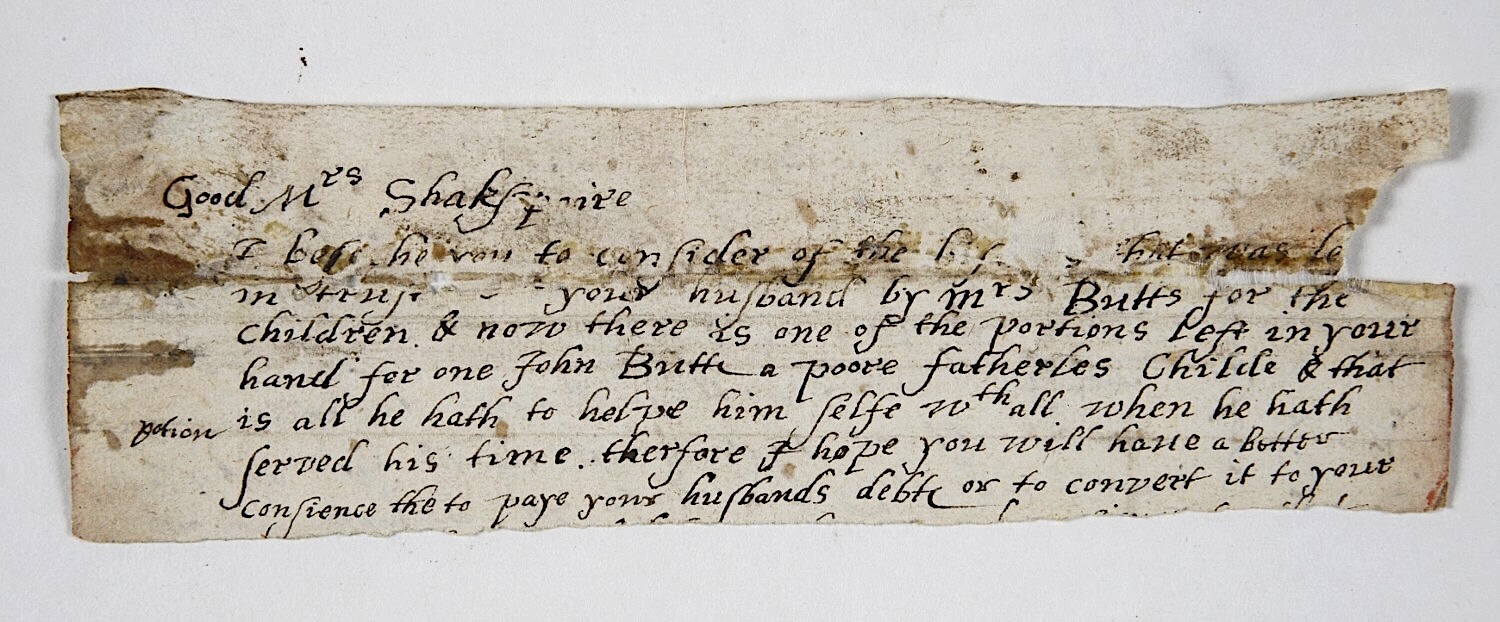
Image via Hereford Cathedral and Hereford Mappa Mundi Trust
At this point, every aspect of William Shakespeare’s life has produced more speculation than any of us could digest in a lifetime. That goes for his professional life, of course, but also his even more scantily documented personal life. As far as his marriage is concerned, the known facts are these: on November 27th, 1582 a marriage license was issued in Worcester to the 18-year-old William Shakespeare and the approximately 26-year-old Anne Hathaway. Six months later came the first of their three children, Susanna. For most of his professional life, William lived in London, while Anne — willed only her husband’s “second-best bed” — remained in his hometown of Stratford-upon-Avon.
According to one common interpretation, the Shakespeares’ was a shotgun wedding avant la lettre, motivated less by romance than expediency. That would certainly explain their apparent choice to live apart, though William’s career would probably have brought him to London anyway, and without a good reason to be in the city, it wasn’t a bad idea to keep the kids out of plague range. (As for his best bed, it would customarily have been reserved for guests.) But according to a new interpretation of an old document by the University of Bristol professor Matthew Steggle, the couple could not only have remained in communication, but also lived together in the capital for a time.
“Hereford Cathedral Library holds a fragmentary seventeenth-century letter addressed to a ‘Mrs Shakspaire,’ concerning her husband’s dealings with a fatherless apprentice,” writes Steggle in his research paper recently published in the journal Shakespeare. “Of the Shakespeares recorded in London, William Shakespeare is the only viable candidate to fit with the letter’s details.” In Steggle’s analysis, it “paints a picture of William and Anne Shakespeare together in London, and living, perhaps around 1599–1603, in Trinity Lane. It further suggests an Anne Shakespeare who is not absent from her husband’s London life, but present and engaged in his financial and social networks.”
The New York Times’ Ephrat Livni quotes Steggle as saying that “this letter, if it belongs to them, offers a glimpse of the Shakespeares together in London, both involved in social networks and business matters, and, on the occasion of this request, presenting a united front against importunate requests to help poor orphans.” This, Livni adds, would “lend some heft to feminist readings of Shakespeare’s life,” as well as to the pop-culture trend of “rethinking the marriage and Hathaway’s role in it.” Each era thus continues to create the Shakespeare for whom it feels the need — and the Mrs. Shakespeare as well.
Related content:
Free Course: A Survey of Shakespeare’s Plays
Why Should We Read William Shakespeare? Four Animated Videos Make the Case
The Only Surviving Script Written by Shakespeare Is Now Online
Did Shakespeare Write Pulp Fiction? (No, But If He Did, It’d Sound Like This)
Did Bach’s Wife Compose Some of “His” Masterpieces? A New Documentary Says Yes
Based in Seoul, Colin Marshall writes and broadcasts on cities, language, and culture. His projects include the Substack newsletter Books on Cities and the book The Stateless City: a Walk through 21st-Century Los Angeles. Follow him on the social network formerly known as Twitter at @colinmarshall.
Read More...A Forgotten 16th-Century Manuscript Reveals the First Designs for Modern Rockets
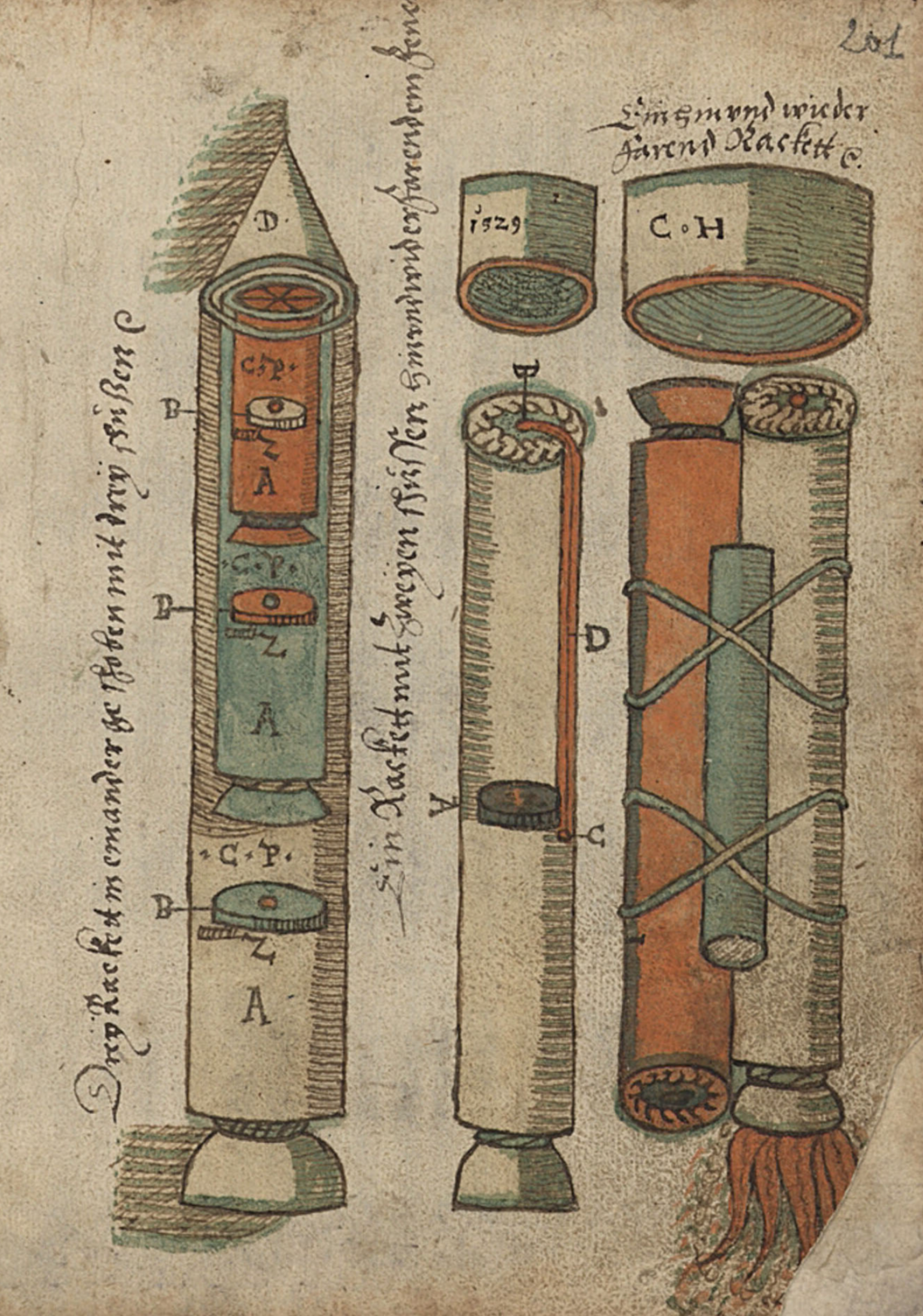
The Austrian military engineer Conrad Haas was a man ahead of his time — indeed, about 400 years ahead, considering that he was working on rockets aimed for outer space back in the mid-sixteenth century. Needless to say, he never actually managed to launch anything into the upper atmosphere. But you have to give him credit for getting as far as he did with the idea, a considerable progress documented in his treatise “How You Must Make Quite a Nice Rocket That Can Travel Itself into the Heights,” which no doubt sounds better in the original German. As Kaushik Patowary notes at Amusing Planet, its 450 pages are “filled with drawings and technical data on artillery, ballistics and detailed descriptions of multistage rockets.”
“Born in 1509 in Dornbach, now part of Vienna, to a German family from Bavaria,” Haas moved to Transylvania, then part of the Austrian Empire, early in his adulthood. “In 1551, Haas was invited by Stephen Báthory, the grand prince of Transylvania, to Hermannstadt (now Sibiu, Romania), where he became the commander of the artillery barracks and a weapons engineer.”
It was in this professional capacity that he began his research into rocketry, which led him to discover the concept of “a cylindrical thrust chamber filled with a powder propellant, with a conical hole to progressively increase the combustion area and consequently the thrust,” a clear intellectual ancestor of the multi-stage design “still used in modern rockets.”
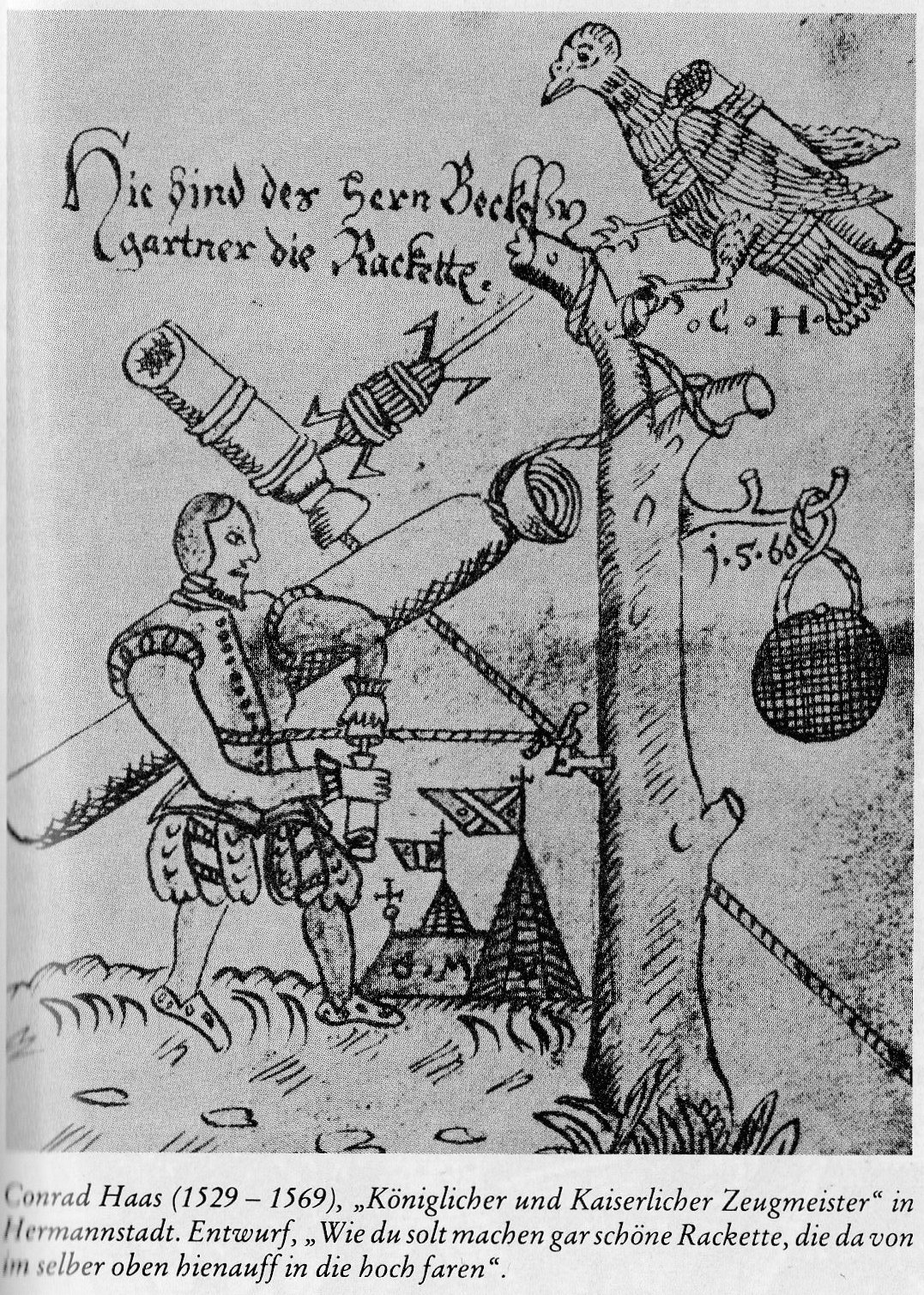
Haas’ is the earliest scientific work on rockets known to have been undertaken in Europe. And until fairly recently, it had been forgotten: only in 1961 was his manuscript found in Sibiu’s public archives, which motivated Romania to claim Haas as the first rocket scientist. Though anachronistic, that designation does underscore the far-sightedness of Haas’ worldview. So do the personal words he included in his chapter about the military use of rockets. “My advice is for more peace and no war, leaving the rifles calmly in storage, so the bullet is not fired, the gunpowder is not burned or wet, so the prince keeps his money, the arsenal master his life,” he wrote. But given what he must have learned while living in politically unstable European borderlands, he surely understood, on some level, that it would be easier to get to the moon.
Related content:
Leonardo da Vinci Draws Designs of Future War Machines: Tanks, Machine Guns & More
Meet the Mysterious Genius Who Patented the UFO
Based in Seoul, Colin Marshall writes and broadcasts on cities, language, and culture. His projects include the Substack newsletter Books on Cities and the book The Stateless City: a Walk through 21st-Century Los Angeles. Follow him on the social network formerly known as Twitter at @colinmarshall.
Read More...The Medieval Manuscript That Features “Yoda”, Killer Snails, Savage Rabbits & More: Discover The Smithfield Decretals

As much as you may enjoy a night in with a book, you might not look so eagerly forward to it if that book comprised 314 folios of 1,971 papal letters and other documents relating to ecclesiastical law, all from the thirteenth century. Indeed, even many specialists in the field would hesitate to take on the challenge of such a manuscript in full. But what if we told you it comes with illustrations of demons running amok, knights battling snails, killer rabbits and other animals taking their revenge on humanity, a dead ringer for Yoda, and the penitent harlot Thäis?
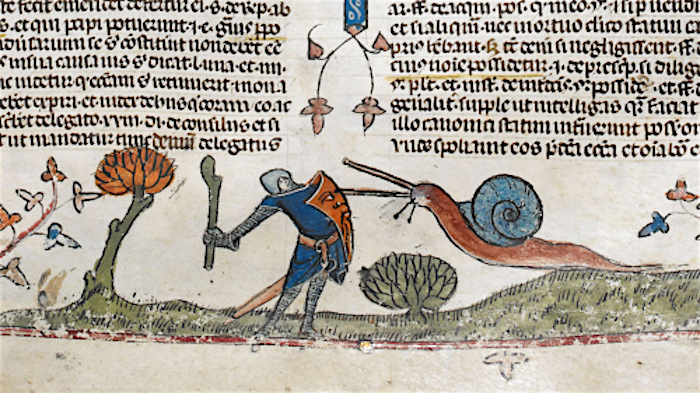
These are just a few of the characters that grace the pages of the Smithfield Decretals, the most visually notable of all extant copies of the Decretales of Pope Gregory IX. When it was originally published as an already-illuminated manuscript in the 1230s, writes Spencer McDaniel at Tales of Times Forgotten, “the margins of the text were deliberately left blank by the original French scribes so that future owners of the text could add their own notes and annotations.” Thus “the manuscript would have originally had a lot of blank space in it, especially in the margins.”

“At some point before around 1340, however, the Smithfield Decretals fell into the possession of someone in eastern England, probably in London, who paid a group of illustrators to add even more extensive illustrations to the text.”
They “drew elaborate borders and illustrations on every page of the manuscript, nearly completely filling up all the margins,” adhering to the contemporary “trend among manuscript illustrators in eastern England for drawing ‘drolleries,’ which are bizarre, absurd, and humorous marginal illustrations.”

Bearing no direct relation to the text of the Decretals, some of these elaborate works of fourteenth-century marginalia appear to tell stories of their own. “These tales have analogues in a dizzying variety of textual and visual sources, including the bible, hagiography, romance, preachers’ exempla, and fabliau” (a humorous and risqué form of early French poetry), writes Alixe Bovey at the British Library’s medieval manuscripts blog. “Some of the narratives have no surviving literary analogues; others constitute isolated visual renditions of once-popular tales.”

If you view the Smithfield Decretals’ illustrations here or in the British Library’s digitization at the Internet Archive, you’ll also see the medieval satirical impulse at work. Take the aforementioned, by now much-circulated “Yoda,” who, as McDaniel writes, “is probably supposed to be a representation of the Devil as a professor of canon law.” It seems that “legal scholars in Middle Ages had a similar reputation to lawyers today; they were seen as slimy, dishonest, and more interested in personal gain than in justice.” They might have been good for a cryptic turn of phrase, but those in need of benevolently dispensed wisdom would have done better to ask elsewhere.

Related content:
Why Knights Fought Snails in Illuminated Medieval Manuscripts
Why Butt Trumpets & Other Bizarre Images Appeared in Illuminated Medieval Manuscripts
Make Your Own Medieval Memes with a New Tool from the Dutch National Library
Based in Seoul, Colin Marshall writes and broadcasts on cities, language, and culture. His projects include the Substack newsletter Books on Cities and the book The Stateless City: a Walk through 21st-Century Los Angeles. Follow him on the social network formerly known as Twitter at @colinmarshall.
Read More...Watch Composer Wendy Carlos Demo an Original Moog Synthesizer (1989)
She’s worked with Stanley Kubrick *and* “Weird Al” Yankovic, and helped Robert Moog in the development of his eponymous synthesizer. Wendy Carlos is also one of the first high profile transgender artists–credited as Walter Carlos for Kubrick’s A Clockwork Orange but having transitioned to Wendy by the time of The Shining, in which only a few of her pieces were used.
In this brief clip from a 1989 BBC episode of Horizon, Carlos, accompanied by her two cats, explains how she uses analog synths to create electronic facsimiles of real instruments–in this case creating an approximation of a xylophone, sculpting a sine wave until it sounds like a mallet on wood.
The segment also shows Carlos operating one of the original Moog synths, about the size of a fridge and looking like an old telephone switchboard with a keyboard attached. By plugging and unplugging a series of cables, she demonstrates, the sine wave is deconstructed from its original “pure” but harsh sound. Later analog synths were additive, not subtractive, she explains. (It’s one of the few times I’ve seen old tech explained so well and so quickly.)
Along with working with Bob Moog, Carlos studied at Columbia-Princeton Electronic Music Center alongside two pioneers of early electronic music: Vladimir Ussachevsky and Otto Luening, both of whom would make very challenging compositions and musique concrete.
But Wendy chose both the classical and popular path, creating the Switched on Bach series that featured 18th century music played on the Moog synth and others. It would lead her to Kubrick and A Clockwork Orange’s idiosyncratic score and even more success. Apart from her score for Disney’s Tron, now very much beloved by fans, Carlos turned to more personal, soundscape work later. And in 2005, if you can find a copy, she put out a multiple-CD set of all her soundtrack work that Kubrick never used for The Shining and others.
The description of the entire Horizon episode has a technofear theme: “In Paris, Xavier Rodet has taught a computer to sing Mozart; in Greenwich Village, Wendy Carlos synthesises a classical concerto from electronic tones…In Australia, Manfred Clynes reckons he has discovered a universal human language of emotion. To prove it he creates feelings on tape. What’s left for human performers to contribute?”
This program was at least a decade after the first sampling keyboard, so the anxiety is either late or overhyped. But it also sounds familiar to our current concerns over AI (as seen in these very web pages!). Synths never replaced human instruments, but it did create more synth players. AI won’t replace human decision making (probably), but it will certainly create more AI programmers.
Note: An earlier version of this post appeared on our site in 2019.
Related Content:
Electronic Music Pioneer Wendy Carlos Demonstrates the Moog Synthesizer on the BBC (1970)
Ted Mills is a freelance writer on the arts.
Read More...How Italy Became the Most Divided Country in Europe: Understanding the Great Divide Between North & South
Prada, Alfa Romeo, Pellegrino, Ferrari, Illy, Lamborghini, Gucci: these are a few Italian corporations we all know, though we don’t necessarily know that they’re all from the north of Italy. The same is true, in fact, of most Italian brands that now enjoy global recognition, and according to the analysis presented in the RealLifeLore video above, that’s not a coincidence. More than 160 years after the unification of Italy, the south remains an economic and social under-performer compared to the north, reflected in measures like the Human Development Index, GDP per capita, and even voter turnout. At this point, the disparity between the two halves of the country looks starker than that between the former East and West Germany.
The reasons begin with geography: besides its obvious proximity to the rest of Europe, northern Italy is home to the highly navigable Po River and its surrounding valley, the freshwater (and hydroelectric power) sources of the Alps, and the deep-water ports at Trieste and Genoa. What’s more, it doesn’t much overlap with the fault zone under the Apennine Mountains of central and southern Italy, and thus isn’t as exposed to the earthquakes that have taken such a toll over the centuries. Nor are any of the country’s active volcanoes — including Mt. Vesuvius, which destroyed Pompeii in the year 79 and killed thousands of Neapolitans in 1631 — located in the north.
After the fall of the Roman Empire, the political fates of what would become northern and southern Italy also diverged. Large parts of the south experienced rule by Greeks, Arabs, Normans, Spaniards, and Austrian Habsburgs. As the video’s narration tells the story, “The long reign of foreign powers throughout southern Italy established a culture of absentee landlords, large land holdings worked by peasants, and feudalism that persisted for much longer than it did in the north, which for centuries after the Middle Ages was controlled by various thriving, independently governed communes and city-states that built up large amounts of trust, or social capital, between the people who lived there and the institutions they built.”
Even at the time of unification, southern Italy had less infrastructure than northern Italy, a difference that remains painfully obvious to any travelers attempting to make their way across the country today. It also had quite a lot of catching up to do with regard to industrial output and literacy rates. Though certain gaps have narrowed, the north-south divide has actually become more pronounced in certain ways since, not least due to the recrudescence of Mafia influence since the Second World War (a major factor in the persistent lack of a bridge to Sicily, as recently featured here on Open Culture). Not to say that each half is homogeneous within itself: spend enough time in any of the regions that constitute either one, and it will come to feel like a distinct nation unto itself. Eventually, you may also find yourself in agreement with the Italians who insist that Italy never really unified in the first place.
Related content:
Exploring the Greatest of Italy’s 6,000 Ghost Towns: Take a Tour of Craco, Italy
Built to Last: How Ancient Roman Bridges Can Still Withstand the Weight of Modern Cars & Trucks
A Data Visualization of Every Italian City & Town Founded in the BC Era
Based in Seoul, Colin Marshall writes and broadcasts on cities, language, and culture. His projects include the Substack newsletter Books on Cities and the book The Stateless City: a Walk through 21st-Century Los Angeles. Follow him on the social network formerly known as Twitter at @colinmarshall.
Read More...An Introduction to The Garden of Earthly Delights & Hieronymus Bosch’s Wildly Creative Vision
Hieronymus Bosch’s masterpiece of grotesquerie, The Garden of Earthly Delights, contains a young God, Adam and Eve, oversized fruits and musical instruments, owls, tortured sinners, something called a “tree man” whose body contains an entire tavern, a defecating avian devil eating a human being, and “frolicking, oblivious figures engaged in all sorts of carnal pleasures,” as art historian Beth Harris puts it in the new Smarthistory video above. Throughout its fifteen minutes, she and her colleague Steven Zucker explain as much as possible of this jam-packed triptych — not that even a lifetime would be long enough to understand it fully.
“Bosch confounds our ability to even talk about what we see,” says Harris. “His imagination has run wild. He’s just invented so many things here that we could never even have thought about in our wildest imaginations.” Zucker cites one art-history theory that this triptych represents Bosch’s attempt to “elevate the visual arts to the level of creativity that was permitted in literature.”
Even in Bosch’s late fifteenth and early sixteenth centuries, writers had an enviably free hand in choosing and presenting their subject matter; because the directly representative form of painting, by contrast, “had always been at the service of religion, it was inherently more conservative.”
It’s entirely possible — and other analyses previously featured here at Open Culture have argued it – that Bosch, too, was working at the service of religion. But it could also be that The Garden of Earthly Delights, in its vast middle panel, tells “an alternate story,” as Zucker puts it. “What if the temptation had not taken place? What if Adam and Eve had remained innocent, and had populated the world? And so, is it possible that what we’re seeing is that reality, played out in Bosch’s imagination?” Not that such a vision would have readily been accepted in the artist’s own time and place — nor that his intentions alone could lead us to a complete interpretation of his work. As any novelist knows, sometimes your characters simply take over, and it could hardly have been within even Bosch’s powers to deny the desires of a cast so teeming and bizarre.
Related content:
The Meaning of Hieronymus Bosch’s The Garden of Earthly Delights Explained
The Meaning of Hieronymus Bosch’s Spellbinding Triptych The Garden of Earthly Delights
A Digital Archive of Hieronymus Bosch’s Complete Works: Zoom In & Explore His Surreal Art
Based in Seoul, Colin Marshall writes and broadcasts on cities, language, and culture. His projects include the Substack newsletter Books on Cities and the book The Stateless City: a Walk through 21st-Century Los Angeles. Follow him on the social network formerly known as Twitter at @colinmarshall.
Read More...A Tour of Ancient Rome’s Best Graffiti: “We Have Urinated in Our Beds … There Was No Chamber Pot” & More
Apart from the likes of bravo and pizza, graffiti must be one of the first Italian words that English-speakers learn in everyday life. As for why the English word comes directly from the Italian, perhaps it has something to do with the history of writing on the walls — a history that, in Western civilization, stretches at least as far back as the time of the Roman Empire. The Fire of Learning video above offers a selection of translated pieces of the more than 11,000 pieces of ancient Roman graffiti found etched into the preserved walls of Pompeii: “Marcus loves Spedusa”; “Phileros is a eunuch”; “Secundus took a crap here” (written three times); “Atimetus got me pregnant”; and “On April 19th, I made bread.”
Crude though some of these may sound, the narrator emphasizes that “many, many of the prominent pieces of graffiti, especially in Pompeii, are too sexual or violent to show here,” comparing their sensibility to that of “a high-school bathroom stall.” You can read more of them at The Ancient Graffiti Project, whose archive is browsable through categories like “love,” “poetry,” “food,” and “gladiators” (as decent a summary as any of life in ancient Rome).
Romans didn’t just write on the walls — a practice that seems to have been encouraged, at least in some places — they also drew on them, as evidenced by what you can see in the figural graffiti section, as well as the examples in the video.
Another rich archive of ancient graffiti comes from a surprising location: the Egyptian pyramids, then as now a major tourist attraction. Rather than posting their reviews of the attraction on the internet, in our twenty-first-century manner, ancient Roman tourists wrote directly on its surface. “I visited and did not like anything except the sarcophagus,” says one inscription; “I can not read the hieroglyphics,” complains another, in a manner that may sound awfully familiar these millennia later. “We have urinated in our beds,” declares another piece of writing, discovered on the door of a Pompeii inn. “Host, I admit we should not have done this. If you ask why? There was no chamber pot.” Consider it confirmed: the ancient world, too, had Airbnb guests.
Related content:
High-Tech Analysis of Ancient Scroll Reveals Plato’s Burial Site and Final Hours
Demystifying the Activist Graffiti Art of Keith Haring: A Video Essay
Archaeologists Discover an Ancient Roman Snack Bar in the Ruins of Pompeii
Tour the World’s Street Art with Google Street Art
Big Bang Big Boom: Graffiti Stop-Motion Animation Creatively Depicts the Evolution of Life
Based in Seoul, Colin Marshall writes and broadcasts on cities, language, and culture. His projects include the Substack newsletter Books on Cities and the book The Stateless City: a Walk through 21st-Century Los Angeles. Follow him on the social network formerly known as Twitter at @colinmarshall.
Read More...Andrei Tarkovsky’s Message to Young People: “Learn to Be Alone,” Enjoy Solitude
I remember the first time I sat down and watched Andrei Tarkovsky’s lyrical, meandering sci-fi epic Stalker. It was a long time ago, before the advent of smartphones and tablets. I watched a beat-up VHS copy on a non-“smart” TV, and had no ability to pause every few minutes and swing by Facebook, Twitter, or Instagram for some instant distraction and digital small talk. The almost three-hour film—with its long, languid takes and endless stretches of silence—is a meditative exercise, a test in patience that at times seems like its own reward.
I recall at the time thinking about how didactic Tarkovsky’s work is, in the best possible sense of the word. It teaches its viewers to watch, listen, and wait. It’s a course best taken alone, like the journey into the film’s mysterious “Zone,” since the presence of another, likely perplexed, viewer might break the quiet spell the movie casts. But while watching a Tarkovsky film—whether Stalker, Andrei Rublev, Solaris, or any of his other pensive creations (watch them online here)—may be a solitary activity, it need not at all be a lonely one.
The distinction between healthy solitude and loneliness is one Tarkovsky is particularly interested in. It’s a cinematic theme he pursues, and a pedagogical one as well. In the video above from The Criterion Collection, Tarkovsky offers some thoughtful insights that can only seem all the more relevant to today’s always-on, multi-screen culture. Unfortunately, the subtitles translate his words selectively, but Maria Popova at The Marginalian has a full translation of the filmmaker’s answer to the question “What would you like to tell young people?” Like some ancient Pan dispensing timeless wisdom, Tarkovsky reclines in an old, gnarled tree—on what may very well be one of his wild, wooded film sets—and says,
I don’t know… I think I’d like to say only that they should learn to be alone and try to spend as much time as possible by themselves. I think one of the faults of young people today is that they try to come together around events that are noisy, almost aggressive at times. This desire to be together in order to not feel alone is an unfortunate symptom, in my opinion. Every person needs to learn from childhood how to spend time with oneself. That doesn’t mean he should be lonely, but that he shouldn’t grow bored with himself because people who grow bored in their own company seem to me in danger, from a self-esteem point of view.
Though I speak as one who grew up in an analogue world free from social media—the only world Tarkovsky ever knew—I don’t think it’s just the cranky old man in me who finds this advice compellingly sound. As a Tom Tomorrow cartoon satirically illustrated, our rapid-fire, pressure-cooker public discourse may grant us instant access to information—or misinformation—but it also encourages, nay urges, us to form hasty opinions, ignore nuance and subtleties, and participate in groupthink rather than digesting things slowly and coming to our own conclusions. It’s an environment particularly hostile to mediums like poetry, or the kinds of poetic films Tarkovsky made, which teach us the value of judgment withheld, and immerse us in the kinds of aesthetic experiences the internet and television, with their nonstop chatter, push to the margins.
Tarkovsky’s general advice to young people can be paired with his challenging advice to young filmmakers, and all artists, in particular—advice that demands focused attention, patience, and commitment to individual passion and vision.
Props to The Marginalian for the translation.
Note: An earlier version of this post appeared on our site in 2015.
Related Content
Watch Andrei Tarkovsky’s Films Free Online: Stalker, The Mirror & Andrei Rublev
Andrei Tarkovsky’s Advice to Young Filmmakers: Sacrifice Yourself for Cinema
Andrei Tarkovsky Creates a List of His 10 Favorite Films (1972)
The Masterful Polaroid Pictures Taken by Filmmaker Andrei Tarkovsky
Read More...What Makes Diego Velázquez’s Las Meninas One of the Most Fascinating Paintings in Art History
Diego Velázquez painted Las Meninas almost 370 years ago, and it’s been under scrutiny ever since. If the public’s appetite to know more about it has diminished over time, that certainly isn’t reflected in the view count of the analysis from YouTube channel Rabbit Hole above, which as of this writing has crossed the 2.5 million mark. So has this video on Las Meninas from Evan Puschak, better known as the Nerdwriter. What element of this particular painting has stoked such fascination, generation after generation after generation? Easier, perhaps, to ask what element hasn’t.
“Through the 36 years he worked for King Philip IV, Velázquez produced dozens of paintings of the Spanish royal family,” says the narrator of the Rabbit Hole video. But the large-scale Las Meninas is different: “the painting appears more like a snapshot of daily life than a typical visage of royals posing to be painted.”
The figures it depicts include Philip’s five-year-old daughter Infanta Margaret Theresa and her entourage, as well as Velázquez himself, at work on a painting — which may be a portrait of the king and queen, reflected as they are on the mirror in the back wall, or perhaps the very image we’re looking at. Or could we possibly be Philip and Mariana ourselves?
On the rearmost plane of Las Meninas stands the queen’s chamberlain Don José Nieto Velázquez (possibly a relation of the artist), on whom it can hardly be a coincidence that all of the painting’s lines converge, like a vanishing point on the horizon. Diego Velázquez’s representation of himself bears an even more conspicuous detail: the knighthood-symbolizing red cross called the Order of Santiago. Born a commoner, Velázquez worked for most of his life in close proximity to the royals, and seems to have made no big secret of his aspirations to join their ranks. Presumably, the Order of Santiago was added after the painting was complete, since Las Meninas is dated to 1656, but Velázquez wasn’t finally knighted until 1659, close to the end of his life.
Different theories exist to explain who exactly added that red cross to the painting, as covered by YouTuber-gallerist James Payne in the Great Art Explained video just above. Like most works of art that have endured through the centuries, Las Meninas has its unsolvable historical mysteries, despite its unusually well-documented creation. But for serious art enthusiasts, the most compelling question remains that of just how Velázquez pulled it all off. “Las Meninas, with all its splendid effects, is a vigorous argument for the virtue of painting,” says Puschak. “This gets at the heart of the mirror, the vanishing point, and the multiple centers of focus. ‘See what my art can do,’ Velázquez is saying to the viewer” — whether that viewer is King Philip, or someone across the world nearly four centuries later.
Related content:
A Short Introduction to Caravaggio, the Master Of Light
Based in Seoul, Colin Marshall writes and broadcasts on cities, language, and culture. His projects include the Substack newsletter Books on Cities and the book The Stateless City: a Walk through 21st-Century Los Angeles. Follow him on the social network formerly known as Twitter at @colinmarshall.
Read More...Support Us
We're hoping to rely on loyal readers, rather than erratic ads. Please click the Donate button and support Open Culture. You can use Paypal, Venmo, Patreon, even Crypto! We thank you!

About Us

Open Culture scours the web for the best educational media. We find the free courses and audio books you need, the language lessons & educational videos you want, and plenty of enlightenment in between.
Advertise With Us
FREE UPDATES!
GET OUR DAILY EMAIL
Get the best cultural and educational resources on the web curated for you in a daily email. We never spam. Unsubscribe at any time.
FOLLOW ON SOCIAL MEDIA
Open Culture editor Dan Colman scours the web for the best educational media. He finds the free courses and audio books you need, the language lessons & movies you want, and plenty of enlightenment in between.
Advertise With Us


