Helen Keller Writes a Letter to Nazi Students Before They Burn Her Book: “History Has Taught You Nothing If You Think You Can Kill Ideas” (1933)
Helen Keller achieved notoriety not only as an individual success story, but also as a prolific essayist, activist, and fierce advocate for poor and marginalized people. She “was a lifelong radical,” writes Peter Dreier at Yes! magazine, whose “investigation into the causes of blindness” eventually led her to “embrace socialism, feminism, and pacifism.” Keller supported the NAACP and ACLU, and protested strongly against patronizing calls for her to “confine my activities to social service and the blind.” Her critics, she wrote, mischaracterized her ideas as “a Utopian dream, and one who seriously contemplates its realization indeed must be deaf, dumb, and blind.”
Twenty years later she found a different set of readers treating her ideas with contempt. This time, however, the critics were in Nazi Germany, and instead of simply disagreeing with her, they added her collection of essays, How I Became a Socialist, to a list of “degenerate” books to be burned on May 10, 1933. Such was the date chosen by Hitler for “a nationwide ‘Action Against the Un-German Spirit,’” writes Rafael Medoff, to take place at German Universities—“a series of public burnings of the banned books” that “differed from the Nazis’ perspective on political, social, or cultural matters, as well as all books by Jewish authors.”
Books burned included works by Einstein and Freud, H.G. Wells, Hemingway, and Jack London, Students hauled books out of the libraries as part of the spectacle. “The largest of the 34 book-burning rallies, held in Berlin,” Medoff notes, “was attended by an estimated 40,000 people.”
Not only were these demonstrations of anti-Semitism, but their contempt for ideas appealed broadly to the Nazi philosophy of “Blood and Soil,” a nationalist caricature of rural values over a supposedly “degenerate,” polyglot urbanism. “The soul of the German people can again express itself,” declared Joseph Goebbels ominously at the Berlin rally. “These flames not only illuminate the final end of an old era; they also light up the new.”

“Some American editorial responses” before and after the burnings, “made light of the event,” remarks the United States Holocaust Museum, calling it “silly” and “infantile.” Others foresaw much worse to come. In one very explicit expression of the terrible possibilities, artist and political cartoonist Jacob Burck drew the image above, evoking the observation of 19th century German writer Heinrich Heine: “Where one burns books, one will soon burn people.” Newsweek described the events as “’a holocaust of books’… one of the first instances in which the term ‘holocaust’ (an ancient Greek word meaning a burnt offering to a deity) was used in connection with the Nazis.”
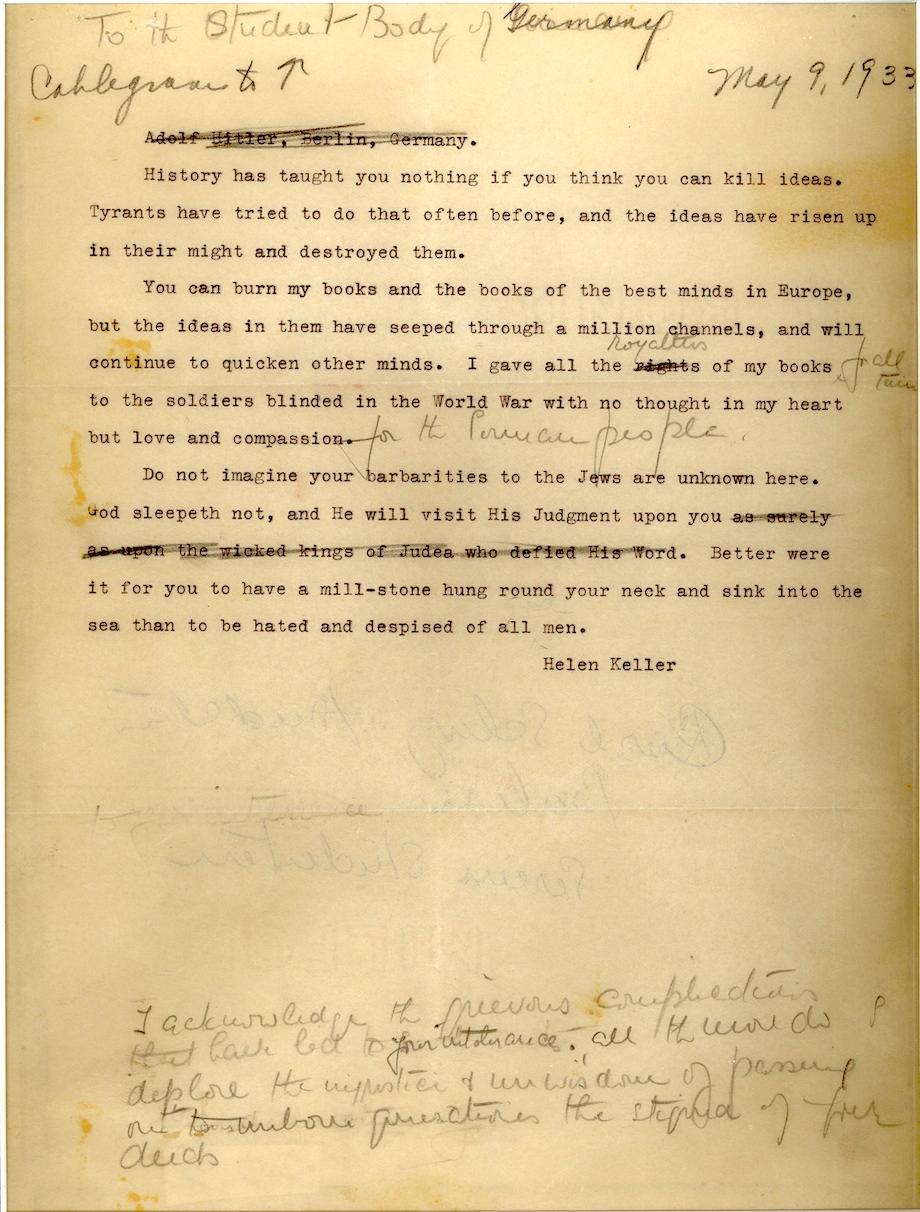
The day before the burnings, Keller also displayed a keen sense for the gravity of book burnings, as well as a “notable… early concern,” notes Rebecca Onion at Slate—outside the Jewish community, that is—for what she called the “barbarities to the Jews.” On May 9, 1933, Keller published a short but pointed open letter to the Nazi students in The New York Times and elsewhere, abjuring them to stop the proposed burnings. She wrote in a religious idiom, invoking the “judgment” of God and paraphrasing the Bible. (Not a traditional Christian, she belonged to a mystical sect called Swedenborgianism.) At the top of the post, you can see the typescript of her letter, with corrections and annotations by Polly Thompson, one of her primary aides. Read the full transcript below:
To the student body of Germany:
History has taught you nothing if you think you can kill ideas. Tyrants have tried to do that often before, and the ideas have risen up in their might and destroyed them.
You can burn my books and the books of the best minds in Europe, but the ideas in them have seeped through a million channels and will continue to quicken other minds. I gave all the royalties of my books for all time to the German soldiers blinded in the World War with no thought in my heart but love and compassion for the German people.
I acknowledge the grievous complications that have led to your intolerance; all the more do I deplore the injustice and unwisdom of passing on to unborn generations the stigma of your deeds.
Do not imagine that your barbarities to the Jews are unknown here. God sleepeth not, and He will visit His judgment upon you. Better were it for you to have a mill-stone hung around your neck and sink into the sea than to be hated and despised of all men.
Keller added the penultimate paragraph of the published text later. (See the handwritten addition at the bottom of the typed draft.) Her concern for the “grievous complications” of the German people was certainly genuine. The expression also seems like a targeted rhetorical move for a student audience, conceding the situation as “complex,” and appealing in more philosophical language to “justice” and “wisdom.” The Nazis ignored her protest, as they did the “massive street demonstrations” that took place on the 10th “in dozens of American cities,” the Holocaust Museum writes, “skillfully organized by the American Jewish Congress” and sparking “the largest demonstration in New York City history up to that date.”
Five years later, however, another planned book burning—this time in Austria before its annexation—was prevented by students at Williams College, Yale, and other universities in the U.S., where pro- and anti-Nazi partisans fought each other on several American campuses. U.S. students were able to push the Austrian National Library to lock the books away rather than burn them. Keller “is not known to have commented specifically” on these student protests, writes Medoff, “but one may assume she was deeply proud that at a time when too many Americans did not want to be bothered with Europe’s problems, these young men and women understood the message of her 1933 letter—that the principles under attack by the Nazis were something that should matter to all mankind.”
Note: This post originally appeared on our site in 2017.
If you would like to support the mission of Open Culture, consider making a donation to our site. It’s hard to rely 100% on ads, and your contributions will help us continue providing the best free cultural and educational materials to learners everywhere. You can contribute through PayPal, Patreon, and Venmo (@openculture). Thanks!
Related Content
The 850 Books a Texas Lawmaker Wants to Ban Because They Could Make Students Feel Uncomfortable
America’s First Banned Book: Discover the 1637 Book That Mocked the Puritans
Read More...Watch the Original Schoolhouse Rock Composers Sing “Conjunction Junction” and “I’m Just a Bill” Live in Concert
At first blush, Schoolhouse Rock!, the interstitial animations airing between ABC’s Saturday morning cartoon line up from 1973 to 1984, may seem like a catchy, educational equivalent of sneaking spinach into pancakes (and a major Gen X touchstone.)
Not so fast! It’s also jazz, baby!
Jazz pianist Bob Dorough recalled how an ad exec at a New York ad agency pitched the idea:
My little boys can’t memorize their times tables, but they sing along with Jimi Hendrix and the Rolling Stones, so why don’t you put it to rock music and we’ll call it Multiplication Rock?
Dorough, whose compositional preferences ran to “extravagant love songs” and vocal challenging numbers, realized that his first order of business would be to write a good song:
I hit upon the idea, let’s pick a number. Three! That’s a good number. And I sat down at the piano and started fooling around. It took me 2 weeks.
In his hands, three became a magic number, an ear worm to bring even the most reluctant elementary mathematicians up to speed in no time.
Eventually, Dorough was able to bring many of his jazz world friends into the fold, including, most famously, trumpeter and Merv Griffin Show sidekick Jack Sheldon, whose one-of-a-kind delivery is the hands down highlight of “Conjunction Junction.”
(Many Schoolhouse Rock! fans, viewing the excerpt of the duo’s mid-90’s live appearance on the KTLA Morning Show, above, professed disbelief that Sheldon’s soul was of the blue-eyed variety, even though the animated engineer who serves as his avatar in that three minute episode is white.)
In an interview with the director of the Fillius Jazz Archive at Hamilton College, Sheldon agreed that the series owed a major debt to jazz:
When we made Conjunction Junction, it was me and Teddy Edwards and Nick Ceroli and Leroy Vinegar and Bob Dorough played the piano. That’s a jazz band…it was really nothing to do with rock. It was always jazz, but we said rock and roll, so everybody loved it for rock and roll.
Another memorable collaboration between Sheldon and Dorough is the much parodied “I’m Just a Bill,” in which a weary scroll loiters on the steps of the Capital Building, explaining to a wide eyed youngster (voiced by his son) the process by which a bill becomes law.
Doroughs’ Schoolhouse Rock! contributions include the haunting Figure Eight, the folky Lucky Seven Sampson, whose sentiments Dorough identified with most closely, and Naughty Number Nine, which his protégé, singer-songwriter Nellie McKay singled out for special praise, “cause it was kind of weird and subversive:”
(It) made me want to gamble and win. I got hooked when I heard Bob’s jazzy rasp of a voice breaking the rules even as he explained them… this guy had a wild mind, which I figured out later equaled creativity.
She also paid the perpetually sunny Dorough, whom she first encountered “glow(ing) with health and good cheer, spreading sunshine wherever he went on the campus of East Stroudsburg University, the supreme compliment:
Lou Reed’s idea of hell would be to sit in heaven with Bob Dorough.
via Laughing Squid
Related Content
Schoolhouse Rock: Revisit a Collection of Nostalgia-Inducing Educational Videos
Conspiracy Theory Rock: The Schoolhouse Rock Parody Saturday Night Live May Have Censored
– Ayun Halliday is the Chief Primatologist of the East Village Inky zine and author, most recently, of Creative, Not Famous: The Small Potato Manifesto and Creative, Not Famous Activity Book. Follow her @AyunHalliday.
Read More...Google & Coursera Launch New Career Certificates That Prepare Students for Jobs in 2–6 Months: Business Intelligence & Advanced Data Analytics
Back in 2021, Google launched a series of online courses designed to help students earn a professional certificate in six months and also land an entry-level job. In its original offering, Google developed certificate programs in five professional areas: User Experience (UX) Design, Data Analytics, Project Management, IT Support and IT Automation. Now, the tech company has added two new programs to its lineup, each offered through Coursera’s online education platform.
First, the Google Advanced Data Analytics Professional Certificate builds on the original Data Analytics Certificate and “delves into machine learning, predictive modeling, and experimental design to collect and analyze large amounts of data.” Featuring seven courses in total, the program takes roughly six months to complete and aims to teach students how to 1) build regression and machine learning models to analyze and interpret data, 2) create data visualizations and apply statistical methods to investigate data, and 3) communicate insights from data analysis to stakeholders. Essentially, it teaches many tools of the trade needed to become a senior data analyst or junior data scientist.
With the Google Business Intelligence Professional Certificate, students can participate in a shorter program that focuses on transforming data into actionable insights for organizations. Consisting of three courses (and lasting about two months), the program helps students learn skills like data modeling, data visualization, and dashboarding–skills that have wide applicability in our data-driven age.
Students can actually take individual courses in these professional certificate programs for free. However, if you would like to receive the certificates, Coursera charges $49 per month (after an initial 7‑day free trial period). That means that the Advanced Data Analytics Professional Certificate, if completed in 6 months, will cost less than $300. And the Business Intelligence Professional Certificate would run about $100. Once students complete a certificate, they can add the credential to their LinkedIn profile, resume, or CV. Likewise, they can connect with 150+ U.S. hiring organizations in Google’s Employer Consortium. If you would like to learn more about Google Career Certificates, you can read this handy page on University of Texas’ website.
Update: Google has also added a new certificate program focused on Cybersecurity. Find out more about the program here.
You can sign up for the programs by clicking on the links in bold above. Each program has a 7‑day free trial.
Note: Open Culture has a partnership with Coursera. If readers enroll in certain Coursera courses and programs, it helps support Open Culture.
Read More...Download Free Coloring Books from Nearly 100 Museums & Libraries

We here at Open Culture heartily endorse the practice of viewing art, whether in a physical museum, in the pages of a book, or online. For some, however, it tends to have one serious shortcoming: all the colors are already filled in. If you’re itching to use your own colored pencils, crayons, watercolors, or other tools of choice on drawings, paintings, and a variety of other works besides in the possession of well-known art institutions, these past few months are a time of year to savor thanks to the initiative Color Our Collections.

Each February, Color Our Collections releases its latest round of coloring books free online, assembled from contributions by the likes of the Bibliothèque nationale de France, Eton College, the New York Botanical Garden, the Toronto Public Library, and the University of California, San Francisco.
“Launched by The New York Academy of Medicine Library in 2016,” says its about page, it hosts an “annual coloring festival on social media during which libraries, museums, archives and other cultural institutions around the world share free coloring content featuring images from their collections.”

The de-colored pictures you see here offer just a taste of all you can find in this year’s Color Our Collections crop. Some of the participating institutions provide colorable selections from across their holdings, some stick to a certain theme, and some contribute actual volumes, digitized whole or created for the occasion. Take, for instance, the Ol’ Medical Colouring Book from Queen’s University Library, which promises hours of fun with pages like “anterior view of the skeletal system,” “ventral view of the brain,” and “urinary system shown on the female form.”
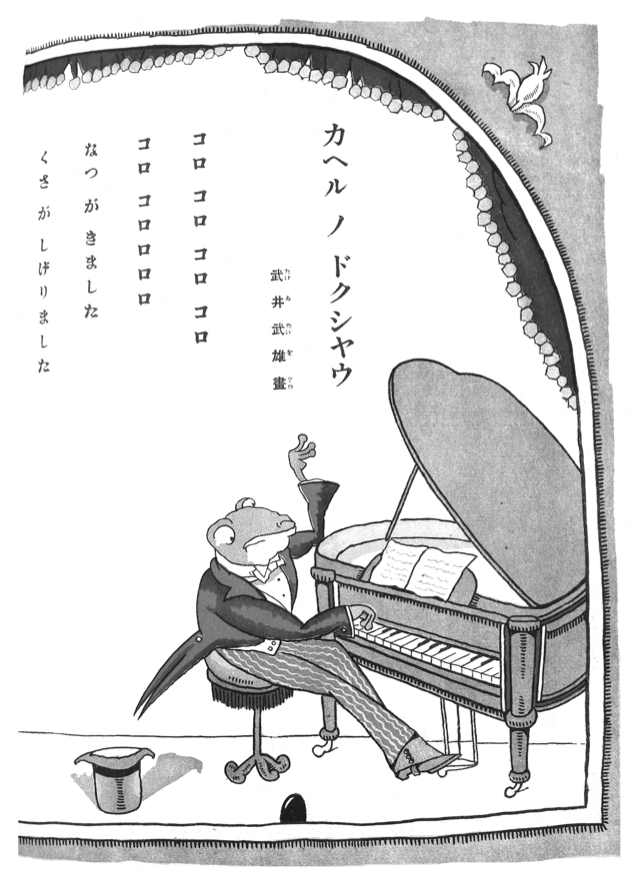
These are some distance from the bunnies and buttercups we colored in as children; so are the vigorous nineteen-thirties motorcycle advertisements assembled by the Harley-Davidson Archive, or the architectural and archaeological drawings from the Médiathèque de Châteaudun. But Color Our Collections 2023 also contains a good deal of kid-directed material as well, including Princeton University Library’s lively package of animal images from issues of Kodomo no Kuni, or The Land of Children — a magazine directed toward the kids of Japan a century ago, but then, some childhood pleasures know no cultural or temporal bounds. Enter the archive of 2023 coloring books here.
Related content:
The Very First Coloring Book, The Little Folks’ Painting Book (Circa 1879)
The First Adult Coloring Book: See the Subversive Executive Coloring Book From 1961
Based in Seoul, Colin Marshall writes and broadcasts on cities, language, and culture. His projects include the Substack newsletter Books on Cities, the book The Stateless City: a Walk through 21st-Century Los Angeles and the video series The City in Cinema. Follow him on Twitter at @colinmarshall or on Facebook.
Read More...The Most Popular Song from Each Month Since January 1980: 40+ Years of Changing Musical Tastes in 50 Minutes
As Helen Reddy sang in the 70s:
You live your life in the songs you hear
On the rock n’ roll radio…
The 80s ushered in a new era, leaving the music industry forever changed, though the songs themselves retained their power to speak to us on a deeply personal level.
In 1979, the English New Wave band The Buggles’ “Video Killed the Radio Star” — which famously became the very first song played on MTV the following year (1980) — was getting a lot of attention.
40 years later Puerto Rican rapper and reggaeton artist Bad Bunny dominates, which speaks not only to the public’s evolving musical tastes but also to the expanded access and opportunities of the Internet age.
Listening to all 512 songs on Boogiehead’s mashup Most Popular Song Each Month Since January 1980 in their entirety would take over 24 hours, so Boogiehead settles instead on a single representative phrase, getting the job done in a whirlwind 50 minutes. Watch it above.
For many of us, that’s all it takes to unleash a flood of memories.
Queen, Madonna, David Bowie, and Michael Jackson make strong showings, as do, more recently, Rhianna, Beyoncé, Lady Gaga, Bruno Mars, and Ariana Grande.
Elsewhere, there are reminders that fame is not just fleeting, but often tethered to a single hit.
That said, sometimes those hits have remarkable staying power.
Witness Dexys Midnight Runners’ Come On Eileen from 1982, with its prescient lyric “I’ll hum this tune forever…”
And some songs turn out to be an unexpected slow burn. How else to explain one of the third-to-last earworms on Boogiehead’s list, “Running Up That Hill” from English singer-songwriter Kate Bush’s 1985 album Hounds of Love?
Its appearance on the hit series Stranger Things led it to go viral on TikTok, netting the 64-year-old Bush a host of new fans in their teens and 20s as well as a couple million dollars. Talk about old wine in new bottles!
Forbes’ Peter Suciu observes how songs’ shelf lives and in-roads are longer and wider than they were in the 80s and 90s:
Running Up That Hill has certainly become more popular now than it was when it was released – and one factor could be that social media has changed the way people listen to music. In 1985, when Michael Jackson was the undisputed King of Pop, Kate Bush would have been relegated to “alternative” music radio stations, which were few and far between, or college radio.
Readers, what song from Boogiehead’s Most Popular Song Each Month Since January 1980 do you most wish would make a comeback? Which of the newer songs could you imagine listening to forty years from now? Let us know in the comments.
Listen to the playlist of every song featured on the Most Popular Song Each Month Since January 1980 here.
Related Content
1980s Metalhead Kids Are Alright: Scientific Study Shows That They Became Well-Adjusted Adults
All the Music Played on MTV’s 120 Minutes: A 2,500-Video Youtube Playlist
– Ayun Halliday is the Chief Primatologist of the East Village Inky zine and author, most recently, of Creative, Not Famous: The Small Potato Manifesto and Creative, Not Famous Activity Book. Follow her @AyunHalliday.
Read More...Understanding Espresso: A Six-Part Series Explaining What It Takes to Pull the Ideal Shot
It doesn’t take long to learn how to pull a shot of espresso. Search for that phrase on Youtube, and you’ll find hours’ worth of sound instruction, most of it in the form of brief and easily digestible videos. All of them cover the same basic stages of the process: grinding, dosing, tamping, and brewing. When examined closely, each of those stages reveals a formidable body of knowledge to master. If any one Youtuber can lay claim to having mastered all of them, it must be James Hoffmann, previously featured here on Open Culture for his videos on subjects from deep-fried coffee to the classic Bialetti Moka Express. In the six-part series above, he offers viewers an overview of all they need to know to achieve a true understanding of espresso.
Episode by episode, Hoffmann explains how to choose the right dose of coffee, ratio between the amount of ground and liquid coffee, brew time, grind size, brew temperature, and pressure. Of course, there is no single universally correct setting or amount of any of these things: each is a variable with its own range of effects on the shot of espresso ultimately yielded.
Each drinker, too, has a different conception of the taste and texture of the ideal espresso shot, and consistently realizing those qualities — or at least getting close — necessitates no small amount of trial and error. But those who listen well to Hoffmann’s explanations will surely end up with fewer errors, and in any case get more enjoyment from the trials.
Watch “Understanding Espresso,” and you’re going to want to know how Hoffmann pulls shots for himself. This he addresses in a bonus episode — unsurprisingly, the longest one of the bunch — which shows his entire process in detail, from preparing the beans to stirring and sipping. Along the way, he also introduces the variety of specialized devices he uses: a strong draw for his many coffee-gearhead subscribers, but one he presents with the caveat that you really don’t need to go high-end all the way in order to live your best espresso life. Even so, the dedicated home enthusiast must put in considerably more time and attention than the average chain-coffee-shop barista. “Cafés want to make good espresso as quickly and easily as possible,” he reminds us. “We want to make incredible espresso every time.”
You can watch the entire playlist, from start to finish, at the very top of the post.
Related content:
The Birth of Espresso: The Story Behind the Coffee Shots That Fuel Modern Life
Coffee College: Everything You Wanted to Know about Coffee Making in One Lecture
All Espresso Drinks Explained: Cappuccino, Latte, Macchiato & Beyond
Life and Death of an Espresso Shot in Super Slow Motion
Based in Seoul, Colin Marshall writes and broadcasts on cities, language, and culture. His projects include the Substack newsletter Books on Cities, the book The Stateless City: a Walk through 21st-Century Los Angeles and the video series The City in Cinema. Follow him on Twitter at @colinmarshall or on Facebook.
Read More...Watch 13 Levels of Drumming, from Easy to Complex, Explained by Snarky Puppy Drummer Larnell Lewis
Above, Snarky Puppy drummer Larnell Lewis explains drumming in 13 levels of difficulty, from easy to complex, showing how “drum techniques build upon each other as the easiest levels incorporate the hi-hat, bass and snare drums, and more difficult levels include polyrhythms, the floor tom, ride cymbals, syncopation and much more.” It’s fun to watch. In another video from the same series produced by Wired magazine, musician Jacob Collier explains the concept of harmony with increasing difficulty to five different people– a child, a teen, a college student, a professional, and jazz legend Herbie Hancock. Enjoy…
If you would like to support the mission of Open Culture, consider making a donation to our site. It’s hard to rely 100% on ads, and your contributions will help us continue providing the best free cultural and educational materials to learners everywhere. You can contribute through PayPal, Patreon, and Venmo (@openculture). Thanks!
Related Content
The Neuroscience of Drumming: Researchers Discover the Secrets of Drumming & The Human Brain
What Makes John Bonham Such a Good Drummer? A New Video Essay Breaks Down His Inimitable Style
The Case for Why Ringo Starr Is One of Rock’s Greatest Drummers
Read More...A Student Writes a Rejection Letter Rejecting Harvard’s Rejection Letter (1981): Hear It Read by Actor Himesh Patel
The documentary filmmaker and sports editor Paul Devlin has won five Emmy awards, but he may well be better known for not getting into Harvard — or rather, for not getting into Harvard, then rejecting Harvard’s rejection. “I noticed that the rejection letter I received from Harvard had a grammatical error,” Devlin writes. “So, I wrote a letter back, rejecting their rejection letter.” His mother then “sent a copy of this letter to the New York Times and it was published in the New Jersey section on May 31, 1981.” In 1996, when the New York Times Magazine published a cover story “about the trauma students were experiencing getting rejected from colleges,” she seized the opportunity to send her son’s rejection-rejection letter to the Paper of Record.
It turned out that Devlin’s letter had already run there, having long since gone the pre-social-media equivalent of viral. “The New York Times accused me of plagiarism. When they discovered that I was the original author and they had unwittingly re-printed themselves, they were none too happy. But my mom insists that it was important to reprint the article because the issue was clearly still relevant.”
Indeed, its afterlife continues even today, as evidenced by the new video from Letters Live at the top of the post. In it actor Himesh Patel, well-known from series like EastEnders, Station Eleven, and Avenue 5, reads aloud Devlin’s letter, which runs as follows:
Having reviewed the many rejection letters I have received in the last few weeks, it is with great regret that I must inform you I am unable to accept your rejection at this time.
This year, after applying to a great many colleges and universities, I received an especially fine crop of rejection letters. Unfortunately, the number of rejections that I can accept is limited.
Each of my rejections was reviewed carefully and on an individual basis. Many factors were taken into account – the size of the institution, student-faculty ratio, location, reputation, costs and social atmosphere.
I am certain that most colleges I applied to are more than qualified to reject me. I am also sure that some mistakes were made in turning away some of these rejections. I can only hope they were few in number.
I am aware of the keen disappointment my decision may bring. Throughout my deliberations, I have kept in mind the time and effort it may have taken for you to reach your decision to reject me.
Keep in mind that at times it was necessary for me to reject even those letters of rejection that would normally have met my traditionally high standards.
I appreciate your having enough interest in me to reject my application. Let me take the opportunity to wish you well in what I am sure will be a successful academic year.
SEE YOU IN THE FALL!
Sincerely,
Paul Devlin
Applicant at Large
However considerable the moxie (to use a wholly American term) shown by the young Devlin in his letter, his reasoning seems not to have swayed Harvard’s admissions department. Whether it would prove any more effective in the twenty-twenties than it did in the nineteen-eighties seems doubtful, but it must remain a satisfying read for high-school students dispirited by the supplicating posture the college-application process all but forces them to take. It surely does them good to remember that they, too, possess the agency to declare acceptance or rejection of that which is presented to them simply as necessity, as obligation, as a given. And for Devlin, at least, there was always the University of Michigan.
Related content:
Read Rejection Letters Sent to Three Famous Artists: Sylvia Plath, Kurt Vonnegut & Andy Warhol
Gertrude Stein Gets a Snarky Rejection Letter from Publisher (1912)
Based in Seoul, Colin Marshall writes and broadcasts on cities, language, and culture. His projects include the Substack newsletter Books on Cities, the book The Stateless City: a Walk through 21st-Century Los Angeles and the video series The City in Cinema. Follow him on Twitter at @colinmarshall or on Facebook.
Read More...Hear De La Soul’s Highly Acclaimed & Influential Hip-Hop Albums Streaming Free for the First Time
If you don’t listen to rap, you’ve heard the same questions over and over in response to that confession. One of the most common is “But have you heard De La Soul?” — which in recent years was easier said than done, at least on streaming platforms. “What kept De La’s tunes out of rotation was a frustrating morass of outdated contracts and record label parsimony,” writes Oliver Wang at NPR. One complication had to do with sampling, a standard hip hop practice conducted in such a far-reaching, freewheeling, and elaborate manner by De La Soul that the prospect of renegotiating each and every sonic snippet they’d cleared in the CD-and-tape era inspired untold corporate intransigence.
But as of this month, “all this has finally been rectified. The group’s most important recordings are now legally available on the internet.” None of them is more important than their debut, 3 Feet High and Rising, originally released in 1989 and added to the Library of Congress’ National Recording Registry in 2010.
As Wang writes, the album “reshaped the public imagination of what hip-hop could be. The core trio — Posdnuos, Trugoy and DJ Pasemaster Mase — assisted by mentor/producer Prince Paul all came straight outta the wilds of suburban Long Island, rapping about advice-spouting crocodiles, Martian transmissions, and an artistic meta-concept they dubbed The D.A.I.S.Y. (Da Inner Soul, Y’all) Age.”
Clearly, De La Soul had a set of artistic priorities all their own. “Sample-hungry rap producers had spent the previous few years mining the James Brown and P‑Funk catalogs and though De La sampled from both on their debut, they were more likely to create memorable musical moments from children’s television songs (‘The Magic Number’), obscure doo-wop singles (‘Plug Tunin”) and classic ’80s pop hits (‘Say No Go’),” to say nothing of a learn-at-home French record. The first time I remember hearing De La Soul was when an early-morning college-radio DJ put on the 3 Feet High track “Eye Know,” which samples Steely Dan — as well as the Mad Lads, Lee Dorsey, and Otis Redding.
As if 3 Feet High and Rising weren’t enough of a cavalcade of wonders, it comes as only one of six De La Soul albums newly available to stream. On the group’s official Youtube channel and other streaming platforms, you can also hear De La Soul Is Dead (1991), Buhloone Mindstate (1993), Stakes Is High (1996), and the Art Official Intelligence pair Thump and Bionix (2001), each of which marks an expansion of the group’s already considerable ambitions. They all join the already-streamable albums released over the twenty years up to the death of founding member David “Trugoy” Jolicoeur last month, an event that may put end to De La Soul as a recording entity. But if you do listen through their expansive and inventive body of work, be prepared for another question: have you heard A Tribe Called Quest?
Related content:
How Jazz Became the “Mother of Hip Hop”
The Birth of Hip Hop: How DJ Kool Herc Used Turntables to Change the Musical World (1973)
Based in Seoul, Colin Marshall writes and broadcasts on cities, language, and culture. His projects include the Substack newsletter Books on Cities, the book The Stateless City: a Walk through 21st-Century Los Angeles and the video series The City in Cinema. Follow him on Twitter at @colinmarshall or on Facebook.
Read More...
Discover Pemmican, The Power Bar Invented Centuries Ago by Native American Tribes
Outdoor enthusiasts of a non-vegetarian stripe, do you weary of garden variety energy bars and trail mix?
Perhaps you’re feeling adventurous enough to make your own pemmican, variously described by Tasting History’s Max Miller, above, as “history’s Power Bar” and “a meaty version of a survival food that has a shelf life not measured in months but in decades, just like hard tack.”
Perhaps you’re already well acquainted with this low-carb, ketogenic portable provision, a culinary staple of the upper half of North America long before the first European traders set foot on the land. Many indigenous communities across North America are still producing pemmican for both personal and ceremonial consumption.
Back in 1743, Hudson’s Bay Company fur trader James Isham was one of the first to document pemmican production for an English readership:
[Meat] beat between two Stones, till some of itt is as small as Dust…when pounded they putt itt into a bag and will Keep for several Years, the Bones they also pound small and Boil them…to Reserve the fatt, which fatt is fine and sweet as any Butter…Reckon’d by some Very good food by the English as well as Natives.
Perhaps now would be a good time to give thanks for the plentiful food options most of us have access to in the 21st-century (and pay it forward with a donation to an organization fighting food insecurity…)
A time may come when knowing how to make pemmican could give us a leg up on surviving, but for now, execution of this recipe is likely more of a curiosity satisfier.
To be fair, it’s not designed to be a delicacy, but rather an extremely long lasting source of calories, four times as nourishing as the same weight of fresh meat.
If you want to try it, lay in 2 pounds of meat — bison is historically the most popular and most documented, but deer, elk, moose, beef, fish, or fowl work well too.
You’ll also need an equal amount of suet, though heed Miller’s advice and add just enough to make things stick.
Bump the flavor up a notch with ground dried berries, sugar, or salt.
(Miller went the traditional route with chokeberries, procured in an extremely 21st-century manner.)
In terms of appliances, feel free to use such modern conveniences as your oven, your blender, and a small pan or mold.
(Please report back if you take the old school route with fire, direct sunlight, mortar, pestle, and a bag formed from undressed hide.)
Given Miller’s response to the finished dish, we’re hunching most of us will rest content to feast on historical context alone, as Miller digs into the Pemmican Proclamation of 1814, the Seven Oaks Incident and the unique role the biracial, bilingual Métis people of Canada played in the North American fur trade…
Those still up for it should feel free to take their pemmican to the next level by boiling it with wild onions or the tops of parsnips, to produce a rubaboo or rechaud, as bushcrafter Mark Young does below.
You can also get a taste of pemmican by ordering the Tanka Bars that Oglala Lakota-owned small business produces on South Dakota’s Pine Ridge Reservation.
Watch more of Max Miller’s Tasting History videos here.
– Ayun Halliday is the Chief Primatologist of the East Village Inky zine and author, most recently, of Creative, Not Famous: The Small Potato Manifesto and Creative, Not Famous Activity Book. Follow her @AyunHalliday.
Read More...Support Us
We're hoping to rely on loyal readers, rather than erratic ads. Please click the Donate button and support Open Culture. You can use Paypal, Venmo, Patreon, even Crypto! We thank you!

About Us

Open Culture scours the web for the best educational media. We find the free courses and audio books you need, the language lessons & educational videos you want, and plenty of enlightenment in between.
Advertise With Us
FREE UPDATES!
GET OUR DAILY EMAIL
Get the best cultural and educational resources on the web curated for you in a daily email. We never spam. Unsubscribe at any time.
FOLLOW ON SOCIAL MEDIA
Open Culture editor Dan Colman scours the web for the best educational media. He finds the free courses and audio books you need, the language lessons & movies you want, and plenty of enlightenment in between.
Advertise With Us

