Pink Floyd’s The Dark Side of the Moon Turns 50: Hear It Get Psychoanalyzed by Neuroscientist Daniel Levitin
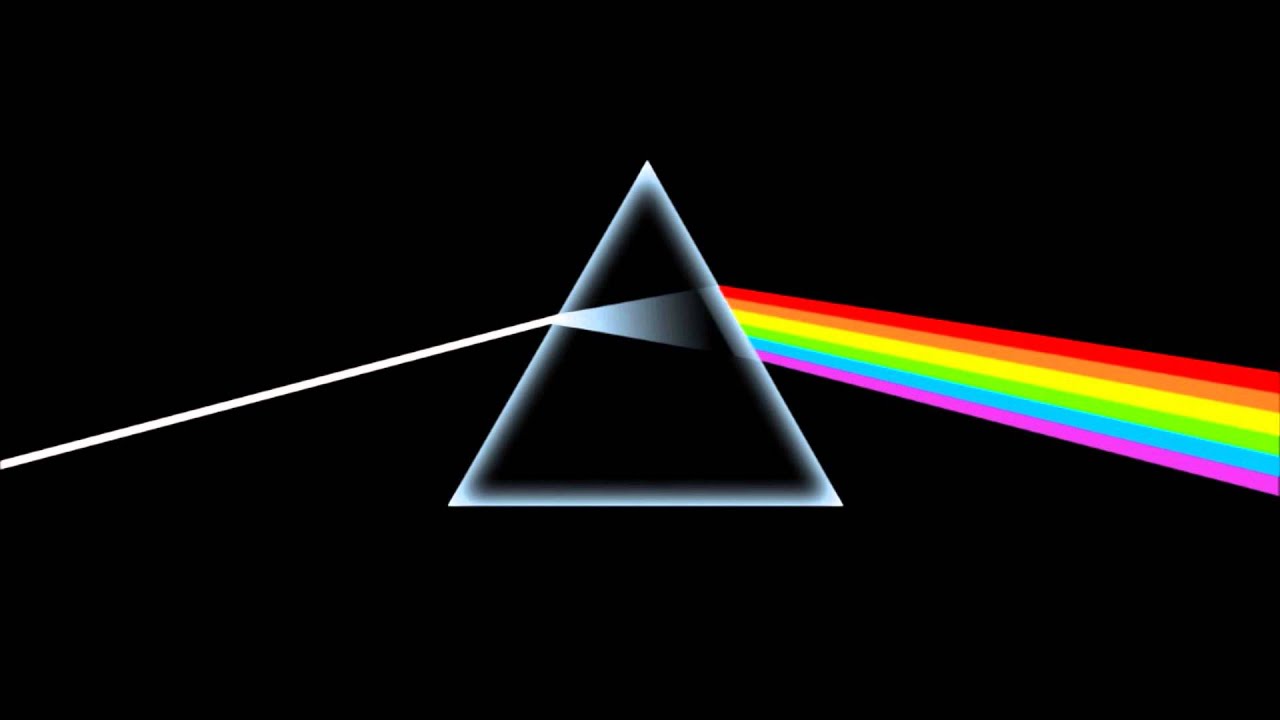
Coming after the maturation of the market for high-fidelity stereo systems but before the advent of home video, the nineteen-seventies provided just the right cultural and economic conditions for a heroic age of the record album. What’s Going On, Blue, Blood on the Tracks, Exile on Main Street, Born to Run, Rumours, Aja: that these and other seventies releases always rank high on best-of-all-time lists can be no accident. But no other mega-selling album of that decade achieved quite the combination of commercial and critical success as Pink Floyd’s The Dark Side of the Moon, which was originally released fifty years ago yesterday — and which remains on the Billboard charts today.
“In 1973, Pink Floyd was a somewhat known progressive rock band,” writes neuroscientist and music producer Daniel Levitin, but The Dark Side of the Moon “catapulted them into world class rock-star status.”
Its masterful engineering “propelled the music off of any sound system to become an all-encompassing, immersive experience” comprising songs that “flow into one another symphonically, with seamless musical coherence, as though written as part of a single melodic and harmonic gesture. Lyric themes of madness and alienation connect throughout,” enlivened by an “array of new electronic sounds, spatialization, pitch and time bending” as well as “clocks, alarms, chimes, cash registers, footsteps” and other elements not normally heard in rock music.
This description comes from an essay Levitin wrote for the Library of Congress in 2012, when The Dark Side of the Moon was inducted into the US National Recording Registry. For the album’s fiftieth anniversary, National Public Radio’s Morning Edition invited him to psychoanalyze it on-air. “Themes of madness and alienation permeate the record,” he says, making reference to the story of departed Pink Floyd member Syd Barrett. But “we can’t know for sure which specific lyrics were about Barrett, as opposed, more generally, to mental anguish,” a condition bound to afflict anyone too deep into the rock-star lifestyle.
In The Dark Side of the Moon’s lyrics Levitin hears Pink Floyd co-founder Roger Waters’ metaphorical treatment of the difficult decision to fire Barrett, as well as his realization that “life wasn’t going to start later. It had started. And the idea of ‘Time’ was to grasp the reins and start guiding your own destiny.” As on the album as a whole, the theme comes through in not just the words but the soundscape: “Right off the bat, they’re playing with time. You hear that clop-clop sound, like a heartbeat or a clock ticking. And you think that the higher-pitched one is the downbeat. But as soon as the instruments come in, you realize you’re off the beat, and everything’s upside down. And your sense of time is distorted.”
Musical artistry accounts in part for the album’s massive success in part, but only in part. Storm Thorgerson’s iconic cover art, still seen on the walls of college dorm rooms today, also had something to do with its success as both cultural phenomenon and consumer product. But it could hardly have sold more than 45 million copies to date without chancing to hit the zeitgeist at a favorable angle: as Pink Floyd drummer Nick Mason said, it was “not only about being a good album but also about being in the right place at the right time.” And with the heroic age of the album long over, The Dark Side of the Moon — a newly re-recorded version of which Waters announced just this year — isn’t about to be eclipsed.
Related content:
Pink Floyd’s Entire Studio Discography is Now on YouTube: Stream the Studio & Live Albums
The Dark Side of the Moon Project: Watch an 8‑Part Video Essay on Pink Floyd’s Classic Album
Watch Documentaries on the Making of Pink Floyd’s Dark Side of the Moon and Wish You Were Here
Download Pink Floyd’s 1975 Comic Book Program for The Dark Side of the Moon Tour
A Live Studio Cover of Pink Floyd’s The Dark Side of the Moon, Played from Start to Finish
Based in Seoul, Colin Marshall writes and broadcasts on cities, language, and culture. His projects include the Substack newsletter Books on Cities, the book The Stateless City: a Walk through 21st-Century Los Angeles and the video series The City in Cinema. Follow him on Twitter at @colinmarshall or on Facebook.
Read More...A 3D Computer Animation of the Panopticon, Jeremy Bentham’s 18th Century Design for an All-Controlling Prison
Nearly two centuries after his death, the eighteenth-century utilitarian philosopher and social reformer Jeremy Bentham — or most of him, anyway — still sits in state in the main building of University College London. For a time in the mid-twenty-tens, he was equipped with the PanoptiCam, “an online camera that streams what Bentham sees while sitting in his cabinet at UCL.” That most everyone gets the joke behind its name speaks to the enduring relevance of one of Bentham’s ideas in particular: the Panopticon, “a prison designed so that a prison guard could look into all cells at any time, and ensure that prisoners modified their behavior for the better.”
In Bentham’s Panopticon, many prisoners could be monitored effectively by just a few unseen guards. This accords, as Michel Foucault writes in 1975’s Discipline and Punish, with the principle that “power should be visible and unverifiable. Visible: the inmate will constantly have before his eyes the tall outline of the central tower from which he is spied upon. Unverifiable: the inmate must never know whether he is being looked at any one moment; but he must be sure that he may always be so.” Foucault drew connections between the Panopticon and the complex, large-scale societies that had developed since Bentham’s day. Imagine if he’d lived to see the rise of social media.
In a series of posts by Philosophy for Change, Tim Rayner takes up just such an exercise. “By making our actions and shares visible to a crowd, social media exposes us to a kind of virtual Panopticon,” he writes. “This is not just because our activities are monitored and recorded by the social media service for the purposes of producing market analysis or generating targeted advertising.” But “the surveillance that directly affects us and impacts on our behavior comes from the people with whom we share.” In the online Panopticon, “we are both guards and prisoners, watching and implicitly judging one another as we share content.” Rayner wrote these words more than a decade ago, but anyone who has experienced life on social media then can hardly deny the parallels with Bentham’s vision.
Far from improving our behavior, however, this constant online surveillance has in a fair few cases made it considerably less appealing. Whatever the nature of its actual effects on those who inhabit it, the Panopticon is an undeniably powerful structure, at least metaphorically speaking. But we should remember that Bentham intended it to be a real, physical structure, one that could contain not just prisons but other types of institutions as well. Whether a Panopticon has ever been wholly built to his specifications seems to be a matter of debate, but we can see what one would look like in the 3D rendering by Myles Zhang at the top of the post: an appropriate medium, after all, in which to perceive an idea most fully realized in the digital realm.
Related content:
Jeremy Bentham’s Mummified Body Is Still on Display – Much Like Other Aging British Rock Stars
What Would Michel Foucault Think of Social Media, Fake News & Our Post Truth World?
Michel Foucault: Free Lectures on Truth, Discourse & The Self (UC Berkeley, 1980–1983)
On the Power of Teaching Philosophy in Prisons
Based in Seoul, Colin Marshall writes and broadcasts on cities, language, and culture. His projects include the Substack newsletter Books on Cities, the book The Stateless City: a Walk through 21st-Century Los Angeles and the video series The City in Cinema. Follow him on Twitter at @colinmarshall or on Facebook.
Read More...Archaeologists May Have Discovered a Secret Language in Lascaux & Chauvet Cave Paintings, Perhaps Revealing a 20,000-Year-Old “Proto-Writing” System

Care to take a guess what your smart phone has in common with Paleolithic cave paintings of Lascaux, Chauvet and Altamira?
Both can be used to track fertility.
Admittedly, you’re probably not using your phone to stay atop the reproductive cycles of reindeer, salmon, and birds, but such information was of critical interest to our hunter-gatherer ancestors.
Knowing how crucial an understanding of animal behavior would have been to early humans led London-based furniture conservator Ben Bacon to reconsider what purpose might have been served by non-figurative markings — slashes, dots, and Y‑shapes — on the cave walls’ 20,000-year-old images.
Their meaning had long eluded esteemed professionals. The marks seemed likely to be numeric, but to what end?
Bacon put forward that they documented animal lives, using a lunar calendar.
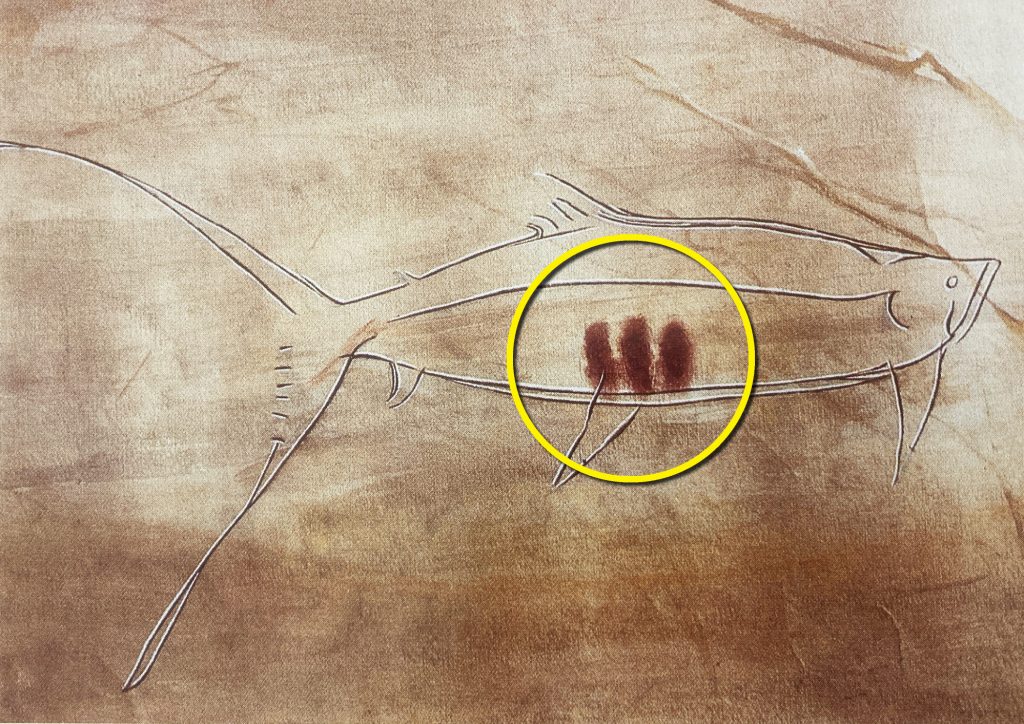
The amateur researcher assembled a team that included experts from the fields of mathematics, archeology, and psychology, who analyzed the data, compared it to the seasonal behaviors of modern animals, and agreed that the numbers represented by the dots and slashes are not cardinal, but rather an ordinal representation of months.
As Bacon told All Things Considered his fellow self-taught anthropological researcher, science journalist Alexander Marshack, came close to cracking the code in the 1970s:
… but he wasn’t actually able to demonstrate the system because he thought that these individual lines were days. What we did is we said, actually, they’re months because a hunter-gatherer doesn’t need to know what day a reindeer migrates. They need to know what month the reindeer migrates. And once you use these months units, this whole system responds very, very well to that.
As to the frequently occurring symbol that resembles a Y, it indicates the months in which various female animal birthed their young. Bacon and his team theorize in the Cambridge Archeological Journal that this mark may even constitute “the first known example of an ‘action‘ word, i.e. a verb (‘to give birth’).
Taken together, the cave paintings and non-figurative markings tell an age-old circular tale of the migration, birthing and mating of aurochs, birds, bison, caprids, cervids, fish, horses, mammoths, and rhinos … and like snakes and wolverines, too, though they were excluded from the study on basis of “exceptionally low numbers.”
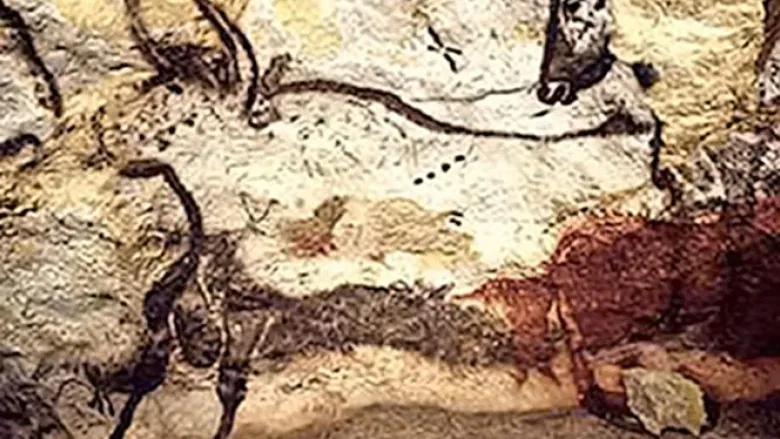
Early humans were able to log months by observing the moon, but how could they tell when a new year had begun, essential information for anyone seeking to arrange their lives around their prey’s previously documented activities?
Bacon and his peers, like so many poets and farmers, look to the rites of spring:
The obvious event is the so-called ‘bonne saison’, a French zooarchaeological term for the time at the end of winter when rivers unfreeze, the snow melts, and the landscape begins to green.
Read the conclusions of their study here.
Related Content
Algerian Cave Paintings Suggest Humans Did Magic Mushrooms 9,000 Years Ago
Was a 32,000-Year-Old Cave Painting the Earliest Form of Cinema?
40,000-Year-Old Symbols Found in Caves Worldwide May Be the Earliest Written Language
- Ayun Halliday is the Chief Primatologist of the East Village Inky zine and author, most recently, of Creative, Not Famous: The Small Potato Manifesto and Creative, Not Famous Activity Book. Follow her @AyunHalliday.
Read More...
Noam Chomsky on ChatGPT: It’s “Basically High-Tech Plagiarism” and “a Way of Avoiding Learning”
ChatGPT, the system that understands natural language and responds in kind, has caused a sensation since its launch less than three months ago. If you’ve tried it out, you’ll surely have wondered what it will soon revolutionize — or, as the case may be, what it will destroy. Among ChatGPT’s first victims, holds one now-common view, will be a form of writing that generations have grown up practicing throughout their education. “The essay, in particular the undergraduate essay, has been the center of humanistic pedagogy for generations,” writes Stephen Marche in The Atlantic. “It is the way we teach children how to research, think, and write. That entire tradition is about to be disrupted from the ground up.”
If ChatGPT becomes able instantaneously to whip up a plausible-sounding academic essay on any given topic, what future could there be for the academic essay itself? The host of YouTube channel EduKitchen puts more or less that very question to Noam Chomsky — a thinker who can be relied upon for views on education — in the new interview above. “For years there have been programs that have helped professors detect plagiarized essays,” Chomsky says. “Now it’s going to be more difficult, because it’s easier to plagiarize. But that’s about the only contribution to education that I can think of.” He does admit that ChatGPT-style systems “may have some value for something,” but “it’s not obvious what.”
As the relevant technology now stands, Chomsky sees the use of ChatGPT as “basically high-tech plagiarism” and “a way of avoiding learning.” He likens its rise to that of the smartphone: many students “sit there having a chat with somebody on their iPhone. One way to deal with that is to ban iPhones; another way to do it is to make the class interesting.” That students instinctively employ high technology to avoid learning is “a sign that the educational system is failing.” If it “has no appeal to students, doesn’t interest them, doesn’t challenge them, doesn’t make them want to learn, they’ll find ways out,” just as he himself did when he borrowed a friend’s notes to pass a dull college chemistry class without attending it back in 1945.
After spending most of his career teaching at MIT, Chomsky retired in 2002 to become a full-time public intellectual. The University of Houston’s Robert Zaretsky, who still teaches, recently offered his own, grimmer take on ChatGPT and education. “The college essay died years ago,” he argues. “It’s a mug’s game in which a student sends me an electronic file that, when open, spills out a jumble of words that the sender propounds to be a finished paper” — to which, presumably, the output of a machine-learning system would actually be far preferable. Most technological “disruptions” leave both positive and negative effects in their wake. If the college essay is indeed unsalvageable, perhaps ChatGPT will finally bring about its replacement with something more interesting.
Update: Chomsky has co-authored an op-ed in The New York Times called “The False Promise of ChatGPT”. Find it here.
Related content:
Noam Chomsky Explains Where Artificial Intelligence Went Wrong
Noam Chomsky Defines What It Means to Be a Truly Educated Person
Noam Chomsky Spells Out the Purpose of Education
Based in Seoul, Colin Marshall writes and broadcasts on cities, language, and culture. His projects include the Substack newsletter Books on Cities, the book The Stateless City: a Walk through 21st-Century Los Angeles and the video series The City in Cinema. Follow him on Twitter at @colinmarshall or on Facebook.
Read More...Contribute a Song to WNYC’s Public Song Project & Use Your Creativity to Explore the Public Domain

We recognize that Open Culture readers are a creative bunch.
As proof, we point to your Getty Museum Challenge entries and the fact that one of your number won Yale University Press’s Kafka Caption Contest.
We’ve identified another opportunity to show off your creative streak, compliments of All Of It with Alison Stewart, a daily live culture program on WNYC, New York City’s public radio station.
You have until February 13 to write and record an original song inspired by a work in the public domain, and submit it to The All Of It Public Song Project.
Amateurs are welcome to take a crack at it and any genre is cricket, including rap, spoken word, and instrumentals.
Even if you limit yourself to the works that entered the public domain on January 1 of this year, the possibilities are almost endless.
Should you be inclined toward a faithful cover, we encourage you to consider one of 1927’s deep cuts, like Fats Waller’s “Soothin’ Syrup Stomp” or Jelly Roll Morton’s “Hyena Stomp,” though we understand the attraction of Irving Berlin’s enduringly popular “Puttin’ on the Ritz”.
Apologies to Emily Joy, the accomplished young classical pianist, above — participation is limited to entrants aged 18 or older.
The rest of us are free to invent new lyrics for an existing composition, or a brand new tune for existing lyrics.
You might musicalize a poem or speech, some dialogue from a film, or a page from a book.
A bluegrass spin on Fritz Lang’s Metropolis, perhaps?
A death metal re-envisioning of Buttercup Days from A.A. Milne’s Now We Are Six?
How about a sissy bounce take on these lines from “The Adventure of the Mazarin Stone,” the first short story in Arthur Conan Doyle’s collection, The Case-Book of Sherlock Holmes:
“Billy, you will see a large and ugly gentleman outside the front door. Ask him to come up.”
“If he won’t come, sir?”
“No violence, Billy. Don’t be rough with him. If you tell him that Count Sylvius wants him he will certainly come.”
“What are you going to do now?” asked the Count as Billy disappeared.
“My friend Watson was with me just now. I told him that I had a shark and a gudgeon in my net; now I am drawing the net and up they come together.”
The Count had risen from his chair, and his hand was behind his back. Holmes held something half protruding from the pocket of his dressing-gown.
“You won’t die in your bed, Holmes.”
Okay, we’re being silly, but only because we don’t want to put ideas in your head!
You could even concoct something entirely new — perhaps a ballad from the POV of To the Lighthouse’s young James Ramsay, or a ditty apologizing to Virginia Woolf for reading the Cliffs Notes instead of the actual novel when it was assigned in your college Women’s Literature class.
…we’re doing it again, aren’t we?
All right, we’ll leave you to it, with a reminder that anything outside of your public domain source material must be wholly original — no borrowing a catchy tune from Lennon and McCartney, capisci?
Winners will get a chance to discuss their works on WNYC and all qualifying entries will be posted at contest’s end for the public’s listening pleasure.
Contest rules and information on how to submit to The All Of It Public Song Project can be found here.
Good luck! We can’t wait to hear what you come up with.
Related Content
A Search Engine for Finding Free, Public Domain Images from World-Class Museums
400,000+ Sound Recordings Made Before 1923 Have Entered the Public Domain
- Ayun Halliday is the Chief Primatologist of the East Village Inky zine and author, most recently, of Creative, Not Famous: The Small Potato Manifesto and Creative, Not Famous Activity Book. Follow her @AyunHalliday.
Read More...“Weird Al” Yankovic Breaks Down His Most Iconic Tracks: “Eat It,” “Amish Paradise,” “White and Nerdy,” and His Other Hilarious Songs
Few things could have been more amusing to a twelve-year-old in 1996 than an Amish-themed parody of the late Coolio’s portentously grim life-in-the-hood anthem “Gangsta’s Paradise.” As luck would have it, “Weird Al” Yankovic released just such a song in 1996, when I happened to be twelve years old myself. Like everyone who’s been a kid at some point in the past 40 years, I grew up hearing and appreciating Yankovic’s prolific output of parodies, pastiches, and even original songs. From “Eat It” to “Smells like Nirvana” to “White and Nerdy,” there was hardly a pop-music phase of my childhood, adolescence, and early adulthood that he didn’t make funny.
That’s to make funny, as distinct from to make fun of: unlike that of a predecessor in comedy songwriting like Tom Lehrer, Yankovic’s body of work evidences not the least tendency toward harshness or ridicule.
Hence his appeal from his very first recording “My Bologona,” an accordion-based parody of “My Sharona” recorded in the bathroom of his college radio station, to no less an advocate of silliness than Dr. Demento, whose airplay launched the young Weird Al’s career — a career that, as Yankovic acknowledges while telling the stories behind his iconic songs in the GQ video above, has not gone without its strokes of luck.
Yet few living performers more clearly personify the old aphorism describing luck as the meeting of preparation and opportunity. “Weird Al approaches the composition of his music with something like the holy passion of Michelangelo painting the ceiling of the Sistine Chapel,” writes Sam Anderson in a 2020 New York Times Magazine profile. Seeing Yankovic’s notes for “White & Nerdy” “file felt like watching a supercomputer crunch through possible chess moves. Every single variable had to be considered, in every single line.” To work in musical form, even the silliest humor demands his total dedication.
Yankovic has long showed a willingness straightforwardly to discuss what it’s like to be Weird Al, as well as what it takes to be Weird Al. For a considerably less straightforward version, we can watch The Roku Channel’s new Weird: The Al Yankovic Story. Most biopics take artistic liberties with the lives of their subjects, but Weird goes all the way, parodying the very form of the biopic itself while performing colossal (and surely fan-delighting) exaggerations of the facts of Yankovic’s life. In the GQ video, for example, he mentions getting the idea for “Like a Surgeon” by hearing Madonna throw it out in an interview; in the trailer above, Madonna turns at the door at his opulent mansion, a veritable succubus ready to drag him into the musical underworld. And it seems a safe bet that things only get Weirder thereafter.
Related content:
“Weird Al” Yankovic Releases “Word Crimes,” a Grammar Nerd Parody of “Blurred Lines”
Two Legends: Weird Al Yankovic “Interviews” James Brown (1986)
Monty Python’s Eric Idle Breaks Down His Most Iconic Characters
Based in Seoul, Colin Marshall writes and broadcasts on cities, language, and culture. His projects include the Substack newsletter Books on Cities, the book The Stateless City: a Walk through 21st-Century Los Angeles and the video series The City in Cinema. Follow him on Twitter at @colinmarshall or on Facebook.
Read More...Albert Camus’ Lessons Learned from Playing Goalie: “What I Know Most Surely about Morality and Obligations, I Owe to Football”

Here’s a vintage football [aka soccer] post in celebration of the World Cup…
Albert Camus once said, “After many years in which the world has afforded me many experiences, what I know most surely in the long run about morality and obligations, I owe to football.”
He was referring to his college days when he played goalie for the Racing Universitaire d’Alger (RUA) junior team. Camus was a decent player, though not the great player that legend later made him out to be.
For Jim White, author of A Matter of Life and Death: A History of Football in 100 Quotations, soccer perhaps taught Camus a few things about selflessness, cooperation, bravery and resilience. That’s a sunny way of looking at things. But perhaps The Telegraph gets at the deeper, darker life lessons Camus took away from soccer:
[T]here is something appropriate about a philosopher like Camus stationing himself between the sticks [that is, in goal]. It is a lonely calling, an individual isolated within a team ethic, one who plays to different constraints. If his team scores, the keeper knows it is nothing to do with him. If the opposition score, however, it is all his fault. Standing sentinel in goal, Camus had plenty of time to reflect on the absurdist nature of his position.
And perhaps the absurdist nature of life itself…
Camus — who appears in the picture up top, wearing the dark color jersey in the front row — contracted tuberculosis when he was only 18 years old. His lungs too damaged to continue playing sports, the young man turned to philosophy. When Camus moved from Algeria to France, he learned that philosophy was a rough and tumble game too — something his soccer days prepared him for. He once quipped, “I learned … that a ball never arrives from the direction you expected it. That helped me in later life, especially in mainland France, where nobody plays straight.”
If you would like to support the mission of Open Culture, consider making a donation to our site. It’s hard to rely 100% on ads, and your contributions will help us continue providing the best free cultural and educational materials to learners everywhere. You can contribute through PayPal, Patreon, and Venmo (@openculture). Thanks!
Related Content:
Why Jorge Luis Borges Hated Soccer: “Soccer is Popular Because Stupidity is Popular”
What is Albert Camus’ The Plague About? An Introduction
Video: The Day Bob Marley Played a Big Soccer Match in Brazil, 1980
Read More...Ancient Roman Coins Reveal the Existence of a Forgotten Roman Emperor
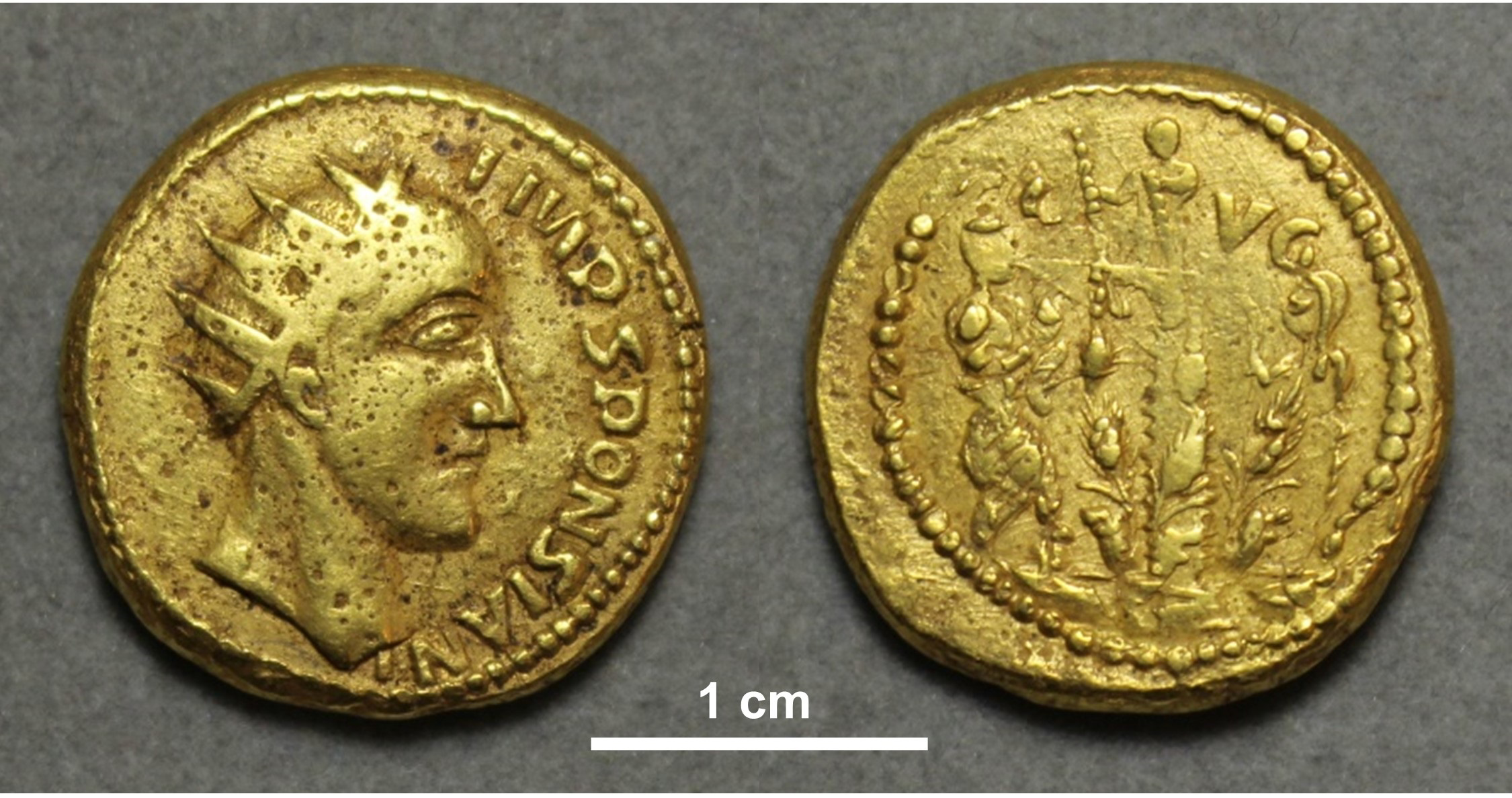
Image by Paul Pearson, University College London
You may think you know your Roman emperors, but do you recognize the face on the coin above? His name was Sponsian, or Sponsianus, and he lived in the middle of the third century. Or at least he did according to certain theories: vanishingly little is known about him, and in fact, this very gold piece (above) is the only evidence we have that he ever existed. Given that numismatists have long written the coin off as an eighteenth-century fake, it’s possible that emperor Sponsian could be a wholly apocryphal figure — but it’s become a bit less likely since the coin went under the electron microscope earlier this year.
“Using modern imaging technology, the researchers said they found ‘deep micro-abrasion patterns’ that were ‘typically associated with coins that were in circulation for an extensive period of time,’ ” writes the New York Times’ April Rubin.
“In addition, the researchers analyzed earthen deposits, finding what they called evidence that the coin had been buried for a long time before being exhumed.” In the details of their design, they’re also “uncharacteristic” of forgeries created in the eighteenth century. If this Sponsian-headed money is fraudulent, then, it’s at least authentically old, or at least much older than had long been assumed.
You can find the published research paper here, at the site of its journal PLOS ONE. Summarizing findings in the paper, a University College London site notes: “The coin … was among a handful of coins of the same design unearthed in Transylvania, in present-day Romania, in 1713. They have been regarded as fakes since the mid-19th-century, due to their crude, strange design features and jumbled inscriptions.” According to Professor Paul N. Pearson, the lead author of the research paper: “Scientific analysis of these ultra-rare coins rescues the emperor Sponsian from obscurity. Our evidence suggests he ruled Roman Dacia, an isolated gold mining outpost, at a time when the empire was beset by civil wars and the borderlands were overrun by plundering invaders.” Jesper Ericsson, a curator at The Hunterian at the University of Glasgow, adds: “we hope that this [research] encourages further debate about Sponsian as a historical figure” and sparks more research into “coins relating to [Sponsian] held in other museums across Europe.”
Keep tabs on the Sponsianus Wikipedia page to learn more about this long-lost Roman emperor.
Related content:
Modern Artists Show How the Ancient Greeks & Romans Made Coins, Vases & Artisanal Glass
How the Ancient Mayans Used Chocolate as Money
Based in Seoul, Colin Marshall writes and broadcasts on cities, language, and culture. His projects include the Substack newsletter Books on Cities, the book The Stateless City: a Walk through 21st-Century Los Angeles and the video series The City in Cinema. Follow him on Twitter at @colinmarshall or on Facebook.
Read More...Joni Mitchell Tells Elton John the Stories Behind Her Iconic Songs: “Both Sides Now,” “Carey” & More
When Joni Mitchell heard the great cabaret artist Mabel Mercer in concert, she was so struck by the older woman’s rendition of “Both Sides Now,” the enduring ballad Mitchell wrote at the tender age of 23, that she went backstage to show her appreciation:
… but I didn’t tell her that I was the author. So, I said, y’know, I’ve heard various recordings of that song, but you bring something to it, y’know, that other people haven’t been able to do. You know, it’s not a song for an ingenue. You have to bring some age to it.
Well, she took offense. I insulted her. I called her an old lady, as far as she was concerned. So I got out of there in a hell of a hurry!
But I think I finally became an old lady myself and could sing the song right.
This is just one of many candid treats to be found in Mitchell’s interview with Elton John, for his Apple Music 1 show Rocket Hour.
For the most part, Mitchell’s reminiscences coalesce around various iconic tracks from her nearly sixty years in the music industry.
“Carey,” off Mitchell’s 1971 album Blue, sparks memories of an exploding stove during a hippie-era sojourn in Matala on Crete’s south coast, with an Odyssey reference thrown in for good measure.
“Amelia” was hatched, as were most of the tunes on 1976’s Hejira, while Mitchell was on a solo road trip in a secondhand Mercedes, an experience that caused her to dwell on the first female aviator to cross the Atlantic solo. (She scribbled down lyrics that had come to her at the wheel whenever she pulled over for lunch.)
Regarding “Sex Kills” from 1994’s Turbulent Indigo, John quotes a Rolling Stone article in which Mitchell discussed the “ugliness” she was detecting in popular music:
I think it’s on the increase. Especially towards women. I’ve never been a feminist, but we haven’t had pop songs up until recently that were so aggressively dangerous to women.
“What did you mean by that?” John asks. “ People saying rap music with ‘my hos’ and stuff like that?”
“Oh, well, y’know, yeah,” Mitchell says, “Hos and booty, y’know, hahahah.”
She may not seem overly fussed about it now, but don’t get her started on what young women wear to the Grammys!
John also invited Mitchell to discuss three songs that have influenced her.
Her picks:
Lambert, Hendricks & Ross’s “Charleston Alley” (a musical epiphany as a high schooler at a college party)
Edith Piaf’s “Les Trois Cloches” (a musical epiphany as an 8‑year-old at a birthday party)
And Chuck Berry’s “Johnny B. Goode” (dancing ‘round the jukebox at Saskatoon swimming pool)
Circling back to “Both Sides Now,” Mitchell prefers the orchestral arrangement she recorded as an alto in 2002 to the original’s girlish soprano, with its possibly unearned perspective. (“It’s not a song for an ingenue…”)
When I performed it, the orchestra gathered around me and I’ve played with classical musicians before and they were always reading the Wall Street Journal behind their sheet music and they always treat you like it’s a condescension to be playing with you, but everybody, the men — Englishmen! — were weeping!
Perhaps you too will be moved to tears, as singer-songwriter Brandi Carlile was during a performance of “Both Sides Now” as part of the 2022 Newport Folk Festival’s Joni Jam, Mitchell’s first show in 22 years, owing to a period of major disillusionment with the music business as well as a 2015 brain aneurysm.
Tune into more episodes of Elton John’s Rocket Hour here.
Related Content
Songs by Joni Mitchell Re-Imagined as Pulp Fiction Book Covers & Vintage Movie Posters
Hear Demos & Outtakes of Joni Mitchell’s Blue on the 50th Anniversary of the Classic Album
- Ayun Halliday is the Chief Primatologist of the East Village Inky zine and author of Creative, Not Famous: The Small Potato Manifesto and the soon to be released Creative, Not Famous Activity Book. Follow her @AyunHalliday.
Read More...The Comiclopedia: An Online Archive of 14,000 Comic Artists, From Stan Lee and Jack Kirby, to Mœbius and Hergé
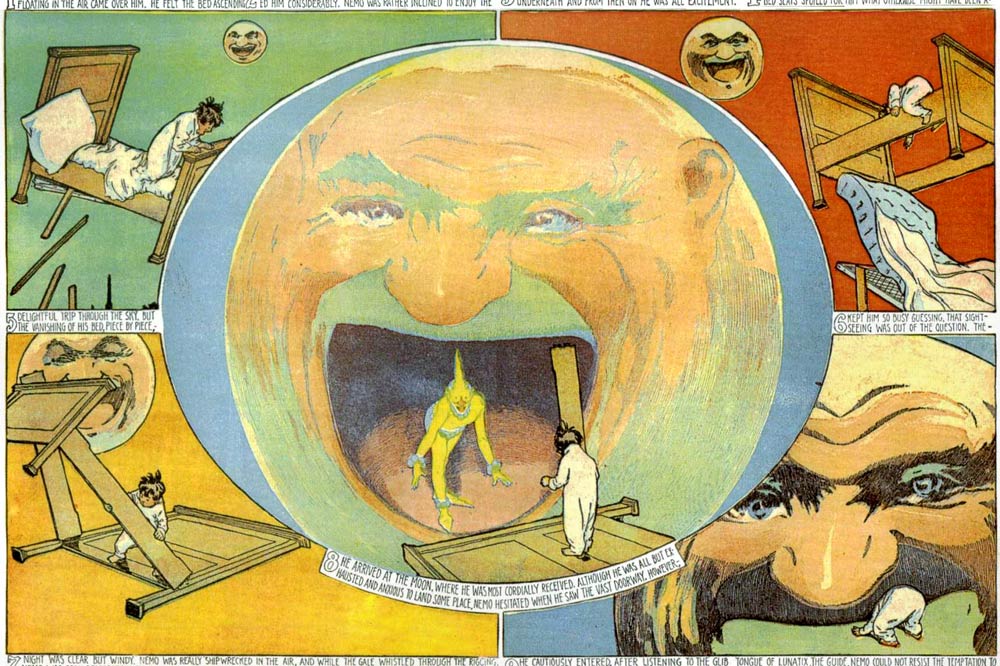
Nobody interested in comics can pass through Amsterdam without visiting Lambiek. Having opened in 1968 as the third comic-book shop in human history, it now survives as the oldest one still in existence. But even those without a trip to the Netherlands lined up can easily marvel at one of Lambiek’s major claims to fame: the Comiclopedia, “an illustrated compendium of over 14,000 comic artists from around the world.” Displaying the same kind of prescience that inspired him to open his store ahead of the comic-industry boom, Lambiek’s founder Kees Kousemaker launched this online encyclopedia in 1999, more than a year before Wikipedia first went live.
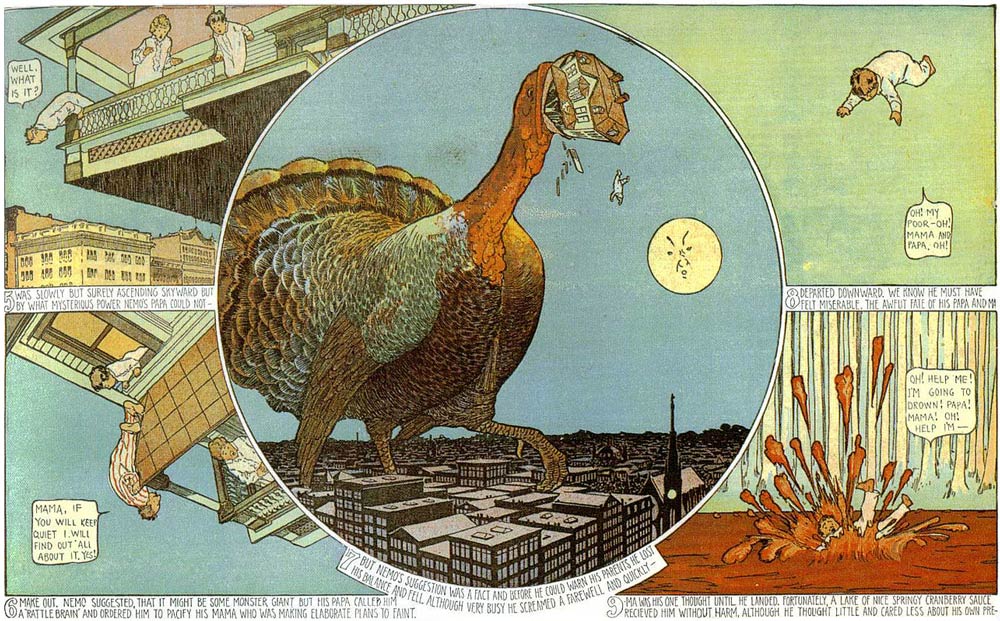
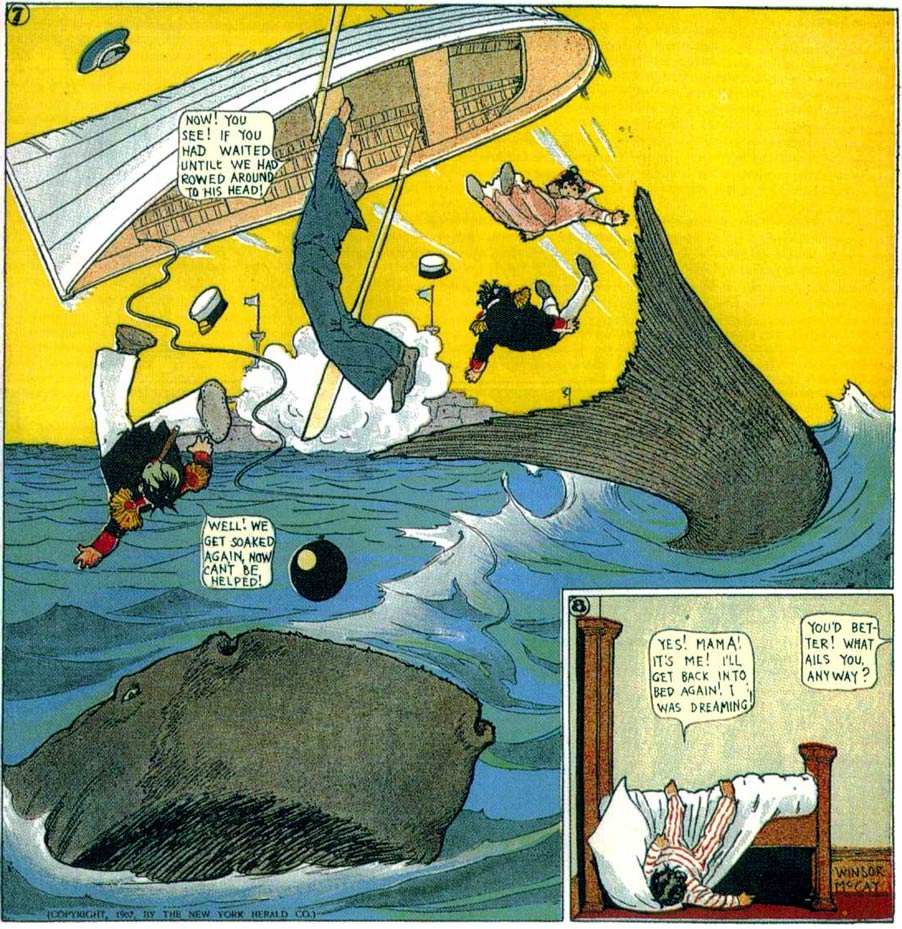
The video above offers a brief illustrated history of the Comiclopedia, but the project’s ambition comes across just as clearly in alphabetically organized index pages. American comic-book icons like Stan Lee and Jack Kirby get extensive entries, of course, but so do newspaper comic-strip creators from George Herriman and Winsor McCay (featured on this page) to Charles Schulz and Bill Watterson (whose entry features not just Calvin and Hobbes but such early work as a panel published in his college newspaper). There are even figures not known primarily as comic artists: the late Charlie Watts, for instance, whose artwork included the back cover of Between the Buttons, or David Lynch, who for nine years “drew” The Angriest Dog in the World.
For 23 years now, the Comiclopedia has maintained its commitment to both including deep cuts of that kind as well as constantly widening its international perspective. You’d expect its robust entries on Jean Giraud, better known as Mœbius, and Georges Remi, better known as Hergé, but you’ll also find introductions to the likes of Serafín Rojo Caamaño, creator of a host of characters beloved in twentieth-century Spain (including the perpetually drunken marchionesses), and Kim Seong-hwan, whose unflappable old man Gobau bore witness to half a century of tumultuous South Korean history.
Nor have Lambiek or the Comiclopedia ignored the comics of its homeland. “Kousemaker and his entourage wrote various essays, articles and books about comics,” says the page on the store’s own story, and without their work “much of the Netherlands’ comics history might otherwise have remained unexplored.” Batavophones can enjoy a thorough overview of the history of Dutch comics here; others can read a more condensed English version here, or set the Comiclopedia’s country filter to the Netherlands and sample the work of the 1,045-and-counting artists currently in the database. If you do make it out to Amsterdam, after all, you’re going to want to know Tom Poes from Eric de Noorman from Kapitein Rob beforehand.
via Metafilter
Related content:
Explore a Big Archive of Vintage Early Comics: 1700–1929
Read The Very First Comic Book: The Adventures of Obadiah Oldbuck (1837)
How to Make Comics: A Four-Part Series from the Museum of Modern Art
Free: Download 15,000+ Free Golden Age Comics from the Digital Comic Museum
The Encyclopedia of Science Fiction: 17,500 Entries on All Things Sci-Fi Are Now Free Online
Based in Seoul, Colin Marshall writes and broadcasts on cities, language, and culture. His projects include the Substack newsletter Books on Cities, the book The Stateless City: a Walk through 21st-Century Los Angeles and the video series The City in Cinema. Follow him on Twitter at @colinmarshall or on Facebook.
Read More...Support Us
We're hoping to rely on loyal readers, rather than erratic ads. Please click the Donate button and support Open Culture. You can use Paypal, Venmo, Patreon, even Crypto! We thank you!

About Us

Open Culture scours the web for the best educational media. We find the free courses and audio books you need, the language lessons & educational videos you want, and plenty of enlightenment in between.
Advertise With Us
FREE UPDATES!
GET OUR DAILY EMAIL
Get the best cultural and educational resources on the web curated for you in a daily email. We never spam. Unsubscribe at any time.
FOLLOW ON SOCIAL MEDIA
Open Culture editor Dan Colman scours the web for the best educational media. He finds the free courses and audio books you need, the language lessons & movies you want, and plenty of enlightenment in between.
Advertise With Us

