Watch World War II Unfold Day by Day: An Animated Map
In the story of World War II we all know, a handful of murderous villains and flawed yet capable defenders of democracy drive the narrative. The authors of a Kings College London project argue that this conventional history shows “a preoccupation with the culpability of statesmen.…. Above all else, the debate about war in 1939 revolves around personalities.” But there is another way to see the causes of war: through the escalating arms race of the 1930s, despite the global push for disarmament following World War I’s devastation.
The leaders of Germany, Italy and Japan wanted war, yet their ability to wage it, and the ways in which that war played out, came down to logistical contests between war machines. “First in Berlin, then in Rome and finally in Tokyo,” writes historian Joseph Maiolo, “the ebb and flow of arms competition compelled leaders to make now-or-never decisions about war.” Such decisions produced a wealth of unintended consequences, and led to catastrophic losses of life. Air, sea, and land power created at an unheard-of industrial scale turned war into an assembly line-like process that “would see humans as no more than pieces of a larger military-industrial machine,” as theorist of war Manuel De Landa writes.
Thus, we see the enormity of the casualties of WWII. Millions of soldiers were fed to the front lines in “the need to prepare for future total wars that would demand sweeping mobilization,” writes Maiolo. Wars for global supremacy demanded all of the state’s capital, especially its human resources. The animated map above tells that story in raw numbers: “WWII Every Day with Army Sizes.” Beginning with Germany’s declaration of war on Poland on September 1st, 1939, the map covers the entirety of the war, showing numbers — sometimes in the tens of millions — fluctuating wildly along the front lines of every theater.
1939 may be the only logical starting point for this presentation. Yet when it comes to understanding why World War II claimed more lives than any other war in history, the explanation must begin several years earlier with arms dealers and generals seeking bigger and bigger budgets for more sophisticated weaponry. As technical problems increased so too did the human costs, until the struggle for global supremacy during WWII became a proliferating race toward mutually assured destruction after the war’s end.
Related Content:
Watch World War II Rage Across Europe in a 7 Minute Time-Lapse Film: Every Day From 1939 to 1945
Josh Jones is a writer and musician based in Durham, NC. Follow him at @jdmagness
Read More...Futurist Makes Weirdly Accurate Predictions in 1922 About What the World Will Look Like in 2022: Wireless Telephones, 8‑Hour Flights to Europe & More
Earlier this year, we revisited a set of predictions made in 1922 about what life would look like 100 years hence, in 2022. In the pages of the New York Herald, English novelist W.L. George imagined a world in which “commercial flying will have become entirely commonplace,” and “wireless telegraphy and wireless telephones will have crushed the cable system,” resulting in generations who’ll never have seen “a wire outlined against the sky.” As for the cinema, “the figures on the screen will not only move, but they will have their natural colors and speak with ordinary voices. Thus, the stage as we know it to-day may entirely disappear, which does not mean the doom of art, since the movie actress of 2022 will not only need to know how to smile but also how to talk.” Above, you can hear a reading of W.L. George’s uncanny forecasts. The reading comes courtesy of the YouTube Channel Voices of the Past. You can read the original text of the article here.
Related Content
In 1900, Ladies’ Home Journal Publishes 28 Predictions for the Year 2000
In 1926, Nikola Tesla Predicts the World of 2026
Read More...Unpopular Music Fandom — Musicians and Philosophers Discuss on Pretty Much Pop: A Culture Podcast #134

With the dissolution of popular music culture by the Internet, what is it now to be into music genres that aren’t currently popular? Is it still an act of rebellion, or is even that passé?
Your Pretty Much Pop host Mark Linsenmayer is joined by composer/multi-instrumentalist Jonathan Segel from Camper van Beethoven, philosopher Matt Teichman of the Elucidations podcast, and musician and Internet DJ Steve Petrinko to talk about our relation to the mainstream, the different types of unpopular music (popular 30 years ago vs. never popular avant garde), post-irony, and more.
Listen to Jonathan and Steve talking about their own music on Mark’s Nakedly Examined Music podcast. Listen to one of Matt’s electronic compositions from college. Listen to Mark and Matt on Matt’s podcast.
Watch Richard Thompson sing “Oops I Did It Again.” Here’s that attempt to give a 2022 remix to the 80s hit “Come On Eileen.”
As recommendations, Jonathan mentioned Venetian Snares, Steve recommended early Weather Report. Read Jonathan’s blog about various versions of The Grateful Dead’s “Dark Star.” Read Pat Metheny picking on Kenny G.
Hear more Pretty Much Pop. Support the show and hear bonus talking for this and nearly every other episode at patreon.com/prettymuchpop or by choosing a paid subscription through Apple Podcasts. This podcast is part of the Partially Examined Life podcast network.
Pretty Much Pop: A Culture Podcast is the first podcast curated by Open Culture. Browse all Pretty Much Pop posts.
Read More...Meet the Physicist Who Has Created 1600+ Wikipedia Entries for Important Female & Minority Scientists
I find nothing more rewarding, honestly, than seeing people get recognized and championed for what they’ve done. — Dr. Jess Wade
As far as centuries go, the 21st one is a relatively good time to be a girl with an interest in STEM.
Modern science-loving girls find themselves born into a world where books and TV shows celebrating their interest proliferate. Their classrooms are festooned with posters of trailblazing female scientists. Even Barbie has ditched her bathing suit for a lab coat and a microscope.
You’d think Wikipedia would have kept pace in this climate.
And it has…thanks almost entirely to the efforts of Dr. Jess Wade, a 33-year-old Imperial College Research Fellow who spends her days investigating spin selective charge transport through chiral systems in the Department of Materials.
Her evenings, however, belong to Wikipedia.
That’s when she drafts entries for under recognized female scientists and scientists of color.
“I had a target for doing one a day, but sometimes I get too excited and do three,” she told The Guardian in 2018.
To date she’s added more than 1,600 names, striving to make their biographies as fully fleshed out as any of the write ups for the white male scientists who flourish on the site.
This requires some forensic digging. Discovering a subject’s maiden name is often the critical step to finding her PhD thesis and early influences.
A handful of Wade’s entries have been stricken for the truly maddening reason that their subjects are too obscure to warrant inclusion.
Wade’s own Wikipedia entry notes the hypocrisy of this logic, referring readers to a 2019 Chemistry World article in which she’s quoted:
When you make a page and it is disputed for deletion, it is not only annoying because your work is being deleted. It’s also incredibly intrusive and degrading to have someone discuss whether someone’s notable enough to be on Wikipedia – a website that has pages about almost every pop song, people who are extras in films no one has ever heard of and people who were in sports teams that never scored.
Below are just a few of the 1600+ female scientists she’s introduced to a wider audience. While history abounds with nearly invisible names whose discoveries and contributions have been inadequately recognized, or all too frequently attributed to male colleagues, these women are all contemporary.
Nuclear chemist Clarice Phelps was part of the team that helped discover, tennessine, the second heaviest known element.
Mathematician Gladys Mae West was one of the developers of GPS.
Physical chemist June Lindsey played a key role in the discovery of the DNA double helix.
Oceanographer and climate scientist Kim Cobb uses corals and cave stalagmites to inform projections of future climate change.
Vaccinologist Sarah Gilbert led the team that developed the Oxford/AstraZeneca vaccine (and inspired a Barbie created in her image, though you can be assured that the Wikipedia entry Wade researched and wrote for her came first.)
Wade’s hope is that a higher representation of female scientists and scientists of color on a crowdsourced, easily-accessed platform like Wikipedia will deal a blow to ingrained gender bias, expanding public perception of who can participate in these sorts of careers and encouraging young girls to pursue these courses of study. As she told the New York Times:
I’ve always done a lot of work to try to get young people — particularly girls and children from lower socioeconomic backgrounds and people of color — to think about studying physics at high school, because physics is still very much that kind of elitist, white boy subject.
Our science can only benefit the whole of society if it’s done by the whole of society. And that’s not currently the case.
Unsurprisingly, Wade is often asked how to foster and support girls with an interest in science, beyond upping the number of role models available to them on Wikipedia.
The way forward, she told NBC, is not attention-getting “whiz bang” one-off events and assemblies, but rather paying skilled teachers as well as bankers, to mentor students on their course of study, and also help them apply for grants, fellowships and other opportunities. As students prepare to enter the workforce, clearly communicated sexual harassment policies and assistance with childcare and eldercare become crucial:
Ultimately, we don’t only need to increase the number of girls choosing science, we need to increase the proportion of women who stay in science.
Listen to Jess Wade talk about her Wikipedia project on NPR’s science program Short Wave here.
Related Content:
Women Scientists Launch a Database Featuring the Work of 9,000 Women Working in the Sciences
- Ayun Halliday is the Chief Primatologist of the East Village Inky zine and author, most recently, of Creative, Not Famous: The Small Potato Manifesto. Follow her @AyunHalliday.
The Entire Archives of Radical Philosophy Go Online: Read Essays by Michel Foucault, Alain Badiou, Judith Butler & More (1972–2022)
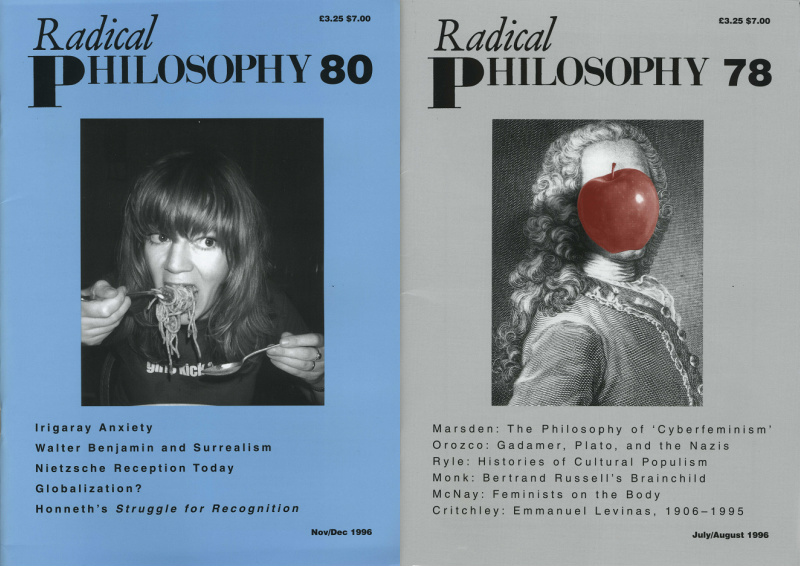
On a seemingly daily basis, we see attacks against the intellectual culture of the academic humanities, which, since the 1960s, have opened up spaces for leftists to develop critical theories of all kinds. Attacks from supposedly liberal professors and centrist op-ed columnists, from well-funded conservative think tanks and white supremacists on college campus tours. All rail against the evils of feminism, post-modernism, and something called “neo-Marxism” with outsized agitation.
For students and professors, the onslaughts are exhausting, and not only because they have very real, often dangerous, consequences, but because they all attack the same straw men (or “straw people”) and refuse to engage with academic thought on its own terms. Rarely, in the exasperating proliferation of cranky, cherry-picked anti-academia op-eds do we encounter people actually reading and grappling with the ideas of their supposed ideological nemeses.
Were non-academic critics to take academic work seriously, they might notice that debates over “political correctness,” “thought policing,” “identity politics,” etc. have been going on for thirty years now, and among left intellectuals themselves. Contrary to what many seem to think, criticism of liberal ideology has not been banned in the academy. It is absolutely the case that the humanities have become increasingly hostile to irresponsible opinions that dehumanize people, like emergency room doctors become hostile to drunk driving. But it does not follow therefore that one cannot disagree with the establishment, as though the University system were still beholden to the Vatican.
Understanding this requires work many people are unwilling to do, either because they’re busy and distracted or, perhaps more often, because they have other, bad faith agendas. Should one decide to survey the philosophical debates on the left, however, an excellent place to start would be Radical Philosophy, which describes itself as a “UK-based journal of socialist and feminist philosophy.” Founded in 1972, in response to “the widely-felt discontent with the sterility of academic philosophy at the time,” the journal was itself an act of protest against the culture of academia.
Radical Philosophy has published essays and interviews with nearly all of the big names in academic philosophy on the left—from Marxists, to post-structuralists, to post-colonialists, to phenomenologists, to critical theorists, to Lacanians, to queer theorists, to radical theologians, to the pragmatist Richard Rorty, who made arguments for national pride and made several critiques of critical theory as an illiberal enterprise. The full range of radical critical theory over the past 45 years appears here, as well as contrarian responses from philosophers on the left.
Rorty was hardly the only one in the journal’s pages to critique certain prominent trends. Sociologists Pierre Bourdieu and Loic Wacquant launched a 2001 protest against what they called “a strange Newspeak,” or “NewLiberalSpeak” that included words like “globalization,” “governance,” “employability,” “underclass,” “communitarianism,” “multiculturalism” and “their so-called postmodern cousins.” Bourdieu and Wacquant argued that this discourse obscures “the terms ‘capitalism,’ ‘class,’ ‘exploitation,’ ‘domination,’ and ‘inequality,’” as part of a “neoliberal revolution,” that intends to “remake the world by sweeping away the social and economic conquests of a century of social struggles.”
One can also find in the pages of Radical Philosophy philosopher Alain Badiou’s 2005 critique of “democratic materialism,” which he identifies as a “postmodernism” that “recognizes the objective existence of bodies alone. Who would ever speak today, other than to conform to a certain rhetoric? Of the separability of our immortal soul?” Badiou identifies the ideal of maximum tolerance as one that also, paradoxically, “guides us, irresistibly” to war. But he refuses to counter democratic materialism’s maxim that “there are only bodies and languages” with what he calls “its formal opposite… ‘aristocratic idealism.’” Instead, he adds the supplementary phrase, “except that there are truths.”
Badiou’s polemic includes an oblique swipe at Stalinism, a critique Michel Foucault makes in more depth in a 1975 interview, in which he approvingly cites phenomenologist Merleau-Ponty’s “argument against the Communism of the time… that it has destroyed the dialectic of individual and history—and hence the possibility of a humanistic society and individual freedom.” Foucault made a case for this “dialectical relationship” as that “in which the free and open human project consists.” In an interview two years later, he talks of prisons as institutions “no less perfect than school or barracks or hospital” for repressing and transforming individuals.
Foucault’s political philosophy inspired feminist and queer theorist Judith Butler, whose arguments inspired many of today’s gender theorists, and who is deeply concerned with questions of ethics, morality, and social responsibility. Her Adorno Prize Lecture, published in a 2012 issue, took up Theodor Adorno’s challenge of how it is possible to live a good life in bad circumstances (under fascism, for example)—a classical political question that she engages through the work of Orlando Patterson, Hannah Arendt, Ludwig Wittgenstein, and Hegel. Her lecture ends with a discussion of the ethical duty to actively resist and protest an intolerable status quo.
You can now read for free all of these essays and hundreds more at the Radical Philosophy archive, either on the site itself or in downloadable PDFs. The journal, run by an ‘Editorial Collective,” still appears three times a year. The most recent issue features an essay by Lars T. Lih on the Russian Revolution through the lens of Thomas Hobbes, a detailed historical account by Nathan Brown of the term “postmodern,” and its inapplicability to the present moment, and an essay by Jamila M.H. Mascat on the problem of Hegelian abstraction.
If nothing else, these essays and many others should upend facile notions of leftist academic philosophy as dominated by “postmodern” denials of truth, morality, freedom, and Enlightenment thought, as doctrinaire Stalinism, or little more than thought policing through dogmatic political correctness. For every argument in the pages of Radical Philosophy that might confirm certain readers’ biases, there are dozens more that will challenge their assumptions, bearing out Foucault’s observation that “philosophy cannot be an endless scrutiny of its own propositions.”
Enter the Radical Philosophy archive here.
Note: This post was originally published on our site in March, 2018.
Related Content:
Introducing Ergo, the New Open Philosophy Journal
History of Modern Philosophy: A Free Online Course
On the Power of Teaching Philosophy in Prisons
Josh Jones is a writer and musician based in Durham, NC. Follow him at @jdmagness
Read More...Artist Makes Astonishing Armor for Cats & Mice
As a child, Jeff De Boer, the son of a sheet metal fabricator, was fascinated by the European plate armor collection in Calgary’s Glenbow Museum:
There was something magical or mystical about that empty form, that contained something. So what would it contain? A hero? Do we all contain that in ourselves?
After graduating from high school wearing a partial suit of armor he constructed for the occasion, De Boer completed seven full suits, while majoring in jewelry design at the Alberta College of Art and Design.
A sculpture class assignment provided him with an excuse to make a suit of armor for a cat. The artist had found his niche.
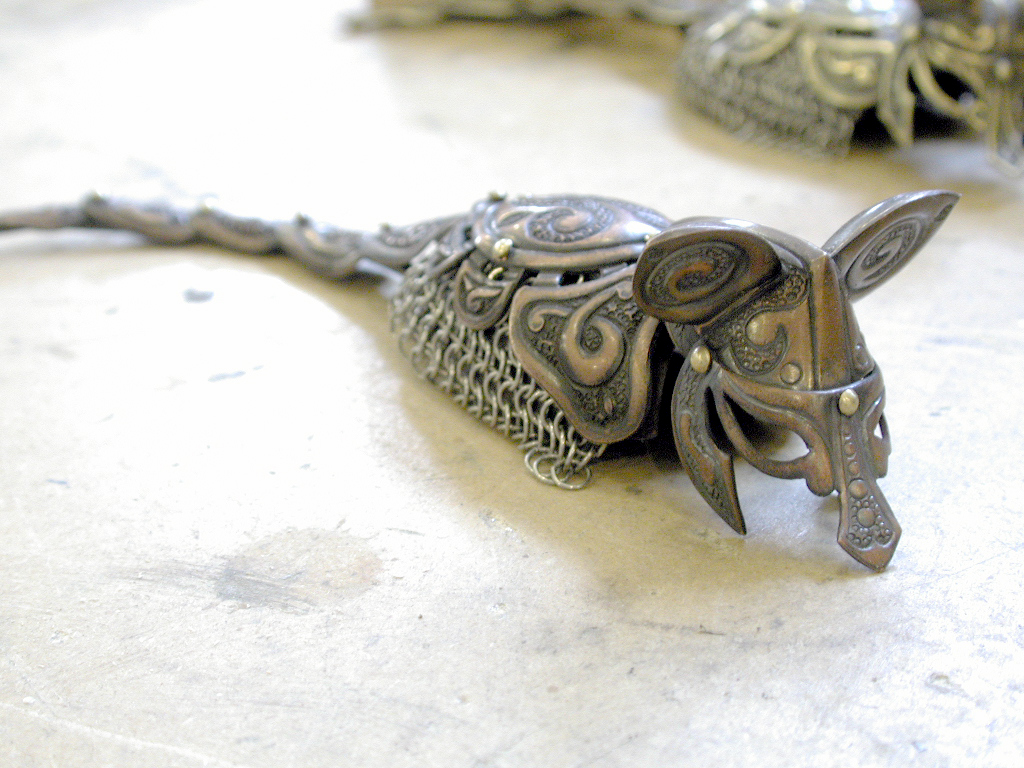
Using steel, silver, brass, bronze, nickel, copper, leather, fiber, wood, and his delicate jewelry making tools, DeBoer became the cats’ armorer, spending anywhere from 50 to 200 hours producing each increasingly intricate suit of feline armor. A noble pursuit, but one that inadvertently created an “imbalance in the universe”:
The only way to fix it was to do the same for the mouse.


“The suit of armor is a transformation vehicle. It’s something that only the hero would wear,” De Boer notes.
Fans of David Petersen’s Mouse Guard series will need no convincing, though no real mouse has had the misfortune to find its way inside one of his astonishing, custom-made creations.
Not even a taxidermy specimen, he revealed on the Making, Our Way podcast:
It’s not an altogether bad idea. The only reason I don’t do it is that hollow suit of armor like you might see in a museum, your imagination will make it do a million things more than if you stick a mouse in it will ever do. I have put armor on cats. I can tell you, it’s nothing like what you think it’s going to be. It’s not a very good experience for the cat. It does not fulfill any fantasies about a cat wearing a suit of armor.
Though cats were his entry point, De Boer’s sympathies seem aligned with the underdog — er, mice. Equipping humble, hypothetical creatures with exquisitely wrought, historical protective gear is a way of pushing back against being perceived differently than one wishes to be.
Accepting an Honorary MFA from his alma mater earlier this year, he described an armored mouse as a metaphor for his “ongoing cat and mouse relationship with the world of fine art…a mischievous, rebellious being who dares to compete on his own terms in a world ruled by the cool cats.”
Each tiny piece is preceded by painstaking research and many reference drawings, and may incorporate special materials like the Japanese silk haori-himo cord lacing the shoulder plates to the body armor of a Samurai mouse family.
Additional creations have referenced Mongolian, gladiator, crusader, and Saracen styles — this last perfect for a Persian cat.


“I mean, “Why not?” he asks in his TED‑x Talk,Village Idiots & Innovation, below.
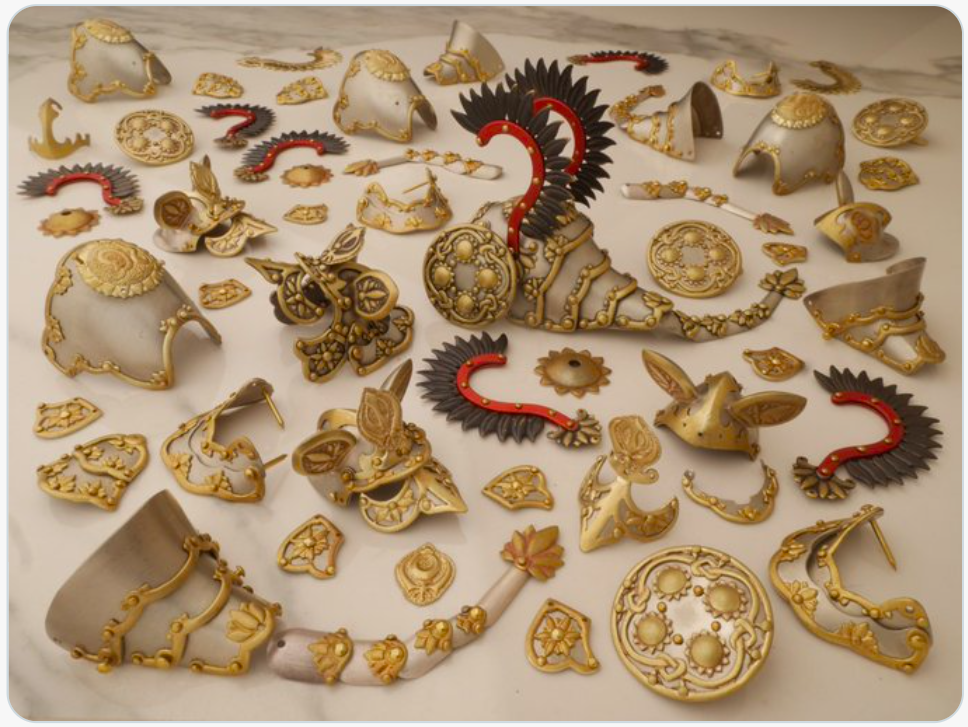
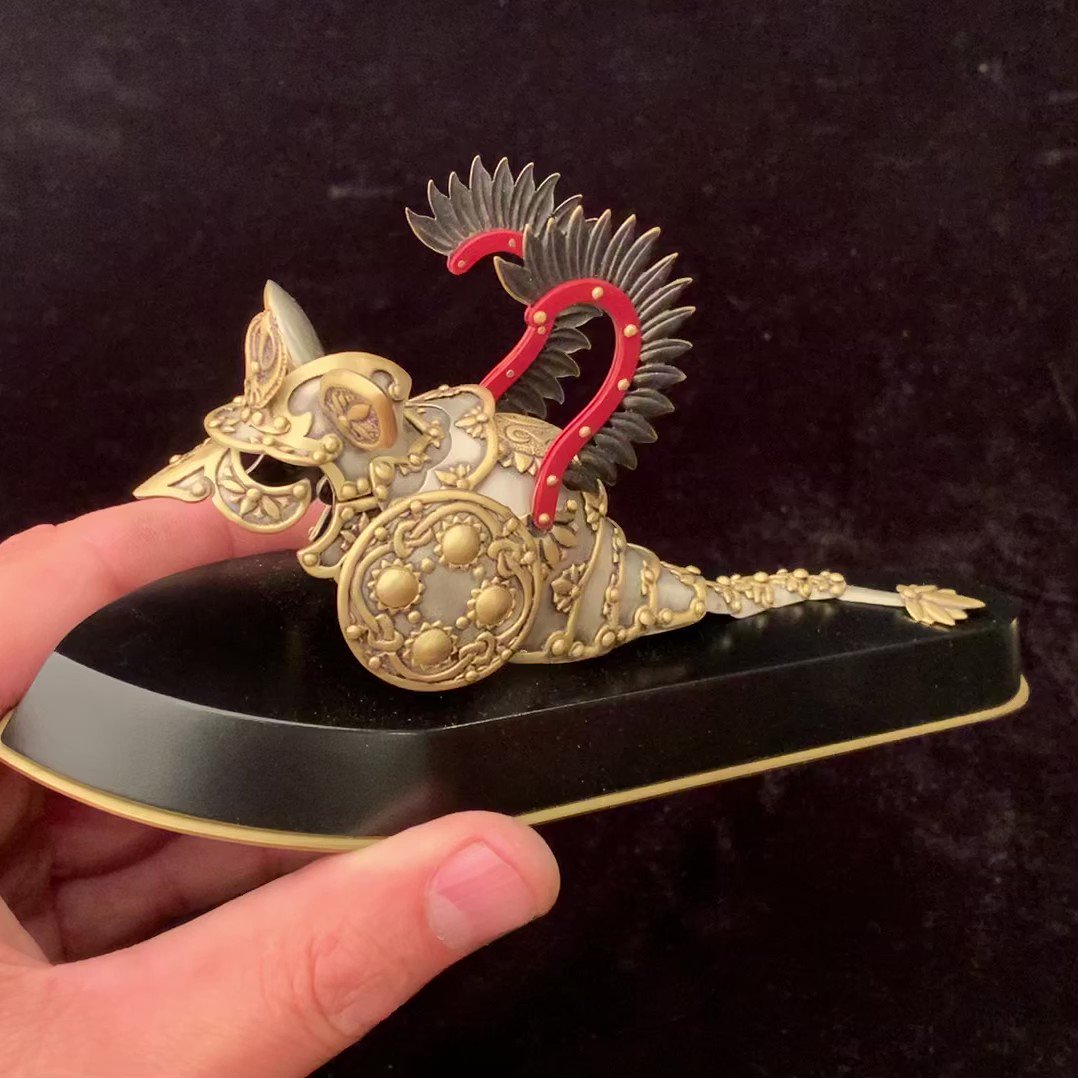
His latest work combines elements of Maratha and Hussar armor in a veritable puzzle of minuscule pieces.
See more of Jeff De Boer’s cat and mouse armor on his Instagram.
Related Content
What’s It Like to Fight in 15th Century Armor?: A Surprising Demonstration
Cats in Medieval Manuscripts & Paintings
- Ayun Halliday is the Chief Primatologist of the East Village Inky zine and author, most recently, of Creative, Not Famous: The Small Potato Manifesto. Follow her @AyunHalliday.
Read More...The Most Distant Places Visited by the Romans: Africa, Scandinavia, China, India, Arabia & Other Far-Flung Lands
As we still say today, all roads lead to Rome. Or at least they did at the height of its power, which historians tend to place in the second century. It was in that century that the Greco-Egyptian polymath Ptolemy wrote his book Geography, whose description of all known lands inspired an unprecedentedly detailed world map. As Ptolemy’s map illustrates, “the Romans, for all their rhetoric about universal empire, were aware that the world was much larger than their domains.” So says ancient-history Youtuber Garrett Ryan in “The Most Distant Places Visited by the Romans,” a video essay from his channel Told in Stone.
Ryan explains what history has recorded of “the vast range and reach of Roman merchants and adventurers,” who made it to Africa, Scandinavia, India, and even China. Some may have been motivated by pure wanderlust (the ancient Roman equivalent of Eurail-hopping college graduates, perhaps) but surely most of them would have set out on such long, arduous, and even dangerous journeys with glory and wealth in mind.
It was the promise of spices, frankincense, and myrrh, for instance, that drew Roman traders to Arabia Felix (or modern-day Yemen), despite the region’s reputation for being “overrun by flying snakes.”
However impressive ancient Rome’s geographical knowledge, they clearly had yet to get the details straight. But they knew enough to bring back from a variety of far-flung lands not just tall tales but treasures unavailable elsewhere, turning the metropole into a reflection of the world. Few such items would have been as visible in Rome as silk, “an indispensable luxury used in everything from legionary standards to the robes of the emperors.” That material came from China, most often purchased through dealers in Central Asia and India. But some particularly adventurous Romans made it not just to the Middle Kingdom but into the very palace of the Chinese emperor. All those roads to Rome were, after all, two-way streets.
Related content:
A Map Showing How the Ancient Romans Envisioned the World in 40 AD
Ancient Rome’s System of Roads Visualized in the Style of Modern Subway Maps
The First Work of Science Fiction: Read Lucian’s 2nd-Century Space Travelogue A True Story
Based in Seoul, Colin Marshall writes and broadcasts on cities, language, and culture. His projects include the Substack newsletter Books on Cities, the book The Stateless City: a Walk through 21st-Century Los Angeles and the video series The City in Cinema. Follow him on Twitter at @colinmarshall, on Facebook, or on Instagram.
Read More...Listen to Music Playlists to Help You Study Like Nietzsche, Socrates, Kant & Other Great Thinkers
The great thinkers of the past knew nothing of Youtube — which, we might be tempted to say today, enabled them to become great thinkers in the first place. This is, of course, uncharitable: surely the rise of streaming media counts among the most important developments in the history of education. Many college students today may genuinely wonder how previous generations got by without Youtube’s background-music mixes engineered, as the New Yorker’s Amanda Petrusich wrote not long ago, “to facilitate and sustain a mood, which in turn might enable a task: studying, folding laundry, making spreadsheets, idly browsing the Internet.”
If Youtube had been available to important minds of previous centuries — indeed, previous millennia — what sort of studying music would it have served to them? This is, in some sense, a philosophical question, and a philosophy channel has been providing answes: a host of answers, in fact, each in the form of a themed Youtube mix.
On Filosofia Acadêmica you’ll find a playlist to study like “a seventeenth-century philosopher” (Beethoven, Tchaikovsky, Tartini), like “a medieval philosopher having the truth revealed by divine grace” (Gregorian chants), and like “Socrates after discovering from the Oracle of Delphi that he is the wisest” (lots of harp and boat sounds).
Uploaded over the past year, these playlists have proven to be the biggest hits on Filosofia Acadêmica (a Brazilian channel also offering interviews like “Filosofia da Matemática com Oswaldo Chateaubriand” and “Filosofia da Religião com Domingos Faria,”). Its creator Elan Marinho has also put effort into crafting music mixes after particular thinkers in such notable moments as “Newton sticking needles in his eyes to test hypotheses about light,” “Turing inventing the computer” and “Nietzsche over the abyss in a tightrope between the animal and the übermensch” (opening, naturally, with “Ride of the Valkyries”). Many of these selections dispense with period accuracy, departing wildly from the subject’s time and place. But then, hasn’t imaginative license has always been a key component of great thought?
Related content:
Stream 58 Hours of Free Classical Music Selected to Help You Study, Work, or Simply Relax
An Ancient Philosophical Song Reconstructed and Played for the First Time in 1,000 Years
Hear What It Sounds Like When Philosopher Daniel Dennett’s Brain Activity Gets Turned into Music
Based in Seoul, Colin Marshall writes and broadcasts on cities, language, and culture. His projects include the Substack newsletter Books on Cities, the book The Stateless City: a Walk through 21st-Century Los Angeles and the video series The City in Cinema. Follow him on Twitter at @colinmarshall, on Facebook, or on Instagram.
Read More...Winnie the Pooh Went Into the Public Domain, and Someone Already Turned the Story Into a Slasher Film: Watch the Trailer for Winnie-The-Pooh: Blood and Honey
Deep in the Hundred Acre Wood
Where Christopher Robin plays
You’ll find the enchanted neighborhood
Of Christopher’s childhood days…
Those sweetly sentimental lyrics were penned not by A.A. Milne, creator of Winnie-The-Pooh but rather the Academy-Award winning songwriting team of brothers Robert and Richard Sherman, who also penned the scores of Mary Poppins, Chitty Chitty Bang Bang, and The Jungle Book.
If you are under the age of 60, chances are your concept of Pooh, Eeyore, Piglet, Kanga, Roo, Owl, Rabbit and Tigger is informed by Winnie the Pooh and Honey Tree, the 1966 Disney cartoon that launched a successful franchise, not E.H. Shepherd’s charming illustrations for the 1926 book, Winnie the Pooh, which entered the public domain this year.
This means that Milne’s work can be freely reproduced or reworked, though Disney retains the copyright to their animated character designs.
Jennifer Jenkins, director of the Center for the Study of the Public Domain at Duke University, told the Washington Post that the bulk of the inquiries she fielded in the lead up to 2022’s public domain titles becoming available had to do with Winnie the Pooh:
I can’t get over how people are freaking out about Winnie-the-Pooh in a good way. Everyone has a very specific story of the first time they read it or their parents gave them a doll or they [have] stories about their kids…It’s the Ted Lasso effect.We need a window into a world where people or animals behave with decency to one another.”
Ummm…
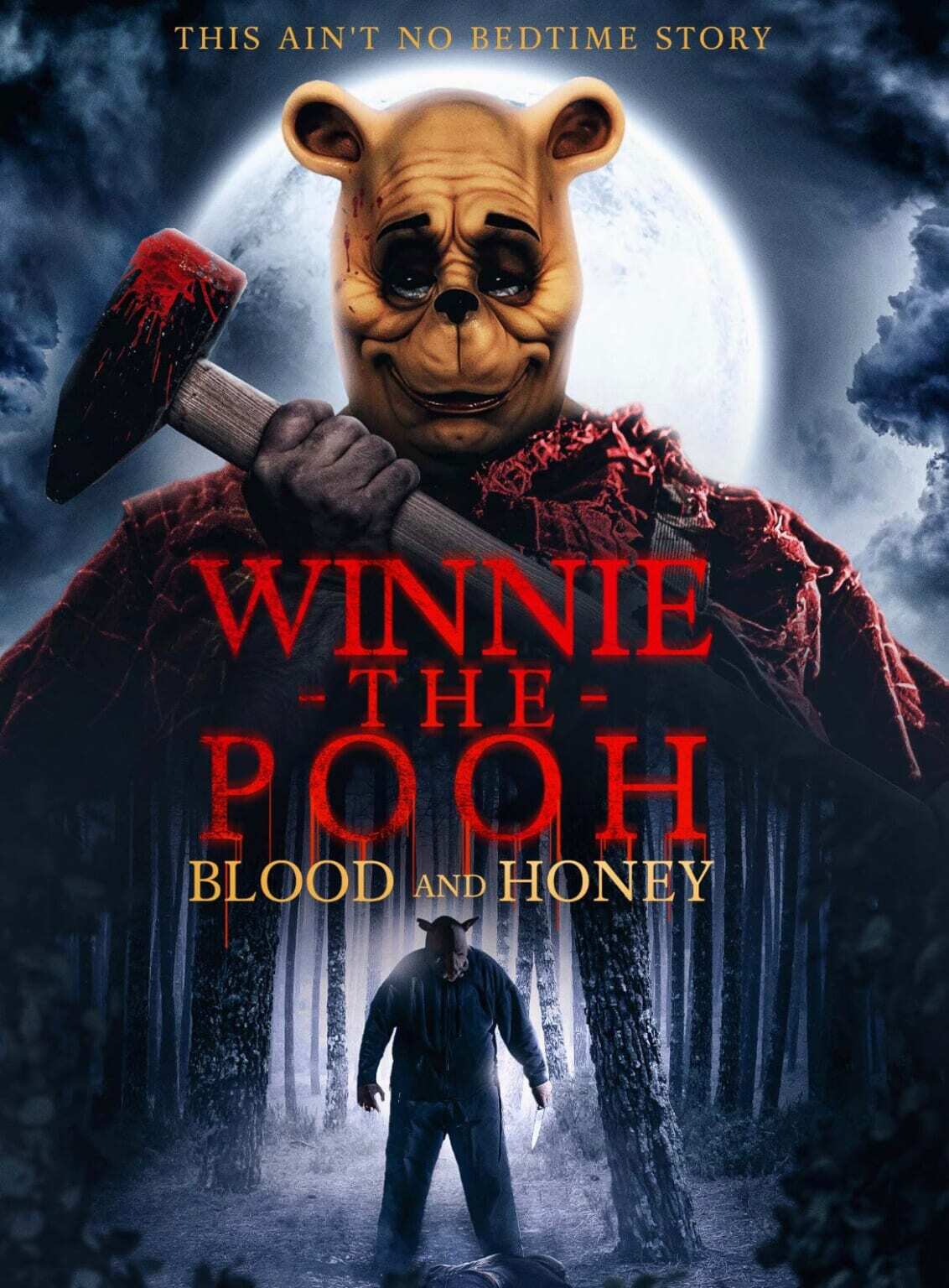
Judging by the trailer for their upcoming live action, low budget feature, Winnie the Pooh: Blood and Honey, Jagged Edge, a London-based horror production company, is not much interested in Ted Lasso good vibes, though they do manage to stay within the limits of the law, equipping a black clad Piglet with threatening tusks, and dressing the titular “silly old bear” in a red shirt that doesn’t exactly scream Tummy Song.
More like Texas Chainsaw Massacre.
Producer-Director Rhys Frake-Waterfield whose as-yet-unreleased credits include Peter Pan’s Neverland Nightmare and Spiders on a Plane told Variety that “we did as much as we could to make sure [the film] was only based on the 1926 version:”
When you see the cover for this and you see the trailers and the stills and all that, there’s no way anyone is going to think this is a child’s version of it.
Here’s hoping he’s right.
The trailer traffics freely in slasher flick tropes:
A bikini clad young woman relaxing, obliviously, in a hot tub.
A hand held camera tracking a desperate, and probably doomed, escape attempt through the woods.
Unnerving warnings written in blood (or possibly honey?)
The childish scrawl on the sign demarcating the 100 Acre Wood is both faithful to the original, and unmistakably sinister.
Equally disturbing is the lettering on Eeyore’s homemade grave marker. (SPOILER: as per Variety, a starving Pooh and Piglet ate him…and apparently discarded a human skull nearby.)
The “enchanted neighborhood of Christopher’s childhood days” has gone decidedly downhill.
Director Frake-Waterfield paints Pooh and Piglet as the primary villains, but surely the college-bound Christopher Robin deserves some of the blame for abandoning his old friends.
On the other hand, when a college-bound Andy tossed his beloved childhood playthings in a giveaway box at the beginning of Toy Story 3, Buzz and Woody did not go on a murderous rampage.
As Frake-Waterfield described Pooh and Piglet’s devolution to HuffPost:
Because they’ve had to fend for themselves so much, they’ve essentially become feral. So they’ve gone back to their animal roots. They’re no longer tame: they’re like a vicious bear and pig who want to go around and try and find prey.
An interview with Dread Central offers a graphic taste of the violent mayhem they inflict, even as Christopher Robin, as clueless as a bikini clad innocent in a hot tub, bleats, “We used to be friends, why are you doing this!?”
Unsurprisingly, the film’s tagline is “This Ain’t No Bedtime Story.”
View production photos, if you dare, here.
- Ayun Halliday is the Chief Primatologist of the East Village Inky zine and author, most recently, of Creative, Not Famous: The Small Potato Manifesto. Her allegiance has long been with the 1926 version. Follow her @AyunHalliday.
Related Content
Hear the Classic Winnie-the-Pooh Read by Author A.A. Milne in 1929
The Original Stuffed Animals That Inspired Winnie the Pooh
Read More...Three Female Artists Who Helped Create Abstract Expressionism: Lee Krasner, Elaine de Kooning & Helen Frankenthaler.
The three artists that gallerists James Payne and Joanne Shurvell have chosen to represent New York City in their series Great Art Cities Explained are as refreshing as they are surprising.
Andy Warhol?
Nope.
No.
Uh-uh.
These gents would be the obvious choice, though only one of the three — Basquiat was a native New Yorker.
Instead, Payne and Shurvell aim their spotlight at three NYC-born Abstract Expressionists.
Three female NYC-born Abstract Expressionists — Lee Krasner, Elaine de Kooning, and Helen Frankenthaler.
These women’s contributions to the movement were considerable, but Krasner and deKooning spent much of their careers overshadowed by celebrated husbands — fellow Abstract Expressionists Jackson Pollock and Willem de Kooning.
The New York-based Abstract Expressionism deposed Paris as the center of the art world, and was the most macho of movements. Krasner, Frankenthaler, and Elaine de Kooning often heard their work described as “feminine”, “lyrical”, or “delicate”, the implication being that it was somehow less than.
Hans Hofmann, an Abstract Expressionist who ran the 8th Street atelier where Krasner studied after training at Cooper Union, the Art Students League, and the National Academy of Design, and working for the WPA’s Federal Art Project, once praised one of her canvases by saying, “This is so good you would not believe it was done by a woman.”
Payne and Shurvell detail how the sociable Krasner, already established in the NYC art scene, shared important contacts with Pollock, with whom she became romantically entangled shortly after their work was shown alongside Picasso’s, Matisse’s , and Georges Braque’s in the pivotal 1942 French and American Painting exhibition at the McMillen Gallery.
She was an energetic promoter of his work, and a cheerleader when he flagged.
They married and moved to Long Island in an unsuccessful bid to put the kibosh on his drinking and extracurricular affairs. He commandeered a barn on the property for his studio, while she made do with a bedroom.
While Pollock ranged around large canvases laid on the barn floor, famously splattering, Krasner produced a Little Image series on a table, sometimes applying paint straight from the tube.
MoMA’s description of an untitled Little Image in their collection states:
Krasner likened these symbols to Hebrew letters, which she had studied as a child but could no longer read or write. In any case, she said, she was interested in creating a language of private symbols that did not communicate any one specific meaning.”
After Pollock died in a car crash while driving under the influence — his mistress survived — Krasner claimed the barn studio for her own practice.
It was a transformative move. Her work not only grew larger, it was informed by the full-body gestures that went into its creation.
Ten years later, she got her first solo show in New York, and MoMA gave her a retrospective in 1984, six months before her death.
In a wildly entertaining 1978 interview on Inside New York’s Art World, below, Krasner recalls how early on, her gender didn’t factor into how her work was received.
I start in high school, and it’s only women artists, all women. Then I’m at Cooper Union, woman’s art school, all women artists and even when I’m on WPA later on, there’s no — you know, there’s nothing unusual about being a woman and being an artist. It’s considerably later that all this begins to happen, specifically when the seat moves from Paris, which was the center, and shifts into New York, and I think that period is known as Abstract Expressionism, where we now have galleries, price, money, attention. Up ’til then it’s a pretty quiet scene. That’s when I’m first aware of being a woman and “a situation” is there.
Elaine de Kooning was an abstract portraitist, an art critic, a political activist, a teacher, and “the fastest brush in town”, but these accomplishments were all too often viewed as less of an achievement than being Mrs. Willem de Kooning, the female half of an Abstract Expressionist “it couple.”
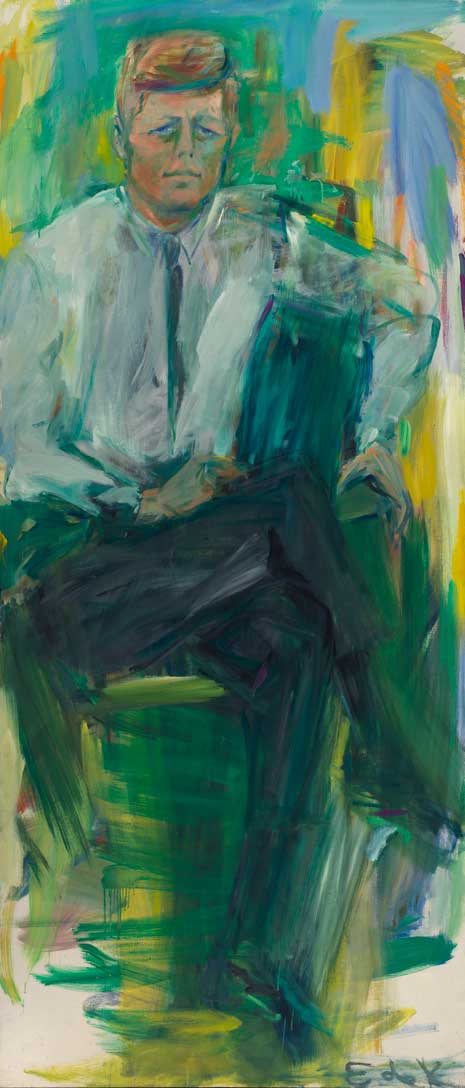
Great Art Cities Explained suggests that the twenty year period in which she and Willem were estranged — they reconciled when she was in her late 50s — was one of personal and artistic growth. She took inspiration from the bullfights she witnessed on her travels, turned a lusty female gaze on male subjects, and was commissioned to paint President Kennedy’s official portrait:
All my sketches from life as he talked on the phone, jotted down notes, read papers, held conferences, had to be made very quickly, catching features and gestures, half for memory, even as I looked, because he never sat still. It was not so much that he seemed restless, rather, he sat like an athlete or college boy, constantly shifting in his chair. At first this impression of youthfulness was a hurdle, as was the fact that he never sat still.
Like Krasner and Elaine de Kooning, Helen Frankenthaler was also part of an Abstract Expressionist golden couple, but fortune decreed she would not play a distant second fiddle to husband Robert Motherwell .
This surely owes something to her pioneering development of the “soak-stain” technique, wherein she poured turpentine-thinned oil paint directly onto unprimed canvas, laid flat.
Soak-stain pre-dated her marriage.
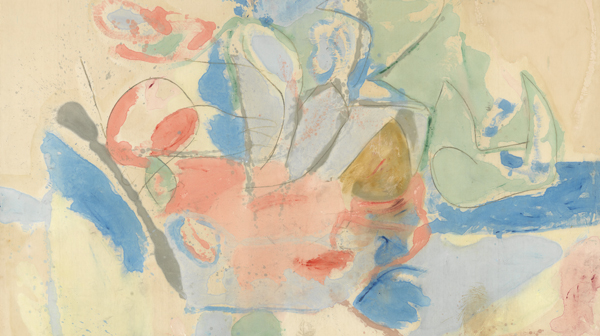
After a visit to Frankenthaler’s studio, where they viewed her landmark Mountains and Sea, above, abstract painters Kenneth Noland and Morris Louis also adopted the technique, as well as her penchant for broad, flat expanses of color — what became known as Color Field Painting.
Like Pollock, Frankenthaler scored a LIFE Magazine spread, though as Art She Says observes, not all LIFE artist profiles were created equal:
The dialogue between these two spreads appears to be a tale of socially-determined masculine energy and feminine composure. Though Pollock’s dominant stance is a key part of his artistic praxis, the issue is not that he is standing while she is sitting. Rather, it is that, with Pollock, we are allowed to glimpse into the intimate sides of his tortured and groundbreaking practice. In stark opposition, Parks’ images of Frankenthaler reinforce our need to see women artists as highly curated, polished figures who are as complete as the masterpieces that they produce. Even if those works appear highly abstracted and visceral, each stroke is perceived, at some level, to represent a calculated, perfected moment of visual enlightenment.
We’re intrigued by Frankenthaler’s 1989 remark to the New York Times:
There are three subjects I don’t like discussing: my former marriage, women artists, and what I think of my contemporaries.
For those who’d like to learn more about these three abstract painters, Payne and Shurvell offer the following book recommendations:
Women of Abstract Expressionism by Irving Sandler
Abstract Expressionism by David Anfam
Three Women Artists: Expanding Abstract Expressionism in the American West by Amy Von Lintel, Bonnie Roos, et al.
Lee Krasner: A Biography by Gail Levin
Fierce Poise: Helen Frankenthaler and 1950s New York by Alexander Nemerov
A Generous Vision: The Creative Life of Elaine de Kooning by Cathy Curtis
Elaine de Kooning: Portraits by Brandon Brame Fortune
Watch a playlist of other Great Art Cities Explained here.
Related Content
The Forgotten Women of Surrealism: A Magical, Short Animated Film
How the CIA Secretly Funded Abstract Expressionism During the Cold War
The Nazi’s Philistine Grudge Against Abstract Art and The “Degenerate Art Exhibition” of 1937
- Ayun Halliday is the Chief Primatologist of the East Village Inky zine and author, most recently, of Creative, Not Famous: The Small Potato Manifesto. Follow her @AyunHalliday.
Read More...Support Us
We're hoping to rely on loyal readers, rather than erratic ads. Please click the Donate button and support Open Culture. You can use Paypal, Venmo, Patreon, even Crypto! We thank you!

About Us

Open Culture scours the web for the best educational media. We find the free courses and audio books you need, the language lessons & educational videos you want, and plenty of enlightenment in between.
Advertise With Us
FREE UPDATES!
GET OUR DAILY EMAIL
Get the best cultural and educational resources on the web curated for you in a daily email. We never spam. Unsubscribe at any time.
FOLLOW ON SOCIAL MEDIA
Open Culture editor Dan Colman scours the web for the best educational media. He finds the free courses and audio books you need, the language lessons & movies you want, and plenty of enlightenment in between.
Advertise With Us


