The Last Cigarette Commercial Ever Aired on American TV (1971)
The slogan “You’ve come a long way, baby” still has some pop-cultural currency. But how many Americans under the age of sixty remember what it advertised? The line was first rolled out in 1968 to promote Virginia Slims, the then-new brand of cigarettes marketed explicitly to women. “Every ad in the campaign put a woman front and center, equating smoking Virginia Slims with being independent, stylish, confident and liberated,” says the American Association of Advertising Agencies. “The slogan itself spoke directly about the progress women all over America were fighting for.”
Such was the zeitgeist power of Virginia Slims that they became the very last cigarette brand ever advertised on American TV, at 11:59 p.m on January 2, 1971, during The Tonight Show Starring Johnny Carson. Richard Nixon had signed the Public Health Cigarette Smoking Act, which banned cigarette advertisements on broadcast media, on April 1, 1970. But it didn’t take effect immediately, the tobacco industry having managed to negotiate for itself one last chance to air commercials during the college football games of New Year’s Day 1971.
“The Philip Morris company has bought all commercial time on the first half hour of all the network talk shows tonight,” says ABC’s Harry Reasoner on a newscast from that same day. “That is, the last half hour on which it is legal to sell cigarettes on radio or television in the United States. This marks, as we like to say, the end of an era.” In tribute, ABC put together an assemblage of past cigarette commercials. That some will feel oddly familiar even to those of us who wouldn’t be born for a decade or two speaks to the power of mass media in postwar America. More than half a century later, now that cigarettes are seldom glimpsed even on dramatic television, all this feels almost surrealistically distant in history.
Equally striking, certainly by contrast to the manner of news anchors in the twenty-twenties, is the poetry of Reasoner’s reflection on the just-closed chapter of television history. “It isn’t like saying goodbye to an old friend, I guess, because the doctors have convinced us they aren’t old friends,” he admits. “But we may be pardoned, I think, on dim winter nights in the future, sitting by the fire and nodding and saying, ‘Remember L.S./M.F.T.? Remember Glen Gray playing smoke rings for the Camel caravan? Remember ‘Nature in the raw is seldom mild’? Remember all those girls who who had it all together?’ ”
Related content:
When the Flintstones Peddled Cigarettes
Cigarette Commercials from David Lynch, the Coen Brothers and Jean Luc Godard
Two Short Films on Coffee and Cigarettes from Jim Jarmusch & Paul Thomas Anderson
Glorious Early 20th-Century Japanese Ads for Beer, Smokes & Sake (1902–1954)
How Edward Munch Signaled His Bohemian Rebellion with Cigarettes (1895): A Video Essay
Based in Seoul, Colin Marshall writes and broadcasts on cities, language, and culture. His projects include the Substack newsletter Books on Cities, the book The Stateless City: a Walk through 21st-Century Los Angeles and the video series The City in Cinema. Follow him on Twitter at @colinmarshall, on Facebook, or on Instagram.
Read More...The Inventive Artwork of Pink Floyd’s Syd Barrett
We’ve had fun at the expense of the multi-hyphenate: i.e. “I’m an actor-slash-drummer-slash-makeup-artist-slash-brand-ambassador,” etc…. And, fair enough. Few people are good enough at their one job to reasonably excel at two or three, right? But then again, we live in the kind of hyperspecialized world Henry Ford could only dream of, and consider ourselves highly favored if we’re allowed to be just the one thing long enough to retire and do nothing.
What if we could have multiple identities without being thought of as unserious, eccentric, or mentally ill?
Discussions of Syd Barrett, Pink Floyd’s founding singer and guitarist, never pass without reference to his mental illness and abrupt disappearance from the stage. But they also rarely engage with Barrett as an artist post-Pink Floyd: namely, his two underrated solo albums; and his output as a painter, the medium in which he began his career and to which he returned for the last thirty years of his life.
If Barrett were allowed a role other than crazy diamond (a role, we must allow, assigned to him by his former bandmates), we might see more of his work in gallery collections and exhibitions. One cannot say this about every famous musician who paints. For Barrett, art was not a hobby, and it called to him before music. It was in his student days at Cambridgeshire College of Arts and Technology that he met David Gilmour. From Cambridge he moved to Camberwell College of Arts in London and began to produce and exhibit mature student work (see here).
Barrett’s work “shows some of the advantages of an art school training,” wrote a reviewer of a 1964 exhibition. “He is already showing himself a sensitive handler of oil paint who wisely limits his palette to gain richness and density.” (Barrett had displayed a prodigious early talent for achieving these qualities in watercolor — see, for example, an impressive, impressionistic still-life of orange dahlias, auctioned off in 2021, made when the artist was only 15.)
His training gave him the confidence to break away from formal exercises during this period and experiment with different styles and subjects, from the disturbing, primitivist Lions to the hollow-eyed, Munch-like Portrait of a Girl. Barrett’s first student period ended in the mid-sixties, as Pink Floyd began to take off and Barrett “turned into a songwriter” (then-manager Andrew King later wrote) “it seemed like overnight.”
After his spell with Pink Floyd and brief solo recording career came to an end, Barrett moved back to Cambridge with his mother in 1978, dropped the nickname “Syd” and began painting again as Roger Barrett, avoiding any mention of life in music. From that year until he died, he worked in several styles and different media, painting striking abstractions and landscapes and even making his own furniture designs.
While he burned many canvases, many from this time survive. See a selected chronology of his work in the video above and in the photos here. Try to put aside the story of Syd Barrett the tragic Pink Floyd frontman, and let the work of Roger Barrett the artist inspire you.
Related Content:
Syd Barrett’s “Effervescing Elephant” Comes to Life in a New Retro-Style Animation
Understanding Pink Floyd’s Wish You Were Here, Their Tribute to Departed Bandmate Syd Barrett
Watch David Gilmour Play the Songs of Syd Barrett, with the Help of David Bowie & Richard Wright
Josh Jones is a writer and musician based in Durham, NC. Follow him at @jdmagness.
Read More...The Book of St Albans, One of the Finest Medieval Manuscripts, Gets Digitized and Put Online
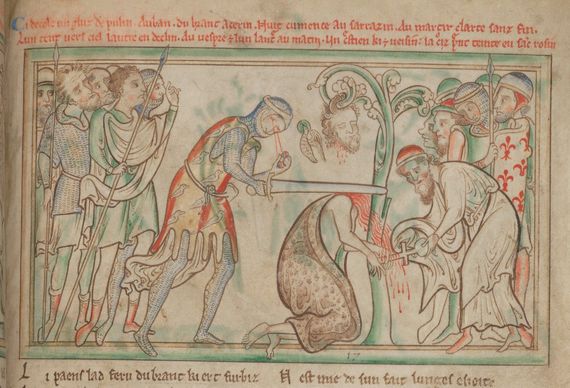
This past month, on the eve of the June 22nd feast of St Alban, the library of Trinity College Dublin announced that it had digitized the “13th century masterpiece” the Book of St Alban, a richly illustrated manuscript that “features 54 individual works of medieval art and has fascinated readers across the centuries, from royalty to renaissance scholars.”
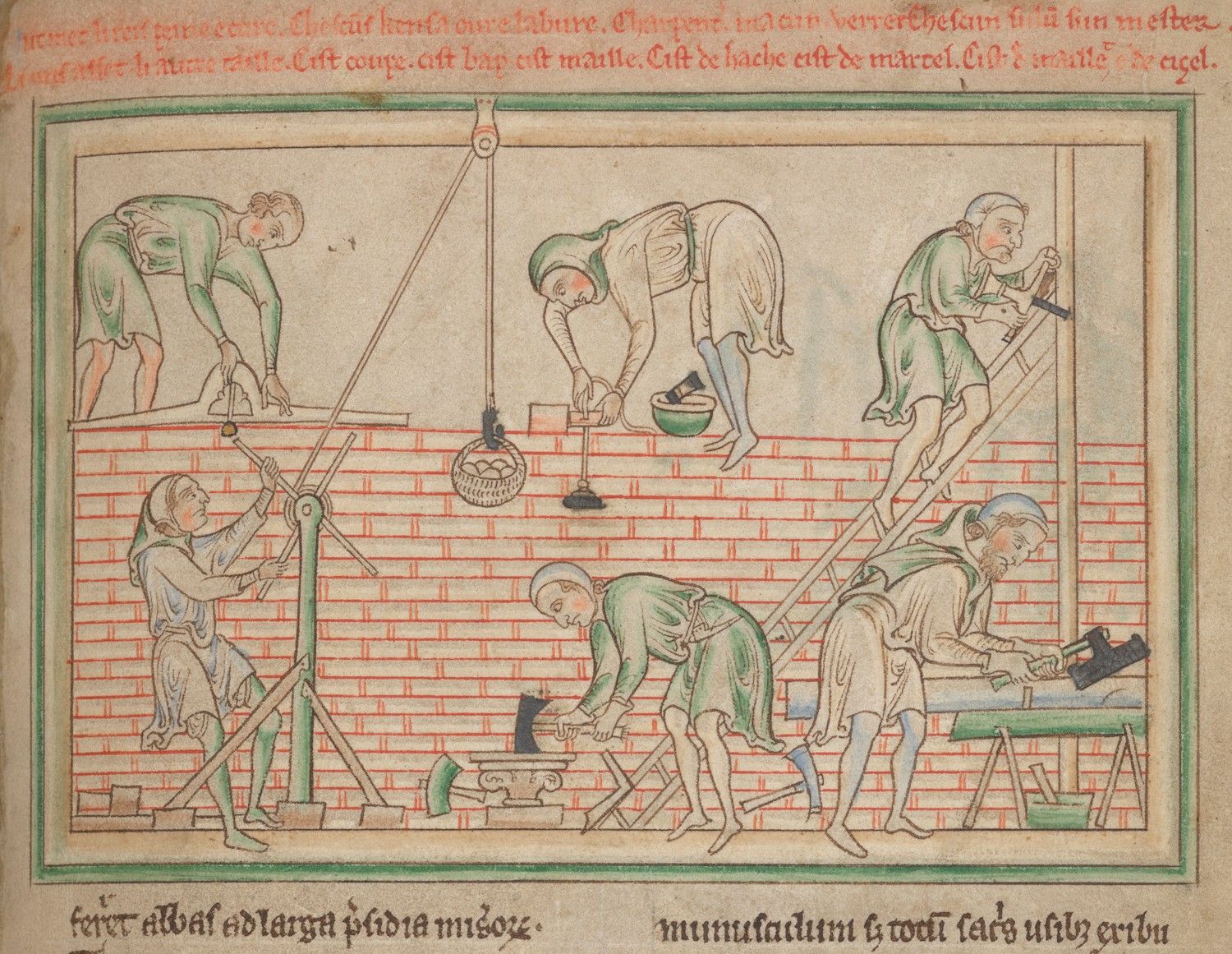
Created by the Benedictine monk Matthew Paris, the manuscript “chronicles the life of St Alban,” notes The Irish Times, “and also outlines the construction of St Alban’s Cathedral in Hertfordshire.” The text and illustrations explain the origins of a cult of St. Alban, the first English martyr, that began to spring up after his 4th century death.
According to the Venerable Bede, the English monk who wrote the Ecclesiastical History of the English People, the martyrdom of Alban involved a few miraculous events. Sentenced to die for his refusal to renounce Christianity, Alban supposedly petitioned God to dry up the River Ver so he could more quickly reach the place of his execution.
This miracle caused Alban’s Roman executioner to fall to his feet, spontaneously convert, and refuse to kill the saint. A second executioner stepped in to behead them both, whereupon this man’s eyes popped out of his head. “He who gave the wicked stroke,” writes Bede, “was not permitted to rejoice over the deceased; for his eyes dropped upon the ground together with the blessed martyr’s head.”
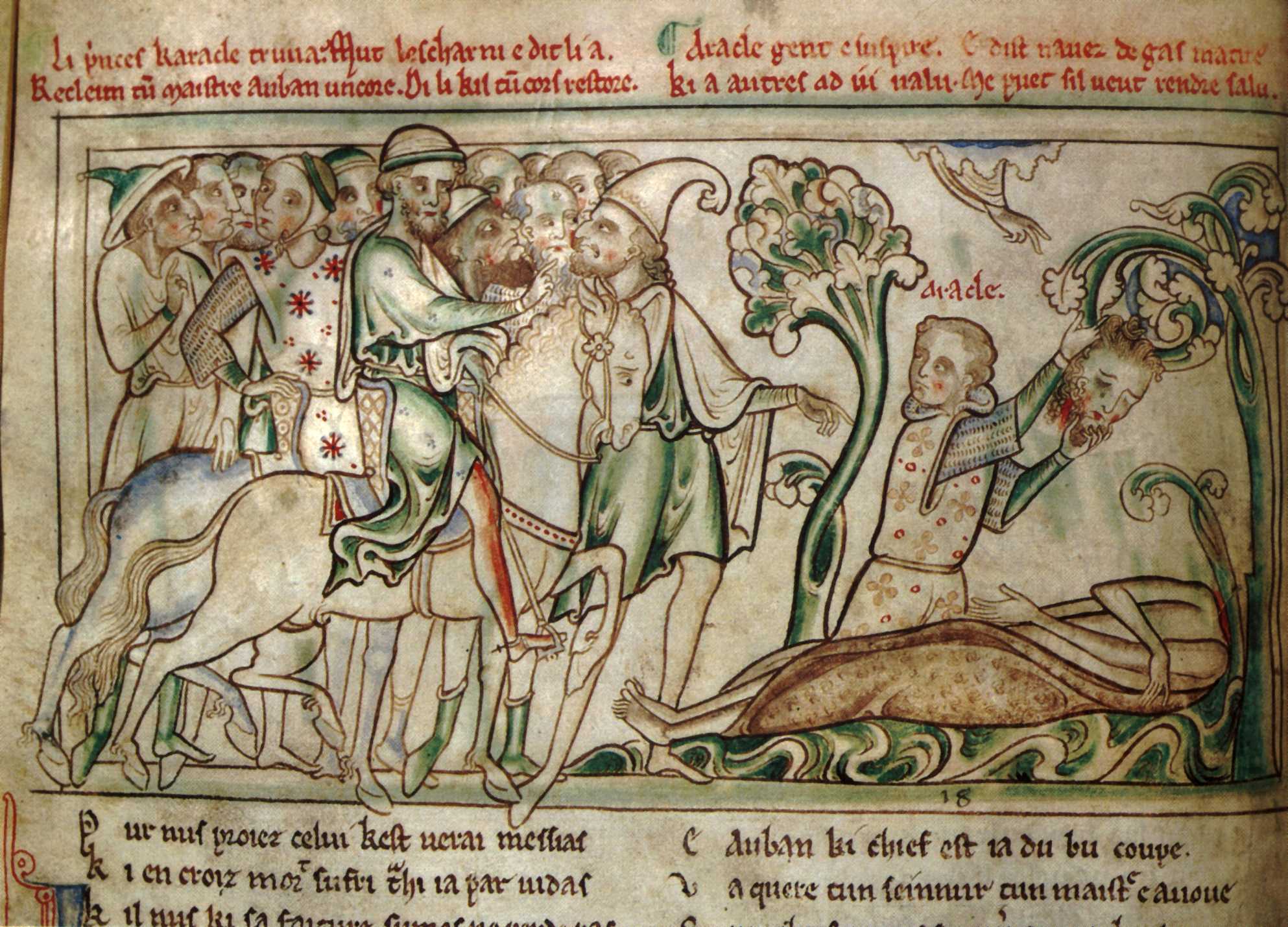
In the illustration of this grisly story (top) from the manuscript, we see the executioner holding his eyes in his hand, and Alban’s head appears to have been caught by the hair on a tree branch above. Another illustration, further up, shows a character named Heraclius making off with Alban’s head.
In a later legend, Alban’s head rolled to the bottom of Holywell Hill, and a well sprang from where it came to rest. On the supposed site of Alban’s execution now stands St Albans Cathedral, once St Albans Abbey, where the Book of St Albans remained for 300 years until Henry VIII dissolved Britain’s monasteries in 1539.
The book is written in both Latin and Anglo-Norman French, “which made it accessible to a wider secular audience including educated noble women,” Trinity College’s Caoimhe Ni Lochlainn writes. “It was borrowed by noble ladies of the period, including the King’s sister-in-law Countess of Cornwall, Sanchia of Provence, and others.”
The manuscript eventually made its way to Trinity College Dublin in 1661, where it has remained ever since, and where its “mostly framed narrative scenes” have been admired by a select few. Now everyone can access the book and its illustrations, made with a “tinted drawing technique,” Lochlainn notes, “where outlined drawings are highlighted with colored washes from a limited palette. This technique was distinctly English, dating back to the Anglo Saxon art of the 10th century.”
See all the grisly details of this fascinating artifact at Trinity College Dublin’s Digital Collections, and learn more about the manuscript in the video just above.
Related Content:
The Medieval Masterpiece, the Book of Kells, Has Been Digitized and Put Online
Josh Jones is a writer and musician based in Durham, NC. Follow him at @jdmagness
Read More...Behold a Book of Color Shades Depicted with Feathers (Circa 1915)
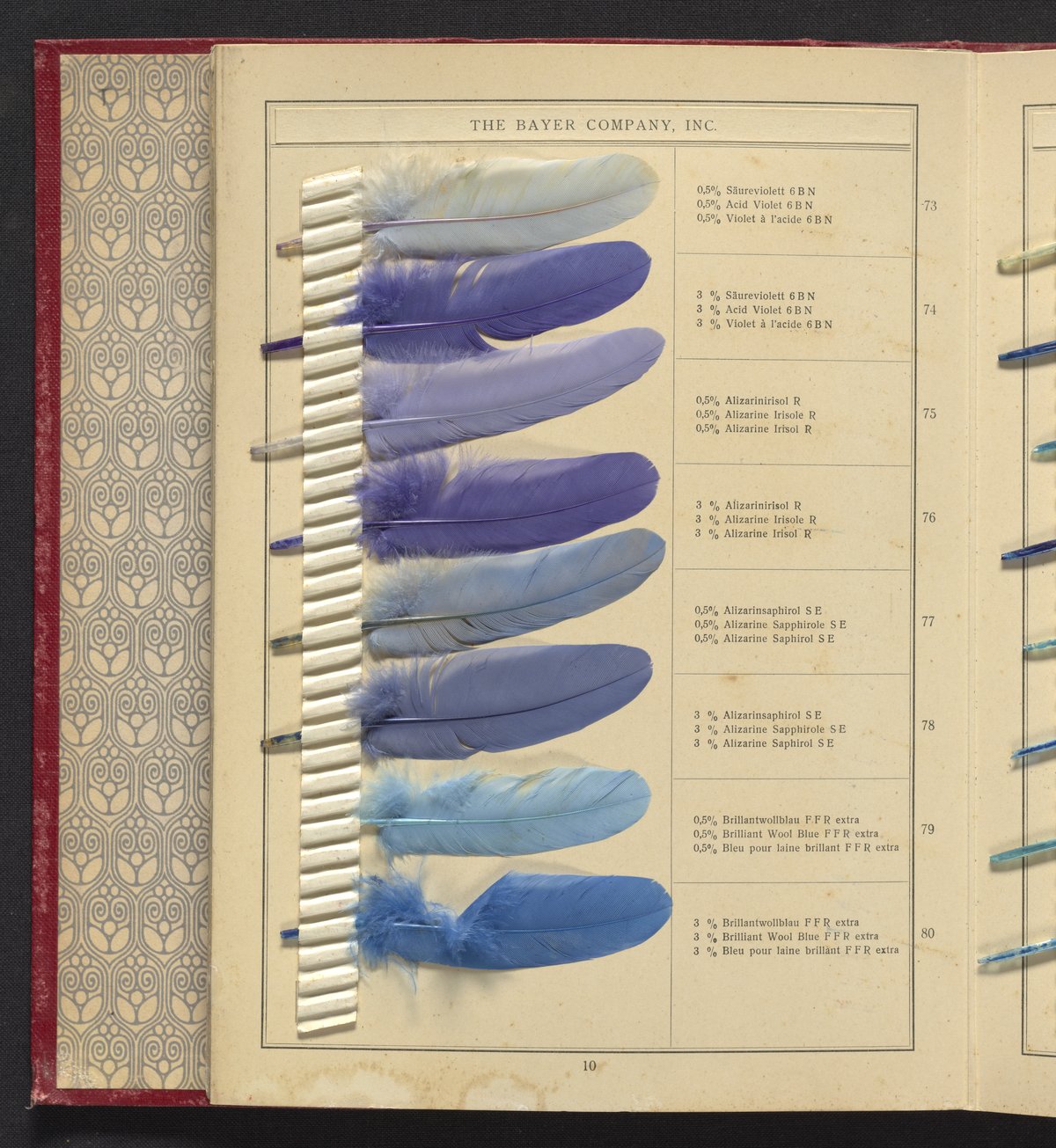
Perhaps the 143 colors showcased in The Bayer Company’s early 20th-century sample book, Shades on Feathers, could be collected in the field, but it would involve a lot of travel and patience, and the stalking of several endangered if not downright extinct avian species.
Far easier, and much less expensive, for milliners, designers and decorators to dye plain white feathers exotic shades, following the instructions in the sample book.
Such artificially obtained rainbows owe a lot to William Henry Perkin, a teenage student of German chemist August Wilhelm von Hofmann, who spent Easter vacation of 1856 experimenting with aniline, an organic base his teacher had earlier discovered in coal tar. Hoping to hit on a synthetic form of quinine, he accidentally hit on a solution that colored silk a lovely purple shade — an inadvertent eureka moment that ranks right up there with penicillin and the pretzel.
A Science Museum Group profile details what happened next:
Perkin named the colour mauve and the dye mauveine. He decided to try to market his discovery instead of returning to college.
On 26 August 1856, the Patent Office granted Perkin a patent for ‘a new colouring matter for dyeing with a lilac or purple colour stuffs of silk, cotton, wool, or other materials’.
Perkin’s next step was to interest cloth dyers and printers in his discovery. He had no experience of the textile trade and little knowledge of large-scale chemical manufacture. He corresponded with Robert and John Pullar in Glasgow, who offered him support. Perkin’s luck changed towards the end of 1857 when the Empress Eugénie, wife of Napoleon III, decided that mauve was the colour to wear. In January 1858, Queen Victoria followed suit, wearing mauve to her daughter’s wedding.
Cue an explosion of dye manufacturers across Great Britain and Europe, including Bayer, producer of the feather sample book. The survival of this artifact is somewhat miraculous given how vulnerable antique feathers are to environmental factors, pests, and improper storage.
(The sample book recommends cleaning the feathers prior to dying in a lukewarm solution of small amounts of olive oil soap and ammonia.)
The Science History Institute, owner of this unusual object, estimates that the undated book was produced between 1913 and 1918, the year the Migratory Bird Act Treaty outlawed the hunting of birds whose feathers humans deemed particularly fashionable.

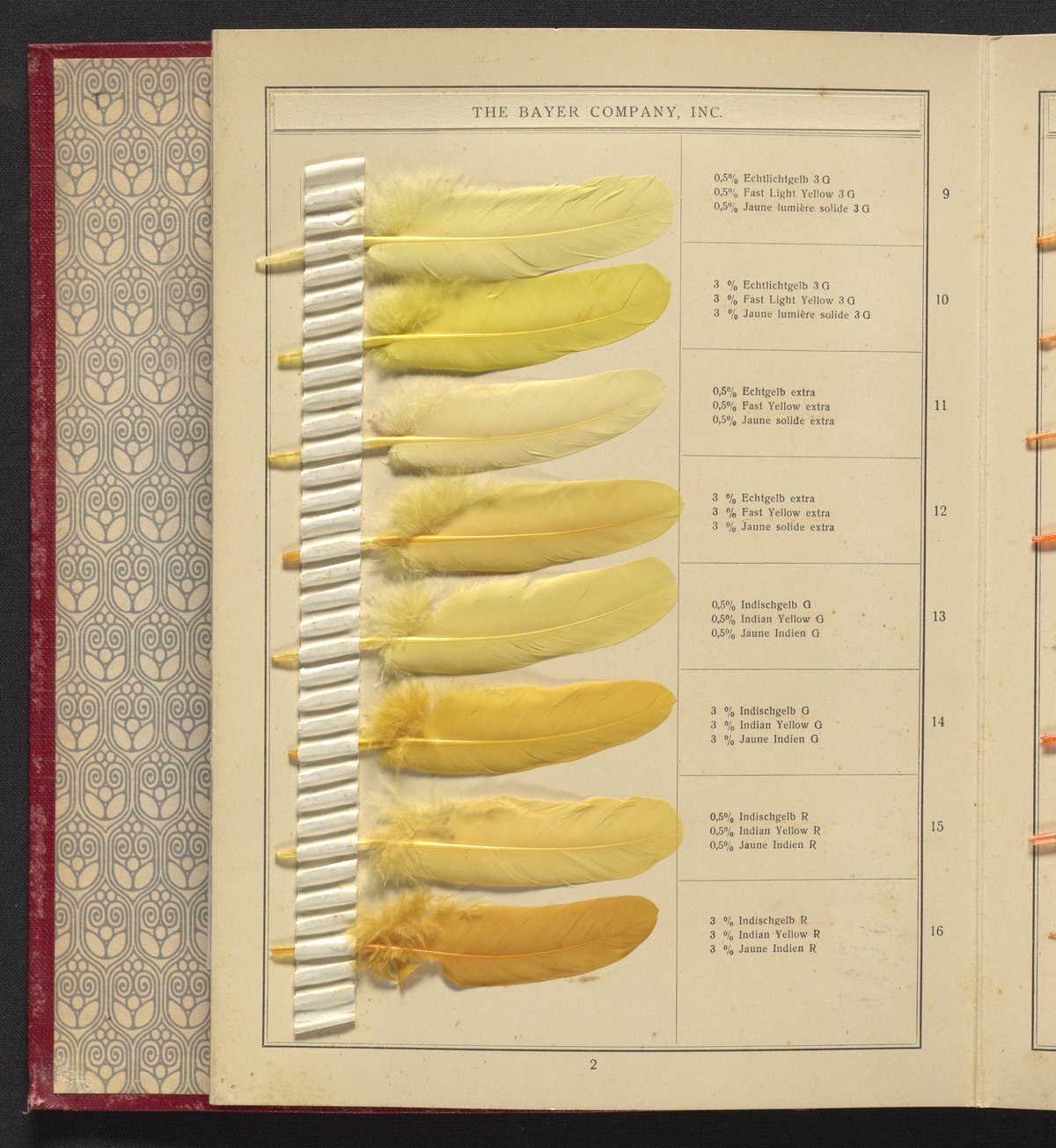
Peruse the Science History Institute of Philadelphia’s digitized copy of the Shades on Feathers sample book here.
Related Content
Download 435 High Resolution Images from John J. Audubon’s The Birds of America
The Bird Library: A Library Built Especially for Our Fine Feathered Friends
- Ayun Halliday is the Chief Primatologist of the East Village Inky zine and author, most recently, of Creative, Not Famous: The Small Potato Manifesto. Follow her @AyunHalliday.
Read More...The First Surviving Photograph of the Moon (1840)

Everyone has been agog over the first photos from the James Webb telescope, and for good reason. “These images,” Rivka Galchin writes at The New Yorker, “carry news about the early universe, the birth and death of stars, the collision of galaxies, and the atmosphere of exoplanets.” They’re also “very, very pretty,” she writes, comparing them to Vermeer.
The clarity and levels of detailed information about the earliest galaxies have even astonished astronomers, whose work has advanced rapidly alongside the growth of the photographic medium. It was an astronomer, in fact – Johann Heinrich von Madler – who first coined the word “photography” in 1839. “Astronomers quickly embraced the use of photographic plates because of their good resolution and the ability to make much larger images,” APS Physics News notes.
Astrophotography properly began in 1840, when John William Draper, a British-born chemist and doctor, took the image above from the roof of the New York University observatory, credited as the first daguerreotype of the Moon. Daguerre himself might have taken an 1839 image, but it was likely destroyed in a fire, as were Draper’s attempts of the previous year, which burned up in a NYU blaze in 1865.
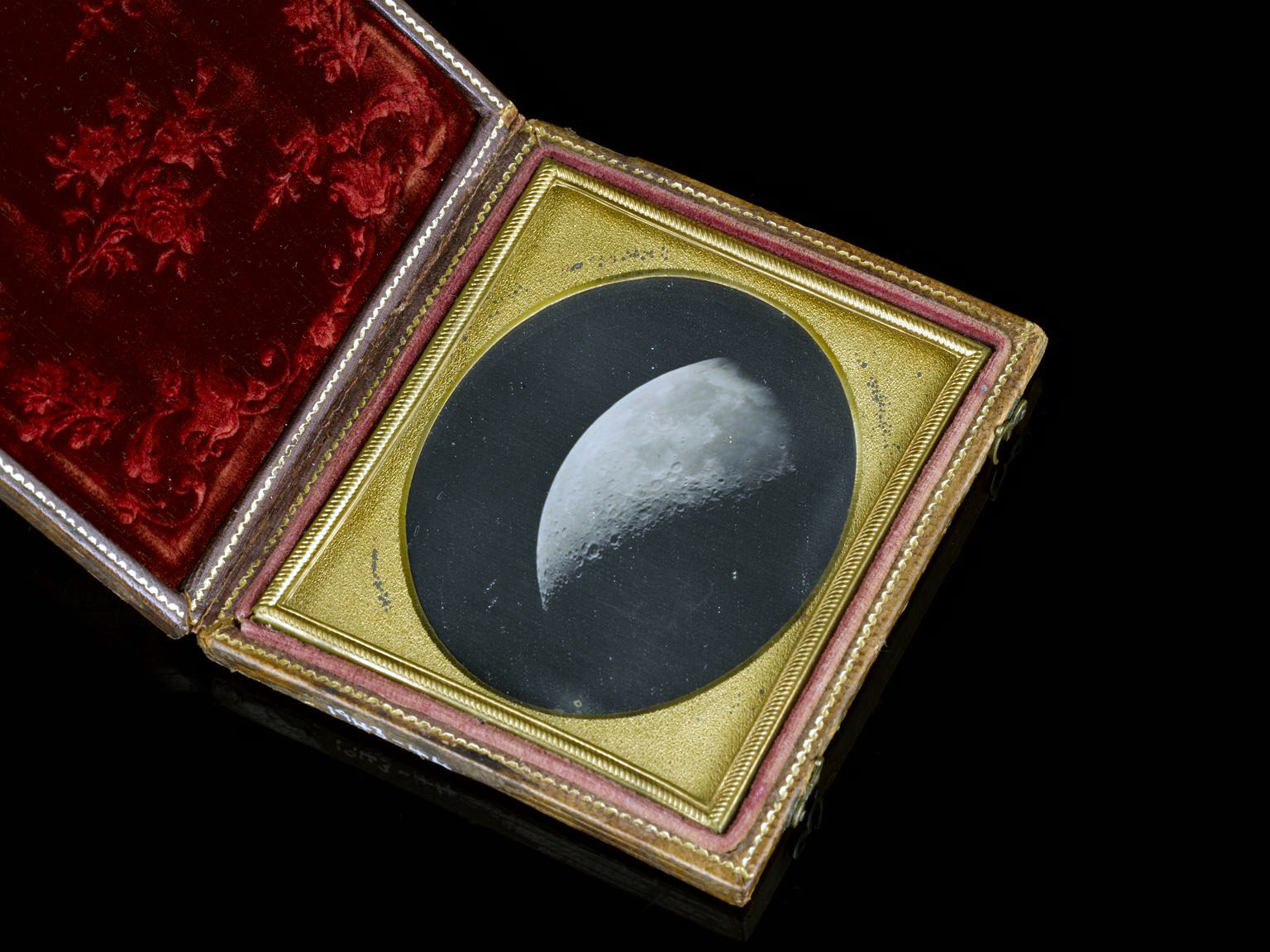
By all accounts, however, these earlier attempts at Moon photography were blurry and unfocused, showing little detail of the Earth’s satellite. Draper’s lunar “portrait,” from 1840, at the top, is largely considered “the world’s first true astrophoto,” writes Jason Major at Lights in the Dark, for its levels of detail and high contrast, comparatively speaking. As Scott Walker writes:
Draper set out to try and improve on Daguerre’s breakthrough by increasing plate sensitivity and reducing exposure times.… His advancement in the technique allowed visualization of craters, mountains and valleys on the moon’s surface which previously couldn’t be captured.
Splotched, spotted, and heavily degraded, the image may not look like much now, but a contemporary of Draper described it then as “the first time that anything like a distinct representation of the moon’s surface has been obtained.”
The achievement was inspirational, and many better attempts soon followed in rapid succession as the medium evolved. In 1851, photographer John Whipple and father-and-son astronomers William and George Bond improved on Draper’s process and made the Moon daguerreotype further up through the Great Refractor Equatorial Mount Telescope at the Harvard College Observatory. (The year previous, Draper himself collaborated with Bond père to make an image of the star Vega). The image caused a “veritable furor,” Smart History notes, at the Great Exhibition of 1851.
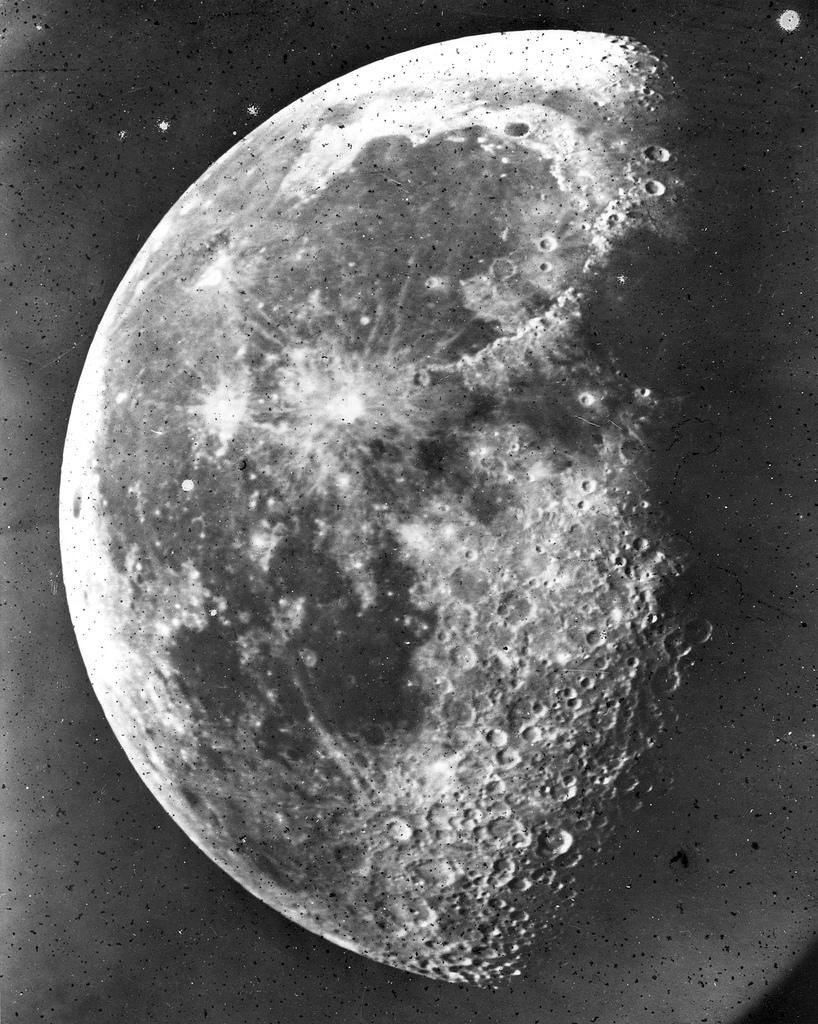
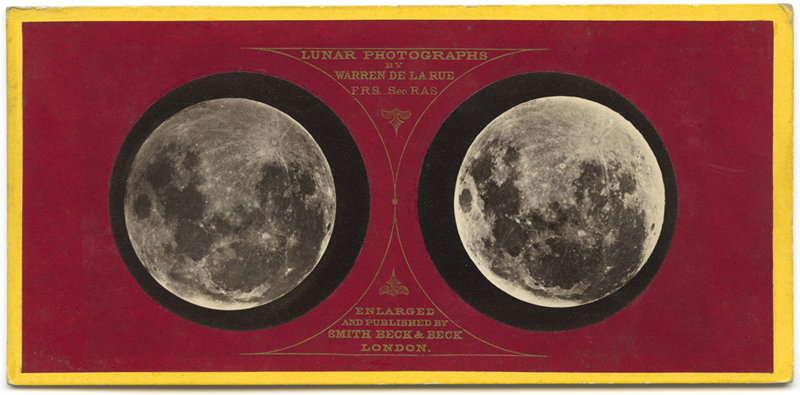
Between 1857 and 1862, astrophotographer and amateur astronomer Warren De La Rue made a series of stereoscopic Moon images (lovingly preserved online by astrophysicist and Queen guitarist Brian May), one of which you can see further up. De La Rue had seen Whipple’s daguerreotype at the Great Exhibition and began innovating his own process for creating stereoscopic astrophotographs. At the same time, Draper’s son, Henry, “an accomplished astrophotographer and one of the most famous American astronomers of his day,” Kiona Smith writes at Forbes, had taken over his father’s Moon photography project. See an 1863 image taken by the younger Draper just above.
“Before the invention of photography,” notes APS News, “astronomers had to sketch what they saw in their telescopes by hand, often missing crucial details.” Daguerre and Draper’s innovations, and those that came soon afterward, “showed them a far superior method was possible.” It is astonishing that these results could be achieved only a few decades after the first photograph, taken in 1826 by Nicéphore Niépce. It is maybe even more astonishing that only a century and a half or so later — a meaningless drop in the cosmic timescale — astrophotography would look beyond the moon to the very origins of the universe itself.
via Smart History
Related Content:
The First Photograph Ever Taken (1826)
The Full Rotation of the Moon: A Beautiful, High Resolution Time Lapse Film
Josh Jones is a writer and musician based in Durham, NC. Follow him at @jdmagness
Read More...Mama Cass and John Denver Sing a Lovely Duet of “Leaving On a Jet Plane” (1972)
My issue is that it’s all very well to sit back and complain but when it’s your country you have a responsibility. — Cass Elliot
What could be more heavenly than Cass Elliot of The Mamas & The Papas and singer-songwriter John Denver harmonizing on Denver’s “Leaving on a Jet Plane,” a tune many conceived of as a protest to the Vietnam War, owing largely to folk trio Peter, Paul and Mary’s cover version.
Maybe some voter registration added to the mix?
Before breaking into their duet on the late night TV musical variety show The Midnight Special, Denver invited Mama Cass to share a few words on her efforts to get out the vote in a presidential election year:
I’ve been traveling around the country for the past year or so, talking on a lot of college campuses and trying to find out exactly what people are thinking, and the thing that’s impressed me the most is, there is still in this country, believe it or not, after all the talk, a tremendous amount of apathy on the part of people who maybe don’t like the way things are going and maybe want to change it, but don’t do anything about it, y’know?
It was August 19, 1972. The war in Vietnam and the upcoming contest between President Richard Nixon and his Democratic challenger George McGovern were the top stories. June’s Watergate break in was a mounting concern.
Earlier in the day, the New York Times reported that “Senator George McGovern expects (South Vietnamese) President Nguyễn Văn Thiệu and his “cohorts” to flee Saigon into exile and a Communist-dominated coalition to take control of South Vietnam if Mr. McGovern is elected President of the United States on Nov. 7.”
Cass Elliot, a McGovern supporter, had become much more vocal about her political activism following the 1968 break up of The Mamas & The Papas, as in this interview with Rolling Stone:
I think everybody who has a brain should get involved in politics. Working within. Not criticizing it from the outside. Become an active participant, no matter how feeble you think the effort is. I saw in the Democratic Convention in Chicago that there were more people interested in what I was interested in than I believed possible. It made me want to work. It made me feel my opinion and ideas were not futile, that there would be room in an organized movement of politics for me to voice myself.
She remained diplomatic on the Midnight Special, telling viewers that “I don’t think it’s so important who you vote for, you vote for who you believe in, but the important thing is to vote,” though it’s hard to imagine that anyone tuning in from home would mistake her for a Nixon gal.
Earlier in the year she had ushered at the Four For McGovern fundraising concert at the LA Forum, was in the audience at Madison Square Warren Beatty’s Together for McGovern concert Garden, and attended a party Americans Abroad for McGovern held in London.
Shortly after the election (SPOILER: Her man lost), during an appearance on The Mike Douglas Show, above, she intimated that she might be open to a career shift:
I think I would like to be a Senator or something in twenty years. I don’t think I really know enough yet. I’m just 30 now and I wouldn’t even be eligible to run for office for another five years. But I have a lot of feelings about things. I know the way I would like to see things for this country and in my travels, when I talk to people, everybody wants pretty much the same thing: peace, enough jobs, no poverty and good education. And I’ve learned a lot. It’s funny. So many people in show business go into politics, and I used to say ‘What the heck do they know about it?’ But when you travel around, you really do get to feel–not to be cliche–the pulse of the country and what people want. I’m concerned and it’s not good to be unconcerned and just sit there.
Listening to her discuss Watergate during her final visit to The Mike Douglas Show, shortly before her 1974 death, really makes us wish she was still here with us.
What we wouldn’t give to hear this outspoken political observer’s take on the situation our country now finds itself in, especially with another five decades of experience under her belt.
Perhaps there’s an alternate universe in which Cass Elliot is President.
If you haven’t yet registered to vote, now would be a great time to do so. It may not be too late to participate in your state’s primary elections. You know that’s what Cass would have wanted.
Related Content
Janis Joplin & Tom Jones Bring the House Down in an Unlikely Duet of “Raise Your Hand” (1969)
- Ayun Halliday is the Chief Primatologist of the East Village Inky zine and author, most recently, of Creative, Not Famous: The Small Potato Manifesto. Follow her @AyunHalliday.
Read More...Take Graphic Design Courses to Launch Your Career as a Graphic Designer, Video Game Designer, UI Designer & More

What can you do with graphic design skills? More and more, it seems, as emerging technologies drive new apps, software, and games. New design challenges are everywhere, from human-machine interfaces, to 3D modeling in video games and animated films, to re-imagining classic designs in print and on screen. In addition to traditional jobs like art director, graphic designer, production artist, and animator, the past few years have seen a sharp rise in demand for User Experience (UX) and User Interface (UI) designers, roles that require a variety of different creative and technical skill sets.
You could get a four-year degree in design to work in one of these fields, or you could take a Coursera Specialization and be one step closer. Coursera has met the demand for new job skills and tech education by partnering with top arts institutions and universities to offer online courses at low cost. All of these courses grant certificates that show potential employers you’re ready to put your learning to use. If careers in art and contemporary design, graphic design, web user experience and interface design, or video game design appeal to you, you can learn those skills in the five certificate-granting Specialization programs below.
- Graphic Design Specialization (5 courses offered by California Institute of the Arts)
- UI / UX Design Specialization (4 courses offered by California Institute of the Arts)
- Modern and Contemporary Art and Design Specialization (4 courses Museum of Modern Art)
- Game Design: Art and Concepts Specialization (4 courses offered by California Institute of the Arts)
- Graphic Design Elements for Non-Designers Specialization (4 courses offered by University of Colorado Boulder)
Graphic designers can choose to be as specialized or generalized as they like, but as in all creative fields, they need a thorough understanding of the basics. A Coursera Specialization is a series of courses intended to lead students to mastery, building on the history and foundations of the field. You can enroll for free and try out any of the Specializations for 7 days. After that, you’ll be charged between $39-$49 per month until you complete the courses in a Specialization. (Financial aid is available).
The exciting Specializations from CALARTS and the Museum of Modern Art will bring you many steps closer to a new career, or maybe even a new personal passion project.
Note: Open Culture has a partnership with Coursera. If readers enroll in certain Coursera courses and programs, it helps support Open Culture.
Related Content:
Josh Jones is a writer and musician based in Durham, NC. Follow him at @jdmagness
Read More...Susan Sontag’s Commencement Address Advice: “Pay Attention. It Connects You With Others. It Makes You Eager. Stay Eager.”

Image by Lynn Gilbert, via Wikimedia Commons
“The times we live in are indeed alarming. It is a time of the most appalling escalation of violence — violence to the environment, both ‘nature’ and ‘culture’; violence to all living beings.” But “it is also a time of a vertiginous drop in cultural standards, of virulent anti-intellectualism, and of triumphant mediocrity.” You may, at this point, already find yourself in agreement with these words. But they’re the words of Susan Sontag, now seventeen years dead, and as such can’t actually be describing our present moment. In fact she spoke them in, and about, 1983, during her first commencement address at Wellesley College.
Characteristically unsparing, Sontag extended her charge of mediocrity even to “the educational system that you have just passed through, or has passed you through.” In her view, “trivializing standards, using as their justification the ideal of democracy, have made the very idea of a serious humanist education virtually unintelligible to most people.” If it is to happen at all, resistance to this mediocrity must happen at the level of the individual. “Perhaps the most useful suggestion I can make on the day when most of you are ceasing to be students,” Sontag says, “is that you go on being students — for the rest of your lives. Don’t move to a mental slum.”
This point returned, somewhat altered, in Sontag’s last commencement address, delivered twenty years later at Vassar College. “Try not to live in a linguistic slum,” she advised the class of 2003. Indeed, “try to imagine at least once a day that you are not an American,” or “that you belong to the vast, the overwhelming majority of people on this planet who don’t have passports, don’t live in dwellings equipped with both refrigerators and telephones, who have never even once flown in a plane.” Though celebrated primarily as a critic, Sontag was also a novelist, and like Vladimir Nabokov understood full well the necessity of imagination to a proper intellectual life.
Elsewhere in her Vassar address, Sontag also makes the highly Nabokovian point that “no book is worth reading that isn’t worth re-reading.” Though the full text of the speech isn’t online, you’ll find these and other choice quotes from it at Vassar Quarterly. Sontag’s key theme seems to have been attention. “Pay attention,” she says in a passage still circulated on social media today. “It’s all about paying attention. Attention is vitality. It connects you with others. It makes you eager. Stay eager. (Two years later, David Foster Wallace would make a similar point about being ” “conscious and aware enough to choose what you pay attention to” in his famous 2005 commencement address at Kenyon College.)
When we develop and retain the habit of paying attention, we see things others don’t, especially those truths that run counter even to our own professed beliefs. “Our society does not censor as totalitarian societies do; on the contrary, our society promises liberty, self-fulfillment, and self-expression,” Sontag says. But pay attention, and you’ll notice that “many features of our so-called culture have as their goal and result the reduction of our mental life, or our mental operation; and this is precisely, I would argue, what censorship is about.” Nearly two decades have passed since Sontag said this, and as she might have expected, we tune out at greater peril than ever.
Related content:
John Berger (RIP) and Susan Sontag Take Us Inside the Art of Storytelling (1983)
Susan Sontag’s List of 10 Parenting Rules
Toni Morrison Lists the 10 Steps That Lead Countries to Fascism (1995)
David Foster Wallace’s Famous Commencement Speech “This is Water” Visualized in a Short Film
‘Never Be Afraid’: William Faulkner’s Speech to His Daughter’s Graduating Class in 1951
Based in Seoul, Colin Marshall writes and broadcasts on cities, language, and culture. His projects include the Substack newsletter Books on Cities, the book The Stateless City: a Walk through 21st-Century Los Angeles and the video series The City in Cinema. Follow him on Twitter at @colinmarshall, on Facebook, or on Instagram.
Read More...Machiavelli’s The Prince Explained in an Illustrated Film
Niccolò Machiavelli lived in a time before the internet, before radio and television, before drones and weapons of mass destruction. Thus one naturally questions the relevance of his political theories to the twenty-first century. Yet in discussions about the dynamics of power, no name has endured as long as Machiavelli’s. His reputation as a theorist rests mostly on his 1532 treatise Il Principe, or The Prince, in which he pioneered a way of analyzing power as it was actually wielded, not as people would have liked it to be. How, he asked, does a ruler — a prince — attain his position in a state, and even more importantly, how does he maintain it?
You can hear Machiavelli’s answers to these questions explained, and see them illustrated, in the 43-minute video above. It breaks The Prince down into seven parts summarizing as many of the book’s main points, including “Do not be neutral,” “Destroy, do not would,” and “Be feared.”
These commandments would seem to align with Machiavelli’s popular image as an apologist, even an advocate, for brutal and repressive forms of rule. But his enterprise has less to do with offering advice than with describing how real figures of power, princes and otherwise, had amassed and retained that power.
The video comes from Eudaimonia, a Youtube channel that has also featured similarly animated exegeses of Stoicism and Sun Tzu’s The Art of War. Its creator makes these ancient sources of knowledge accessible with not just his cartoonish illustrations, but also his inclusion of illuminating examples from more recent history. In the case of The Prince, these come from eras like the Russian Revolution, World War II, and even our own time of instant global communication, attention-hungry media, and a seemingly weak political class. In much of the world, we live in a time much less nasty and brutish than Machiavelli’s. But looking at the effectiveness (or lack thereof) of our own leaders, we have to admit that the principles of The Prince may not have gone out of effect.
To delve deeper into the world of Machiavelli, you can watch a BBC documentary on the Renaissance political theorist below.
Related content:
What Does “Machiavellian” Really Mean?: An Animated Lesson
Salman Rushdie: Machiavelli’s Bad Rap
Introduction to Political Philosophy: A Free Yale Course
Allan Bloom’s Lectures on Machiavelli (Boston College, 1983)
Based in Seoul, Colin Marshall writes and broadcasts on cities, language, and culture. His projects include the Substack newsletter Books on Cities, the book The Stateless City: a Walk through 21st-Century Los Angeles and the video series The City in Cinema. Follow him on Twitter at @colinmarshall, on Facebook, or on Instagram.
Read More...
Helen Keller Was a “Firebrand” Socialist (or How History Whitewashed Her Political Life)
We expect that histories of famous figures will prune their lives, sand down rough edges, rewrite and revise awkward and inconvenient facts. What we may not expect – at least in the U.S. – is that decades of a famous person’s life will be redacted from the record. This is essentially what happened, however, to the biography of Helen Keller even before her death in 1968. Perhaps the main offender remains playwright William Gibson’s 1957 The Miracle Worker, adapted from the 1903 autobiography she wrote at 23. Ostensibly about Keller, the story centers instead, beginning with its title, on her teacher, Anne Sullivan.
The play (and 1962 film with Anne Bancroft and Patty Duke reprising their stage parts), portrays Keller as a child, a role she was perpetually assigned by her critics throughout her adult life. She authored and published 14 books and dozens of essays during her 87 years, delivered hundreds of speeches, and maintained a friendship and correspondence with many important figures of the day. But in addition to the usual sexism, she had to contend with those who thought her disability rendered her unfit to express opinions on matters such as politics. They asked that she “confine my activities to social service and the blind,” she wrote in a sardonic reply.
Keller’s political vision was written off as “a Utopian dream, and one who seriously contemplates its realization indeed must be deaf, dumb, and blind.” What did she see in her mind that made critics rush to belittle her? An end to war and Jim Crow; women’s suffrage, labor rights; an end to poverty and the preventable childhood illnesses it engendered.… In a word, Helen Keller was a socialist — and a publicly committed one. “That we know so little of her avowed socialism is astonishing, because she was an extroverted firebrand who delivered hundreds of radical speeches during” — writes Eileen Jones at Jacobin, quoting the 2020 documentary Her Socialist Smile — “ ‘a fifty-year run on the lecture circuit.’ ”
Keller published frequent articles on the newly formed Soviet Union, Eugene Debs and the IWW (including “Why I Became an IWW” in 1916), and “Why Men Need Woman Suffrage” (in 1913). “Turning the yellowing pages of radical newspapers and magazines from 1910 to the early 1920’s,” writes historian Philip Foner in an introduction to her collected socialist writings, “one frequently finds the name Helen Keller beneath speeches, articles, and letters dealing with major social questions of the era. The vision which runs through most of these writings is the vision of socialism.”
Mark Twain may have been the first to call Anne Sullivan a “miracle worker” and Keller “a miracle,” but he treated Keller “not as a freak,” she wrote, but as an equal and shared many of her views. He helped fund her education at Radcliffe College (then a part of Harvard ) and encouraged her to speak and publish. Keller joined the socialist party at age 29, in 1909, and in 1912, she published an article in The New York Call titled “How I Became a Socialist.” The answer, she writes: “by reading.” As would be the case throughout her life, Keller felt the need to take a defensive posture: critics had accused John and Anne Macy (formerly Sullivan) of corrupting her, to which she replied that she neither shared Mr. Macy’s propagandistic variety of Marxism nor did Mrs. Macy share either of their views.
Keller’s political writing is now widely available thanks to the internet, and can no longer be suppressed by educators who want to use her childhood and disability but ignore most of her adult life. Even students watching the PBS American Masters documentary Becoming Helen Keller (see clip at the top) will learn that, gasp, yes, she was a socialist. Dig deeper, and they’ll find her views were unique and significant to the U.S. left: Keith Rosenthal writes at International Socialist Review:
She was a serious political thinker who made important contributions in the fields of socialist theory and practice.… [S]he was a pioneer in pointing the way toward a Marxist understanding of disability oppression and liberation—this reality has been overlooked and censored. The mythological Helen Keller that we are familiar with has aptly been described as a sort of “plaster saint;” a hollow, empty vessel who is little more than an apolitical symbol for perseverance and personal triumph.
Get to know the real Helen Keller — or a seriously overlooked (at least) side of her life — in her political writings here, here, and here and watch a video introduction to her politics by Historically Fantastic further up.
via Jacobin
Related Content:
Watch Helen Keller & Teacher Annie Sullivan Demonstrate How Helen Learned to Speak (1930)
Josh Jones is a writer and musician based in Durham, NC. Follow him at @jdmagness
Read More...Support Us
We're hoping to rely on loyal readers, rather than erratic ads. Please click the Donate button and support Open Culture. You can use Paypal, Venmo, Patreon, even Crypto! We thank you!

About Us

Open Culture scours the web for the best educational media. We find the free courses and audio books you need, the language lessons & educational videos you want, and plenty of enlightenment in between.
Advertise With Us
FREE UPDATES!
GET OUR DAILY EMAIL
Get the best cultural and educational resources on the web curated for you in a daily email. We never spam. Unsubscribe at any time.
FOLLOW ON SOCIAL MEDIA
Open Culture editor Dan Colman scours the web for the best educational media. He finds the free courses and audio books you need, the language lessons & movies you want, and plenty of enlightenment in between.
Advertise With Us


