Google Unveils a Digital Marketing & E‑Commerce Certificate: 7 Courses Will Help Prepare Students for an Entry-Level Job in 6 Months

During the pandemic, Google launched a series of Career Certificates that will “prepare learners for an entry-level role in under six months.” Their first certificates focused on Project Management, Data Analytics, User Experience (UX) Design, IT Support and IT Automation. Now comes their latest–a certificate dedicated to Digital Marketing & E‑commerce.
Offered on the Coursera platform, the Digital Marketing & E‑commerce Professional Certificate consists of seven courses, all collectively designed to help students “develop digital marketing and e‑commerce strategies; attract and engage customers through digital marketing channels like search and email; measure marketing analytics and share insights; build e‑commerce stores, analyze e‑commerce performance, and build customer loyalty.” The courses include:
- Foundations of Digital Marketing and E‑commerce
- Attract and Engage Customers with Digital Marketing
- From Likes to Leads: Interact with Customers Online
- Think Outside the Inbox: Email Marketing
- Assess for Success: Marketing Analytics and Measurement
- Make the Sale: Build, Launch, and Manage E‑commerce Stores
- Satisfaction Guaranteed: Develop Customer Loyalty Online
In total, this program “includes over 190 hours of instruction and practice-based assessments, which simulate real-world digital marketing and e‑commerce scenarios that are critical for success in the workplace.” Along the way, students will learn how to use tools and platforms like Canva, Constant Contact, Google Ads, Google Analytics, Hootsuite, HubSpot, Mailchimp, Shopify, and Twitter. You can start a 7‑day free trial and explore the courses. If you continue beyond that, Google/Coursera will charge $39 USD per month. That translates to about $235 after 6 months.
If you don’t want to pay, you can audit each course for free, without ultimately receiving the certificate.
Explore the Digital Marketing & E‑commerce Professional Certificate.
Note: Open Culture has a partnership with Coursera. If readers enroll in certain Coursera courses and programs, it helps support Open Culture.
Related Content
Read More...When Orson Welles Became a Speech & Joke Writer for Franklin Delano Roosevelt
As someone who had mastered radio, film, and stage at such a young age, it shouldn’t be a surprise that Orson Welles once flirted with the idea of running for office. It never happened, but Welles got pretty close in 1944 by ghost-writing speeches for Franklin Delano Roosevelt’s re-election campaign. This in-depth article at Smithsonian by Erick Trickey goes into greater detail about this mix of entertainment and politics, and shows how both have always influenced each other.
In the final four months of 1944, America was still at war with Japan and Germany, and Roosevelt was seeking an unprecedented fourth term to bring the war to a close. Roosevelt’s Republican challenger Thomas Dewey questioned the ailing president’s stamina and wellness for the job, along with accusations of corruption and incompetence.
Welles was still Hollywood’s golden boy, with a career that had taken off during Roosevelt’s second term with his infamous War of the Worlds radio play, picking up on America’s pre-war paranoia. It had continued through 1941’s Citizen Kane and its thinly veiled attack on William Randolph Hearst and other oligarchs. Welles’ voice carried authority and gravitas. He was also married to Rita Hayworth at the time, and enjoying the upside of Hollywood success.
Roosevelt engaged the left-wing Welles in the last month of the campaign and soon the actor was traveling the country and delivering speeches at rallies for FDR. In one stop he called Republicans “the partisans of privilege, the champions of monopoly, the old opponents of liberty, the determined adversaries of the small business and the small farm.”
Welles also supplied ideas and jokes for FDR’s speeches. When Dewey and other Republicans attacked FDR’s dog Fala, Welles’ penned this: “Well, of course, I don’t resent attacks, and my family doesn’t resent attacks — but Fala does resent them. You know, Fala is Scotch, and being a Scottie, as soon as he learned that the Republican fiction writers, in Congress and out, had concocted a story that I had left him behind on the Aleutian Islands and had sent a destroyer back to find him — at a cost to the taxpayers of 2 or 3 or 8 or $20 million — his Scotch soul was furious. He has not been the same dog since.”
The American public seemed to agree that going after a pet was a bit too much. The nationally broadcast speech turned FDR’s fortunes around. And at FDR’s final rally at Fenway Park in Boston, the president introduced both Welles (“The Dramatic Voice”) and Frank Sinatra (“The Voice”). Welles spoke out against GOP elitism: “By free enterprise they want exclusive right to freedom. They are stupid enough to think that a few can enjoy prosperity at the expense of the rest.”
Days later, FDR won 53 percent of the popular vote and took the electoral college, 432–99. In one sense though, Dewey’s attacks on FDR’s health were founded: Roosevelt died five months later on April 12, 1945.
FDR had written to Welles to thank him for the rally, but also wrote about that April’s meeting of the United Nations. The man had the weight of the free world upon his shoulders, and Welles felt it. The artist wrote a eulogy for FDR for the New York Post:
Desperately we need his courage and his skill and wisdom and his great heart. He moved ahead of us showing a way into the future. If we lose that way, or fall beside it, we have lost him indeed. Our tears would mock him who never wept except when he could do no more than weep. If we despair. because he’s gone — he who stood against despair — he had as well never have lived, he who lived so greatly.
You can read it online here.
Related Content:
Hear Orson Welles’ Iconic War of the Worlds Broadcast (1938)
Rare Video Shows FDR Walking: Filmed at the 1937 All-Star Game
Listen to Eight Interviews of Orson Welles by Filmmaker Peter Bogdanovich (RIP)
The Hearts of Age: Orson Welles’ Surrealist First Film (1934)
Ted Mills is a freelance writer on the arts who currently hosts the Notes from the Shed podcast and is the producer of KCRW’s Curious Coast. You can also follow him on Twitter at @tedmills, and/or watch his films here.
Read More...Self-Encounter: The 10-Episode TV Show That Introduced Existentialism to Americans in 1961
“Existentialism is both a philosophy and a mood,” says Hazel Barnes by way of opening the television series Self-Encounter: A Study in Existentialism. “As a mood, I think we could say that it is the mood of the twentieth century — or, at least, of those people in the twentieth century who are discontent with things as they are. It expresses the feeling that, somehow or other, all of those systems — whether they be social, psychological, or scientific — which have attempted to define and explain and determine man, have somehow missed the living individual person.”
Existentialism was on the rise in 1961, when Barnes spoke those words, and the subsequent six decades have arguably done little to assuage its discontent. By the time of Self-Encounter’s broadcast in ’61, Barnes was already well-known in philosophical circles for her English translation of Jean-Paul Sartre’s Being and Nothingness. When she took on that job, with what she later described as “three years of badly taught high school French and one yearlong course in college, and a bare minimum of background in philosophy,” she couldn’t have known that it would set her on the road to becoming the most famous popularizer of existentialism in America.
Five years after the publication of Barnes’ Sartre translation, along came the opportunity to host a ten-part series on National Public Educational Television (a predecessor of PBS) explaining Sartre’s thought as well as that of other writers like Simone de Beauvoir, Albert Camus, and Richard Wright, between dramatizations of scenes drawn from existentialist literature. Self-Encounter was once “thought to be entirely lost, the original tapes having been reported recorded over,” writes Nick Nielsen. But after the series’ unexpected rediscovery in 2017, all of its episodes gradually made their way to the web. You can watch all ten of them straight through in the nearly five-hour video at the top of the post, or view them one-by-one at the American Archive of Public Broadcasting.
“Self Encounter was produced in 1961 and first broadcast in 1962,” Nielsen writes. “I cannot help but note that Route 66 aired from 1960 to 1964, The Outer Limits aired from 1963 to 1965, Rawhide aired from 1959 to 1965, and Perry Mason aired from 1957 to 1966” — not to mention The Twilight Zone, from 1959 to 1964. “It would be difficult to name another television milieu of comparable depth. Our mental image of this period of American history as being one of stifling conformity is belied by these dark perspectives on human nature.” And as for the social, psychological, scientific, and of course technological systems in effect today, the existentialists would surely take a dim view of their potential to liberate us from conformity — or any other aspect of the human condition.
Related content:
Existentialism with Hubert Dreyfus: Five Free Philosophy Courses
Existential Philosophy of Kierkegaard, Sartre, Camus Explained with 8‑Bit Video Games
Based in Seoul, Colin Marshall writes and broadcasts on cities, language, and culture. His projects include the Substack newsletter Books on Cities, the book The Stateless City: a Walk through 21st-Century Los Angeles and the video series The City in Cinema. Follow him on Twitter at @colinmarshall, on Facebook, or on Instagram.
Read More...Footage of Flappers from 1929 Restored & Colorized with AI
The flapper is the Roaring 20s’ enduring emblem — a liberated, young woman with bobbed hair, rolled down stockings, and a public thirst for cocktails.
(My grandmother longed to be one, and succeeded, as best one could in Cairo, Illinois, only to marry an older man at the age of 17, and give birth to my father a few months before the stock market crashed, bringing the frivolity of the decade to an abrupt halt.)
Our abiding affection for the flapper is stoked on F. Scott Fitzgerald’s Jazz Age novella, The Great Gatsby, and its many stage and screen adaptations, with their depictions of wild parties featuring guests like Miss Baedecker (“When she’s had five or six cocktails she always starts screaming like that”) and Lucille (“I never care what I do, so I always have a good time.”)
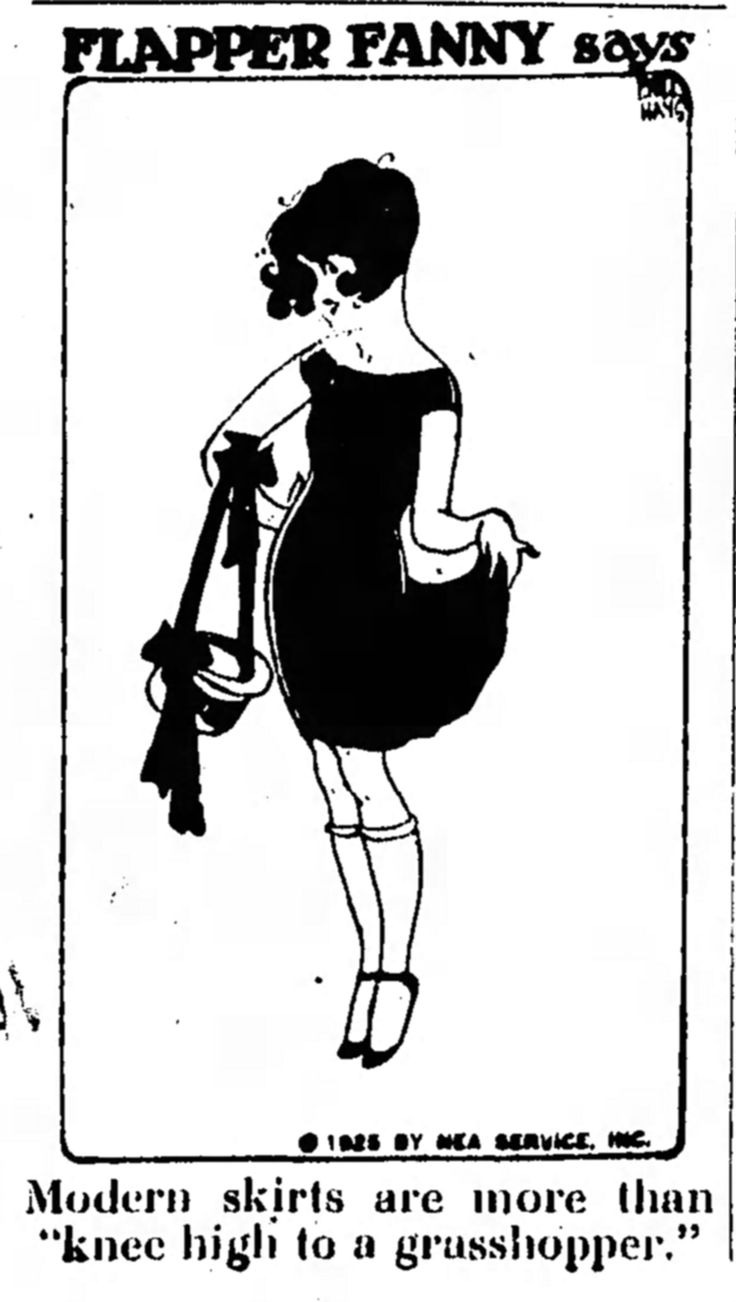
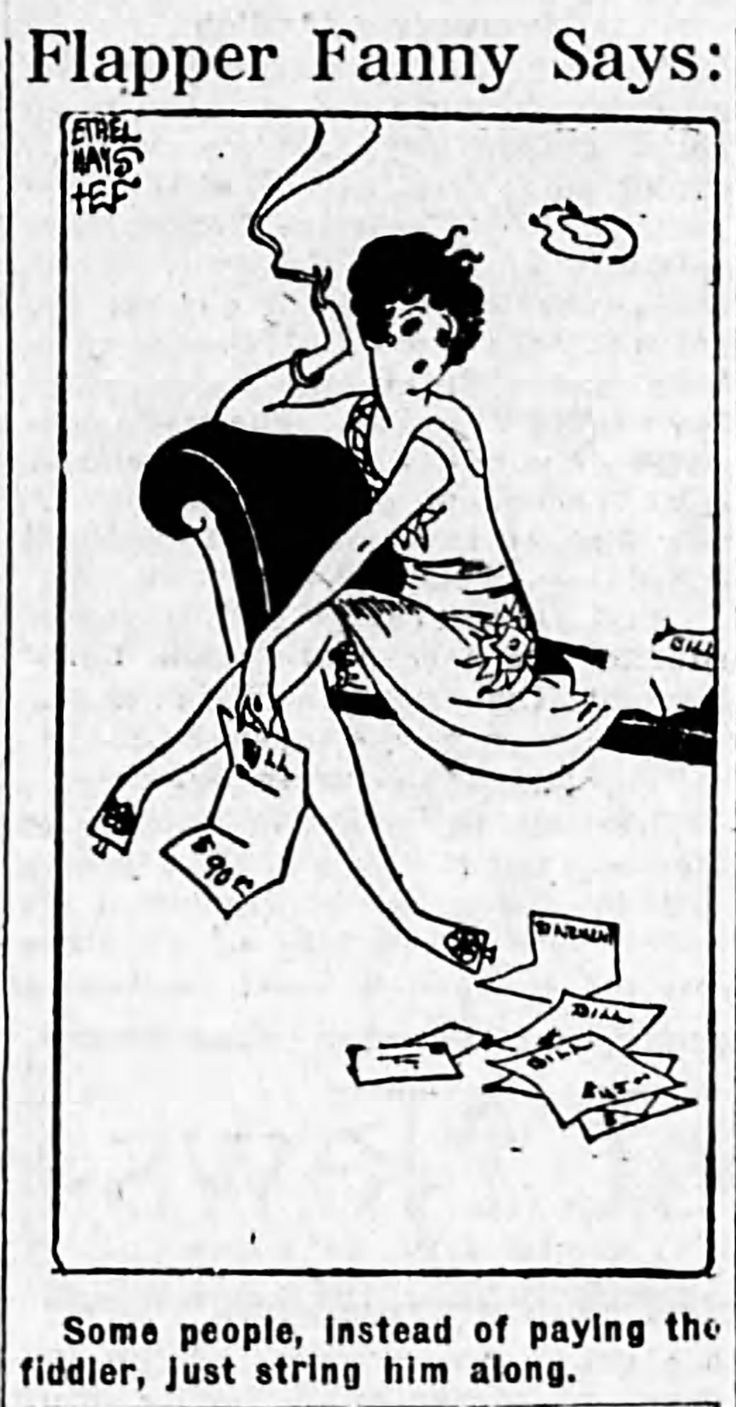
The vintage fashion blog Glamour Daze’s newly colorized footage of a 1929 fashion show in Buffalo, New York, at the top of this post, presents a vastly more sedate image than Fitzgerald, or Ethel Hays, whose single-panel daily cartoon Flapper Fanny was wildly popular with both young women and men of the time.
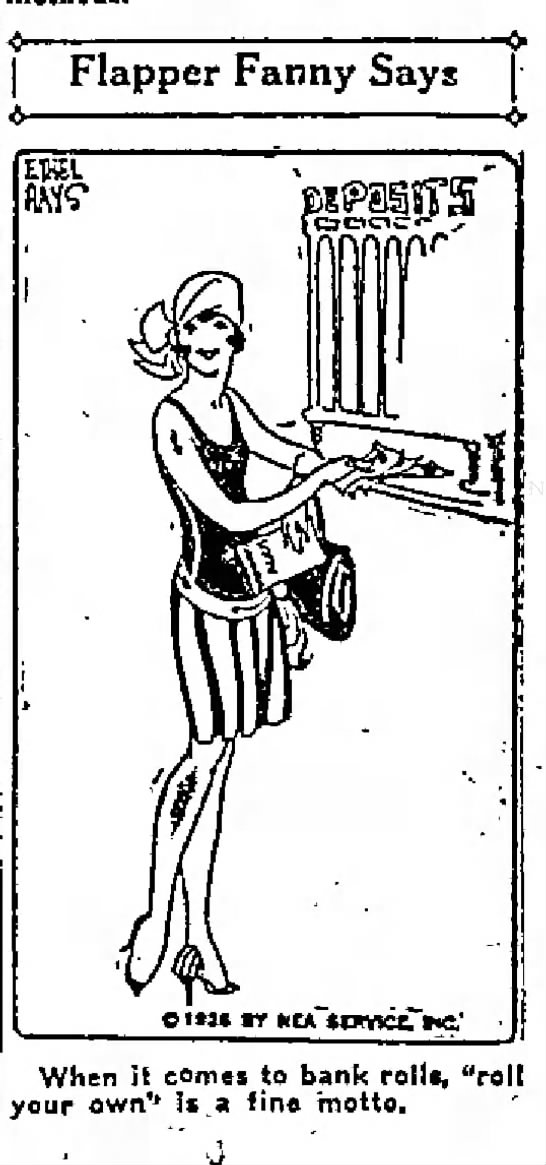
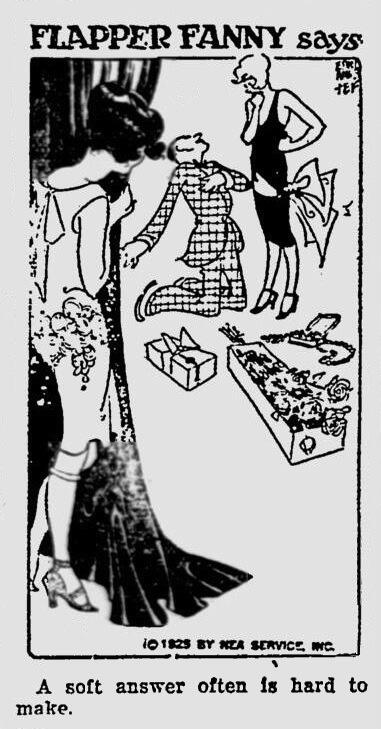
The scene it presents seems more wholesome than one might have found in New York City, with what Fitzgerald dubbed its “wild promise of all the mystery and the beauty in the world”. The models seem more eager amateurs than runway professionals, though lined up jauntily on a wall, all exhibit “nice stems.”
My young grandmother would have gone ga ga for the cloche hats, tea dresses, bathing suits, lounging pajamas, golf and tennis ensembles, and evening gowns, though the Deep Exemplar-based Video Colorization process seems to have stained some models’ skin and teeth by mistake.
The original black and white footage is part of the University of South Carolina’s Fox Movietone News collection, whose other fashion-related clips from 1929 include presentations featuring Washington debutantes and college coeds.
Added sound brings the period to life with nary a mention of the Charleston or gin, though if you want a feel for 20s fashion, check out the collection’s non-silent Movietone clip devoted to the latest in 1929 swimwear — this is a modernistic beach ensemble of rayon jersey with diagonal stripes and a sun back cut…
It’s the cat’s pajamas. As is this playlist of hits from 1929.
Explore Glamour Daze’s guide to 1920s fashion history here.
Watch the original black and white footage of the Buffalo, New York fashion show here.
- Ayun Halliday is the Chief Primatologist of the East Village Inky zine and author, most recently, of Creative, Not Famous: The Small Potato Manifesto. Follow her @AyunHalliday.
Read More...Revisit Morphine, the 90s Power Trio Who Played the Two-String Bass, Saxophone & Drums
No 90s band flew as low under that radar as Cambridge, Massachusetts three-piece Morphine. Too odd for nostalgia radio, not commercial enough to pop up on a big-time modern soundtrack, Morphine either means nothing to you or, if you were in the right place at the right time, everything.
YouTube channel Rock n’ Roll True Stories would like more people to discover Morphine and their introduction video does an adequate job of stitching together interview quotes, band pics, and some daffy stock photography. The only thing missing: actual examples of their music. We’ll get to that in just a bit.
Morphine were somewhere between a rock band and a jazz trio. Led by Mark Sandman, the group consisted of drummers Jerome Deupree or Billy Conway, and saxophonist Dana Colley, with Sandman’s two-string bass front and center. “In a pop universe where every singer, guitarist, and keyboardist instinctively goes to a higher note to attract attention,” wrote the Washington Post at the time, “Morphine stays hunkered down low.”
Live, Sandman mostly kept to his bass, but on their five albums, he also included homemade instruments like the “tritar,” consisting of two guitar strings and a bass string. He also added piano and keyboards to the mix. Colley sometimes played two saxes at once, or he switched out his main baritone for soprano, tenor, or bass saxophones.
After their first indie release Good in 1992, Rykodisc signed the band. But Morphine remained as resolutely anti-commercial as they could, turning down offers to license their songs for commercials. (Ryko, however, could license their music for TV and movies without the band’s approval.) “You Look Like Rain” was a college radio “hit”; “Buena” was the single release. There’s a bit of Tom Waits or Nick Cave in his voice; a bit of be-bop by way of Twin Peaks in the music. It’s a formula they tweaked, altered, and perfected. Their critical apex came with the album Cure for Pain in 1993, but each successive album sold more units. The label Dreamworks took over from Ryko, but Sandman felt they were pushing the band to be something they were not, a “new Beck” or a sound beyond the trio of instruments. But they didn’t falter and remained true to themselves.
Instead, the band ended when Sandman suffered a heart attack on stage in 1999, possibly due to stress and the oppressive heat of the venue itself. Their fifth and final album The Night was released posthumously. The surviving members have formed a few Morphine-adjacent bands since, as well as starting a scholarship in Sandman’s name.
Ryko recently re-released their early discography on vinyl with bonus tracks, so a new generation is poised to discover Morphine, look around and wonder, who else knows about this band? That’s how it starts.
Related Content:
A Massive 800-Track Playlist of 90s Indie & Alternative Music, in Chronological Order
The Evolution of the Rock Guitar Solo: 28 Solos, Spanning 50 Years, Played in 6 Fun Minutes
Stream a Massive Collection of Indie, Noise Industrial Mixtapes from the 80s and 90s
Ted Mills is a freelance writer on the arts who currently hosts the Notes from the Shed podcast and is the producer of KCRW’s Curious Coast. You can also follow him on Twitter at @tedmills, and/or watch his films here.
Read More...A Master List of 1,700 Free Courses From Top Universities: A Lifetime of Learning on One Page

For the past 15 years, we’ve been busy rummaging around the internet and adding courses to an ever-growing list of Free Online Courses, which now features 1,700 courses from top universities. Let’s give you the quick overview: The list lets you download audio & video lectures from schools like Stanford, Yale, MIT, Oxford, Harvard and many other institutions. Generally, the courses can be accessed via YouTube, iTunes or university web sites, and you can listen to the lectures anytime, anywhere, on your computer or smart phone. We haven’t done a precise calculation, but there’s about 50,000 hours of free audio & video lectures here. Enough to keep you busy for a very long time–something that’s useful during these socially distant times.
Right now you’ll find 200 free philosophy courses, 105 free history courses, 170 free computer science courses, 85 free physics courses and 55 Free Literature Courses in the collection, and that’s just beginning to scratch the surface. You can peruse sections covering Astronomy, Biology, Business, Chemistry, Economics, Engineering, Math, Political Science, Psychology and Religion.
Here are some highlights from the complete list of Free Online Courses. We’ve added a few unconventional/vintage courses in the mix just to keep things interesting.
- A History of Philosophy in 81 Video Lectures: From Ancient Greece to Modern Times — Free Online Video — Arthur Holmes, Wheaton College
- A Romp Through Ethics for Complete Beginners - Various Formats – Marianne Talbot, Oxford University
- Ancient Greek History — Various Formats — Donald Kagan, Yale
- Creative Reading and Writing by William S. Burroughs — Free Online Audio — Naropa University
- Critical Reasoning for Beginners — Various Formats – Marianne Talbot, Oxford
- Deep Learning — Free Online Video — Vincent Vanhoucke, Google
- Edible Education 101 – Free Online Video – Michael Pollan, UC Berkeley
- Financial Markets — Various Formats — Robert Shiller, Yale
- Growing Up in the Universe – Free Online Video – Richard Dawkins, Oxford
- Harvard’s Introductory Computer Science Course - Free Online Course — David Malan, Harvard
- Hemingway, Fitzgerald, Faulkner – Various Formats – Wai Chee Dimock, Yale
- How to Listen to Music — Various Formats — Craig Wright, Yale
- Human Behavioral Biology – Various Formats – Robert Sapolsky, Stanford
- Introduction to the Old Testament (Hebrew Bible) – Free Online Video — Christine Hayes, Yale.
- Lectures on Digital Photography — Free Online Video — Marc Levoy, Stanford/Google
- Physics for Future Presidents – Free Online Video – Richard Muller, UC Berkeley
- Science and Cooking: From Haute Cuisine to the Science of Soft Matter — Various Formats — Team taught, Harvard
- Speak Italian with Your Mouth Full - Various Formats — MIT, Dr. Paola Rebusco
- The American Novel Since 1945 – Various Formats – Amy Hungerford, Yale
- The Central Philosophy of Tibet — Free Online Audio – Robert Thurman, Columbia University
- The Character of Physical Law (1964) - Free Online Video — Richard Feynman, Cornell
- The Tempest - Free Online Audio — Allen Ginsberg, Naropa
- Walter Kaufmann Lectures on Nietzsche, Kierkegaard and Sartre — Free Online Audio
The complete list of courses can be accessed here: 1,700 Free Online Courses from Top Universities. For more enriching material, see our other collections below.
Related Content:
1,000 Free Audio Books: Download Great Books for Free.
4,000+ Free Movies Online: Great Classics, Indies, Noir, Westerns, Documentaries & More.
Learn 45+ Languages Online for Free: Spanish, Chinese, English & More.
200 Online Certificate & Microcredential Programs from Leading Universities & Companies.
Read More...
What Did People Do Before the Invention of Eyeglasses?
You remember it — one of the most heartbreaking scenes on TV. A man longs for nothing more than time to read, to be free of all those people Sartre told us make our hells. Finally granted his wish by the H‑Bomb, he then accidentally break his glasses, rendering himself unable make out a word. Oh, cruel irony! Not an optometrist or optician in sight! Surely, there are “Time Enough at Last” jokes at eye care conventions worldwide.
Morality tales wrapped in science fiction might make us think about all sorts of things, but one of the most obvious questions when we witness the fate of Mr. Henry Bemis, “charter member in the fraternity of dreamers,” might be, but what did people do before corrective lenses? Were millions forced to accept his fate, living out their lives with farsightedness, nearsightedness, and other defects that impede vision? How did early humans survive in times much less hospitable to disabilities? At least there were others to read and describe things for them.…
In truth, the Twilight Zone is not far off the mark. Or at least nearsightedness and reading are closely linked. “As long as primates have been around, there’s probably been myopia,” says professor of ophthalmology Ivan Schwab. But Schwab argues in his book Evolution’s Witness: How Eyes Evolved that the rise of reading likely caused skyrocketing rates of myopia over the past three hundred years. “Though genes and nutrition may play a role in nearsightedness,” Natalie Jacewicz writes at NPR, “[Schwab] says education and myopia seem to be linked, suggesting that when people do a lot of close work, their eyes grow longer.”
As the History Dose video above explains, the oldest image of a pair of glasses dates from a 1351 painting of Cardinal Hugh of Saint-Cher. The painting is an anachronism — spectacles, the narrator tells us, were invented 23 years earlier in Pisa, after the cardinal’s death. They “gradually spread across Europe and travelled the Silk Road to China.” (The oldest surviving pair of glasses dates from around 1475). So what happened before 1286? As you’ll learn, glasses were not the only way to enlarge small items. In fact, humans have been using some form of magnifying lens to read small print (or manuscript or cuneiform or what-have-you) for thousands of years. Those lenses, however, corrected presbyopia, or far-sightedness.
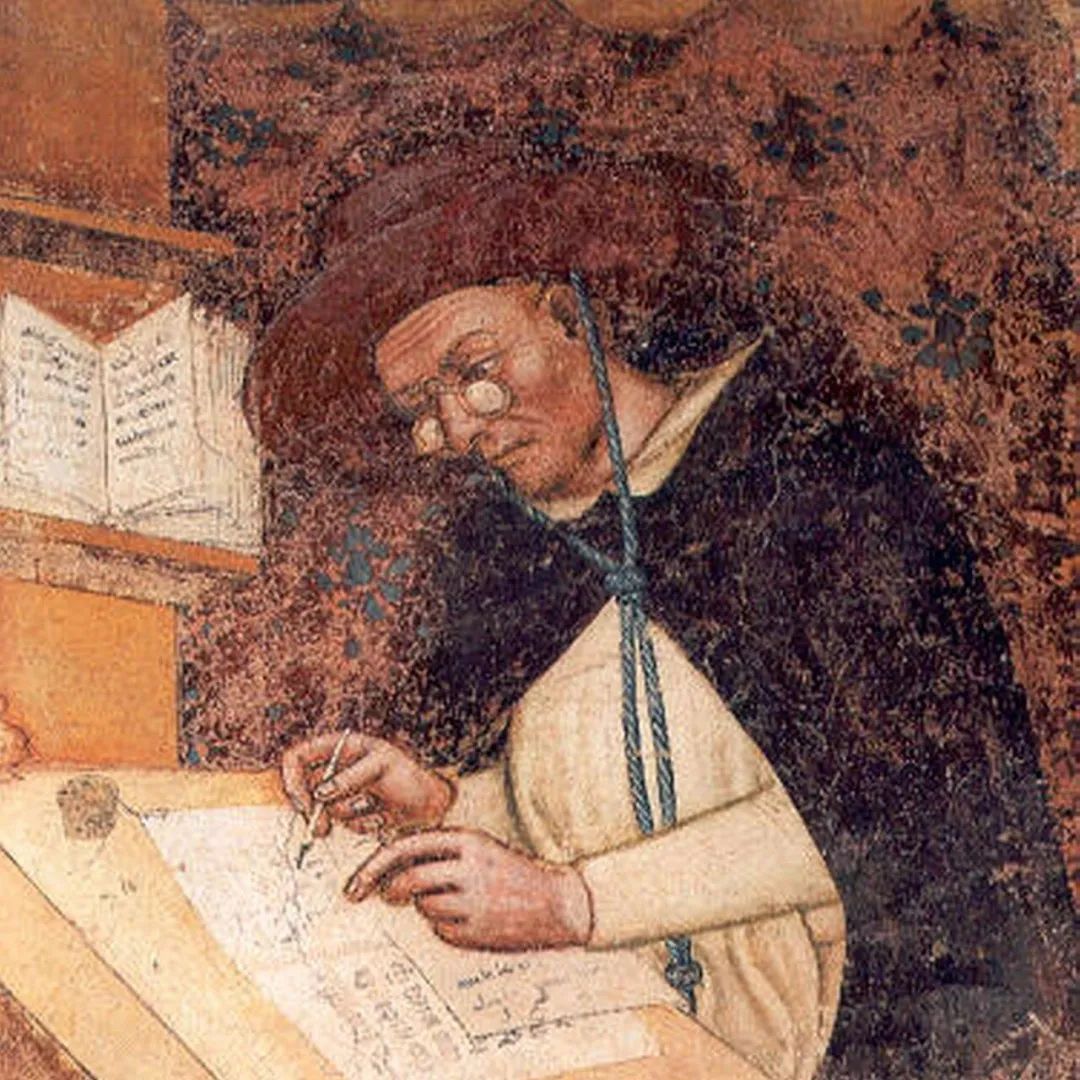
Those with myopia were mostly out of luck until the invention of sophisticated lens-grinding techniques and improved vision tests. But for most of human history, unless you were a sailor or a soldier, you “likely spent your day as an artisan, smith, or farm worker,” occupations where distance vision didn’t matter as much. In fact, artisans like medieval scribes and illuminators, says Neil Handley — museum curator of the College of Optometrists, London — were “actually encouraged to remain in their myopic condition, because it was actually ideal for them doing this job.”
It wasn’t until well after the time of Gutenberg that wearing lenses on one’s face became a thing — and hardly a popular thing at first. Early glasses were held up to the eyes, not worn. They were heavy, thick, and fragile. In the 15th century, “because… they were unusual and rare,” says Handley, “they were seen as having magical powers” and their wearers viewed as “in league with the devil, immoral.” That stigma went away, even if glasses picked up other associations that sometimes made their users the subject of taunts. But by the nineteenth century, glasses were common around the world.
Given that we all spend most of our time interacting with small text and images on handheld screens, it seems maybe they haven’t spread widely enough. “More than a billion, and maybe as many as 2.5 billion, people in the world need but don’t have glasses to correct for various vision impairments,” notes Livescience, citing figures from The New York Times. For many people, especially in the developing world, the question of how to get by in the world without eyeglasses is still a very pressing, present-day issue.
Related Content:
The World’s Oldest Surviving Pair of Glasses (Circa 1475)
James Joyce, With His Eyesight Failing, Draws a Sketch of Leopold Bloom (1926)
Josh Jones is a writer and musician based in Durham, NC. Follow him at @jdmagness
Read More...How to Wear a Toga the Official Ancient Roman Way
What does it take to wear an ancient Roman toga with dignity and grace?
Judging from the above demonstration by Dr Mary Harlow, Associate Professor of Ancient History at the University of Leicester, a couple of helpers, who, in the first century CE, would have invariably been enslaved, and thus ineligible for togas of their own.
The iconic outer garments, traditionally made of wool, begin as single, 12–16m lengths of fabric.
Extra hands were needed to keep the cloth from dragging on the dirty floor while the wearer was being wrapped, to secure the garment with additional pleats and tucks, and to create the pouch-like umbo at chest level, in a manner as aesthetically pleasing as every other fold and drape was expected to be.
As formal citizen’s garb, the toga was suitable for virtually every public occasion, as well as an audience with the emperor.
In addition to slaves, the toga was off-limits to foreigners, freedmen, and, with the notable exception of adulteresses and prostitutes, women.
Wealthier individuals flaunted their status by accenting their outfit with stripes of Tyrian Purple.
The BBC reports that dying even a single small swatch of fabric this shade “took tens of thousands of desiccated hypobranchial glands wrenched from the calcified coils of spiny murex sea snails” and that thus dyed, the fibers “retained the stench of the invertebrate’s marine excretions.”
Achieving that Tyrian Purple hue was “a very smelly process,” Dr. Harlow confirms, “but if you could retain a little bit of that fishy smell in your final garment, it would show your colleagues that you could afford the best.”
Given the laundry-related revelations of some toga investigating students in Salisbury University’s Department of Theatre and Dance study abroad program, above, a fishy odor might not have been the greatest olfactory challenge associated with this garment.
The students also share how toga-clad Romans dealt with stairs, and introduce viewers to 5 forms of toga:
Toga Virilis — the toga of manhood
Toga Praetexta — the pre-toga of manhood toga
Toga Pulla — a dark mourning toga
Toga Candida- a chalk whitened toga sported by those running for office
Toga Picta- to be worn by generals, praetors celebrating games and consuls. The emperor’s toga picta was dyed purple. Uh-oh.
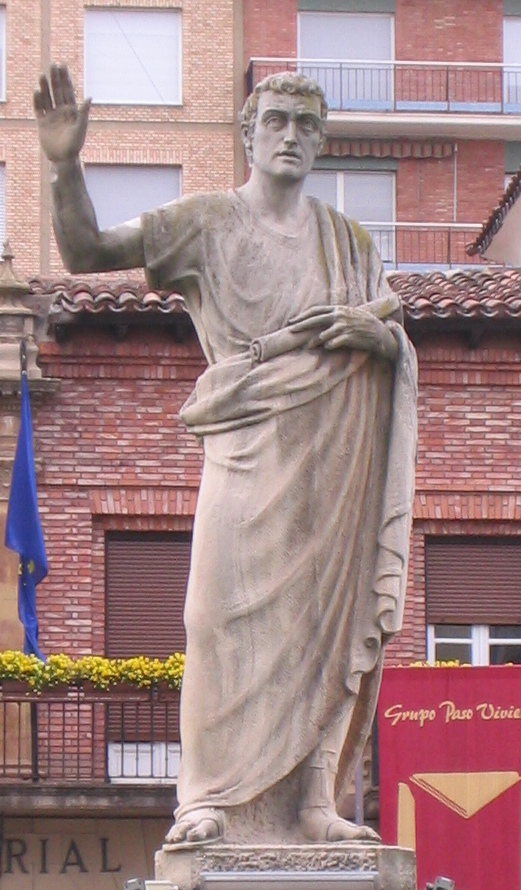
Their youthful enthusiasm for antiquity is rousing, though Quintilian, the first century CE educator and expert in rhetoric might have had some thoughts on their clownish antics.
He certainly had a lot of thoughts about togas, which he shared in his instructive masterwork, Institutio Oratoria:
The toga itself should, in my opinion, be round, and cut to fit, otherwise there are a number of ways in which it may be unshapely. Its front edge should by preference reach to the middle of the shin, while the back should be higher in proportion as the girdle is higher
behind than in front. The fold is most becoming, if it fall to a point a little above the lower edge of the tunic, and should certainly never fall below it. The other fold which passes obliquely like a belt under the right shoulder and over the left, should neither be too tight nor too loose. The portion of the toga which is last to be arranged should fall rather low, since it will sit better thus and be kept in its place. A portion of the tunic also should be drawn back in order that it may not fall over the arm when we are pleading, and the fold should be thrown over the shoulder, while it will not be unbecoming if the edge be turned back. On the other hand, we should not cover the shoulder and the whole of the throat, otherwise our dress will be unduly narrowed and will lose the impressive effect produced by breadth at the chest. The left arm should only be raised so far as to form a right angle at the elbow, while the edge of the toga should fall in equal lengths on either side.
Quintillian was willing to let some of his high standards slide if the wearer’s toga had been untidied by the heat of rousing oration:
When, however, our speech draws near its close, more especially if fortune shows herself kind, practically everything is becoming; we may stream with sweat, show signs of fatigue, and let our dress fall in careless disorder and the toga slip loose from us on every side…On the other hand, if the toga falls down at the beginning of our speech, or when we have only proceeded but a little way, the failure to replace it is a sign of indifference, or sloth, or sheer ignorance of the way in which clothes should be worn.
We’re pretty sure he would have frowned on classical archaeologist Shelby Brown’s experiments using a twin-size poly-blend bed sheet in advance of an early 21st-century College Night at the Getty Villa.
Prospective guests were encouraged to attend in their “best togas.”
Could it be that the party planners , envisioning a civilized night of photo booths, classical art viewing, and light refreshments in the Herculaneum-inspired Getty Villa, were so ignorant of 1978’s notorious John Belushi vehicle Animal House?
…Estne volumen in toga, an solum tibi libet me videre?
Related Content
Roman Statues Weren’t White; They Were Once Painted in Vivid, Bright Colors
Archaeologists Discover an Ancient Roman Sandal with Nails Used for Tread
- Ayun Halliday is the Chief Primatologist of the East Village Inky zine and author, most recently, of Creative, Not Famous: The Small Potato Manifesto. Follow her @AyunHalliday.
Read More...Watch a Very Nervous, 23-Year-Old David Byrne and Talking Heads Performing Live in NYC (1976)
“This is a person who is profoundly uncomfortable addressing an audience and yet puts himself in that position,” David Byrne told Studio 360’s Kurt Anderson in 2019, as they watched some of the above footage of his 23-year-old self fronting a live Talking Heads’ performance back in 1976.
Everything was pretty new back in that Bicentennial year.
Talking Heads had formed the year before, when Byrne and drummer Chris Frantz, who’d been bandmates at the Rhode Island College of Design, moved to New York City with Frantz’s girlfriend, bassist Tina Weymouth.
The venue hosting this live performance, New York City’s legendary experimental art space, The Kitchen, was slightly less wet behind the ears, having opened its doors in 1971. (Some 30 years later, elder statesman Byrne was the guest of honor at its annual spring gala.)
However you define it — New Wave, no wave, post-punk art pop — the band’s sound was also fresh, though Byrne suggests, in the interview with Anderson, there was nothing new about his youthful cockiness:
…like a lot of bands, artists, everything else, any period really, you tend to think that, um, the pervasive stuff around you is crap and you and your friends are…we’re doing the real stuff.
And optimistically, one might think, since we’re doing the real stuff and it has real soul and passion, and it’s of its moment, it represents its moment, and so immodestly, you think, “Of course! Things are just going to fall into your lap because you’re doing something that has some truth to it. Uh…that certainly doesn’t always happen.
It happened comparatively quickly for Talking Heads.
Several of the songs they performed as a trio that March night at the Kitchen made it onto Talking Heads: 77, the debut studio album recorded barely a year later, by which time a fourth member, Jerry Harrison, had joined on keyboards and guitar.
Of particular note above is Psycho Killer, which earned the band both notoriety, owing to the coincidental timing of 1976 and 1977’s Son of Sam murders, and their first Billboard Hot 100 spot.
“This song was written a long time ago,” the young Byrne stutters into the microphone at the Kitchen, then apologizes for fiddling with his clothes and equipment.
(“It’s all good!” Frantz calls out encouragingly from behind his drum kit.)
According to the liner notes of Once in a Lifetime: The Best of Talking Heads, Byrne began work on the song in college:
When I started writing this (I got help later), I imagined Alice Cooper doing a Randy Newman-type ballad. Both the Joker and Hannibal Lecter were much more fascinating than the good guys. Everybody sort of roots for the bad guys in movies.
Fans may note a disparity in the lyrics between this performance and recorded versions of the song. Here, the second verse goes:
Listen to me, now I’ve passed the test
I think I’m cute, I think I’m the best
Skirt tight, don’t like that style
Don’t criticize what I know is worthwhile
Psycho Killer stayed on the shelf for David Byrne’s American Utopia, the Broadway show recently filmed by Spike Lee. But it gave a far more polished Byrne an excellent opener for Talking Heads’ 1984 concert film, Stop Making Sense.
The uncomfortable young frontman dressed like a “proletariat everyman,” who the Kitchen’s press release described as “a cross between Ralph Nader, Lou Reed, and Tony Perkins.” And he has since managed to acquire some impressive performance chops over the course of a still flourishing career.
This is your chance to catch him at that awkward age when, as Byrne told Kirk Anderson, he performed “because he had to”:
There was this means of communication that was being a performer and writing songs and singing them (that) was a way of, kind of being present to other people — not just girls, but other people in general.
Setlist for The Kitchen, March 13, 1976:
00:00 — Introduction/soundcheck
02:13 — The Girls Want To Be With the Girls (Featured on More Songs About Buildings and Food in 1978)
06:05 — Psycho Killer (Featured on Talking Heads: 77 in 1977, with different lyrics)
The lyrics of the 2nd verse of Psycho Killer is different from the recorded version!
10:55 — I Feel It In My Heart (Featured on the deluxe version of Talking Heads: 77, with different lyrics)
15:28 — I Wish You Wouldn’t Say That (Featured on the deluxe version of Talking Heads: 77)
18:15 — Information about the recording
19:00 — Stay Hungry (Featured on More Songs About Buildings and Food)
24:35 — I Want To Live (Featured on compilations such as Sand in the Vaseline, 1992 and Bonus Rarities & Outtakes, 2006)
29:48 — Tentative Decisions (Featured on Talking Heads: 77)
32:55 — No Compassion (assumed, video ends before song starts)
Related Content
Watch the Talking Heads Play a Vintage Concert in Syracuse (1978)
The Talking Heads Play CBGB, the New York Club that Shaped Their Sound (1975)
- Ayun Halliday is the Chief Primatologist of the East Village Inky zine and author, most recently, of Creative, Not Famous: The Small Potato Manifesto. Follow her @AyunHalliday.
Read More...Russia’s War on Ukraine: A Conversation Hosted by The Atlantic, Featuring Anne Applebaum, Tom Nichols & Jeffrey Goldberg
“After years of threats, Vladimir Putin’s Russian forces invaded Ukraine—culminating in the largest attack against one European state by another since the Second World War. What happens now?”
Above, you can watch a wide-ranging conversation hosted by The Atlantic, featuring Anne Applebaum (Pulitzer-prize winning historian), Tom Nichols (U.S. Naval War College professor), and Jeffrey Goldberg (editor-in-chief of The Atlantic) as they examine “the global reaction, the effectiveness of sanctions, and how to address the rise of authoritarianism and ongoing threats to democracy.” It’s also worth reading Applebaum’s latest piece, “The Impossible Suddenly Became Possible.”
Read More...Support Us
We're hoping to rely on loyal readers, rather than erratic ads. Please click the Donate button and support Open Culture. You can use Paypal, Venmo, Patreon, even Crypto! We thank you!

About Us

Open Culture scours the web for the best educational media. We find the free courses and audio books you need, the language lessons & educational videos you want, and plenty of enlightenment in between.
Advertise With Us
FREE UPDATES!
GET OUR DAILY EMAIL
Get the best cultural and educational resources on the web curated for you in a daily email. We never spam. Unsubscribe at any time.
FOLLOW ON SOCIAL MEDIA
Open Culture editor Dan Colman scours the web for the best educational media. He finds the free courses and audio books you need, the language lessons & movies you want, and plenty of enlightenment in between.
Advertise With Us

