A First Look at How Tony Soprano Became Tony Soprano: Watch the New Trailer for The Many Saints of Newark
When The Sopranos drew to a close fourteen years ago, its ambiguous yet somehow definitive final scene hardly promised a continuation of the New Jersey mafia saga. Since then, fans have had to make do with reflections, histories, and exegeses, up to and including re-watch podcasts hosted by the actors themselves. As time has passed the show has only drawn higher and higher acclaim, which can’t be said about every product of the ongoing “golden age of television drama” The Sopranos got started. A return to the well was perhaps inevitable, and indeed has just been announced: The Many Saints of Newark, a prequel film co-written by David Chase, the creator credited with contributing to the original series a significant portion of its genius.
Onscreen, The Sopranos drew its power from one Soprano above all: local mob boss Tony Soprano, as portrayed by James Gandolfini in what has been ranked among the greatest screen acting achievements of all time. Whether or not Tony survived that final scene, Gandolfini died in 2013, and ever since it has been impossible to imagine any other actor portraying the character — or at least portraying the character in a modern-day setting.
Telling the story of a Tony Soprano in his youth, with a young actor necessarily playing him, has remained a viable proposition. Into that role, for the 1960s and 70s-set The Many Saints of Newark, has stepped Gandolfini’s real-life son Michael.
For the then-20-year-old Michael Gandolfini, taking over his father’s role had to be a daunting prospect, especially since he’d never seen The Sopranos before. At least one binge-watch of the series (among other rigorous forms of preparation) later, he delivered the performance of which you can take a first look in The Many Saints of Newark’s new trailer above. “As rival gangs try to wrest control from the DiMeo crime family in the race-torn city of Newark,” Consequence Film’s Ben Kaye writes of its story, the young Anthony Soprano, a promising but indifferent student with an eye on college, “gets swept up in the violence and crime by his uncle Dickie Moltisanti.” As Sopranos fans know full well, “Anthony becomes the feared mob head Tony Soprano and treats Dickie’s son, Christopher, as his protégé.” Evidently, an antihero of Tony’s stature is made, not born.
Related Content:
How David Chase Breathed Life into the The Sopranos
David Chase Reveals the Philosophical Meaning of The Sopranos’ Final Scene
James Gandolfini Shows Kinder, Softer, Gentler Side on Sesame Street (2002)
Based in Seoul, Colin Marshall writes and broadcasts on cities, language, and culture. His projects include the Substack newsletter Books on Cities, the book The Stateless City: a Walk through 21st-Century Los Angeles and the video series The City in Cinema. Follow him on Twitter at @colinmarshall or on Facebook.
Read More...The Acoustics of Stonehenge: Researchers Build a Model to Understand How Sound Reverberated within the Ancient Structure
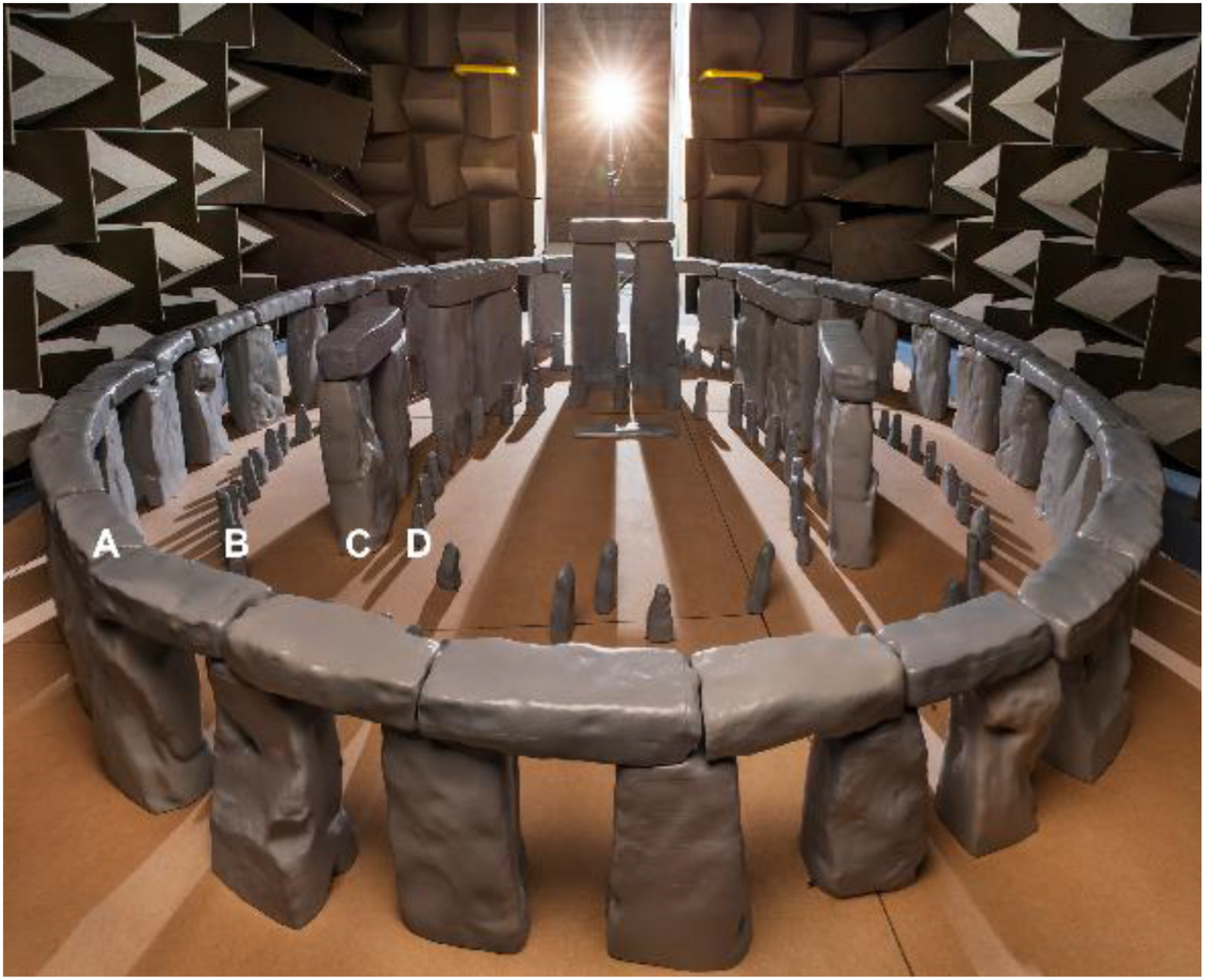
It’s impossible to resist a Spinal Tap joke, but the creators of the complete scale model of England’s ancient Druidic structure pictured above had serious intentions — to understand what those inside the circle heard when the stones all stood in their upright “henge” position. A research team led by acoustical engineer Trevor Cox constructed the model at one-twelfth the actual size of Stonehenge, the “largest possible scale replica that could fit inside an acoustic chamber at the University of Salford in England, where Cox works,” reports Bruce Bower at Science News. The tallest of the stones is only two feet high.
This is not the first time acoustic research has been carried out on Stonehenge, but previous projects were “all based on what’s there now,” says Cox. “I wanted to know how it sounded in 2200 B.C., when all the stones were in place.” The experiment required a lot of extrapolation from what remains. The construction of “Stonehenge Lego” or “Minihenge,” as the researchers call it, assumes that “Stonehenge’s outer circle of standing sarsen stones — a type of silcrete rock found in southern England — had originally consisted of 30 stones.” Today, there are 17 sarsen stones in the outer circle among the 63 complete stones remaining.
“Based on an estimated total 157 stones placed at the site around 4,200 years ago, the researchers 3‑D printed 27 stones of all sizes and shapes,” Bower explains. “Then, the team used silicone molds of those items and plaster mixed with other materials to re-create the remaining 130 stones. Simulated stones were constructed to minimize sound absorption, much like actual stones at Stonehenge.” Once Cox and his team had the model completed and placed in the acoustic chamber, they began experimenting with sound waves and microphones, measuring impulse responses and frequency curves.
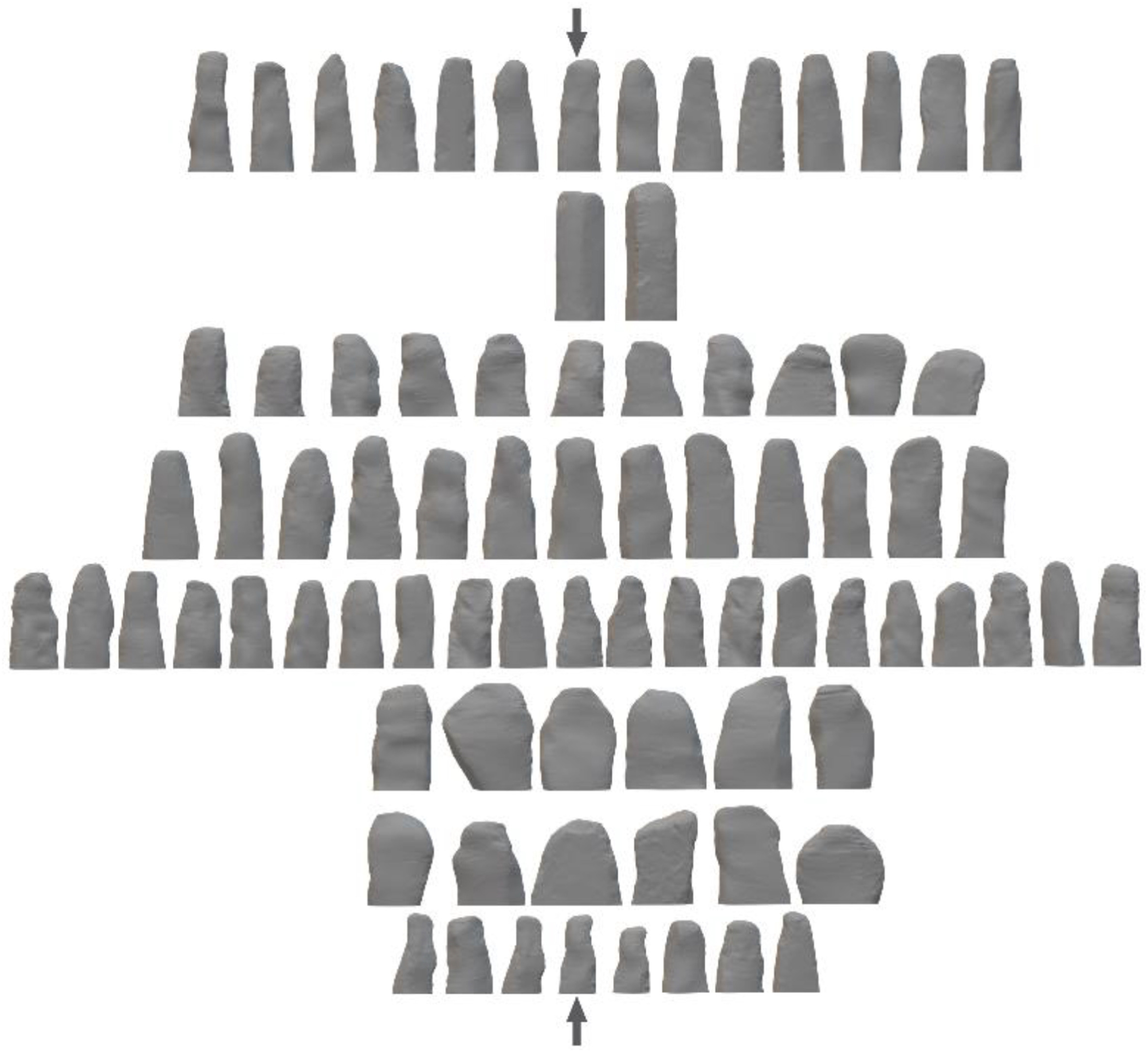
What were the results of this sonic Stonehenge recreation? “We expected to lose a lot of sound vertically, because there’s no roof,” says Cox. Instead, researchers found “thousands upon thousands of reflections as the sound waves bounced around horizontally.” Participants in ritual chants or musical celebrations inside the circle would have heard the sound amplified and clarified, like singing in a tiled bathroom. For those standing outside the monument, or even within the outer circle of stones, the sound would have been muffled or dampened. Likewise, the arrangement would have dampened sound entering the inner circle from outside.
Indeed, the effect was so pronounced that “the placement of the stones was capable of amplifying the human voice by more than four decibels, but produced no echoes,” notes Artnet. This suggests that the site’s acoustic properties were not accidental, but designed as part of its essential function for an elite group of participants, “even though the site’s construction would have required a huge amount of manpower.” This is hardly different from other monumental ancient religious structures like pyramids and ziggurats, built for royalty and an elite priesthood. But it’s only one interpretation of the structure’s purpose.
While Cox and his team do not believe acoustics were the primary motivation for Stonehenge’s design — astrological alignment seems to have been far more important — it clearly played some role. Other scholars have their own hypotheses. Research still needs to account for environmental factors — or why “Stonehenge hums when the wind blows hard,” as musicologist Rupert Till points out. Some have speculated the stones may have been instruments, played like a giant xylophone, a theory tested in a 2013 study conducted by researchers from the Royal College of Art, but this, too, remains speculative.
As the great Stonehenge enthusiast Nigel Tufnel once sang, “No one knows who they were, or what they were doing.” But whatever it sounded like, Cox and his colleagues have shown that the best seats were inside the inner circle. Read the research team’s full article here.
Related Content:
The Ancient Astronomy of Stonehenge Decoded
The Spinal Tap Stonehenge Debacle
Josh Jones is a writer and musician based in Durham, NC. Follow him at @jdmagness
Read More...This Is “The End”: A Video Exploration of The Doors’ Existential Epic
If you had broken up with your college boyfriend and he told you that he written an 11-minute song about you while on enough LSD to kill a horse, would you want to hear it? Or would you block his number on your phone?
Or maybe because said boyfriend is Jim Morrison and the band is the Doors and the song is “The End,” we’ll let it slide, because whether or not you think Jim’s lyrics are super deep or supercilious, the groove is undeniable, four small furry musicians gathered together in a studio and grooving on a raga, conjuring up Eastern mysticism with Western instruments.
In Polyphonic’s explainer video on “The End,” he pulls apart The Doors’ magnum opus, the closer to its 1967 debut album, analyzing the song in real time as it unspools. (There’s a few moments where Polyphonic and Morrison are vocalizing at the same time—we recommend turning on captions).
The girlfriend in question was Mary Werbelow, Morrison’s steady in the early ‘60s before he chose the path of putting his poetry to music. The Werbelow/Morrison couple had to die for the Doors to be born, in a sense, and Morrison started the lyrics as a goodbye song, a standard pop trope at the time. (There’s a very touching, rare interview with Werbelow here). But Morrison took it in another direction, we could say.
“The End” might be the first musical example of the Psychotronic Breakup genre. Defined by Noah Segan and Adam Egypt Mortimer when talking about film, the Psychotronic Breakup genre “uses dream imagery, paranormal ideas, or the horror genre to express the emotional drama of heartbreak.” Segan and Mortimer’s definition deals only with film, but Morrison does the same thing with song, a little over ten years before the films they discuss. “The End” is a breakup song that breaks down the psyche like LSD, sending the injured party back to basics, and into a universe of archetypes. Things are dying. Things are being reborn. There’s a blue bus which is calling us, and that is either a reference to the Solar Boat in Egyptian mythology or a reference to the Santa Monica bus system (according to one wag in the comments). Or hey, maybe it is both, because Morrison is tapping into something here, much like James Joyce created layers of myth within the quotidian. (Morrison achieves this by walking backwards into it, however.)
Polyphonic gets into the song’s Oedipal Cliff Notes section, describing how it all came fluming out of Morrison on stage, the band having dragged him to a gig at the Whiskey a Go-Go after he consumed “10,000 mikes” (i.e. 10,000 micrograms, about ten full doses) of LSD. A few days later the “kill your teachers, kill your parents” riff was committed to tape, this time also on LSD.
For all its pretense the song still works. And though Morrison never did reconcile with his girlfriend, the song did find its soul mate when Francis Ford Coppola used “The End” as the opening to Apocalypse Now, another work of art that drained the life force from its creator. There are no real cover versions of “The End,” and there are no films past Coppola’s that can use it without irony. It exists like a totem, to be found and puzzled over.
(But because this is late capitalism and everything is terrible, Polyphonic’s segue into a sponsor ad at 11:46 is something wondrous to behold in its perverse beauty. Be warned, my only friend.)
Related Content:
“The Lost Paris Tapes” Preserves Jim Morrison’s Final Poetry Recordings from 1971
A Young, Clean Cut Jim Morrison Appears in a 1962 Florida State University Promo Film
Ted Mills is a freelance writer on the arts who currently hosts the Notes from the Shed podcast and is the producer of KCRW’s Curious Coast. You can also follow him on Twitter at @tedmills, and/or watch his films here.
Read More...Watch an Accurate Reconstruction of the World’s Oldest Computer, the 2,200 Year-Old Antikythera Mechanism, from Start to Finish
There’s nothing like an ancient mystery, especially one as seemingly insoluble as the origins of “the world’s first computer,” the Antikythera mechanism. Discovered off the coast of the Greek island of Antikythera in 1901, the corroded collection of gears and dials seemed fake to scientists at first because of its ingeniousness. It has since been dated to 100 to 150 BC and has inspired decades of research and speculative reconstruction. Yet, no one knows who made it, and more importantly, no one knows how it was made.
“The distance between this device’s complexity and others made at the same time is infinite,” says Adam Wojcik, a materials scientist at the University College of London. “Frankly, there is nothing like it that has ever been found. It’s out of this world.”
The expression should not make us think of ancient aliens — the Antikythera mechanism contains more than enough evidence of human limitation, showing a geocentric model of the cosmos with the only five planets its maker would have known.
The 2,000-plus year-old device continues to reveal its secrets, including hidden inscriptions found during CT scans of the object, as Smithsonian reported in 2015. The mechanism is “similar in size to a mantel clock, and bits of wood found on the fragments suggest it was housed in a wooden case. Like a clock, the case would’ve had a large circular face with rotating hands. There was a knob or handle on the side, for winding the mechanism forward or backward. And as the knob turned, trains of interlocking gearwheels drove at least seven hands at various speeds. Instead of hours and minutes, the hands displayed celestial time.”
If the Antikythera mechanism is a “celestial clock,” who better to design and build its reconstruction than a clockmaker? That is exactly what we see in the videos above, created for the clockmaking YouTube channel Clickspring. Using the best scientific model of the mechanism to date — published this year by Dr. Tony Freeth and colleagues of the Antikythera Mechanism Research Project — Clickspring shows how the device might have fit together and makes educated guesses about the right placement of its dozens of small parts.
You can see a preview of the Antikythera reconstruction project at the top, watch the full project above, and see individual episodes showcasing different phases of construction on YouTube. The model “conforms to all the physical evidence,” Freeth writes, “and matches the descriptions in the scientific inscriptions engraved on the mechanism itself.” What no one can figure out, however, is just how the ancient Greek artisans who made it shaped precision metal parts without lathes and other modern tools of the machine-makers trade. Researchers, and clockmakers, may have pieced together the Antikythera puzzle, but the mystery of how it came into existence at all remains unsolved.
Related Content:
Modern Artists Show How the Ancient Greeks & Romans Made Coins, Vases & Artisanal Glass
Josh Jones is a writer and musician based in Durham, NC. Follow him at @jdmagness
Read More...Wikipedia’s Surprising Power in Shaping Science: A New MIT Shows How Wikipedia Shapes Scientific Research

If you were in high school or college when Wikipedia emerged, you’ll remember how strenuously we were cautioned against using such an “unreliable source” for our assignments. If you went on to a career in science, however, you now know how important a role Wikipedia plays in even professional research. It may thus surprise you to learn that students still get more or less the same warning about what, two decades later, has become the largest encyclopedia and fifth most-visited web site in the world. “Many of us use Wikipedia as a source of information when we want a quick explanation of something,” say MIT’s citation guidelines. “However, Wikipedia or other wikis, collaborative information sites contributed to by a variety of people, are not considered reliable sources for academic citation.”
That quotation appears, somewhat ironically, in a recent MIT research paper called “Science is Shaped by Wikipedia: Evidence From a Randomized Control Trial.” Its authors, Neil C. Thompson from MIT and Douglas Hanley from the University of Pittsburgh, use both “Big Data” and experimental approaches to support their claim that “incorporating ideas into a Wikipedia article leads to those ideas being used more in the scientific literature.”
Testing the existence of an underlying causal relationship, they “commissioned subject matter experts to create new Wikipedia articles on scientific topics not covered in Wikipedia.” Half of these articles were added to Wikipedia, and half retained as a control group. “Reviewing the relevant journal articles published later, they find that “the word-usage patterns from the treatment group show up more in the prose in the scientific literature than do those from the control group.”
In other words, Wikipedia does indeed appear to shape science — or as Wharton professor Ethan Mollick put it on Twitter, “The secret heart of academia is… Wikipedia.” Expanding on the idea, he added that “Wikipedia is used like a review article,” which surveys the current state of a particular scientific field. “Review articles are extremely influential on the direction of scientific research, and while Wikipedia articles are generally less influential, there are more of them, they are more up-to-date, and they are free.” That last point — and the implied contrast to traditional, scientific journals with their often shockingly high subscription fees — becomes a key point in Thompson and Hanley’s advocacy for public repositories of knowledge in general, with their power to galvanize research across the whole world. The power of open culture is considerable; the power of open science, perhaps even more so.
You can read Hanley and Thompson’s study on the power of Wikipedia free online: “Science is Shaped by Wikipedia: Evidence From a Randomized Control Trial.”
Related Content:
Listen to Wikipedia: A Web Site That Turns Every Wikipedia Edit Into Ambient Music in Real Time
NASA’s New Online Archive Puts a Wealth of Free Science Articles Online
Royal Society Opens Online Archive; Puts 60,000 Papers Online
Free Online Courses: The Sciences
200 Free Textbooks: A Meta Collection
Based in Seoul, Colin Marshall writes and broadcasts on cities, language, and culture. His projects include the Substack newsletter Books on Cities, the book The Stateless City: a Walk through 21st-Century Los Angeles and the video series The City in Cinema. Follow him on Twitter at @colinmarshall or on Facebook.
Read More...Discover Ibn Sina (Avicenna), a Missing Pixel in Your Image of Philosophy: Partially Examined Life Episode #267 Featuring Peter Adamson

Most American students in philosophy live on a diet of ancient Greek philosophy on the one hand, and then “modern” philosophy, which starts around the time of Descartes (the 17th century), with numerous schools and approaches spilling into the present day. If you get anything from between those ancient days and modernity, it’s probably some churchmen, i.e. Augustine (from the 4th century) and Thomas Aquinas (the 13th century), with perhaps a few Romans thrown in there and (if you’re Jewish) Maimonides (12th century).
But a key part of this lineage was the Eastward turn that the great works of Greek and Roman philosophy took during the so-called Dark Ages, when they were preserved and copied in the Islamic world, and this period produced a wealth of philosophy including two figures who became influential enough in the West that their names were Latinized: Ibn Sīnā (980‑1037 C.E.) and Ibn Rushd, a.k.a. Averroes (1126–1198). Aquinas was very familiar with these figures and incorporated them into his influential works, and in the case of Ibn Sina, at least, important figures like John Locke had definitely known at least about his views, if not his actual works.
On the Partially Examined Life Philosophy Podcast, which has been going for 13 years now, we range widely over the history of philosophy but had not actually cracked the Islamic world. Luckily, Ibn Sīnā is one of the favorite philosophers of one of our favorite guests, Peter Adamson of King’s College London. Peter runs his own podcast, The History of Philosophy (Without Any Gaps), which as the name implies, covers Medieval philosophy with admirable thoroughness, covering not only Ibn Sīnā and Ibn Rushd, but also figures like al-Rāzī, al-Fārābī, Al-Ghazālī, and many others.
Peter was good enough to recommend some readings to introduce us and our listeners to this figure, some of which he actually wrote. Because of the volume, redundancy, and style of Ibn Sīnā’s writings, some sort of guide to collect and to some degree explain passages is essential for getting a handle on this idiosyncratic and brilliant thinker. He wrote at least three different versions of his all-encompassing system, which was influenced by and meant to supplant Aristotle’s. In addition to philosophical/theological topics, it included mathematics, science, psychology, and more. So instead of trying to read a whole work covering all that, it makes more sense to pick individual topics and then look at the various formulations he gave about these.
Our two topics for this discussion were a peculiar argument for the existence of God — with important implications for talking about metaphysics more generally — and an argument for the immateriality of the soul, which likewise tells us a lot about the way that Ibn Sīnā thought about knowledge and its relation to the world.
The argument for the existence of God was later called by Thomas Aquinas “the argument from contingency.” It posits that things in the world don’t simply exist, but that they require something else to support their existence. This isn’t a cause is the chronological sense that we talk about it: a prior event that gave rise to the thing. Rather, the material components of something in a certain arrangement make it continue to exist as that thing right now; for example, a house exists because its component wood parts exist, with nails and such holding them in place. And the wood in turn has its character because of its physical/chemical components, etc. If these component causes weren’t in place, the thing would not exist; the thing is thus “contingent,” meaning it might well not have existed were it not for those causes.
This picture of the universe thus includes a giant network of causality, but does that network itself rest on anything? According to Ibn Sīnā, there must be something that is not contingent that holds everything else up. But is this thing God (in the sense that a good Muslim of his time would recognize it)? Ibn Sīnā then has a long series of arguments to show one by one that just by being “the necessary being,” this entity also must be unique, must be all-powerful, generous, and all the other things one would expect God to be.
The argument for the immortality of the soul is perhaps Ibn Sīnā’s most famous argument, often called the flying or floating man argument. It’s a thought experiment whereby you imagine you’ve just been created, but fully mature, so you can think, but with no memory, and your senses are inoperable. You can’t even feel gravity or the ground under your feet (thus the “flying” part). According to Ibn Sīnā, you would still in such a situation know that you exist. Since your apprehension of self did not include any part of your body (you couldn’t feel your body at all), that is supposed to prove that your body is not an essential part of what you are.
Ibn Sīnā thought this argument definitive because of his theory of knowledge by which if you know anything at all, then you know about the essential components of that thing. If you know what a triangle is, you know that it’s an abstract geometrical figure with three straight sides. If you know what a horse is, you know that it’s a biological animal with a particular character that you can identify. And to know what you are essentially, you only need know that feeling of your own mind; anything else about that mind being associated with a particular body that lives in a particular part of the world and is just knowledge of contingent, relational facts about yourself.
PEL hosts Mark Linsenmayer and Dylan Casey grapple in detail with Peter about these arguments, both on this recording and on a second part of the discussion for those that want to hear more. To read more about these arguments and get the citations to the texts we read for this discussion, see the essay for this episode at partiallyexaminedlife.com. The History of Philosophy podcast also features four monologues and an interview about Ibn Sīnā. Don’t let this gap in your knowledge of major figures in intellectual history remain unfilled!
Mark Linsenmayer is the host of the Partially Examined Life, Pretty Much Pop, and Nakedly Examined Music podcasts. He is a writer and musician working out of Madison, Wisconsin. Read more Open Culture posts about The Partially Examined Life.
Image by Solomon Grundy.
Read More...In 1926, Nikola Tesla Predicts the World of 2026
Not long after Nikola Tesla died in 1943, the world seemed to forget him. The first public tribute paid to his considerable research and development in the realm of electricity thereafter came in 1960 with the introduction of the tesla, the SI unit of magnetic flux density. But in the decades since Tesla has enjoyed an afterlife as an icon of under-appreciated prescience. Some of this reputation is based on interviews given in the 1920s and 1930s, when he was still a celebrity. Take the short Colliers magazine profile from 1926 in which he foresees the emergence of devices that will allow us “to communicate with one another instantly, irrespective of distance”; a man, Tesla predicts, “will be able to carry one in his vest pocket.”
This article is one source of the words spoken in the Voices of the Past video above. In it, Tesla also speaks of a future hugely enriched by the “wireless energy” he spent much of his career pursuing. It will power “flying machines” in which “we shall ride from New York to Europe in a few hours.” A household’s daily newspaper “will be printed ‘wirelessly’ in the home during the night.”
Thanks to instant worldwide communication, “international boundaries will be largely obliterated and a great step will be made toward the unification and harmonious existence of the various races inhabiting the globe.” All the while, new generations of ever better-educated women “will ignore precedent and startle civilization with their progress.”
Many will applaud Tesla’s views on the advancement of women, though here his thinking takes a turn that may give pause even to the most forward-thinking among us today: “The acquisition of new fields of endeavor by women, their gradual usurpation of leadership, will dull and finally dissipate feminine sensibilities, will choke the maternal instinct, so that marriage and motherhood may become abhorrent and human civilization draw closer and closer to the perfect civilization of the bee.” The inventor of alternating current has much to say in favor of apian society, “the most highly organized and intelligently coordinated system of any form of nonrational animal life.” And so why not restructure human civilization around a single queen?
This video also draws on a 1937 interview with Tesla in Liberty magazine, which features even more discomfiting propositions. “The only method compatible with our notions of civilization and the race is to prevent the breeding of the unfit by sterilization and the deliberate guidance of the mating instinct,” Tesla insists. “The Secretary of Hygiene or Physical Culture will be far more important in the cabinet of the President of the United States who holds office in the year 2035 than the Secretary of War.” Despite perhaps having crossed the line into mad-scientism, Tesla remained incisive about the persistent condition of humans under high technology. “We suffer from the derangement of our civilization because we have not yet completely adjusted ourselves to the machine age,” he claims. “The solution of our problems does not lie in destroying but in mastering the machine.” Here in the 21st century, of course, many of us would be content simply to gain mastery over the one in our vest pocket.
Related Content:
Nikola Tesla Accurately Predicted the Rise of the Internet & Smart Phone in 1926
The Electric Rise and Fall of Nikola Tesla: As Told by Technoillusionist Marco Tempest
A 1947 French Film Accurately Predicted Our 21st-Century Addiction to Smartphones
Hear an Ancient Chinese Historian Describe The Roman Empire (and Other Voices of the Past)
Based in Seoul, Colin Marshall writes and broadcasts on cities, language, and culture. His projects include the Substack newsletter Books on Cities, the book The Stateless City: a Walk through 21st-Century Los Angeles and the video series The City in Cinema. Follow him on Twitter at @colinmarshall or on Facebook.
Read More...Stream a Massive Archive of Grateful Dead Concerts from 1965–1995
Image by Herb Greene, via Wikimedia Commons
“Once we’re done with it, the audience can have it.” — Jerry Garcia
It so happens that one of the greatest things about the Internet is also one of the not-so-greatest things: you hardly ever have to leave the house anymore. Of course, for traders and collectors of bootlegs, this has been a major boon. Obscure tapes a fan might spend years tracking down in previous times can now be searched, found, and downloaded with ease. And — as a special added bonus — their quality won’t degrade with every copy.
For Deadheads, especially, such easy online access has been critically important in maintaining a community of people who love the Grateful Dead, when there hasn’t been a Grateful Dead show in years. That’s enough time for new generations of Deadheads to emerge, and to discover and grow up with a resource their elders could only dream about: the Internet Archive’s Grateful Dead collection, which currently features over 15,000 recordings (mostly complete concerts) and continues to expand as more are added.
Sure, it’s not quite compensation for never getting to see, and tape, the band in person, but these days, such a thing would probably be impossible in any case, even if Jerry Garcia hadn’t died in 1995. (Last year, to keep fans’ spirits up, band members Mickey Hart, Bob Weir, and Donna Jean Godchaux welcomed famous special guests on YouTube and broadcast unreleased filmed concerts in the weekly “Shakedown Stream.”) For those raised on Dead tapes, the archive must feel like coming home. For others, it can be a bewildering collection of dates, venues, and locations.
How to navigate the thousands of recordings of the estimated 2,200 concerts captured on tape by the band and their fans over the course of decades? A few years back, one fan made a list of the “10 Essential/Best Grateful Dead Shows,” all of which you can download and/or stream and pore over to your heart’s content.
“I am not an old Dead Head, or a member of the 4‑decade club,” he admits. “In fact, I never saw a show, seeing as I was born in 2001.” It’s not his fault, but he’s entered an arena where fundamental disagreement about such things is a matter of course.
1. 09–21-72, The Spectrum, Philadelphia, PA
2. 05–08-77, Cornell University, Ithaca, NY
3. 02–27-69, Fillmore West, San Francisco, CA
4. 05–02-70, Harpur College, Binghamton, NY
5. 08–27-72, Veneta, OR
6. 07–07-89, JFK Stadium, Philadelphia, PA
7. 05–26-72, The Strand Lyceum, London, England
8. 12–31-78, Winterland Arena, San Francisco, CA
9. 11–08-69, Fillmore Theater, San Francisco, CA
10. 12–06-73, Cleveland Public Hall, Cleveland, OH
11. 06–26-74, Providence Civic Center, Providence, RI
See the top ten list above (including links to shows), find honorable mentions here, a shorter list by Mike Mineo here, and add your own picks in the comments. And consider the fact that a band who devoted more time to touring than anything else “had just one Top Forty hit in thirty years,” Nick Paumgarten writes at The New Yorker (though “not for lack of trying”). They more than their share of terrible nights onstage (by their own admission) but still inspire people who will never see them play.
“Each tape seemed to have its own particular note of decay, like the taste of the barnyard in a wine or a cheese,” writes Paumgarten of learning to savor these concerts: “You came to love each one, as you might a three-legged dog.” For Deadheads, it can be hard to pick favorites, especially if you haven’t heard them all yet. Immerse yourself in live Dead now at the Internet Archive’s Grateful Dead Collection here. Browse by the year of the recordings here.
Related Content:
The Grateful Dead Movie: Watch It Free Online
Josh Jones is a writer and musician based in Durham, NC. Follow him at @jdmagness
Read More...The New Enlightenment and the Fight to Free Knowledge: Part 3
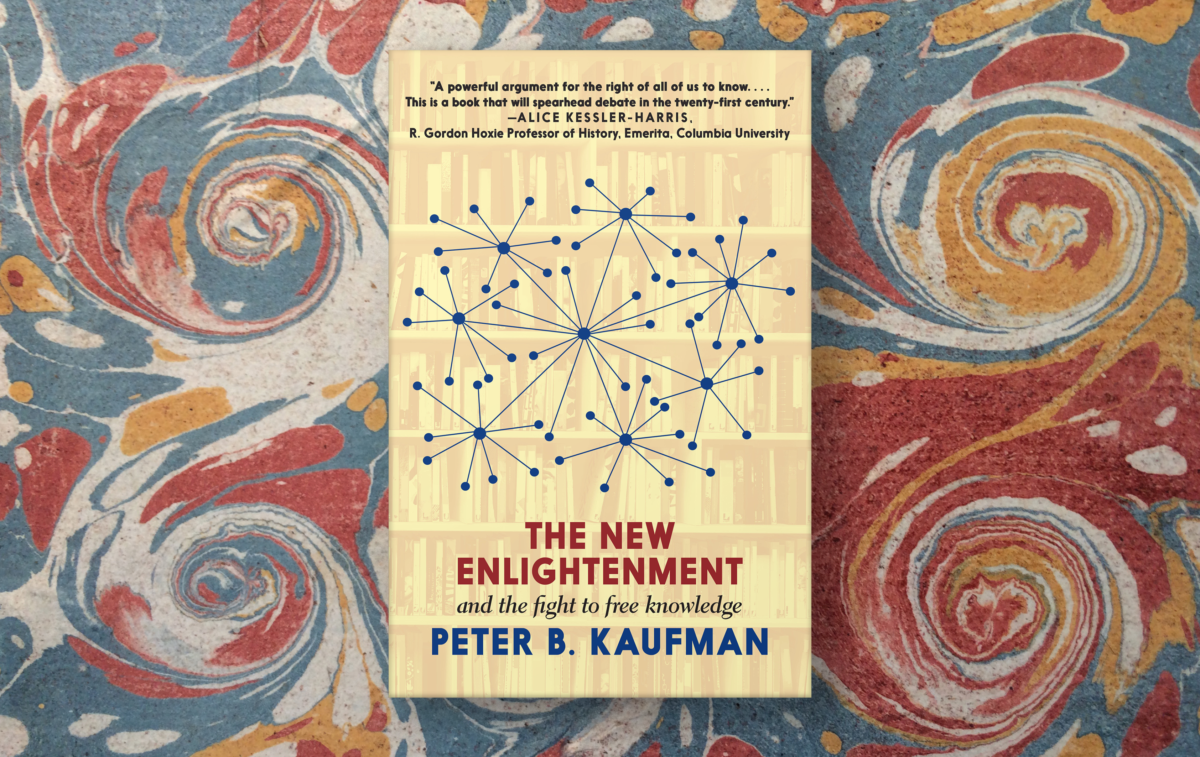
Editor’s Note: MIT Open Learning’s Peter B. Kaufman has just published The New Enlightenment and the Fight to Free Knowledge, a book that takes a historical look at the powerful forces that have purposely crippled our efforts to share knowledge widely and freely. His new work also maps out what we can do about it. Generously, Peter has made his book available through Open Culture by publishing three short essays along with links to the corresponding freely licensed sections of his book. Today, you can read his third essay “The Republic of Images” (below). Find his first essay, “The Monsterverse” here, his second essay “On Wikipedia, the Encyclopédie, and the Verifiability of Information” here, and purchase the entire book online.
In November 1965, after some hondling between the Carnegie Corporation and the Ford Foundation, a senior executive from Carnegie called former president of MIT James Killian with an invitation. Would Killian be interested in assembling a commission to study educational television with an eye toward strengthening the American system of learning on screen, and could he start right away? Killian jumped; a commission was formed; and two years, eight meetings, 225 interviews, and 92 site visits later, the Carnegie Commission’s report comes out, a bill gets written, the bill becomes law, and President Johnson is signing the 1967 Public Television Act to create public television and radio.
At the signing ceremony, Johnson said, “Today, we rededicate a part of the airwaves – which belong to all the people – and we dedicate them for the enlightenment of all the people. We must consider,” he said, “new ways to build a great network for knowledge – not just a broadcast system, but one that employs every means of sending and storing information that the individual can use.”
Heady stuff. But it gets even better:
Think of the lives that this would change:
The student in a small college could tap the resources of a great university. […]
The country doctor getting help from a distant laboratory or a teaching hospital;
A scholar in Atlanta might draw instantly on a library in New York;
A famous teacher could reach with ideas and inspirations into some far-off classroom, so that no child need be neglected.
Eventually, I think this electronic knowledge bank could be as valuable as the Federal Reserve Bank.
And such a system could involve other nations, too – it could involve them in a partnership to share knowledge and to thus enrich all mankind.
A wild and visionary idea? Not at all. Yesterday’s strangest dreams are today’s headlines and change is getting swifter every moment.
I have already asked my advisers to begin to explore the possibility of a network for knowledge – and then to draw up a suggested blueprint for it.
The system he was signing into law, Johnson said, “will be free, and it will be independent – and it will belong to all of our people.”
A new network for knowledge.
Imagine.
Fifty years later, totally (seemingly) unrelated, then MIT president Charles Vest went on to speak of something else, something that became MIT Open Courseware. Together with new foundations – this time the Hewlett Foundation and the Mellon Foundation led the way – Vest envisioned “a transcendent, accessible, empowering, dynamic, communally constructed framework of open materials and platforms on which much of higher education worldwide can be constructed or enhanced:”
A meta-university that will enable, not replace, residential campuses, that will bring cost efficiencies to institutions through the shared development of educational materials. That will be adaptive, not prescriptive. It will serve teachers and learners in both structured and informal contexts. It will speed the propagation of high-quality education and scholarship. It will build bridges across cultures and political boundaries. And it will be particularly important to the developing world.
Today, in our time of severe truth decay, our great epistemic crisis, it might be time again to envision another intervention, formative and transformational as the establishment of public broadcasting, imaginative and daring as the launch of open courseware and the open education movement. Indeed, something as breathtaking as the events above, and their own vital forbear over a century ago – the founding of a network of public libraries across America and other parts of the world (which also happened with Andrew Carnegie’s financial support).
The original Enlightenment brought us Newton’s physics, Rousseau’s political philosophy, Linnaeus’s taxonomies, Montesquieu’s laws, the Declaration of Independence, the Declaration of the Rights of Man – it was the Age of Reason. Its founders – as we noted in [Parts 1 and II on] Open Culture – comprised between themselves what became known as the great Republic of Letters. They were all men, though; and they all were white; while they had access to their own means and to the mean of media production, and they delivered new systems of thinking much of the modern world is based on today, their circles were limited; their imaginations were not our imaginations.
Today we have a chance to do more – to take advantage of the cultures and communities that have arisen in the centuries and from the struggles since that time, to launch a new Enlightenment, and to realize perhaps in bolder and more secure ways this new network for knowledge. Video, more than text now, has taken over the internet; video is a new key to our networked world. The company Cisco Systems – which makes many of the devices that connect us – deploys a forecasting tool it calls the Visual Networking Index (VNI). The latest VNI tells us that there were 3.4 billion Internet users on the planet in 2017, almost half of the planet’s current population of 7.7 billion people. By 2022, there will be 4.8 billion Internet users: 60 percent of the planet, and more people in the world will be connected to the Internet than not. By 2022, more than 28 billion “devices and connections” will be online. And – here’s the kicker – video will make up 82 percent of global Internet traffic. Video is dominant already. During peak evening hours in the Americas, Netflix can account for as much as 40 percent of downstream Internet traffic, and Netflix – Netflix alone – constitutes 15 percent of Internet traffic worldwide. All this forecasting was completed before the pandemic; before 125 million cases of Corona virus; before 3 million deaths worldwide; before the explosion of Zoom.
We are living in a video age. What will be our next media intervention? How do knowledge institutions secure their deservedly central place in search and on the web? We need to look over our rights vis-à-vis the government and the giant companies that increasingly control our Internet; we need to look at the growing power we have to contribute to access to knowledge and share our wealth especially in the online Commons; we need to make sure that the public record, especially video (and especially video of all the lies and crimes, and of all the outrageous falsehoods leaders circulate about COVID) is all archived and preserved. We need to strengthen how much of the network we own and control.
What’s important is that we have begun to reach toward the point where there is equity in the leadership of our knowledge institutions. No longer are white men and only white men in charge of the Library of Congress, for example, or the Smithsonian Institution, or, and thus by extension, of our new Enlightenment. New and diverse study and action groups are being formed specifically to address our information disorder. But many more of our leading knowledge institutions – and, critically, foundations and funding agencies again – need to lead this work. This is a 20th-anniversary year for MIT Open CourseWare, for Wikipedia, and for Creative Commons; indeed, MIT OCW starts to celebrate its birthday this month. Many other like-minded progressive institutions and their supporters are on the move. That network for knowledge is coming again: this time, our new Enlightenment moment will belong to all of us.
Peter B. Kaufman works at MIT Open Learning and is the author of The New Enlightenment and the Fight to Free Knowledge.
Read More...Meet Les Rallizes Dénudés, the Mysterious Japanese Psych-Rock Band Whose Influence Is Everywhere
For those young people – including you – who live this modern agonising adolescence and who are wanting the true radical music, I sincerely wish the dialogue accompanied by piercing pain will be born and fill this recital hall.
– text from late 60s’ Les Rallizes Dénudés concert flyers
In Spanish writer Carlos Ruiz Zafón’s bestselling novel The Shadow of the Wind, narrator Daniel Sempere spends his adolescence trying to solve the mystery of an obscure dead novelist. Fans of the book might see Daniel’s detective story in Grayson Haver Currin’s quest to learn more about Japanese psych rock band Les Rallizes Dénudés and its elusive founder Takashi Mizutani. The band has inspired devotion and endless fascination among their small cult following. But Currin’s investigations met with one after another dead end. Les Rallizes Dénudés is, he writes, “a band that’s existed behind a veil of secrecy for so long that it’s almost impossible to tell where facts end and where fantasy begins.”
It does not help that many people’s first and last encounter with Les Rallizes Dénudés was Julian Cope’s 2007 Japrocksampler, a generous, even encyclopedic introduction to post-war Japanese rock and roll. The book played “a pivotal role in exposing American and English audiences to Les Rallizes Dénudés’ tantric guitar shrieks,” yet its meager chapter on the band is apparently riddled with inaccuracies, including the claim that the band never recorded in the studio in their entire 29-year existence. They did, in 1991, 24 years after they began playing stages in Tokyo.
So how did anyone hear about them if they didn’t make or promote albums? “Through bootlegs, bootlegs and more bootlegs,” Cope wrote. Here he does not exaggerate, but even where he does, “it’s in the service of truth,” Dangerous Minds argues, going on to summarize the “skeletal” biography Cope sketches out for the band:
Takashi Mizutani formed the group as a college student in the ‘60s, when, Cope writes, French culture still found devotees among postwar Japanese youth looking for a revolutionary alternative to Uncle Sam. That means: Cool for these guys was ice cold. Deadpan as the Velvets or Spacemen 3, Mizutani and his bandmates identified with the loudest, darkest and most destructive aspects of psych-rock.
Les Rallizes Dénudés is legendary for good reason, as you can learn in the Bandsplaining video at the top. One thing we do know about them is that a former bassist apparently hijacked an airplane for the Japanese Red Army Faction (then found asylum in North Korea), but “it’s actually not the most interesting thing about them.” Those who already know a certain kind of psychedelic rock may hear the dark, echoey drone of White Light/White Heat-era Velvet Underground and later bands like Brian Jonestown Massacre or Moon Duo, as well as the No Wave noise rock of Sonic Youth and hazy shoegaze of My Bloody Valentine.
The band’s echoing vocals and swirling, wailing peals of fuzzed-out guitar “foreshadowed the next five decades of underground rock,” the Bandsplaining video notes. This seems to be the case whether the musicians inspired by Les Rallizes Dénudés had ever heard their music directly. Japanese underground music “only began reaching Western ears in the early 90s,” writes Alan Cummings, a University of London professor of Japanese translation, drama, culture, and history, and a foremost Western authority on Japanese psych rock. When the music first reached listeners outside Japan, however, it wasn’t Les Rallizes Dénudés they first heard.
Cummings, who saw Les Rallizes Dénudés live in Japan, wrote “what might be the first English piece to ever mention the band” ten years later in 1999 in a Wire article on underground Japanese rock. “What is or was a rallize, and why it should be naked,” he remarked of their nonsensical French name, “remains unknown,” like most everything else about them. This was by design. As one musician living in Tokyo put it, their ubiquitous obscurity was “part of the Les Rallizes Dénudés strategy.”
You start hearing about this band, and once you know what their music sounds like, you hear their influence everywhere. Yet they’re not anywhere. They’re ether. They’re smoke.
Les Rallizes Dénudés are so obscure in Japan, they don’t receive a mention in the follow-up article Cummings wrote for the Wire in 2013, in which he surveys the underground Japanese rock scene once again. He also admits to being part of a mystification of Japanese subcultures and adopting an attitude of “fantasy and projection” that he traces back to the 19th century. In the case of Les Rallizes Dénudés, however, fantasy and projection are often all we have to work with in the story of a band whose sound is everywhere but whose former associates and members, including Mizutani himself, don’t wish to be found. As Currin writes, “People not only talk about Mizutani as a folk legend; they talk about people who simply know him as such.”
Thanks to YouTube and the prevalence of camcorders at Les Rallizes Dénudés shows, hours of footage of the band performing live can be viewed online, available to people outside the small community of cassette and VHS tapers and traders who kept their legend alive. See some of that footage above, including an hour and a half long “documentary” that consists of nothing but the band’s hypnotic jams.
Related Content:
Discover the Ambient Music of Hiroshi Yoshimura, the Pioneering Japanese Composer
Zamrock: An Introduction to Zambia’s 1970s Rich & Psychedelic Rock Scene
Hear Enchanting Mixes of Japanese Pop, Jazz, Funk, Disco, Soul, and R&B from the 70s and 80s
Josh Jones is a writer and musician based in Durham, NC. Follow him at @jdmagness
Read More...Support Us
We're hoping to rely on loyal readers, rather than erratic ads. Please click the Donate button and support Open Culture. You can use Paypal, Venmo, Patreon, even Crypto! We thank you!

About Us

Open Culture scours the web for the best educational media. We find the free courses and audio books you need, the language lessons & educational videos you want, and plenty of enlightenment in between.
Advertise With Us
FREE UPDATES!
GET OUR DAILY EMAIL
Get the best cultural and educational resources on the web curated for you in a daily email. We never spam. Unsubscribe at any time.
FOLLOW ON SOCIAL MEDIA
Open Culture editor Dan Colman scours the web for the best educational media. He finds the free courses and audio books you need, the language lessons & movies you want, and plenty of enlightenment in between.
Advertise With Us


.png)