Watch Conservationists Moving & Restoring an Exquisite Ancient Greek Mosaic
Raise a glass to the city of Dion on the Eastern slopes of Mount Olympus, considered by the ancient Greeks a divine location, where Zeus held sway.
And while we’re at it, raise a glass to Zeus’ son, Dionysus the god of fertility and theater, and most famously, wine:
…hail to you, Dionysus, god of abundant clusters! Grant that we may come again rejoicing to this season, and from that season onwards for many a year. — The Homeric hymn to Dionysus
In the summer of 1987, archaeologists working at an excavation site near the modern village of Dion unearthed a mosaic of thousands of stone tessarae depictng “ivy-crowned Dionysus, the loud-crying god, splendid son of Zeus and glorious Semele,” raising a drinking horn as he rides nude in a chariot pulled by sea panthers.
1800 some years earlier, it had adorned the floor of a sumptuous villa’s banquet hall.
The villa was destroyed by fire, possibly as the result of an earthquake, but a layer of rich Dion mud preserved the mosaic in astonishing condition for nearly two millennia.
A roof was erected over the rediscovered mural, with a footbridge on the perimeter affording the public excellent views for over twenty years.
Exposure to the elements inevitably started taking a toll, with individual tiles melting into the earth and plants springing up in the cracks.
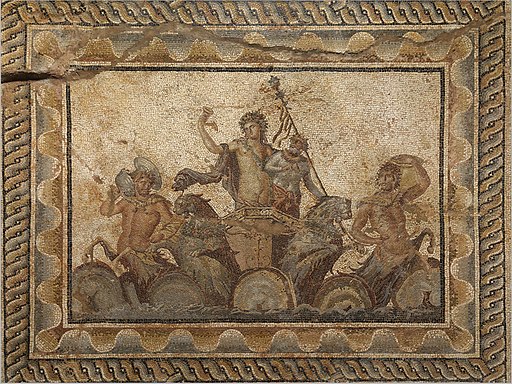
Using funds from the Onassis Foundation, the mosaic was rehabilitated and relocated to a specially designed, environmentally-secure building.
The Onassis Foundation’s narration-free video above provides a peek at the process, reducing what must, at times, have been a supremely nerve-wracking 2‑year endeavor to a pleasant seven-minute meditation, punctuated by birdsong and calm, coordinated group effort.
For those who prefer a more specific blow by blow, Rion Nakaya’s The Kid Should See This breaks down the conservation team’s efforts to divide the mural along a grid using drills, flat steel blades, and adhesive fabric, before sandwiching the sections between steel and wooden plates for transport to their new home.
(We found the moment when the protective fabric is steamed away to be a particularly harrowing thrill. )
Those who’d like to explore Dion’s treasures in depth might enjoy Onassis Foundation’s exhibition catalogue Gods and Mortals at Olympus: Ancient Dion, City of Zeus, edited by the late archeologist Dimitrios Pandermalis, below.
Related Content
What Ancient Greek Music Sounded Like: Hear a Reconstruction That is ‘100% Accurate’
Introduction to Ancient Greek History: A Free Online Course from Yale
Mythos: An Animation Retells Timeless Greek Myths with Abstract Modern Designs
- Ayun Halliday is the Chief Primatologist of the East Village Inky zine and author, most recently, of Creative, Not Famous: The Small Potato Manifesto and Creative, Not Famous Activity Book. Follow her @AyunHalliday.
Read More...How The Parthenon Marbles Ended Up In The British Museum
Last month, we delved into a proposal to use digital technology to clone the 2,500-year-old Parthenon Marbles currently housed in the British Museum.
The hope is that such uncanny facsimiles might finally convince museum Trustees and the British government to return the originals to Athens.
Today, we’ll take a closer look at just how these treasures of antiquity, known to many as the Elgin marbles, wound up so far afield.
The most obvious culprit is Thomas Bruce, the 7th Earl of Elgin, who initiated the takeover while serving as Britain’s ambassador to the Ottoman Empire from 1798–1803.
Prior to setting sail for this posting, he hatched a plan to assemble a documentary team who would sketch and create plaster molds of the Parthenon marbles for the eventual edification of artists and architects back home. Better yet, he’d get the British government to pay for it.
The British government, eying the massive price tag of such a proposal, passed.
So Elgin used some of his heiress wife’s fortune to finance the project himself, hiring landscape painter Giovanni Battista Lusieri — described by Lord Byron as “an Italian painter of the first eminence” — to oversee a team of draftsmen, sculptors, and architects.
As The Nerdwriter’s Evan Puschak notes above, political alliances and expansionist ambition greased Lord Elgin’s wheels, as the Ottoman Empire and Great Britain found common cause in their hatred of Napoleon.
British efforts to expel occupying French forces from Egypt generated good will sufficient to secure the requisite firman, a legal document without which Lusieri and the team would not have been given access to the Acropolis.
The original firman has never surfaced, and the accuracy of what survives — an English translation of an Italian translation — casts Elgin’s acquisition of the marbles in a very dubious light.
Some scholars and legal experts have asserted that the document in question is a mere administrative letter, since it apparently lacked the signature of Sultan Selim III, which would have given it the contractual heft of a firman.
In addition to giving the team entry to Acropolis grounds to sketch and make plaster casts, erect scaffolding and expose foundations by digging, the letter allowed for the removal of such sculptures or inscriptions as would not interfere with the work or walls of the Acropolis.
This implies that the team was to limit itself to windfall apples, the result of the heavy damage the Acropolis sustained during a 1687 mortar attack by Venetian forces.
Some of the dislodged marble had been harvested for building materials or souvenirs, but plenty of goodies remained on the ground for Elgin and company to cart off.
In an article for Smithsonian Magazine, Hellenist author Bruce Clark details how Elgin’s personal assistant, clergyman Philip Hunt, leveraged Britain’s support of the Ottoman Empire and anti-France position to blur these boundaries:
Seeing how highly the Ottomans valued their alliance with the British, Hunt spotted an opportunity for a further, decisive extension of the Acropolis project. With a nod from the sultan’s representative in Athens—who at the time would have been scared to deny a Briton anything—Hunt set about removing the sculptures that still adorned the upper reaches of the Parthenon. This went much further than anyone had imagined possible a few weeks earlier. On July 31, the first of the high-standing sculptures was hauled down, inaugurating a program of systematic stripping, with scores of locals working under Lusieri’s enthusiastic supervision.
Lusieri, whose admirer Lord Byron became a furious critic of Elgin’s removal of the Parthenon marbles, ended his days believing that his commitment to Lord Elgin ultimately cost him an illustrious career as a watercolorist.
He also conceded that the team had been “obliged to be a little barbarous”, a gross understatement when one considers their vandalism of the Parthenon during the ten years it took them to make off with half of its surviving treasures — 21 figures from East and West pediments, 15 metope panels, and 246 feet of what had been a continuous narrative frieze.
Clark notes that although Elgin succeeded in relocating them to British soil, he “derived little personal happiness from his antiquarian acquisitions.”
After numerous logistical headaches involved in their transport, he found himself begging the British government to take them off his hands when an acrimonious divorce landed him in financial straits.
This time the British government agreed, acquiring the lot for £35,000 — less than half of what Lord Elgin claimed to have shelled out for the operation.
The so-called Elgin Marbles became part of the British Museum’s collection in 1816, five years before the Greek War of Independence’s start.
They have been on continual display ever since.
The 21st-century has witnessed a number of world class museums rethinking the provenance of their most storied artifacts. In many cases, they have elected to return them to their land of origin.
Greece has long called for the Parthenon marbles in the British Museum to be permanently repatriated to Athens, but thusfar museum Trustees have refused.
In their opinion, it’s complicated.
Is it though? Lord Elgin’s ultimate motivations might have been, and Bruce Clark, in a brilliant ninja move, suggests that the return could be viewed as a positive stripping away, atonement by way of getting back to basics:
Suppose that among his mixture of motives—personal aggrandizement, rivalry with the French and so on—the welfare of the sculptures actually had been Elgin’s primary concern. How could that purpose best be served today? Perhaps by placing the Acropolis sculptures in a place where they would be extremely safe, extremely well conserved and superbly displayed for the enjoyment of all? The Acropolis Museum, which opened in 2009 at the foot of the Parthenon, is an ideal candidate; it was built with the goal of eventually housing all of the surviving elements of the Parthenon frieze…. If the earl really cared about the marbles, and if he were with us today, he would want to see them in Athens now.
Related Content
The Metropolitan Museum of Art Restores the Original Colors to Ancient Statues
John Oliver’s Show on World-Class Art Museums & Their Looted Art: Watch It Free Online
Take a Virtual Reality Tour of the World’s Stolen Art
- Ayun Halliday is the Chief Primatologist of the East Village Inky zine and author, most recently, of Creative, Not Famous: The Small Potato Manifesto and Creative, Not Famous Activity Book. Follow her @AyunHalliday.
Read More...YouTube & Arizona State University Team Up to Offer Online Courses for Real College Credits
A recent Pew Research Center survey found that nearly one in five American teenagers is on Youtube “almost constantly.” Ten years ago, the figure surely wouldn’t have been that high, and twenty years ago, of course, Youtube didn’t exist at all. But today, no enterprise directed at teenagers can afford to ignore it: that goes for pop music and fashion, of course, but also for education. Most kids just starting college are on Youtube, but so are those about to start college, those taking time off from college, and those unsure of whether they’re willing or able to go to college at all. Hence College Foundation, a new extension of Youtube channel Study Hall, the product of a partnership between Arizona State University, YouTube and Crash Course.
Crash Course has long produced video series that, both entertainingly and at length, cover subjects taught in school from history to literature to philosophy and beyond. The College Foundation’s program will make it possible not just to learn on Study Hall, but to earn real college credits as well.
“Students who are interested in formal coursework beyond watching the videos may pay a $25 fee to enroll in an ASU online course that includes interacting with other students and instructors,” writes Inside Higher Education’s Susan D’Agostino. Upon completion of the course, “the student can decide whether they would like to pay $400 to record the grade and receive ASU credit.”
Enrollment is now open for the first four College Foundations courses, English Composition, College Math, U.S. History and Human Communication, all of which begin on March 7th. (Those who sign up before that start date will receive a $50 discount.) “Once you’re in a course, you can contact a success coach via email to get help with assignments,” writes TechCrunch’s Aisha Malik. “You can complete your coursework when it’s convenient for you, but you will have weekly due dates for most of the courses. If you want to access additional support, some instructors hold optional office hours.” This sort of learning experience could become a bridge to Youtube life and college life — the latter being the subject addressed, with characteristic Youtube directness, in the existing Study Hall course “How to College.”
Related content:
1,700 Free Online Courses from Top Universities
A Crash Course in World History
A Crash Course on Psychology: A 30-Part Video Series from Hank Green
Crash Course Big History: John Green Teaches Life, the Universe & Everything
Based in Seoul, Colin Marshall writes and broadcasts on cities, language, and culture. His projects include the Substack newsletter Books on Cities, the book The Stateless City: a Walk through 21st-Century Los Angeles and the video series The City in Cinema. Follow him on Twitter at @colinmarshall or on Facebook.
Read More...What People Named Their Cats in the Middle Ages: Gyb, Mite, Méone, Pangur Bán & More
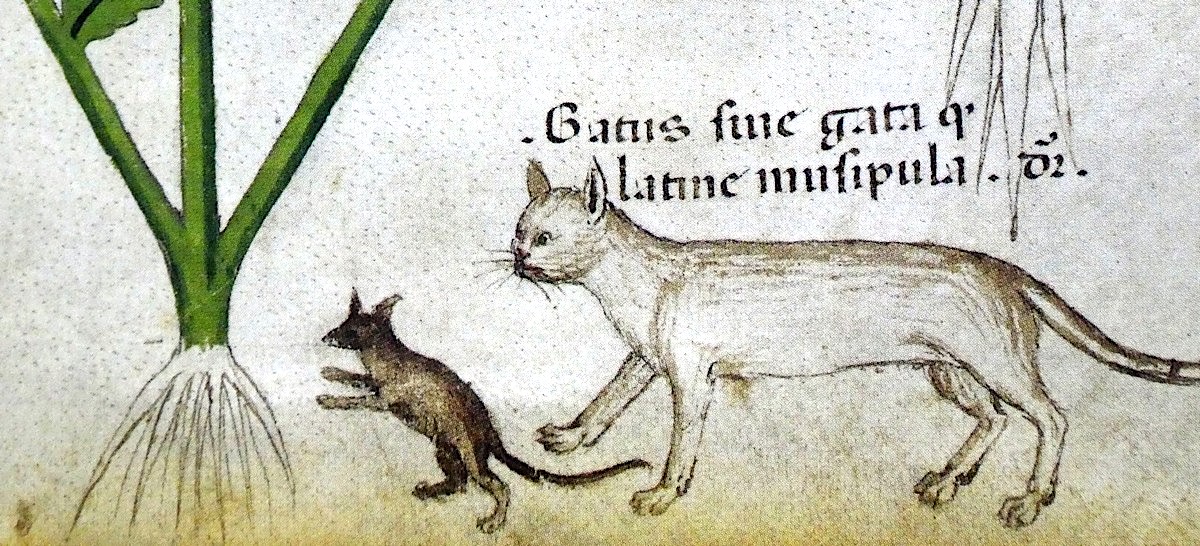
“The Naming of Cats is a difficult matter,” declares the opening poem in Old Possum’s Book of Practical Cats by T. S. Eliot. But the possibilities are many and varied: “Peter, Augustus, Alonzo or James”; “Plato, Admetus, Electra, Demeter”; “Munkustrap, Quaxo, or Coricopat.” Things must have been less complicated in the Middle Ages, when you could just call a cat Gyb and be done with it. “The shortened form of the male name Gilbert, Gyb” explains Kathleen Walker-Meikle in Medieval Cats, dates as “a popular name for individual pet cats” at least back to the late fourteenth century.
In a slightly different form, the name even appears in Shakespeare, when Falstaff describes himself as “as melancholy as a gib cat.” Gyb’s equivalent across the Chanel was Tibers or Tibert; the sixteenth-century French poet Joachim du Bellay kept a “beloved gray cat” named Belaud.
Legal texts reveal that the Irish went in for “cat names that refer to the animal’s physical appearance,” like Méone (“little meow”), Cruibne (“little paws”), and Bréone (“little flame”). Walker-Meikle also highlights Pangur Bán, a cat “immortalized in a ninth-century poem by an Irish monk.” This hymn to the parallel skills of human and feline begins, in Seamus Heaney’s English translation, as follows:
Pangur Bán and I at work,
Adepts, equals, cat and clerk:
His whole instinct is to hunt,
Mine to free the meaning pent.
Frequent Open Culture readers may be reminded of the twelfth-century Chinese poet who wrote of being domesticated by his own cats, verses we featured here a few years ago. More recently, we put up a list of 1,065 Medieval dog names, which run the gamut from Garlik, Nosewise, and Hosewife to Hornyball, Argument, and Filthe. You’ll notice that the names given to dogs in the Middle Ages seem to have been more amusing, if less dignified, than the ones given to cats. Perhaps this reflects the strong, clearly centuries-and-centuries-old differences between the natures of the animals themselves, each with its own strengths and weaknesses. But whatever our preferences in that area, who among us couldn’t do with a Pangur Bán of our own?
Related content:
A List of 1,065 Medieval Dog Names: Nosewise, Garlik, Havegoodday & More
Cats in Medieval Manuscripts & Paintings
Cats in Japanese Woodblock Prints: How Japan’s Favorite Animals Came to Star in Its Popular Art
T. S. Eliot Reads Old Possum’s Book of Practical Cats & Other Classic Poems (75 Minutes, 1955)
In 1183, a Chinese Poet Describes Being Domesticated by His Own Cats
Based in Seoul, Colin Marshall writes and broadcasts on cities, language, and culture. His projects include the Substack newsletter Books on Cities, the book The Stateless City: a Walk through 21st-Century Los Angeles and the video series The City in Cinema. Follow him on Twitter at @colinmarshall or on Facebook.
Read More...The Brooklyn Public Library Gives Every Teenager in the U.S. Free Access to Censored Books
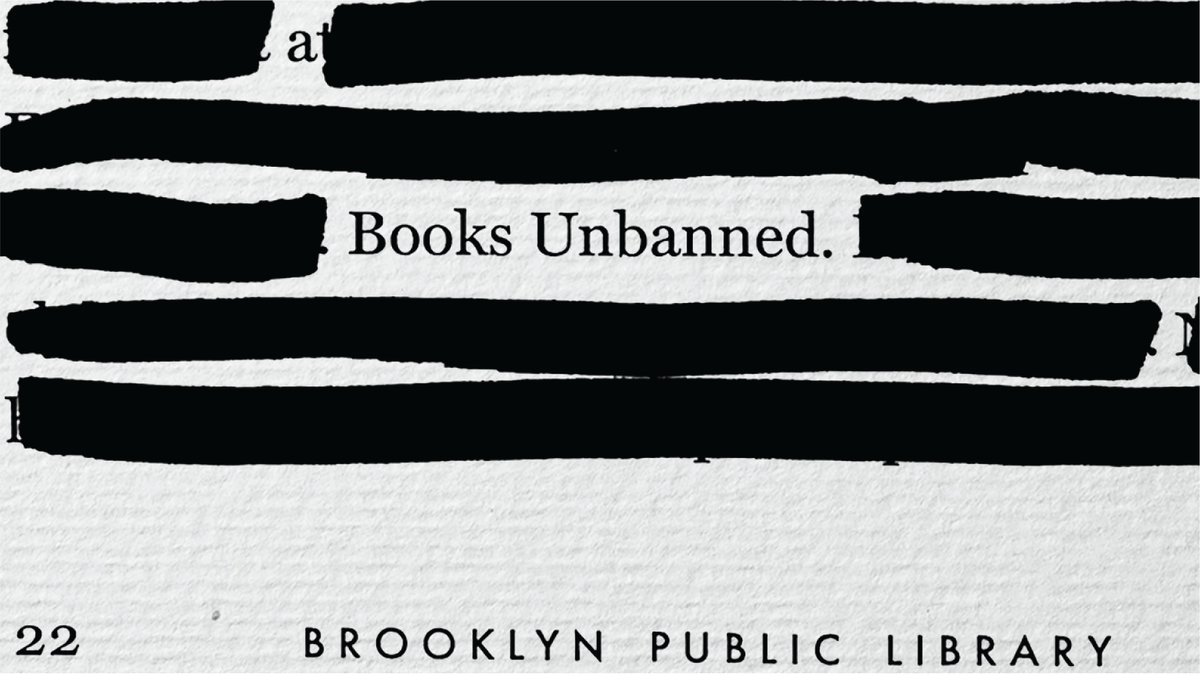
We have covered it before: school districts across the United States are increasingly censoring books that don’t align with conservative, white-washed visions of the world. Art Spiegelman’s Maus, The Illustrated Diary of Anne Frank, Alice Walker’s The Color Purple, Toni Morrison’s The Bluest Eye, and Harper Lee’s To Kill a Mockingbird–these are some of the many books getting pulled from library shelves in American schools. In response to this concerning trend, the Brooklyn Public Library has made a bold move: For a limited time, the library will offer a free eCard to any person aged 13 to 21 across the United States, allowing them free access to 500,000 digital books, including many censored books. The Chief Librarian for the Brooklyn Public Library, Nick Higgins said:
A public library represents all of us in a pluralistic society we exist with other people, with other ideas, other viewpoints and perspectives and that’s what makes a healthy democracy — not shutting down access to those points of view or silencing voices that we don’t agree with, but expanding access to those voices and having conversations and ideas that we agree with and ideas that we don’t agree with.
And he added:
This is an intellectual freedom to read initiative by the Brooklyn Public Library. You know, we’ve been paying attention to a lot of the book challenges and bans that have been taking place, particularly over the last year in many places across the country. We don’t necessarily experience a whole lot of that here in Brooklyn, but we know that there are library patrons and library staff who are facing these and we wanted to figure out a way to step in and help, particularly for young people who are seeing, some books in their library collections that may represent them, but they’re being taken off the shelves.
As for how to get the Brooklyn Public Library’s free eCard, their Books Unbanned website offers the following instructions: “individuals ages 13–21 can apply for a free BPL eCard, providing access to our full eBook collection as well as our learning databases. To apply, email bo***********@**********ry.org.” In short, send them an email.
You can find a list of America’s most frequently banned books at the website of the American Library Association.
Note: We first posted about this initiative during the dog days of last August. But it seemed worth mentioning this program while school’s in full swing. Hence why we’re flagging Books Unbanned again.
If you would like to support the mission of Open Culture, consider making a donation to our site. It’s hard to rely 100% on ads, and your contributions will help us continue providing the best free cultural and educational materials to learners everywhere. You can contribute through PayPal, Patreon, and Venmo (@openculture). Thanks!
Related Content
Texas School Board Bans Illustrated Edition of The Diary of Anne Frank
The 850 Books a Texas Lawmaker Wants to Ban Because They Could Make Students Feel Uncomfortable
Umberto Eco Makes a List of the 14 Common Features of Fascism
Read More...Why We All Need Subtitles Now
We live in an age of subtitles. On some level this is a vindication of the cinephiles who spent so much of the twentieth century complaining about shoddy dubbing of foreign films and public unwillingness to “read movies.” Today we think nothing of reading not just movies but television shows as well, even those performed in our native language. For an increasing proportion of at-home viewers — including on-computer, on-tablet, and on-phone viewers — subtitles have come to feel like a necessity, even in the absence of any hearing difficulties. Vox’s Edward Vega investigates why this has happened in the video above.
The chief irony of the story is that the intelligibility of film and television dialogue seems to have degraded as a result of sound recording and editing technology having improved. Back in the early days of sound film, actors had practically to shout into bulky microphones concealed on-set or placed just off it. Today, a production can keep a couple of boom mics suspended overhead at all times, but also rig each actor up with a few hidden lavaliers. The upshot is that dialogue almost always gets recorded acceptably, but it removes the pressure on performers to deliver their lines with the clarity they would, say, on stage.
For better or for worse, this has encouraged a tendency toward unprecedentedly naturalistic dialogue, manifest though it often does as slurring and mumbling. At the same time, says dialogue editor Austin Olivia Kendrick, filmmakers have come to believe that “if you want your movie to feel ‘cinematic,’ you have to have wall-to-wall bombastic, loud sound.” Yet a soundtrack can be cranked up only so high, an explosion of the same loudness as a human voice won’t sound like an explosion at all: “you need that contrast in volume in order to give your ear a sense of scale.”
This need to preserve the sound mix’s “dynamic range” — just the opposite of the “loudness wars” in popular music — thus keeps dialogue on the quiet side. You can still hear it clear as day in a theater equipped with up-to-date surround-sound facilities, but much less so when it’s coming out of the tiny speakers crammed into the back of a flat-panel television, let alone the bottom of a cellphone. Turning the subtitles on and leaving them on has emerged as a common solution to this thoroughly modern problem. Another would be to invest in a proper high-end amplifier and speaker setup, which, if widely adopted, would certainly come as a vindication for all the frustrated audiophiles out there.
Related content:
Why Do People Talk Funny in Old Movies?, or The Origin of the Mid-Atlantic Accent
How the Sounds You Hear in Movies Are Really Made: Discover the Magic of “Foley Artists”
Based in Seoul, Colin Marshall writes and broadcasts on cities, language, and culture. His projects include the Substack newsletter Books on Cities, the book The Stateless City: a Walk through 21st-Century Los Angeles and the video series The City in Cinema. Follow him on Twitter at @colinmarshall or on Facebook.
Read More...Adapting the Unfilmable Story of Pinnochio — Pretty Much Pop: A Culture Podcast #143
Your Pretty Much Pop A‑Team Mark Linsenmayer, Lawrence Ware, Sarahlyn Bruck, and Al Baker discuss the original 1883 freaky children’s story by Carlo Collodi and consider the recent rush of film versions, from a new Disney/Robert Zemikis CGI take to Guillermo del Toro’s stop-motion passion project to a heavily costumed Italian version by Matteo Garrone, which is the second to feature Oscar winner Roberto Benigni in a lead role. Benigni’s previous try was a 2002 version that is the most true to the beats of the original story and maybe because of this has a 0% on Rotten Tomatoes. Why do people keep remaking this story, and how has the original moral of “be a good boy and obey” changed over the years?
Read the original story. Some articles going through the film versions include:
- “The twisted history of Pinocchio on screen” by Cindy White
- “Pinocchio: Top 10 Best Movie And TV Adaptations, Ranked by IMDb” by Olivia Hayward
- “Pinocchios, Ranked” by Barry Levitt
- “The Transformations of Pinocchio” by Joan Acocella
- “Pinocchio: The scariest children’s story ever written” by Nicholas Barber
Follow us @law_writes, @sarahlynbruck, @ixisnox, @MarkLinsenmayer.
Hear more Pretty Much Pop. Support the show and hear bonus talking for this and nearly every other episode at patreon.com/prettymuchpop or by choosing a paid subscription through Apple Podcasts. This podcast is part of the Partially Examined Life podcast network.
Pretty Much Pop: A Culture Podcast is the first podcast curated by Open Culture. Browse all Pretty Much Pop posts.
Read More...Medieval Mixed-Gender Fight Club: Behold Images from a 15th-Century Fighting Manual
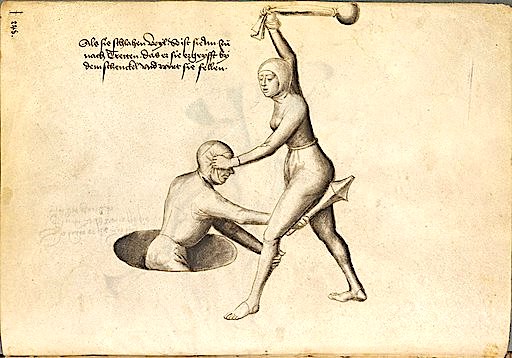
Welcome to Medieval Mixed-Gender Fight Club.
The first rule of Medieval Mixed-Gender Fight Club is: you do not talk about Medieval Mixed-Gender Fight Club.
The second rule of Medieval Mixed-Gender Fight Club is: you DO NOT talk about Medieval Mixed-Gender Fight Club!
Why?
The Public Domain Review’s managing editor, Hunter Dukes, wisely argues that it’s because we have so little to go on, beyond these startling images of “judicial duels” between men and women in German fencing master Hans Talhoffer’s illustrated 15th-century “fight books.”
The male combatant, armed with a wooden mace, starts out in a waist-deep hole.
The female, armed with a rock wrapped in a length of cloth, stands above, feet planted to the ground.
Their matching unisex garments wouldn’t look out of place at the Met Gala, and provide for maximum movement as evidenced by the acrobatic, and seriously painful-looking paces Talhoffer puts them through.
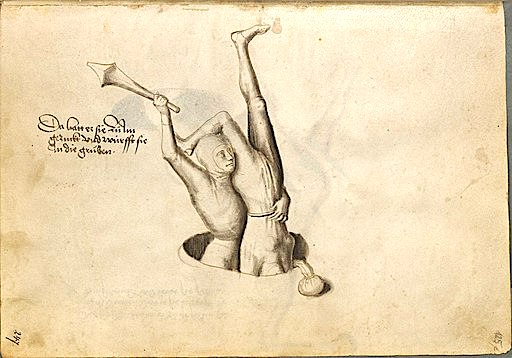
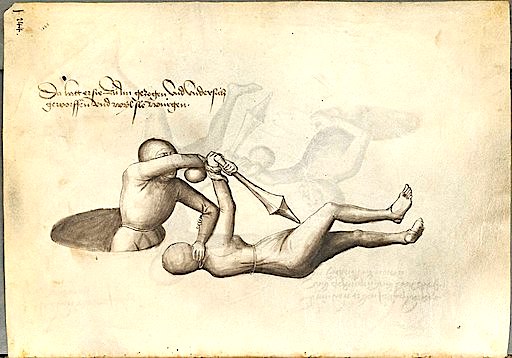
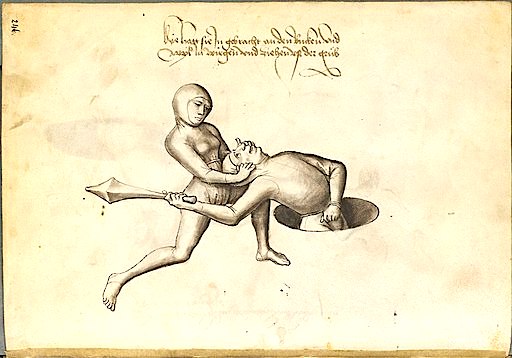
Dukes is not alone in wondering what’s going on here, and he doesn’t mince words when calling bullshit on those responsible for “hastily researched articles” eagerly pronouncing them to be action shots of divorce-by-combat.
Such brutal methods of formal uncoupling had been rendered obsolete centuries before Talhoffer began work on his instructional manuals.
In a 1985 article in Source: Notes in the History of Art, Allison Coudert, a professor of Religious Studies at UC Davis, posits that Talhoffer might have been drawing on the past in these pages:
I would suggest that no records of judicial duels between husbands and wives exists after 1200 because of both changes in the reality and the ideal of what a woman could be and do. Before 1200, women may well have battled their husbands. Women understood and defended the importance of their economic and administrative roles in the household. After the twelfth century, however, law, custom and religion made marital duels all but unthinkable.
Why would Talhoffer bother including archaic material if the focus of his Fechtbuchs was giving less experienced fighters concrete information for their betterment?
We like the notion that he might have been seeking to inject his manuscripts with a bit of an erotic charge, but concede that scholars like Coudert, who have PhDs, research chops, and actual expertise in the subject, are probably warmer when reckoning that he was just covering his historical bases.
For now, let us enjoy these images as art, and possible sources of inspiration for avant-garde circus acts, Halloween couples costumes, and Valentines.
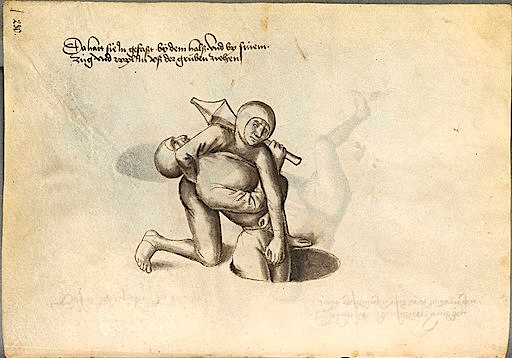
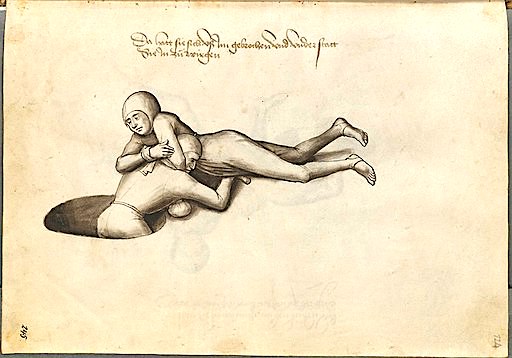
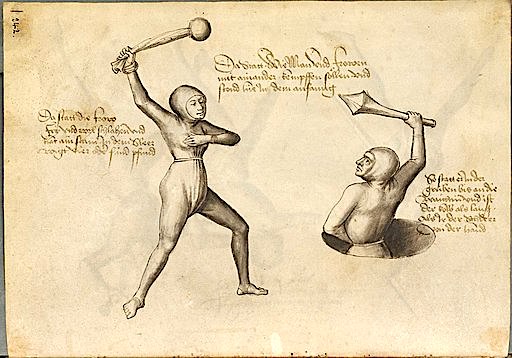
Explore more images from the 15th-century Fechtbuchs of Hans Talhoffer here and here.
Related Content
What It’s Like to Actually Fight in Medieval Armor
How to Get Dressed & Fight in 14th Century Armor: A Reenactment
The Medieval Masterpiece, the Book of Kells, Is Now Digitized & Put Online
- Ayun Halliday is the Chief Primatologist of the East Village Inky zine and author, most recently, of Creative, Not Famous: The Small Potato Manifesto and Creative, Not Famous Activity Book. Follow her @AyunHalliday.
Read More...When Leonard Bernstein Turned Voltaire’s Candide into an Opera (with Help from Lillian Hellman, Dorothy Parker & Stephen Sondheim)
The seventeen-fifties found Western civilization in the middle of its Age of Enlightenment. That long era introduced on a large scale the notion that, through the use of rationality and scientific knowledge, humanity could make progress. For the Enlightenment’s true believers, it would have eventually become quite easy indeed to assume that we had nowhere to go but up, and would sooner or later attain a state of perfection. No such fantasies, of course, for Jean-Marie Arouet, better known as Voltaire. Despite being an Enlightenment icon, he pulled no punches in attacking what he saw as its delusions, most lastingly in his 1759 satirical novel Candide, ou l’Optimisme.
Two centuries later, Western civilization, and especially the freshly formed civilization of the United States of America, had entered a new age of reason. Or rather, it had entered an age of technical, industrial, and organizational “know-how.”
The conviction that America could be perfected through engineered systems played its part in generating a degree of prosperity the world had never known (and would have scarcely been imaginable in Voltaire’s day). But it also had grimmer manifestations, such as McCarthyism and the House Un-American Activities Committee, whose procedures ground away at the core of the anti-Communist “red scare.”
In Candide, Voltaire takes to task a variety of not just beliefs but institutions, including the Portuguese Inquisition. The playwright Lillian Hellman, who’d been blacklisted after appearing before the HUAC in 1947, “observed a sinister parallel between the Inquisition’s church-sponsored purges and the ‘Washington Witch Trials,’ fueled by anti-Communist hysteria.” So says the web site of Leonard Bernstein, Hellman’s collaborator on what would become a comic-operetta adaptation of Candide. With contributions from lyricist John LaTouche, poet Richard Wilbur, and Algonquin Round Table wit Dorothy Parker, their production was ready to open in the fall of 1956.
Stripped in the eleventh hour of Hellman’s most direct topical attacks, and even then criticized for over-seriousness, the original Broadway production of Candide ended after 73 performances. (Recordings of the original production can be purchased online.) Nevertheless, there was cause for optimism about its future: the show would be revived in London with a revised book two years later, with further new versions to follow in the nineteen-seventies and eighties, its lyrics supplemented by no less a Broadway master than Stephen Sondheim. The two-and-a-half hour video above combines highlights of two consecutive performances in 1989, conducted by Bernstein himself in the year before his death. “Like its hero, Candide is perhaps destined never to find its perfect form and function,” notes Bernstein’s site. “In the final analysis, however, that may prove philosophically appropriate.”
Related content:
An Animated Introduction to Voltaire: Enlightenment Philosopher of Pluralism & Tolerance
Based in Seoul, Colin Marshall writes and broadcasts on cities, language, and culture. His projects include the Substack newsletter Books on Cities, the book The Stateless City: a Walk through 21st-Century Los Angeles and the video series The City in Cinema. Follow him on Twitter at @colinmarshall or on Facebook.
Read More...The Two Fridas: An Introduction to Frida Kahlo’s Famous Large-Scale Painting (1939)
One can appreciate the art of Frida Kahlo while knowing nothing of the art of her onetime husband, the Mexican muralist Diego Rivera. But the experience of certain of her paintings can be greatly enriched by some knowledge of their relationship, the clearest example being The Two Fridas, which Kahlo painted in 1939 after their divorce. The largest of her numerous self-portraits, it presents the artist as a set of doppelgängers set apart by their attire: one wears a European dress, and the other a traditional Mexican one. The resulting tableau could, on one level, reflect her dual heritage; it also, as Kahlo herself put it, shows “the Frida Diego loved, and the one he didn’t.”
The Two Fridas is the subject of the video essay above from Great Art Explained. “The darker-skinned Frida on the right is the indigenous Mexican Frida that was adored by her husband,” explains its host, gallerist James Payne.
“The lighter-skinned Frida on the left is the European Frida that he rejected.” Presenting herself in the former fashion “sent a clear message of cultural identity, nationalism, and feminism” — but it also concealed the “broken body” that resulted from a bus crash in her youth as well as various other physical disorders later in life. This portrait, however, exposes the heart of “Mexican Frida” in order to show that it “remains intact, sustained by the small portrait of Diego” in her hand.
The heart of “European Frida,” however, is rendered as “disconnected from her beloved Diego,” and it “bleeds profusely onto her dress, a Victorian lace dress similar to the one her mother wore.” The two Fridas are connected through their exposed hearts by a single artery, one connected to the portrait of Rivera. Payne points out the particular symbolic power of a bleeding heart, a “fundamental symbol of Catholicism” that “can also be seen as symbolic of Aztec ritual sacrifice,” in the case of a culturally conflicted artist such as Kahlo. In retrospect, The Two Fridas also seems to express the inevitability of Kahlo and Rivera’s remarriage, which would come the following year. They had “one of the most obsessive and tumultuous relationships in art history,” as Payne puts it, but while both lived, they knew they couldn’t do without each other.
Related content:
Frida Kahlo: The Life of an Artist
A Brief Animated Introduction to the Life and Work of Frida Kahlo
The Intimacy of Frida Kahlo’s Self-Portraits: A Video Essay
Home Movies of Frida Kahlo (and a Side Order of Romantic Entanglements)
Based in Seoul, Colin Marshall writes and broadcasts on cities, language, and culture. His projects include the Substack newsletter Books on Cities, the book The Stateless City: a Walk through 21st-Century Los Angeles and the video series The City in Cinema. Follow him on Twitter at @colinmarshall or on Facebook.
Read More...Support Us
We're hoping to rely on loyal readers, rather than erratic ads. Please click the Donate button and support Open Culture. You can use Paypal, Venmo, Patreon, even Crypto! We thank you!

About Us

Open Culture scours the web for the best educational media. We find the free courses and audio books you need, the language lessons & educational videos you want, and plenty of enlightenment in between.
Advertise With Us
FREE UPDATES!
GET OUR DAILY EMAIL
Get the best cultural and educational resources on the web curated for you in a daily email. We never spam. Unsubscribe at any time.
FOLLOW ON SOCIAL MEDIA
Open Culture editor Dan Colman scours the web for the best educational media. He finds the free courses and audio books you need, the language lessons & movies you want, and plenty of enlightenment in between.
Advertise With Us

