The Futurist Architectural Designs Created by Étienne-Louis Boullée in the 18th Century
If a painter is ahead of his time, his work won’t sell particularly well while he’s alive. If an architect is ahead of his time, his work probably won’t exist at all — not in built form, at least. Such was the case with Étienne-Louis Boullée, who constructed few projects in the eighteenth century in which he lived, almost none of which remain standing today. The best Boullée devotees can do for a site of pilgrimage is the Hôtel Alexandre in Paris’ eighth arrondissement, which, though handsome enough, doesn’t quite offer a sense of why he would have devotees in the first place. To understand that, one must look to Boullée’s unbuilt works, the most notable of which are introduced in the video from Kings and Things above.
“Paper architect” identifies a member of the profession who may design structures prolifically but seldom, if ever, builds them. It is not a desirable label, especially in its implication of willful impracticality (even by architectural standards). But as practiced by Boullée, paper architecture became an art form unto itself: he left behind not just an extensive essay on his art, but voluminous drawings that envision a host of neoclassical buildings as ambitious in his time as they were unfashionable — and often, due to their sheer size, unbuildable.
These included an updated colosseum, a spherical cenotaph for Isaac Newton taller than the Great Pyramids of Giza, a basilica meant to give its beholders an impression of the universe itself, a royal library of near-Borgesian proportions, and even an actual Tower of Babel.
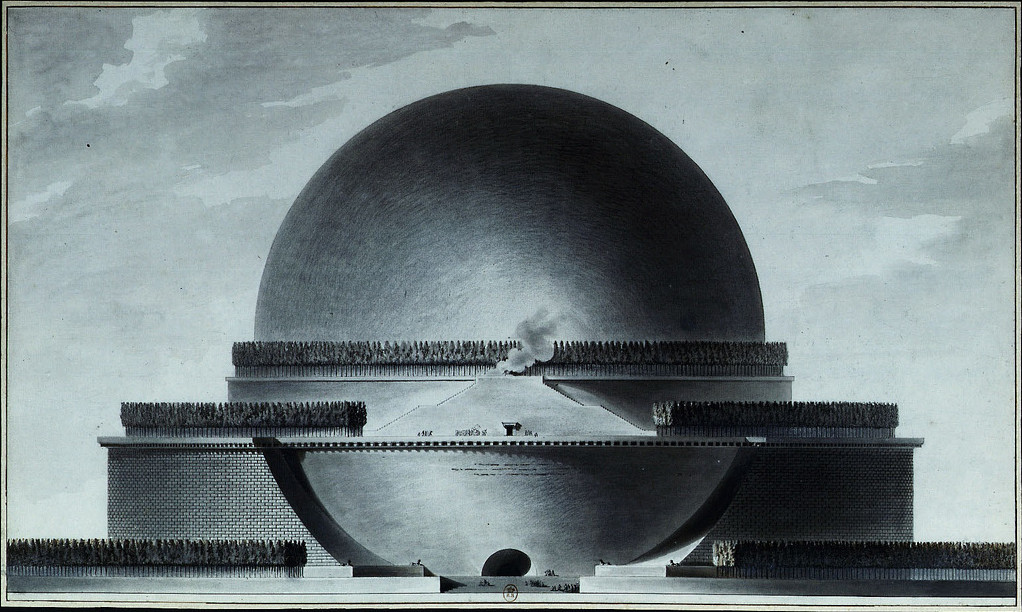
For Boullée, bigger was better, an idea that would sweep global architecture a century and a half after his death. By the mid-twentieth century, the world had also come to accept a Boullée-like preference for minimal ornamentation as well as his conception of what his contemporaries jokingly termed architecture parlante: that is, buildings that “speak” about their purpose visually, and in no uncertain terms. (You can hear more about it in the video below, a segment by professor Erika Naginski from Harvard’s online course “The Architectual Imagination.”) When Boullée designed a Palace of Justice, he placed a courthouse directly over a jailhouse, articulating “one enormous metaphor for crime overwhelmed by the weight of justice.” This may have been a bit much even for the new French Republic, but for those who appreciated Boullée’s work, it pointed the way to the architecture of the future — a future we would later call modern.
via Aeon
Related content:
What Makes Paris Look Like Paris? A Creative Use of Google Street View
The Creation & Restoration of Notre-Dame Cathedral, Animated
Why Do People Hate Modern Architecture?: A Video Essay
How to Draw Like an Architect: An Introduction in Six Videos
Based in Seoul, Colin Marshall writes and broadcasts on cities, language, and culture. His projects include the Substack newsletter Books on Cities, the book The Stateless City: a Walk through 21st-Century Los Angeles and the video series The City in Cinema. Follow him on Twitter at @colinmarshall or on Facebook.
Read More...
An Exhilarating ASL Performance of Rihanna’s Super Bowl Halftime Show
Before Super Bowl LVII fades too far into the background (being an Eagles fan, it can’t fade fast enough for me), it’s worth flagging this great ASL performance of Rihanna’s Super Bowl Halftime Show. Above, you can watch Justina Miles, a nursing student at HBCU Bowie State University, become “the first female deaf performer for the Super Bowl’s halftime show,” notes CNBC. Before this, Miles went viral when her ASL performance of Lil’ Kim’s “Crush on You” exploded on TikTok. As one commenter noted on YouTube, this may be the best Super Bowl performance since Prince.
If you would like to support the mission of Open Culture, consider making a donation to our site. It’s hard to rely 100% on ads, and your contributions will help us continue providing the best free cultural and educational materials to learners everywhere. You can contribute through PayPal, Patreon, and Venmo (@openculture). Thanks!
Related Content
“Alexander Hamilton” Performed with American Sign Language
Read More...Archaeologists May Have Discovered a Secret Language in Lascaux & Chauvet Cave Paintings, Perhaps Revealing a 20,000-Year-Old “Proto-Writing” System

Care to take a guess what your smart phone has in common with Paleolithic cave paintings of Lascaux, Chauvet and Altamira?
Both can be used to track fertility.
Admittedly, you’re probably not using your phone to stay atop the reproductive cycles of reindeer, salmon, and birds, but such information was of critical interest to our hunter-gatherer ancestors.
Knowing how crucial an understanding of animal behavior would have been to early humans led London-based furniture conservator Ben Bacon to reconsider what purpose might have been served by non-figurative markings — slashes, dots, and Y‑shapes — on the cave walls’ 20,000-year-old images.
Their meaning had long eluded esteemed professionals. The marks seemed likely to be numeric, but to what end?
Bacon put forward that they documented animal lives, using a lunar calendar.

The amateur researcher assembled a team that included experts from the fields of mathematics, archeology, and psychology, who analyzed the data, compared it to the seasonal behaviors of modern animals, and agreed that the numbers represented by the dots and slashes are not cardinal, but rather an ordinal representation of months.
As Bacon told All Things Considered his fellow self-taught anthropological researcher, science journalist Alexander Marshack, came close to cracking the code in the 1970s:
… but he wasn’t actually able to demonstrate the system because he thought that these individual lines were days. What we did is we said, actually, they’re months because a hunter-gatherer doesn’t need to know what day a reindeer migrates. They need to know what month the reindeer migrates. And once you use these months units, this whole system responds very, very well to that.
As to the frequently occurring symbol that resembles a Y, it indicates the months in which various female animal birthed their young. Bacon and his team theorize in the Cambridge Archeological Journal that this mark may even constitute “the first known example of an ‘action‘ word, i.e. a verb (‘to give birth’).
Taken together, the cave paintings and non-figurative markings tell an age-old circular tale of the migration, birthing and mating of aurochs, birds, bison, caprids, cervids, fish, horses, mammoths, and rhinos … and like snakes and wolverines, too, though they were excluded from the study on basis of “exceptionally low numbers.”

Early humans were able to log months by observing the moon, but how could they tell when a new year had begun, essential information for anyone seeking to arrange their lives around their prey’s previously documented activities?
Bacon and his peers, like so many poets and farmers, look to the rites of spring:
The obvious event is the so-called ‘bonne saison’, a French zooarchaeological term for the time at the end of winter when rivers unfreeze, the snow melts, and the landscape begins to green.
Read the conclusions of their study here.
Related Content
Algerian Cave Paintings Suggest Humans Did Magic Mushrooms 9,000 Years Ago
Was a 32,000-Year-Old Cave Painting the Earliest Form of Cinema?
40,000-Year-Old Symbols Found in Caves Worldwide May Be the Earliest Written Language
- Ayun Halliday is the Chief Primatologist of the East Village Inky zine and author, most recently, of Creative, Not Famous: The Small Potato Manifesto and Creative, Not Famous Activity Book. Follow her @AyunHalliday.
Read More...
Do Movie Androids Want to Love Us or Kill Us? Pretty Much Pop: A Culture Podcast #144

Your Pretty Much Pop hosts Mark Linsenmayer, Lawrence Ware, Sarahlyn Bruck, and Al Baker talk through various ethical and narrative problems having to do with the creation of artificial life.
We all watched M3GAN and Steve Spielberg’s A.I., and also touch on After Yang, Ex Machina, Bicentennial Man, the BBC show Humans, and of course this is an element in classic sci-fi properties like Alien, Blade Runner, Star Trek, etc.
We also go on a tangent about A.I. writing academic papers.
We mention the short stories E.M. Forster’s “The Machine Stops” and Roger Zelazny’s “For a Breath I Tarry.”
Follow us @law_writes, @sarahlynbruck, @ixisnox, @MarkLinsenmayer.
Hear more Pretty Much Pop. Support the show and hear bonus talking for this and nearly every other episode at patreon.com/prettymuchpop or by choosing a paid subscription through Apple Podcasts. This podcast is part of the Partially Examined Life podcast network.
Pretty Much Pop: A Culture Podcast is the first podcast curated by Open Culture. Browse all Pretty Much Pop posts.
Read More...Older Women Come Together & Play Punk Rock: Discover The Unglamorous Music Project
Punk is not only not dead, it’s getting a fresh burst of energy, thanks to The Unglamorous Music Project, a female collective in Leicester.
In accordance with punk tradition, musical ability is not a primary concern.
Shockingly, life experience is.
With five, six, and seven decades worth, Unglamorous Music Project participants have no illusions about how women their age — with the possible exception of Patti Smith — are perceived.
Rather than content themselves with crumbs and conform to societal expectations, they are going hard in newly formed bands like The Wonky Portraits, Dada Women, BOILERS, Velvet Crisis and The Verinos, above.
“This is definitely not ‘cutesy grannies have a go at punk’ band,” BOILERS’ Allison “Fish” Dunne emphasized to The Guardian:
I’ve got no fucks to give any more about what anyone thinks of me…We write our own music and we’ve got a lot to say about everything we’re angry about. I’ve been enraged for years.
The Verinos’ 61-year-old Ruth Miller, founder of The Unglamorous Music Project, told RNZ how she tapped into an unexpectedly rich reservoir of previously unacted upon mature female musical impulse, when she mentioned her plan to form a band to the friend with whom she drank coffee and talked politics.
The friend confessed that she’d long wanted to take up the drums, and on the strength of that comment was drafted as drummer for the Verinos, after watching one instructional YouTube video.
A “really cool looking older woman” with “sticking up hair” whom Miller approached in a restaurant, asking, “Excuse me, are you in a band?” earned her place by answering “No, but I’ve always wanted to learn bass.”
I think as a woman, you hit a particular age and you think, “Well, I don’t care what anyone thinks. It’s my life, and I really want to do music again, and it doesn’t matter whether people like it or not. They don’t have to listen…”
But they do like it! It’s incredibly appealing, that idea of seeing a group of older women who are just themselves.
Miller believes that rather than paying for private lessons and concentrating on the “proper” way to play music, beginners should let go of their inhibitions and have a go at playing communally.
The principles of the Unglamorous Music Project spell it out even more explicitly:
- Choose an instrument that appeals and fits in with others
- Find helpful people to lend you stuff and support unconditionally
- Form a duo or band with other beginners straightaway
- Explore very simple rhythms and sounds
- Write your own words about your life
- Sing great tunes and backing vocals
- Play your song in a confident, cool, challenging way
- Get encouragement and applause from friends
- Start performing to audiences as soon as possible
Perhaps an unspoken principle, given the Project’s emphasis on fun, is assuming Ramones-style stage names, a la Vim, Vi, Volcano, Vixen and VeeDee Verino.
If you’re inspired to join the movement, mark your calendar for March, 8, International Women’s Day and join Miller’s Facebook group, 66 Days to your Debut.
Related Content
Four Female Punk Bands That Changed Women’s Role in Rock
How the Riot Grrrl Movement Created a Revolution in Rock & Punk
– Ayun Halliday is the Chief Primatologist of the East Village Inky zine and author, most recently, of Creative, Not Famous: The Small Potato Manifesto and Creative, Not Famous Activity Book. Follow her @AyunHalliday.
Read More...An Introduction to the World-Renowned Architect Zaha Hadid, “the Queen of the Curve”
Zaha Hadid won the Pritzker Prize, architecture’s most prestigious award, in 2004. She was then in her early fifties — practically a schoolgirl by the standards of her profession — and had only completed four buildings. Yet the Pritzker committee already suspected that she saw possibilities in the built environment, and perhaps entire dimensions, that others did not. Indeed, she would spend her remaining dozen years proving them right, as evidenced by the legacy of impressive structures she left all across the world, from the Contemporary Arts Center in Cincinnati and the BMW Central Building in Leipzig to the London Aquatics Center and the Guangzhou Opera House.
Living in Seoul, I myself have occasion every so often to pass through a Hadid building: the Dongdaemun Design Plaza, which opened in 2013. Essentially a collection of shops and exhibition spaces, it has become best known as a quasi-public gathering place full of backdrops suitable for Instagram photography.
In its size, shape, and aesthetic, the DDP stands well apart from its urban context, looking like a spaceship sent by an advanced alien civilization to colonize an old downtown garment district. In that respect it’s representative of Hadid’s work, which realizes the kind of irregular, unrelentingly curvilinear forms practically unknown in architecture before her rise to its highest level of stardom.
“In her buildings, walls are never quite vertical, floors seldom remain flat for long, and the twain meet not in ninety-degree angles but, rather, in the kinds of curves one finds in skateboard parks,” writes the New Yorker’s John Seabrook, profiling Hadid in 2009. “There is no single Hadid style, although one can detect a watermark in her buildings’ futuristic smoothness. Certain themes carry through her use of materials (glass, steel, concrete), her lines (corridors often trace flowing arabesque shapes, while roof struts make sharp Z‑shaped angles), her structures (she favors column-free spaces), and her sculptural interiors and asymmetric façades.”
Such distinctive designs — of buildings as well as of furniture, jewelry, and other consumer objects — earned Hadid the informal title of “queen of the curve.” You can learn more about her reign and its lasting influence in these two video essays, one from Curious Muse and the other from The B1M. Like all the most innovative architects, Hadid had visions realizable only with, and simultaneously influenced by, the technology of her time. “The idea is not to have any 90-degree angles,” she once said, and the development of advanced computer-aided design tools in the nineteen-nineties made that idea a reality. In pursuing that idea to its very limits, she took the most concrete of all art forms and, improbably, made it abstract.
Related content:
Why Do People Hate Modern Architecture?: A Video Essay
Based in Seoul, Colin Marshall writes and broadcasts on cities, language, and culture. His projects include the Substack newsletter Books on Cities, the book The Stateless City: a Walk through 21st-Century Los Angeles and the video series The City in Cinema. Follow him on Twitter at @colinmarshall or on Facebook.
Read More...How The Beatles Reviewed Songs Topping the Charts During the 1960s: Hear Their Takes on the Beach Boys, Ray Charles, the Byrds, Joan Baez & More
In the year 1966, “it seemed to Western youth that The Beatles knew — that they had the key to current events and were somehow orchestrating them through their records.” So writes Ian McDonald in the critical study Revolution in the Head: The Beatles’ Records and the Sixties. But some had been looking to John Lennon, Paul McCartney, George Harrison, and Ringo Starr as pop-culture oracles since they put out their first album in 1963. Unlike the youth-oriented stars who came before, they fully inhabited the roles of both performers and creators. If anyone knew how to read the zeitgeist of that decade, surely it was the Beatles.
Hence the appearance of each Beatle in Melody Maker magazine’s “Blind Date” feature, which captured its subjects’ spontaneous reactions to the singles on the charts at the moment. When Lennon sat for a Blind Date in January of 1964, he gave his verdict on songs from Manfred Mann, Gerry and the Pacemakers, Ray Charles, and Ricky Nelson — as well as the now-less-well-known Marty Wilde, Millicent Martin, and The Bruisers.
You can see the article turned into a full audiovisual production, complete with clips of the music, at the Youtube channel Yesterday’s Papers. There you can also compare its playlist to that of McCartney’s session just three years later, but on a transformed musical landscape populated by the likes of The Small Faces, Donovan, the Lovin’ Spoonful, and the Byrds.
For that last California band McCartney expresses appreciation, if also reservations about what then seemed to him their stylistic stagnation: the late David Crosby, he notes, “knows where they should be going musically.” Other than calling the then-passé Gene Pitney’s “In the Cold Light of Day” a song he’s heard “hundreds of times before, although I haven’t actually heard this record,” he keeps his assessment characteristically positive. More surprising are Starr’s harsh verdicts on the pop music of December 1964, not just the songs themselves (though the Shangri-Las’ “Leader of the Pack” notably fails to impress him), but also the judgment of the audiences they target. “Being good,” he says of the Daylighters’ “Oh Mom,” “it won’t sell.”
Of Sandra Barry’s “We Were Lovers (When The Party Began),” Starr comments that it “sounds like an Englishman trying to be American, which never works properly.” Having grown up worshiping American rock-and-roll and started their own careers anxious about being received as foreign interlopers, the Fab Four show a natural sensitivity to this transatlantic dynamic in pop music. “It’s good if it’s English, mediocre if it’s American,” says Harrison of a song before finding out that the singer is his countryman Glyn Geoffrey Ellis, better known as Wayne Fontana. “Those breaks are so British,” Lennon says of a Unit 4 + 2 single of December 1965, and he doesn’t seem to mean it as a good thing. But when McCartney calls a Kiki Dee number “British to the core” the following year, it’s hard not to hear a note of admiration.
On Yesterday’s Papers’ Blind Date playlist, you can see and hear more nineteen-sixties and seventies music reviews from Mick Jagger, Jimmy Page, Jimi Hendrix, Dusty Springfield, Frank Zappa, Brian Jones, Roger Daltrey, Eric Clapton, Roger Waters, Syd Barrett, and many other icons of twentieth-century popular music besides.
Related content:
The Kinks’ Ray Davies Reviews the Beatles’ 1966 Album Revolver; Calls It “A Load of Rubbish”
Hear the 10 Best Albums of the 1960s as Selected by Hunter S. Thompson
89 Essential Songs from The Summer of Love: A 50th Anniversary Playlist
Based in Seoul, Colin Marshall writes and broadcasts on cities, language, and culture. His projects include the Substack newsletter Books on Cities, the book The Stateless City: a Walk through 21st-Century Los Angeles and the video series The City in Cinema. Follow him on Twitter at @colinmarshall or on Facebook.
Read More...Coffee College: Everything You Wanted to Know about Coffee Making in One Lecture
No matter how much coffee you drink, you never drink the same coffee twice. Coffee-drinkers understand this instinctively, even those who only drink their coffee at home using the same beans and the same brewing process day in and day out. For even in the most controlled coffee-making conditions we can achieve in our everyday lives, variations have a way of creeping in. Endless scrutiny of those variations is all in a day’s work for someone like Matt Perger, who’s come out on or near the top of several barista championships, and who founded the online coffee-education service Barista Hustle and its associated Youtube channel.
In the channel’s most popular video by far, Perger delivers an 80-minute lecture on “advanced coffee making” at Assembly Coffee in London. After covering the adjectives used to describe the flavor of coffee in general — from “weak,” “delicate,” and “tea-like” to “luscious,” “bitter,” and “overwhelming” — he moves on to the vocabulary of extraction.
The most important stage in the coffee-making process as far as the resulting taste is concerned, extraction is accomplished by putting hot water through coffee grounds, in whichever manner and with whichever device you may choose to do it. Weaker methods of extraction result in “salty” or “vegetal” tastes, and stronger methods in “astringent” or “powdery” ones.
As in so many pursuits, the most desirable outcomes lie in the middle of the spectrum. Just how to achieve that perfectly “transparent,” “nutty,” “balanced,” and even “sweet” cup of coffee constitutes the driving professional question for Perger and baristas like him. Clearly possessed of a taste for rigor, he explains the effects of everything from the design of roasters and grinders to the techniques of brewing and pouring while citing the findings of experiments and blind taste tests — and even acknowledging when pieces of expensive coffee-making gear yield no demonstrable quantitative benefit. True coffee aficionados who have an endless appetite for this kind of talk may find themselves tempted to sign up for Barista Hustle’s online courses, but even more so to brew another cup for themselves.
Related content:
Everything You Wanted to Know About Coffee in Three Minutes
How to Make Coffee in the Bialetti Moka Pot: The “Ultimate Techique”
The Birth of Espresso: The Story Behind the Coffee Shots That Fuel Modern Life
Your Burning Questions About Coffee Answered by James Hoffmann
10 Essential Tips for Making Great Coffee at Home
Based in Seoul, Colin Marshall writes and broadcasts on cities, language, and culture. His projects include the Substack newsletter Books on Cities, the book The Stateless City: a Walk through 21st-Century Los Angeles and the video series The City in Cinema. Follow him on Twitter at @colinmarshall or on Facebook.
Read More...The Unrealized Projects of Frank Lloyd Wright Get Brought to Life with 3D Digital Reconstructions

All images here by David Romero
From the humblest home renovator to the mightiest auteur of skyscrapers, every architect shares the common experience of not building their projects. This is true even of Frank Lloyd Wright himself: in his lifetime he created 1,171 architectural works, 660 of which went unrealized. How those never-built Wright designs would have fared in the physical realm has been a topic of great interest for the architect’s generation upon generation of fans.

But one lover of Wright’s work has gone well beyond speculation, creating faithful, photorealistic 3D renderings of these nonexistent structures, a few of which you can see at the site of the Frank Lloyd Wright Foundation.
Notably, the digital artist paying such painstaking homage to this most American of all architects hails from Spain. David Romero is the creator of the site Hooked on the Past, a showcase of his various architectural renderings.

“The project started in 2018, when the Frank Lloyd Wright Foundation commissioned Romero to render some of the architect’s most ambitious works for its quarterly magazine,” writes Smithsonian’s Molly Enking. “Each series of images corresponds with a different theme — like designs related to automobiles. Most recently, Romero tackled several of Wright’s unrealized skyscraper projects for the foundation.”

Romero’s most ambitious undertaking thus far has been his rendering of Broadacre City, Wright’s design for an entire urban-rural utopia previously featured here on Open Culture. “Modeling Broadacre took me over eight months,” he tells the FLWF. “The virtual model contains more than one hundred buildings, of which all the exterior facades have been modeled, including their doors and windows. There also are one hundred ships, two hundred ‘aerotors,’ 5,800 cars, and more than 250,000 trees in the virtual model,” each made of “hundreds of thousands of three-dimensional polygons.”

Even though Wright left behind a fairly rich set of materials documenting his plans for Broadacre City, Romero had to draw from other sources both to fill out the surrounding landscape (Midwestern, por supuesto) and to create a properly “retro-futuristic” ambience. “A reference that seemed especially relevant to me was the Dymaxion Car by Buckminster Fuller,” he says, “a design that has points in common with Wright’s ideas.”

The near-fantastical Broadacre City would probably have been unbuildable at any point in history, but others would also face serious challenges today: “For example, in the Trinity Chapel Wright designed beautiful access ramps with a single constant slope throughout its path. This design, perfectly valid in 1958, would not meet today the requirements of the ADA code and the design would lose the elegance of its simplicity.”
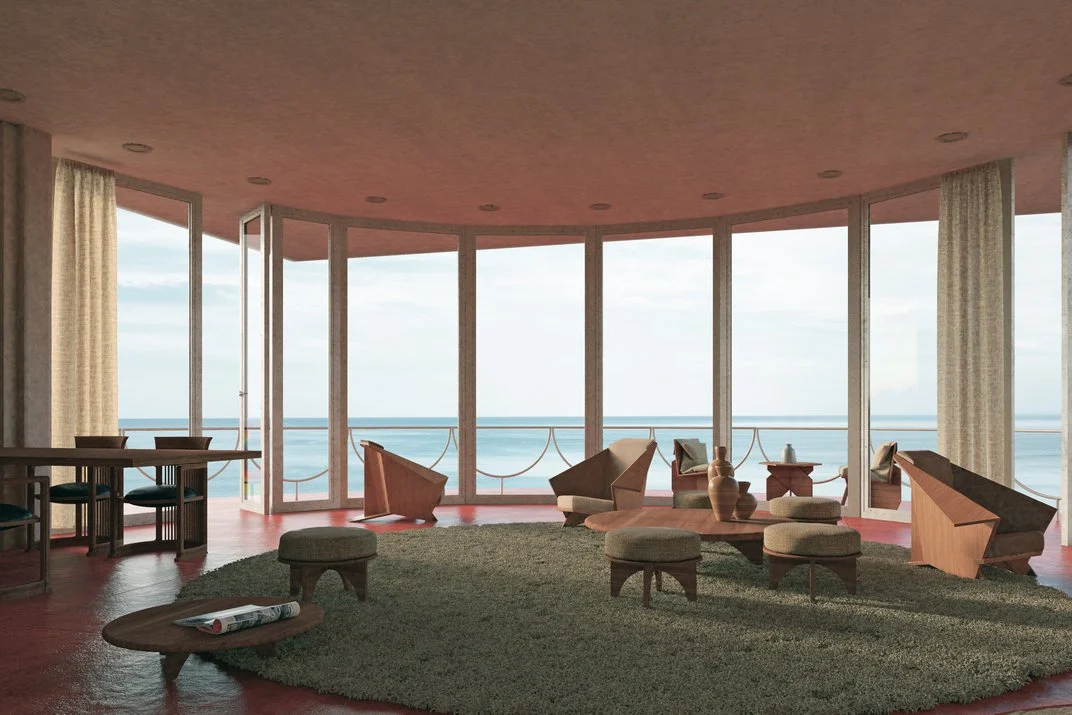
Romero has also brought to digital life a range of Wright’s other demolished or never-built projects including the Thomas C. Lea House, the Arizona Capitol Building, the Lake Tahoe Summer Colony (featuring cabins that appear to float in the water), the massive National Life Insurance Building, and the Universal Portland Cement Co. Exhibition Pavilion. Given the work Romero and his collaborators (including no few fellow enthusiasts with keen eyes for inaccurate-looking details) have put in, Frank Lloyd Wright would surely recognize more than a few of his own visions in the results — and in the project itself, something of his own ambition.

via Smithsonian Magazine/Messy Nessy
Related content:
Frank Lloyd Wright Designs an Urban Utopia: See His Hand-Drawn Sketches of Broadacre City (1932)
What Frank Lloyd Wright’s Unusual Windows Tell Us About His Architectural Genius
When Frank Lloyd Wright Designed a Doghouse, His Smallest Architectural Creation (1956)
Based in Seoul, Colin Marshall writes and broadcasts on cities, language, and culture. His projects include the Substack newsletter Books on Cities, the book The Stateless City: a Walk through 21st-Century Los Angeles and the video series The City in Cinema. Follow him on Twitter at @colinmarshall or on Facebook.
Read More...A Guided Tour Through All of Vermeer’s Famous Paintings, Narrated by Stephen Fry
It doesn’t take particularly long to be impressed by the paintings of Johannes Vermeer even today, three and a half centuries after he painted him. But an understanding of how he achieved the particular visual effects that still inspire appreciation around the world comes only after spending a bit more time with his work, ideally in the company of a more knowledgeable viewer. Starting in the spring of this year, you’ll be able to spend time with nearly all of that work — no fewer than 25 of the 34 paintings unambiguously attributed to him — at Amsterdam’s Rijksmuseum. “With loans from all over the world,” says the Rijksmuseum’s site, “this promises to be the largest Vermeer exhibition ever.”
“The Rijksmuseum’s exhibition in 2023 will include masterpieces such as The Girl with a Pearl Earring (Mauritshuis, The Hague), The Geographer (Städel Museum, Frankfurt am Main), Lady Writing a Letter with her Maid (The National Gallery of Ireland, Dublin) and Woman Holding a Balance (The National Gallery of Art, Washington DC).”
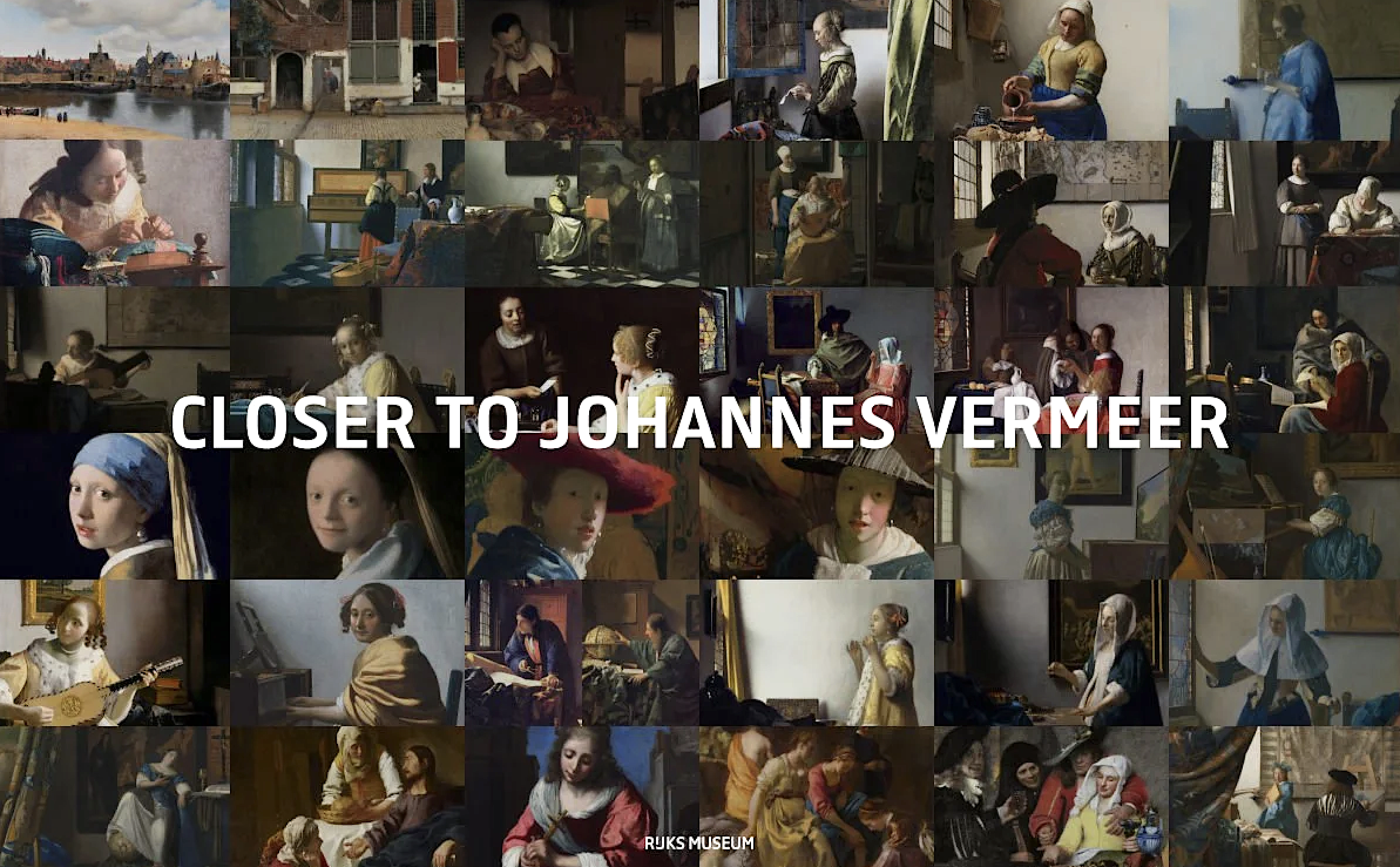
The lineup also includes “the newly restored Girl Reading a Letter at the Open Window from the Gemäldegalerie Alte Meister in Dresden” as well as the Rijksmuseum’s Milkmaid and The Little Street. Both of those last paintings figure prominently in Closer to Johannes Vermeer, a new online tour of all the artist’s famous paintings.
Here on Open Culture, we’ve previously featured a variety of online attractions offered by the Rijksmuseum, an institution eager to bring the world of the Dutch masters online. As a virtual tour guide for Closer to Johannes Vermeer it has enlisted Stephen Fry, that well-known enthusiast of not just classical art but also high technology. He provides context for the paintings and points out elements within them that we may never have noticed, noting that Vermeer achieved the effects he did by carefully putting things into his compositions, but also by even more carefully taking things out. It couldn’t have been easy for him to remove the people and objects he’d rendered with such painstaking realism, using subtle techniques to enrich their visual impact. But he’d dedicated himself to the “search for stillness,” as Fry calls it, and an artistic calling like that demands the occasional sacrifice. Enter Stephen Fry’s virtual tour here.
If you would like to support the mission of Open Culture, consider making a donation to our site. It’s hard to rely 100% on ads, and your contributions will help us continue providing the best free cultural and educational materials to learners everywhere. You can contribute through PayPal, Patreon, and Venmo (@openculture). Thanks!
Related content:
What Makes Vermeer’s The Milkmaid a Masterpiece?: A Video Introduction
Master of Light: A Close Look at the Paintings of Johannes Vermeer Narrated by Meryl Streep
Stephen Fry Takes Us Inside the Story of Johannes Gutenberg & the First Printing Press
Based in Seoul, Colin Marshall writes and broadcasts on cities, language, and culture. His projects include the Substack newsletter Books on Cities, the book The Stateless City: a Walk through 21st-Century Los Angeles and the video series The City in Cinema. Follow him on Twitter at @colinmarshall or on Facebook.
Read More...Support Us
We're hoping to rely on loyal readers, rather than erratic ads. Please click the Donate button and support Open Culture. You can use Paypal, Venmo, Patreon, even Crypto! We thank you!

About Us

Open Culture scours the web for the best educational media. We find the free courses and audio books you need, the language lessons & educational videos you want, and plenty of enlightenment in between.
Advertise With Us
FREE UPDATES!
GET OUR DAILY EMAIL
Get the best cultural and educational resources on the web curated for you in a daily email. We never spam. Unsubscribe at any time.
FOLLOW ON SOCIAL MEDIA
Open Culture editor Dan Colman scours the web for the best educational media. He finds the free courses and audio books you need, the language lessons & movies you want, and plenty of enlightenment in between.
Advertise With Us


