When a UFO Came to Japan in 1803: Discover the Legend of Utsuro-bune

For the enthusiast of unidentified flying objects, we live in interesting times indeed. Back in 2021, as we previously featured here on Open Culture, the CIA declassified and published thousands of pages of UFO-related documents. In just the past few weeks, three UFOs were shot down over North America. In the span of time between those events, much else has also occurred to stimulate the imagination of those who’ve kept watching the skies. Fascination with UFOs may have strong cultural associations with twentieth-century America — and the subject can now feel a bit passé for that reason — but it knows fewer cultural or temporal boundaries than we may think: witness, for example, the Japanese folktale of Utsuro-bune.
“In 1803, a round vessel drifted ashore on the Japanese coast and a beautiful woman emerged, wearing strange clothing and carrying a box. She was unable to communicate with the locals, and her craft was marked with mysterious writing.” Such is the premise of the legend as retold at Nippon.com, which also offers an analysis by Gifu University professor emeritus Tanaka Kazuo.
“Long before the American UFO stories, the craft depicted in Edo-period Japanese documents for some reason looked like a flying saucer,” he says. Nor have scholars traced Utsuro-bune (虚舟, which means “hollow ship”) back to only one source: to date, Tanaka “has found eleven documents relating to the Hitachi Utsuro-bune legend, of which the most interesting are thought to date from 1803, the same year that the craft was said to have come to shore.”

What exactly happened in Hitachi, a small city on Japan’s east coast, in 1803? Why do near contemporary depictions of the Utsuro-bune itself (especially in the 1835 Hyōryū kishū or “records of castaways,” as seen at the top of the post) so closely resemble modern-day visions of flying saucers? Given that the incident is held to have taken place during the country’s 265-year-long sakoku period of national isolation, no foreigner is likely to have crossed over to Japanese shores without causing a major incident. Unable to communicate with this mysterious woman, the fishermen of Hitachi are said simply to have returned her — box and all — to the hollow ship, which drifted back out to sea, never to be seen again. It was her good luck, some ufologists might say, to have turned up on Earth a century and a half before the opening of Area 51.
Related content:
The First Museum Dedicated to Japanese Folklore Monsters Is Now Open
The Appeal of UFO Narratives: Investigative Journalist Paul Beban Visits Pretty Much Pop #14
Based in Seoul, Colin Marshall writes and broadcasts on cities, language, and culture. His projects include the Substack newsletter Books on Cities, the book The Stateless City: a Walk through 21st-Century Los Angeles and the video series The City in Cinema. Follow him on Twitter at @colinmarshall or on Facebook.
Read More...3,000-Year-Old Olive Tree on the Greek Island of Crete Still Produces Olives Today

Image by Eric Nagle, via Wikimedia Commons
On the island of Crete, in the village of Vouves, stands an olive tree estimated to be 3,000 years old. Hearty and resilient, “the Olive Tree of Vouves” still bears fruit today. Because, yes, olives are apparently considered a fruit.
Archaeologist Ticia Verveer posted a picture of the tree on Twitter and noted: It “stood here when Rome burned in AD64, and Pompeii was buried under a thick carpet of volcanic ash in AD79.” That all happened during the tree’s infancy alone.
An estimated 20,000 people now visit the tree each year. If you can’t swing a trip to Crete, you can take a closer look with the video below, right around the three minute mark.
Across the Mediterranean, you can still find six other olive trees believed to be 2,000–3,000 years old–some of our last living ties to an ancient world. And beautiful ones at that.
If you would like to support the mission of Open Culture, consider making a donation to our site. It’s hard to rely 100% on ads, and your contributions will help us continue providing the best free cultural and educational materials to learners everywhere. You can contribute through PayPal, Patreon, and Venmo (@openculture). Thanks!
Related Content:
Visit Monte Testaccio, the Ancient Roman Hill Made of 50 Million Crushed Olive Oil Jugs
Read More...
Leonardo’s Lost Sketches Suggest That He Theorized Gravity Before Galileo & Newton
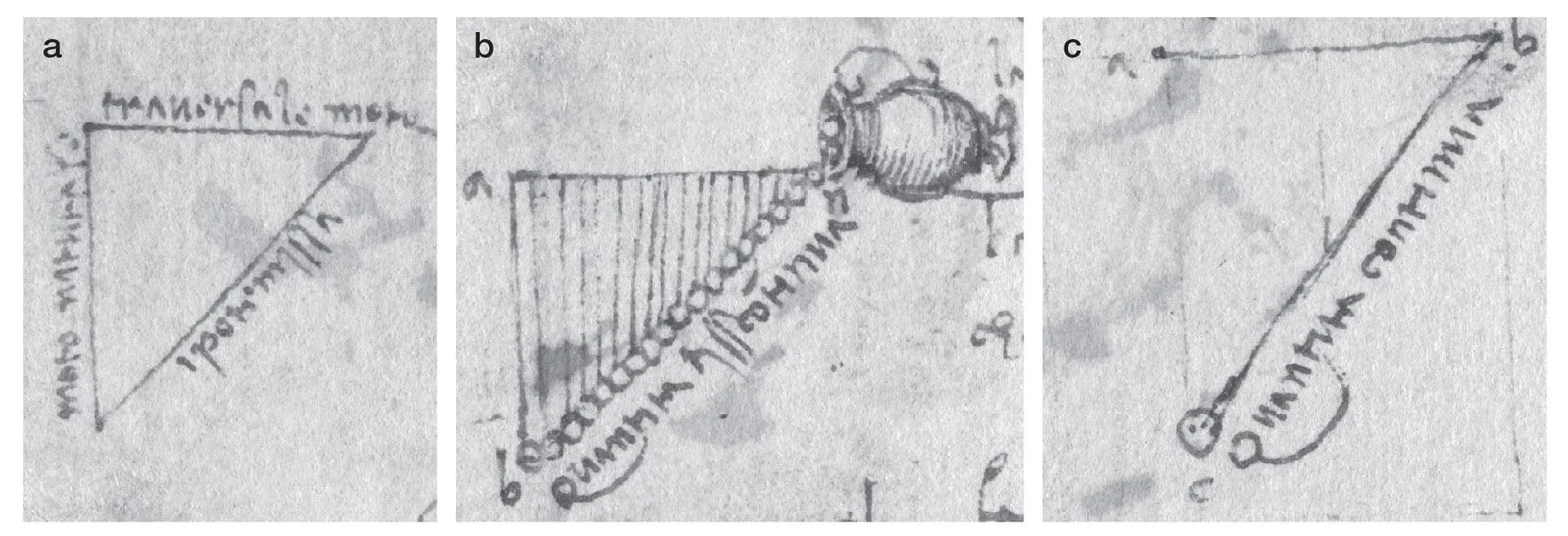
It would be clichéd to describe Leonardo da Vinci as a man ahead of his time. But in the case of the quintessential Renaissance polymath, it may well be one of those clichés firmly rooted in truth. In fact, that rooting has just grown even firmer with the discovery of a triangle that Leonardo sketched in one of his notebooks, the Codex Arundel (circa 1478–1518). That triangle, as the New York Times’ William J. Broad writes, had “an adjoining pitcher and, pouring from its spout, a series of circles that formed the triangle’s hypotenuse.” This image sounds simple, but it reveals that Leonardo approached an understanding of the laws of gravity before Galileo, and well before Newton.
This finding is the work of Morteza Gharib, a professor of aeronautics at the California Institute of Technology. Captivated by this sketch, he “used a computer program to flip the triangle and the adjacent areas of backward writing,” which clarified what Leonardo was attempting to do.
His diagram turned out “to split the effects of gravity into two parts that revealed an aspect of nature normally kept hidden.” The first part was gravity’s “natural downward pull”; the second was the movement of the pitcher itself along a line. That Leonardo drew “the pitcher’s contents falling lower and lower over time” implies his understanding that “gravity was a constant force that resulted in a steady acceleration.”

Along with co-authors Chris Roh and Flavio Noca, Gharib has published a paper on “Leonardo da Vinci’s Visualization of Gravity as a Form of Acceleration” in this month’s issue of Leonardo — an appropriately named journal in this case, though one dedicated less to the study of Leonardo the man than to the study of the intersection of art and science he occupied. As Gharib and others see it, Leonardo “was far more than an artist and suggested that his fame as a pioneering scientist could skyrocket if more technically knowledgeable experts probed the Codex Arundel and other sources” — the kind of experts who can tell that, with his pitcher and triangle, Leonardo managed to determine the strength of gravity’s pull to an accuracy of about 97 percent. Which leads us to wonder: What else about the nature of reality must he have worked out in the margins of his notebooks?
Related Content:
Leonardo da Vinci’s Visionary Notebooks Now Online: Browse 570 Digitized Pages
Leonardo da Vinci’s Elegant Design for a Perpetual Motion Machine
Based in Seoul, Colin Marshall writes and broadcasts on cities, language, and culture. His projects include the Substack newsletter Books on Cities, the book The Stateless City: a Walk through 21st-Century Los Angeles and the video series The City in Cinema. Follow him on Twitter at @colinmarshall or on Facebook.
Read More...John Waters Takes You on a Comical Tour of His Apartment (1986)
We interrupt our regularly scheduled programming to bring you this: John Water giving a tour of his 1980s apartment. Highlights of the tour include: his collection of portraits of murderesses (preferably murderesses who have since found religion), an electric chair, a witches’ broom, fake pieces of meat found in various rooms … well, you get the picture. Enjoy!
If you would like to support the mission of Open Culture, consider making a donation to our site. It’s hard to rely 100% on ads, and your contributions will help us continue providing the best free cultural and educational materials to learners everywhere. You can contribute through PayPal, Patreon, and Venmo (@openculture). Thanks!
Related Content
John Waters’ RISD Graduation Speech: Real Wealth Is Life Without A*Holes
An Anti, Anti-Smoking Announcement from John Waters
John Waters Talks About His Books and Role Models in a Whimsical Animated Video
Read More...Watch 80 Minutes of Never-Released Footage Showing the Wreckage of the Titanic (1986)
Perhaps, this past Valentine’s Day, you caught a screening of James Cameron’s Titanic, that nineteen-nineties blockbuster having been re-released for its 25th anniversary. You may have even found yourself feeling a renewed appreciation for the film’s precision-engineered mixture of Hollywood romance and technologically robust historical re-creation. As Cameron himself tells it, he and his collaborators were galvanized to reach such heights by making a series of underwater expeditions to see the wreckage of the RMS Titanic itself firsthand in 1995 — less than a decade after that most notorious of all ocean liners was rediscovered.
The Titanic vanished beneath the waves of the Atlantic Ocean on April 15, 1912. For nearly 75 years thereafter, nobody saw it again, or indeed had a clear idea of where it even was. It wasn’t until 1985 that its location was determined, thanks to a joint expedition by Jean-Louis Michel of French national oceanographic agency IFREMER and Robert Ballard of the Woods Hole Oceanographic Institution. The job necessitated the use of IFREMER’s new high-resolution sonar as well as the WHOI’s remotely controlled deep-sea vehicle Argo and its companion robot Jason, designed to take pictures and gather objects from the sea floor.
When Ballard and his crew returned to the Titanic the following year, they brought a new cast of machines with them: the deep-diving submersible DSV Alvin, the Jason’s descendant Jason Jr., and the camera system ANGUS (Acoustically Navigated Geological Underwater Survey). You can see more than 80 minutes of the footage they collected in the video at the top of the post, newly uploaded to the WHOI’s Youtube channel. This expedition marked “the first time humans set eyes on the ill-fated ship since 1912,” and most of the footage shot on it has never before been released to the public.
The video offers close-up views of the Titanic’s “rust-caked bow, intact railings, a chief officer’s cabin and a promenade window,” as NPR’s Emily Olson writes. “At one point, the camera zeroes in on a chandelier, still hanging, swaying against the current in a haunting state of elegant decay.” What’s more, “the WHOI’s newly released footage shows the shipwreck in the most complete state we’ll ever see.” Over the past 37 years, the handiwork of the world of undersea organisms have taken their toll on the Titanic, whose remains could vanish almost entirely in a manner of decades — but whose power to inspire works of art will surely go on and on.
Related content:
See the First 8K Footage of the Titanic, the Highest-Quality Video of the Shipwreck Yet
Watch the Titanic Sink in This Real-Time 3D Animation
Titanic Survivor Interviews: What It Was Like to Flee the Sinking Luxury Liner
The Titanic: Rare Footage of the Ship Before Disaster Strikes (1911–1912)
How the Titanic Sank: James Cameron’s New CGI Animation
Based in Seoul, Colin Marshall writes and broadcasts on cities, language, and culture. His projects include the Substack newsletter Books on Cities, the book The Stateless City: a Walk through 21st-Century Los Angeles and the video series The City in Cinema. Follow him on Twitter at @colinmarshall or on Facebook.
Read More...Turning the Pages of an Illuminated Medieval Manuscript: An ASMR Museum Experience
Page turning is to ASMR as the electric bass is to rock.
The Victoria and Albert Museum’s popular Autonomous Sensory Meridian Response video series (find it here) has seen episodes devoted to iconic Second Wave feminist magazines and a couple of late 20th-century pop up artist’s books, but the parchment pages of this medieval antiphonary — or choirbook — make for some truly legendary sounds.
Audio designer and performance-maker Julie Rose Bower deserves a portion of the credit for heightening the aural experience for her use of the ambisonics format.
Kudos too to National Art Library Special Collections curator Catherine Yvard…if she ever wants a break from medieval manuscript illumination and Gothic ivory sculpture, she could specialize in extremely soothing voiceover narration.
It’s rare to find such pleasurably tingly ASMR sensations paired with allusions to the somewhat barbarous process of making parchment from animal skins, but that’s what illuminator Francesco dai Libri, and his son Girolamo were working with in 1492 Verona.
Our ears may not be able to detect much difference between the skin sides and flesh sides of these remarkably well preserved pages, but Bower does due diligence, as Yvard slowly drags her fingers across them.
No need to fear that Yvard’s bare hands could cause harm to this 530-year-old object.
Experts at the British Library have decreed that the modern practice of donning white gloves to handle antique manuscripts decreases manual dexterity, while heightening the possibility of transferred dirt or dislodged pigments.
The sturdy parchment of this particular antiphonary has seen far worse than the careful hands of a professional curator.
Pages 7, 8, 9 have been singed along the bottom margins, and elsewhere, the gothic hand lettering has been scraped away, presumably with a knife, in preparation for a liturgical update that never got entered.
If your brain is crying out for more after spending 15 and a half intimate minutes with these medieval pages, we leave you with the snap crackle and pop of other items in the V&A’s collection:
Treat your ears to Victoria and Albert’s full ASMR at the Museum playlist here.
– Ayun Halliday is the Chief Primatologist of the East Village Inky zine and author, most recently, of Creative, Not Famous: The Small Potato Manifesto and Creative, Not Famous Activity Book. Follow her @AyunHalliday.
Read More...How to Silence the Negative Chatter in Our Heads: Psychology Professor Ethan Kross Explains
A couple of weeks ago, the New York Times published an article headlined “How to Stop Ruminating.” If your social media feeds are anything like mine, you’ve seen it pop up with some frequency since then. “Perhaps you spend hours replaying a tense conversation you had with your boss over and over in your head,” writes its author Hannah Seo. “Maybe you can’t stop thinking about where things went wrong with an ex during the weeks and months after a breakup.” The piece’s popularity speaks to the commonness of these tendencies.
But if “your thoughts are so excessive and overwhelming that you can’t seem to stop them,” leading to distraction and disorganization at work and at home, “you’re probably experiencing rumination.” For this broader phenomenon University of Michigan psychology professor Ethan Kross has a more evocative name: chatter.
“Your inner voice is your ability to silently use language to reflect on your life,” he explains in the Big Think video above. “Chatter refers to the dark side of the inner voice. When we turn our attention inward to make sense of our problems, we don’t end up finding solutions. We end up ruminating, worrying, catastrophizing.”
Despite being an invaluable tool for planning, memory, and self-control, our inner voice also has a way of turning against us. “It makes it incredibly hard for us to focus,” Kross says, and it can also have “severe negative physical health effects” when it keeps us perpetually stressing out over long-passed events. “We experience a stressor in our life. It then ends, but in our minds, our chatter perpetuates it. We keep thinking about that event over and over again.” When you’re inside them, such mental loops can feel infinite, and they could result in perpetually dire consequences in our personal and professional lives. To those in need of a way to break free, Kross emphasizes the power of rituals.
“When you experience chatter, you often feel like your thoughts are in control of you,” he says. But “we can compensate for this feeling out of control by creating order around us. Rituals are one way to do that.” Performing certain actions exactly the same way every single time gives you “a sense of order and control that can feel really good when you’re mired in chatter.” Kross goes into greater depth on the range of chatter-controlling tools available to us (“distanced-self talk,” for example, which involves perceiving and addressing the self as if it were someone) in his book Chatter: The Voice in Our Head, Why It Matters, and How to Harness It. His interview with Chase Jarvis above offers a preview of its content — and a reminder that, as means of silencing chatter go, sometimes a podcast works as well as anything.
Related content:
Why You Do Your Best Thinking In The Shower: Creativity & the “Incubation Period”
Based in Seoul, Colin Marshall writes and broadcasts on cities, language, and culture. His projects include the Substack newsletter Books on Cities, the book The Stateless City: a Walk through 21st-Century Los Angeles and the video series The City in Cinema. Follow him on Twitter at @colinmarshall or on Facebook.
Read More...The Life & Art of Gustav Klimt: A Short Art History Lesson on the Austrian Symbolist Painter and His Work
The Austrian symbolist painter, Gustav Klimt, a driving force of the Vienna Secession, has joined the ranks of famous, dead artists being served up as pricey, super-sized, Instagram-friendly immersive experiences.
Jane Kallir, author of Gustav Klimt: 25 Masterworks and co-founder of the Kallir Research Institute, a foundation dedicated to furthering the study of Austrian and German Modernists, is not buying into this approach.
Having visited the Gold in Motion immersive Klimt exhibit at New York City’s recently inaugurated Hall des Lumières with Artnet’s Ben Davis, she definitely has some notes:
They take liberties with the originals. If you know the originals well, which I do, it’s sometimes hard to figure out what they were working from. The color is sometimes way off. And some of the images are not by Klimt at all. They seem like pastiches of Klimt or pieces of Klimts that they’ve pasted together in different ways…these images are blown up to a height of, what, 20 feet? It really doesn’t work, aesthetically. Klimt’s drawings are especially difficult because they’re so delicate, at times almost invisible.
But mustn’t some young visitors, after posting the plethora of selfies that motivate many a pilgrimage to this “multi-sensory celebration,” be moved to learn more about the artist it’s cashing in on?
That’d be a good thing, right?
Of course it would, and Paul Priestley provides a great introduction to Klimt’s life and work in the above episode of his Art History School web series.
We grant that spending 13 minutes with a middle-aged arts educator in a festive vest is a less sexy-seeing prospect than “step(ping) into a wonderland of moving paintings” to be “amazed by the golden era of modernism.”
But Priestley offers something you can’t really focus on while gawking at enormous 360º projections of The Kiss during a $35 timed entry — historical context and a generous portion of art world dish on a “lifelong bachelor who had countless liaisons during his lifetime, usually with his models, and is rumored to have fathered more than a dozen children.”
Priestley makes clear how the young Klimt’s career took a fateful turn with Philosophy (below), part of a massive commission for the ceiling of Vienna University’s Great Hall, that was ultimately destroyed by the Nazis, but has since been resurrected after a fashion using AI, black and white photos, and eyewitness descriptions.
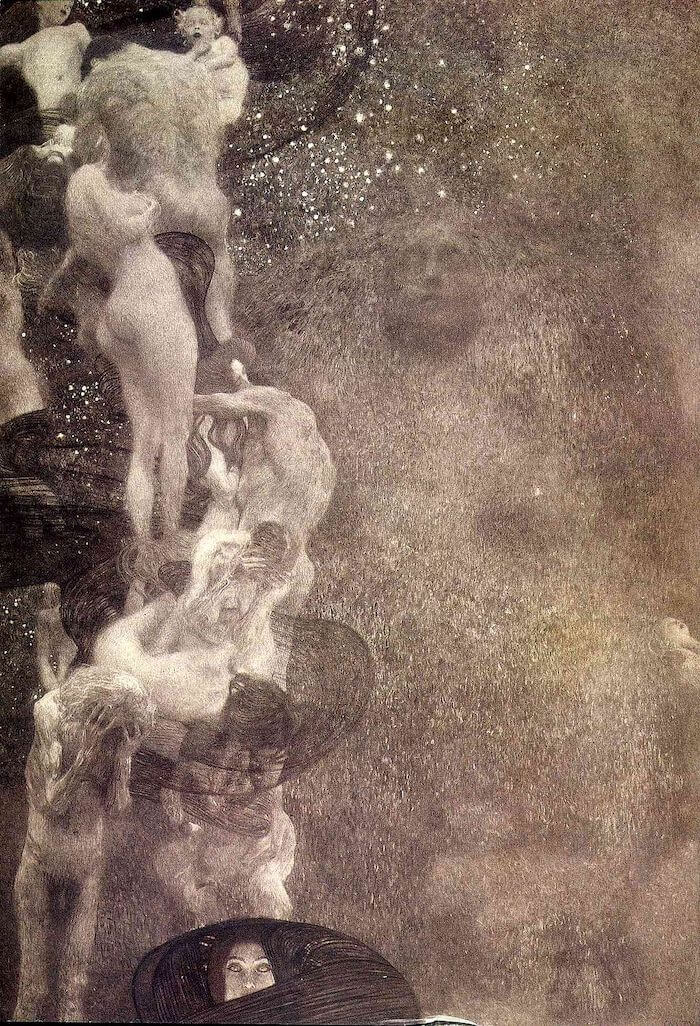
When Klimt’s first go at it was displayed, it was savaged by critics as “chaotic, nonsensical and out of keeping with the intended setting.”
Philosophy’s drubbing put an end to Klimt’s official commissions, but private ones flourished due to the bohemian painter’s “beautiful women in elegantly languid and flattering poses.”
Imagine how those status conscious society matrons would have reacted to seeing their likenesses tapped as immersive art, which Vice’s Alex Fleming-Brown pegs as “the latest lazy lovechild of TikTok and enterprising warehouse landlords.”
Surely they would have relished the attention!

Well, everyone, that is, except Margaret Stonborough-Wittgenstein, sister of Ludwig, who chafed at her appearance in Klimt’s 1905 bridal portrait as “too innocent, timid and girlish…” and stuck the picture in the attic.
C’mon, they can’t all be The Kiss.
It’s an astonishing painting, but there’s so much more to discover about Klimt and his four decades worth of work.
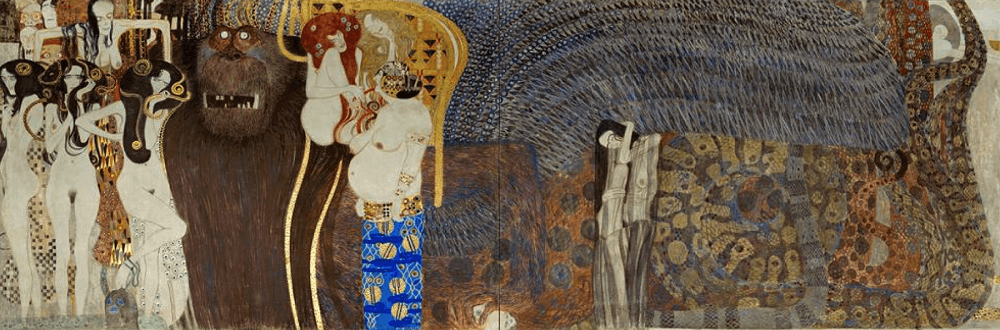
But first, with apologies to any readers who genuinely enjoy immersive art exhibits — many do — here are Jane Kallir’s not entirely conciliatory thoughts on Beethoven Frieze, Klimt’s voluptuous vision of lust, love and disease, which was deliberately enhanced by accompanying sculpture and live music when it made its public debut in 1902, and is currently being parceled out and writ large in digital form in the building formerly known as New York’s Emigrant Industrial Savings Bank:
I asked myself whether Klimt would have approved of the Beethoven Frieze projections. I believe most artists embrace cutting-edge technology, whatever it may be in their day and age. The Beethoven Frieze segment is a Gesamtkunstwerk on a scale that Klimt might have dreamed of—might have. This is the one part of the presentation that could be faithful to his intentions.
Related Content
– Ayun Halliday is the Chief Primatologist of the East Village Inky zine and author, most recently, of Creative, Not Famous: The Small Potato Manifesto and Creative, Not Famous Activity Book. Follow her @AyunHalliday.
Read More...How to Solve the Prisoner’s Dilemma: A Gloriously Animated Explanation of the Classic Game-Theory Problem
Imagine two prisoners, each one placed in solitary confinement. The police offer a deal: if each betrays the other, they’ll both get five years in prison. If one betrays the other but the other keeps quiet, the betrayer will walk free and the betrayed will serve ten years. If neither say anything, they’ll both be locked up, but only for two years. Unable coordinate, both prisoners will likely betray each other in order to secure the best individual outcome, despite the fact that it would be better on the whole for both to keep their mouths shut. This is the “prisoner’s dilemma,” a thought experiment much-cited in game theory and economics since the middle of the twentieth century.
Though the situation the prisoner’s dilemma describes may sound quite specific, its general form actually conforms to that of a variety of problems that arise throughout the modern world, in politics, trade, interpersonal relations, and a great many others besides.
Blogger Scott Alexander describes the prisoner’s dilemmas as one manifestation of what Allen Ginsberg called Moloch, the relentless unseen force that drives societies toward misery. Moloch “always and everywhere offers the same deal: throw what you love most into the flames, and I can grant you power.” Or, as he’d put it to Chewy the gingerbread man, “Betray your friend Crispy, and I’ll make a fox eat only three of your limbs.”
Such is the situation animated in gloriously woolly stop-motion by Ivana Bošnjak and Thomas Johnson in the TED-Ed video at the top of the post, which replaces the prisoners with “sentient baked goods,” the jailer with a hungry woodland predator, and years of imprisonment with bitten-off arms and legs. After explaining the prisoner’s dilemma in a whimsical manner, it presents one proposed solution: the “infinite prisoner’s dilemma,” in which the participants decide not just once but over and over again. Such a setup would allow them to “use their future decisions as bargaining chips for the present one,” and eventually (depending upon how heavily they value future outcomes in the present) to settle upon repeating the outcome that would let both of them walk free — as free as they can walk on one gingerbread leg, at any rate.
Related content:
An Introduction to Game Theory & Strategic Thinking: A Free Course from Yale University
The Famous Schrödinger’s Cat Thought Experiment Comes Back to Life in an Off-Kilter Animation
Watch a 2‑Year-Old Solve Philosophy’s Famous Ethical “Trolley Problem” (It Doesn’t End Well)
Based in Seoul, Colin Marshall writes and broadcasts on cities, language, and culture. His projects include the Substack newsletter Books on Cities, the book The Stateless City: a Walk through 21st-Century Los Angeles and the video series The City in Cinema. Follow him on Twitter at @colinmarshall or on Facebook.
Read More...A 3D Computer Animation of the Panopticon, Jeremy Bentham’s 18th Century Design for an All-Controlling Prison
Nearly two centuries after his death, the eighteenth-century utilitarian philosopher and social reformer Jeremy Bentham — or most of him, anyway — still sits in state in the main building of University College London. For a time in the mid-twenty-tens, he was equipped with the PanoptiCam, “an online camera that streams what Bentham sees while sitting in his cabinet at UCL.” That most everyone gets the joke behind its name speaks to the enduring relevance of one of Bentham’s ideas in particular: the Panopticon, “a prison designed so that a prison guard could look into all cells at any time, and ensure that prisoners modified their behavior for the better.”
In Bentham’s Panopticon, many prisoners could be monitored effectively by just a few unseen guards. This accords, as Michel Foucault writes in 1975’s Discipline and Punish, with the principle that “power should be visible and unverifiable. Visible: the inmate will constantly have before his eyes the tall outline of the central tower from which he is spied upon. Unverifiable: the inmate must never know whether he is being looked at any one moment; but he must be sure that he may always be so.” Foucault drew connections between the Panopticon and the complex, large-scale societies that had developed since Bentham’s day. Imagine if he’d lived to see the rise of social media.
In a series of posts by Philosophy for Change, Tim Rayner takes up just such an exercise. “By making our actions and shares visible to a crowd, social media exposes us to a kind of virtual Panopticon,” he writes. “This is not just because our activities are monitored and recorded by the social media service for the purposes of producing market analysis or generating targeted advertising.” But “the surveillance that directly affects us and impacts on our behavior comes from the people with whom we share.” In the online Panopticon, “we are both guards and prisoners, watching and implicitly judging one another as we share content.” Rayner wrote these words more than a decade ago, but anyone who has experienced life on social media then can hardly deny the parallels with Bentham’s vision.
Far from improving our behavior, however, this constant online surveillance has in a fair few cases made it considerably less appealing. Whatever the nature of its actual effects on those who inhabit it, the Panopticon is an undeniably powerful structure, at least metaphorically speaking. But we should remember that Bentham intended it to be a real, physical structure, one that could contain not just prisons but other types of institutions as well. Whether a Panopticon has ever been wholly built to his specifications seems to be a matter of debate, but we can see what one would look like in the 3D rendering by Myles Zhang at the top of the post: an appropriate medium, after all, in which to perceive an idea most fully realized in the digital realm.
Related content:
Jeremy Bentham’s Mummified Body Is Still on Display – Much Like Other Aging British Rock Stars
What Would Michel Foucault Think of Social Media, Fake News & Our Post Truth World?
Michel Foucault: Free Lectures on Truth, Discourse & The Self (UC Berkeley, 1980–1983)
On the Power of Teaching Philosophy in Prisons
Based in Seoul, Colin Marshall writes and broadcasts on cities, language, and culture. His projects include the Substack newsletter Books on Cities, the book The Stateless City: a Walk through 21st-Century Los Angeles and the video series The City in Cinema. Follow him on Twitter at @colinmarshall or on Facebook.
Read More...Support Us
We're hoping to rely on loyal readers, rather than erratic ads. Please click the Donate button and support Open Culture. You can use Paypal, Venmo, Patreon, even Crypto! We thank you!

About Us

Open Culture scours the web for the best educational media. We find the free courses and audio books you need, the language lessons & educational videos you want, and plenty of enlightenment in between.
Advertise With Us
FREE UPDATES!
GET OUR DAILY EMAIL
Get the best cultural and educational resources on the web curated for you in a daily email. We never spam. Unsubscribe at any time.
FOLLOW ON SOCIAL MEDIA
Open Culture editor Dan Colman scours the web for the best educational media. He finds the free courses and audio books you need, the language lessons & movies you want, and plenty of enlightenment in between.
Advertise With Us


