The Story of the Edsel, Ford’s Infamously Failed Car Brand of the 1950s
For 60 years now, the name Edsel has been synonymous with failure. In a way, this vindicates the position of Henry Ford II, who opposed labeling a brand of cars with the name of his father Edsel Ford. The son of Ford Motor Company founder Henry Ford, Edsel Ford died young in 1943, and thus didn’t live to see “E Day,” the rollout of his namesake line of automobiles. It happened on September 4, 1957, the culmination of two years of research and development on what was for most of that time called the “E car,” the letter having been chosen to indicate the project’s experimental nature. Alas, all seven of Edsel’s first models struck the American public as too conventional to stand out — and at the same time, too odd to buy.
You can hear the story of Edsel in the two videos above, one from transportation enthusiast Ruairidh MacVeigh and another from Regular Car Reviews. Both offer explanations of how the brand’s cars were conceived, and what went wrong enough in their execution to make them a laughing stock still today. No Edsel postmortem can fail to consider the name itself, a choice made in desperation after the rejection of more than 6,000 other possibilities presented by the advertising firm of Foote, Cone & Belding.
Its manager of marketing research also unofficially sought the counsel of modernist poet Marianne Moore, whose suggestions included “Utopian Turtletop,” “Resilient Bullet,” “Mongoose Civique,” and “The Impeccable.”
Another factor cited as a cause of Edsel’s disappointing sales is its cars’ signature vertical grille, derided early on for its shape resembling a horse collar — among other, less mentionable things. Such aesthetic missteps may not have sunk the brand on their own, but they certainly didn’t counteract the effects of other, more mundane conditions. These included persistent assembly-line problems (without a dedicated factory, Edsels tended occasionally to come out with parts improperly installed or absent) and a 1957 economic recession that made upper-middle-tier automobiles of this kind unappealing to the American driver. Even the top-rated CBS television special The Edsel Show — despite its performances from the likes of Bing Crosby, Frank Sinatra, Rosemary Clooney, and Louis Armstrong — drummed up little public enthusiasm.
Edsel lasted only from 1958 to 1960, in which time Ford manufactured 118,287 of its cars in total. Six decades after the mark’s retirement, fewer than 10,000 Edsel cars survive — most of them as sought-after collector’s items. For Edsels now have their appreciators, as evidenced by the video above from professional mid-century Americana enthusiast Charles Phoenix, who marvels over every feature of a 1958 Citation, Edsel’s top-of-the-line model, from its Teletouch push-button gear selector to its customizable speed-warning indicator. (Seatbelts came standard, despite being optional extras on other cars of the day.) Current Edsel owners also include lifestyle guru Martha Stewart, who showed off her mint 1958 Roundup in a recent video with Jay Leno — though she seems rather prouder of also owning Edsel Ford’s house.
Related Content:
A Flying Car Took to the Skies Back in 1949: See the Taylor Aerocar in Action
A Hulking 1959 Chevy Bel Air Gets Obliterated by a Mid-Size 2009 Chevy Malibu in a Crash Test
178,000 Images Documenting the History of the Car Now Available on a New Stanford Web Site
Based in Seoul, Colin Marshall writes and broadcasts on cities, language, and culture. His projects include the Substack newsletter Books on Cities, the book The Stateless City: a Walk through 21st-Century Los Angeles and the video series The City in Cinema. Follow him on Twitter at @colinmarshall or on Facebook.
Read More...Watch Django Reinhardt & Stéphane Grappelli Play Masterfully Together in Vivid Color (1938)
Few jazz guitarists today could claim to be entirely free of the influence of Django Reinhardt. This despite the fact that he lost the use of two fingers — which ultimately encouraged him to develop a distinctive playing style — and that he died 68 years ago. The unfortunate abbreviation of Reinhardt’s life means that he never built a substantial body of solo work, though he did play on many recorded dates that include performances alongside Coleman Hawkins and Benny Carter. It also means that he left even less in the way of footage, though we do get a crisp and illuminating view of him and his guitar in the 1938 documentary short “Jazz ‘Hot,’ ” previously featured here on Open Culture.
“Jazz ‘Hot’ ” also features violin-playing from Stéphane Grappelli, who founded the group Quintette du Hot Club de France with Reinhardt in 1934. As they deepened their knowledge of jazz, the two influenced each other so thoroughly as to develop their own style of music.
Grappelli lived long enough to play with the likes of Jean-Luc Ponty, Paul Simon, Yo Yo Ma, and even Pink Floyd. Still, more than a few jazz fans would surely claim that none of his professional collaborators was more important to his musical formation than Reinhardt. Now you can see them playing together in color, and fairly realistic color at that, in the clip at the top of the post.
The original black-and-white footage (which appears just above) was colorized with DeOldify, a deep learning-based application developed to restore photographs and motion pictures from bygone times. Perhaps you’ve seen the previous DeOldify colorization projects we’ve featured here, which run the gamut from musical numbers in Stormy Weather and Hellzapoppin’ to scenes of 1920s Berlin and even an 1896 snowball fight in Lyon. Granted access to a time machine, more than a few jazz-lovers would no doubt choose to go back to the Paris of the 1930s to see the Quintette du Hot Club de France in action. Technology has yet to make that a viable proposition, but it’s given us a next-best-thing that no appreciator of jazz guitar — or jazz violin — could fail to enjoy.
Related Content:
Jazz ‘Hot’: The Rare 1938 Short Film With Jazz Legend Django Reinhardt
Django Reinhardt Demonstrates His Guitar Genius in Rare Footage From the 1930s, 40s & 50s
Based in Seoul, Colin Marshall writes and broadcasts on cities, language, and culture. His projects include the Substack newsletter Books on Cities, the book The Stateless City: a Walk through 21st-Century Los Angeles and the video series The City in Cinema. Follow him on Twitter at @colinmarshall or on Facebook.
Read More...New Research Confirms That the Vikings Landed in North America 471 Years Before Columbus & Exactly 1,000 Years Ago
“We have to celebrate Columbus because he discovered America.”
“No he didn’t. Leif Erikson got there first.”
“Nuh-uh.”
“Uh-huh….”
etc…
I paraphrase here from the halls of my elementary school circa sometime in the late 20th century, when many of us were convinced the first Europeans to set foot on the continent were not the Spanish and their bloody-minded, treasure-seeking Italian captain, but what we thought of as bloody-minded, treasure-seeking Vikings. Which side was right?
Our grade-school objections to Columbus were not necessarily moral or intellectual. Most of us chose team Viking for the helmets (more on that later). But evidence that Vikings landed in North America dates back hundreds of years to historical accounts and sagas about Leif’s father, Erik the Red. These accounts tell of a place called Vinland, identified as lying somewhere along the Northeastern coastline where the Norse found wild grapes.
In the 20th century came the suggestion that Vinland might have been located in Canada, at a site called L’Anse aux Meadows in what is now Newfoundland. Between 1960 and 1968, an excavation by Norwegian archaeologist Anne Stine Ingstad and her husband, explorer Helge Ingstad, found the remains of the “only conclusively identified Viking site in the Americas outside of Greenland,” writes Katherine Kornei at The New York Times.
Eight timber-framed buildings at the site look very much like similar structures in Greenland built for Erik the Red. And yet, exactly when the settlement arose has been a mystery; “radiocarbon measurements of artifacts from L’Anse aux Meadows span the entire Viking Age, from the late eighth through the 11th centuries.” That is, until new results just published in Nature which claim to have “decisively pinned down when the Norse explorers were in Newfoundland: the year A.D. 1021, or exactly 1,000 years ago.”
Scientists obtained this date from three pieces of wood lately unearthed from what is known as the site’s “Viking layer” — a stump, a log, and a branch. “These artifacts were significant finds for two reasons,” notes the CBC. “One is that they showed cut marks made by metal blades, specific to Vikings, not Indigenous stone blades. The second reason is that all three artifacts still had the outermost layer of the tree intact,” allowing archaeologists to conclusively tell their age.
A host of unanswered questions remain. We cannot say for certain this new data confirms the ancient stories of Vinland or Leif Erikson. Although the structures, tools, and other artifacts at the site are unquestionably Norse, researchers don’t know who, precisely, settled at L’Anse aux Meadows, or whether it was a long-term settlement or a temporary outpost. (Evidence published in 2019 suggests that “Norse activity at LAM may have endured for a century.”)
At the top of the post, see a short explainer from Nature showing not only how archeologists confirmed that Vikings landed in North America, but also how they learned exactly when — 471 years before Columbus. As for why there’s no Leif Erikson day in the U.S.… well, there is, it turns out — October 9th — though no one gets a holiday. And about those helmets? Stereotypes that first appeared in Wagnerian opera.
As even video games recognize these days, the Vikings may be some of the most misunderstood peoples in ancient history. Learn more about their time in Newfoundland, and maybe points further south, in the episode of America Unearthed from the History Channel, above, and read the Nature article on the most recent artifacts here.
Related Content:
Archaeologists Find the Earliest Work of “Abstract Art,” Dating Back 73,000 Years
Josh Jones is a writer and musician based in Durham, NC. Follow him at @jdmagness
Read More...Become a Project Manager Without a College Degree with Google’s Project Management Certificate
As we first mentioned last year, Google has launched a series of Career Certificate programs that allow students to gain expertise in a field, ideally enough to start working without a 4‑year college degree. This initiative now includes a Certificate in Project Management, which consists of six courses.
- Foundations of Project Management
- Project Initiation: Starting a Successful Project
- Project Planning: Putting It All Together
- Project Execution: Running the Project
- Agile Project Management
- Capstone: Applying Project Management in the Real World
Above, a Program Manager talks about “her path from dropping out of high school and earning a GED, joining the military, and working as a coder, to learning about program management and switching into that career track.” An introduction to the Project Management certificate appears below.
The Project Management program takes about six months to complete, and should cost about $250 in total. Students get charged $39 per month until they complete the program.
You can explore the Project Management certificate here. And find other Google career certificates in other fields–e.g. UX Design and Data Analytics–over on this page. All Google career courses are hosted on the Coursera platform.
Note: Open Culture has a partnership with Coursera. If readers enroll in certain Coursera courses and programs, it helps support Open Culture.
Related Content
150 Free Online Business Courses
Read More...Yale Professor Jason Stanley Identifies 10 Tactics of Fascism: The “Cult of the Leader,” Law & Order, Victimhood and More
What is fascism? Fascism is an ideology developed and elaborated in early 20th-century Western Europe and enabled by technology, mass media, and weapons of war. Most of us learned the basics of that development from grade school history textbooks. We generally came to appreciate to some degree — though we may have forgotten the lesson — that the phrase “creeping fascism” is redundant. Fascism stomped around in jackboots, smashed windows and burned Reichstags before it fully seized power, but its most important action was the creeping: into language, media, education, and religious institutions. None of these movements arose, after all, without the support (or at least acquiescence) of those in power.
There are differences between Italian Fascism, German Nazism, and their various nationalist descendents. Mussolini secured power chiefly through intimidation. But once he was appointed prime minister by the King in 1922 he began consolidating his dictatorship, a process that took several years and required such dealings as the creation of Vatican City in 1929 to secure the Church’s goodwill. Some later fascist leaders, like Augusto Pinochet, came to power in coups (with the support of the CIA). Others, like Hitler, won elections, after a decade of “creeping” into the culture by normalizing nationalist pride based on racial hierarchies and nursing a sense of aggrieved persecution among the German people over perceived humiliations of the past.
In every case, leaders exploited local hatreds and inflamed ordinary people against their neighbors with the constant repetition of an alarming “Big Lie” and the promises of a strongman for salvation. Every similar movement that has arisen since the end of WWII, says Yale University Professor of Philosophy Jason Stanley in the video above, has shared these characteristics: using propaganda to create an alternate reality and paying obeisance to a “cult of the leader,” no matter how repugnant his tactics, behavior, or personality. “Right wing by nature,” fascism’s patriarchal structure appeals to conservatives. While it mobilizes violence against minorities and leftists, it seduces those on the right by promising a share of the spoils and validating conservative desires for a single, unifying national narrative:
Fascism is a cult of the leader. It involves the leader setting the rules about what’s true and false. So any kind of expertise, reality, all of that is a challenge to the authority of the leader. If science would help him, then he can say, “Okay, I’ll use it.” Institutions that teach multiple perspectives on history in all its complexity are always a threat to the fascist leader.
Rather than simply destroying institutions, fascists twist them to their own ends. The arts, sciences, and humanities must be purged of corrupting elements. Those who resist face job loss, exile or worse. The important thing, says Stanley, is the sorting into classes of those who deserve life and property and those who don’t.
[O]nce you have hierarchies set up, you can make people very nervous and frightened about losing their position on that hierarchy. Hierarchy goes right into victimhood because once you convince people that they’re justifiable higher on the hierarchy, then you can tell them that they’re victims of equality. German Christians are victims of Jews. White Americans are victims of Black American equality. Men are victims of feminism.
The appeal to “law and order,” to police state levels of control, only applies to certain threatening classes who need to be put back in their place or eliminated. It does not apply to those at the top of the hierarchy, who recognize no constraints on their actions because they perceive themselves as threatened and in a state of emergency. It’s really the immigrants, leftists, and other minorities who have taken over, “and that’s why you need a really macho, powerful, violent response”:
Law and order structures who’s legitimate and who’s not. Everywhere around the world, no matter what the situation is, in very different socioeconomic conditions, the fascist leader comes and tells you, “Your women and children are under threat. You need a strong man to protect your families.” They make conservatives hysterically afraid of transgender rights or homosexuality, other ways of living. These are not people trying to live their own lives. They’re trying to destroy your life, and they’re coming after your children. What the fascist politician does is they take conservatives who aren’t fascist at all, and they say, “Look, I know you might not like my ways. You might think I’m a womanizer. You might think I’m violent in my rhetoric. But you need someone like me now. You need someone like me ’cause homosexuality, it isn’t just trying for equality. It’s coming after your family.”
Stanley offers several historical examples for his assessment of what he breaks down into a total of 10 tactics of fascism. (See an earlier video here in which he discusses 3 characteristics of the ideology.) Like Umberto Eco, who identified 14 characteristics of what he called “ur-fascism” in a 1995 essay, Stanley notes that “not all terrible things are fascist. Fascism is a very particular ideological structure” that arose in a particular time and place. But while its stated aims and doctrines are subject to change according to the psychology of the leader and the national culture, it always shares a certain grouping, or “bundle,” of features.
Each of these individual elements is not in and of itself fascist, but you have to worry when they’re all grouped together, when honest conservatives are lured into fascism by people who tell them, “Look, it’s an existential fight. I know you don’t accept everything we do. You don’t accept every doctrine. But your family is under threat. Your family is at risk. So without us, you’re in peril.” Those moments are the times when we need to worry about fascism.
Below we’re adding Stanley’s recent interview where he explains how America has now entered fascism’s legal phase. You can read his related article in The Guardian.
Related Content:
Umberto Eco Makes a List of the 14 Common Features of Fascism
The Nazis’ 10 Control-Freak Rules for Jazz Performers: A Strange List from World War II
Josh Jones is a writer and musician based in Durham, NC. Follow him at @jdmagness
Read More...Three Hours of Yo Yo Ma Playing Bach’s Six Cello Suites: Music That “Helps Us Navigate Through Troubled Times”
“Believe it or not, this was the very first piece of music I started on the cello when I was four years old,” said Yo Yo Ma before playing the “Prelude” from J.S. Bach’s Unaccompanied Cello Suite No. 1 for NPR’s Tiny Desk concert series in 2018. That same year, the world-famous cello prodigy released his third recording of all six suites in an album titled Six Evolutions — Bach: Cello Suites. The “two-and-a-half hours of sounds that map humanity in all its triumphs, joys and sorrows,” write NPR’s Mary Louise Kelly and Tom Huizenga, “has become a lodestar for the celebrated cellist.”
Ma made his first recording of the Unaccompanied Cello Suites in 1983, and won a Grammy the following year. “He released another set in 1997,” a recording that shows the musician’s own evolution in collaboration with “architects, ice skaters and Kabuki artists.” But his performance of the suites has always been evolutionary, as a New York Times reviewer noted of a live performance in 1991: “Certainly solitary study or at most the presence of a few colleagues was the intended milieu, not the vastness of Carnegie Hall, the presence of 2,800 listeners and the marathon format of two complete recitals with an hour’s break between them.”
No matter Bach’s intentions for the pieces, they have served as Ma’s musical home, and he’s carried them with him wherever he goes, as in the full 2015 performance above at the Royal Albert Hall. See time stamps of the performance just below:
0:00 Introduction
3:49 Suite I in G Major
22:25 Suite II in D Minor
42:51 Suite III in C Major — with interview and short break
1:13:09 Suite IV in E‑Flat Major
1:40:50 Suite V in C Minor
2:08:46 Suite VI in D Major
Here, as he had done nearly a quarter of a century earlier at Carnegie Hall, Ma not only proves that Bach’s music “travels well,” but he also reaffirms his commitment to the Unaccompanied Cello Suites. As he writes in the notes to Six Evolutions:
Bach’s Cello Suites have been my constant musical companions. For almost six decades, they have given me sustenance, comfort, and joy during times of stress, celebration, and loss. What power does this music possess that even today, after three hundred years, it continues to help us navigate through troubled times? Now that I’m in my sixties, I realize that my sense of time has changed, both in life and in music, at once expanded and compressed. Music, like all of culture, helps us to understand our environment, each other, and ourselves. Culture helps us to imagine a better future. Culture helps turn ‘them’ into ‘us.’ And these things have never been more important.
These are the principles upon which Ma has staked his musical claim, as he now travels the world to deliver Bach to audiences everywhere. The Bach Project aims for “36 concerts. 36 days of action. 6 continents,” and “1 experiment: how culture connects us.”
Unable to travel in May of 2020, Ma instead played all six cello suites live on television at Boston’s WGBH studios, live-streaming the broadcast on YouTube. Now, he’s back on his trek, playing everywhere “the same masterpiece,” notes Radio Open Source, “the rarest solo performance piece that can show you infinity… an old artistic masterpiece that’s also a modern showpiece for a solo performer who fills giant venues, East and West, indoors and out, in Chile and China, in Africa and the Andes, with audiences that seem to sit breathless for most of two and a half hours.” Does Ma’s belief that Bach can “save the world” seem a little Pollyanish? Perhaps. But what other piece of music, and what other performer, has attained such universal goodwill? Learn more about Ma’s Bach Project here and see him play the Prelude for the whole world in the video above.
Related Content:
Yo-Yo Ma Plays an Impromptu Performance in Vaccine Clinic After Receiving 2nd Dose
Josh Jones is a writer and musician based in Durham, NC. Follow him at @jdmagness
Read More...Bill Gates Lets College Students Download a Free Digital Copy of His Book, How to Avoid a Climate Disaster

FYI: Earlier this year, Bill Gates published the New York Times bestseller, How to Avoid a Climate Disaster: The Solutions We Have and the Breakthroughs We Need. In the book, Gates explains why we need to work toward net-zero emissions of greenhouse gases, and how we can achieve this goal. Given that this responsibility will eventually fall to a younger generation of leaders, Gates has decided to make a digital copy of his book available to every college and university student in the world.
The book can be downloaded an .epub file which can be opened in a compatible e‑reader application on many devices. An email address, along with a name of college/university, is required. Find the book here.
Related Content
Take Big History: A Free Short Course on 13.8 Billion Years of History, Funded by Bill Gates
Bill Gates Recommends 5 Thought-Provoking Books to Read This Summer
Read More...Why–and When–Did the United States Turn Against Science?: Views from Neil DeGrasse Tyson, Bill Nye, Margaret Atwood & More
When did Americans lose the ability to think and act rationally? Or did they ever, on the whole, have such ability? These are the questions at the heart of the Big Think video above, a supercut of interview clips from public intellectuals — Neil DeGrasse, Michael Shermer, Tyson, Kurt Andersen, Bill Nye, and Margaret Atwood — opining on the state of the nation’s intellectual health. Unsurprisingly, the prognosis is not good, as Carl Sagan predicted over 25 years ago.
Of interest here is the diagnosis: How did the country get to a place where it is unable to defend itself against a deadly virus because millions of citizens refuse to take it seriously? How did Americans let Exxon wreck the climate because millions of Americans refused to believe in human-caused climate change? How did a failed mogul and reality TV star become president? How did Qanon, Pizzagate…. How did any of it happen?
The roots are long and deep, says writer and former host of NPR’s Studio 360, Kurt Andersen, who has spent a significant amount of time thinking about the culture of American irrationalism. On the one hand, “Americans have always been magical thinkers and passionate believers in the untrue,” from the time of the Puritans, who were not persecuted refugees so much as fanatics no one in England could stand. And the problem is even older than the country’s founding, Andersen argues in his book Fantasyland: How America Went Haywire: A 500-Year History — it dates to the foundations of the modern world.
On the other hand, and somewhat contradictorily, it was those Puritans again who kept the worst of things in check. “We also have the virtues embodied by the Puritans and their secular descendants,” Andersen writes at The Atlantic: “steadiness, hard work, frugality, sobriety, and common sense” — such virtues as helped build the country’s scientific industries and research institutions, which have been steadily undermined by the relativism of the 1960s (Andersen argues), the effects of the internet, and a series of devastating political choices. The delusional irrationalism was built in — but hyper-individualism and profiteering of the last several decades supercharged it. “The United States used to be the world leader in technology,” says Bill Nye, but no more.
Margaret Atwood, who is Canadian not American, talks mostly about the universal human difficulty of letting go of comforting core beliefs, and the uses the example of the outcry against Darwinian evolution. Yet her very presence in the discussion will make viewers think of her most famous novel, The Handmaid’s Tale, in which she imagined what lies beneath the supposedly enlightened common sense of the country’s government. The stage was long ago set for a revolution that could easily turn the country against science, she believed.
As Atwood wrote in 2018 of the novel’s genesis: “Nations never build apparently radical forms of government on foundations that aren’t there already.… The deep foundation of the United States — so went my thinking — was not the comparatively recent 18th-century Enlightenment structures of the Republic, with their talk of equality and their separation of Church and State, but the heavy-handed theocracy of 17th-century Puritan New England — with its marked bias against women — which would need only the opportunity of a period of social chaos to reassert itself.”
Rather than identifying the problems with Puritans or 60s hippies, Neil DeGrasse Tyson — as he has done throughout his career — discusses issues of science education and communication. On both fronts, there has been some improvement. “More journalists who are science fluent… are writing about science than was the case 20 years ago,” he says, “so now I don’t have to worry about the journalist missing something fundamental.… And [science] reporting has been much more accurate in recent years, I’m happy to report.”
But while the internet has amplified our opportunities for scientific literacy, it has also done the opposite, grossly muddying the intellectual waters with misinformation and a competitive need to get the story first. “If it’s not yet verified, it’s not there yet.… So be more open about how wrong the thing you’re reporting on could be, because otherwise you’re doing a disservice to the public. And that disservice is that people out there say, ‘Scientists don’t know anything.’ ”
There are also those who choose to side with handful of contrarian scientists who disagree with the consensus. “This is irresponsible,” says Tyson. “Plus it means you don’t know how science works.” Or it means you’re looking to confirm biases rather than genuinely take an interest in the scientific process. For all of their insights, the talking head critics in the video fail to mention a primary driver behind so much of the U.S.‘s science denialism, a motivation as foundational to the country as the Puritan’s zealotry: profit, at all costs.
Read a transcript of the video here.
Related Content:
1,700 Free Online Courses from Top Universities
An Animated Margaret Atwood Explains How Stories Change with Technology
Isaac Asimov Laments the “Cult of Ignorance” in the United States (1980)
Josh Jones is a writer and musician based in Durham, NC. Follow him at @jdmagness
Read More...Elvis’ Three Appearances on The Ed Sullivan Show: Watch History in the Making and from the Waist Up (1956)
Oh, to be in the studio audience of CBS’ Television City in Hollywood on September 9th, 1956, to see Elvis Presley’s gyrating pelvis rocket him to superstardom on The Ed Sullivan Show.
His appearance made television history, but 60 million home viewers were left to fill in some major blanks, as the rising heartthrob was filmed from the waist up whenever he was in motion.
Sullivan had been hesitant to book Elvis, not wanting to court the outrage the magnetic young singer had sparked in two “suggestive” appearances on The Milton Berle Show earlier that year. Elvis, he told the press, was “not my cup of tea” and “wasn’t fit for family entertainment.”
Television host Steve Allen, presumably alert to similar red flags, attempted to skirt the issue by shoehorning Elvis into tie and tails to perform “Hound Dog” to an inattentive, top-hatted basset hound.
Elvis was displeased by this jokey spin, but submitted, and newcomer Allen’s ratings clobbered Sullivan’s that week.
Sullivan sent Steve Allen a telegram:
Steven Presley Allen, NBC TV, New York City. Stinker. Love and kisses. Ed Sullivan.
Whether Sullivan was throwing down a gauntlet, or delivering congratulations with a side of poor sportsmanship is somewhat unclear, but Sullivan was now ready to claim his stake, at ten times the price.
The $5,000 appearance fee that had been floated prior to Elvis’ appearance on The Milton Berle Show, had ballooned to the jaw dropping sum of $50,000 for 3 episodes.
Sullivan and Presley’s names are forever linked for that historic first appearance, but injuries from a car crash knocked the host out of commission. Actor Charles Laughton subbed in as host from Sullivan’s New York studio, and was charged with ushering in Elvis’s remote appearance in a very particular way.
As cultural critic Greil Marcus writes:
Presley was the headliner, and a Sullivan headliner normally opened the show, but Sullivan was burying him. Laughton had to make the moment invisible: to act as if nobody was actually waiting for anything. He did it instantly, with complete command, with the sort of television presence that some have and some — Steve Allen, or Ed Sullivan himself — don’t. It’s a sense of ease, a querulous interrogation of the medium itself, affirming one’s own odd, irreducible subjectivity against the objectivity enforced by any system of representations: that is, getting it across that at any moment that you might forget where you are and say whatever comes into your head, which was exactly what half the country hoped and half the country feared might be the case with Elvis Presley.
Laughton, who elsewhere in the show used a reading of James Thurber’s Red Riding Hood parody, “The Little Girl and the Wolf” to insinuate that “it’s not so easy to fool little girls nowadays as it used to be,” settled on a non-committal “and now, away to Hollywood to meet Elvis Presley!”
Elvis, clad in a non-threatening plaid jacket on a set trimmed with guitar-shaped cut outs, thanked Laughton, and wiped his brow:
Wow. This is probably the greatest honor I’ve ever had in my life. Ah. There’s not much I can say except, it really makes you feel good. We want to thank you from the bottom of our heart.
His first number, “Don’t Be Cruel,” had an immediate effect on the teenage girls in attendance, who knew what they were seeing.
“Thank you, ladies,” he said, coyly acknowledging what all knew to be true, before going on to debut the title song of the motion picture he was in town to film, Love Me Tender, his first of 31 such vehicles.
Disc jockeys tuned in to tape the unreleased song for play on their radio shows, shooting pre-sales up to nearly a million.
Later in the show Elvis returned to cover Little Richard’s hit, “Ready Teddy,” and wish the show’s regular host a swift recovery. And then:
As a great philosopher once said…’You ain’t nothin’ but a hound dog!’
Cue screams.
A week later, The New York Times’ Jack Gould alleged that in booking Elvis, Sullivan had failed to “exercise good sense and display responsibility,” moralizing that “in some ways it was perhaps the most unpleasant of (the singer’s) recent three performances:
Mr. Presley initially disturbed adult viewers — and instantly became a martyr in the eyes of his teen- age following — for his striptease behavior on last spring’s Milton Berle program. Then with Steve Allen he was much more sedate. On the Sullivan program he injected movements of the tongue and indulged in wordless singing that were singularly distasteful.
At least some parents are puzzled or confused by Presley’s almost hypnotic power; others are concerned; perhaps most are a shade disgusted and content to permit the Presley fad to play itself out.
Neither criticism of Presley nor of the teen-agers who admire him is particularly to the point. Presley has fallen into a fortune with a routine that in one form or another has always existed on the fringe of show business; in his gyrating figure and suggestive gestures the teen-agers have found something that for the moment seems exciting or important.
Cue more screams.
A month and a half after his first Sullivan Show booking, Elvis and Sullivan met in the New York studio for a follow up, along with a chaste youth choir, the Little Gaelic Singers, and ventriloquist Señor Wences. (S’alright? S’alright.)
“Don’t Be Cruel,” “Love Me Tender,” and “Hound Dog” were on the menu again, along with a brand new release — “Love Me,” above.
Señor Wences was not the tough act to follow here.
The appearance resulted in more wildly high ratings for Sullivan, and a growing awareness of the perils of rock n’ roll, as embodied by Elvis’ well lubricated nether regions, which the camera, fooling no one, again shied from at crucial moments.
Cue another million teenage fan club enrollments, as well as parents, clergy and other concerned citizens who came together to burn the singer in effigy in Nashville and St. Louis.
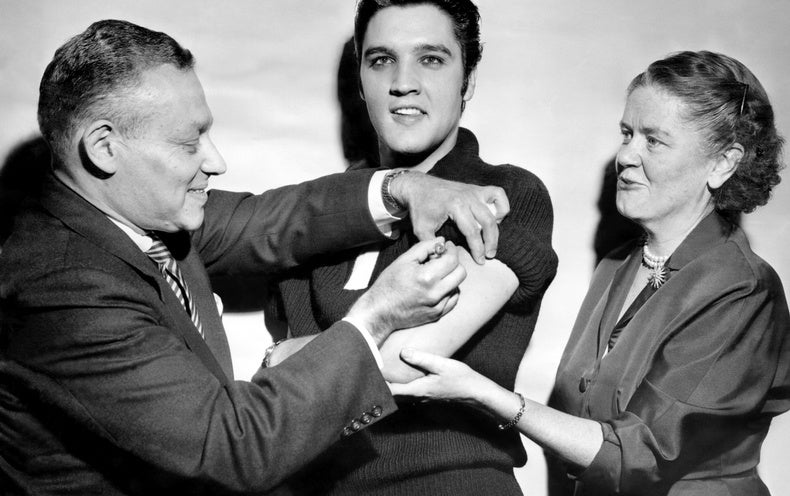
Nearly as notable, from the perspective of 2021, was the public service Elvis performed backstage, allowing himself to be photographed receiving the polio vaccine, in hopes his legions of admirers would follow suit.
Elvis’ third visit to Sullivan’s show, January 6th, 1957, would prove to be his last, owing to the astronomical fee his manager Colonel Tom Parker set for future television appearances: $300,000 with the promise of two guest spots and an hour-long special. An attempt to book Elvis for Sullivan’s 10th anniversary celebration, was thwarted by the fact that Elvis was abroad, serving in the Army.
Another massive audience tuned in for another helping of hits — “Hound Dog,” “Love Me Tender,” “Heartbreak Hotel,” and “Don’t Be Cruel,” as well as newer material — “Too Much” and “When My Blue Moon Turns To Gold Again.”
Between songs, Sullivan advised the swooning teenagers to rest their larynxes and introduced Elvis’ performance of the gospel standard, “Peace in the Valley,” by urging viewers to contribute to a Hungarian refugee relief fund Elvis supported.
While many fans persist in the belief that the gospel number was included as an affectionate nod to the singer’s beloved mother, Gladys, a letter from Colonel Parker’s assistant to Elvis suggests that the choice had more to do with his host:
Mr. Sullivan thought it might be very appropriate for you to sing a hymn or a semi-religious song on the show. You certainly can sing a hymn very effectively and I think it would make a very strong impression on all the viewers. It has been suggested that a song like ‘Peace in the Valley’ might be held in readiness. We have obtained the music on this song and are forwarding it to you.”
This time, home viewers really were left to guess what was going on below the star’s sequined vest and open collared blouse, described by Marcus as “the outlandish costume of a pasha, if not a harem girl:”
From the make-up over his eyes, the hair falling in his face, the overwhelmingly sexual cast of his mouth, he was playing Rudolph Valentino in The Sheik, with all stops out. That he did so in front of the Jordanaires, who this night appeared as the four squarest-looking men on the planet, made the performance even more potent.
Sullivan’s first co-producer, Marlo Lewis, intimated that the decision to formalize a waist-up policy for Elvis’ third visit was sparked by a rumor that had dogged his prior appearances. To wit:
Elvis has been hanging a small soft-drink bottle from his groin underneath his pants, and when he wiggles his leg it looks as though his pecker reaches down to his knee!
Meanwhile, it appeared Sullivan was no longer willing to be lumped in with Elvis’ detractors, closing the show by saying:
I wanted to say to Elvis Presley and the country that this is a real decent, fine boy, and wherever you go, Elvis, we want to say we’ve never had a pleasanter experience on our show with a big name than we’ve had with you. So now let’s have a tremendous hand for a very nice person!
Had Elvis won him over, or was it, as cultural critic Tim Parrish asserts, that Colonel Parker, “had threatened to remove Elvis from the show if Sullivan did not apologize for telling the press that Elvis’s ‘gyrations’ were immoral.”
Watch all of Elvis Presley’s performances on The Ed Sullivan Show in HD here.
For a glimpse of the 1956 Gibson J‑200 Elvis played in that final appearance, and speculation as to whether he crossed paths with fellow guests Carol Burnett and Lena Horne, watch Graceland archivist Angie Marchese’s show and tell of ephemera related to his stints on the Ed Sullivan Show.
Related Content:
Ayun Halliday is an author, illustrator, theater maker and Chief Primatologist of the East Village Inky zine. Follow her @AyunHalliday.
Read More...How Randy Bachman Found His Stolen Favorite Guitar After 45 Years, with the Help of Facial-Recognition Software
Facial-recognition technology has come into its own in recent decades, though its imagined large-scale uses do tend to sound troublingly dystopian. Still, some of its actual success stories have been pleasing indeed, few of them so much as the one briefly told in the video above by Bachman Turner Overdrive’s Randy Bachman. Its protagonist is not Bachman himself but one of his guitars: a 1957 Gretsch 6120 Chet Atkins, a model named after the star Nashville guitarist. “This is the first really good expensive electric guitar I got,” he says, adding that he “played it on many, many BTO hits, and in 1975 it was stolen from a Holiday Inn hotel room in Toronto.”
“The disappearance triggered a decades-long search,” writes Todd Coyne in a feature at CTV News. “Bachman enlisted the help of the RCMP” — also known at the Mounties — “the Ontario Provincial Police and vintage instrument dealers across Canada and the United States. It also triggered what Bachman now recognizes as a mid-life crisis,” resulting in his eventual purchase of 385 Gretsch guitars. Those included a dozen 6120s from the 1950s, but none of them were the one he bought at age 20 from Winnipeg Piano. He must have given up hope by the time the message arrived: “I found your Gretsch guitar in Tokyo.”
The sender, an old neighbor of Bachman’s, had in fact found the Gretsch on Youtube. In the video below, made for Christmas 2019, a Japanese guitarist named Takeshi plays “Rockin’ Around the Christmas Tree” on an orange 6120 that Bachman immediately recognized as his long-lost favorite instrument. Coyne writes that the neighbor “had used some old photographs of the guitar and rejigged some facial-recognition software to identify and detect the unique wood-grain patterns and lines of cracked lacquer along the instrument’s body,” as seen in the original video for BTO’s “Lookin’ Out for #1.” Subsequently, he “ran scans of this unique profile against every image he could find of an orange 1957 Chet Atkins guitar posted online over the last decade and a half.”
Persistence, at least in this case, paid off. But since Takeshi felt nearly as strong a connection to the guitar as Bachman did, an arrangement had to be made. With the Japanese wife of his son Tal (also a musician, best known for the 1990s hit “She’s So High”) acting as interpreter, he negotiated with Takeshi the terms of an exchange. As Bachman tells it, “He said he would give me back my guitar, but I had to find him its twin”: the same model — of which only 35 were made in 1957 — in mint condition with all the same parts and no additional modifications. And for a mere thirty times the $400 price he originally paid, he eventually found that twin. Now all that remains, as soon travel restrictions ease between the U.S. and Japan, is for Bachman and Takeshi to meet up at the Gretsch factory in Nagoya, play a gig together, and take care of business.
Related Content:
Guitarist Randy Bachman Demystifies the Opening Chord of The Beatles’ “A Hard Day’s Night”
Guitar Stories: Mark Knopfler on the Six Guitars That Shaped His Career
The Captivating Art of Restoring Vintage Guitars
Hear Joni Mitchell’s Earliest Recording, Rediscovered After More than 50 Years
Based in Seoul, Colin Marshall writes and broadcasts on cities, language, and culture. His projects include the Substack newsletter Books on Cities, the book The Stateless City: a Walk through 21st-Century Los Angeles and the video series The City in Cinema. Follow him on Twitter at @colinmarshall or on Facebook.
Read More...Support Us
We're hoping to rely on loyal readers, rather than erratic ads. Please click the Donate button and support Open Culture. You can use Paypal, Venmo, Patreon, even Crypto! We thank you!

About Us

Open Culture scours the web for the best educational media. We find the free courses and audio books you need, the language lessons & educational videos you want, and plenty of enlightenment in between.
Advertise With Us
FREE UPDATES!
GET OUR DAILY EMAIL
Get the best cultural and educational resources on the web curated for you in a daily email. We never spam. Unsubscribe at any time.
FOLLOW ON SOCIAL MEDIA
Open Culture editor Dan Colman scours the web for the best educational media. He finds the free courses and audio books you need, the language lessons & movies you want, and plenty of enlightenment in between.
Advertise With Us

