When David Bowie Played Andy Warhol in Julian Schnabel’s Film, Basquiat
Many actors have played Andy Warhol over the years, but not as many as you might think. Crispin Glover played him in The Doors, Jared Harris played him in I Shot Andy Warhol, Guy Pearce played him in Factory Girl, and Bill Hader played him in Men in Black III, but with a twist: he is actually an agent who is so bad as his cover role as an artist, he’s “painting soup cans and bananas, for Christ sakes!” On television John Cameron Mitchell has acted the Warhol role in Vinyl, and Evan Peters briefly portrayed him in American Horror Story: Cult.
But you might suspect our favorite Warhol would be the one acted by David Bowie in Julian Schnabel’s 1996 Basquiat, the biopic of the Black street artist who was taken into the art world fold by Warhol, and wound up collaborating with him in last works by both artists. Jeffrey Wright plays Basquiat in one of his earliest roles.
Now, you might watch this scene from Basquiat above (and another below) and say, well, that’s just mostly Bowie. But I would say, yes, that’s kind of the point. Andy Warhol is an enigmatic figure, a legend to many, a man who hid behind a constructed persona; David Bowie is too. When one plays the other, a weird sort of magic happens. Fame leaks into fame. Many actors might do better with the mannerisms or the voice, but the charisma…that is all Bowie. After singing about the painter back in 1972, Bowie finally collapsed their visions together in the art of film, where reality and fantasy meet and meld.
Around this time in the mid 1990s, Bowie was very much a part of the New York/London art scene. He was on the editorial board of Modern Painters magazine and interviewed Basquiat director (and artist) Julian Schnabel, Tracey Emin, Damien Hirst, and Balthus. A conceptual artist-slash-serial killer became one of the main characters of his overlooked 1995 Eno collaboration Outside. He was both a collector and an artist, which we’ve focused on before. And he was thinking about the new world opening up because of the internet. Bowie’s artist brain saw the possibilities and the dangers, and also the raw capitalist potential. He offered shares in himself as an IPO in 1997 and released a single as Tao Jones Index, three puns in one. Bowie never predicted the idiocy of the NFT, but he certainly would have laughed wryly at it.
In this Charlie Rose interview to promote Basquiat, Bowie and Schnabel discuss the role of Warhol, the role of art, and the reality of the art world.
“It was more of an impersonation, really,” says Bowie about his Warhol. “That’s how I approach anything.” Of note, however, is how quickly Bowie moves away from discussing himself or the film to talk about larger issues of art and commerce. Bowie does admit that he and Schnabel disagree on a lot of things, and you can see it in their body language. But there’s also a huge respect. It’s a fascinating interview, go watch the whole thing.
Bonus: Below watch Bowie meeting Warhol back during the day…
Related Content:
96 Drawings of David Bowie by the “World’s Best Comic Artists”: Michel Gondry, Kate Beaton & More
The Odd Couple: Jean-Michel Basquiat and Andy Warhol, 1986
When David Bowie Launched His Own Internet Service Provider: The Rise and Fall of BowieNet (1998)
Ted Mills is a freelance writer on the arts who currently hosts the Notes from the Shed podcast and is the producer of KCRW’s Curious Coast. You can also follow him on Twitter at @tedmills, and/or watch his films here.
Read More...What’s the Role of a Director in Constructing Comedy? Pretty Much Pop: A Culture Podcast #100

What makes for a good comedy film or show? Funny people reading (or improvising) funny lines is not enough; an good director needs to capture (or recreate in the editing room) comic timing, construct shots so that the humor comes through and coach the actors to make sure that the tone of the work is consistent.
Your Pretty Much Pop hosts Mark Linsenmayer, Erica Spyres, and Brian Hirt are joined by Heather Fink to discuss the role of the director in making a comedy (or anything else) actually good. Heather has directed for TV, film, and commercials and spent a lot of time doing sound (a boom operator or sound utility) for productions like Saturday Night Live, Get Out, The Morning Show, and Marvel’s Daredevil.
We talk about maintaining comedy through the tedious process of filming, putting actors through sex scenes and other hardships, not telling them how to say their lines, comedians in dramas, directing improv/prank shows, and more. We touch on include Bad Trip, Barry, and Ted Lasso, and more.
Watch some of Heather’s work:
- Alleged, a short about dramatizing accusations against Steven Segal
- Inside You, a film she wrote, directed, and (reluctantly) starred in
- The Focus Group, a short Heather directed written by and starring Sara Benincasa
We used some articles to bring various directors and techniques to mind:
- “Directing Comedy 101″ by Ray Richmond
- “Judd Apatow Talks to Jason Bateman About Being the ‘Anti-David Fincher’ | Directors on Directors”
- “10 Best Contemporary Comedy Directors” by Rafael Sarmiento
- “The Best Comedy Directors in Film History” from Ranker
- “10 Hollywood notables who directed an episode of ‘The Office’” by Mike Rose
Hear more of this podcast at prettymuchpop.com. This episode includes bonus discussion that you can access by supporting the podcast at patreon.com/prettymuchpop. This podcast is part of the Partially Examined Life podcast network.
Pretty Much Pop: A Culture Podcast is the first podcast curated by Open Culture. Browse all Pretty Much Pop posts.
Read More...The Aesthetic of Evil: A Video Essay Explores Evil in the Films of Bergman, Hitchcock, Kubrick, Scorsese & Beyond
Movies have heroes and villains. Or at least children’s movies do; the more sophisticated the audience, the hazier the line between good and evil becomes, until it finally seems to vanish altogether. Not that cinema directed toward genuinely mature audiences dispenses with those concepts entirely: rather, it makes art out of the ambiguity and interpenetration between them. This is true, to an extent, even in some of the recent wave of big-budget superhero movies, in the main exercises in rolling an “adult” texture onto stories essentially geared toward adolescents. Hence the appearance of the Joker, Batman’s grinning arch-nemesis, in “The Aesthetic of Evil,” the Cinema Cartography video essay above.
In the Joker of Christopher Nolan’s The Dark Knight, “we see an evil that’s relentless, primarily because the core function is complete and total anarchy. Whatever order is established, whoever it’s under ‚must be destroyed. As a result, an epoch is created where any rules or codes of conduct are broken. Anything that you anticipate will happen, will result in the opposite.”
This Joker made an outsized cultural impact with not just the explicitness of his disorder-oriented morality, but also a material-transcending performance by Heath Ledger. In that same era, Jamie Hector took a comparatively minimalist but equally memorable turn in David Simon’s series The Wire as Marlo Stanfield, a drug kingpin “too villainous for the villains.” Like the Joker, Marlo is a law unto himself, “willing to destroy the equilibrium of any facet of the world there is, on a whim.”
These two represent just one of the forms evil has taken in recent decades. The essay’s other examples range from Psycho’s Norman Bates and 2001’s HAL 9000 to The King of Comedy’s Rupert Pupkin and Fanny and Alexander’s stepfather Edvard — or rather, the unwelcome transformation of the family Edvard represents. The most diabolical evil does not confine itself within the person of the antagonist, especially not in the work of Michael Haneke, which twice appears in “The Aesthetic of Evil.” Benny’s Video is on one level about a murderous adolescent; on another, it’s about the “evasion of the real” that seduces us all. The White Ribbon is on one level about random acts of violence in a small village; on another, it’s about how evil reflects “the collective consciousness of a society.” Haneke’s films have often been described as difficult to watch, and that may well have less to do with what they show than what they know: even if we aren’t all villains, we’re certainly not heroes.
Related Content:
Orson Welles on the Art of Acting: ‘There is a Villain in Each of Us’
Rare Video: Georges Bataille Talks About Literature & Evil in His Only TV Interview (1958)
The Aesthetic of Anime: A New Video Essay Explores a Rich Tradition of Japanese Animation
The Dark Knight: Anatomy of a Flawed Action Scene
Based in Seoul, Colin Marshall writes and broadcasts on cities, language, and culture. His projects include the Substack newsletter Books on Cities, the book The Stateless City: a Walk through 21st-Century Los Angeles and the video series The City in Cinema. Follow him on Twitter at @colinmarshall or on Facebook.
Read More...Explore Divine Comedy Digital, a New Digital Database That Collects Seven Centuries of Art Inspired by Dante’s Divine Comedy

The number of artworks inspired by Dante’s Divine Comedy in the seven hundred years since the poet completed his epic, vernacular masterwork is so vast that referring to the poem inevitably means referring to its illustrations. These began appearing decades after the poet’s death, and they have not stopped appearing since. Indeed, it might be fair to say that the title Divine Comedy (simply called Comedy before 1555) names not only an epic poem but also its many constellations of artworks and interpretations, which would have filled a modest-sized set of Dante encyclopedias before the internet.
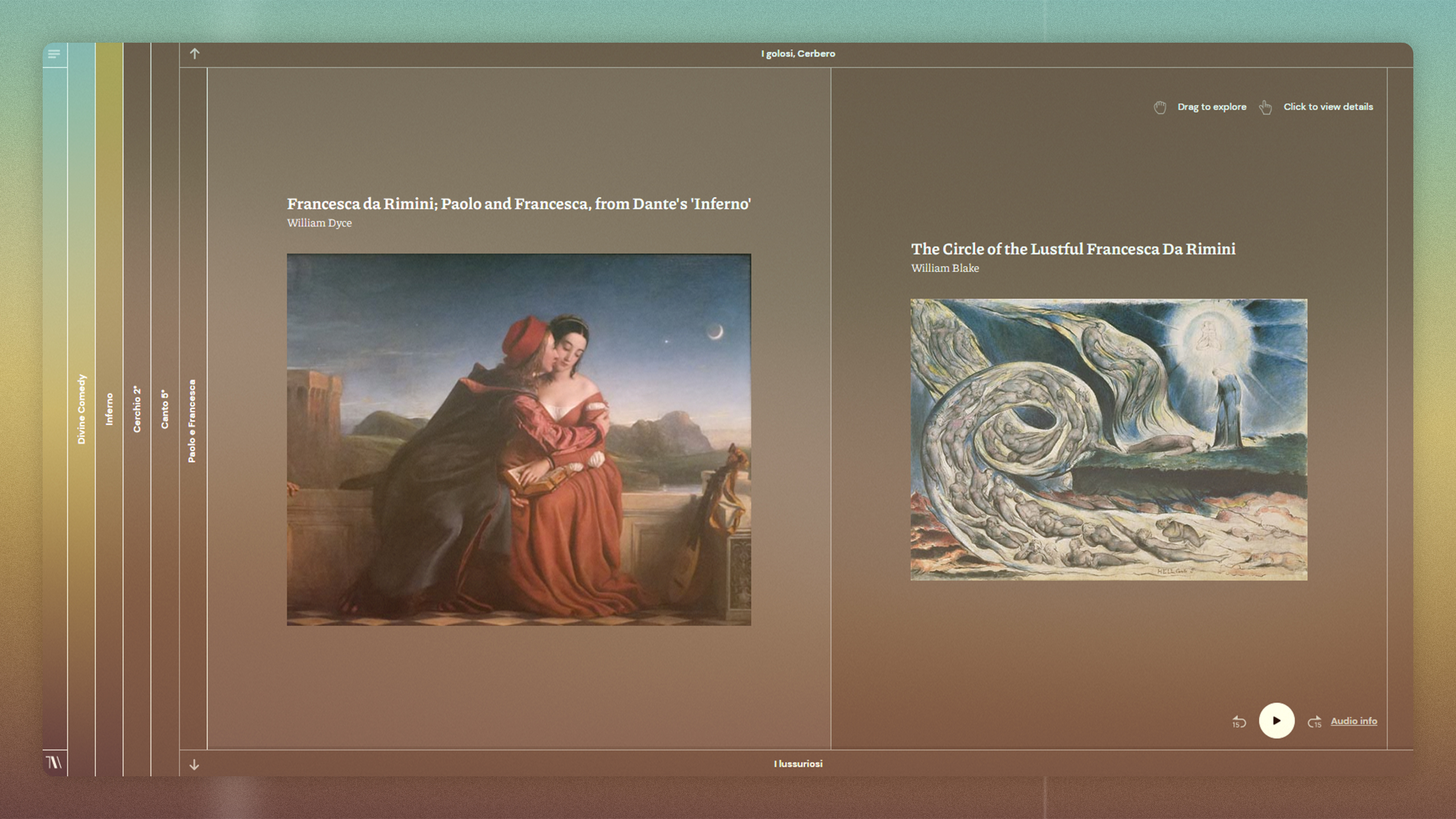
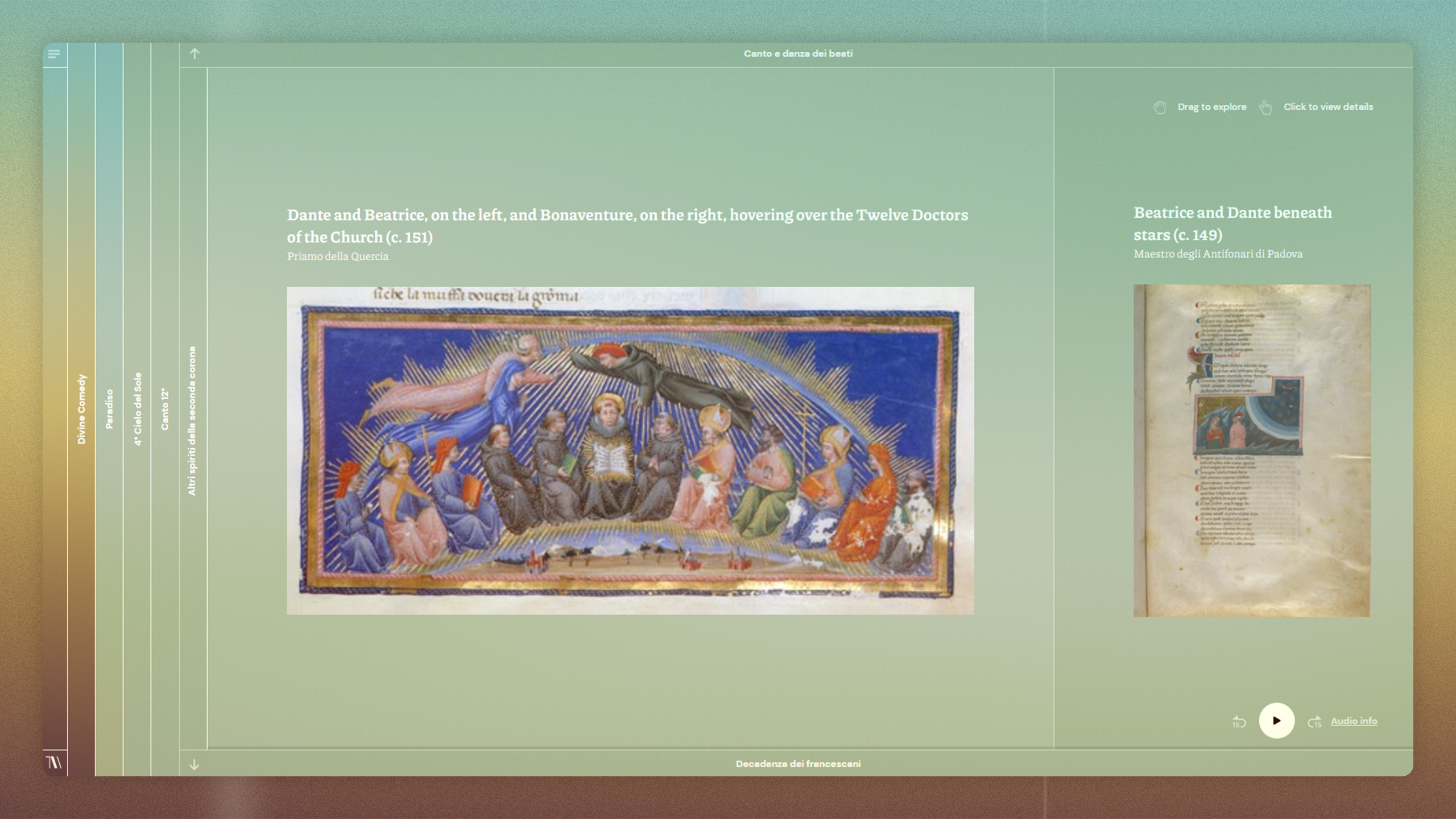
Luckily for art historians and Dante scholars working today, there is now Divine Comedy Digital, a beautifully designed database which brings these artworks — spread out all over the world — together in one virtual place.
The interface requires no special Dante knowledge to navigate, though it helps to be familiar with the poem and/or have a reference copy nearby when looking through the menus. Dividing neatly into the poem’s three books (or cantiche), the menu at the left further breaks down into circles (Inferno), terraces (Purgatorio), and Cantos (all three books).
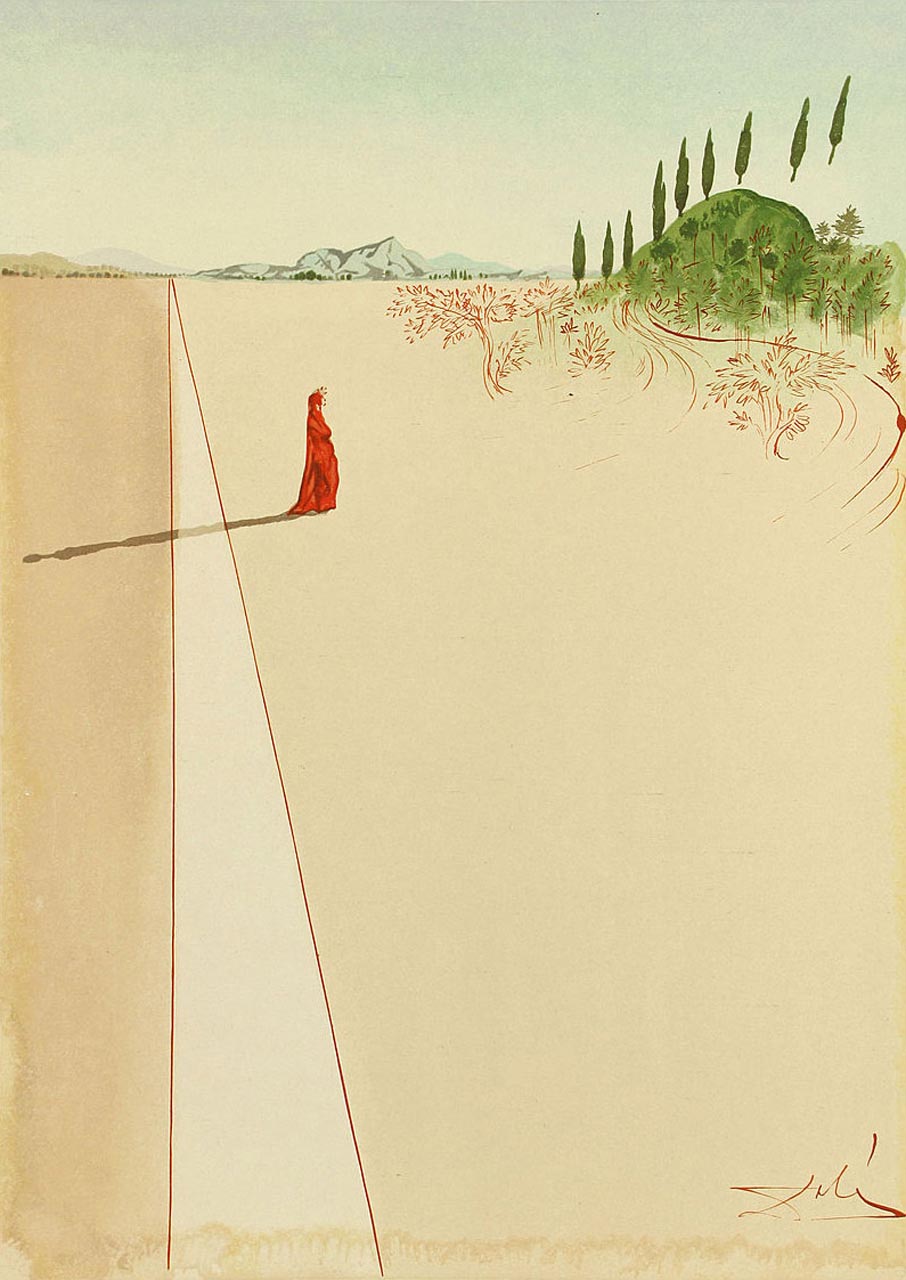
Toggling between options in a menu on the right allows visitors to see the number of illustrated verses in each Canto or the number of artworks. Within a matter of minutes, you’ll be discovering Dante illustrations you never knew existed, from Salvador Dali’s The Delightful Mount (1950, above) to Alessandro Vellutello’s Dante and St. Bernard, Mary and the Trinity (1544) and hundreds of others in the years in-between.

Calling itself a “slow surfing site,” Divine Comedy Digital contains a handy tutorial if you do get lost and allows users “not only to navigate through the collection, but also to suggest missing artworks.” So far, the 17th and 18th centuries are hugely underrepresented, though not for a lack of Dante-inspired artwork made in that two-hundred year period. The gaps mean there is much more Dante art to come.

Released in June of this year, the project is the work of The Visual Agency, “an information design agency specialized in data-visualization based in Milan and Dubai” and was created to celebrate the 700th anniversary of Dante’s death. As he continues to inspire artists for the next few hundred years, perhaps the work based on his epic poem will trend more digital than medieval, creating interpretations the poet never could have dreamt. Enter the Divine Comedy Digital project here.
You can also see some of the earliest illustrated editions of Dante’s Divine Comedy (1487–1568), courtesy of Columbia University, here.
Related Content:
A Free Course on Dante’s Divine Comedy from Yale University
Mœbius Illustrates Dante’s Paradiso
Hear Dante’s Inferno Read Aloud by Influential Poet & Translator John Ciardi (1954)
A Digital Archive of the Earliest Illustrated Editions of Dante’s Divine Comedy (1487–1568)
Josh Jones is a writer and musician based in Durham, NC. Follow him at @jdmagness.
Read More...The Meaning of Hieronymus Bosch’s Spellbinding Triptych, The Garden of Earthly Delights
Hieronymus Bosch was born Jheronimus van Aken. We know precious little else about him, not even the year of his birth, which scholar Nicholas Baum guesses must have been right in the middle of the fifteenth century. But we do know that the artist was born in the Dutch town of ‘s‑Hertogenbosch, better known as Den Bosch, to which his assumed name pays tribute. It is thus to Den Bosch that Baum travels in the The Mysteries of Hieronymus Bosch, the 1983 BBC TV movie above, in search of clues to an interpretation of Bosch’s mysterious, grotesque, and sometimes hilarious paintings. What manner of place could produce an artistic mind capable of The Garden of Earthly Delights?
“My first reaction was disappointment,” Baum says of Den Bosch. “I wasn’t expecting such a very ordinary, very commercial, very provincial little town. I couldn’t for the life of me fit anybody as extraordinary as Bosch into a sleepy little place like this.” A hardworking everyday Dutchman might laugh at Baum’s English imagination having got away with him; perhaps he’d even quote his country’s well-worn proverb about normal human behavior being crazy enough.
Nevertheless, fueled by a near-lifelong fascination with Bosch’s fantastical and forbidding art, Baum goes deeper: quite literally deeper, in one case, descending to the dank cellar beneath the house where the artist grew up in order to take in “the authentic smell and feel of Bosch’s own day.”
Further insights come when Baum investigates Bosch’s membership in the Catholic fraternity of the Common Life. A few decades later, that same order would also educate northern Renaissance philosopher Erasmus, whose religiosity is well known. Bosch must have been no less pious, but for centuries that didn’t figure as thoroughly into the interpretation of his paintings as it might have. Focused on the vivid images of bacchanalia Bosch incorporated into his work, some speculated on his involvement in orgy-oriented secret societies. But Baum’s journey convinces him that Bosch was “a fierce and pious Christian” who painted with the goal of turning a gluttonous, wealth- and pleasure-obsessed humanity back toward the teachings of the Bible. And half a millennium later, it is his wildly imaginative renderings of sin that continue to compel us — as well as hold out the promise of further secrets yet unexplained.
For anyone interested, Taschen now publishes an Bosch: The Complete Works, a beautiful and exhaustive exploration of the painter’s work. It includes a special chapter on The Garden of Earthly Delights.
Related Content:
The Meaning of Hieronymus Bosch’s The Garden of Earthly Delights Explained
Based in Seoul, Colin Marshall writes and broadcasts on cities, language, and culture. His projects include the Substack newsletter Books on Cities, the book The Stateless City: a Walk through 21st-Century Los Angeles and the video series The City in Cinema. Follow him on Twitter at @colinmarshall or on Facebook.
Read More...Neil Young Plays “Hey, Hey, My, My” with Devo: Watch a Classic Scene from the Improvised Movie Human Highway (1980)
For Neil Young fans, the words “Human Highway” can mean one of three different things, two of which are so unlike the third, it’s as if they came from different artists. First, there’s “Human Highway,” the song, one of Young’s gentle acoustic rags, with Nicolette Larson’s soft vocal harmonies and lots of banjo and fiddle. It landed on 1978’s Comes a Time but debuted five years earlier, nearly becoming the title track for a CSNY album that never materialized, a legendary follow-up to Déjà Vu.
None of this has anything to do with Human Highway, the 1980 film directed by Neil Young (as “Bernard Shakey”) and Dean Stockwell, which tells the “story,” if it can be called, of a crooked diner owner in a small town next to a nuclear power plant staffed by the members of Devo as “nuclear garbagepersons.” The cast is cult film royalty: “Dennis Hopper is a psychotic cook named Crackers,” notes critic Steven Puchalski, “Sally Kirkland is a beleaguered waitress; [Stockwell] is the new owner, Young Otto (son of the late Old Otto); plus Neil Young and Russ Tamblyn are frighteningly convincing as two noodle-headed gas pump operators, Lionel and Fred.”
The film is set on the last day before a nuclear apocalypse, a slapstick take on the time’s nuclear anxiety and Young’s stance against nuclear power. His nerdy Lionel idolizes rock star Frankie Fontaine (also Young), then becomes him in a dream sequence full of “wooden Indians” — his backing band. He then jams out with Devo for ten minutes (top) one of the highlights of the film, a performance of “Hey, Hey, My, My” with Mark Mothersbaugh taking lead vocals as Devo character “Booji Boy” (pronounced “boogie boy”).
“By normal standards,” Puchalski writes, “the movie sucks, but it’s a Mutant Must-See for Rock-‘N’-Schlock Completists.” It could also be one of the most influential indie films of the eighties, argues Den of Geek’s Jim Knipfel, leaving its mark on everything from Alex Cox’s Repo Man to David Lynch’s Blue Velvet (in which Hopper and Stockwell play somewhat similar characters) and Twin Peaks (in which Russ Tamblyn appears), to Tim Burton’s Pee Wee Herman’s Big Adventure.
Or maybe Young “was simply cursed to be ten minutes ahead of his time,” given that hardly anyone saw Human Highway in 1982. Shot over four years, and mostly financed by Young himself, Human Highway saw a limited release in L.A. then disappeared until a 1996 VHS edit of the film brought it some renown and critical reappraisal. (Its cover quoted an agent at William Morris saying, “It’s so bad, it’s going to be huge.”) The film has since become a cult classic, warranting special screenings like a reunion in 2016 at L.A.‘s Regal Theater featuring Young, Tamblyn, Devo’s Gerald Casale, actress Charlotte Stewart, and Cameron Crowe. (See a trailer for the DVD director’s cut release just above.)
At one point during the Q&A, Young turned to Crowe and asked, “Do you think we could get this movie made today?”. The film was made under unique conditions: “no script, improvised dialogue and a daily routine that began with someone asking him ‘What’s the plan today, Neil?’ to which he always replied ‘The plan today is no plan!’ ” It could get made, if Neil wanted to finance it (and a younger cast could handle the amount of drugs that clearly went into making the film). Given the number of digital distribution channels and Young’s fame, it could also very likely find a wide audience.
But in 1982, releasing a self-financed film, even if you were Neil Young, proved much more challenging. And in the late seventies and early eighties, one of the few ways for innovative New Wave bands like Devo to get wider notice was to catch the ear of stars like Young, who discovered them on stage in 1977 and knew he had to get them on film — before “Whip It” and their first defining hits came out — and show the rest of us what we were missing.
Related Content:
The Mastermind of Devo, Mark Mothersbaugh, Presents His Personal Synthesizer Collection
When Neil Young & Rick “Super Freak” James Formed the 60’s Motown Band, The Mynah Birds
Josh Jones is a writer and musician based in Durham, NC. Follow him at @jdmagness
Read More...Watch 15 Hours of The Pink Panther for Free
Remember Saturday mornings?
If you’re an American of a certain age, you probably spent a good chunk of them sprawled in front of the TV, absorbing a steady stream of network cartoons peppered with ads for toys and sugared cereal.
One of Saturday morning’s animated stars stood out from the crowd, a lanky, bipedal feline of a distinctly rosy hue.
He shared Bugs Bunny’s anarchic streak, without the hopped-up, motormouthed intensity.
In fact, he barely spoke, and soon went entirely mute, relying instead on Henry Mancini’s famous theme, which followed him everywhere he went.
Above all, he was sophisticated, with a minimalist aesthetic and a long cigarette holder.
Director Blake Edwards attributes his lasting appeal to his “promiscuous, fun-loving, devilish” nature.
John Cork’s short documentary Behind the Feline: The Cartoon Phenomenon, below, details how Edwards charged commercial animators David DePatie and Friz Freleng with creating a cartoon persona for the Pink Panther Diamond in his upcoming jewel heist caper.
DePatie, Freleng and their team drafted over a hundred renderings in response to the character notes Edwards bombarded them with via telegram.
Edward’s favorite, designed by director Hawley Pratt, featured the iconic cigarette holder and appeared in the feature film’s trailer and title sequence, ultimately upstaging a star studded cast including David Niven, Claudia Cardinale, Robert Wagner, and Peter Sellers as Inspector Clouseau.
The cartoon panther’s sensational debut prompted United Artists to order up another 156 shorts, to be released over a four to five year period. The first of these, The Pink Phink, not only established the tone, it also nabbed the Academy Award for 1964’s best animated short.
Although he was created with an adult audience in mind — the narrator of the original theatrical trailer asks him about bedroom scenes — his wordless torment of the simplified cartoon Inspector proved to be money in the bank on Saturday mornings.
The Pink Panther Show ran from 1969 to 1980, weathering various title tweaks and a jump from NBC to ABC.
Syndication and cable TV ensured a vibrant afterlife, here and in other countries, where the character’s sophistication and reliance on body language continues to be a plus.
The plots unfolded along predictable lines — the groovy panther spends 6 minutes thwarting and bedeviling a less cool, less pink-oriented character, usually the Inspector.
Every episode’s title includes a reference to the star’s signature color, often to groaning degree — Pink of the Litter, Pink-A-Boo, The Hand Is Pinker Than the Eye, Pinkcome Tax, The Scarlet Pinkernel.…
We won’t ask you to guess the color of Pink Panther Flakes, manufactured under the auspices of Post, a Pink Panther Show co-sponsor.
“I thought it was just fine for the film,” Edwards says of the animated Pink Panther in Cork’s 2003 documentary, “But I had no idea that it would take off like that, that it would have that kind of a life of its own… that kind of a merchandising life of its own. Thank god it did!”
Stay cool this summer with an 11-hour Pink Panther marathon, comprised of the following free compilations of Seasons 1, 2, 3 and 4.
Season 1
Season 2
Season 3
Season 4
Related Content:
How Looney Tunes & Other Classic Cartoons Helped Americans Become Musically Literate
Peter Sellers Performs The Beatles “A Hard Day’s Night” in Shakespearean Voice
Ayun Halliday is an author, illustrator, theater maker and Chief Primatologist of the East Village Inky zine. Follow her @AyunHalliday.
Read More...An Introduction to Japanese Kabuki Theatre, Featuring 20th-Century Masters of the Form (1964)
The English language has adopted kabuki as an adjective, applied to situations where exaggerated appearances and performances are everything. Business, politics, media: name any realm of modernity, and the myriad ways in which its affairs can turn kabuki will spring to mind. A highly stylized form of dance-drama originating in the seventeenth century, it continues to stand today as a pillar of classical Japanese culture — and indeed, according to UNESCO, one piece of the Intangible Cultural Heritage of Humanity. The worldwide regard for kabuki owes in part to self-promotional efforts on the part of Japan, whose Ministry of Foreign Affairs commissioned the half-hour introductory film above.
Produced in 1964, Kabuki: The Classic Theatre of Japan holds up as a representation of the art, as well as a view of some of the mid-20th century’s master practitioners. These actors include Jitsukawa Enjaku III, Nakamura Utaemon VI, and Ichikawa Danjūrō XI, whose stage names reflect their place in an unbroken professional lineage.
In fact, Ichikawa Danjūrō XI is a predecessor of Ichikawa Ebizō XI, previously featured here on Open Culture for his work in kabuki Star Wars adaptations. The generations shown here didn’t go in for such pop-cultural hybridization, but rather plays from the traditional kabuki repertoire like Shibaraku, Musume Dōjōji, and Sukeroku, scenes from all three of which appear in the film.
“Through elaborate costumes and vivid makeup, through beautifully stylized acting and exaggerated vocalization, and highlighted with picturesque settings and colorful music, the kabuki actors create dramatic effects of extraordinary intensity within a framework of pure entertainment,” explains the narrator. And as in the early performances of Shakespeare, all the roles are played by males, specialists known as onnagata. “Because the emphasis in kabuki is on artistic performance, not realism, the onnagata is considered more capable of expressing true femininity than is possible for an actress.” This may have struck Western viewers in the 1960s as an odd notion, but the sheer foreignness of kabuki — cultural, geographical, and temporal — must have been as captivating back then as it remains today, no matter how long we’ve been throwing its name around.
Related Content:
World Shakespeare Festival Presents 37 Plays by the Bard in 37 Languages: Watch Them Online
Based in Seoul, Colin Marshall writes and broadcasts on cities, language, and culture. His projects include the Substack newsletter Books on Cities, the book The Stateless City: a Walk through 21st-Century Los Angeles and the video series The City in Cinema. Follow him on Twitter at @colinmarshall or on Facebook.
Read More...Thirty-Six Views of Mount Fuji: A Deluxe New Art Book Presents Hokusai’s Masterpiece, Including “The Great Wave Off Kanagawa”

Like most Japanese masters of ukiyo‑e woodblock art, Katsushika Hokusai is best known mononymously. But he’s even better known by his work — and by one piece of work in particular, The Great Wave off Kanagawa. Even those who’ve never heard the name Hokusai have seen that print, arresting in its somehow calm turbulence, or at least they’ve seen one of its countless modern parodies and tributes (most recently, a large-scale homage in the medium of LEGO). But when he died in 1849, the prolific and long-lived artist left behind a body of work amounting to more than 30,000 paintings, sketches, prints, and illustrations (as well as a how-to-draw book).
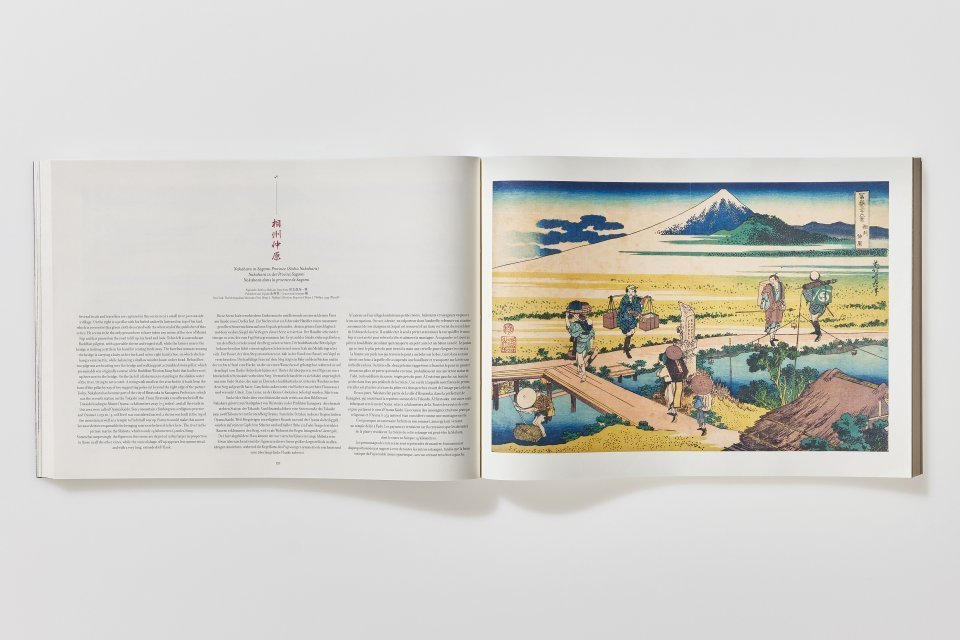
None of those 30,000 works are quite as famous as his Great Wave off Kanagawa, but very few indeed are as ambitions as the series to which it belongs, Thirty-Six Views of Mount Fuji. It is that two-year project, the artistic fruit of an obsession with Fuji and its environs, that Taschen has taken as the material for their new book Hokusai: Thirty-six Views of Mount Fuji.
Produced in a 224-page “XXL edition,” it gathers “the finest impressions from institutions and collections worldwide in the complete set of 46 plates alongside 114 color variations” — all sewn together, appropriately, with “Japanese binding.”
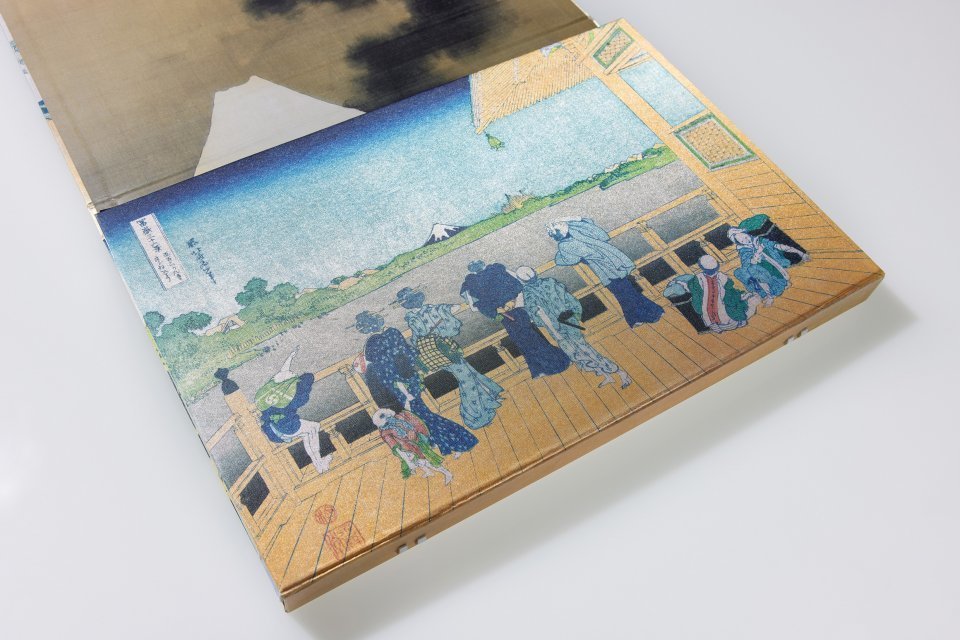
Not only does the book reproduce Thirty-six Views of Mount Fuji with Taschen’s signature attention to image quality, it presents The Great Wave off Kanagawa in a way few actually see it: in context. For that most widely published of all Hokusai prints launched the series, which continued on to Fine Wind, Clear Morning, Thunderstorm Beneath the Summit, and Kajikazawa in Kai Province, that last being an image held in especially high esteem by ukiyo‑e enthusiasts. One such enthusiast, east Asian art historian Andreas Marks, has performed this book’s editing and writing, as he did with Taschen’s previous Japanese Woodblock Prints (1680–1938). Experiencing the whole of Thirty-six Views of Mount Fuji, more than one reader will no doubt become as transfixed by Hokusai as Hokusai was by his homeland’s most beloved mountain. You can pick up a copy of Hokusai: Thirty-six Views of Mount Fuji here.
Related Content:
See Classic Japanese Woodblocks Brought Surreally to Life as Animated GIFs
Based in Seoul, Colin Marshall writes and broadcasts on cities, language, and culture. His projects include the Substack newsletter Books on Cities, the book The Stateless City: a Walk through 21st-Century Los Angeles and the video series The City in Cinema. Follow him on Twitter at @colinmarshall or on Facebook.
Read More...A Dancer Pays a Gravity-Defying Tribute to Claude Debussy
Most dancers have an intuitive understanding of physics.
Choreographer Yoann Bourgeois pushes this science beyond the standard lifts, leaps, and pirouettes, drawing on his training at the Centre National Des Arts du Cirque for a piece marking the centenary of composer Claude Debussy’s death, above.
Given the occasion, the choice of Clair de Lune, Debussy’s best loved piano work, feels practically de rigueur, but the trampoline comes as a bit of a shock.
We may not be able to see it, but it plays such an essential role, it’s tempting to call this solo a pas de deux. At the very least, the trampoline is an essential collaborator, along with pianist Alexandre Tharau and filmmaker Raphaël Wertheimer.
Bourgeois’ expressiveness as a performer has earned him comparisons to Charlie Chaplin and Buster Keaton. His choreography shows that he also shares their work ethic, attention to detail, and love of jawdropping visual stunts.
Don’t expect any random boinging around on this tramp’.
For four and a half minutes, Bourgeois’ everyman struggles to get to the top of a stark white staircase. Every time he falls off, the trampoline launches him back onto one of the steps — higher, lower, the very one he fell off of…
Interpret this struggle how you will.
Psyche, a digital magazine that “illuminates the human condition through psychology, philosophical understanding and the arts” found it to be “an abstracted interpretation of a childlike experience of time.” One viewer wondered if the number of steps — twelve — was significant.
It’s no stretch to conceive of it as a comment on the nature of life — a constant cycle of falling down and bouncing back.
It’s lovely to behold because Bourgeois makes it look so easy.
In an interview with NR, he spoke of how his circus studies led to the realization that “the relationship between physical forces” is what he’s most interested in exploring. The stairs and trampoline, like all of his sets (or devices, as he prefers to call them), are there to “amplify specific physical phenomenon”:
In science, we’d call them models – they’re simplifications of our world that enable me to amplify one particular force at a time. Together, this ensemble of devices, this constellation of constructed devices, tentatively approaches the point of suspension. And so, this makes up a body of research; it’s a life’s research that doesn’t have an end in itself.
The relationship with physical forces has an eloquent capacity that can be very big; it has the kind of expression that is universal.
Watch more of Youann Bourgeois’ physics-based choreography on his YouTube channel.
Related Content:
Hear Debussy Play Debussy: A Vintage Recording from 1913
Ayun Halliday is an author, illustrator, theater maker and Chief Primatologist of the East Village Inky zine. Follow her @AyunHalliday.
Read More...Support Us
We're hoping to rely on loyal readers, rather than erratic ads. Please click the Donate button and support Open Culture. You can use Paypal, Venmo, Patreon, even Crypto! We thank you!

About Us

Open Culture scours the web for the best educational media. We find the free courses and audio books you need, the language lessons & educational videos you want, and plenty of enlightenment in between.
Advertise With Us
FREE UPDATES!
GET OUR DAILY EMAIL
Get the best cultural and educational resources on the web curated for you in a daily email. We never spam. Unsubscribe at any time.
FOLLOW ON SOCIAL MEDIA
Open Culture editor Dan Colman scours the web for the best educational media. He finds the free courses and audio books you need, the language lessons & movies you want, and plenty of enlightenment in between.
Advertise With Us

