Startup School: Take YCombinator’s Free Online Course for Current & Aspiring Entrepreneurs
If you’re working on a startup, take note. YCombinator–a well-known Silicon Valley accelerator–has created Startup School, a free online program for entrepreneurs. The school has a track for current startup founders, and another one for aspiring/eventual founders. In each case, the school strives to offer the best lessons and advice on how to start a startup, while building “a community of entrepreneurs who can encourage, teach and support one another.” Startup School is completely free. You just need a device with access to the internet. View the curriculum here. (Topics include everything from “How to Get Start Up Ideas” and “How to Pitch a Startup,” to “How to Find the Right Co-Founder” and “How to Split Equity.”) And sign up here.
This course will be added to our list, 1,700 Free Online Courses from Top Universities.
If you would like to support the mission of Open Culture, consider making a donation to our site. It’s hard to rely 100% on ads, and your contributions will help us continue providing the best free cultural and educational materials to learners everywhere. You can contribute through PayPal, Patreon, and Venmo (@openculture). Thanks!
Related Content:
How to Start a Start-Up: A Free Online Course from Y Combinator Taught at Stanford
150 Free Online Business Courses
Entrepreneurship Through the Lens of Venture Capital: A Free Online Course from Stanford
Read More...What Is Contemporary Art?: An Online Course from The Museum of Modern Art
What is contemporary art? In this course from the Museum of Modern Art, you’ll explore this question through more than 70 works of art made from 1980 to the present, with a focus on art of the last decade. You’ll hear directly from artists, architects, and designers from around the globe about their creative processes, materials, and inspiration.
3D printed glass and sculptures made of fiber. Dance performed in the factory and the museum. Hacking into television and video games. Portraits made with paint or artificial intelligence. Intimate explorations of the body and collective actions. In this course, you’ll learn about artworks in both traditional and surprising mediums, all drawn from the collection of The Museum of Modern Art. Each week students will look at contemporary art from a different theme: Media from Television to the Internet, Territories & Transit, Materials & Making, Agency, and Power.
You can take What Is Contemporary Art? for free by selecting the audit option upon enrollment. If you want to take the course for a certificate, you will need to pay a fee.
What Is Contemporary Art? will be added to our list, 1,700 Free Online Courses from Top Universities.
Related Content:
For a complete list of online courses, please visit our complete collection, 1,700 Free Online Courses from Top Universities.
For a list of online certificate programs, visit 200 Online Certificate & Microcredential Programs from Leading Universities & Companies, which features programs from our partners Coursera, Udacity, FutureLearn and edX.
And if you’re interested in Online Mini-Masters and Master’s Degrees programs from universities, see our collection: Online Degrees & Mini Degrees: Explore Masters, Mini Masters, Bachelors & Mini Bachelors from Top Universities.
Read More...Modern Art & Ideas: A Free Online Course from the Museum of Modern Art
Looking at modern art through the lens of different themes can reveal surprising connections and new insights. In this online course Modern Art & Ideas, students explore four themes taught at The Museum of Modern Art: Places and Spaces, Art and Identity, Transforming Everyday Objects, Art and Society. The course features audio interviews with artists, designers, and curators.
You can take the course for free by selecting the audit function upon enrollment. If you want to take the course for credit, you will need to pay a fee.
Modern Art & Ideas will be added to our collection, 1,700 Free Online Courses from Top Universities.
Related Content:
For a complete list of online courses, please visit our complete collection, 1,700 Free Online Courses from Top Universities.
For a list of online certificate programs, visit 200 Online Certificate & Microcredential Programs from Leading Universities & Companies, which features programs from our partners Coursera, Udacity, FutureLearn and edX.
And if you’re interested in Online Mini-Masters and Master’s Degrees programs from universities, see our collection: Online Degrees & Mini Degrees: Explore Masters, Mini Masters, Bachelors & Mini Bachelors from Top Universities.
Read More...Seeing Through Photographs: A Free Online Course from the Museum of Modern Art
In this course, “Seeing Photographs,” from the Museum of Modern Art, you will look closely at 100 photographs from the collection of The Museum of Modern Art, going behind the scenes of the Museum and into artist studios through original films and audio interviews. You will hear a variety of perspectives on the ways photography has been used throughout its 180-year history: as a means of artistic expression, a tool for science and exploration, an instrument of documentation, a way to tell stories and record histories, and a mode of communication and critique. Short texts and readings from MoMA publications provide enhanced context for the works in the course.
You can take “Seeing Photographs” for free by selecting the audit option upon enrollment. For a fee you can take the course for credit.
Find “Seeing Photographs” listed in our collection, 1,700 Free Online Courses from Top Universities.
Related Content:
For a complete list of online courses, please visit our complete collection, 1,700 Free Online Courses from Top Universities.
For a list of online certificate programs, visit 200 Online Certificate & Microcredential Programs from Leading Universities & Companies, which features programs from our partners Coursera, Udacity, FutureLearn and edX.
And if you’re interested in Online Mini-Masters and Master’s Degrees programs from universities, see our collection: Online Degrees & Mini Degrees: Explore Masters, Mini Masters, Bachelors & Mini Bachelors from Top Universities.
Read More...Pyramids of Giza: Ancient Egyptian Art and Archaeology–a Free Online Course from Harvard
From Harvard’s Peter Der Manuelian comes Pyramids of Giza: Ancient Egyptian Art and Archaeology offered on the edX platform.
Explore the archaeology, history, art, and hieroglyphs surrounding the famous Egyptian Pyramids at Giza. Learn about Old Kingdom pharaohs and elites, tombs, temples, the Sphinx, and how new technology is unlocking their secrets.
Where is Giza? How were the Pyramids built? How did the cemeteries and hundreds of decorated tombs around them develop? What was Giza’s contribution to this first great age of ancient Egyptian civilization, the Old Kingdom?
The Giza Plateau and its cemeteries — including the majestic Pyramids and the Great Sphinx — are stirring examples of ancient Egyptian architecture and culture. They provide windows into ancient Egyptian society, but also contain mysteries waiting to be solved. The Egyptian Pyramids at Giza provide an opportunity to explore the history of archaeology and to learn about some of the modern methods shaping the discipline today.
This introductory course will explore the art, archaeology, and history surrounding the Giza Pyramids. We will learn about Egyptian pharaohs and high officials of the Pyramid Age, follow in the footsteps of the great 20th-century expeditions, and discover how cutting-edge digital tools like 3D-modeling are reshaping the discipline of Egyptology.
Join us on this online journey to ancient Egypt’s most famous archaeological site as we uncover the history and significance of Giza, and use new digital techniques to unravel the mysteries of its ancient tombs and temples.
You can take the course for free by selecting the audit option upon enrollment, or take it for credit for a feel. Enroll here.
Find more courses on our list, 1,700 Free Online Courses from Top Universities.
Related Content:
What Ancient Egyptian Sounded Like & How We Know It
Read More...The Foundations of Positive Psychology: Free Online Courses from the University of Pennsylvania
From Martin Seligman and the University of Pennsylvania comes The Foundations of Positive Psychology Specialization–a series of four courses that provides an introduction to key theories and research in the field of positive psychology. The individual courses include:
- Positive Psychology: Martin E. P. Seligman’s Visionary Science (taught by Martin E.P. Seligman, Ph.D.)
- Positive Psychology: Applications and Interventions (James Pawelski, Ph.D.)
- Positive Psychology: Character, Grit and Research Methods (Claire Robertson-Kraft, Ph.D. and Angela Duckworth)
- Positive Psychology: Resilience Skills (Karen Reivich, Ph.D.)
You can take each course for free if you enroll with the “audit” function upon enrollment. Or, for a fee, you can take the courses and receive a certificate. The choice is yours.
For more psychology courses, visit our collection: Free Online Psychology & Neuroscience Courses, a subset of our collection, 1,700 Free Online Courses from Top Universities.
Related Content:
For a complete list of online courses, please visit our complete collection, 1,700 Free Online Courses from Top Universities.
For a list of online certificate programs, visit 200 Online Certificate & Microcredential Programs from Leading Universities & Companies, which features programs from our partners Coursera, Udacity, FutureLearn and edX.
And if you’re interested in Online Mini-Masters and Master’s Degrees programs from universities, see our collection: Online Degrees & Mini Degrees: Explore Masters, Mini Masters, Bachelors & Mini Bachelors from Top Universities.
Read More...The Ukulele Orchestra of Great Britain’s Headbanging Cover of Nirvana’s “Smells Like Teen Spirit”
Smells Like Teen Spirit is an unusual anthem because it refuses the role of the anthem. It’s perfect for the generation it represented because this was a cohort that was so ambivalent about any traditional values [or] conventional success. — music critic Ann Powers
The screaming existential angst of “Smells Like Teen Spirit” ensured that Nirvana would define, transcend, and outlast the 90s grunge scene.
The song was an instant hit. Here’s a description from someone who was present at the small Seattle club O.K Hotel for its first live performance:
They started playing the new song and people erupted. We were being slimed on by shirtless guys, just moshing. My friend Susan started hyperventilating, she thought it was so good: ‘I can’t, gasp, believe what they just played!’ It was just instantaneous; it was crazy.
“Smells Like Teen Spirit” was unreconstituted rock bliss to us…
…and perhaps not the most natural fit for a ukulele cover?
On the other hand, what better instrument for those “ambivalent about conventional success” than the ukulele?
The Ukelele Orchestra of Great Britain’s cover is as intentionally silly as the band itself, but also manages to convey some of the original’s DGAF attitude.
That’s quite an accomplishment for a seated row of formally dressed, middle aged musicians, strumming in unison on an instrument anyone can play… but few can play well.
The ukulele has become cool in certain circles, but remains inextricably linked to Tiny Tim tiptoeing through the tulips, and a million fumbling summer camp recreations of Jake Shimabukuro’s gentle Hawaiian “Somewhere Over the Rainbow.”
Orchestra founder Peter Brooke Turner’s tribute to lead vocalist Kurt Cobain helps nudge the needle past pure novelty into the realm of credibility, or at least a sophisticated understanding of all the ways in which the original works.
Plus, his “yeah” at 1:52 transcends the era of flannels, harkening to a time when the unconflicted preening rock god reigned supreme. (We should note that he serves plenty of ham alongside that sausage.)
Best of all is David Suich’s enthusiastic headbanging. Clearly a fellow who enjoys putting his long hair in service of his art! (We refer you to the Ukulele Orchestra’s interpretation of AC/DC’s “Highway to Hell.” below…)
Related Content:
The First Live Performance of Nirvana’s “Smells Like Teen Spirit” (1991)
1,000 Musicians Play Nirvana’s “Smells Like Teen Spirit” Live, at the Same Time
Ayun Halliday is an author, illustrator, theater maker and Chief Primatologist of the East Village Inky zine. Follow her @AyunHalliday.
Read More...Discover Ibn Sina (Avicenna), a Missing Pixel in Your Image of Philosophy: Partially Examined Life Episode #267 Featuring Peter Adamson
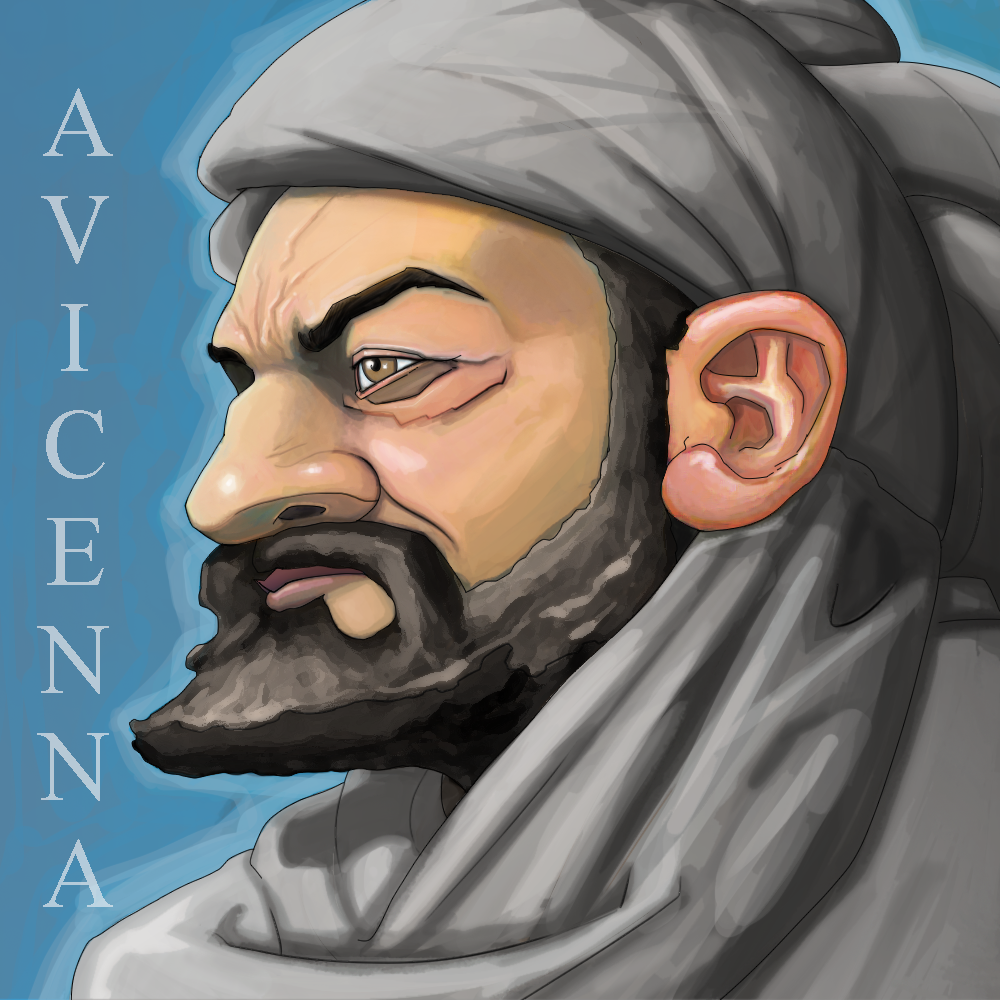
Most American students in philosophy live on a diet of ancient Greek philosophy on the one hand, and then “modern” philosophy, which starts around the time of Descartes (the 17th century), with numerous schools and approaches spilling into the present day. If you get anything from between those ancient days and modernity, it’s probably some churchmen, i.e. Augustine (from the 4th century) and Thomas Aquinas (the 13th century), with perhaps a few Romans thrown in there and (if you’re Jewish) Maimonides (12th century).
But a key part of this lineage was the Eastward turn that the great works of Greek and Roman philosophy took during the so-called Dark Ages, when they were preserved and copied in the Islamic world, and this period produced a wealth of philosophy including two figures who became influential enough in the West that their names were Latinized: Ibn Sīnā (980‑1037 C.E.) and Ibn Rushd, a.k.a. Averroes (1126–1198). Aquinas was very familiar with these figures and incorporated them into his influential works, and in the case of Ibn Sina, at least, important figures like John Locke had definitely known at least about his views, if not his actual works.
On the Partially Examined Life Philosophy Podcast, which has been going for 13 years now, we range widely over the history of philosophy but had not actually cracked the Islamic world. Luckily, Ibn Sīnā is one of the favorite philosophers of one of our favorite guests, Peter Adamson of King’s College London. Peter runs his own podcast, The History of Philosophy (Without Any Gaps), which as the name implies, covers Medieval philosophy with admirable thoroughness, covering not only Ibn Sīnā and Ibn Rushd, but also figures like al-Rāzī, al-Fārābī, Al-Ghazālī, and many others.
Peter was good enough to recommend some readings to introduce us and our listeners to this figure, some of which he actually wrote. Because of the volume, redundancy, and style of Ibn Sīnā’s writings, some sort of guide to collect and to some degree explain passages is essential for getting a handle on this idiosyncratic and brilliant thinker. He wrote at least three different versions of his all-encompassing system, which was influenced by and meant to supplant Aristotle’s. In addition to philosophical/theological topics, it included mathematics, science, psychology, and more. So instead of trying to read a whole work covering all that, it makes more sense to pick individual topics and then look at the various formulations he gave about these.
Our two topics for this discussion were a peculiar argument for the existence of God — with important implications for talking about metaphysics more generally — and an argument for the immateriality of the soul, which likewise tells us a lot about the way that Ibn Sīnā thought about knowledge and its relation to the world.
The argument for the existence of God was later called by Thomas Aquinas “the argument from contingency.” It posits that things in the world don’t simply exist, but that they require something else to support their existence. This isn’t a cause is the chronological sense that we talk about it: a prior event that gave rise to the thing. Rather, the material components of something in a certain arrangement make it continue to exist as that thing right now; for example, a house exists because its component wood parts exist, with nails and such holding them in place. And the wood in turn has its character because of its physical/chemical components, etc. If these component causes weren’t in place, the thing would not exist; the thing is thus “contingent,” meaning it might well not have existed were it not for those causes.
This picture of the universe thus includes a giant network of causality, but does that network itself rest on anything? According to Ibn Sīnā, there must be something that is not contingent that holds everything else up. But is this thing God (in the sense that a good Muslim of his time would recognize it)? Ibn Sīnā then has a long series of arguments to show one by one that just by being “the necessary being,” this entity also must be unique, must be all-powerful, generous, and all the other things one would expect God to be.
The argument for the immortality of the soul is perhaps Ibn Sīnā’s most famous argument, often called the flying or floating man argument. It’s a thought experiment whereby you imagine you’ve just been created, but fully mature, so you can think, but with no memory, and your senses are inoperable. You can’t even feel gravity or the ground under your feet (thus the “flying” part). According to Ibn Sīnā, you would still in such a situation know that you exist. Since your apprehension of self did not include any part of your body (you couldn’t feel your body at all), that is supposed to prove that your body is not an essential part of what you are.
Ibn Sīnā thought this argument definitive because of his theory of knowledge by which if you know anything at all, then you know about the essential components of that thing. If you know what a triangle is, you know that it’s an abstract geometrical figure with three straight sides. If you know what a horse is, you know that it’s a biological animal with a particular character that you can identify. And to know what you are essentially, you only need know that feeling of your own mind; anything else about that mind being associated with a particular body that lives in a particular part of the world and is just knowledge of contingent, relational facts about yourself.
PEL hosts Mark Linsenmayer and Dylan Casey grapple in detail with Peter about these arguments, both on this recording and on a second part of the discussion for those that want to hear more. To read more about these arguments and get the citations to the texts we read for this discussion, see the essay for this episode at partiallyexaminedlife.com. The History of Philosophy podcast also features four monologues and an interview about Ibn Sīnā. Don’t let this gap in your knowledge of major figures in intellectual history remain unfilled!
Mark Linsenmayer is the host of the Partially Examined Life, Pretty Much Pop, and Nakedly Examined Music podcasts. He is a writer and musician working out of Madison, Wisconsin. Read more Open Culture posts about The Partially Examined Life.
Image by Solomon Grundy.
Read More...Leonardo da Vinci’s Notebooks Get Digitized: Where to Read the Renaissance Man’s Manuscripts Online
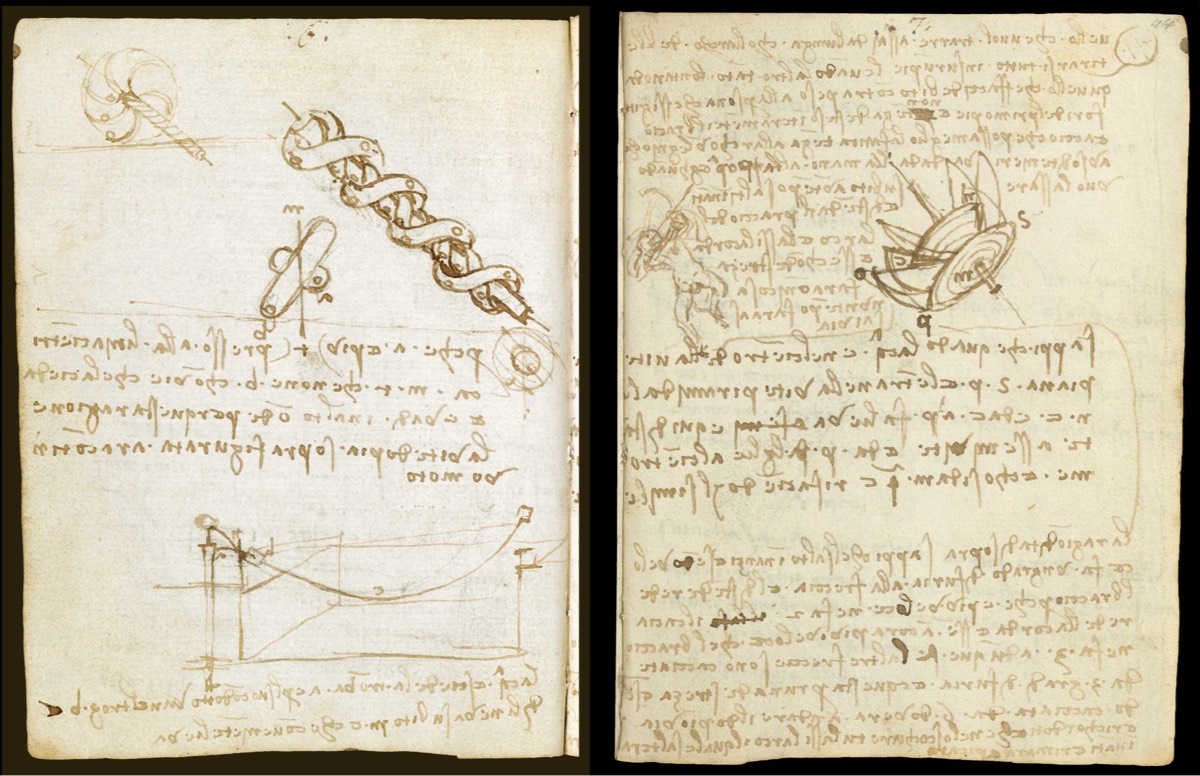
From the hand of Leonardo da Vinci came the Mona Lisa and The Last Supper, among other art objects of intense reverence and even worship. But to understand the mind of Leonardo da Vinci, one must immerse oneself in his notebooks. Totaling some 13,000 pages of notes and drawings, they record something of every aspect of the Renaissance man’s intellectual and daily life: studies for artworks, designs for elegant buildings and fantastical machines, observations of the world around him, lists of his groceries and his debtors. Intending their eventual publication, Leonardo left his notebooks to his pupil Francesco Melzi, by the time of whose own death half a century later little had been done with them.
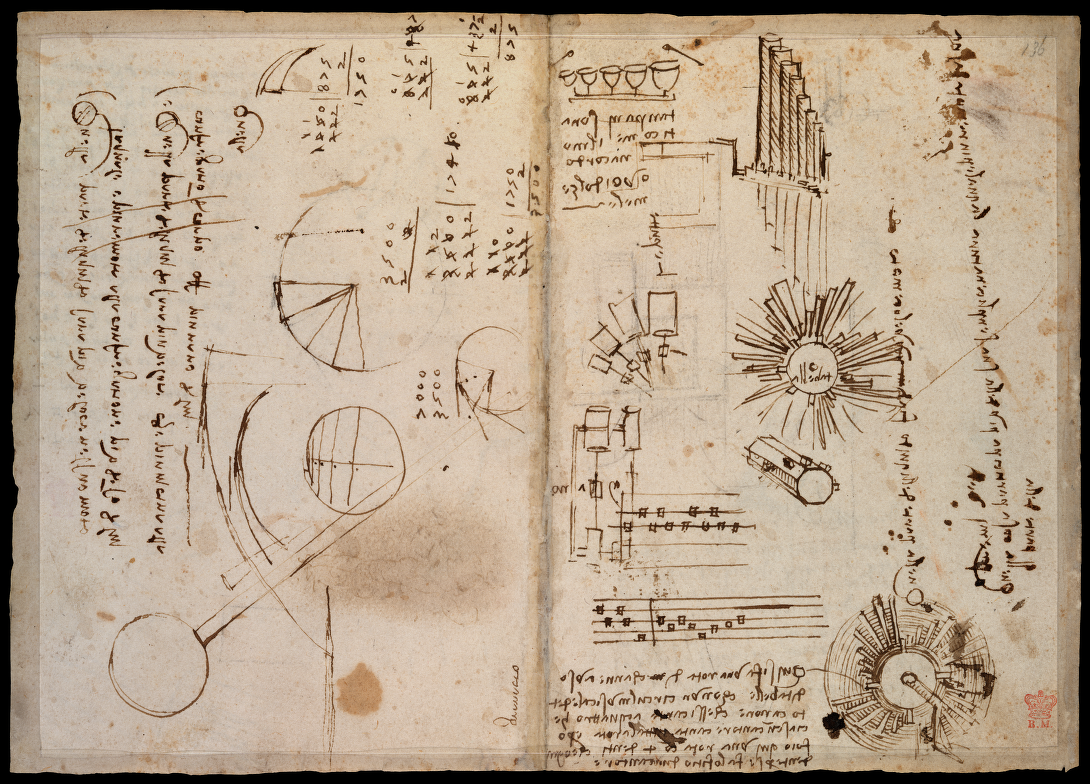
Absent a proper steward, Leonardo’s notebooks scattered across the world. Six centuries later, their surviving pages constitute a series of codices in the possession of such entities as the Biblioteca Ambrosiana, the British Museum, the Institut de France, and Bill Gates.
In recent years, they and their collaborating organizations have made efforts to open Leonardo’s notebooks to the world, digitizing them, translating them, and organizing them for convenient browsing on the web. Here on Open Culture, we’ve previously featured the Codex Arundel as made available to the public by the British Library, Codex Atlanticus by the Visual Agency, and the three-part Codex Forster by the Victoria & Albert Museum.
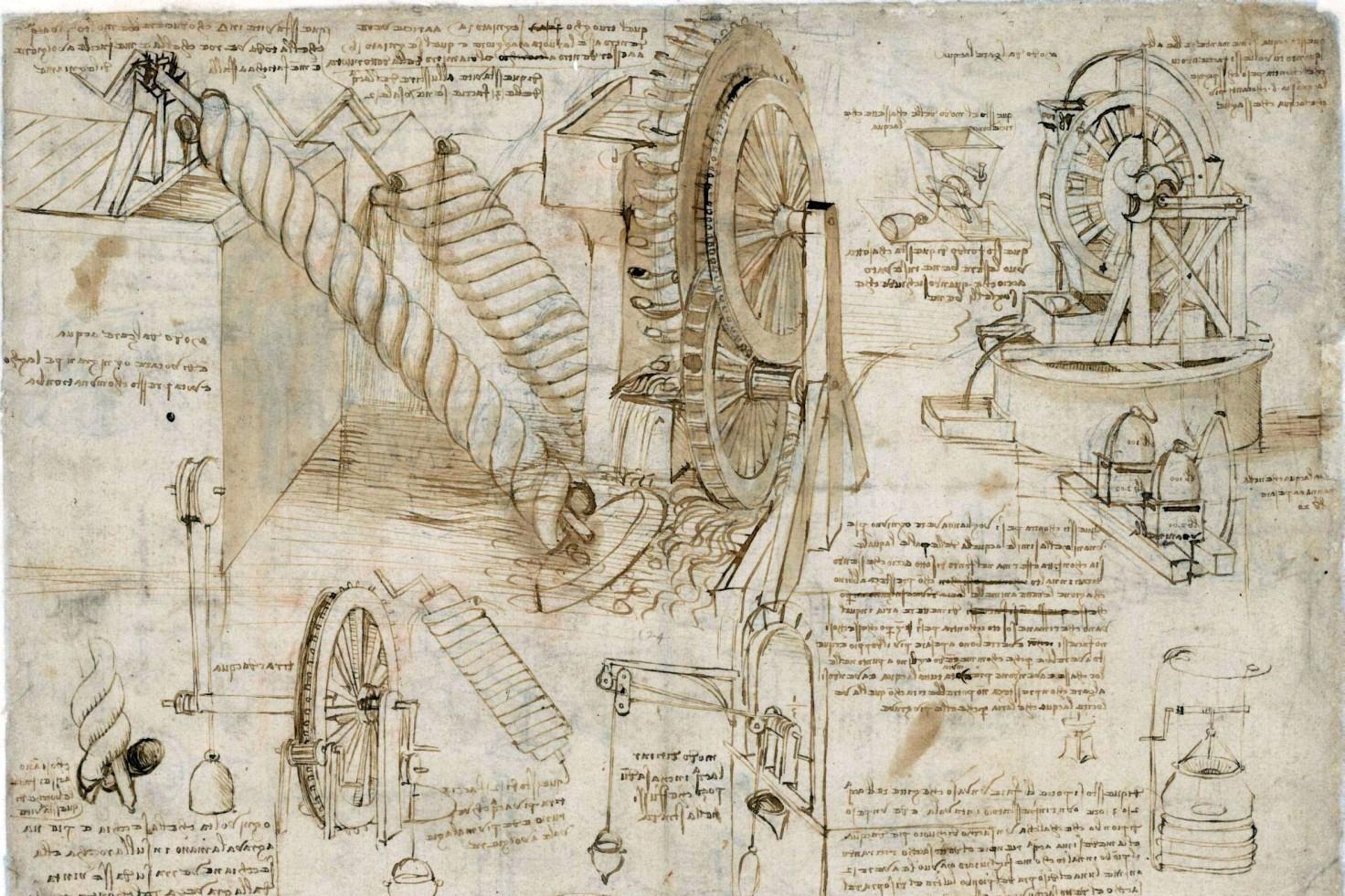
Other collections of Leonardo’s notebooks made available to view online include the Madrid Codices at the Biblioteca Nacional de España, the Codex Trivulzianus at the Archivo Storico Civico e Biblioteca Trivulziana, and the Codex on the Flight of Birds at the Smithsonian National Air and Space Museum. (Published as a standalone book, his Treatise on Painting is available to download at Project Gutenberg.) Even so, many of the pages Leonardo wrote haven’t yet made it to the internet, and even when they do, generations of interpretive work — well beyond reversing his “mirror writing” — will surely remain. Much as humanity is only now putting some of his inventions to the test, the full publication of his notebooks remains a work in progress. Leonardo himself would surely understand: after all, one can’t cultivate a mind like his without patience.
Related Content:
Leonardo da Vinci’s Bizarre Caricatures & Monster Drawings
Leonardo da Vinci’s Handwritten Resume (1482)
Leonardo Da Vinci’s To Do List (Circa 1490) Is Much Cooler Than Yours
Why Did Leonardo da Vinci Write Backwards? A Look Into the Ultimate Renaissance Man’s “Mirror Writing”
Based in Seoul, Colin Marshall writes and broadcasts on cities, language, and culture. His projects include the Substack newsletter Books on Cities, the book The Stateless City: a Walk through 21st-Century Los Angeles and the video series The City in Cinema. Follow him on Twitter at @colinmarshall or on Facebook.
Read More...Pink Floyd’s David Gilmour Composes a Soundtrack to Arthur C. Clarke’s Documentary Fractals: The Colors of Infinity
An observer once called the Mandelbrot Set “The Thumbprint of God,” the simple equation that led to the discovery of fractal geography, chaos theory, and why games like No Man’s Sky even exist. In 1994, Arthur C. Clarke, writer of both science fiction and science fact, narrated a one-hour documentary on the new mathematics, called Fractals: The Colors of Infinity. If that sounds familiar, dear reader, it’s because we’ve told you about it long ago. But it’s worth revisiting, and it’s worth mentioning that the soundtrack was created by Pink Floyd’s David Gilmour.
To be honest, at first I wasn’t really hearing that Floyd vibe, just some pleasant synth-strings you could find on any number of documentaries. But then Clarke explains the implication of the Mandelbrot equation, ending it with “This really is infinity.” And then Boom, the acid hit.
Or rather, the rainbow computer graphics of the endless zoom hit, and it was unmistakably Gilmour—cue up 5:19 and be careful with that fractal, Eugene. This happens again at 14:30, 25:12, 31:07, 35:46, 38:22, 43:22, 44:51, and 50:06 for those with an itchy scrubbing finger. But stick around for the whole doc, as the history of how we got to the equation, its precedents in nature and art, and the implications only hinted at in the program, all make for interesting viewing.
The music will remind you in places of “Shine On Your Crazy Diamond”, “Obscured by Clouds,” and “On the Run.” When a DVD was released years later, a special feature isolated just Gilmour’s music and the fractal animation.
Gilmour has contributed soundtrack work to other programs. He has an uncredited performance on Guy Pratt’s soundtrack from 1995’s Hackers; incidental music for 1992’s Ruby Takes a Trip with Ruby Wax; and a 1993 documentary on the arts and drug use called The Art of Tripping.
There are no official releases of this soundtrack work, but one user has put up 16 minutes of the Colours of Infinity music over at SoundCloud.
Related Content:
Watch David Gilmour Play the Songs of Syd Barrett, with the Help of David Bowie & Richard Wright
Arthur C. Clarke Predicts the Future in 1964 … And Kind of Nails It
Ted Mills is a freelance writer on the arts who currently hosts the Notes from the Shed podcast and is the producer of KCRW’s Curious Coast. You can also follow him on Twitter at @tedmills, and/or watch his films here.
Read More...Support Us
We're hoping to rely on loyal readers, rather than erratic ads. Please click the Donate button and support Open Culture. You can use Paypal, Venmo, Patreon, even Crypto! We thank you!

About Us

Open Culture scours the web for the best educational media. We find the free courses and audio books you need, the language lessons & educational videos you want, and plenty of enlightenment in between.
Advertise With Us
FREE UPDATES!
GET OUR DAILY EMAIL
Get the best cultural and educational resources on the web curated for you in a daily email. We never spam. Unsubscribe at any time.
FOLLOW ON SOCIAL MEDIA
Open Culture editor Dan Colman scours the web for the best educational media. He finds the free courses and audio books you need, the language lessons & movies you want, and plenty of enlightenment in between.
Advertise With Us

