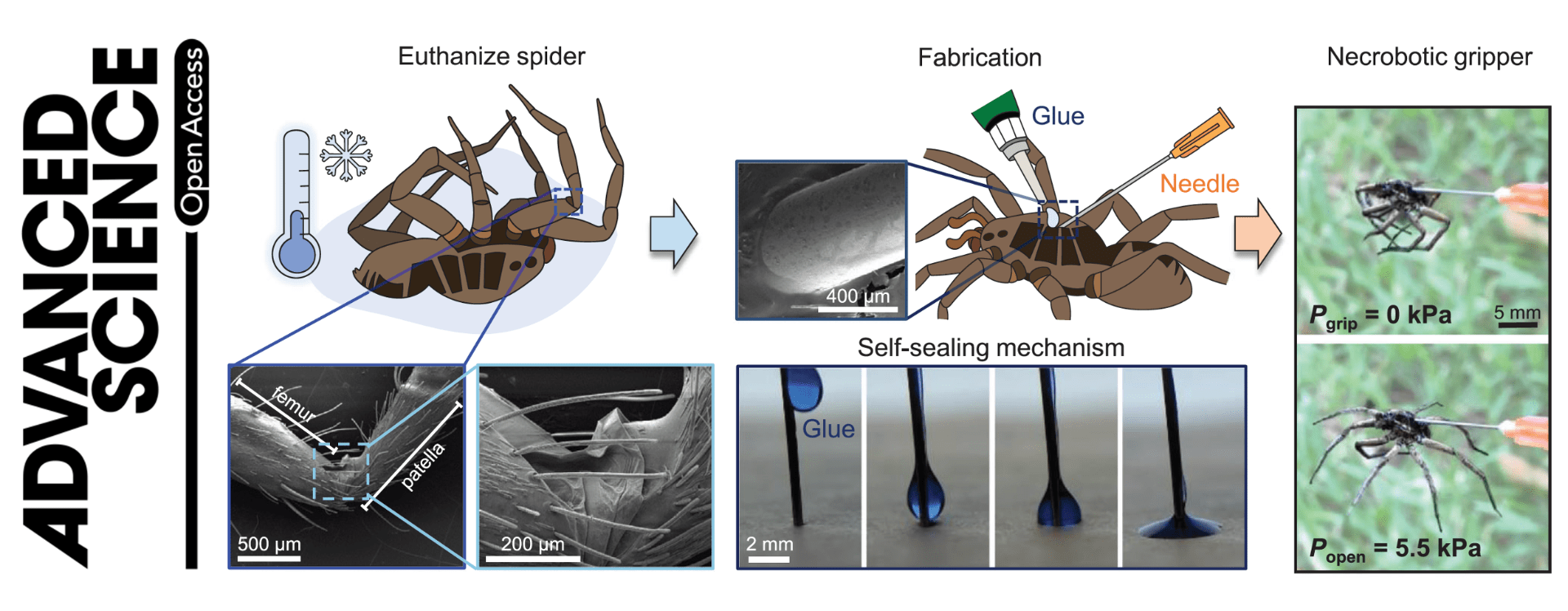
They only have flexor muscles, which allow their legs to curl in, and they extend them outward by hydraulic pressure. When they die, they lose the ability to actively pressurize their bodies. That’s why they curl up.
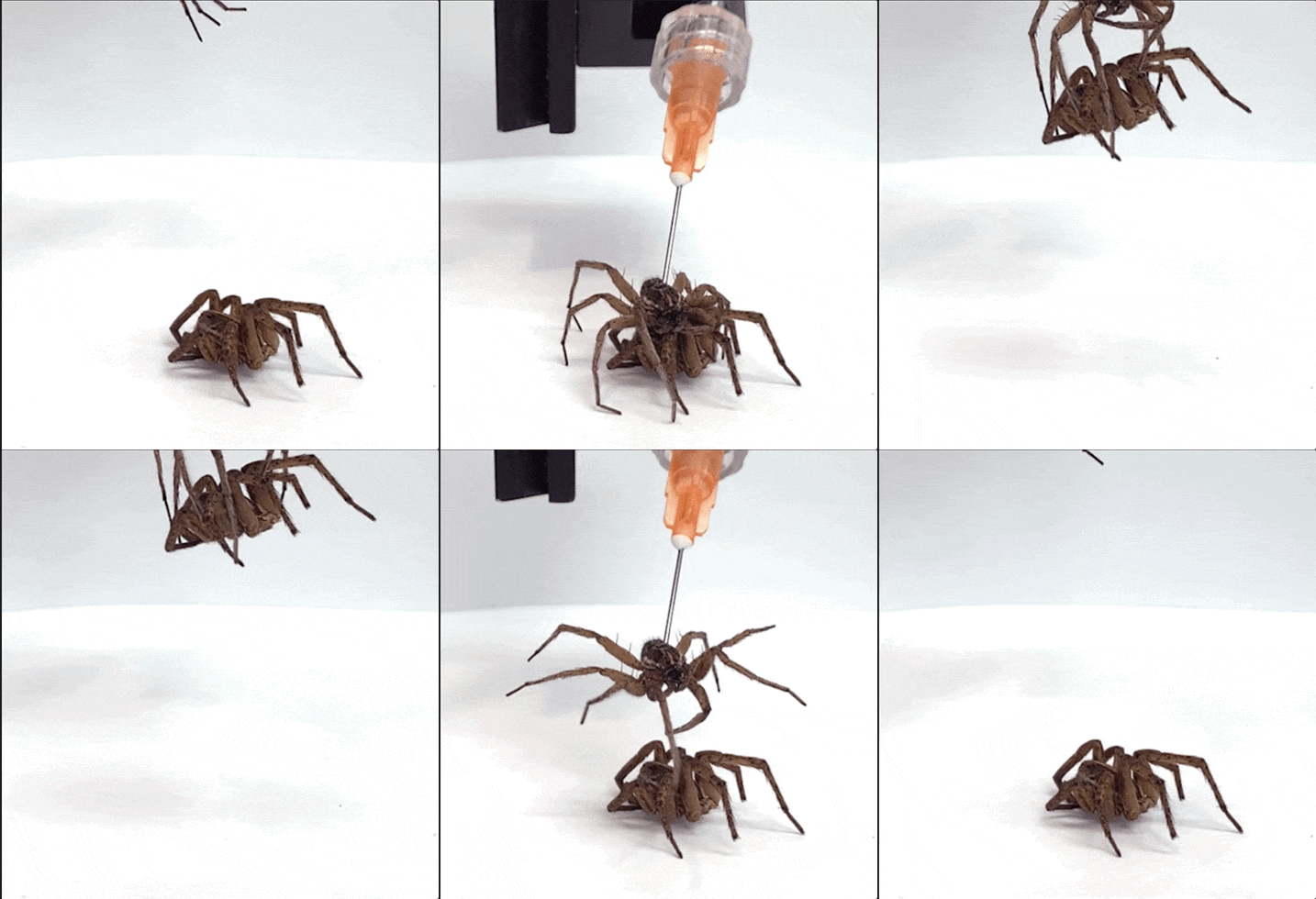
When a scientifically inclined human inserts a needle into a deceased spider’s hydraulic prosoma chamber, seals it with superglue, and delivers a tiny puff of air from a handheld syringe, all eight legs will straighten like fingers on jazz hands.
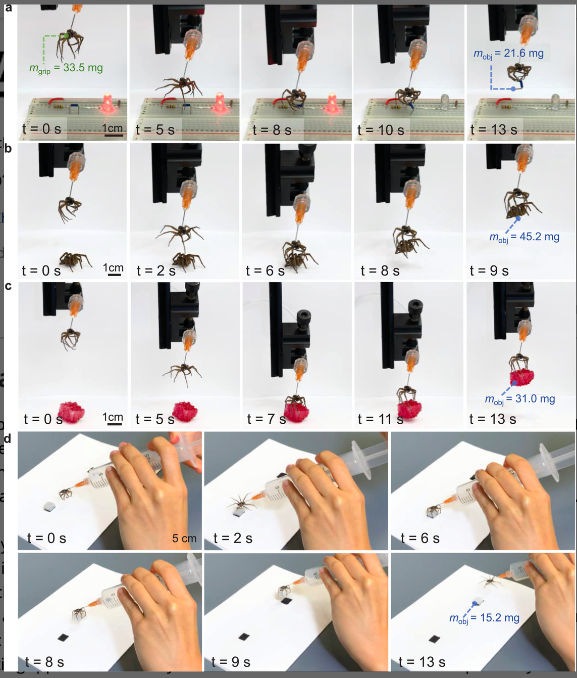
These necrobiotic spider gripper tools can lift around 130% of their body weight — smaller spiders are capable of handling more — and each one is good for approximately 1000 grips before degrading.
Preston and Yap envision putting the spiders to work sorting or moving small scale objects, assembling microelectronics, or capturing insects in the wild for further study.
Eventually, they hope to be able to isolate the movements of individual legs, as living spiders can.
Environmentally, these necrobiotic parts have a major advantage in that they’re fully biodegradable. When they’re no longer technologically viable, they can be composted. (Humans can be too, for that matter…)
The idea is as innovative as it is offbeat. As a soft robotics specialist, Preston is always seeking alternatives to hard plastics, metals and electronics:
We use all kinds of interesting new materials like hydrogels and elastomers that can be actuated by things like chemical reactions, pneumatics and light. We even have some recent work on textiles and wearables…The spider falls into this line of inquiry. It’s something that hasn’t been used before but has a lot of potential.”
Conquer any lingering arachnophobia by reading Yap and Preston’s research article, Necrobotics: Biotic Materials as Ready-to-Use Actuators, here.
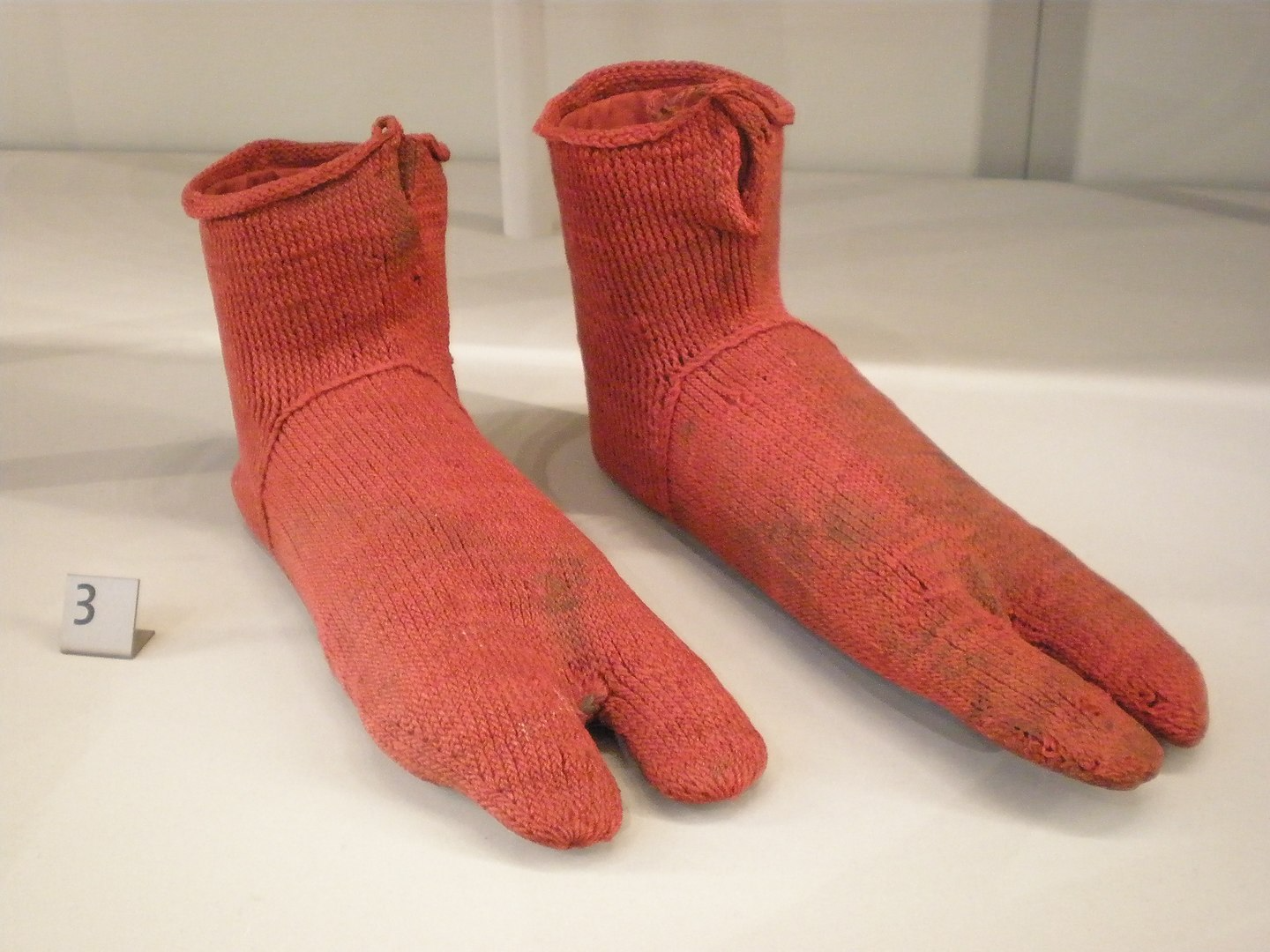
We have, above, a pair of socks. You can tell that much by looking at them, of course, but what’s less obvious at a glance is their age: this pair dates back to 250–420 AD, and were excavated in Egypt at the end of the nineteenth century. That information comes from the site of the Victoria and Albert Museum, where you can learn more about not just these Egyptian socks but the distinctive, now-vanished technique used to make socks in Egypt at the time: “nålbindning, sometimes called knotless netting or single needle knitting — a technique closer to sewing than knitting,” which, as we know it, wouldn’t emerge until the eleventh century in Islamic Egypt. The technique still remains in use today.
Time consuming and skill-intensive, nålbindning produced especially close-fitting garments, and “fit is of particular importance in a cold climate but also for protecting feet clothed in sandals only.” And yes, it seems that socks like these were indeed worn with sandals, a function indicated by their split-toe construction.
A few years ago, we featured archaeological research here on Open Culture pointing to the ancient Romans as the first sock-and-sandal wearers in human history. These particular socks were also made in the time of the Roman Empire, though they were unearthed at its far reaches, from “the burial grounds of ancient Oxyrhynchus, a Greek colony on the Nile.”
As Smithsonian.com’s Emily Spivack writes, “We don’t know for sure whether these socks were for everyday use, worn with a pair of sandals to do the ancient Egyptian equivalent of running errands or heading to work — or if they were used as ceremonial offerings to the dead (they were found by burial grounds, after all).” But the fact that their appearance is so striking to us today, at least sixteen centuries later, reminds us that we aren’t as familiar as we think with the world that produced them. And if, to our modern eyes, they even look a bit goofy — though less goofy than they would if worn properly, along with a pair of sandals — we should remember the painstaking method with which they must have been crafted, as well as the way they constitute a thread, as it were, through the history of western civilization.
Based in Seoul, Colin Marshall writes and broadcasts on cities, language, and culture. His projects include the Substack newsletterBooks on Cities, the book The Stateless City: a Walk through 21st-Century Los Angeles and the video series The City in Cinema. Follow him on Twitter at @colinmarshall or on Facebook.
You may not hear the term mash-up very often these days, but the concept itself isn’t exactly the early-two-thousands fad that it might imply. It seems that, as soon as technology made it possible for enthusiasts to combine ostensibly unrelated pieces of media — the more incongruous, the better — they started doing so: take the synchronization of The Wizard of Oz and Pink Floyd’s The Dark Side of the Moon, known as The Dark Side of the Rainbow. But even back in the seventies, the art of the proto-mash-up wasn’t practiced only by rogue projectionists in altered states of mind, as evidenced by the 1976 20th Century Fox Release All This and World War II, which assembled real and dramatized footage of that epoch-making geopolitical conflict with Beatles covers.
Upon its release, All This and World War II “was received so harshly it was pulled from theaters after two weeks and never spoken of again,” as Keith Phipps writes at The Reveal.
Those who actually seek it out and watch it today will find that it gets off to an even less auspicious start than they might imagine: “A clip of Charlie Chan (Sidney Toler) skeptically receiving the news of Neville Chamberlain’s ‘peace in our time’ declaration in the 1939 film City in Darkness gives way to a cover of ‘Magical Mystery Tour’ by ’70s soft-rock giants Ambrosia. Accompanying the song: footage of swastika banners, German soldiers marching in formation, and a climactic appearance from a smiling Adolf Hitler, by implication the organizer of the ‘mystery tour’ that was World War II.”
The other recording artists of the seventies enlisted to supply new versions of well-known Beatles numbers include the Bee Gees, Elton John, the Who’s Keith Moon, and Peter Gabriel, names that assured the soundtrack album (which you can hear on this Youtube playlist) a much greater success than the film itself, with its fever-dream mixture of newsreels Axis and Allied with 20th Century Fox war-picture clips.
As for what everyone involved was thinking in the first place, Phipps quotes an explanation that soundtrack producer Lou Reizner once provided to UPI: “It would have been easy to take the music of the era and dub it to match the action on screen. But we’d have lost the young audience. We want all age groups to see this picture because we think it makes a statement about the absurdity of war. It is the definitive anti-war film” — or, as Phipps puts it, the definitive “cult film in search of cult.”
Based in Seoul, Colin Marshall writes and broadcasts on cities, language, and culture. His projects include the Substack newsletterBooks on Cities, the book The Stateless City: a Walk through 21st-Century Los Angeles and the video series The City in Cinema. Follow him on Twitter at @colinmarshall or on Facebook.
More recently, the poet and international educator has combined her interest in amigurumi crocheted animals and ChatGPT, the open source AI chatbot.
Having crocheted an amiguruminarwhal for a nephew earlier this year, she hopped on ChatGPT and asked it to create “a crochet pattern for a narwhal stuffed animal using worsted weight yarn.”
The result might have discouraged another querent, but Woolner got out her crochet hook and sallied forth, following ChatGPTs instructions to the letter, despite a number of red flags indicating that the chatbot’s grasp of narwhal anatomy was highly unreliable.
Its ignorance is part of its DNA. As a large language model, ChatGPT is capable of producing predictive text based on vast amounts of data in its memory bank. But it can’t see images.
It has no idea what a cat looks like or even what crochet is. It simply connects words that frequently appear together in its training data. The result is superficially plausible passages of text that often fall apart when exposed to the scrutiny of an expert—what’s been called “fluent bullshit.”
It’s also not too hot at math, a skill set knitters and crocheters bring to bear reading patterns, which traffic in numbers of rows and stitches, indicated by abbreviations that really flummox a chatbot.
Rnd 7: sc even (12); F/O and leave a long strand of yarn to sew the dorsal fin between rnds # 18–23. Do not stuff the fin.
Pity poor ChatGPT, though, like Woolner, it tried.
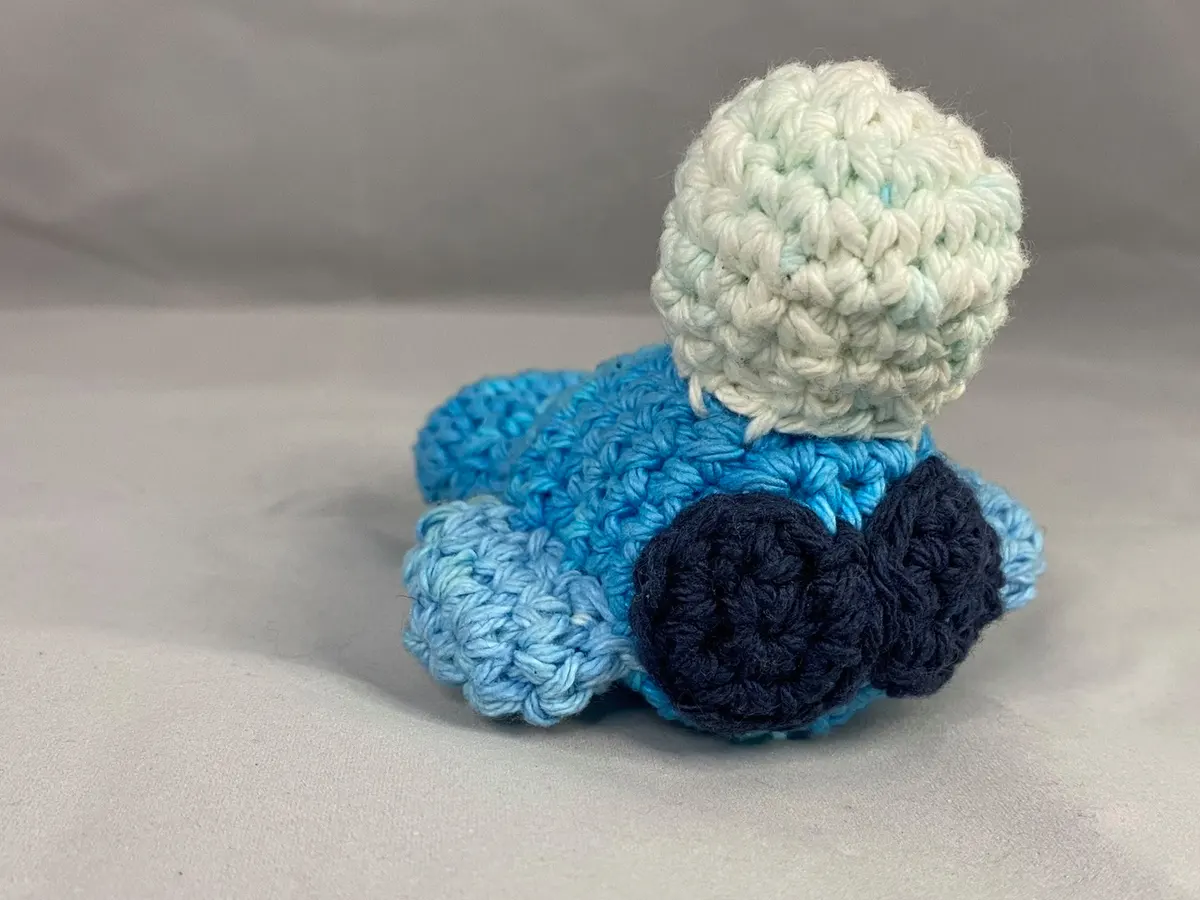
Their collaboration became a cause célèbre when Woolner debuted the “AI generated narwhal crochet monstrosity” on TikTok, aptly comparing the large tusk ChatGPT had her position atop its head to a chef’s toque.
Is that the best AI can do?
A recent This American Life episode details how Sebastien Bubeck, a machine learning researcher at Microsoft, commanded another large language model, GPT‑4, to create code that TikZ, a vector graphics producer, could use to “draw” a unicorn.
This collaborative experiment was perhaps more empirically successful than the ChatGPT amigurumi patterns Woolner dutifully rendered in yarn and fiberfill. This American Life’s David Kestenbaum was sufficiently awed by the resulting image to hazard a guess that “when people eventually write the history of this crazy moment we are in, they may include this unicorn.”
It’s not good, but it’s a fucking unicorn. The body is just an oval. It’s got four stupid rectangles for legs. But there are little squares for hooves. There’s a mane, an oval for the head. And on top of the head, a tiny yellow triangle, the horn. This is insane to say, but I felt like I was seeing inside its head. Like it had pieced together some idea of what a unicorn looked like and this was it.
Let’s not poo poo the merits of Woolner’s ongoing explorations though. As one commenter observed, it seems she’s “found a way to instantiate the weird messed up artifacts of AI generated images in the physical universe.”
To which Woolner responded that she “will either be spared or be one of the first to perish when AI takes over governance of us meat sacks.”
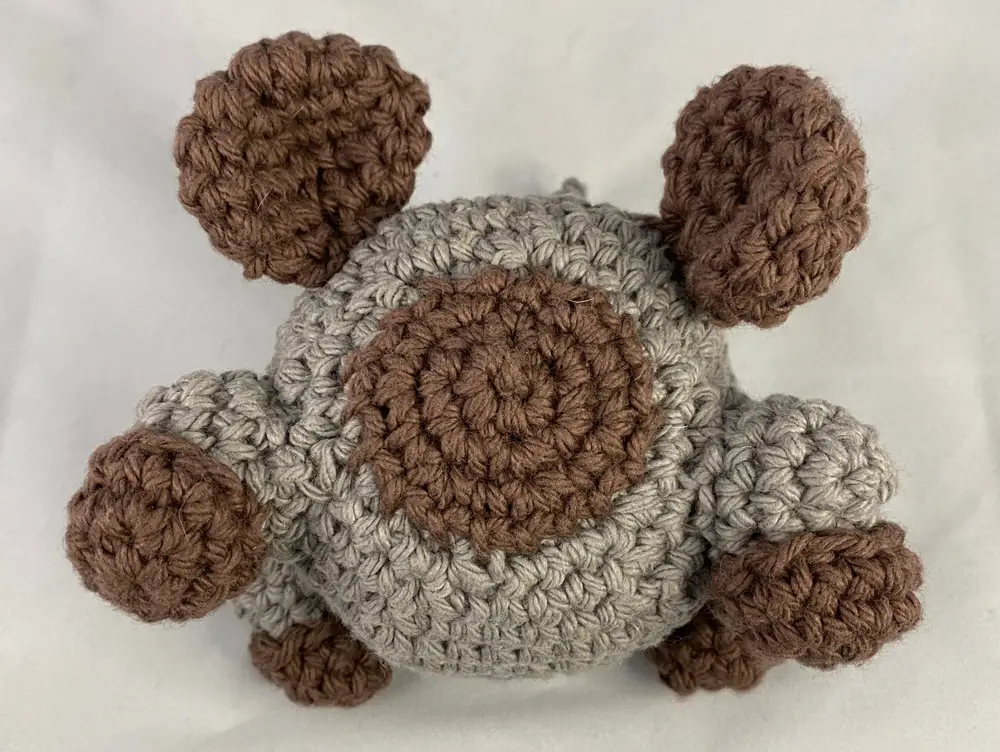
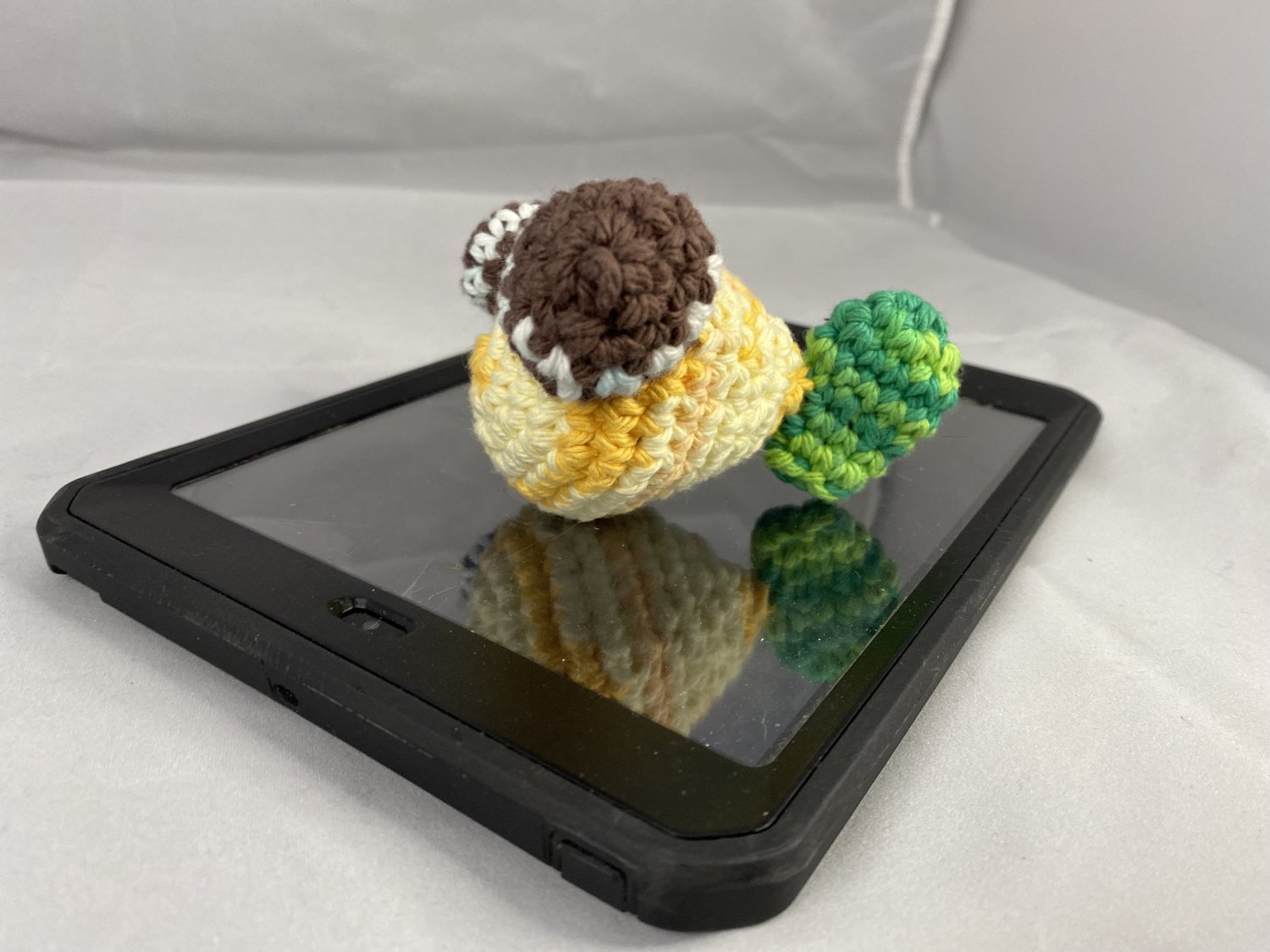
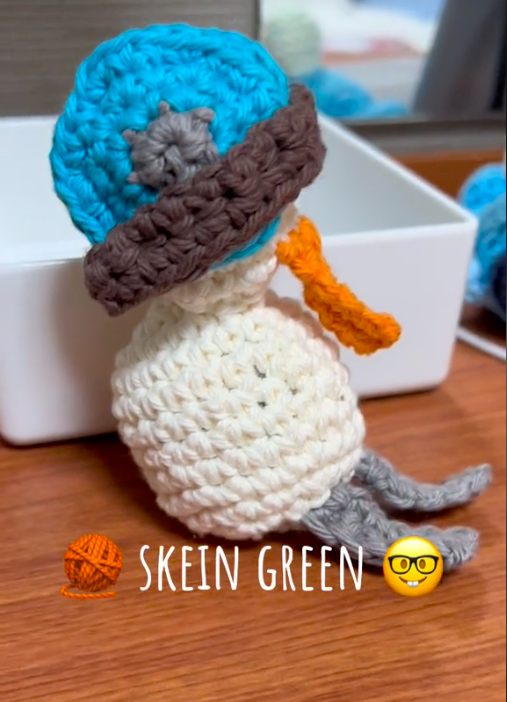
In the meantime, she’s continuing to harness ChatGPT to birth more monstrous amigurumi. Gerald the Narwhal’s has been joined by a cat, an otter, Norma the Normal Fish, XL the Newt, and Skein Green, a pelican bearing get well wishes for author and science vlogger Hank Green.
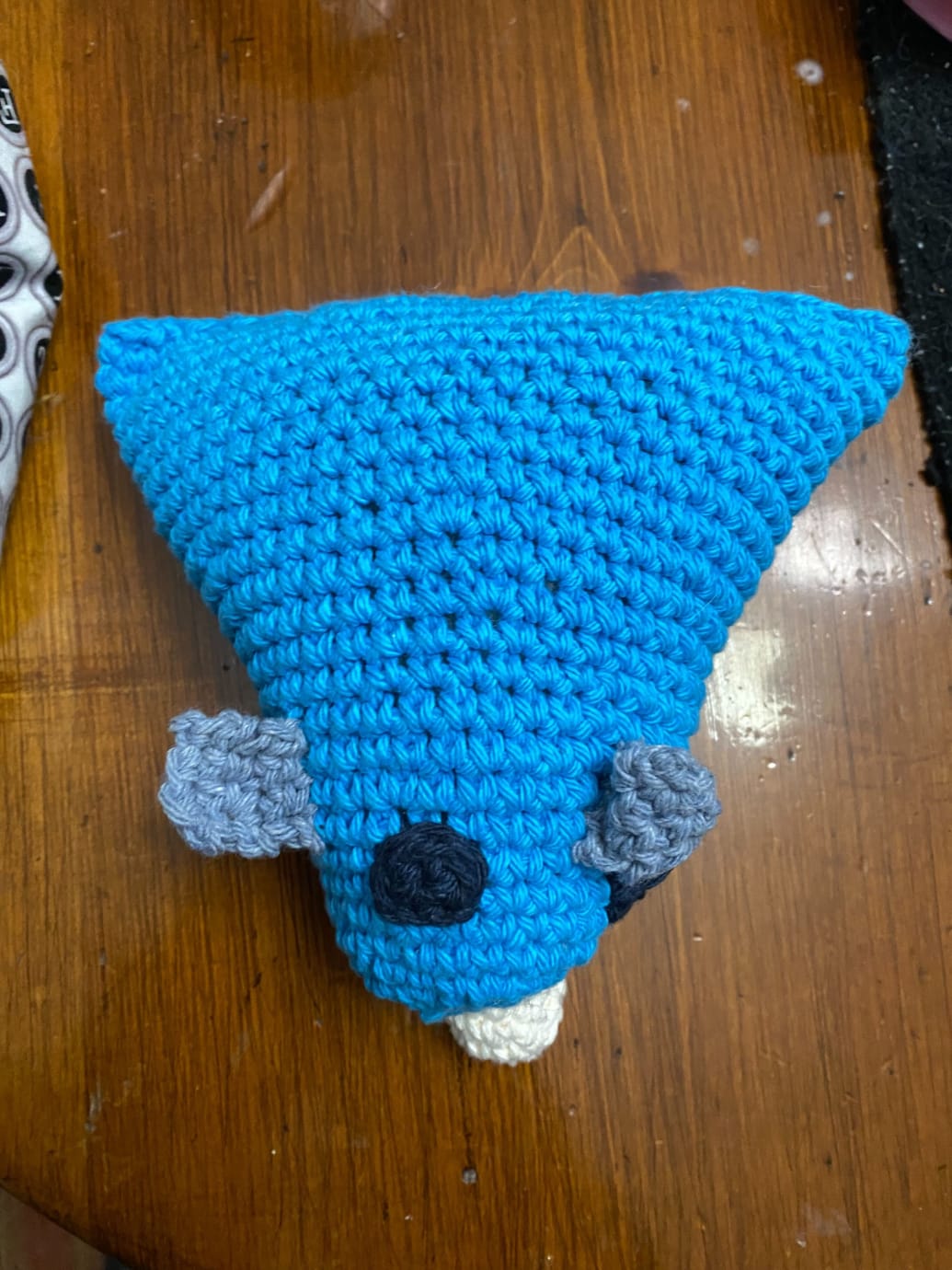
Two weeks later, the Daily Beast pronounced this attempt, nicknamed Gerard, “even less narwhal-looking than the first. Its body was a massive stuffed triangle, and its tusk looked like a gumdrop at one end.”
Woolner dubbed Gerard possibly the most frustrating AI-generated amigurumi of her acquaintance, owing to an onslaught of specificity on ChatCPT’s part. It overloaded her with instructions for every individual stitch, sometimes calling for more stitches in a row than existed in the entire pattern, then dipped out without telling her how to complete the body and tail.
As silly as it all may seem, Woolner believes her ChatGPT amigurumi collabsare a healthy model for artists using AI technology:
I think if there are ways for people in the arts to continue to create, but also approach AI as a tool and as a potential collaborator, that is really interesting. Because then we can start to branch out into completely different, new art forms and creative expressions—things that we couldn’t necessarily do before or didn’t have the spark or the idea to do can be explored.
If you, like Hank Green, have fallen for one of Woolner’s unholy creations, downloadable patterns are available here for $2 a pop.
Those seeking alternatives to fiberfill are advised to stuff their amigurumi with “abandoned hopes and dreams” or “all those free tee shirts you get from giving blood and running road races or whatever you do for fun”.
“The inhabitants of fifteenth-century Florence included Brunelleschi, Ghiberti, Donatello, Masaccio, Filippo Lippi, Fra Angelico, Verrocchio, Botticelli, Leonardo, and Michelangelo,” writes tech investor and essayist Paul Graham. “Milan at the time was as big as Florence. How many fifteenth century Milanese artists can you name?” Once you get thinking about the question of “what happened to the Milanese Leonardo,” it’s hard to stop. So it seems to have been for network physicist Albert-László Barabási, whose work on the distribution of scientific genius we featured last month here on Open Culture. Graham’s speculation also applied to that line of inquiry, but it applies much more directly to Barabási’s work on artistic fame.
“In the contemporary art context, the value of an artwork is determined by very complex networks,” Barabási explains in the Big Think video above. Factors include “who is the artist, where has that artist exhibited before, where was that work exhibited before, who owns it and who owned it before, and how these multiple links connect to the canon and to art history in general.” In search of a clearer understanding of their relative importance and the nature of their interactions, he and a team of researchers gathered all the relevant data to produce “a worldwide map of institutions, where it turned out that the most central nodes — the most connected nodes — happened to be also the most prestigious museums: MoMA, Tate, Gagosian Gallery.”
So far, this may come as no great surprise to anyone familiar with the art world. But the most interesting characteristic of this network map, Barabási says, is that it “allowed us to predict artistic success. That is, if you give me an artist and their first five exhibits, I’d put them on the map and we could fast-forward their career to where they’re going to be ten, twenty years from now.” In the past, the artists who made it big tended to start their career in some proximity to the map’s central institutions.“It’s very difficult for somebody to enter from the periphery. But our research shows that it’s possible”: such artists “exhibited everywhere they were willing to show their work,” eventually making influential connections by these “many random acts of exhibition.”
This research, published a few years ago in Science, “confirms how important networks are in art, and how important it is for an artist to really understand the networks in which their work is embedded.” Location matters a great deal, but that doesn’t consign talent to irrelevance. The more talented artists are, “the more and higher-level institutions are willing to work with them.” If you’re an artist, “who was willing to work with you in your first five exhibits is already a measure of your talent and your future journey in the art world.” But even if you’re not an artist, you underestimate simultaneous importance of ability and connections — and how those two factors interact with each other — at your peril. From art to science to insurance claims adjustment to professional bowling, every field involves networks: networks that, as Barabási’s work has shown us, aren’t always visible.
Based in Seoul, Colin Marshall writes and broadcasts on cities, language, and culture. His projects include the Substack newsletterBooks on Cities, the book The Stateless City: a Walk through 21st-Century Los Angeles and the video series The City in Cinema. Follow him on Twitter at @colinmarshall or on Facebook.
How has this show evolved from satirical science fiction to something more often just horror studies that study human nature? We talk about our favorite episodes and what does and doesn’t work. Does the show have to be so dark to make its point? Does it always have a point, or is some of it just fun?
Hand binding a book, using primarily 15-century methods and materials sounds like a major undertaking, rife with pitfalls and frustration.
A far more relaxing activity is watching Four Keys Book Arts’ wordless, 24-minute highlights reel of self-taught bookbinder Dennis tackling that same assignment, above. (Bonus — it’s a guaranteed treat for those prone to autonomous sensory meridian response tingles.)
For research on this type of binding, he turned to book designer J.A. Szirmai’s The Archaeology of Medieval Bookbinding, and while the goal was never 100% period accuracy, Dennis notes that the craft of traditional hand-binding has remained virtually unchanged for centuries:
The medieval binder would have found many of the tools and techniques to be very familiar. The single biggest anachronism is my use of synthetic PVA glue rather than period-appropriate animal glue. The second historic anomaly is my use of marbled paper, though it could be argued that the earliest European marbled papers of the mid-17th century do overlap with this binding style. The nonpareil pattern I have chosen for the endpapers, though, dates from the 1820’s, and so is distinctly out of place. But apart from those, virtually all of the other materials in this book would have been available to the medieval bookbinder.
Those craving a more step-by-step explanation should set time aside to view the longer videos, below, in which Dennis shares such time-consuming, detail-oriented tasks as trimming and tidying the edges with a cabinet scraper and bookbinder’s plough, sewing endbands to support and protect the book’s head and the spine, and decorating the leather cover with a hand-tooled floral pattern embellished with gold foil highlights.
Endpapers: Four Keys Book Arts handmade marbled paper, Fabriano Accademia 120 gsm drawing paper, red handmade paper
Thread: Undyed Linen 25/3, unknown brand
Cords: Leather, unknown type, roughly 3 oz/ 1 mm
Wax: Natural Beeswax
Glue: Mix of Acid-Free PVA and Methyl Cellulose, 3:2 ratio.
Paper Knife (made from an old kitchen knife)
Bone Folder (handmade in-house)
Scrap book board, various sizes/thickness
Pressing Boards (1/2″ maple plywood, made in house)
Cast-Iron Book Press (Patrick Ritchie, Edinburgh, circa 1850)
Stainless Steel rulers, various sizes
Small Stanley Knife
Maple Laying Press (handmade in-house)
Small Carpenter’s Square, unknown brand
Pencil (Blackwing)
Steel dividers, unknown brand
Lithography Stone (circa 1925)
Cotton Rag
Agate Burnisher
Piercing Cradle (handmade in-house)
Awl
2″ natural bristle brush, generic
parchment release paper
blotting paper
Acetate barrier sheets, .01 gauge
Dahle Vantage 12e Guillotine (found at a thrift store)
Scissors
Bookbinding Needles
Sewing Frame (handmade in-house)
Brass H‑Keys (handmade in-house)
Linen sewing tapes, 12 mm
Pins
Watch a full playlist of Four Keys Book Arts’ Medieval Gothic Binding videos here. See more of Dennis book binding projects on Four Keys Book Arts’ Instagram.
“We lunched up-stairs at Botin’s,” writes Ernest Hemingway near the end of The Sun Also Rises (1926). “It is one of the best restaurants in the world. We had roast suckling pig and drank rioja alta.” You can do the very same thing today, a century after the period of that novel — and indeed, you also could’ve done it two centuries before the period of that novel, for Botin’s was established in 1725, and now stands as the oldest restaurant in continuous operation. Founded as Casa Botín by a Frenchman named Jean Botin, it passed in 1753 into the hands of one of his nephews, who re-christened it Sobrino de Botín. Whatever the place has been called over this whole time, its oven has never once gone cold.
?si=-fSM9okYlxvKCpTd
“It is our jewel, our crown jewel,” Botín’s deputy manager Javier Sanchéz Álvarez says of that oven in the Great Big Story video above. “It needs to keep hot at night and be ready to roast in the morning.” What it has to roast is, of course, the restaurant’s signature cochinillo, or suckling pig, about which you can learn more from the Food Insider video just above.
“It’s exactly the same recipe and tradition,” says Sanchéz Álvarez. “Absolutely everything is done in the exact same way as in the old days,” down to the application of the spices, butter, wine, and salt to the raw pork before it enters the historic oven belly-up. “It’s very important that the skin of the cochinillo is very crunchy,” he adds. “If the skin isn’t crunchy, it’s not good.”
Needless to say, Botín is poorly placed to win the favor of the world’s vegetarians. But it does robust business nevertheless, having pulled through the COVID-19 pandemic (with, at the very least, its oven still lit), and more recently received a visit from superstar food vlogger Mark Wiens. Its enduring success surely owes to its more-than-proven ability to deliver on a simple promise: “We will serve you a hearty suckling pick with some good potatoes and a serving of good Spanish ham,” as Sanchéz Álvarez puts it. Working at the restaurant for more than 40 of its 298 years has made it “like home to me,” he says, employing the common Spanish expression of feeling como un pez en el agua — though, given the nature of Botín’s menu, a more terrestrial metaphor is surely in order.
Based in Seoul, Colin Marshall writes and broadcasts on cities, language, and culture. His projects include the Substack newsletterBooks on Cities, the book The Stateless City: a Walk through 21st-Century Los Angeles and the video series The City in Cinema. Follow him on Twitter at @colinmarshall or on Facebook.
Jimmy Buffett wrote “Margaritaville” in 1977. It ended up being his only song to reach the pop Top 10. But the song carried him for the next 45 years. When you think Margaritaville, you think of an easy-breezy way of life. And that simple idea infused the brand of Buffett’s Margaritaville business empire. Between the song’s birth and the singer’s death this weekend, Buffett created a Margaritaville business empire that included bars, restaurants, casinos, beach resorts, retirement communities, cruises, packaged foods, apparel, footwear, and beyond. This spring, Buffett improbably made Forbes’ list of billionaires. Above, you can watch a young Jimmy Buffet perform “Margaritaville” in 1978, right at the beginning of the song’s long journey from hit, to brand, to commercial empire.
If you would like to support the mission of Open Culture, consider making a donation to our site. It’s hard to rely 100% on ads, and your contributions will help us continue providing the best free cultural and educational materials to learners everywhere. You can contribute through PayPal, Patreon, and Venmo (@openculture). Thanks!
Another chapter from the Annals of Unlikely Performances…
Last week, we highlighted Chuck Berry performing with the Bee Gees on a 1973 episode of the Midnight Special. It’s a pairing that doesn’t work on paper. But, on stage, it’s magic. The same goes for when Berry sang with Tom Jones on a 1974 episode of the same show. It’s magic once again.
If you’re a veteran OC reader, you know that Jones could sing with anyone. On his variety show, This Is Tom Jones, he shared the stage with Janis Joplin, not to mention Crosby, Stills, Nash & Young, and Stevie Wonder. It worked. Just watch the expression on Janis and Crosby’s face.
Now 83, Tom Jones and his voice are still going strong. Below, you can watch him sing “Samson And Delilah” in 2021.
If you would like to support the mission of Open Culture, consider making a donation to our site. It’s hard to rely 100% on ads, and your contributions will help us continue providing the best free cultural and educational materials to learners everywhere. You can contribute through PayPal, Patreon, and Venmo (@openculture). Thanks!
Though it enjoys a particular popularity here in the twenty-first century, the rigorously equanimous Stoic worldview comes to us through the work of three figures from antiquity: Epictetus, Seneca, and Marcus Aurelius. Epictetus was born and raised a slave. Seneca, the son of rhetorician Seneca the Elder, became an advisor to Nero (a position that ultimately forced him to take his own life). Marcus Aurelius, the most exalted of the three, actually did the top job himself, ruling the Roman Empire from 161 to 180 AD. He also left behind a text, the Meditations, that stands alongside Epictetus’ Enchiridion and Seneca’s many essays and letters as a pillar of the canon of Stoicism.
Though the importance of these aims can be illustrated any number of ways, their achievement depends on accepting the notion central to all Stoic thought: “the dichotomy of control,” which dictates that “some things are in our control and others aren’t.” When life hurts, “it often means that we care about things we have no control over, and by doing so, we let them control us.”
All the Stoics understood this, but for Marcus Aurelius, “being unperturbed by things outside of his control allowed him to cope with the many responsibilities and challenges he faced as an emperor, and to focus on the task he believed he was given by the gods.” He knew that “it’s not the outside world and the events that take place in it, our bodies included, that hurt us, but our thoughts, memories, and fantasies regarding them.” To indulge those fantasies means to live in perpetual conflict with reality, and thus in perpetual, and futile, grievance against it. The stronger our judgments about what happens, “the more vulnerable we become to the whims of Fortuna, the unpredictable goddess of luck, chance, and fate,” forces that eventually get the better of us all — even if we happen to have the world’s mightiest empire at our command.
Based in Seoul, Colin Marshall writes and broadcasts on cities, language, and culture. His projects include the Substack newsletterBooks on Cities, the book The Stateless City: a Walk through 21st-Century Los Angeles and the video series The City in Cinema. Follow him on Twitter at @colinmarshall or on Facebook.
We're hoping to rely on loyal readers, rather than erratic ads. Please click the Donate button and support Open Culture. You can use Paypal, Venmo, Patreon, even Crypto! We thank you!
Open Culture scours the web for the best educational media. We find the free courses and audio books you need, the language lessons & educational videos you want, and plenty of enlightenment in between.