Deep fried coffee. Yes, it’s a thing, and coffee connoisseur James Hoffmann decided to give it a go. How did it turn out? We won’t spoil it for you–other than to say, don’t be surprised if deep fried coffee makes its way into a future edition of Hoffmann’s book, The World Atlas of Coffee.
If you would like to sign up for Open Culture’s free email newsletter, please find it here. It’s a great way to see our new posts, all bundled in one email, each day.
If you would like to support the mission of Open Culture, consider making a donation to our site. It’s hard to rely 100% on ads, and your contributions will help us continue providing the best free cultural and educational materials to learners everywhere. You can contribute through PayPal, Patreon, and Venmo (@openculture). Thanks!
It took me four years to paint like Raphael, but a lifetime to paint like a child. — Pablo Picasso
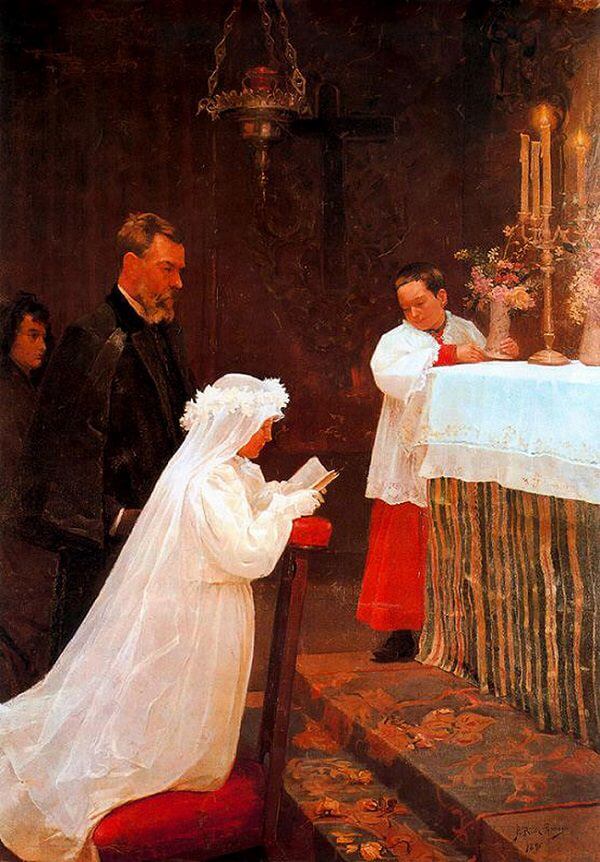
We think it’s safe to say that most of us have a preconceived notion of Picasso’s style, and The First Communion, above, isn’t it.
Picasso was just 15 when he completed this large-scale oil, having lost his 7‑year-old sister, Conchita, to diphtheria one year before.
The stricken young artist had attempted to bargain with God, vowing to give up painting if she was spared. As Arianna Huffington writes in the biography Picasso: Creator and Destroyer:
…he was torn between wanting her saved and wanting her dead so that his gift would be saved. When she died, he decided that God was evil and destiny an enemy. At the same time, he was convinced that it was his ambivalence that had made it possible for God to kill Conchita. His guilt was enormous—the other side of his belief in his powers to affect the world around him. And it was compounded by his almost magical conviction that his little sister’s death had released him to be a painter and follow the call of the powers he had been given, whatever the consequences.
If there’s evil at work in the “First Communion,” he keeps it under wraps. All eyes are on the rapt young communicant, embodied in his surviving sister, Lola, in a snowy veil and gown.
Their father, painter and drawing professor José Ruiz y Blasco, assumes the part of the girl’s father or godfather, a solemn witness to this rite of passage.
Ruiz y Blasco provided instruction and championed his son’s gift. He encouraged him to enter the “First Communion,” and later, “Science and Charity” (in which he appears as the doctor) in the Exposicion de Bellas Artes, a competition and exhibition opportunity for emerging artists.
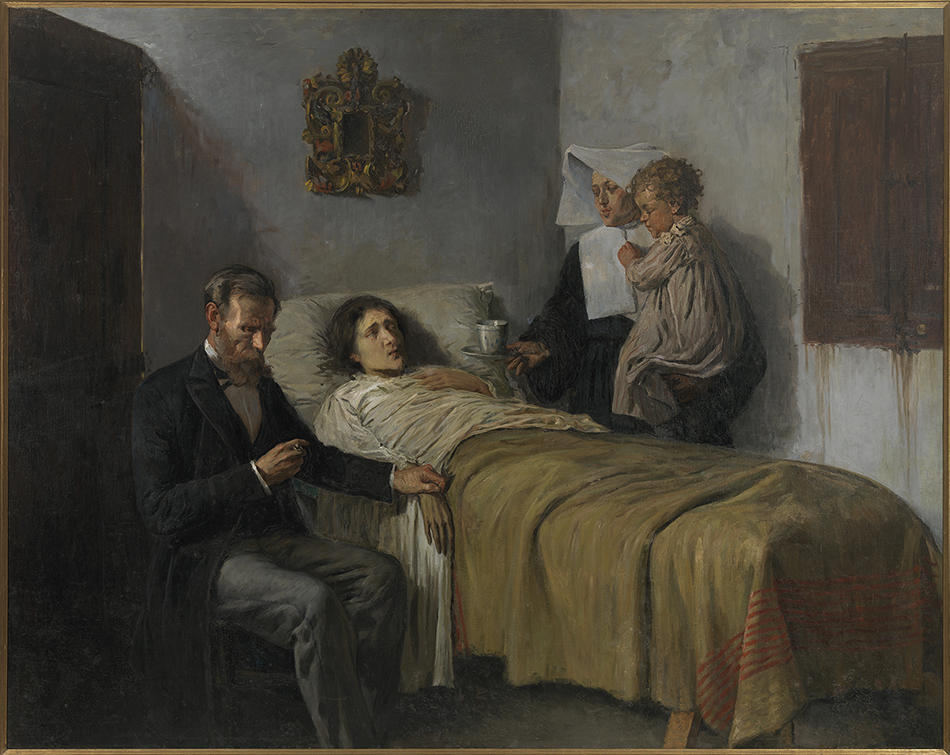
Picasso later remarked that “every time I draw a man, I think of my father. To me, man is Don José, and will be all my life…”
Ruiz y Blasco, convinced that Picasso’s talent would bring success as a naturalistic painter of classical scenes and portraits, was deeply disappointed when his teenaged son began blowing off class at Madrid’s prestigious Academia Real de San Fernando.
Just imagine how he reacted to the scandalous Cubist vision of “Les Demoiselles d’Avignon,” unveiled a mere eleven years after the “First Communion.”
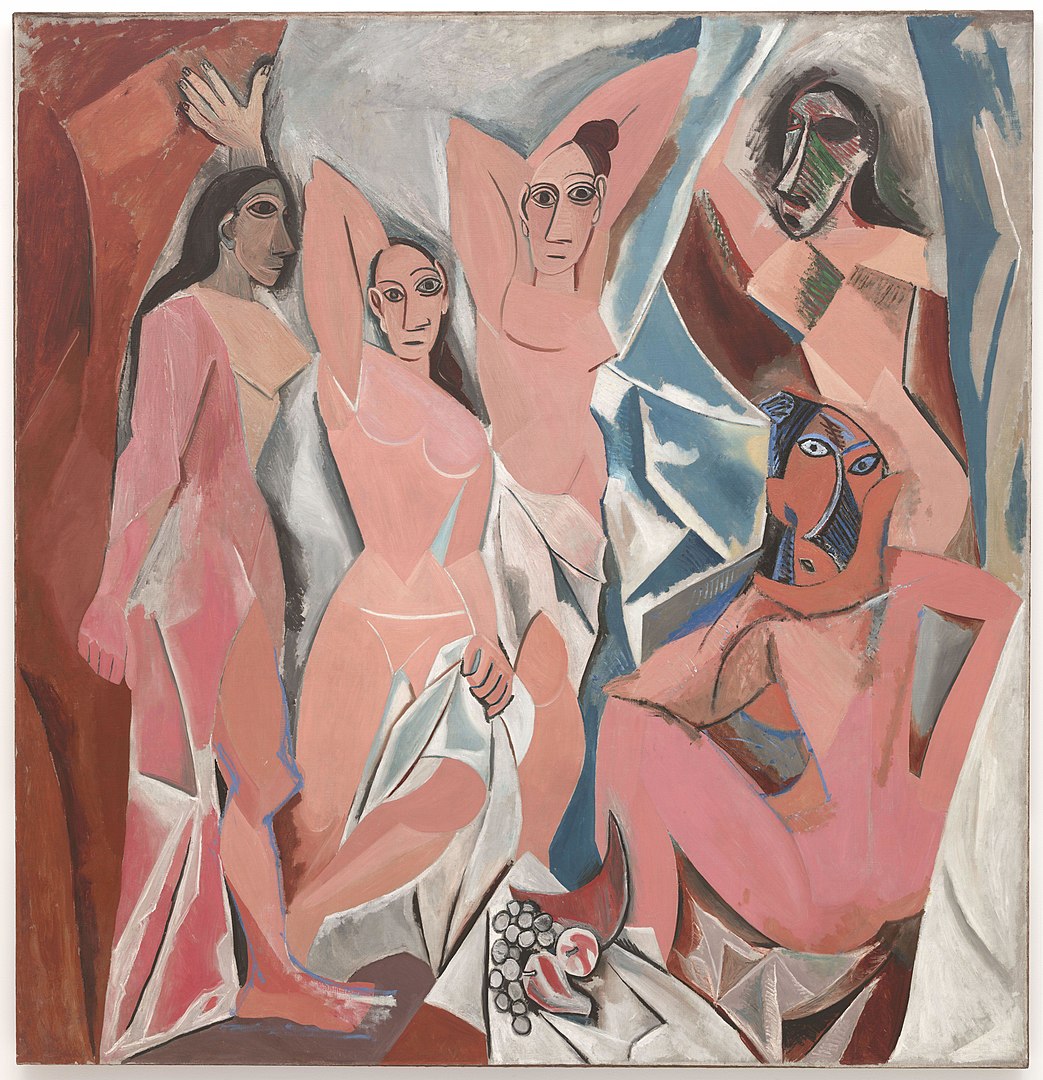
The rest is history.
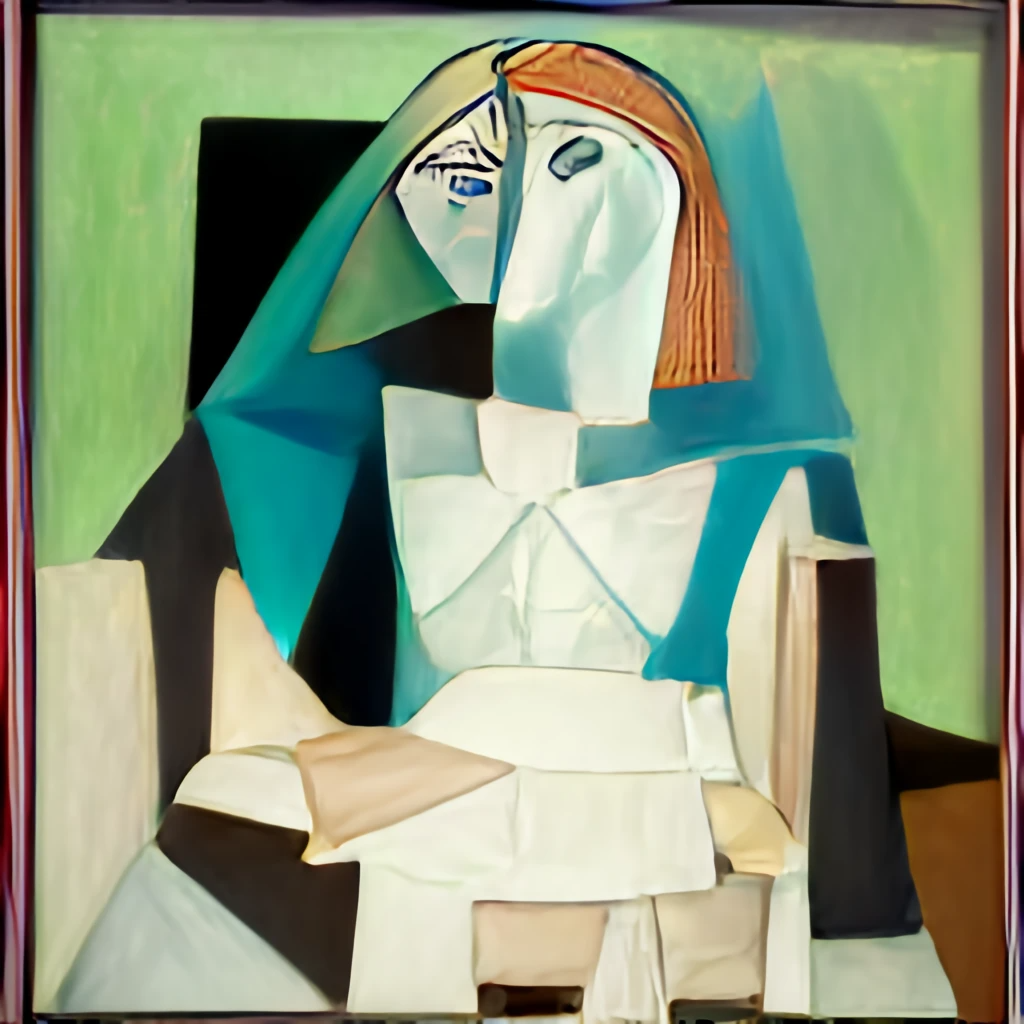
Just for fun, we invited the free online AI image generator Craiyon (formerly known as DALL‑E Mini) to have a go using the prompt “Picasso First Communion”.
Most of us have doodled in the margins of our books at one time or another, and some of us have even dared to write our own names. But very of few us, presumably, would have expected our handiwork to be marveled at twelve centuries hence. Yet that’s just what has happened to the marginalia left by a medieval Englishwoman we know only as Eadburg, who some time in the eighth century committed her name — as well as other symbols and figures — to the pages of a Latin copy of the Acts of the Apostles.
Eadburg did this with such secrecy that only advanced twenty-first century technology has allowed us to see it at all. That the readers in the Middle Ages sometimes jotted in their manuscripts isn’t unheard of.
But unlike most of them, Eadburg seems to have favored a drypoint stylus — i.e., a tool with nothing on it to leave a clear mark — which would have made her writing nearly impossible to notice with the naked eye. To see all of them necessitated the use of a technique called “photometric stereo,” which Oxford University’s Bodleian Library Senior Photographer John Barrett explains in this blog post.
The scanning process collects images that “map the direction and height of the original’s surface, and are processed into renders showing only the relief of the original with the tone and color removed.” Subsequent steps of filtering and enhancement result in a digital reproduction of “the three-dimensional surface of the page,” which, with the proper enhancements, finally allows drypoint inscriptions to be seen. Eadburg’s name, reports the Guardian’s Donna Ferguson, was found “passionately etched into the margins of the manuscript in five places, while abbreviated forms of the name appear a further ten times.”
Other new discoveries in the manuscript’s pages include “tiny, rough drawings of figures — in one case, of a person with outstretched arms, reaching for another person who is holding up a hand to stop them.” What Eadburg meant by it all remains a matter of active inquiry, but then, so does her very identity. “Charter evidence suggests that a woman called Eadburg was abbess of a female religious community at Minster-in-Thanet, in Kent from at least 733 until her death sometime between 748 and 761,” writes Barrett, but she wasn’t the only Eadburg who could’ve possessed the book. All this contains a lesson for today’s marginalia-makers: if you’re going to sign your name, sign it in full.
Based in Seoul, Colin Marshall writes and broadcasts on cities, language, and culture. His projects include the Substack newsletterBooks on Cities, the book The Stateless City: a Walk through 21st-Century Los Angeles and the video series The City in Cinema. Follow him on Twitter at @colinmarshall or on Facebook.
Image by Paul Pearson, University College London
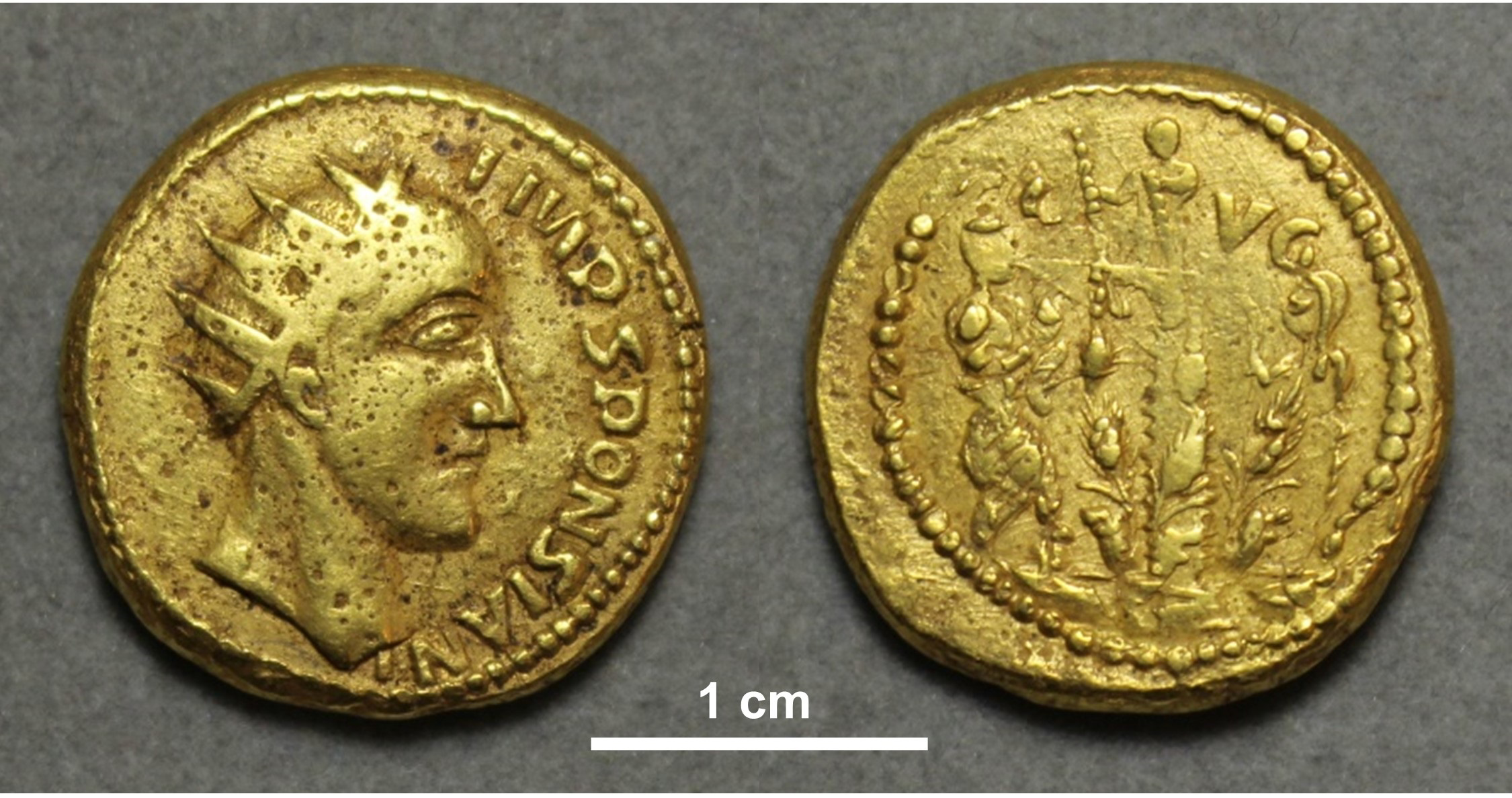
You may think you know your Roman emperors, but do you recognize the face on the coin above? His name was Sponsian, or Sponsianus, and he lived in the middle of the third century. Or at least he did according to certain theories: vanishingly little is known about him, and in fact, this very gold piece (above) is the only evidence we have that he ever existed. Given that numismatists have long written the coin off as an eighteenth-century fake, it’s possible that emperor Sponsian could be a wholly apocryphal figure — but it’s become a bit less likely since the coin went under the electron microscope earlier this year.
“Using modern imaging technology, the researchers said they found ‘deep micro-abrasion patterns’ that were ‘typically associated with coins that were in circulation for an extensive period of time,’ ” writes the New York Times’ April Rubin.
“In addition, the researchers analyzed earthen deposits, finding what they called evidence that the coin had been buried for a long time before being exhumed.” In the details of their design, they’re also “uncharacteristic” of forgeries created in the eighteenth century. If this Sponsian-headed money is fraudulent, then, it’s at least authentically old, or at least much older than had long been assumed.
You can find the published research paper here, at the site of its journal PLOS ONE. Summarizing findings in the paper, a University College London site notes: “The coin … was among a handful of coins of the same design unearthed in Transylvania, in present-day Romania, in 1713. They have been regarded as fakes since the mid-19th-century, due to their crude, strange design features and jumbled inscriptions.” According to Professor Paul N. Pearson, the lead author of the research paper: “Scientific analysis of these ultra-rare coins rescues the emperor Sponsian from obscurity. Our evidence suggests he ruled Roman Dacia, an isolated gold mining outpost, at a time when the empire was beset by civil wars and the borderlands were overrun by plundering invaders.” Jesper Ericsson, a curator at The Hunterian at the University of Glasgow, adds: “we hope that this [research] encourages further debate about Sponsian as a historical figure” and sparks more research into “coins relating to [Sponsian] held in other museums across Europe.”
Based in Seoul, Colin Marshall writes and broadcasts on cities, language, and culture. His projects include the Substack newsletterBooks on Cities, the book The Stateless City: a Walk through 21st-Century Los Angeles and the video series The City in Cinema. Follow him on Twitter at @colinmarshall or on Facebook.
(Yes, you are allowed to pick more than one favorite.)
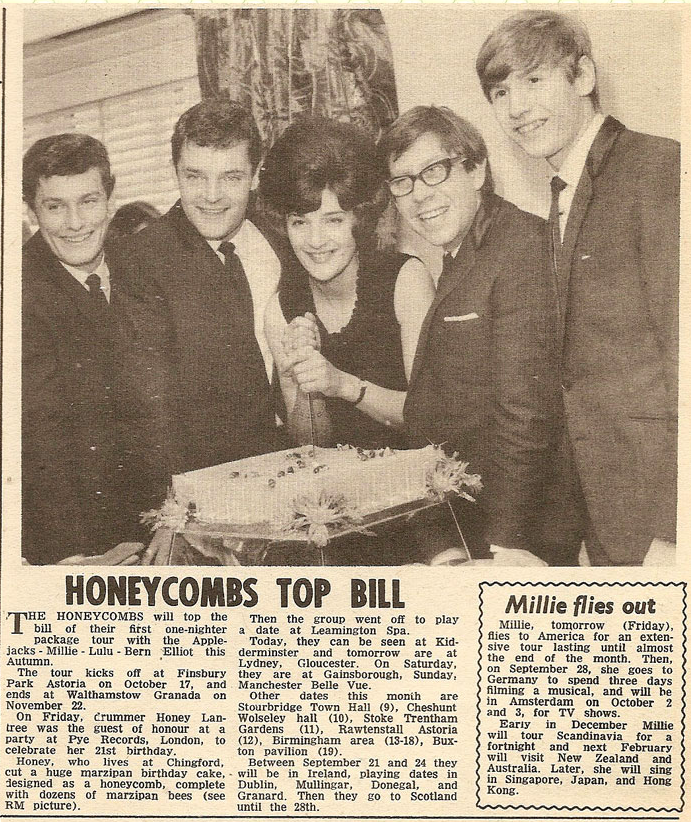
Things were decidedly different when drummer Honey Lantree, the only female member of the 60s British Invasion group the Honeycombs, took up the sticks.
Drums were not her original instrument. Her boyfriend, employer, and eventual bandmate Martin Murray was giving her a guitar lesson when she asked if she could take a whirl at his kit.
Murray recalled his surprise when she started whaling away like a vet:
She was just a born, natural drummer; she hadn’t played before and just went for it. I was aghast, staring at her, and said, “All right, you’re our new drummer.”
Lantree’s gender helped the Honeycombs secure press.
She snagged a celebrity endorsement for Carlton drums and turned 21 with a cake festooned with marzipan bees, and, more importantly, a #1 single, “Have I the Right.”
Of course, her gender also ensured that most of the coverage would focus on her appearance, with scant, if any mention of her musical talent.
Lantree was not the only member of the Honeycombs to find this galling.
As lead singer Denis D’Ell told the Record Mirror in 1965:
How can it be a gimmick just because we have a girl, Honey, on drums? Honey plays with us purely and simply because she is the right drummer for the job. If she wasn’t any good, she wouldn’t hold down the job.
On tour, we don’t have any troubles by having a girl with us. We just operate as a group. Perhaps it is that the novelty has worn off — we hope that fans soon will forget all about this so-called gimmick.
The following year, he quit, along with lead guitarist Alan Ward and Peter Pye, who had replaced Murray on rhythm guitar. Lantree and her brother, Honeycombs’ bassist John, soldiered on with new personnel until the 1967 death of producer Joe Meek.
Still, for a brief period, the Honeycombs’ recordings, tours, television appearances, and yes, press coverage made Lantree the most famous female drummer in the world.
Admittedly, the field was not particularly crowded. Just challenging in ways that outstripped the disproportionate focus on figures, boyfriends, and beauty tips.
Male fans dragged Lantree offstage during a concert in Cornwall, leading her to remark, “You expect this sort of thing but it’s still terrifying.”
Around the same time, another British band, the all-female Liverbirds, were invited to cross the pond for a coveted gig in Las Vegas…provided they’d play it topless. “Can you imagine me on the drums playing topless,” Sylvia Saunders, who shortly thereafter was forced to choose between the drums and a high risk pregnancy, gasped.
Although she is said to have inspired a number of young female musicians, including Karen Carpenter, Lantree, who died in 2018 at the age of 75, rarely shows up on curated lists of notable female drummers.
In a strange way, that spells progress — there are many more female drummers today than there were in the mid 60s, and mercifully more opportunities for them to be taken seriously as musicians.
The Rovers, Fidos, and Spots of the world have been regarded since time immemorial as man’s best friends. But they haven’t always been named Rover, Fido, and Spot: early fifteenth-century English dog owners preferred to give their pets names like Nosewise, Garlik, Pretyman, and Gaylarde. Or at least the author of a fifteenth-century English manuscript thought those names suitable for dogs at the time, according to a thread posted just a few days ago by Twitter user WeirdMedieval. Other canine monikers officially endorsed by the author (whose precise identity remains unclear) include Filthe, Salmon, Havegoodday, Hornyball, and Argument, none of which you’re likely to meet in the dog park today.
Meant to cover hunting dogs including “running hounds, terriers and greyhounds,” the compilation includes “numerous recognizable proper names, including several from history, mythology and Arthurian romance” like Absolon, Charlemayne, Nero, and Romulus. Some “have the quality of bynames or sobriquets. Some are descriptive, some are simple nouns, and others are compounds of different lexical elements.”
Dog names in the Middle Ages also came from the natural world (Dolfyn, Flowre, Fawkon), human professions (Hosewife, Tynker), and even the nationalities of Europe (Ducheman, German). You can learn more about the variety of pet names back then from this post at Medievalists.org. King Henry VIII “had a dog named Purkoy, who got its name from the French ‘pourquoi’ because it was very inquisitive.” In Switzerland of 1504, the most popular dog name was Furst (“Prince”). And as for cats, in medieval England they tended to be “known as Gyb — the short form of Gilbert,” while in France “they were called Tibers or Tibert,” named for a character in the Reynard the Fox fables. All of these sounded normal five or six centuries ago, but who among us is daring enough to reintroduce the likes of Synfull, Crampette, and Snacke into the trend-sensitive word of pet ownership in the 2020s?
Based in Seoul, Colin Marshall writes and broadcasts on cities, language, and culture. His projects include the Substack newsletterBooks on Cities, the book The Stateless City: a Walk through 21st-Century Los Angeles and the video series The City in Cinema. Follow him on Twitter at @colinmarshall or on Facebook.
If you want to understand the history of art in twentieth-century America, you can’t overlook the corner of Fifth Avenue and 56th Street in New York City. No, not Trump Tower, but the building it replaced: Bonwit Teller, the luxury department store that had stood on the site since 1929. Then as now, any shop on Fifth Avenue has to find a way to set itself apart, and by 1939 Bonwit Teller had built a “reputation for having Manhattan’s screwiest window displays.” So says Time magazine, covering a minor debacle that year over one of the installations by “the world’s No. 1 surrealist, Salvador Dalí.”
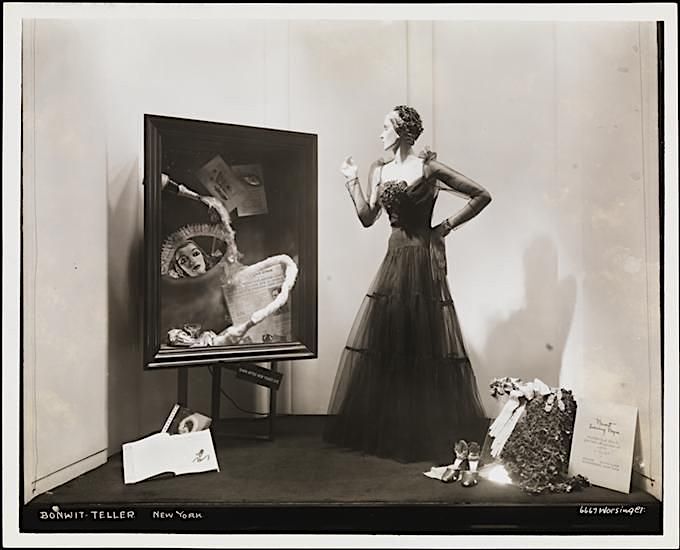
Dalí had previously dressed Bonwit Teller’s windows without incident in 1936, riding high on the buzz from his first American exhibition that same year. When invited back by the store to create a new display, writes Tim McNeese in Salvador Dalí, “he decided to use the windows to depict the ‘Narcissus complex,’ ” divided into day and night. “In the Day window, Narcissus is personified,” says The Art Story. “Three wax hands holding mirrors reached out of a bathtub lined with black lambskin and filled with water. A mannequin entered the tub in a scant outfit of green feathers. For the Night window, the feet of a poster bed are replaced by buffalo legs and the canopy is topped by its pigeon-eating head. A wax mannequin sat nearby on a bed of coals.”
As for the public reaction, writes the New York Times’ Michael Pollak, “words were exchanged, not all of them complimentary, and the store’s staff made quick changes. The skinny-dipper in ‘Day’ was quickly replaced by an attired mannequin. Out went the sleeper in ‘Night’; in went a standing model.” As soon as he caught sight of the unauthorized modifications, Dalí took corrective action. McNeese quotes the artist’s own memory of the proceedings: “I dashed into the window to disarrange it, so that my name, signed in the window, should not be dishonored. I was never so surprised as when the bathtub just shot through the window when I pushed it and I was thereafter most confused.”
Dalí was charged with disorderly conduct but issued a suspended sentence since, as the judge put it, “These are some of the privileges that an artist with temperament seems to enjoy.” Nothing like this happened to Andy Warhol when he later dressed Bonwit Teller’s windows, writes i‑D’s Briony Wright, though “a commission for the department store in 1961 brought what could be considered his big break.” Those same windows also became opportunities for a host of other artists including Sari Dienes, James Rosenquist, Jasper Johns, and Robert Rauschenberg, the last two of whom collaborated on a display as Maston Jones. They had their own reasons for the pseudonym, but an artist of Dalí’s particular sensibility knows you don’t turn down a chance to get your name on Fifth Avenue.
Based in Seoul, Colin Marshall writes and broadcasts on cities, language, and culture. His projects include the Substack newsletterBooks on Cities, the book The Stateless City: a Walk through 21st-Century Los Angeles and the video series The City in Cinema. Follow him on Twitter at @colinmarshall or on Facebook.
Americans today can acquire every element of their Thanksgiving dinner practically ready to eat, in need of little more than some heat before being set on the table. This very Thursday, in fact, many Americans will no doubt do just that. But it wasn’t an option two centuries ago, especially for those who lived on the wild frontier. To see how they’d have put their Thanksgiving dinner together, you’ll want to consult one Youtube channel in particular: Early American, previously featured here on Open Culture for its videos re-creating various meals as they would have been prepared circa 1820.
The creators of Early American, Justine Dorn and Ron Rayfield, also happen to be a married couple in real life. In their videos they appear to play historical versions of themselves, adhering to the domestic division of labor custom would have dictated in rural America of the early nineteenth century.
All this happens at the hearth, which demands a set of skills (and a set of tools, including an hourglass) not normally possessed by home-cooking enthusiasts of the twenty-twenties. But the meal that results will surely look appetizing even to modern viewers. Though Abraham Lincoln made Thanksgiving a national holiday in 1863, George Washington first issued a proclamation for “a day of public thanksgiving and prayer” in 1789. And by that time, many of Thanksgiving’s dishes had already become established tradition. (Turkey and cranberry were linked together in the first American cookbook in 1796, NPR notes.) As always, Justine provides the original recipes (scant in detail though they often are) at the end. Use them well, it seems, and you can have a grand Thanksgiving feast even if you don’t bring home a turkey.
Based in Seoul, Colin Marshall writes and broadcasts on cities, language, and culture. His projects include the Substack newsletterBooks on Cities, the book The Stateless City: a Walk through 21st-Century Los Angeles and the video series The City in Cinema. Follow him on Twitter at @colinmarshall or on Facebook.
We're hoping to rely on loyal readers, rather than erratic ads. Please click the Donate button and support Open Culture. You can use Paypal, Venmo, Patreon, even Crypto! We thank you!
Open Culture scours the web for the best educational media. We find the free courses and audio books you need, the language lessons & educational videos you want, and plenty of enlightenment in between.