Discover Michelangelo’s First Painting, Created When He Was Only 12 or 13 Years Old
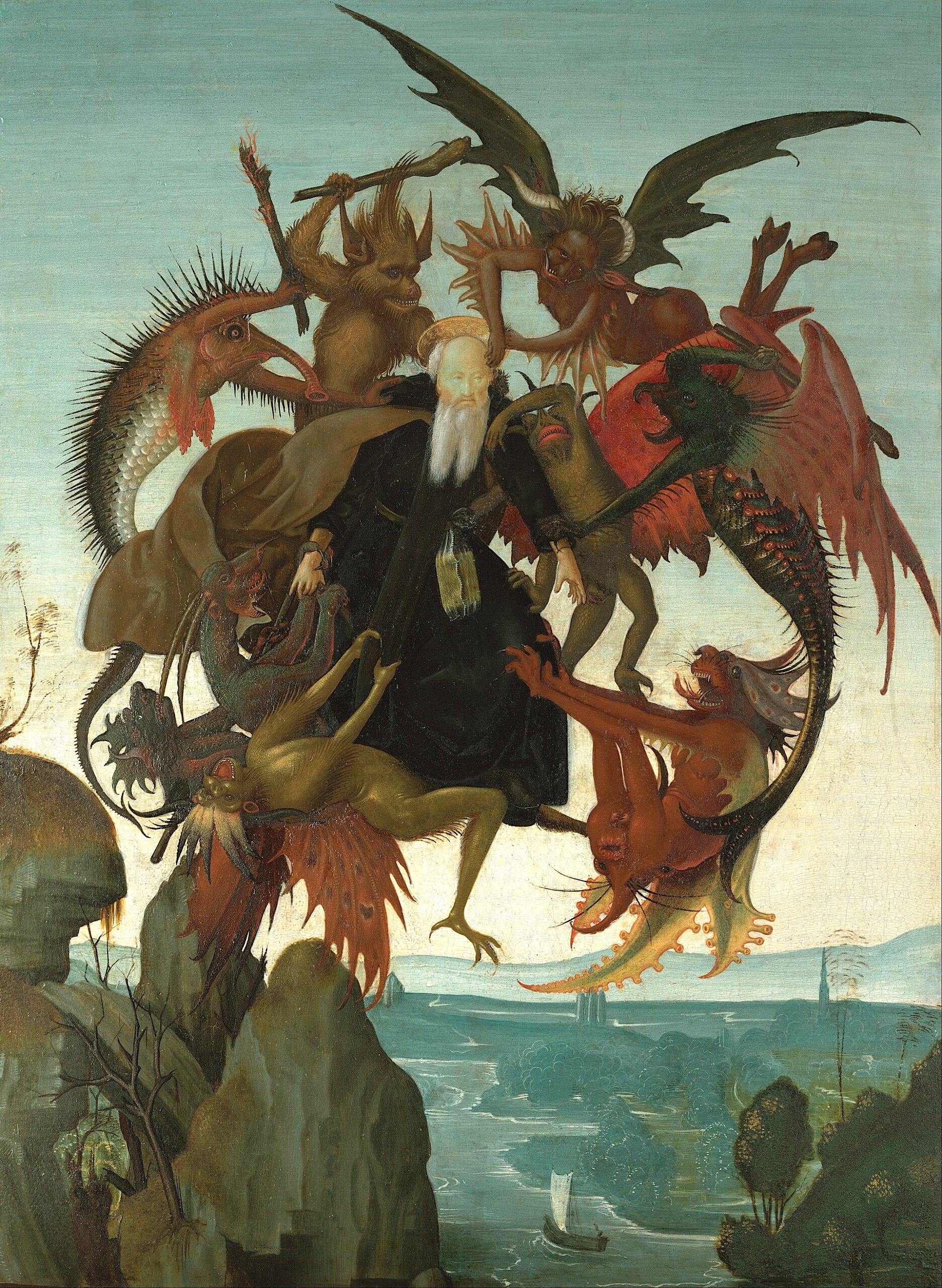
Think back, if you will, to the works of art you created at age twelve or thirteen. For many, perhaps most of us, our output at that stage of adolescence amounted to directionless doodles, chaotic comics, and a few unsteady-at-best school projects. But then, most of us didn’t grow up to be Michelangelo. In the late fourteen-eighties, when that towering Renaissance artist was still what we would now call a “tween,” he painted The Torment of Saint Anthony, a depiction of the titular religious figure beset by demons in the desert. Though based on a widely known engraving, it nevertheless shows evidence of rapidly advancing technique, inspiration, and even creativity — especially when placed under the infrared scanner.
For about half a millennium, The Torment of Saint Anthony wasn’t thought to have been painted by Michelangelo. As explained in the video from Inspiraggio just below, when the painting sold at Sotheby’s in 2008, the buyer took it to the Metropolitan Museum of Art for examination and cleaning.
“Beneath the layers of dirt accumulated over the centuries,” says the narrator, “a very particular color palette appeared. “The tones, the blends, the way the human figure was treated: all of it began to resemble the style Michelangelo would use years later in none other than the Sistine Chapel.” Infrared reflectography subsequently turned up pentimenti, or correction marks, a common indication that “a painting is not a copy, but an original work created with artistic freedom.”
It was the Kimbell Art Museum in Fort Worth, Texas that first bet big on the provenance of The Torment of Saint Anthony. Its newly hired director purchased the painting after turning up “not a single convincing argument against the attribution.” Thus acquired, it became “the only painting by Michelangelo located anywhere in the Americas, and also just one of four easel paintings attributed to him throughout his entire career,” during most of which he disparaged oil painting itself. About a decade later, and after further analysis, the art historian Giorgio Bonsanti put his considerable authority behind a definitive confirmation that it is indeed the work of the young Michelangelo. There remain doubters, of course, and even the notoriously uncompromising artist himself may have considered it an immature work unworthy of his name. But who else could have created an immature work like it?
Related Content:
How Four Masters — Michelangelo, Donatello, Verrocchio & Bernini — Sculpted David
A Secret Room with Drawings Attributed to Michelangelo Opens to Visitors in Florence
Michelangelo’s Illustrated Grocery List
Based in Seoul, Colin Marshall writes and broadcasts on cities, language, and culture. He’s the author of the newsletter Books on Cities as well as the books 한국 요약 금지 (No Summarizing Korea) and Korean Newtro. Follow him on the social network formerly known as Twitter at @colinmarshall.
Read More...The Ancient Tool Used in Japan to Strengthen Memory & Focus: The Abacus
William Gibson famously observed that the future is already here, it’s just not evenly distributed. That line is often thought to have been inspired by Japan, which was already projecting a thoroughly futuristic image, at least in popular culture, by the time he made his debut with Neuromancer in 1984. But as anyone who’s spent enough time in the country understands — albeit not without frustration — even twenty-first-century Japan remains in many ways a pre-digital society. Many businesses only take cash, more than a few services require communication by fax, and there’s no substitute for a physical hanko seal on important documents. Even so, it may come as a surprise to learn that Japan still uses abacuses.
Or rather, Japan still uses abacuses as educational tools: you won’t see many shopkeepers pull them out while ringing up your purchases, but if you glance in the window of the right kind of private academy, you might well see young students furiously performing calculations the very old-fashioned way.
If they’re sufficiently advanced, as explained in the BBC video above, they won’t even have actual abacuses; they’ll just move around beads pictured in their heads. (It brings to mind how Dustin Hoffman’s savant in Rain Man explains his performance of seemingly impossible mental math: “I see it.”) Such intensive abacus education was common across northeast Asia in the mid-twentieth century, when the arithmetic skills it cultivated were important for both individual survival and national development.
It was that very development that tended to push the abacus into obsolescence. When Korea, where I live, could afford electronic calculators, the prestige associated with abacus mastery dissolved practically overnight. Determined Korean parents can still sign their children up for jupan classes, much as Chinese parents might encourage theirs to enter into suanpan competitions out of a sense of civilizational pride, but they have nothing like the status the soroban enjoys in Japan. That may be vindicated by neuroscientific research pointing toward the benefits learning the abacus can have on a developing brain’s cognitive functions. As the BBC video explains, abacus training enhances cognitive function by sharpening concentration, accelerating information processing, and strengthening visual memory, leading to improved memory and sustained focus. But as any enthusiast of Japanese craft culture knows, no matter how much harder it may be to do things with analog tools, sometimes it’s just more satisfying.
Related Content:
The Wonderful Wooden Marble Adding Machine
The Mathematics Behind Origami, the Ancient Japanese Art of Paper Folding
Based in Seoul, Colin Marshall writes and broadcasts on cities, language, and culture. He’s the author of the newsletter Books on Cities as well as the books 한국 요약 금지 (No Summarizing Korea) and Korean Newtro. Follow him on the social network formerly known as Twitter at @colinmarshall.
Read More...How to Jumpstart Your Creative Process with William S. Burroughs’ Cut-Up Technique
The inner critic creates writer’s block and stifles adventurous writing, hems it in with safe clichés and overthinking. Every writer has to find his or her own way to get free of that sourpuss rationalist who insists on strangling each thought with logical analysis and fitting each idea into an oppressive predetermined scheme or ideology. William S. Burroughs, one of the most adventurous writers to emerge from the mid-20th century, famously employed what he called the cut-up method.
Developed by Burroughs and painter Brion Gysin, this literary take on the collage technique used by avant-garde artists like Georges Braque originated with Surrealist Tristan Tzara, who “proposed to create a poem on the spot by pulling words out of a hat.” The suggestion was so provocative, Burroughs claims in his essay “The Cut-Up Method,” that cut-ups were thereafter “grounded… on the Freudian couch.”
Since Burroughs and Gysin’s literary redeployment of the method in 1959, it has proved useful not only for poets and novelists, but for songwriters like David Bowie and Kurt Cobain. And any frustrated novelist, poet, or songwriter may use it to shake off the habitual thought patterns that cage creativity or choke it off entirely. How so?
Well, it’s best at this point to defer to the authority, Burroughs himself, who explains the cut-up technique thus:
The method is simple. Here is one way to do it. Take a page. Like this page. Now cut down the middle and cross the middle. You have four sections: 1 2 3 4 … one two three four. Now rearrange the sections placing section four with section one and section two with section three. And you have a new page. Sometimes it says much the same thing. Sometimes something quite different–(cutting up political speeches is an interesting exercise)–in any case you will find that it says something and something quite definite. Take any poet or writer you fancy. Heresay, or poems you have read over many times. The words have lost meaning and life through years of repetition. Now take the poem and type out selected passages. Fill a page with excerpts. Now cut the page. You have a new poem. As many poems as you like.
Burroughs gives us “one way” to do it. There may be infinite others, and it’s up to you to find what works. I myself have pushed through a creative funk by making montages from scraps of ancient poetry and phrases of modern pop, clichés ripped from the headlines and esoteric quotes from obscure religious texts—pieced together more or less at random, then edited to fit the form of a song, poem, or whatever. Virtual cut-and-paste makes scissors unnecessary, but the physical act may precipitate epiphanies. “Images shift sense under the scissors,” Burroughs writes; then he hints at a synesthesia experience: “smell images to sound sight to sound sound to kinesthetic.”
Who is this method for? Everyone, Burroughs asserts. “Cuts ups are for everyone,” just as Tzara remarked that “poetry is for everyone.” No need to have established some experimental art world bona fides, or even call oneself an artist at all; the method is “experimental in the sense of being something to do.” In the short video at the top, you can hear Burroughs explain the technique further, adding his occult spin on things by noting that many cut-ups “seem to refer to future events.” On that account, we may suspend belief.
As Jennie Skerl notes in her essay on Burroughs, cut-up theory “parallels avant-garde literary theory” like Jacques Derrida’s Deconstruction. “All writing is in fact cut ups,” writes Burroughs, meaning not that all writing is pieced together with scissors and glue, but that it’s all “a collage of words read heard overheard.” This theory should liberate us from onerous notions of originality and authenticity, tied to ideas of the author as a sui generis, all-knowing god and the text as an expression of cosmically ordered meaning. (Another surrealist writing method, the game of Exquisite Corpse, makes the point literal.) All that metaphysical baggage weighs us down. Everything’s been done—both well and badly—before, Burroughs writes. Follow his methods and his insistent creative maxim and you cannot make a mistake—“Assume that the worst has happened,” he writes, “and act accordingly.”
Note: An earlier version of this post appeared on our site in 2016.
Related Content:
How David Bowie, Kurt Cobain & Thom Yorke Write Songs With William Burroughs’ Cut-Up Technique
The “Priest” They Called Him: A Dark Collaboration Between Kurt Cobain & William S. Burroughs
Josh Jones is a writer and musician based in Durham, NC.
Read More...How Movies Created Their Special Effects Before CGI: Metropolis, 2001: A Space Odyssey & More
The youngest moviegoers today do not, of course, remember a time before visual effects could be created digitally. What may give us more pause is that, at this point in cinema history, most of their parents don’t remember it either. Consider the fact that Steven Spielberg’s Jurassic Park, with its once impossibly realistic (and still wholly passable) CGI dinosaurs, came out 32 years ago. That may put it, we must acknowledge, into the realm of the “classic,” the kind of picture whose entertainment value holds up despite — or because of — the qualities that fix it in its time. Equally spectacular but longer-canonized classics pose a greater challenge to the imaginations of young viewers, who can hardly guess how they could have been made “before computers.”
After seeing the notable examples provided in the new Primal Space video above, they’ll certainly understand one thing: it wasn’t easy. Even a seemingly simple effect like the pen floating loose through the zero-gravity cabin in 2001: A Space Odyssey required no small degree of ingenuity. We might naturally assume that filmmakers in 1968 would have accomplished it with a couple of pieces of Scotch tape and fishing line, but that would have resulted in unacceptable tangling problems, to say nothing of the trickiness of ensuring, quite literally, that the strings didn’t show. Instead, Kubrick’s team ended up attaching the pen to a sheet of glass — meticulously cleaned, no doubt, to eliminate the possibility of streaks — large enough to occupy the entire frame and thus go unnoticed by the viewer. It was then slowly rotated by a crank-turning assistant.
A few different effects from 2001 come in for explanation throughout the course of the video, including the multiple-exposure photography that made possible shots of spacecraft passing planets as well as the psychedelic “Star Gate” sequence toward the end. Though some of the devices used in these processes were put together just for the production, the underlying techniques had already been evolving for more than 60 years. Indeed, many were pioneered by Georges Méliès, previously featured here on Open Culture for A Trip to the Moon from 1902, the very first science-fiction film. This video goes behind the scenes of a work from the year before: L’Homme à la tête en caoutchouc, or The Man with the Rubber Head, in which Méliès managed a shot in which his own cranium inflates to huge proportions without the use of so much as a zoom lens.
Other examples, drawn from a range of beloved films from Metropolis to Mary Poppins, illustrate the inventiveness born of sheer technical limitation in the days when filmmaking was a wholly analog affair. In some cases, the effects these productions pulled off with miniatures, prisms, and mirrors 60, 80, 100 years ago look as good as anything Hollywood puts on the screen today — or rather better, since the innate physicality behind them makes them feel more “real.” Perhaps unsurprisingly, this video’s artificial-intelligence course sponsor makes reference to the endless range of visual possibilities available to those who master that technology. And it’s not impossible that we now stand on the cusp of a revolution in visual effects for that reason, with at least as much of an upside and downside as CGI. If so, we should prepare ourselves to hear the question, from children born today, of how anyone ever made movies before AI.
Related content:
The Art of Creating Special Effects in Silent Movies: Ingenuity Before the Age of CGI
How Stanley Kubrick Made 2001: A Space Odyssey: A Seven-Part Video Essay
How 2001: A Space Odyssey Became “the Hardest Film Kubrick Ever Made”
Why Movies Don’t Feel Real Anymore: A Close Look at Changing Filmmaking Techniques
Based in Seoul, Colin Marshall writes and broadcasts on cities, language, and culture. His projects include the Substack newsletter Books on Cities and the book The Stateless City: a Walk through 21st-Century Los Angeles. Follow him on the social network formerly known as Twitter at @colinmarshall.
Read More...Isaac Asimov Predicts the Future on The David Letterman Show (1980)
In 1980, Newsweek published a cantankerous and sadly on-the-nose diagnosis of the United States’ “cult of ignorance” — written by one Isaac Asimov, “professor of biochemistry at Boston University School of Medicine” and “author of 212 books, most of them on various scientific subjects for the general public.” Given this intimidating biography, and the fact that Asimov believed that “hardly anyone can read” in the U.S., we might expect the science fiction legend wanted nothing to do with television. We would be wrong.
Asimov seemed to love TV. In 1987, for example, the four-time Hugo winner wrote a humorously critical takedown of ALF for TV Guide. And he was a consummate TV entertainer, making his first major TV appearance on Johnny Carson’s Tonight Show in 1968, appearing four times on The Mike Douglas Show in the next few years, and giving his final television interviews to Dick Cavett in a two-part series in 1989. The same year he wrote about America’s cult of ignorance, he appeared on The David Letterman show to crack wise with the biggest wiseass on TV. Asimov held his own and then some.
“Asimov, sixty in this video, proves himself a natural comedian,” writes the Melville House blog; “Letterman, thirty-three, can barely keep up.” Surely Asimov’s banter had nothing to do with The David Letterman Show’s cancellation three days later. (Letterman was back on the air for eleven seasons two years later.) Their interview ranges widely from pop culture (Asimov confesses his appreciation for both Star Wars and The Empire Strikes Back) to “the future of medicine, space exploration, hope for mankind, and much more,” Vic Sage writes at Pop Culture Retrorama.
Asimov’s dry delivery — honed during his English-and-Yiddish-speaking Brooklyn childhood — is delightful. But the writer, teacher, and scientist hasn’t only come on TV to crack jokes, promote a book, and flaunt his muttonchops. He wants to educate his fellow Americans about the state of the future. (His Newsweek bio was outdated. As Letterman says, his appearance marked the publication of his 221st book.) Like Hari Seldon, the hero of his 1951 novel Foundation, Asimov felt confident in his ability to predict the course of human progress (or regress, as the case may be).
He also felt confident answering questions about what to do with outer space, and where to “put more men,” as Letterman says. His recommendation to build “factories” may strike us as a banal forerunner of Jeff Bezos’ even more banal plans for office parks in space. Asimov boasts of the vision he had of “pocket computers” in 1950 — hardly a reality in 1980. Dave complains about how complicated computers are, and Asimov accurately predicts that as technology catches up, they will get simpler to use. “But these are little things,” he says. “I never tried to predict. I just tried to write stories to pay my way through college.” He must have paid it several times over, and he seemed to get more right than he got wrong. See more of Asimov’s predictions in the links below.
Note: An earlier version of this post appeared on our site in 2021.
Related Content:
Isaac Asimov Laments the “Cult of Ignorance” in the United States (1980)
Josh Jones is a writer and musician based in Durham, NC.
Read More...George Orwell’s Six Rules for Writing Clear and Tight Prose

Image via Wikimedia Commons
Most everyone who knows the work of George Orwell knows his 1946 essay “Politics and the English Language” (published here), in which he rails against careless, confusing, and unclear prose. “Our civilization is decadent,” he argues, “and our language… must inevitably share in the general collapse.” The examples Orwell quotes are all guilty in various ways of “staleness of imagery” and “lack of precision.”
Ultimately, Orwell claims, bad writing results from corrupt thinking, and often attempts to make palatable corrupt acts: “Political speech and writing are largely the defense of the indefensible.” His examples of colonialism, forced deportations, and bombing campaigns find ready analogues in our own time. Pay attention to how the next article, interview, or book you read uses language “favorable to political conformity” to soften terrible things.
Orwell’s analysis identifies several culprits that obscure meaning and lead to whole paragraphs of bombastic, empty prose:
Dying metaphors: essentially clichés, which “have lost all evocative power and are merely used because they save people the trouble of inventing phrases for themselves.”
Operators or verbal false limbs: these are the wordy, awkward constructions in place of a single, simple word. Some examples he gives include “exhibit a tendency to,” “serve the purpose of,” “play a leading part in,” “have the effect of.” (One particular peeve of mine when I taught English composition was the phrase “due to the fact that” for the far simpler “because.”)
Pretentious diction: Orwell identifies a number of words he says “are used to dress up a simple statement and give an air of scientific impartiality to biased judgments.” He also includes in this category “jargon peculiar to Marxist writing” (“petty bourgeois,” “lackey,” “flunkey,” “hyena”).
Meaningless words: Abstractions, such as “romantic,” “plastic,” “values,” “human,” “sentimental,” etc. used “in the sense that they not only do not point to any discoverable object, but are hardly ever expected to do so by the reader.” Orwell also damns such political buzzwords as “democracy,” “socialism,” “freedom,” “patriotic,” “justice,” and “fascism,” since they each have “several different meanings which cannot be reconciled with one another.”
Most readers of Orwell’s essay inevitably point out that Orwell himself has committed some of the faults he finds in others, but will also, with some introspection, find those same faults in their own writing. Anyone who writes in an institutional context—be it academia, journalism, or the corporate world—acquires all sorts of bad habits that must be broken with deliberate intent. “The process” of learning bad writing habits “is reversible” Orwell promises, “if one is willing to take the necessary trouble.” How should we proceed? These are the rules Orwell suggests:
(i) Never use a metaphor, simile, or other figure of speech which you are used to seeing in print.
(ii) Never use a long word where a short one will do.
(iii) If it is possible to cut a word out, always cut it out.
(iv) Never use the passive where you can use the active.
(v) Never use a foreign phrase, a scientific word, or a jargon word if you can think of an everyday English equivalent.
(vi) Break any of these rules sooner than say anything outright barbarous.
What constitutes “outright barbarous” wording he does not say, exactly. As the internet cliché has it: Your Mileage May Vary. You may find creative ways to break these rules without thereby being obscure or justifying mass murder.
But Orwell does preface his guidelines with some very sound advice: “Probably it is better to put off using words as long as possible and get one’s meaning as clear as one can through pictures and sensations. Afterward one can choose—not simply accept—the phrases that will best cover the meaning.” Not only does this practice get us closer to using clear, specific, concrete language, but it results in writing that grounds our readers in the sensory world we all share to some degree, rather than the airy world of abstract thought and belief that we don’t.
These “elementary” rules do not cover “the literary use of language,” writes Orwell, “but merely language as an instrument for expressing and not for concealing or preventing thought.” In the almost eighty years since his essay, the quality of English prose has likely not improved, but our ready access to writing guides of all kinds has. Those who care about clarity of thought and responsible use of rhetoric would do well to consult them often, and to read, or re-read, Orwell’s essay.
Note: An earlier version of this post appeared on our site in 2016.
Related Content:
10 Writing Tips from Legendary Writing Teacher William Zinsser
Stephen King’s 20 Rules for Writers
V.S. Naipaul Creates a List of 7 Rules for Beginning Writers
Nietzsche’s 10 Rules for Writing with Style
Josh Jones is a writer and musician based in Durham, NC.
Read More...An Immersive, ASMR-Style Look at Japanese Woodblock Printing
While not every Open Culture reader dreams of moving to Japan and becoming a woodblock printmaker, it’s a safe bet that at least a few of you entertain just such a fantasy from time to time. David Bull, a British-Born Canadian who got his first exposure to the art of ukiyo‑e in his late twenties, actually did it. Though he’s been living in Japan and steadily pursuing his art there since 1986, only in recent years has he become known around the world. That’s thanks to his YouTube channel, which we’ve featured here several times before. In the video above, one of his most popular, he lets his viewers experience printmaking from his point of view, seeing what he sees and even hearing what he hears.
Though Bull normally focuses on the early stage carving images into the blocks, here he spends about an hour on the final printing phase, going through a batch of eight sheets. As even a few minutes’ viewing reveals, this is a labor-intensive and thoroughly analog process.
That impression will be heightened if you wear headphones, since, as Bull explains, he shot the video while wearing in-ear microphones that record the sounds of the job just as he hears them. This particular aspect of the production required him to rise considerably earlier than usual, in order to avoid the considerable daytime noise on the streets of Tokyo right outside his workshop — and thus to more fully satisfy the large ASMR crowd.
The term ASMR, or “Autonomous Sensory Meridian Response,” refers to a set of pleasing sensations triggered by certain kinds of sound, often those produced by soft-spoken individuals like Bull or the kind of repetitive, methodical tool work he does. Chances are, many if not most of the almost 950,000 views this video has racked up so far have come from ASMR enthusiasts less interested in Japanese woodblock printing per se than in the general aesthetic experience of watching and listening to Japanese woodblock printing — at least at first. We all know how life can go: one day you’re checking out YouTube, just looking to relax, and the next you’re ensconced in Asakusa, having wholly devoted yourself to a three-and-a-half-millennium-year-old traditional art form.
Related Content:
Enter a Digital Archive of 213,000+ Beautiful Japanese Woodblock Prints
Download 2,500 Beautiful Woodblock Prints and Drawings by Japanese Masters (1600–1915)
Watch a Master Japanese Printmaker at Work: Two Unintentionally Relaxing ASMR Videos
Based in Seoul, Colin Marshall writes and broadcasts on cities, language, and culture. His projects include the Substack newsletter Books on Cities and the book The Stateless City: a Walk through 21st-Century Los Angeles. Follow him on the social network formerly known as Twitter at @colinmarshall.
Read More...How the “Marvelization” of Cinema Accelerates the Decline of Filmmaking
As hard as it may be to believe, some of us have never seen a movie belonging to the Marvel Cinematic Universe. If you’re one of those uninitiated, none of the countless clips incorporated into the Like Stories of Old video essay above will tempt you to get initiated. Nor will the laments aired by host Tom van der Linden, who, despite once enjoying the MCU himself, eventually came to wonder why keeping up with its releases had begun to feel less like a thrill than a chore. As if their CGI-laden sound and fury weren’t trying enough, there’s also “the constant quipping, the annoying self-awareness, the fact that everything has to be a franchise now.”
Van der Linden labels a central factor in the decline of the MCU “storytelling entropy.” Classic films, you may have noticed, concentrate practically all the energy in every facet of their production toward the expression of specific themes, stories, and characters; at their best, their every line, gesture, cut, and invention represents the tip of an artistic iceberg. Take, to use a popular example, the lightsaber introduced in Star Wars, which Van der Linden calls “not just a weapon, but a metaphor” that “symbolically communicates a lot about the philosophy of its wielder, and about the larger world that it exists in,” condensing “a multitude of meanings and ideas into a simple, singular object.”
It does so in the first two or three movies, at any rate. In the decades since, as the Star Wars universe has grown ever vaster, more complex, and conceptually unwieldy, so the proliferation and modification of the once-marvelous lightsaber has turned it into something mundane, even banal. So it goes with storytelling entropy, a phenomenon that afflicts every narrative franchise commercially compelled to grow without end. That process of expansion eventually turns even the most captivating original materials diffuse and uninvolving to all but the hardest-core fans — by which point it has usually become obvious that creators themselves have long since lost their own passion for the stories.
Most MCU viewers will admit that it has produced misses as well as hits. But Marvelization, as Van der Linden calls it, has also inspired other, imitative corporate franchises to pump out globally marketable content fiercely protected by intellectual property lawyers — and has even drained the interest out of realms of film and television that have nothing to do with superheroes, swords, or sci-fi. Hollywood has always been about the bottom line, of course, but only in recent decades have market saturation, cross-platform strategy, and maximum crossover potential come to dominate its priorities so completely. From the MCU or otherwise, a Marvelized movie is one that, at bottom, has no pressing need to be made — and that we, ultimately, feel no pressing need to see.
Related content:
Why Movies Don’t Feel Real Anymore: A Close Look at Changing Filmmaking Techniques
Based in Seoul, Colin Marshall writes and broadcasts on cities, language, and culture. His projects include the Substack newsletter Books on Cities and the book The Stateless City: a Walk through 21st-Century Los Angeles. Follow him on the social network formerly known as Twitter at @colinmarshall.
Read More...Why Movies Don’t Feel Real Anymore: A Close Look at Changing Filmmaking Techniques
Anyone who keeps an eye on Hollywood knows — indeed, has been ever more frequently and anxiously informed — that the theater business is in trouble. If fewer of us than ever have been going out to the movies, one reason must have to do with the easy availability of home streaming, to say nothing of all the proliferating digital distractions precision-engineered to capture our attention. But could it also have to do with a change in the pictures themselves? With more than two million views racked up in just four days, the new Like Stories of Old video essay above ventures an explanation as to “Why Movies Just Don’t Feel ‘Real’ Anymore.”
In recent years, even long, colossally budgeted, and ceaselessly marketed spectacles feel strangely insubstantial on any screen, big or small. The video’s creator Tom van der Linden points to a variety of factors, beginning with a worsening lack of correspondence between the cinematic image and our perception of reality.
One clearly — or rather, readily — noticeable contributing trend is the prevalence of shallow focus, which keeps the characters in the foreground sharp but lets all the details of the background go blurry: not the way we see the real world, unless we misplace our glasses. Because we live in deep focus, deep focus cinematography feels more real to us.
Of course, not every movie can be Lawrence of Arabia. But there was a time when practically all of them did deliver what’s called “haptic visuality,” the word haptic relating to the concept of our sense of touch. Older films have a tangibility about them in large part because the filmmakers had no choice: working only or primarily with analog tools, they could only do so much to detach images from our physical experience. Digital photography, post-production CGI, and now the open abyss of AI have made anything technically possible, though as van der Linden underscores, those technologies by themselves don’t guarantee that the resulting movie won’t feel real. Ultimately, unreality is a choice, and one we moviegoers should hope the industry will stop making — if not for our satisfaction, then for its own survival.
Related Content:
The Dark Knight: Anatomy of a Flawed Action Scene
Why We All Need Subtitles Now
Why Do Wes Anderson Movies Look Like That?
Based in Seoul, Colin Marshall writes and broadcasts on cities, language, and culture. His projects include the Substack newsletter Books on Cities and the book The Stateless City: a Walk through 21st-Century Los Angeles. Follow him on the social network formerly known as Twitter at @colinmarshall.
Read More...How Paris Became Paris: The Story Behind Its Iconic Squares, Bridges, Monuments & Boulevards
Even today, the Paris of the popular imagination is, for the most part, the Paris envisioned by Baron Georges-Eugène Haussmann and made a reality in the eighteen-fifties and sixties. Not that he could order the city built whole: as explained by Manuel Bravo in the new video above, Paris had already existed for about two millennia, growing larger, denser, and more intricate all the while. But as the prefect under Emperor Napoleon III, Haussmann was empowered to carve it up by force, opening “dozens of wide, long avenues that connected important parts of the city,” a layout that “mirrored the street system in Rome created 300 years earlier by Pope Sixtus V, but on a much grander scale.”
However considerable the violence it did to medieval Paris, this process of “Haussmannization” showed a certain historical consciousness. After all, the French capital was once a Roman city: Lutetia Parisorum, named for the Parisii, the Gallic tribe that had inhabited the island in the middle of the Seine that Parisians now call Île de la Cité.
As was their usual modus operandi, the conquering Romans laid a cardo maximus running from north to south, today known as Rue Saint-Jacques. Thereafter, “the rest of the original layout was lost to organic growth.” In the form Paris eventually took in the Middle Ages, “there were no public urban spaces of major significance”: no Place Dauphine, no Place des Vosges, no Place Vendôme.
Those very same Parisian squares now enjoyed by locals and tourists alike did much to develop the expectation of “aesthetic unity” in the city’s built environment, and a couple of centuries before Haussmann at that. It may not be a complete exaggeration to call Paris frozen in the Baron’s mid-nineteenth century, but as Bravo explains, a close examination of both the city’s celebrated spaces and overall form reveals the ways in which a much deeper past has done its part to shape or inspire them. An enthusiast of urban history can spend weeks, months, or even years appreciating the details that remind us that the palimpsest of Paris has never quite been overwritten, even in a place as unrelentingly examined — if seldom truly seen — as the Louvre.
Related Content:
A 3D Animation Reveals What Paris Looked Like When It Was a Roman Town
Take an Aerial Tour of Medieval Paris
The Architectural History of the Louvre: 800 Years in Three Minutes
A 5‑Hour Walking Tour of Paris and Its Famous Streets, Monuments & Parks
Venice Explained: Its Architecture, Its Streets, Its Canals, and How Best to Experience Them All
Based in Seoul, Colin Marshall writes and broadcasts on cities, language, and culture. His projects include the Substack newsletter Books on Cities and the book The Stateless City: a Walk through 21st-Century Los Angeles. Follow him on the social network formerly known as Twitter at @colinmarshall.
Read More...Support Us
We're hoping to rely on loyal readers, rather than erratic ads. Please click the Donate button and support Open Culture. You can use Paypal, Venmo, Patreon, even Crypto! We thank you!

About Us

Open Culture scours the web for the best educational media. We find the free courses and audio books you need, the language lessons & educational videos you want, and plenty of enlightenment in between.
Advertise With Us
FREE UPDATES!
GET OUR DAILY EMAIL
Get the best cultural and educational resources on the web curated for you in a daily email. We never spam. Unsubscribe at any time.
FOLLOW ON SOCIAL MEDIA
Open Culture editor Dan Colman scours the web for the best educational media. He finds the free courses and audio books you need, the language lessons & movies you want, and plenty of enlightenment in between.
Advertise With Us


