3D Print 18,000 Famous Sculptures, Statues & Artworks: Rodin’s Thinker, Michelangelo’s David & More
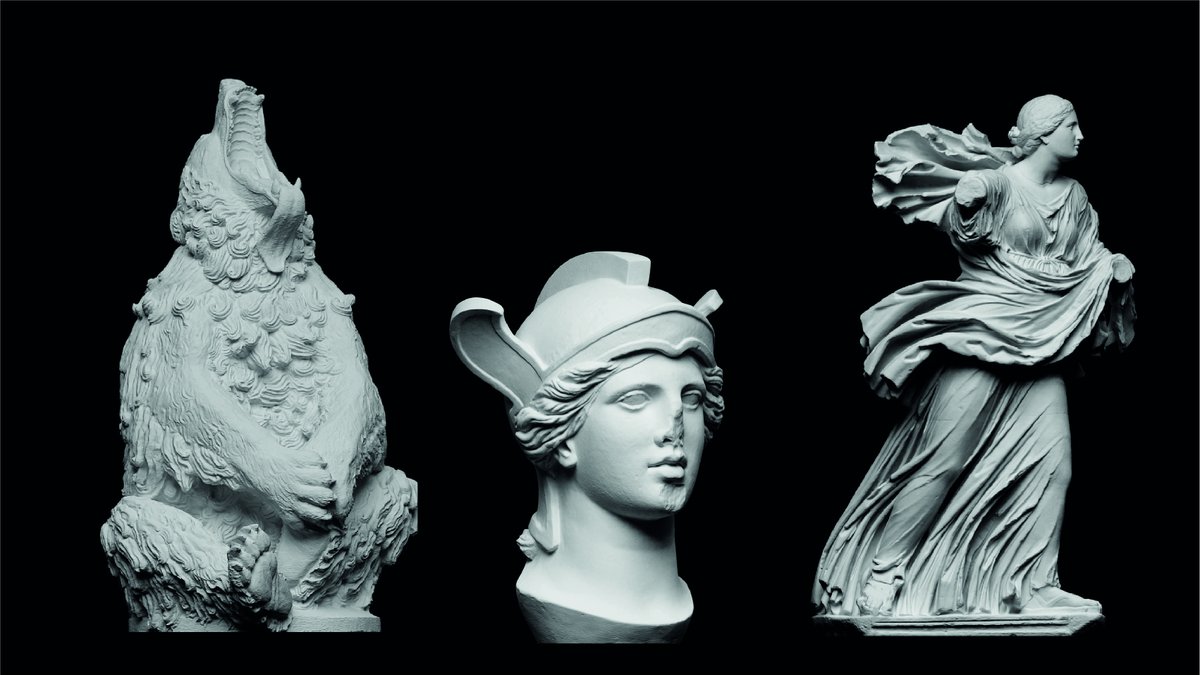
To recent news stories about 3D printed guns, prosthetics, and homes, you can add Scan the World’s push to create “an ecosystem of 3D printable objects of cultural significance.”
Items that took the ancients untold hours to sculpt from marble and stone can be reproduced in considerably less time, provided you’ve got the technology and the know-how to use it.
Since we last wrote about this free, open source initiative in 2017, Scan the World has added Google Arts and Culture to the many cultural institutions with whom it partners, expanding both its audience and the audience of the museums who allow items in their collections to be scanned prior to 3D printing.


Community contributors have uploaded scan data for over 18,000 sculptures and artifacts onto the platform.
China and India are actively courting participants to make some of their treasures available.
Although Scan the World is searchable by collection, artist, and location, with so many options, the community blog is a great place to start.
Here you will find helpful tips for beginners hoping to produce realistic looking skulls and sculptures — control your temperature, shake your resin, and learn from your mistakes.
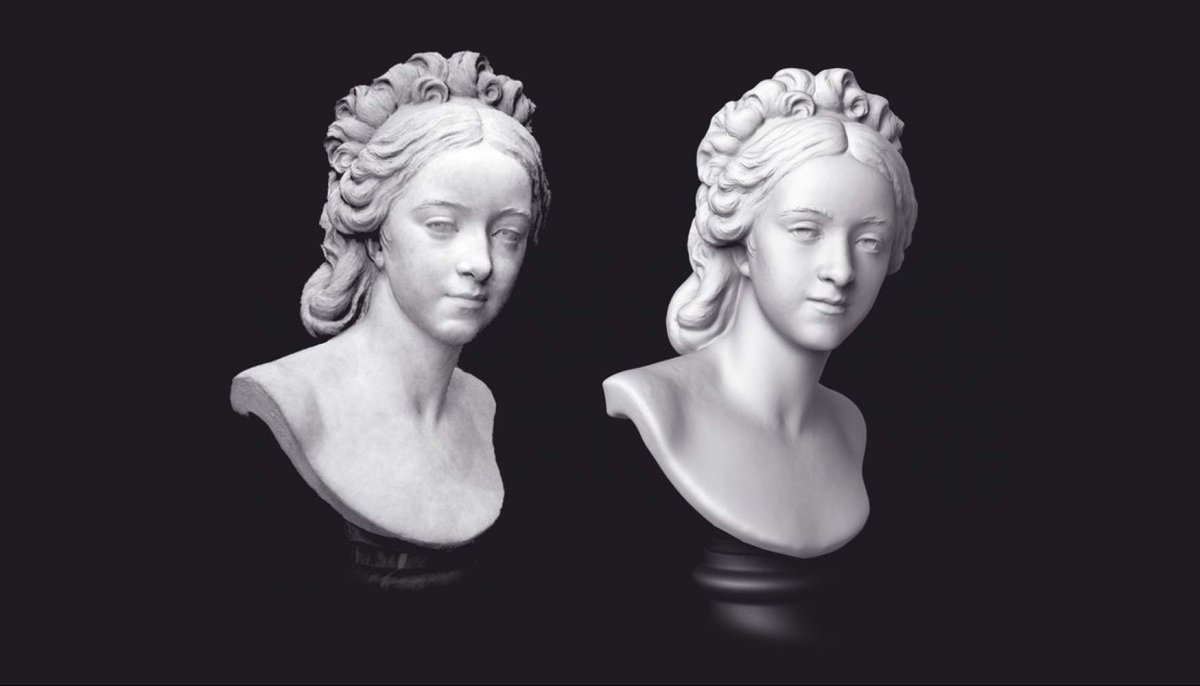
Got an unreachable object you’re itching to print? Take a look at the drone photogrammetry tutorial to prep yourself for taking a good scan — rotate slowly, remember the importance of light, and get up to speed on your drone by test-driving it in an open location.
Keep an eye peeled for competitions, like this one, which was won by a photo editor and retoucher with no formal 3‑D training.
Art lovers with little inclination to crack out the 3D printer will find interesting essays on such topics as the Gates of Hell, scanning in the pandemic, and the history of hairstyles in sculpture
You can also embark on a virtual tour of some of the global locations whose splendors are being scanned, programmed, and rendered in resin.
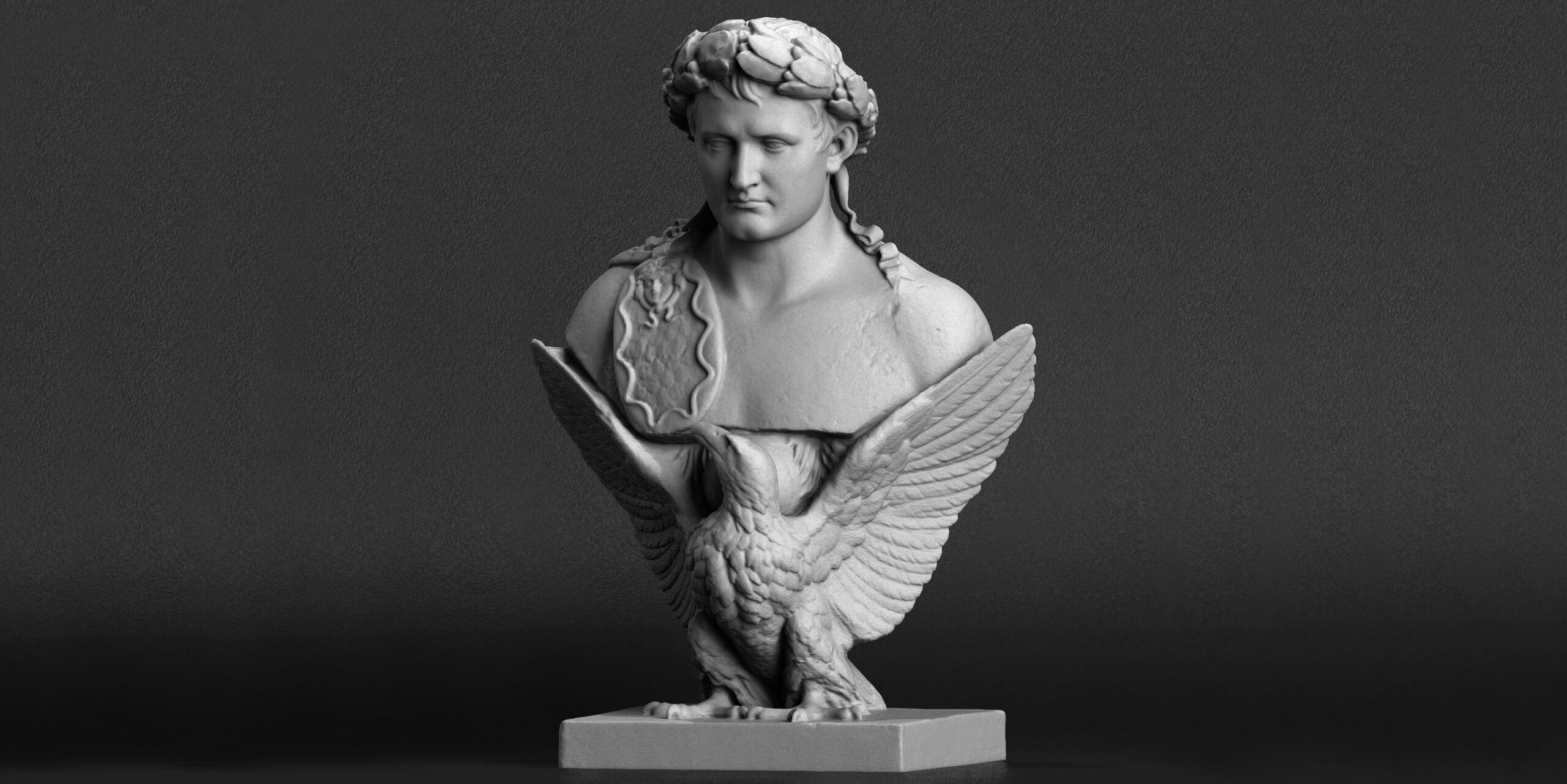
A virtual trip to Paris takes in some of the Louvre’s greatest 3‑dimensional hits: the Venus de Milo, Winged Victory, and Psyche Revived by Cupid’s Kiss.
(Any one of those oughta class up the ol’ bedsit…)
The virtual trip to Austria includes Kierling’s monument to Franz Kafka, the Beethoven memorial in Vienna’s Heiligenstädter Park, and Klaus Weber’s tribute to Hugo Rheinhold’s Darwinian sculpture, Monkey with Skull. (1,868 downloads and counting!)
A Google map awaits those who would tour the original flavor inspirations in person.
Begin your explorations of Scan the World here, and do let us know in the comments if you have plans for printing.
Related Content:
The Earth Archive Will 3D-Scan the Entire World & Create an “Open-Source” Record of Our Planet
Ayun Halliday is an author, illustrator, theater maker, Chief Primatologist of the East Village Inky zine, and sometimes, a French Canadian bear known as L’Ourse. Follow her @AyunHalliday.
Read More...Critics Celebrate Two-Lane Blacktop, the 1971 Existential Road-Movie Masterpiece by Monte Hellman (RIP), Starring James Taylor & Dennis Wilson
The road movie has long since proven itself as one of the great American cultural forms, not least by capturing the imagination of other societies, no matter how distant or different. As New York Times critic A.O. Scott declares in the video above, “one of the finest road movies, and perhaps the purest of them all, is Monte Hellman’s Two-Lane Blacktop.” In his original 1971 review of the film, a Roger Ebert described Hellman as “an American director whose work is much prized by the French, who have a knack for finding existential truths in movies we thought were Westerns.” In some sense Two-Lane Blacktop is indeed a Western, but Hellman’s death earlier this week will prompt many to revisit the film and see that it’s also much more — as well as much less.
Two-Lane Blacktop ostensibly tells the story of a cross-country race from New Mexico to Washington, D.C. In one car, a customized 1955 Chevrolet 150, are quasi-hippie gearheads known only as the Driver and the Mechanic (joined for a stretch by a hitchhiking Girl). In the other, a brand-new GTO, is a middle-aged man known only as GTO. “The mysticism of this movie is in its absence of mysticism,” says Scott. “It’s so literal-minded, so bare-bones, so absurd, and it exposes not only the romance of the open road and the car culture, but the emptiness, the nihilism.” Hellman, as the New Yorker’s Richard Brody puts it in his own video essay, “shears this composition down to its existential bare bones,” leaving not much more in its reality than what Ebert calls “miscellaneous establishments thrown up along the sides of the road to support life: motels, gas stations, hamburger stands.”
As stripped-down as its ’55 Chevy, Two-Lane Blacktop rolled up in the wake of Dennis Hopper’s Easy Rider, whose success convinced more than a few studios that cheaply produced, counter-culturally themed road movies could hit the box-office jackpot. Though unsuccessful upon its initial release just shy of 50 years ago, the film has only consolidated its power since. Some of that power comes from unexpected sources, such as the casting of singer-songwriter James Taylor and the Beach Boys’ Dennis Wilson as the Driver and the Mechanic. These musicians, to Brody’s mind, “exert a negative charisma: their presence is both powerful and blank, deeply expressive in its neutrality.” Scott sees Taylor’s turn in particular as occupying “a realm beyond acting, in a kind of deadpan, stoned, zen state of non-performance.”
As GTO, Warren Oates brings all the traditional acting chops Two-Lane Blacktop requires, shifting between braggadocio, pathos, and a kind of postmodern posturing as often as he changes his boldly colored V‑neck sweaters. “This nameless driver has bought the James Bond ideal of the well-rounded man,” writes Kent Jones in his essay on the film for the Criterion Collection, “but he prefigures Woody Allen’s Zelig in the desperate speed with which he adapts himself to every new situation and passenger.” These tendencies can’t save him on the entropic open road, only emphasizing as it does what Brody calls “the impossibility of solitude, the tendril-like encroachment of the outside world.” But then, neither can the mechanical single-mindedness of the Driver and Mechanic. This is the American condition, but only in that it’s a high-octane distillation of the human one.
Related content:
A Brief History of the Great American Road Trip
178,000 Images Documenting the History of the Car Now Available on a New Stanford Web Site
Rock Stars Who Died Before They Got Old: What They Would Look Like Today
Tom Waits Names 14 of His Favorite Art Films
A Hulking 1959 Chevy Bel Air Gets Obliterated by a Mid-Size 2009 Chevy Malibu in a Crash Test
Based in Seoul, Colin Marshall writes and broadcasts on cities, language, and culture. His projects include the Substack newsletter Books on Cities, the book The Stateless City: a Walk through 21st-Century Los Angeles and the video series The City in Cinema. Follow him on Twitter at @colinmarshall or on Facebook.
Read More...Watch “Hi-Fi-Fo-Fum,” a Short Satirical Film About the Invention of the Audiophile (1959)
Sometime in the mid-1990s, my father gave me his hi-end, hi-fi stereo system from the mid-1970s: a vacuum tube-powered amplifier, pair of stereo speakers in walnut cabinets, and a turntable. Heavy, bulky, and built with hardly an ounce of plastic between them, these components lacked all of the functionality we look for in consumer audio today: no 4K HDMI, no Bluetooth, no surround sound of any kind. As such features became de rigeur, my stereo migrated to the closet, piece by piece, then out the door, to make room for new, shiny black plastic boxes.
Now, a search for that same equipment turns up auctions for hundreds more than its worth ten, twenty, fifty years ago. Why does obsolete audio technology fetch such high prices, when there are appliance graveyards filled with CRT TVs and other relics of the analogue past? Blame the audiophile, a very specific kind of nerd who spends their days obsessing over frequency response curves, speaker placement, and the optimal tracking force of a stylus, immersed in magazine articles, online forums, and product reviews.
While the rest of the world contents itself with streaming MP3s and tinny computer speakers, audiophiles buy and restore old analogue stereo equipment, pair it with the latest in high-tech engineering, wire it together with connectors that cost more than your TV, and build specialized listening environments more like boutique showrooms than any run-of-the-mill man- or woman-cave. In short, they tend to orient their lives, as much possible, around the pursuit of perfect sound reproduction.
Audiophilia has trickled down, somewhat, in the renewed consumer love for vinyl records, but to compare the big box-store systems on which most people listen to LPs to the gear of the well-heeled cognoscenti is to spit upon the very name of Audio. The snobbery and endless dissatisfaction of the audiophile are nothing new, as the 1959 BBC short film above shows, addressing the question asked of audiophiles everywhere, at all times: “Do they like music? Or are they in love with equipment?”
The charming, satirical BBC portrait brings this character to life for non-audiophiles, who tend to find the audiophile’s obsessions unbearably tedious. But if appreciation for such things makes audiophiles just slightly better than ordinary listeners, so be it. Whatever the disagreements, and they are numerous, among them, all audiophiles “agree on the fundamental facts in life,” writes Lucio Cadeddu in a “Survivor’s Guide on Audiophile Behavior.”
Enjoyment of rhythmic, organized sound may be universally human, but for the audiophile, that pedestrian pleasure is secondary to “having a wide frequency response and getting a realistic virtual image, whatever that means.” Audiophilia, for all its privileged investment in equipment the average person can’t afford, can be seen as no more than an advanced form of conspicuous consumption. Or it can be seen as a life “devoted,” Cadeddu writes, “to formal perfection.”
via Ted Gioia
Related Content:
How Vinyl Records Are Made: A Primer from 1956
How Old School Records Were Made, From Start to Finish: A 1937 Video Featuring Duke Ellington
Josh Jones is a writer and musician based in Durham, NC. Follow him at @jdmagness
Read More...Hear Joni Mitchell’s Earliest Recording, Rediscovered After More than 50 Years
How excited would you be to listen to a recording, made at an AM radio station in 1963, labeled “JONI ANDERSON AUDITION TAPE”? If you know much about the singer-songwriters of the mid-20th century, you’d be quite excited indeed. For Joni Anderson is none other than Joni Mitchell, who under that married name would go on to become one of the most influential solo performers to come out of the folk-music scene. Not that she prized the designation that thus accompanied her to stardom: “I was never a folksinger,” she recently remembered herself insisting. “I would get pissed off if they put that label on me.”
She had a point. Listen to that 1963 audition tape, on which she sings “The House of the Rising Sun” while accompanying herself on the ukulele, and on some level you’ve got to call it folk music. But even at the age of 19, Mitchell — or rather Anderson — exhibited the distinctively captivating musical presence that would get listeners of more than one generation playing her records until they wore through.
Whether the teenage DJ who recorded her demo had any idea of what she would become at the time, he knew full well the cultural value of the tape when his daughter rediscovered it in the basement more than fifty years later.
In the video just above, you can see that DJ, one Barry Bowman, react to Mitchell’s earliest-known recording after threading it up in his home studio. “Damn!” he says, marveling at the crispness of the sound after all these decades — and the fact that he somehow managed to do justice to both her voice and her strings with the relatively meager equipment available to him at CFQC-AM. The tape even captures the distinctive sound of her alternate-tuned baritone ukulele, which she originally took up while growing up in Saskatoon when her mother vetoed the guitar.
Last year Mitchell’s 1963 version of “The House of the Rising Sun” saw official release as part of the box set Joni Mitchell Archives Vol. 1: The Early Years (1963–1967). Listening back to the material of that period surprised even Mitchell, and made her change her mind about her earlier folk-related resentments: “It was beautiful. It made me forgive my beginnings. And I had this realization… I was a folksinger!” She may have transcended folk music — just as she left Saskatoon for Toronto, and then Toronto for southern California — but even Joni Mitchell had to start somewhere.
via Metafilter
Related Content:
Watch Joni Mitchell’s Classic Performances of “Both Sides Now” & “The Circle Game” (1968)
Based in Seoul, Colin Marshall writes and broadcasts on cities, language, and culture. His projects include the Substack newsletter Books on Cities, the book The Stateless City: a Walk through 21st-Century Los Angeles and the video series The City in Cinema. Follow him on Twitter at @colinmarshall or on Facebook.
Read More...Watch Metallica Play “Enter Sandman” Before a Crowd of 1.6 Million in Moscow, During the Final Days of the Soviet Union (1991)
In the years following the collapse of the Soviet Union a “triumphalist discourse” arose in the U.S., writes historian Richard Sakwa, “which suggests that the Soviet demise was a deliberate act plotted and executed by president Ronald Reagan” with massive military budgets and nuclear threats. This narrative has less exclusive currency today. There are as many theories as theorists of Soviet demise, among them the “compelling argument,” says Jim Brown, producer of a documentary called Free to Rock, “that rock and roll was a factor — a contributing factor of many — in ending the Cold War.”
It’s not a facetious claim and may have little to do, as some allege, with the CIA spreading foreign influence in the U.S.S.R. during the 1980s. A homegrown “rock subculture,” writes Carl Schreck at The Atlantic, “had been percolating in the Soviet Union for decades by the time Gorbachev came to power in 1985.”
As Metallica came to power in 1991 with The Black Album, their best-selling record — and one of the biggest selling albums of all time, worldwide — young Russians did not need to be instructed in the finer points of rocking out against authoritarianism and government control.
Never before, however, had Russian rockers gathered in the open as they did in ‘91, when the heavy metal festival Monsters of Rock stopped in Moscow for the first time since its founding in 1980, attracting a reported 1.6 million fans — one of the largest concerts in history — to see headliners AC/DC, Metallica, and Pantera. The show “was not the first time Western heavy-metal acts have played Moscow,” wrote The New York Times. “In 1989, Ozzy Osbourne, Bon Jovi and Motley Crue filled Lenin Stadium for two days to help raise money for Soviet charities.” But Monsters of Rock was something different.
Promoted as a “celebration of democracy and freedom” by its corporate sponsor, Time Warner, and arriving just a month after a failed coup attempt by Soviet hardliners, the concert was something of a successful coup for AC/DC, who “until a few years ago… were formally banned in the Soviet Union.” (One 1985 list compiled by the Young Communist League said they promoted “neofascism” and “violence.”) Soviet music critic and writer Andrei Orlov gestured toward realpolitik in a remark on the subject: “Look at the graffiti in the city. AC/DC is written on every wall.”
Even more revolutionary, in heavy metal terms, was the appearance of Metallica at second billing on the tour. It would prove to be one of several “ live coups,” for the band, K.J. Daughton writes. After their massive success on MTV with “Enter Sandman,” “Unforgiven,” and “Nothing Else Matters,” the band played several major concerts, including their “historic musical tour de force” at Tushino Airfield in Moscow. “In a video of the set,” writes Didier Cadena (watch it in full above), “one can see the ocean of people moving around and singing along, even though the majority of the crowd only knew English through the music.”
The concert was not without its moments of violence. “The brutal intervention of Soviet police left 53 people injured,” writes Daughton (see some of the official overreaction above). But these were the rattles of a dying police state. Just a few months later in December, the Soviet Union officially dissolved.
Can AC/DC or Metallica take credit? No, but they were important symbols for a wave of disaffected Russian youth the Soviet leader himself had no desire to hold back. Gorbachev, after all, was “a fan of Elvis Presley,” says Brown. “He liked rock and roll… And I think he takes pride in the fact that after wasting, you know, trillions of dollars on weapons, that words and actions and culture brought these two countries together.”
Related Content:
Josh Jones is a writer and musician based in Durham, NC. Follow him at @jdmagness
Read More...Watch the “Greatest Juggler of the Ages,” Frances Brunn, Perform His “Painfully Exciting” Juggling Routine (1969)
When John Ringling North, then president of Ringling Bros. and Barnum & Bailey Circus, saw a pair of German jugglers and acrobats perform in Spain, he immediately invited them to join “the Greatest Show on Earth.” A brother and sister team, Francis and Lottie Brunn would astonish audiences. In 1950, theater critic Brooks Atkinson called Francis “the greatest juggler of the ages. Not many people in the world are as perfectly adjusted as Mr. Brunn is. He will never have to visit a psychiatrist.” If physical grace and balance are reflective of one’s state of mind, maybe he was right.
When Lottie left the act in 1951, Francis went on to popular fame and even more hyperbolic acclaim. “After he performed before the queen of England in 1963, The Evening Standard called his show ‘almost painfully exciting,’” Douglas Martin writes at The New York Times.
“Trying to describe Brunn’s act is like trying to describe the flight of a swallow,” writes Francisco Alvarez in Juggling: Its History and Greatest Performers. He became a regular performer on The Ed Sullivan Show, “played the Palace with Judy Garland,” notes Martin, “and went twice to the White House, where President Dwight D. Eisenhower proclaimed him the best juggler he had ever seen.”
None of this should bias you toward the television performance, above, of course. (How many jugglers could Eisenhower have seen, anyway?) Judge for yourself. By way of further context, we should note that Brunn was known for perfecting “an austere but demanding minimalism. He was fascinated by controlling just one ball, and virtually compelled audiences to share this fascination.” Or as Brunn put it, “it sounds like nothing, but it is quite difficult to do properly.” As anyone (or virtually everyone) who has tried and failed to juggle can attest, this description fits the art of juggling in general all too well.
Brunn made it look laughably easy: “Large numbers of objects posed scant problem. He was believed to be the first juggler in the world to put up 10 hoops,” Martin writes. He also liked to incorporate flamenco into his act to compound the difficulty and the grace. “I do not consider myself doing tricks,” he said in 1983. “There is one movement for eight minutes. It’s supposed to be, let’s say, like a ballet…. I would love if the audience is so fascinated that nobody applauds in the end.” Brunn, I suspect, never got to hear the sound of stunned silence after his act.
Related Content:
Josh Jones is a writer and musician based in Durham, NC. Follow him at @jdmagness
Read More...The Beautiful, Innovative & Sometimes Dark World of Animated Soviet Propaganda (1925–1984)
Growing up, we assembled our worldview from several different sources: parents, siblings, classmates. But for most of us, wherever and whenever we passed our formative years, nothing shaped our early perceptions of life as vividly, and as thoroughly, as cartoons — and this is just as Lenin knew it would be. “With the establishment of the Soviet Union in 1922,” writes New York Times film critic Dave Kehr, “Lenin proclaimed the cinema the most important of all the arts, presumably for its ability to communicate directly with the oppressed and widely illiterate masses.”
Lenin certainly didn’t exclude animation, which assumed its role in the Soviet propaganda machine right away: Soviet Toys, the first U.S.S.R.-made cartoon, premiered just two years later. It was directed by Dziga Vertov, the innovative filmmaker best known for 1929’s A Man with a Movie Camera, a thrilling articulation of the artistic possibilities of documentary. Vertov stands as perhaps the most representative figure of Soviet cinema’s early years, in which tight political confines nevertheless permitted a freedom of artistic experimentation limited only by the filmmaker’s skill and imagination.
This changed with the times: the 1940s saw the elevation of skilled but West-imitative animators like Ivan Ivanov-Vano, whom Kehr calls the “Soviet Disney.” That label is suitable enough, since an Ivanov-Vano short like Someone Else’s Voice from 1949 “could easily pass for a Disney ‘Silly Symphony,’ ” if not for its un-Disneylike “threatening undertone.” (Not that Disney couldn’t get darkly propagandistic themselves.)
With its magpie who “returns from a flight abroad and dares to warble some of the jazz music she has heard on her travels” only to have “the hearty peasant birds of the forest swoop down and rip her feathers out,” Someone Else’s Voice tells a more allegorical story than those in most of the shorts gathered in this Soviet propaganda animation playlist.
The playlist’s selections come from the collection Animated Soviet Propaganda: From the October Revolution to Perestroika; “workers are strong-chinned, noble, and generic,” writes the A.V. Club’s Tasha Robinson. “Capitalists are fat, piggish cigar-chompers, and foreigners are ugly caricatures similar to those seen in American World War II propaganda.” With their strong “anti-American, anti-German, anti-British, anti-Japanese, anti-Capitalist, anti-Imperialist, and pro-Communist slant,” as Kehr puts it, they would require an impressionable audience indeed to do any convincing outside Soviet territory. But they send an unmistakable message to viewers back in the U.S.S.R.: you don’t know how lucky you are.
Related Content:
Watch Dziga Vertov’s Unsettling Soviet Toys: The First Soviet Animated Movie Ever (1924)
Animated Films Made During the Cold War Explain Why America is Exceptionally Exceptional
Based in Seoul, Colin Marshall writes and broadcasts on cities, language, and culture. His projects include the Substack newsletter Books on Cities, the book The Stateless City: a Walk through 21st-Century Los Angeles and the video series The City in Cinema. Follow him on Twitter at @colinmarshall or on Facebook.
Read More...Watch Blondie’s Debbie Harry Perform “Rainbow Connection” with Kermit the Frog on The Muppet Show (1981)
Do you dig songs about rainbows?
The host of one of the very last episodes of The Muppet Show — Debbie Harry, lead singer of Blondie — does, and in 1981, she seized the opportunity to duet with Kermit the Frog on his signature tune, “The Rainbow Connection” — its only performance in the series’ five season run.
Many of us associate the folksy number with The Muppet Movie’s pastoral opening scene. This rendition transfers the action backstage to the kimono-clad Harry’s dressing room.
Who knew her sweet soprano would pair so nicely with a banjo?
She also exhibits a game willingness to lean into Muppet-style hamminess, responding to the lyric “Have you heard voices?” with an expression that verges on psychological horror.
Midway through, the two are joined by a chorus of juvenile frogs in scouting uniforms.
A little context — these youngsters spend the episode trying to earn their punk merit badge.
No wonder. By 1981, when the episode aired, Blondie had achieved massive mainstream success, with such hits as “One Way or Another” and “Call Me,” both of which were shoehorned into the episode.
As creator Jim Henson’s son, Brian, recalled in a brief introduction to its video release:
…I was in high school and my father knew that Debbie Harry was, like, the biggest thing in the world to me. And he booked her to be on The Muppet Show during a vacation week from school and he didn’t tell me. We went out to dinner the night before shooting and they made me sit next to Debbie Harry at this fancy restaurant. And I just remember this whole dinner I was just endlessly sweating and all I knew was that I was aware of Debbie Harry sitting on the side of me. I don’t think I ever said a word to her, I don’t think I ever looked at her, but she did a great episode, she’s a great performer and she’s a lovely lady.
With punk permeating the airwaves, the fan site Tough Pigs, Muppet Fans Who Grew Up laments other guest hosts who might have been booked before the show ended its run:
It’s a shame Debbie Harry was the only member of her scene to make it to The Muppet Show. Can you imagine special guest stars, The Ramones, The B‑52’s or even Talking Heads? … Harry’s guest stint reveals that the Muppets’ chaotic and textured world has more in common with the punk scene than one would initially expect.
The finale finds the Frog Scouts moshing to “Call Me,” with a reasonably “punk” looking, rainbow-clad backing Muppets band (Dr. Teeth and the Electric Mayhem sat this one out due to their pre-existing associations with Motown, jazz, and a more classic rock sound.)
Related Content:
The Muppets Sing the First & Second Acts of Hamilton
Witness the Birth of Kermit the Frog in Jim Henson’s Live TV Show, Sam and Friends (1955)
When Debbie Harry Combined Artistic Forces with H.R. Giger
Ayun Halliday is an author, illustrator, theater maker and Chief Primatologist of the East Village Inky zine. Follow her @AyunHalliday.
Read More...Watch Radiohead Perform In Rainbows & The King of Limbs in Intimate Live Settings, with No Host or Audience
Over the past twenty years Radiohead managed to achieve something no other rock band ever has: enduring outsider art rock credibility that shielded them from the media machinery they came to loathe at the end of the millennium, and enduring popularity that meant they could drop their last, 2016 LP, A Moon Shaped Pool “without doing a single interview and it still topped the charts all over the world,” Rolling Stone writes,” even if Drake and Beyonce kept them stuck at Number Three in America.” How did they do it?
Twenty years ago, New Yorker music writer Alex Ross described pop music as “in a state of suspense. On the one hand, the Top Forty chart is overrun with dancers, models, actors, and the like; on the other hand, there are signs that pop music is once again becoming a safe place for creative musicians. The world fame of Radiohead is a case in point.” Do we still see a dichotomy between “dancers, models, actors” and “creative musicians” like Radiohead in pop music? Perhaps it was a false one to begin with.
Despite their ambivalence about pop (and halls of fame), Radiohead hasn’t necessarily wanted to be pegged as standard bearers of the avant garde either. As drummer Phil Selway put it in the year they released Amnesia, the second of two of the most bafflingly oblique, yet strangely danceable rock albums in popular music: “we don’t want people twiddling their goatees over our stuff. What we do is pure escapism.” Yet after OK Computer, they emerged sounding like a band trying to escape itself.
They never wanted to be a collection of celebrities. They were happiest in the basement, co-creating a sound that is certainly greater than the sum of its parts but is also very much, Ross writes, the sum of its parts: “Take away any one element — Selway’s flickering rhythmic grid, for example, fierce in execution and trippy in effect — and Radiohead are a different band.” Even their programmed, electronic beats sound like Selway’s playing. “The five together form a single mind, with its own habits and tics — the Radiohead Composer.”
After detonating expectations that they’d continue on as a typical arena rock band, they were free to make music that met no one’s expectations but their own. That creative freedom unleashed in the next two decades a handful of albums solidifying their status as “Knights Templar of rock and roll” because of their willingness to change and adapt, while always playing to their strengths: their single-mindedness when playing together and the refined songwriting of Thom Yorke, showcased solo in the first episode of their producer Nigel Godrich’s “From the Basement” series. As mentioned in another recent post, the series featured intimate live music performances of bands, without a host or audience.
In later episodes, however, from 2008 and 2011, respectively, further up, the band played the full albums In Rainbows and The King of Limbs to perfection. Under the former video, on their YouTube page, one commenter jokes, “what a great band. I hope they can get out of the basement someday.” It’s funny because it seems like that’s exactly where they’d rather be. See more live performances from the “From the Basement” series here.
Related Content:
Radiohead Will Stream Concerts Free Online Until the Pandemic Comes to an End
Radiohead’s Thom Yorke Performs Songs from His New Soundtrack for the Horror Film, Suspiria
Josh Jones is a writer and musician based in Durham, NC. Follow him at @jdmagness
Read More...Grateful Dead Fan Creates a Faithful Mini Replica of the Band’s Famous “Wall of Sound” During Lockdown
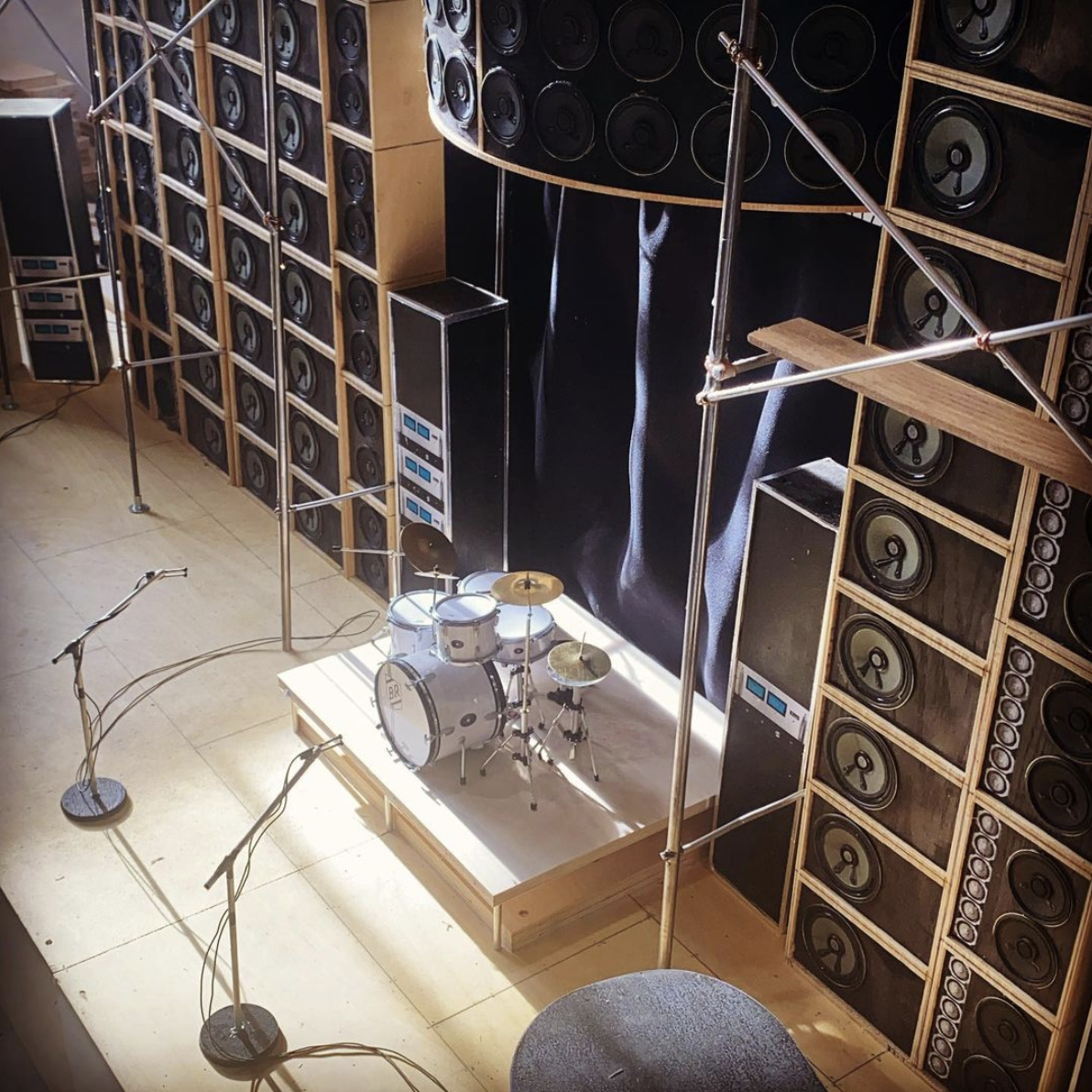
A few years ago we told you about the Wall of Sound. Not the one created in the studio by Phil Spector, but the one created by Grateful Dead tech engineer Owsley “Bear” Stanley out of over 600 speakers. Before the Dead worked to revolutionize how rock concerts could sound, the speakers at live shows were trebly, underpowered things, having not been designed for the sudden change in musical texture and sound during the 1960s. In the early days, speakers were mostly used to make sure the drums didn’t drown out the other band members. Stanley’s three-story, 28,800-watt massive wall, with columns of speakers dedicated to each musician, promised crisp fidelity more so than pure loudness. In developing the set-up, Stanley and his fellow engineers helped introduce ideas still being used in live sound today.
For all that, however, the Wall only got used for seven months of touring in 1974. It took hours and hours to assemble and disassemble. For those who heard it, the system lived up to its hype. And it was immortalized in the Winterland, San Francisco shows filmed for The Grateful Dead Movie (watch it online).
Now, nearly 50 years later a dedicated fan has rebuilt the wall as a 1/6th scale model in his basement. While some of us took up baking during 2020’s COVID lockdown, Anthony Coscia began to work four hours a day, every day, for two months, on this model. He posted his progress on Instagram and Deadheads, most of which hadn’t seen the real thing in person, lost their minds. (See this video to get a good taste of things.) Coscia also had never seen the fabled Wall in real life—he would have been a toddler at the time. But he made up for it later in the late ‘80s, seeing the band 35 times, and the Jerry Garcia Band 25 times.

An architect by day, Coscia insisted on the smallest details being replicated, urged on by social media. The finished model is 6 foot, 8 inches tall and 10 feet wide, and features 390 working speakers. It pumps out a not-exactly-Winterland-worthy 800 watts.
“It’s a massive glorified clock radio but it sounds better than I thought,” he told the Wall Street Journal.
And although he spent $2,000 in total, he’s already been offered $100,000 for it from an anonymous donor.

The obsession with the band continues a half-century later. A just announced series of shows by Bob Weir’s Dead & Company in January 2022—in Cancun, of course, where it’s warm—have sold out.
Related Content:
The Grateful Dead Movie: Watch It Free Online
Ted Mills is a freelance writer on the arts who currently hosts the Notes from the Shed podcast and is the producer of KCRW’s Curious Coast. You can also follow him on Twitter at @tedmills, and/or watch his films here.
Read More...Support Us
We're hoping to rely on loyal readers, rather than erratic ads. Please click the Donate button and support Open Culture. You can use Paypal, Venmo, Patreon, even Crypto! We thank you!

About Us

Open Culture scours the web for the best educational media. We find the free courses and audio books you need, the language lessons & educational videos you want, and plenty of enlightenment in between.
Advertise With Us
FREE UPDATES!
GET OUR DAILY EMAIL
Get the best cultural and educational resources on the web curated for you in a daily email. We never spam. Unsubscribe at any time.
FOLLOW ON SOCIAL MEDIA
Open Culture editor Dan Colman scours the web for the best educational media. He finds the free courses and audio books you need, the language lessons & movies you want, and plenty of enlightenment in between.
Advertise With Us


