Bertrand Russell: The Everyday Benefit of Philosophy Is That It Helps You Live with Uncertainty
On the strength of a few quotations and the popular lecture Why I am Not a Christian, philosopher Bertrand Russell has been characterized as a so-called “positive atheist,” a phrase that implies a high degree of certainty. While it is true that Russell saw “no reason to believe any of the dogmas of traditional theology” — he saw them, in fact, as positively harmful — it would be misleading to suggest that he rejected all forms of metaphysics, mysticism, and imaginative, even poetic, speculation.
Russell saw a way to greatness in the search for ultimate truth, by means of both hard science and pure speculation. In an essay entitled “Mysticism and Logic,” for example, Russell contrasts two “great men,” Enlightenment philosopher David Hume, whose “scientific impulse reigns quite unchecked,” and poet William Blake, in whom “a strong hostility to science co-exists with profound mystic insight.”
It’s interesting that Russell chooses Blake for an example. One of his oft-quoted aphorisms cribs a line from another mystical poet, William Butler Yeats, who wrote in “The Second Coming” (1920), “The best lack all conviction, while the worst / Are full of passionate intensity.” Russell’s version of this, from his 1933 essay “The Triumph of Stupidity,” is a bit clunkier rhetorically speaking:
“The fundamental cause of the trouble is that in the modern world the stupid are cocksure while the intelligent are full of doubt.”
The quote has been significantly altered and streamlined over time, it seems, yet it still serves as a kind of motto for the skeptical philosophy Russell advocated, one he would partially define in the 1960 interview above as a way to “keep us modestly aware of how much that seems like knowledge isn’t knowledge.” On the other hand, philosophy pushes reticent intellectuals to “enlarge” their “imaginative purview of the world into the hypothetical realm,” allowing “speculations about matters where exact knowledge is not possible.”
Where the quotation above seems to pose an insoluble problem—similar to the cognitive bias known as the “Dunning-Kruger Effect”—it seems in Russell’s estimation a false dilemma. At the 9:15 mark, in answer to a direct question posed by interviewer Woodrow Wyatt about the “practical use of your sort of philosophy to a man who wants to know how to conduct himself,” Russell replies:
I think nobody should be certain of anything. If you’re certain, you’re certainly wrong because nothing deserves certainty. So one ought to hold all one’s beliefs with a certain element of doubt, and one ought to be able to act vigorously in spite of the doubt…. One has in practical life to act upon probabilities, and what I should look to philosophy to do is to encourage people to act with vigor without complete certainty.
Russell’s discussion of the uses of philosophy puts me in mind of another concept devised by a poet: John Keats’ “negative capability,” or what Maria Popova calls “the art of remaining in doubt…. The willingness to embrace uncertainty, live with mystery, and make peace with ambiguity.” Perhaps Russell would not characterize it this way. He was, as you’ll see above, not much given to poetic examples. And indeed, Russell’s method relies a great deal more on logic and probability theory than Keats’. And yet the principle is strikingly similar.
For Russell, certainty stifles progress, and an inability to take imaginative risks consigns us to inaction. A middle way is required to live “vigorously,” that of philosophy, which requires both the mathematic and the poetic. In “Mysticism and Logic,” Russell sums up his position succinctly: “The greatest men who have been philosophers have felt the need of science and of mysticism: the attempt to harmonise the two was what made their life, and what always must, for all its arduous uncertainty, make philosophy, to some minds, a greater thing than either science or religion.”
If you would like to support the mission of Open Culture, consider making a donation to our site. It’s hard to rely 100% on ads, and your contributions will help us continue providing the best free cultural and educational materials to learners everywhere. You can contribute through PayPal, Patreon, and Venmo (@openculture). Thanks!
Note: An earlier version of this post appeared on our site in 2015.
Related Content:
Bertrand Russell’s Message to People Living in the Year 2959: “Love is Wise, Hatred is Foolish”
Josh Jones is a writer and musician based in Durham, NC. Follow him at @jdmagness
Read More...Advice for Time Traveling to Medieval Europe: How to Stay Healthy & Safe, and Avoiding Charges of Witchcraft
Generations of foreign tourists in Europe have heard advice about traveling in groups, haggling prices, avoiding pickpockets, and being able to communicate in, if not the local language, then at least the lingua franca. It turns out that very similar guidance applies to time travel in Europe, or at least specifically to the region of England, France, Germany, and northern Italy in the central Middle Ages, roughly between the years 1000 and 1400. In the new video above, history Youtuber Premodernist provides an hour’s worth of advice to the modern preparing to travel back in time to medieval Europe — beginning with the declaration that “you will very likely get sick.”
The gastrointestinal distress posed by the “native biome” of medieval European food and drink is one thing; the threat of robbery or worse by its roving packs of outlaws is quite another. “Crime is rampant” where you’re going, so “carry a dagger” and “learn how to use it.” In societies of the Middle Ages, people could only protect themselves by being “enmeshed in social webs with each other. No one was an individual.” And so, as a traveler, you must — to put it in Dungeons-and-Dragons terms — belong to some legible class. Though you’ll have no choice but to present yourself as having come from a distant land, you can feel free to pick one of two guises that will suit your obvious foreignness: “you’re either a merchant or a pilgrim.”
Unlike modern-day Europe, through which you travel for weeks barely speaking to anyone, the Europe of the Middle Ages offers numerous opportunities for conversation, whether you want them or not. Without any media as we know it today, medievals had to “make their own entertainment by talking to each other,” and if they could talk to a stranger from an exotic land, so much the more entertaining. But having none of our relatively novel ideas that “everybody’s on an equal footing, that everybody’s equal to each other, nobody’s better or worse than anybody else, nobody gets any special treatment,” they’ll guess your social rank and treat you accordingly; you, in turn, would do well to act the part.
Imagining themselves in medieval Europe, many of our contemporaries say things like, “If I go there, they’ll hang me as a witch, or they’ll burn me at the stake as a witch, because I’m wearing modern clothes and because I talk funny.” But that fear (not untainted, perhaps, by a certain self-regard) is unfounded, since medievals “were not scared of people just because they were different. They were scared of people who were different in a way that challenged the social order or threatened social chaos.” Their worldview put religious affiliation above all, without consideration for even the most hotly debated twenty-first-century political or racial battle lines. But then, as we never needed time travel to understand, the past is a foreign country; they do things differently there.
Related content:
A Free Yale Course on Medieval History: 700 Years in 22 Lectures
How to Make a Medieval Manuscript: An Introduction in 7 Videos
What Sex Was Like in Medieval Times?: Historians Look at How People Got It On in the Dark Ages
A Concise Breakdown of How Time Travel Works in Popular Movies, Books & TV Shows
Based in Seoul, Colin Marshall writes and broadcasts on cities, language, and culture. His projects include the Substack newsletter Books on Cities, the book The Stateless City: a Walk through 21st-Century Los Angeles and the video series The City in Cinema. Follow him on Twitter at @colinmarshall or on Facebook.
Read More...
Explore the Florentine Codex: A Brilliant 16th Century Manuscript Documenting Aztec Culture Is Now Digitized & Available Online

The Spanish conquista of the Americas happened long enough ago — and left behind a spotty enough body of historical records — that we tend to perceive it as much through simplifications, exaggerations, and distortions as we do through facts. What we now call Mexico underwent “essentially an internal conflict between different indigenous groups who saw the arrival of strangers as an opportunity to resist having to pay tribute to the Aztec Empire,” says Universidad Nacional Autónoma de Mexico history professor Berenice Alcántara Rojas. “When the Spaniards initially attacked the Mexica capital, they were swiftly driven out.”
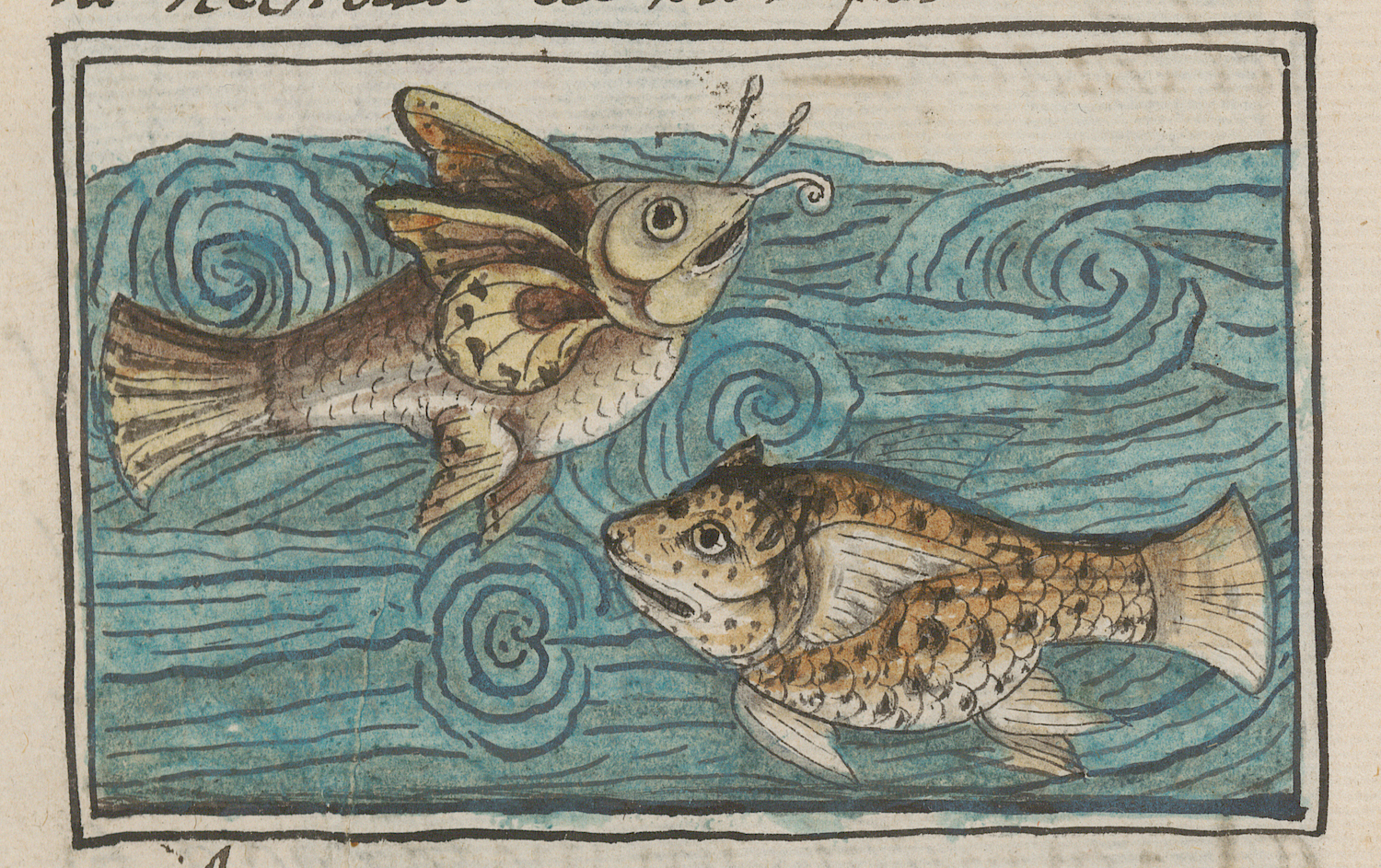
“Only when aided by various groups of Indigenous allies, as well as by the spread of a terrible smallpox epidemic, did they manage to force the ruler Cuauhtemoc and other Mexica leaders to capitulate,” Rojas continues, drawing upon details provided in the version of the events laid out in the Florentine Codex.
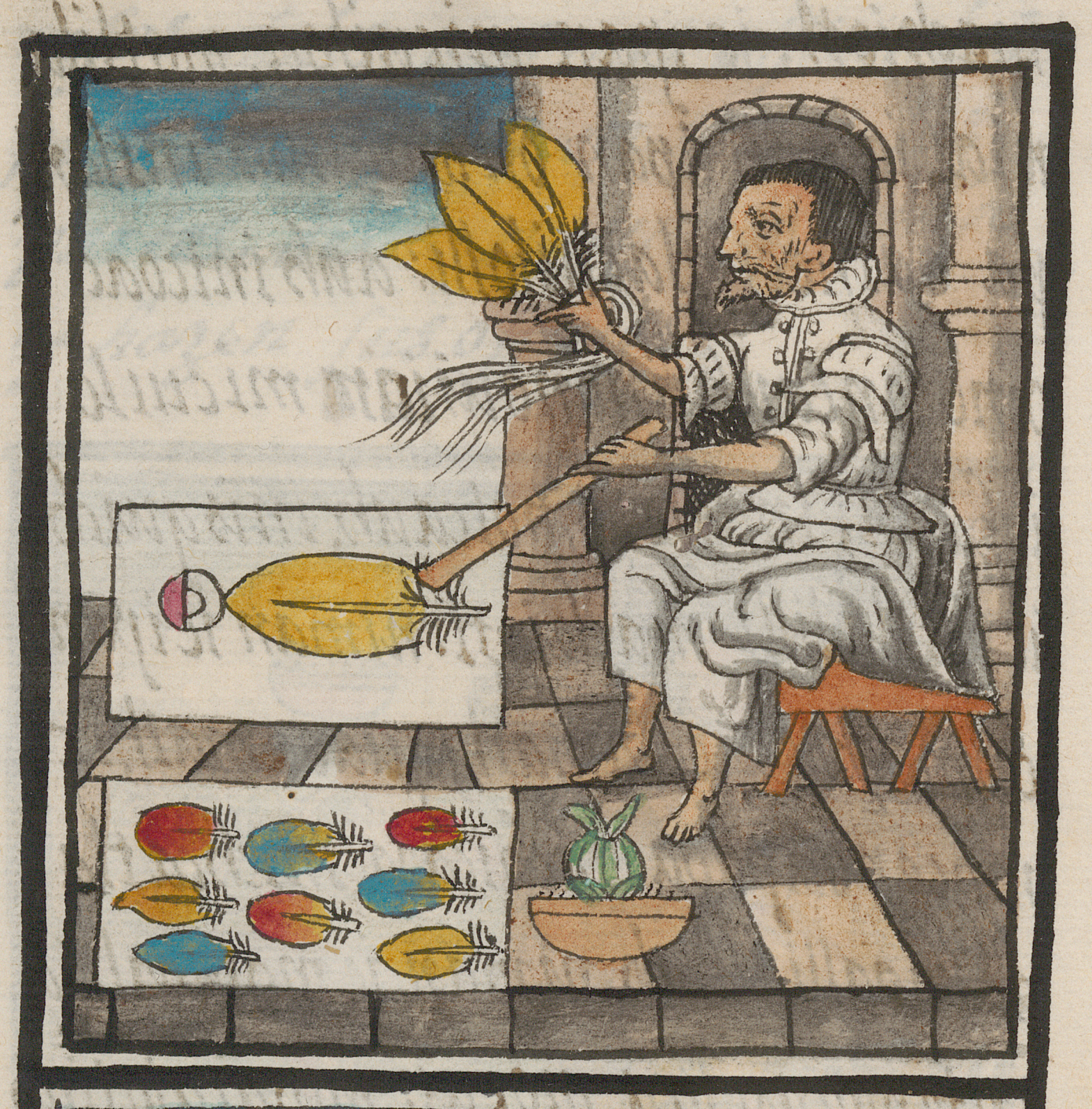
That encyclopedic series of twelve 16th-century illustrated manuscripts lavishly documents the known society and nature of that land at the time — and has now, nearly 450 years later, been acknowledged as “the most reliable source of information about Mexica culture, the Aztec Empire, and the conquest of Mexico.”
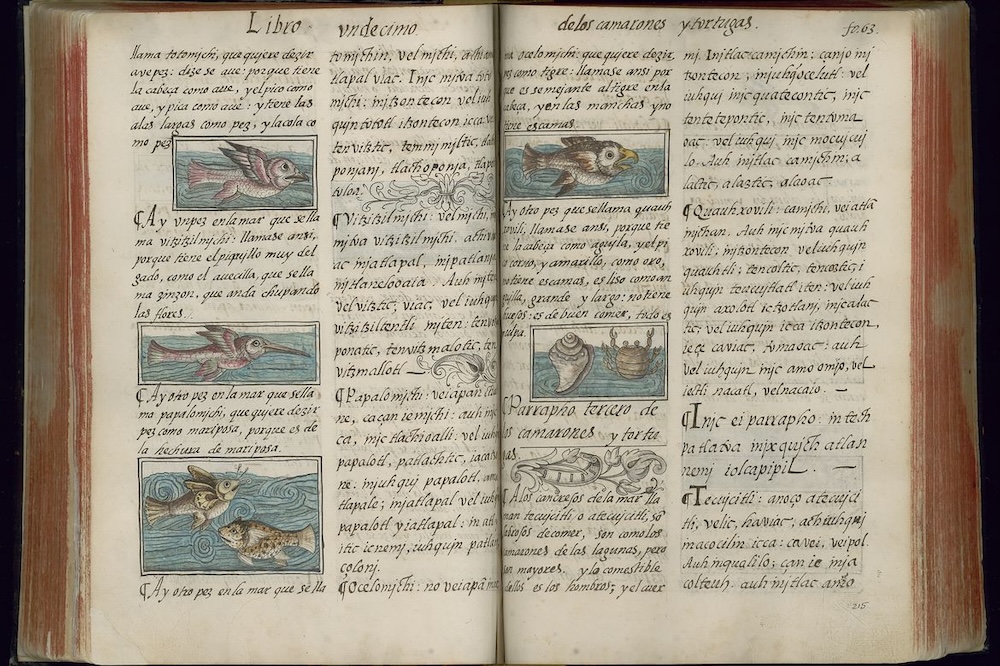
“In 1547, Bernardino de Sahagún, a Spanish Franciscan friar who committed most of his life to working closely with the Indigenous peoples of Mexico, began collecting information about central Mexican Nahua culture, life, people, history, astronomy, flora, fauna, and the Nahuatl language, among other topics,” says the Getty Research Institute. “Nahua elders, grammarians, scribes, and artists worked with Sahagún to compile a three-volume, 12-book, 2500-page illustrated manuscript, modeling its content on European encyclopedias, especially Pliny the Elder’s Natural History,” all of which has been digitized, translated, and made available at the Getty’s web site.

A thoroughly multicultural project avant la lettre, the Florentine Codex (named for the Medici family library in Florence, where it was sent upon its completion) has only just become accessible to a wide online readership. Though it’s “been digitally available via the World Digital Library since 2012, for most users it remained impenetrable because reading it requires knowledge of sixteenth-century Nahuatl and Spanish, and of pre-Hispanic and early modern European art traditions.” By offering searchable text in modern versions of both those languages as well as English — to say nothing of its browsable sections organized by people, animals, deities, and even by Nahuatl terms like coyote and tortilla — the Digital Florentine Codex re-illuminates an entire civilization.
Related content:
Native Lands: An Interactive Map Reveals the Indigenous Lands on Which Modern Nations Were Built
Explore the Codex Zouche-Nuttall: A Rare, Accordion-Folded Pre-Columbian Manuscript
How the Ancient Mayans Used Chocolate as Money
Based in Seoul, Colin Marshall writes and broadcasts on cities, language, and culture. His projects include the Substack newsletter Books on Cities, the book The Stateless City: a Walk through 21st-Century Los Angeles and the video series The City in Cinema. Follow him on Twitter at @colinmarshall or on Facebook.
Read More...The History of Disco Visualized on a Circuit Diagram of a Klipschorn Speaker: Features 600 Musicians, DJs, Producers, Clubs & Record Labels

Half a century after it was birthed in New York’s black, Latino and gay underground club scene–and nearly 45 years after the infamous Disco Demolition in Chicago’s Comiskey Park–disco is finally being accorded some respect in the annals of music history.
Even those who remain impervious to disco fever seem willing to acknowledge its cultural significance as evidenced by a recent exchange on the Trouser Press forum:
It was everywhere and could indeed get tiresome. But today I can appreciate how well put-together those records by an artist like the Bee Gees were…
Hearing techno for the first time in the early 90s, and realizing it was just disco in a new, all-electronic package, made me realize how good a lot of it was…
I remember seeing (A Taste of Honey) on The Midnight Special. It was the first time I’d seen a band with female members playing instruments…
Having previously celebrated the history of hip-hop, UK-based design studio Dorothy gives disco its due with a blueprint paying tribute to the many artists who made the form what it was, from foundation layers like Teddy Pendergrass, Marvin Gaye, and James Brown to such trailblazing superstars as Donna Summer, Gloria Gaynor, Sylvester, Chic and the Bee Gees.
The Disco Love Blueprint also name checks some of disco’s influential producers, DJs, and labels, along with watershed moments like 1969’s Stonewall Uprising and 1977’s Saturday Night Fever, reportedly film critic Gene Siskel’s favorite movie.
And while the disco explosion eventually saw young straight singles doing the Bump in Indianapolis, Phoenix, and Spokane, Dorothy sticks close to the epicenter by including such legendary New York City clubs as Studio 54, The Gallery, Paradise Garage, The Saint, and The Loft, a private discotheque in DJ David Mancuso’s Lower Manhattan apartment.

In Bill Brewster’s Last Night a DJ Saved My Life: The History of the Disc Jockey, Mancuso’s audio engineer, Alex Rosner, recalled the Loft’s clientele as being “probably about sixty percent black and seventy percent gay:”
There was a mix of sexual orientation, there was a mix of races, mix of economic groups. A real mix, where the common denominator was music.
One can’t mention the music at The Loft without giving props to the innovative and efficient sound system Rosner devised for Mancuso’s 1,850-square-foot space, using a McIntosh amplifier, an AR amplifier, Vega bass bottom speakers, and two Klipschorn Cornwall loudspeakers, whose circuit diagram inspired the Disco Love Blueprint’s layout.

As composer and producer Matt Sommers told The Vinyl Factory, those speakers surrounded dancers with the sort of high volume, undistorted sound they could lose themselves in:
…the Mancuso parties were unique because what he did was take it to a whole other level and created that envelopment experience where you could really get lost and I think that’s what people love about that, because you can just let your troubles go and enjoy it.
Get Dorothy’s Disco Love Blueprint, featuring 600 musicians, DJs, producers, clubs and record labels here.
Related Content
Diagram of a 1950s Theremin: 200 Inventors, Composers & Musicians
The Untold Story of Disco and Its Black, Latino & LGBTQ Roots
– Ayun Halliday is the Chief Primatologist of the East Village Inky zine and author, most recently, of Creative, Not Famous: The Small Potato Manifesto and Creative, Not Famous Activity Book. Follow her @AyunHalliday.
Read More...Open Planet Lets You Download & Use 4,500 Free Videos That Document Nature & Climate Change
Plastic pollution in the Red Sea…
A melting glacier in Iceland…
Trees scorched by a wildfire in Australia…
As the effects of climate change become increasingly dire, we’ve grown accustomed to such grimly sobering visions.
Some look away.
Others work to heighten awareness of these clear and present environmental dangers.
And some strive to implement innovative solutions before it’s too late:
Solar panels in Costa Rica
Bubble barriers filtering plastic refuse from Amsterdam’s canals…
Sustainable agroforestry in the Amazon.
A classroom full of desks constructed from recycled one-time use plastics in India…
The creators of Open Planet, a soon-to-launch free footage library, hope to support change-making organizations and individuals by supplying video that can be edited together into narratives to “inspire optimism and action in this decisive decade for our planet.”
Caroline Petit, who prioritizes education and awareness in her position as Deputy Director for the United Nations Regional Information Centre for Europe, hails Open Planet for supplying worldwide free access to high-quality, accurate footage:
At this halfway point of the Sustainable Development Goals, it is crucial to provide all possible tools to supercharge the breakthroughs needed to achieve them. Capturing hearts and minds to motivate action is one powerful way to do so.
Enlisting some non-humans players to help achieve that end is a sound idea.
Behold a Nepal Gray Langur mother and baby hanging out in the treetops…
Cheetah cubs playfully sparring with each other in Kenya’s Masai Mara National Reserve…
A group of Pashmina goats peacefully grazing on wild sea buckthorn berries on the high plateaus of Ladakh.
Open Planet’s 4,500 clip strong collection also teems with photogenic birds, insects, and marine life, with more being added all the time.
Studio Silverback, which is collaborating with Carnegie Mellon University’s CREATE Lab on this project, created some of the footage specifically for the platform.
The remainder has been donated by outside filmmakers, broadcasters, and production companies who are credited in their clips’ content details.
In advance of its 2024 global launch, Open Planet has released a mostly uplifting 74-clip spotlight collection drawn from over 2000 pieces of footage filmed in India
A look at the platform’s searchable filter themes reminds us that the picture is not so overwhelmingly rosy, but also makes a strong case that change is possible:
Biodiversity
Climate
Consumption
Deforestation
Energy
Extreme Weather
Food
Human Health
Land Management
Natural Disasters
Nature-only
Pollution
Waste
Water
Sustainable Future
Technology
Explore Open Planet’s footage library and create a free account to download the clips of your choice here. The videos are free to use for educational, environmental and impact storytelling.
via Colossal
Related Content
Carl Sagan Warns Congress about Climate Change (1985)
Frank Capra’s Science Film The Unchained Goddess Warns of Climate Change in 1958
– Ayun Halliday is the Chief Primatologist of the East Village Inky zine and author, most recently, of Creative, Not Famous: The Small Potato Manifesto and Creative, Not Famous Activity Book. Follow her @AyunHalliday.
Read More...A Researcher Identifies the Old Man on the Iconic Cover of Led Zeppelin IV, 52 Years After the Album’s Release

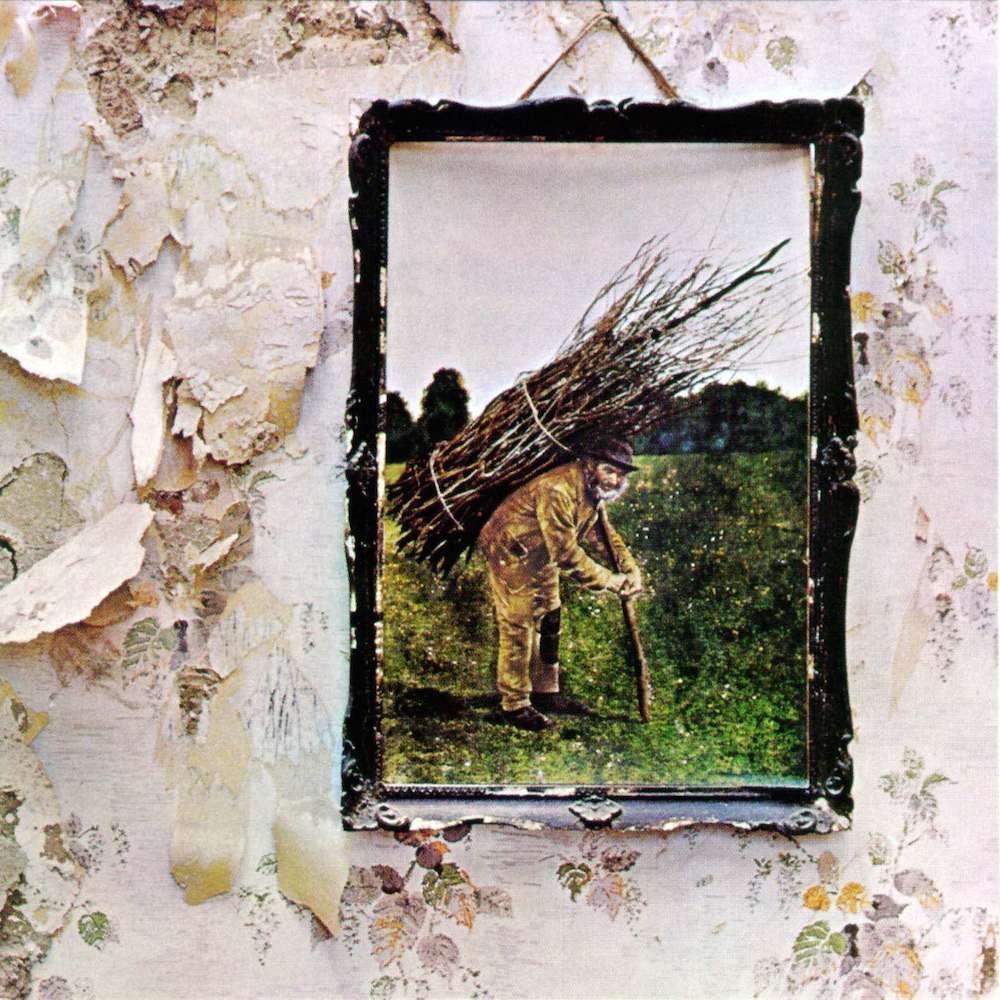
Who’s that bearded man on the cover of Led Zeppelin IV, the one hunched over, carrying a large bundle of sticks? Brian Edwards, a researcher from the University of the West of England, has solved the 52-year-old mystery. Looking through a photo album while conducting research, Edwards spotted a photograph and, being a Led Zeppelin fan, “instantly recognised the man with the sticks.” “It was quite a revelation, he told the BBC.” From there, he figured out who took the photograph in 1892 (Ernest Howard Farmer), and eventually identified the figure in the photo itself: Lot Long, a thatcher from Mere, a town in Wiltshire, England. You can see him above.
Decades later, Robert Plant apparently found a colorized version of the photograph in an antique shop. On the 1971 album cover, we see the photo turned into a framed painting and layered onto the wall of a drab home. The rest, as they say, is rock ’n’ roll history…
Related Content
William S. Burroughs Reviews a Led Zeppelin Concert for Crawdaddy! Magazine (1975)
Hear Led Zeppelin’s First Recorded Concert Ever (1968)
Read More...Watch Hokusai’s The Great Wave off Kanagawa Get Entirely Recreated with 50,000 LEGO Bricks
A few years ago here on Open Culture, we featured a re-creation of The Great Wave off Kanazawa made entirely out of LEGO by a serious enthusiast named Jumpei Mitsui. Though the work’s depth does come across to some extent in still photos, it bears repeating that Mitsui assembled not just a two-dimensional image, but a complete three-dimensional scene that, when viewed straight on, looks just like Hokusai’s famous woodblock print. All told, the project required 50,000 LEGO bricks, all of which you can now watch Mitsui lay down in the ten-minute time-lapse video above.
By presenting the whole construction process from a variety of angles, the video allows us to better appreciate not just the painstaking manual labor involved, but the amount of creative and technical work necessary to conceptualize the Great Wave — perhaps the foremost example of the vividly flat ukiyo‑e woodblock print style — in physical reality.
Viewers who’ve never tried their hand at large-scale LEGO building will also be surprised by the way in which Mitsui goes about building the grid-like sub-structure that undergirds what looks, in the finished product, like a sold sea of bricks.
It’s natural that Mitsui (now a “LEGO Certified Professional”) has shared the details of how he built his best-known LEGO creation on Youtube, given that it was on the same platform that he gained some of the knowledge necessary to execute it in the first place. “The brick artist observed waves on Youtube for hours, and read academic papers on waves to better understand their forms and energy,” notes The Kid Should See This, underscoring the intensity of preparation required even for what may, at first, look like a novelty project. And if the still-young Mitsui is anything like his nineteenth-century countryman, he’ll be tempted to build the Great Wave again, and even better, a few more times in the decades to come.
Related content:
Hokusai’s Iconic Print The Great Wave off Kanagawa Recreated with 50,000 LEGO Bricks
Ai Weiwei Recreates Monet’s Water Lilies Triptych Using 650,000 Lego Bricks
The Frank Lloyd Wright LEGO Set
With 9,036 Pieces, the Roman Colosseum Is the Largest LEGO Set Ever
Why Did LEGO Become a Media Empire? Pretty Much Pop: A Culture Podcast #37
Based in Seoul, Colin Marshall writes and broadcasts on cities, language, and culture. His projects include the Substack newsletter Books on Cities, the book The Stateless City: a Walk through 21st-Century Los Angeles and the video series The City in Cinema. Follow him on Twitter at @colinmarshall or on Facebook.
Read More...One Hour of David Lynch Listening to Rain, Smoking & Reflecting on Art
At this point, there’s no need to point out the dangers posed by smoking. Those who do it these days do it in full knowledge of the health risks involved, for reasons of their own. Sometimes those reasons are artistic ones: “I had this idea that you drink coffee, you smoke cigarettes, and you paint, and that’s it,” says David Lynch in Jon Nguyen’s documentary David Lynch: The Art Life, describing his youthful conception of what it was to be an artist. “Maybe girls come into it a little bit, but basically, it’s the incredible happiness of working and living that life.” Though much better known as a filmmaker than a painter, Lynch has never stopped living that life, cigarette-smoking and all.
The “you drink coffee, you smoke cigarettes, and you paint” line surfaces in the audio mix of the video above, which mashes up that and other of Lynch’s observations from various places and times with looped footage of him silently smoking and listening to the rain falling outside. Most of his words here have to do with “the art life”: how he conceives of it, how he lives it, and how he made his way into it in the first place.
Some of them will be well familiar to longtime Lynch fans, not least his notion that, when it comes to getting the ideas with which he builds his work, the “little fish” swim on the surface of consciousness, but the “big fish” — the stranger, more powerful ideas that lead, presumably, to a Blue Velvet or a Mulholland Dr. — inhabit the kind of depths accessible only through meditation.
Along with such pieces of Lynchian advice come expressions of enthusiasm, memories from his younger days, and reflections on history, society, and nature, all of them similarly decontextualized and backed by an ominous-sounding piece of music. The resulting ambience isn’t entirely unlike that of Lynch’s deliberately disturbing sitcom Rabbits, but it also fits in with the burgeoning genre of long-form Youtube videos optimized for relaxation value. Thirty years ago, when each movie or television show he made seemed to surpass the last in sheer weirdness, we entered Lynch’s world in order to be unsettled, to see and hear things at once inexplicably compelling and obscurely horrifying; in the twenty-twenties, we go there to unwind.
Related Content:
An Animated David Lynch Explains Where He Gets His Ideas
Bertrand Russell Explains How Smoking Paradoxically Saved His Life
David Lynch Explains How Meditation Enhances Our Creativity
Cigarette Commercials from David Lynch, the Coen Brothers and Jean Luc Godard
An Anti, Anti-Smoking Announcement from John Waters
Two Short Films on Coffee and Cigarettes from Jim Jarmusch & Paul Thomas Anderson
Based in Seoul, Colin Marshall writes and broadcasts on cities, language, and culture. His projects include the Substack newsletter Books on Cities, the book The Stateless City: a Walk through 21st-Century Los Angeles and the video series The City in Cinema. Follow him on Twitter at @colinmarshall or on Facebook.
Read More...Renaissance Knives Had Music Engraved on the Blades & Now You Can Hear the Songs Performed by Modern Singers
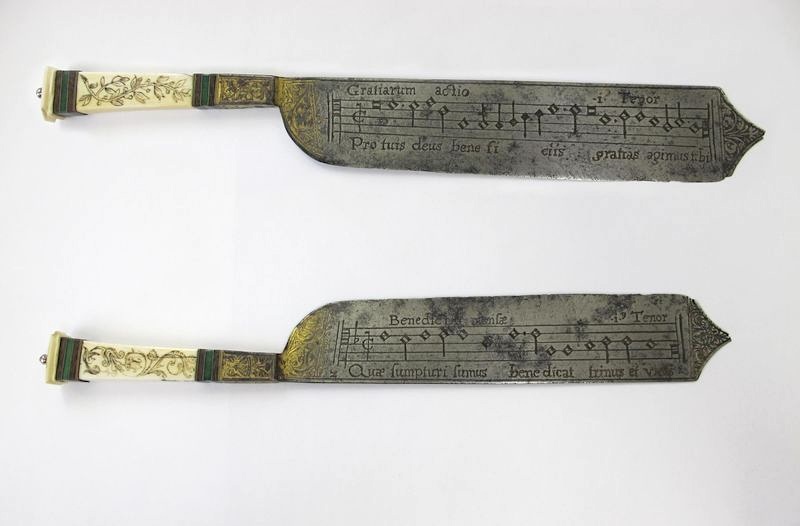
Image courtesy of The Victoria and Albert Museum
On any given weekend, in any part of the state where I live, you can find yourself standing in a hall full of knives, if that’s the kind of thing you like to do. It is a very niche kind of experience. Not so in some other weapons expos—like the Arms and Armor galleries at the Metropolitan Museum of Art, where everyone, from the most warlike to the staunchest of pacifists, stands in awe at the intricate ornamentation and incredibly deft craftsmanship on display in the suits of armor, lances, shields, and lots and lots of knives.
We must acknowledge in such a space that the worlds of art and of killing for fame and profit were never very far apart during Europe’s late Medieval and Renaissance periods. Yet we encounter many similar artisanal instruments from the time, just as finely tuned, but made for far less belligerent purposes.
As Maya Corry of the Fitzwilliam Museum in Cambridge—an institution with its own impressive arms and armor collection—comments in the video above (at 2:30), one unusual kind of 16th century knife meant for the table, not the battlefield, offers “insight into that harmonious, audible aspect of family devotions,” prayer and song.
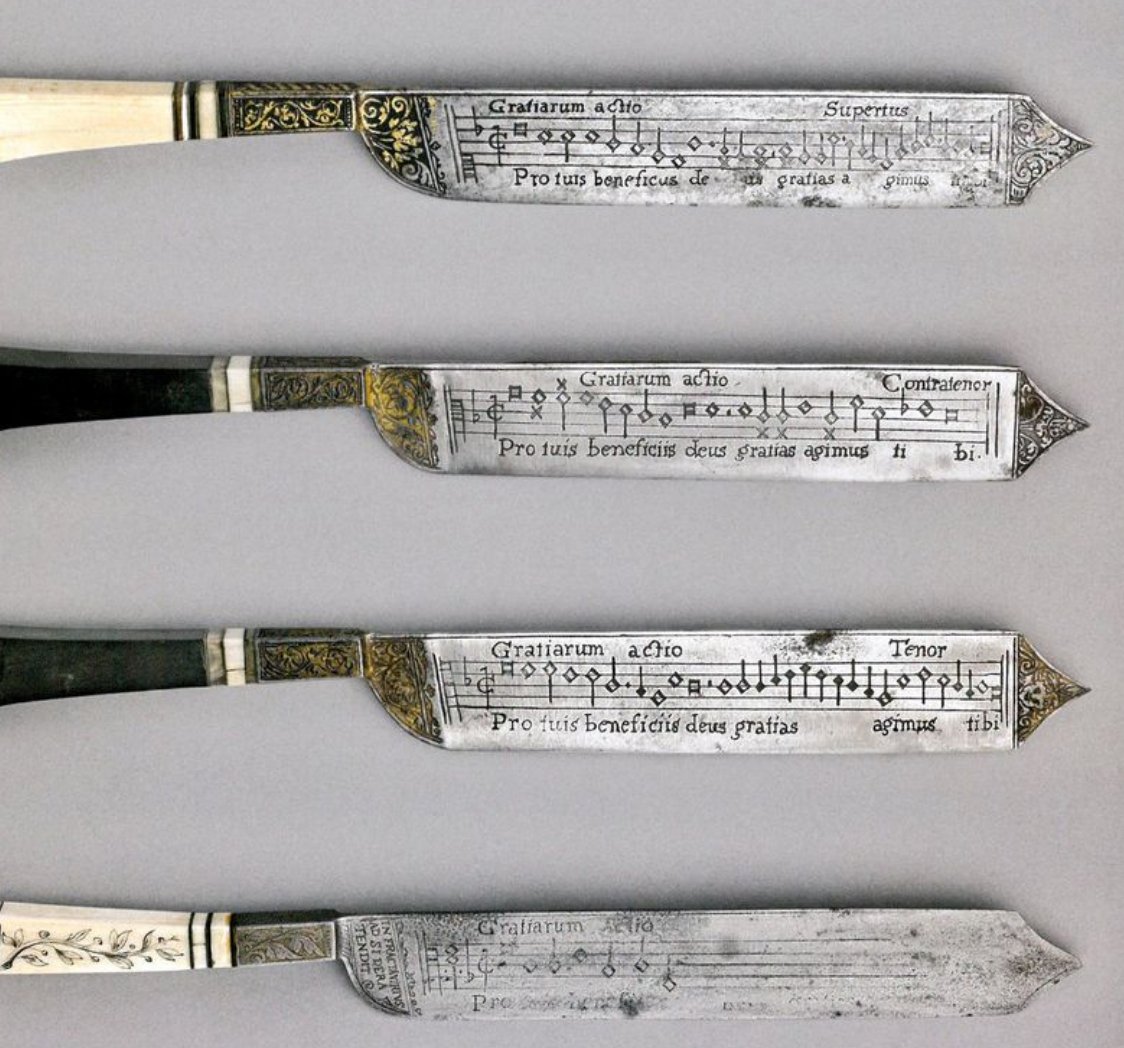
From the collection of the Fitzwilliam Museum, in Cambridge. (Johan Oosterman )
These knives, which have musical scores engraved in their blades, brought a table together in singing their prayers, and may have been used to carve the lamb or beef in their “striking balance of decorative and utilitarian function.” At least historians think such “notation knives,” which date from the early 1500s, were used at banquets. “The sharp, wide steel would have been ideal for cutting and serving meat,” writes Eliza Grace Martin at the WQXR blog, “and the accentuated tip would have made for a perfect skewer.” But as Kristen Kalber, curator at the Victoria and Albert Museum, which houses the knives at the top of the post, tells us “diners in very grand feasts didn’t cut their own meat.” It’s unlikely they would have sung from the bloody knives held by their servants.
The knives’ true purpose “remains a mystery,” Martin remarks, like many “rituals of the Renaissance table.” Victoria and Albert Museum curator Kirstin Kennedy admits in the video above that “we are not entirely sure” what the “splendid knife” she holds was used for. But we do know that each knife had a different piece of music on each side, and that a set of them together contained different harmony parts in order to turn a roomful of diners into a chorus. One set of blades had the grace on one side, with the inscription, “the blessing of the table. May the three-in-one bless that which we are about to eat.” The other side holds the benediction, to be sung after the dinner: “The saying of grace. We give thanks to you God for your generosity.”
Common enough verbiage for any household in Renaissance Europe, but when sung, at least by a chorus from the Royal College of Music, who recreated the music and made the recordings here, the prayers are superbly graceful. Above, hear one version of the Grace and Benediction from the Victoria and Albert Museum knives; below, hear a second version. You can hear a captivating set of choral prayers from the Fitzwilliam Museum knives at WQXR’s site, recorded for the Fitzwilliam’s “Madonnas & Miracles” exhibit. We are as unlikely now to encounter singing kitchen knives as we are to run into a horse and rider bearing 100 pounds of finely-wrought wearable steel sculpture. Such strange artifacts seem to speak of a strange people who valued beauty whether carving up the main course or cutting down their enemies.
Note: An earlier version of this post appeared on our site in 2017.
If you would like to support the mission of Open Culture, consider making a donation to our site. It’s hard to rely 100% on ads, and your contributions will help us continue providing the best free cultural and educational materials to learners everywhere. You can contribute through PayPal, Patreon, and Venmo (@openculture). Thanks!
Josh Jones is a writer and musician based in Durham, NC. Follow him at @jdmagness
Read More...Why People Hate Brutalist Buildings on American College Campuses
Many Americans receive their introduction to the style known as Brutalism in college. This owes less to courses in twentieth-century architecture than to university campuses themselves, which tend to have been expanded or even wholly constructed in the decades immediately following the Second World War. As Vox’s Dean Peterson explains in the new video above, its veterans returned home eager to receive the tertiary education to which the G.I. Bill entitled them, which “necessitated that universities build new facilities to handle ballooning admissions. And with so many new buildings being needed, what did architects of the day turn to? Brutalism.”
“Not just a style of architecture but an entire aesthetic ethos,” Brutalism had developed through inspiration from the work of Charles-Édouard Jeanneret, better known as Le Corbusier. While other architects had employed concrete before him, he was the one to make the bold choice of leaving it exposed on the surface in its raw form: béton brut, to use the term that gave the movement its name.
To qualify under the rubric of this “new Brutalism,” as architectural historian Reyner Banham (later to become famous for his ultra-modern view of Los Angeles) referred to it, a structure should demonstrate “memorability as an image,” “clear exhibition of structure,” and “valuation of materials ‘as found’ ” — in contrast to the nineteen-fifties’ proliferation of seemingly featureless glass-sheathed skyscrapers designed by modernists like Ludwig Mies van der Rohe and his many imitators.
“Brutalist buildings strove for honesty in their materials and structure,” says Peterson. “They showed you how they were constructed.” Though acclaimed in their day as built statements of a break from the staid past into a wholly reimagined future, many campus Brutalist buildings in the United States subsequently fell into disrepair, owing to the economic downturn of the seventies and the resultant lapses into “deferred maintenance” — which, deferred long enough, shades into planned demolition. Such has been the case with Evans Hall, the statistics, economics, and mathematics building at University of California, Berkeley, which, since its construction in 1971, played an important part in the history of computer science, not least as the node through which the whole of the west coast connected to ARPANET, the military-built precursor to the internet.
Today, objections to Evans Hall’s Brutalist aesthetics, as well as to its location in front of the San Francisco Bay and its poor earthquake-safety rating (that last being fairly common among UC Berkeley’s structures), have led to its being emptied out with an eye toward replacement. Though it may be too late for Evans Hall, much of America’s Brutalist heritage can still be rehabilitated. “Be patient,” says architecture professor Timothy Rohan (author of a study of American Brutalist Paul Rudolph). “Just because you find something unfashionable at the moment doesn’t mean you should eradicate it.” This is not, perhaps, advice particularly well-suited to college students, but given the likelihood of their exposure to Brutalism not just on campus but also on Instagram, they may turn out to be its best hope yet.
Related content:
Why Do People Hate Modern Architecture?: A Video Essay
Based in Seoul, Colin Marshall writes and broadcasts on cities, language, and culture. His projects include the Substack newsletter Books on Cities, the book The Stateless City: a Walk through 21st-Century Los Angeles and the video series The City in Cinema. Follow him on Twitter at @colinmarshall or on Facebook.
Read More...Support Us
We're hoping to rely on loyal readers, rather than erratic ads. Please click the Donate button and support Open Culture. You can use Paypal, Venmo, Patreon, even Crypto! We thank you!

About Us

Open Culture scours the web for the best educational media. We find the free courses and audio books you need, the language lessons & educational videos you want, and plenty of enlightenment in between.
Advertise With Us
FREE UPDATES!
GET OUR DAILY EMAIL
Get the best cultural and educational resources on the web curated for you in a daily email. We never spam. Unsubscribe at any time.
FOLLOW ON SOCIAL MEDIA
Open Culture editor Dan Colman scours the web for the best educational media. He finds the free courses and audio books you need, the language lessons & movies you want, and plenty of enlightenment in between.
Advertise With Us