The Armored-Knight “Robot” Designed by Leonardo da Vinci (circa 1495)

Image by Erik Möller, via Wikimedia Commons
Those of us who were playing video games in the nineteen-nineties may remember a fun little platformer, not technically unimpressive for its time, called Clockwork Knight. The concept of a clockwork knight turns out to have had some historical validity, or at least it could potentially have been justified by the then-current state of Leonardo da Vinci studies. Back in the fifties, writes Royal Montgomery at Unchained Robotics, “a team of scholars at the University of California were poring over a number of Leonardo da Vinci’s notebooks, specifically the Codices Atlanticus and Madrid.” There they found plans for what turned out to be “a life-size mechanical knight inside a fifteenth-century German suit of armor.”
More than one generation of enthusiasts and robotics specialists have since set about re-creating Leonardo’s “automaton.” Before 2007, writes Montgomery, “most reconstructed plans included a mechanical device in the belly of the knight. It was later determined that this device had nothing to do with the knight at all — it was actually part of a clock!”
Even if it didn’t run on literal clockwork, Leonardo’s knight would’ve made quite a spectacle. It “appears to have been assembled and displayed for the first time at a ceremony held by the Prince of Milan, Ludovico Sforza in 1495,” and in this sole appearance “could sit and stand, lift its own visor, and move its arms. It was stiff, sure, but you try moving gracefully in 15th century armor.”
However much it amused its aristocratic audience, Leonardo’s surreptitiously pulley-and-cable-operated “robot” would also have offered working, integrated proof of the kind of mechanical systems to which he’d long put his formidable engineering mind. And today, as pointed out at the site of the Robotic Online Short Film Festival, “we are fascinated and terrified in equal parts by humanoid robots for military purposes like Atlas, created by the company Boston Dynamics for DARPA (Defense Advanced Research Projects Agency of the United States). They are all heirs, with twenty-first century technology, to the robotic soldier designed by Leonardo.” The question of whether he also did any pioneering work on robot animals who could dance remains a matter of inquiry for future Leonardo scholars.
Related content:
Explore the Largest Online Archive Exploring the Genius of Leonard da Vinci
Leonardo da Vinci’s Elegant Design for a Perpetual Motion Machine
The Ingenious Inventions of Leonardo da Vinci Recreated with 3D Animation
The Amazing Engineering of Gauntlets (Armored Gloves) from the 16th Century
200-Year-Old Robots That Play Music, Shoot Arrows & Even Write Poems: Watch Automatons in Action
Based in Seoul, Colin Marshall writes and broadcasts on cities, language, and culture. His projects include the Substack newsletter Books on Cities, the book The Stateless City: a Walk through 21st-Century Los Angeles and the video series The City in Cinema. Follow him on Twitter at @colinmarshall or on Facebook.
Read More...The Life & Work of Richard Feynman Explored in a Three-Part Freakonomics Radio Miniseries
Here at Open Culture, Richard Feynman is never far from our minds. Though he distinguished himself with his work on the development of the atomic bomb and his Nobel Prize-winning research on quantum electrodynamics, you need no special interest in either World War II or theoretical physics to look to him as an intellectual model. In the years after his death in 1988, his legend grew as not just a scientific mind but even more so as a veritable personification of curiosity, surrounded by stories (deliberately cultivated by him in his lifetime) of safe-cracking, bongo-playing, and nude model-drawing, to the point that Feynman the man became somewhat hard to discern.
In the view of Freakonomics Radio host Stephen Dubner, Feynman’s public profile has lately fallen into an unfortunate desuetude. It seems that people just don’t talk about him the way they used to, hard though that is to imagine for any of us who grew up reading collections of anecdotes like Surely You’re Joking, Mr. Feynman!.
Operating on the supposition that we could all use more Feynman in our lives, Freakonomics Radio has, over the past month, put out a three-part series covering his life and work, from his recruitment to the Manhattan Project and later public analysis of the Challenger disaster to his years teaching at Caltech to his late-in-life experimentation with psychedelic substances (further explored in a fourth, bonus episode).
“The Curious, Brilliant, Vanishing Mr. Feynman” (also available on Apple and Spotify) includes a variety of interviews with its subject’s friends, relatives, collaborators, and successors. All speak highly of him, though some complicate the legend by looking at the downsides of his idiosyncratic attitudes toward both science and the social world: his insistence on understanding everything by figuring it out himself from scratch may have led to him making fewer discoveries than he would have, had he made more use of the research of others, and his enthusiasm for womankind, shall we say, manifested in ways that would probably generate calls for “cancellation” today. But just as Feynman eschewed the label of “genius,” he never claimed to be a perfect human being. And besides, it isn’t his social inclinations or even his bongo skills we should admire, but his dedication to defeating “lousy ideas” — which, as he no doubt expected, have only proliferated since he left us.
Related content:
What Made Richard Feynman One of the Most Admired Educators in the World
How Richard Feynman’s Diagrams Revolutionized Physics
Watch a New Animation of Richard Feynman’s Ode to the Wonder of Life, with Music by Yo-Yo Ma
The “Feynman Technique” for Studying Effectively: An Animated Primer
Based in Seoul, Colin Marshall writes and broadcasts on cities, language, and culture. His projects include the Substack newsletter Books on Cities, the book The Stateless City: a Walk through 21st-Century Los Angeles and the video series The City in Cinema. Follow him on Twitter at @colinmarshall or on Facebook.
Read More...A Preview of Sora, the New OpenAI Tool That Creates Remarkable AI-Generated Videos
A little over four years ago, we featured here on Open Culture a set of realistic images of people who don’t actually exist. They were, as we would now assume, wholly generated by an artificial-intelligence system, but back in 2018, there were still those who doubted that such a thing could be done without furtive human intervention. Now, after the release of tools like OpenAI’s ChatGPT and DALL‑E, few such doubters remain. In recent weeks, another OpenAI product has caused quite a stir despite having yet to be properly released: Sora, which can use text prompts to create not just replies in kind or still images, but minute-long video clips.
“This is simultaneously really impressive and really frightening,” says Youtuber Marques Brownlee in his introduction to Sora above. He examines some of the demo videos released so far by OpenAI, highlighting both their strengths and weaknesses.
It would be difficult not to feel at least a little astonishment at the result Sora has produced from the following prompt: “A stylish woman walks down a Tokyo street filled with warm glowing neon and animated city signage. She wears a black leather jacket, a long red dress, and black boots, and carries a black purse. She wears sunglasses and red lipstick. She walks confidently and casually. The street is damp and reflective, creating a mirror effect of the colorful lights. Many pedestrians walk about.”
There’s something Blade Runner going on here, in more senses than one. The not-quite-human qualities about this “footage” do stand out on closer inspection, and in any case make the whole thing feel, as Bownlee puts it, “a little bit… off.” But as he also emphasizes, repeatedly, it was just a year ago that the bizarre AI-generated Will Smith eating spaghetti made the social-media rounds as a representation of the state of the art. The underlying technology has clearly come a long, long way since then, and though the material so far released by OpenAI may feel faintly awkward and “video-gamey,” they clearly show Sora’s capability to create videos plausible at first and even second glance.
This may spell trouble not just for those currently in the stock-footage business, but also for those who happen to believe everything they watch. Brownlee calls the implications “insanely sketchy during an election year in the US,” but he may take some comfort in the fact that Sora is not, at the moment, available to the general public. There are also explainers, like the one from the Wall Street Journal video above, in which AI-industry professional Stephen Messer points out the telltale glitches of AI-generated video, many of which have to do with the finer details of physics and anatomy. And if you find yourself paying unusual attention to the consistency of the number digits on Messner’s hands, just tell yourself that this is how it feels to live in the future.
Related content:
Artificial Intelligence Creates Realistic Photos of People, None of Whom Actually Exist
A New Course Teaches You How to Tap the Powers of ChatGPT and Put It to Work for You
DALL‑E, the New AI Art Generator, Is Now Open for Everyone to Use
Based in Seoul, Colin Marshall writes and broadcasts on cities, language, and culture. His projects include the Substack newsletter Books on Cities, the book The Stateless City: a Walk through 21st-Century Los Angeles and the video series The City in Cinema. Follow him on Twitter at @colinmarshall or on Facebook.
Read More...Hear Grace Slick’s Hair-Raising Vocals in the Isolated Track for “White Rabbit” (1967)
“One pill makes you larger and one pill makes you small…”
Sometime in the summer of 2016, this isolated track of Grace Slick’s vocals for “White Rabbit”–probably the most famous Jefferson Airplane song and definitely one of the top ten psychedelic songs of the late ‘60s–popped up YouTube. As these things go, nobody took credit, but everybody on the Internet was thankful.
Drenched in echo, Slick sings with martial precision, completely in command of her vibrato and dipping and rising all through the Phrygian scale (also known as the Spanish or Gypsy scale.) And no wonder, the song was written in 1965 after an LSD trip at her Marin county home where Slick had listened to Miles Davis’ Sketches of Spain over and over again for 24 hours. Compare the original version to Davis’ track “Solea” to hear what I mean.
Bob Irwin, who was in charge of remastering Jefferson Airplane’s catalog in 2003, was the first to hear Slick’s isolated vocals after many, many years:
When you put up the multi- tracks of the performances to something like “White Rabbit” and isolate Grace’s vocal…you can’t believe the intensity in that vocal. It’s hair-raising, and absolutely unbelievable. I was telling Bill Thompson about that. It’s not that I’m so well-seasoned that nothing surprises me, but boy oh boy, when I put that multi up and I heard Grace’s vocal solo-ed—and it’s absolutely whisper-quiet, there’s not an ounce of leakage in there at all—-you can hear every breath drawn and the intensity and the concentration…
Interestingly, when Slick wrote the song, Airplane hadn’t started. Instead she was in a band called The Great Society, and the original jam version doesn’t do justice to the composition.
Rhythm guitarist David Minor recalled that the song came out of a songwriting request to the other members of the band.
“When we started working, nobody had anything because I couldn’t write any more,” he recalls. “I was too busy keeping up with my various jobs. So Grace’s husband Jerry challenged them: ‘What are you gonna do? Let David write all the songs?’ Y’know, ‘Do something!’. So Darby came back with a couple of songs and Grace came back with White Rabbit.”
When the Great Society fell apart, Jefferson Airplane chose Slick as their singer in 1966 and she brought with her “White Rabbit.” The rest is rock history, and a large part of the now-retired Slick’s income.
Note: An earlier version of this post appeared on our site in 2017. It’s a favorite, and today we’re bringing it back for an encore.
Related Content:
Jefferson Airplane Plays on a New York Rooftop; Jean-Luc Godard Captures It (1968)
Ted Mills is a freelance writer on the arts who currently hosts the artist interview-based FunkZone Podcast and is the producer of KCRW’s Curious Coast. You can also follow him on Twitter at @tedmills, read his other arts writing at tedmills.com and/or watch his films here.
Read More...The Cover of George Orwell’s 1984 Becomes Less Censored with Wear & Tear
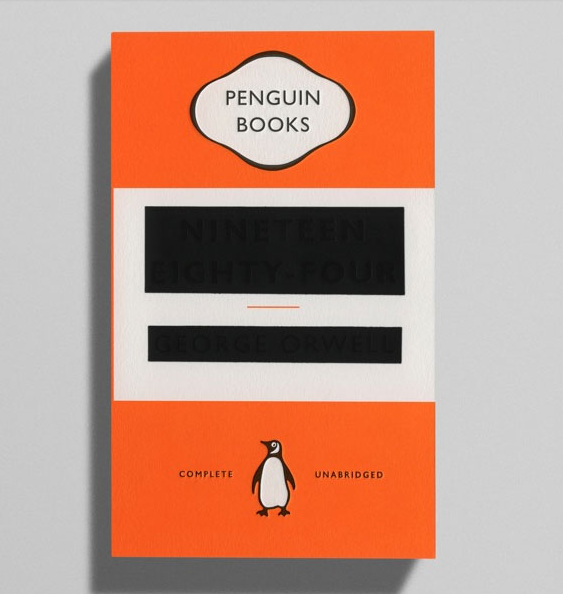
In 2013, Penguin released in the UK a series of new covers for five works by George Orwell, including a particularly bold cover design for Orwell’s best-known work, 1984. According to Creative Review, the designer, David Pearson, made it so that the book’s title and Orwell’s name were debossed, then almost completely obscured by black foiling, leaving just “enough of a dent for the title to be determined.” No doubt, the design plays on the whole idea of censorship, “referencing the rewriting of history carried out by the novel’s Ministry of Truth.”
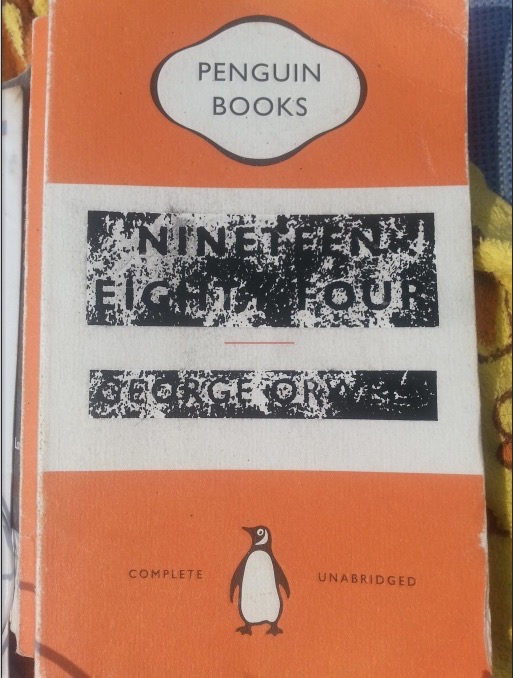
Years later, you’ll have difficulty buying new copies of Pearson’s design. They’re in pretty short supply. But anyone with a well-worn copy of the book might discover what one Redditor has also observed–that the cover design “becomes less censored with wear.” Compare the “before” image above to the “after” image down below. Was this all part of Pearson’s long-range master plan? Or something of a design flaw? We’ll probably never know. But if you’re looking for a book that gets better with age, then this is one to add to your list.
If you would like to support the mission of Open Culture, consider making a donation to our site. It’s hard to rely 100% on ads, and your contributions will help us continue providing the best free cultural and educational materials to learners everywhere. You can contribute through PayPal, Patreon, and Venmo (@openculture). Thanks!
Related Content:
George Orwell’s Harrowing Race to Finish 1984 Before His Death
Aldous Huxley to George Orwell: My Hellish Vision of the Future is Better Than Yours (1949)
Read More...10 Biggest Threats to the World in 2024, Ranked by Ian Bremmer
At the start of each year, Ian Bremmer, a political scientist and president of Eurasia Group, creates a list that ranks the greatest threats to our world. In 2024, Bremmer puts his finger on Ungoverned AI, a Partitioned Ukraine, a volatile Middle East, and a sputtering Chinese economy. But the biggest threat? A divided United States where the right and left consider each other an existential threat, where political candidates threaten their rivals, where power doesn’t get transitioned peacefully, and where foreign nations look to further sow the seeds of internal division. You can read Bremmer’s full report here.
If you would like to support the mission of Open Culture, consider making a donation to our site. It’s hard to rely 100% on ads, and your contributions will help us continue providing the best free cultural and educational materials to learners everywhere. You can contribute through PayPal, Patreon, and Venmo (@openculture). Thanks!
Read More...
Beethoven’s 5th: Watch an Animated Graphical Score
Stephen Malinowski is a self-described “Music Animation Machine,” with a penchant for creating animated graphical scores. Above, he does his thing with the first movement of Beethoven’s Symphony 5.
How does he make this magic? Malinowski writes: “There were a lot of steps; here’s a short summary. I found a recording I could license and made the arrangements to use it. I found a MIDI file that was fairly complete, and imported that into the notation program Sibelius. I compared it to a printed copy of the score from my library and fixed things that were wrong… Then, I listened to the recording and compared that to the score, and modified the score so that the timings were more like what the orchestra was actually playing. I exported this as a MIDI file and ran it through my custom frame-rendering software. Then, I made a “reduction” of the score and colored it to match the colors I was planning to use in the bar-graph score. Unfortunately, when I squished the bar-graph score enough to make room for the notation score, too much detail was lost, so I ended up deciding not to use the notation. Then I put all the pieces (rendered frames, audio, titles) together in Adobe Premiere and exported the movie as a QuickTime file. Then, I used On2 Flix to convert the final file into Flash format (so that YouTube’s conversion to their Flash format wouldn’t change it in unpredictable ways), and uploaded the result.”
Enjoy!
Read More...Watch Dziga Vertov’s Soviet Toys: The First Soviet Animated Movie Ever (1924)
Dziga Vertov is best known for his dazzling city symphony A Man with a Movie Camera, which was ranked by Sight and Sound magazine as the 8th best movie ever made. Yet what you might not know is that Vertov also made the Soviet Union’s first ever animated movie, Soviet Toys.
Consisting largely of simple line drawings, the film might lack the verve and visual sophistication that marked A Man with a Movie Camera, but Vertov still displays his knack for making striking, pungent images. Yet those who don’t have an intimate knowledge of Soviet policy of the 1920s might find the movie — which is laden with Marxist allegories — really odd.
Soviet Toys came out in 1924, during Lenin’s New Economic Policy (NEP), which gave some market incentives to small farmers. Not surprisingly, the farmers started producing a lot more food than before, and soon a whole new class of middleman traders formed — the reviled “NEPmen.”
The movie opens with a NEPman — a bloated caricature of a Capitalist (who coincidentally looks vaguely like Nikita Khrushchev) — devouring a massive heap of food. He’s so stuffed that he spends much of the rest of the movie sprawled out on the floor, much in the same way one might imagine Jamie Dimon after Thanksgiving dinner. Then he belches riches at a woman who is can-canning on his distended belly. I said this film is odd.
Later, as a couple of squabbling Russian Orthodox priests look on, a worker tries to extract money from the NEPman by cutting his gut with a huge pair of scissors. When that fails, the worker and a passing peasant fuse bodies to create a two-headed being that stomps on the Capitalist’s belly, which pops open like a piñata filled with cash. Then members of the Red Army pile together and form a sort of human pyramid before turning into a giant tree. They hang the Capitalist along with the priests. The end.
Some of the references in this movie are clear: The worker’s use of scissors points to the “Scissors Crisis” – an attempt by the Central Government to correct the price imbalance between agriculture and industrial goods. And the physical melding of the peasantry and the proletariat is a representation of the never quite realized dream of the Bolsheviks. Other images are as obscure as they are weird — the leering close ups of the Capitalist, the NEPman’s girlfriend who disappears into his stomach, the revolutionary filmmaker who has the eyes of a camera lens and the mouth of a camera shutter. They feel like something out of a Marxist fever dream.
Soviet Toys can be found in the Animation section of our collection of Free Movies Online.
Note: An earlier version of this post appeared on our site in 2014.
Related Content:
Watch Dziga Vertov’s A Man with a Movie Camera, Named the 8th Best Film Ever Made
A Soviet Animation of Stephen King’s Short Story “Battleground” (1986)
Jonathan Crow is a Los Angeles-based writer and filmmaker whose work has appeared in Yahoo!, The Hollywood Reporter, and other publications. You can follow him at @jonccrow.
Read More...How French Cinema Works
Evan Puschak, the video essayist better known as the Nerdwriter, has seen a lot of movies. Here on Open Culture, we’ve previously featured his analyses of a range of pictures including Blade Runner, Reservoir Dogs, Parasite, La Dolce Vita, Nostalghia, and You’ve Got Mail. When he notices something special about the films coming out of one country in particular, we’d do well to listen to him address why. He once devoted a video essay to Jean-Luc Godard’s Breathless, which he frames as having set off the nouvelle vague, the first movement most of us think of when we think of French cinema — which many of us around the world regard as occupying une classe à part. Puschak finds one reason we do so in his new video essay above.
That reason is the Centre national du cinéma et de l’image, or CNC, the governmental agency tasked with promoting not just French film but French audiovisual arts in general. “For decades, it sat at the center of cinema in France, affecting every layer of the industry there,” says Puschak. Funded by taxes on cinema admissions, television providers, and media both physical and streaming, it redistributes money to the production, distribution, and exhibition of films, television shows, video games, and other forms of art (as well as to the preservation of existing art). As far as movies in particular, the declared idea is to “support an independent cinema that is bold in terms of market standards and that cannot find its financial balance without public assistance.”
“In the US film industry, there’s only one metric to judge movies: commercial success,” Puschak says. “Without participation by the state, there can be no other metric. The market determines everything,” and that holds as true for indie films as it does for broad Hollywood spectacles. The CNC also invests heavily in “the maintenance and renovation of theaters, especially those that show art-house films,” all across France, and even in cinema education for schoolchildren meant to encourage an appreciation for “all kinds of movies, not just those that giant corporations have millions of dollars to promote.” This in contrast to the many Americans “conditioned from an early age to see only certain kinds of movies in the theater.”
Of course, how well a CNC-style agency would work in America, a world apart from the dirigiste culture of France, is a matter of debate. So, in fact, is the question of how well it works in France. It has “all the problems you’d expect from a large bureaucracy: sluggishness, red tape, waste, controversies over who gets to choose what films get money.” But the CNC has evolved in fits and starts with changes in technology and culture, and the US has lately directed no small amount of financial support to film production in the form of state-level tax credits. As anyone who visits the cinemas of Paris will notice, France has a “public of devoted filmgoers, people who want to go out to the movie theater and have a wide range of experiences there.” Cinephiles the world over would surely agree that any money spent to cultivate that is money well spent.
Related content:
How Anna Karina (RIP) Became the Mesmerizing Face of the French New Wave
An Introduction to Jean-Luc Godard’s Innovative Filmmaking Through Five Video Essays
RIP Jean-Paul Belmondo: The Actor Who Went from the French New Wave to Action Superstardom
Based in Seoul, Colin Marshall writes and broadcasts on cities, language, and culture. His projects include the Substack newsletter Books on Cities, the book The Stateless City: a Walk through 21st-Century Los Angeles and the video series The City in Cinema. Follow him on Twitter at @colinmarshall or on Facebook.
Read More...A 500-Page Book Explores the Ghosts & Monsters from Japanese Folklore

Westerners tend to think of Japan as a land of high-speed trains, expertly prepared sushi and ramen, auteur films, brilliant animation, elegant woodblock prints, glorious old hotels, sought-after jazz-records, cat islands, and ghost towns. The last of those has, of course, not been shown to harbor literal wraiths and spirits. But if that sort of thing happens to be what you’re looking for, Japan’s long history offers up a wealth of mythological chimeras whose form, behavior, and sheer numbers exceed any of our expectations. Welcome to the supernatural realm of the shapeshifting, good- and bad-luck-bringing, trick-playing yōkai.
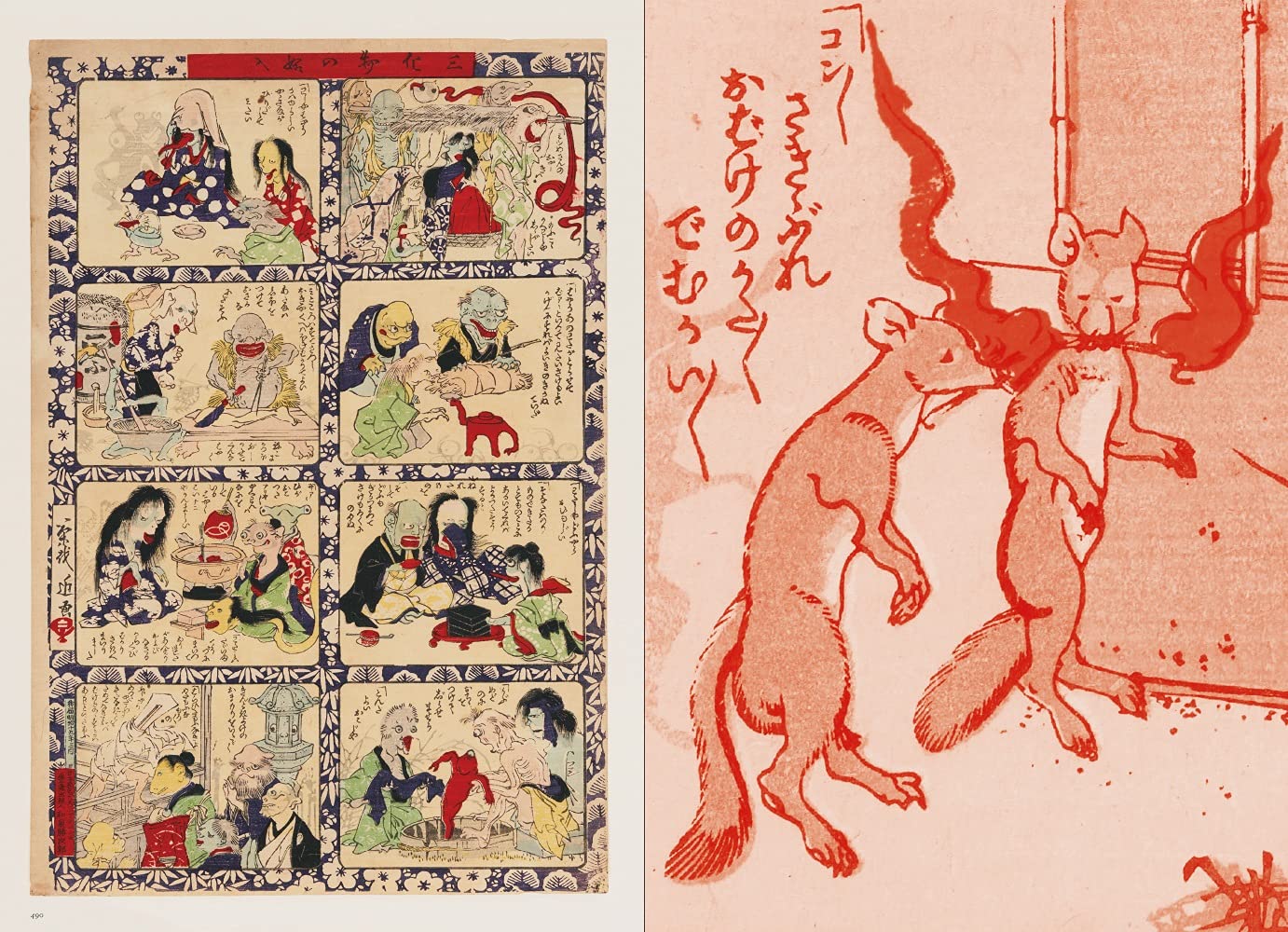
“Translating to ‘strange apparition,’ the Japanese word yōkai refers to supernatural beings, mutant monsters, and spirits,” writes Colossal’s Grace Ebert. “Mischievous, generous, and sometimes vengeful, the creatures are rooted in folklore and experienced a boom during the Edo period when artists would ascribe inexplicable phenomena to the unearthly characters.”
Hiroshima Prefecture’s Miyoshi Mononoke Museum, whose opening we announced here on Open Culture in 2019, “houses the largest yōkai collection in the world with more than 5,000 works, and a book recently published by PIE International showcases some of the most iconic and bizarre pieces from the institution.”
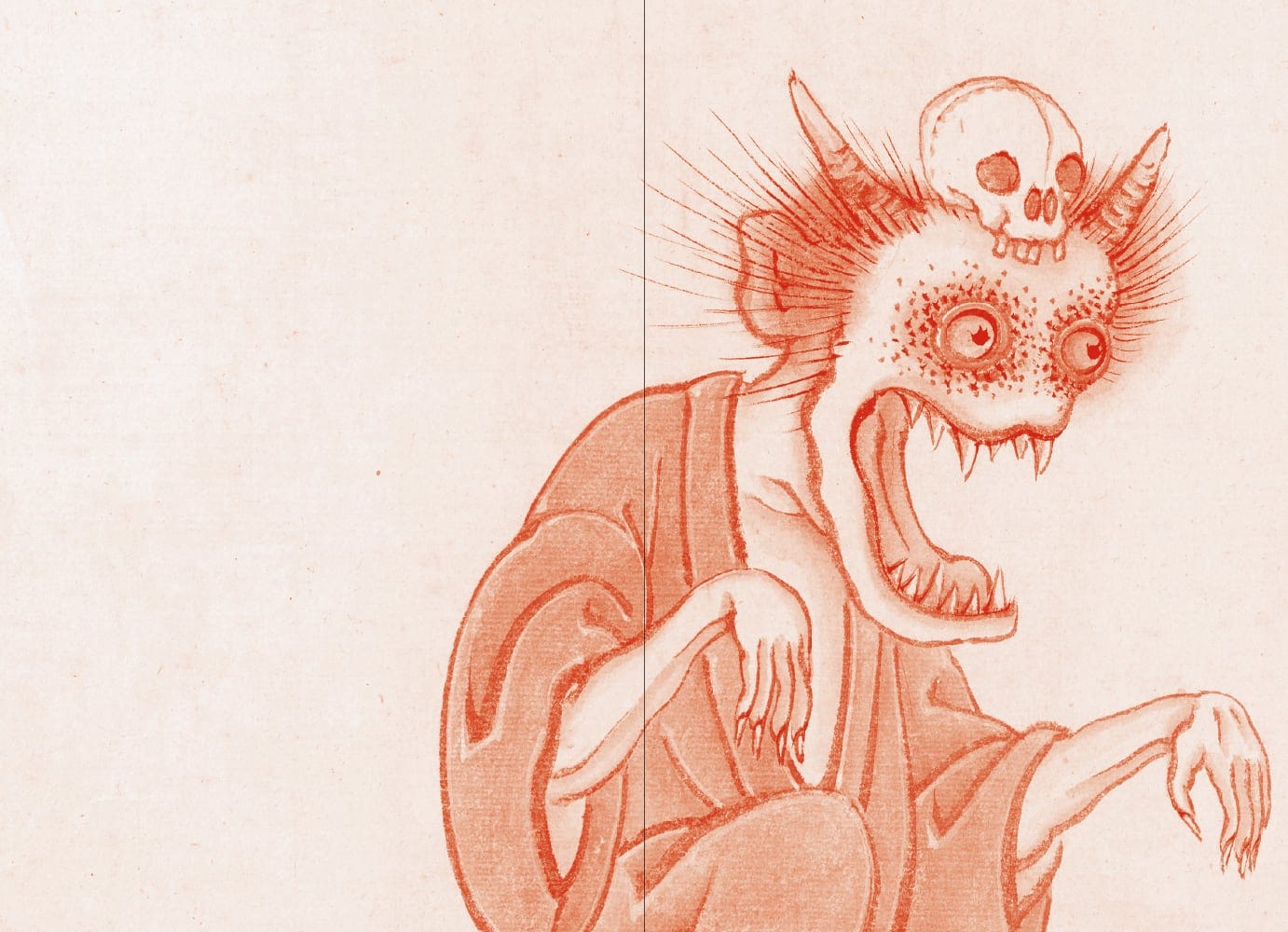
Written by ethnologist Yumoto Koichi, a yōkai expert whose donations constitute most of the Miyoshi Mononoke Museum’s collection, the 500-page YOKAI offers “the rare experience of seeing the brushwork of Edo-era painters like Tsukioka Yoshitoshi,” whom we’ve featured here as Japan’s last great woodblock artist. Poised between the human and animal kingdoms, reflecting the ways of the past as well as the forces of nature, yōkai would seem to belong entirely to the tales of a bygone age. But in fact, many of them have joined the canon since Tsukioka’s time, having emerged from haunted-school rumors, the fertile imaginations of manga artists, and even video games. Whether to accept these “modern yōkai” has been a matter of some debate, but as Japanese popular culture has long shown us, every age needs its own monsters.

via Colossal
Related content:
The First Museum Dedicated to Japanese Folklore Monsters Is Now Open
When a UFO Came to Japan in 1803: Discover the Legend of Utsuro-bune
Based in Seoul, Colin Marshall writes and broadcasts on cities, language, and culture. His projects include the Substack newsletter Books on Cities, the book The Stateless City: a Walk through 21st-Century Los Angeles and the video series The City in Cinema. Follow him on Twitter at @colinmarshall or on Facebook.
Read More...Support Us
We're hoping to rely on loyal readers, rather than erratic ads. Please click the Donate button and support Open Culture. You can use Paypal, Venmo, Patreon, even Crypto! We thank you!

About Us

Open Culture scours the web for the best educational media. We find the free courses and audio books you need, the language lessons & educational videos you want, and plenty of enlightenment in between.
Advertise With Us

FREE UPDATES!
GET OUR DAILY EMAIL
Get the best cultural and educational resources on the web curated for you in a daily email. We never spam. Unsubscribe at any time.
FOLLOW ON SOCIAL MEDIA

Open Culture editor Dan Colman scours the web for the best educational media. He finds the free courses and audio books you need, the language lessons & movies you want, and plenty of enlightenment in between.
Advertise With Us


