The Untold Story of Disco and Its Black, Latino & LGBTQ Roots
As a white Midwestern child of the ‘70s, I received two messages loud and clear: disco was a breathtakingly glamorous, sexy urban scene, and “disco sucks.”
Culturally, the latter prevailed.
It was the opinion voiced most loudly by the popular boys.
Dissenters pushed back at their own peril.
I didn’t know what YMCA was about, and I’m not convinced the ski jacketed, puka-necklaced alpha males at my school did either.
(My father, who sang along joyfully whenever it came on the car radio, definitely did.)
Disco’s been dead for a long time now.
In the four plus decades since disgruntled Chicago radio DJ Steve Dahl commandeered a baseball stadium for a Disco Demolition Night where fans tossed around homophobic and racist epithets while destroying records, there’s been notable social progress.
This progress is the lens that makes Noah Lefevre’s Polyphonic video essay The Untold History of Disco, and other investigations into the racial and sexual underpinnings of disco possible.
I certainly never heard of Stonewall as a kid, but many contemporary viewers, coming of age in a country that is, on the whole, much more LGBTQ-friendly than the world of their parents and grandparents, are familiar with it as a gay rights milestone.
Lefevre ties the birth of disco to the 1969 Stonewall Uprising, and a subculture born of necessity, wherein gay men improvised underground dance clubs where they could cut freely loose with same sex partners.
Instead of live dance music, these venues boasted DJs, crate diggers open to any groove that would keep the party going on the dance floor: psychedelic, classic soul, progressive soul, jazz fusion, Latin American dance music, African pop…
(Thus the name discotheque)
A disco sound began to coalesce around existing hits as the O‑jays’ Love Train and Isaac Hayes’ Theme from Shaft.
You can hear it in Jimmy Nolen’s chicken scratch lead guitar for James Brown and session drummer Earl Young’s open high hat and four-to-the-floor beat on Harold Melvin and the Blue Notes’ The Love I Lost.
In the beginning, crowds were primarily Black, Latino and gay at New York City discos like The Loft, which started out as a rent party, and The Sanctuary, housed in a deconsecrated midtown German Baptist church. Mapplethorpe model Leigh Lee recalled The Sanctuary’s cachet to the Village Voice’s Peter Braunstein:
It was supposed to be a secret, but I don’t know how secret it could have been when faggots and lesbians can come out of a church from midnight till sunrise.
As discotheque DJs began driving the record charts, mainstream producers took note, opening the gates for such monster hits as the Barry White-helmed Love Unlimited Orchestra’s Love’s Theme, Donna Summer’s Love to Love Ya, and Chic’s Le Freak.
A glitter-bedecked nude man rode a white horse into Bianca Jagger’s birthday party at Studio 54 on the stroke of midnight, while hinterland squares did The Hustle at their local Holiday Inns.
By the time celebs like the Rolling Stones and Rod Stewart starting horning in on the act, disco had already reached its tipping point.
Little twerps like me, whose mothers wouldn’t let them see the R‑rated Saturday Night Fever bought Bee Gees 45s from our local Peaches and sang along to Gloria Gaynor’s I Will Survive, as did some of our dads…
(An unexpected pleasure of Lefevre’s video is seeing all those familiar record labels spinning just the way they did on our precious stereos — Atlantic! Casablanca! Polydor! RSO! Somebody pass me a Dr. Pepper and a yellow plastic insert!)
Radio DJ Rick Dees’ novelty hit with Disco Duck seemed so harmless at the time, but it was surely music to the mainstream “disco sucks” crowd’s ears. (Good luck to any punk who betrayed a fondness for Disco Duck )
Disco’s reign was brief — Lefevre notes that its end coincides with the beginning of the AIDS crisis — but its impact has been greater than many assume at first blush.
Disco’s emphasis on turntables and long play versions influenced hip hop and electronic dance music.
Nearly half a century after discomania seized the land, its deep connection to Black, Latino and LGBTQ history must not be tossed aside lightly.
Watch more of Noah Lefevre’s Polyphonic video essays here.
Related Content
- Ayun Halliday is the Chief Primatologist of the East Village Inky zine and author, most recently, of Creative, Not Famous: The Small Potato Manifesto. Her Indiana ties resulted in an invitation to Rick “Disco Duck” Dees’ 1977 wedding. Follow her @AyunHalliday.
Read More...Why Jorge Luis Borges Hated Soccer: “Soccer is Popular Because Stupidity is Popular”
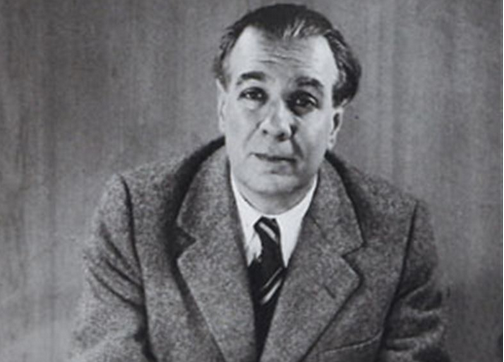
Image by Grete Stern, via Wikimedia Commons
I will admit it: I’m one of those oft-maligned non-sports people who becomes a football (okay, soccer) enthusiast every four years, seduced by the colorful pageantry, cosmopolitan air, nostalgia for a game I played as a kid, and an embarrassingly sentimental pride in my home country’s team. I don’t lose all my critical faculties, but I can’t help but love the World Cup even while recognizing the corruption, deepening poverty and exploitation, and host of other serious sociopolitical issues surrounding it. And as an American, it’s simply much easier to put some distance between the sport itself and the jingoistic bigotry and violence—“sentimental hooliganism,” to use Franklin Foer’s phrase—that very often attend the game in various parts of the world.
In Argentina, as in many soccer-mad countries with deep social divides, gang violence is a routine part of futbol, part of what Argentine writer Jorge Luis Borges termed a horrible “idea of supremacy.” Borges found it impossible to separate the fan culture from the game itself, once declaring, “soccer is popular because stupidity is popular.” As Shaj Mathew writes in The New Republic, the author associated the mass mania of soccer fandom with the mass fervor of fascism or dogmatic nationalism. “Nationalism,” he wrote, “only allows for affirmations, and every doctrine that discards doubt, negation, is a form of fanaticism and stupidity.” As Mathews points out, national soccer teams and stars do often become the tools of authoritarian regimes that “take advantage of the bond that fans share with their national teams to drum up popular support [….] This is what Borges feared—and resented—about the sport.”
There is certainly a sense in which Borges’ hatred of soccer is also indicative of his well-known cultural elitism (despite his romanticizing of lower-class gaucho life and the once-demimonde tango). Outside of the hugely expensive World Cup, the class dynamics of soccer fandom in most every country but the U.S. are fairly uncomplicated. New Republic editor Foer summed it up succinctly in How Soccer Explains the World: “In every other part of the world, soccer’s sociology varies little: it is the province of the working class.” (The inversion of this soccer class divide in the U.S., Foer writes, explains Americans’ disdain for the game in general and for elitist soccer dilettantes in particular, though those attitudes are rapidly changing). If Borges had been a North, rather than South, American, I imagine he would have had similar things to say about the NFL, NBA, NHL, or NASCAR.
Nonetheless, being Jorge Luis Borges, the writer did not simply lodge cranky complaints, however politically astute, about the game. He wrote a speculative story about it with his close friend and sometime writing partner Adolfo Bioy Casares. In “Esse Est Percipi” (“to be is to be perceived”), we learn that soccer has “ceased to be a sport and entered the realm of spectacle,” writes Mathews: “representation of sport has replaced actual sport.” The physical stadiums crumble, while the games are performed by “a single man in a booth or by actors in jerseys before the TV cameras.” An easily duped populace follows “nonexistent games on TV and the radio without questioning a thing.”
The story effectively illustrates Borges’ critique of soccer as an intrinsic part of a mass culture that, Mathews says, “leaves itself open to demagoguery and manipulation.” Borges’ own snobberies aside, his resolute suspicion of mass media spectacle and the coopting of popular culture by political forces seems to me still, as it was in his day, a healthy attitude. You can read the full story here, and an excellent critical essay on Borges’ political philosophy here. For those interested in exploring Franklin Foer’s book, see How Soccer Explains the World: An Unlikely Theory of Globalization.
Note: An earlier version of this post appeared on our site in 2014.
Related Content:
Video: Bob Marley Plays a Soccer Match in Brazil, 1980
Jorge Luis Borges’ 1967–8 Norton Lectures On Poetry (And Everything Else Literary)
Jorge Luis Borges Draws a Self-Portrait After Going Blind
Josh Jones is a writer and musician based in Durham, NC. Follow him at @jdmagness
Read More...The 100 Greatest Films of All Time According to 1,639 Film Critics & 480 Directors: See the Results of the Once-a-Decade Sight and Sound Poll
Chantal Akerman’s Jeanne Dielman, 23 quai du Commerce, 1080 Bruxelles is a three-and-a-half hour film in which nothing happens. That, in any case, will be the description offered by many who will view it for the first time in the coming months. Their curiosity will have been piqued by its triumph in the just-released results of Sight and Sound magazine’s critics poll to determine the greatest films of all time. Conducted just once per decade since 1952, it has only seen two other top-spot upsets in that time: when Citizen Kane displaced Bicycle Thieves in 1962, and when Vertigo displaced Citizen Kane half a century later.
The top ten on this year’s Sight and Sound critics poll is as follows:
- Jeanne Dielman 23, quai du Commerce, 1080 Bruxelles (Chantal Akerman, 1975)
- Vertigo (Alfred Hitchcock, 1958)
- Citizen Kane (Orson Welles, 1941)
- Tokyo Story (Yasujirō Ozu, 1953)
- In the Mood for Love (Wong Kar Wai, 2000)
- 2001: A Space Odyssey (Stanley Kubrick, 1968)
- Beau travail (Claire Denis, 1998)
- Mulholland Dr. (David Lynch, 2001)
- Man with a Movie Camera (Dziga Vertov, 1929)
- Singin’ in the Rain (Gene Kelly and Stanley Donen, 1952)
Since 1992, the magazine has also run a separate poll that collects the votes of not critics but film directors, which this year placed 2001 at number one. Its top ten also includes such selections as Federico Fellini’s 8½, Andrei Tarkovsky’s Mirror, and Abbas Kiarostami’s Close-Up.
The directors ranked Jeanne Dielman at a respectable number four, tied with Tokyo Story. “On the side of content, the film charts the breakdown of a bourgeois Belgian housewife, mother and part-time prostitute over the course of three days,” writes film theorist Laura Mulvey on Sight and Sound’s page for the film.
“On the side of form, it rigorously records her domestic routine in extended time and from a fixed camera position.” As you may already imagine, these elements — as well as the fact that the title character is played by no less grand a movie star than Delphine Seyrig — make for a singular viewing experience.
That title isn’t without a certain irony, given how much of the film Akerman devotes to straightforward depictions of a middle-aged woman performing household chores — taking us far indeed from the domain of, say, Jerry Bruckheimer. “Shot in static, long takes, the film’s pace and tone may first seem slow or dull,” writes Adam Cook in the IndieWire video essay “Chantal Akerman’s Jeanne Dielman Is a True Action Movie,” but “in observing these household tasks free of periphery, they take on a dramaturgy of their own.” Only with time and repetition do “the nuances in Delphine Seyrig’s expressions convey vastly different connotations” and “the smallest details take on narrative power and significance.”
“Her life is organized to allow no gaps in the day,” Akerman told a television chat-show audience in 1975, when Jeanne Dielman had just come out. But “her very structured universe starts to unravel,” and “her subconscious expresses itself through a series of little slip-ups.” In a 2009 interview for the Criterion Collection, Akerman drew connections between her character’s regimentation and the strict Jewish rituals she herself observed in childhood: “Knowing every moment of every day, what she must do the next moment, brings a sort of peace.” When the routine is disrupted, “a suspense builds, because I think that deep down, we know that something’s going to happen.” On this emotional level, Jeanne Dielman is more conventional than it may seem. And to those who can immerse themselves in it, it feels like the only film in which anything does happen.
See the Sight and Sound poll results here.
Related content:
100 Overlooked Films Directed by Women: See Selections from Sight & Sound Magazine’s New List
103 Essential Films By Female Filmmakers: Clueless, Lost in Translation, Ishtar and More
The Ten Greatest Films of All Time According to 358 Filmmakers
The Ten Greatest Films of All Time According to 846 Film Critics
The Best 100 Movies of the 21st Century (So Far) Named by 177 Film Critics
The Top 100 American Films of All Time, According to 62 International Film Critics
Based in Seoul, Colin Marshall writes and broadcasts on cities, language, and culture. His projects include the Substack newsletter Books on Cities, the book The Stateless City: a Walk through 21st-Century Los Angeles and the video series The City in Cinema. Follow him on Twitter at @colinmarshall or on Facebook.
Read More...Watch Neil Young & Crazy Horse Play & Record the New 15-Minute Track “Chevrolet” for the First Time
“Chevrolet,” a new track on Neil Young’s 42nd studio album World Record, takes you on a long, rambling road trip, covering a lot of different terrain over 15 minutes, with some verses lasting more than two minutes. Above, you can watch Neil Young and Crazy Horse (Nils Lofgren, Billy Talbot and Ralph Molina) play the song for the very first time. It’s also the same cut that appears on the album. It’s a pretty remarkable display of musicianship, and a great new Neil Young track.
If you would like to support the mission of Open Culture, consider making a donation to our site. It’s hard to rely 100% on ads, and your contributions will help us continue providing the best free cultural and educational materials to learners everywhere. You can contribute through PayPal, Patreon, and Venmo (@openculture). Thanks!
Related Content
When Neil Young & Rick “Super Freak” James Formed the 60’s Motown Band, The Mynah Birds
“More Barn!” The Story of How Neil Young First Played Harvest for Graham Nash (1972)
Read More...
Succession Star Brian Cox Teaches Hamlet’s Soliloquy to a 2‑Year-Old Child
Perhaps you’ve seen Scottish actor Brian Cox perform with the Royal Shakespeare Company in critically-acclaimed performances of The Taming of The Shrew and Titus Andronicus. Or, more likely, you’ve seen him in the blockbuster HBO series, Succession. But there’s perhaps another role you haven’t seen him in: tutor of toddlers. A number of years back, Cox taught Theo, then only 30 months old, the famous soliloquy from Hamlet, hoping to show there’s a Shakespearean actor in all of us. Later, Cox talked to the BBC about his “masterclass” with Theo and what he took away from the experience. Watch him muse right below:
If you would like to support the mission of Open Culture, consider making a donation to our site. It’s hard to rely 100% on ads, and your contributions will help us continue providing the best free cultural and educational materials to learners everywhere. You can contribute through PayPal, Patreon, and Venmo (@openculture). Thanks!
Related Content:
Watch Brian Cox of “Succession” Read Hunter S. Thompson’s Profanity-Laden Letter
Pink Floyd’s David Gilmour Sings Shakespeare’s Sonnet 18
The History of Ancient Rome in 20 Quick Minutes: A Primer Narrated by Brian Cox
Read More...See 21 Historic Films by Lumière Brothers, Colorized and Enhanced with Machine Learning (1895–1902)
Auguste and Louis Lumière thought that cinema didn’t have a future. Fortunately, they came to that conclusion only after producing a body of work that comprises some of the earliest films ever made, as well as invaluable glimpses of the end of the nineteenth century and the dawn of the twentieth, an era that has now passed out of living memory. Using the motion-photography system that they developed themselves, the Lumière brothers captured life around them in not just their native France, but Switzerland, Italy, England, the United States, and even more exotic lands like Egypt, Turkey, and Japan — all of which you can see in the compilation video above.
The smooth color footage you see here is not, of course, what the Lumière brothers showed to their wide-eyed audiences well over a century ago. It all comes specially prepared by Youtuber Denis Shirayev, who specializes in enhancing old film with current technologies, some of them driven by machine learning.
If this sounds familiar, it may be because we’ve featured a good deal of Shirayev’s work here on Open Culture before, including his restored versions of Victorian England, Belle Epoque Paris, New York City in 1911, Amsterdam in 1922, Tokyo at the start of the Taishō era — and even the Lumière brothers’ famous movie of a train arriving at La Ciotat Station.
For this compilation video’s first four and half minutes, Shirayev explains how he does it. But first, he offers a disclaimer: “Some people mistakenly think that the colors in this video are the original source colors, or that the source material had audio, or that the enhanced faces are real.” All that was in fact added later, and that’s where the artificial intelligence comes in: even in the absence of direct historical evidence, it can “guess” what the real details not captured by the Lumière bothers’ camera might have looked like. This is part of a process that also includes upscaling, stabilization, and conversion to 60 frames per second — a form of motion smoothing, in recent years the subject of a cinematic controversy the Lumière brothers certainly couldn’t have imagined.
After Shirayev’s remarks, you can start watching 21 Lumière brothers films after the 4:30 mark.
Related content:
Watch the Films of the Lumière Brothers & the Birth of Cinema (1895)
The History of the Movie Camera in Four Minutes: From the Lumière Brothers to Google Glass
Based in Seoul, Colin Marshall writes and broadcasts on cities, language, and culture. His projects include the Substack newsletter Books on Cities, the book The Stateless City: a Walk through 21st-Century Los Angeles and the video series The City in Cinema. Follow him on Twitter at @colinmarshall or on Facebook.
Read More...Deep Fried Coffee: A Very Disturbing Discovery
Deep fried coffee. Yes, it’s a thing, and coffee connoisseur James Hoffmann decided to give it a go. How did it turn out? We won’t spoil it for you–other than to say, don’t be surprised if deep fried coffee makes its way into a future edition of Hoffmann’s book, The World Atlas of Coffee.
If you would like to support the mission of Open Culture, consider making a donation to our site. It’s hard to rely 100% on ads, and your contributions will help us continue providing the best free cultural and educational materials to learners everywhere. You can contribute through PayPal, Patreon, and Venmo (@openculture). Thanks!
Related Content
“The Vertue of the COFFEE Drink”: An Ad for London’s First Cafe Printed Circa 1652
Life and Death of an Espresso Shot in Super Slow Motion
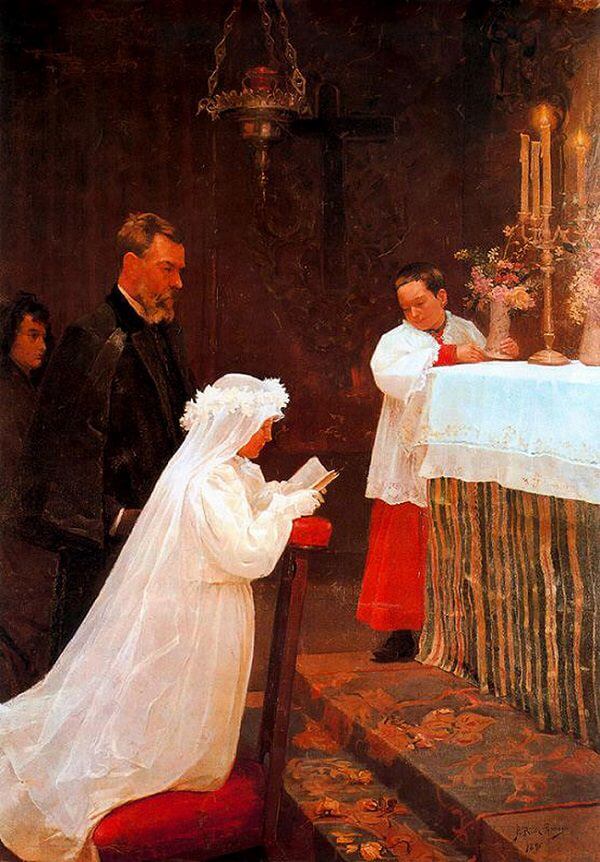
Read More...15-Year-Old Picasso Paints His First Masterpiece, “The First Communion”
It took me four years to paint like Raphael, but a lifetime to paint like a child. — Pablo Picasso
We think it’s safe to say that most of us have a preconceived notion of Picasso’s style, and The First Communion, above, isn’t it.
Picasso was just 15 when he completed this large-scale oil, having lost his 7‑year-old sister, Conchita, to diphtheria one year before.
The stricken young artist had attempted to bargain with God, vowing to give up painting if she was spared. As Arianna Huffington writes in the biography Picasso: Creator and Destroyer:
…he was torn between wanting her saved and wanting her dead so that his gift would be saved. When she died, he decided that God was evil and destiny an enemy. At the same time, he was convinced that it was his ambivalence that had made it possible for God to kill Conchita. His guilt was enormous—the other side of his belief in his powers to affect the world around him. And it was compounded by his almost magical conviction that his little sister’s death had released him to be a painter and follow the call of the powers he had been given, whatever the consequences.
If there’s evil at work in the “First Communion,” he keeps it under wraps. All eyes are on the rapt young communicant, embodied in his surviving sister, Lola, in a snowy veil and gown.
Their father, painter and drawing professor José Ruiz y Blasco, assumes the part of the girl’s father or godfather, a solemn witness to this rite of passage.
Ruiz y Blasco provided instruction and championed his son’s gift. He encouraged him to enter the “First Communion,” and later, “Science and Charity” (in which he appears as the doctor) in the Exposicion de Bellas Artes, a competition and exhibition opportunity for emerging artists.
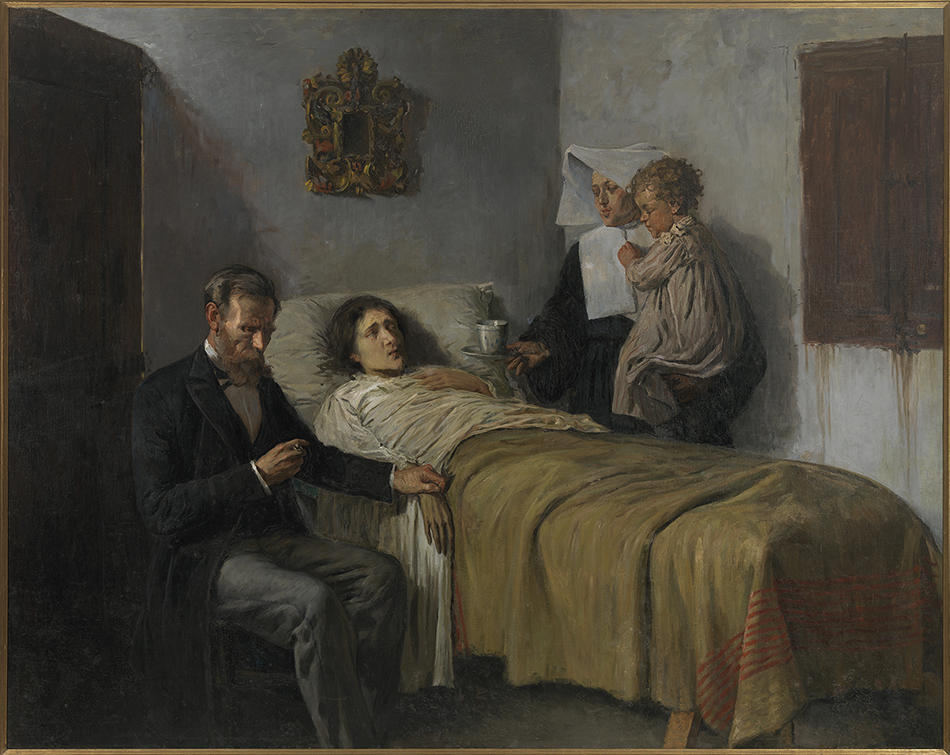
Picasso later remarked that “every time I draw a man, I think of my father. To me, man is Don José, and will be all my life…”
Ruiz y Blasco, convinced that Picasso’s talent would bring success as a naturalistic painter of classical scenes and portraits, was deeply disappointed when his teenaged son began blowing off class at Madrid’s prestigious Academia Real de San Fernando.
Just imagine how he reacted to the scandalous Cubist vision of “Les Demoiselles d’Avignon,” unveiled a mere eleven years after the “First Communion.”
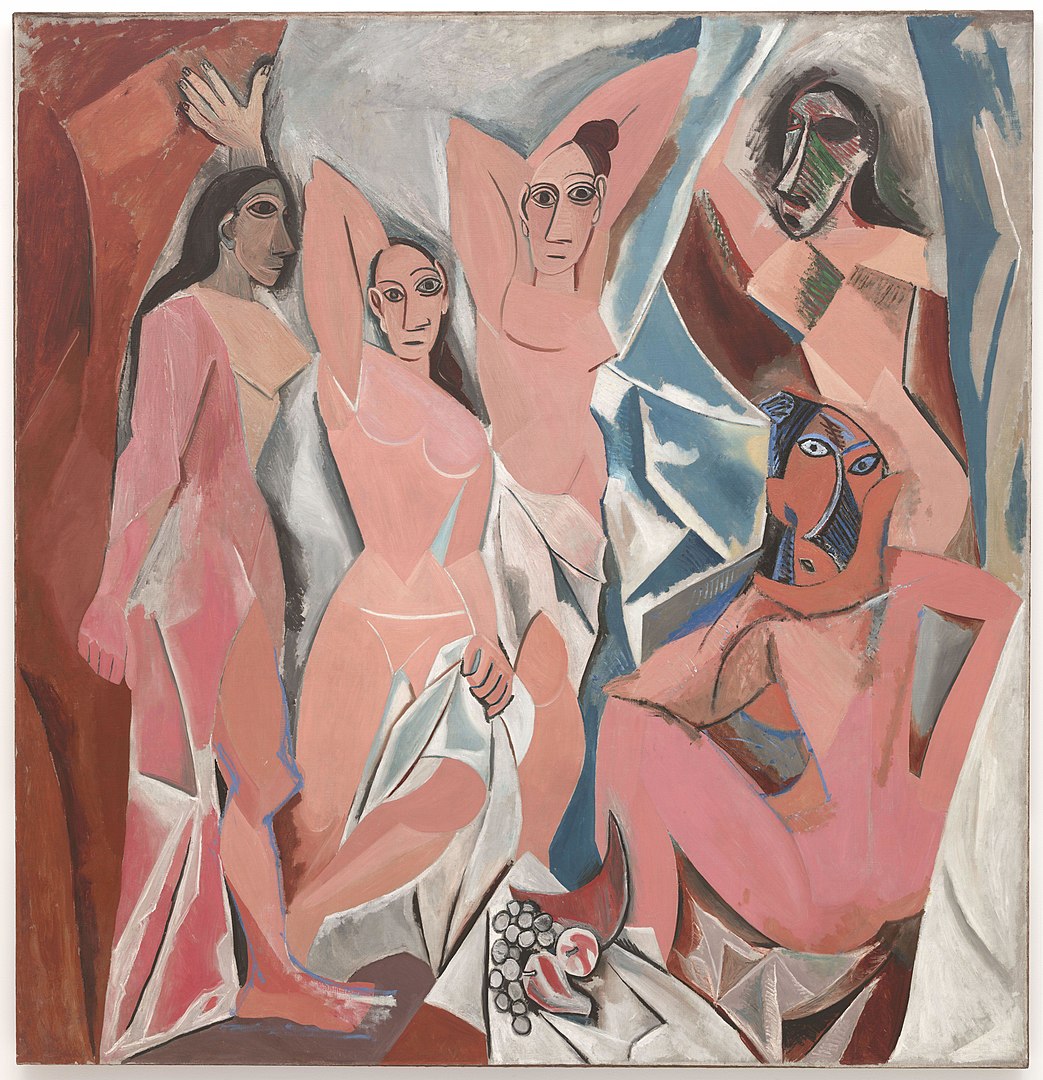
The rest is history.
Just for fun, we invited the free online AI image generator Craiyon (formerly known as DALL‑E Mini) to have a go using the prompt “Picasso First Communion”.

The results should surprise no one.
Related Content
How To Understand a Picasso Painting: A Video Primer
- Ayun Halliday is the Chief Primatologist of the East Village Inky zine and author, most recently, of Creative, Not Famous: The Small Potato Manifesto. Follow her @AyunHalliday.
Read More...8th Century Englishwoman Scribbled Her Name & Drew Funny Pictures in a Medieval Manuscript, According to New Cutting-Edge Technology

Most of us have doodled in the margins of our books at one time or another, and some of us have even dared to write our own names. But very of few us, presumably, would have expected our handiwork to be marveled at twelve centuries hence. Yet that’s just what has happened to the marginalia left by a medieval Englishwoman we know only as Eadburg, who some time in the eighth century committed her name — as well as other symbols and figures — to the pages of a Latin copy of the Acts of the Apostles.
Eadburg did this with such secrecy that only advanced twenty-first century technology has allowed us to see it at all. That the readers in the Middle Ages sometimes jotted in their manuscripts isn’t unheard of.
But unlike most of them, Eadburg seems to have favored a drypoint stylus — i.e., a tool with nothing on it to leave a clear mark — which would have made her writing nearly impossible to notice with the naked eye. To see all of them necessitated the use of a technique called “photometric stereo,” which Oxford University’s Bodleian Library Senior Photographer John Barrett explains in this blog post.
The scanning process collects images that “map the direction and height of the original’s surface, and are processed into renders showing only the relief of the original with the tone and color removed.” Subsequent steps of filtering and enhancement result in a digital reproduction of “the three-dimensional surface of the page,” which, with the proper enhancements, finally allows drypoint inscriptions to be seen. Eadburg’s name, reports the Guardian’s Donna Ferguson, was found “passionately etched into the margins of the manuscript in five places, while abbreviated forms of the name appear a further ten times.”

Other new discoveries in the manuscript’s pages include “tiny, rough drawings of figures — in one case, of a person with outstretched arms, reaching for another person who is holding up a hand to stop them.” What Eadburg meant by it all remains a matter of active inquiry, but then, so does her very identity. “Charter evidence suggests that a woman called Eadburg was abbess of a female religious community at Minster-in-Thanet, in Kent from at least 733 until her death sometime between 748 and 761,” writes Barrett, but she wasn’t the only Eadburg who could’ve possessed the book. All this contains a lesson for today’s marginalia-makers: if you’re going to sign your name, sign it in full.
Related content:
When Medieval Manuscripts Were Recycled & Used to Make the First Printed Books
160,000+ Medieval Manuscripts Online: Where to Find Them
Discover Nüshu, a 19th-Century Chinese Writing System That Only Women Knew How to Write
Ayn Rand Trashes C.S. Lewis in Her Marginalia: He’s an “Abysmal Bastard”
Based in Seoul, Colin Marshall writes and broadcasts on cities, language, and culture. His projects include the Substack newsletter Books on Cities, the book The Stateless City: a Walk through 21st-Century Los Angeles and the video series The City in Cinema. Follow him on Twitter at @colinmarshall or on Facebook.
Read More...Meet Honey Lantree, the Trailblazing 1960s Female Drummer
Quick, who’s your favorite female drummer?
Hardly a strange question!
(Yes, you are allowed to pick more than one favorite.)
Things were decidedly different when drummer Honey Lantree, the only female member of the 60s British Invasion group the Honeycombs, took up the sticks.
Drums were not her original instrument. Her boyfriend, employer, and eventual bandmate Martin Murray was giving her a guitar lesson when she asked if she could take a whirl at his kit.
Murray recalled his surprise when she started whaling away like a vet:
She was just a born, natural drummer; she hadn’t played before and just went for it. I was aghast, staring at her, and said, “All right, you’re our new drummer.”
Lantree’s gender helped the Honeycombs secure press.
She snagged a celebrity endorsement for Carlton drums and turned 21 with a cake festooned with marzipan bees, and, more importantly, a #1 single, “Have I the Right.”
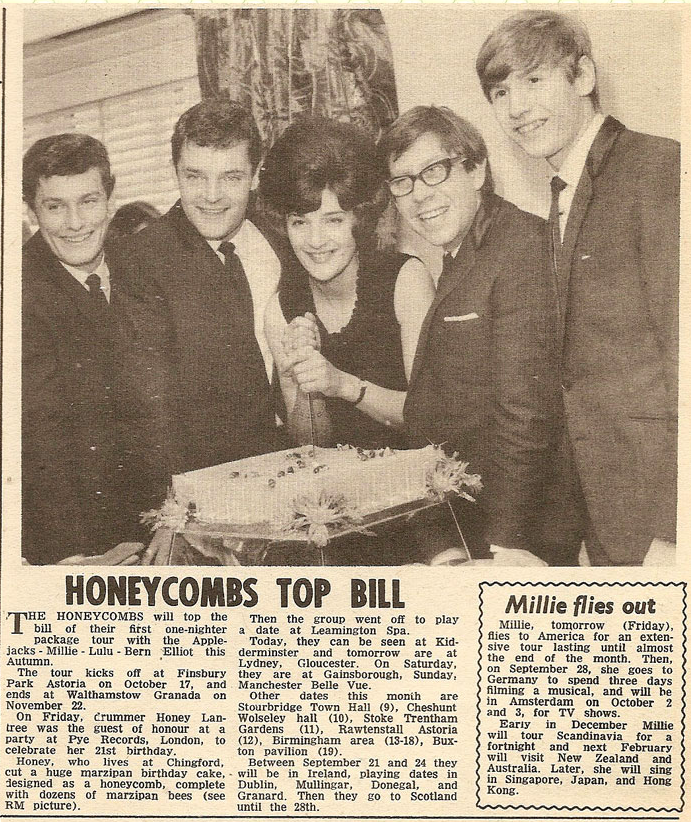

Of course, her gender also ensured that most of the coverage would focus on her appearance, with scant, if any mention of her musical talent.
Lantree was not the only member of the Honeycombs to find this galling.
As lead singer Denis D’Ell told the Record Mirror in 1965:
How can it be a gimmick just because we have a girl, Honey, on drums? Honey plays with us purely and simply because she is the right drummer for the job. If she wasn’t any good, she wouldn’t hold down the job.
On tour, we don’t have any troubles by having a girl with us. We just operate as a group. Perhaps it is that the novelty has worn off — we hope that fans soon will forget all about this so-called gimmick.
The following year, he quit, along with lead guitarist Alan Ward and Peter Pye, who had replaced Murray on rhythm guitar. Lantree and her brother, Honeycombs’ bassist John, soldiered on with new personnel until the 1967 death of producer Joe Meek.
Still, for a brief period, the Honeycombs’ recordings, tours, television appearances, and yes, press coverage made Lantree the most famous female drummer in the world.
Admittedly, the field was not particularly crowded. Just challenging in ways that outstripped the disproportionate focus on figures, boyfriends, and beauty tips.
Male fans dragged Lantree offstage during a concert in Cornwall, leading her to remark, “You expect this sort of thing but it’s still terrifying.”
Around the same time, another British band, the all-female Liverbirds, were invited to cross the pond for a coveted gig in Las Vegas…provided they’d play it topless. “Can you imagine me on the drums playing topless,” Sylvia Saunders, who shortly thereafter was forced to choose between the drums and a high risk pregnancy, gasped.
Although she is said to have inspired a number of young female musicians, including Karen Carpenter, Lantree, who died in 2018 at the age of 75, rarely shows up on curated lists of notable female drummers.
In a strange way, that spells progress — there are many more female drummers today than there were in the mid 60s, and mercifully more opportunities for them to be taken seriously as musicians.
Related Content
Meet the Liverbirds, Britain’s First Female (and Now Forgotten) Rock Band
The Woman Who Invented Rock n’ Roll: An Introduction to Sister Rosetta Tharpe
New Web Project Immortalizes the Overlooked Women Who Helped Create Rock and Roll in the 1950s
- Ayun Halliday is the Chief Primatologist of the East Village Inky zine and author, most recently, of Creative, Not Famous: The Small Potato Manifesto. Follow her @AyunHalliday.
Read More...Support Us
We're hoping to rely on loyal readers, rather than erratic ads. Please click the Donate button and support Open Culture. You can use Paypal, Venmo, Patreon, even Crypto! We thank you!

About Us

Open Culture scours the web for the best educational media. We find the free courses and audio books you need, the language lessons & educational videos you want, and plenty of enlightenment in between.
Advertise With Us
FREE UPDATES!
GET OUR DAILY EMAIL
Get the best cultural and educational resources on the web curated for you in a daily email. We never spam. Unsubscribe at any time.
FOLLOW ON SOCIAL MEDIA
Open Culture editor Dan Colman scours the web for the best educational media. He finds the free courses and audio books you need, the language lessons & movies you want, and plenty of enlightenment in between.
Advertise With Us


