Hear the Best of Angelo Badalamenti (RIP) from 1986–2017: Features Music from David Lynch’s Blue Velvet, Twin Peaks & More
The late Angelo Badalamenti composed music for singers like Marianne Faithfull and Nina Simone, for movies like The City of Lost Children and National Lampoon’s Christmas Vacation, and even for the 1992 Olympics in Barcelona. But of all his musical work, no piece is more likely to begin playing in our minds at the mention of his name than the theme from Twin Peaks, the ABC series that both mystified and enraptured audiences in the early nineteen-nineties. Looking back, one would expect anything less from a prime-time show co-created by David Lynch. And though Twin Peaks’ initial run would come to only three seasons, Lynch and Badalamenti’s collaboration would continue for decades thereafter.
It was with his work for Lynch, in fact, that Badalamenti first broke through as a film composer: 1986’s Blue Velvet may have established Lynch as America’s foremost popular “art house” auteur, but it also introduced its viewers the world over to the seductive and unsettling beauty of Badalamenti’s music.
That film’s song “Mysteries of Love” (with its Lynch-penned lyrics sung by Julee Cruise, who also died this year) comes early in the chronological best-of-Badalamenti Youtube playlist embedded above. Spanning the years 1986 through 2017, it also includes music from such motion pictures as Cousins, Holy Smoke!, The Beach, Cet amour-là, and The Edge of Love.
The bulk of the playlist’s selections, however, were composed for Lynch. You’ll hear music from Wild at Heart, The Straight Story, Mulholland Dr. (a film featuring a brief but memorable appearance by Badalamenti himself), and of course, Twin Peaks — not just the original series and the 1992 movie Fire Walk with Me, but also the 2017 continuation Twin Peaks: The Return, for which Badalamenti returned as composer. In all these eras, his work sounded distinctive, somehow traditional, unconventional, earnest, and ironic all at once — a mixture that could hardly have been better suited to the Lynchian sensibility. And so it is with a thoroughly Lynchian salute, in the middle of one of his daily weather reports, that the man himself sends Badalamenti off.
Related Content:
Angelo Badalamenti Reveals How He and David Lynch Composed the Twin Peaks‘ “Love Theme”
Get a First Listen to David Lynch & Angelo Badalamenti’s Long-Lost Album, Thought Gang
Hear the Music of David Lynch’s Twin Peaks Played by the Danish National Symphony Orchestra
Based in Seoul, Colin Marshall writes and broadcasts on cities, language, and culture. His projects include the Substack newsletter Books on Cities, the book The Stateless City: a Walk through 21st-Century Los Angeles and the video series The City in Cinema. Follow him on Twitter at @colinmarshall or on Facebook.
Read More...Hear Neil Gaiman Read A Christmas Carol Just Like Charles Dickens Read It

In Christmases past, we featured Charles Dickens’ hand-edited copy of his beloved 1843 novella A Christmas Carol. He did that hand editing for the purposes of giving public readings, a practice that, in his time, “was considered a desecration of one’s art and a lowering of one’s dignity.” That time, however, has gone, and many of the most prestigious writers alive today take the reading aloud of their own work to the level of art, or at least high entertainment, that Dickens must have suspected one could. Some writers even do a bang-up job of reading other writers’ work: modern master storyteller Neil Gaiman gave us a dose of that when we featured his recitation of Lewis Carroll’s “Jabberwocky” from memory. Today, however, comes the full meal: Gaiman’s telling of A Christmas Carol straight from that very Dickens-edited reading copy.
Gaiman read to a full house at the New York Public Library, an institution known for its stimulating events, holiday-themed or otherwise. But he didn’t have to hold up the afternoon himself; taking the stage before him, BBC researcher and The Secret Museum author Molly Oldfield talked about her two years spent seeking out fascinating cultural artifacts the world over, including but not limited to the NYPL’s own collection of things Dickensian. You can hear both Oldfield and Gaiman in the recording below. But perhaps the greatest gift of all came in the form of the latter’s attire for his reading: not only did he go fully Victorian, he even went to the length of replicating the 19th-century literary superstar’s own severe hair part and long goatee. And School Library Journal has pictures. The story really gets started around the 11:00 mark. Gaiman’s reading will be added to our list of Free Audio Books. You can find the text of Dickens’ classic here.
Note: An earlier version of this post appeared on our site in December 2014.
Related Content:
An Oscar-Winning Animation of Charles Dickens’ Classic Tale, A Christmas Carol (1971)
Charles Dickens’ Hand-Edited Copy of His Classic Holiday Tale, A Christmas Carol
Hear Charles Dickens’ A Christmas Carol Read by His Great-Granddaughter, Monica
Based in Seoul, Colin Marshall writes and broadcasts on cities, language, and culture. His projects include the Substack newsletter Books on Cities, the book The Stateless City: a Walk through 21st-Century Los Angeles and the video series The City in Cinema. Follow him on Twitter at @colinmarshall or on Facebook.
Read More...The Museum of Wonky English, a Japanese Exhibition Dedicated to Hilarious Mistranslations
I got hooked on Duolingo a few years ago. Since then, I’ve used it daily to practice languages like French, Spanish, Finnish, Chinese, and Japanese. But none of those courses is quite as popular with as many users as the one for English, which is widely spoken around the world — and, inevitably, almost as widely misspoken around the world. Even non-English-speaking countries tend to put up some English-language signage, sparse and strange though it can often be: a handwritten grocer’s sign warning customers not to “finger the peaches”; a notice mounted just above a urinal that urges visitors to “please urinate with precision and elegance.”

These examples come, unsurprisingly, from Japan, whose awkward but vividly memorable written English has long circulated in Western media. That made Tokyo the ideal location for the Museum of Wonky English, a pop-up collaboration between Duolingo Japan and creative agency UltraSuperNew that, as the latter’s site describes it, exhibits “sixteen of the best examples of wonky English found all over Japan.”
When “visitors look at the signs, menus, clothes, and other objects exhibited in the museum — objects that can make them chuckle, gasp, think, and reflect — they will notice there’s more depth to wonky English than they initially thought and become more emboldened to learn a foreign language.”

You can still see some of the Museum of Wonky English’s prized linguistic artifacts in the promotional video above (which provides the original Japanese phrases from which these odd translations sprang), as well as in the pictures accompanying this Japanese-language article. “Please do not eat children and elderly.” “When coffee is gone. It’s over.” “Crap your hands.”
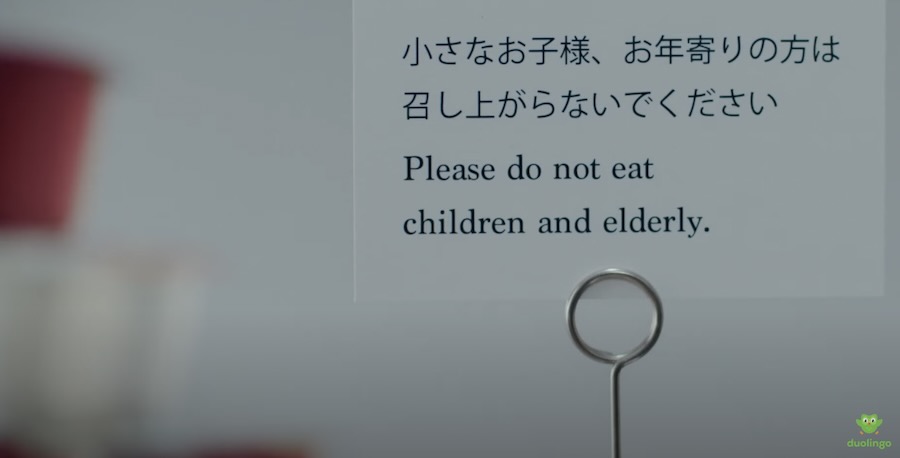
Though unidiomatic at best, these phrases and others exert a kind of power over the imagination. When closely scrutinized, they also illuminate the mechanics of the underlying Japanese language and its differences with English. And though the Museum of Wonky English was open for only a week, a run that ended last week, I can assure you — living, as I do, in Korea — that wonky English itself remains in rude health.

Related content:
Learn 48 Languages Online for Free: Spanish, Chinese, English & More
David Foster Wallace Breaks Down Five Common Word Usage Mistakes in English
“Weird Al” Yankovic Releases “Word Crimes,” a Grammar Nerd Parody of “Blurred Lines”
Based in Seoul, Colin Marshall writes and broadcasts on cities, language, and culture. His projects include the Substack newsletter Books on Cities, the book The Stateless City: a Walk through 21st-Century Los Angeles and the video series The City in Cinema. Follow him on Twitter at @colinmarshall or on Facebook.
Read More...How to Get Dressed & Fight in 14th Century Armor: A Reenactment
For a medieval knight, physical combat in a full suit of armor could hardly have been a simple matter — but then, nor could the task of putting it on in the first place. You can see the latter depicted in the video above from Norwegian history buff Ola Onsrud. He describes the armor as a “detailed reconstruction based on the effigy of the Black Prince (1330–1376) in the Canterbury Cathedral, other relevant effigies, paintings in fourteenth-century manuscripts and late fourteenth-century armor displayed in The Royal Armories in Leeds.” If you’ve so much as glanced at such imagery, Onsrud’s armor should strike you as looking quite like the real deal.
But this is functional clothing, after all, and as such must be put to the test. Onsrud does so in the video just below, a demonstration of how the wearer of such armor would actually do hand-to-hand combat. “To make comments, the visor of my helmet is open through most of the video,” he notes.
“This will of course make my face an interesting target for my adversary.” In a real medieval battle, of course, the helmet would be closed, and thus the combatants wouldn’t simply aim for the face. As Onsrud explains, the idea is to use one’s sword “against the weak spots of the armor. After finding a weak spot, I can put all my body weight behind it and drive it in.”
Medieval suits of armor turn out not to be as impenetrable as they look. Onsrud runs down a few of their major weak points, including the insides of the gloves, the armpits, and — most wince-inducingly of all — the groin. The defense capability of armor also varied depending upon the weapons used; even the best-suited-up had reason to fear an enemy with a poleaxe. “But the absolute best way to take down an armored knight is by using a lance from a horse,” especially a horse “galloping up to 40 kilometers an hour” whose combined weight with its rider could reach 700 kilograms. Surely even the most committed reenactor won’t do that on Youtube.
Related content:
How to Make and Wear Medieval Armor: An In-Depth Primer
What It’s Like to Actually Fight in Medieval Armor
How Well Can You Move in Medieval Armor?: Medievalist Daniel Jaquet Gives It a Try in Real Life
What’s It Like to Fight in 15th Century Armor?: A Surprising Demonstration
Based in Seoul, Colin Marshall writes and broadcasts on cities, language, and culture. His projects include the Substack newsletter Books on Cities, the book The Stateless City: a Walk through 21st-Century Los Angeles and the video series The City in Cinema. Follow him on Twitter at @colinmarshall or on Facebook.
Read More...The Disturbing Paintings of Hieronymus Bosch: A Short Introduction
Most casual viewers of Hieronymus Bosch’s paintings must acknowledge his artistic skill, and many must also wonder whether he was completely out of his mind. But insanity, however vividly suggested by his imagery, isn’t an especially compelling explanation for that imagery. Bosch painted in a particular place and time — the Netherlands of the late fifteenth and early sixteenth century, to be specific — but he also painted within a dominant worldview.“He grew up in a time of deep religious anxiety,” says Youtuber Hochelaga in the video essay above. “Ideas about sin, death, and the devil were becoming more sophisticated,” and “there was a genuine fear that demonic forces lived amongst the population.”
Hence the analyses like that of Great Art Explained, which frames Bosch’s best-known painting The Garden of Earthly Delights as an expression of “hardcore Christianity.” But something about the triptych’s sheer elaborateness and grotesquerie demands further inquiry. Hochelaga explores the possibility that Bosch worked in a condition of not just fearful piety, but psychological affliction.
“There is a disease called St. Anthony’s fire,” he says, contracted “by eating a poisonous black fungus called ergots that grow on rye crops. Symptoms include sores, convulsions, and a fierce burning sensation in limbs and extremities,” as well as “frightening and overpowering hallucinations that can last for hours at a time.”
This psychoactive power is now “believed to be behind the many Dancing Plagues recorded throughout the Middle Ages.” This explanation came together when, “in the mid-twentieth century, it was discovered that when ergots are baked in an oven, they transform into a form of lysergic acid diethylamide, also known as LSD.” Did Bosch himself receive the bizarre visions he painted from inadvertently consuming that now well-known hallucinogenic substance? The many paintings he made of St. Anthony “may have been a form of devotional prayer, done so in the hopes that the saint would rid him of his debilitating illness.” Look at The Garden of Earthly Delights even today, and you’ll feel that if you saw these murderous bird-human hybrids around you, you’d try whatever you could to get rid of them, too.
Related Content:
A Digital Archive of Hieronymus Bosch’s Complete Works: Zoom In & Explore His Surreal Art
The Meaning of Hieronymus Bosch’s The Garden of Earthly Delights Explained
New App Lets You Explore Hieronymus Bosch’s The Garden of Earthly Delights in Virtual Reality
Based in Seoul, Colin Marshall writes and broadcasts on cities, language, and culture. His projects include the Substack newsletter Books on Cities, the book The Stateless City: a Walk through 21st-Century Los Angeles and the video series The City in Cinema. Follow him on Twitter at @colinmarshall or on Facebook.
Read More...Behold a 15th-Century Italian Manuscript Featuring Medicinal Plants with Fantastical Human Faces
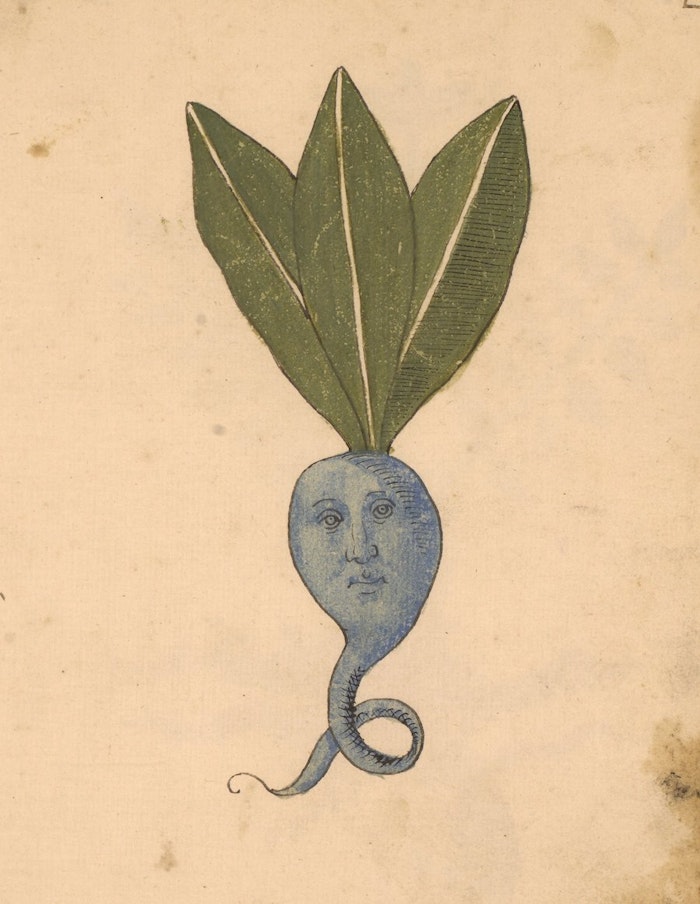
No matter where you may stand on herbal medicine as a viable 21st-century option, it’s not hard to imagine we’d have all been true believers back in the 15th-century.
In an article for Heart Views, cardiologist Rachel Hajar lists some common herbal treatments of the Middle Ages:
Headache and aching joints were treated with sweet-smelling herbs such as rose, lavender, sage, and hay. A mixture of henbane and hemlock was applied to aching joints. Coriander was used to reduce fever. Stomach pains and sickness were treated with wormwood, mint, and balm. Lung problems were treated with a medicine made of liquorice and comfrey. Cough syrups and drinks were prescribed for chest and head-colds and coughs.
If nothing else, such approaches sound rather more pleasant than bloodletting.
Monks were responsible for the study and cultivation of medicinal herbs.
You may recall how one of Friar Lawrence’s daily tasks in Romeo and Juliet involved venturing into the monastery garden, to fill his basket full “baleful weeds and precious-juicèd flowers.”
(The powerful sleeping potion he concocted for the young lovers may have had disastrous consequences, but no one can claim it wasn’t effective.)
Monks preserved their herbal knowledge in illustrated books and manuscripts, many of which cleaved closely to works of classical antiquity such as Pliny the Elder’s Naturalis Historia and Dioscordes’ De Materia Medica.
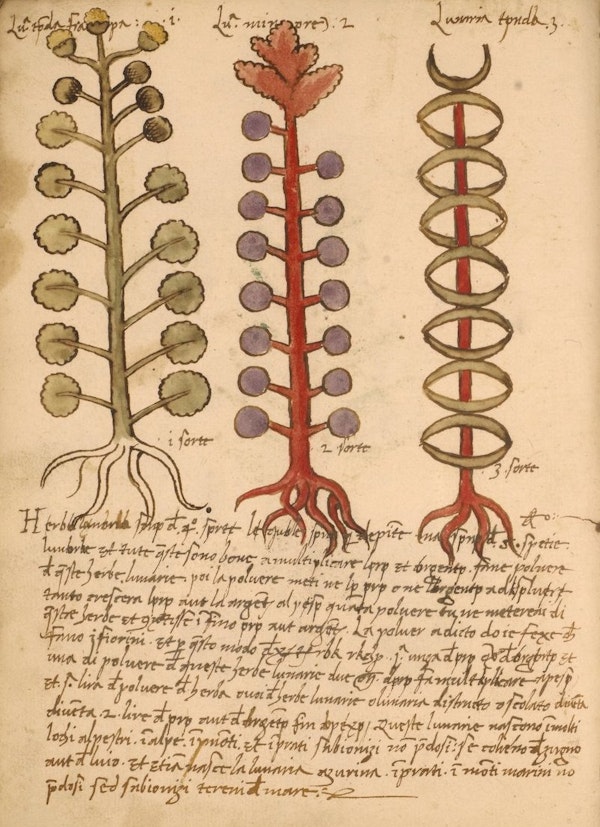
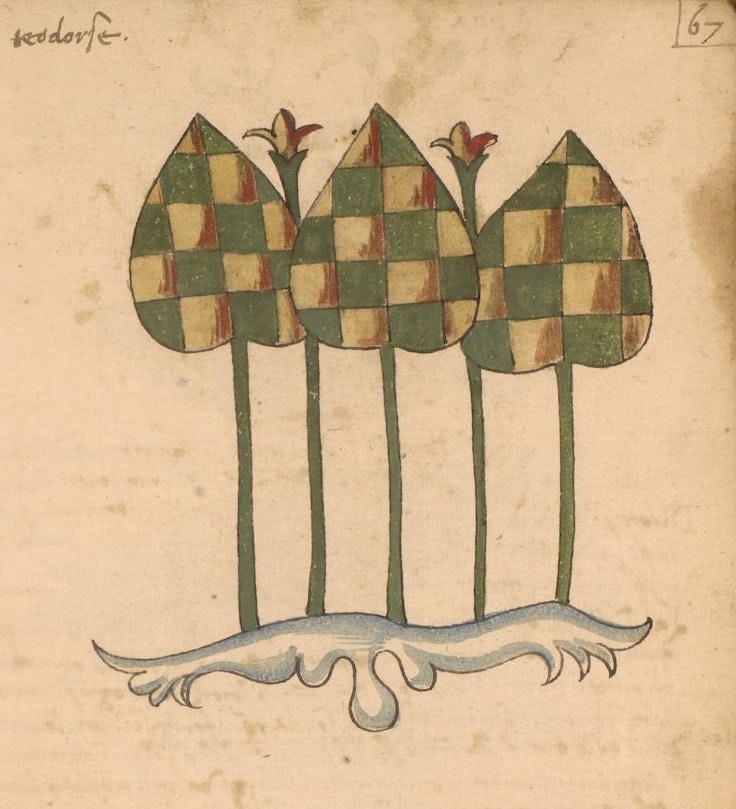
These early medical texts can still be appreciated as art, particularly when they contain fantastical embellishments such as can be seen in Erbario, above, a handmade 15th-century herbal from northern Italy that was recently added to the University of Pennsylvania Library’s collection of rare books and manuscripts.
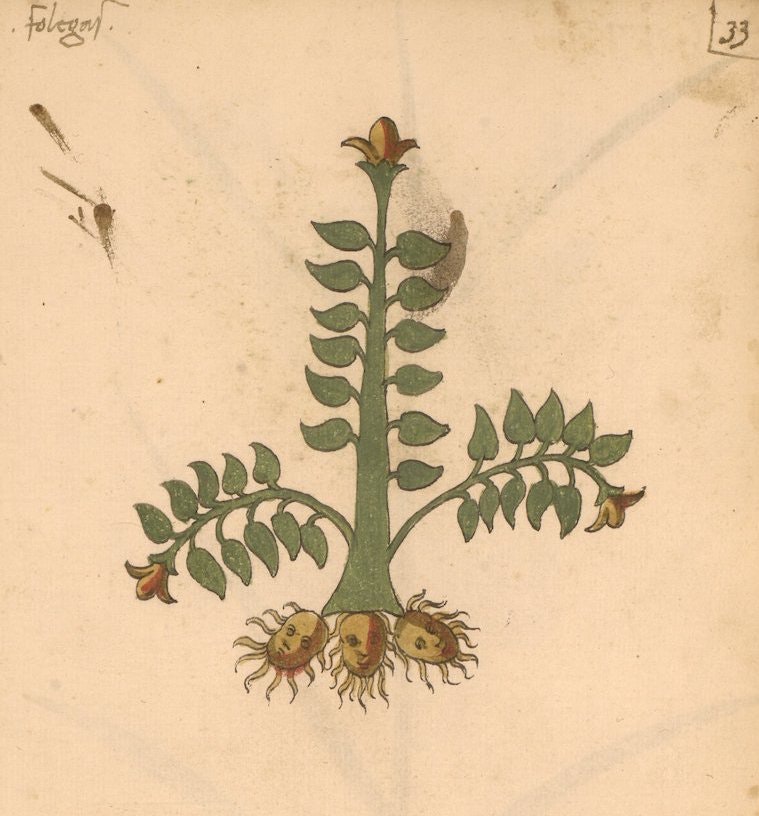
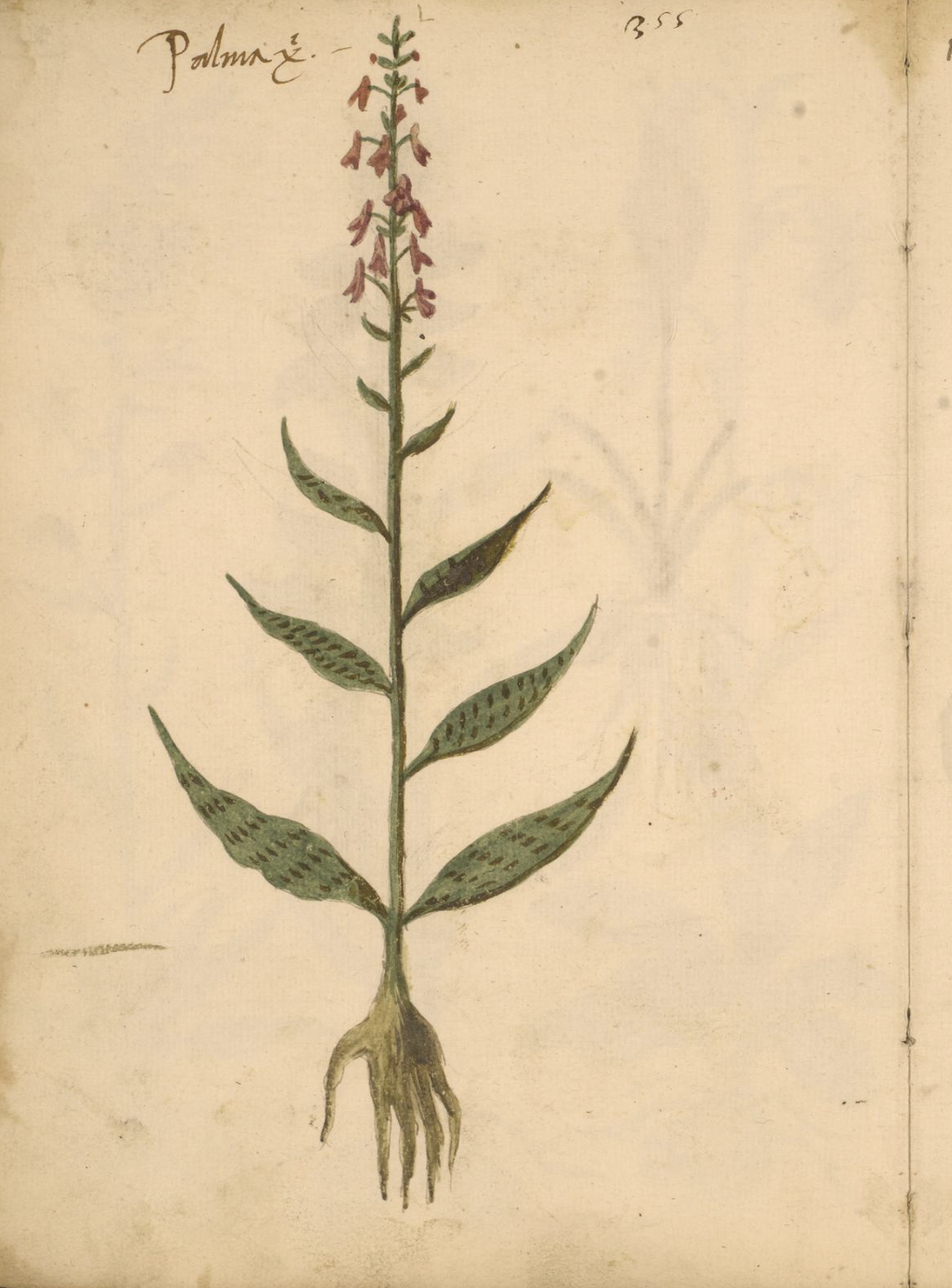
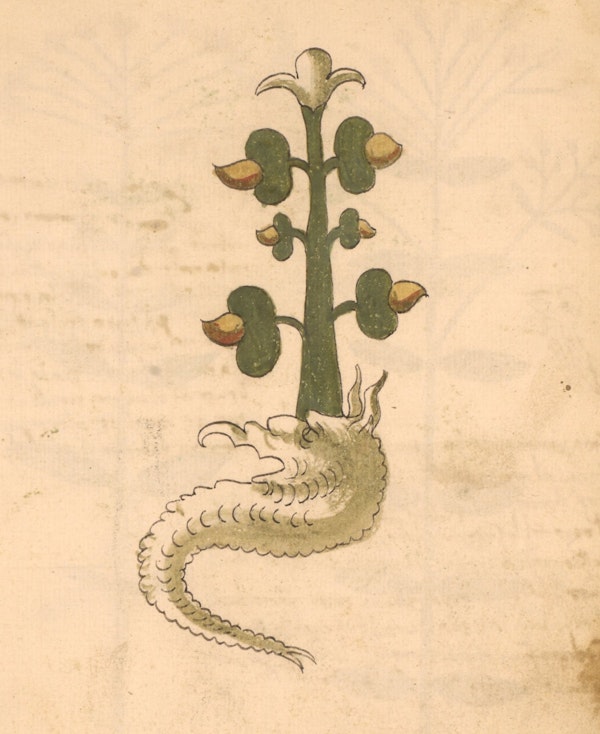
In addition to straightforward botanical illustrations, there are some roots, leaves, flowers and fruit (pardon the pronoun) of a decidedly anthropomorphic bent.
Fancying up drawings of plants with human faces and or dragon-shaped roots was a medieval convention.
Mandrake roots — prescribed as an anesthetic, an aphrodisiac, a fertility booster, and a sleep aid — were frequently rendered as humans.
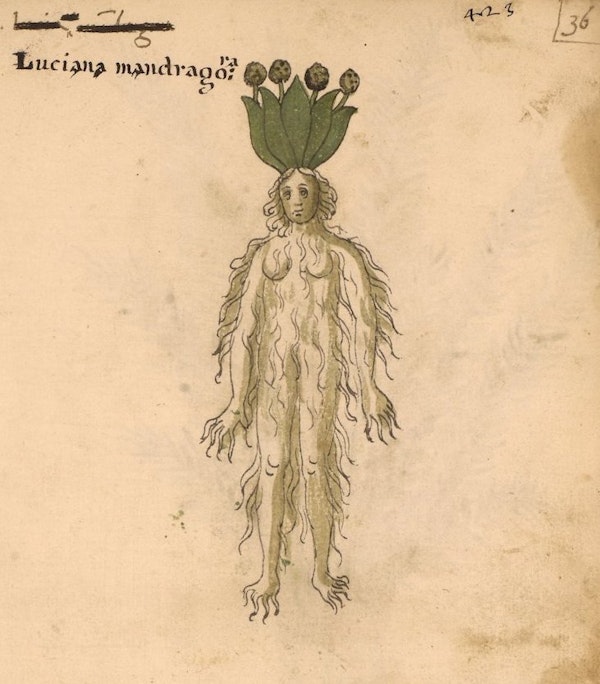
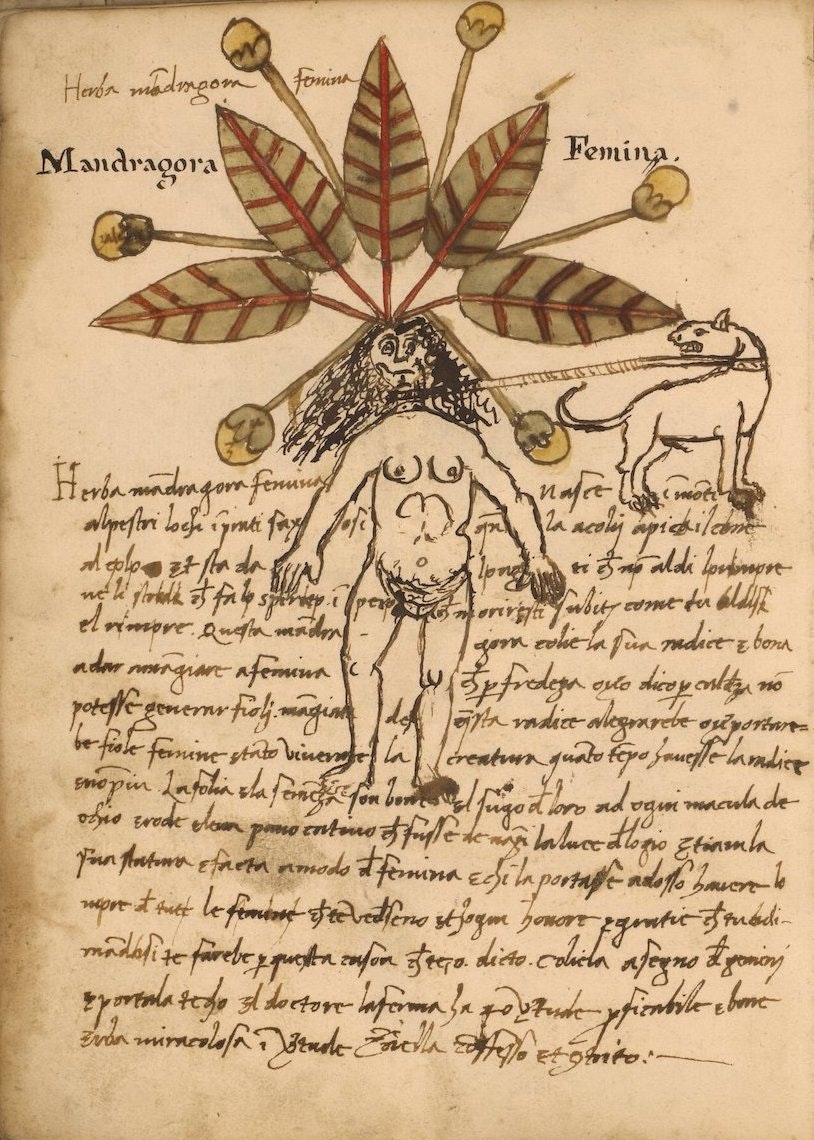
Wired’s Matt Simon writes that mandrake roots “can look bizarrely like a human body and legend holds that it can even come in male and female form:”
It’s said to spring from the dripping fat and blood and semen of a hanged man. Dare pull it the from the earth and it lets out a monstrous scream, bestowing agony and death to all those within earshot.
Yikes! Can we get a spoonful of sugar to help that go down?
No wonder Juliet, preparing to quaff Friar Lawrence’s sleeping potion in the family tomb, fretted that it might wear off prematurely, leaving her subject to “loathsome smells” and “shrieks like mandrakes torn out of the earth.”
Methinks some chamomile might have calmed those nerves…
View a digitized copy of Erbario here, or at the Public Domain Review.
Related Content
1,000-Year-Old Illustrated Guide to the Medicinal Use of Plants Now Digitized & Put Online
A Beautiful 1897 Illustrated Book Shows How Flowers Become Art Nouveau Designs
- Ayun Halliday is the Chief Primatologist of the East Village Inky zine and author, most recently, of Creative, Not Famous: The Small Potato Manifesto. Follow her @AyunHalliday.
Read More...How Qatar Built Stadiums with Forced Labor
I will let Vox preface the video above:
Ever since Qatar won the rights to host the FIFA World Cup in 2010, its treatment of migrant workers has made international headlines. News stories and human rights organizations revealed migrant workers who built the stadiums, hotels, and all the new infrastructure required for the World Cup were being forced to work, not getting paid, unable to leave, and in some cases, dying.
At the heart of the abuse faced by migrant workers is the kafala system. A system prevalent in Gulf states that ties workers to their sponsors, it often gives sponsors almost total control of migrant workers’ employment and immigration status.
Due to all the scrutiny Qatar has been under, some reforms have been put in place, but the kafala system is more than a law — it’s a practice. And while these reforms exist on paper, human rights organizations say there’s still a long way to go.
To understand how hundreds of thousands of migrant workers were stuck in an exploitative system while building the stadiums for the World Cup, watch our 10-minute video above.
To delve deeper, it’s also worth listening to the New York Times’ recent podcast, Qatar’s Big Bet on the World Cup and read The Guardian article, 6,500 migrant workers have died in Qatar since World Cup awarded.
If you would like to support the mission of Open Culture, consider making a donation to our site. It’s hard to rely 100% on ads, and your contributions will help us continue providing the best free cultural and educational materials to learners everywhere. You can contribute through PayPal, Patreon, and Venmo (@openculture). Thanks!
Read More...What Are “Creatives”? Pretty Much Pop #138 on the Role of the Artist in Modern Society

Is there really a division in today’s culture between those who create and the merely receptive masses? Your Pretty Much Pop host gathers three artists in different media about the place of the artist in society: sci-fi author Brian Hirt, art photographer and academic Amir Zaki, and musician/novelist/ex-English prof John Andrew Fredrick, who leads a band called The Black Watch.
We touch on art education, the self-understanding of artists, the relation between artist and consumer, art vs. commerce, bad art vs. non-art, and much more.
Listen to Amir talking about photography on a past PMP episode. Listen to John talk about his music with Mark on Nakedly Examined Music. Listen to John’s new EP. Brian brings up the Decoder Ring podcast episode “The Storytelling Craze.” Listen to Mark’s tunes.
Follow us @blackwatchmusic, @amir_zaki_, and @MarkLinsenmayer.
Hear more Pretty Much Pop. Support the show and hear bonus talking for this and nearly every other episode at patreon.com/prettymuchpop or by choosing a paid subscription through Apple Podcasts. This podcast is part of the Partially Examined Life podcast network.
Pretty Much Pop: A Culture Podcast is the first podcast curated by Open Culture. Browse all Pretty Much Pop posts.
Read More...Albert Camus’ Lessons Learned from Playing Goalie: “What I Know Most Surely about Morality and Obligations, I Owe to Football”
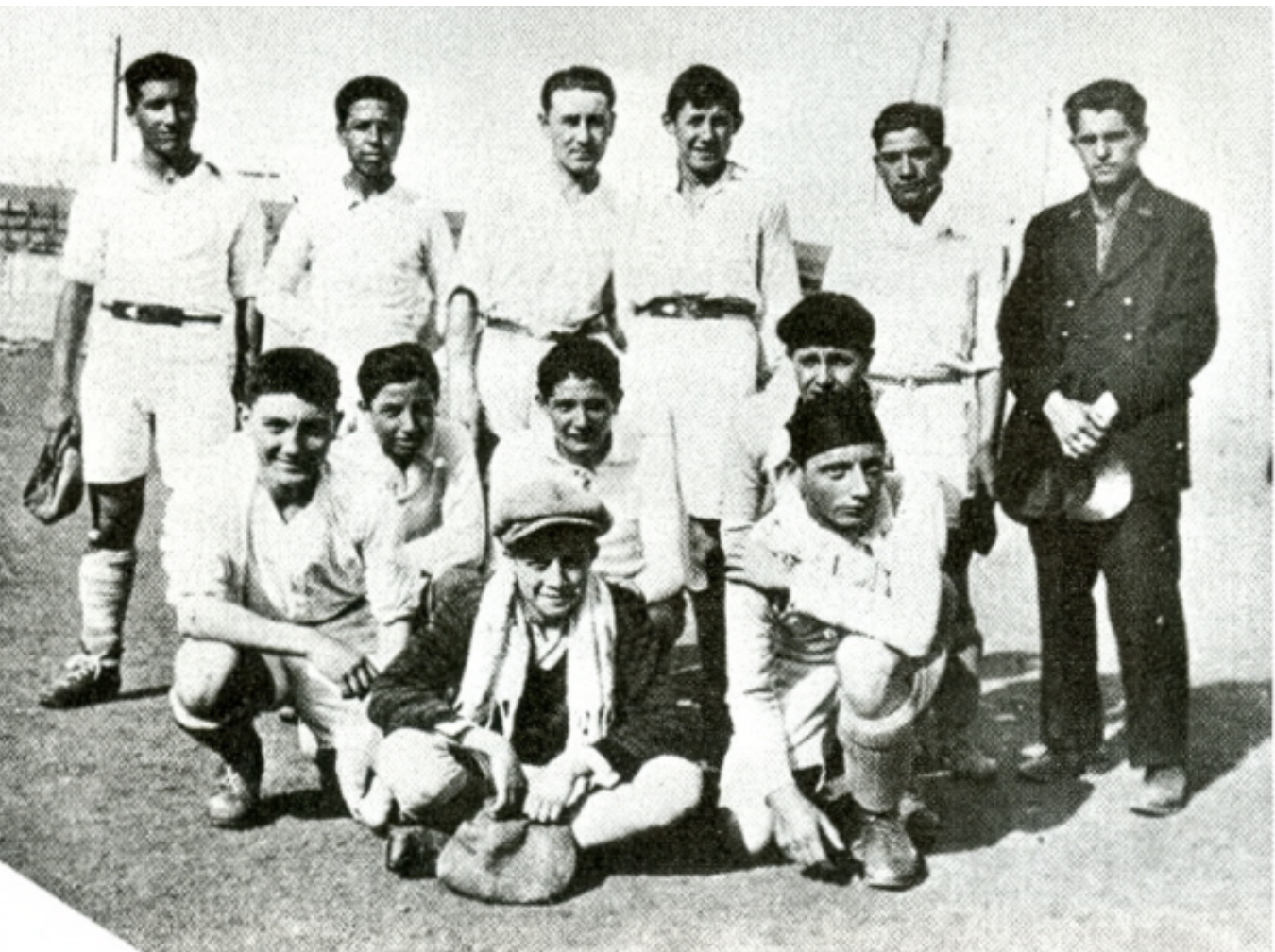
Here’s a vintage football [aka soccer] post in celebration of the World Cup…
Albert Camus once said, “After many years in which the world has afforded me many experiences, what I know most surely in the long run about morality and obligations, I owe to football.”
He was referring to his college days when he played goalie for the Racing Universitaire d’Alger (RUA) junior team. Camus was a decent player, though not the great player that legend later made him out to be.
For Jim White, author of A Matter of Life and Death: A History of Football in 100 Quotations, soccer perhaps taught Camus a few things about selflessness, cooperation, bravery and resilience. That’s a sunny way of looking at things. But perhaps The Telegraph gets at the deeper, darker life lessons Camus took away from soccer:
[T]here is something appropriate about a philosopher like Camus stationing himself between the sticks [that is, in goal]. It is a lonely calling, an individual isolated within a team ethic, one who plays to different constraints. If his team scores, the keeper knows it is nothing to do with him. If the opposition score, however, it is all his fault. Standing sentinel in goal, Camus had plenty of time to reflect on the absurdist nature of his position.
And perhaps the absurdist nature of life itself…
Camus — who appears in the picture up top, wearing the dark color jersey in the front row — contracted tuberculosis when he was only 18 years old. His lungs too damaged to continue playing sports, the young man turned to philosophy. When Camus moved from Algeria to France, he learned that philosophy was a rough and tumble game too — something his soccer days prepared him for. He once quipped, “I learned … that a ball never arrives from the direction you expected it. That helped me in later life, especially in mainland France, where nobody plays straight.”
If you would like to support the mission of Open Culture, consider making a donation to our site. It’s hard to rely 100% on ads, and your contributions will help us continue providing the best free cultural and educational materials to learners everywhere. You can contribute through PayPal, Patreon, and Venmo (@openculture). Thanks!
Related Content:
Why Jorge Luis Borges Hated Soccer: “Soccer is Popular Because Stupidity is Popular”
What is Albert Camus’ The Plague About? An Introduction
Video: The Day Bob Marley Played a Big Soccer Match in Brazil, 1980
Read More...How to Read Ancient Egyptian Hieroglyphs: A British Museum Curator Explains
If you want to learn to read hieroglyphics, you must first learn that (with apologies to the artists behind “You Never Knew”) there are no such things as hieroglyphics. There are only hieroglyphs, as the British Museum’s curator of ancient writing Ilona Regulski explains in the video just above, and hieroglyphic is the adjectival form. You may remember Regulski from another British Museum video we’ve featured here on Open Culture, about what the Rosetta Stone actually says — which she knows because she can actually read it, not just in the ancient Greek language, but in the ancient Egyptian one. Here, she explains how to interpret its once utterly mysterious symbols.
It would take an incurious viewer indeed not to be captivated by their first glimpse of hieroglyphs, which possess a kind of detail and beauty little seen in other writing systems. Or at least they do when carved into stone, Regulski explains; in more everyday contexts, the impressive arrangements of owls, ankhs, baskets, eyes, and bread loaves took on a more simplified, abstracted form.
Either way, it makes use of a complex and distinctive grammatical system about which we can draw a good deal of insight from examining a single inscription: in this case, an inscription on a lintel glorifying Amenemhat III, “one of the most famous kings of ancient Egypt.”
Those who feel their historical-linguistic curiosity piqued would do well to visit the British Museum’s current exhibition “Hieroglyphs: Unlocking Ancient Egypt,” which runs until February 19th of next year. If you can’t make it to London, you can still go a bit deeper with the video below. Drawn the Great Courses series “Decoding the Secrets of Egyptian Hieroglyphs,” it features Egyptologist Bob Brier’s breakdown of such relevant concepts as phonetics, determinatives, and ideograms, as well as guided exercises in sentence translation and name transliteration. After demonstrating admirable hieroglyphic penmanship (certainly compared to most moderns), Brier leaves us with a homework assignment — just the sort of thing the ancient Egyptians themselves were doing a few millennia ago.
Related content:
An Animated History of Writing: From Ancient Egypt to Modern Writing Systems
You Could Soon Be Able to Text with 2,000 Ancient Egyptian Hieroglyphs
What Ancient Egyptian Sounded Like & How We Know It
An Ancient Egyptian Homework Assignment from 1800 Years Ago: Some Things Are Truly Timeless
A 4,000-Year-Old Student ‘Writing Board’ from Ancient Egypt (with Teacher’s Corrections in Red)
Based in Seoul, Colin Marshall writes and broadcasts on cities, language, and culture. His projects include the Substack newsletter Books on Cities, the book The Stateless City: a Walk through 21st-Century Los Angeles and the video series The City in Cinema. Follow him on Twitter at @colinmarshall or on Facebook.
Read More...Support Us
We're hoping to rely on loyal readers, rather than erratic ads. Please click the Donate button and support Open Culture. You can use Paypal, Venmo, Patreon, even Crypto! We thank you!

About Us

Open Culture scours the web for the best educational media. We find the free courses and audio books you need, the language lessons & educational videos you want, and plenty of enlightenment in between.
Advertise With Us
FREE UPDATES!
GET OUR DAILY EMAIL
Get the best cultural and educational resources on the web curated for you in a daily email. We never spam. Unsubscribe at any time.
FOLLOW ON SOCIAL MEDIA
Open Culture editor Dan Colman scours the web for the best educational media. He finds the free courses and audio books you need, the language lessons & movies you want, and plenty of enlightenment in between.
Advertise With Us

