Some successful Hollywood producers spend their money on yachts, sports teams, and European castles. Norman Lear’s biggest purchase, or at least his most famous one, was a copy of the Declaration of Independence. He did not, of course, buy the kind of reproduction any tourist can pick up at the gift shop of a major American historic site, but a “Dunlap broadside,” one of 200 or so run off by Philadelphia printer John Dunlap on the very night of July 4th, 1776. After handing over $8.1 million in exchange for the document in 2001, Lear put it on tour, and it thereafter made years of public appearances all around the country, including at the 2002 Olympics, Super Bowl XXXVI, and the Live 8 concert in the city where it was made.
Lear’s purchase also inspired a film, as it might well do for any man with his connections. Co-produced by Lear and the late Rob Reiner, another Hollywood enthusiast of American politics, the 2001 short at the top of the post captures a dramatic reading of the Declaration of Independence by a lineup of big stars of the day, including the likes of Michael Douglas, Winona Ryder, Edward Norton, Renée Zellweger, and Benicio del Toro.
Their performances were all shot together at Independence Hall in Philadelphia by Conrad Hall, the famed cinematographer of Cool Hand Luke, Butch Cassidy and the Sundance Kid, Marathon Man, and American Beauty, on July 4, 2001.
These 25 years later, the film remains an invigorating refresher on what the Declaration of Independence actually says. Don’t think of it as the next best thing to reading that hallowed document: as Morgan Freeman tells us in his introduction, Thomas Jefferson “intended for the declaration to be performed, and not just read. Its words and rhythms were written to be spoken, in proud and defiant tones in grand public places.” His fellow thespians deliver them with the aplomb of a country that understood itself as supreme in the world, though one does now feel a certain irony in their speaking in the mid-summer of 2001, just months before that confidence would be terribly shaken. American history, it turned out, had not yet ended; even now, on the 250th anniversary of the United States’ independence, it may have just barely begun.
Based in Seoul, Colin Marshall writes and broadcasts on cities, language, and culture. He’s the author of the newsletterBooks on Cities as well as the books 한국 요약 금지 (No Summarizing Korea) and Korean Newtro.Follow him on the social network formerly known as Twitter at @colinmarshall.
Mortimer J. Adler rose to cultural prominence in the mid-twentieth-century United States, not that a figure like him could have done so in any other place or time. A haphazard professional and intellectual path involving copy-boy work at the New YorkSun, night school, and an incomplete Columbia degree eventually led to a faculty position teaching philosophy of law at the University of Chicago. In 1945, he commenced work on what would become the Great Books of the Western World, a 54-volume set published by Encyclopædia Britannica including the works of everyone from Homer to Virgil to Darwin to Hemingway. Sold door-to-door, it became an unlikely success by the early nineteen-sixties, and for a time it was a fairly common, if bookshelf-dominating, sight in the aspirational homes of suburban America.
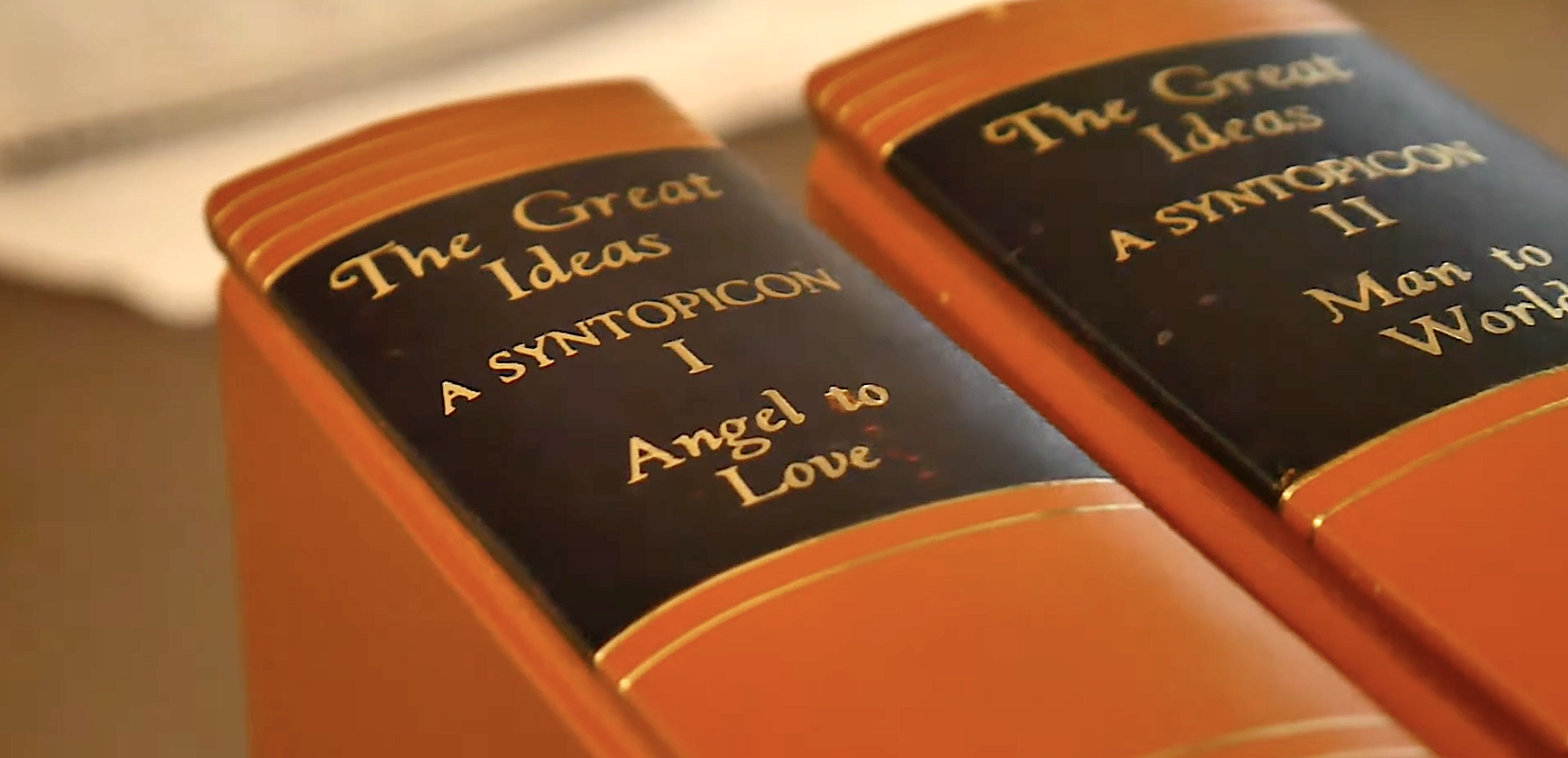
How many of those families regularly pulled their Great Books off the shelf is another matter. Despite having come through an intensive process of curation, they could still look rather imposing as the wall of knowledge they formed all together. To this problem, Adler offered a characteristically ambitious and idiosyncratic solution: a concept-oriented index called the Syntopicon — or rather, “A Syntopicon.”
“He believed these two volumes to be just the ‘assistance’ that the average man needed to dig into the books that formed Western Civilization,” writes Jonathan White, an alumnus of the similarly Western canon-based St. John’s College. They “comprised an exhaustive catalogue of each time one of the 102 ‘Great Ideas of Western Civilization’ was mentioned in the 431 ‘Great Books’ enshrined in Britannica’s collection.”
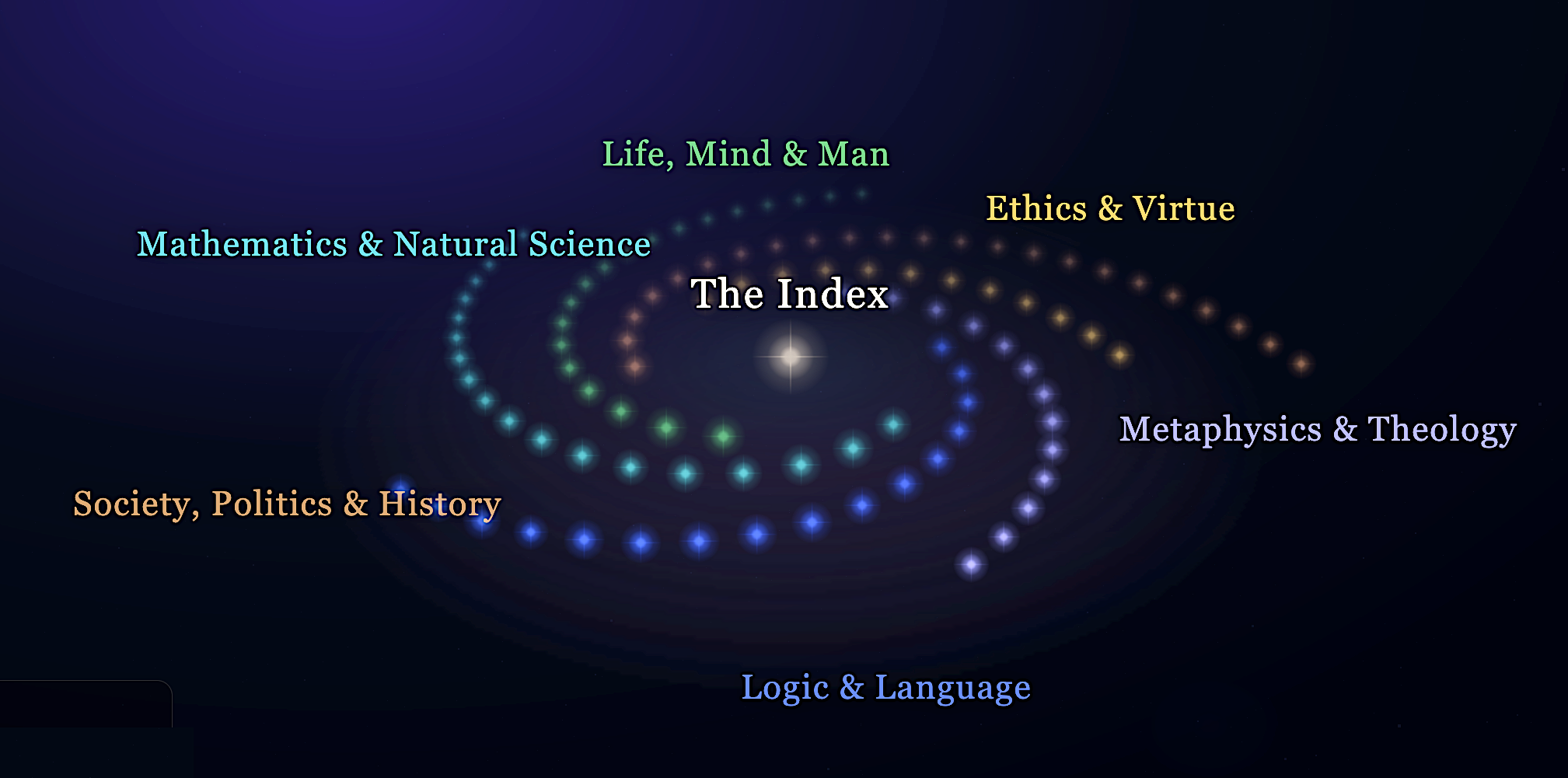
Good and evil, logic and love, pleasure and pain, universal and particular: all the big ideas, at least as Adler defined them, were there in A Syntopicon. Customers reportedly found it unwieldy, but the notion behind it holds out a certain appeal still today. It’s even inspired the launch of Syntopi.com, a digital successor that enables you to navigate “the Great Conversation” in a variety of ways including a 3D visualization and a personal curriculum-creation tool. The Great Books of the Western World’s mid-century readers — professionals and businessmen looking to fill the gaps in their general knowledge, veterans ready to learn more after their G.I. Bill-funded college education, housewives hoping to get a handle on what intelligent people were supposed to know about — could have had fun with it. And we could benefit, no doubt, from rediscovering a little of their earnestly self-improving spirit ourselves. You can view an edition of A Syntopicon on the Internet Archive, or this site.
Based in Seoul, Colin Marshall writes and broadcasts on cities, language, and culture. He’s the author of the newsletterBooks on Cities as well as the books 한국 요약 금지 (No Summarizing Korea) and Korean Newtro.Follow him on the social network formerly known as Twitter at @colinmarshall.
As Bangkok rises into the ranks of the world’s great culinary destination cities, its restaurant scene caters to ever more well-heeled travelers. There, you can now visit establishments with not just one, and not just two, but three Michelin stars. Even so, many a Bangkok habitué will surely tell you that the city’s best food is still served in the same humble places as always, or at least whose rent hasn’t been hiked too badly. Even in as hipsterized an area as Ekkamai Road, though, some have been around long enough to own their real estate. Take Wattana Panich, which has been serving beef noodle soup in its own building for more than 50 years — and indeed, using the same broth the whole time.
You can have a look at the process in the Great Big Story video at the top of the post. “Forever soup, also known as perpetual stew or hunter’s pot, is enjoying a moment as adventurous cooks and intrepid diners rediscover the old method in which a broth can simmer for weeks, months or even years,” writes Shan Li in a recent Wall Street Journal article.
Third-generation Wattana Panich owner Nattapong Kaweenuntawong “has tended the broth from morning until night since gaining custody two decades ago. By day, it bubbles in a giant stainless-steel pot about 5 feet across and one foot deep, encased in lava-like concrete and heated by gas. He tweaks the flavor by adding fresh ingredients, including fish sauce, soy sauce, chunks of beef and sachets of Chinese herbs.”
Perhaps you feel you can taste it already. But its regular visitors may insist that you’ll never really know the flavor of the shop’s eponymous broth, continuously refined while being rolled over night after night for five decades, until you try it for yourself. The prospect may put certain Westerners, uncomfortable consuming even last night’s leftovers, ill at ease. But they should rest assured that the solid ingredients are always fresh. It’s just the broth itself, rigorously strained each night and boiled each day, that has been kept in use, tying the establishment to its own past in the same manner as its inherited ownership. As with any family business, of course, each generation gets completely displaced sooner or later, just as every molecule of “forever soup” at one time will, in theory, have been consumed by some later time. Is the broth Wattana Panich uses today really identical to the one it started with in 1974? That’s a philosophical question best saved for after the meal.
Based in Seoul, Colin Marshall writes and broadcasts on cities, language, and culture. He’s the author of the newsletterBooks on Cities as well as the books 한국 요약 금지 (No Summarizing Korea) and Korean Newtro.Follow him on the social network formerly known as Twitter at @colinmarshall.
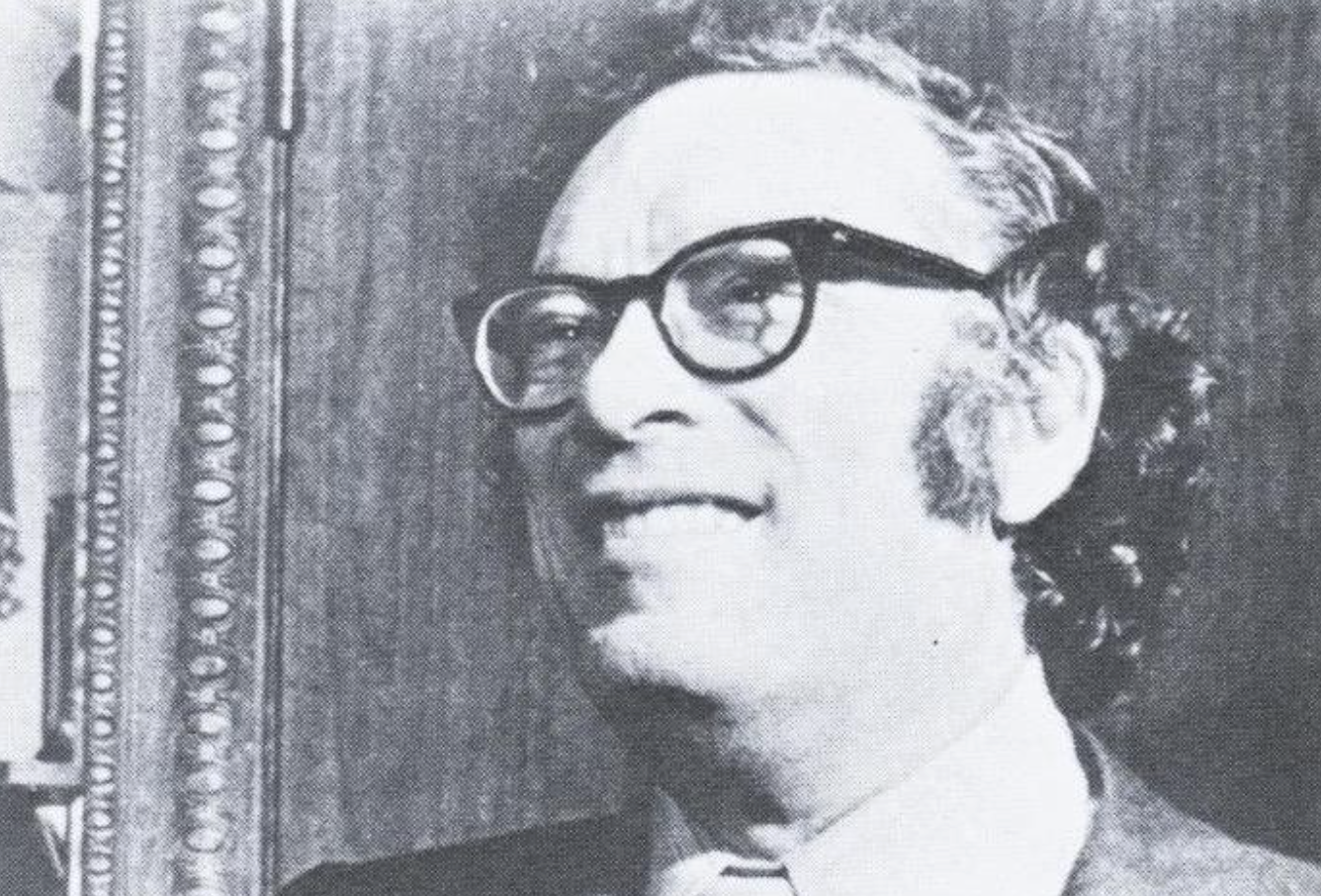
In 1980, scientist and writer Isaac Asimov argued in an essay that “there is a cult of ignorance in the United States, and there always has been.” That year, the Republican Party stood at the dawn of the Reagan Revolution, which initiated a decades-long conservative groundswell. Political strategist Steve Schmidt (who has been regretful about choosing Sarah Palin as John McCain’s running mate in 2008) once pointed to what he called “intellectual rot” as a primary culprit, and a cult-like devotion to irrationality among a certain segment of the electorate.
It’s a familiar contention. There have been critiques of American anti-intellectualism since the country’s founding, though whether or not that phenomenon has intensified, as Susan Jacoby alleged inThe Age of American Unreason, may be a subject of debate. Not all of the unreason is partisan, as failures to challenge human- and AI-generated misinformation in political news sources and social media outlets over recent years have shown. But “the strain of anti-intellectualism,” writes Asimov, “has been a constant thread winding its way through our political and cultural life, nurtured by the false notion that democracy means that ‘my ignorance is just as good as your knowledge.’”
Asimov’s primary examples happen to come from the political world. However, he doesn’t name contemporary names but reaches back to take a swipe at Eisenhower (“who invented a version of the English language that was all his own”) and George Wallace. Particularly interesting is Asimov’s take on the “slogan on the part of the obscurantists: ‘Don’t trust the experts!’” This language, along with charges of “elitism,” Asimov wryly notes, is so often used by people who are themselves experts and elites, “feeling guilty about having gone to school.” So many of the American political class’ wounds are self-inflicted, he suggests, but that’s because they are beholden to a largely ignorant electorate:
To be sure, the average American can sign his name more or less legibly, and can make out the sports headlines—but how many nonelitist Americans can, without undue difficulty, read as many as a thousand consecutive words of small print, some of which may be trisyllabic?
Asimov’s examples are less than convincing: road signs “steadily being replaced by little pictures to make them internationally legible” has more to do with linguistic diversity than illiteracy, and accusing television commercials of speaking their messages out loud instead of using printed text on the screen seems to fundamentally misunderstand the nature of the medium. Jacoby in her book-length study of the problem looks at educational policy in the United States, and the resistance to national standards that virtually ensures widespread pockets of ignorance all over the country. Asimov’s very short, pithy essay has neither the space nor the inclination to conduct such analysis.
Instead he is concerned with attitudes. Not only are many Americans badly educated, he writes, but the broad ignorance of the population in matters of “science… mathematics… economics… foreign languages…” has as much to do with Americans’ unwillingness to read as their inability.
There are 200 million Americans who have inhabited schoolrooms at some time in their lives and who will admit that they know how to read… but most decent periodicals believe they are doing amazingly well if they have circulation of half a million. It may be that only 1 per cent—or less—of Americans make a stab at exercising their right to know. And if they try to do anything on that basis they are quite likely to be accused of being elitists.
One might in some respects charge Asimov himself of elitism when he concludes, “We can all be members of the intellectual elite.” Such a blithely optimistic statement ignores the ways in which economic elites actively manipulate education policy to suit their interests, cripple education funding, and oppose efforts at free or low cost higher education. Many efforts at spreading knowledge—like the Chautauquas of the early 20th century, the educational radio programs of the 40s and 50s, and the public television revolution of the 70s and 80s—have been ad hoc and nearly always imperiled by funding crises and the designs of profiteers.
Nonetheless, the widespread (though hardly universal) availability of free resources on the internet has made self-education a reality for many people, and certainly for most Americans. But perhaps not even Isaac Asimov could have foreseen the bitter polarization and disinformation campaigns that technology has also enabled. Needless to say, “A Cult of Ignorance” was not one of Asimov’s most popular pieces of writing. First published on January 21, 1980 in Newsweek, the short essay has never been reprinted in any of Asimov’s collections.
Note: An earlier version of this post appeared on our site in 2016.
Most of our conception of Stoicism, an ancient school of thought much featured here on Open Culture, derives from the writings of just three figures: Epictetus, Marcus Aurelius, and Seneca the Younger. But there were other Stoics, and despite their antiquity, we may yet learn more about them. Take Chrysippus of Soli, who was officially known as the Second Founder of Stoicism due to his influence on its spread throughout the Greek and Roman world. What we know of his demanding work, we know because of references written on scrolls inadvertently preserved in a villa in Herculaneum when nearby Mount Vesuvius erupted in the year 79. To date, most of those “Herculaneum papyri” have been unreadable, but soon, thanks to technologies like X‑ray microtomography and artificial intelligence, that may change.
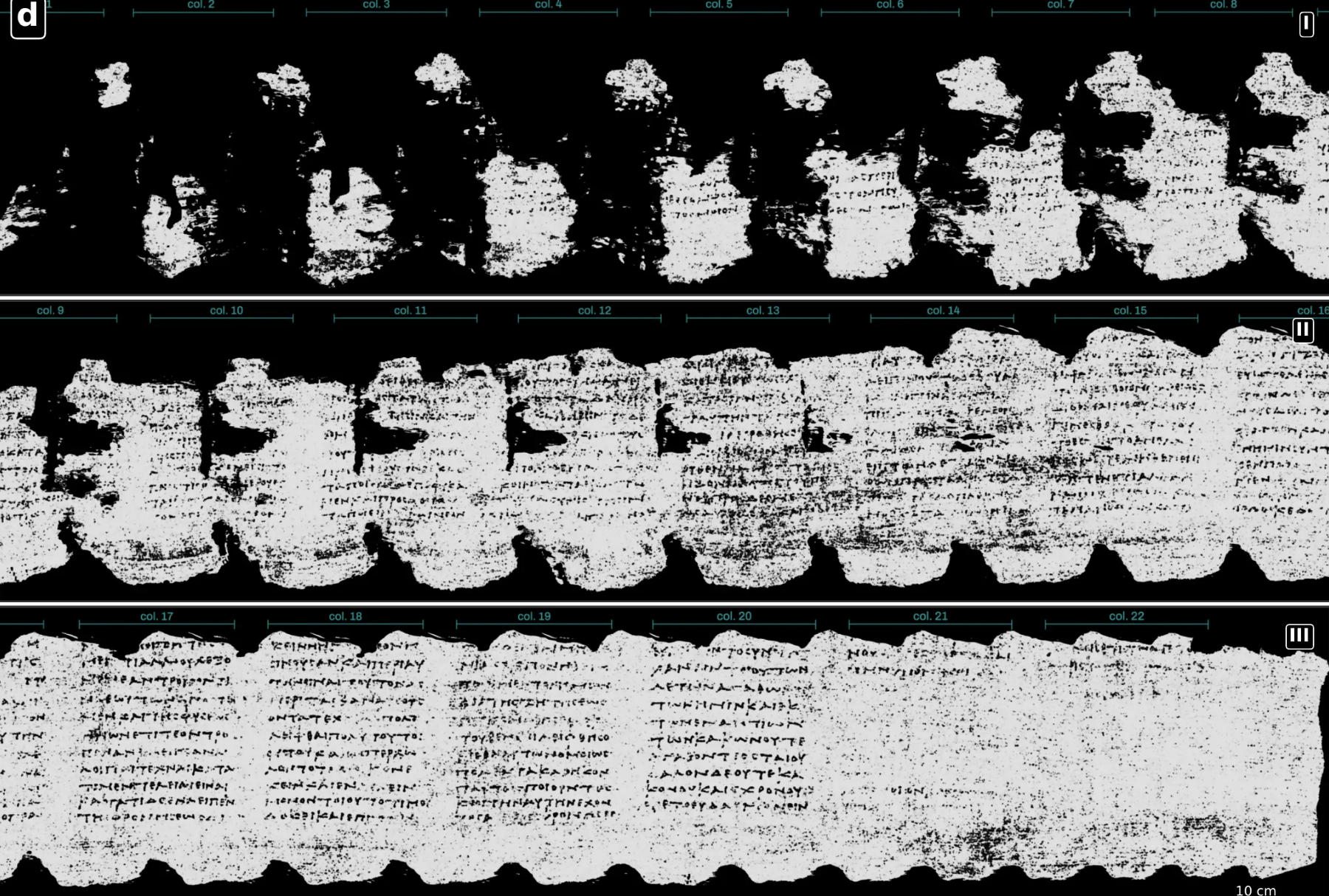
In 2023, we posted about the decoding of the first word of one such scroll, an achievement made with the incentive of prizes offered by a contest called the Vesuvius Challenge. Now, says its website, “we have completely virtually unwrapped and read PHerc. 1667 — the scroll the Vesuvius Challenge community knows as Scroll 4 — without ever touching its pages.”
What appears to be little more than a big hunk of charcoal, further damaged by several physical unrolling attempts in less technologically advanced times, turns out to be “a philosophical treatise on ethics, and the evidence points to a Stoic work: it turns on human nature, impulse, and the moral progress of human beings.” The scroll’s last preserved column even drops the name of Aristocreon, “nephew and disciple of the great Stoic Chrysippus,” suggesting it dates to the second century BC.
These collaborative efforts, both technological and intellectual, have made PHerc. 1667 “the first Herculaneum papyrus to be digitally unrolled and read in full, end to end, and made available for sustained scholarly study.” But there are also other texts still being deciphered, including PHerc. 139, which has been identified as “Philodemus, On Gods, Book 8 — a treatise by the Epicurean philosopher whose works fill so much of this library.” In their day, Stoicism and Epicureanism stood as similar but rival philosophies, and it seems that the owner of the so-called Villa of the Papyri (possibly Julius Caesar’s father-in-law) had an interest in both of them. Ancient Stoics and Epicureans carried on a lively debate about how to live, some of whose arguments were written down. If the necessary technologies continue to advance, perhaps we’ll one day be able to read them all and pick that conversation up right where they left it off. Learn more about the decoding of the papyrus here and here.
Based in Seoul, Colin Marshall writes and broadcasts on cities, language, and culture. He’s the author of the newsletterBooks on Cities as well as the books 한국 요약 금지 (No Summarizing Korea) and Korean Newtro.Follow him on the social network formerly known as Twitter at @colinmarshall.
When Eichmann in Jerusalem—Hannah Arendt’s book about Nazi officer Adolf Eichmann’s trial—came out in 1963, it contributed one of the most famous of post-war ideas to the discourse, the “banality of evil.” And the concept at first caused a critical furor. “Enormous controversy centered on what Arendt had written about the conduct of the trial, her depiction of Eichmann, and her discussion of the role of the Jewish Councils,” writes Michael Ezra at Dissent magazine, “Eichmann, she claimed, was not a ‘monster’; instead, she suspected, he was a ‘clown.’”
Arendt blamed victims who were forced to collaborate, critics charged, and made the Nazi officer seem ordinary and unremarkable, relieving him of the extreme moral weight of his responsibility. She answered these charges in an essay titled “Personal Responsibility Under Dictatorship,” published in 1964. Here, she aims to clarify the question in her title by arguing that if Eichmann were allowed to represent a monstrous and inhuman system, rather than shockingly ordinary human beings, his conviction would make him a scapegoat and let others off the hook. Instead, she believes that everyone who worked for the regime, whatever their motives, is complicit and morally culpable.
But although most people are culpable of great moral crimes, those who collaborated were not, in fact, criminals. On the contrary, they chose to follow the rules in a demonstrably criminal regime. It’s a nuance that becomes a stark moral challenge. Arendt points out that everyone who served the regime agreed to degrees of violence when they had other options, even if those might be fatal. Quoting Mary McCarthy, she writes, “If somebody points a gun at you and says, ‘Kill your friend or I will kill you,’ he is tempting you, that is all.”
While this circumstance may provide a “legal excuse,” for killing, Arendt seeks to define a “moral issue,” a Socratic principle she had “taken for granted” that we all believed: “It is better to suffer than do wrong,” even when doing wrong is the law. People like Eichmann were not criminals and psychopaths, Arendt argued, but rule-followers protected by social privilege. “It was precisely the members of respectable society,” she writes, “who had not been touched by the intellectual and moral upheaval in the early stages of the Nazi period, who were the first to yield. They simply exchanged one system of values against another,” without reflecting on the morality of the entire new system.
Those who refused, on the other hand, who even “chose to die,” rather than kill, did not have “highly developed intelligence or sophistication in moral matters.” But they were critical thinkers practicing what Socrates called a “silent dialogue between me and myself,” and they refused to face a future where they would have to live with themselves after committing or enabling atrocities. We must remember, Arendt writes, that “whatever else happens, as long as we live we shall have to live together with ourselves.”
Such refusals to participate might be small and private and seemingly ineffectual, but in large enough numbers, they would matter. “All governments,” Arendt writes, quoting James Madison, “rest on consent,” rather than abject obedience. Without the consent of government and corporate employees, the “leader… would be helpless.” Arendt admits the unlikely effectiveness of active opposition to a one-party authoritarian state. And yet when people feel most powerless, most under duress, she writes, an honest “admission of one’s own impotence” can give us “a last remnant of strength” to refuse.
We have only for a moment to imagine what would happen to any of these forms of government if enough people would act “irresponsibly” and refuse support, even without active resistance and rebellion, to see how effective a weapon this could be. It is in fact one of the many variations of nonviolent action and resistance—for instance the power that is potential in civil disobedience.
We have example after example of these kinds of refusals to participate in a murderous system or further its aims. Arendt was aware these actions can come at great cost. The alternatives, she argues, may be far worse.
Note: An earlier version of this post appeared on our site in 2017.
Ask anyone, of most any age and in most any society, how we get wood, and you’ll hear one answer: by cutting down trees. It’s therefore natural that any method of lumber production that leaves trees standing will get a lot of attention. Such has been the case with daisugi, the 600-year-old Japanese technique we’ve previously featured here on Open Culture. The Leaf of Life video above explains just what it involves: “Specially planted cedar trees are pruned heavily. Think of it as a giant bonsai.” While these operations take place biennially, “harvesting takes 20 years, and old tree stock grows up to 100 shoots at a time,” producing a stronger and more flexible wood to boot.
Such an unusual method of cultivation, you may imagine, must have arisen in unusual circumstances. As the video explains, daisugi was originally invented in the western Japanese region of Kitayama, well south of the Osaka-Kyoto-Nara conurbation.
Working under a shortage of seedlings and flat terrain, the arborists of Kitayama developed this method of foresting that made it possible to “reduce the number of plantations, make the harvest cycle faster, and produce denser wood as well.” More than a little of the demand for it owed to the fourteenth-century elite vogue for sukiya-zukuri, an elegant form of residential architecture much expanded from the traditional Japanese tea house.
For a more nuts-and-bolts — or rather, trunks-and-branches — explanation of how daisugi is done, have a look at the video just above from Roji Gardening. You first need a sugi tree, also known as a Cryptomeria japonica or Japanese redwood, whose fast growth makes it all work. When it reaches six or seven meters, which takes about as many years, “you do something Western gardeners would never dream of”: cut the trunk at the height of half a meter, prune back the remaining branches, and cultivate the buds that appear on the remaining “platform seeder.” Continue regularly pruning the series of “perfectly vertical” new trunks into which they grow, eventually removing everything but the top 30 centimeters on each. Within a decade, you’ll end up with a good source of wood, if you need it, but also an “ever-changing, interesting statement tree” — that, as a bonus, will also look like something out of a Ghibli movie.
If you would like to support the mission of Open Culture, consider making a donation to our site. It’s hard to rely 100% on ads, and your contributions will help us continue providing the best free cultural and educational materials to learners everywhere. You can contribute through PayPal, Patreon, and Venmo (@openculture). Thanks!
If you would like to support the mission of Open Culture, consider making a donation to our site. It’s hard to rely 100% on ads, and your contributions will help us continue providing the best free cultural and educational materials to learners everywhere. You can contribute through PayPal, Patreon, and Venmo (@openculture). Thanks!
Based in Seoul, Colin Marshall writes and broadcasts on cities, language, and culture. He’s the author of the newsletterBooks on Cities as well as the books 한국 요약 금지 (No Summarizing Korea) and Korean Newtro.Follow him on the social network formerly known as Twitter at @colinmarshall.
In summer of 1984, American popular culture was dominated by Ghostbusters, a blockbuster that combined sharp comedy and spectacular visual effects on a scale — and in an unlikely harmony — moviegoers had never seen before. Its great success advanced the careers of everyone involved, not least that of Bill Murray. Having already been an early (if not immediately beloved) Saturday Night Live cast member and given much-praised performances in comedies like Caddyshack, Stripes, and Tootsie, he brought his famously detached sensibility to the role of the ghost-busting Dr. Peter Venkman and thereby became the most in-demand comic actor in Hollywood. When, less than six months later, The Razor’s Edge opened with Murray in the starring role, fans bought tickets in hopes of more laughs.
It’s not as if they hadn’t been warned. The Razor’s Edge was adapted from a novel by W. Somerset Maugham, a popular writer in his day, but hardly a straightforward humorist. On the promotional circuit, Murray stressed that this was “a serious movie,” not a comedy but a drama. Nevertheless, both critics and audiences at the time had trouble accepting him in the role of Larry Darrell, a once-lighthearted young man who comes back from World War I overwhelmed by the need to venture back out into the world in search of the ultimate truths of existence. Murray was driven to make the film (for which he took pay only as co-screenwriter) out of the deep identification he felt with the character, which can only have intensified the sting of its failure.
That Larry was a fellow Chicagoan only explains part of the appeal. Murray’s thirtieth birthday, the birth of his first child, and the death of friends like Doug Kenney and John Belushi (who’s indirectly eulogized in the film) had put him in a reflective state of mind, while his growing wealth and fame brought personal and psychological challenges of their own. The prospect of exotic location shoots in Paris and the Himalayas, where Larry’s peripatetic seeking takes him, may have sweetened the deal. Revisited today, the result has plenty of memorable moments, some of them possessed of genuine beauty and grandeur. Alas, the story Maugham tells in the novel, rich with the subtleties of memory, perception, and deception, doesn’t survive the Hollywood tendencies toward over-compression and literal-mindedness.
It must be said that some of the blame lies with Murray himself, whose goofball instincts clash against the nineteen-twenties setting; as he later admitted, he and director John Byrum were wrong to insist on a period piece. (Just imagine the possibilities of Murray playing a returned Vietnam veteran instead.) Regardless, he continued to follow his inner Larry in the aftermath, decamping to Paris with his young family in order to live and learn far from the American scene he knew. It was there that he encountered the teachings of the mystic G. I. Gurdjieff, whose influence on Murray’s persona we’ve previously featured here on Open Culture. That marked another step along the path of experience that would lead him to play wiser, sadder, yet never entirely unfunny characters in pictures like Wes Anderson’s Rushmore and Sofia Coppola’s Lost in Translation — and, in so doing, win dramatic respectability after all.
Based in Seoul, Colin Marshall writes and broadcasts on cities, language, and culture. He’s the author of the newsletterBooks on Cities as well as the books 한국 요약 금지 (No Summarizing Korea) and Korean Newtro.Follow him on the social network formerly known as Twitter at @colinmarshall.
We’ve previously featured a series of remarkable little films of French artists Pierre-Auguste Renoir, Claude Monet and Edgar Degas. Here we wrap things up with just one more: a rare glimpse of the great sculptor Auguste Rodin.
The footage was taken in 1915, two years before Rodin’s death. There are several sequences. The first shows the artist at the columned entrance to an unidentified structure, followed by a brief shot of him posing in a garden somewhere. The rest of the film, beginning at the 53-second mark, was clearly shot at the palatial, but dilapidated, Hôtel Biron, which Rodin was using as a studio and second home.
The mansion was built as a private residence in the early 18th century, and served as a Catholic school for girls from 1820 until about 1904, when it became illegal for public money to be used for religious education. When the last of the nuns cleared out, the rooms of the Hôtel Biron were rented out to a diverse group of people that included some notable artists: Jean Cocteau, Isadora Duncan, Henri Matisse and Rainer Maria Rilke, who served for a time as Rodin’s secretary. It was Rilke’s wife, the sculptor Clara Westhoff Rilke, who first told Rodin about the place in 1909.
Rodin first rented four rooms on the main floor, but was alarmed when he learned of plans to sell the property off in pieces to developers. So he made a deal with the government: In exchange for bequeathing all his works to the French state, the sculptor was allowed to occupy the mansion for the rest of his life, and after he died, the estate would become the Musée Rodin.
By the time actor Sacha Guitry and his cameraman arrived to film this scene from Ceux de Chez Nous, or “Those of Our Land,” Rodin was the sole occupant of the Hôtel Biron. The film shows the 74-year-old artist walking down the weed-covered steps of the mansion and working inside, chipping away at a marble statue with a hammer and chisel. When Rodin was asked once about how he created his statues, he said, “I choose a block of marble and chop off whatever I don’t need.”
Note: An earlier version of this post appeared on our site in 2012.
If you would like to support the mission of Open Culture, consider making a donation to our site. It’s hard to rely 100% on ads, and your contributions will help us continue providing the best free cultural and educational materials to learners everywhere. You can contribute through PayPal, Patreon, and Venmo (@openculture). Thanks!
Thinking back to the many childhood grocery-store trips made with their parents, Americans of a certain age will remember nothing so vividly as the Weekly World News. It always stood out on the checkout stand’s impulse-buy rack, in part because of its adherence to stark yet jumbled black-and-white cover designs even as all the other magazines grew slicker and simpler. But what really caught our young and impressionable eyes had even more to do with the contrast between the surrounding publications’ mundane coverage of home, family, and celebrity and the WWN’s unfailingly, screamingly outlandish headlines: “I WAS BIGFOOT’S LOVE SLAVE!” “WILD WEST TOWN ON VENUS!” “BAT BOY LEADS COPS ON 3 STATE CHASE!”
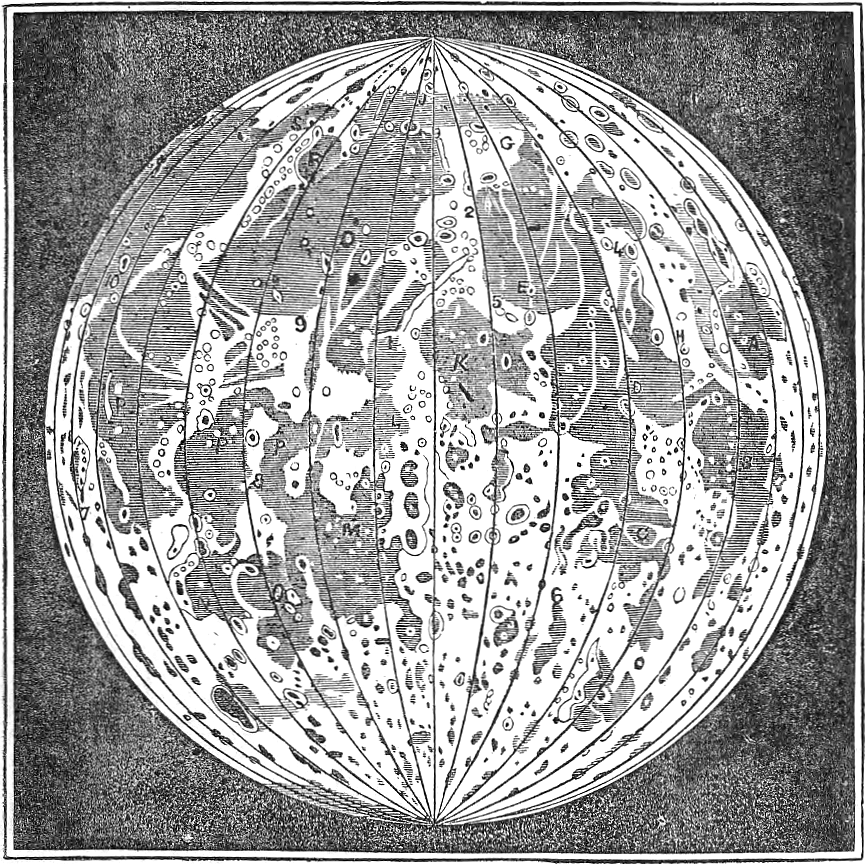
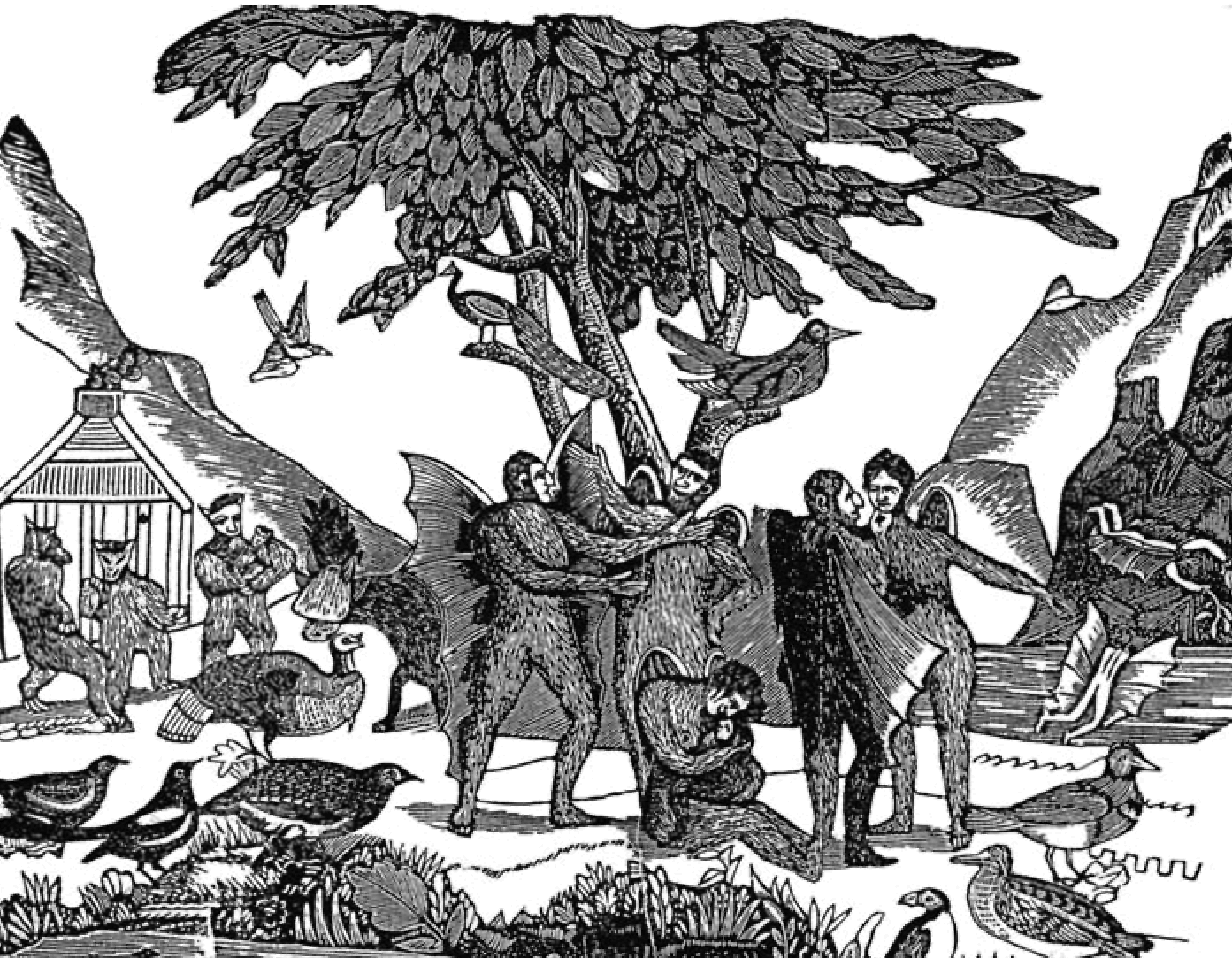
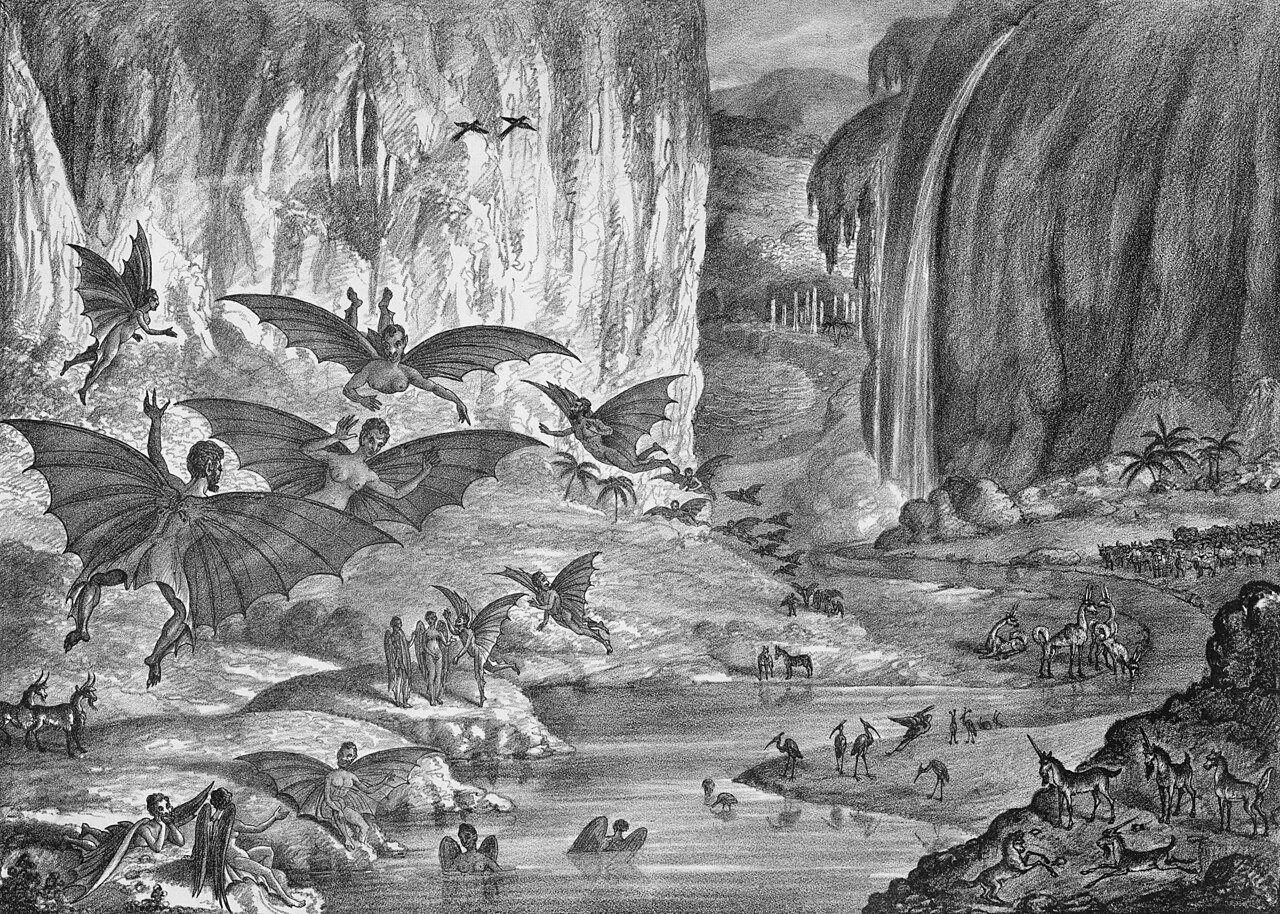
For many of us, the temptation to buy (or at least flip through) an issue of the WWN lay in keeping up with the exploits of Bat Boy, the most prominent of many fictional characters to which its extravagantly lurid yet oddly sober stories returned again and again. Though introduced only in 1992, he has notable ancestors in his industry: take the “Vespertilio-homo,” or “man-bat,” a race found to have made its home on the moon in 1835.
Or at least that’s what the readers of New York newspaper the Sun were told in a series of illustrated articles, later collected in book form, that credited the discovery to the astronomer Sir John Herschel. Herschel was real, but as the Sun admitted the following month, the Vespertilio-homo wasn’t — nor were the unicorn-goats, miniature zebras, and beavers walking on their hind legs reportedly also seen through his telescope.
The “Great Moon Hoax,” as it’s now known, and about which you can learn more from the BBC video at the top of the post, wasn’t Herschel’s doing. A reporter called Richard Adams Locke admitted to the fabrication, seemingly motivated by a desire to boost the circulation of the Sun, one of the many “penny paper” tabloids of the day that lived and died by sensation and scandal, and also to make light of the extravagant astronomical claims then in the air. Much like the writers of the Weekly World News — or later, the Onion — Locke wanted less to fool readers than to entertain them by satirizing an over-credulous popular culture. Yet what he pioneered was, quite literally, “fake news,” though that label by now refers to media created with clear intent to deceive. The world has changed since the eighteen-thirties, and indeed, even since Bat Boy’s late twentieth-century heyday, when the WWN predicted his election as President of the United States in 2028. Stranger things have certainly happened.
Based in Seoul, Colin Marshall writes and broadcasts on cities, language, and culture. He’s the author of the newsletterBooks on Cities as well as the books 한국 요약 금지 (No Summarizing Korea) and Korean Newtro.Follow him on the social network formerly known as Twitter at @colinmarshall.
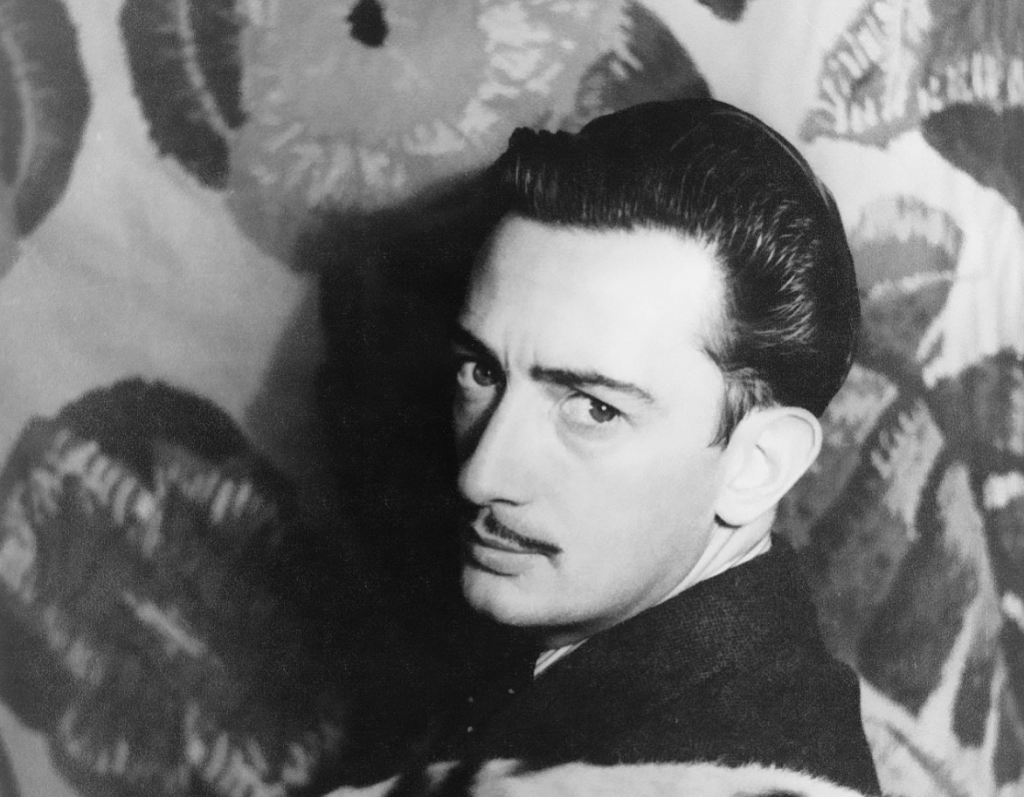
We may be conditioned to offering an opinion at the push of a button, but before venturing on the question of whether we can, or should, separate the art from the artist, it seems ever prudent to ask, “Which art and which artist?” There are the usual case studies, in addition to the crop of disgraced celebrities: Ezra Pound, P.G. Wodehouse, and, in philosophy, Martin Heidegger. One case of a very troubling artist, Salvador Dalí, gets less attention, but offers us much material for consideration, especially alongside an essay by George Orwell, who ruminated on the question and called Dalí both “a disgusting human being” and an artist of undeniably “exceptional gifts.”
Like these other figures, Dalí has long been alleged to have had fascist sympathies, a charge that goes back to the 1930s and perhaps originated with his fellow Surrealists, especially André Breton, who put Dalí on “trial” in 1934 for “the glorification of Hitlerian fascism” and expelled him from the movement. The Surrealists, most of whom were communists, were provoked by Dalí’s disdain for their politics, expressed in the likeness of Lenin in The Enigma of William Tell. It’s also true that Dalí seemed to publicly profess an admiration for Hitler. But as with everything he did, it’s impossible to tell how seriously we can take any of his pronouncements.
Another painting, 1939’s The Enigma of Hitler is even more ambiguous than The Enigma of William Tell, a collection of dream images, with the recurring melting objects, crutches, mollusk shells, and food images, set around a tiny portrait of the German dictator. Kamila Kocialkowska suggests that psychoanalytic motifs in the painting, some rather obvious, reflect Hitler’s “fear of impotence, and certain commentators have noted that Hitler’s enthusiastic promotion of nationalistic breeding can further explain the innuendo present in this image.”
The Hitler obsession began years earlier. “I often dreamed of Hitler as a woman,” Dalí supposedly said,
His flesh, which I imagined as whiter than white, ravished me. I painted a Hitlerian wet nurse sitting kneeling in a puddle of water….
There was no reason for me to stop telling one and all that to me Hitler embodied the perfect image of the great masochist who would unleash a world war solely for the pleasure of losing and burying himself beneath the rubble.
The painting Dalí alludes to, The Weaning of Furniture-Nutrition, is the work that first raised Breton’s ire, since “Dalí had originally painted a swastika on the nurse’s armband,” notes art historian Robin Adèle Greeley, “which the Surrealists later forced him to paint out.” Dalí later claimed that his Hitler paintings “subvert fascist ideologies,” Greeley writes: “Breton and company appear not to have appreciated a fellow Surrealist suggesting that there were connections to be made between bourgeois childhoods such as their own and the family life of the Nazi dictator.” Likewise, his creepy dream-language above is hardly more straightforward than the paintings, though he did write in The Unspeakable Confessions of Salvador Dalí, “Hitler turned me on in the highest.”
Other pieces of evidence for Dalí’s politics are also compelling but still circumstantial, such as his friendship with the proudly professed Nazi-sympathizer, Wallis Simpson, the American Duchess of Windsor, and his admiration for Spanish dictator Francisco Franco, whom he called, as Lauren Oyler points out at Vice, “the greatest hero of Spain.” (Dalí painted a portrait of Franco’s daughter). Oyler points out that Dalí’s “wickedness,” as Orwell put it in his scathing review of the artist’s “autobiography” (a spurious category in the case of serial fabricator Dalí), matters even if it were pure provocation rather than genuine commitment.
The claim carries more weight when applied to the artist’s attested sadism in general. Dalí spends a good part of his Confessions delighting in stories of brutal physical and sexual assault and cruelty to animals. (The famous Dalí Atomicus photo, his collaboration with Philippe Halsman, required 28 attempts, Oyler notes, and “each of those attempts involved throwing three cats in the air and flinging buckets of water at them.”) Whether or not Dalí was a genuine Nazi sympathizer or an amoral right-wing troll, Orwell is completely unwilling to give him a pass for generally cruel, abusive behavior.
“In his outlook,” writes Orwell, “his character, the bedrock decency of a human being does not exist. He is as anti-social as a flea. Clearly, such people are undesirable, and a society in which they can flourish has something wrong with it.” But perhaps Dalí means to say exactly that. Allowing for the possibility, Orwell is also unwilling to toss aside Dalí’s work. The artist, he writes “has fifty times more talent than most of the people who would denounce his morals and jeer at his paintings.”
When it comes to the question of Dalí as fascist, some less-than-nuanced views of his work (“Marxist criticism has a short way with such phenomena as Surrealism,” writes Orwell) might miss the mark. The Weaning of Furniture-Nutrition, writes Greeley, seems to reveal “a secret about his own middle-class background” as a nursery for fascism, especially given the “disturbing” fact that “the nurse is a portrait of Dalí’s own, and that she droops hollowly on the shore near the painter’s Catalan childhood home, suggesting that Dalí himself might have had a ‘hitlerian’ upbringing.”
Greeley’s further elaboration on Dalí’s conflict with Breton further weakens the charges against him. “Ten days before the February meeting, he had defended himself to Breton,” she writes, “claiming, ‘I am hitlerian neither in fact nor in intention.’ ” He pointed out that the Nazis would likely burn his work, and chastised leftists for “their lack of insight into fascism.”
The question of Dalí’s fascist sympathies is incoherent without the biography, and the biographical evidence against Dalí seems fairly thin. Nonetheless, he has emerged from history as a violent, vicious, opportunistic person. How much this should matter to our appreciation of his art is a matter you’ll have to decide for yourself.
Note: An earlier version of this post appeared on our site in 2018.
We're hoping to rely on loyal readers, rather than erratic ads. Please click the Donate button and support Open Culture. You can use Paypal, Venmo, Patreon, even Crypto! We thank you!
Open Culture scours the web for the best educational media. We find the free courses and audio books you need, the language lessons & educational videos you want, and plenty of enlightenment in between.