Denis Villeneuve’s new adaptation of Frank Herbert’s Dune has made a decently promising start to what looks set to shape up into an epic series of films. But however many installments it finally comprises, it’s unlikely to run anywhere near as long as Alejandro Jodorowsky’s version — had Jodorowsky actually made his version, that is. Previously featured here on Open Culture, that project promised to unite the talents of not just the creator of the Dune universe and the director of The Holy Mountain, but those of Mœbius, H.R. Giger, Salvador Dalí, Pink Floyd, Orson Welles, and Mick Jagger. Even David Lynch’s Dune, for all its large-scale weirdness, would surely play like My Dinner with Andre by comparison.
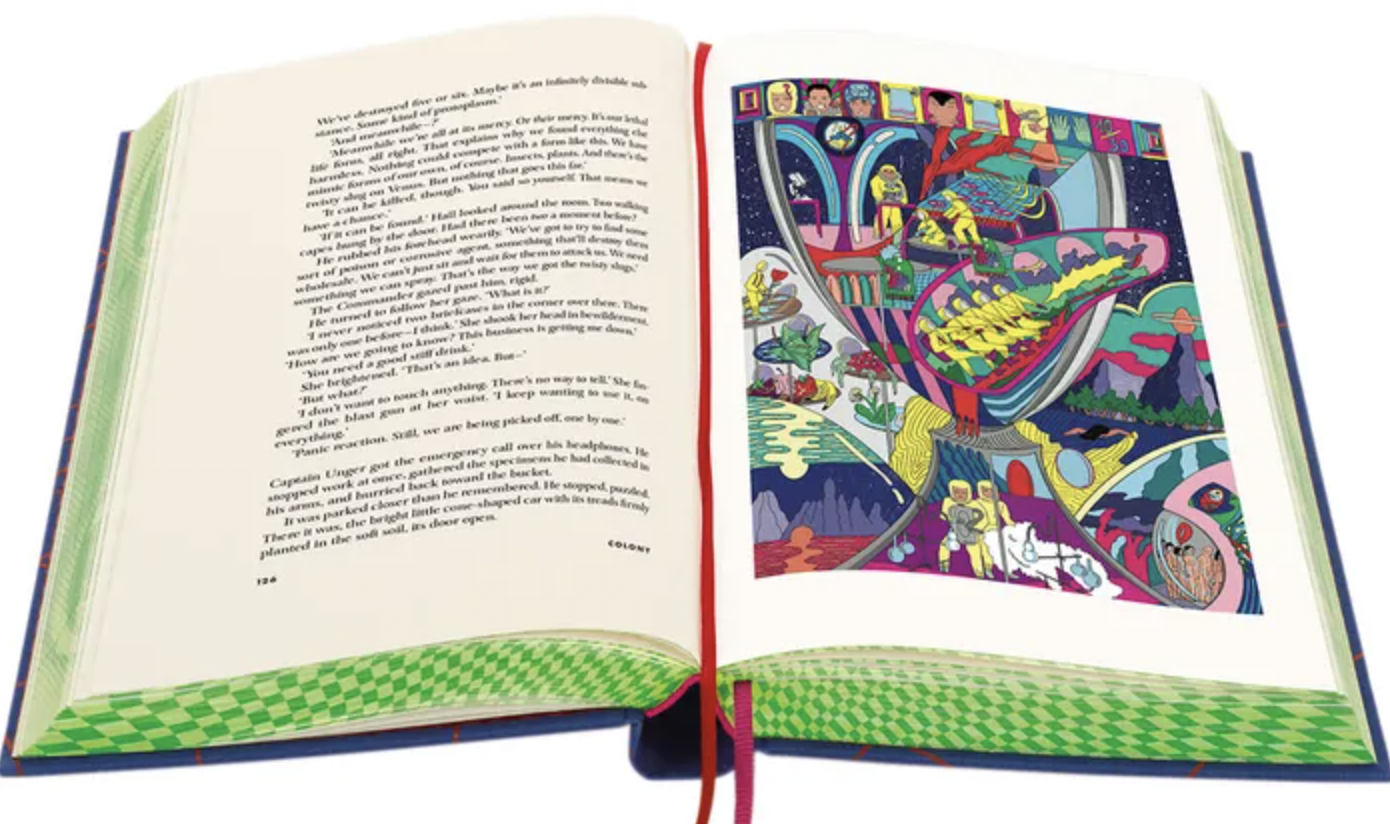
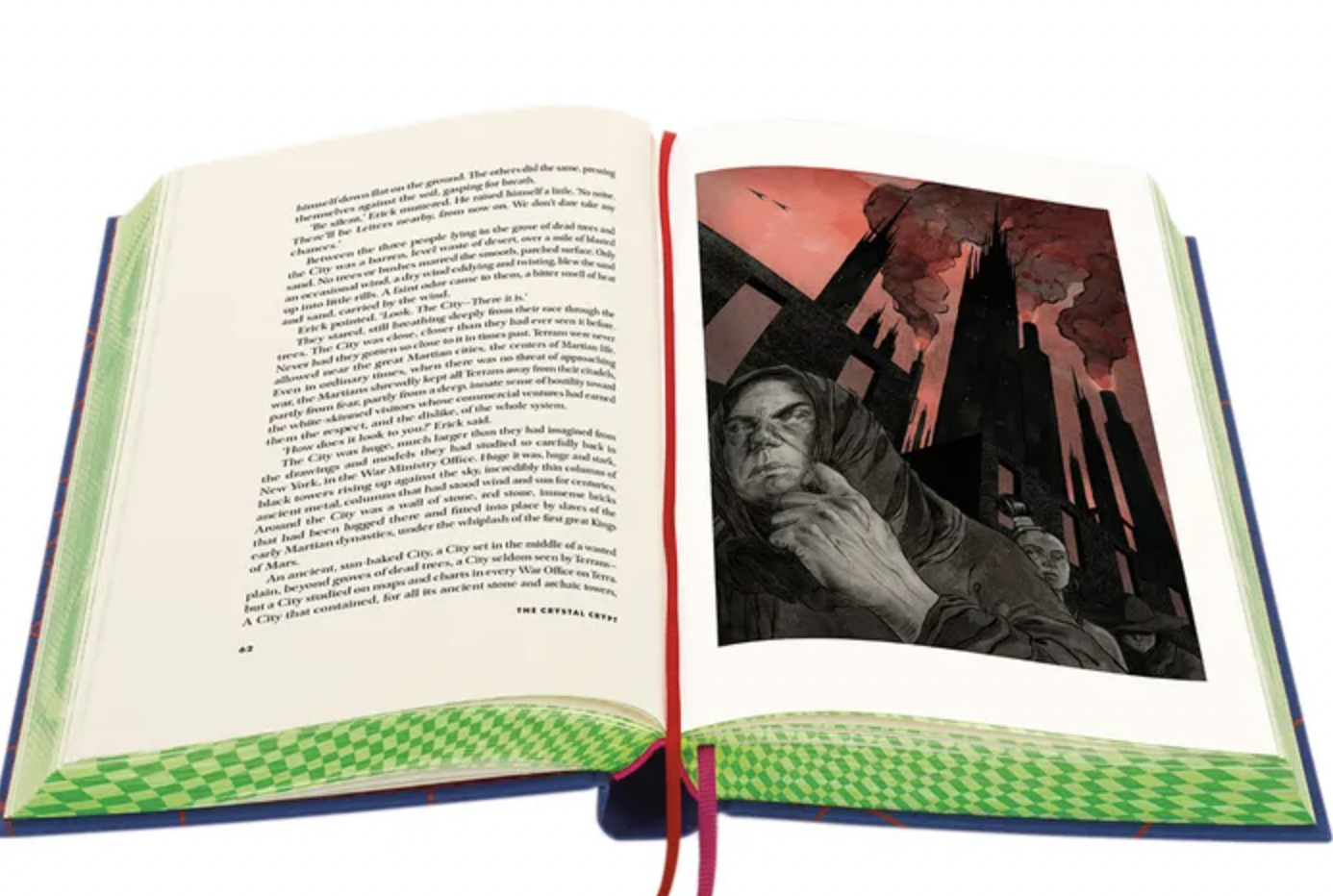
Alas, none of us will ever get to see Jodorowsky’s Dune, now one of the most storied of all unmade films. But one of us — one of the deep-pocketed among us, at least — now has a chance to own the book. Not Herbert’s novel: the book assembled circa 1985 as a pitching aid, meant to show studios the extensive pre-production work Jodorowsky, producer Michel Seydoux, and their collaborators had done.
“Filled with the script, storyboards, concept art, and more, the book is basically as close as anyone can get to seeing Jodorowsky’s version of Dune,” writes io9’s Germain Lussier. “But, of course, the director and his team only created a handful of copies and this was decades ago. This isn’t a book you can just get on Amazon.”
But you can get it at Christie’s, on whose auction block it’s expected to go for between €25,000 and €35,000 (around USD $30,000–40,000). Reckoning that only ten to twenty copies were ever printed, the house’s listing describes the book as “an extraordinary artifact” from “a doomed project which inspired legions of film-makers and moviegoers alike.” Despite all of Hollywood ultimately passing on this enormously ambitious adaptation, “all of this was not in vain.” Jodorowsky himself claims that, though unrealized, his Dune set a precedent for “a larger-than-life science fiction movie, outside of the scientific rigor of 2001: A Space Odyssey.” Its influence, according to Christie’s, is present in 1970s films like Star Wars and Alien. Would it be too much to sense a trace of the Jodorowskyan in Villeneuve’s Dune as well?
Based in Seoul, Colin Marshall writes and broadcasts on cities, language, and culture. His projects include the Substack newsletterBooks on Cities, the book The Stateless City: a Walk through 21st-Century Los Angeles and the video series The City in Cinema. Follow him on Twitter at @colinmarshall or on Facebook.
The book can be downloaded an .epub file which can be opened in a compatible e‑reader application on many devices. An email address, along with a name of college/university, is required. Find the book here.
Whatever the benefits and pleasures of our current internet-enriched world, one must admit that it’s not quite as exciting as the setting of Snow Crash. Originally published in 1992, that novel not only made the name of its author Neal Stephenson, it elevated him to the status of a technological Nostradamus. It did so, at least, among readers interested in the internet and its potential, which was much more of a niche subject 29 years ago. Of the many inventions with which Stephenson furnished Snow Crash’s then-futuristic 21st-century cyberpunk reality, few have captured as many techie imaginations as the “metaverse,” an enormous virtual world inhabited by the avatars of its users.
“Lots of other science fiction media includes metaverse-like systems,” writes The Verge’s Adi Robertson, but “Stephenson’s book remains one of the most common reference points for metaverse enthusiasts.” This holds especially true in Silicon Valley, where, as Vanity Fair’s Joanna Robinson puts it, “a host of engineers, entrepreneurs, futurists, and assorted computer geeks (including Amazon C.E.O. Jeff Bezos) still revere Snow Crash as a remarkably prescient vision of today’s tech landscape.” It’s rumored that Facebook CEO Mark Zuckerberg will soon announce his company’s intent to change its name to one that better suits its own long-term plan: to transition, as Zuckerberg himself put it, “from people seeing us as primarily being a social media company to being a metaverse company.”
Bold though this may sound, astute readers haven’t forgotten that Snow Crash is a dystopian novel. The metaverse it presents “is an outgrowth of Stephenson’s satirical corporation-dominated future America,” writes Robinson, “but it’s undeniably depicted as having a cool side.” After all, the novel’s protagonist is “a master hacker who gets in katana fights at a virtual nightclub,” though his virtual existence compensates for a grimmer real-world lifestyle. “In the book, Hiro lives in a shabby shipping container,” Stephenson says, “but when he goes to the Metaverse, he’s a big deal and has access to super high-end real estate.” This may sound faintly reminiscent of certain online worlds already in existence: Second Life, for example, whose heyday came in the early 2010s.
Though presumably more ambitious, Zuckerberg’s vision of the metaverse remains, for the moment, broadly defined: it will consist, he’s said, of “a set of virtual spaces where you can create and explore with other people who aren’t in the same physical space as you.” But as The Verge’s Alex Heath notes in an article on Facebook’s impending name change, the company “already has more than 10,000 employees building consumer hardware like AR glasses” — glasses, that is, for augmented reality, the overlaying digital elements onto the real world — “that Zuckerberg believes will eventually be as ubiquitous as smartphones.” It’s not impossible that he could be leading the way toward the thrilling, dangerous, and often hilarious virtual world Snow Crash held out to us — and in whose absence we’ve had to make do with Facebook.
Based in Seoul, Colin Marshall writes and broadcasts on cities, language, and culture. His projects include the Substack newsletterBooks on Cities, the book The Stateless City: a Walk through 21st-Century Los Angeles and the video series The City in Cinema. Follow him on Twitter at @colinmarshall or on Facebook.
Two centuries ago, Haiti, “then known as Saint-Domingue, was a sugar powerhouse that stood at the center of world trading networks,” writes Philippe Girard in his history of the Haitian war for independence. “Saint-Domingue was the perle de Antilles… the largest exporter of tropical products in the world.” The island colony was also at the center of the trade in plants that drove the scientific revolution of the time, and many a naturalist profited from the trade in slaves and sugar, as did planter, “physician, botanist, and inadvertent historiographer of the Haitian Revolution” Michel Etienne Descourtilz, the Public Domain Review writes.
Descourtilz’ 1809 Voyages d’un naturaliste “chronicles, among other adventures, a trip from France to Haiti in 1799 in order to secure his family’s plantations.” Instead, he was arrested and conscripted as a doctor under Jean-Jacques Dessalines.
The experience did not change his view that the island should be reconquered, though he did admit “the germ” of rebellion “must secretly have existed everywhere there were slaves.” Decourtilz chiefly spent his time, while not attending to those wounded by Napoleon’s army, collecting plants between Port-au-Prince and Cap-Haïtien.
In the dense tropical growth along the Artibonite river, now part of the border between Haiti and the Dominican Republic, Decourtilz learned much about the plant world — and maybe learned from some Haitians who knew more about the island’s flora than the Frenchman did. Rescued in 1802, Decourtilz returned to France with his plants and began to compile his research into taxonomic books, including Flores pittoresque et medicale des Antilles, in eight volumes, and a later, 1827 work entitled Atlas des champignons: comestibles, suspects et vénéneux, or “Atlas of mushrooms: edible, suspect and poisonous.”
As the title makes clear, sorting out the differences between one mushroom and another can easily be a matter of life and death, or at least serious poisoning. “Fly agaric, for example,” writes the Public Domain Review, “can resemble edible species of blushers.” Consumed in small amounts, it might cause hallucinations and euphoria. Larger doses can lead to seizures and coma. One can imagine the numbers of colonists in the French Caribbean who either had very bad trips or were poisoned or killed by unfamiliar plant life. Just last year alone in France, hundreds were poisoned from misidentified mushrooms.
To guide the mushroom hunter, cook, and eater, Decourtiliz’s book featured these rich, colorful lithographs here by artist A. Cornillon (which may remind us of the proto-psychedelic scientific art of Ernst Haeckel). He alludes to the great dangers of wild mushrooms in a dedication to “S.A.R., Duchesse de Berry” and promises his guide will prevent “mortal accidents” (those which “frequently occur among the poor.”) Descourtilz offers his guide, accessible to all, he writes, out of a devotion to the alleviation of human suffering. Read his Atlas of Mushrooms, in French at the Internet Archive, and see more of Cornillon’s illustrations here.
Some of the distinctiveness of Spain as we know it today comes as a legacy of the period from 700 to 1200, when most of it was under Muslim rule. The culture of Al-Andalus, as the Islamic states of modern-day Spain and Portugal were then called, survives most visibly in architecture. But it also had its own cuisine, developed by not just Muslims, but by Christians and Jews as well. Whatever the dietary restrictions they individually worked under, “cooks from all three religions enjoyed many ingredients first brought to the Iberian peninsula by the Arabs: rice, eggplants, carrots, lemons, sugar, almonds, and more.”
The Fiḍāla itself dates to around 1260. It was composed in Tunis by Ibn Razīn al-Tujībī, “a well-educated scholar and poet from a wealthy family of lawyers, philosophers, and writers. As a member of the upper class, he enjoyed a life of leisure and fine dining which he set out to celebrate in the Fiḍāla.” The Christian Reconquista had already put a bitter end to all that leisure and fine dining, and it was in relatively hardscrabble African exile that al-Tujībī wrote this less as a cookbook than as “an exercise in culinary nostalgia, a wistful look back across the Strait of Gibraltar to the elegant main courses, side dishes, and desserts of the author’s youth, an era before Spain’s Muslims and Jews had to hide their cultural cuisines.”
That description comes from food historian Nawal Nasrallah, translator of the complete Fiḍāla into an English edition published last month by Brill. In some of its sections al-Tujībī covers breads, vegetables, poultry dishes, and “meats of quadrupeds”; in others, he goes into detail on stuffed tripe, “edible land snails,” and techniques for “remedying overly salty foods and raw meat that does not smell fresh.” (The book includes 475 recipes in total.) Though much in the Moorish diet is a far cry from that of the majority in modern English-speaking countries, interest in historical gastronomy has been on the rise in recent years. And as even those separated from al-Tujībī by not just culture but seven centuries’ worth of time know, whatever your reasons for leaving a place, you soon long for nothing as acutely as the food — and that longing can motivate impressive achievements.
Based in Seoul, Colin Marshall writes and broadcasts on cities, language, and culture. His projects include the Substack newsletterBooks on Cities, the book The Stateless City: a Walk through 21st-Century Los Angeles and the video series The City in Cinema. Follow him on Twitter at @colinmarshall or on Facebook.
For all its talk of liberty, the US government has practiced dehumanizing authoritarianism and mass murder since its founding. And since the rise of fascism in the early 20th century, it has never been self-evident that it cannot happen here. On the contrary — wrote Yale historian Timothy Snyder before and throughout the Trump presidency — it happened here first, though many would like us to forget. The histories of southern slavocracy and manifest destiny directly informed Hitler’s plans for the German colonization of Europe as much as did Europe’s 20th-century colonization of Africa and Asia.
Snyder is not a scholar of American history, though he has much to say about his country’s present. His work has focused on WWII’s totalitarian regimes and his popular books draw from a “deep knowledge of twentieth-century European history,” write Françoise Mouly and Genevieve Bormes at The New Yorker.
Indeed, the problem with rigid conformity to populist ideas became the subject of Snyder’s 2017 bestseller, On Tyranny: Twenty Lessons from the Twentieth Century, “a slim volume,” Mouly and Bormes note, “which interspersed maxims such as ‘Be kind to our language’ and ‘Defend institutions’ with biographical and historical sketches.” (We posted an abridged version of Snyder’s 20 lessons that year.) On Tyrannybecame an “instant best-seller… for those who were looking for ways to combat the insidious creep of authoritarianism at home.”
If you’ve paid any attention to the news lately, maybe you’ve noticed that the threat has not receded. Ideas about how to combat anti-democratic movements remain relevant as ever. It’s also important to remember that Snyder’s book dates from a particular moment in time and draws on a particular historical perspective. Contextual details that can get lost in writing come to the fore in images — clothing, cars, the use of color or black and white: these all key us in to the historicity of his observations.
“We don’t exist in a vacuum,” says artist Nora Krug, the designer and illustrator of a new, graphic edition of On Tyranny just released this month. “I use a variety of visual styles and techniques to emphasize the fragmentary nature of memory and the emotive effects of historical events.” Krug worked from artifacts she found at flea markets and antique stores, “depositories of our collective consciousness,” as she writes in an introductory note to the new edition.
Krug’s choice of a variety of mediums and creative approaches “allows me to admit,” she says, “that we can only exist in relationship to the past, that everything we think and feel is thought and felt in reference to it, that our future is deeply rooted in our history, and that we will always be active contributors to shaping how the past is viewed and what our future will look like.”
Its related poems will almost certainly strike those of us whose understanding of feline attitude has been shaped by LOLCats, Grumpy Cat, the existential Henri, Talking Kitty Cat’s acerbic Sylvester, and the mordant 1970s TV spokescat Morris as sweet to the point of sickly. But it boasts six hundred vocabulary words, a rhyme structure that promotes reading aloud, and a note to teachers with suggestions for classroom activities.
Grover explained how her feline cast of characters would win over even the most reluctant reader, inspiring “much the same delight to the little reader of juvenile fiction, as do adventure and romance to the grown-up reader”:
In one respect kittens take precedence over dolls. They are alive. They must be treated kindly. They will not bear the abuse and neglect given to many beautiful dolls. They demand attention and companionship, and they return a real devotion in return for kindness and care. Therefore we love them and especially do our children love them and delight in stories of them.
The loosely structured story concerns a grand party thrown by the Queen of the Cats. Following some breathless preparations, the guests take turns introducing themselves to her majesty, though unlike T.S. Eliot’s Old Possum’s Book of Practical Cats (1939), there’s not much that could be cobbled into a hit musical.
One lace-bonneted character is reminiscent of Tom Kitten’s mother, Mrs. Tabitha Twitchit, and her unsuccessful attempts to wrangle her rambunctious offspring into clothing fit for “fine company,” though the wit falls somewhat short of Beatrix Potter’s.
Headgear abounds, as do restrictive buntings that must’ve been a great help when dealing with uncooperative models and long exposures.
Although the photographer is uncredited, the images are likely the work of Harry Whittier Frees, a “pioneer of the anthropomorphic kitten photograph genre” as per the New York Daily News. In his introduction to his far more ambitiously posed 1915 work, The Little Folks of Animal Land, Frees alluded to his process:
The difficulties of posing kittens and puppies for pictures of this kind have been overcome only by the exercise of great patience and invariable kindness. My little models receive no especial training, and after their daily performance before the camera they enjoy nothing more than a good frolic about the studio.
That’s a pleasant thought, though historian and postcard collector Mary L. Weigley tells a somewhat different tale in an article for Pennsylvania Heritage, describing how only 3/10 of his negatives could be published, and his work was so “challenging, time-consuming and nerve-wracking” that he took 9 months out of every year to recuperate.
Cats!
Download a free copy of Eulalie Osgood Grover’s Kittens and Catshere.
When J.R.R. Tolkien’s The Lord of the Rings appeared in the mid-1950s, its first critical readers held some diverging views on the books’ quality. On the one hand, there was praise for the revival of fantasy for grown-ups, and comparisons to great epics of the past. On the other hand, Tolkien’s prose was excoriated for its wordiness, length, and seemingly inexhaustible obsession with obscurities. Both perspectives seemed to miss something important. Yes, Tolkien drew liberally from epics of the past such as the Norse Sagas and created a world as fully-realized as any in ancient mythology, building in decades what took centuries to develop.
It’s also true that Tolkien wrote in a thoroughly unusual way — unfamiliar as he was with the conventions of contemporary literary prose. But his style did not only derive from his work as a scholar of Anglo-Saxon literature. For all of the discussion of Tolkien’s encyclopedic technique, no one seemed to note at the time that the author had, in fact, invented for himself (with apologies to James Joyce) a new genre and way of writing, a kind of etymological fantasy, a kind of writing he learned while working on the Oxford English Dictionary, that august catalogue of the English language which first appeared in full in 1928 — in ten volumes after fifty years of work.
The Oxford English Dictionary (OED) remains an indispensable reference for scholars of language and literature, but it is not itself a typical academic text. It is a compendium, a miscellany, a descriptive map and timeline tracking how English evolves; it is the ultimate reference work, a work of philology, a discipline that had fallen out of fashion by the time of The Lord of the Rings. The first edition of the OED, begun in 1878 (five years into the proposed timeline, the editors had only reached the word “ant”), contained around 400,000 words. Between the years 1919 and 1920, Tolkien was responsible for the words between waggle and warlock. He would later say he “learned more in those two years than in any other equal period of my life.”
The OED establishes linguistic histories by citing a word’s appearances in literature and popular press over time, tracing derivations from other languages, and tracing the evolution, and extinction, of words and meanings. After his return from World War I, the future novelist found himself working under founding co-editor Henry Bradley, laboring away on words like walnut, walrus, and wampum, which “seem to have been assigned to Tolkien because of their particularly difficult etymologies,” notes theOED blog. These entries would later be singled out by Bradley as “containing ‘etymological facts or suggestion not given in other dictionaries.’ ”
The experience as an OED lexicographer prepared Tolkien for his lifelong career as a philologist. It also informed his literary technique, argue Peter Gilliver, Jeremy Marshall, and Edmund Weiner, the authors of Ring of Words: Tolkien and the Oxford English Dictionary and former OED editors, all. The authors show how Tolkien drew the language of his books directly from his etymological research. For example, “for decades it was assumed that he was being characteristically modest” when he declined to claim credit for the invention of the word “hobbit.” As it turned out, “an obscure list of mythical beings, published in 1895” came to light in 1977, including the word “ ‘hobbits’, along with such other irresistible creatures as ‘boggleboes’ and gallytrots,” writes Kelly Grovier at The Guardian.
Tolkien’s relationship to etymology in The Hobbit, The Lord of the Rings, and every other lengthy piece of writing Middle Earth-related goes far beyond digging up obscure words or coining new ones. He learned to think like a lexicographer. As the authors write, “in describing his own creative processes, Tolkien often comments on how the contemplation of an individual word can be the starting point for an adventure in imagination — and contemplating individual words is precisely what lexicographers do.” Tolkien’s boundless curiosity about the roots of language led him to “invent everything,” writes Tolkien critic John Garth, “from star mariners to calendars, flowers, cities, foodstuffs, writing systems and birthday customs, to mention just a few of the eclectic features of Middle-earth.”
Decades after Tolkien’s first association with the OED, he would become involved again with the publication in 1969 when the editor of the dictionary’s Supplement, his former student Robert Burchfield, asked for comments on the entry for “Hobbit.” Tolkien offered his own definition for just one of the many Tolkienian words that would eventually make into the OED (along with mathom, orc, mithril, and balrog). Burchfield published Tolkien’s definition almost exactly as written:
In the tales of J. R. R. Tolkien (1892–1973): one of an imaginary people, a small variety of the human race, that gave themselves this name (meaning ‘hole-dweller’) but were called by others halflings, since they were half the height of normal men.
We're hoping to rely on loyal readers, rather than erratic ads. Please click the Donate button and support Open Culture. You can use Paypal, Venmo, Patreon, even Crypto! We thank you!
Open Culture scours the web for the best educational media. We find the free courses and audio books you need, the language lessons & educational videos you want, and plenty of enlightenment in between.