MTV Rewind Lets You Revisit 40,000 Music Videos & Commercials from the Golden Age of MTV

MTV still exists. At least, it still exists in the United States, or in certain of that country’s markets, for the time being. A flurry of premature obituaries recently blew through the internet after the announcement that the network had shut down in other parts of the world, Europe included. But even there, some expressed the sentiment that MTV had already died long before. And indeed, in the U.S., where it originally launched, asking who remembers when MTV actually used to play music videos has been a common lament for decades, aired even by generations too young to remember those days themselves. But members of any generation can now relive them — or live them for the first time — through a new site called MTV Rewind.
The first music video that greets the visitor is The Buggles’ “Video Killed the Radio Star,” and appropriately so, since it inaugurated MTV itself when it went live on August 1st, 1981. What follows are all the rest of the videos played on that first day, like Phil Collins’ “In the Air Tonight,” Blondie’s “Rapture,” David Bowie’s “Boys Keep Swinging,” and Kate Bush’s “Wuthering Heights.”
(Other, less widely remembered entries include no fewer than three songs by Cliff Richard, which speaks to the then-incomplete formation of the kind of pop-musical culture we still associate with MTV.) The site’s other playlists recreate other eras and genre-specific programs, from 120 Minutes to Total Request Live, Headbanger’s Ball to Yo! MTV Raps.
Currently, MTV Rewind’s music video count comes to about 40,000, enough to ensure any former addict of the network a stream of nostalgia hits. But the site’s creator (a 43-year-old American resident in Albania, according to the New York Times, known pseudonymously as “Flex”) has also incorporated vintage station IDs and commercials, many of them liable to trigger downright Proustian sensations in the right viewer. What may feel refreshing even to curious younger visitors is that, whichever channel they choose, the next video that plays is determined not by an algorithm attempting to predict their personal tastes. Rather, each playlist is shaped by the popular culture of a particular era, with enough left-field selections to keep it interesting: just the sort of thing in hopes of which we used to flip over to MTV, back when the idea of streaming video on our computers still sounded like sheerest fantasy. Enter MTV Rewind here.
Related Content:
Watch the First 2+ Hours of MTV’s Inaugural Broadcast (August 1, 1981)
All the Music Played on MTV’s 120 Minutes: A 2,500-Video Youtube Playlist
The Internet Archive Rescues MTV News’ Web Site, Making 460,000+ of Its Pages Searchable Again
The 50 Greatest Music Videos of All Time, Ranked by AV Club
Revisit Pop-Up Video: The VH1 Series That Reinvented Music Videos & Pop Culture
Based in Seoul, Colin Marshall writes and broadcasts on cities, language, and culture. He’s the author of the newsletter Books on Cities as well as the books 한국 요약 금지 (No Summarizing Korea) and Korean Newtro. Follow him on the social network formerly known as Twitter at @colinmarshall.
Read More...Download 435 High Resolution Images from John J. Audubon’s The Birds of America

In our experience, bird lovers fall into two general categories:
Keenly observant cataloguers like John James Audubon …
And those of us who cannot resist assigning anthropomorphic personalities and behaviors to the 435 stars of Audubon’s The Birds of America, a stunning collection of prints from life-size watercolors he produced between 1827 and 1838.
Our suspicions have little to do with biology, but rather, a certain zestiness of expression, an overemphatic beak, a droll gleam in the eye.
The Audubon Society’s newly redesigned website abounds with treasure for those in either camp:
Free high res downloads of all 435 plates.
Mp3s of each specimen’s call.
And vintage commentary that effectively splits the difference between science and the unintentionally humorous locutions of another age.

Take for instance, the Burrowing Owl, as described by self-taught naturalist Thomas Say (1787–1834):
It is delightful, during fine weather, to see these lively little creatures sporting about the entrance of their burrows, which are always kept in the neatest repair, and are often inhabited by several individuals. When alarmed, they immediately take refuge in their subterranean chambers; or, if the dreaded danger be not immediately impending, they stand near the brink of the entrance, bravely barking and flourishing their tails, or else sit erect to reconnoitre the movements of the enemy.
The notes of ornithologist John Kirk Townsend (1809 – 1851) suggest that not everyone was as taken with the species as Say (who was, in all fairness, the father of American entomology):
Nothing can be more unpleasant than the bagging of this species, on account of the fleas with which their plumage swarms, and which in all probability have been left in the burrow by the Badger or Marmot, at the time it was abandoned by these animals. I know of no other bird infested by that kind of vermin.

The Common Gallinule, above, suggests that there’s often more to these birds than meets the eye. His somewhat sheepish looking countenance belies the red hot love life Audubon recounts:
… the manifestations of their amatory propensity were quite remarkable. The male birds courted the females, both on the land and on the water; they frequently spread out their tail like a fan, and moved round each other, emitting a murmuring sound for some seconds. The female would afterwards walk to the water’s edge, stand in the water up to her breast, and receive the caresses of the male, who immediately after would strut on the water before her, jerking with rapidity his spread tail for awhile, after which they would both resume their ordinary occupations.

Being that we are firmly planted in the second type of bird lover’s camp, this ornithological cornucopia mainly serves to whet our appetite for more Falseknees, self-described bird nerd Joshua Barkman’s beautifully rendered webcomic.
Yes, Audubon’s Indigo Bird, aka Petit Papebleu, “an active and lively little fellow” who “possesses much elegance in his shape, and also a certain degree of firmness in his make” was separated by a century or so from “Mood Indigo”—we presume that’s the tune stuck in Barkman’s bird’s head—but he does look rather preoccupied, no?
Possibly just thinking of mealworms…
Explore Audubon’s Birds of America by chronological or alphabetical order, or by state, and download them all for free here.
Note: An earlier version of this post appeared on our site in 2019.
Related Content:
What Kind of Bird Is That?: A Free App From Cornell Will Give You the Answer
The Bird Library: A Library Built Especially for Our Fine Feathered Friends
Ayun Halliday is an author, illustrator, and theater maker in NYC.
Read More...When Pianist Maria João Pires Prepared to Perform the Wrong Mozart Concerto, Then Recovered Miraculously
Imagine, if you will, taking a seat at the piano before a full house of 2,000 music lovers ready to hear Mozart’s Piano Concerto No. 20 in D minor — and, more importantly, on stage with an orchestra and conductor more than ready to play it. That would be difficult enough, but now imagine that you thought you were supposed to play the Piano Concerto No.23 in A major, another piece of music entirely. This is the stuff of nightmares, and indeed, the very situation in which pianist Maria João Pires found herself in 2013, after she’d been recruited to fill in for another player at an open rehearsal held at Amsterdam’s Concertgebouw. You can watch it unfold, assuming you can bear it, in the clip above.
As Pires says in the Classic FM interview below, it had been “perhaps 11 months” since she’d last played the piece into which she could hear the orchestra launching, “and that’s the moment where you start losing the memory of the details. That’s how the memory functions, you know. And when people see this panic, they perhaps don’t know that the reality is, we lose our memories after just a couple of months.”
It seems to have been the encouragement of conductor Riccardo Chailly that got her through the moment of panic and into a creditable performance. “You know it so well!” he insisted to her, and indeed, as he remembered later, “The miracle is that she has such a memory that she could, within a minute, switch to a new concerto without making one mistake.”
The eleventh-hour call Pires received asking her to take the gig was part of the problem, but so was a misheard number. According to the Köchel catalogue, which organizes all of Mozart’s work, the Piano Concerto No. 20 in D minor is 466, whereas the Piano Concerto No. 23 in A major is 488. Whether Pires misheard the K‑number or the caller misspoke, she soon found herself faced with a musical challenge for which she felt completely unprepared. In fact, she wasn’t: as Chailly knew, or at least banked on, her career as a classical pianist up to that point had given her all the experience she needed to draw upon to overcome the crisis. As her recovery reminds us, professionalism isn’t so much about making sure that things always go right as being able to handle it when they go wrong. It happens that Pires has gone through this particular kind of mix-up three times, which makes her a consummate professional indeed.
Related Content:
Watch the First Performance of a Mozart Composition That Had Been Lost for Centuries
Hear the Experimental Piano Jazz Album by Comedian H. Jon Benjamin — Who Can’t Play Piano
The Piano Played with 16 Increasing Levels of Complexity: From Easy to Very Complex
The Mistake Waltz: Watch the Hilarious Ballet by Legendary Choreographer Jerome Robbins
Based in Seoul, Colin Marshall writes and broadcasts on cities, language, and culture. He’s the author of the newsletter Books on Cities as well as the books 한국 요약 금지 (No Summarizing Korea) and Korean Newtro. Follow him on the social network formerly known as Twitter at @colinmarshall.
Read More...“Riders on the Storm” Performed by John Densmore, Robby Krieger and 20+ Musicians Around the World
Formed in 1965, the Doors burned hot until Jim Morrison died in 1971, and the band finally broke up in 1973. The group left behind more than a few fine songs—“Light My Fire,” “Break On Through (To the Other Side),” “L.A. Woman,” and “Roadhouse Blues,” to name a few. Above, the music collective Playing for Change pays tribute to another Doors classic, “Riders on the Storm.” Featuring performances by the two surviving Doors members John Densmore and Robby Krieger, the video also weaves in appearances by 20+ musicians, everyone from Lukas and Micah Nelson, to Don Was and Foo Fighters keyboardist Rami Jaffee. According to Playing for Change, the “performance reimagines the classic anthem as a meditation on unity, hope, and shared humanity,” qualities that otherwise seem in short supply today. Enjoy!
If you would like to support the mission of Open Culture, consider making a donation to our site. It’s hard to rely 100% on ads, and your contributions will help us continue providing the best free cultural and educational materials to learners everywhere. You can contribute through PayPal, Patreon, and Venmo (@openculture). Thanks!
Related Content
How the Doors Got Banned from The Ed Sullivan Show (1967)
“The Lost Paris Tapes” Preserves Jim Morrison’s Final Poetry Recordings from 1971
Jim Morrison Accurately Predicts the Future of Electronic Music in 1969
Read More...Stream 4,000+ Public Domain Movies on WikiFlix: Silent Classics, Academy Award-Winners, Hitchcock Films & More
Humanity was already enjoying motion pictures a century ago. But the ability to do so at home still lay a few decades in the future, and the ability to pull up a movie on demand through a streaming service much further still. Young people in the twenty-twenties may be unable to fathom how previous generations got by without Netflix and the like, but all of us, whatever our age, may be curious about what such platforms would have offered in the nineteen-twenties. Now we can see for ourselves on WikiFlix, a free streaming site that offers more than 4,000 public-domain films for our enjoyment. Currently hot on its front page: Fritz Lang’s Metropolis, Sergei Eisenstein’s Battleship Potemkin, and F. W. Murnau’s Nosferatu.
Even casual film-lovers will know those important titles, even if they have yet to watch the pictures themselves. Regular Open Culture readers may also spot more than a few movies previously featured here: Georges Méliès’ A Trip to the Moon; Lotte Reiniger’s The Adventures of Prince Achmed; William Cameron Menzies’ (H. G. Wells-scripted) Things to Come; Ida Lupino’s The Hitch-Hiker.
There’s also Stanley Donen’s Charade, the best film Alfred Hitchcock never made — as well as some of the films he did make, like The Lodger, Jamaica Inn, and Notorious. Hitchcock’s Murder! was one of the works from 1930 that just came available on Public Domain Day at the beginning of this month, along with the likes of the Marx Brothers-starring Animal Crackers and the Best Picture-winning All Quiet on the Western Front.
Not all the movies on WikiFlix are at least 95 years old. Some have fallen into the public domain for reasons other than sheer age. Others, like Nina Paley’s Sita Sings the Blues, were made freely available by their creators upon release; browse the site by year, and you can find plenty of other recent productions. On the list of sections, you can also organize your viewing options by country, frequency of citation on Wikipedia (whose volunteer community created WikiFlix), or genre. How about a film noir tonight? A buddy picture? Some form of exploitation? Perhaps a B western? As TechCrunch’s Amanda Silberling writes, “Why not watch a Soviet musical inspired by Cinderella, a silent film about swashbuckling pirates, or a Japanese post-apocalyptic film that features a guy who somehow played for both the Boston Celtics and the Chicago Cubs?” With It’s a Wonderful Life on there, you at least know you’re set for next Christmas.
Related Content:
4,000+ Free Movies Online: Great Classics, Indies, Noir, Westerns, Documentaries & More
Download 9,200+ Free Films from the Prelinger Archives: Documentaries, Cartoons & More
Watch 3,000+ Films Free Online from the National Film Board of Canada
Based in Seoul, Colin Marshall writes and broadcasts on cities, language, and culture. He’s the author of the newsletter Books on Cities as well as the books 한국 요약 금지 (No Summarizing Korea) and Korean Newtro. Follow him on the social network formerly known as Twitter at @colinmarshall.
Read More...Buckminster Fuller’s Dymaxion Sleep Plan: He Slept Two Hours a Day for Two Years & Felt “Vigorous” and “Alert”
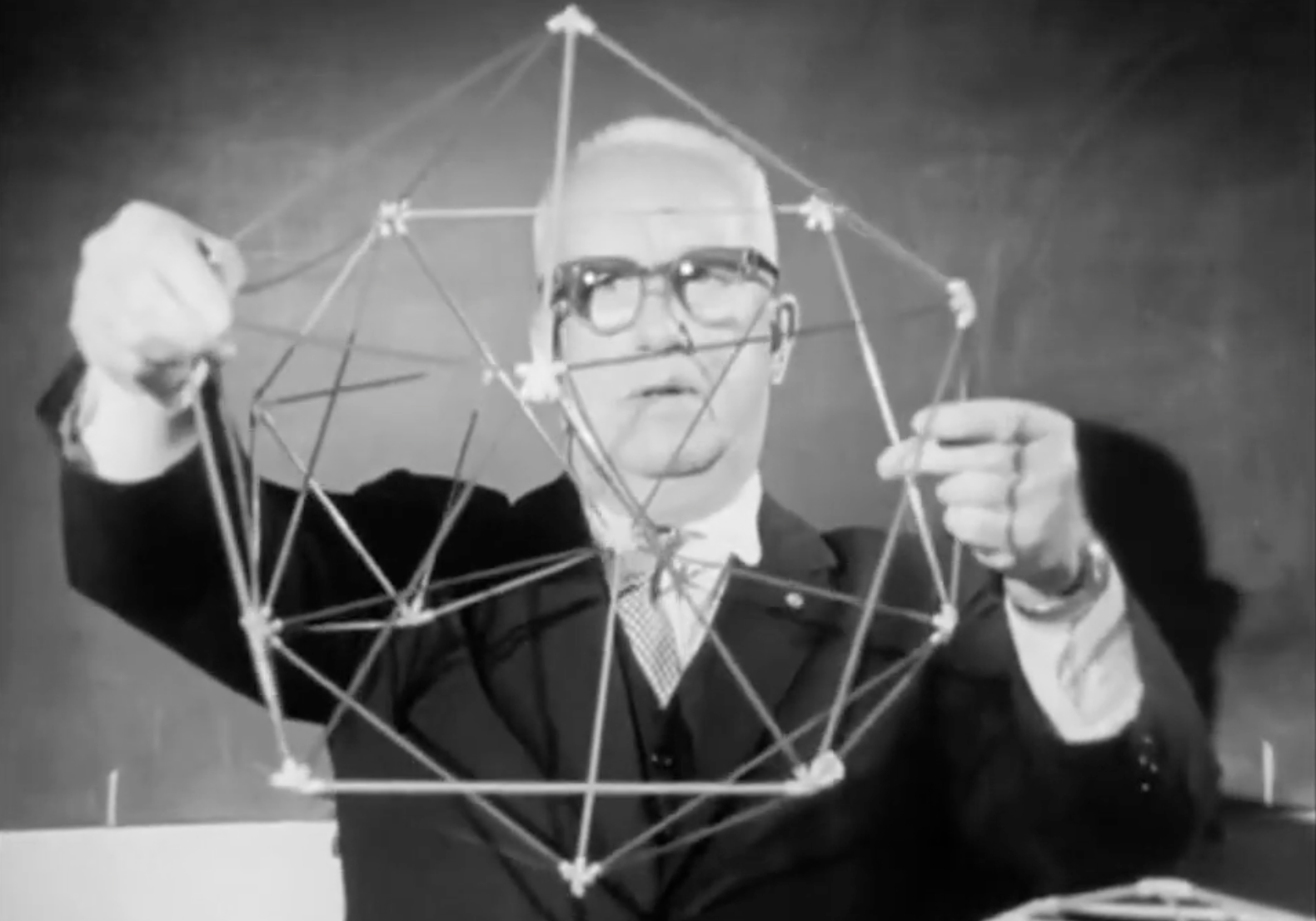
One potential drawback of genius, it seems, is restlessness, a mind perpetually on the move. Of course, this is what makes many celebrated thinkers and artists so productive. That and the extra hours some gain by sacrificing sleep. Voltaire reportedly drank up to 50 cups of coffee a day, and seems to have suffered no particularly ill effects. Balzac did the same, and died at 51. The caffeine may have had something to do with it. Both Socrates and Samuel Johnson believed that sleep is wasted time, and “so for years has thought grey-haired Richard Buckminster Fuller,” wrote Time magazine in 1943, “futurific inventor of the Dymaxion house, the Dymaxion car and the Dymaxion globe.”
Engineer and visionary Fuller intended his “Dymaxion” brand to revolutionize every aspect of human life, or—in the now-slightly-dated parlance of our obsession with all things hacking—he engineered a series of radical “lifehacks.” Given his views on sleep, that seemingly essential activity also received a Dymaxion upgrade, the trademarked name combining “dynamic,” “maximum,” and “tension.” “Two hours of sleep a day,” Fuller announced, “is plenty.” Did he consult with specialists? Medical doctors? Biologists? Nothing as dull as that. He did what many a mad scientist does in the movies. (In the search, as Vincent Price says at the end of The Fly, “for the truth.”) He cooked up a theory, and tested it on himself.
“Fuller,” Time reported, “reasoned that man has a primary store of energy, quickly replenished, and a secondary reserve (second wind) that takes longer to restore.” He hypothesized that we would need less sleep if we stopped to take a nap at “the first sign of fatigue.” Fuller trained himself to do just that, forgoing the typical eight hours, more or less, most of us get per night. He found—as have many artists and researchers over the years—that “after a half-hour nap he was completely refreshed.” Naps every six hours allowed him to shrink his total sleep per 24-hour period to two hours. Did he, like the 50s mad scientist, become a tragic victim of his own experiment?
No danger of merging him with a fly or turning him invisible. The experiment’s failure may have meant a day in bed catching up on lost sleep. Instead, Fuller kept it up for two full years, 1932 and 1933, and reported feeling in “the most vigorous and alert condition that I have ever enjoyed.” He might have slept two hours a day in 30 minute increments indefinitely, Time suggests, but found that his “business associates… insisted on sleeping like other men,” and wouldn’t adapt to his eccentric schedule, though some not for lack of trying. In his book BuckyWorks J. Baldwin claims, “I can personally attest that many of his younger colleagues and students could not keep up with him. He never seemed to tire.”
A research organization looked into the sleep system and “noted that not everyone was able to train themselves to sleep on command.” The point may seem obvious to the significant number of people who suffer from insomnia. “Bucky disconcerted observers,” Baldwin writes, “by going to sleep in thirty seconds, as if he had thrown an Off switch in his head. It happened so quickly that it looked like he had had a seizure.” Buckminster Fuller was undoubtedly an unusual human, but human all the same. Time reported that “most sleep investigators agree that the first hours of sleep are the soundest.” A Colgate University researcher at the time discovered that “people awakened after four hours’ sleep were just as alert, well-coordinated physically and resistant to fatigue” as those who slept the full eight.
Sleep research since the forties has made a number of other findings about variable sleep schedules among humans, studying shift workers’ sleep and the so-called “biphasic” pattern common in cultures with very late bedtimes and siestas in the middle of the day. The success of this sleep rhythm “contradicts the normal idea of a monophasic sleeping schedule,” writes Evan Murray at MIT’s Culture Shock, “in which all our time asleep is lumped into one block.” Biphasic sleep results in six or seven hours of sleep rather than the seven to nine of monophasic sleepers. Polyphasic sleeping, however, the kind pioneered by Fuller, seems to genuinely result in even less needed sleep for many. It’s an idea that’s only become widespread “within roughly the last decade,” Murray noted in 2009. He points to the rediscovery, without any clear indebtedness, of Fuller’s Dymaxion system by college student Maria Staver, who named her method “Uberman,” in honor of Nietzsche, and spread its popularity through a blog and a book.
Murray also reports on another blogger, Steve Pavlina, who conducted the experiment on himself and found that “over a period of 5 1/2 months, he was successful in adapting completely,” reaping the benefits of increased productivity. But like Fuller, Pavlina gave it up, not for “health reasons,” but because, he wrote, “the rest of the world is monophasic” or close to it. Our long block of sleep apparently contains a good deal of “wasted transition time” before we arrive at the necessary REM state. Polyphasic sleep trains our brains to get to REM more quickly and efficiently. For this reason, writes Murray, “I believe it can work for everyone.” Perhaps it can, provided they are willing to bear the social cost of being out of sync with the rest of the world. But people likely to practice Dymaxion Sleep for several months or years probably already are.
Note: An earlier version of this post appeared on our site in 2017.
Related Content:
Bertrand Russell & Buckminster Fuller on Why We Should Work Less, and Live & Learn More
Everything I Know: 42 Hours of Buckminster Fuller’s Visionary Lectures Free Online (1975)
Josh Jones is a writer and musician based in Durham, NC.
Read More...A Brief History of Surrealist Art: From the Bible and Ancient Egypt to Salvador Dalí’s Dream Worlds
The term surrealism — or rather, surréalisme — originates from the French words for “beyond reality.” That’s a zone, we may assume, reachable by only daring, and possibly unhinged, artistic minds. But in fact, even the most down-to-earth among us go beyond reality on a nightly basis. We do so in our dreams, where the accepted mechanics of space and time, life and death, and cause and effect do not apply. Or rather, they’re replaced by another set of rules entirely, which feels perfectly consistent and convincing to us in the moment. Such “dream logic” may frustrate the friends and family we attempt to regale with tales of our night visions, but as the surrealists found, it could also be put to the service of enduring art.
In the Hochelaga video above, that channel’s creator Tommie Trelawny provides a long history of surrealism in a short running time. Tracing that movement’s roots, he goes all the way back to the ancient culture of the Australian Aboriginals, for whom the concept of the “dreamtime” still plays an important role — and has inspired “possibly the oldest unbroken artistic tradition in the world.”
In other places and other eras of antiquity, dreams were also considered “a bridge for the spirit world and the physical one.” For the Egyptians, “these nighttime voyages were a chance to see reality more clearly,” as evidenced by resut, their word for “dream,” which also means “awakening.” Unsurprisingly for regular Hochelaga viewers, Trelawny also finds dreams in the Bible, “a book full of visions of the divine and glimpses into the cosmic unknown.”
In every period between antiquity and now, art — including the work of Hieronymus Bosch, Albrecht Durer, and Edvard Munch, as well as Japanese woodblock prints — has attempted to capture the sort of experiences and imagery encountered only in dreams, and indeed nightmares. But it was only in the wake of Sigmund Freud’s The Interpretation of Dreams, first published in 1899, that surrealism could take shape, inspired by the question, “If the mind can reveal itself through dreams, what if it could reveal itself through art?” Après Freud came the unconsciousness-inspired paintings of Giorgio de Chirico, René Magritte, and of course Salvador Dalí. Yet none of them could have foreseen the truly surrealistic déluge that artificial intelligence has brought us. If AI reveals to us something of how we think, its hallucinations reveal to us even more about how we dream.
Related Content:
An Introduction to Surrealism: The Big Aesthetic Ideas Presented in Three Videos
David Lynch Presents the History of Surrealist Film (1987)
The Fantastic Women Of Surrealism: An Introduction
Based in Seoul, Colin Marshall writes and broadcasts on cities, language, and culture. He’s the author of the newsletter Books on Cities as well as the books 한국 요약 금지 (No Summarizing Korea) and Korean Newtro. Follow him on the social network formerly known as Twitter at @colinmarshall.
Read More...Elementary School Choir Sings the Grateful Dead’s “Ripple,” “Box of Rain,” “Brokedown Palace” & More: RIP Bob Weir
?si=euaFB6jMJ_TPxRmf
Down in Austin, Texas, music teacher Gavin Tabone leads the Barton Hills Choir, made up of 3rd- through 6th-grade students. Backed by professional musicians, the choir performs a wide-ranging mix of music, from classic pop and rock to indie songs by artists like Wilco, Muse, The Flaming Lips, and especially the Grateful Dead. Above and below, you can find performances of such Dead classics as “Ripple,” “Box of Rain” and “Going Down the Road Feeling Bad” → “I Know You Rider.” And if you head to their YouTube channel, you can find versions of “Cassidy,” “Touch of Grey,” “Scarlet Begonias,” “Brokedown Palace,” and more.
With the passing of Bob Weir this weekend, it seems like a fitting time to highlight these performances. Weir first joined the Dead when only a teenager, still basically a kid himself, and then continued the journey for the next 60 years, introducing the Dead’s songbook to successive generations of fans. In recent years, he talked about the Dead songbook enduring for the next 200 to 300 years, much as Beethoven remains with us today. As we watch elementary students perform Grateful Dead classics, it’s hard not to think that Weir was on to something.
Related Content
When the Grateful Dead Played at the Egyptian Pyramids, in the Shadow of the Sphinx (1978)
The Isolated Bass Grooves of The Grateful Dead’s Phil Lesh (RIP)
Stream a Massive Archive of Grateful Dead Concerts from 1965–1995
Read More...Trevor Noah Explains How Kintsugi, the Japanese Art of Repairing Pottery, Helped Him Overcome Life’s Tragedies
Trevor Noah ended his stint as the host of The Daily Show a little over three years ago, but he’s made himself into another kind of pop-cultural presence since then. In evidence, we have his appearance above on the popular podcast and YouTube show Diary of a CEO. For more than two and a half hours, Noah discusses with host Steven Bartlett (who, like Noah, also happens to be African-born with mixed parentage) his reasons for quitting that political-news-comedy TV institution, his struggles with depression, and the time his stepfather shot his mother in the head. She lived, owing to the miraculously unlikely trajectory of the bullet, but that didn’t stop the experience from becoming what Noah describes as the worst of his life.
Discussing all this brings to his mind the Japanese art of kintsugi (previously featured here on Open Culture). “It’s a practice of repairing pottery and ceramics that have broken,” Noah explains. “What happens is, you break a plate, or you break a vase or something,” and “they put it back together, these artisans who do it. But they don’t just glue it back together, they glue it back together and they sort of adorn it with a golden binding. And what you get is an object that is somehow more beautiful than before it was broken.”
Kintsugi struck him as “one of the most beautiful concepts, and a different way to think about being ‘fixed’ or ‘overcoming’ ”; it wasn’t “the idea that we are perfect, the way we were before something happened to us, but rather, it is that we get to wear our cracks with a new type of pride, and a new type of beauty.”
Noah would hardly be the only person to see in these reconstituted ceramic vessels with their gleaming kintsugi seams a metaphor for himself. Like more than a few public figures in the West, he’s been willing to discuss the vicissitudes of his life in detail, and even use them for material in work like his stand-up comedy and his memoir Born a Crime. But it is unusual, in a chat like this with millions and millions of viewers, to hear reference made to a half-millennium-old Japanese form of pottery repair. That possibility, of course, is central to the appeal of long-form interview podcasts, whose conversations have the time and space to go far down unexpected paths. The Daily Show may deliver more laughs per minute, but given its format’s time constraints, kintsugi-type talk is no doubt the first thing to get edited out — and the cut certainly won’t be highlighted.
Related Content:
How Japanese Kintsugi Masters Restore Pottery by Beautifying the Cracks
Stephen Fry on Coping with Depression: It’s Raining, But the Sun Will Come Out Again
Based in Seoul, Colin Marshall writes and broadcasts on cities, language, and culture. He’s the author of the newsletter Books on Cities as well as the books 한국 요약 금지 (No Summarizing Korea) and Korean Newtro. Follow him on the social network formerly known as Twitter at @colinmarshall.
Read More...Can Genius Be Taught? The Polgár Sisters and the Experiment That Put the Question to the Test
As any new parent soon finds out, there exists a robust market for products, services, and media that promise to boost a child’s intelligence. Some of these offerings come as close as legally possible to holding out the promise of putting any tot on the path to genius, brazenly begging the question of whether it’s possible to raise a genius in the first place. Still, the efforts parents have deliberately made in that direction have occasionally produced notable results, from epochal figures like Mozart or John Stuart Mill to the promising-mathematician-turned-streetcar-transfer-obsessed-recluse William Sidis. More recently came the Polgár sisters, who were successfully raised to become some of the greatest female chess players in history.
Having studied the nature of intelligence at university, their father László got it in his head that, since most geniuses started learning their subjects intensively and early, parents could cultivate genius-level performance in their children by directing that learning process themselves. He sought out a wife both intellectually promising and willing to devote herself to testing this hypothesis. Together they went on to father three daughters, putting them through a rigorous, custom-made education oriented toward chess mastery. Chess became the project’s central subject in large part because of its sheer objectivity, all the better for László Polgár to measure the results of this domestic experiment.
Nor could it have hurt, given the importance of retaining the interest of children, that chess was a game — and one with evocative toy-like pieces — that offers immediate feedback and feelings of accomplishment. For his daughters, Polgár has emphasized, learning involved none of the drudgery and busywork of school. “A child does not like only play: for them it is also enjoyable to acquire information and solve problems,” he writes in his book Raise a Genius! “A child’s work can also be enjoyable; so can learning, if it is sufficiently motivating, and if it means a constant supply of problems to solve that are appropriate for the level of the child’s needs. A child does not need play separate from work, but meaningful action.”
The proof of Polgár’s theories is in the pudding — or at any rate, in the ratings. All three of his daughters became elite chess players. Sofia, the middle one, became the sixth-strongest female player in the world; Susan, the eldest, the top-ranked female player in the world; Judit, the youngest, the strongest female chess player of all time. This despite the fact that their father was an unexceptional chess player, and their mother not a chess player at all. Some eagerly take the story of the Polgár sisters as a vindication of nurture over nature; others, scientific researchers included, argue that it only shows that practice is a necessary condition for this kind of genius, not a sufficient one. For my part, having kept an eye on a pair of infant twins while writing this, I’d be happy if my own kids could just master holding on to their bottles.
Related content:
Learn How to Play Chess Online: Free Chess Lessons for Beginners, Intermediate Players & Beyond
Meet Alma Deutscher, the Classical Music Prodigy: Watch Her Performances from Age 6 to 14
Hear the Pieces Mozart Composed When He Was Only 5 Years Old
Read an 18th-Century Eyewitness Account of 8‑Year-Old Mozart’s Extraordinary Musical Skills
Based in Seoul, Colin Marshall writes and broadcasts on cities, language, and culture. He’s the author of the newsletter Books on Cities as well as the books 한국 요약 금지 (No Summarizing Korea) and Korean Newtro. Follow him on the social network formerly known as Twitter at @colinmarshall.
Read More...Support Us
We're hoping to rely on loyal readers, rather than erratic ads. Please click the Donate button and support Open Culture. You can use Paypal, Venmo, Patreon, even Crypto! We thank you!

About Us

Open Culture scours the web for the best educational media. We find the free courses and audio books you need, the language lessons & educational videos you want, and plenty of enlightenment in between.
Advertise With Us

FREE UPDATES!
GET OUR DAILY EMAIL
Get the best cultural and educational resources on the web curated for you in a daily email. We never spam. Unsubscribe at any time.
FOLLOW ON SOCIAL MEDIA

Open Culture editor Dan Colman scours the web for the best educational media. He finds the free courses and audio books you need, the language lessons & movies you want, and plenty of enlightenment in between.
Advertise With Us

