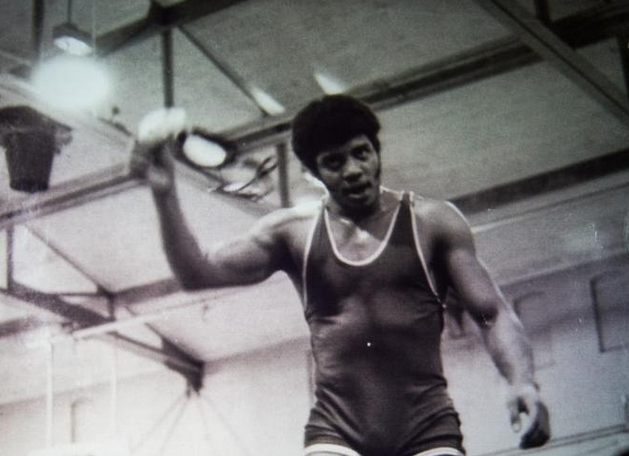
We know that Neil deGrasse Tyson was something of a wunderkind during his high school years. If you’re an OC regular, you’ve read all about how Carl Sagan personally recruited Tyson to study with him at Cornell. Deftly, politely, the young Tyson declined and went to Harvard.
There’s perhaps another side of the precocious Tyson you might not know as much about. The athletic side. While a student at The Bronx High School of Science, Tyson (class of 1976) wore basketball sneakers belonging to the Knick’s Walt “Clyde” Frazier. He ran an impressive 4:25 mile. And he captained the school’s wrestling team, during which time he conjured up a new-fangled wrestling move. In professional wrestling, Ric Flair had the dreaded Figure Four Leg Lock, and Jimmy Snuka, a devastating Superfly Splash. Tyson? He had the feared “Double Tidal Lock.” He explains and demonstrates the physics-based move in the video below, originally recorded at the University of Indianapolis.
A recent Pew Research Center survey found that nearly one in five American teenagers is on Youtube “almost constantly.” Ten years ago, the figure surely wouldn’t have been that high, and twenty years ago, of course, Youtube didn’t exist at all. But today, no enterprise directed at teenagers can afford to ignore it: that goes for pop music and fashion, of course, but also for education. Most kids just starting college are on Youtube, but so are those about to start college, those taking time off from college, and those unsure of whether they’re willing or able to go to college at all. Hence College Foundation, a new extension of Youtube channel Study Hall, the product of a partnership between Arizona State University, YouTube and Crash Course.
Crash Course has long produced video series that, both entertainingly and at length, cover subjects taught in school from history to literature to philosophy and beyond. The College Foundation’s program will make it possible not just to learn on Study Hall, but to earn real college credits as well.
“Students who are interested in formal coursework beyond watching the videos may pay a $25 fee to enroll in an ASU online course that includes interacting with other students and instructors,” writes Inside Higher Education’s Susan D’Agostino. Upon completion of the course, “the student can decide whether they would like to pay $400 to record the grade and receive ASU credit.”
Enrollment is now open for the first four College Foundations courses, English Composition, College Math, U.S. History and Human Communication, all of which begin on March 7th. (Those who sign up before that start date will receive a $50 discount.) “Once you’re in a course, you can contact a success coach via email to get help with assignments,” writes TechCrunch’s Aisha Malik. “You can complete your coursework when it’s convenient for you, but you will have weekly due dates for most of the courses. If you want to access additional support, some instructors hold optional office hours.” This sort of learning experience could become a bridge to Youtube life and college life — the latter being the subject addressed, with characteristic Youtube directness, in the existing Study Hall course “How to College.”
Based in Seoul, Colin Marshall writes and broadcasts on cities, language, and culture. His projects include the Substack newsletterBooks on Cities, the book The Stateless City: a Walk through 21st-Century Los Angeles and the video series The City in Cinema. Follow him on Twitter at @colinmarshall or on Facebook.
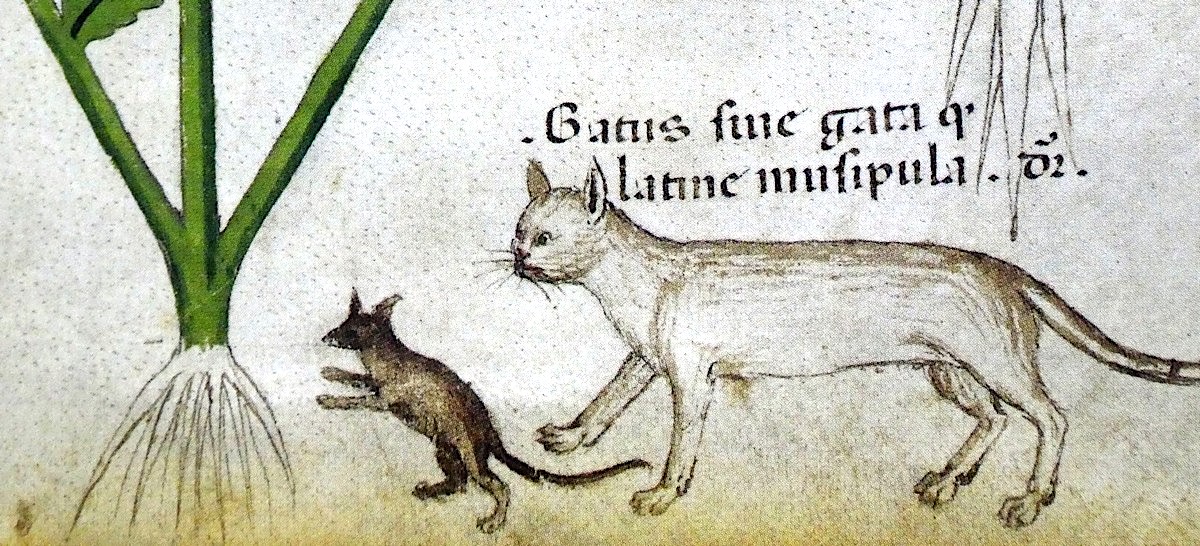
“The Naming of Cats is a difficult matter,” declares the opening poem in Old Possum’s Book of Practical Cats by T. S. Eliot. But the possibilities are many and varied: “Peter, Augustus, Alonzo or James”; “Plato, Admetus, Electra, Demeter”; “Munkustrap, Quaxo, or Coricopat.” Things must have been less complicated in the Middle Ages, when you could just call a cat Gyb and be done with it. “The shortened form of the male name Gilbert, Gyb” explains Kathleen Walker-Meikle in Medieval Cats, dates as “a popular name for individual pet cats” at least back to the late fourteenth century.
In a slightly different form, the name even appears in Shakespeare, when Falstaff describes himself as “as melancholy as a gib cat.” Gyb’s equivalent across the Chanel was Tibers or Tibert; the sixteenth-century French poet Joachim du Bellay kept a “beloved gray cat” named Belaud.
Legal texts reveal that the Irish went in for “cat names that refer to the animal’s physical appearance,” like Méone (“little meow”), Cruibne (“little paws”), and Bréone (“little flame”). Walker-Meikle also highlights Pangur Bán, a cat “immortalized in a ninth-century poem by an Irish monk.” This hymn to the parallel skills of human and feline begins, in Seamus Heaney’s English translation, as follows:
Pangur Bán and I at work,
Adepts, equals, cat and clerk:
His whole instinct is to hunt,
Mine to free the meaning pent.
Frequent Open Culture readers may be reminded of the twelfth-century Chinese poet who wrote of being domesticated by his own cats, verses we featured here a few years ago. More recently, we put up a list of 1,065 Medieval dog names, which run the gamut from Garlik, Nosewise, and Hosewife to Hornyball, Argument, and Filthe. You’ll notice that the names given to dogs in the Middle Ages seem to have been more amusing, if less dignified, than the ones given to cats. Perhaps this reflects the strong, clearly centuries-and-centuries-old differences between the natures of the animals themselves, each with its own strengths and weaknesses. But whatever our preferences in that area, who among us couldn’t do with a Pangur Bán of our own?
Based in Seoul, Colin Marshall writes and broadcasts on cities, language, and culture. His projects include the Substack newsletterBooks on Cities, the book The Stateless City: a Walk through 21st-Century Los Angeles and the video series The City in Cinema. Follow him on Twitter at @colinmarshall or on Facebook.
The Youtuber “EmperorTigerstar” specializes in documenting the unfolding of world historical events by stitching together hundreds of maps into timelapse films. In years past, we’ve featured his “map animations” of the U.S. Civil War (1861–1865), World War I(1914–1918), and World War II (1939–1945). Today, we’re highlighting a more ambitious project, an attempt to visually document the rise and fall of the Romans. The video covers 2,000 years of history, in just ten minutes.
Moving from 753 BC to 1479 AD, the animated map shows Rome’s territorial boundaries changing as the Roman Kingdom morphs into the Roman Republic and later the Roman Empire. Then the gravity of history takes over and we experience the gradual decline of Roman civilization. We see the bifurcation that splits the Empire into Western and Eastern (Byzantine) parts, until only a little piece remains.
If you would like to support the mission of Open Culture, consider making a donation to our site. It’s hard to rely 100% on ads, and your contributions will help us continue providing the best free cultural and educational materials to learners everywhere. You can contribute through PayPal, Patreon, and Venmo (@openculture). Thanks!
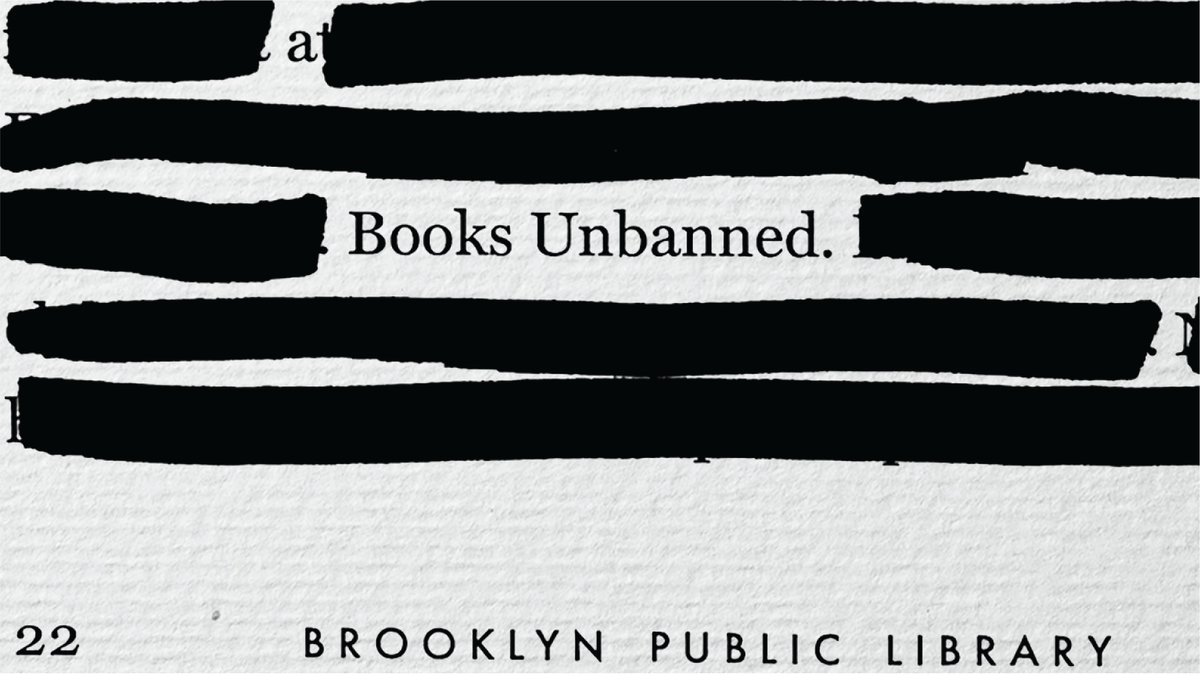
We have covered it before: school districts across the United States are increasingly censoring books that don’t align with conservative, white-washed visions of the world. Art Spiegelman’s Maus, The Illustrated Diary of Anne Frank, Alice Walker’s The Color Purple, Toni Morrison’s The Bluest Eye, and Harper Lee’s To Kill a Mockingbird–these are some of the many books getting pulled from library shelves in American schools. In response to this concerning trend, the Brooklyn Public Library has made a bold move: For a limited time, the library will offer a free eCard to any person aged 13 to 21 across the United States, allowing them free access to 500,000 digital books, including many censored books. The Chief Librarian for the Brooklyn Public Library, Nick Higgins said:
A public library represents all of us in a pluralistic society we exist with other people, with other ideas, other viewpoints and perspectives and that’s what makes a healthy democracy — not shutting down access to those points of view or silencing voices that we don’t agree with, but expanding access to those voices and having conversations and ideas that we agree with and ideas that we don’t agree with.
And he added:
This is an intellectual freedom to read initiative by the Brooklyn Public Library. You know, we’ve been paying attention to a lot of the book challenges and bans that have been taking place, particularly over the last year in many places across the country. We don’t necessarily experience a whole lot of that here in Brooklyn, but we know that there are library patrons and library staff who are facing these and we wanted to figure out a way to step in and help, particularly for young people who are seeing, some books in their library collections that may represent them, but they’re being taken off the shelves.
As for how to get the Brooklyn Public Library’s free eCard, their Books Unbanned website offers the following instructions: “individuals ages 13–21 can apply for a free BPL eCard, providing access to our full eBook collection as well as our learning databases. To apply, email bo***********@**********ry.org.” In short, send them an email.
Note: We first posted about this initiative during the dog days of last August. But it seemed worth mentioning this program while school’s in full swing. Hence why we’re flagging Books Unbanned again.
If you would like to support the mission of Open Culture, consider making a donation to our site. It’s hard to rely 100% on ads, and your contributions will help us continue providing the best free cultural and educational materials to learners everywhere. You can contribute through PayPal, Patreon, and Venmo (@openculture). Thanks!
We live in an age of subtitles. On some level this is a vindication of the cinephiles who spent so much of the twentieth century complaining about shoddy dubbing of foreign films and public unwillingness to “read movies.” Today we think nothing of reading not just movies but television shows as well, even those performed in our native language. For an increasing proportion of at-home viewers — including on-computer, on-tablet, and on-phone viewers — subtitles have come to feel like a necessity, even in the absence of any hearing difficulties. Vox’s Edward Vega investigates why this has happened in the video above.
The chief irony of the story is that the intelligibility of film and television dialogue seems to have degraded as a result of sound recording and editing technology having improved. Back in the early days of sound film, actors had practically to shout into bulky microphones concealed on-set or placed just off it. Today, a production can keep a couple of boom mics suspended overhead at all times, but also rig each actor up with a few hidden lavaliers. The upshot is that dialogue almost always gets recorded acceptably, but it removes the pressure on performers to deliver their lines with the clarity they would, say, on stage.
For better or for worse, this has encouraged a tendency toward unprecedentedly naturalistic dialogue, manifest though it often does as slurring and mumbling. At the same time, says dialogue editor Austin Olivia Kendrick, filmmakers have come to believe that “if you want your movie to feel ‘cinematic,’ you have to have wall-to-wall bombastic, loud sound.” Yet a soundtrack can be cranked up only so high, an explosion of the same loudness as a human voice won’t sound like an explosion at all: “you need that contrast in volume in order to give your ear a sense of scale.”
This need to preserve the sound mix’s “dynamic range” — just the opposite of the “loudness wars” in popular music — thus keeps dialogue on the quiet side. You can still hear it clear as day in a theater equipped with up-to-date surround-sound facilities, but much less so when it’s coming out of the tiny speakers crammed into the back of a flat-panel television, let alone the bottom of a cellphone. Turning the subtitles on and leaving them on has emerged as a common solution to this thoroughly modern problem. Another would be to invest in a proper high-end amplifier and speaker setup, which, if widely adopted, would certainly come as a vindication for all the frustrated audiophiles out there.
Based in Seoul, Colin Marshall writes and broadcasts on cities, language, and culture. His projects include the Substack newsletterBooks on Cities, the book The Stateless City: a Walk through 21st-Century Los Angeles and the video series The City in Cinema. Follow him on Twitter at @colinmarshall or on Facebook.
The first rule of Medieval Mixed-Gender Fight Club is: you do not talk about Medieval Mixed-Gender Fight Club.
The second rule of Medieval Mixed-Gender Fight Club is: you DO NOT talk about Medieval Mixed-Gender Fight Club!
Why?
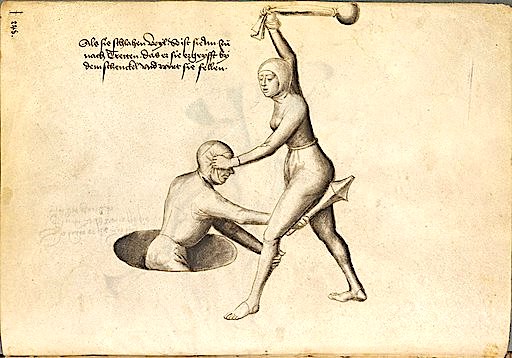
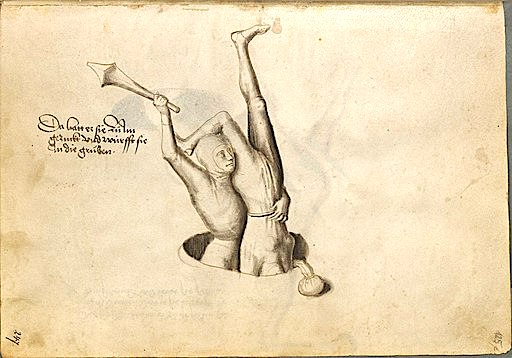
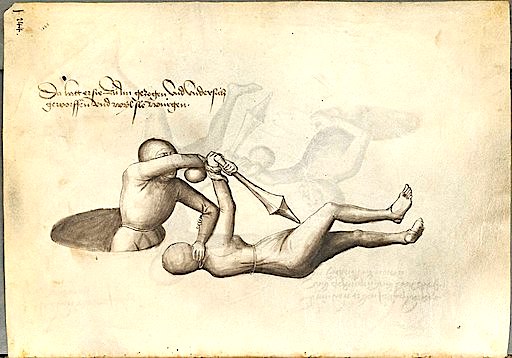
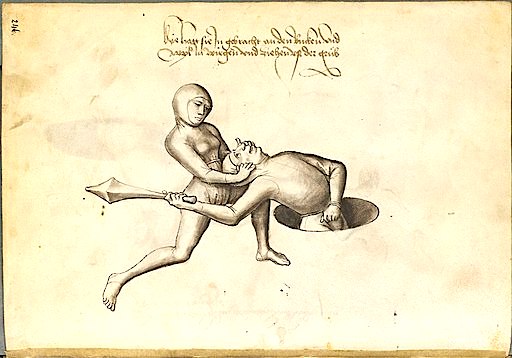
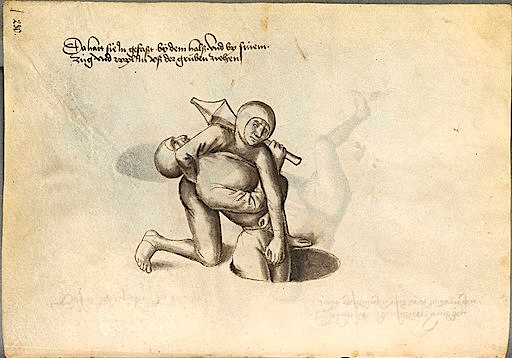
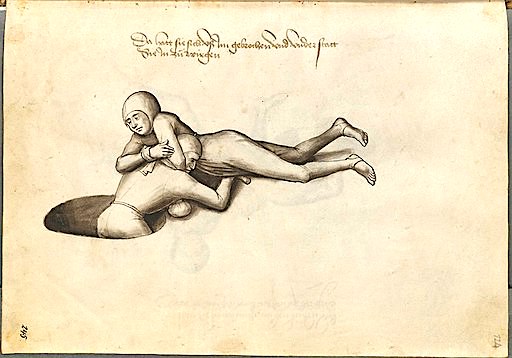
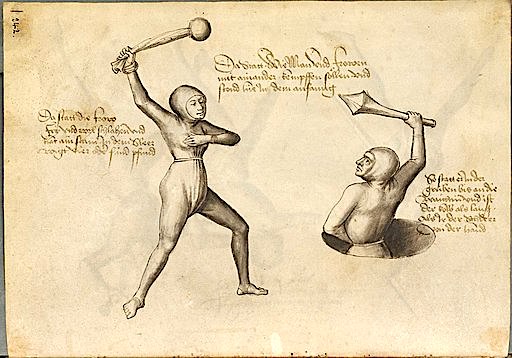
The Public Domain Review’s managing editor, Hunter Dukes, wisely argues that it’s because we have so little to go on, beyond these startling images of “judicial duels” between men and women in German fencing master Hans Talhoffer’s illustrated 15th-century “fight books.”
The male combatant, armed with a wooden mace, starts out in a waist-deep hole.
The female, armed with a rock wrapped in a length of cloth, stands above, feet planted to the ground.
Their matching unisex garments wouldn’t look out of place at the Met Gala, and provide for maximum movement as evidenced by the acrobatic, and seriously painful-looking paces Talhoffer puts them through.
Dukes is not alone in wondering what’s going on here, and he doesn’t mince words when calling bullshit on those responsible for “hastily researched articles” eagerly pronouncing them to be action shots of divorce-by-combat.
Such brutal methods of formal uncoupling had been rendered obsolete centuries before Talhoffer began work on his instructional manuals.
In a 1985 article in Source: Notes in the History of Art, Allison Coudert, a professor of Religious Studies at UC Davis, posits that Talhoffer might have been drawing on the past in these pages:
I would suggest that no records of judicial duels between husbands and wives exists after 1200 because of both changes in the reality and the ideal of what a woman could be and do. Before 1200, women may well have battled their husbands. Women understood and defended the importance of their economic and administrative roles in the household. After the twelfth century, however, law, custom and religion made marital duels all but unthinkable.
Why would Talhoffer bother including archaic material if the focus of his Fechtbuchs was giving less experienced fighters concrete information for their betterment?
We like the notion that he might have been seeking to inject his manuscripts with a bit of an erotic charge, but concede that scholars like Coudert, who have PhDs, research chops, and actual expertise in the subject, are probably warmer when reckoning that he was just covering his historical bases.
For now, let us enjoy these images as art, and possible sources of inspiration for avant-garde circus acts, Halloween couples costumes, and Valentines.
Explore more images from the 15th-century Fechtbuchs of Hans Talhoffer here and here.
The seventeen-fifties found Western civilization in the middle of its Age of Enlightenment. That long era introduced on a large scale the notion that, through the use of rationality and scientific knowledge, humanity could make progress. For the Enlightenment’s true believers, it would have eventually become quite easy indeed to assume that we had nowhere to go but up, and would sooner or later attain a state of perfection. No such fantasies, of course, for Jean-Marie Arouet, better known as Voltaire. Despite being an Enlightenment icon, he pulled no punches in attacking what he saw as its delusions, most lastingly in his 1759 satirical novel Candide, ou l’Optimisme.
Two centuries later, Western civilization, and especially the freshly formed civilization of the United States of America, had entered a new age of reason. Or rather, it had entered an age of technical, industrial, and organizational “know-how.”
The conviction that America could be perfected through engineered systems played its part in generating a degree of prosperity the world had never known (and would have scarcely been imaginable in Voltaire’s day). But it also had grimmer manifestations, such as McCarthyism and the House Un-American Activities Committee, whose procedures ground away at the core of the anti-Communist “red scare.”
In Candide, Voltaire takes to task a variety of not just beliefs but institutions, including the Portuguese Inquisition. The playwright Lillian Hellman, who’d been blacklisted after appearing before the HUAC in 1947, “observed a sinister parallel between the Inquisition’s church-sponsored purges and the ‘Washington Witch Trials,’ fueled by anti-Communist hysteria.” So says the web site of Leonard Bernstein, Hellman’s collaborator on what would become a comic-operetta adaptation of Candide. With contributions from lyricist John LaTouche, poet Richard Wilbur, and Algonquin Round Table wit Dorothy Parker, their production was ready to open in the fall of 1956.
Stripped in the eleventh hour of Hellman’s most direct topical attacks, and even then criticized for over-seriousness, the original Broadway production of Candide ended after 73 performances. (Recordings of the original production can be purchased online.) Nevertheless, there was cause for optimism about its future: the show would be revived in London with a revised book two years later, with further new versions to follow in the nineteen-seventies and eighties, its lyrics supplemented by no less a Broadway master than Stephen Sondheim. The two-and-a-half hour video above combines highlights of two consecutive performances in 1989, conducted by Bernstein himself in the year before his death. “Like its hero, Candide is perhaps destined never to find its perfect form and function,” notes Bernstein’s site. “In the final analysis, however, that may prove philosophically appropriate.”
Based in Seoul, Colin Marshall writes and broadcasts on cities, language, and culture. His projects include the Substack newsletterBooks on Cities, the book The Stateless City: a Walk through 21st-Century Los Angeles and the video series The City in Cinema. Follow him on Twitter at @colinmarshall or on Facebook.
One can appreciate the art of Frida Kahlo while knowing nothing of the art of her onetime husband, the Mexican muralist Diego Rivera. But the experience of certain of her paintings can be greatly enriched by some knowledge of their relationship, the clearest example being The Two Fridas, which Kahlo painted in 1939 after their divorce. The largest of her numerous self-portraits, it presents the artist as a set of doppelgängers set apart by their attire: one wears a European dress, and the other a traditional Mexican one. The resulting tableau could, on one level, reflect her dual heritage; it also, as Kahlo herself put it, shows “the Frida Diego loved, and the one he didn’t.”
The Two Fridas is the subject of the video essay above from Great Art Explained. “The darker-skinned Frida on the right is the indigenous Mexican Frida that was adored by her husband,” explains its host, gallerist James Payne.
“The lighter-skinned Frida on the left is the European Frida that he rejected.” Presenting herself in the former fashion “sent a clear message of cultural identity, nationalism, and feminism” — but it also concealed the “broken body” that resulted from a bus crash in her youth as well as various other physical disorders later in life. This portrait, however, exposes the heart of “Mexican Frida” in order to show that it “remains intact, sustained by the small portrait of Diego” in her hand.
The heart of “European Frida,” however, is rendered as “disconnected from her beloved Diego,” and it “bleeds profusely onto her dress, a Victorian lace dress similar to the one her mother wore.” The two Fridas are connected through their exposed hearts by a single artery, one connected to the portrait of Rivera. Payne points out the particular symbolic power of a bleeding heart, a “fundamental symbol of Catholicism” that “can also be seen as symbolic of Aztec ritual sacrifice,” in the case of a culturally conflicted artist such as Kahlo. In retrospect, The Two Fridas also seems to express the inevitability of Kahlo and Rivera’s remarriage, which would come the following year. They had “one of the most obsessive and tumultuous relationships in art history,” as Payne puts it, but while both lived, they knew they couldn’t do without each other.
Based in Seoul, Colin Marshall writes and broadcasts on cities, language, and culture. His projects include the Substack newsletterBooks on Cities, the book The Stateless City: a Walk through 21st-Century Los Angeles and the video series The City in Cinema. Follow him on Twitter at @colinmarshall or on Facebook.
So we invite you to bring a friend, position yourselves in opposite corners, facing away from each other, and murmur your secrets to the wall.
Your friend will hear you as clearly as if you’d been whispering directly into their ear…and 9 times out of 10, a curious onlooker will approach to ask what exactly is going on.
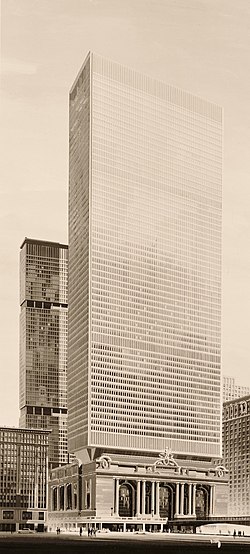
Onassis wrote to Mayor Abraham Beame in 1975, hoping to enlist him in the fight to spare midtown Manhattan’s jewel from an affront that the Landmarks Preservation Commission called an “aesthetic joke:”
Is it not cruel to let our city die by degrees, stripped of all her proud moments, until there is nothing left of all her history and beauty to inspire our children? If they are not inspired by the past of our city, where will they find the strength to fight for her future?
(Amtrak’s long distance lines operate out of Penn Station…)
Spend some time in Grand Central’s iconic Main Concourse.
Gaze up toward the great arched windows to see if you can catch a tiny human figure behind the glass bricks, passing along one of the high up hidden catwalks connecting office buildings anchoring Grand Central’s corners.
Perhaps you’ll be privy to some intrigue near the famous four-sided clock, a time-honored rendez-vous spot that’s appeared in numerous films, including The Godfather, Men in Black, and North by Northwest.
Admire the upside down and backwards constellations adorning the vaulted ceiling, marveling that it not only took five men — architect Whitney Warren, artist Paul Helleu, muralist J. Monroe Hewlett, painter Charles Basing, and astronomer Harold Jacoby — to get it wrong, their celestial boo-boo has been embraced during subsequent renovations.
If your wallet’s as fat as a Park Avenue swell’s, head to the Campbell Apartment atop the West Staircase. Formerly the private office of Jazz Age financier, John W. Campbell, it’s now a glamorous venue for blowing $20 on a martini.
(Hot tip — that same $20 can fetch you sixteen Long Island Blue Points during Happy Hour at the Oyster Bar.)
As for the East Staircase, nearly 100 years younger than its seeming fraternal twin across the Concourse’s marble expanse, that one leads to an Apple Store.
Browse various options for Grand Central Terminal guided and self-guided tours here.
We're hoping to rely on loyal readers, rather than erratic ads. Please click the Donate button and support Open Culture. You can use Paypal, Venmo, Patreon, even Crypto! We thank you!
Open Culture scours the web for the best educational media. We find the free courses and audio books you need, the language lessons & educational videos you want, and plenty of enlightenment in between.