The Pulp Tarot: A New Tarot Deck Inspired by Midcentury Pulp Illustrations

Graph­ic artist Todd Alcott has endeared him­self to Open Cul­ture read­ers by retro­fitting mid­cen­tu­ry pulp paper­back cov­ers and illus­tra­tions with clas­sic lyrics from the likes of David BowiePrinceBob Dylan, and Talk­ing Heads.

Although he’s dab­bled in the abstrac­tions that once graced the cov­ers of psy­chol­o­gy, phi­los­o­phy, and sci­ence texts, his over­ar­ch­ing attrac­tion to the visu­al lan­guage of sci­ence fic­tion and illic­it romance speak to the pre­mi­um he places on nar­ra­tive.

And with hun­dreds of “mid-cen­tu­ry mashups” to his name, he’s become quite a mas­ter of bend­ing exist­ing nar­ra­tives to his own pur­pos­es.

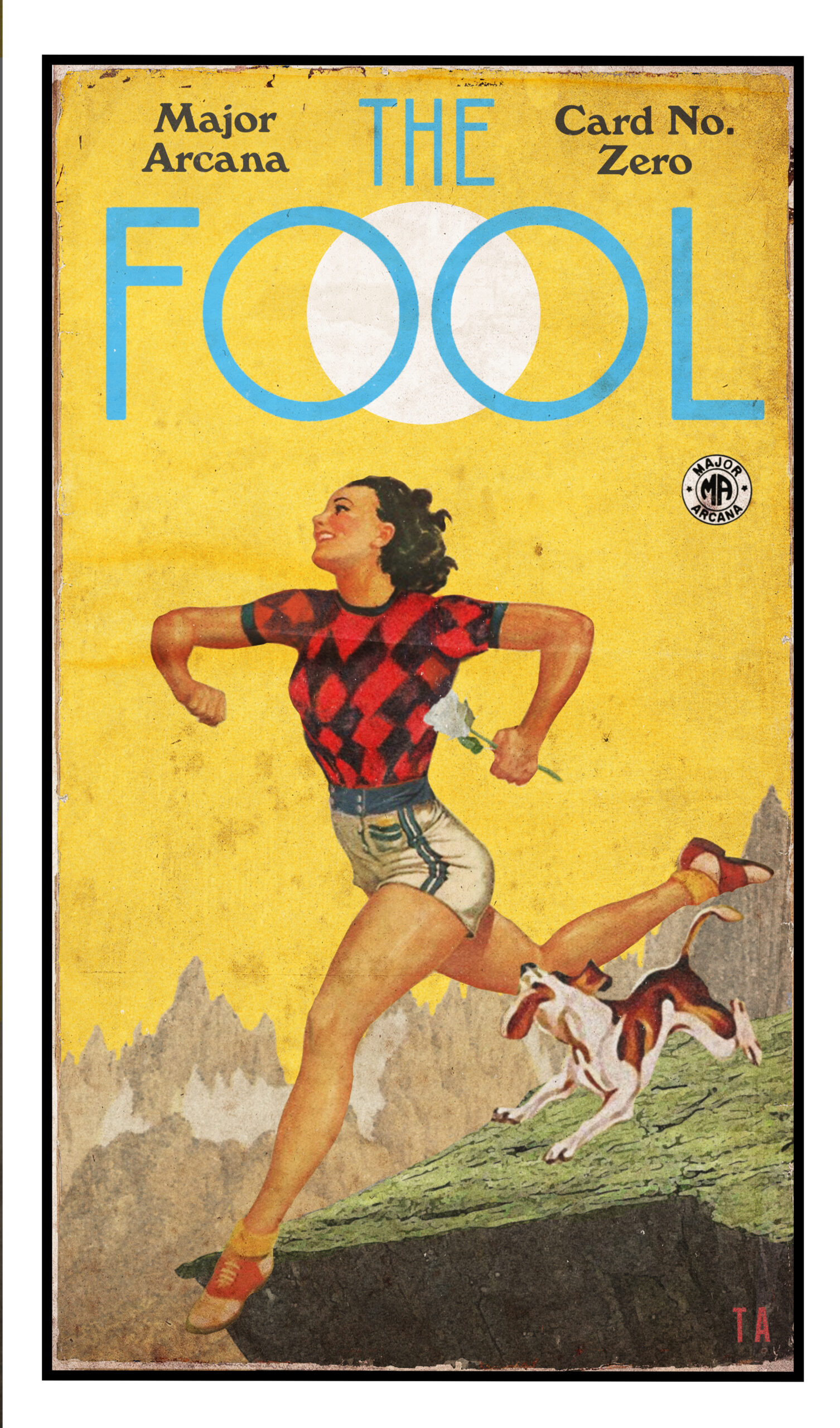
Recent­ly, Alcott turned his atten­tion to the cre­ation of the Pulp Tarot deck he is fund­ing on Kick­starter.

A self-described “clear-eyed skep­tic as far as para­nor­mal things” go, Alcott was drawn to the “sim­plic­i­ty and strange­ness” of Pamela Col­man Smith’s “bewitch­ing” Tarot imagery:

Maybe because they were sim­ply the first ones I saw, I don’t know, but there is some­thing about the nar­ra­tive thread that runs through them, the way they delin­eate the devel­op­ment of the soul, with all the choic­es and crises a soul encoun­ters on its way to ful­fill­ment, that real­ly struck a chord with me. You lay out enough Tarot spreads and they even­tu­al­ly coa­lesce around a hand­ful of cards that real­ly seem to define you. I don’t know how it hap­pens, but it does, every time: there are cards that come up for you so often that you think, “Yep, that’s me,” and then there are oth­ers that turn up so rarely that, when they do come up, you have to look them up in the lit­tle book­let because you’ve nev­er seen them before.

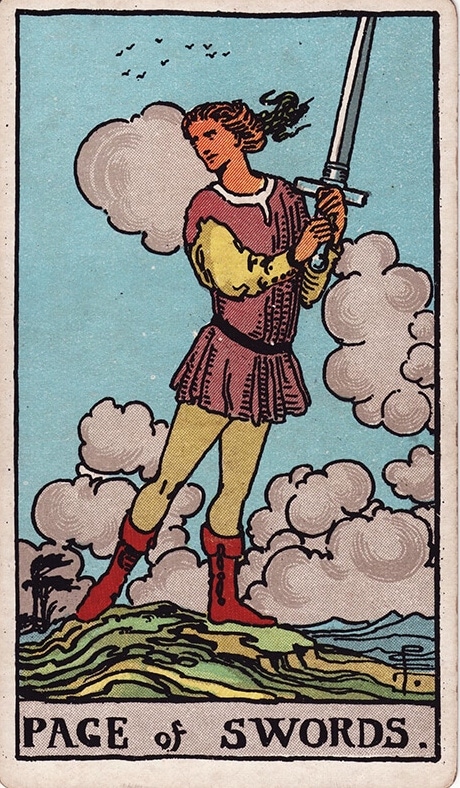
One such card for Alcott is the Page of Swords. In the ear­ly 90s, curi­ous to know what the Tarot would have to say about the young woman he’d start­ed dat­ing, he shuf­fled and cut his Rid­er-Waite-Smith deck “until some­thing inside said “now” and he flipped over the Page of Swords:

I looked it up in the book­let, which said that the Page of Swords was a secret-keep­er, like a spy. I thought about that for a moment; the woman I was see­ing was noth­ing like a spy, and had no spy-like attrib­ut­es. I shrugged and began the process again, shuf­fling and cut­ting and shuf­fling and cut­ting, until, again, some­thing inside said “now,” and turned up the card again. It was the Page of Swords, again. My heart leaped, I put the deck back in its box and qui­et­ly freaked out for a while. The next day, I asked the young lady if the Page of Swords meant any­thing to her, and she said “Oh sure, when I was a kid, that was my card.” Any­way, I’m now mar­ried to her.

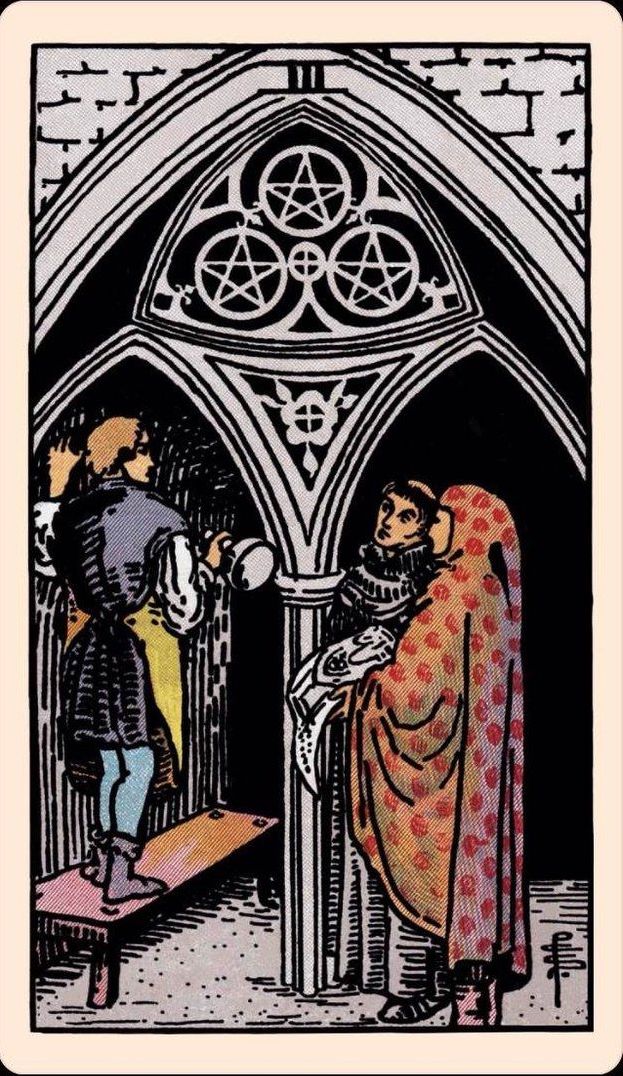
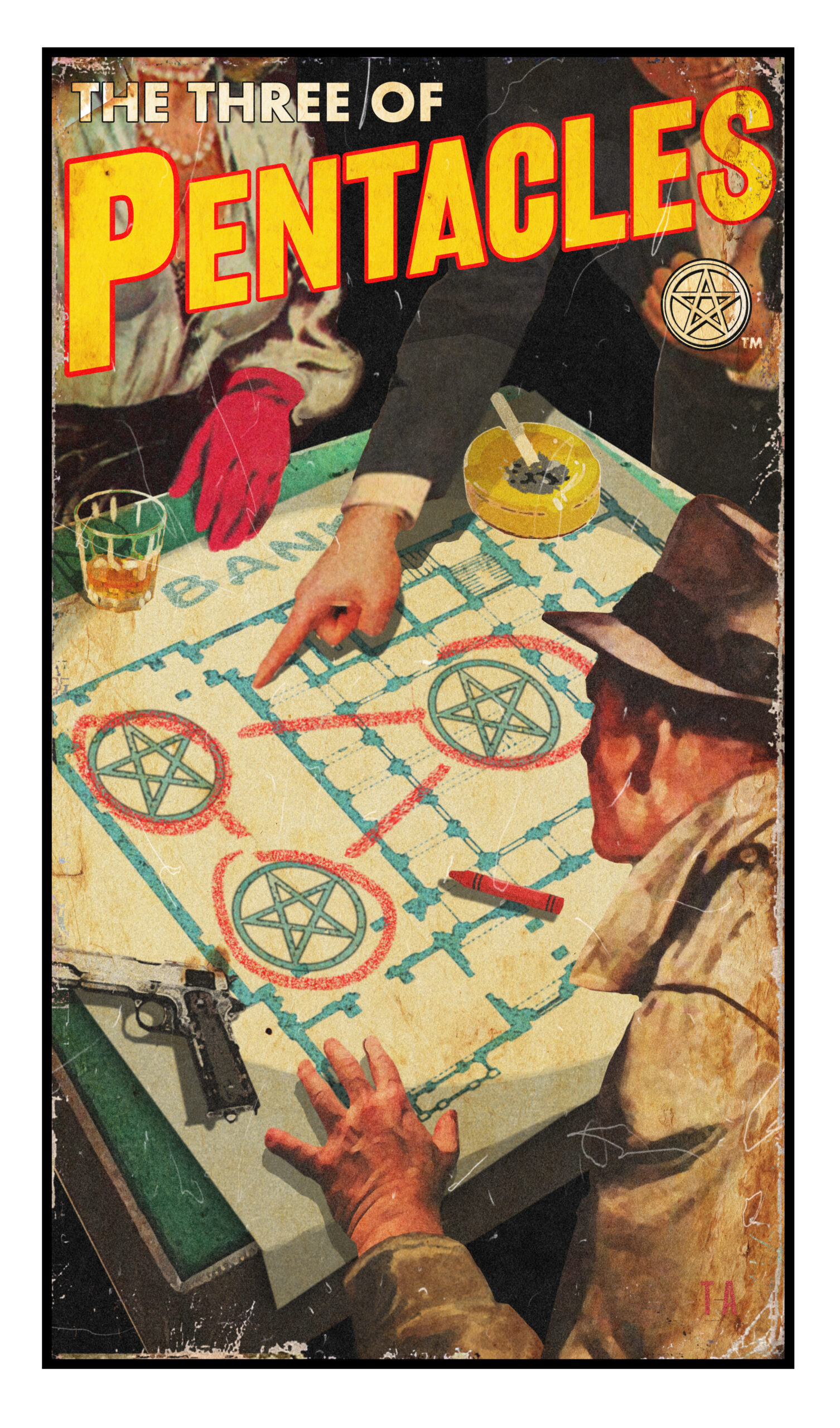
The Three of Pen­ta­cles is anoth­er favorite, one that pre­sent­ed a par­tic­u­lar design chal­lenge.

The Smith deck shows a stone­ma­son, an archi­tect and a church offi­cial, col­lab­o­rat­ing on build­ing a cathe­dral. Now, there are no cathe­drals in the pulp world, so I had to think, well, in the pulp world, pen­ta­cles rep­re­sent mon­ey, so the obvi­ous choice would be to show three crim­i­nals plan­ning a heist. I could­n’t find an image any­thing close to the one in my head, so I had to build it: the room, the table, the map of the bank, the plan, the peo­ple involved, and then stitch it all togeth­er in Pho­to­shop so it end­ed up look­ing like a cohe­sive illus­tra­tion. That was a real­ly joy­ful moment for me: there were the three con­spir­a­tors, the Big Cheese, the Dame and The Goon, their roles clear­ly defined despite not see­ing any­one’s face. It was a real break­through, see­ing that I could put togeth­er a lit­tle nar­ra­tive like that.

Smith imag­ined a medieval fan­ta­sy world when design­ing her Tarot deck. Alcott is draw­ing on 70 years of pop-cul­ture ephemera to cre­ate a trib­ute to Smith’s vision that also works as a deck in their own right “with its own moral nar­ra­tive uni­verse, based on the atti­tudes and con­ven­tions of that world.”

Before draft­ing each of his 70 cards, Alcott stud­ied Smith’s ver­sion, research­ing its mean­ing and design as he con­tem­plates how he might trans­late it into the pulp ver­nac­u­lar. He has found that some of Smith’s work was delib­er­ate­ly exact­ing with regard to col­or, atti­tude, and cos­tume, and oth­er instances where spe­cif­ic details took a back seat to mood and emo­tion­al impact:

Once I under­stand what a card is about, I look through my library to find images that help get that across. It can get real­ly com­pli­cat­ed! A lot of times, the char­ac­ter’s body is in the right posi­tion but their face has the wrong expres­sion, so I have to find a face that fits what the card is try­ing to say. Or their phys­i­cal atti­tude is right, but I need them to be grip­ping or throw­ing some­thing, so I have to find hands and arms that I can graft on, Franken­stein style. In some cas­es, there will be fig­ures in the cards cob­bled togeth­er from five or six dif­fer­ent sources. 

These cards are eas­i­ly the most com­plex work I’ve ever done in that sense. The song pieces I do are a con­ver­sa­tion between the piece and the song, but these cards are a con­ver­sa­tion between me, Smith, the entire Tarot tra­di­tion, and the uni­verse. 

Vis­it Todd Alcott’s Etsy shop to view more of his mid-cen­tu­ry mash ups, and see more cards from The Pulp Tarot and sup­port Kick­starter here.

All images from the Pulp Tarot used with the per­mis­sion of artist Todd Alcott.

Relat­ed Con­tent:

Clas­sic Songs Re-Imag­ined as Vin­tage Book Cov­ers Dur­ing Our Trou­bled Times: “Under Pres­sure,” “It’s the End of the World as We Know It,” “Shel­ter from the Storm” & More

David Bowie Songs Reimag­ined as Pulp Fic­tion Book Cov­ers: Space Odd­i­ty, Heroes, Life on Mars & More

Songs by Joni Mitchell Re-Imag­ined as Pulp Fic­tion Book Cov­ers & Vin­tage Movie Posters

Four Clas­sic Prince Songs Re-Imag­ined as Pulp Fic­tion Cov­ers: When Doves Cry, Lit­tle Red Corvette & More

Ayun Hal­l­i­day is an author, illus­tra­tor, the­ater mak­er and Chief Pri­ma­tol­o­gist of the East Vil­lage Inky zine.  Fol­low her @AyunHalliday.

Ethan Hawke Explains How to Give Yourself Permission to Be Creative

The most cre­ative peo­ple, you’ll notice, throw them­selves into what they do with absurd, even reck­less aban­don. They com­mit, no mat­ter their doubts about their tal­ents, edu­ca­tion, finances, etc. They have to. They are gen­er­al­ly fight­ing not only their own mis­giv­ings, but also those of friends, fam­i­ly, crit­ics, financiers, and land­lords. Artists who work to real­ize their own vision, rather than some­one else’s, face a with­er­ing­ly high prob­a­bil­i­ty of fail­ure, or the kind of suc­cess that comes with few mate­r­i­al rewards. One must be will­ing to take the odds, and to renounce, says Ethan Hawke in the short TED talk above, the need for val­i­da­tion or approval.

This is hard news for peo­ple pleasers and seek­ers after fame and rep­u­ta­tion, but in order to over­come the inevitable social obsta­cles, artists must be will­ing, says Hawke, to play the fool. He takes as his exam­ple Allen Gins­berg, who appeared on William F. Buckley’s Fir­ing Line in May of 1968 and, rather than answer Buckley’s charge that his polit­i­cal posi­tions were “naive,” pulled out a har­mo­ni­um and pro­ceed­ed to sing the Hare Krish­na chant (“the most unhar­ried Krish­na I’ve ever heard,” Buck­ley remarked). Upon arriv­ing home to New York, says Hawke, Gins­berg was met by peo­ple who were aghast at what he’d done, feel­ing that he made him­self a clown for mid­dle Amer­i­ca.

Gins­berg was unboth­ered. He was will­ing to be “America’s holy fool,” as Vivian Gor­nick called him, if it meant inter­rupt­ing the con­stant stream of adver­tis­ing and pro­pa­gan­da and mak­ing Amer­i­cans stop to won­der “who is this stu­pid poet?”

Who is this per­son so will­ing to chant at William F. Buck­ley for “the preser­va­tion of the uni­verse, instead of its destruc­tion”? What might he have to say to my secret wish­es? This is what artists do, says Hawke, take risks to express emo­tions, by what­ev­er means are at hand. It is the essence of Ginsberg’s view of cre­ativ­i­ty, to let go of judg­ment, as he once told a writ­ing stu­dent:

Judge it lat­er. You’ll have plen­ty of time to judge it. You have all your life to judge it and revise it! You don’t have to judge it on the spot there. What ris­es, respect it. Respect what ris­es….

Judge your own work lat­er, if you must, but what­ev­er you do, Hawke advis­es above, don’t stake your worth on the judg­ments of oth­ers. The cre­ative life requires com­mit­ting instead to the val­ue of human cre­ativ­i­ty for its own sake, with a child­like inten­si­ty that doesn’t apol­o­gize for itself or ask per­mis­sion to come to the sur­face.

Relat­ed Con­tent: 

Allen Gins­berg Talks About Com­ing Out to His Fam­i­ly & Fel­low Poets on 1978 Radio Show (NSFW)

The Long Game of Cre­ativ­i­ty: If You Haven’t Cre­at­ed a Mas­ter­piece at 30, You’re Not a Fail­ure

David Lynch Explains How Sim­ple Dai­ly Habits Enhance His Cre­ativ­i­ty

Josh Jones is a writer and musi­cian based in Durham, NC. Fol­low him at @jdmagness

The Airline Toilets Theatre Company: Watch One Man Stage Comical Shows in Airplane Bathrooms

When COVID 19 struck, the­ater lovers were faced with a choice.

Let go entire­ly, or expand our def­i­n­i­tions of what con­sti­tutes “the­ater.”

We’ve had 14 months to get used to the idea of per­for­mances staged in clos­etsin pod­cast form, or as phone calls hing­ing on audi­ence par­tic­i­pa­tion.

We’re sick of Zoom, but we no longer con­sid­er it manda­to­ry for the play­ers to inhab­it the same space as each oth­er or the audi­ence.

This is all old news to Peter Brooke Turn­er, a mem­ber of the Ukulele Orches­tra of Great Britain and the founder of the Air­line Toi­lets The­atre Com­pa­ny.

The ATTC’s reper­toire con­sists of great works of lit­er­a­ture, song and dance… per­formed exclu­sive­ly in air­craft lava­to­ries, a true feat when one con­sid­ers that Turn­er, impre­sario and sole com­pa­ny mem­ber, is 6’8”.

2015’s inau­gur­al pro­duc­tion, above, remains among the company’s most ambi­tious —  a 50th anniver­sary recre­ation of Bob Dylan’s 1965 pro­mo­tion­al film clip for Sub­ter­ranean Home­sick Blues, shot on var­i­ous flights through­out the Ukulele Orchestra’s US tour.

Before long, Turner’s car­ry-on was stuffed with props and cos­tumes — a toga, three self-adhe­sive Abra­ham Lin­coln beards, a fat suit, a plas­tic cig­ar, card­board face masks of Jimi Hen­drix and Queen’s Bri­an May, and a num­bers of inflat­a­bles, includ­ing a woman, a horse, and a not par­tic­u­lar­ly real­is­tic hand­gun.

Stag­ing solo, site spe­cif­ic mini pro­duc­tions struck Turn­er as a far more amus­ing prospect than remain­ing in his seat, watch­ing a movie:

I don’t like pas­sive con­sumerism — I’d rather make my own movie than watch some CGI block­buster on a plane. 90% of tour­ing is NOT per­form­ing but sit­ting around on a plane/train/bus star­ing into space — I’m just try­ing to do some­thing cre­ative to make the time pass. 

With advance plan­ning, the sim­pler pro­duc­tions can make it into the can on a sin­gle take.

The James Bond Trib­ute, below, which called for cos­tume changes, pup­pets and card­board masks of Sean Con­nery, Roger Moore, and Daniel Craig, was shot in seg­ments — Lon­don to Frank­furt, Sin­ga­pore to Auck­land, and Sin­ga­pore to Lon­don.

Rather than pro­ject­ing for the ben­e­fit of folks in the non-exis­tent back row, Turn­er prefers to lip synch pre­re­cord­ed lines, fed to him via ear­bud. This helps dial down the sus­pi­cions of flight atten­dants and fel­low pas­sen­gers. Once the “occu­pied” light comes on, he reck­ons he has between 7 to 10 min­utes to take care of busi­ness. Should any­one ques­tion the length of his stay, or his large bag of cos­tumes and props, his excuse is that “I suf­fer from haem­or­rhoids and need to change my pants. (Believe me, this is a con­ver­sa­tion no one wants to take fur­ther.)”

Watch a playlist of the Best of the Air­line Toi­lets The­ater Com­pa­ny here.

Relat­ed Con­tent: 

Drift: Pas­sen­ger Shoots Strik­ing Short Film Out of Air­plane Win­dow

Pre-Flight Safe­ty Demon­stra­tion Gets Per­formed as a Mod­ern Dance: A Cre­ative Video from a Tai­wanese Air­line

Artist Nina Katchadouri­an Cre­ates Flem­ish Style Self-Por­traits in Air­plane Lava­to­ry

Ayun Hal­l­i­day is an author, illus­tra­tor, the­ater mak­er and Chief Pri­ma­tol­o­gist of the East Vil­lage Inky zine.  Join her June 7 for a Necro­mancers of the Pub­lic Domain: The Peri­od­i­cal Cica­da, a free vir­tu­al vari­ety hon­or­ing the 17-Year Cicadas of Brood X. Fol­low her @AyunHalliday.

Creative Thinking: A Free Online Course from Imperial College London

From Peter Childs (Head of the Dyson School of Design Engi­neer­ing at Impe­r­i­al Col­lege Lon­don) comes a free course that explores cre­ative think­ing tech­niques, and how to apply them to every­day prob­lems and glob­al chal­lenges. The course descrip­tion for Cre­ative Think­ing: Tech­niques and Tools for Suc­cess reads:

In today’s ever-grow­ing and chang­ing world, being able to think cre­ative­ly and inno­v­a­tive­ly are essen­tial skills. It can some­times be chal­leng­ing to step back and reflect in an envi­ron­ment which is fast paced or when you are required to assim­i­late large amounts of infor­ma­tion. Mak­ing sense of or com­mu­ni­cat­ing new ideas in an inno­v­a­tive and engag­ing way, approach­ing prob­lems from fresh angles, and pro­duc­ing nov­el solu­tions are all traits which are high­ly sought after by employ­ers.

The great­est inno­va­tors aren’t nec­es­sar­i­ly the peo­ple who have the most orig­i­nal idea. Often, they are peo­ple- or teams- that have har­nessed their cre­ativ­i­ty to devel­op a new per­spec­tive or more effec­tive way of com­mu­ni­cat­ing an idea. You can train your imag­i­na­tion to seize oppor­tu­ni­ties, break away from rou­tine and habit, and tap into your nat­ur­al cre­ativ­i­ty.

This course will equip you with a ‘tool-box’, intro­duc­ing you to a selec­tion of behav­iours and tech­niques that will aug­ment your innate cre­ativ­i­ty. Some of the tools are suit­ed to use on your own and oth­ers work well for a group, enabling you to lever­age the pow­er of sev­er­al minds.

You can take Cre­ative Think­ing: Tech­niques and Tools for Suc­cess for free by select­ing the audit option upon enrolling. If you want to take the course for a cer­tifi­cate, you will need to pay a fee.

Cre­ative Think­ing will be added to our list, 1,700 Free Online Cours­es from Top Uni­ver­si­ties.

Relat­ed Con­tent:

The Long Game of Cre­ativ­i­ty: If You Haven’t Cre­at­ed a Mas­ter­piece at 30, You’re Not a Fail­ure

How Walk­ing Fos­ters Cre­ativ­i­ty: Stan­ford Researchers Con­firm What Philoso­phers and Writ­ers Have Always Known

David Lynch Explains How Sim­ple Dai­ly Habits Enhance His Cre­ativ­i­ty

by | Permalink | Make a Comment ( 7 ) |

167 Pieces of Life & Work Advice from Kevin Kelly, Founding Editor of Wired Magazine & The Whole Earth Review

Image by Christo­pher Michel, via Wiki­me­dia Com­mons

I am a big admir­er of Kevin Kel­ly for the same rea­son I am of Bri­an Eno—he is con­stant­ly think­ing. That thirst for knowl­edge and end­less curios­i­ty has always been the back­bone to their par­tic­u­lar art forms. For Eno it’s music, but for Kel­ly it’s in his edi­tor­ship of the Whole Earth Review and then Wired mag­a­zine, pro­vid­ing a space for big ideas to reach the widest audi­ence. (He’s also the rea­son one of my buck­et lists is the Nakasendo, after see­ing his pho­to essay on it.)

On his 68th birth­day in 2020, Kel­ly post­ed on his blog a list of 68 “Unso­licit­ed Bits of Advice.” One bit of advice that frames his thought process and his work is this one:

“I’m pos­i­tive that in 100 years much of what I take to be true today will be proved to be wrong, maybe even embar­rass­ing­ly wrong, and I try real­ly hard to iden­ti­fy what it is that I am wrong about today.”

How­ev­er, the list is more about wis­dom from a life well-spent. Many fall into the art of being a curi­ous human among oth­er humans:

  • Every­one is shy. Oth­er peo­ple are wait­ing for you to intro­duce your­self to them, they are wait­ing for you to send them an email, they are wait­ing for you to ask them on a date. Go ahead.
  • The more you are inter­est­ed in oth­ers, the more inter­est­ing they find you. To be inter­est­ing, be inter­est­ed.
  • Being able to lis­ten well is a super­pow­er. While lis­ten­ing to some­one you love keep ask­ing them “Is there more?”, until there is no more.

And this is prob­a­bly the hard­est piece of advice these days:

  • Learn how to learn from those you dis­agree with, or even offend you. See if you can find the truth in what they believe.

Oth­er bits of advice have to do with cre­ativ­i­ty and being an artist:

  • Always demand a dead­line. A dead­line weeds out the extra­ne­ous and the ordi­nary. It pre­vents you from try­ing to make it per­fect, so you have to make it dif­fer­ent. Dif­fer­ent is bet­ter.
  • Don’t be the smartest per­son in the room. Hang­out with, and learn from, peo­ple smarter than your­self. Even bet­ter, find smart peo­ple who will dis­agree with you.
  • To make some­thing good, just do it. To make some­thing great, just re-do it, re-do it, re-do it. The secret to mak­ing fine things is in remak­ing them.
  • Art is in what you leave out.

And some of the more inter­est­ing ones are his dis­agree­ments with per­ceived wis­dom:

  • Fol­low­ing your bliss is a recipe for paral­y­sis if you don’t know what you are pas­sion­ate about. A bet­ter mot­to for most youth is “mas­ter some­thing, any­thing”. Through mas­tery of one thing, you can drift towards exten­sions of that mas­tery that bring you more joy, and even­tu­al­ly dis­cov­er where your bliss is.

One year lat­er, Kel­ly has returned with 99 more bits of advice. I guess he couldn’t wait til his 99th birth­day for it. Some favorites include:

  • If some­thing fails where you thought it would fail, that is not a fail­ure.
  • Being wise means hav­ing more ques­tions than answers.
  • I have nev­er met a per­son I admired who did not read more books than I did.
  • Every per­son you meet knows an amaz­ing lot about some­thing you know vir­tu­al­ly noth­ing about. Your job is to dis­cov­er what it is, and it won’t be obvi­ous.

and final­ly:

  • Don’t let your email inbox become your to-do list.

There is a small shift in Kelly’s 2021 list from his 2020 list, like a lit­tle more frus­tra­tion with the world, a need for more order in the chaos. I won­der what his advice will be in a few more years?

via Boing­Bo­ing

Relat­ed Con­tent:

Wired Co-Founder Kevin Kel­ly Gives 36 Lec­tures on Our Future World: Edu­ca­tion, Movies, Robots, Autonomous Cars & More

The Best Mag­a­zine Arti­cles Ever, Curat­ed by Kevin Kel­ly

What Books Could Be Used to Rebuild Civ­i­liza­tion?: Lists by Bri­an Eno, Stew­art Brand, Kevin Kel­ly & Oth­er For­ward-Think­ing Minds

Ted Mills is a free­lance writer on the arts who cur­rent­ly hosts the Notes from the Shed pod­cast and is the pro­duc­er of KCR­W’s Curi­ous Coast. You can also fol­low him on Twit­ter at @tedmills, and/or watch his films here.

Kermit the Frog Gives a TED Talk About Creativity & the Power of “Ridiculous Optimism”

In 2015, 3.8 bil­lion years after “cre­ativ­i­ty emerged” out of “sheer­est empti­ness,” Ker­mit the Frog was tapped to give a talk on cre­ativ­i­ty at TEDx­Jack­son.

How did a local, one-day event man­age to snag such a glob­al icon?

Roots.

The famed frog’s cre­ator, Jim Hen­son, spent his first decade in Mis­sis­sip­pi (though Ker­mit was born of a ping pong ball and Henson’s mother’s old coat after the fam­i­ly relo­cat­ed to Mary­land.)

The con­fer­ence took place 15 years after Henson’s untime­ly death, leav­ing Ker­mit to be ani­mat­ed by Steven Whit­mire, the first of two pup­peteers to tack­le a role wide­ly under­stood to be Henson’s alter ego.

The voice isn’t quite the same, but the man­ner­isms are, includ­ing the throat clear­ing and crum­pled facial expres­sions.

Also present are a num­ber of TED Talk tropes, the smart phone prompts, the dark stage, pro­jec­tions designed to empha­size pro­found points.

A num­ber of jokes fail to elic­it the expect­ed laughs … we’ll leave it up to you to deter­mine whether the fault lays with the live audi­ence or the mate­r­i­al. (It’s not easy being green and work­ing blue comes with chal­lenges, too.)

Were he to give his TED Talk now, in 2021, Ker­mit prob­a­bly wouldn’t describe the audience’s col­lec­tive deci­sion to “accept a premise, sus­pend our dis­be­lief and just enjoy the ride” as a “con­spir­a­cy of crazi­ness.”

He might bypass a bina­ry quote like “If neces­si­ty is the moth­er of inven­tion, then cre­ativ­i­ty is the father.”

He’d also be advised to steer clear of a pho­to of Miss Pig­gy dressed as a geisha, and secure her con­sent to share some of the raci­er anec­dotes… even though she is a known atten­tion hog.

He would “tran­scend and include” in the words of philoso­pher Ken Wilber, one of many inspi­ra­tions he cites over the course of his 23-minute con­sid­er­a­tion of cre­ativ­i­ty and its ori­gins, attempt­ing to answer the ques­tion, “Why are we here?”

Also ref­er­enced: Michelan­ge­lo, Albert Ein­stein, Sal­vador Dali, Charles Baude­laire, Zen mas­ter Shun­ryū Suzu­ki, math­e­mati­cian Alfred North White­head, author and edu­ca­tor, Sir Ken Robin­son (who appears, briefly) and of course, Hen­son, who applaud­ed the “ridicu­lous opti­mism” of fling­ing one­self into cre­ative explo­rations, unsure of what one might find.

He can’t wan­der freely about the stage, but he does share some stir­ring thoughts on col­lab­o­ra­tion, men­tors, and the impor­tance of main­tain­ing “beginner’s mind,” free of pre-con­cep­tions.

How to cul­ti­vate beginner’s mind?

Try fast for­ward­ing to the 11:11 mark. Watch for 20 sec­onds. It’s the purest invi­ta­tion to believe since Peter Pan begged us to clap Tin­ker Bell back to life.

Do you? Because Ker­mit believes in you.

Relat­ed Con­tent: 

Wit­ness the Birth of Ker­mit the Frog in Jim Henson’s Live TV Show, Sam and Friends (1955)

Watch Blondie’s Deb­bie Har­ry Per­form “Rain­bow Con­nec­tion” with Ker­mit the Frog on The Mup­pet Show (1981)

Jim Henson’s Com­mer­cials for Wilkins Cof­fee: 15 Twist­ed Min­utes of Mup­pet Cof­fee Ads (1957–1961)

Ayun Hal­l­i­day is an author, illus­tra­tor, the­ater mak­er and Chief Pri­ma­tol­o­gist of the East Vil­lage Inky zine.  Fol­low her @AyunHalliday.

Watch the “Greatest Juggler of the Ages,” Frances Brunn, Perform His “Painfully Exciting” Juggling Routine (1969)

When John Rin­gling North, then pres­i­dent of Rin­gling Bros. and Bar­num & Bai­ley Cir­cus, saw a pair of Ger­man  jug­glers and acro­bats per­form in Spain, he imme­di­ate­ly invit­ed them to join “the Great­est Show on Earth.” A broth­er and sis­ter team, Fran­cis and Lot­tie Brunn would aston­ish audi­ences. In 1950, the­ater crit­ic Brooks Atkin­son called Fran­cis “the great­est jug­gler of the ages. Not many peo­ple in the world are as per­fect­ly adjust­ed as Mr. Brunn is. He will nev­er have to vis­it a psy­chi­a­trist.” If phys­i­cal grace and bal­ance are reflec­tive of one’s state of mind, maybe he was right.

When Lot­tie left the act in 1951, Fran­cis went on to pop­u­lar fame and even more hyper­bol­ic acclaim. “After he per­formed before the queen of Eng­land in 1963, The Evening Stan­dard called his show ‘almost painful­ly excit­ing,’” Dou­glas Mar­tin writes at The New York Times.

“Try­ing to describe Brunn’s act is like try­ing to describe the flight of a swal­low,” writes Fran­cis­co Alvarez in Jug­gling: Its His­to­ry and Great­est Per­form­ers. He became a reg­u­lar per­former on The Ed Sul­li­van Show, “played the Palace with Judy Gar­land,” notes Mar­tin, “and went twice to the White House, where Pres­i­dent Dwight D. Eisen­how­er pro­claimed him the best jug­gler he had ever seen.”

None of this should bias you toward the tele­vi­sion per­for­mance, above, of course. (How many jug­glers could Eisen­how­er have seen, any­way?) Judge for your­self. By way of fur­ther con­text, we should note that Brunn was known for per­fect­ing “an aus­tere but demand­ing min­i­mal­ism. He was fas­ci­nat­ed by con­trol­ling just one ball, and vir­tu­al­ly com­pelled audi­ences to share this fas­ci­na­tion.” Or as Brunn put it, “it sounds like noth­ing, but it is quite dif­fi­cult to do prop­er­ly.” As any­one (or vir­tu­al­ly every­one) who has tried and failed to jug­gle can attest, this descrip­tion fits the art of jug­gling in gen­er­al all too well.

Brunn made it look laugh­ably easy: “Large num­bers of objects posed scant prob­lem. He was believed to be the first jug­gler in the world to put up 10 hoops,” Mar­tin writes. He also liked to incor­po­rate fla­men­co into his act to com­pound the dif­fi­cul­ty and the grace. “I do not con­sid­er myself doing tricks,” he said in 1983. “There is one move­ment for eight min­utes. It’s sup­posed to be, let’s say, like a bal­let…. I would love if the audi­ence is so fas­ci­nat­ed that nobody applauds in the end.” Brunn, I sus­pect, nev­er got to hear the sound of stunned silence after his act.

Relat­ed Con­tent: 

Watch the Ser­pen­tine Dance, Cre­at­ed by the Pio­neer­ing Dancer Loie Fuller, Per­formed in an 1897 Film by the Lumière Broth­ers

One of the Great­est Dances Sequences Ever Cap­tured on Film Gets Restored in Col­or by AI: Watch the Clas­sic Scene from Stormy Weath­er

Dis­cov­er Alexan­der Calder’s Cir­cus, One of the Beloved Works at the Whit­ney Muse­um of Amer­i­can Art

Josh Jones is a writer and musi­cian based in Durham, NC. Fol­low him at @jdmagness

Artist Makes Micro-Miniature Sculptures So Small They Fit on the Head of a Pin

The jury remains out as to the num­ber of angels that can dance on a pin, but self-taught artist Flor Car­va­jal is amass­ing some data regard­ing the num­ber of itty bit­ty sculp­tures that can be installed on the tips of match­sticks, pen­cil points, and — thanks to a rude encounter with a local reporter — in the eye of a nee­dle.

Accord­ing to Tucson’s Mini Time Machine Muse­um of Minia­tures, where her work is on dis­play through June, The Van­guardia Lib­er­al was con­sid­er­ing run­ning an inter­view in con­junc­tion with an exhib­it of her Christ­mas-themed minia­tures. When she wouldn’t go on record as to whether any of the itty-bit­ty nativ­i­ty scenes she’d been craft­ing for over a decade could be described as the world’s small­est, the reporter hung up on her.

Rather than stew, she imme­di­ate­ly start­ed exper­i­ment­ing, switch­ing from Sty­ro­foam to syn­thet­ic resin in the pur­suit of increas­ing­ly minis­cule manger scenes.

By sun­rise, she’d man­aged to place the Holy Fam­i­ly atop a lentil, a grain of rice, the head of a nail, and the head of a pin.

These days, most of her micro-minia­ture sculp­tures require between 2 and 14 days of work, though she has been labor­ing on a mod­el of Apol­lo 11 for over a year, using only a mag­ni­fy­ing glass and a nee­dle, which dou­bles as brush and carv­ing tool.

In a vir­tu­al artist’s chat last month, she empha­sizes that a calm mind, steady hands, and breath con­trol are impor­tant things to bring to her work­bench.

Open win­dows can lead to nat­ur­al dis­as­ter. The odds of recov­er­ing a work-in-progress that’s been knocked to the floor are close to nil, when said piece is ren­dered in 1/4” scale or small­er.

Reli­gious themes pro­vide ongo­ing inspi­ra­tion — a recent achieve­ment is a 26 x 20 mil­lime­ter recre­ation of Leonar­do da Vinci’s Last Sup­per — but she’s also drawn to sub­jects relat­ing to her native Colum­bia, like Goran­chacha, the son the Muis­ca Civ­i­liza­tion’s Sun God, and Juan Valdez, the fic­tion­al rep­re­sen­ta­tive of the nation­al cof­fee grow­ers fed­er­a­tion.

See more of  Flor Carvajal’s micro-minia­tures on her Insta­gram.

Relat­ed Con­tent: 

Cook­ing with Wool: Watch Mouth­wa­ter­ing Tiny Woolen Food Ani­ma­tions

Watch Tee­ny Tiny Japan­ese Meals Get Made in a Minia­ture Kitchen: The Joy of Cook­ing Mini Tem­pu­ra, Sashi­mi, Cur­ry, Okonomiya­ki & More

The Grue­some Doll­house Death Scenes That Rein­vent­ed Mur­der Inves­ti­ga­tions

Ayun Hal­l­i­day is an author, illus­tra­tor, the­ater mak­er and Chief Pri­ma­tol­o­gist of the East Vil­lage Inky zine.  Fol­low her @AyunHalliday.

« Go BackMore in this category... »
Quantcast