Nick Cave’s Online Store: Pencils Adorned with Lyrics, Mugs, Polaroids & More

I’m sit­ting on the bal­cony
Read­ing Flan­nery O’Connor
With a pen­cil and a plan

- Nick Cave, Car­nage

Access to tech­nol­o­gy has trans­formed the cre­ative process, and many artists who’ve come to depend on it have long ceased to mar­vel at the labor and time saved, seething with resent­ment when devices and dig­i­tal access fails.

Musi­cian Nick Cave, founder and front­man of The Bad Seeds, is one who hasn’t aban­doned his ana­log ways, whether he’s in the act of gen­er­at­ing new songs, or seek­ing respite from the same.

“There has always been a strong, even obses­sive, visu­al com­po­nent to the (song­writ­ing) process,” he writes, “a com­pul­sive ren­der­ing of the lyric as a thing to be seen, to be touched, to be exam­ined:”

I have always done this—basically drawn my songs—for as long as I’ve been writ­ing them…when the pres­sure of song writ­ing gets too much, well, I draw a cute ani­mal or a naked woman or a reli­gious icon or a mytho­log­i­cal crea­ture or some­thing. Or I take a Polaroid or make some­thing out of clay. I do a col­lage, or write a child’s poem and date stamp and stick­er it, or do some granny-art with a set of water­colour paints. 

Last year, these extra cre­ative labors became fruits in their own right, with the open­ing of Cave Things, an online shop well stocked with quirky objects “con­ceived, sourced, shaped, and designed” by the musi­cian.

These include such long­time fas­ci­na­tions as prayer cards, pic­ture discs, and Polaroids, and a series of enam­eled charms and ceram­ic fig­ures that evoke Vic­to­ri­an Stafford­shire “flat­backs.”

T‑shirts, gui­tar picks and egg cups may come graced with doo­dles of fre­quent col­lab­o­ra­tor War­ren Ellis’ beard­ed mug, or the afore­men­tioned naked women, which Cage describes to Inter­view’s Ben Bar­na as “a com­pul­sive habit I have had since my school days”:

They have no artis­tic mer­it. Rather, they are evi­dence of a kind of rit­u­al­is­tic and habit­u­al think­ing, not dis­sim­i­lar to the act of writ­ing itself, actu­al­ly.

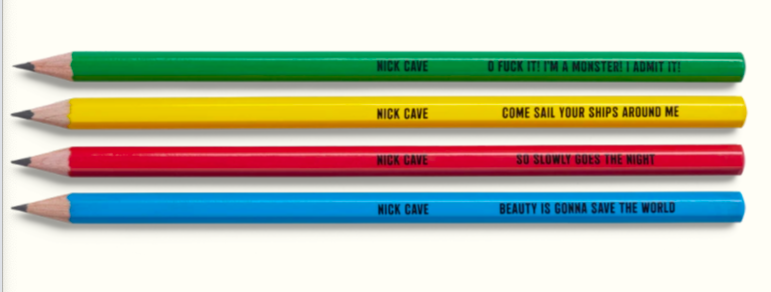
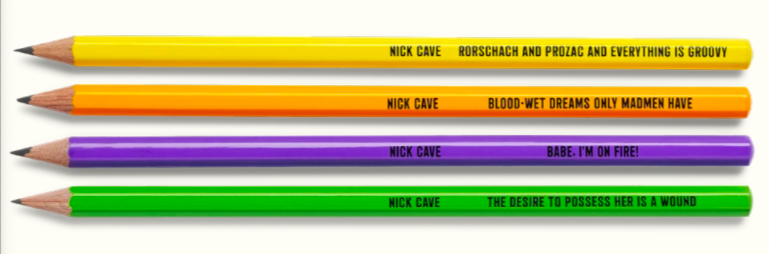
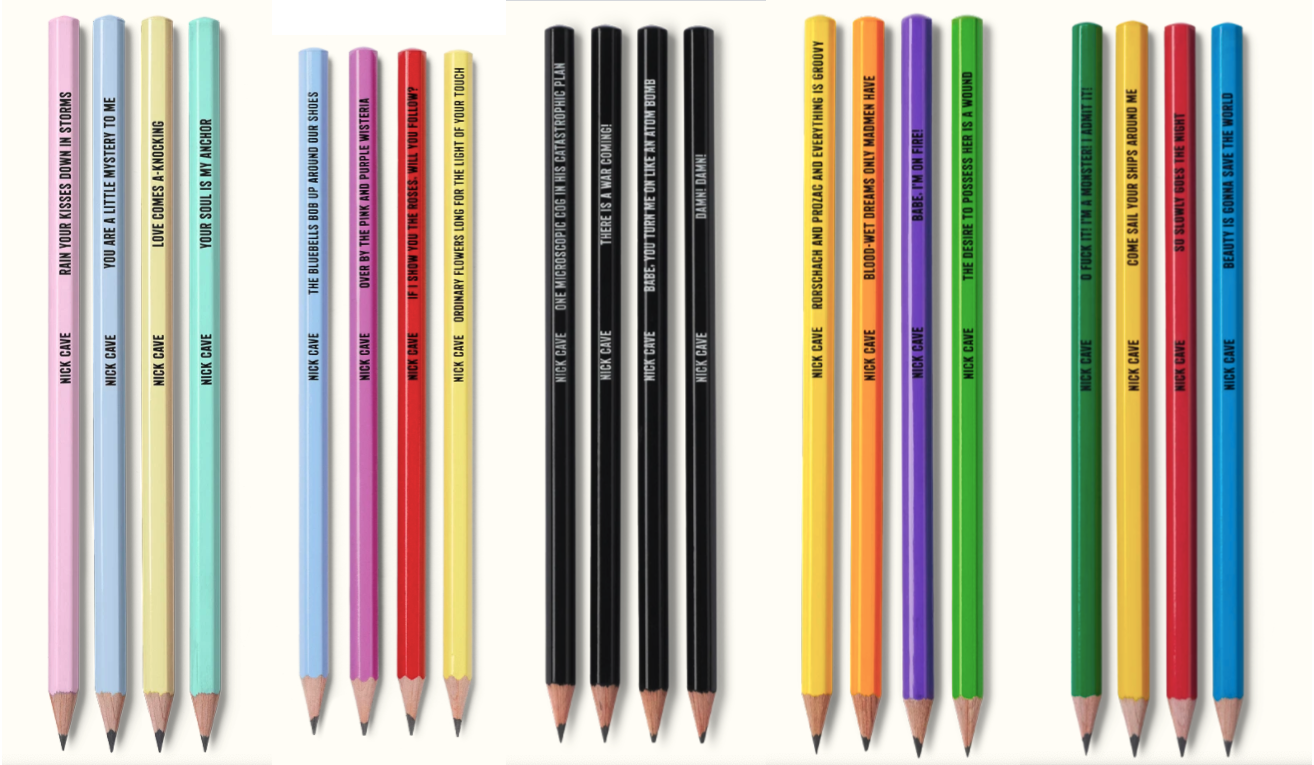
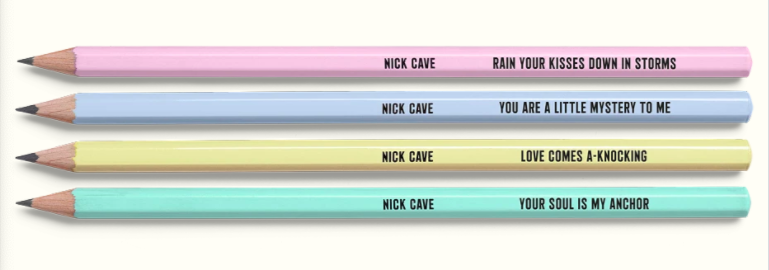
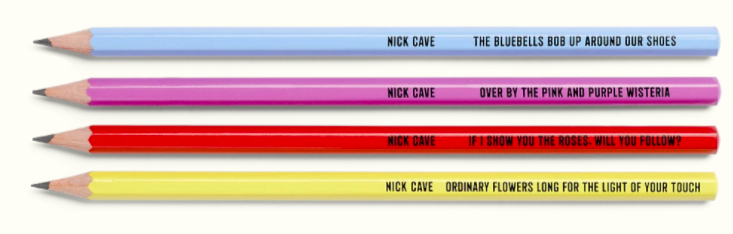
Of all of Cave’s Cave Things, the ones with the broad­est appeal may be the pen­cil sets per­son­al­ized with the­mat­ic snip­pets of his lyrics.

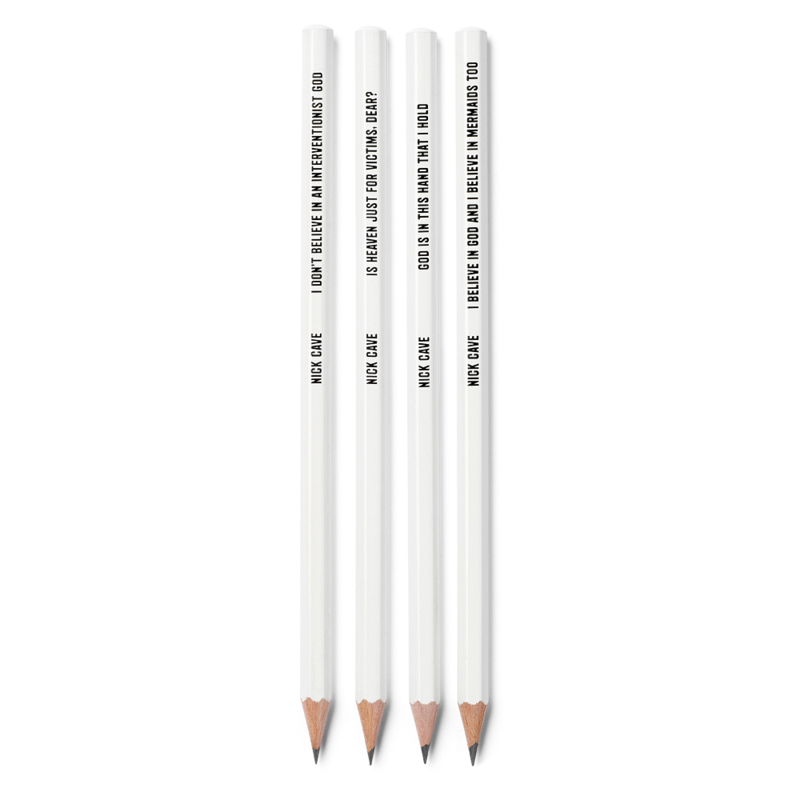
White god pen­cils quote from “Into My Arms,” “Idiot Prayer,” “Mer­maids,”  and “Hand of God.”

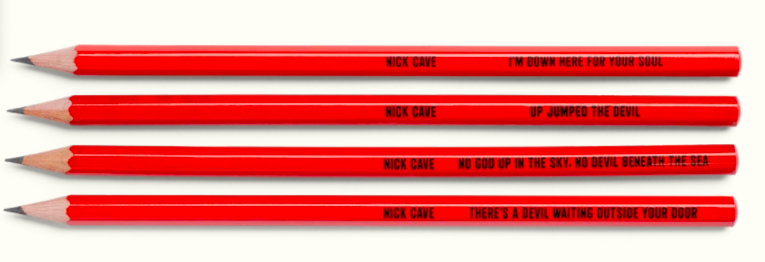
A red dev­il pen­cil bear­ing lines from “Bromp­ton Ora­to­ry” slips a bit of god into the mix, as well as a ref­er­ence to the sea, a fre­quent Cave motif.

Mad­ness and war pen­cils are coun­ter­bal­anced by pen­cils cel­e­brat­ing love and flow­ers.

The pen­cils are Vikings, a clas­sic Dan­ish brand well known to pen­cil nerds, hard and black on the graphite scale.

Put them all in a cup and draw one out at ran­dom, or let your mood or feel­ings about what said pen­cil will be writ­ing or draw­ing deter­mine your pick.

Mean­while Cave’s imple­ments of choice may sur­prise you. As he told NME’s Will Richards last Decem­ber:

My process of lyric writ­ing is as fol­lows: For months, I write down ideas in a note­book with a Bic medi­um ball­point pen in black. At some point, the songs begin to reveal them­selves, to take some kind of form, which is when I type the new lyrics into my lap­top. Here, I begin the long process of work­ing on the words, adding vers­es, tak­ing them away, and refin­ing the lan­guage, until the song arrives at its des­ti­na­tion. At this stage, I take one of the yel­low­ing back pages I have cut from old sec­ond-hand books, and, on my Olympia type­writer, type out the lyrics. I then glue it into my bespoke note­book, num­ber it, date-stamp it, and stick­er it. The song is then ‘offi­cial­ly’ com­plet­ed.

Hmm. No pen­cils, though there’s a ref­er­ence to a blind pen­cil sell­er in Cave’s con­tri­bu­tion to the sound­track of Wim Wen­ders’ sci­ence fic­tion epic Until the End of the World.

Two more lyrics about pen­cils and he’ll have enough to put a Pen­cil Pen­cils set up on Cave Things!

Fol­low Cave Things on Insta­gram to keep tabs on new pen­cil drops.

Relat­ed Con­tent: 

Nick Cave Answers the Hot­ly Debat­ed Ques­tion: Will Arti­fi­cial Intel­li­gence Ever Be Able to Write a Great Song?

Lis­ten to Nick Cave’s Lec­ture on the Art of Writ­ing Sub­lime Love Songs (1999)

Ani­mat­ed Sto­ries Writ­ten by Tom Waits, Nick Cave & Oth­er Artists, Read by Dan­ny Devi­to, Zach Gal­i­fi­anakis & More

Ayun Hal­l­i­day is an author, illus­tra­tor, the­ater mak­er and Chief Pri­ma­tol­o­gist of the East Vil­lage Inky zine. Fol­low her @AyunHalliday.
A Guitarist Rocks Out on Guitars Made from Shovels, Cigar Boxes, Oil Cans & Whisky Barrels

When Kei­th Richards felt he’d gone as far as he could go with the six-string gui­tar, he took one string off and played five, a trick he learned from Ry Cood­er. These days, the trend is to go in the oppo­site direc­tion, up to sev­en or eight strings for high­ly tech­ni­cal pro­gres­sive met­al com­po­si­tions and down­tuned “djent.” Tra­di­tion­al­ists may balk at this. A five-string, after all, is a mod­i­fi­ca­tion eas­i­ly accom­plished with a pair of wire-cut­ters. But odd­ly shaped eight-string gui­tars seem like weird­ly roco­co extrav­a­gances next to your aver­age Stra­to­cast­er, Tele, or Les Paul.

Ideas we have about what a gui­tar should be, how­ev­er, come most­ly from the mar­ket­ing and pub­lic rela­tions machin­ery around big brand gui­tars and big name gui­tarists. The truth is, there is no Pla­ton­ic ide­al of the gui­tar, since no one is quite sure where the gui­tar came from.

It’s most eas­i­ly rec­og­nized ances­tors are the oud and the lute, which them­selves have ancient her­itages that stretch into pre­his­to­ry. The six-string arrived rather late on the scene. In the renais­sance, gui­tars had eight strings, tuned in four “cours­es,” or pairs, like the mod­ern 12-string, and baroque gui­tars had 10 strings in five cours­es.

Clos­er in time to us, “the jazz gui­tarist George Van Eps had a sev­en-string gui­tar built for him by Epi­phone Gui­tars in the late 1930s,” notes one brief his­to­ry, “and a sig­na­ture Gretsch sev­en-string in the late 60s and ear­ly 70s…. Sev­er­al oth­ers began using sev­en-string gui­tars after Van Eps.” Russ­ian folk gui­tars had sev­en strings before the arrival of six-string Span­ish clas­si­cal instru­ments (two hun­dred years before the arrival of Korn).

Mean­while, in the hills, hol­lars, and deltas of the U.S. south, folk and blues musi­cians built gui­tars out of what­ev­er was at hand, and fit as many, or as few, strings as need­ed. From these instru­ments came the pow­er­ful­ly sim­ple, time­less licks Keef spent his career emu­lat­ing. Gui­tarist Justin John­son has cul­ti­vat­ed an online pres­ence not only with his slick elec­tric slide play­ing, but also with his trib­utes to odd, old-time, home­made gui­tars. At the top, he plays a three-string shov­el gui­tar, doing Kei­th two bet­ter.

Fur­ther up, some “Porch Swing Slidin’” with a six-string cig­ar box-style gui­tar engraved with a por­trait of Robert John­son. Above, hear a stir­ring ren­di­tion of George Harrison’s “While My Gui­tar Gen­tly Weeps” on an oil can and a slide solo on a whiskey bar­rel gui­tar. Final­ly, John­son rocks out Ray Charles on a three string cig­ar box gui­tar, made most­ly out of ordi­nary items you might find around the shed.

You might not be able to pluck out Renais­sance airs or com­pli­cat­ed, sweep-picked arpeg­gios on some of these instru­ments, but where would even the most com­plex pro­gres­sive rock and met­al be with­out the raw pow­er of the blues dri­ving the evo­lu­tion of the gui­tar? Final­ly, below, see John­son play a hand­made one-string Did­dley Bow (and see the mak­ing of the instru­ment as well). Orig­i­nal­ly a West African instru­ment, it may have been the very first gui­tar.

Relat­ed Con­tent: 

Kei­th Richards Demon­strates His Famous 5‑String Tech­nique (Used on Clas­sic Stones Songs Like “Start Me Up,” “Honky Tonk Women” & More)

Meet Brushy One String, the One String Gui­tar Play­er Who Will Blow Your Mind

The His­to­ry of the Gui­tar: See the Evo­lu­tion of the Gui­tar in 7 Instru­ments

Josh Jones is a writer and musi­cian based in Durham, NC. Fol­low him at @jdmagness

Medieval Tennis: A Short History and Demonstration

British You Tuber Niko­las “Lindy­biege” Lloyd is a man of many, many inter­ests.

Wing Chun style kung fu…

Children’s tele­vi­sion pro­duced in the UK between 1965 and 1975…

Ancient weapon­rychain­mail, and his­tor­i­cal­ly accu­rate WWII mod­el minia­tures

Actress Celia John­son, star of the 1945 roman­tic dra­ma Brief Encounter

Evo­lu­tion­ary psy­chol­o­gy

…and it would appear, ten­nis.

But not the sort you’ll find played on the grass courts of Wim­ble­don, or for that mat­ter, the hard courts of the US Open.

Lloyd is one of a select few who grav­i­tate toward the ver­sion of the game that was known as the sport of kings.

It was, accord­ing to a 1553 guide, cre­at­ed, “to keep our bod­ies healthy, to make our young men stronger and more robust, chas­ing idle­ness, virtue’s mor­tal ene­my, far from them and thus mak­ing them of a stronger and more excel­lent nature.”

Hen­ry VIII was a tal­ent­ed and enthu­si­as­tic play­er in his youth, caus­ing the Venet­ian Ambas­sador to rhap­sodize, “it was the pret­ti­est thing in the world to see him play; his fair skin glow­ing through a shirt of the finest tex­ture.”

Henry’s sec­ond wife, the ill-fat­ed Anne Boleyn, was also a fan of the sport, with mon­ey rid­ing on the match she was watch­ing when she was sum­moned to the Privy Coun­cil “by order of the King,” the first stop on her very swift jour­ney to the Tow­er of Lon­don.

The sport’s roots reach all the way to the 11th and 12th cen­turies when monks and vil­lagers in south­ern France were mad for jeu de paume, a ten­nis-like game pre­dat­ing the use of rac­quets, whose pop­u­lar­i­ty even­tu­al­ly spread to the roy­als and aris­to­crats of Paris.

The game Lloyd tries his hand at above is now known as Real Ten­nis, a term invent­ed in the 19th-cen­tu­ry to dis­tin­guish it from the then-new craze for lawn ten­nis.

Men­tion “the sport of kings” these days and most folks will assume you’re refer­ring to fox hunt­ing or horse-rac­ing.

Mind you, real ten­nis is just as rar­i­fied. You won’t find it being played on any old (which is to say new) indoor court. It requires four irreg­u­lar­ly sized walls, an asym­met­ri­cal lay­out, and a slop­ing pent­house roof. Behold the lay­out of a Real Ten­nis court by Ateth­nekos, com­pli­ments of  Eng­lish Wikipedia:

Com­pared to that, the Ten­nis Depart­ment’s dia­gram of the famil­iar mod­ern set up seems like child’s play:

Oth­er cog­ni­tive chal­lenges for those whose ver­sion of ten­nis does­n’t extend back to medieval days:  a slack net; lop­sided, tight­ly strung, small raque­ts; and a gallery of waist-high screened “haz­ards,” that are spir­i­tu­al­ly akin to pin­ball tar­gets, espe­cial­ly the one with the bell.

The hand­made balls may look sim­i­lar to your aver­age mass-pro­duced Penn or Wil­son, but expect that each will be “unique in its par­tic­u­lar quirks”:

They are not per­fect­ly spher­i­cal and these seams stick out a lit­tle bit more here and there, which means that the bounce can be rather unpre­dictable. Because these are heav­ier and hard­er, they don’t swerve when you spin them in the air very much, but when they hit a wall and get a decent grip, the swerve can send them zing­ing off along the wall to great effect.

Once Lloyd has ori­ent­ed view­ers and him­self to the court and equip­ment, Real Ten­nis pro Zak Eadle walks him through serv­ing, scor­ing, and strat­e­gy in the form of chas­es.

Quoth Shake­speare’s Hen­ry V:

His present, and your pains, we thank you for:
When we have match’d our rack­ets to these balls,
We will, in France, by God’s grace play a set,
Shall strike his father’s crown into the Haz­ard:
Tell him, he made a match with such a wran­gler, 
That all the Courts of France will be disturb’d with chas­es.

Even non-ath­let­ic types could find them­selves fas­ci­nat­ed by the his­tor­i­cal con­text Lindy­beige pro­vides.

If you’re moved to take rac­quet in hand, there are a hand­ful of Real Ten­nis courts in the USA, UK, Aus­tralia, and France where you might be able to try your luck.

The sport could use you. Esti­mates indi­cate that the num­ber of play­ers has dwin­dled to a mere 10,000. Sure­ly some­one is des­per­ate for a part­ner.

Delve fur­ther into the world of Real Ten­nis on the Inter­na­tion­al Real Ten­nis Pro­fes­sion­als Association’s web­site.

Check out some of Lindybeige’s oth­er inter­ests on his YouTube chan­nel.

Relat­ed Con­tent: 

Watch Accu­rate Recre­ations of Medieval Ital­ian Longsword Fight­ing Tech­niques, All Based on a Man­u­script from 1404

What It’s Like to Actu­al­ly Fight in Medieval Armor

The Rules of 100 Sports Clear­ly Explained in Short Videos: Base­ball, Foot­ball, Jai Alai, Sumo Wrestling, Crick­et, Pétanque & Much More

Ayun Hal­l­i­day is an author, illus­tra­tor, the­ater mak­er and Chief Pri­ma­tol­o­gist of the East Vil­lage Inky zine.  Fol­low her @AyunHalliday

Andy Warhol’s Vibrant, Impractical, Illustrated Cookbook from 1959: A Feast for the Eyes


Gor­geous­ly illus­trat­ed cook­books fea­tur­ing sump­tu­ous images of fan­cy desserts and oth­er spe­cial occa­sion food can be quite an intim­i­dat­ing propo­si­tion to self-doubt­ing begin­ners.

The recipes them­selves are daunt­ing, and as every Great British Bak­ing Show view­er learns, watch­ing the top con­tes­tants squirm in advance of co-host Paul Hol­ly­wood’s icy judg­ment, fla­vor can’t save an edi­ble cre­ation that fails as art.

Andy Warhol’s approach to cook­ery appears rather more blithe.

His 1959 cook­book, Wild Rasp­ber­ries — the title is a play on Ing­mar Bergman’s Wild Straw­ber­ries — dis­plays lit­tle inter­est in its read­ers’ cook­ing abil­i­ty… or, for that mat­ter, its authors.

Fan­ci­ful rep­re­sen­ta­tions of such del­i­ca­cies as Gar­doons a la Mous­se­line are pret­ty as a pic­ture… and stress free giv­en that no one is actu­al­ly expect­ed to make them.

Wild Rasp­ber­ries is all about atti­tude… and ambi­tion of a pure­ly social nature.

Warhol’s co-author, inte­ri­or dec­o­ra­tor and soci­ety host­ess Suzie Frank­furt, recalled hatch­ing the idea for this col­lab­o­ra­tion, short­ly after encoun­ter­ing the young artist at New York City’s fabled sweet spot, Serendip­i­ty: “We thought it would be a mas­ter­piece and we’d sell thou­sands. I think we sold 20.”

It’s pos­si­ble the endeav­or was a few decades ahead of its time. We can imag­ine Wild Rasp­ber­ries doing quite well as an impul­sive lifestyle type buy at Urban Out­fit­ters.

Sec­ond­hand copies of a 1997 reprint occa­sion­al­ly resur­face, as do auc­tion lots of the orig­i­nal 34 lith­o­graph sets, hand-col­ored by four school­boys who lived upstairs from Warhol, pri­or to hand-bind­ing by rab­bis on the Low­er East Side.

After con­sign­ing a few copies to Dou­ble­day and Riz­zoli book­stores, Warhol and Frank­furt gave the bulk of the first edi­tion away as Christ­mas presents to friends, who were no doubt well equipped to appre­ci­ate the tongue-in-cheek nature of its “recipes,” hand-let­tered by Warhol’s moth­er, Julia — whose spelling boo-boos were pur­pose­ful­ly allowed to stand.

The instruc­tions eschew crass men­tion of mea­sure­ments or cook­ing times… per­fect for any­one with hired staff, stand­ing reser­va­tions at Upper East Side hot spots, or a social X‑Ray diet reg­i­men.

Instead, read­ers are direct­ed to send the Cadil­lac round to Trad­er Vic’s tiki bar for a suck­ling pig of suf­fi­cient size for a par­ty of 15, or to gath­er morels should they find them­selves hol­i­day­ing in the vicin­i­ty of Nor­mandy.

Salade de Alf Lan­don, a bombe of lob­ster tails named for FDR’s oppo­nent in the 1936 Pres­i­den­tial elec­tion, crowned with aspara­gus tips and hard­boiled plover eggs, seems like it could dou­ble as a fetch­ing cha­peau, espe­cial­ly when paired with one of Warhol’s whim­si­cal fan­ta­sy  for footwear com­pa­ny I. Miller’s week­ly ads in The New York Times.

In fact, near­ly every­thing in this vibrant­ly hand col­ored “cook­book” makes for plau­si­ble mid-cen­tu­ry millinery, from Torte a la Dobosch to an imprac­ti­cal­ly ver­ti­cal arrange­ment of Hard Boiled Eggs.


Wild Rasp­ber­ries may have been a swipe at aspi­ra­tional, host­ess-ori­ent­ed late-50s cook­books, but Green­gages a la Warhol’s ref­er­ence to hyper­local pro­duce would fit right in with with Portlandia’s 21st cen­tu­ry food­ie spoofs.

High and low com­bine to great effect with wink­ing ref­er­ences to Gre­ta Gar­bo and gos­sip colum­nist Dorothy Kil­gallenLucky Whip dessert top­ping, a “Seared Roe­buck,” and store-bought super­mar­ket sponge cake (the lat­ter in Wild Rasp­ber­ries’ most legit-sound­ing recipe, some­thing of an upgrade from the recipe for “cake” Warhol shared in The Phi­los­o­phy of Andy Warhol — a choco­late bar served between slices of bread.

Relat­ed Con­tent: 

MoMA’s Artists’ Cook­book (1978) Reveals the Meals of Sal­vador Dalí, Willem de Koon­ing, Andy Warhol, Louise Bour­geois & More

300 Rarely-Seen, Risqué Draw­ings by Andy Warhol Pub­lished in the New Book, Andy Warhol: Love, Sex, and Desire. Draw­ings (1950–1962)

130,000 Pho­tographs by Andy Warhol Are Now Avail­able Online, Cour­tesy of Stan­ford Uni­ver­si­ty

Ayun Hal­l­i­day is an author, illus­tra­tor, the­ater mak­er and Chief Pri­ma­tol­o­gist of the East Vil­lage Inky zine.  Fol­low her @AyunHalliday.
Vintage Public Health Posters That Helped People Take Smart Precautions During Past Crises


We sub­scribe to the the­o­ry that art saves lives even in the best of times.

In the midst of a major pub­lic health cri­sis, art takes a front line posi­tion, com­mu­ni­cat­ing best prac­tices to cit­i­zens with eye catch­ing, easy to under­stand graph­ics and a few well cho­sen words.

In March of 2020, less than 2 weeks after COVID-19 brought New York to its knees, Angeli­na Lip­pert, the Chief Cura­tor of Poster House, one of the city’s new­er muse­ums shared a blog post, con­sid­er­ing the ways in which the CDC’s basic hygiene rec­om­men­da­tions for help­ing stop the spread had been tout­ed to pre­vi­ous gen­er­a­tions.

As she not­ed in a lec­ture on the his­to­ry of the poster as Pub­lic Ser­vice Announce­ment the fol­low­ing month, “mass pub­lic health action… is how we stopped tuber­cu­lo­sis, polio, and oth­er major dis­eases that we don’t even think of today:”

And a major part of erad­i­cat­ing them was edu­cat­ing the pub­lic. That’s real­ly what PSAs are—a means of inform­ing and teach­ing the pub­lic en masse. It goes back to that idea … of not hav­ing to seek out infor­ma­tion, but just being pre­sent­ed with it. Keep­ing the bar­ri­er for entry low means more peo­ple will see and absorb the infor­ma­tion.

The Office of War Infor­ma­tion and the Dis­trict of Colum­bia Soci­ety for the Pre­ven­tion of Blind­ness used an approach­able look­ing rac­coon to con­vince the pub­lic to wash hands in WWII.

Artist Sey­mour Nydorf swapped the rac­coon for a blonde wait­ress with glam­orous red nails in a series of six posters for the U.S. Pub­lic Health Ser­vice of the Fed­er­al Secu­ri­ty Agency

Cough­ing and sneez­ing took posters into some­what gross­er ter­rain.

The New Zealand Depart­ment of Health’s 50s era poster shamed care­less sneez­ers into using a han­kie, and might well have giv­en those in their vicin­i­ty a per­sua­sive rea­son to bypass the buf­fet table.

Great Britain’s Cen­tral Coun­cil for Health Edu­ca­tion and Min­istry of Health col­lab­o­rat­ed with

Her Majesty’s Sta­tionery Office to teach the pub­lic some basic infec­tion math in WWII.

Children’s well­be­ing can be a very per­sua­sive tool. The WPA Fed­er­al Art Project was not play­ing in 1941 when it paired an image of a cheru­bic tot with stern warn­ings to par­ents and oth­er fam­i­ly mem­bers to curb their affec­tion­ate impuls­es, as well as the trans­mis­sion of tuber­cu­lo­sis.

The arrest­ing image packs more of a wal­lop than this earnest and far wordier, ear­ly 20s poster by the Nation­al Child Wel­fare Asso­ci­a­tion and the Nation­al Asso­ci­a­tion for the Study and Pre­ven­tion of Tuber­cu­lo­sis.

Read Poster House Chief Cura­tor Angeli­na Lippert’s Brief His­to­ry of PSA Posters here.

Down­load the free anti-xeno­pho­bia PSAs Poster House com­mis­sioned from design­er Rachel Gin­grich ear­ly in the pan­dem­ic here.

Relat­ed Con­tent: 

Down­load Beau­ti­ful Free Posters Cel­e­brat­ing the Achieve­ments of Liv­ing Female STEM Lead­ers

The First Muse­um Ded­i­cat­ed Exclu­sive­ly to Poster Art Opens Its Doors in the U.S.: Enter the Poster House

Sal­vador Dalí Cre­ates a Chill­ing Anti-Vene­re­al Dis­ease Poster Dur­ing World War II

Down­load 2,000 Mag­nif­i­cent Turn-of-the-Cen­tu­ry Art Posters, Cour­tesy of the New York Pub­lic Library

Ayun Hal­l­i­day is an author, illus­tra­tor, the­ater mak­er and Chief Pri­ma­tol­o­gist of the East Vil­lage Inky zine.  Fol­low her @AyunHalliday.
How West Magazine Created a Southern-California Pop-Culture Aesthetic with the Help of Milton Glaser, Gahan Wilson, and Others (1967–1972)


In the late 1960s, a coun­ter­cul­ture-mind­ed media pro­fes­sion­al could sure­ly have imag­ined more appeal­ing places to work than the Los Ange­les Times. Wide­ly derid­ed as the offi­cial organ of the South­ern Cal­i­for­nia Bab­bitt, the paper also put out a bland Sun­day sup­ple­ment called West mag­a­zine. But West had the poten­tial to evolve into some­thing more vital — or so seemed to think its edi­tor, Jim Bel­lows. The cre­ator of “the orig­i­nal New York mag­a­zine in the ear­ly 1960s,” writes Design Observer’s Steven Heller, Bel­lows con­vinced a young adman named Mike Sal­is­bury, “who worked for Car­son Roberts Adver­tis­ing in L.A. (where Ed Ruscha and Ter­ry Gilliam worked), to accept the job as art direc­tor.”

Sal­is­bury inject­ed West “with such an abun­dance of pop cul­ture visu­al rich­ness that it was more like a minia­ture muse­um than week­ly gazette.” Its week­ly issues “cov­ered a wide range of themes — most­ly reflect­ing Salisbury’s insa­tiable curiosi­ties — from a fea­ture on bas­ket­ball that illus­trat­ed the tremen­dous size of cen­ter for­wards by show­ing a life-size pho­to­graph of Wilt Chamberlin’s Con­verse sneak­er, to a pic­to­r­i­al his­to­ry of movie star pin­ups with a bevy of gor­geous sil­hou­ettes fan­ning on the page, to an array of souped-up VW Bee­tles in all shapes and sizes.”

On any giv­en Sun­day, sub­scribers might find them­selves treat­ed to “the his­to­ry of Mick­ey Mouse, Coca-Cola art (the first time it was pub­lished as ‘art’), the visu­al his­to­ry of Levis, Hol­ly­wood gar­den apart­ments, Ray­mond Chan­dler loca­tions, and Kus­tom Kars.”

“I was the writer on the Coca-Cola ‘art’ piece as well as the first ‘pro­gram­mat­ic’ archi­tec­ture arti­cle to see print,” says a com­menter under the Design Observ­er ret­ro­spec­tive named Lar­ry Dietz. He also claims to have writ­ten the fea­ture on Ray­mond Chan­dler’s Los Ange­les; much lat­er, he adds, Chi­na­town screen­writer “Robert Towne said that he was inspired to learn about L.A. his­to­ry from that piece, but that the writ­ing was crap­py.” But then, the main impact of Sal­is­bury’s West was nev­er meant to be tex­tu­al. Heller quotes Sal­is­bury as say­ing that “design was not my sole objec­tive: cin­e­ma-graph­ic infor­ma­tion is a bet­ter def­i­n­i­tion.” Of all the cov­ers he designed, he remem­bers the one just above, pro­mot­ing an exposé on hero­in, as hav­ing been the most con­tro­ver­sial: “Don’t give me too much real­i­ty over Sun­day break­fast,” he heard read­ers grum­bling.


Oth­er mem­o­rable West cov­ers include the mag­a­zine’s trib­ute to the just-can­celed Ed Sul­li­van show in 1971, as well as con­tri­bu­tions by artists and design­ers like Vic­tor Moscoso, Gahan Wil­son, John Van Hamersveld, and Mil­ton Glaser, all fig­ures who did a great deal to craft the Amer­i­can zeit­geist of the 1960s and 70s. The mag­a­zine as a whole con­sol­i­dat­ed the South­ern Cal­i­forn­ian pop-cul­tur­al aes­thet­ic of its peri­od, as dis­tinct from what Sal­is­bury calls the “qua­si-Vic­to­ri­an” look and feel of San Fran­cis­co to the north and the “Roco­co or Baroque” New York to the east. Los Ange­les, to his mind, was “stream­line,” emblema­tized by the cul­ture and indus­try of motor­cy­cle cus­tomiza­tion and its “belief in Futur­ism.”

West was a prod­uct of the Los Ange­les Times under Otis Chan­dler, pub­lish­er from 1960 to 1980, who ded­i­cat­ed his career to expand­ing the scope and ambi­tion of the news­pa­per his great-grand­fa­ther had once run. His labors paid off in ret­ro­spect, espe­cial­ly from read­ers as astute as Joan Did­ion, who praised Chan­dler’s Times to the skies. But by 1972, West seemed to have become too much of an extrav­a­gance even for him. After the mag­a­zine’s can­cel­la­tion, Sal­is­bury moved on to Rolling Stone, then in the process of con­vert­ing from a news­pa­per to a mag­a­zine for­mat. No small part of that mag­a­zine’s pop-cul­tur­al pow­er in the 70s must have owed to his art direc­tion.

Lat­er in the decade, both Sal­is­bury and Glaser would bring their tal­ents to the just-launched New West mag­a­zine. It had no direct con­nec­tion with West or the Los Ange­les Times, but was con­ceived as the sis­ter pub­li­ca­tion of New York Mag­a­zine, which itself had been re-invent­ed by Glaser and pub­lish­er Clay Felk­er in the mid-1960s. Its debut cov­er, just above, fea­tured Glaser’s art­work; three years lat­er, in 1979, Sal­is­bury designed a cov­er on Cal­i­for­ni­a’s water cri­sis that the Amer­i­can Insti­tute of Graph­ic Arts’ Steven Brow­er calls “pre­scient.” At that same time, he notes, Sal­is­bury “worked with Fran­cis Ford Cop­po­la on the set design for Apoc­a­lypse Now; he designed Michael Jackson’s break­through album, Off the Wall,” and he even col­lab­o­rat­ed with George Har­ri­son on his epony­mous album.” But when “vet­er­an mag­a­zine art direc­tors” get togeth­er and “rem­i­nisce about the glo­ry years,” writes Heller, it’s West they inevitably talk about.

Relat­ed Con­tent:

Take a Dig­i­tal Dri­ve Along Ed Ruscha’s Sun­set Boule­vard, the Famous Strip That the Artist Pho­tographed from 1965 to 2007

Mil­ton Glaser’s Styl­ish Album Cov­ers for The Band, Nina Simone, John Cage & Many More

Down­load the Com­plete Archive of Oz, “the Most Con­tro­ver­sial Mag­a­zine of the 60s,” Fea­tur­ing R. Crumb, Ger­maine Greer & More

A Com­plete Dig­i­ti­za­tion of the 1960s Mag­a­zine Avant Garde: From John Lennon’s Erot­ic Lith­o­graphs to Mar­i­lyn Monroe’s Last Pho­tos

Down­load 50+ Issues of Leg­endary West Coast Punk Music Zines from the 1970–80s: Dam­age, Slash & No Mag

Flair Mag­a­zine: The Short-Lived, High­ly-Influ­en­tial Mag­a­zine That Still Inspires Design­ers Today (1950)

Based in Seoul, Col­in Mar­shall writes and broad­casts on cities, lan­guage, and cul­ture. His projects include the Sub­stack newslet­ter Books on Cities, the book The State­less City: a Walk through 21st-Cen­tu­ry Los Ange­les and the video series The City in Cin­e­ma. Fol­low him on Twit­ter at @colinmarshall or on Face­book.

Discover the Stettheimer Dollhouse: The 12-Room Dollhouse Featuring Miniature, Original Modernist Art by Marcel Duchamp

The Stet­theimer Doll­house has been wow­ing young New York­ers since it entered the Muse­um of the City of New York’s col­lec­tion in 1944.

The lux­u­ri­ous­ly appoint­ed, two-sto­ry, twelve-room house fea­tures tiny crys­tal chan­de­liers, trompe l’oeil pan­els, an itty bit­ty mah-jongg set, and a deli­cious-look­ing dessert assort­ment that would have dri­ven Beat­rix Potter’s Two Bad Mice wild.

Its most aston­ish­ing fea­ture, how­ev­er, tends to go over its youngest fans’ heads — an art gallery filled with orig­i­nal mod­ernist paint­ings, draw­ings, and sculp­tures by the likes of Mar­cel DuchampGeorge Bel­lowsGas­ton Lachaise, and Mar­guerite Zorach.

The house’s cre­ator, Car­rie Wal­ter Stet­theimer, drew on her family’s close per­son­al ties to the avant-garde art world to secure these con­tri­bu­tions.

The art deal­er Paul Rosen­berg described the affin­i­ty between these artists and the three wealthy Stet­theimer sis­ters, one of whom, Florine, was her­self a mod­ernist painter:

Artists… went there and not at all mere­ly because of the indi­vid­u­al­i­ties of the trio of women and their taste­ful hos­pi­tal­i­ty. They went for the rea­son that they felt them­selves entire­ly at home with the Stetties—so the trio was called—and the Stet­ties seemed to feel them­selves entire­ly at home in their com­pa­ny. Art was an indis­pens­able com­po­nent of the mod­ern, open intel­lec­tu­al life of the place. The sis­ters felt it as a liv­ing issue. Sin­cere­ly they lived it.

Art is def­i­nite­ly part of the dollhouse’s life.

Duchamp recre­at­ed Nude Descend­ing a Stair­case, inscrib­ing the back “Pour la col­lec­tion de la poupée de Car­rie Stet­theimer à l’occasion de sa fête en bon sou­venir. Mar­cel Duchamp 23 juil­let 1918 N.Y.”

Mar­guerite Thomp­son ZorachAlexan­der Archipenko, and Paul Theve­naz also felt no com­punc­tion about fur­nish­ing a doll­house with nudes.

Louis Bouché — the “bad boy of Amer­i­can art” as per the Stet­theimers’ friend, writer and pho­tog­ra­ph­er Carl Van Vecht­en, made a tiny ver­sion of his paint­ing, Mama’s Boy.

Car­rie wrote to Gas­ton Lachaise, to thank him for two minia­ture nude draw­ings and an alabaster Venus:

My dolls and I thank you most sin­cere­ly for the love­ly draw­ings that are to grace their art gallery. I think that the dolls—after they are born, which they are not, yet—ought to be the hap­pi­est and proud­est dolls in the world as own­ers of the draw­ings and the beau­ti­ful stat­ue. I am now hop­ing that they will nev­er be born, so that I can keep them [the art works] for­ev­er in cus­tody, and enjoy them myself, while await­ing their arrival.

Car­rie worked on the doll­house from from 1916 to 1935. Her sis­ter Ettie donat­ed it to the muse­um and took it upon her­self to arrange the art­work. As Johan­na Fate­man writes in 4Columns:

Twen­ty-eight of the artists’ gifts were stored sep­a­rate­ly; Ettie select­ed thir­teen from the col­lec­tion, and her grace­ful arrange­ment became per­ma­nent, though it’s like­ly that the pieces were meant to be shown in rota­tion.

The Muse­um of the City of New York’s cur­rent exhi­bi­tion, The Stet­theimer Doll­house: Up Close, includes pho­tos of the art­works that Ettie did not choose to install.

The works that have always been on view are Mar­cel Duchamp’s Nude Descend­ing a Stair­case, Alexan­der Archipenko’s Nude, Louis Bouche’s Mama’s Boy, Gas­ton Lachaise’s Venus and two nudesCarl Sprinchorn’s Dancers, Albert Gleizes’ Seat­ed Fig­ure and Bermu­da Land­scape, Paul Thevenaz’s L’Ombre and Nude with Flow­ing Hair, Mar­guerite Zorach’s Bather and Bathers, William Zorach’s Moth­er and Child, and a paint­ing of a ship by an unknown artist.

Relat­ed Con­tent:

The Grue­some Doll­house Death Scenes That Rein­vent­ed Mur­der Inves­ti­ga­tions

A Record Store Designed for Mice in Swe­den, Fea­tur­ing Albums by Mouse Davis, Destiny’s Cheese, Dol­ly Pars­ley & More

An Art Gallery for Ger­bils: Two Quar­an­tined Lon­don­ers Cre­ate a Mini Muse­um Com­plete with Ger­bil-Themed Art

Ayun Hal­l­i­day is an author, illus­tra­tor, the­ater mak­er and Chief Pri­ma­tol­o­gist of the East Vil­lage Inky zine.  Fol­low her @AyunHalliday.
Discover The Grammar of Ornament, One of the Great Color Books & Design Masterpieces of the 19th Century

In the mid-17th cen­tu­ry, young Eng­lish­men of means began to mark their com­ing of age with a “Grand Tour” across the Con­ti­nent and even beyond. This allowed them to take in the ele­ments of their civ­i­liza­tion­al her­itage first-hand, espe­cial­ly the arti­facts of clas­si­cal antiq­ui­ty and the Renais­sance. After com­plet­ing his archi­tec­tur­al stud­ies, a Lon­don­er named Owen Jones embarked upon his own Grand Tour in 1832, rather late in the his­to­ry of the tra­di­tion, but ide­al tim­ing for the research that inspired the project that would become his lega­cy.

Accord­ing to the Vic­to­ria and Albert Muse­um, Jones vis­it­ed “Italy, Greece, Egypt and Turkey before arriv­ing in Grana­da, in Spain to car­ry out stud­ies of the Alham­bra Palace that were to cement his rep­u­ta­tion.”

He and French archi­tect Jules Goury, “the first to study the Alham­bra as a mas­ter­piece of Islam­ic design,” pro­duced “hun­dreds of draw­ings and plas­ter casts” of the his­tor­i­cal, cul­tur­al, and aes­thet­ic palimpsest of a build­ing com­plex. The fruit of their labors was the book Plans, Ele­va­tions, Sec­tions and Details of the Alham­bra, “one of the most influ­en­tial pub­li­ca­tions on Islam­ic archi­tec­ture of all time.”

Pub­lished in the 1840s, the book pushed the print­ing tech­nolo­gies of the day to their lim­its. In search of a way to do jus­tice to “the intri­cate and bright­ly col­ored dec­o­ra­tion of the Alham­bra Palace,” Jones had to put in more work research­ing “the then new tech­nique of chro­molith­o­g­ra­phy — a method of pro­duc­ing mul­ti-col­or prints using chem­i­cals.” In the fol­low­ing decade, he would make even more ambi­tious use of chro­molith­o­g­ra­phy — and draw from a much wider swath of world cul­ture — to cre­ate his print­ed mag­num opus, The Gram­mar of Orna­ment.

With this book, Jones “set out to reac­quaint his col­leagues with the under­ly­ing prin­ci­ples that made art beau­ti­ful,” write Met­ro­pol­i­tan Muse­um of Art cura­tor Femke Speel­berg and librar­i­an Robyn Flem­ing. “Instead of writ­ing an aca­d­e­m­ic trea­tise on the sub­ject, he chose to assem­ble a book of one hun­dred plates illus­trat­ing objects and pat­terns from around the world and across time, from which these prin­ci­ples could be dis­tilled.” To accom­plish this he drew on his own trav­el expe­ri­ences as well as resources clos­er at hand, includ­ing “the muse­o­log­i­cal and pri­vate col­lec­tions that were avail­able to him in Eng­land, and the objects that had been on dis­play dur­ing the Uni­ver­sal Exhi­bi­tions held in Lon­don in 1851 and 1855.”

The Gram­mar of Orna­ment was pub­lished in 1856, emerg­ing into a Britain “dom­i­nat­ed by his­tor­i­cal revivals such as Neo­clas­si­cism and the Goth­ic Revival,” says the V&A. “These design move­ments were rid­dled with reli­gious and social con­no­ta­tions. Instead, Owen Jones sought a mod­ern style with none of this cul­tur­al bag­gage. Set­ting out to iden­ti­fy the com­mon prin­ci­ples behind the best exam­ples of his­tor­i­cal orna­ment, he for­mu­lat­ed a design lan­guage that was suit­able for the mod­ern world, one which could be applied equal­ly to wall­pa­pers, tex­tiles, fur­ni­ture, met­al­work and inte­ri­ors.”

Indeed, the pat­terns so lav­ish­ly repro­duced in the book soon became trends in real-world design. They weren’t always employed with the intel­lec­tu­al under­stand­ing Jones sought to instill, but since The Gram­mar of Orna­ment has nev­er gone out of print (and can even be down­loaded free from the Inter­net Archive), his prin­ci­ples remain avail­able for all to learn — and his painstak­ing­ly artis­tic print­ing work remains avail­able for all to admire — even in the cor­ners of the world that lay beyond his imag­i­na­tion.

You can pur­chase a com­plete and unabridged col­or edi­tion of The Gram­mar of Orna­ment online.

Relat­ed Con­tent:

The Com­plex Geom­e­try of Islam­ic Art & Design: A Short Intro­duc­tion

Explore the Beau­ti­ful Pages of the 1902 Japan­ese Design Mag­a­zine Shin-Bijut­sukai: Euro­pean Mod­ernism Meets Tra­di­tion­al Japan­ese Design

A Beau­ti­ful 1897 Illus­trat­ed Book Shows How Flow­ers Become Art Nou­veau Designs

The Bauhaus Book­shelf: Down­load Orig­i­nal Bauhaus Books, Jour­nals, Man­i­festos & Ads That Still Inspire Design­ers World­wide

Every Page of Depero Futur­ista, the 1927 Futur­ist Mas­ter­piece of Graph­ic Design & Book­mak­ing, Is Now Online

Based in Seoul, Col­in Mar­shall writes and broad­casts on cities, lan­guage, and cul­ture. His projects include the Sub­stack newslet­ter Books on Cities, the book The State­less City: a Walk through 21st-Cen­tu­ry Los Ange­les and the video series The City in Cin­e­ma. Fol­low him on Twit­ter at @colinmarshall or on Face­book.

« Go BackMore in this category... »
Quantcast