More than 120 years after the end of the Victorian era, we might assume that we retain a more or less accurate cultural memory of the Victorians themselves: of their social mores, their aesthetic sensibilities, their ambitions great and small, their many and varied hang-ups. Some of the most vivid representations of these qualities have come down to us through primary sources, which tend to be texts and works of visual art. Late in Queen Victoria’s reign came photographs, and at the very end, even the motion picture. But how can we be sure how her people really sounded?
Strictly speaking, the earliest process for mechanically recording the sound of the human voice dates back to 1860, not even halfway through the Victorian era. But the technology still had a long way to go at that time, and it wasn’t until the 1880s that Thomas Edison’s phonograph and the wax cylinders it played became commercially viable. So explains the King and Things video above, on the spread of audio recording and the earliest possibilities it opened for capturing the voices of what we now regard as the distant past. Those voices include that of a man introduced as “one of England’s most famous after-dinner speakers, Mr. Edmund Yates.”
That cylinder was recorded in 1888, at one of the London soirées held by an American Edison employee named George Gouraud. The son of French engineer François Gouraud, who had introduced daguerreotype photography to the United States in the 1830s, he took it upon himself to bring the phonograph to Britain. He did so in a top-down manner, inviting socially distinguished guests to his home for dinner so that they might thrill to the novelty of after-dinner speeches delivered by machine — and then record their own messages to Edison himself. “I can only say that I am astonished and somewhat terrified at the results of this evening’s experiments,” said one of Gouraud’s guests, the composer Sir Arthur Sullivan.
That astonishment aside, Sullivan also admitted that he was “terrified at the thought that so much hideous and bad music may be put on record forever.” Many alive today would credit him with considerable prescience on that count. But he also understood that the phonograph would produce wonders, such as the recordings included in this video of such notables as four-time Prime Minister William Gladstone, Florence Nightingale, and Queen Victoria herself — at least according to the consensus of the scholars who’ve scrutinized the highly indistinct recording in question. Only long after Edison’s time would humanity develop a recording technology capable of being replayed again and again without degradation. But given our image of Victorians, perhaps it’s suitable that their voices should sound ghostly.
Based in Seoul, Colin Marshall writes and broadcasts on cities, language, and culture. His projects include the Substack newsletterBooks on Cities and the book The Stateless City: a Walk through 21st-Century Los Angeles. Follow him on Twitter at @colinmarshall or on Facebook.
Photos on this page courtesy of the Falklands Maritime Heritage
Few who hear the story of the Endurance could avoid reflecting on the aptness of the ship’s name. A year after setting out on the Imperial Trans-Antarctic Expedition in 1914, it got stuck in a mass of drifting ice off Antarctica. There it remained for ten months, while leader Sir Ernest Shackleton and his crew of 27 men waited for a thaw. But the Endurance was being slowly crushed, and eventually had to be left to its watery grave. What secures its place in the history books is the sub-expedition made by Shackleton and five others in search of help, which ensured the rescue of every single man who’d been on the ship.
This harrowing journey has, of course, inspired documentaries, including this year’s Endurance from National Geographic, which debuted at the London Film Festival last month and will come available to stream on Disney+ later this fall. “The documentary incorporates footage and photos captured during the expedition by Australian photographer Frank Hurley, who [in 1914] brought several cameras along for the journey,” writes Smithsonian.com’s Sarah Kuta. “Filmmakers have color-treated Hurley’s black-and-white images and footage for the first time. They also used artificial intelligence to recreate crew members’ voices to ‘read’ their own diary entries.”
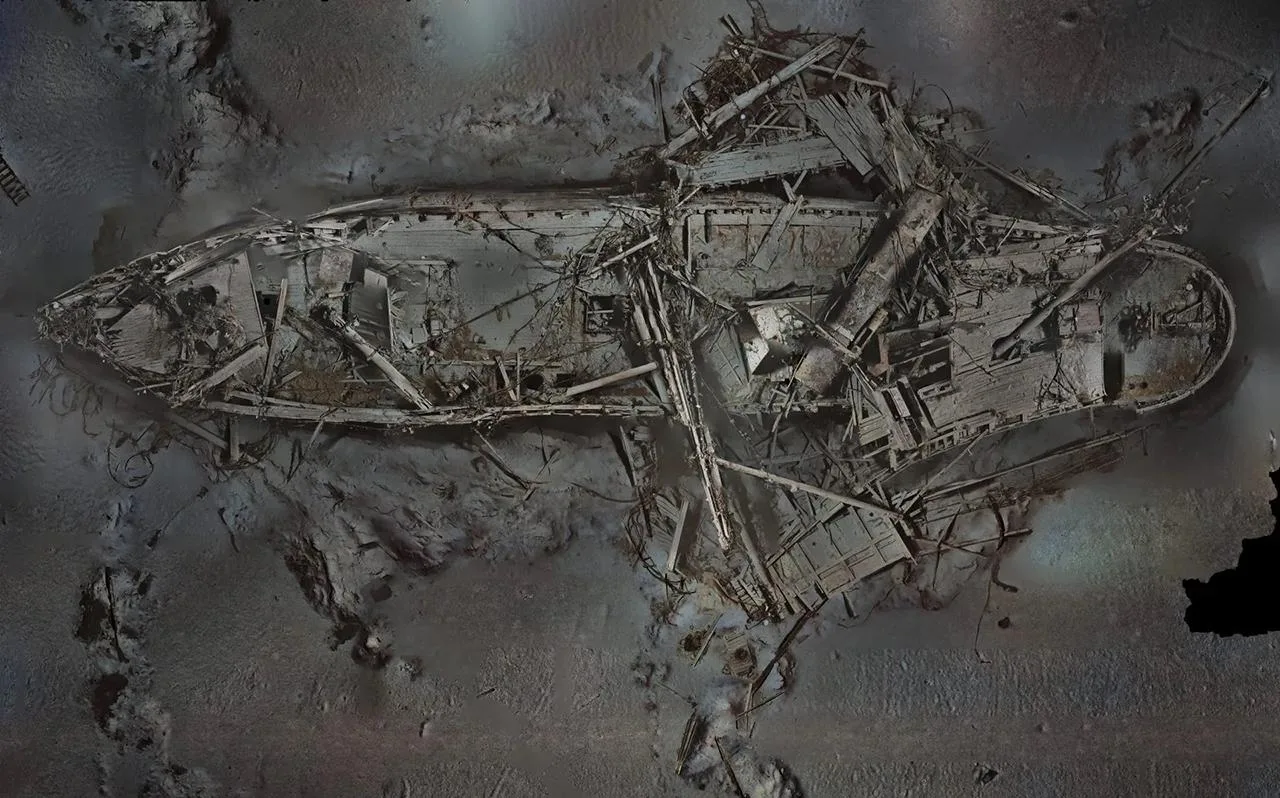
The fruits of an even more technologically impressive project have been released along with Endurance: a 3D digital model “created from more than 25,000 high-resolution images captured after the iconic vessel was discovered in March 2022.”
As we noted at the time here on Open Culture, the ship was found to be in remarkably good condition after well over a century spent two miles beneath the Weddell Sea. “Endurance looks much like it did when it sank on November 21, 1915. Everyday items used by the crew — including dining plates, a boot and a flare gun — are still easily recognizable among the protected wreckage.”
Endurance has, in other words, endured. Its intactness — which “makes it look as though the ship,” writes CNN.com’s Jack Guy, “has been miraculously lifted out of the Weddell Sea onto dry land in one piece” — is, in its way, as improbable and impressive as Shackleton and company’s survival of its fateful first expedition. The degree of detail captured by this new scan (not technologically feasible back at the time of the last acclaimed documentary on this subject), should make possible further, even deeper research into the story of the Endurance. But one question will remain unanswerable: would that story have resonated quite as long had the ship kept its original name, Polaris?
Based in Seoul, Colin Marshall writes and broadcasts on cities, language, and culture. His projects include the Substack newsletterBooks on Cities and the book The Stateless City: a Walk through 21st-Century Los Angeles. Follow him on Twitter at @colinmarshall or on Facebook.
For 142 years now, Sagrada Família has been growing toward the sky. Or at least that’s what it seems to be doing, as its ongoing construction realizes ever more fully a host of forms that look and feel not quite of this earth. It makes a kind of sense to learn that, in designing the cathedral that would remain a work in progress nearly a century after his death, Antoni Gaudí built a model upside-down, making use of gravity in the opposite way to which we normally think of it as acting on a building. But as architecture YouTuber Stewart Hicks explains in the video above, Gaudí was hardly the first to use that technique.
Take St. Paul’s Cathedral, which Christopher Wren decided to make the tallest building in London in 1685. It included what would be the highest dome ever built, at 365 feet off the ground. “For a traditional dome design to reach this height, it would have to span an opening that’s 160 feet or 49 meters wide, but this made it much too heavy for the walls below,” says Hicks. “Existing techniques for building this just couldn’t work.” Enter scientist-engineer Robert Hooke, who’d already been figuring out ways to model forces like this by hanging chains from the ceiling.
“Hooke’s genius was that he realized that the chain in his experiments was calculating the perfect shape for it to remain in tension, since that’s all it can do.” He explained domes as, physically, “the exact opposite of the chains. His famous line was, ‘As hangs the flexile line, so but inverted will stand the rigid arch.’ ” In other words, “if you flip the shape of Hooke’s chain experiments upside down, the forces flip, and this shape is the perfect compression system.” Hence the distinctively elongated-looking shape of the dome on the completed St. Paul’s Cathedral, a departure from all architectural precedent.
The shape upon which Wren and Hooke settled turned out to be very similar to what architecture now knows as a catenary curve, a concept important indeed to Gaudí, who was “famously enamored with what some call organic forms.” He made detailed models to guide the construction of his projects, but after those he’d left behind for Sagrada Família were destroyed by anarchists in 1936, the builders had nothing to go on. Only in 1979 did the young architect Mark Burry “imagine the models upside-down,” which brought about a new understanding of the building’s complex, landscape-like forms. It was a similar physical insight that made possible such dramatic mid-century buildings as Annibale Vitellozzi and Pier Nervi’s Palazzetto dello Sport and Eero Saarinen’s TWA Flight Center: pure Space Age, but rooted in the Enlightenment.
Based in Seoul, Colin Marshall writes and broadcasts on cities, language, and culture. His projects include the Substack newsletterBooks on Cities and the book The Stateless City: a Walk through 21st-Century Los Angeles. Follow him on Twitter at @colinmarshall or on Facebook.
Some refer to the written Chinese language as ideographic: that is, structured according to a system in which each symbol represents a particular idea or concept, whether abstract or concrete. That’s true of certain Chinese characters, but only a small minority. Most of them are actually logographs, each of which represents a word or part of a word. But if you dig deep enough into their history — and the history of other Asian languages that use Chinese-derived vocabulary — you’ll find that some started out long ago as pictographs, designed visually to represent the thing to which they referred.
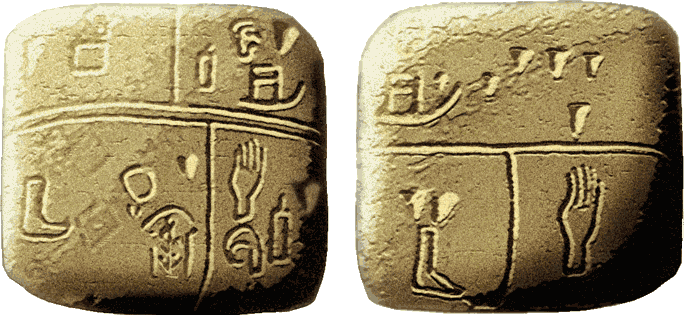
That doesn’t hold true for Chinese alone: it appears, in fact, that all written languages began as forms of pictographic “proto-writing,” at least judging by the earliest texts currently known to man. If we look at the oldest of them all, the limestone “Kish tablet” unearthed from the site of the eponymous ancient Sumerian city in modern-day Iraq, we can in some sense “read” several of the symbols in its text, even five and a half millennia after it was written. “The writing on its surface is purely pictographic,” says the narrator of the brief IFLScience video below, “and represents a midpoint between proto-writing and the more sophisticated writing of the cuneiform.”
Cuneiform, previously featured here on Open Culture, was used by the ancient Babylonians to label maps and record stew recipes, among other important tasks. “First developed around 3200 B.C. by Sumerian scribes in the ancient city-state of Uruk, in present-day Iraq, as a means of recording transactions, cuneiform writing was created by using a reed stylus to make wedge-shaped indentations in clay tablets,” says Archaeology magazine. Over 3,000 years, this earliest proper script “was used by scribes of multiple cultures over that time to write a number of languages other than Sumerian, most notably Akkadian, a Semitic language that was the lingua franca of the Assyrian and Babylonian Empires.”
Cuneiform was also used to write the Scheil dynastic tablet, which dates from the early second millennium BC. That means we can read it, and thus know that it comprises a literary-historical text that lists off the reigns of various rulers of Sumerian cities. We should note that the Scheil dynastic tablet is also, sometimes, referred to as the “Kish tablet,” which surely causes some confusion. But for the anonymous writer of the earlier Kish tablet, who would have lived about two millennia earlier, the emergence of cuneiform and all the civilizational developments it would make possible lay far in the future. His pictographic text may never be deciphered properly or mapped to a historically documented language, but at least we can tell that he must surely have had hands and feet more or less like our own.
Based in Seoul, Colin Marshall writes and broadcasts on cities, language, and culture. His projects include the Substack newsletterBooks on Cities and the book The Stateless City: a Walk through 21st-Century Los Angeles. Follow him on Twitter at @colinmarshall or on Facebook.
Were you to google “Carl Jung and Nazism”—and I’m not suggesting that you do—you would find yourself hip-deep in the charges that Jung was an anti-Semite and a Nazi sympathizer. Many sites condemn or exonerate him; many others celebrate him as a blood and soil Aryan hero. It can be nauseatingly difficult at times to tell these accounts apart. What to make of this controversy? What is the evidence brought against the famed Swiss psychiatrist and onetime close friend, student, and colleague of Sigmund Freud?
Truth be told, it does not look good for Jung. Unlike Nietzsche, whose work was deliberately bastardized by Nazis, beginning with his own sister, Jung need not be taken out of context to be read as anti-Semitic. There is no irony at work in his 1934 paper The State of Psychotherapy Today, in which he marvels at National Socialism as a “formidable phenomenon,” and writes, “the ‘Aryan’ unconscious has a higher potential than the Jewish.” This is only one of the least objectionable of such statements, as historian Andrew Samuels demonstrates.
One Jungian defender admits in an essay collection called Lingering Shadows that Jung had been “unconsciously infected by Nazi ideas.” In response, psychologist John Conger asks, “Why not then say that he was unconsciously infected by anti-Semitic ideas as well?”—well before the Nazis came to power. He had expressed such thoughts as far back as 1918. Like the philosopher Martin Heidegger, Jung was accused of trading on his professional associations during the 30s to maintain his status, and turning on his Jewish colleagues while they were purged.
Yet his biographer Deirdre Bair claims Jung’s name was used to endorse persecution without his consent. Jung was incensed, “not least,” Mark Vernon writes at The Guardian, “because he was actually fighting to keep German psychotherapy open to Jewish individuals.” Bair also reveals that Jung was “involved in two plots to oust Hitler, essentially by having a leading physician declare the Führer mad. Both came to nothing.” And unlike Heidegger, Jung strongly denounced anti-Semitic views during the war. He “protected Jewish analysts,” writes Conger, “and helped refugees.” He also worked for the OSS, precursor to the CIA, during the war.
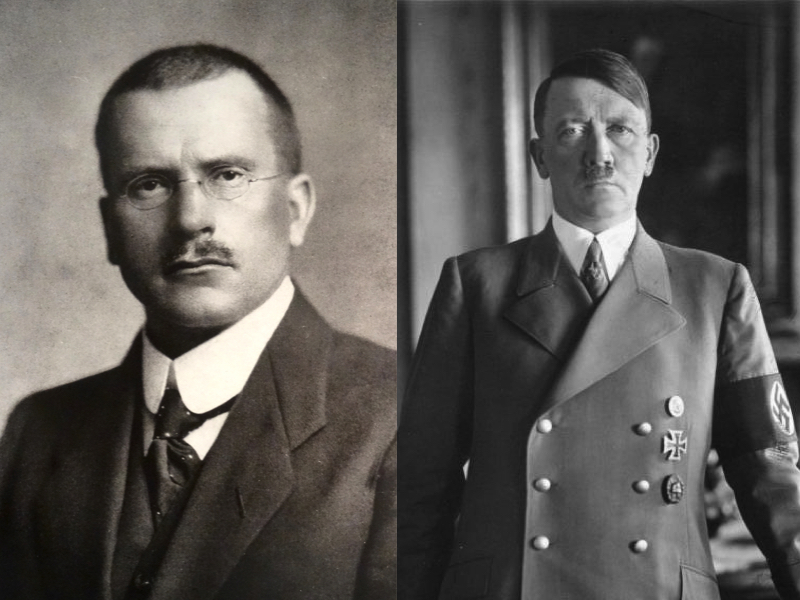
His recruiter Allen Dulles wrote of Jung’s “deep antipathy to what Nazism and Fascism stood for.” Dulles also cryptically remarked, “Nobody will probably ever know how much Prof. Jung contributed to the allied cause during the war.” These contradictions in Jung’s words, character, and actions are puzzling, to say the least. I would not presume to draw any hard and fast conclusions from them. They do, however, serve as the necessary context for Jung’s observations of Adolf Hitler. Nazis of today who praise Jung most often do so for his supposed characterization of Hitler as “Wotan,” or Odin, a comparison that thrills neo-pagans who, like the Germans did, use ancient European belief systems as clothes hangers for modern racist nationalism.
In his 1936 essay, “Wotan,” Jung describes the old god as a force all its own, a “personification of psychic forces” that moved through the German people “towards the end of the Weimar Republic”—through the “thousands of unemployed,” who by 1933 “marched in their hundreds of thousands.” Wotan, Jung writes, “is the god of storm and frenzy, the unleasher of passions and the lust of battle; moreover he is a superlative magician and artist in illusion who is versed in all secrets of an occult nature.” In personifying the “German psyche” as a furious god, Jung goes so far as to write, “We who stand outside judge the Germans far too much as if they were responsible agents, but perhaps it would be nearer the truth to regard them also as victims.”
“One hopes,” writes Per Brask, “evidently against hope, that Jung did not intend” his statements “as an argument of redemption for the Germans.” Whatever his intentions, his mystical racialization of the unconscious in “Wotan” accorded perfectly well with the theories of Alfred Rosenberg, “Hitler’s chief ideologist.” Like everything about Jung, the situation is complicated. In a 1938 interview, published by Omnibook Magazine in 1942, Jung repeated many of these disturbing ideas, comparing the German worship of Hitler to the Jewish desire for a Messiah, a “characteristic of people with an inferiority complex.” He describes Hitler’s power as a form of “magic.” But that power only exists, he says, because “Hitler listens and obeys….”
His Voice is nothing other than his own unconscious, into which the German people have projected their own selves; that is, the unconscious of seventy-eight million Germans. That is what makes him powerful. Without the German people he would be nothing.
Jung’s observations are bombastic, but they are not flattering. The people may be possessed, but it is their will, he says, that the Nazi leader enacts, not his own. “The true leader,” says Jung, “is always led.” He goes on to paint an even darker picture, having closely observed Hitler and Mussolini together in Berlin:
In comparison with Mussolini, Hitler made upon me the impression of a sort of scaffolding of wood covered with cloth, an automaton with a mask, like a robot or a mask of a robot. During the whole performance he never laughed; it was as though he were in a bad humor, sulking. He showed no human sign.
His expression was that of an inhumanly single-minded purposiveness, with no sense of humor. He seemed as if he might be a double of a real person, and that Hitler the man might perhaps be hiding inside like an appendix, and deliberately so hiding in order not to disturb the mechanism.
With Hitler you do not feel that you are with a man. You are with a medicine man, a form of spiritual vessel, a demi-deity, or even better, a myth. With Hitler you are scared. You know you would never be able to talk to that man; because there is nobody there. He is not a man, but a collective. He is not an individual, but a whole nation. I take it to be literally true that he has no personal friend. How can you talk intimately with a nation?
Read the full interview here. Jung goes on to further discuss the German resurgence of the cult of Wotan, the “parallel between the Biblical triad… and the Third Reich,” and other peculiarly Jungian formulations. Of Jung’s analysis, interviewer H.R. Knickerbocker concludes, “this psychiatric explanation of the Nazi names and symbols may sound to a layman fantastic, but can anything be as fantastic as the bare facts about the Nazi Party and its Fuehrer? Be sure there is much more to be explained in them than can be explained by merely calling them gangsters.”
Note: An earlier version of this post appeared on our site in 2017.
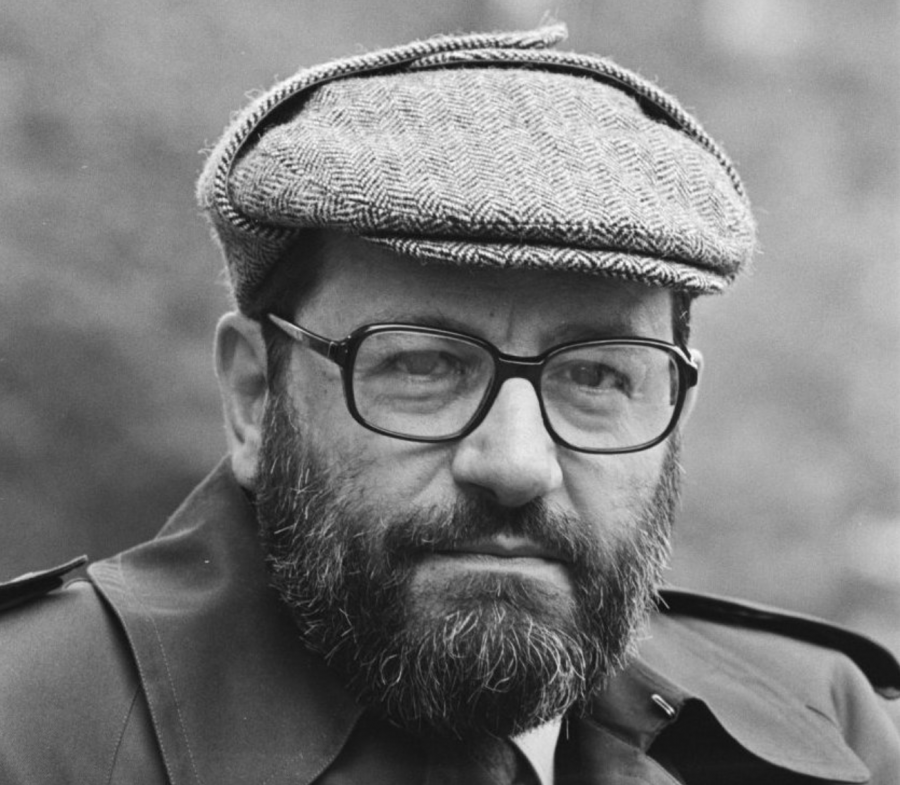
One of the key questions facing both journalists and loyal oppositions these days is how do we stay honest as euphemisms and trivializations take over the discourse? Can we use words like “fascism,” for example, with fidelity to the meaning of that word in world history? The term, after all, devolved decades after World War II into the trite expression fascist pig, writes Umberto Eco in his 1995 essay “Ur-Fascism,” “used by American radicals thirty years later to refer to a cop who did not approve of their smoking habits.” In the forties, on the other hand, the fight against fascism was a “moral duty for every good American.” (And every good Englishman and French partisan, he might have added.)
Eco grew up under Mussolini’s fascist regime, which “was certainly a dictatorship, but it was not totally totalitarian, not because of its mildness but rather because of the philosophical weakness of its ideology. Contrary to common opinion, fascism in Italy had no special philosophy.” It did, however, have style, “a way of dressing—far more influential, with its black shirts, than Armani, Benetton, or Versace would ever be.” The dark humor of the comment indicates a critical consensus about fascism. As a form of extreme nationalism, it ultimately takes on the contours of whatever national culture produces it.
It may seem to tax one word to make it account for so many different cultural manifestations of authoritarianism, across Europe and even South America. Italy may have been “the first right-wing dictatorship that took over a European country,” and got to name the political system. But Eco is perplexed “why the word fascism became a synecdoche, that is, a word that could be used for different totalitarian movements.” For one thing, he writes, fascism was “a fuzzy totalitarianism, a collage of different philosophical and political ideas, a beehive of contradictions.”
While Eco is firm in claiming “There was only one Nazism,” he says, “the fascist game can be played in many forms, and the name of the game does not change.” Eco reduces the qualities of what he calls “Ur-Fascism, or Eternal Fascism” down to 14 “typical” features. “These features,” writes the novelist and semiotician, “cannot be organized into a system; many of them contradict each other, and are also typical of other kinds of despotism or fanaticism. But it is enough that one of them be present to allow fascism to coagulate around it.”
The cult of tradition. “One has only to look at the syllabus of every fascist movement to find the major traditionalist thinkers. The Nazi gnosis was nourished by traditionalist, syncretistic, occult elements.”
The rejection of modernism. “The Enlightenment, the Age of Reason, is seen as the beginning of modern depravity. In this sense Ur-Fascism can be defined as irrationalism.”
The cult of action for action’s sake. “Action being beautiful in itself, it must be taken before, or without, any previous reflection. Thinking is a form of emasculation.”
Disagreement is treason. “The critical spirit makes distinctions, and to distinguish is a sign of modernism. In modern culture the scientific community praises disagreement as a way to improve knowledge.”
Fear of difference. “The first appeal of a fascist or prematurely fascist movement is an appeal against the intruders. Thus Ur-Fascism is racist by definition.”
Appeal to social frustration. “One of the most typical features of the historical fascism was the appeal to a frustrated middle class, a class suffering from an economic crisis or feelings of political humiliation, and frightened by the pressure of lower social groups.”
The obsession with a plot. “Thus at the root of the Ur-Fascist psychology there is the obsession with a plot, possibly an international one. The followers must feel besieged.”
The enemy is both strong and weak. “By a continuous shifting of rhetorical focus, the enemies are at the same time too strong and too weak.”
Pacifism is trafficking with the enemy. “For Ur-Fascism there is no struggle for life but, rather, life is lived for struggle.”
Contempt for the weak. “Elitism is a typical aspect of any reactionary ideology.”
Everybody is educated to become a hero. “In Ur-Fascist ideology, heroism is the norm. This cult of heroism is strictly linked with the cult of death.”
Machismo and weaponry. “Machismo implies both disdain for women and intolerance and condemnation of nonstandard sexual habits, from chastity to homosexuality.”
Selective populism. “There is in our future a TV or Internet populism, in which the emotional response of a selected group of citizens can be presented and accepted as the Voice of the People.”
Ur-Fascism speaks Newspeak. “All the Nazi or Fascist schoolbooks made use of an impoverished vocabulary, and an elementary syntax, in order to limit the instruments for complex and critical reasoning.”
One detail of Eco’s essay that often goes unremarked is his characterization of the Italian opposition movement’s unlikely coalitions. The Resistance included Communists who “exploited the Resistance as if it were their personal property,” and leaders like Eco’s childhood hero Franchi, “so strongly anti-Communist that after the war he joined very right-wing groups.” This itself may be a specific feature of an Italian resistance, one not observable across the number of nations that have resisted totalitarian governments. As for the seeming total lack of common interest between these parties, Eco simply says, “Who cares?… Liberation was a common deed for people of different colors.”
It’s safe to say that we no longer believe in the gods of the ancient world — or rather, that most of us no longer believe in their literal existence, but some of us have faith in their box-office potential. This two-part video series from Vanity Fair examines a variety of movies and television shows that have drawn on Greek and Roman myth since the mid-twentieth-century, including Jason and the Argonauts, Clash of the Titans, Troy, and Disney’s Hercules. Offering commentary on their faithfulness to the source material is Peter Meineck, Professor of Classics in the Modern World at New York University.
Not that he insists on holding these entertainments to rigorous standards of accuracy. “I would not use the term ‘accuracy’ at any point in Xena: Warrior Princess, because it’s fantastic,” he says at one point. But then, when it comes to the stories told by ancient Greeks and Romans, we’re dealing with rather fantasy-rich material from the start.
Heightened, augmented, refined, and syncretized over many generations, they’ve come down to us in forms that reflect more or less eternally human notions about the forces that govern reality and its vicissitudes — ready made, in some cases, to incorporate into the latest twenty-first-century superhero spectacle.
Possessed of distinctive physical traits, temperaments, superhuman powers, and even grudges, the many gods of the polytheistic antiquity were, in their way, the comic-book heroes of their time. And just as we have different “universes” of characters to choose from, different eras and cultures had their own lineups of deities, none quite the same as any other. “At the pinnacle of this teeming numinous universe were the Olympians, the twelve gods headed by Zeus and Hera,” says ancient-history Youtuber Garrett Ryan in the Told in Stone video above. “The Greeks influenced Roman religion virtually from the beginning. By the time Rome emerged into the full light of history, the Roman gods had been assimilated to their Greek counterparts.”
Hence our recognizing Greek Olympians like Poseidon, Artemis, Athena, and Dionysus, but also their Roman equivalents Neptune, Diana, Minerva, and Bacchus. “There seems to have been little doubt in Romans’ minds that their chief gods were the same as those of the Greeks,” Ryan says. “The Greeks, for their part, generally accepted that the Romans worshipped their gods under different names — while also being “eager collectors of exotic deities,” many of which could be found within their own vast empire. The result was a bewildering profusion of gods for every occasion, Greek-inspired or otherwise: an omen of the more-is-better ethos that the Hollywood blockbuster would embrace a couple of millennia later.
Based in Seoul, Colin Marshall writes and broadcasts on cities, language, and culture. His projects include the Substack newsletterBooks on Cities and the book The Stateless City: a Walk through 21st-Century Los Angeles. Follow him on Twitter at @colinmarshall or on Facebook.
From Rick Steves comes a thought-provoking documentary that revisits the rise of fascism in Europe, reminding us of how charismatic figures like Benito Mussolini and Adolf Hitler came to power by promising to create a better future for their frustrated, economically depressed countries–a future that recaptured the glory of some mythologized past. Once in power, these fascist leaders replaced democracy with a cult of personality, steadily eroded democratic norms and truth, ratcheted up violence, and found scapegoats to victimize–something facilitated by the spread of conspiracy theories and propaganda through modern media. They would lead their nations into war, and ultimately ruin, but not before creating a playbook for other charismatic autocrats who entice voters with simplistic solutions to complex problems.
Originally aired on television, Steves has released the documentary on YouTube, hoping that 21st-century citizens can “learn from the hard lessons of 20th-century Europe.” The text accompanying his documentary reads as follows:
In this one-hour special, Rick travels back a century to learn how fascism rose and then fell in Europe — taking millions of people with it. We’ll trace fascism’s history from its roots in the turbulent aftermath of World War I, when masses of angry people rose up, to the rise of charismatic leaders who manipulated that anger, the totalitarian societies they built, and the brutal measures they used to enforce their ideology. We’ll see the horrific consequences: genocide and total war. And we’ll be inspired by the stories of those who resisted. Along the way, we’ll visit poignant sights throughout Europe relating to fascism, and talk with Europeans whose families lived through those times. Our goal: to learn from the hard lessons of 20th-century Europe, and to recognize that ideology in the 21st century.
The Story of Fascism (which will be added to our list of Free Documentaries) is recommended for students and adults alike. With World War II fading from living memory, we could use a good reminder, says Steves, of how “nationalism can be channeled into evil, and how our freedoms and democracies are not indestructible…in fact, they are fragile.”
If you would like to support the mission of Open Culture, consider making a donation to our site. It’s hard to rely 100% on ads, and your contributions will help us continue providing the best free cultural and educational materials to learners everywhere. You can contribute through PayPal, Patreon, and Venmo (@openculture). Thanks!
We're hoping to rely on loyal readers, rather than erratic ads. Please click the Donate button and support Open Culture. You can use Paypal, Venmo, Patreon, even Crypto! We thank you!
Open Culture scours the web for the best educational media. We find the free courses and audio books you need, the language lessons & educational videos you want, and plenty of enlightenment in between.