As Twitter decays, we want to remind you that you can find posts from Open Culture on other social media platforms. Find us now on Threads, where have 900+ followers in the first 24 hours. We’re also on Blue Sky and Facebook. Or get our daily email newsletter. Pick your favorite and keep tabs on our daily posts.…
It should go without saying that one should drink responsibly, for reasons pertaining to life and limb as well as reputation. The ubiquity of still and video cameras means potentially embarrassing moments can end up on millions of screens in an instant, copied, downloaded, and saved for posterity. Not so during the infancy of photography, when it was a painstaking process with minutes-long exposure times and arcane chemical development methods. Photographing people generally meant keeping them as still as possible for several minutes, a requirement that rendered candid shots next to impossible.
We know the results of these early photographic portraiture from many a famous Daguerreotype, named for its French inventor, Louis-Jacques-Mandé Daguerre. At the same time, during the 1830s and 40s, another process gained popularity in England, called the Calotype—or “Talbotype,” for its inventor William Henry Fox Talbot. “Upon hearing of the advent of the Daguerreotype in 1839,” writes Linz Welch at the United Photographic Artists Gallery site, Talbot “felt moved to action to fully refine the process that he had begun work on. He was able to shorten his exposure times greatly and started using a similar form of camera for exposure on to his prepared paper negatives.”
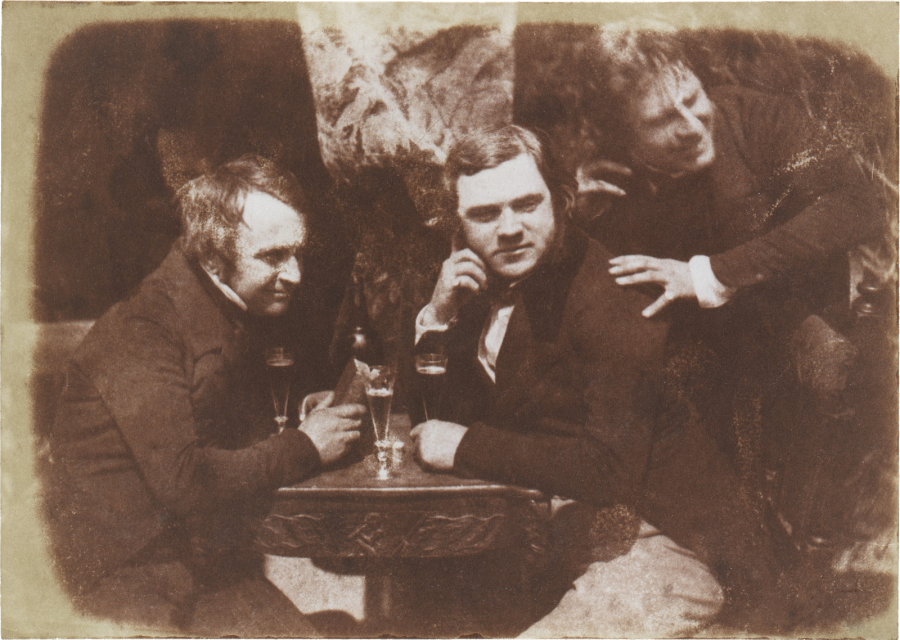
This last feature made the Calotype more versatile and mechanically reproducible. And the shortened exposure times seemed to enable some greater flexibility in the kinds of photographs one could take. In the 1843 photo above, we have what appears to be an entirely unplanned grouping of revelers, caught in a moment of cheer at the pub. Created by Scottish painter-photographers Robert Adamson and David Octavius Hill—who grins, half-standing, on the right—the image looks like almost no other portrait from the time. Rather than sitting rigidly, the figures slouch casually; rather than looking grim and mournful, they smile and smirk, apparently sharing a joke. The photograph is believed to be the first image of alcoholic consumption, and it does its subject justice.
Though Talbot patented his Calotype process in England in 1841, the restrictions did not apply in Scotland. “In fact,” the Metropolitan Museum of Art writes, “Talbot encouraged its use there.” He maintained a correspondence with interested scientists, including Adamson’s older brother John, a professor of chemistry. But the Calotype was more of an artists’ medium. Where Daguerreotypes produced, Welch writes, “a startling resemblance of reality,” with clean lines and even tones, the Calotype, with its salt print, “tended to have high contrast between lights and darks…. Additionally, because of the paper fibers, the image would present with a grain that would diffuse the details.” We see this especially in the capturing of Octavius Hill, who appears both lifelike in motion and rendered artistically with charcoal or brush.
The other two figures—James Ballantine, writer, stained-glass artist, and son of an Edinburgh brewer, and Dr. George Bell, in the center—have the rakish air of characters in a William Hogarth scene. The National Galleries of Scotland attributes the naturalness of these poses to “Hill’s sociability, humour and his capacity to gauge the sitters’ characters.” Surely the booze did its part in loosening everyone up. The three men are said to be drinking Edinburgh Ale, “according to a contemporary account… ‘a potent fluid, which almost glued the lips of the drinker together.’ ” Such a side effect would, at least, make it extremely difficult to over-imbibe.
Note: An earlier version of this post appeared on our site in 2017.
If you would like to support the mission of Open Culture, consider making a donation to our site. It’s hard to rely 100% on ads, and your contributions will help us continue providing the best free cultural and educational materials to learners everywhere. You can contribute through PayPal, Patreon, and Venmo (@openculture). Thanks!
The City of London has exploded like Blade Runner in the last couple of decades with glass and concrete and shrines to global capitalism like St. Mary Axe (aka the Gherkin) and the Shard (aka the Shard). But has the view from the ground stayed the same? According to this charming then vs. now video assembled by a company called YesterVid, yes.
Trawling through the oldest surviving public domain footage from the early days of film (1890 — 1920), the videographers have placed old and modern-day shots side by side, matching as close as they can camera placement and lens.
Missing from today: the soot, the filth in the gutter, and the free-for-all in the streets as horse-drawn carriages and early busses battled it out with pedestrians. Streets are safer now, with railings to protect citizens, though the signs of increased security are also apparent, and CCTV cameras are most probably filming the director…somewhere!
St. Paul’s still needs room to breathe, and while the Empire Theatre may not show any more Lumiere Cinematographies, it’s still a cinema showing IMAX films. It didn’t suffer the fate of many cinemas outside of London after the ‘60s: being turned into bingo halls or just torn down.
Also: the sea of red poppies seen at 4:28 during the shot of the Tower of London’s moat is an installation work by artist Paul Cummins. Blood Swept Lands and Seas of Red was installed between July and November of 2014 and, according to Wikipedia, it consisted of 888,246 ceramic red poppies, each intended to represent one British or Colonial serviceman killed in the Great War.
Final point: the oldest pub in London, Ye Olde Cheshire Cheese, still stands, and during the sweltering summers provides a cool respite, as most of its drinking rooms are underground. Cheers!
Note: An earlier version of this post appeared on our site in 2015.
If you would like to support the mission of Open Culture, consider making a donation to our site. It’s hard to rely 100% on ads, and your contributions will help us continue providing the best free cultural and educational materials to learners everywhere. You can contribute through PayPal, Patreon, and Venmo (@openculture). Thanks!
Ted Mills is a freelance writer on the arts who currently hosts the FunkZone Podcast. You can also follow him on Twitter at @tedmills, read his other arts writing at tedmills.com and/or watch his films here.
Seven decades after his death, George Bernard Shaw is remembered for his prodigious body of work as a playwright, but also — and at least as much — for his personal eccentricities: the then-unfashionable teetotaling vegetarianism, the rejection of vaccines and even the germ theory of disease, the all-wool wardrobe. Thus, even those casually familiar with Shaw’s life and work may not be terribly surprised to learn that he not only had an outbuilding in which to do his work, but an outbuilding that could be rotated 360 degrees. “Shaw’s writing refuge was a six-square-meter wooden summerhouse, originally intended for his wife Charlotte,” writes Idler’s Alex Johnson. “Built on a revolving base that used castors on a circular track,” it was “essentially a shed on a lazy Susan.”
The hut became a part of Shaw’s formidable public image in a period of the early twentieth century “when there was a growing appreciation of idyllic rural settings — a knock-on effect of which was that people had garden buildings installed. Shaw made the most of this movement, promoting himself as a reclusive thinker toiling in his rustic shelter, away from the intrusions of press and people alike, while at the same time inviting in newspapers and magazines and posing for photos.”
In 1929, “Shaw stood in front of his hut for a photo for Modern Mechanics & Inventions magazine to promote the idea of sunlight as a healing agent.” Hence the importance of rotating to catch its rays all day long through windows made of Vitaglass, “a recent invention that allowed UV rays to come through, letting, the makers said, ‘health into the building.’ ”
However odd some of Shaw’s views and practices, one can’t help but imagine that at least some of them contributed to his longevity. The 1946 British Pathé newsreel above pays him a visit just a few years before his death at the age of 94, finding him still writing (he still had the play Buoyant Billions ahead of him, as well as several other miscellaneous works), and what’s more, doing so in his hut: “Like G. B. S. himself,” says the narrator, “it pretends to be strictly practical, with no nonsense about it.” Yet Shaw seems to have had a sense of humor about his theoretically humble workspace, naming it after the English capital so that unwanted visitors to his home in the village of Ayot St Lawrence could be told, not untruthfully, that he was in London. But one naturally wonders: when he rang up the main house with his in-hut telephone (another of its highly advanced features), did his housekeeper say it was London calling?
Based in Seoul, Colin Marshall writes and broadcasts on cities, language, and culture. His projects include the Substack newsletterBooks on Cities, the book The Stateless City: a Walk through 21st-Century Los Angeles and the video series The City in Cinema. Follow him on Twitter at @colinmarshall or on Facebook.
We’ve all come across a LEGO set from childhood and felt the temptation to try building it one more time — making the generous assumption, of course, that all the pieces are in the box, to say nothing of the instructions. If you’re missing a few bricks, you can always turn to the robust secondary market in LEGO components. If you’re missing the manual, there’s now one place you should look first: the LEGO building instructions collection at the Internet Archive. There you’ll find digitized materials for more than 6,800 different sets, including such popular releases as the LEGO Chevrolet Camaro Z28, the LEGO International Space Station, and the LEGO cover photo of Meet the Beatles.
Since they were first brought to market in the late nineteen-fifties, LEGO’s signature building bricks have been primarily considered children’s toys. And of course, most of us got to know LEGO in childhood; I myself have fond memories of working my way up to the Ice Planet 2002 series, with its still much-referenced transparent orange chainsaws.
The Metafilter discussion of the Internet Archive’s LEGO building instructions collection reveals not only that some are excited indeed about the existence of this resource, but also that others consider building from instructions to be a misuse of the medium. It may be true that following specific documented steps for hours on end may encourage a certain slackening of the imagination. But then, it may also be true that physically working one’s way through a complex assembly process can build dexterity and generate ideas for later freeform constructions. However we approach LEGO, and whatever age at which we approach it, we need only keep in mind the Danish imperative that gave the company its name: leg godt — play well. Enter the collection of instructions here.
Based in Seoul, Colin Marshall writes and broadcasts on cities, language, and culture. His projects include the Substack newsletterBooks on Cities, the book The Stateless City: a Walk through 21st-Century Los Angeles and the video series The City in Cinema. Follow him on Twitter at @colinmarshall or on Facebook.
If you think cannabis possesses a broad range of applications, olive oil is going to blow your mind!
Humans have been hip to this miracle elixir since approximately 2500 BCE, when Mediterranean dwellers used it as lamp fuel and to anoint royalty, warriors, and other VIPs. (Not for nothing does “messiah” translate to “the anointed one”…)
Its culinary applications entered the mix between the 5th and 4th centuries BCE.
Even amurca, the bitter tasting, foul smelling liquid byproduct of the oil pressing process had numerous things to recommend it, as least as far as the ancient Romans were concerned. They used it as a fertilizer, a pesticide, a floor plaster, a sealant for jars, a fire accelerant, moth repellent, axel grease, a surface varnish, a nutritional supplement for livestock, and a remedy for skin diseases and infections.
It’s also a serious pollutant, so good on them for diverting it from the landfill.
Methods for extracting this practical, nutritional powerhouse from the olive fruit have evolved over time.
Bronze Age frescoes and ancient papyri document the earliest approach.
The Romans and Greeks took things up a notch with mechanical presses, such as the replica at the Biblical History Center, above.
In an episode of his National GeographicUncharted series, chef Gordon Ramsay traveled to Morocco to take a turn at one of the manually-turned stone grinding wheels that were the Middle Ages’ contribution to the history of olive oil, discovering in the process that such “bloody hard work” is better accomplished by an ass.
His labors were rewarded with a taste of olive oil straight from the press - oh my lord, that is beautiful! I’ve heard of extra virgin but this is gonna be extra-extra virgin!
Insider Foodtracks olive oil to the 21st century, where production is underway at a mill in Monopoli in the southern Italian region of Puglia, an area where olive trees outnumber humans, 15 to 1.
Puglia’s 1,000-plus mills supply 40% of the country’s olive oil production, and 12% worldwide.
Contemporary olive oil makers obtain a traditional quality product by splitting the difference between the ancient and the modern, with conveyor belts ferrying the fruit to a vat where machine-driven granite wheels crush them to a pulp.
It’s less picturesque, but also more efficient and hygienic than pre-Industrial methods, thanks, in part, to rubber gloves and stainless steel.
Grading oil according to its purity is also a modern innovation, providing consumers a handle quality, taste and health attributes.
Learn more about the history of olive oil here, then get cookin’!
Among millions and millions imprisoned in the Holocaust, one man in particular stands out — and stood out even to his Nazi captors. “At the Mauthausen garage yard, a black point stood about amidst the dust-colored multitude,” writes novelist Joaquim Amat-Piniella. “It’s a black boy from Barcelona, born in Spanish Africa. The officer who had spotted him from the balcony ordered that he be brought up to him. His robust and muscular body surprised the Nazis,” as did his cultivation: that he responded to their questions in German may well have kept him from being sent immediately to the gas chamber. His name was Carlos José Grey Molay, also known as Carlos Greykey, and his remarkable life story is the subject of 5124.GREYKEY, Enric Ribes’ short documentary film above.
Narrated by Greykey’s daughter Muriel Grey Molay, “5124.GREYKEY uses retro techniques, recreated home movies and personal/archival photography to visualise a daughter’s memories of an enigmatic father.” So writes Rob Munday at Short of the Week, going on to describe the film as “consisting of painstakingly recreated home movies (reshot on Super 8 and 16mm — as Muriel couldn’t retrieve them), photos (both from Muriel’s archive and historic archives) and stop-motion (created by S/W alums I+G Stop Motion).”
Through these materials, “much like how the daughter builds a solid understanding of her Dad’s past, bit-by-bit, a picture of Jose only starts to form after we are given the pieces of the puzzle to put together ourselves.”
The Barcelona-born son of parents from modern-day Equatorial Guinea, Greykey was studying medicine at university when the Spanish Civil War broke out. Conscripted, he fought against the rebels, and later moved on to France, where he fought against the Germans. It was the Nazi victory there that put him in the Mauthausen concentration camp along with Amat-Piniella. Like everyone else interned there, he received a number — the titular 5124 — but his refinement and formidable language skills (in addition to his native Spanish, he commanded not just German, but also French, English, and Catalán) secured him the special position of serving at the table of the camp’s commander. Whatever privileges attended this position, Greykey’s wartime experience haunted him for the rest of his life: a life swept up in enough currents of history to be more than overdue for a feature film-treatment.
Based in Seoul, Colin Marshall writes and broadcasts on cities, language, and culture. His projects include the Substack newsletterBooks on Cities, the book The Stateless City: a Walk through 21st-Century Los Angeles and the video series The City in Cinema. Follow him on Twitter at @colinmarshall or on Facebook.
Ridley Scott’s 1977 film The Duellists stars Harvey Keitel and Keith Carradine as Frenchmen in the early nineteenth century. Both of their characters are military officers, Keitel’s a Bonapartist and Carradine’s an anti-Bonapartist, and their relationship plays out over a duel-punctuated sixteen-year period during and just after the Napoleonic Wars. The Duellists is required viewing for any student of Scott-as-auteur, not just due to its being his debut feature, but also to its presumptive connections to his latest work. Even working on a low budget 45 years ago, Scott and his collaborators managed to perform an acclaimed re-creation of Napoleon’s France. What has he accomplished on the far grander canvas of Napoleon, which comes out on November 22nd?
Napoleon, as previously featured here on Open Culture, is also the title of the greatest movie Stanley Kubrick never made. Judging by its newly released trailer, Ridley Scott’s film isn’t exactly a stylistic homage to Kubrick, though one doubts that Kubrick’s work was all too far from Scott’s mind during the project — as indeed it wasn’t in the making of The Duellists, which was heavily influenced by Barry Lyndon.
But as a historical drama, Napoleon seems to have more obviously in common with Scott’s own swords-and-sandals blockbuster Gladiator, which included a memorable performance by Joaquin Phoenix as Marcus Aurelius’ power-mad son Commodus, who kills his father in order to make himself emperor.
Phoenix plays another imperial role in Napoleon: that of the titular military commander who rose to rule the French Empire for more than a decade. Bringing Napoleon’s story to the screen afforded Scott the chance to stage no fewer than six battle sequences — including, as Smithsonian.com’s Teresa Nowakowski notes, “the Battle of Austerlitz, a military engagement that went down in history as one of Napoleon’s greatest successes. The trailer depicts the pivotal moment when Napoleon’s forces fired artillery into the ice on which enemy troops were retreating,” an episode well-suited to Scott’s instinct for spectacle. However much his particular sensibilities may differ from Kubrick’s, it’s easy to understand why both directors would be drawn to the subject of Napoleonic ambition.
Based in Seoul, Colin Marshall writes and broadcasts on cities, language, and culture. His projects include the Substack newsletterBooks on Cities, the book The Stateless City: a Walk through 21st-Century Los Angeles and the video series The City in Cinema. Follow him on Twitter at @colinmarshall or on Facebook.
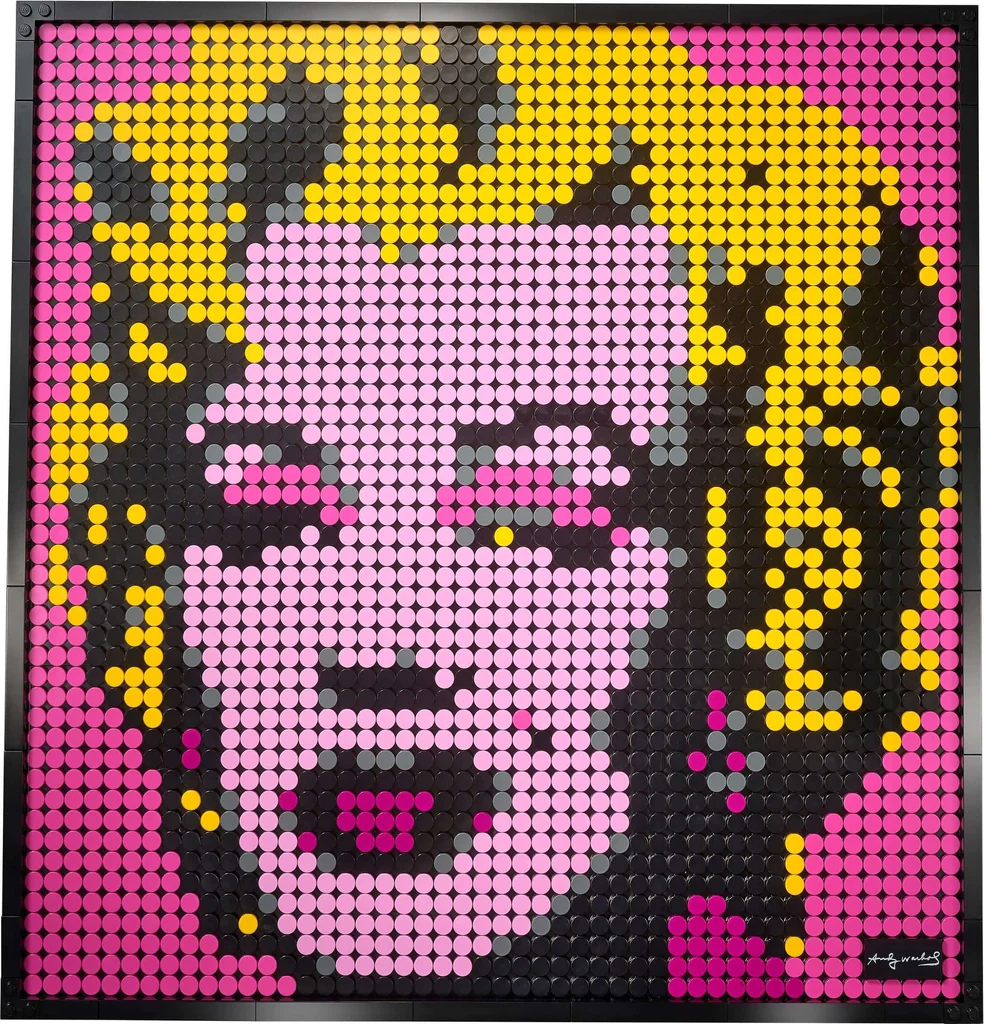
The art of Keith Haring emerged in the highly specific place and time of early-eighties New York City. Four decades later, it’s visible all around the world, yet hasn’t lost its associations with its origins. Just the other day, I was walking down a street in my neighborhood in Seoul and noticed that a boutique had put a T‑shirt emblazoned with one of Haring’s artistic declarations that “CRACK IS WACK!!” Drug abuse use was just one of the issues to which he attached his work: others included apartheid, nuclear disarmament, and above all AIDS awareness. How, in contrast to so much activist art, has the Haring oeuvre achieved its enduring popularity?
Gallerist and Youtuber James Payne addresses this question in his new Great Art Explained video on Haring’s life and work. As soon as possible after a television-saturated suburban baby-boomer upbringing that did its part to teach him to “sell difficult politics in the same way Madison Avenue sold vacuum cleaners,” Haring moved to New York.
Within its cultural free-for-all he developed a signature style by making chalk drawings on unused ad spaces: “he called the New York subway his ‘laboratory,’ experimenting with ideas and form,” and only occasionally getting into trouble for it. New Yorkers “looked forward to seeing what he drew next and where, and before long mainstream media noticed him too and almost overnight he became a star.”
As Haring’s fame grew, it became clear that “he truly believed in the power of art to change the world. This belief, combined with the immediacy of his cartoon style, came together spectacularly in the nineteen-eighties.” Indeed, as Kurt Andersen writes in the New Yorker, Haring at his “manic, moneyed, fun, party-driven, celebrity-obsessed, shameless” prime was a personification of that decade. But even after his AIDS-related death in 1990, the simple exuberance of his art style lived on, not least in the form of posters and other products. “It’s definitely art for the age of mechanical reproduction,” Haring once said of his own work, and its sheer commonness — as well as its outward cheerfulness — make it easy to overlook the sources of its power. As has been said of Walt Disney, for whom he had dreamed of working since childhood, Haring didn’t just give people what they wanted; he wanted what they wanted.
Based in Seoul, Colin Marshall writes and broadcasts on cities, language, and culture. His projects include the Substack newsletterBooks on Cities, the book The Stateless City: a Walk through 21st-Century Los Angeles and the video series The City in Cinema. Follow him on Twitter at @colinmarshall or on Facebook.
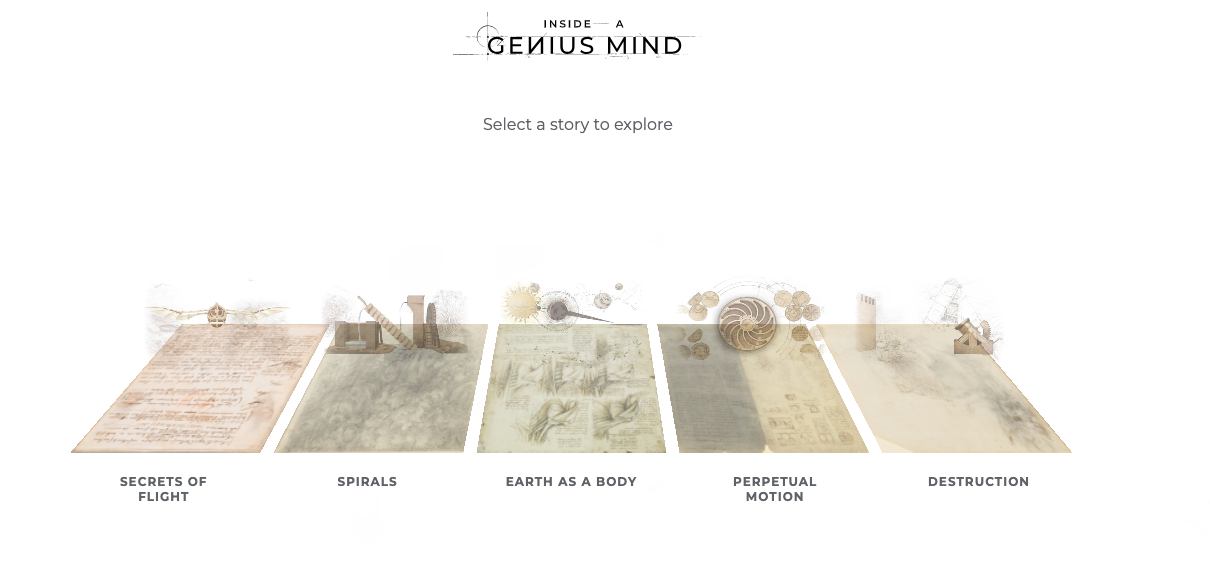
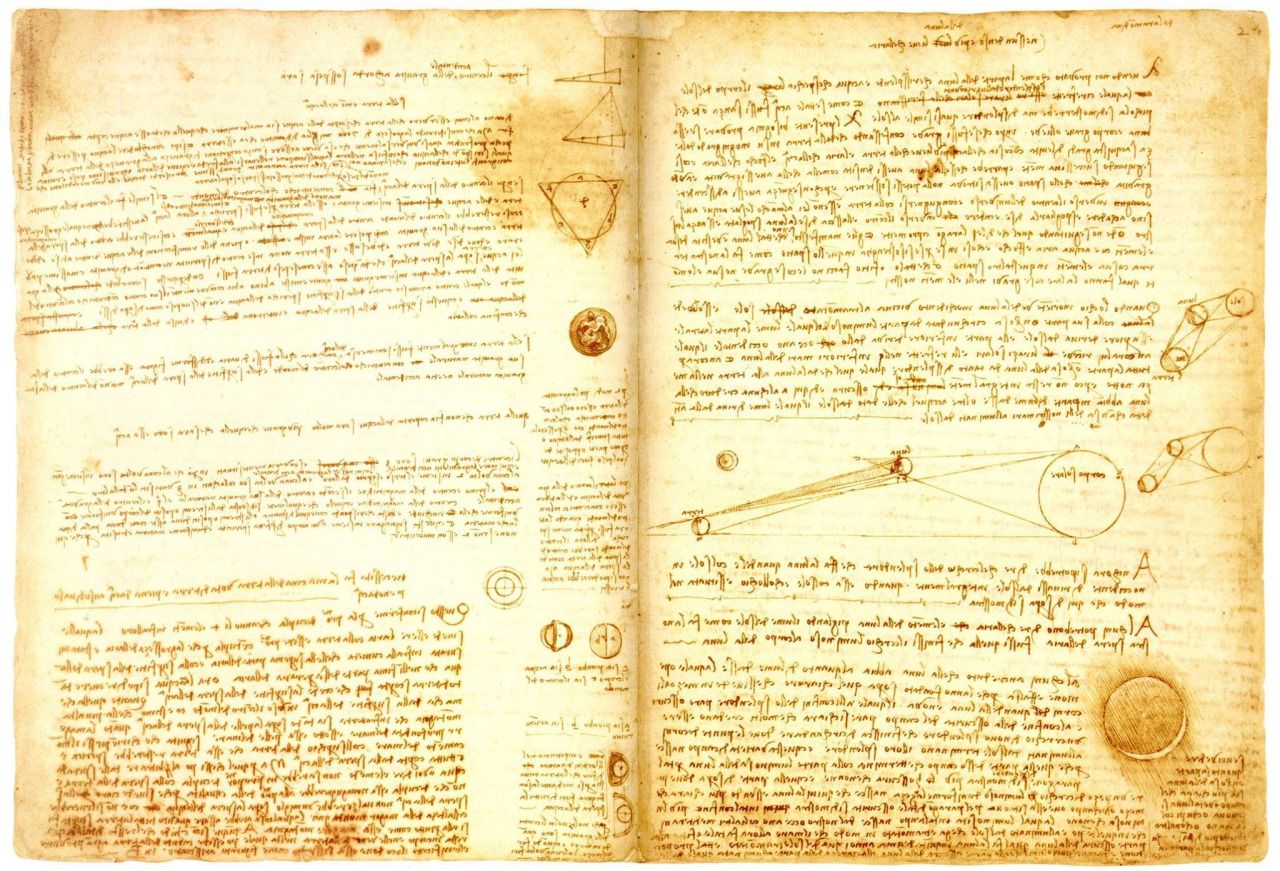
Google Arts & Culture’s new initiative Inside a Genius Mindoffers an interactive experience of the codices in which Da Vinci made his sketches, diagrams, and notes.
It’s also a curatorial collaboration between a human — Oxford art history professor Martin Kemp — and artificial intelligence.
His non-human counterpart used machine learning to delve into the notebooks’ contents, investigating some 1040 pages from 6 volumes and “drawing thematic connections across time and subject matter to reflect Leonardo’s spirit of interdisciplinary imagination, innovation and the profound unity at the heart of his apparently diverse pursuits.”
Upon launching the experiment, you bushwhack your way through the individual codices by clicking on the sketches floating toward you like elements in a classic space-themed video game, or choose to enjoy one of five curated stories.
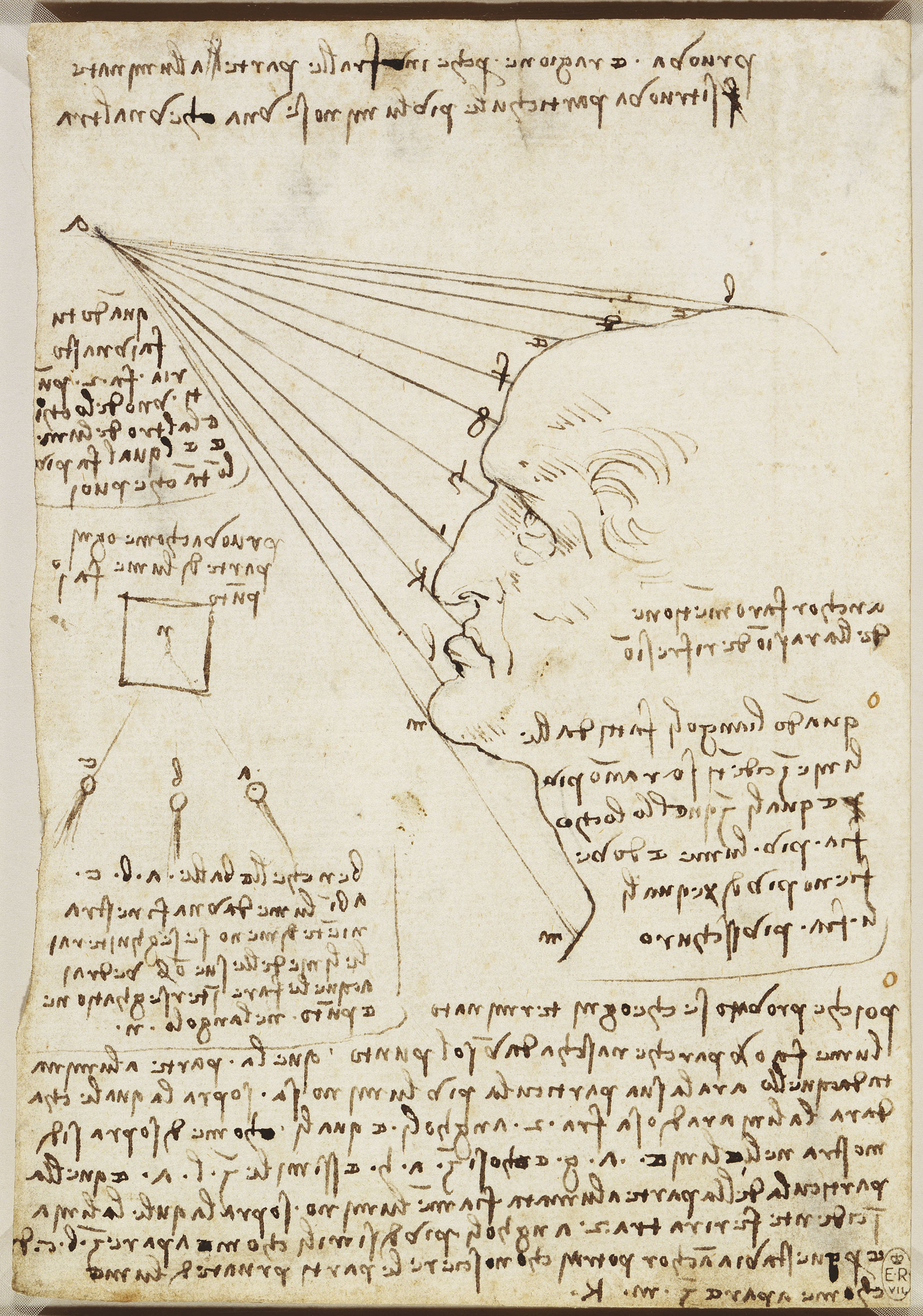
Using a discreet and somewhat fiddly navigation bar on the left side of the screen, we toured Leonardo’s renderings of the flayed muscles of the upper spine, the vessels and nerves of the neck and liver, the Arno valley with the route of a proposed canal that would run from Florence to Pisa, a view of the Alps from Milan, the fall of light on a face, studies of optics and men in action, and observations of the moon and earthshine.
How are these things related?
“Leonardo believed that the human body represented the whole natural world in miniature” and the selections do offer food for thought that Leonardo’s passion for the underlying laws of nature is the common thread running through his research and art.
Each image is accompanied a button inviting you to “explore” the work further. Click it for information about dimensions, provenance, and media, as well as some tantalizing biographical tidbits, such as this, adapted from the catalogue for the 2019 exhibit Leonardo da Vinci: A Life in Drawing:
Leonardo had first studied anatomy in the late 1480s. By the end of his life he claimed to have performed 30 human dissections, intending to publish an illustrated treatise on the subject, but this was never completed, and Leonardo’s work thus had no discernible impact on the discipline. His only documented dissection was carried out in the winter of 1507–8, when he performed an autopsy on an old man whose death he had witnessed in a hospital in Florence. The studies on this page from Leonardo’s notebook are based on that dissection: on the verso Leonardo depicts the vessels of the liver; and in notes elsewhere in the notebook he gives the first known clinical description of cirrhosis of the liver.
Perhaps you’d like to circumvent the machine learning and use your own genius mind to make connections a la Da Vinci?
Try messing around with the AI tags. See what you can cobble together to forge a cohesive alliance between such elements as wing, horse, map, musical instruments, and spiral.
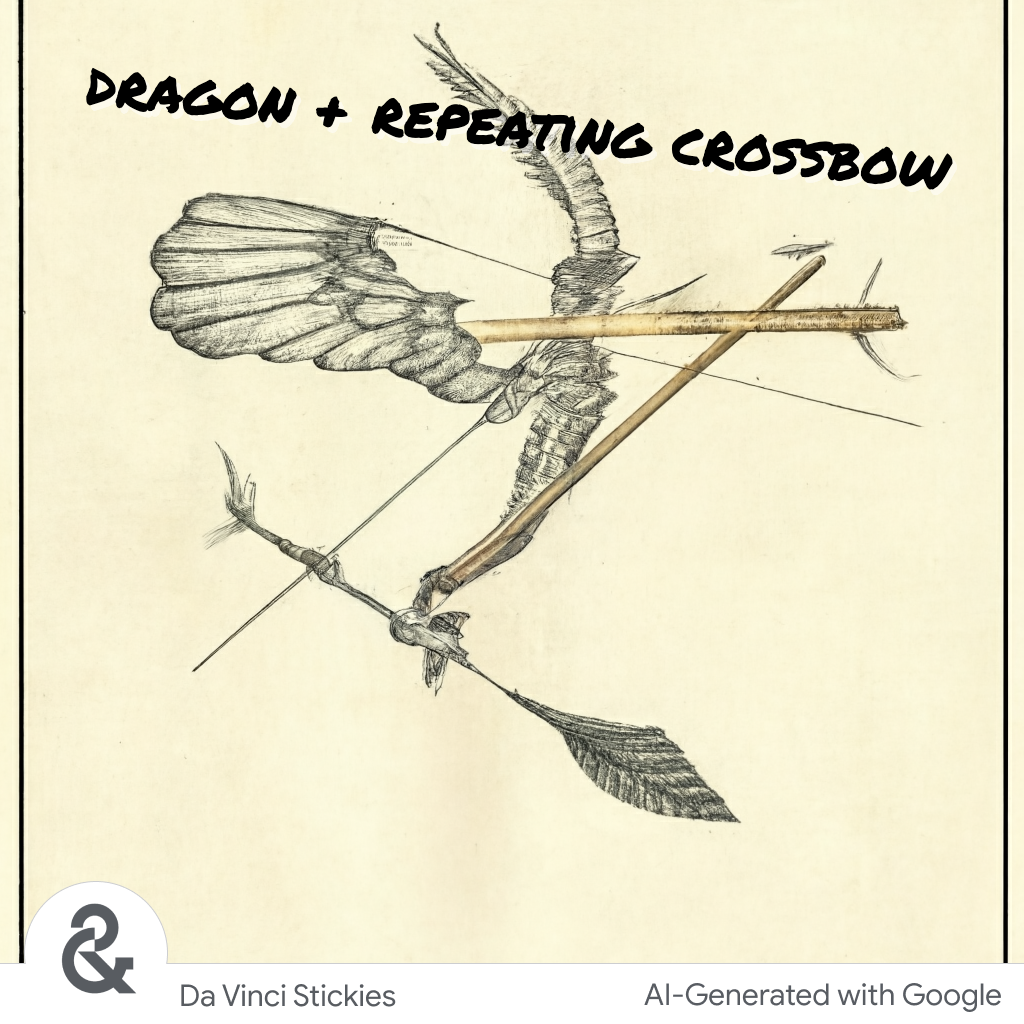
Or cleanse your palate by putting a mash-up of two codex sketches on a digital sticky with the help of Google AI, mindful that the master, who lived to the ripe old age of 67, was probably a bit more intentional with his time…
Of all the Romance languages, none is more Romantic than Italian, at least in the sense that it has changed the least in its long descent from Latin to its current form. Whether the Italian spoken in recent centuries has a particularly close resemblance to Latin is another question, and one American Youtuber Luke Ranieri investigates on the streets of Rome itself in the video above. In order to find out whether modern-day Italians can understand ancient Latin, he approaches unsuspecting Romans and asks them for directions in that language, speaking it fluently and just as their ancestors would have back in the first century.
So, can Romans understand Latin? “Yes,” Ranieri concludes, “but they don’t always enjoy it.” Most of the individuals he addresses claim that they can’t understand him at first. But as the conversation continues — in Latin on one side, Italian on the other — it becomes clear that they can indeed figure out what he wants to know.
“Italians are almost universally exposed only to the traditional Italian pronunciation of Latin (called the pronuncia scolastica), otherwise known as the Ecclesiastical Pronunciation,” Ranieri notes in a comment. But “in this video, I am using the Restored Classical Pronunciation of Latin as it was pronounced in Rome two thousand years ago.”
He may have had better luck at the Vatican and the Colosseum, but the Italians he meets in Rome do rise to this challenge, more or less, though few do it without hemming, hawing, and of course, attempting to use English. For the language of England has, one could argue, risen to play the same role in wide swaths of our world that Latin once played across the Roman Empire. This situation has its advantages, but in the heart of many a language-lover it also inspires some regrets. Though full of Latinate vocabulary, English arguably falls short of the beauty of the genuine Romance languages. And even the most obstinate Anglophone has to admit that, compared to Latin, English lacks something: a certain gravitas, let us say.
Based in Seoul, Colin Marshall writes and broadcasts on cities, language, and culture. His projects include the Substack newsletterBooks on Cities, the book The Stateless City: a Walk through 21st-Century Los Angeles and the video series The City in Cinema. Follow him on Twitter at @colinmarshall or on Facebook.
We're hoping to rely on loyal readers, rather than erratic ads. Please click the Donate button and support Open Culture. You can use Paypal, Venmo, Patreon, even Crypto! We thank you!
Open Culture scours the web for the best educational media. We find the free courses and audio books you need, the language lessons & educational videos you want, and plenty of enlightenment in between.