An Interactive Visualization of the Stanford Encyclopedia of Philosophy

2020 was “a year for the (record) books in publishing,” wrote Jim Milliot in Publisher’s Weekly this past January, a surge continuing into 2021. Yet some kinds of print books have so declined in sales there may be no reason to keep publishing them, or buying them, since their equivalents online are superior in almost every respect to any version on paper. As I finally conceded during a recent, aggressive spring cleaning, I personally have no reason to store heavy, bulky, dusty reference books, except in cases of extreme sentiment.
The online Stanford Encyclopedia of Philosophy, or the SEP, dispensed with the need for philosophy encyclopedias in print years ago. It’s “the most interesting website on the internet,” wrote Nikhail Sonnad at Quartz in 2015. “Not because of the content — which includes fascinating entries on everything from ambiguity to zombies—but because of the site itself. Its creators have solved one of the internet’s fundamental problems: How to provide authoritative, rigorously accurate knowledge, at no cost to readers. It’s something the encyclopedia, or SEP, has managed to do for two decades.”

Started in 1995 by Stanford philosopher Edward Zalta with only two entries, the SEP is “positively ancient in internet years,” but it is hardly “ossified,” remaining an online source “‘comparable in scope, depth and authority,’” the American Library Association’s Booklist review wrote, “to the biggest philosophy encyclopedias in print.”
I personally think the SEP is just as interesting for its content as its achievement, if not more so — and now, thanks to engineer and developer Joseph DiCastro, that content is more accessible than ever, though an interactive visualization project and search engine called Visualizing SEP.

Visualizing SEP “provides clear visualizations based on a philosophical taxonomy that DiCastro adapted from the one developed by the Indiana University Philosophy Ontology Project (InPhO),” Justin Weinberg writes at Daily Nous. “Type a term into the search box and suggested SEP entries will be listed. Click on one of the entry titles, and a simple visualization will appear with your selected entry at the center and related entries surrounding it.” At the top of the page, you can select from a series of “domains.” Each selection produces a similar visualization of various-sized dots.
I found enough entries to keep me busy for hours in the very first domain graph, “Aesthetics and Philosophy of Art.” The last of these, simply titled “Thinker,” links together all of the philosophers mentioned in the Stanford Encyclopedia of Philosophy, from the most famous household names to the most obscure and scholastic. Just skimming through these names and reading the brief biographies at the left will leave readers with a broader contextual understanding than they could gain from a print encyclopedia. (Click on the “Article Details” button to expand the full article).

The visualizer project carries forth into the data-obsessed 21st century one of the best things about the Internet in its earliest years: access to free, high quality (and highly portable) information with few barriers for entry. Learn more about how to best navigate Visualizing SEP at Daily Nous.
Related Content:
Free Online Philosophy Courses
A Data Visualization of Modern Philosophy, 1950–2018
The History of Philosophy Visualized in an Interactive Timeline
Josh Jones is a writer and musician based in Durham, NC. Follow him at @jdmagness
Read More...Watch Accurate Recreations of Medieval Italian Longsword Fighting Techniques, All Based on a Manuscript from 1404
Given recent events, the prospect of hundreds of young men meeting on Facebook, then traveling from around the country to a central U.S. location might sound like reasonable cause for alarm. Yet a recent convention fitting that description had nothing to do with political violence but, rather, a celebration and appreciation of the name “Josh” (full disclosure: this writer did not attend). The gathering of the Joshes this past April in Nebraska could not have been more peaceful, including its finishing battle royale, conducted with pool noodles. (Winner: adorable 4‑year-old Josh Vinson, Jr., or “Little Josh,” from Lincoln, NE).
The Joshes had no concern for proper pool-noodle-wielding technique, if there is such a thing. But groups of people who gather around the country to stage medieval-style battles in live-action role playing (LARP) games with weapons both real and fake might benefit from pointers.
So, too, might those who choreograph sword fights on stage and screen. Where can serious historical re-creators learn how to wield a real blade in historically accurate combat? One resource can be found at Wiktenauer, a wiki devoted to collecting “all of the primary and secondary source literature that makes up the text of historical European Martial arts (HEMA) research.”
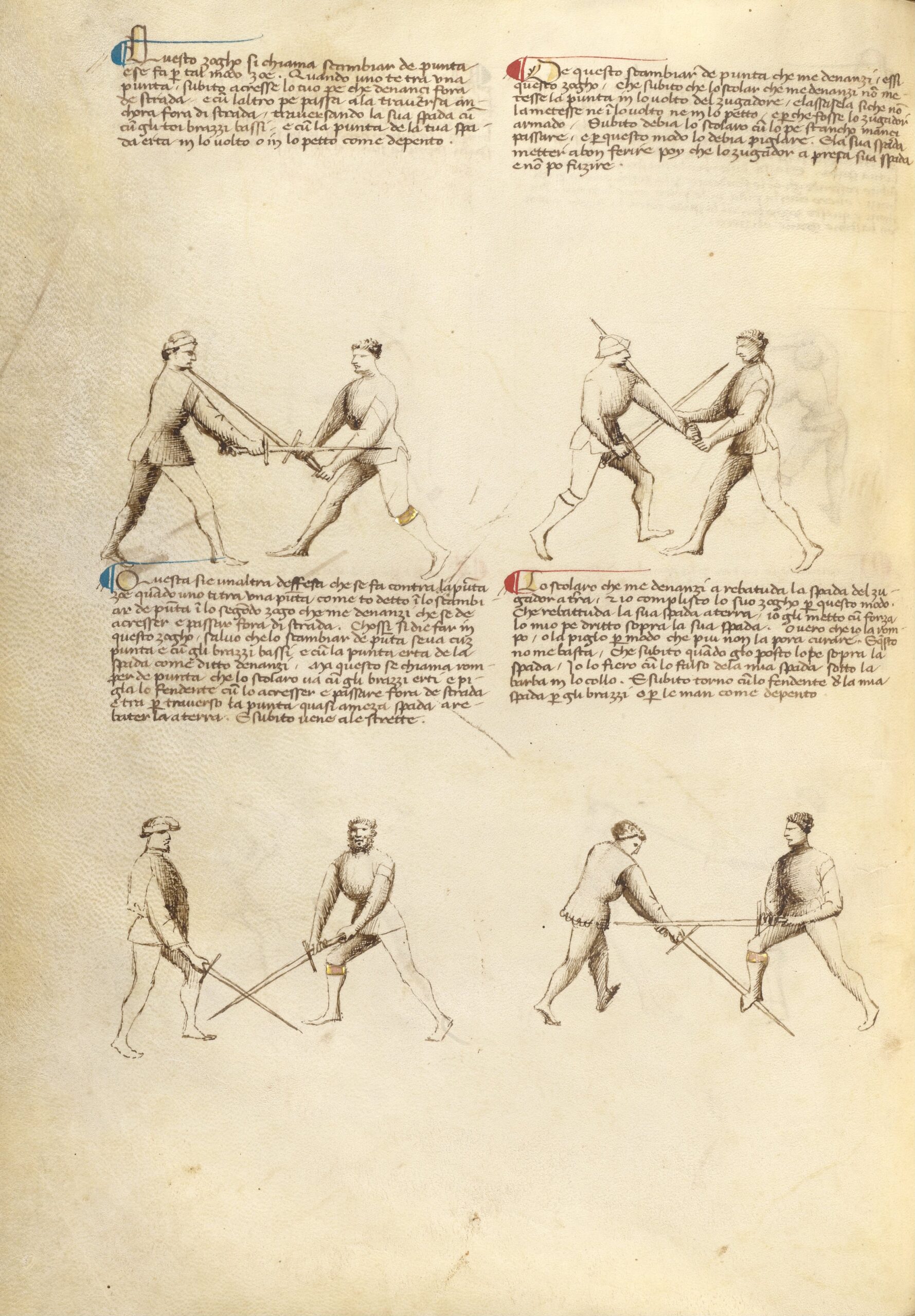
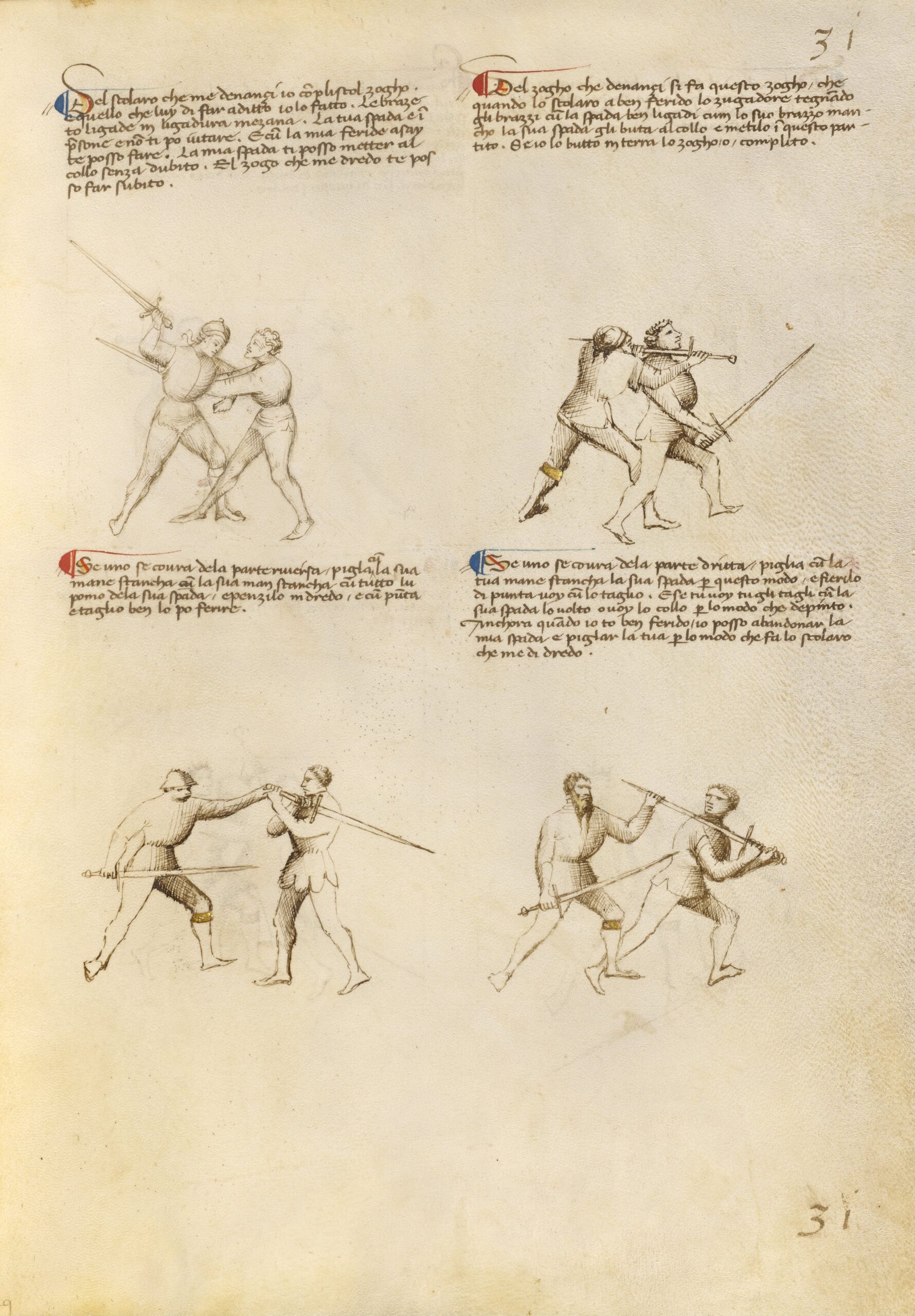
The Fior di Battaglia (“Flower of Battle”) — an Italian fencing manual by Fiore de’i Liberi dating from circa 1404 — offers richly- and copiously-illustrated demonstrations of medieval Italian longsword fighting techniques. In the original manuscript, seen here and at The Getty, “the illustrations are inked sketches with gold leafing on the crowns and garters,” notes the Wiktenauer entry. They dominate the text, which “takes the form of descriptive paragraphs set in poor Italian verse, which are nevertheless fairly clear and informative.” So clear, indeed, the brooding young men of Akademia Szermierzy — a Polish group that recreates medieval sword-fighting techniques — can more than convincingly mimic the moves in the video at the top.
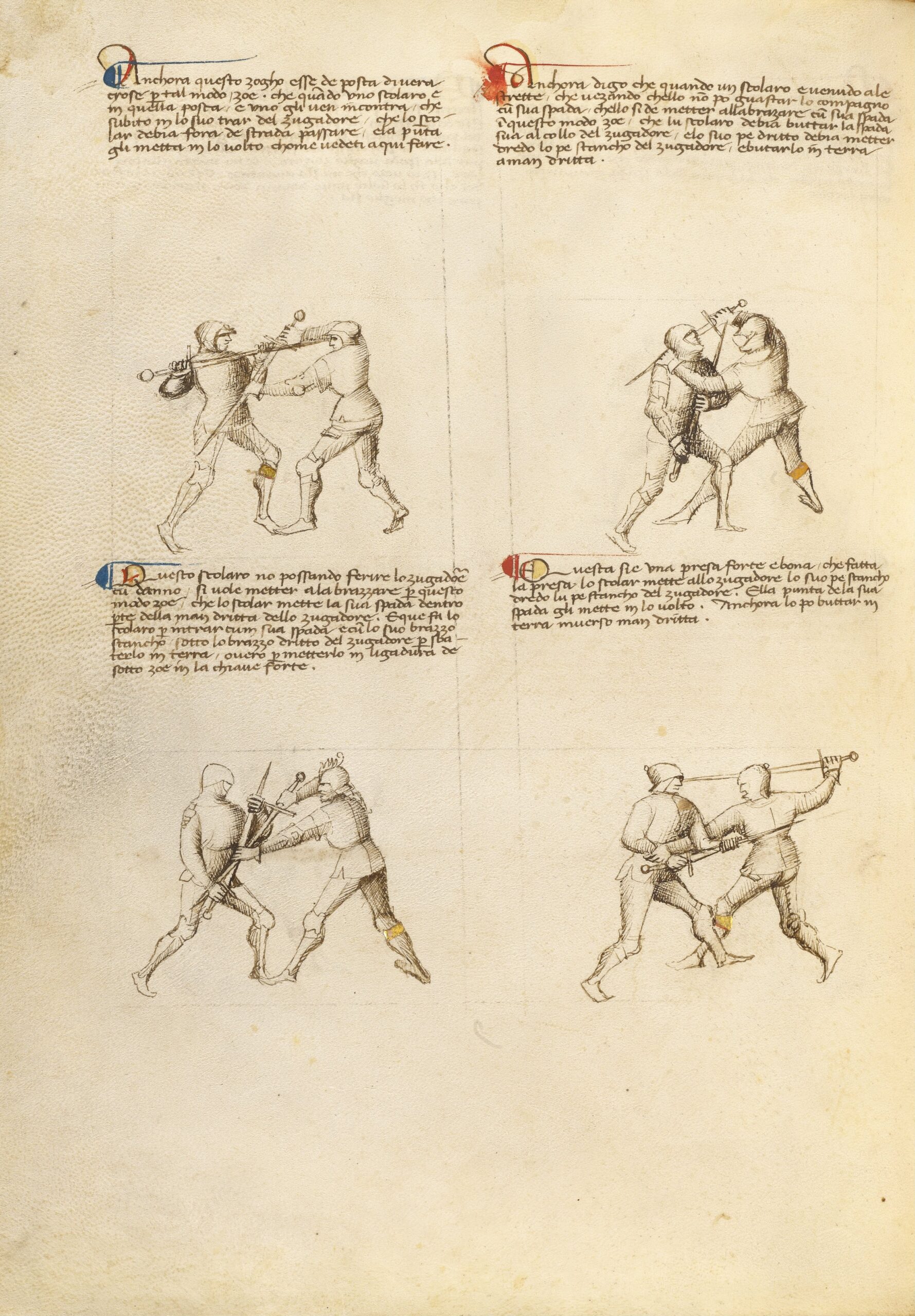
Once they get going, after some requisite pre-fight rigamarole, it’s impressive stuff, maybe already familiar to modern fencers and certain members of the Society for Creative Anachronism, the LARP-ing organization of amateurs recreating everything from the Middle Ages and the Renaissance. But for those who think all live-action role-playing is the equivalent of the Battle of the Joshes (or off-brand Nazis running through the streets in homemade armor), the sheer ballet of historical sword-fighting may come as a surprise — and maybe inspire a few more people to pull on the doublet and hose. See more medieval sword-fighting recreations from Akademia Szermierzy here, and the full text of the Fior di Battaglia here.
Related Content:
A Hypnotic Look at How Japanese Samurai Swords Are Made
The Last Duel Took Place in France in 1967, and It’s Caught on Film
Josh Jones is a writer and musician based in Durham, NC. Follow him at @jdmagness
Read More...European Paintings: From Leonardo to Rembrandt to Goya–A Free Online Course from the Universidad Carlos III de Madrid (UC3M)
From the Universidad Carlos III de Madrid (UC3M) comes European Paintings: From Leonardo to Rembrandt to Goya, which the university describes as follows:
The goal of this course is to help students become familiar with the leading European painters and paintings from approximately 1400 to 1800, and with the issues that found expression in the art of painting. Included in this broad timeframe are artists of the importance of Leonardo da Vinci, Caravaggio, Velázquez, Rembrandt, Vermeer or Goya. Painters during this period were concerned with ideas such as the pursuit of beauty, the pleasures and pains associated with love, the demonstration of power and status, or the relationship of men and women to the divinity and to nature. In paintings from the period covered in this course we find traces of the emergence of the modern mind set, and information on issues such as the respective roles of women and men in the world. The classes will focus on images of paintings by the artists listed in the course syllabus. The discussions that will take place in the “course forum” will allow us to touch upon a broader range of issues.
You can take European Paintings: From Leonardo to Rembrandt to Goya for free by selecting the audit option upon enrollment. If you want to take the course for a certificate, you will need to pay a fee.
European Paintings: From Leonardo to Rembrandt to Goya will be added to our list, 1,700 Free Online Courses from Top Universities.
Related Content:
Free Course: An Introduction to the Art of the Italian Renaissance
14 Paris Museums Put 300,000 Works of Art Online: Download Classics by Monet, Cézanne & More
The Art of Europe’s Forgotten Avant-Garde Artists Now Digitized and Put Online
Read More...The Ukulele Orchestra of Great Britain’s Headbanging Cover of Nirvana’s “Smells Like Teen Spirit”
Smells Like Teen Spirit is an unusual anthem because it refuses the role of the anthem. It’s perfect for the generation it represented because this was a cohort that was so ambivalent about any traditional values [or] conventional success. — music critic Ann Powers
The screaming existential angst of “Smells Like Teen Spirit” ensured that Nirvana would define, transcend, and outlast the 90s grunge scene.
The song was an instant hit. Here’s a description from someone who was present at the small Seattle club O.K Hotel for its first live performance:
They started playing the new song and people erupted. We were being slimed on by shirtless guys, just moshing. My friend Susan started hyperventilating, she thought it was so good: ‘I can’t, gasp, believe what they just played!’ It was just instantaneous; it was crazy.
“Smells Like Teen Spirit” was unreconstituted rock bliss to us…
…and perhaps not the most natural fit for a ukulele cover?
On the other hand, what better instrument for those “ambivalent about conventional success” than the ukulele?
The Ukelele Orchestra of Great Britain’s cover is as intentionally silly as the band itself, but also manages to convey some of the original’s DGAF attitude.
That’s quite an accomplishment for a seated row of formally dressed, middle aged musicians, strumming in unison on an instrument anyone can play… but few can play well.
The ukulele has become cool in certain circles, but remains inextricably linked to Tiny Tim tiptoeing through the tulips, and a million fumbling summer camp recreations of Jake Shimabukuro’s gentle Hawaiian “Somewhere Over the Rainbow.”
Orchestra founder Peter Brooke Turner’s tribute to lead vocalist Kurt Cobain helps nudge the needle past pure novelty into the realm of credibility, or at least a sophisticated understanding of all the ways in which the original works.
Plus, his “yeah” at 1:52 transcends the era of flannels, harkening to a time when the unconflicted preening rock god reigned supreme. (We should note that he serves plenty of ham alongside that sausage.)
Best of all is David Suich’s enthusiastic headbanging. Clearly a fellow who enjoys putting his long hair in service of his art! (We refer you to the Ukulele Orchestra’s interpretation of AC/DC’s “Highway to Hell.” below…)
Related Content:
The First Live Performance of Nirvana’s “Smells Like Teen Spirit” (1991)
1,000 Musicians Play Nirvana’s “Smells Like Teen Spirit” Live, at the Same Time
Ayun Halliday is an author, illustrator, theater maker and Chief Primatologist of the East Village Inky zine. Follow her @AyunHalliday.
Read More...Discover Ibn Sina (Avicenna), a Missing Pixel in Your Image of Philosophy: Partially Examined Life Episode #267 Featuring Peter Adamson

Most American students in philosophy live on a diet of ancient Greek philosophy on the one hand, and then “modern” philosophy, which starts around the time of Descartes (the 17th century), with numerous schools and approaches spilling into the present day. If you get anything from between those ancient days and modernity, it’s probably some churchmen, i.e. Augustine (from the 4th century) and Thomas Aquinas (the 13th century), with perhaps a few Romans thrown in there and (if you’re Jewish) Maimonides (12th century).
But a key part of this lineage was the Eastward turn that the great works of Greek and Roman philosophy took during the so-called Dark Ages, when they were preserved and copied in the Islamic world, and this period produced a wealth of philosophy including two figures who became influential enough in the West that their names were Latinized: Ibn Sīnā (980‑1037 C.E.) and Ibn Rushd, a.k.a. Averroes (1126–1198). Aquinas was very familiar with these figures and incorporated them into his influential works, and in the case of Ibn Sina, at least, important figures like John Locke had definitely known at least about his views, if not his actual works.
On the Partially Examined Life Philosophy Podcast, which has been going for 13 years now, we range widely over the history of philosophy but had not actually cracked the Islamic world. Luckily, Ibn Sīnā is one of the favorite philosophers of one of our favorite guests, Peter Adamson of King’s College London. Peter runs his own podcast, The History of Philosophy (Without Any Gaps), which as the name implies, covers Medieval philosophy with admirable thoroughness, covering not only Ibn Sīnā and Ibn Rushd, but also figures like al-Rāzī, al-Fārābī, Al-Ghazālī, and many others.
Peter was good enough to recommend some readings to introduce us and our listeners to this figure, some of which he actually wrote. Because of the volume, redundancy, and style of Ibn Sīnā’s writings, some sort of guide to collect and to some degree explain passages is essential for getting a handle on this idiosyncratic and brilliant thinker. He wrote at least three different versions of his all-encompassing system, which was influenced by and meant to supplant Aristotle’s. In addition to philosophical/theological topics, it included mathematics, science, psychology, and more. So instead of trying to read a whole work covering all that, it makes more sense to pick individual topics and then look at the various formulations he gave about these.
Our two topics for this discussion were a peculiar argument for the existence of God — with important implications for talking about metaphysics more generally — and an argument for the immateriality of the soul, which likewise tells us a lot about the way that Ibn Sīnā thought about knowledge and its relation to the world.
The argument for the existence of God was later called by Thomas Aquinas “the argument from contingency.” It posits that things in the world don’t simply exist, but that they require something else to support their existence. This isn’t a cause is the chronological sense that we talk about it: a prior event that gave rise to the thing. Rather, the material components of something in a certain arrangement make it continue to exist as that thing right now; for example, a house exists because its component wood parts exist, with nails and such holding them in place. And the wood in turn has its character because of its physical/chemical components, etc. If these component causes weren’t in place, the thing would not exist; the thing is thus “contingent,” meaning it might well not have existed were it not for those causes.
This picture of the universe thus includes a giant network of causality, but does that network itself rest on anything? According to Ibn Sīnā, there must be something that is not contingent that holds everything else up. But is this thing God (in the sense that a good Muslim of his time would recognize it)? Ibn Sīnā then has a long series of arguments to show one by one that just by being “the necessary being,” this entity also must be unique, must be all-powerful, generous, and all the other things one would expect God to be.
The argument for the immortality of the soul is perhaps Ibn Sīnā’s most famous argument, often called the flying or floating man argument. It’s a thought experiment whereby you imagine you’ve just been created, but fully mature, so you can think, but with no memory, and your senses are inoperable. You can’t even feel gravity or the ground under your feet (thus the “flying” part). According to Ibn Sīnā, you would still in such a situation know that you exist. Since your apprehension of self did not include any part of your body (you couldn’t feel your body at all), that is supposed to prove that your body is not an essential part of what you are.
Ibn Sīnā thought this argument definitive because of his theory of knowledge by which if you know anything at all, then you know about the essential components of that thing. If you know what a triangle is, you know that it’s an abstract geometrical figure with three straight sides. If you know what a horse is, you know that it’s a biological animal with a particular character that you can identify. And to know what you are essentially, you only need know that feeling of your own mind; anything else about that mind being associated with a particular body that lives in a particular part of the world and is just knowledge of contingent, relational facts about yourself.
PEL hosts Mark Linsenmayer and Dylan Casey grapple in detail with Peter about these arguments, both on this recording and on a second part of the discussion for those that want to hear more. To read more about these arguments and get the citations to the texts we read for this discussion, see the essay for this episode at partiallyexaminedlife.com. The History of Philosophy podcast also features four monologues and an interview about Ibn Sīnā. Don’t let this gap in your knowledge of major figures in intellectual history remain unfilled!
Mark Linsenmayer is the host of the Partially Examined Life, Pretty Much Pop, and Nakedly Examined Music podcasts. He is a writer and musician working out of Madison, Wisconsin. Read more Open Culture posts about The Partially Examined Life.
Image by Solomon Grundy.
Read More...Pink Floyd’s David Gilmour Composes a Soundtrack to Arthur C. Clarke’s Documentary Fractals: The Colors of Infinity
An observer once called the Mandelbrot Set “The Thumbprint of God,” the simple equation that led to the discovery of fractal geography, chaos theory, and why games like No Man’s Sky even exist. In 1994, Arthur C. Clarke, writer of both science fiction and science fact, narrated a one-hour documentary on the new mathematics, called Fractals: The Colors of Infinity. If that sounds familiar, dear reader, it’s because we’ve told you about it long ago. But it’s worth revisiting, and it’s worth mentioning that the soundtrack was created by Pink Floyd’s David Gilmour.
To be honest, at first I wasn’t really hearing that Floyd vibe, just some pleasant synth-strings you could find on any number of documentaries. But then Clarke explains the implication of the Mandelbrot equation, ending it with “This really is infinity.” And then Boom, the acid hit.
Or rather, the rainbow computer graphics of the endless zoom hit, and it was unmistakably Gilmour—cue up 5:19 and be careful with that fractal, Eugene. This happens again at 14:30, 25:12, 31:07, 35:46, 38:22, 43:22, 44:51, and 50:06 for those with an itchy scrubbing finger. But stick around for the whole doc, as the history of how we got to the equation, its precedents in nature and art, and the implications only hinted at in the program, all make for interesting viewing.
The music will remind you in places of “Shine On Your Crazy Diamond”, “Obscured by Clouds,” and “On the Run.” When a DVD was released years later, a special feature isolated just Gilmour’s music and the fractal animation.
Gilmour has contributed soundtrack work to other programs. He has an uncredited performance on Guy Pratt’s soundtrack from 1995’s Hackers; incidental music for 1992’s Ruby Takes a Trip with Ruby Wax; and a 1993 documentary on the arts and drug use called The Art of Tripping.
There are no official releases of this soundtrack work, but one user has put up 16 minutes of the Colours of Infinity music over at SoundCloud.
Related Content:
Watch David Gilmour Play the Songs of Syd Barrett, with the Help of David Bowie & Richard Wright
Arthur C. Clarke Predicts the Future in 1964 … And Kind of Nails It
Ted Mills is a freelance writer on the arts who currently hosts the Notes from the Shed podcast and is the producer of KCRW’s Curious Coast. You can also follow him on Twitter at @tedmills, and/or watch his films here.
Read More...The Utopian, Socialist Designs of Soviet Cities
Modernist architecture transformed the modern city in the 20th century, for good and ill. Nowhere is this transformation more evident than the former Soviet Union and its former republics. There, we find truth in the western stereotypes of the Soviet city as cold, faceless, and soul-crushingly nondescript — so much so that the plot of a 1975 Russian TV film called The Irony of Fate, or Enjoy Your Bath!, hinges on a man drunkenly traveling to Leningrad by mistake and falling asleep in a stranger’s apartment, thinking it’s his own place in Moscow. Russians found the joke so relatable, they began a tradition of watching the film each year on Christmas, as the City Beautiful above video on Soviet urban architecture points out.
Once it had eliminated private property, the experiment of the Soviet Union began with good intentions, architecturally-speaking. Constructivism, the first form of distinctly Soviet architecture, was developed first as an art movement by Vladimir Tatlin and Alexander Rodchenko. Constructivists sought to balance the nation’s need to build tons of new housing under harsh economic conditions with “ambition for using the built environment to engineer societal changes and instill the avant-garde in everyday life,” points out the Designing Buildings Wiki. Drawing from Bauhaus and Futurism, the movement only lasted into the 1930s. Many of its finest designs went unrealized, but it left a significant mark on subsequent architectural movements like Brutalism.
The synthesis of beauty and utility would fall apart, however, under the massive collectivizing drives of Stalin. When his reign ended, public housing blocks known as “Krushchyovkas” sprang up, named after the premier “who initiated their mass production in the late 1950s,” writes Mark Byrnes at Bloomberg CityLab. This was “a distinctly banal architectural type” built quickly and cheaply when Moscow “had twice the population its housing stock could accommodate. Five-story Krushchoyvkas popped up in newly planned microdistricts.” These, as you’ll see in the explainer video, could be added on to existing cities indefinitely for maximal urban sprawl “in hopes of alleviating the severe housing crisis exacerbated under Joseph Stalin.”
As the popularity of The Irony of Fate demonstrates, Krushchoyvkas introduced serious problems of their own, including their grimly comic sameness. The film begins with an animated history lesson on Soviet urban planning. “The urban design was not flexible,” author Philipp Meuser tells Byrnes. “This was the first critique of them dating back to the early ‘60s.” Later versions built under Brezhnev and called “Brezhnevkis” introduced different shapes and sizes to break up the monotony. All of the housing blocks were built to last 20 to 25 years and were not well-maintained, if they were maintained at all. The earliest began deteriorating in the ‘70s.
At their height, however, Krushchoyvkas “were popular because it was revolutionary for housing politics.” One U.S. official put it in 1967: “What the Russians have done is to develop the only technology in the world to produce acceptable, low-cost housing on a large scale.” Cities around the world followed suit in buildings like the Japanese danchi, for example, and the infamously awful American public housing projects of the 60s and 70s, built along similar lines as the Krushchyovkas and the misguided urban design theories of Swiss architect Le Corbusier, another modernist who, like the Constructivists, reimagined city space according to a model of mass production.
The original Constructivist manifesto, published in 1923, promised art and building “of no discernible ‘style’ but simply a product of an industrial order like a car, an aeroplane and such like.” The reality of Constructivist designs — like the designs of cars and aeroplanes — involved a great deal of imagination and creativity. But the architectural legacy of what Constructivists touted as “technical mastery and organization of materials” — under the massively centralized bureaucracy of the fully realized one-party Communist state — created something entirely different than the idealistic avant-gardists had once intended for the modern city.
Related Content:
The Glorious Poster Art of the Soviet Space Program in Its Golden Age (1958–1963)
Josh Jones is a writer and musician based in Durham, NC. Follow him at @jdmagness
Read More...Pink Floyd’s First Masterpiece: An Audio/Video Exploration of the 23-Minute Track, “Echoes” (1971)
Of the many things that can and have been said of Pink Floyd’s 1973 masterpiece, The Dark Side of the Moon, one consistently bears repeating: it set a standard for how a rock album could function as a seamless, unified whole. There have been few releases since that meet this standard. Even Floyd themselves didn’t seem like they could measure up to Dark Side’s maturity just a few years earlier. But they were well on their way with 1971’s Meddle.
“Meddle is really the album where all four of us were finding our feet,” said David Gilmour. The observation especially applied to the 23-minute odyssey “Echoes,” the “masterwork of the album — the one where we were all discovering what Pink Floyd was all about.” All four members of the band learned to compose together in the rehearsal room, Nick Mason recalled, “just sitting there thinking, playing… It’s a nice way to work — and, I think, in a way, the most ‘Floyd-ian’ material we ever did came about that way.”
“Echoes,” indeed, was the band’s “first masterpiece,” argues Noah Lefevre in the Polyphonic “audio/visual companion” above. The song was originally titled “The Return of the Son of Nothing” because the band had gone into the studio with “nothing prepared,” Nick Mason remembered later that year. As they struggled to find their way forward after the experiments of Ummagumma and Atom Heart Mother, touring constantly, they felt uninspired, calling all their ideas “nothings.” They expected little from inspirations like the “ping” sound that opens “Echoes.”
Instead, they created the most substantial material of their career to date. Inspired by Muhammad Iqbal’s poem “Two Planets,” Roger Waters “wrote lyrics to an epic piece” about being at sea, in every sense, yet glimpsing the potential for rescue and connection. Richard Wright wrote “the whole piano thing at the beginning and the chord structure for the song,” he told Mojo in his final interview, showcasing his serious compositional talents. And the range of tones, effects, and styles that Gilmour pioneered on “Echoes” have become legendary among guitarists and Floyd fans.
“Echoes,” says Lefevre above, changed the band’s direction lyrically and musically, helping them break out of the critical box labeled “space rock.” Instead of “another song about looking upwards to the stars, Waters looked down into the cold, strange depths of the ocean.” It wasn’t the first time rock and roll had visited what Lefevre calls the “psychedelic underwater.” Hendrix was there three years earlier when he turned into a merman. But Floyd found something entirely their own in their exploration. Learn how they did it in the stylish video above, cleverly synced to the whole of “Echoes.”
Related Content:
Pink Floyd’s “Echoes” Provides a Soundtrack for the Final Scene of Kubrick’s 2001: A Space Odyssey
Josh Jones is a writer and musician based in Durham, NC. Follow him at @jdmagness
Read More...Sonic Explorations of Japanese Jazz: Stream 8 Mixes of Japan’s Jazz Tradition Free Online
“Man,” a fellow working the checkout counter at Los Angeles’ Amoeba Music once said to me, “you sure do like Japanese jazz.” His tone was one of faint disbelief, but then, this particular record-shopping trip happened well over a decade ago. Since then the global listenership of Japanese jazz has increased enormously, thanks to the expansion of audiovisual streaming platforms and the enterprising collectors and curators who’ve used them to share the glory of the most American of all art forms as mastered and re-interpreted by dedicated musicians in the Land of the Rising Sun.
High-profile Japanese-jazz enthusiasts of the 2020s include the Turkish DJ Zag Erlat, creator of the Youtube channel My Analog Journal, whose short 70s mix of the stuff we featured last year here on Open Culture. But it was only a matter of time before the musical minds at London-based online radio station NTS broadcast the definitive Japanese Jazz session to the world.
Previously, NTS have dedicated large blocks of airtime to projects like the history of spiritual jazz and a tribute to the favorite music of novelist Haruki Murakami — a Japanese man and a jazz-lover, but one whose America-inspired cultural energy hasn’t been particularly directed toward jazz of the Japanese variety.
“Japanese jazz” refers not to a single genre, but to a variety of different kinds of jazz given Japanese expression. Hence NTS’ Japanese Jazz Week, each of whose bilingually announced broadcasts specializes in a different facet of the music. The first mix is dedicated to the late guitarist Ryo Kawasaki; the second, to traditional Japanese instruments like the shakuhachi, and the koto; the third, to Three Blind Mice, often described as “the Japanese Blue Note”; the fourth, to jazz fusion, one of the musical currents in Japan that gave rise to city pop in the 1980s; the fifth, to pianist Masabumi Kikuchi, who played with the likes of Sonny Rollins and Miles Davis; the sixth, to modal jazz and bop from the 1960s to the 1980s; and the seventh, to free-improvising saxophonist Kaoru Abe, “a true maverick of late 70’s Japanese jazz.”
Japanese Jazz Week also includes a special on spiritual and free jazz as played in Japan “from its earliest stirrings in the 1960s until it reached international recognition in the 1970s.” The 70s, as the international fan consensus appears to reflect, was the golden age of Japanese jazz; as I recall, the heap of LPs I set down before that Amoeba clerk came mostly from that decade. The decade’s players, producers, labels, and concert venues continue their work today, the current pandemic-related difficulties of live performance aside. When the shows start and travel resumes again in earnest, no small number of Japanese-jazz fans will be booking their tickets to Tokyo at once, all in search of an offline Japanese Jazz Week — or two or three — of their own.
Related Content:
Hear Enchanting Mixes of Japanese Pop, Jazz, Funk, Disco, Soul, and R&B from the 70s and 80s
Hear a 9‑Hour Tribute to John Peel: A Collection of His Best “Peel Sessions”
Based in Seoul, Colin Marshall writes and broadcasts on cities, language, and culture. His projects include the Substack newsletter Books on Cities, the book The Stateless City: a Walk through 21st-Century Los Angeles and the video series The City in Cinema. Follow him on Twitter at @colinmarshall or on Facebook.
Read More...An Immersive Pink Floyd Museum Exhibition Is Coming to the U.S.: Get Tickets Online
While it’s not technically incorrect to call Pink Floyd a rock band, the term feels somehow unequal to the descriptive task at hand. One doesn’t so much listen to albums like The Dark Side of the Moon and The Wall as experience them, and this went even more so for their elaborate, increasingly colossal live performances. A retrospective of Pink Floyd’s history, which stretched back to 1965, must do justice to Pink Floyd’s transcendent ambition: this was the goal of Pink Floyd: Their Mortal Remains, an exhibition that first opened at London’s Victoria and Albert Museum in 2017 and is now preparing to make its United States debut at Los Angeles’ Vogue Multicultural Museum this summer.
“You arrive into Their Mortal Remains via a life-size replica of the band’s Bedford van, their black-and-white touring vehicle in the mid-Sixties,” Rolling Stone’s Emily Zemler writes of the V&A show. “The story is told by letters, drawings, posters, video footage, newspaper clippings, music instruments, ticket stubs and odd objects, some of them replicas.”
The items on display come not just from the professional life of the band but the personal lives of it members as well: “Syd Barrett’s red-orange bicycle,” for instance, or “the actual cane used on Waters during his early years” to deliver punishment for misbehavior at school.
Also on display are no few notable musical instruments, including a kit painted for drummer Nick Mason with ukiyo‑e artist Katsushika Hokusai’s The Great Wave off Kanagawa. “Once it’s behind glass, it just looks a million dollars,” Mason says in one of Their Mortal Remains’ trailers, appearing in his capacity as a consultant to the project. It main curator, graphic designer Aubrey “Po” Powell, co-created the cover art for The Dark Side of the Moon, and brings to bear a thorough knowledge of Pink Floyd’s music, their history, and their sensibility. “It’s way out of scale to anything that you’ve ever seen before,” he says of the exhibition’s design, “and that sort of journey is very reminiscent of psychedelia, of being on psychedelic drugs.”
In its way, the alteration of consciousness is as essential to the Pink Floyd phenomenon as the incorporation of technology (subject of a recent Mason-hosted BBC podcast series) and the expansion of rock music’s sonic territory. On a deeper level, there’s also what V&A director Tristram Hunt calls “an English pastoral idiom,” which will certainly make for an intriguing juxtaposition when Their Mortal Remains completes its installation in the thick of Hollywood Boulevard. There it will run from August 3rd to November 28th, though tickets are already on sale at the Vogue Multicultural Museum’s web site. Though in Los Angeles the consciousness-altering substances that have traditionally accompanied their music are now more legal than ever, be warned that what Salvador Dalí said of himself also holds true for Pink Floyd: they are drugs.
Related Content:
An Hour-Long Collection of Live Footage Documents the Early Days of Pink Floyd (1967–1972)
The Dark Side of the Moon Project: Watch an 8‑Part Video Essay on Pink Floyd’s Classic Album
Based in Seoul, Colin Marshall writes and broadcasts on cities, language, and culture. His projects include the Substack newsletter Books on Cities, the book The Stateless City: a Walk through 21st-Century Los Angeles and the video series The City in Cinema. Follow him on Twitter at @colinmarshall or on Facebook.
Read More...Support Us
We're hoping to rely on loyal readers, rather than erratic ads. Please click the Donate button and support Open Culture. You can use Paypal, Venmo, Patreon, even Crypto! We thank you!

About Us

Open Culture scours the web for the best educational media. We find the free courses and audio books you need, the language lessons & educational videos you want, and plenty of enlightenment in between.
Advertise With Us
FREE UPDATES!
GET OUR DAILY EMAIL
Get the best cultural and educational resources on the web curated for you in a daily email. We never spam. Unsubscribe at any time.
FOLLOW ON SOCIAL MEDIA
Open Culture editor Dan Colman scours the web for the best educational media. He finds the free courses and audio books you need, the language lessons & movies you want, and plenty of enlightenment in between.
Advertise With Us

