Parrots Taught to FaceTime Each Other Become Less Lonely, a New Study Shows
It’s telling that the avian participants in a recent study wherein pet parrots, assisted by their owners, learned to make video calls to others of their kind were recruited from the online educational forum Parrot Kindergarten.
In the above footage, the humans’ hopeful, high-pitched cajoling, as they encourage their birds to interact with a new “friend”, carries a strong whiff of those Mommy and Me classes where a dozen or so adults sit crosslegged in a circle, shaking tambourines and brightly warbling “Twinkle, Twinkle, Little Star,” while an equal number of toddlers wander around, markedly less invested in the proceedings.
Though, really, who am I to judge? I don’t have a parrot, and it’s been over two decades since my youngest child required parental interference to foment social interaction…
Eighteen pet parrots enrolled in the study, hanging out with one another during self-initiated video chats, to see how and if such interactions might improve their quality of life.
No one was forced to make a call if they weren’t feeling it, or to remain on the line after their interest flagged.
I’m hunching the average parrot’s preoccupation with modern technology clocks in far south of the average American toddler’s, which may explain why they completed a mere 147 calls over the course of two months (and 1000 hours of combined footage.)
That said, I can easily imagine a scenario in which the average human toddler, having successfully gotten their beak, excuse me, hands on a touchscreen tablet, loses all interest in FaceTiming with a peer, preferring the solitary pleasures of Balloon Pop or Peek-a-Zoo.
Typically, human toddlers have more opportunities for “interspecies ethical enrichment” than creatures whose lives are primarily spent in a cage. As the authors of the study note, “over 20 million parrots are kept as pets in the US, often lacking appropriate stimuli to meet their high social, cognitive, and emotional needs.”
The parrot participants may not have thrown themselves into the proceedings with the vigor of Bye Bye Birdie’s teenaged telephone chorus, but all placed calls, the majority exhibited “high motivation and intentionality”, and their humans indicated that they would gladly continue to facilitate this social experiment.
The human contribution is not inconsiderable here. It took vast amounts of time and patience to orient the birds to the system, and careful monitoring to make sure calls didn’t run off the rails. Nothing like having your iPad screen smashed by a parrot who’s got beef in an online forum…
Several legit friendships formed over the course of the experiment — a Goffin’s cockatoo and an African grey who made each other’s virtual acquaintance during the pilot study were still chatting, a year after they met.
Data collected in the field shows that the number and duration of outgoing calls were closely tied to the number and duration of incoming calls. The most popular birdies did not take their connections for granted.
It’s a finding humans would do well to absorb if we are to combat feelings of isolation from within our own species.
Read Birds of a Feather Video-Flock Together: Design and Evaluation of an Agency-Based Parrot-to-Parrot Video-Calling System for Interspecies Ethical Enrichment here.
Related Content
What Kind of Bird Is That?: A Free App From Cornell Will Give You the Answer
Parrot Sings AC/DCs “Whole Lotta Rosie”
– Ayun Halliday is the Chief Primatologist of the East Village Inky zine and author, most recently, of Creative, Not Famous: The Small Potato Manifesto and Creative, Not Famous Activity Book. Follow her @AyunHalliday.
Read More...
Plan Your Trip Across the Roads of the Roman Empire, Using Modern Web Mapping Technology
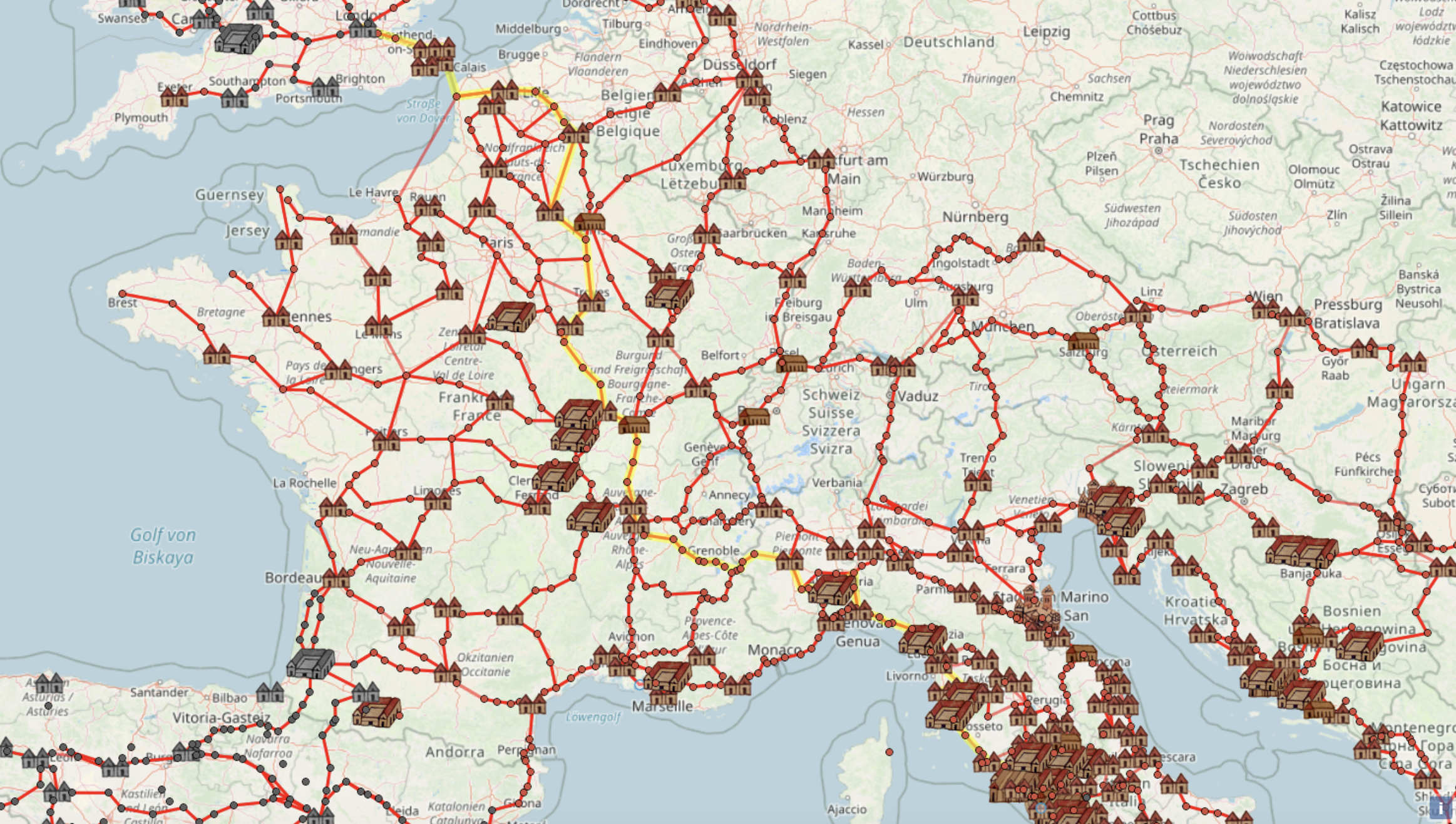
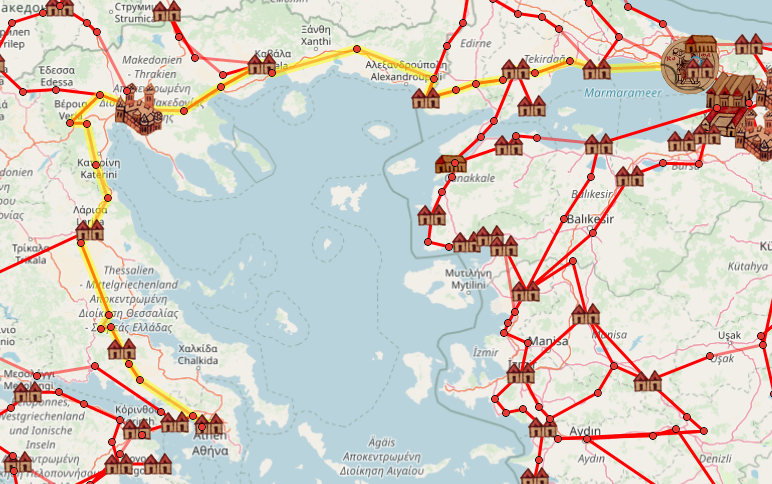
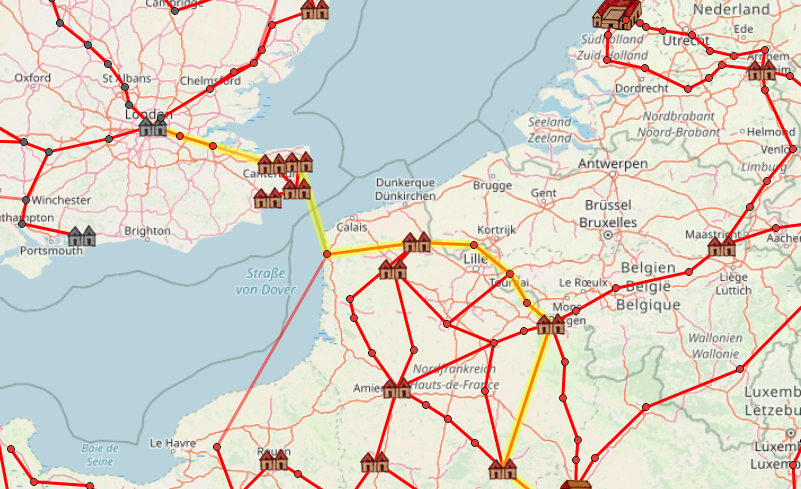
At the moment, I happen to be planning some time in France, with a side trip to Belgium included. Modern intra-European train travel makes arranging the latter quite convenient: Thalys, the high-speed rail service connecting those two countries, can get you from Paris to Brussels in about an hour and half. This stands in contrast to the time of the Roman Empire, which despite its political power lacked high-speed rail, and indeed lacked rail of any kind. But it did have an expansive network of roads, some of which you can still walk today, imagining what it would have been like to travel Europe two millennia ago. And now, using the website OmnesViae, you can get historically accurate directions as well.
Big Think’s Frank Jacobs describes OmnesViae as “the online route planner the Romans never knew they needed.” It “leans heavily on the Tabula Peutingeriana” — also known as the Peutinger Map, and previously featured here on Open Culture — “the closest thing we have to a genuine itinerarium (‘road map’) of the Roman Empire.”
Though not quite geographically accurate, it does offer a detailed view of which cities in the empire were connected and how. “Geolocating thousands of points from Peutinger, OmnesViae reformats the roads and destinations on the scroll onto a more familiarly landscaped map. The shortest route between two (ancient) points is calculated using the distances traveled over Roman rather than modern roads, also taking into account the rivers and mountains the network must cross.”
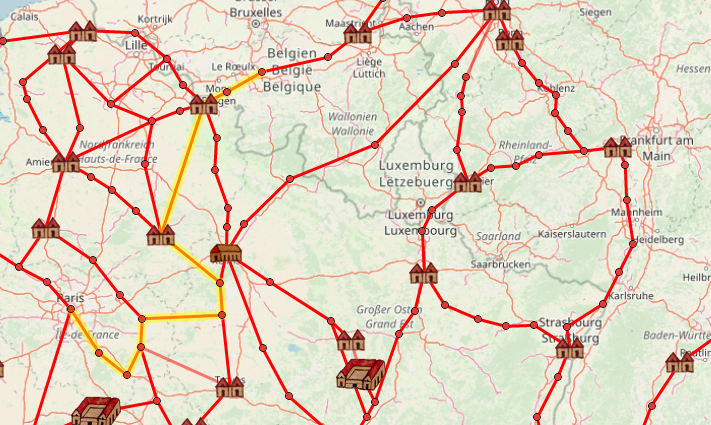
You can use OmnesViae just like any other way-finding application, except you enter your origin and destination into fields labeled “ab” and “ad” rather than “from” and “to.” And though “for some cities current day names are understood,” as the instructions note, it works better — and feels so much more authentic — if you type in cities like “Roma” and “Londinio.” The resulting journey between those two great capitals looks arduous indeed, passing at least three mountainous areas, thirteen rivers, and countless smaller settlements. And according to OmnesViae, no roads led to Brussels: the closest an ancient traveler could get to the location of the modern-day seat of the European Union was the Walloon village of Liberchies — which, as the birthplace of Django Reinhardt, remains an important stop for the jazz-loving traveler of Europe today.
via Big Think
Related content:
The Roads of Ancient Rome Visualized in the Style of Modern Subway Maps
How the Ancient Romans Built Their Roads, the Lifelines of Their Vast Empire
The Roman Roads and Bridges You Can Still Travel Today
How to Make Roman Concrete, One of Human Civilization’s Longest-Lasting Building Materials
Based in Seoul, Colin Marshall writes and broadcasts on cities, language, and culture. His projects include the Substack newsletter Books on Cities, the book The Stateless City: a Walk through 21st-Century Los Angeles and the video series The City in Cinema. Follow him on Twitter at @colinmarshall or on Facebook.
Read More...A Culinary Videos Series Shows Every Conceivable Way to Cook Eggs, Potatoes, Pizza, Bacon & More
So you think you know your way around a potato, eh?
No doubt you excel at boiling, mashing, roasting, baking and twice baking …
You may make a mean potato chip or pomme frite…
Perhaps you’ve perfected some tricks with a microwave or air fryer.
But before you’re puffed too full of bragging rights, have you ever thought to subject this humble root vegetable to a blow torch, an iron, a dishwasher, a juicer or a gasoline powered generator plugged into a giant dimmer switch?
No?
Congratulations on having avoided some truly dreadful methods for preparing a potato, judging by the results of some of Bon Appétit Contributing Editor Amiel Stanek’s more outré, tongue-in-cheek experiments, above.
Wait, maybe there aren’t really 63 ways to cook potatoes?
The preparation we’re legitimately eager to try is pickling, for spuds Stanek declares “very sweet, salty, acidic”, a welcome addition to a cheese board or a crudité plate.
And there’s an argument to be made for turning a waffle iron into a dual purpose device by making hash browns in it.
Stanek fares less well, piping pre-mashed potatoes into a Rollie ® Eggmaster, “a weird, made-for-TV device that is made expressly for cooking eggs:”
Ewww, no, why is it like that? This is disgusting!!!
If you’re wondering how that Rollie ® does with its intended ingredient, Stanek’s got an answer for you:
Oh no, no, no, no, no, no, no, no, no, oh my god, it looks like it’s in a condom. This is the most disgusting egg thing we have made all day…it tastes like bad seafood. I don’t know why, it tastes plastic‑y. This is horrible!
Meanwhile, those in long term relationships with partners holding different views on the best way to scramble, fry or poach an egg may find themselves feeling vindicated by this episode.
Either that or horribly betrayed.
Other than potatoes and eggs, the only episode of the 10 in the Almost Every series not exclusively geared toward cooking flesh is the one devoted to pizza, which at 32 methods, ties with chicken breast. (Only whole chicken, at 24 methods, has fewer options.)
Vegans will likely feel unimpressed, in addition to left out, given that there’s nearly that many suggested hacks for melting plant-based cheese.
Perhaps a visit to Moonburger, a meatless Hudson Valley chain where Stanek is Culinary Consultant and the shakes are dairy free is in order?
Those craving ever more offbeat attacks, however, will find themselves entertained by Stanek’s efforts involving an Easy-Bake Oven (yeah, nope, not good at all), a Teenage Mutant Ninja Turtle Pizza Machine (the whole cheese sitch looks a little bit demented…bummer, dude), and a crust that’s baked around a silicone cone, then filled with a “molten, dangerous slurry” of sauce and cheese (this thing looks demonic to me, like an animal horn meant for a Satanic ritual…)
If that’s not our cue to seek out a restaurant with a wood burning oven, perhaps it’s a signal we should order out.
Watch a complete playlist of Bon Appétit’s Almost Every here.
Related Content
– Ayun Halliday is the Chief Primatologist of the East Village Inky zine and author, most recently, of Creative, Not Famous: The Small Potato Manifesto and Creative, Not Famous Activity Book. Follow her @AyunHalliday.
Read More...The Five Graphs That Changed the World: See Groundbreaking Data Visualizations by Florence Nightingale, W. E. B. DuBois & Beyond
Almost two and a half centuries after its first publication, Adam Smith’s An Inquiry into the Nature and Causes of the Wealth of Nations is much better known as simply The Wealth of Nations. Had he written it today, the text itself, which runs between a formidable 500–700 pages in most editions, would also be considerably shorter. It’s not just that writers in Smith’s day went in for length per se (though many now read as if they did), but that graphs hadn’t been invented yet. Much of what he’d discovered about the nature of economics could have been expressed more concisely — and much more clearly — in pictures rather than words.
As it happens, the kind of informational graphs we know best today would be invented by Smith’s fellow Scot William Playfair in 1786, just a decade after The Wealth of Nations came out. “Data visualization is everywhere today, but when Playfair first created them over 200 years ago, using shapes to represent numbers was largely sneered at,” says Adam Rutherford in the Royal Society video above.
“How could drawings truly represent solid scientific data? But now, data visualization has become an art form of its own.” There follow “five graphs that changed the world,” beginning with the map of water pumps that physician John Snow used to determine the cause of a cholera epidemic in 1850s London, previously featured here on Open Culture.
We’ve also posted W. E. B. Du Bois’ “handmade charts showcasing the educational, social, and business accomplishments of black Americans in the 35 years since slavery had been officially abolished.” The other world-changing graphs here include Florence Nightingale’s “coxcomb” that showed how unsanitary hospital conditions killed more soldiers during the Crimean War than did actual fighting; the so-called Kallikak Family Tree, a fraudulent visual case for removing the “feeble-minded” from society; and Ed Hawkins’ more recent red-and-blue “warming stripes” designed to present the effects of climate change to a non-scientific audience. Using just blocks of color, with neither numbers nor text, Hawkins’ bold graph harks back to an earlier golden era of data visualization: after Playfair, but before PowerPoint.
Related content:
The Art of Data Visualization: How to Tell Complex Stories Through Smart Design
A Proportional Visualization of the World’s Most Popular Languages
The History of Philosophy Visualized
Based in Seoul, Colin Marshall writes and broadcasts on cities, language, and culture. His projects include the Substack newsletter Books on Cities, the book The Stateless City: a Walk through 21st-Century Los Angeles and the video series The City in Cinema. Follow him on Twitter at @colinmarshall or on Facebook.
Read More...Pussy Riot Sends a Powerful Message to Vladimir Putin: “You Have Already Lost. You Know It.”
Speaking at TED, Nadya Tolokonnikova, founding member of Pussy Riot, has a powerful message for Russians today: Resisting the authority of Vladimir Putin is an option. It’s a choice. Of that, Tolokonnikova has already provided ample proof. For more than a decade, the members of Pussy Riot have staged high-profile protests in Russia … and paid the price, with time served in prison. As she puts it, “Courage is an ability to act in the face of fear. And some of us have chosen to live courageously.” That example is what makes her a threat:
The reason why I became a threat to the system, not because of any actual physical power that I have, but because courage is contagious. And any act of speaking the truth can cause incalculable transformations in social consciousness. And we all have this power. It’s a moral act to use this power. You may or may not achieve the results that you wanted, but there is eternal beauty in trying to find truth, in risking everything you’ve got for what’s right…
As always, she saves choice words for Putin: “Vladimir Vladimirovich, the Kremlin walls became your prison walls. You have already lost. You know it. That’s why you’re so afraid. You lost in spirit.” Now we just need Russians at home, and Ukrainians on the battlefield, to make the implicit explicit.
If you would like to support the mission of Open Culture, consider making a donation to our site. It’s hard to rely 100% on ads, and your contributions will help us continue providing the best free cultural and educational materials to learners everywhere. You can contribute through PayPal, Patreon, and Venmo (@openculture). Thanks!
Related Content
A History of Pussy Riot: Watch the Band’s Early Performances/Protests Against the Putin Regime
Read More...Download Free Coloring Books from Nearly 100 Museums & Libraries
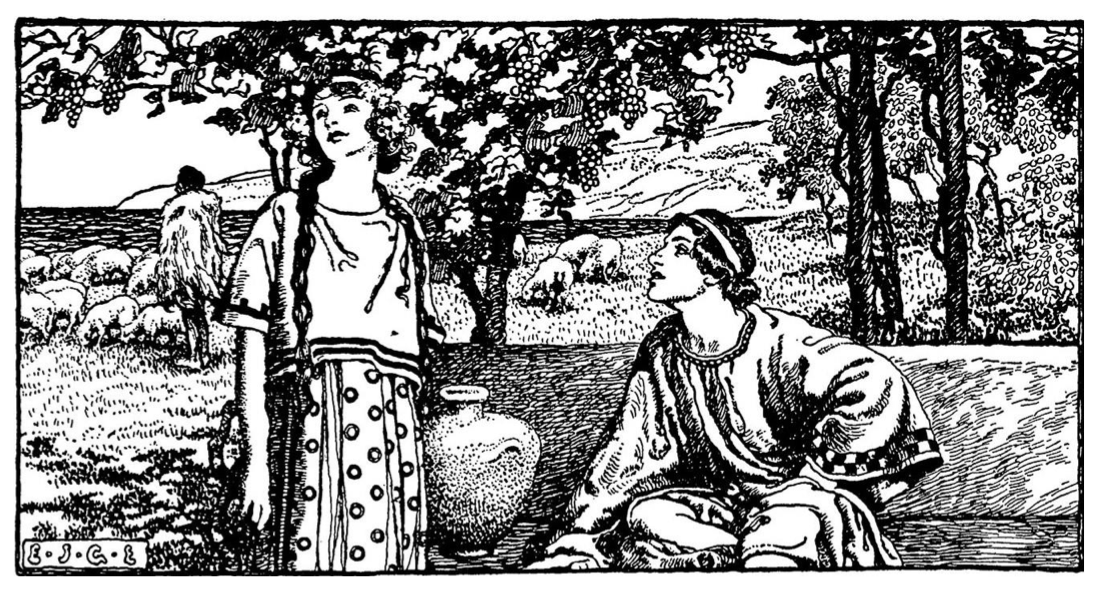
We here at Open Culture heartily endorse the practice of viewing art, whether in a physical museum, in the pages of a book, or online. For some, however, it tends to have one serious shortcoming: all the colors are already filled in. If you’re itching to use your own colored pencils, crayons, watercolors, or other tools of choice on drawings, paintings, and a variety of other works besides in the possession of well-known art institutions, these past few months are a time of year to savor thanks to the initiative Color Our Collections.
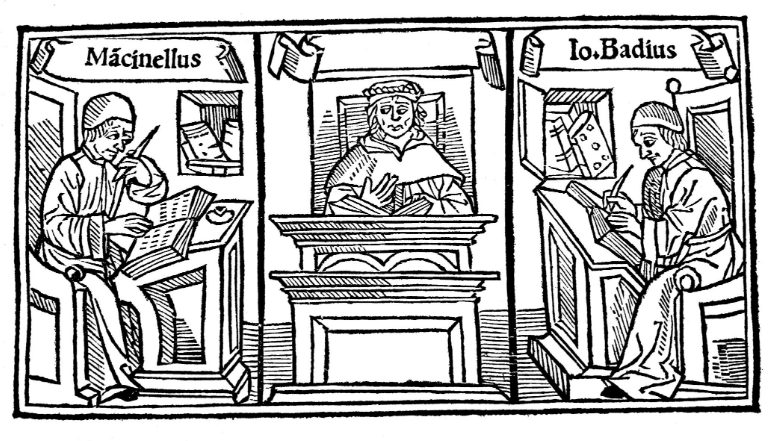
Each February, Color Our Collections releases its latest round of coloring books free online, assembled from contributions by the likes of the Bibliothèque nationale de France, Eton College, the New York Botanical Garden, the Toronto Public Library, and the University of California, San Francisco.
“Launched by The New York Academy of Medicine Library in 2016,” says its about page, it hosts an “annual coloring festival on social media during which libraries, museums, archives and other cultural institutions around the world share free coloring content featuring images from their collections.”

The de-colored pictures you see here offer just a taste of all you can find in this year’s Color Our Collections crop. Some of the participating institutions provide colorable selections from across their holdings, some stick to a certain theme, and some contribute actual volumes, digitized whole or created for the occasion. Take, for instance, the Ol’ Medical Colouring Book from Queen’s University Library, which promises hours of fun with pages like “anterior view of the skeletal system,” “ventral view of the brain,” and “urinary system shown on the female form.”
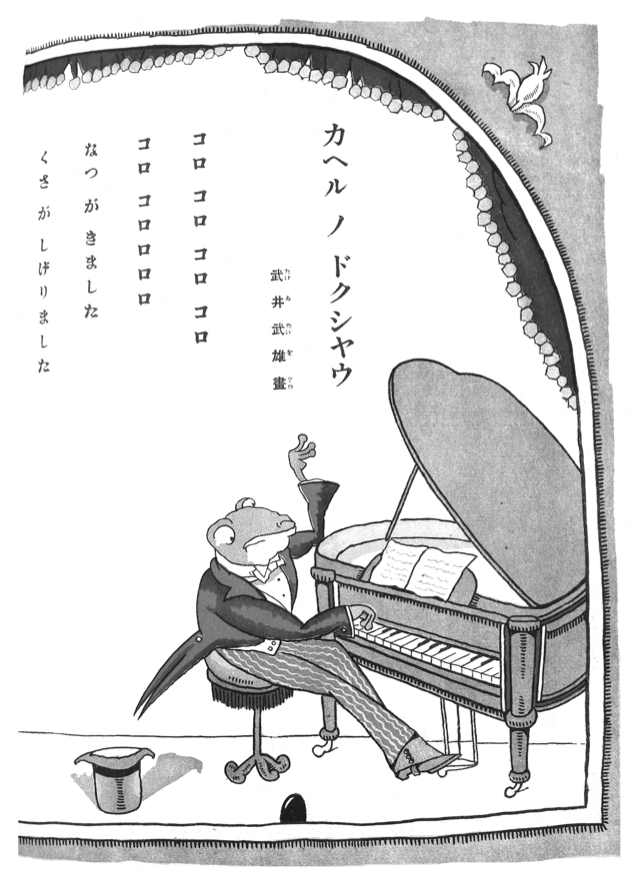
These are some distance from the bunnies and buttercups we colored in as children; so are the vigorous nineteen-thirties motorcycle advertisements assembled by the Harley-Davidson Archive, or the architectural and archaeological drawings from the Médiathèque de Châteaudun. But Color Our Collections 2023 also contains a good deal of kid-directed material as well, including Princeton University Library’s lively package of animal images from issues of Kodomo no Kuni, or The Land of Children — a magazine directed toward the kids of Japan a century ago, but then, some childhood pleasures know no cultural or temporal bounds. Enter the archive of 2023 coloring books here.
Related content:
The Very First Coloring Book, The Little Folks’ Painting Book (Circa 1879)
The First Adult Coloring Book: See the Subversive Executive Coloring Book From 1961
Based in Seoul, Colin Marshall writes and broadcasts on cities, language, and culture. His projects include the Substack newsletter Books on Cities, the book The Stateless City: a Walk through 21st-Century Los Angeles and the video series The City in Cinema. Follow him on Twitter at @colinmarshall or on Facebook.
Read More...Harry Belafonte (RIP), James Baldwin, Marlon Brando & Sidney Poitier Talk About Civil Rights, 1963
Note: Yesterday Harry Belafonte, the civil rights activist, singer and actor, passed away at age 96. In his memory, we’re bringing back a post from our archive, one that features Belafonte and other legends discussing the March on Washington, back in August, 1963. The film above is now made available by the US National Archives.
On the day of the historic “March on Washington for Jobs and Freedom” (August 28, 1963), known today as The Great March on Washington, CBS aired a 30-minute roundtable discussion featuring Harry Belafonte, James Baldwin, Marlon Brando, Charlton Heston, Joseph L. Mankiewicz and Sidney Poitier.
The whole segment is fascinating, even and perhaps especially because the speakers pursue their sometimes divergent agendas (Heston speaks optimistically about peaceful dissent, Brando hopes the Civil Rights movement may lead to reparations for Native Americans, while Belafonte warns ominously that the United States has now reached a “point of no return”). But it may be Joseph Mankiewicz, the sharp-witted writer/director of All About Eve, who provides one of the discussion’s pithiest lines: “Freedom, true freedom,” he says, “is not given by governments; it is taken by the people.”
If you would like to support the mission of Open Culture, consider making a donation to our site. It’s hard to rely 100% on ads, and your contributions will help us continue providing the best free cultural and educational materials to learners everywhere. You can contribute through PayPal, Patreon, and Venmo (@openculture). Thanks!
Related Content:
How Jazz Helped Fuel the 1960s Civil Rights Movement
How Martin Luther King, Jr. Used Nietzsche, Hegel & Kant to Overturn Segregation in America
Read More...Urine Wheels in Medieval Manuscripts: Discover the Curious Diagnostic Tool Used by Medieval Doctors
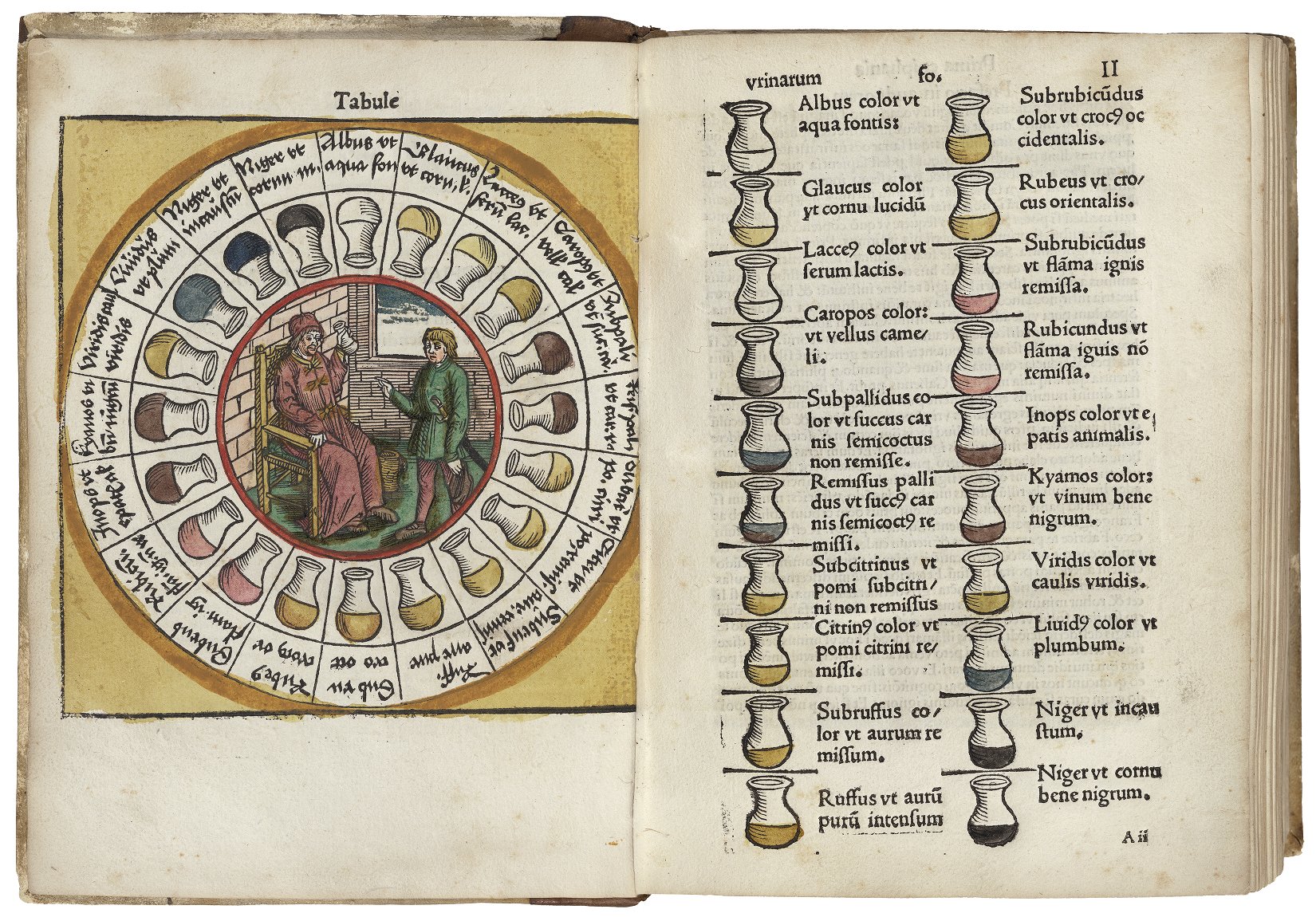
If you went to the doctor in late medieval Europe hoping to get a health complaint checked out, you could be sure of one thing: you’d have to hand over a urine sample. Though it dates back at least as far as the fourth millennium BC, the practice of uroscopy, as it’s called, seems to have been regarded as a near-universal diagnostic tool by the thirteenth century. At Medievalists.net, you can read excerpts of the then-definitive text On Urines, written about that time by French royal physician Gilles de Corbeil.
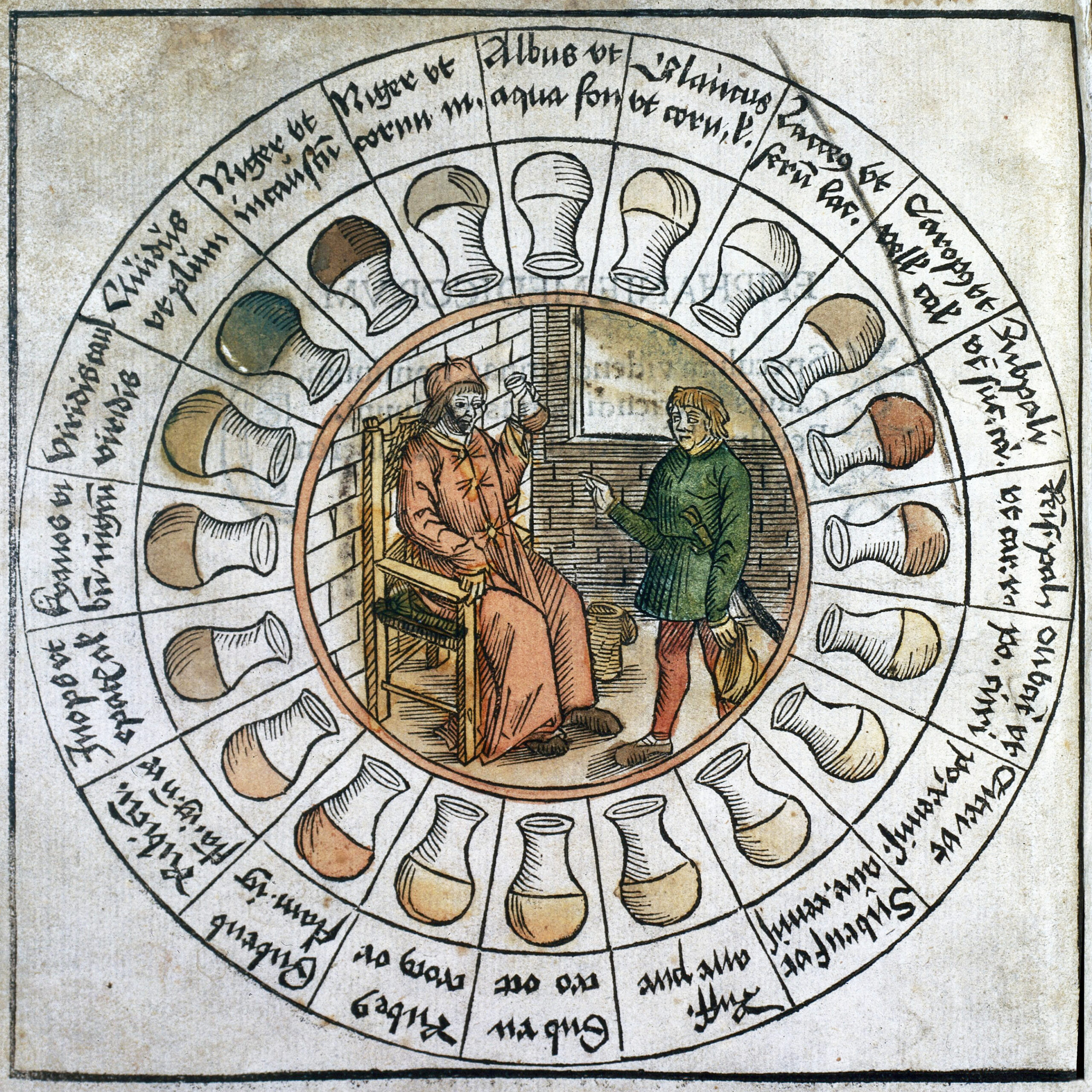
When a skilled physician examines a patient’s urine, de Corbeil explains, “health or illness, strength or debility, deficiency, excess, or balance, are determined with certainty.” Urine “darkened by a black cloudiness, and muddied with sediment, if produced on a critical day of an illness, and accompanied by poor hearing and insomnia, portends a flux of blood from the nose”; depending on other factors, “the patient will die or recover.”
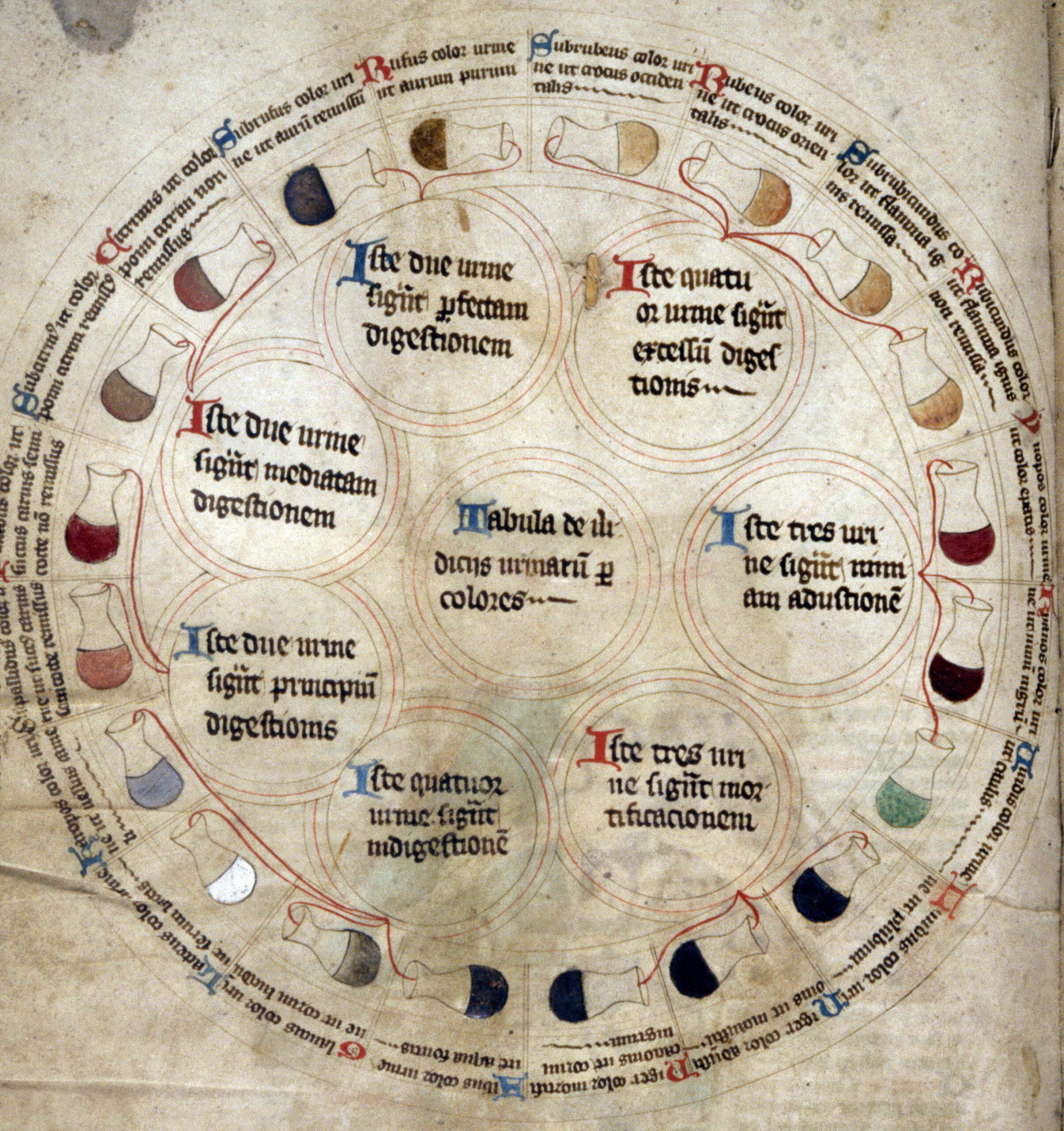
Urine that looks livid near the surface could indicate a variety of conditions: “a mild form of hemitriteus fever; falling sickness; ascites; synochal fever; the rupture of a vein; catarrh, strangury; an ailment of the womb; a flux; a defect of the lungs; pain in the joints; consumptive phithisis; the extinction of natural heat.”
White urine could be a signal of everything from dropsy to lipothymia to hemorrhoids; wine-colored urine “means danger to health when it accompanies a continued fever; it is less to be feared if there is no fever.”
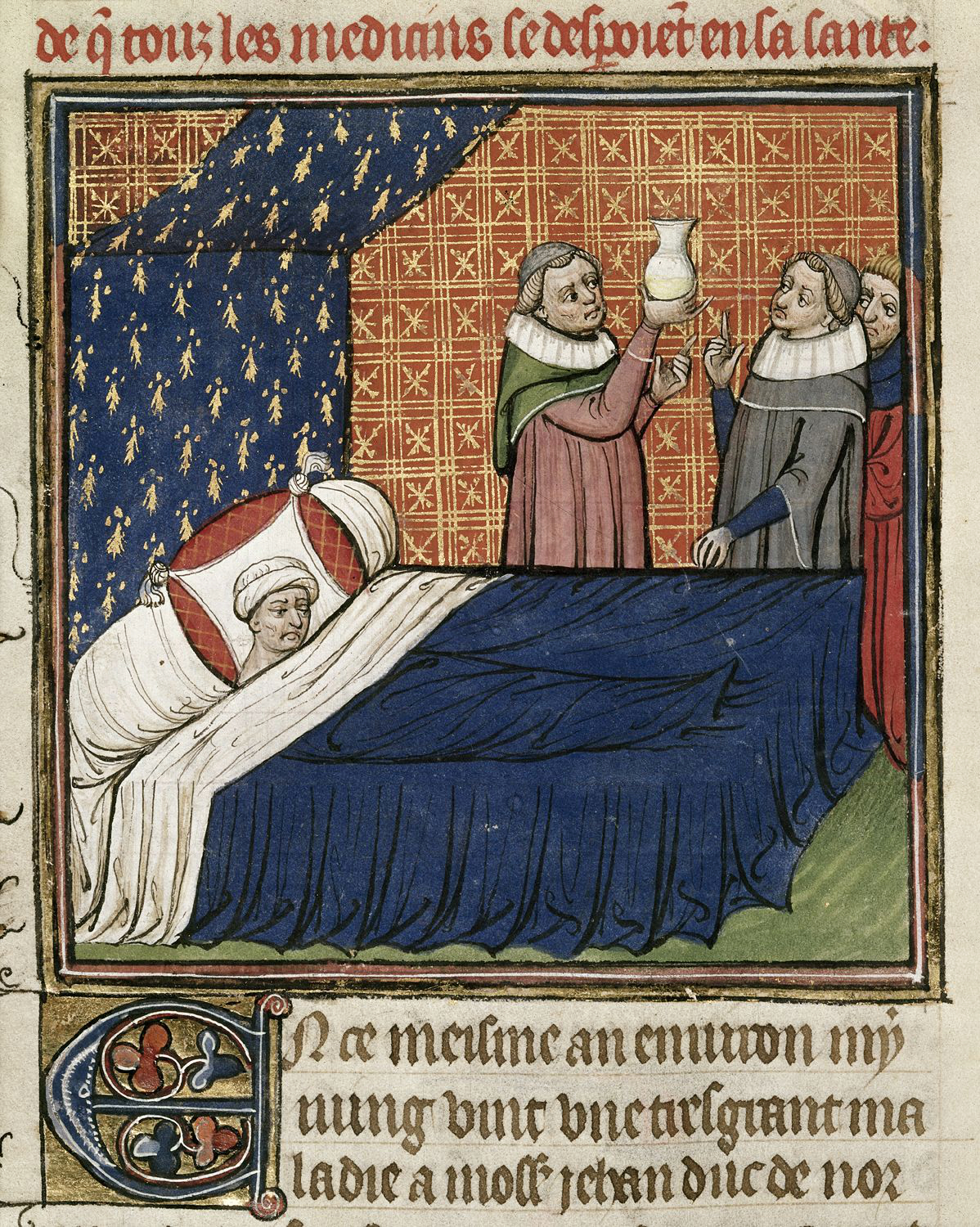
We may feel tempted, 800 years later, to discard all of this as pre-scientific nonsense. But compared with other diagnostic methods in the Middle Ages, uroscopy had a decent track record. “Urine was a particularly useful tool for diagnosing leprosy,” writes the Public Domain Review’s Katherine Harvey, “because the immediate physiological cause was thought to be a malfunctioning liver — an organ which was central to the digestive process, and thus any problems would be visible in the urine.” Indeed, “new forms of urine analysis have developed from these ancient traditions, and our present-day medical landscape is awash with urine samples.”
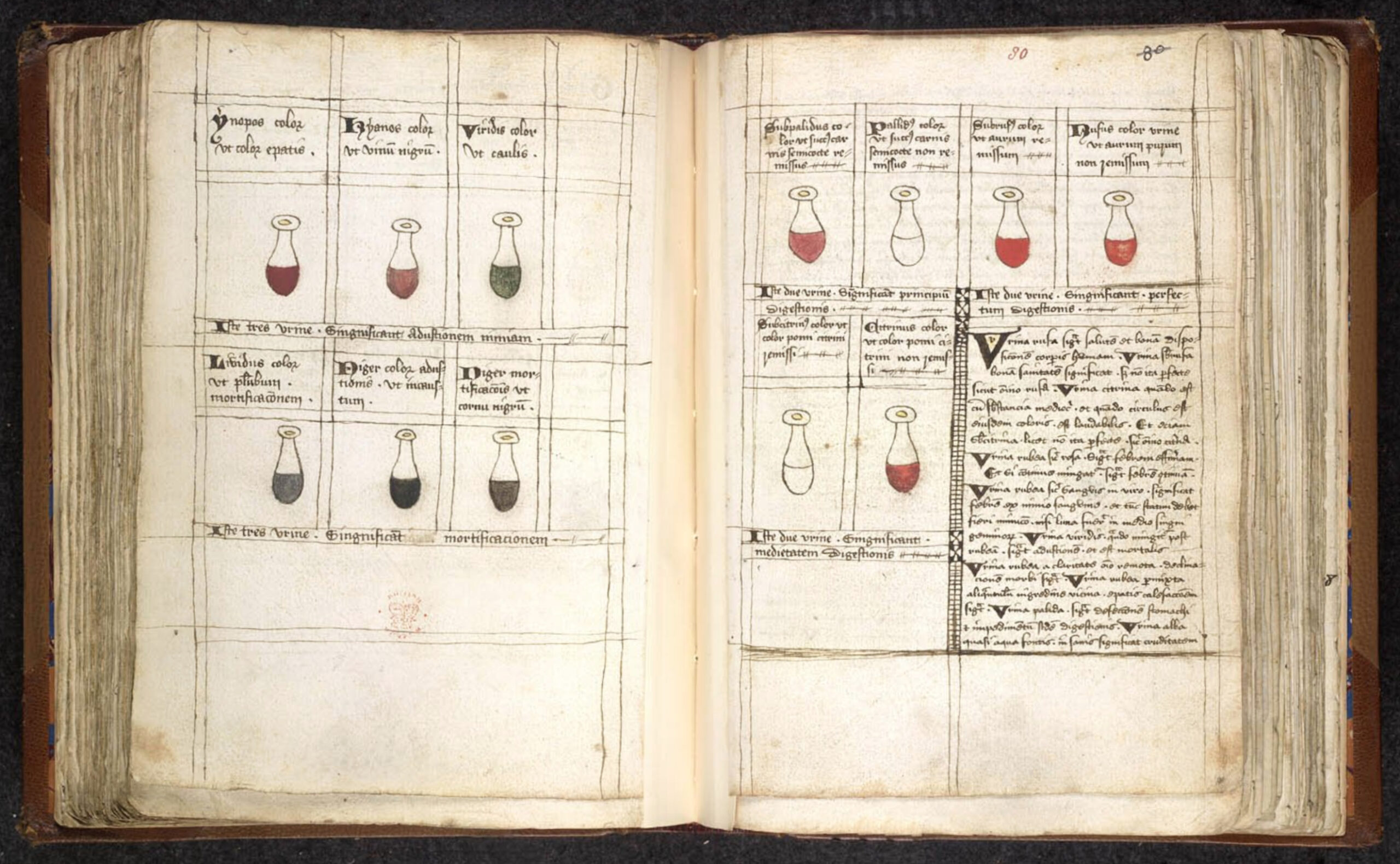
That’s certainly a vivid image, and so are the “urine wheels” that accompany Harvey’s piece: elaborate illustrations designed to help doctors identify the particular hue of a given sample, each one colored with the best pigmentation techniques of the time. But “there was no standardization,” notes Atlas Obscura’s Sarah Laskow, “and while some book publishers created detailed coloring instructions, the artisans who did the work didn’t always conform to those specifications.” As much prestige as these volumes surely exuded on the bookshelf, it was as true then as it is now that you become a good doctor not by reading manuals, but by getting your hands dirty.
Related content:
How the Brilliant Colors of Medieval Illuminated Manuscripts Were Made with Alchemy
1,000-Year-Old Illustrated Guide to the Medicinal Use of Plants Now Digitized & Put Online
Based in Seoul, Colin Marshall writes and broadcasts on cities, language, and culture. His projects include the Substack newsletter Books on Cities, the book The Stateless City: a Walk through 21st-Century Los Angeles and the video series The City in Cinema. Follow him on Twitter at @colinmarshall or on Facebook.
Read More...Watch Cab Calloway Actually Perform “Mr. Hepster’s Dictionary,” His Famous Dictionary of Jazz Slang (1944)
Who’s up for a good dictionary on film?
Colin Browning, assistant editor of The Bluff, a Loyola Marymount University student newspaper, has some kopasetic casting suggestions for a hypothetical feature adaptation of the “Merriam-Webster classic.”
He’s just muggin’, of course. Still, he seems like a young man who’s got his boots on.
Dig?
…no?
In that case, you’d best acquaint yourself with the only cinematic dictionary adaptation we’re aware of, the Mr. Hepcat’s Dictionary number from Sensations of 1945, above.
Musical team Al Sherman & Harry Tobias drew directly from Cab Calloway’s Cat-ologue: a Hepster’s Dictionary, a lexicon of Harlem jazz musicians’ slang originally published in 1938 ’ when choosing terms for Calloway to define for a young protégée, eager to be schooled in “the lingo all the jitterbugs use today.”
In between, Calloway, lays some iron in white tie and tails.
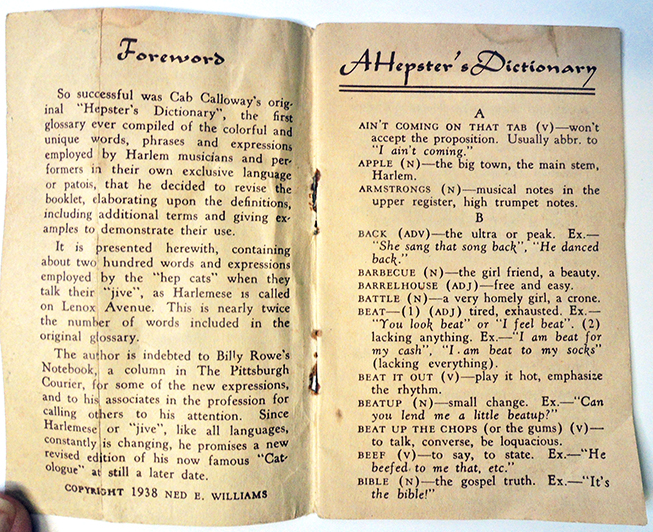
By the time the film came out, Calloway’s Hepster Dictionary was in its seventh edition, and had earned its place as the official jive language reference book of the New York Public Library.
As Calloway wrote in the foreword to the sixth edition:
“Jive talk” is now an everyday part of the English language. Its usage is now accepted in the movies, on the stage, and in the song products of Tin Pan Alley. It is reasonable to assume that jive will find new avenues in such hitherto remote places as Australia, the South Pacific, North Africa, China, Italy, France, Sicily, and inevitably Germany and wherever our Armed Forces may serve.
I don’t want to lend the impression here that the many words contained in this edition are the figments of my imagination. They were gathered from every conceivable source. Many first saw the light of printer’s ink in Billy Rowe’s widely read column “The Notebook,” in the Pittsburgh Courier.
And now to enrich our vocabularies…
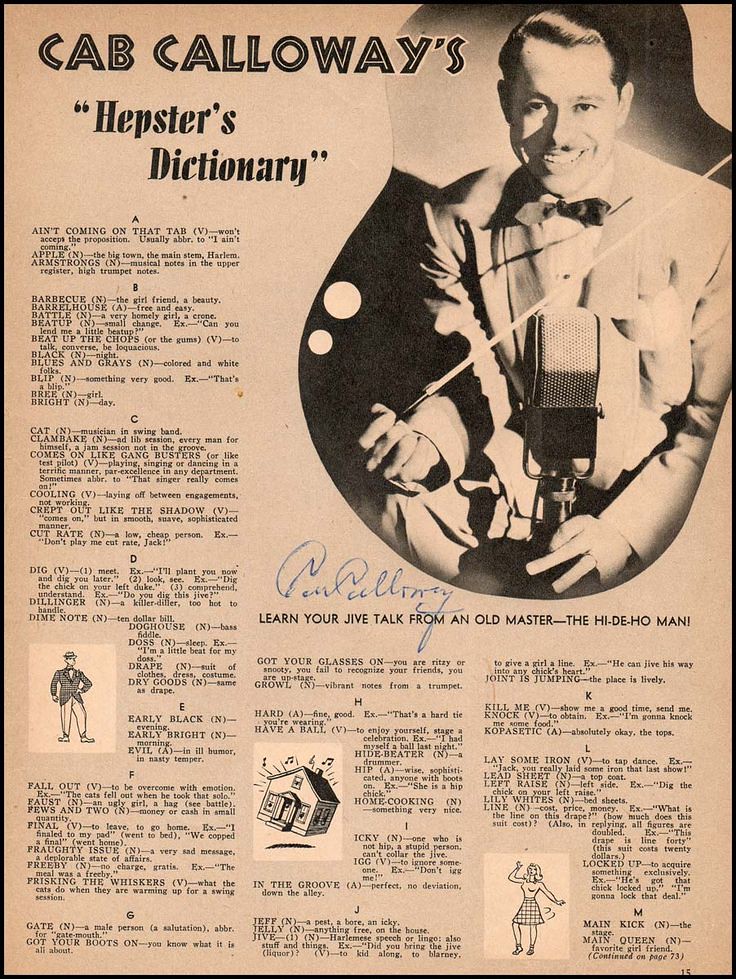
HEPSTER’S DICTIONARY
A
- A hummer (n.): exceptionally good. Ex., “Man, that boy is a hummer.”
- Ain’t coming on that tab (v.): won’t accept the proposition. Usually abbr. to “I ain’t coming.”
- Alligator (n.): jitterbug.
- Apple (n.): the big town, the main stem, Harlem.
- Armstrongs (n.): musical notes in the upper register, high trumpet notes.
B
- Barbecue (n.): the girl friend, a beauty.
- Barrelhouse (adj.): free and easy.
- Battle (n.): a very homely girl, a crone.
- Beat (adj.): (1) tired, exhausted. Ex., “You look beat” or “I feel beat.” (2) lacking anything. Ex, “I am beat for my cash”, “I am beat to my socks” (lacking everything).
- Beat it out (v.): play it hot, emphasize the rhythm.
- Beat up (adj.): sad, uncomplimentary, tired.
- Beat up the chops (or the gums) (v.): to talk, converse, be loquacious.
- Beef (v.): to say, to state. Ex., “He beefed to me that, etc.”
- Bible (n.): the gospel truth. Ex., “It’s the bible!”
- Black (n.): night.
- Black and tan (n.): dark and light colored folks. Not colored and white folks as erroneously assumed.
- Blew their wigs (adj.): excited with enthusiasm, gone crazy.
- Blip (n.): something very good. Ex., “That’s a blip”; “She’s a blip.”
- Blow the top (v.): to be overcome with emotion (delight). Ex., “You’ll blow your top when you hear this one.”
- Boogie-woogie (n.): harmony with accented bass.
- Boot (v.): to give. Ex., “Boot me that glove.”
- Break it up (v.): to win applause, to stop the show.
- Bree (n.): girl.
- Bright (n.): day.
- Brightnin’ (n.): daybreak.
- Bring down ((1) n. (2) v.): (1) something depressing. Ex., “That’s a bring down.” (2) Ex., “That brings me down.”
- Buddy ghee (n.): fellow.
- Bust your conk (v.): apply yourself diligently, break your neck.
C
- Canary (n.): girl vocalist.
- Capped (v.): outdone, surpassed.
- Cat (n.): musician in swing band.
- Chick (n.): girl.
- Chime (n.): hour. Ex., “I got in at six chimes.”
- Clambake (n.): ad lib session, every man for himself, a jam session not in the groove.
- Chirp (n.): female singer.
- Cogs (n.): sun glasses.
- Collar (v.): to get, to obtain, to comprehend. Ex., “I gotta collar me some food”; “Do you collar this jive?”
- Come again (v.): try it over, do better than you are doing, I don’t understand you.
- Comes on like gangbusters (or like test pilot) (v.): plays, sings, or dances in a terrific manner, par excellence in any department. Sometimes abbr. to “That singer really comes on!”
- Cop (v.): to get, to obtain (see collar; knock).
- Corny (adj.): old-fashioned, stale.
- Creeps out like the shadow (v.): “comes on,” but in smooth, suave, sophisticated manner.
- Crumb crushers (n.): teeth.
- Cubby (n.): room, flat, home.
- Cups (n.): sleep. Ex., “I gotta catch some cups.”
- Cut out (v.): to leave, to depart. Ex., “It’s time to cut out”; “I cut out from the joint in early bright.”
- Cut rate (n.): a low, cheap person. Ex., “Don’t play me cut rate, Jack!”
D
- Dicty (adj.): high-class, nifty, smart.
- Dig (v.): (1) meet. Ex., “I’ll plant you now and dig you later.” (2) look, see. Ex., “Dig the chick on your left duke.” (3) comprehend, understand. Ex., “Do you dig this jive?”
- Dim (n.): evening.
- Dime note (n.): ten-dollar bill.
- Doghouse (n.): bass fiddle.
- Domi (n.): ordinary place to live in. Ex., “I live in a righteous domi.”
- Doss (n.): sleep. Ex., “I’m a little beat for my doss.”
- Down with it (adj.): through with it.
- Drape (n.): suit of clothes, dress, costume.
- Dreamers (n.): bed covers, blankets.
- Dry-goods (n.): same as drape.
- Duke (n.): hand, mitt.
- Dutchess (n.): girl.
E
- Early black (n.): evening
- Early bright (n.): morning.
- Evil (adj.): in ill humor, in a nasty temper.
F
- Fall out (v.): to be overcome with emotion. Ex., “The cats fell out when he took that solo.”
- Fews and two (n.): money or cash in small quantity.
- Final (v.): to leave, to go home. Ex., “I finaled to my pad” (went to bed); “We copped a final” (went home).
- Fine dinner (n.): a good-looking girl.
- Focus (v.): to look, to see.
- Foxy (v.): shrewd.
- Frame (n.): the body.
- Fraughty issue (n.): a very sad message, a deplorable state of affairs.
- Freeby (n.): no charge, gratis. Ex., “The meal was a freeby.”
- Frisking the whiskers (v.): what the cats do when they are warming up for a swing session.
- Frolic pad (n.): place of entertainment, theater, nightclub.
- Fromby (adj.): a frompy queen is a battle or faust.
- Front (n.): a suit of clothes.
- Fruiting (v.): fickle, fooling around with no particular object.
- Fry (v.): to go to get hair straightened.
G
- Gabriels (n.): trumpet players.
- Gammin’ (adj.): showing off, flirtatious.
- Gasser (n, adj.): sensational. Ex., “When it comes to dancing, she’s a gasser.”
- Gate (n.): a male person (a salutation), abbr. for “gate-mouth.”
- Get in there (exclamation.): go to work, get busy, make it hot, give all you’ve got.
- Gimme some skin (v.): shake hands.
- Glims (n.): the eyes.
- Got your boots on: you know what it is all about, you are a hep cat, you are wise.
- Got your glasses on: you are ritzy or snooty, you fail to recognize your friends, you are up-stage.
- Gravy (n.): profits.
- Grease (v.): to eat.
- Groovy (adj.): fine. Ex., “I feel groovy.”
- Ground grippers (n.): new shoes.
- Growl (n.): vibrant notes from a trumpet.
- Gut-bucket (adj.): low-down music.
- Guzzlin’ foam (v.): drinking beer.
H
- Hard (adj.): fine, good. Ex., “That’s a hard tie you’re wearing.”
- Hard spiel (n.): interesting line of talk.
- Have a ball (v.): to enjoy yourself, stage a celebration. Ex., “I had myself a ball last night.”
- Hep cat (n.): a guy who knows all the answers, understands jive.
- Hide-beater (n.): a drummer (see skin-beater).
- Hincty (adj.): conceited, snooty.
- Hip (adj.): wise, sophisticated, anyone with boots on. Ex., “She’s a hip chick.”
- Home-cooking (n.): something very dinner (see fine dinner).
- Hot (adj.): musically torrid; before swing, tunes were hot or bands were hot.
- Hype (n, v.): build up for a loan, wooing a girl, persuasive talk.
I
- Icky (n.): one who is not hip, a stupid person, can’t collar the jive.
- Igg (v.): to ignore someone. Ex., “Don’t igg me!)
- In the groove (adj.): perfect, no deviation, down the alley.
J
- Jack (n.): name for all male friends (see gate; pops).
- Jam ((1)n, (2)v.): (1) improvised swing music. Ex., “That’s swell jam.” (2) to play such music. Ex., “That cat surely can jam.”
- Jeff (n.): a pest, a bore, an icky.
- Jelly (n.): anything free, on the house.
- Jitterbug (n.): a swing fan.
- Jive (n.): Harlemese speech.
- Joint is jumping: the place is lively, the club is leaping with fun.
- Jumped in port (v.): arrived in town.
K
- Kick (n.): a pocket. Ex., “I’ve got five bucks in my kick.”
- Kill me (v.): show me a good time, send me.
- Killer-diller (n.): a great thrill.
- Knock (v.): give. Ex., “Knock me a kiss.”
- Kopasetic (adj.): absolutely okay, the tops.
L
- Lamp (v.): to see, to look at.
- Land o’darkness (n.): Harlem.
- Lane (n.): a male, usually a nonprofessional.
- Latch on (v.): grab, take hold, get wise to.
- Lay some iron (v.): to tap dance. Ex., “Jack, you really laid some iron that last show!”
- Lay your racket (v.): to jive, to sell an idea, to promote a proposition.
- Lead sheet (n.): a topcoat.
- Left raise (n.): left side. Ex., “Dig the chick on your left raise.”
- Licking the chops (v.): see frisking the whiskers.
- Licks (n.): hot musical phrases.
- Lily whites (n.): bed sheets.
- Line (n.): cost, price, money. Ex., “What is the line on this drape” (how much does this suit cost)? “Have you got the line in the mouse” (do you have the cash in your pocket)? Also, in replying, all figures are doubled. Ex., “This drape is line forty” (this suit costs twenty dollars).
- Lock up: to acquire something exclusively. Ex., “He’s got that chick locked up”; “I’m gonna lock up that deal.”
M
- Main kick (n.): the stage.
- Main on the hitch (n.): husband.
- Main queen (n.): favorite girl friend, sweetheart.
- Man in gray (n.): the postman.
- Mash me a fin (command.): Give me $5.
- Mellow (adj.): all right, fine. Ex., “That’s mellow, Jack.”
- Melted out (adj.): broke.
- Mess (n.): something good. Ex., “That last drink was a mess.”
- Meter (n.): quarter, twenty-five cents.
- Mezz (n.): anything supreme, genuine. Ex., “this is really the mezz.”
- Mitt pounding (n.): applause.
- Moo juice (n.): milk.
- Mouse (n.): pocket. Ex., “I’ve got a meter in the mouse.”
- Muggin’ (v.): making ’em laugh, putting on the jive. “Muggin’ lightly,” light staccato swing; “muggin’ heavy,” heavy staccato swing.
- Murder (n.): something excellent or terrific. Ex., “That’s solid murder, gate!”
N
- Neigho, pops: Nothing doing, pal.
- Nicklette (n.): automatic phonograph, music box.
- Nickel note (n.): five-dollar bill.
- Nix out (v.): to eliminate, get rid of. Ex., “I nixed that chick out last week”; “I nixed my garments” (undressed).
- Nod (n.): sleep. Ex., “I think I’l cop a nod.”
O
- Ofay (n.): white person.
- Off the cob (adj.): corny, out of date.
- Off-time jive (n.): a sorry excuse, saying the wrong thing.
- Orchestration (n.): an overcoat.
- Out of the world (adj.): perfect rendition. Ex., “That sax chorus was out of the world.”
- Ow!: an exclamation with varied meaning. When a beautiful chick passes by, it’s “Ow!”; and when someone pulls an awful pun, it’s also “Ow!”
P
- Pad (n.): bed.
- Pecking (n.): a dance introduced at the Cotton Club in 1937.
- Peola (n.): a light person, almost white.
- Pigeon (n.): a young girl.
- Pops (n.): salutation for all males (see gate; Jack).
- Pounders (n.): policemen.
Q
- Queen (n.): a beautiful girl.
R
- Rank (v.): to lower.
- Ready (adj.): 100 per cent in every way. Ex., “That fried chicken was ready.”
- Ride (v.): to swing, to keep perfect tempo in playing or singing.
- Riff (n.): hot lick, musical phrase.
- Righteous (adj.): splendid, okay. Ex., “That was a righteous queen I dug you with last black.”
- Rock me (v.): send me, kill me, move me with rhythm.
- Ruff (n.): quarter, twenty-five cents.
- Rug cutter (n.): a very good dancer, an active jitterbug.
S
- Sad (adj.): very bad. Ex., “That was the saddest meal I ever collared.”
- Sadder than a map (adj.): terrible. Ex., “That man is sadder than a map.”
- Salty (adj.): angry, ill-tempered.
- Sam got you: you’ve been drafted into the army.
- Send (v.): to arouse the emotions. (joyful). Ex., “That sends me!”
- Set of seven brights (n.): one week.
- Sharp (adj.): neat, smart, tricky. Ex., “That hat is sharp as a tack.”
- Signify (v.): to declare yourself, to brag, to boast.
- Skins (n.): drums.
- Skin-beater (n.): drummer (see hide-beater).
- Sky piece (n.): hat.
- Slave (v.): to work, whether arduous labor or not.
- Slide your jib (v.): to talk freely.
- Snatcher (n.): detective.
- So help me: it’s the truth, that’s a fact.
- Solid (adj.): great, swell, okay.
- Sounded off (v.): began a program or conversation.
- Spoutin’ (v.): talking too much.
- Square (n.): an unhep person (see icky; Jeff).
- Stache (v.): to file, to hide away, to secrete.
- Stand one up (v.): to play one cheap, to assume one is a cut-rate.
- To be stashed (v.): to stand or remain.
- Susie‑Q (n.): a dance introduced at the Cotton Club in 1936.
T
- Take it slow (v.): be careful.
- Take off (v.): play a solo.
- The man (n.): the law.
- Threads (n.): suit, dress or costume (see drape; dry-goods).
- Tick (n.): minute, moment. Ex., “I’ll dig you in a few ticks.” Also, ticks are doubled in accounting time, just as money is doubled in giving “line.” Ex., “I finaled to the pad this early bright at tick twenty” (I got to bed this morning at ten o’clock).
- Timber (n.): toothpick.
- To dribble (v.): to stutter. Ex., “He talked in dribbles.”
- Togged to the bricks: dressed to kill, from head to toe.
- Too much (adj.): term of highest praise. Ex., “You are too much!”
- Trickeration (n.): struttin’ your stuff, muggin’ lightly and politely.
- Trilly (v.): to leave, to depart. Ex., “Well, I guess I’ll trilly.”
- Truck (v.): to go somewhere. Ex., “I think I’ll truck on down to the ginmill (bar).”
- Trucking (n.): a dance introduced at the Cotton Club in 1933.
- Twister to the slammer (n.): the key to the door.
- Two cents (n.): two dollars.
U
- Unhep (adj.): not wise to the jive, said of an icky, a Jeff, a square.
V
- Vine (n.): a suit of clothes.
- V‑8 (n.): a chick who spurns company, is independent, is not amenable.
W
- What’s your story?: What do you want? What have you got to say for yourself? How are tricks? What excuse can you offer? Ex., “I don’t know what his story is.”
- Whipped up (adj.): worn out, exhausted, beat for your everything.
- Wren (n.): a chick, a queen.
- Wrong riff: the wrong thing said or done. Ex., “You’re coming up on the wrong riff.”
Y
- Yarddog (n.): uncouth, badly attired, unattractive male or female.
- Yeah, man: an exclamation of assent.
Z
- Zoot (adj.): exaggerated
- Zoot suit (n.): the ultimate in clothes. The only totally and truly American civilian suit.
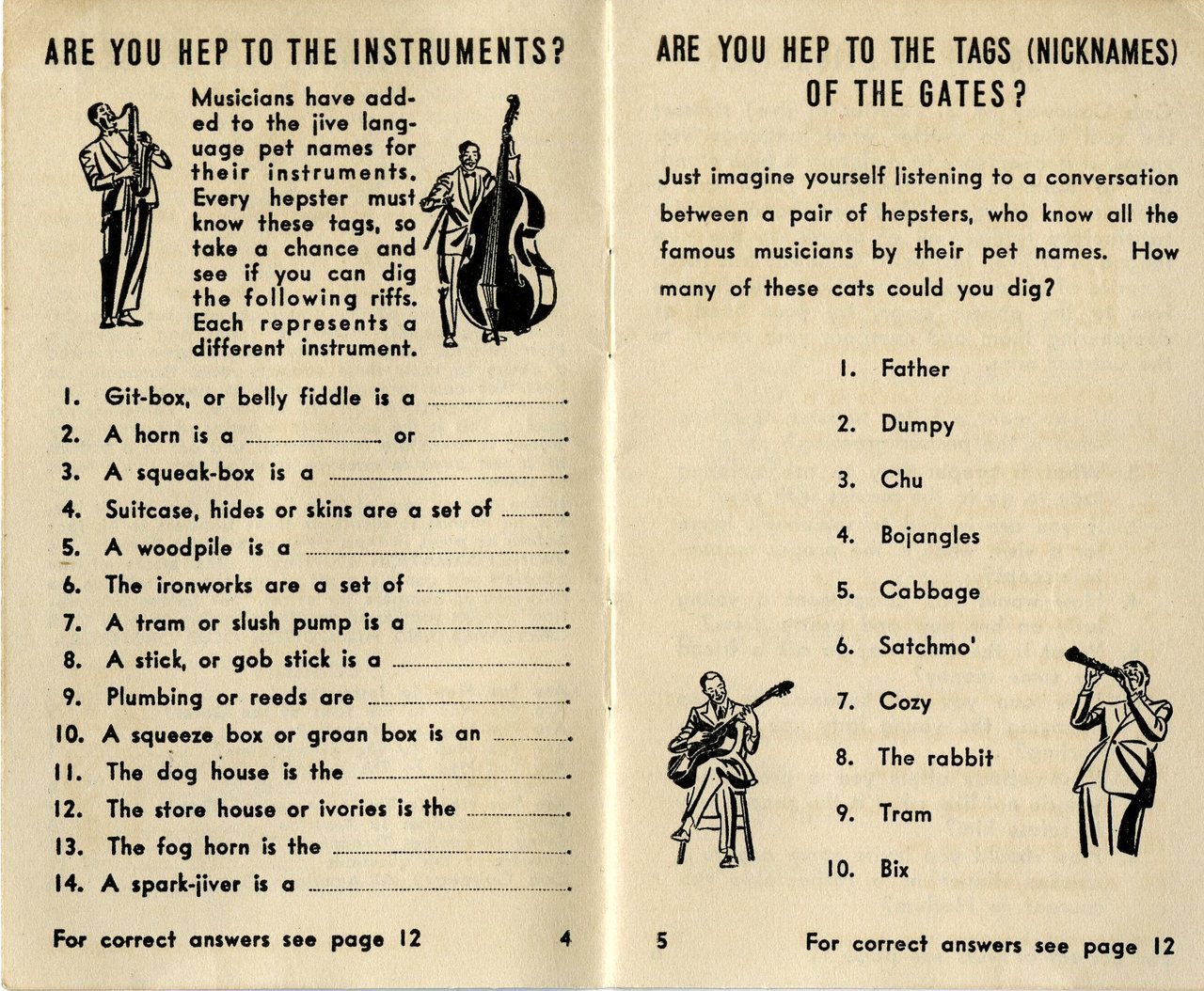
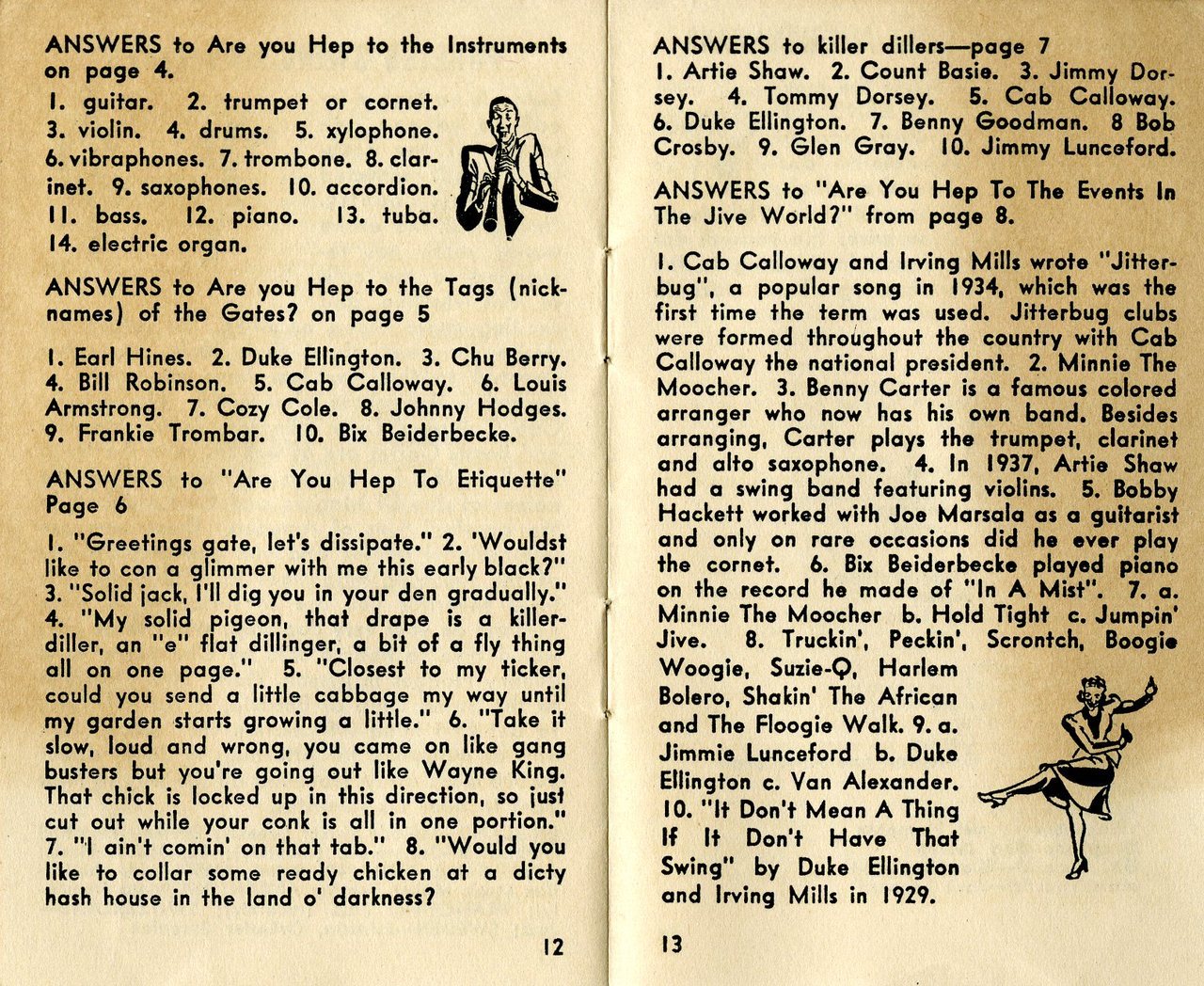
That’s solid murder, gate!
If you’re not too beat, Jazz Night In America builds on Calloway’s dictionary with some additional vocabulary in the video below. Watch it for the meanings of stank, ictus, swoop, and scoop, defined collectively by drummer Ali Jackson as the sort of colloquialisms you use when you “don’t want everyone to know what you’re saying, but you want to express a point.”
Listen to poet Lemn Sissay’s BBC history of Cab Calloway’s Hepster’s Dictionary here.
Related Content
– Ayun Halliday is the Chief Primatologist of the East Village Inky zine and author, most recently, of Creative, Not Famous: The Small Potato Manifesto and Creative, Not Famous Activity Book. Follow her @AyunHalliday.
Read More...Why the Ancient Romans Had Better Teeth Than Modern Europeans
The cases for traveling back in time and living in a past era are many and varied, but the case against doing so is always the same: dentistry. In every chapter of human history before this one, so we’re often told, everyone lived in at least a low-level state of agony inflicted by tooth problems, to say nothing of the unimaginable unsightliness of their smiles. But as justified as we probably are in laughing at the pearly whites on display in Hollywood period pieces, the historical record conflicts with our belief that the further you go into the past, the worst everyone’s teeth: ancient Romans, as explained in the Told In Stone video above, actually had better teeth than modern Europeans.
That’s hardly a high bar to clear, a modern American may joke. But then, the United States today takes dental care to an almost obsessive level, whereas the citizens of the Roman Empire had practically nothing to work with by comparison. “The standard, and often sole implement employed to clean teeth was a toothpick,” says Told in Stone creator Garrett Ryan. These “were paired with tooth powders, which were rubbed over the teeth and gums with an enthusiastic finger.” Ingredients included “pumice, pulverized bone, powdered glass, and crushed shell,” or sometimes “sheep’s sweat and the ash of a wolf’s head.” — all a far cry from anything offered on the toothpaste aisle today.
“Bad breath was a chronic condition in the classical world,” and “toothache seems to have been almost equally prevalent.” The treatment most commonly practiced by Roman dentists was extraction, performed without anesthetic. Yet only about a third of the preserved skeletons recovered from the ruins of Pompeii and Herculaneum were missing teeth, “and relatively few had cavities.” Though many societies today take dental condition as a marker of class, in ancient Rome the relationship was, to a certain extent, reversed: “A young girl wearing expensive jewelry, for example, already had five cavities, probably because her family could afford to give her plenty of snacks smothered in expensive and sugary honey.”
Indeed, “in the absence of processed sugar, oral bacteria were less aggressive than they are today.” Romans got cavities, but “the pervasive blackened teeth and hollow cheeks of early modern Europe,” an era at the unfortunate intersection of relatively plentiful sugar and relatively primitive dentistry, “were nearly as distant from the Roman experience as they are from ours.” Some of us here in the sugar-saturated twenty-first century, with its constant pursuit of dental perfection, may now be considering the potential benefits of shifting to an ancient Roman diet — without, of course, all those tiny, enamel-abrading stones that had a way of ending up in ancient Roman bread.
Related content:
Try the Oldest Known Recipe For Toothpaste: From Ancient Egypt, Circa the 4th Century BC
Explore the Roman Cookbook, De Re Coquinaria, the Oldest Known Cookbook in Existence
Archaeologists Discover an Ancient Roman Snack Bar in the Ruins of Pompeii
Bars, Beer & Wine in Ancient Rome: An Introduction to Roman Nightlife and Spirits
The Mystery Finally Solved: Why Has Roman Concrete Been So Durable?
Based in Seoul, Colin Marshall writes and broadcasts on cities, language, and culture. His projects include the Substack newsletter Books on Cities, the book The Stateless City: a Walk through 21st-Century Los Angeles and the video series The City in Cinema. Follow him on Twitter at @colinmarshall or on Facebook.
Read More...Support Us
We're hoping to rely on loyal readers, rather than erratic ads. Please click the Donate button and support Open Culture. You can use Paypal, Venmo, Patreon, even Crypto! We thank you!

About Us

Open Culture scours the web for the best educational media. We find the free courses and audio books you need, the language lessons & educational videos you want, and plenty of enlightenment in between.
Advertise With Us
FREE UPDATES!
GET OUR DAILY EMAIL
Get the best cultural and educational resources on the web curated for you in a daily email. We never spam. Unsubscribe at any time.
FOLLOW ON SOCIAL MEDIA
Open Culture editor Dan Colman scours the web for the best educational media. He finds the free courses and audio books you need, the language lessons & movies you want, and plenty of enlightenment in between.
Advertise With Us

