Cats Migrated to Europe 7,000 Years Earlier Than Once Thought

The animals were imperfect,
long-tailed,
unfortunate in their heads.
Little by little they
put themselves together,
making themselves a landscape,
acquiring spots, grace, flight.
The cat,
only the cat
appeared complete and proud:
he was born completely finished,
walking alone and knowing what he wanted.
- Pablo Neruda, excerpt from Ode to the Cat
We find ourselves in agreement with Nobel Prize-winning poet, and cat lover, Pablo Neruda:
Those of us who provide for felines choose to believe we are “the owner, proprietor, uncle of a cat, companion, colleague, disciple or friend of (our) cat”, when in fact they are mysterious beasts, far more self-contained than the companionable, inquisitive canine Neruda immortalized in Ode to the Dog.
We can bestow names and social media accounts on cats of our acquaintance, channel them on the steps of the Met Gala, attach GPS trackers to their collars, give them pride of placement in books for children and adults, and try our best to get inside their heads, but what do we know about them, really?
We even got their history wrong.
Common knowledge once held that cats made their way to northern Europe from the Mediterranean aboard Roman — and eventually Viking — ships sometime between the 3rd to 7th century CE, but it turns out we were off by millennia.
In 2016, a team of researchers collaborating on the Five Thousand Years of History of Domestic Cats in Central Europe project confirmed the presence of domestic cats during the Roman period in the area that is now northern Poland, using a combination of zooarchaeology, genetics and absolute dating.
More recently, the team turned their attention to Felis bones found in southern Poland and Serbia, determining the ones found in the Jasna Strzegowska Cave to be Pre-Neolithic (5990–5760 BC), while the Serbian kitties hail from the Mesolithic-Neolitic era (6220–5730 BC).
In addition to clarifying our understanding of how our pet cats’ ancestors arrived in Central Europe from Egypt and the Fertile Crescent, the project seeks to “identify phenotypic features related to domestication, such as physical appearance, including body size and coat color; behavior, for example, reduced aggression; and possible physiological adaptations to digest anthropogenic food.”
Regarding non-anthropogenic food, a spike in the Late Neolithic Eastern European house mouse population exhibits some nifty overlap with these ancient cat bones’ newly attached dates, though Dr. Danijela Popović, who supervised the project’s paleogeneticians, reports that the cats’ arrival in Europe preceded that of the first farmers:
These cats probably were still wild animals that naturally colonized Central Europe.
We’re willing to believe they established a bulkhead, then hung around, waiting until the humans showed up before implementing the next phase of their plan — self-domestication.
Read the research team’s “history of the domestic cat in Central Europe” here.
Related Content
A 110-Year-Old Book Illustrated with Photos of Kittens & Cats Taught Kids How to Read
Cats in Medieval Manuscripts & Paintings
via Big Think
– Ayun Halliday, human servant of two feline Mailroom Böyz, is the Chief Primatologist of the East Village Inky zine and author, most recently, of Creative, Not Famous: The Small Potato Manifesto and Creative, Not Famous Activity Book. Follow her @AyunHalliday.
Read More...Behold Shakespeare’s First Folio, the First Published Collection of Shakespeare’s Plays, Published 400 Year Ago (1623)
Summer’s lease may have all too short a date, but every year, it’s time enough for dozens, nay, hundreds of free Shakespeare productions to pop up in the parks and parking lots.
We owe these pleasures in part to the First Folio, a fat collection of Shakespeare’s plays, compiled in 1623, seven years after his death.
As Elizabeth James, senior librarian at the National Art Library in London, and Harriet Reed, contemporary performance curator at the Victoria and Albert Museum point out in the show-and-tell above, 18 previously-unpublished plays would have sunk into oblivion had they not been truffled up and preserved here by John Heminge and Henry Condell, listed in the Folio as among the ‘Principall Actors’ of his work.
You may be able to imagine a world without Cymbeline or Timon of Athens, but what about Macbeth or The Tempest?
Hemings and Condell’s desire to create an accurate compendium of Shakespeare’s work for posterity led them to scour prompt books, authorial fair copy, and working drafts referred to as “foul papers” — a term rife for revival, in our opinion — for the texts of the unpublished works.
Their labors yielded some 750 copies of a luxurious, high-priced volume, which positioned Shakespeare as someone of such consequence, his words were to be accorded the same reverence as that of classical authors’.
They categorized the plays as comedies, tragedies, or histories, forever cementing our conceptions of the individual works.
The now familiar portrait of the author also contributed to the perceived weightiness of the tome.
Of the 230-some First Folios that survive, the bulk are in library or university collections — with the Folger Shakespeare Library, Tokyo’s Meisei University, the New York Public Library, the British Library the University of Cambridge, the University of Oxford, the University of Texas at Austin and Princeton among those holding multiple copies.
Some retain the handwritten annotations of their original owners, a meticulous record of plays seen or read. How many would you be able to check off as something read or seen?
All’s Well That Ends Well,
Antony and Cleopatra
As You Like It
The Comedy of Errors
Coriolanus
Cymbeline
Henry VI, Part 1
Henry VII
Julius Caesar
King John,
Macbeth
Measure for Measure
The Taming of the Shrew
The Tempest
Timon of Athens
Twelfth Night
The Two Gentlemen of Verona
The Winter’s Tale.
An online version of the First Folio can be viewed here.
Related Content
The Only Surviving Script Written by Shakespeare Is Now Online
Take a Virtual Tour of Shakespeare’s Globe Theatre in London
– Ayun Halliday is the Chief Primatologist of the East Village Inky zine and author, most recently, of Creative, Not Famous: The Small Potato Manifesto and Creative, Not Famous Activity Book. Follow her @AyunHalliday.
Read More...Take Virtual Tours of Every Star Trek Enterprise Bridge: A New Interactive Web Portal Created by The Roddenberry Archive
It’s a rare young Star Trek fan indeed who doesn’t fantasize about sitting on the bridge of the starship Enterprise. That has gone for every generation of fan, every Star Trek series, and every Enterprise, whose bridges you can see in the new video above from the Roddenberry Archive. It begins, naturally, with the original Star Trek, the show with which creator Gene Roddenberry started it all — and for which art director Matt Jefferies designed a bridge that would become a model not just for all subsequent Enterprises, but real-life command centers as well. As the narrator says, “Jefferies’ bridge made such an impression that engineers from NASA, the U.S. Navy, and private industry have studied it as a model for an advanced, efficient control room.”
That narrator happens to be John de Lancie, whom viewers of Star Trek: The Next Generation and subsequent series will know as the all-powerful extra-dimensional being Q. He’s not the only familiar performer to participate in this retrospective project: in the video above appears a certain William Shatner, who as James Tiberius Kirk occupied the captain’s chair of the very first Enterprise.
Even those who prefer the later, more complex Star Treks have surely wondered what that position would feel like, and now they can get a virtual sense of it at the Roddenbery Archive’s web site, which is now offering virtual tours of the bridge of every series’ central ship.

“The site features 360-degree, 3D models of the various versions of the Enterprise, as well as a timeline of the ship’s evolution throughout the franchise’s history,” writes Smithsonian.com’s Sarah Kuta. “Fans of the show can also read detailed information about each version of the ship’s design, its significance to the Star Trek storyline and its production backstory.” All this comes online to mark the end of Star Trek: Picard, the recent series built around Patrick Stewart’s Enterprise captain from The Next Generation, whose final episode went up last month on the streaming service Paramount+. For that grand finale, production designer Dave Blass “recreated the bridge of the Enterprise D,” and “Picard’s triumphant return to his beloved ship brought nostalgic tears to the eyes of more than a few fans,” no doubt regardless of generation. Take the virtual tours here.
via Smithsonian
Related content:
Watch Star Trek: New Voyages: The Original Fan-Made Sequel to the 1960s TV Series
How Isaac Asimov Went from Star Trek Critic to Star Trek Fan & Advisor
William Shatner Narrates Space Shuttle Documentary
The Encyclopedia of Science Fiction: 17,500 Entries on All Things Sci-Fi Are Now Free Online
Star Trek: World-Building Over Generations — Pretty Much Pop: A Culture Podcast #42
Based in Seoul, Colin Marshall writes and broadcasts on cities, language, and culture. His projects include the Substack newsletter Books on Cities, the book The Stateless City: a Walk through 21st-Century Los Angeles and the video series The City in Cinema. Follow him on Twitter at @colinmarshall or on Facebook.
Read More...The Amazing Engineering of Gauntlets (Armored Gloves) from the 16th Century
The phrase “to throw down the gauntlet” means to issue a challenge, and this is understood all over the English-speaking world — even by those who have no idea what, exactly, a gauntlet is. “The word itself comes from the French word gantelet, and referred to the heavy, armored gloves worn by medieval knights,” writes History.com’s Elizabeth Harrison. “In an age when chivalry and personal honor were paramount, throwing a gauntlet at the feet of an enemy or opponent was considered a grave insult that could only be answered with personal combat, and the offended party was expected to ‘take up the gauntlet’ to acknowledge and accept the challenge.”
How many of us, here in the twenty-first century, have ever literally taken up a gauntlet? Adam Savage never has, which may come as a surprise to fans of the former MythBusters co-host and enthusiast of combat technologies past, present, and future.
Or at least he hadn’t until making the new video above, which finds him in the Metropolitan Museum of Art’s Arms and Armor conservation lab. There, armorer Ted Hunter has opened up the museum’s “gauntlet drawer” and laid out an array of genuine examples for Savage to take up, all of them made in Germany or Italy in the sixteenth century.
Each of these gauntlets was made in a different style, with details like a fine-meshed chain mail underside (to make it easier to keep a grip on your sword) or even a locking spring catch (to make it impossible to let go of your sword at all). Savage marvels at these features, but also the visibly painstaking craftsmanship that went into every aspect of these gauntlets’ construction, which he has more than enough experience to understand. His enthusiasm and knowledge are evidenced by the wealth of armor-related videos on his Youtube channel, including a series about building his own full suit of armor, a challenge that it was inevitable he would set himself against — a gauntlet, in other words, he both threw down and took up.
Related content:
How to Make and Wear Medieval Armor: An In-Depth Primer
How Well Can You Move in Medieval Armor?: Medievalist Daniel Jaquet Gives It a Try in Real Life
How to Get Dressed & Fight in 14th Century Armor: A Reenactment
What It’s Like to Actually Fight in Medieval Armor
What’s It Like to Fight in 15th Century Armor?: A Surprising Demonstration
Watch Adam Savage Build Barbarella’s Space Rifle in One Day
Based in Seoul, Colin Marshall writes and broadcasts on cities, language, and culture. His projects include the Substack newsletter Books on Cities, the book The Stateless City: a Walk through 21st-Century Los Angeles and the video series The City in Cinema. Follow him on Twitter at @colinmarshall or on Facebook.
Read More...The Seattle Public Library Gives Students Free Digital Access to Books Getting Banned Across the United States

According to a new report published by PEN America, the “2022–23 school year has been marked to date by an escalation of book bans and censorship in classrooms and school libraries across the United States.” PEN America has tracked “1,477 instances of individual books banned, affecting 874 unique titles,” during the first half of this academic year. That marks an increase of 28 percent compared to the prior six months, January – June 2022.” The book bannings are taking place in conservative-leaning states (mainly, Texas, Florida, Missouri, Utah, and South Carolina), and overwhelmingly, they’re targeting “stories by and about people of color and LGBTQ+ individuals.”
Fortunately, American public libraries are pushing back. As mentioned last summer, the Brooklyn Public Library launched Books Unbanned. This initiative provides American students, no matter where they live in the U.S., free access to 500,000 digital books, including books banned by students’ local libraries. And now the Seattle Public Library has joined the effort, rolling out its own version of Books Unbanned. “We believe in your right to read what you want, discover yourself and form your own opinions,” writes the library. “Teens and young adults ages 13 to 26 living anywhere in the U.S. can access our entire collection of e‑books and audiobooks.” To get started, students can fill out the form at the bottom of this page (click here), and then explore these curated lists of banned non-fiction books and banned fiction books.
If you would like to support the mission of Open Culture, consider making a donation to our site. It’s hard to rely 100% on ads, and your contributions will help us continue providing the best free cultural and educational materials to learners everywhere. You can contribute through PayPal, Patreon, and Venmo (@openculture). Thanks!
Related Content
The 850 Books a Texas Lawmaker Wants to Ban Because They Could Make Students Feel Uncomfortable
The Pioneering Data Visualizations of William Playfair, Who Invented the Line, Bar, and Pie Charts (Circa 1786)
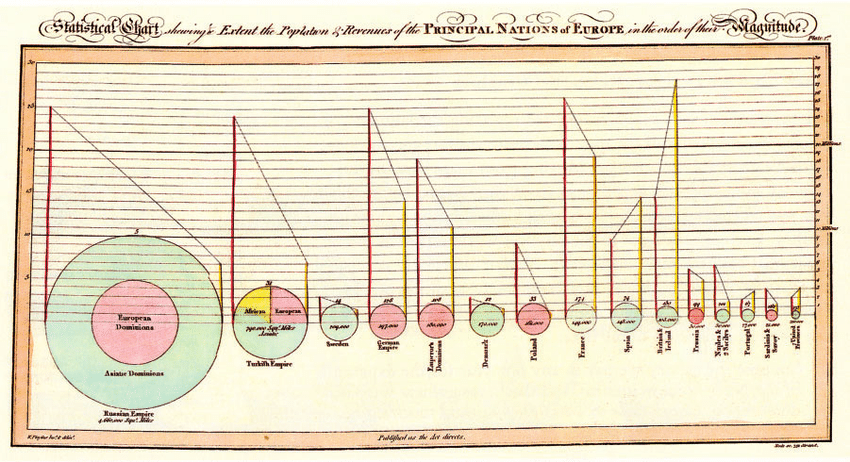
“If you see a pie chart projected twelve feet high in front of you, you know you’re in the hands of an idiot.” These words have stuck with me since I heard them spoken by Edward Tufte, one of the most respected living authorities on data visualization. The latter-day sins of pie-chart-makers (especially those who make them in PowerPoint) are many and varied, but the original sin of the pie chart itself is that of fundamentally misrepresenting one-dimensional information — a company budget, a city’s population demographics — in two-dimensional form.
Yet the pie chart was created by a master, indeed the first master, of information design, the late-eighteenth- and early-nineteenth-century Scottish economist William Playfair. Tufte includes Playfair’s first pie chart, an illustration of the land holdings of various nations and empires circa 1800, in his book The Visual Display of Quantitative Information.
“The circle represents the area of each country,” Tufte explains. “The line on the left, the population in millions read on the vertical scales; the line on the right, the revenue (taxes) collected in millions of pounds sterling read also on the vertical scale.” The dotted lines between them show, in Playfair’s words, whether “the country is burdened with heavy taxes or otherwise” in proportion to its population.
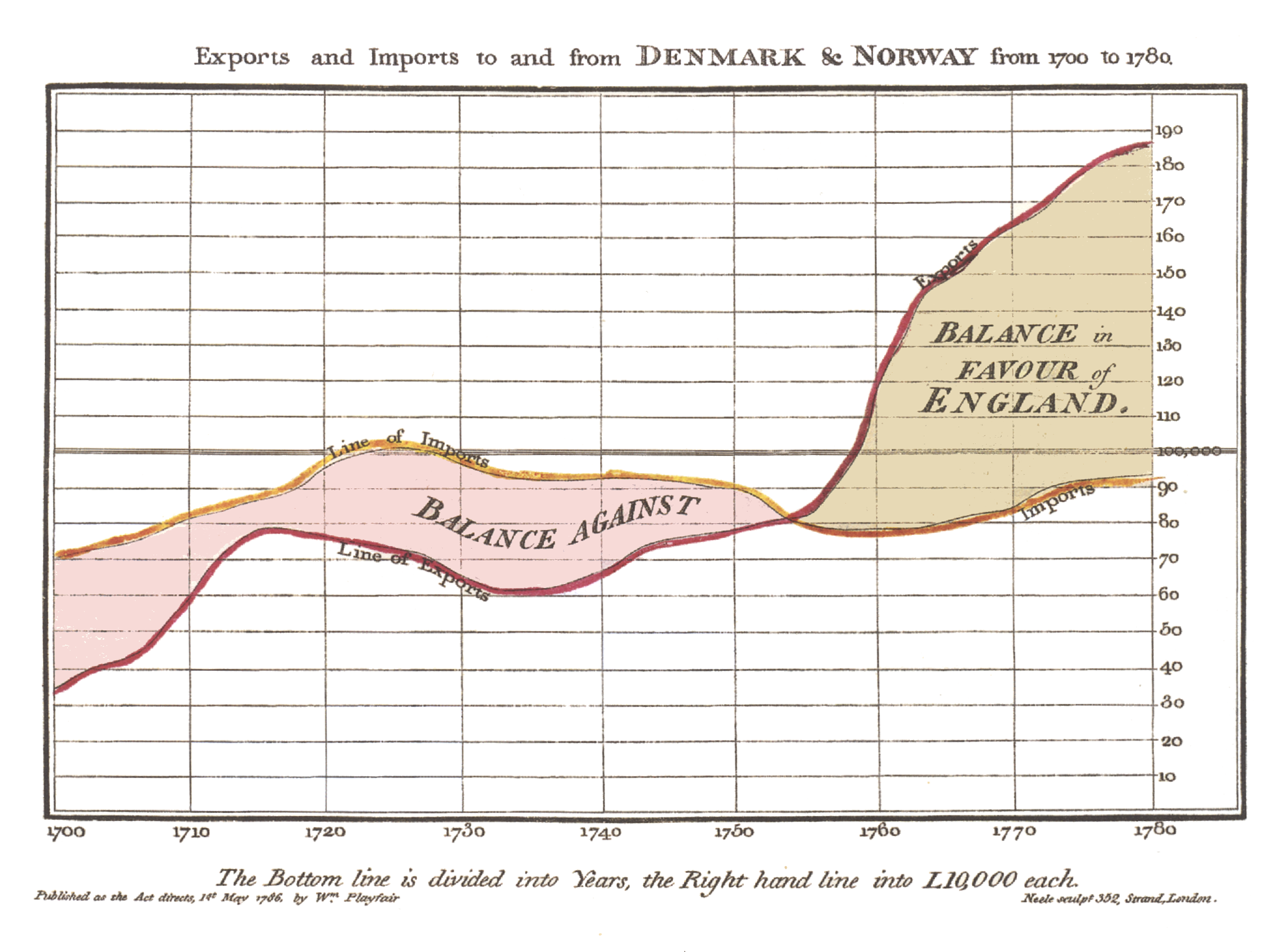
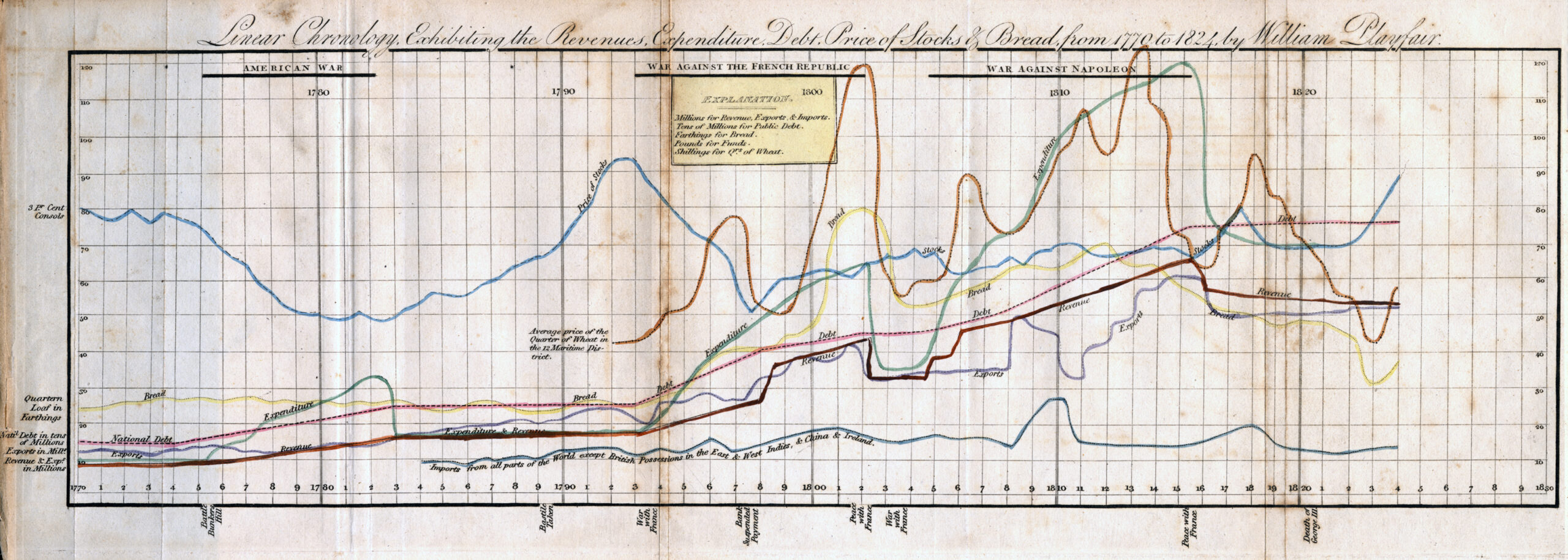
Playfair was experimenting with data visualization long before his invention of the pie chart. He also came up with the more truthful bar chart, history’s first example of which appeared in his Commercial and Political Atlas of 1786. That same book also contains the striking graph above, of England’s “exports and imports to and from Denmark and Norway from 1700 to 1780,” whose lines create fields that make the balance of trade legible at a glance. A much later example of the line graph, another form Playfair is credited with inventing, appears just below, “exhibiting the revenues, expenditure, debt, price of stocks and bread from 1770 to 1824,” a period spanning the American and French Revolutions as well as the Napoleonic Wars.
It’s safe to say that Playfair lived in interesting times, and even within that context lived an unusually interesting life. During Great Britain’s wars with France, he served his country as a secret agent, even coming up with a plan to counterfeit assignats, a French currency at the time, in order to destabilize the enemy’s economy. “Their assignats are their money,” he wrote in 1793, “and it is better to destroy this paper founded upon an iniquitous extortion and a villainous deception than to shed the blood of men.” Two years after the plan went into effect, the assignat was worthless and France’s ship of state had more or less run aground. Playfair’s measures may seem extreme, but then, you don’t win a war with pie charts.
Related content:
The Art of Data Visualization: How to Tell Complex Stories Through Smart Design
Based in Seoul, Colin Marshall writes and broadcasts on cities, language, and culture. His projects include the Substack newsletter Books on Cities, the book The Stateless City: a Walk through 21st-Century Los Angeles and the video series The City in Cinema. Follow him on Twitter at @colinmarshall or on Facebook.
Read More...Watch a Traditional Japanese Carpenter Make 190+ Different Joints, All Without Nails, Screws, or Glue
Before the internet, it would have been hard to imagine that people around the world would one day be unable to get enough of traditional Japanese carpentry, and specifically traditional Japanese joinery. And before Youtube, who could have predicted that videos showing each and every step of a woodworking project — without narration, or indeed explanation of any kind — would find an enthusiastic viewership? At the intersection of these two surprising phenomena stands that channel H Carpenter, whose unadorned, methodical, and detailed portrayals of wooden joint-making have racked up millions upon millions of views.
In traditional Japanese joinery, which we’ve featured many times before here on Open Culture, the carpenter uses no nails, screws, or adhesives. Rather, he carves the ends of the pieces of wood to be joined into interlocking three-dimensional shapes that can hold solid for decades, or even centuries.
The biggest advantage of this technique, writes a commenter on one video, “is that it minimizes the use of rust-prone nails and other materials, reduces damage to the wood, and dampens seismic shaking with unfastened joints” — always a consideration in earthquake-prone Japan. “Furthermore, the entire building can be disassembled like Lego blocks, and only the damaged parts can be replaced and rebuilt as before.”
Like many other Japanese traditions, this form of carpentry has been around for a long time indeed, and through the centuries has built up a formidable library of joints, many of them complex enough not to be comprehensible at first glance. With 193 videos on the relevant playlist so far, H carpenter seems to have made a mission of constructing all of them on Youtube not just to aid our understanding of their workings, but also to provide us with the sensory pleasures of the process itself. (A few million of his views are surely accounted for by ASMR enthusiasts alone.) Just like his forebears in the craft, he does it without using a single nail — as well, perhaps as a counterbalance to the chatter of the twenty-first century, without speaking a single word.
Related content:
See How Traditional Japanese Carpenters Can Build a Whole Building Using No Nails or Screws
Building Without Nails: The Genius of Japanese Carpentry
Based in Seoul, Colin Marshall writes and broadcasts on cities, language, and culture. His projects include the Substack newsletter Books on Cities, the book The Stateless City: a Walk through 21st-Century Los Angeles and the video series The City in Cinema. Follow him on Twitter at @colinmarshall or on Facebook.
Read More...School Principal, Forced to Resign After Students Learn About Michelangelo’s “David,” Visits the Renaissance Statue in Florence
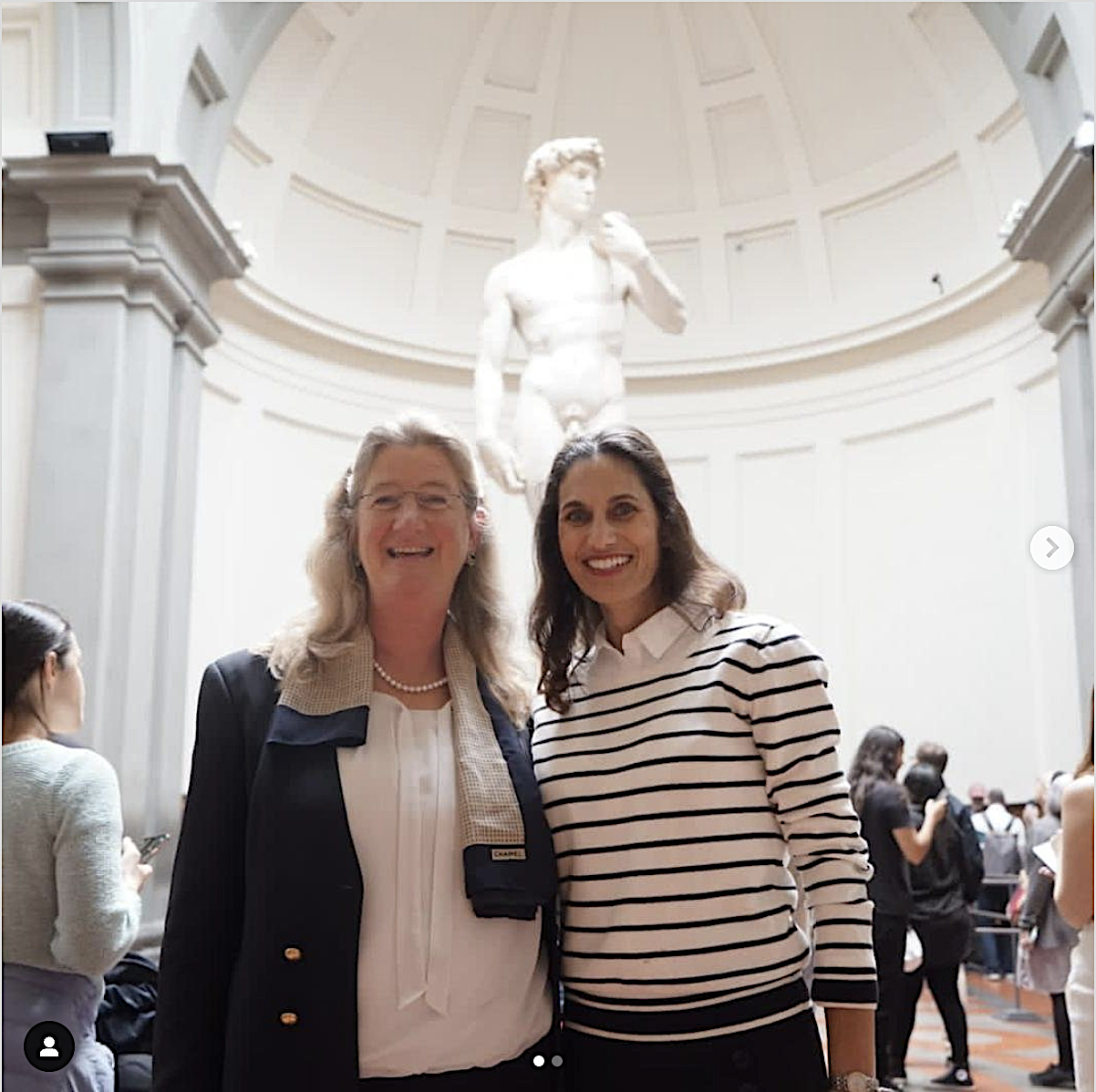
In March, a Florida school principal lost her job when 6th graders encountered Michelangelo’s “David” during an art history lesson–even though the school ostensibly specializes in offering students “a content-rich classical education in the liberal arts and sciences.” Parents apparently found the Renaissance sculpture, um, “pornographic.”
Fast forward two months, and the former principal Hope Carrasquilla has now traveled to Florence and visited Michelangelo’s “David” in person. This came at the invitation of the mayor of Florence, Dario Nardella, and the director of the Galleria dell’Accademia, Cecilie Hollberg. Above you can see Hollberg on the left, and Carrasquilla on the right.
On Instagram, Carrasquilla commented:
I’m very impressed. The thing that strikes me the most, and that I didn’t know, is that this whole gallery was built for him [Michelangelo’s “David”]. I think it’s beautiful, it looks like a church. And to me, that just represents really the purity of this figure and you see his humanity. There is nothing wrong with the human body. Michelangelo did nothing wrong. He could only sculpt it like this. It couldn’t be otherwise. He’s wonderful and I’m really happy to be here.
In her own statement, Hollberg said:
I am delighted to welcome her and show her the magnificence of our museum, as well as personally introduce her to David, a sculpture that I reiterate has nothing to do with pornography. It is a masterpiece representing a religious symbol of purity and innocence, the triumph of good over evil. His nudity is an outward manifestation of Renaissance thought, which considered man the centre of the universe. People from all over the world, including many Americans, make the pilgrimage to admire him every year. Currently, more than 50% of visitors are from the United States. I am certain that Ms. Carrasquilla will receive the welcome and solidarity she deserves here in Florence.
Florida may be canceling classical art and thought. Florence is decidedly not.
Related Content
How Michelangelo’s David Still Draws Admiration and Controversy Today
Michelangelo’s Illustrated Grocery List
Leonardo da Vinci’s Handwritten Resume (1482)
Read More...Why Renaissance Masters Added Egg Yolk to Their Paints: A New Study Sheds Light
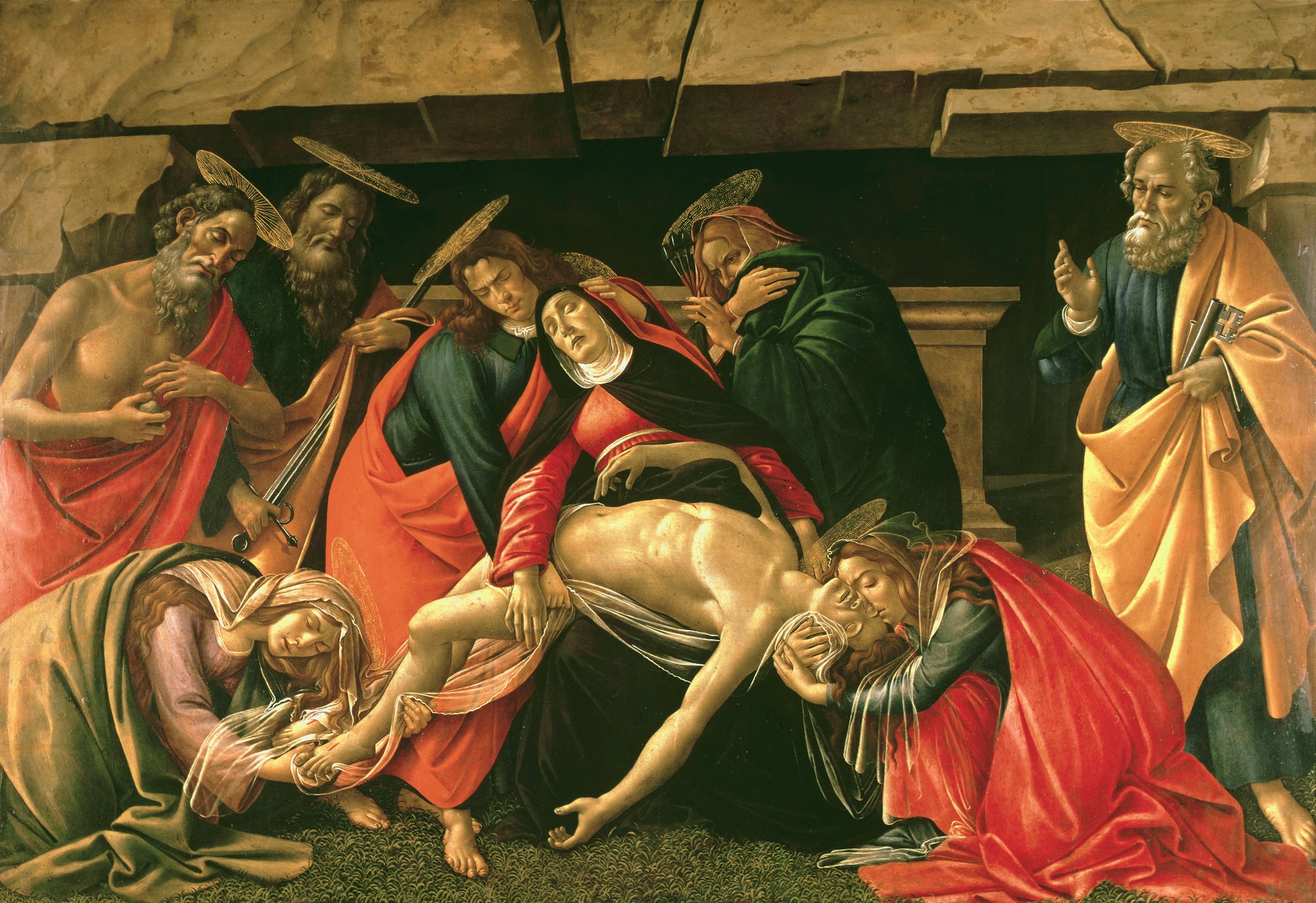
Today we think of the Renaissance as one of those periods when everything changed, and if the best-known artifacts of the time are anything to go by, nothing changed quite so much as art. This is reflected in obvious aesthetic differences between the works of the Renaissance and those created before, as well as in less obvious technical ones. Egg yolk-based tempera paints, for example, had been in use since the time of the ancient Egyptians, but in the fifteenth century they were replaced by oil paints. When chemical analysis of the work of certain Renaissance masters revealed traces of egg, they were assumed to be the result of chance contamination.
Now, thanks to a recent study led by chemical engineer Ophélie Ranquet of the Karlsruhe Institute of Technology, we have reason to believe that painters like Botticelli and Leonardo kept eggs in the mix deliberately. Oil replaced tempera because “it creates more vivid colors and smoother color transitions,” writes Smithsonian.com’s Teresa Nowakowski.
“It also dries slowly, so it can be used for longer after the initial preparation.” But “the colors darken more easily over time, and the paint is more susceptible to damage from light exposure. It also has a tendency to wrinkle as it dries,” visible in Leonardo’s Madonna of the Carnation below.
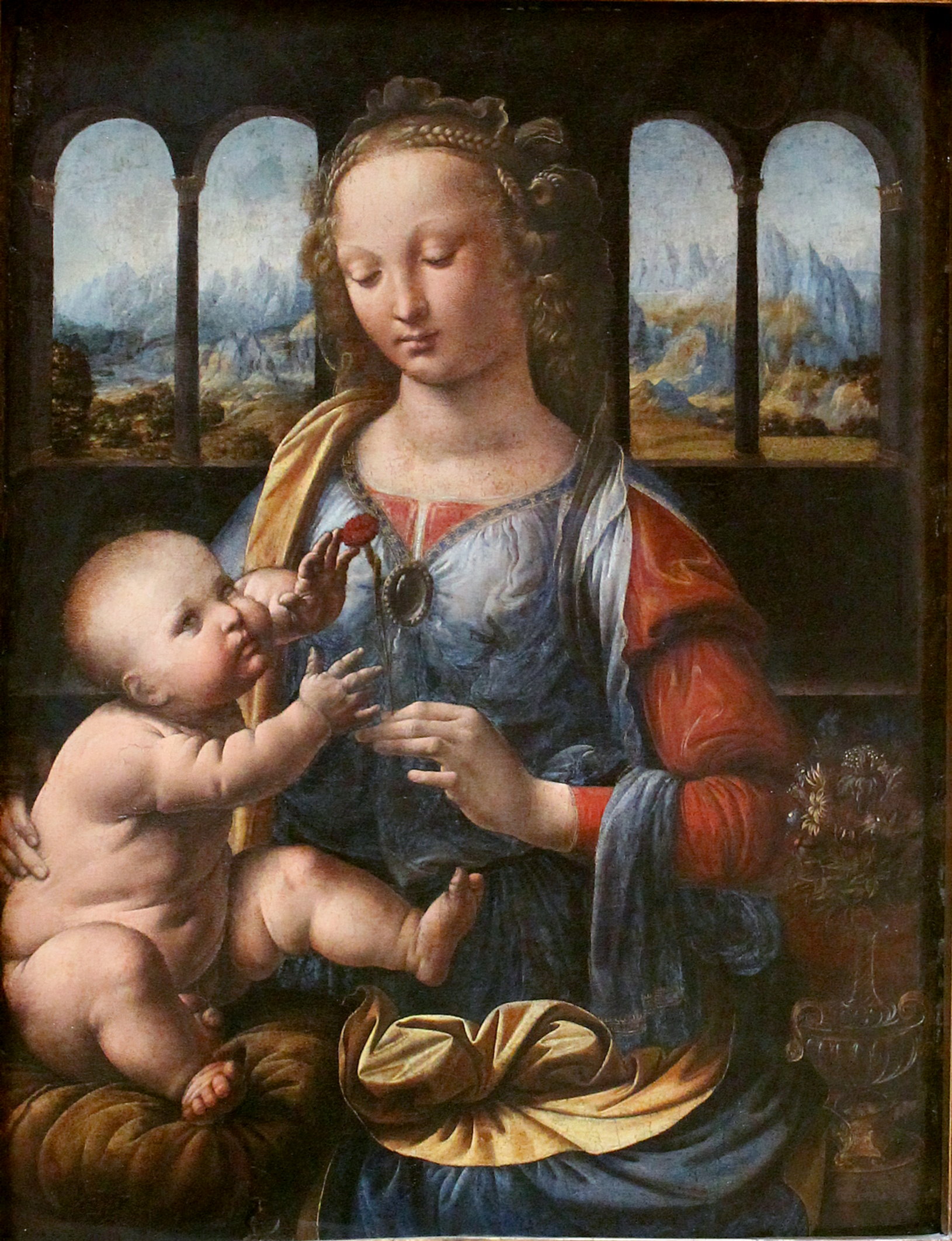
Putting in a bit of egg yolk may have been a way of using oil’s advantages while minimizing its disadvantages. Ranquet and her collaborators tested this idea by doing it themselves, re-creating two pigments used during the Renaissance, both with egg and without. “In the mayolike blend” produced by the former method, writes ScienceNews’ Jude Coleman, “the yolk created sturdy links between pigment particles, resulting in stiffer paint. Such consistency would have been ideal for techniques like impasto, a raised, thick style that adds texture to art. Egg additions also could have reduced wrinkling by creating a firmer paint consistency,” though the paint itself would take longer to dry.
In practice, Renaissance painters seem to have experimented with different proportions of oil and egg, and so discovered that each had its own strengths for rendering different elements of an image. Hyperallergic’s Taylor Michael writes that in The Lamentation Over the Dead Christ, seen up top, “Botticelli painted Christ, Mary Magdalene, and the Virgin, among others, with tempera, and the background stone and foregrounding grass with oil.” Thanks to the oxidization-slowing effects of phospholipids and antioxidants in the yolk — as scientific research has since proven — they’ve all come through the past five centuries looking hardly worse for wear.
Related content:
How Caravaggio Painted: A Re-Creation of the Great Master’s Process
A 900-Page Pre-Pantone Guide to Color from 1692: A Complete High-Resolution Digital Scan
Based in Seoul, Colin Marshall writes and broadcasts on cities, language, and culture. His projects include the Substack newsletter Books on Cities, the book The Stateless City: a Walk through 21st-Century Los Angeles and the video series The City in Cinema. Follow him on Twitter at @colinmarshall or on Facebook.
Read More...1,800 Hand-Cut Silhouettes of 19th-Century Historical Figures Get Digitized & Put Online by the Smithsonian
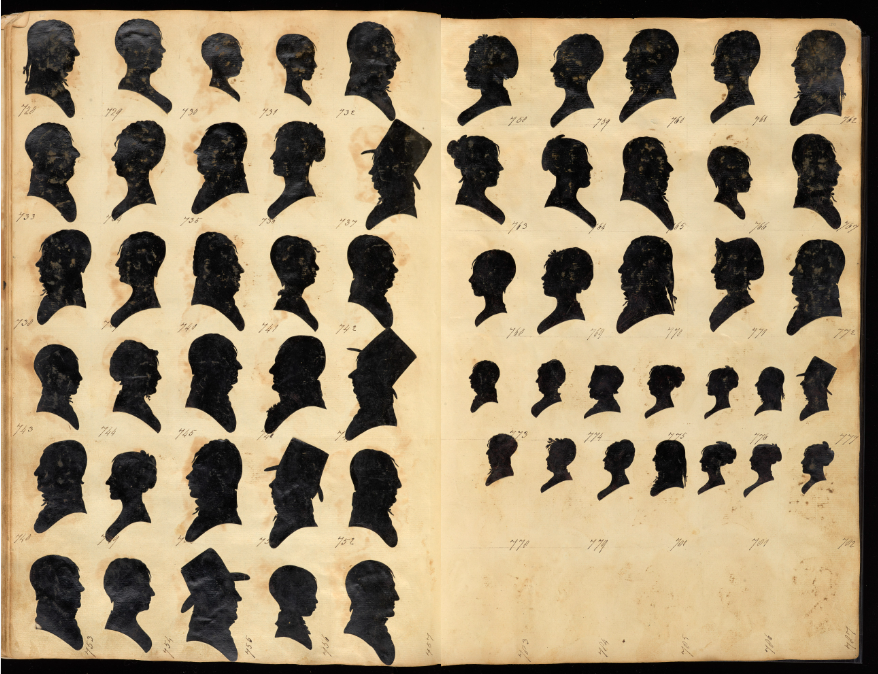
With the exception of Kara Walker’s provocative cut paper narratives, silhouettes haven’t struck us as a particularly revealing art form.
Perhaps we would have felt differently in the early 19th-century, when silhouettes offered a quick and affordable alternative to oil portraits, and photography had yet to be invented.
Self-taught silhouette artist William Bache traveled the eastern seaboard, and later to New Orleans and Cuba, plying his trade with a physiognotrace, a device that helped him outline subjects’ profiles on folded sheets of light paper.
Once a profile had been captured, Bache carefully cut inside the tracing and affixed the “hollow-cut” surrounding sheet to black paper, creating the appearance of a hand-cut black silhouette on a white background.
Customers could purchase four copies of these shadow likenesses for 25¢, which, adjusted for inflation, is about the same amount as a photo strip in one of New York City’s vintage photobooths these days — $5.
Bache was an energetic promoter of his services, advertising that if customers found it inconvenient to visit one of his pop-up studios, he would “at the shortest notice, wait upon them at their own Dwellings without any additional expense.”
Naturally, people were eager to lay hands on silhouettes of their children and sweethearts, too.
One of Bache’s competitors, Raphaelle Peale assumed the perspective of a satisfied male customer to tout his own business:
‘Tis almost herself, Eliza’s shade,
Thus by the faithful facietrace pourtray’d!
Her placid brow and pouting lips, whose swell
My fond impatient ardor would repell.
Let me then take that vacant seat, and there
Inhale her breath, scarce mingled with the air:
And thou blest instrument! which o’er her face
Did’st at her lips one moment pause, retrace
My glowing form and leave, unequall’d bliss!
Borrow’d from her, a sweet etherial Kiss.
Hot stuff, though hopefully besotted young lovers refrained from pressing their lips to the silhouettes they loved best. Conservators in the Smithsonian’s National Portrait Gallery, which houses Bache’s sample book, a ledger filled with likenesses of some 1,800 sitters, discovered it to be suffused with arsenic, presumably meant to repel invading rodents and insects.
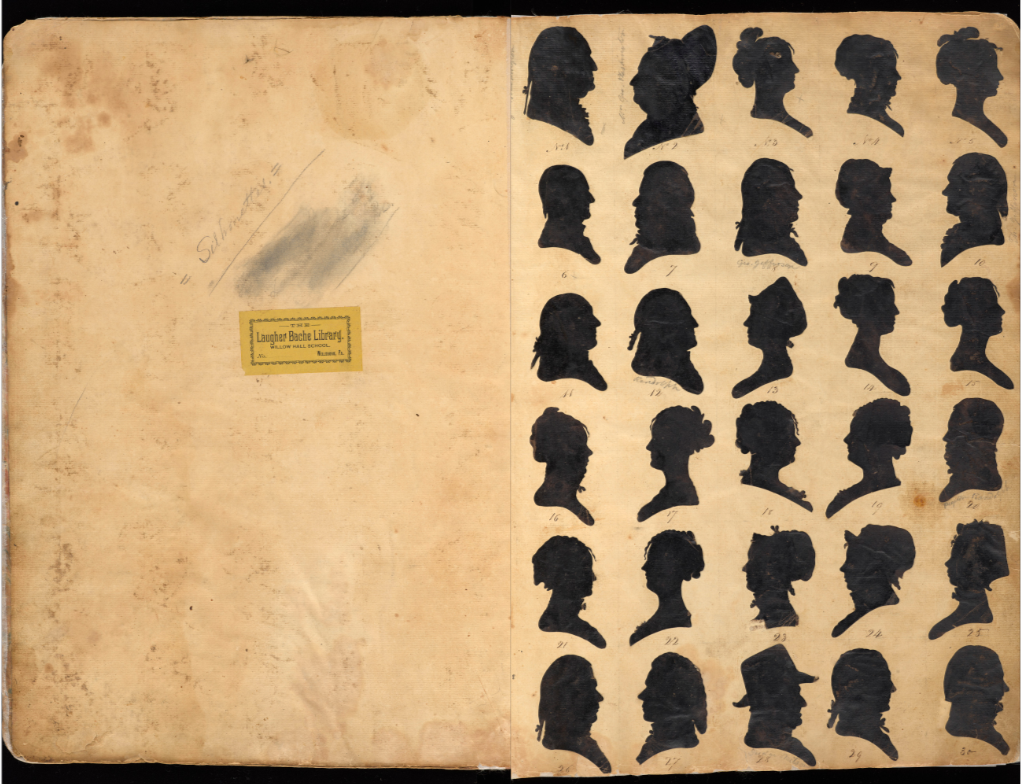
Most of the heads in Bache’s album arrived unidentified, but by combing through digitized newspapers, history books, baptismal records, wills, marriage certificates and Ancestry.com, lead curator Robyn Asleson and Getty-funded research assistant Elizabeth Isaacson have managed to identify over 1000.
There are some whose names — and profiles — remain well known more than 200 years later. Can you identify George Washington, Martha Washington, and Thomas Jefferson on the album page below?
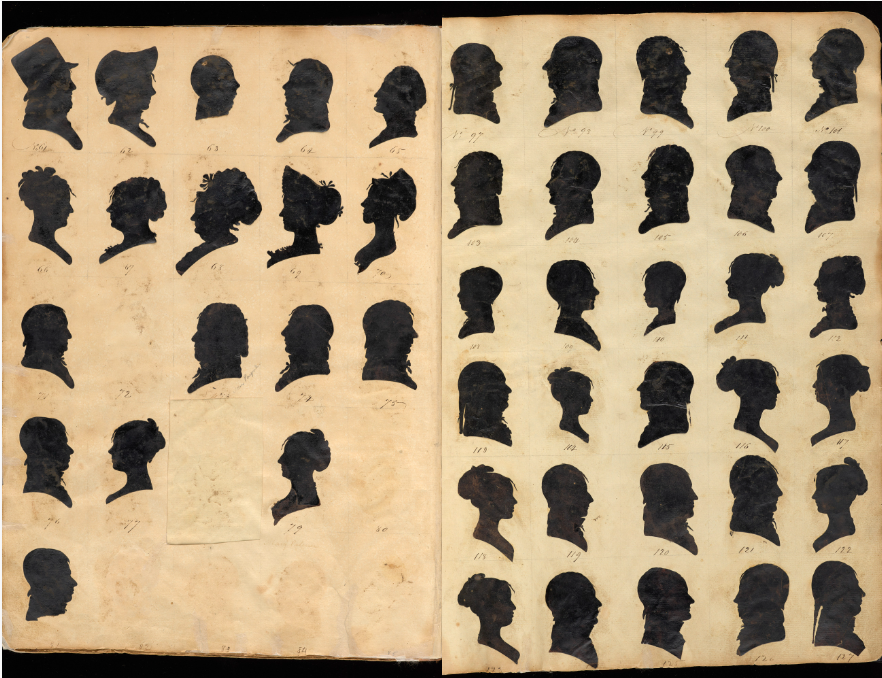
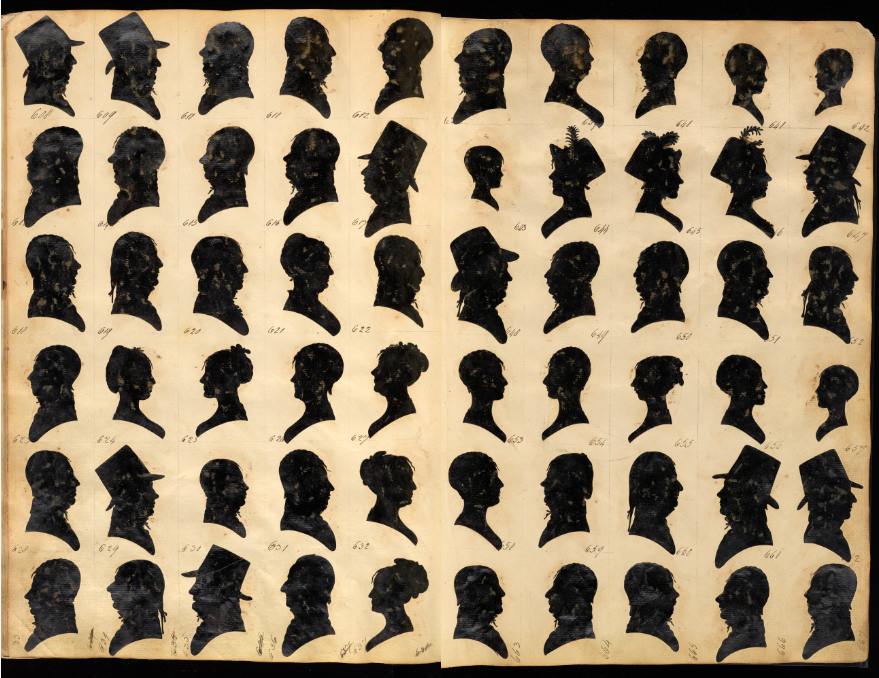
Some pages contain entire families. Pedro Bidetrenoulleau coughed up $1.25 for his own likeness, as well as those of his wife, and children Félix, Adele, and Zacharine, numbers 638 through 642, below.
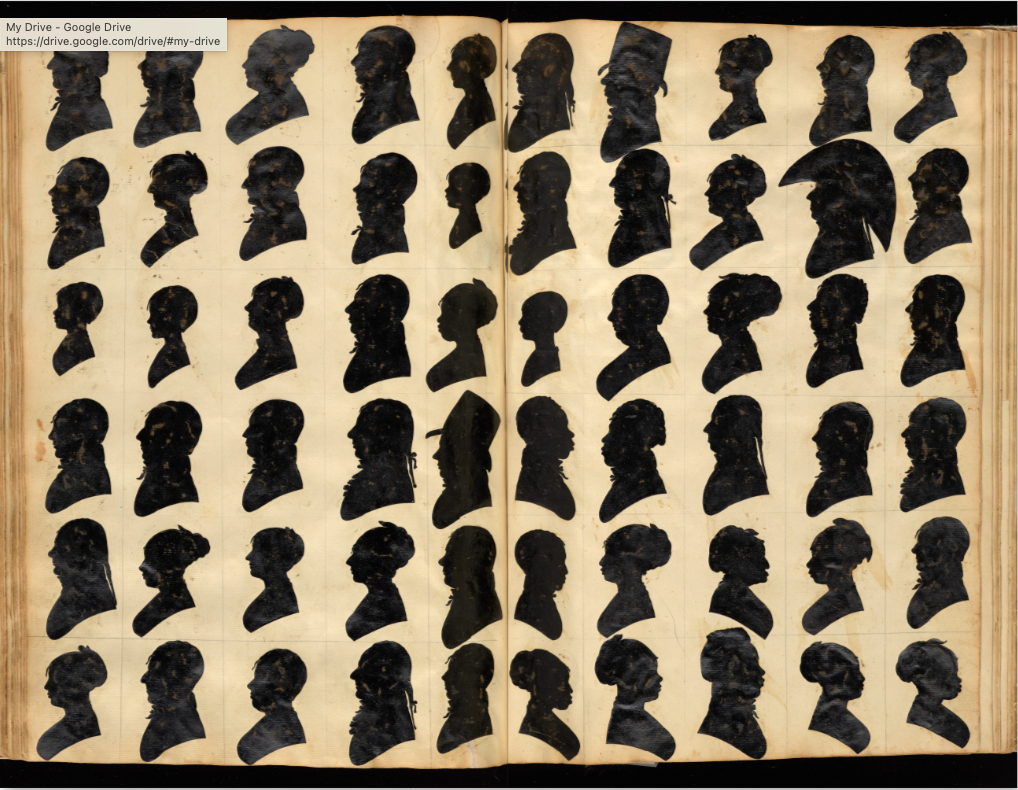
Bache’s travels to New Orleans and Cuba make for a racially diverse collection, though little is known about most of the Black sitters. Dr. Asleson suspects some of these might be the only existing portraits of these individuals, particularly in the case of New Orleanians in mixed-race relationships, whose descendants destroyed strategic evidence in the effort to “pass” as white:
As I was learning more and more about this history, I really began to hope that some of the people who are trying to find their heritage today, who realize it might have been deliberately eradicated to protect their ancestors from oppression, might have the chance to discover an image of a great-great-grandfather or grandmother.
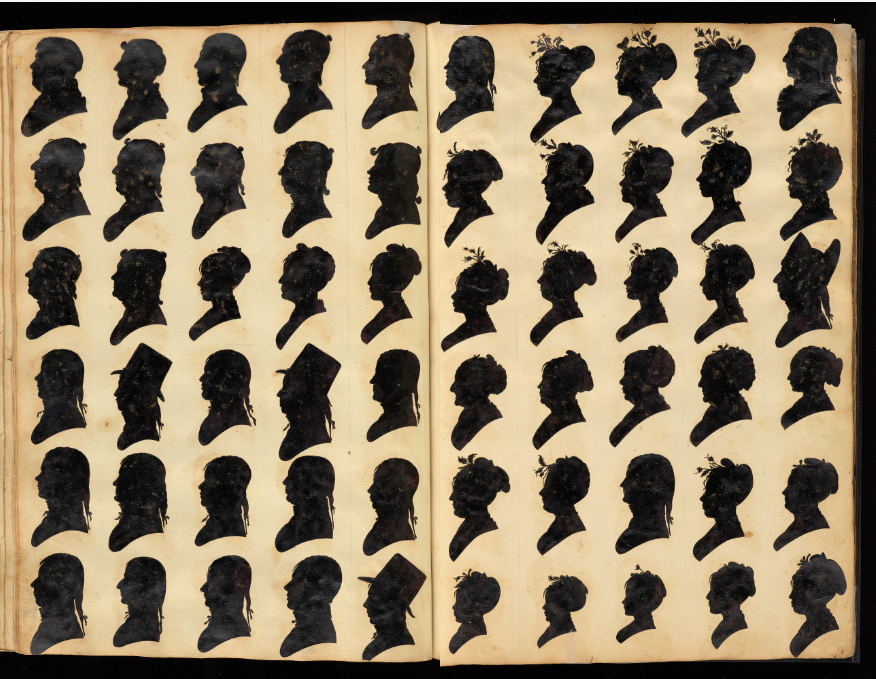
Readers, if you are the caretaker of passed down family silhouettes, perhaps you can help the curators get closer to putting a name to someone who currently exists as little more than a shadow in interesting headgear.
Even if you’re not in possession of a silhouette, you may well be one of the tens of thousands living in the United States today connected to the album by blood.
Explore an arsenic-free, interactive copy of William Bache’s silhouette ledger book here.
Related Content
– Ayun Halliday is the Chief Primatologist of the East Village Inky zine and author, most recently, of Creative, Not Famous: The Small Potato Manifesto and Creative, Not Famous Activity Book. Follow her @AyunHalliday.
Read More...Support Us
We're hoping to rely on loyal readers, rather than erratic ads. Please click the Donate button and support Open Culture. You can use Paypal, Venmo, Patreon, even Crypto! We thank you!

About Us

Open Culture scours the web for the best educational media. We find the free courses and audio books you need, the language lessons & educational videos you want, and plenty of enlightenment in between.
Advertise With Us
FREE UPDATES!
GET OUR DAILY EMAIL
Get the best cultural and educational resources on the web curated for you in a daily email. We never spam. Unsubscribe at any time.
FOLLOW ON SOCIAL MEDIA
Open Culture editor Dan Colman scours the web for the best educational media. He finds the free courses and audio books you need, the language lessons & movies you want, and plenty of enlightenment in between.
Advertise With Us

