The Downfall of Oscar Wilde: An Animated Video Tells How Wilde Quickly Went from Celebrity Playwright to Prisoner
Oscar Wilde left a body of literature that continues to entertain generation after generation of readers, but for many of his fans his life leads to his work, not the other way around. Its latest retelling, Oscar Wilde: A Life by Matthew Sturgis, came out in the United States just this past week. “Universally heralded as a genius” when his play The Importance of Being Earnest premiered in London in 1895, he was just a few months later “bankrupt and about to be imprisoned. His reputation was in tatters and his life was ruined beyond repair.” This is how Alain de Botton tells it in “The Downfall of Oscar Wilde,” the animated School of Life video above.
Wilde was imprisoned, as even those who’ve never read a word he wrote know, for his homosexuality. This de Botton described as “the swift fall of a great man due to a small but fateful slip,” a result of the social and legal conditions that obtained in the time and place in which Wilde lived. Having fallen for “a beguiling young man named Lord Alfred Douglas,” known as “Bosie,” Wilde found himself on the receiving end of threats from Bosie’s father, the Marquess of Queensbury. Their conflict eventually provoked the Marquess to publicize Wilde and Bosie’s relationship all throughout London, and since “homosexuality was illegal and deeply frowned upon in Victorian society, this was a dangerous accusation.”
Though Wilde fought a valiant and characteristically eloquent court battle, he was eventually convicted of “gross indecency” and sentenced to two years of imprisonment and hard labor. “For someone of Wilde’s luxurious background,” says de Botton, “it was an impossible hardship.” This time inspired his essay De Profundis, and later his poem The Ballad of Reading Gaol, but according to most accounts of his life, he never really recovered from it before succumbing to meningitis in 1900. He had plans, writes The New Yorker’s Clare Bucknell, “for a new social comedy, a new Symbolist drama, a new libretto.” But as his lover Bosie put it, Wilde’s life of post-release continental exile was “too narrow and too limited to stir him to creation.”
The United Kingdom has since pardoned Wilde (and others, like computer scientist Alan Turing) for the crimes committed in their lifetimes that would not be considered crimes today. More than a century has passed since Wilde’s death, and “our society has become generous towards Wilde’s specific behavior,” says de Botton. “Many of us would, across the ages, want to comfort and befriend Oscar Wilde. It’s a touching hope, but one that would be best employed in extending understanding to all those less talented and less witty figures who are right now facing grave difficulties.” Wilde might have come to a bleak end, but the life he lived and the reactions it provoked still have much to teach us about our attitudes today.
Related Content:
Hear Oscar Wilde Recite a Section of The Ballad of Reading Gaol (1897)
Based in Seoul, Colin Marshall writes and broadcasts on cities, language, and culture. His projects include the Substack newsletter Books on Cities, the book The Stateless City: a Walk through 21st-Century Los Angeles and the video series The City in Cinema. Follow him on Twitter at @colinmarshall or on Facebook.
Read More...A 110-Year-Old Book Illustrated with Photos of Kittens & Cats Taught Kids How to Read
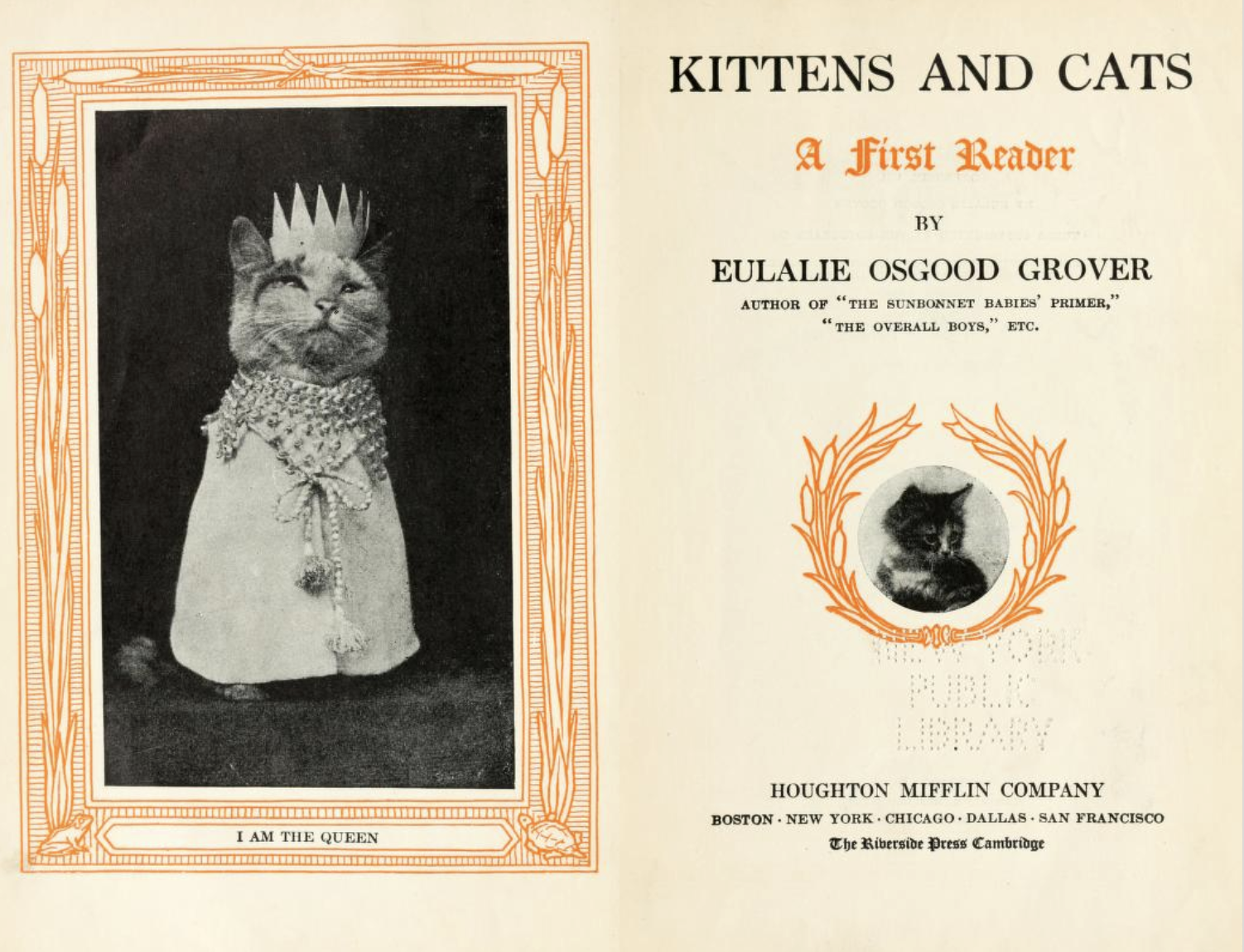
Unlike our 21st-century cat memes and other such online feline-based entertainments, children’s author Eulalie Osgood Grover’s 1911 work, Kittens and Cats: A First Reader was intended to educate.
Its related poems will almost certainly strike those of us whose understanding of feline attitude has been shaped by LOLCats, Grumpy Cat, the existential Henri, Talking Kitty Cat’s acerbic Sylvester, and the mordant 1970s TV spokescat Morris as sweet to the point of sickly. But it boasts six hundred vocabulary words, a rhyme structure that promotes reading aloud, and a note to teachers with suggestions for classroom activities.
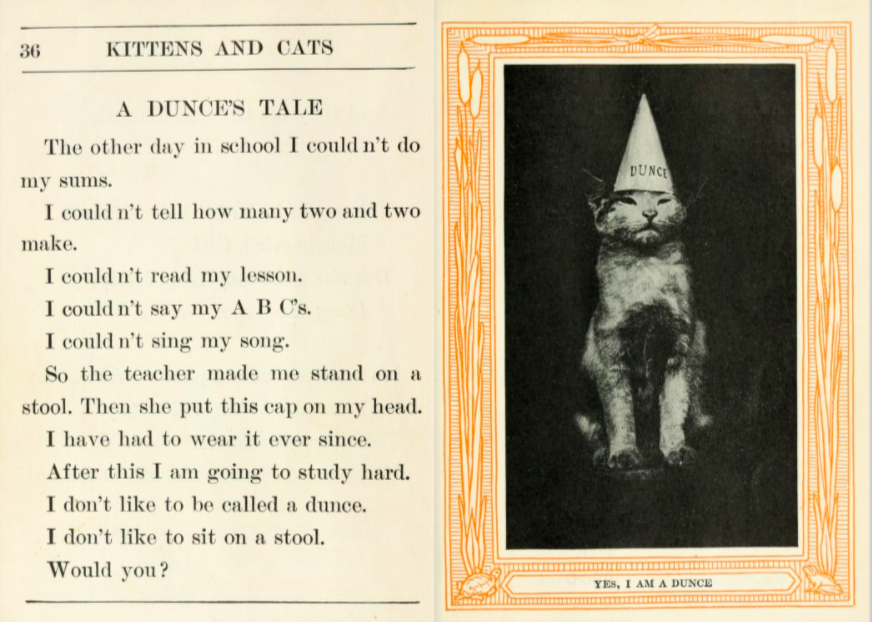
Grover explained how her feline cast of characters would win over even the most reluctant reader, inspiring “much the same delight to the little reader of juvenile fiction, as do adventure and romance to the grown-up reader”:
In one respect kittens take precedence over dolls. They are alive. They must be treated kindly. They will not bear the abuse and neglect given to many beautiful dolls. They demand attention and companionship, and they return a real devotion in return for kindness and care. Therefore we love them and especially do our children love them and delight in stories of them.
The loosely structured story concerns a grand party thrown by the Queen of the Cats. Following some breathless preparations, the guests take turns introducing themselves to her majesty, though unlike T.S. Eliot’s Old Possum’s Book of Practical Cats (1939), there’s not much that could be cobbled into a hit musical.
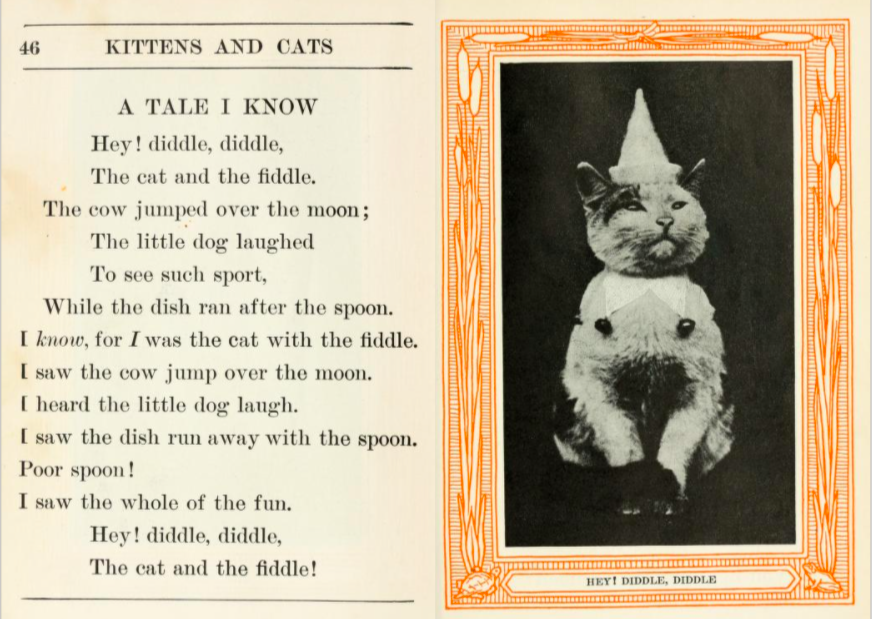
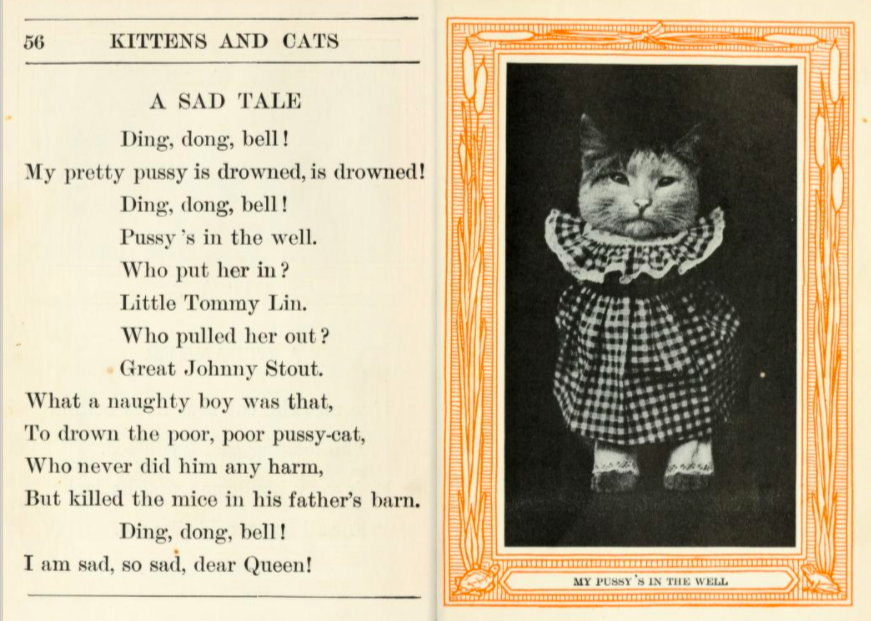
Grover fleshes out the narrative with callbacks to a number of cat-rich nursery rhymes — Hickory Dickory Dock, Three Little Kittens, Hey Diddle Diddle, As I Was Going to St. Ives, Ding Dong Bell…
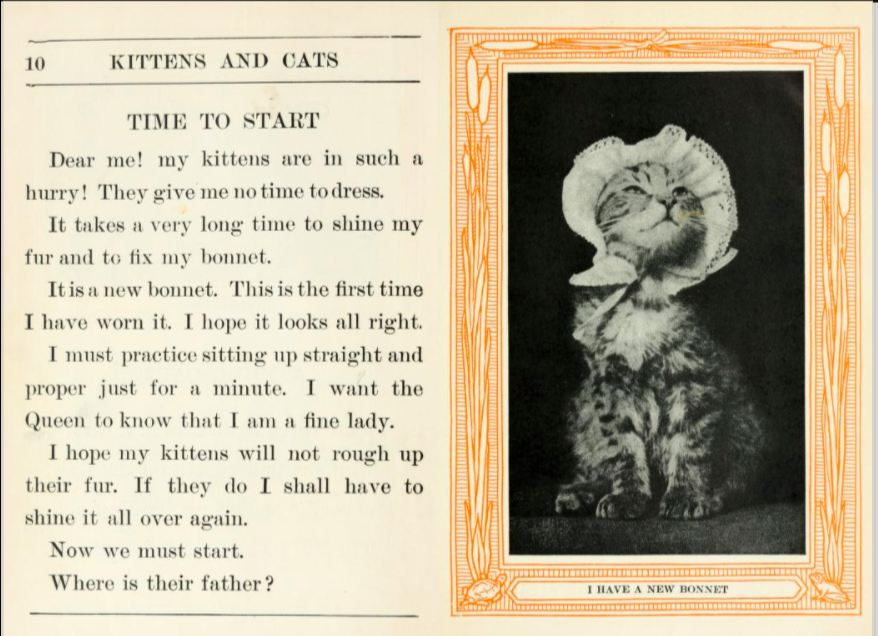
One lace-bonneted character is reminiscent of Tom Kitten’s mother, Mrs. Tabitha Twitchit, and her unsuccessful attempts to wrangle her rambunctious offspring into clothing fit for “fine company,” though the wit falls somewhat short of Beatrix Potter’s.
Headgear abounds, as do restrictive buntings that must’ve been a great help when dealing with uncooperative models and long exposures.
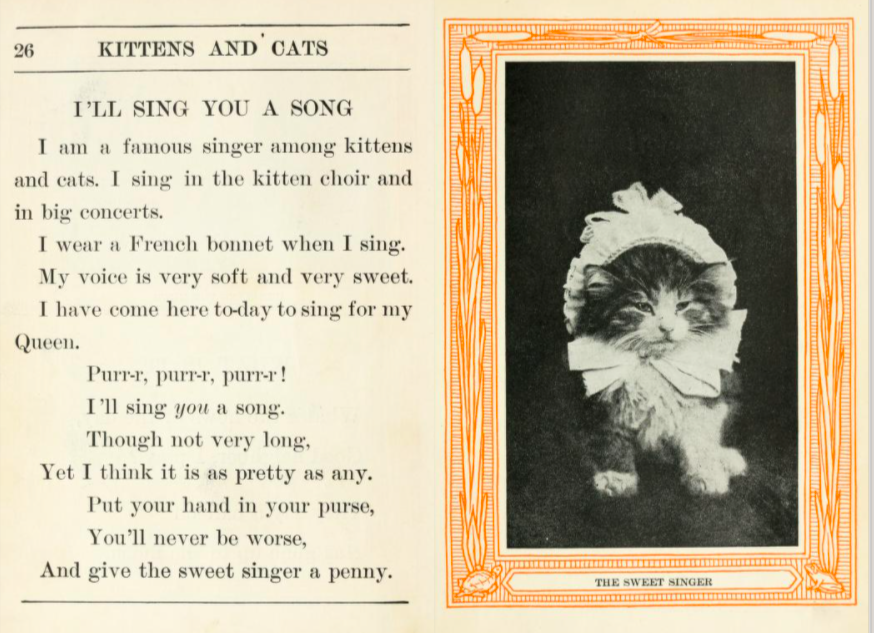
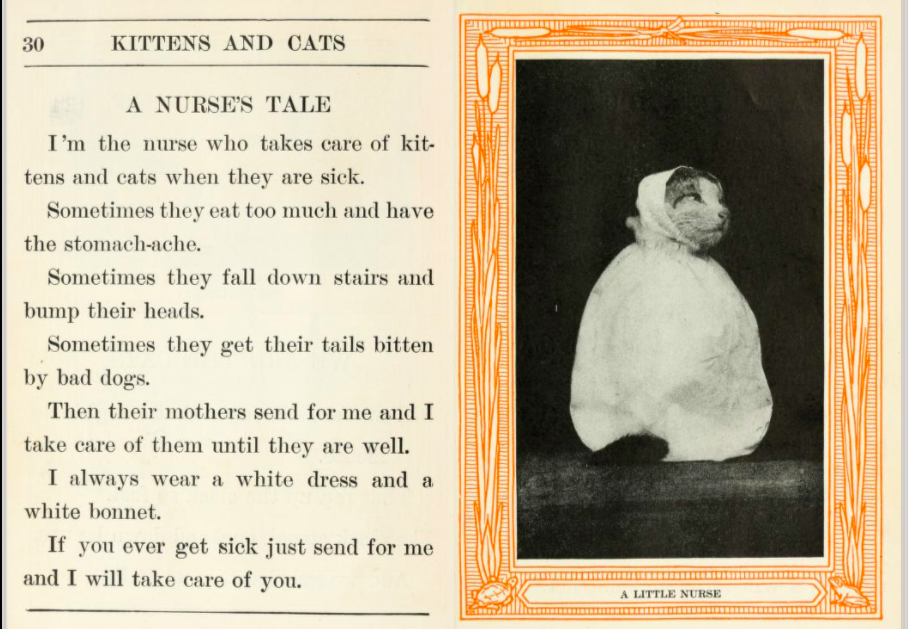
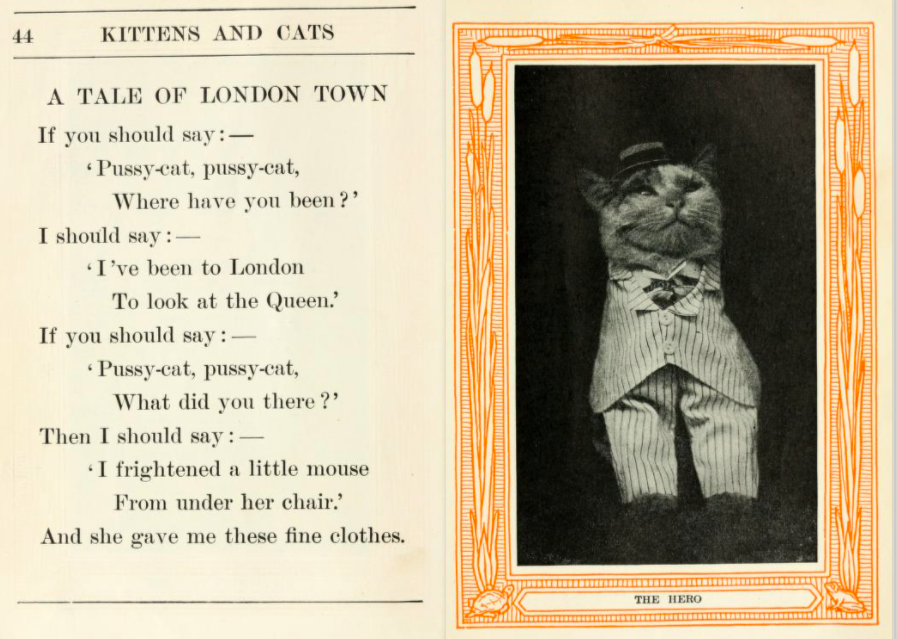
Although the photographer is uncredited, the images are likely the work of Harry Whittier Frees, a “pioneer of the anthropomorphic kitten photograph genre” as per the New York Daily News. In his introduction to his far more ambitiously posed 1915 work, The Little Folks of Animal Land, Frees alluded to his process:
The difficulties of posing kittens and puppies for pictures of this kind have been overcome only by the exercise of great patience and invariable kindness. My little models receive no especial training, and after their daily performance before the camera they enjoy nothing more than a good frolic about the studio.
That’s a pleasant thought, though historian and postcard collector Mary L. Weigley tells a somewhat different tale in an article for Pennsylvania Heritage, describing how only 3/10 of his negatives could be published, and his work was so “challenging, time-consuming and nerve-wracking” that he took 9 months out of every year to recuperate.
Cats!
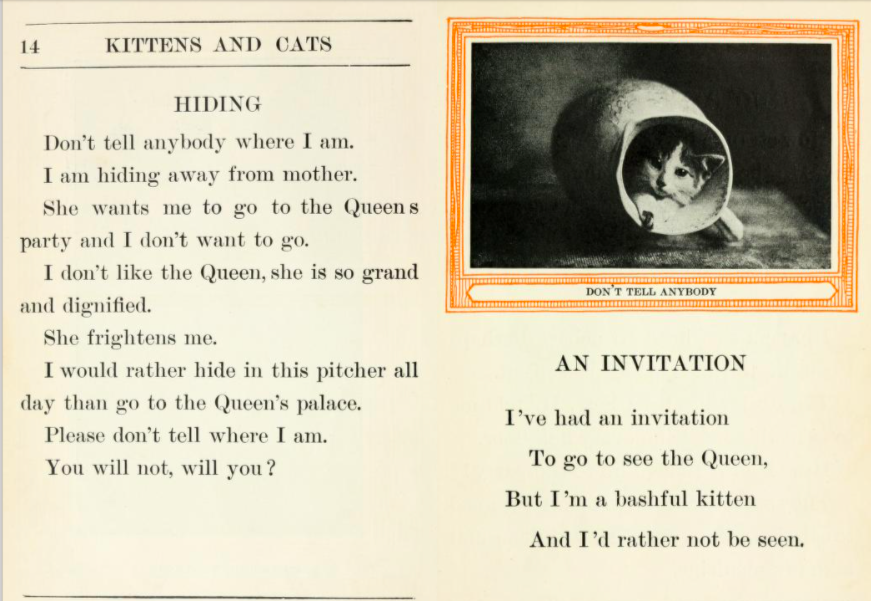
Download a free copy of Eulalie Osgood Grover’s Kittens and Cats here.
Related Content:
Why Humans Are Obsessed with Cats
GPS Tracking Reveals the Secret Lives of Outdoor Cats
Ayun Halliday is an author, illustrator, theater maker and Chief Primatologist of the East Village Inky zine. Follow her @AyunHalliday.
Read More...John Lennon Finally Meets & Jams with His Hero, Chuck Berry (1972)
“If you had tried to give rock and roll another name, you would call it Chuck Berry,” says John Lennon by way of introduction to his hero in the clip above from The Mike Douglas Show. The two perform Berry’s “Memphis, Tennessee” and “Johnny B. Goode” (with Lennon’s backing band, Elephant’s Memory, and unwelcome discordant backing vocals from Yoko). The moment was a major highlight of Lennon’s post-Beatles’ career. The year was 1972, and Lennon and Yoko Ono had taken over Douglas’ show for the week, booking such guests as Ralph Nader, Jerry Rubin, and then Surgeon General Dr. Jesse Steinfeld. Douglas called it “probably the most memorable week I did in all my 20-something years on air,” Guitar World notes. Lennon used it as the opportunity to finally meet, and jam out, with his idol.
Berry wasn’t just a major inspiration for the young Lennon; “From his songwriting and lyrics, to his guitar playing and stage antics, perhaps nobody else short of Elvis Presley was as influential on [all] the young Beatles as Chuck Berry,” writes Beatles scholar Aaron Krerowicz, listing “at least 15” of Berry’s songs the band covered (as either the Quarrymen or the Beatles). Paul McCartney credits Berry for the Beatles’ very existence. They were fans, he wrote in tribute after Berry’s death, “from the first minute we heard the great guitar intro to ‘Sweet Little Sixteen.’” But it wasn’t only Berry’s playing that hooked them: “His stories were more like poems than lyrics…. To us he was a magician.”
McCartney first pointed out the similarities between Lennon’s “Come Together” (originally penned as a campaign song for Timothy Leary’s run against Ronald Reagan for the governorship of California) and Berry’s 1956 “You Can’t Catch Me,” he tells Barry Miles in Many Years From Now. “John acknowledged it was rather close to it,” says Paul, “so I said, ‘Well, anything you can do to get away from that.’” Despite the resulting “swampy” tempo, Berry’s legal team still sued over the lyric “here comes old flat-top,” a direct lift from Berry’s song. In an out-of-court settlement, Lennon agreed to record even more of Berry’s tunes. “You Can’t Catch Me” appears on Lennon’s 1975 album of classic covers, Rock ‘n’ Roll.
This legal tussle aside, there was no beef between the two. The appearance on Douglas’ show proved to be a huge boost for Berry, who revitalized his career that year with the suggestive, controversial “My Ding-a-Ling,” his biggest-selling hit, and — in an ironic twist — originally a goofy novelty song composed and recorded by Dave Bartholomew 20 years earlier. When asked by Douglas, however, what drew him to Berry’s music, Lennon echoes McCartney: “[Berry] was writing good lyrics and intelligent lyrics in the 1950s when people were singing ‘Oh baby, I love you so.’ It was people like him that influenced our generation to try and make sense out of the songs rather than just sing ‘do wah diddy.’”
Lennon wasn’t above covering Gene Vincent’s “Be-Bop-a-Lula” a few years later, and the Beatles themselves mixed intelligent narrative songwriting with healthy doses of pop nonsense — patterning themselves after the man Lennon called “my hero, the creator of Rock and Roll.” A few years after Lennon’s 1980 death, Berry returned the compliment, calling Lennon “the greatest influence in rock music” before bringing Julian Lennon onstage and exclaiming, “ain’t he like his pa!”
The year was 1986 and the occasion was Berry’s 60th birthday concert. After their performance of “Johnny B. Goode,” Berry leaned over to Julian and said, “Tell papa hello. I’ll tell you what he says. I’ll see him.” It’s a bittersweet moment. Little, I guess, did Berry suspect that he would rock on for another 30 years, releasing his final, posthumous album in 2017 after his death at age 90.
Related Content:
Chuck Berry Takes Keith Richards to School, Shows Him How to Rock (1987)
Hear the Original, Never-Heard Demo of John Lennon’s “Imagine”
Josh Jones is a writer and musician based in Durham, NC. Follow him at @jdmagness
Read More...A Sneak Peek of Peter Jackson’s New Beatles Documentary Get Back: Watch the New Trailer
In much the same way David Lynch gave us way more Twin Peaks than we’d ever hoped for in 2017, Peter Jackson and the Beatles are giving us nothing like the little seen and quickly shelved Let It Be documentary from 1970, but a full six hours of the final musical works of the Beatles. Premiering on Disney Plus (yes, I know, you gotta pay money to the Mouse) over three days after Thanksgiving, this six-hour series is the big one fans of the various remasters, repackages, and remixes have been waiting for.
The Get Back sessions have long been a sour note in a career that was mostly joyous. Appearing over and over again in bootleg form, the various jam sessions, cover versions, and rehearsals through the songs that would turn up on Abbey Road and Let It Be can be grim listening. (I know, I’ve listened to a lot of it. The Beatles practicing is just as tedious as any other band working through songs.) The general narrative is that the acrimony among the band members, the wraith-like presence of Yoko Ono, and Paul’s relentlessly upbeat badgering of everybody else caused the world’s most famous band to break up. Abandoning the project, they performed some of the songs on a Saville Row rooftop, and the rest was left up to the lawyers (and Phil Spector) to sort out.
Jackson’s Get Back, made with the blessings of the surviving Beatles, intends to upend that narrative.
“The thing is, when the film was released, The Beatles were breaking up, but they weren’t breaking up when they were making Let It Be, which was recorded a year earlier,” Jackson told GQ Magazine. “So I suppose it would have been odd to release a film where they are all enjoying each other’s company.”
The acrimony only set in later, when Allen Klein became their manager, he added.
This is Beatles as a family, and families argue, joke about, and get down to family business.
Honing the techniques Jackson used to bring to life old World War I footage in They Shall Not Grow Old, the film takes the 57 hours of footage shot by Michael Lindsay-Hogg and makes it look like it was shot yesterday. The colors you see in the trailer, however, have not been altered. “I mean, it does make you jealous of the 1960s, because the clothing is so fantastic,” Jackson said.
The album Let It Be always had the shadow of a bad breakup over it, but for newer generations, that may no longer be the case after this documentary drops next month.
Related Content:
Ted Mills is a freelance writer on the arts who currently hosts the Notes from the Shed podcast and is the producer of KCRW’s Curious Coast. You can also follow him on Twitter at @tedmills, and/or watch his films here.
Read More...The Little-Known Bombing of Pompeii During World War II
In 79 AD, 17-year-old Gaius Plinius Caecilius Secundus, known as Pliny the Younger, gazed across the Bay of Naples from his vacation home in Misenum and watched Mount Vesuvius erupt. “Darkness fell, not the dark of a moonless or cloudy night,” Pliny wrote in his eyewitness account — the only surviving such document — “but as if the lamp had been put out in a dark room.” Unbeknownst to Pliny and his famous uncle, Pliny the Elder, admiral of the Roman navy and revered naturalist, hundreds of lives were also snuffed out by lava, clouds of smoke and ash, and temperatures in the hundreds of degrees Fahrenheit. The Elder Pliny launched ships to attempt an evacuation. In the morning, he was found dead, likely from asphyxiation, along with over two thousand residents of Pompeii and Herculaneum.
When the buried town was first unearthed, a new cycle of witness, death, and resurrection began. “Since its rediscovery in the mid-18th century,” writes National Geographic, “the site has hosted a tireless succession of treasure hunters and archeologists,” not to mention tourists — starting with aristocratic gentlemen on their Grand Tour of Europe. In 1787, Goethe climbed Vesuvius and gazed into its crater. “He recorded with disappointment that the freshest lava was already five days old, and that the volcano neither belched flame nor pelted him with stones,” writes Amelia Soth in an article about “Pompeii Mania” among the Romantics, a passion that culminated in Edward Bulwer-Lytton’s 1834 potboiler, The Last Days of Pompeii, “hands-down the most popular novel of the age.”
Bulwer-Lytton’s book “had such a dramatic impact on how we think about Pompeii,” the Getty writes, that the museum named an exhibition after it that features — unlike so many other histories — Pompeii’s 20th century “apocalypse”: an Allied bombing raid in the autumn of 1943 that damaged nearly every part of the site, including “some of Pompeii’s most famous monuments, as well as its museum.” As Nigel Pollard shows in his book Bombing Pompeii, over 160 Allied bombs hit Pompeii in August and September. Few tourists who now flock to the site know how much of the ruins have been rebuilt since then. “Only recently have the literature and the scientific community paid due attention to these dramatic events, which constitute a fundamental watershed in the modern history of the site,” writes archeologist Silvia Bertesago.
A Pliny of his time (an Elder, given his decades of scientific accomplishment), Pompeii’s superintendent, archeologist Amedeo Maiuri, “accelerated the protection of buildings and moveable items” in advance of the bombing raids. But “who will save monuments, houses and paintings from the fury of the bombardments?” he wrote. Maiuri had warned of the coming destruction, and when false information identified the slopes of Vesuvius as a German hideout, the longest-running archeological excavation in the world became “a real target of war.… The first bombing of Pompeii took place on the night of August 24 1943.… Between August 30 and the end of September, several other raids followed by both day and night.… No part of the excavations was completely spared.”
Maiuri chronicled the destruction, writing:
It was thus that from 13 to 26 September Pompeii suffered its second and more serious ordeal, battered by one or more daily attacks: during the day flying low without fear of anti-aircraft retaliation; at night with all the smoke and brightness of flares […]. During those days no fewer than 150 bombs fell within the excavation area, scattered across the site and concentrated where military targets were thought to be.
Himself wounded in his left foot by a bomb, Maiuri helped draw up a list of 1378 destroyed items and over 100 damaged buildings. Hasty, emergency rebuilding in the years to follow would lead to the use of “experimental materials” like reinforced concrete, which “would later prove incompatible with the original materials” and itself require restoration and repair. The ruins of Pompeii were rebuilt and resurrected after they were nearly destroyed a second time by fire from the sky — this time entirely an act of humankind. But the necropolis would have its revenge. The following year, Vesuvius erupted, destroying nearly all of the 80 B‑25 bombers and the Allied airfield at the foot of the mountain.

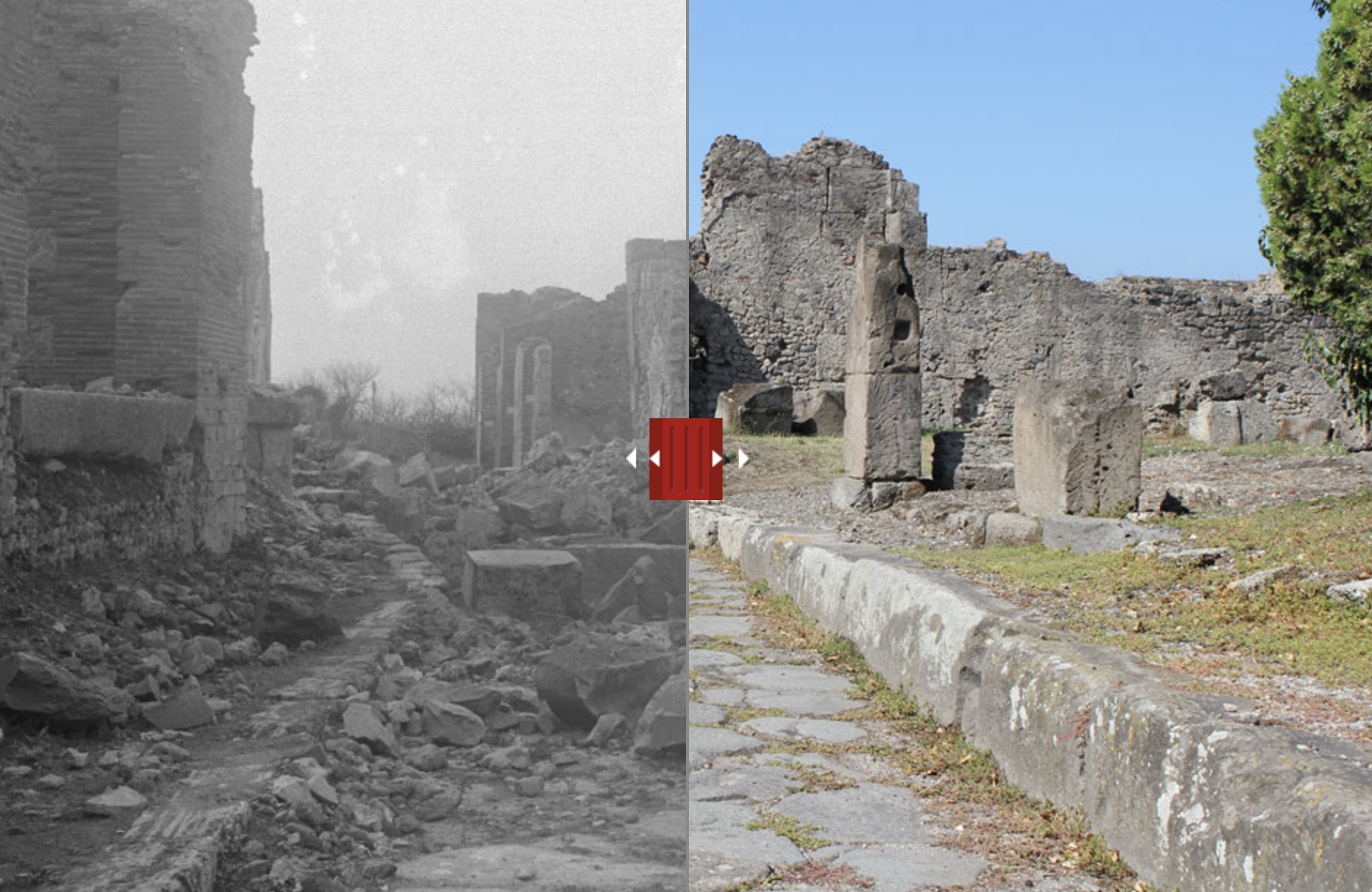
In the video above, you can learn more about the bombing of Pompeii. See photographs of the destruction at Pompeii Commitment and at the Getty Museum, which features photos of Pompeiian sites destroyed by bombing side-by-side with color images of the rebuilt sites today. These images are dramatic, enough to make us pay attention to the seams and joints if we have the chance to visit, or revisit, the famous archeological site in the future. And we might want to ask our guide if we can see not only the ruins of the natural disaster, but also the multiple undetonated bombs from the “apocalypse” of World War II.
Related Content
Pompeii Rebuilt: A Tour of the Ancient City Before It Was Entombed by Mount Vesuvius
A Drone’s Eye View of the Ruins of Pompeii
Josh Jones is a writer and musician based in Durham, NC. Follow him at @jdmagness
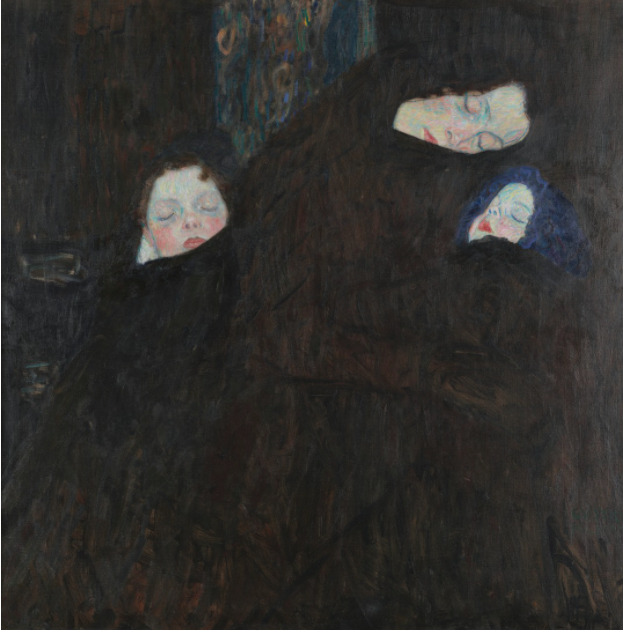
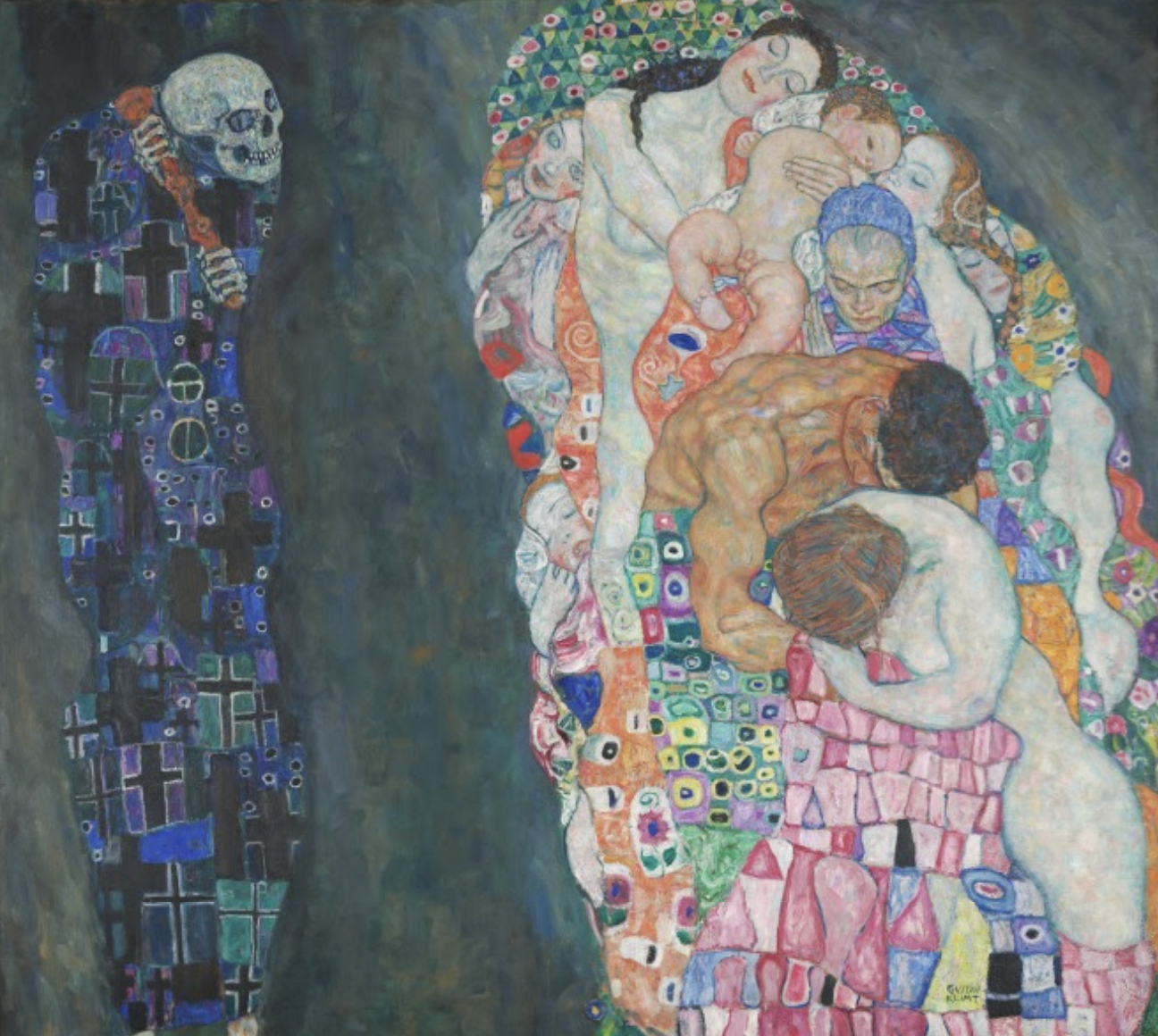
Read More...136 Paintings by Gustav Klimt Now Online (Including 63 Paintings in an Immersive Augmented Reality Gallery)
At the end of World War II the Nazis burned an Austrian castle full of masterpieces, including three paintings by Gustav Klimt entitled Philosophy, Medicine, and Jurisprudence. Called the “Faculty Paintings,” these were commissioned by the University of Vienna for the ceiling of its Great Hall in 1900, then, upon completion seven years later, were deemed pornographic and never exhibited. Until now, they were preserved for posterity only in black and white photographs.
Thanks to cutting edge art restoration AI, the monochromatic images of Klimt’s Faculty Paintings have been reconstructed in color. They are now on display in an online gallery of 130 paintings, plus a virtual exhibition of 63 of the artist’s works, all brought together by Google Arts & Culture and appropriately called Klimt vs. Klimt. It’s a retrospective exploring the artist’s many contradictions. Was he a “scholar or innovator? Feminist or womanizer? Famous artist or humble craftsman? The answer, in most cases, is both,” notes Google. There’s more, of course, given the venue, as Art Daily explains:
The exhibition features an immersive Augmented Reality Pocket Gallery, which digitally organizes 63 of Klimt’s masterworks under a single roof. Audiences can virtually walk the halls of the gallery space at scale and zoom in on the paintings’ fine ornamentation and pattern, characteristic of Klimt’s practice, made possible by the digitization of his iconic artworks in ultra-high resolution.
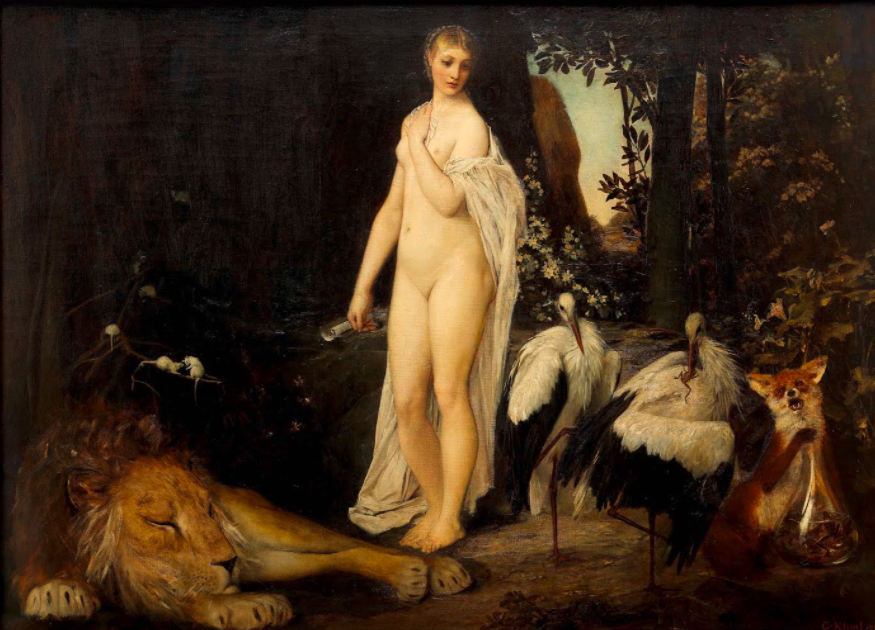
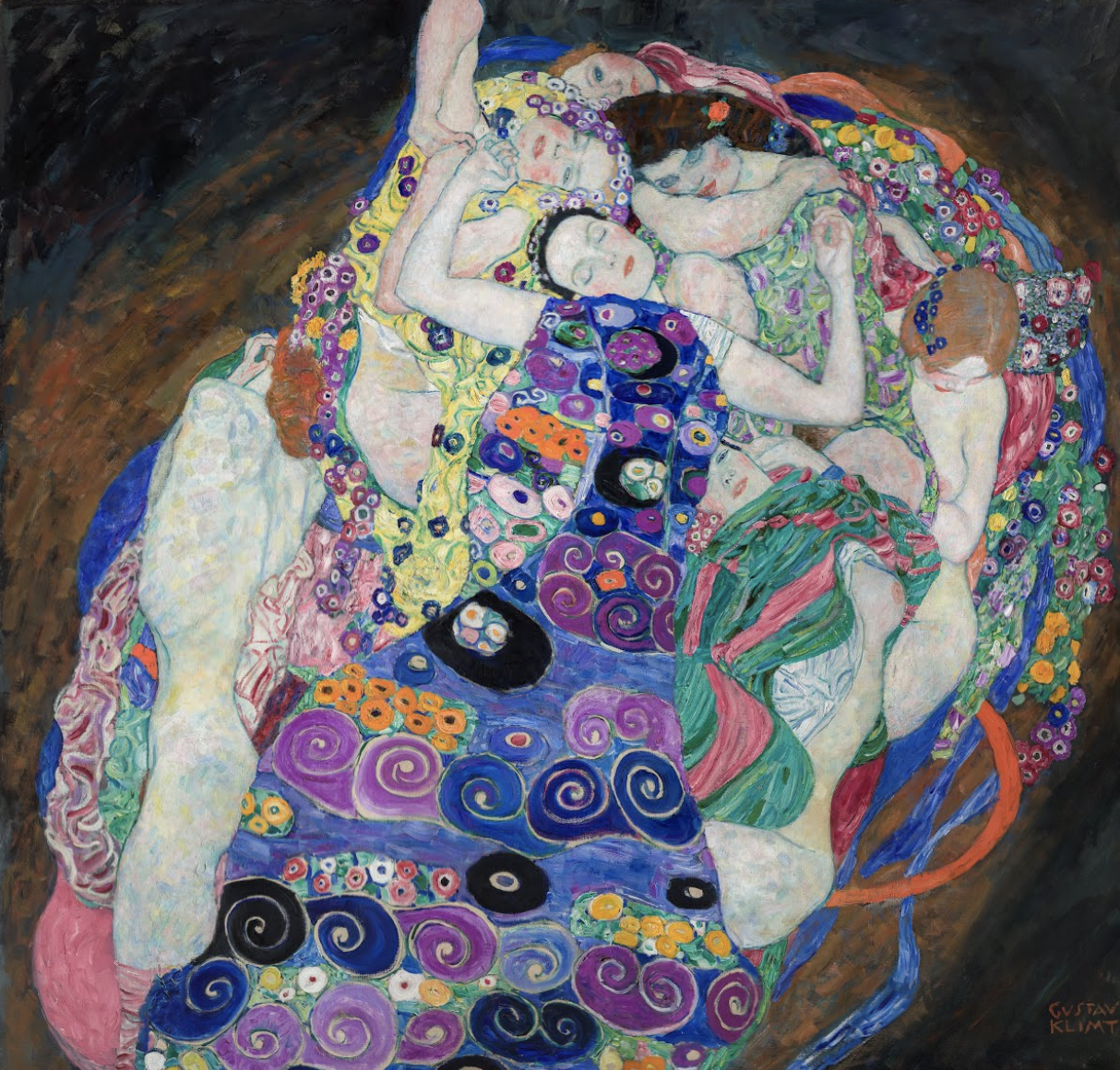
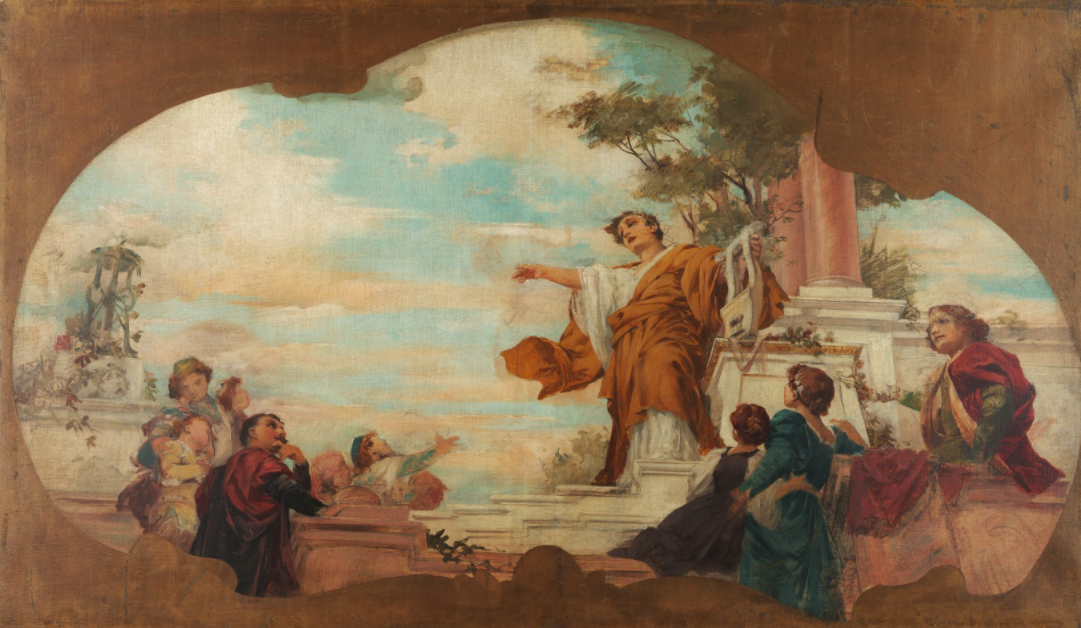
With respect to the first pair of oppositions (that is, scholar or innovator?), Klimt was assuredly both, though not exactly at the same time. Trained as an architectural painter at the University of Applied Arts in Vienna, his early work is solidly academic — realist, formal, classical and conservative.
So conservative an artist was Klimt, in fact, he was elected an honorary member of the University of Munich and the University of Vienna, and in 1888 Klimt received the Golden Order of Merit from Austrian Emperor Franz Josef I … before, that is, his work was judged obscene — a judgment that did surprisingly little to hinder Klimt’s career.
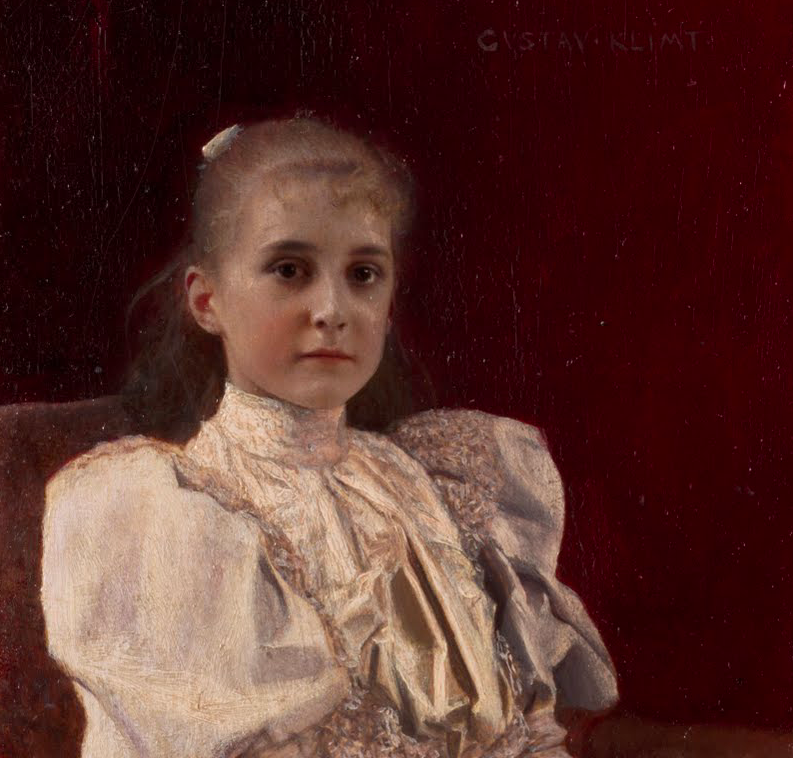
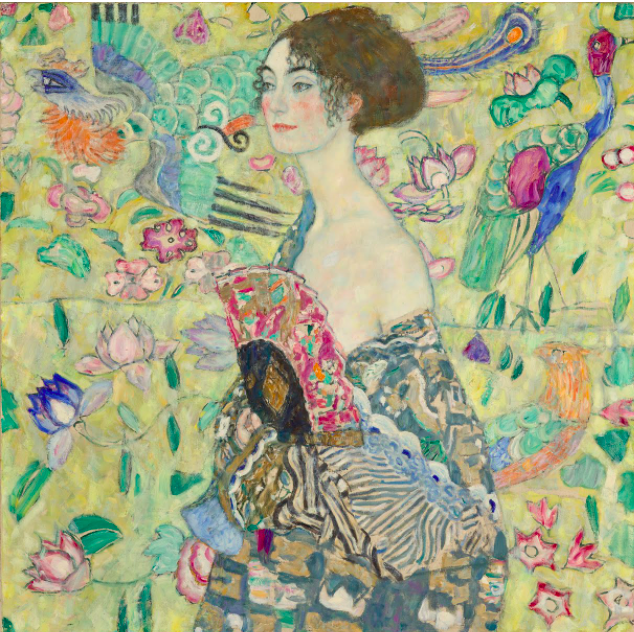
At the end of the 19th century, Klimt abruptly shifted focus, particularly after the death of his artist brother Ernst and his father, a gold engraver, in 1892. He became a founding member of the Vienna Secession movement, producing some of his most famous Symbolist works during his “Golden Phase,” when many of his works contained real gold leaf in tribute not only to his father but to the Byzantine art he saw during visits to Venice and Ravenna. This was the height of Klimt’s career, when he produced such works as The Kiss, The Embrace, and Fulfillment and Expectation, “probably the ultimate stage of my development of ornament,” he said.
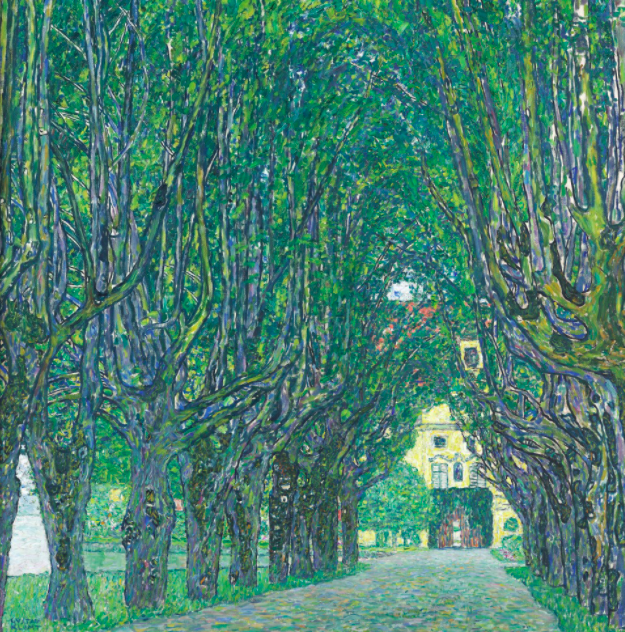
In many ways, Klimt embodied contradiction. An admirer of society and luxury, he also spurned company, turned away all visitors, and spending so much time painting landscapes during summer holidays that locals called him Waldschrat, “forest demon.” Renowned for his sexual adventurousness (he supposedly fathered 14 children), Klimt was also an intensely focused and isolated individual. In a piece entitled “Commentary on a Non-Existent Self-Portrait,” he writes:
I have never painted a self-portrait. I am less interested in myself as a subject for a painting than I am in other people, above all women… There is nothing special about me. I am a painter who paints day and day from morning to night… Whoever wants to know something about me… ought to look carefully at my pictures.
Look carefully at an online gallery of Klimt’s works here. And see the immersive Augmented Reality gallery here.
Related Content:
Josh Jones is a writer and musician based in Durham, NC. Follow him at @jdmagness
Read More...Slot Machine Age: A 1964 British Newsreel Angsts Over Whether Automated Machines Will Displace People
When Americans hear the phrase “slot machine,” they think of pensioners compulsively pulling levers day and night in Las Vegas. But when the British hear it, a much less bleak vision comes to their minds: the automated dispensation of cigarettes, coffee, groceries, and even entire meals. Or at least such a vision came to the minds of Britons back in 1964, the year of the British Pathé newsreel above. With its brilliant colors and jazzy score, Slot Machine Age proudly displayed to the viewing public the range of coin-operated wonders already making their way into daily life, from pay phones and pinball machines to shoe-buffers and bottle-recycling stations.
“This invention, this brainchild of the boffins, has created a new disease,” declares the announcer: “slot machine fever.” Again, this has nothing to do with gambling, and everything to do with automation. Nearly 60 years ago, buying something from a machine was a novelty to most people in even the most highly industrialized countries on Earth.
Yet even then the automat, where diners pulled all their dishes from coin-operated windows, had in certain cities been an institution for decades. Alas, such establishments didn’t survive the explosion of fast food in the 1970s, whose business model made use of more, not less, human labor.
But in the 1960s, the age of the robot seemed well on its way — so much so that this phrase titles another, slightly later British Pathé production showcasing a “semi-computerized version of the dumbwaiter” being tried out in hotel rooms. From it the film’s honeymooning couple extract cocktails, peanuts, toothpaste, and “that last cigarette of the day.” It even offers reading material, a concept since tried again in France, Poland, San Francisco, and an eccentric bookstore in Toronto, but the glorious age of all-around convenience predicted in these newsreels has yet to materialize. We citizens of the 21st century are in many cases hardly pleased, but rather anxious about what we see as our growing dependence on automation. Still, with the coronavirus-induced vogue for contact-free payment and dining, perhaps it’s time to give the automat another chance.
Related Content:
Watch 85,000 Historic Newsreel Films from British Pathé Free Online (1910–2008)
Hear Alan Watts’s 1960s Prediction That Automation Will Necessitate a Universal Basic Income
Watch the “Biblio-Mat” Book-Vending Machine Dispense Literary Delight
Based in Seoul, Colin Marshall writes and broadcasts on cities, language, and culture. His projects include the Substack newsletter Books on Cities, the book The Stateless City: a Walk through 21st-Century Los Angeles and the video series The City in Cinema. Follow him on Twitter at @colinmarshall or on Facebook.
Read More...What Makes a “Cult” Band? Pretty Much Pop: A Culture Podcast #107
What makes for a “cult band”? Not just a small audience, because Grateful Dead fans are an archetypical cult. Not just a devoted, emotionally invested audience; no volume of Swifties make Taylor Swift qualify as a cult act. Does the music have to be somehow inaccessible, or the fans snobby?
Your host Mark Linsenmayer and three other musicians try to figure it out:
- Tim Quirk, frontman of Too Much Joy, writer and music executive
- Aaron David Gleason, musician and actor
- Chris Sunami writes The Pop Culture Philosopher blog, among other things
A few of the names that come up for consideration are Tom Waits, The Cure, XTC, Big Star, Brian Wilson, Lou Reed, Guided by Voices, David Bowie, R.E.M., The Residents, Os Mutantes, Tony Owens, Phil Judd, Mike “Sport” Murphy, and many more.
We talk about how the Internet has affected fandom and the music business, the power of musicians lauding each other, and how music fandom relates to other fandom.
Listen to Tim on Nakedly Examined Music and The Partially Examined Life. Read his blog 5‑star-songs. Read his article “Hopelessly Devote: Cult Bands.” Follow him @tbquirk.
Listen to Aaron talking about his songs on Nakedly Examined Music, on Pretty Much Pop last year (talking about Borat), and as part of a Partially Examined Life audioplay (also featuring PMP favorite Erica Spyres and cult actress Lucy Lawless). Listen to the song he mentions that resulted from a Tik-Tok collaboration with cult artist Emma Freeman. Follow him on Facebook.
Read Chris’ post-mortem on cult artist Fountains of Wayne’s Adam Schlesinger.
A couple of articles that fed into this included:
- “The 8 Most Annoying Band Cult Followings in America” by Clayton Guse
- “The 12 Strangest Albums With Rabid Cult Followings” by Sean Kelly
- “List ‘Em Carefully: The Top 15 Cult Acts” by Ted Maider (from back in 2011)
Just to explain one of Mark’s comments, there really was a playset for “the hatch” for the TV show Lost.
This episode includes bonus discussion you can access by supporting the podcast at patreon.com/prettymuchpop or by choosing a paid subscription through Apple Podcasts. This podcast is part of the Partially Examined Life podcast network.
Pretty Much Pop: A Culture Podcast is the first podcast curated by Open Culture. Browse all Pretty Much Pop posts.
Read More...Behold the Photographs of John Thomson, the First Western Photographer to Travel Widely Through China (1870s)

In the early 1860s, a few Westerners had seen China — but nearly all of them had seen it for themselves. The still-new medium of photography had yet to make images of everywhere available to viewers everywhere else, which meant an opportunity for traveling practitioners like John Thomson. “The son of a tobacco spinner and shopkeeper,” says BBC.com, ” he was apprenticed to an Edinburgh optical and scientific instrument manufacturer where he learned the basics of photography.”
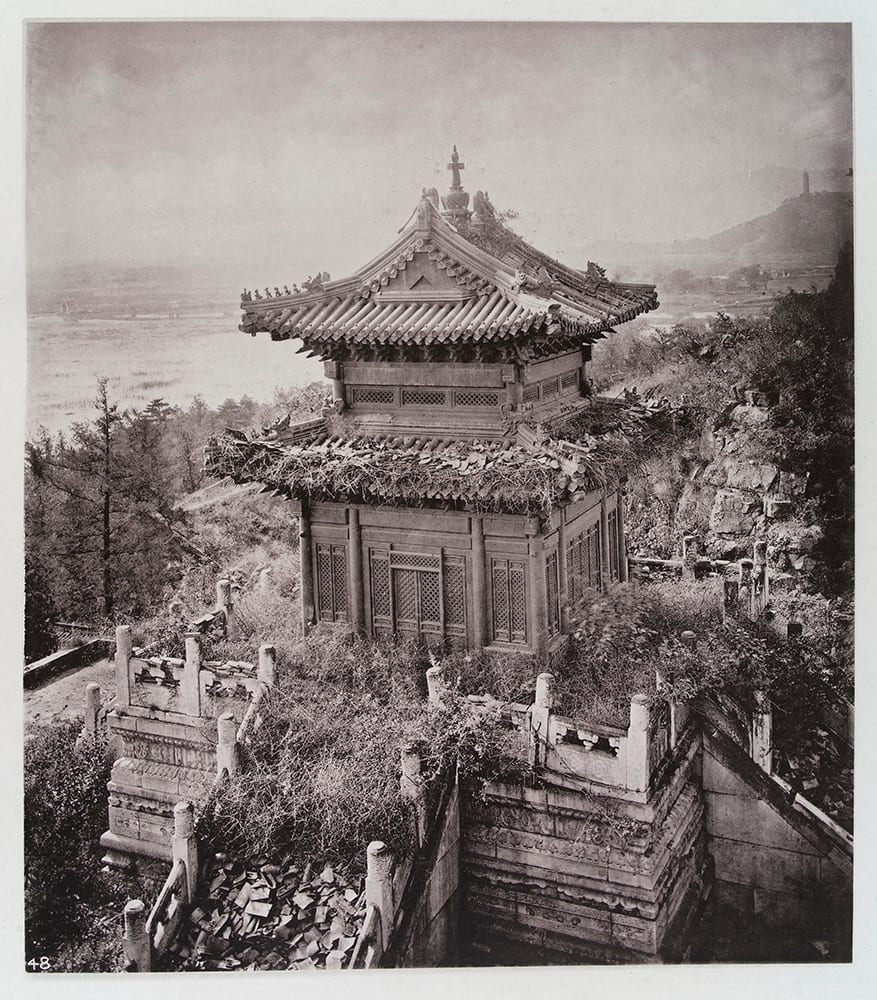
In 1862 Thomson sailed from Leith “with a camera and a portable dark room. He set up in Singapore before exploring the ancient civilizations of China, Thailand — then known as Siam — and Cambodia.” It is for his extensive photography of China in the late 1860s and early 1870s that he’s best known today.
First lavishly published in a series of books titled Illustrations of China and Its People (now available to read free online at the Yale University Library: volume one, volume two, volume three, volume four), they now constitute some of the earliest and richest direct visual records of Chinese landscapes, cityscapes, and society as they were in the late 19th century.

“The first Western photographer to travel widely through the length and breadth of China,” Thomson brought his camera on journeys “far more extensive than those undertaken by most Westerners of his generation,” extending “beyond the relative comfort and safety of the coastal treaty ports.” Those words come from scholar of the 19th-century Allen Hockley, whose five-part visual essay “John Thomson’s China” at MIT Visualizing Cultures provides a detailed overview and historical contextualization of Thomson’s work in Asia.

Thomson’s photographs, writes Hockley, “fall into two broad categories: scenic views and types. Views encompassed both natural landscapes and built environments. They could be panoramic, taking in large swaths of scenery, or they might highlight specific natural phenomena or individual structures.”

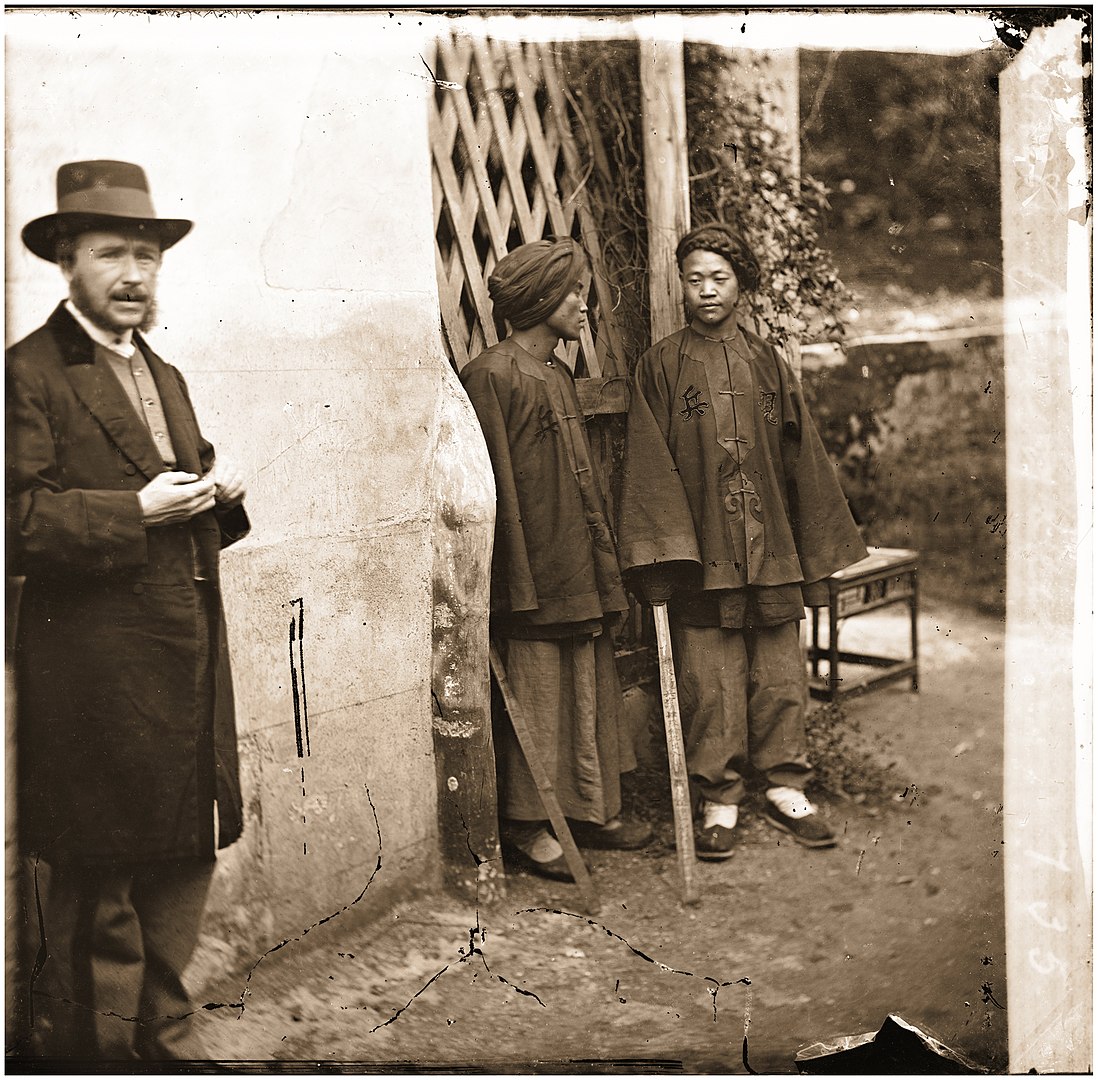
Types “focused on the manners and customs of Chinese people and tended to highlight the defining features of gender, age, class, ethnicity, and occupation.” A century and a half later, both Thomson’s views and types have given scholars in a variety of disciplines much to discuss.
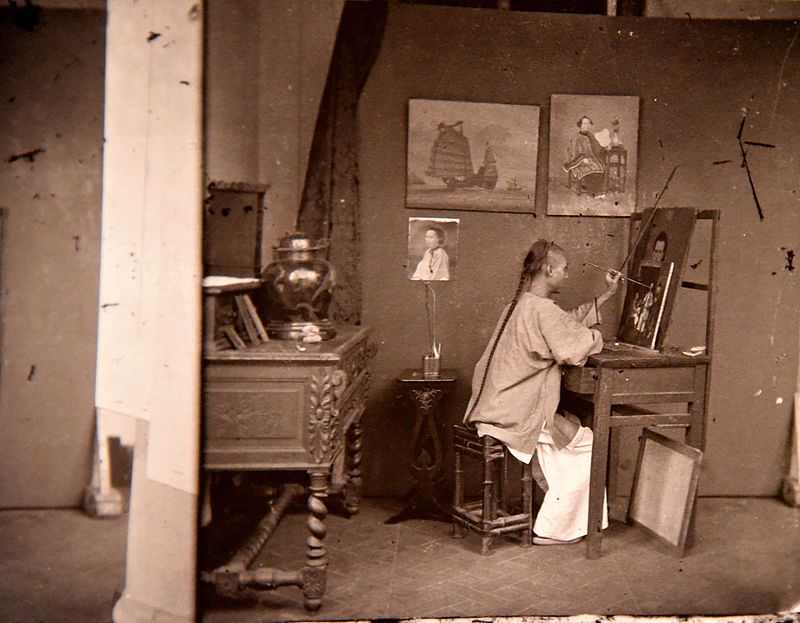
“It is clear from his commentary to Illustrations of China that, however sympathetic he was towards Chinese people, he could often be superior and high-handed,” writes Andrew Hiller at Visualizing China. “If Thomson never sought to question the validity of Britain’s presence, his attitude towards China was ambivalent. Whilst critical of what he saw as the corruption and obfuscation of Qing officials, he nevertheless could see the country’s potential.”

Thomson also helped others to see that potential — or at least those who could afford to buy his books, whose prices matched the quality of their production. But today, thanks to online archives like Historical Photographs of China and Wellcome Collection, they’re free for everyone to behold. China itself has become much more accessible since Thomson’s day, of course, but it’s famously a much different place than it was 25 years ago, let alone 150 years ago. The land through which he traveled — and of which he took so many of the very earliest photographs — is now infinitely less accessible to us than it ever was to his fellow Westerners of the 19th century.
Hear a lecture on Thomson’s photography in China from the University of London here.
Related Content:
How Vividly Colorized Photos Helped Introduce Japan to the World in the 19th Century
1850s Japan Comes to Life in 3D, Color Photos: See the Stereoscopic Photography of T. Enami
Based in Seoul, Colin Marshall writes and broadcasts on cities, language, and culture. His projects include the Substack newsletter Books on Cities, the book The Stateless City: a Walk through 21st-Century Los Angeles and the video series The City in Cinema. Follow him on Twitter at @colinmarshall or on Facebook.
Read More...Watch Free Cult Films by Stanley Kubrick, Fritz Lang, Boris Karloff, Bela Lugosi & More on the New Kino Cult Streaming Service
For many Open Culture readers, the Halloween season offers an opportunity — not to say an excuse — to re-experience classic horror films: F.W. Murnau’s Nosferatu from 1922, for instance, or even George Méliès The Haunted Castle, which launched the whole form in 1896. This year, may we suggest a home screening of the formidable work of vintage cinema that is 1968’s The Astro Zombies? Written, produced, and directed by Ted Mikels — auteur of The Corpse Grinders and Blood Orgy of the She-Devils — it features not just “a mad astro-scientist” played by John Carradine and “two gore-crazed, solar-powered killer robot zombies,” but “a bloody trail of girl-next-door victims; Chinese communist spies; deadly Mexican secret agents led by the insanely voluptuous Tura Satana” and an “intrepid CIA agent” on the case of it all.
You can watch The Astro Zombies for free, and newly remastered in HD to boot, at Kino Cult, the new streaming site from film and video distributor Kino Lorber. Pull up the front page and you’ll be treated to a wealth of titillating viewing options of a variety of eras and subgenres: “Drive-in favorites” like Ape and Beware! The Blob; “golden age exploitation” like Reefer Madness and She Shoulda Said ‘No’!; and even classics like Fritz Lang’s Metropolis and Stanley Kubrick’s Fear and Desire.
True cult-film enthusiasts, of course, may well go straight to the available selections, thoughtfully grouped together, from “Master of Italian Horror” Mario Bava and prolific Spanish “B‑movie” kingpin Jesús Franco. Those looking to throw a fright night might consider Kino Cult’s offerings filed under “hardboiled horror”: Killbillies, The House with 100 Eyes, Bunny: The Killer Thing.
Few of these pictures skimp on the grotesque; fewer still skimp on the humor, a necessary ingredient in even the most harrowing horror movies. Far from a pile of cynical hackwork, Kino Cult’s library has clearly been curated with an eye toward films that, although for the most part produced inexpensively and with unrelenting intent to provoke visceral reactions in their audiences, are hardly without interest to serious cinephiles. The site even includes an “artsploitation” section containing such taboo-breaching works as Curtis Burz’s Summer House. Among its general recent additions you’ll also find Dogtooth by Yorgos Lanthimos, perhaps the most daring high-profile provocateur currently at work in the medium. Since Kino Cult has made all these films and more available to stream at no charge, none of us, no matter our particular cinematic sensibilities, has an excuse to pass this Halloween un-entertained — and more to the point, undisturbed. Enter the collection here.
Related Content:
4,000+ Free Movies Online: Great Classics, Indies, Noir, Westerns, Documentaries & MoreThe First Horror Film, George Méliès’ The Haunted Castle (1896)
Watch Nosferatu, the Seminal Vampire Film, Free Online (1922)
Martin Scorsese Creates a List of the 11 Scariest Horror Films
Stephen King’s 22 Favorite Movies: Full of Horror & Suspense
Based in Seoul, Colin Marshall writes and broadcasts on cities, language, and culture. His projects include the Substack newsletter Books on Cities, the book The Stateless City: a Walk through 21st-Century Los Angeles and the video series The City in Cinema. Follow him on Twitter at @colinmarshall or on Facebook.
Read More...Support Us
We're hoping to rely on loyal readers, rather than erratic ads. Please click the Donate button and support Open Culture. You can use Paypal, Venmo, Patreon, even Crypto! We thank you!

About Us

Open Culture scours the web for the best educational media. We find the free courses and audio books you need, the language lessons & educational videos you want, and plenty of enlightenment in between.
Advertise With Us
FREE UPDATES!
GET OUR DAILY EMAIL
Get the best cultural and educational resources on the web curated for you in a daily email. We never spam. Unsubscribe at any time.
FOLLOW ON SOCIAL MEDIA
Open Culture editor Dan Colman scours the web for the best educational media. He finds the free courses and audio books you need, the language lessons & movies you want, and plenty of enlightenment in between.
Advertise With Us

