The Earliest Known Customer Complaint Was Made 3,800 Years Ago: Read the Rant on an Ancient Babylonian Tablet
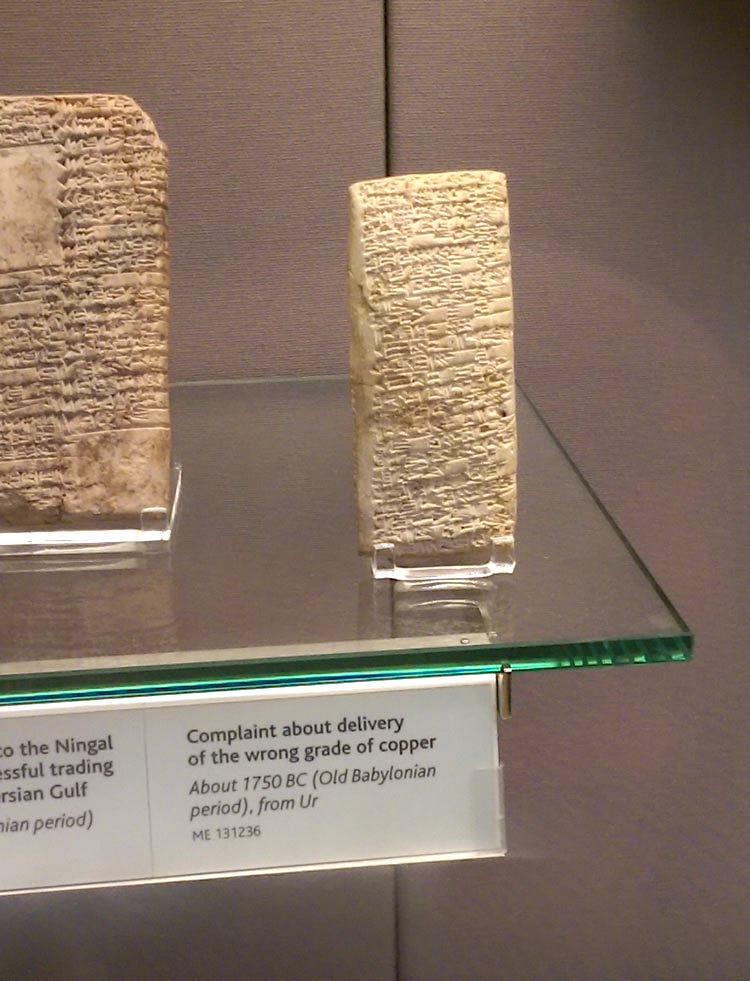
Image via Wikimedia Commons
The site Fast Company published an article that describes the “Complaint Restraint project,” an initiative that aims to create a “positive life by eliminating negative statements.” It’s an admirable goal. Though most of us have a perverse love of wallowing in our misery—a human trait amplified a thousandfold by the internet—complaining rarely makes things any better. As in the Buddha’s parable of the “second arrow,” our griping can make our sufferings doubly painful; as in the parable of the “poisoned arrow,” it can postpone or substitute for the constructive actions we need to take in order to heal or improve our condition.
But it would be a mistake to think that complaining is somehow a recent phenomenon, though we may hear more of it every day, all the time, from every quarter of the globe. The Buddhist arrow stories are, after all, at least a couple thousand years old; lamentation more or less constitutes its own genre in Biblical literature.
Even older still than these religious sources is the first documented customer service complaint, a specific variety of complaining that we might be forgiven for associating mainly with a modern, consumerist age—and one of the few kinds of complaints that can generate positive results.
Absent a Yelp app, the ancient Babylonian consumer in this case inscribed his complaint on a clay tablet—which now resides at the British Museum—sometime around 1750 B.C. The irate purchaser here, Nanni, writing to someone named Ea-nasir, received a shipment of copper ore of an inferior grade, after some annoying delay and in a damaged condition. In the translation below from Assyriologist A. Leo Oppenheim, Nanni vents his spleen.
Tell Ea-nasir: Nanni sends the following message:
When you came, you said to me as follows : “I will give Gimil-Sin (when he comes) fine quality copper ingots.” You left then but you did not do what you promised me. You put ingots which were not good before my messenger (Sit-Sin) and said: “If you want to take them, take them; if you do not want to take them, go away!”
What do you take me for, that you treat somebody like me with such contempt? I have sent as messengers gentlemen like ourselves to collect the bag with my money (deposited with you) but you have treated me with contempt by sending them back to me empty-handed several times, and that through enemy territory. Is there anyone among the merchants who trade with Telmun who has treated me in this way? You alone treat my messenger with contempt! On account of that one (trifling) mina of silver which I owe(?) you, you feel free to speak in such a way, while I have given to the palace on your behalf 1,080 pounds of copper, and umi-abum has likewise given 1,080 pounds of copper, apart from what we both have had written on a sealed tablet to be kept in the temple of Samas.
How have you treated me for that copper? You have withheld my money bag from me in enemy territory; it is now up to you to restore (my money) to me in full.
Take cognizance that (from now on) I will not accept here any copper from you that is not of fine quality. I shall (from now on) select and take the ingots individually in my own yard, and I shall exercise against you my right of rejection because you have treated me with contempt.
It does seem that Nanni maybe took this poor service a little too personally. In any case, let’s hope he received some satisfaction for the trouble it must have taken to inscribe this angry message.
Note: An earlier version of this post appeared on our site in 2015.
Related Content:
Mark Twain Drafts the Ultimate Letter of Complaint (1905)
Hunter S. Thompson Calls Tech Support, Unleashes a Tirade Full of Fear and Loathing (NSFW)
Behold the Oldest Written Text in the World: The Kish Tablet, Circa 3500 BC
Hear the Oldest Song in the World: A Sumerian Hymn Written 3,400 Years Ago
How to Write in Cuneiform, the Oldest Writing System in the World: A Short Introduction
Hear the Earliest Recorded Customer Complaint Letter: From Ancient Sumeria 1750 BC
Josh Jones is a writer and musician based in Durham, NC.
Read More...Was the Baghdad Battery Actually a Battery?: An Archaeologist Demystifies the 2,000-Year-Old Artifact
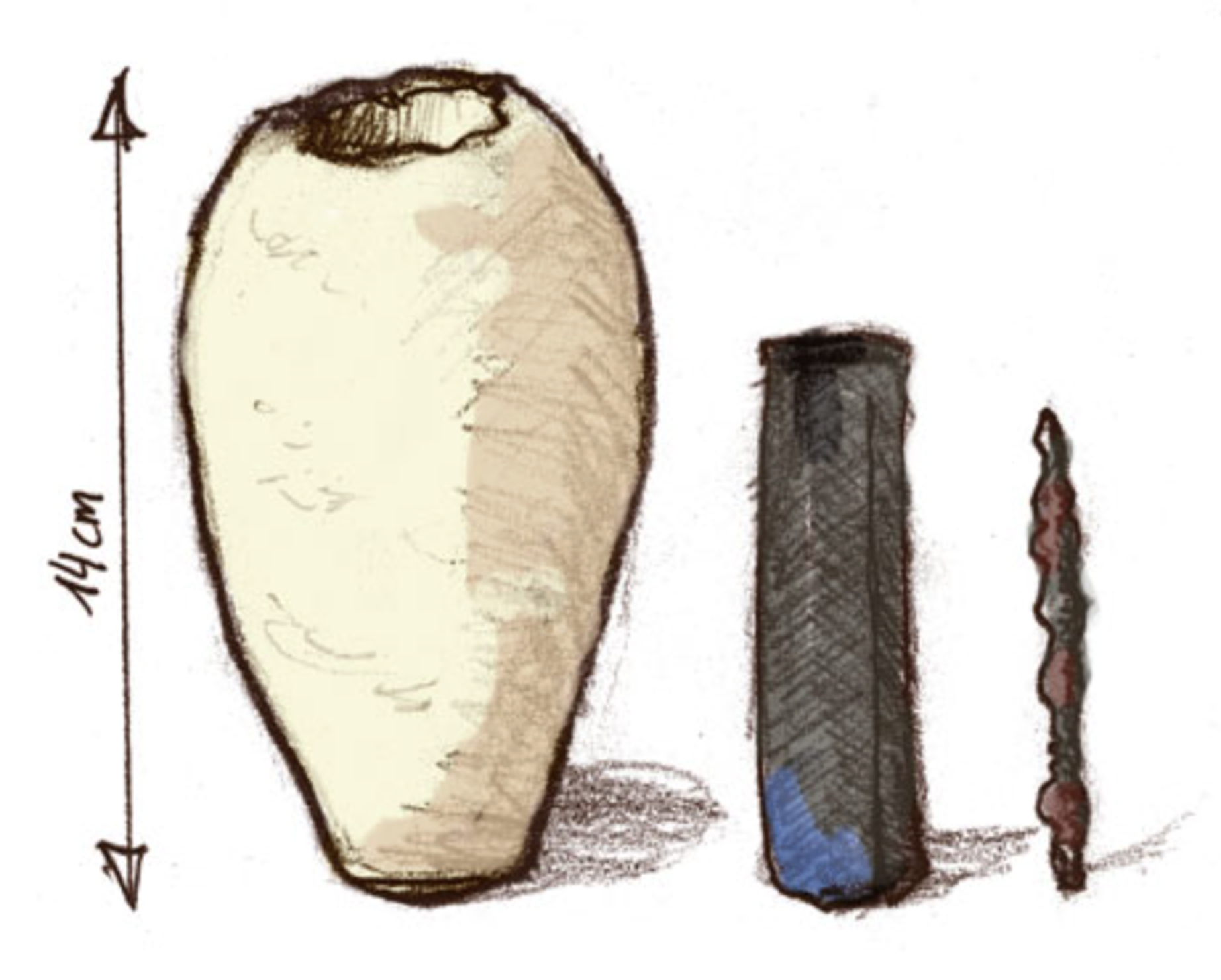
Image by Ironie, via Wikimedia Commons
The average Open Culture reader may well be aware that there is such a thing as Archaeology YouTube. What could come as more of a surprise is how much back-and-forth there is within that world. Below, we have a video from the channel Artifactually Speaking in which Brad Hafford, a University of Pennsylvania archaeologist, gives his take on the so-called Baghdad Battery, an ancient artifact discovered in modern-day Iraq. He does so in the form of a response to an earlier video on the Baghdad Battery from another channel hosted by a young archaeology educator called Milo Rossi. At some points Hafford agrees, and at others he has corrections to make, but surely both YouTubers can agree on the fascination of the object in question. After all: an ancient battery?
Even those of us without any particular investment in archaeology may find our curiosity piqued by the notion that some long-vanished civilization had managed to harness electricity. The name Baghdad Battery was granted in the first place by Wilhelm König, who was the director of the laboratory of the National Museum of Iraq in the nineteen-thirties, when the object was originally discovered.
Given that it consisted of not just a ceramic pot but also a copper tube and an iron rod, all attached to one another with bitumen (a substance present in crude oil used today in asphalt), the idea of its being used for power storage was logical, in its way, if also fantastically anachronistic. Not that König suggested the Baghdad Battery was used to power, say, a grid of streetlights; rather, he supposed that it could have been involved in some kind of electroplating system.
Unfortunately for König’s hypothesis, none of the other gilded artifacts recovered from ancient Iraq, no matter how fine their craft, were actually electroplated. More practically speaking, the Baghdad Battery has no means of connection to a circuit, a necessity to charge it up in the first place. As of now, the professional consensus holds that it must have been ceremonial: a default, as Rossi frames it, whenever archaeologists throw up their hands at a lack of dispositive evidence about an artifact’s original purpose. Though Hafford acknowledges that tendency, he also lays out the reasons he believes the mysteries don’t go quite as deep as popularizers tend to assume. Like any good YouTuber, archaeological or otherwise, Rossi responded with another video of his own, in which he addresses Hafford’s criticisms, and also keeps the Baghdad Battery — as well as its newly created namesake cocktail — firing up our imaginations a little longer.
Related Content:
Behold the Oldest Written Text in the World: The Kish Tablet, Circa 3500 BC
20 New Lines from The Epic of Gilgamesh Discovered in Iraq, Adding New Details to the Story
Based in Seoul, Colin Marshall writes and broadcasts on cities, language, and culture. His projects include the Substack newsletter Books on Cities and the book The Stateless City: a Walk through 21st-Century Los Angeles. Follow him on the social network formerly known as Twitter at @colinmarshall.
Read More...Isaac Asimov Predicts the Future on The David Letterman Show (1980)
In 1980, Newsweek published a cantankerous and sadly on-the-nose diagnosis of the United States’ “cult of ignorance” — written by one Isaac Asimov, “professor of biochemistry at Boston University School of Medicine” and “author of 212 books, most of them on various scientific subjects for the general public.” Given this intimidating biography, and the fact that Asimov believed that “hardly anyone can read” in the U.S., we might expect the science fiction legend wanted nothing to do with television. We would be wrong.
Asimov seemed to love TV. In 1987, for example, the four-time Hugo winner wrote a humorously critical takedown of ALF for TV Guide. And he was a consummate TV entertainer, making his first major TV appearance on Johnny Carson’s Tonight Show in 1968, appearing four times on The Mike Douglas Show in the next few years, and giving his final television interviews to Dick Cavett in a two-part series in 1989. The same year he wrote about America’s cult of ignorance, he appeared on The David Letterman show to crack wise with the biggest wiseass on TV. Asimov held his own and then some.
“Asimov, sixty in this video, proves himself a natural comedian,” writes the Melville House blog; “Letterman, thirty-three, can barely keep up.” Surely Asimov’s banter had nothing to do with The David Letterman Show’s cancellation three days later. (Letterman was back on the air for eleven seasons two years later.) Their interview ranges widely from pop culture (Asimov confesses his appreciation for both Star Wars and The Empire Strikes Back) to “the future of medicine, space exploration, hope for mankind, and much more,” Vic Sage writes at Pop Culture Retrorama.
Asimov’s dry delivery — honed during his English-and-Yiddish-speaking Brooklyn childhood — is delightful. But the writer, teacher, and scientist hasn’t only come on TV to crack jokes, promote a book, and flaunt his muttonchops. He wants to educate his fellow Americans about the state of the future. (His Newsweek bio was outdated. As Letterman says, his appearance marked the publication of his 221st book.) Like Hari Seldon, the hero of his 1951 novel Foundation, Asimov felt confident in his ability to predict the course of human progress (or regress, as the case may be).
He also felt confident answering questions about what to do with outer space, and where to “put more men,” as Letterman says. His recommendation to build “factories” may strike us as a banal forerunner of Jeff Bezos’ even more banal plans for office parks in space. Asimov boasts of the vision he had of “pocket computers” in 1950 — hardly a reality in 1980. Dave complains about how complicated computers are, and Asimov accurately predicts that as technology catches up, they will get simpler to use. “But these are little things,” he says. “I never tried to predict. I just tried to write stories to pay my way through college.” He must have paid it several times over, and he seemed to get more right than he got wrong. See more of Asimov’s predictions in the links below.
Note: An earlier version of this post appeared on our site in 2021.
Related Content:
Isaac Asimov Laments the “Cult of Ignorance” in the United States (1980)
Josh Jones is a writer and musician based in Durham, NC.
Read More...Read the Uplifting Letter That Albert Einstein Sent to Marie Curie During a Time of Personal Crisis (1911)
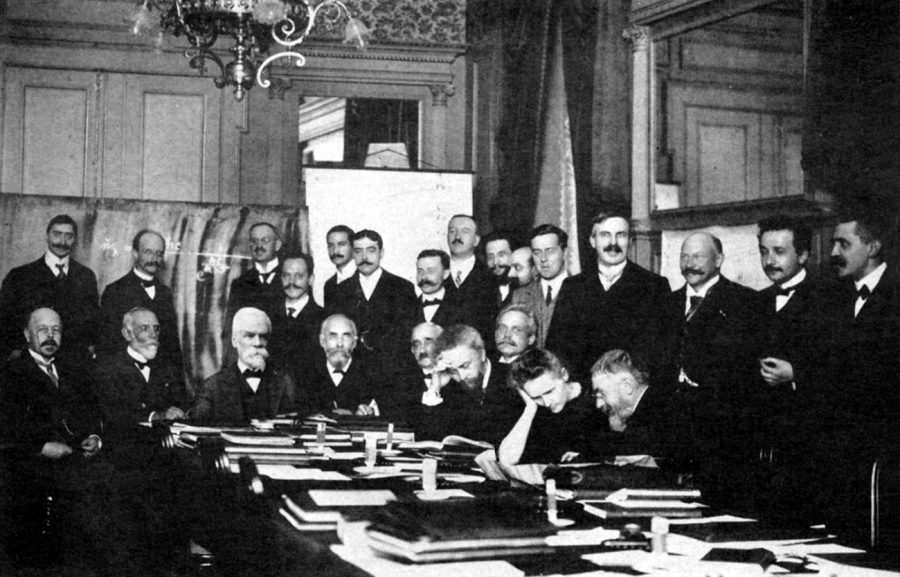
Marie Curie’s 1911 Nobel Prize win, her second, for the discovery of radium and polonium, would have been cause for public celebration in her adopted France, but for the nearly simultaneous revelation of her affair with fellow physicist Paul Langevin, the fellow standing to the right of a 32-year-old Albert Einstein in the above group photo from the 1911 Solvay Conference in Physics.
Both stories broke while Curie—unsurprisingly, the sole woman in the photo—was attending the conference in Brussels.
Equally unsurprisingly, the press preferred le scandale to la réalisation scientifique. Sex sells, then and now.
The fires of radium which beam so mysteriously…have just lit a fire in the heart of one of the scientists who studies their action so devotedly; and the wife and the children of this scientist are in tears.…
—Le Journal, November 4, 1911
There’s no denying that the affair was painful for Langevin’s family, particularly his wife, Jeanne, who supplied the media with incriminating letters from Curie to her husband. She must have been aware that Curie would be the one to bear the brunt of the public’s disapproval. Double standards with regard to gender are nothing new.
A furious throng gathered outside of Curie’s house and anti-Semitic papers, dissatisfied with labeling the pioneering scientist a mere home wrecker, declared—erroneously—that she was Jewish. The timeline was tweaked to suggest that Curie had taken up with Langevin prior to her husband’s death. Fellow radiochemist Bertram Boltwood seized the opportunity to declare that “she is exactly what I always thought she was, a detestable idiot.”
In the midst of this, Einstein, who had made Curie’s acquaintance at the conference, proved himself a true friend with a “don’t let the bastards get you down” letter, written on November 23. Other than a delicate allusion to Langevin as a person with whom he felt privileged to be in contact, he refrained from mentioning the cause of her misfortune.
A friendly word can go a long way in times of disgrace, and Einstein supplied his new friend with some stoutly unequivocal ones, denouncing the scandalmongers as “reptiles” feasting on sensationalistic “hogwash”:
Highly esteemed Mrs. Curie,
Do not laugh at me for writing you without having anything sensible to say. But I am so enraged by the base manner in which the public is presently daring to concern itself with you that I absolutely must give vent to this feeling. However, I am convinced that you consistently despise this rabble, whether it obsequiously lavishes respect on you or whether it attempts to satiate its lust for sensationalism! I am impelled to tell you how much I have come to admire your intellect, your drive, and your honesty, and that I consider myself lucky to have made your personal acquaintance in Brussels. Anyone who does not number among these reptiles is certainly happy, now as before, that we have such personages among us as you, and Langevin too, real people with whom one feels privileged to be in contact. If the rabble continues to occupy itself with you, then simply don’t read that hogwash, but rather leave it to the reptile for whom it has been fabricated.
With most amicable regards to you, Langevin, and Perrin, yours very truly,
A. Einstein
PS I have determined the statistical law of motion of the diatomic molecule in Planck’s radiation field by means of a comical witticism, naturally under the constraint that the structure’s motion follows the laws of standard mechanics. My hope that this law is valid in reality is very small, though.
That deliberately geeky postscript amounts to another sweet show of support. Perhaps it fortified Curie when a week later, she received a letter from Nobel Committee member Svante Arrhenius, urging her to skip the Prize ceremony in Stockholm. Curie rejected Arrhenius’ suggestion thusly:
The prize has been awarded for the discovery of radium and polonium. I believe that there is no connection between my scientific work and the facts of private life. I cannot accept … that the appreciation of the value of scientific work should be influenced by libel and slander concerning private life.
For a more in-depth look at Marie Curie’s nightmarish November, refer to “Honor and Dishonor” the sixteenth chapter in Barbara Goldsmith’s Obsessive Genius: The Inner World of Marie Curie.
Note: An earlier version of this post appeared on our site in 2018.
Related Content:
Marie Curie’s Research Papers Are Still Radioactive a Century Later
Marie Curie Invented Mobile X‑Ray Units to Help Save Wounded Soldiers in World War I
Ayun Halliday is an author, illustrator and theater maker in NYC.
Read More...How Frank Gehry (RIP) and the Guggenheim Museum Bilbao Changed Architecture
It felt, for quite some time there, like the age of Frank Gehry would never end. But now that the latest defining figure of American architecture — or technically, Canadian-American architecture — has died at the age of 96, the time has come to ask when, exactly, his age began. Or rather, with which building: Walt Disney Concert Hall in Los Angeles? The Louis Vuitton Foundation in Paris? The radical renovation of his own humble Santa Monica home often cited at the origin point of the metallic, deliberately incongruous, often nearly alien aesthetic now recognized around the world? According to the B1M video above, it is to the Guggenheim Museum Bilbao we must look to if we wish to understand the architecture of Frank Gehry — and much else besides.
The Guggenheim Bilbao was a challenging project when it was first conceived in the early nineteen-nineties, but then, Bilbao was a challenged setting. Once a prosperous port city, the Basque metropolis had fallen on hard times indeed, rapidly deindustrializing without much in the way of alternative appeal. Bilbao’s slight history with tourism went back to the mid-nineteenth century, but for many Spaniards, the prospect of turning the place into an international destination seemed remote at best. Still, an ambitious development plan was devised involving new infrastructure, including the city’s first metro system, centered around a branch of New York’s Solomon R. Guggenheim Museum.
With its original Fifth Avenue location designed by Frank Lloyd Wright (Gehry’s predecessor in the cultural role of the one architect, or “starchitect,” of whom everyone has heard), that institution had a certain degree of experience with daring building designs. Familiar though the look of its gleaming sculptural curves may be today, actually constructing their non-Euclidean geometric forms in reality required technologies never before widely employed in architecture, including the early 3D-modeling system CATIA (this video’s sponsor, incidentally). Nor was the search for the right exterior texture to reflect Bilbao’s distinctively cloudy skies especially straightforward, but it did benefit from good timing: Gehry determined that titanium could do the job, whereupon the mass decommissioning of Soviet submarines happened to dump a great deal of that material on the market.
In these technological, political, and economic ways, the Guggenheim Bilbao was a product of its time. As it happened, it and the associated redevelopments did, in fact, breathe new life into the city, which has inspired a decades-long “Bilbao effect” on projects around the world with similar goals, some of them also featuring Gehry-designed cultural institutions. As the B1M host Fred Mills puts it, “Telling a story like this really is like reading out a list of things that we, today, take for granted: the idea that a museum could be an international tourist attraction, the technology, the 3D design.” And, like most architects, Gehry is survived by not just his built legacy, but also a series of projects not yet complete — including the Guggenheim Abu Dhabi, scheduled to open its doors next year.
You can see a photo gallery of Gehry’s other groundbreaking architectural projects at The Guardian.
Related content:
Gehry’s Vision for Architecture
How Zaha Hadid Revolutionized Architecture & Drew Inspiration from Russian Avant-Garde Art
Take an Online Course on Design & Architecture with Frank Gehry
Frank Lloyd Wright Thought About Making the Guggenheim Museum Pink
Based in Seoul, Colin Marshall writes and broadcasts on cities, language, and culture. His projects include the Substack newsletter Books on Cities and the book The Stateless City: a Walk through 21st-Century Los Angeles. Follow him on the social network formerly known as Twitter at @colinmarshall.
Read More...“The Matilda Effect”: How Pioneering Women Scientists Have Been Written Out of Science History

Photo via Wikimedia Commons
The history of science, like most every history we learn, comes to us as a procession of great, almost exclusively white, men, unbroken but for the occasional token woman—well-deserving of her honors but seemingly anomalous nonetheless. “If you believe the history books,” notes the Timeline series The Matilda Effect, “science is a guy thing. Discoveries are made by men, which spur further innovation by men, followed by acclaim and prizes for men. But too often, there is an unsung woman genius who deserves just as much credit” and who has been overshadowed by male colleagues who grabbed the glory.
In 1993, Cornell University historian of science Margaret Rossiter dubbed the denial of recognition to women scientists “the Matilda effect,” for suffragist and abolitionist Matilda Joslyn Gage, whose 1893 essay “Woman as an Inventor” protested the common assertion that “woman… possesses no inventive or mechanical genius.” Such assertions, Gage proceeded to demonstrate, “are carelessly or ignorantly made… although woman’s scientific education has been grossly neglected, yet some of the most important inventions of the world are due to her.”
Over 100 years later, Rossiter’s tenacious work in unearthing the contributions of U.S. women scientists inspired the History of Science Society to name a prestigious prize after her. The Timeline series profiles a few of the women whom it describes as prime examples of the Matilda effect, including Dr. Lise Meitner, the Austrian-born physicist and pioneer of nuclear technology who escaped the Nazis and became known in her time as “the Jewish Mother of the Bomb,” though she had nothing to do with the atomic bomb. Instead, “Meitner led the research that ultimately discovered nuclear fission.” But Meitner would become “little more than a footnote in the history of Nazi scientists and the birth of the Atomic age.”
Instead, Meitner’s colleague Otto Hahn received the accolades, a Nobel Prize in Chemistry and “renown as the discoverer of nuclear fission. Meitner, who directed Hahn’s most significant experiments and calculated the energy release resulting from fission, received a few essentialist headlines followed by decades of obscurity.” (See Meitner and Hahn in the photo above.) Likewise, the name of Alice Augusta Ball has been “all but scrubbed from the history of medicine,” though it was Ball, an African American chemist from Seattle, Washington, who pioneered what became known as the Dean Method, a revolutionary treatment for leprosy.
Ball conducted her research at the University of Hawaii, but she tragically died at the age of 24, in what was likely a lab accident, before the results could be published. Instead, University President Dr. Arthur Dean, who had co-taught chemistry classes with Ball, continued her work. But he failed “to mention Ball’s key contribution” despite protestations from Dr. Harry Hollmann, a surgeon who worked with Ball on treating leprosy patients. Dean claimed credit and published their work under his name. Decades later, “the scant archival trail of Alice Ball was rediscovered…. In 2000, a plaque was installed at the University of Hawaii commemorating Ball’s accomplishments.”
Other women in the Matilda effect series include bacterial geneticist Esther Lederberg, who made amazing discoveries in genetics that won her husband a Nobel Prize; Irish astrophysicist Jocelyn Bell Burnell, who discovered the first radio pulsars in 1967, but was excluded from the Nobel awarded to her thesis supervisor Antony Hewish and astronomer Martin Ryle. A similar fate befell Dr. Rosalind Franklin, the chemist excluded from the Nobel awarded to her colleagues James Watson, Francis Crick, and Maurice Wilkins for the discovery of DNA.
These prominent examples are but the tip of the iceberg when it comes to women who made significant contributions to scientific history and were rewarded by being written out of it and denied awards and recognition in their lifetime. For more on the history of U.S. women in science and the social forces that worked to exclude them, see Margaret Rossiter’s three-volume Women Scientists in America series: Struggles and Strategies to 1940, Before Affirmative Action, 1940–1972, and Forging a New World since 1972. And read Timeline’s Matilda Effect series of articles here.
Note: An earlier version of this post appeared on our site in 2018.
Related Content:
Women Scientists Launch a Database Featuring the Work of 9,000 Women Working in the Sciences
Josh Jones is a writer and musician based in Durham, NC.
Read More...The Gnostic Gospels: An Introduction to the Forbidden Teachings of Jesus
It would be impossible to understand Western civilization without understanding the history of Christianity. But in order to do that, it may serve us well to think of it as the history of Christianities, plural. So suggests Hochelaga creator Tommie Trelawny in the new video above, which explains the Gnostic Gospels, the “forbidden teachings of Jesus.” As a system of beliefs, Gnosticism is a fairly far cry from the mainstream forms of Christianity with which most of us are familiar today. But its surviving texts may sound uncannily familiar, despite also involving outlandish-sounding elements that seem to belong to another civilization entirely. Gnostic teachings have long been considered heresy by Christians, but do they really represent just a different evolutionary branch of the faith: another Christianity?
Religious scholars of many stripes have concerned themselves with few matters as intensively as they have with theodicy, that is, the matter of how to square the notion of a good, omnipotent deity with the obvious existence of evil down here in the world. Since its loose coalition of beliefs came together in the late first century, Gnosticism has proposed an elegant solution: that the deity is not, in fact, good, or rather, that under the transcendent, unknowable God is a much more poorly behaved “demiurge” who displays an indifference, at best, to the lot of humanity. In this view, our resulting world is less a perfect creation than a cosmic mistake — a proposition that would account for certain of its qualities we experience on the day-to-day level, even if we have no particular religious proclivities.
Thanks to the discovery of Egypt’s Nag Hammadi library in 1945, we can directly access many of the teachings of the so-called “Gnostic Gospels.” They tell us, to make a few grand simplifications, that our reality is illusory and that we can only come to grasp the true nature of both it and ourselves through esoteric learning, gnosis being the ancient Greek term for knowledge. This worldview may bring to mind that of certain Greek philosophers, or indeed that of The Matrix, a near-obligatory reference for a video like this. A quarter-century on from that movie, it’s not hard to understand why it resonated with the sizable-enough proportion of humanity who feel alienated from who they really are or what the world really is — and who, any millennium now, would make reasonably promising candidates to bring about a Gnostic revival.
Related content:
Behold the Codex Gigas (aka “Devil’s Bible”), the Largest Medieval Manuscript in the World
The Philosophy of The Matrix: From Plato and Descartes, to Eastern Philosophy
The Ancient Greeks Who Converted to Buddhism
How Our Depiction of Jesus Changed Over 2,000 Years and What He May Have Actually Looked Like
Based in Seoul, Colin Marshall writes and broadcasts on cities, language, and culture. His projects include the Substack newsletter Books on Cities and the book The Stateless City: a Walk through 21st-Century Los Angeles. Follow him on the social network formerly known as Twitter at @colinmarshall.
Read More...George Orwell’s Six Rules for Writing Clear and Tight Prose

Image via Wikimedia Commons
Most everyone who knows the work of George Orwell knows his 1946 essay “Politics and the English Language” (published here), in which he rails against careless, confusing, and unclear prose. “Our civilization is decadent,” he argues, “and our language… must inevitably share in the general collapse.” The examples Orwell quotes are all guilty in various ways of “staleness of imagery” and “lack of precision.”
Ultimately, Orwell claims, bad writing results from corrupt thinking, and often attempts to make palatable corrupt acts: “Political speech and writing are largely the defense of the indefensible.” His examples of colonialism, forced deportations, and bombing campaigns find ready analogues in our own time. Pay attention to how the next article, interview, or book you read uses language “favorable to political conformity” to soften terrible things.
Orwell’s analysis identifies several culprits that obscure meaning and lead to whole paragraphs of bombastic, empty prose:
Dying metaphors: essentially clichés, which “have lost all evocative power and are merely used because they save people the trouble of inventing phrases for themselves.”
Operators or verbal false limbs: these are the wordy, awkward constructions in place of a single, simple word. Some examples he gives include “exhibit a tendency to,” “serve the purpose of,” “play a leading part in,” “have the effect of.” (One particular peeve of mine when I taught English composition was the phrase “due to the fact that” for the far simpler “because.”)
Pretentious diction: Orwell identifies a number of words he says “are used to dress up a simple statement and give an air of scientific impartiality to biased judgments.” He also includes in this category “jargon peculiar to Marxist writing” (“petty bourgeois,” “lackey,” “flunkey,” “hyena”).
Meaningless words: Abstractions, such as “romantic,” “plastic,” “values,” “human,” “sentimental,” etc. used “in the sense that they not only do not point to any discoverable object, but are hardly ever expected to do so by the reader.” Orwell also damns such political buzzwords as “democracy,” “socialism,” “freedom,” “patriotic,” “justice,” and “fascism,” since they each have “several different meanings which cannot be reconciled with one another.”
Most readers of Orwell’s essay inevitably point out that Orwell himself has committed some of the faults he finds in others, but will also, with some introspection, find those same faults in their own writing. Anyone who writes in an institutional context—be it academia, journalism, or the corporate world—acquires all sorts of bad habits that must be broken with deliberate intent. “The process” of learning bad writing habits “is reversible” Orwell promises, “if one is willing to take the necessary trouble.” How should we proceed? These are the rules Orwell suggests:
(i) Never use a metaphor, simile, or other figure of speech which you are used to seeing in print.
(ii) Never use a long word where a short one will do.
(iii) If it is possible to cut a word out, always cut it out.
(iv) Never use the passive where you can use the active.
(v) Never use a foreign phrase, a scientific word, or a jargon word if you can think of an everyday English equivalent.
(vi) Break any of these rules sooner than say anything outright barbarous.
What constitutes “outright barbarous” wording he does not say, exactly. As the internet cliché has it: Your Mileage May Vary. You may find creative ways to break these rules without thereby being obscure or justifying mass murder.
But Orwell does preface his guidelines with some very sound advice: “Probably it is better to put off using words as long as possible and get one’s meaning as clear as one can through pictures and sensations. Afterward one can choose—not simply accept—the phrases that will best cover the meaning.” Not only does this practice get us closer to using clear, specific, concrete language, but it results in writing that grounds our readers in the sensory world we all share to some degree, rather than the airy world of abstract thought and belief that we don’t.
These “elementary” rules do not cover “the literary use of language,” writes Orwell, “but merely language as an instrument for expressing and not for concealing or preventing thought.” In the almost eighty years since his essay, the quality of English prose has likely not improved, but our ready access to writing guides of all kinds has. Those who care about clarity of thought and responsible use of rhetoric would do well to consult them often, and to read, or re-read, Orwell’s essay.
Note: An earlier version of this post appeared on our site in 2016.
Related Content:
10 Writing Tips from Legendary Writing Teacher William Zinsser
Stephen King’s 20 Rules for Writers
V.S. Naipaul Creates a List of 7 Rules for Beginning Writers
Nietzsche’s 10 Rules for Writing with Style
Josh Jones is a writer and musician based in Durham, NC.
Read More...The Oldest Known Depiction of Human Sexuality: The Turin Papyrus (Circa 1150 B.C.E.)
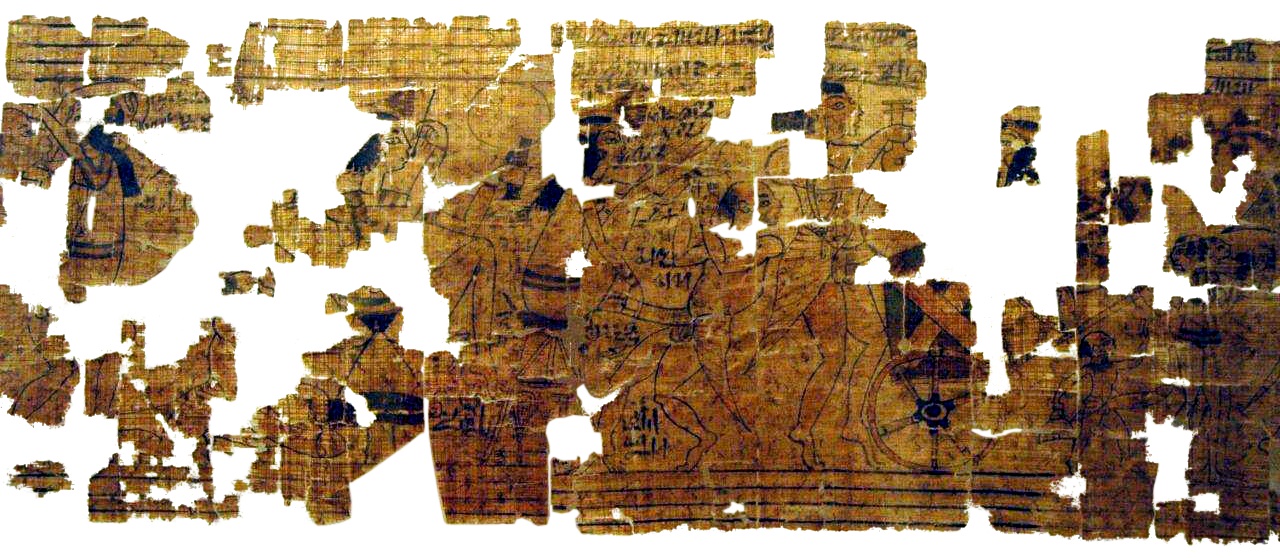
Image via Wikimedia Commons
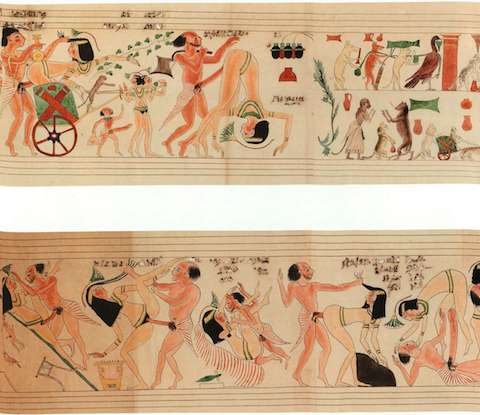
With the old joke about every generation thinking they invented sex, Listverse brings us the papyrus above, the oldest depiction of sex on record. Painted sometime in the Ramesside Period (1292–1075 B.C.E.), the fragments above—called the “Turin Erotic Papyrus” because of their “discovery” in the Egyptian Museum of Turin, Italy—only hint at the frank versions of ancient sex they depict (see a graphic partial reconstruction at the bottom of the post—probably NSFW). The number of sexual positions the papyrus illustrates—twelve in all—“fall somewhere between impressively acrobatic and unnervingly ambitious,” one even involving a chariot. Apart from its obvious fertility symbols, writes archaeology blog Ancient Peoples, the papyrus also has a “humorous and/or satirical” purpose, and probably a male audience—evidenced, perhaps, by its resemblance to 70’s porn: “the men are mostly unkempt, unshaven, and balding […], whereas the women are the ideal of beauty in Egypt.”
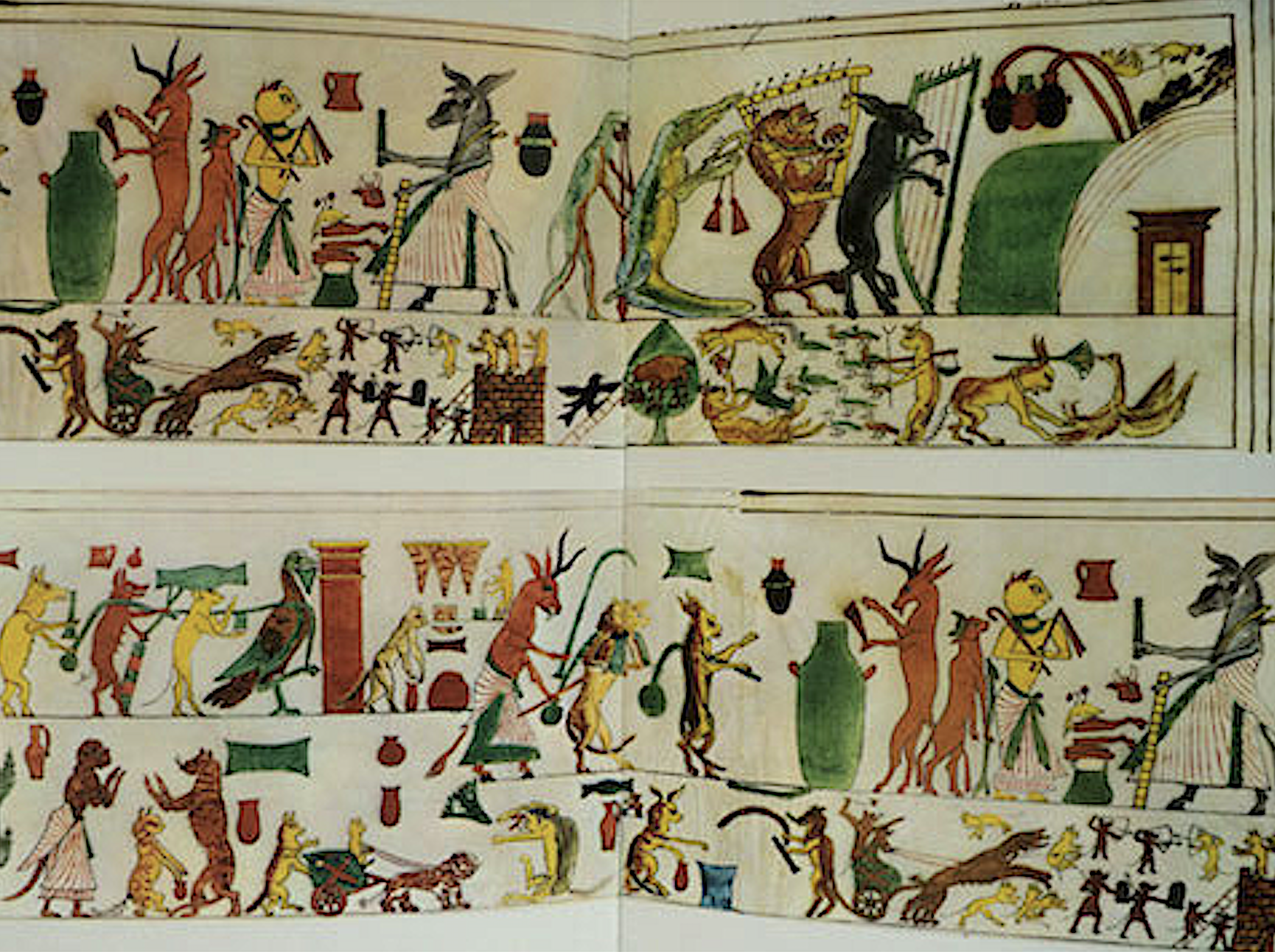
In fact the erotic portion of the papyrus was only made public in the 1970s. Egyptologists have known of the larger scroll, technically called “Papyrus Turin 55001” since the 1820s. On the right side of the papyrus (above) animals perform various human tasks as musicians, soldiers, and artisans. The artist meant this piece too as satire, Ancient Peoples alleges. Like ancient Roman and Greek satirical art, the animals may represent supposed archetypal aspects of the artists and tradesmen shown here. All very interesting, but of course the real interest in Papyrus Turin 55001 is of the prurient variety.
Egyptology student Caroline Seawright points us toward the rather lurid History Channel segment on the erotic papyrus, which calls the pictures “one of the most shocking sets of images in the whole of antiquity.” Against a perception of ancient Egyptians as “buttoned-up and repressed,” the video, and Seawright, detail the ways in which the culture reveled in a stylized ritual sexuality quite different from our own limited mores.
Sacred temple prostitutes held a privileged position and mythological narratives incorporated unbiased descriptions of homosexuality and transgenderism. Ancient Egyptians even expected to have sex after death, attaching fabricated organs to their mummies. The above applies mainly to a certain class of Egyptian. As archaeologist David O’Connor points out, the Turin Erotic Papyrus’ high “artistic merit” marks it as within the provenance of “an elite owner and audience.” You can find more detailed images from a different reconstruction of the erotic papyrus here.
Note: An earlier version of this post appeared on our site in 2014.
Related Content:
An Ancient Egyptian Homework Assignment from 1800 Years Ago: Some Things Are Truly Timeless
Sex and Alcohol in Medieval Times: A Look into the Pleasures of the Middle Ages
The Unlikely Friendship of Mark Twain and Nikola Tesla
Mark Twain was, in the estimation of many, the United States of America’s first truly homegrown man of letters. And in keeping with what would be recognized as the can-do American spirit, he couldn’t resist putting himself forth now and again as a man of science — or, more practically, a man of technology. Here on Open Culture, we’ve previously featured his patented inventions (including a better bra strap), the typewriter of which he made pioneering use to write a book, and even the internet-predicting story he wrote in 1898. Given Twain’s inclinations, his fame, and the time in which he lived, it may come as no surprise to hear that he also struck up a friendship with the much-romanticized inventor Nikola Tesla.
As it happens, Tesla had become a fan of Twain’s long before they met, having found solace in the American writer’s books provided during a long, near-fatal stretch of childhood illness. He credits his recovery with the laughter that reading material provided him, and one imagines seeing life in the U.S. through Twain’s eyes played some part in his eventual emigration there.
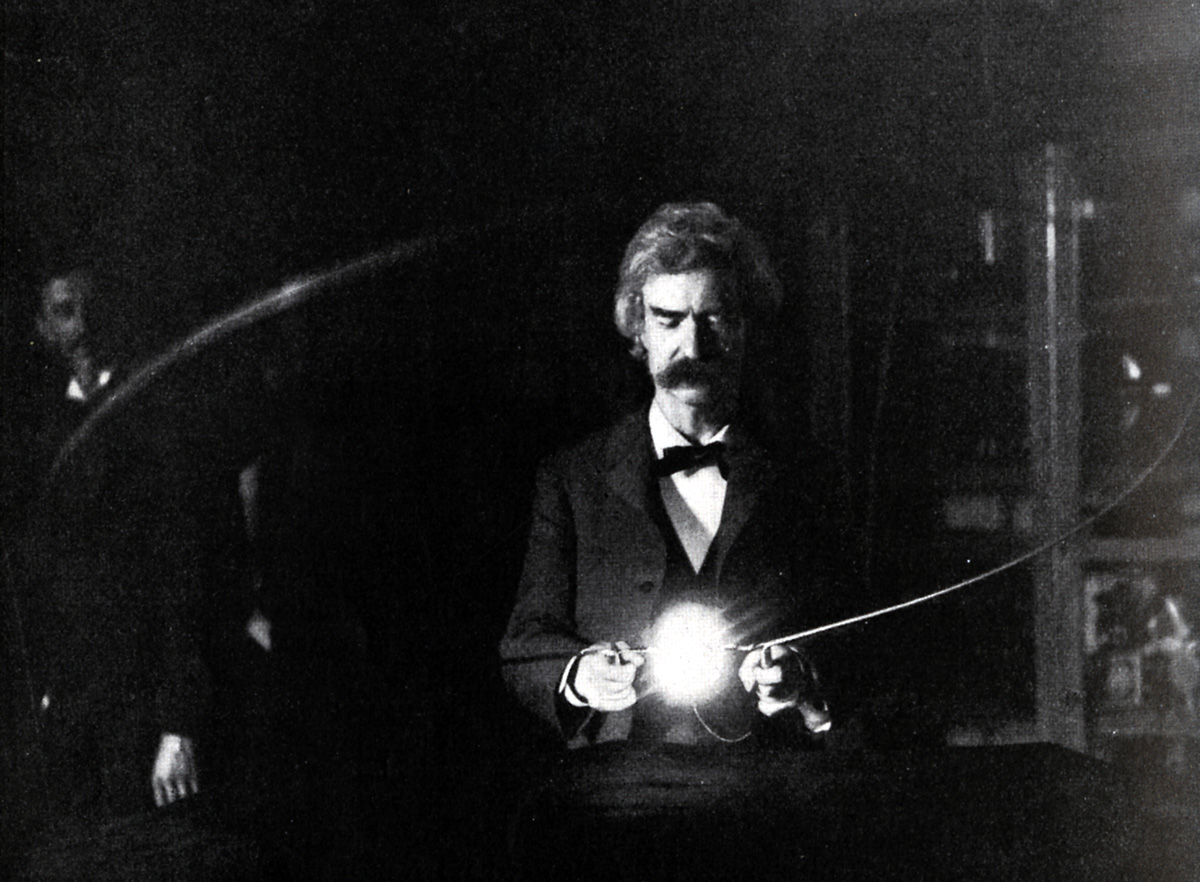
By that point, Twain himself was living in Europe, though his frequent visits to New York meant that he could drop by Tesla’s lab and see how his latest experiments with electricity were going. It was there, in 1894, that the two men took the photograph above, in which Twain holds a vacuum lamp engineered by Tesla and powered (out of frame) by the electromagnetic coil that bears his name.
As Ian Harvey writes at The Vintage News, “Tesla was a scientist whose work largely revolved around electricity; at that time, making your living as a scientist and inventor could often mean having to be somewhat of a showman,” a pressure Twain understood. History has recorded that Tesla provided Twain with — in addition to an electricity-based constipation cure that worked rather too well — advice against putting his money into an uncompetitive automatic typesetting machine that, unfortunately, went unheeded. The onetime riverboat captain went on to make an even more unsound investment in a powder called Plasmon, which promised to end world hunger. Perhaps Tesla’s spiritual descendants are to be found in today’s Silicon Valley, inventing the future; Mark Twain’s certainly are, underwriting any number of far-fetched schemes, if with far less of a sense of humor.
Related Content:
Mark Twain Plays With Electricity in Nikola Tesla’s Lab (Photo, 1894)
Mark Twain Wrote the First Book Ever Written With a Typewriter
Mark Twain’s Patented Inventions for Bra Straps and Other Everyday Items
When David Bowie Became Nikola Tesla: Watch His Electric Performance in The Prestige (2006)
Based in Seoul, Colin Marshall writes and broadcasts on cities, language, and culture. His projects include the Substack newsletter Books on Cities and the book The Stateless City: a Walk through 21st-Century Los Angeles. Follow him on the social network formerly known as Twitter at @colinmarshall.
Read More...Support Us
We're hoping to rely on loyal readers, rather than erratic ads. Please click the Donate button and support Open Culture. You can use Paypal, Venmo, Patreon, even Crypto! We thank you!

About Us

Open Culture scours the web for the best educational media. We find the free courses and audio books you need, the language lessons & educational videos you want, and plenty of enlightenment in between.
Advertise With Us

FREE UPDATES!
GET OUR DAILY EMAIL
Get the best cultural and educational resources on the web curated for you in a daily email. We never spam. Unsubscribe at any time.
FOLLOW ON SOCIAL MEDIA

Open Culture editor Dan Colman scours the web for the best educational media. He finds the free courses and audio books you need, the language lessons & movies you want, and plenty of enlightenment in between.
Advertise With Us


