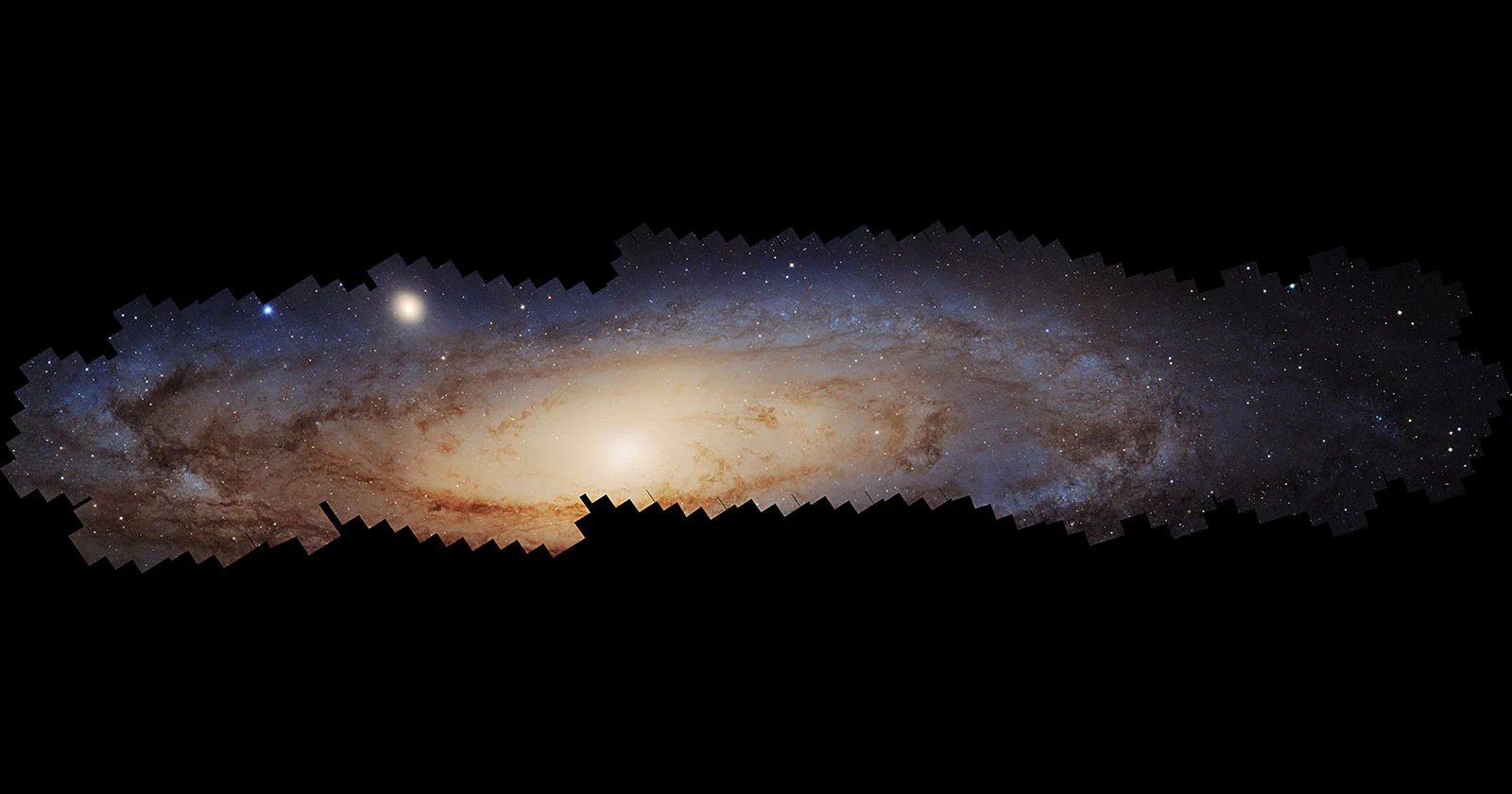
Using the Hubble Space Telescope, astronomers have created a majestic 417-megapixel panorama of the Andromeda galaxy, located some 2.5 million light-years away from our planet. Taking more than a decade to complete, the photomosaic captures 200 million stars, which is only a fraction of Andromeda’s estimated one trillion stars. According to NASA, the 2.5 billion pixel mosaic “will help astronomers piece together the galaxy’s past history that includes mergers with smaller satellite galaxies.” On this NASA website, you can download a copy of the mosaic, and learn more about the exploration of Andromeda.
If you would like to support the mission of Open Culture, consider making a donation to our site. It’s hard to rely 100% on ads, and your contributions will help us continue providing the best free cultural and educational materials to learners everywhere. You can contribute through PayPal, Patreon, and Venmo (@openculture). Thanks!
Denis Villeneuve’s recent film adaptation of Dune is generally considered to be superior to the late David Lynch’s, from 1984 — though even according to many of Lynch’s fans, it could hardly have been worse. In a 1996 piece for Premiere magazine, David Foster Wallace described Dune as “unquestionably the worst movie of Lynch’s career,” not least due to the miscasting of the director himself: “Eraserhead had been one of those sell-your-own-plasma-to-buy-the-film-stock masterpieces, with a tiny and largely unpaid cast and crew. Dune, on the other hand, had one of the biggest budgets in Hollywood history,” marshaled by super-producer Dino De Laurentiis. But could even a master blockbuster craftsman have made cinematic sense of Frank Herbert’s original story, “which even in the novel is convoluted to the point of pain”?
With its two parts having been released in the twenty-twenties, Villeneuve’s Dune practically cries out for Youtube video essays comparing it to Lynch’s version. The one above from Archer Green first highlights their differences through one scene that was memorable in the novel and both films: when, being put to the test by the Reverend Mother Gaius Helen Mohiam, the young hero Paul Atreides, played in the old Dune by Kyle MacLachlan and the new one by Timothée Chalamet, inserts his hand into a box that inflicts extreme pain. Superficially similar though they may appear, the two sequences reveal defining qualities of each picture’s look and feel — Villeneuve’s is shadowy and full of ancient-looking details, while Lynch’s looks like a piece of retro-futuristic Jacobean theater — as well as the contrast between how they dramatize the source material.
The new Dune is “a very modern-looking film that goes for a realistic and grounded aesthetic, and it feels more like a serious prestige sci-fi movie,” says Archer Green, “whereas old Dune is more surrealist: it’s elaborate, grungy, and ultimately quite over the top.” Their having been made in different eras explains some of this, but so does their having been made at different scales of time. Viewed back-to-back, Villeneuve’s Dune movies run just over five and a half hours. Lynch openly admitted that he’d “sold out” his right to the final cut in exchange for a major Hollywood project, but he also seldom failed to mention that the studio demanded that the film be “squeezed” to two hours and 17 minutes in order to guarantee a certain minimum number of daily screenings.
This pressure to get the runtime down must have motivated some of what even in the nineteen-eighties felt old-fashioned about Lynch’s Dune, like its extended “exposition dumps” and its “having characters’ thoughts audibilized on the soundtrack while the camera zooms in on the character making a thinking face,” as Wallace put it. The film’s failure “could easily have turned Lynch into an embittered hack, doing effects-intensive gorefests for commercial studios” or “sent him scurrying to the safety of academe, making obscure, plotless 16mm’s for the pipe-and-beret crowd.” Instead, he took the paltry deal subsequently offered him by De Laurentiis and made Blue Velvet, whose success he rode to become a major cultural figure. In a way, Lynch’s Dune fiasco gave Chalamet the eventual opportunity to become the definitive Paul Atreides — and MacLachlan, to become Special Agent Dale Cooper.
Based in Seoul, Colin Marshall writes and broadcasts on cities, language, and culture. His projects include the Substack newsletterBooks on Cities and the book The Stateless City: a Walk through 21st-Century Los Angeles. Follow him on the social network formerly known as Twitter at @colinmarshall.
During their days filming Documentary Now!, a mockumentary series that aired on IFC, Fred Armisen and Bill Hader teamed up and created a fictionalized “history” of Simon and Garfunkel, telling the “real” story behind the making of “Bridge Over Troubled Water” and “Mrs. Robinson”–stories you’ve assuredly never heard before. Have a laugh. Enjoy!
As every cinephile has by now heard, and lamented, we’ve just lost a great American filmmaker. From Eraserhead to Blue Velvet to Mulholland Drive to Inland Empire, David Lynch’s features will surely continue to bewilder and inspire generation after generation of aspiring young auteurs. (There seems even to be a re-evaluation underway of his adaptation of Dune, the box-office catastrophe that turned him away from the Hollywood machine.) But Lynch was never exactly an aspiring young auteur himself. He actually began his career as a painter, just one of the many facets of his artistic existence that we’ve featured over the years here at Open Culture.
Lynch studied painting at the Pennsylvania Academy of Fine Arts in the mid-nineteen-sixties, and the urban decay of Philadelphia at the time did a great deal to inspire the aesthetic of Eraserhead, which made his name on the midnight-movie circuit a decade later. When the MTV era fired up in just a few years, he found his signature blend of grotesquerie and hyper-normality — what would soon be termed “Lynchian” — in demand from certain like-minded recording artists. It was around that same time that he launched a side career as a comic artist, or in any case a comic writer, contributing a thoroughly static yet compellingly varied strip called The Angriest Dog in the World to the LA Reader from the early eighties through the early nineties.
In 1987, the year after the art-house blockbuster that was Blue Velvet set off what Guy Maddin later called “the last real earthquake in American cinema,” Lynch hosted a BBC television series on the history of surrealist film. That ultra-mass medium would turn out to be a surprisingly receptive venue for his highly idiosyncratic art: first he made commercials, then he co-created with Mark Frost the ABC mystery series Twin Peaks, which practically overtook American popular culture when it debuted in 1990. (See also these video essays on the making and meaning of the show.) Not that the phenomenon was limited to the U.S., as evidenced by Lynch’s going on to direct a mini-season of Twin Peaks in the form of canned-coffee commercials for the Japanese market.
Even Mulholland Drive, the picture many consider to be Lynch’s masterpiece, was conceived as a pilot for a TV show. Not long after its release, he put out more work in serial form, including the savage cartoon Dumbland and the harrowing sitcom homage Rabbits (later incorporated into Inland Empire, his final film). In the late two-thousands, he presented Interview Project, a documentary web series co-created by his son; in the early twenty-tens, he put out his first (but not last) solo music album, Crazy Clown Time. That same decade, his photographs of old factories went on display, his line of organic coffee came onto the market, his autobiography was published, and his MasterClass went online.
Lynch remained prolific through the COVID-19 pandemic of the twenty-twenties, in part by posting Los Angeles weather reports from his home to his YouTube channel. In recent years, he announced that he would never retire, despite living with a case of emphysema so severe that he could no longer direct in any conventional manner. Such are the wages, as he acknowledged, of having smoked since age seven, though he also seemed to believe that every habit and choice in life contributed to his work. Perhaps the smoking did its part to inspire him, like his long practice of Transcendental Meditation or his daily milkshake at Bob’s Big Boy, about all of which he spoke openly in life. But if there’s any particular secret of his formidable creativity, it feels as if he’s taken it with him.
Based in Seoul, Colin Marshall writes and broadcasts on cities, language, and culture. His projects include the Substack newsletterBooks on Cities and the book The Stateless City: a Walk through 21st-Century Los Angeles. Follow him on the social network formerly known as Twitter at @colinmarshall.
“This is fire season in Los Angeles,” Joan Didion once wrote, relating how every year “the Santa Ana winds start blowing down through the passes, and the relative humidity drops to figures like seven or six or three per cent, and the bougainvillea starts rattling in the driveway, and people start watching the horizon for smoke and tuning in to another of those extreme local possibilities — in this instance, that of imminent devastation.” The New Yorker published this piece in 1989, when Los Angeles’ fire season was “a particularly early and bad one,” but it’s one of many writings on the same phenomenon now circulating again, with the highly destructive Palisades Fire still burning away.
Back in 1989, longtime Angelenos would have cited the Bel Air Fire of 1961 as a particularly vivid example of what misfortune the Santa Ana winds could bring. Widely recognized as a byword for affluence (not unlike the now virtually obliterated Pacific Palisades), Bel Air was home to the likes of Dennis Hopper, Burt Lancaster, Joan Fontaine, Zsa Zsa Gabor and Aldous Huxley — all of whose houses counted among the 484 destroyed in the conflagration (in which, miraculously, no lives were lost). You can see the Bel Air Fire and its aftermath in “Design for Disaster,” a short documentary produced by the Los Angeles Fire Department and narrated by William Conrad (whose voice would still have been instantly recognizable as that of Marshal Matt Dillon from the golden-age radio drama Gunsmoke).
Los Angeles’ repeated affliction by these blazes is perhaps overdetermined. The factors include not just the dreaded Santa Anas, but also the geography of its canyons, the dryness of the vegetation in its chaparral (not, pace Didion, desert) ecology, and the inability of its water-delivery system to meet such a sudden and enormous need (which also proved fateful in the Palisades Fire). It didn’t help that the typical house at the time was built with “a combustible roof; wide, low eaves to catch sparks and fire; and a big picture window to let the fire inside,” nor that such dwellings were “closely spaced in brush-covered canyons and ridges serviced by narrow roads.” The Bel Air Fire brought about a wood-shingle roof ban and a more intensive brush-clearance policy, but the six decades of fire seasons since do make one wonder what kind of measures, if any, could ever subdue these particular forces of nature.
Based in Seoul, Colin Marshall writes and broadcasts on cities, language, and culture. His projects include the Substack newsletterBooks on Cities and the book The Stateless City: a Walk through 21st-Century Los Angeles. Follow him on the social network formerly known as Twitter at @colinmarshall.
In the summer of 1981, the British band Queen was recording tracks for their tenth studio album, Hot Space, at Mountain Studios in Montreux, Switzerland. As it happened, David Bowie had scheduled time at the same studio to record the title song for the movie Cat People. Before long, Bowie stopped by the Queen sessions and joined in. The original idea was that he would add backup vocals on the song “Cool Cat.” “David came in one night and we were playing other people’s songs for fun, just jamming,” says Queen drummer Roger Taylor in Mark Blake’s book Is This the Real Life?: The Untold Story of Freddie Mercury and Queen. “In the end, David said, ‘This is stupid, why don’t we just write one?’ ”
And so began a marathon session of nearly 24 hours, fueled, according to Blake, by wine and cocaine. Built around John Deacon’s distinctive bass line, the song was mostly written by Mercury and Bowie. Blake describes the scene, beginning with the recollections of Queen’s guitarist:
‘We felt our way through a backing track all together as an ensemble,’ recalled Brian May. ‘When the backing track was done, David said, “Okay, let’s each of us go in the vocal booth and sing how we think the melody should go–just off the top of our heads–and we’ll compile a vocal out of that.” And that’s what we did.’ Some of these improvisations, including Mercury’s memorable introductory scatting vocal, would endure on the finished track. Bowie also insisted that he and Mercury shouldn’t hear what the other had sung, swapping verses blind, which helped give the song its cut-and-paste feel.
“It was very hard,” said May in 2008, “because you already had four precocious boys and David, who was precocious enough for all of us. Passions ran very high. I found it very hard because I got so little of my own way. But David had a real vision and he took over the song lyrically.” The song was originally titled “People on Streets,” but Bowie wanted it changed to “Under Pressure.” When the time came to mix the song at Power Station studios in New York, Bowie insisted on being there. “It didn’t go too well,” Blake quotes Queen’s engineer Reinhold Mack as saying. “We spent all day and Bowie was like, ‘Do this, do that.’ In the end, I called Freddie and said, ‘I need help here,’ so Fred came in as a mediator.” Mercury and Bowie argued fiercely over the final mix.
At one point Bowie threatened to block the release of the song, but it was issued to the public on October 26, 1981 and eventually rose to Number One on the British charts. It was later named the number 31 song on VH1’s list of the 100 greatest songs of the 1980s. “ ‘Under Pressure’ is a significant song for us,” May said in 2008, “and that is because of David and its lyrical content. I would have found that hard to admit in the old days, but I can admit it now.… But one day, I would love to sit down quietly on my own and re-mix it.”
After listening to the isolated vocal track above, you can hear the officially released 1981 mix below:
Note: An earlier version of this post appeared on our site in 2013.
For those looking to boost their skills or explore new fields without breaking the bank, Class Central has done the heavy lifting. Known as a search engine for online courses, Class Central has compiled what might be the largest collection of free online certificates and badges available anywhere. From tech giants like Google and Microsoft to elite universities like Harvard and Stanford, this list covers a diverse range of subjects and skill sets.
There was a time when the world’s top universities used to offer free certificates for completing online courses. While most of those certificates are no longer free, many of the courses themselves remain open to learners, covering topics like Computer Science, Literature, and Business.
Certificates can serve as both motivation and proof of achievement for completing online courses. While platforms like Coursera and edX have moved toward paid certifications, a surprising number of free options remain — if you know where to look. Thankfully, Class Central’s guide makes it easy to find these opportunities.
What’s Included in the Guide?
The article organizes free certificate offerings by providers, including:
Google: Over 1,000 free certificates and badges in topics like digital marketing, Android development, and AI.
Harvard: Free certificates for their popular CS50 series and other online courses.
Stanford Medicine: Medical courses offering free certificates and CME credit.
LinkedIn Learning: 110+ hours of free certifications in business, technology, and design.
Semrush Academy: 90+ courses with free certificates focused on marketing and SEO.
CodeSignal: 700+ free skill certifications to validate coding, technical abilities, and soft skills.
If you’re ready to explore the full list of free courses and certifications, head over to Class Central’s detailed guide: Massive List of Thousands of Free Certificates and Badges. It’s a treasure trove for anyone looking to learn something new, enhance their resume, or simply satisfy their curiosity — all for free!
Bob Ross the man died nearly thirty years ago, but Bob Ross the archetypal TV painter has never been more widely known. “With his distinctive hair, gentle voice, and signature expressions such as ‘happy little trees,’ he’s an enduring icon,” writes Michael J. Mooney in an Atlantic piece from 2020. “His likeness appears on a wide assortment of objects: paints and brushes, toasters, socks, calendars, dolls, ornaments, and even a Chia Pet.” Here in Korea, where I live, he’s universally called Bob Ajeossi, ajeossi being a kind of colloquial title for middle-aged men. It’s quite an afterlife for a soft-spoken public-television host from the eighties.
Ross quickly became a pop-cultural figure in that era, starring in semi-ironic MTVspots by the early nineties. But over the decades, writes Mooney, “the appreciation of Bob Ross has morphed into something nearly universally earnest.” It helps that he has “the ultimate calming presence,” which has drawn special appreciation here in the twenty-first century: “More than a decade before most therapists were telling clients to be mindful and present, Ross was telling his viewers to appreciate their every breath.” This meditative, positive mood pervades all of The Joy of Painting’s more than 400 recorded broadcasts, and they even deliver the soothing effects of what YouTube-viewing generations know as “unintentional ASMR.”
Now you can watch almost all those broadcasts on a single YouTube playlist, which includes all of The Joy of Painting’s 31 seasons, originally aired between 1983 and 1994. (The videos come from the official YouTube channel of The Joy of Painting and Bob Ross.) Despite having ended its run well before any of us had ever imagined watching video online, the show now feels practically made for the internet, what with not just its ASMR qualities, but also the parasocial friendliness of Ross’ personality, the instructional value and sheer quantity of its content, and the highly consistent format. Every time, Ross paints a complete picture from start to finish: usually a landscape featuring mighty mountains, freedom-loving clouds, and happy little trees, but occasionally something just different enough to keep it interesting. And so the man Mooney describes as “probably America’s most famous painter” lives on as a beloved YouTuber.
Based in Seoul, Colin Marshall writes and broadcasts on cities, language, and culture. His projects include the Substack newsletterBooks on Cities and the book The Stateless City: a Walk through 21st-Century Los Angeles. Follow him on the social network formerly known as Twitter at @colinmarshall.
We are regularly urged to take 10,000 steps a day. However, it turns out 10,000 isn’t exactly a number anchored in science. Rather, it’s a product of marketing. According to a Harvard medical website, that figure goes back to “1965, when a Japanese company made a device named Manpo-kei, which translates to ’10,000 steps meter.’ ” 10,000 likely sounded better than a more precise number. And so it began.
So this raises the question: what’s the ideal number of steps according to science? Dr. I‑Min Lee, a professor of medicine at Harvard Medical School, focused on that question and determined that mortality rates decline when women increase their steps from lower levels (e.g., 2,000 steps) to 4,400 steps per day, with gains increasing until they reach 7,500 steps. From there, the gains level out. (Read the JAMA study here.) Meanwhile, a European study, which monitored 226,000 participants, found that people who walked more than 2,337 steps daily could start lowering their risk of dying from heart disease. And people who walked more than 3,867 steps daily could start reducing their risk of dying from any cause overall. However, unlike the Harvard study, the European study found that adding more steps continues to lower mortality rates, with gains accruing past 7,500 steps, and perhaps beyond 20,000 steps. What’s the exact sweet spot? We’ll need more research to figure that out. Until then, the existing research suggests that it pays to spend time with your walking shoes.
The new video above come from TED-Ed.
If you would like to support the mission of Open Culture, consider making a donation to our site. It’s hard to rely 100% on ads, and your contributions will help us continue providing the best free cultural and educational materials to learners everywhere. You can contribute through PayPal, Patreon, and Venmo (@openculture). Thanks!
“Considering that, in a cartoon, anything can happen that the mind can imagine, the comics have generally depicted pretty mundane worlds,” writes Calvin and Hobbes creator Bill Watterson. “Sure, there have been talking animals, a few spaceships and whatnot, but the comics have rarely shown us anything truly bizarre. Little Nemo’s dream imagery, however, is as mind-bending today as ever, and Winsor McCay remains one of the greatest innovators and manipulators of the comic strip medium.” And Little Nemo, which sprawled across entire newspaper pages in the early decades of the twentieth century, pushed artistic boundaries not just as a comic, but also as a film.
When first seen in 1911, the twelve-minute short Little Nemo was titled Winsor McCay, the Famous Cartoonist of the N.Y. Herald and His Moving Comics. A mixture of live action and animation, it dramatizes McCay making a gentleman’s wager with his colleagues that he can draw figures that move — an idea that might have come with a certain plausibility, given that speed-drawing was already a successful part of his vaudeville act. Meeting this challenge entails drawing 4,000 pictures, a task as demanding for McCay the character as it was for McCay the real artist. This labor adds up to the four minutes that end the film, which contains moments of still-impressive fluidity, technique, and humor.
Clearly possessed of a sense of animation’s potential as an art form, McCay went on to make nine more films, and ultimately considered them his proudest work. Like the Little Nemo movie, he used his second such effort, Gertie the Dinosaur, in his vaudeville act, performing alongside the projection to create the effect of his giving the titular prehistoric creature commands. “In some ways, McCay was the forerunner of Walt Disney in terms of American animation,” writes Lucas O. Seastrom at The Walt Disney Family Museum. “In order to create a lovable dinosaur and accomplish these seemingly magical feats, McCay used mathematical precision and groundbreaking techniques, such as the process of inbetweening, which later became a Disney standard.”
More than once, McCay the animator drew inspiration from the work of McCay the newspaper artist: in 1921, he made a couple of motion pictures out of his pre-Little Nemo sleep-themed comic strip Dream of the Rarebit Fiend. But for his most ambitious animated work, he turned toward history — and, at the time, rather recent history — to re-create the sinking of the RMSLusitania, an event that his employer, the newspaper magnate William Randolph Hearst, had insisted on downplaying at the time due to his stance against the U.S.’ joining the Great War. Decades thereafter, Looney Tunes animator Chuck Jones said that “the two most important people in animation are Winsor McCay and Walt Disney, and I’m not sure which should go first.” Watch these and McCay’s other surviving films on this Youtube playlist, and you can decide for yourself.
Based in Seoul, Colin Marshall writes and broadcasts on cities, language, and culture. His projects include the Substack newsletterBooks on Cities and the book The Stateless City: a Walk through 21st-Century Los Angeles. Follow him on the social network formerly known as Twitter at @colinmarshall.
Charles Darwin’s work on heredity was partly driven by tragic losses in his own family. Darwin had married his first cousin, Emma, and “wondered if his close genetic relation to his wife had had an ill impact on his children’s health, three (of 10) of whom died before the age of 11,” Katherine Harmon writes at Scientific American. (His suspicions, researchers surmise, may have been correct.) He was so concerned about the issue that, in 1870, he pressured the government to include questions about inbreeding on the census (they refused).
Darwin’s children would serve as subjects of scientific observation. His notebooks, says Alison Pearn of the Darwin Correspondence Project at Cambridge University Library, show a curious father “prodding and poking his young infant,” Charles Erasmus, his first child, “like he’s another ape.” Comparisons of his children’s development with that of orangutans helped him refine ideas in On the Origin of Species, which he completed as he raised his family at their house in rural Kent, and inspired later ideas in Descent of Man.
But as they grew, the Darwin children became far more than scientific curiosities. They became their father’s assistants and apprentices. “It’s really an enviable family life,” Pearn tells the BBC. “The science was everywhere. Darwin just used anything that came to hand, all the way from his children right through to anything in his household, the plants in the kitchen garden.” Steeped in scientific investigation from birth, it’s little wonder so many of the Darwins became accomplished scientists themselves.
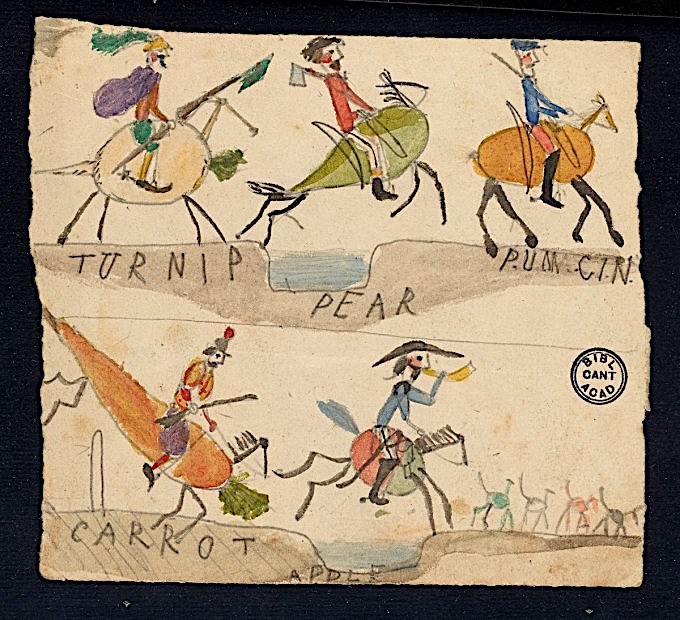
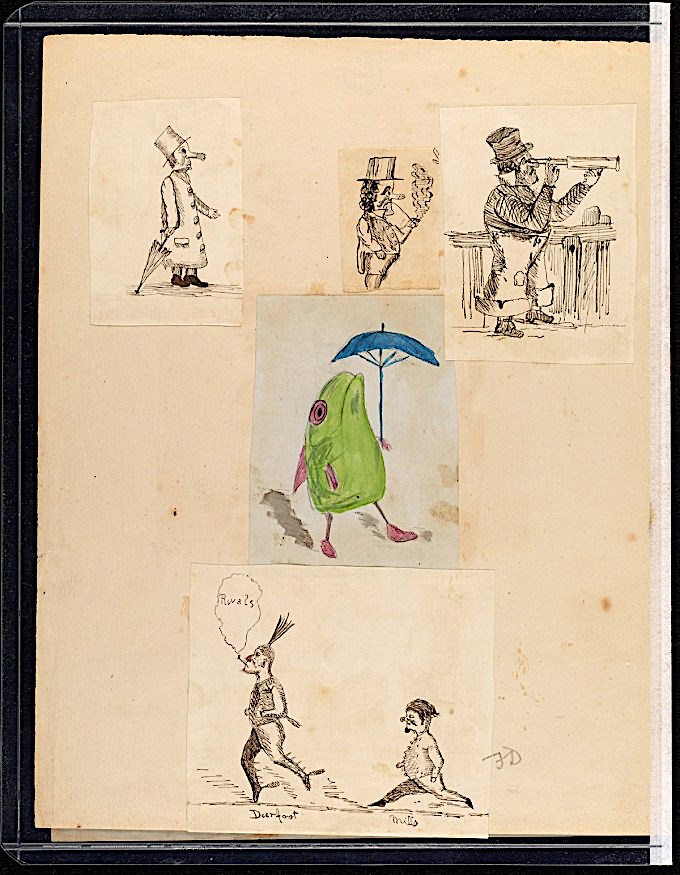
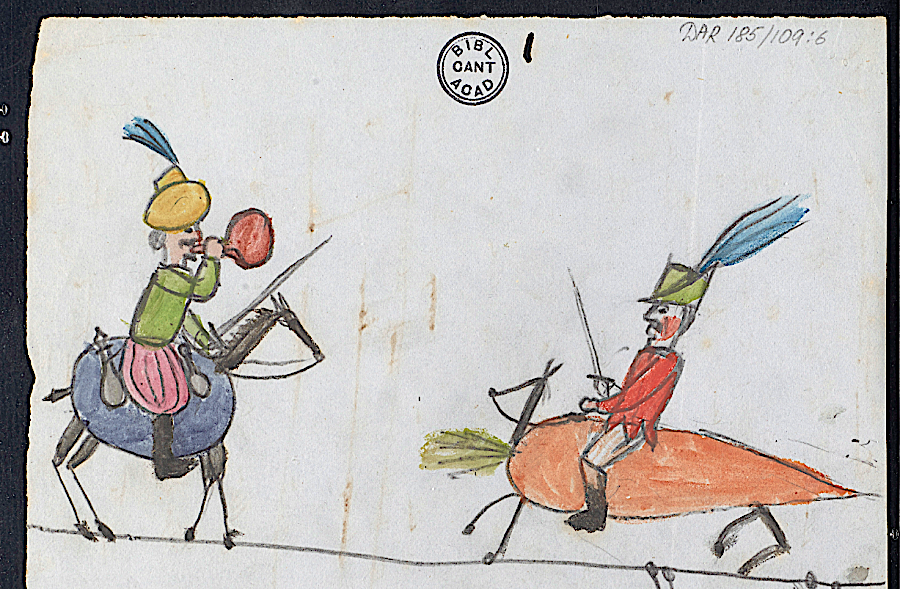
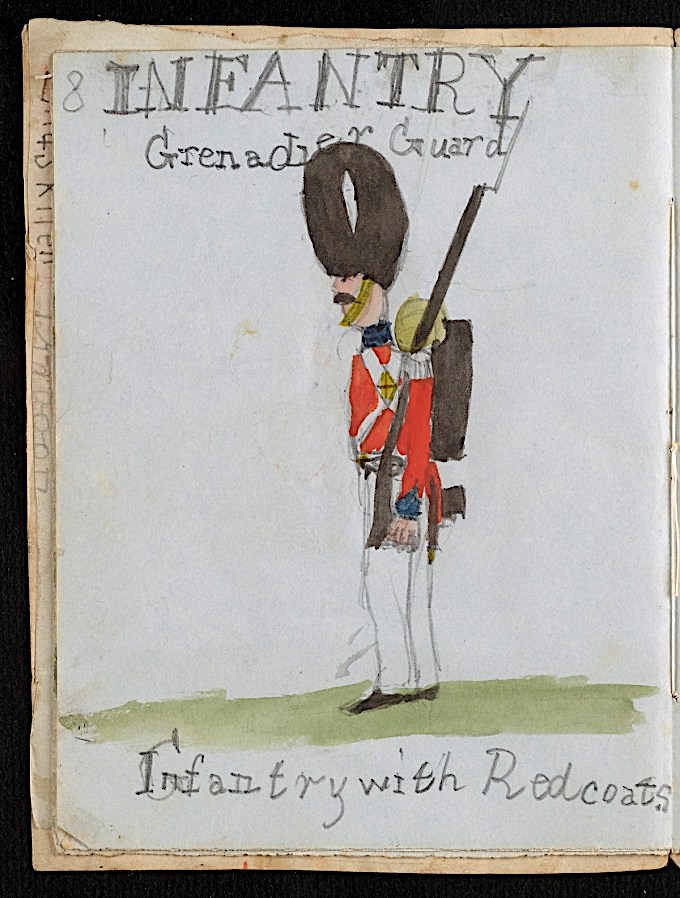
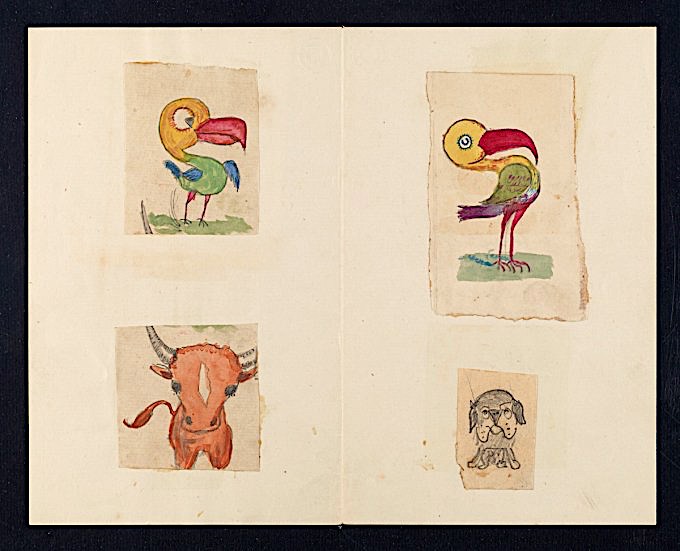
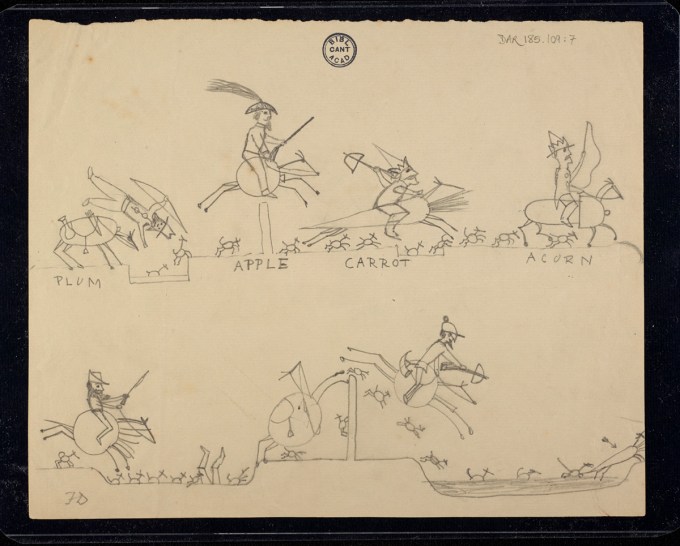
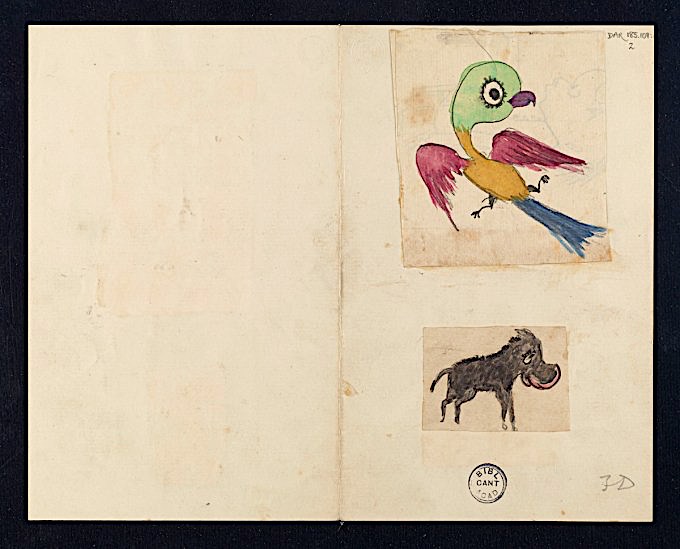
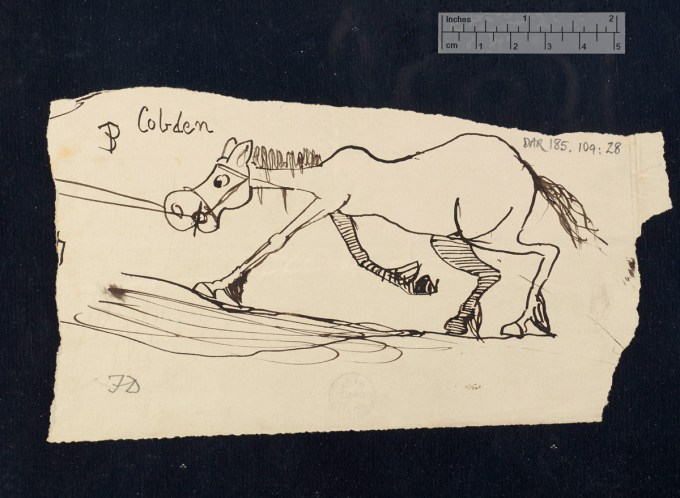
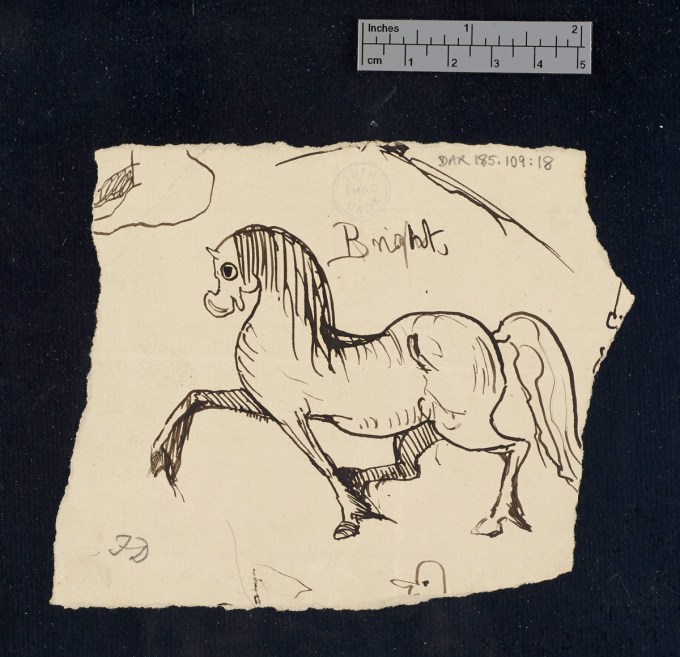
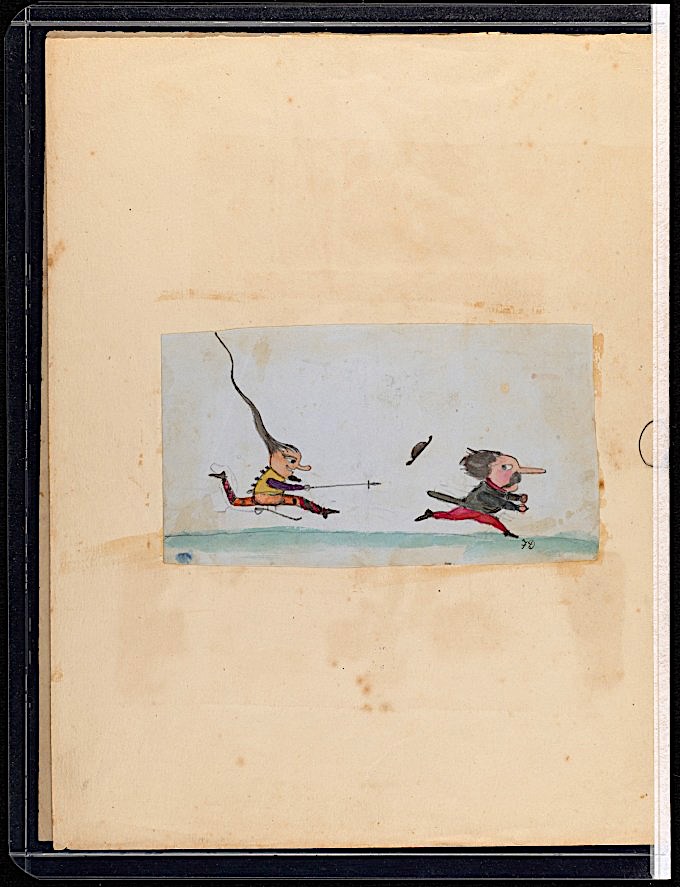
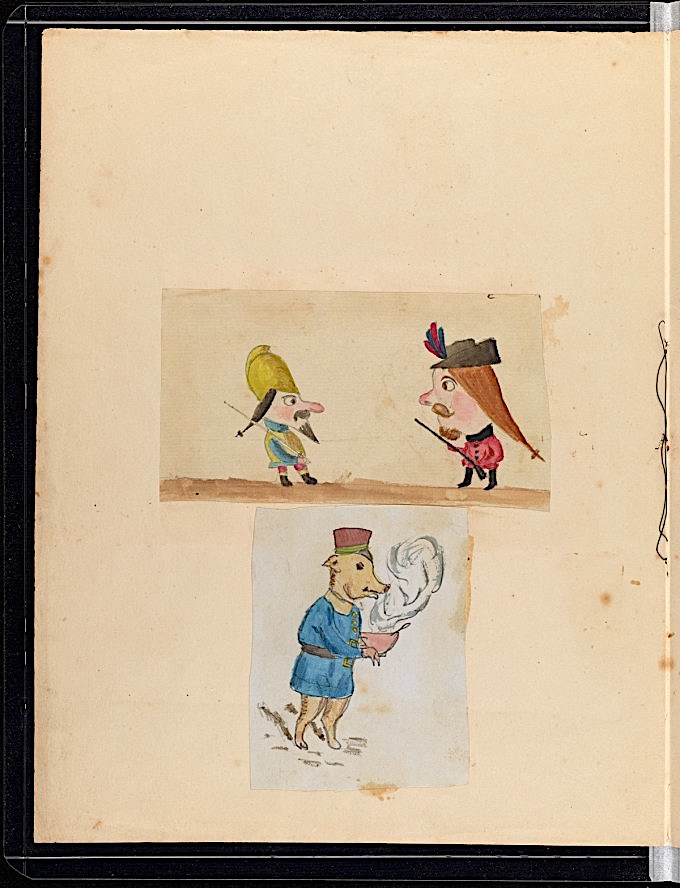
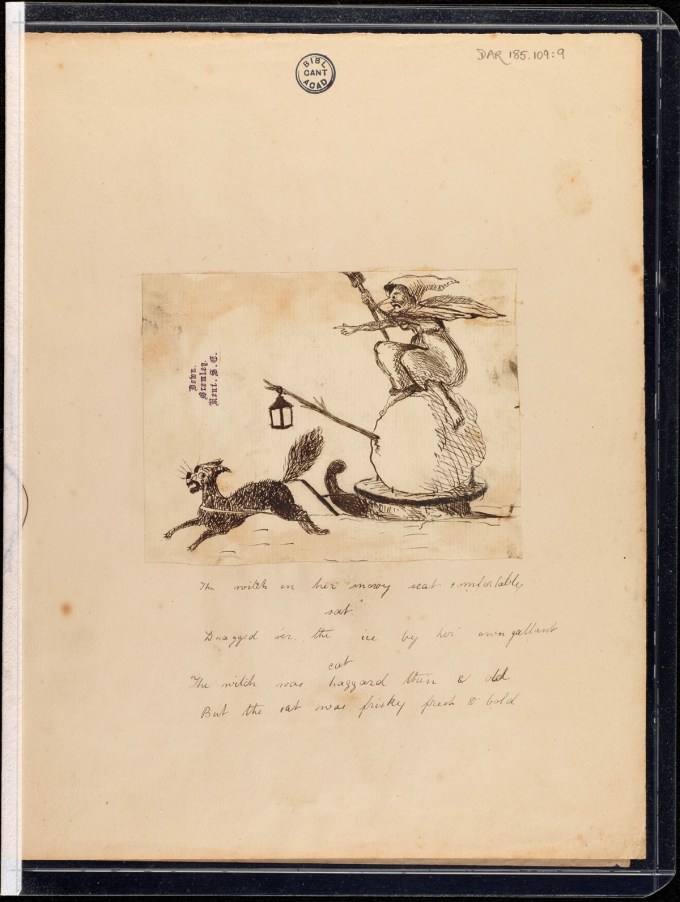
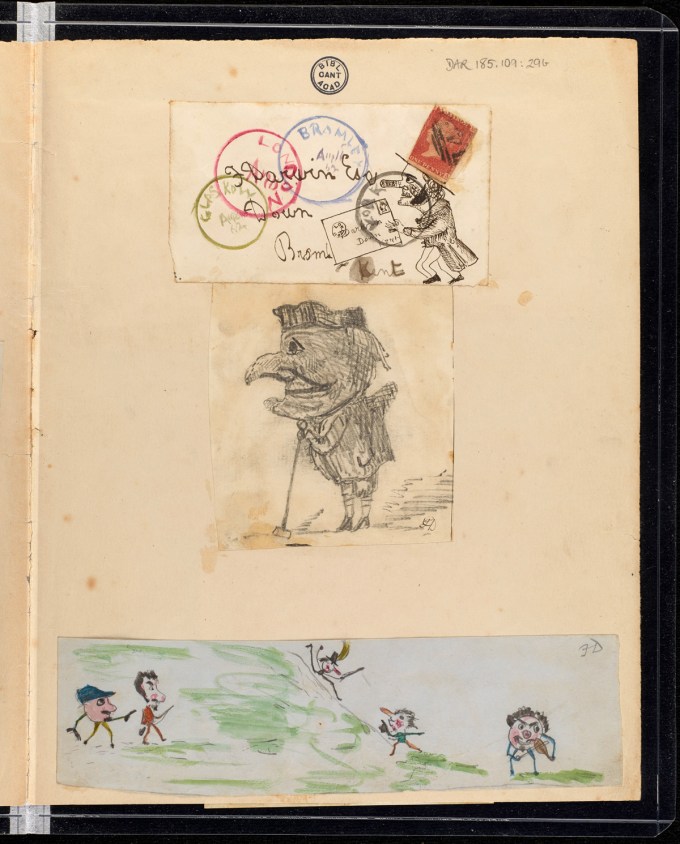
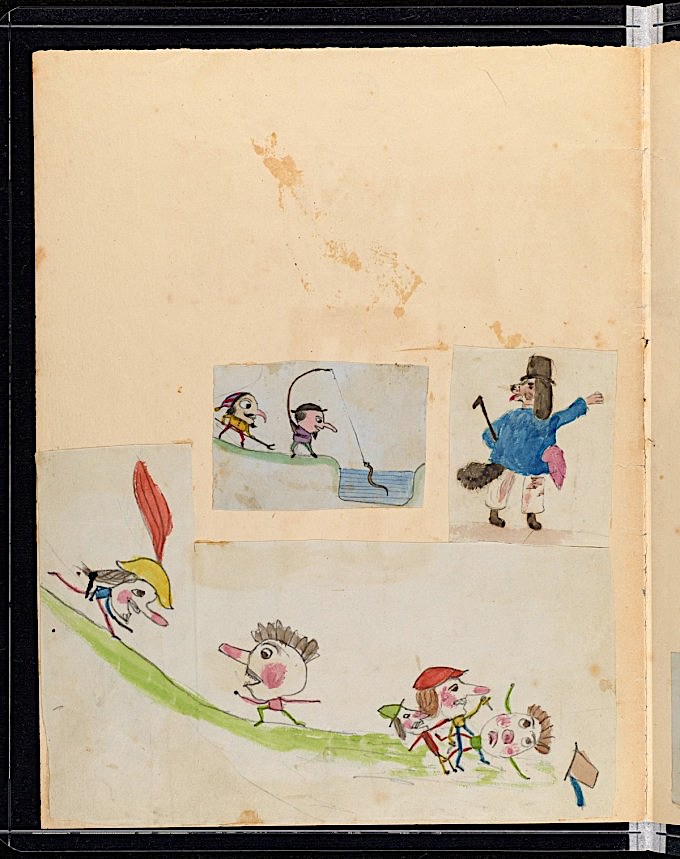
Down House was “by all accounts a boisterous place,” writes McKenna Staynor at The New Yorker, “with a wooden slide on the stairs and a rope swing on the first-floor landing.” Another archive of Darwin’s prodigious writing, Cambridge’s Darwin Manuscripts Project, gives us even more insight into his family life, with graphic evidence of the Darwin brood’s curiosity in the dozens of doodles and drawings they made in their father’s notebooks, including the original manuscript copy of his magnum opus.
The project’s director, David Kohn, “doesn’t know for certain which kids were the artists,” notes Staynor, “but he guesses that at least three were involved: Francis, who became a botanist; George, who became an astronomer and mathematician; and Horace, who became an engineer.” One imagines competition among the Darwin children must have been fierce, but the drawings, “though exacting, are also playful.” One depicts “The Battle of Fruits and Vegetables.” Others show anthropomorphic animals and illustrate military figures.
There are short stories, like “The Fairies of the Mountain,” which “tells the tale of Polytax and Short Shanks, whose wings have been cut off by a ‘naughty fairy.’” Imagination and creativity clearly had a place in the Darwin home. The man himself, Maria Popova notes, felt significant ambivalence about fatherhood. “Children are one’s greatest happiness,” he once wrote, “but often & often a still greater misery. A man of science ought to have none.”
It was an attitude born of grief, but one, it seems, that did not breed aloofness. The Darwin kids “were used as volunteers,” says Kohn, “to collect butterflies, insects, and moths, and to make observations on plants in the fields around town.” Francis followed his father’s path and was the only Darwin to co-author a book with his father. Darwin’s daughter Henrietta became his editor, and he relied on her, he wrote, for “deep criticism” and “corrections of style.”
Despite his early fears for their genetic fitness, Darwin’s professional life became intimately bound to the successes of his children. The Darwin Manuscripts Project, which aims to digitize and make public around 90,000 pages from the Cambridge University Library’s Darwin collection will have a profound effect on how historians of science understand his impact. “The scope of the enterprise, of what we call evolutionary biology,” says Kohn, “is defined in these papers. He’s got his foot in the twentieth century.”
The archive also shows the development of Darwin’s equally important legacy as a parent who inspired a boundless scientific curiosity in his kids. See many more of the digitized Darwin children’s drawings at The Marginalian.
Note: An earlier version of this post appeared on our site in 2020.
We're hoping to rely on loyal readers, rather than erratic ads. Please click the Donate button and support Open Culture. You can use Paypal, Venmo, Patreon, even Crypto! We thank you!
Open Culture scours the web for the best educational media. We find the free courses and audio books you need, the language lessons & educational videos you want, and plenty of enlightenment in between.