confirmation-sent
Your subscription to openculture.com is almost complete. You will now need to click on the confirmation link on the email we sent to you (please be sure to check your spam filter if you do not see the email in the next minute.)
Read More...Zoo Hires Marvin Gaye Impersonator to Help Endangered Monkeys “Get It On”
This past weekend, monkeys residing at a British zoo got a special treat. A Marvin Gaye impersonator performed “Let’s Get It On” and “Sexual Healing,” all in an effort to help the monkeys, well, “get it on.”
Located in Stafford, England, the Trentham Monkey Forest saw the performance as a novel way to get their endangered Barbary macaques to produce offspring: Park Director Matt Lovatt said on the zoo’s website: “We thought it could be a creative way to encourage our females to show a little affection to males that might not have been so lucky in love.” “Females in season mate with several males so paternity among our furry residents is never known. Each birth is vital to the species with Barbary macaques being classed as endangered. Birthing season occurs in late spring/early summer each year, so hopefully Marvin’s done his magic and we can welcome some new babies!”
For anyone keeping score, Dave Largie is the singer channeling Marvin.
If you would like to support the mission of Open Culture, consider making a donation to our site. It’s hard to rely 100% on ads, and your contributions will help us continue providing the best free cultural and educational materials to learners everywhere. You can contribute through PayPal, Patreon, and Venmo (@openculture). Thanks!
Related Content
Pianist Plays Beethoven, Bach, Chopin, Ravel & Debussy for Blind Elephants in Thailand
Footage of the Last Known Tasmanian Tiger Restored in Color (1933)
Two Million Wondrous Nature Illustrations Put Online by The Biodiversity Heritage Library
Read More...John Locke’s Personal Pancake Recipe: “This Is the Right Way” to Make the Classic Breakfast Treat
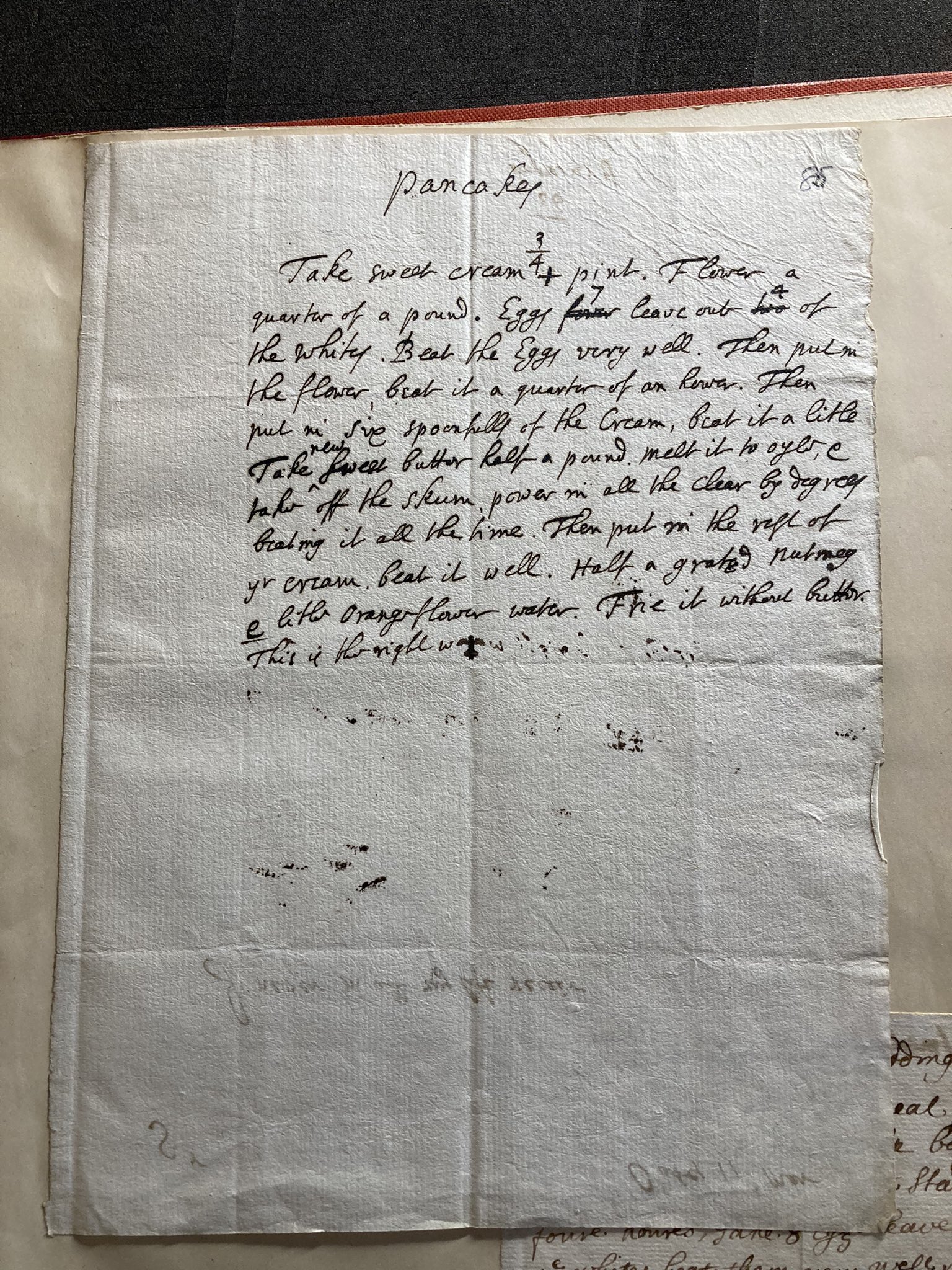
No student of Western political philosophy can ignore John Locke, whose work defined the concepts of governance we now know as liberalism. By the same token, no student of Western cuisine can ignore pancakes, a canonical element of what we now know as breakfast. The oldest pancake recipe we’ve featured here on Open Culture dates to 1585. Ernest Hemingway had his own preferred pancake-making method; so do Simon and Garfunkel, though theirs are of the potato variety.
Locke, as you might imagine, opted for a more traditionally English recipe. Three centuries on, how well his vision of liberalism has held up remains a matter of active debate. As for his pancakes, Marissa Nicosia at Cooking in the Archives put them to the test just last year. “When David Armitage posted this recipe for pancakes in the Bodleian collection on Twitter, I knew that I wanted to try it,” Nicosia writes. Her transcription is as follows:
pancakes
Take sweet cream 3/4 + pint. Flower a
quarter of a pound. Eggsfour7 leave outtwo4 of
the whites. Beat the Eggs very well. Then put in
the flower, beat it a quarter of an hower. Then
put in six spoonfulls of the Cream, beat it a litle
Take new sweet butter half a pound. Melt it to oyle, &
take off the skum, power in all the clear by degrees
beating it all the time. Then put in the rest of
your cream. beat it well. Half a grated nutmeg
& litle orangeflower water. Frie it without butter.
This is the right way
“From the start, I was intrigued by the cross-outs and other notes in the recipe. It appears that it was first drafted (or prepared) using significantly fewer eggs.” As meticulous in his cooking as in his philosophy, Locke clearly paid close attention to “the details of separating and whisking eggs as well as adding just the right amount of orange blossom water (‘litle’) and nutmeg (‘Half a grated nutmeg’) — an exceptional, expensive amount.”
Drawing on her significant experience with early modern pancakes, Nicosia describes Locke’s version as “a bit fluffier and fattier than a classic French crêpe,” though with “far less rise than my favorite American breakfast version”; her husband places them “somewhere between a classic English pancake and a Scotch pancake.” Perhaps that somewhat northerly taste and texture stands to reason, in light of the considerable influence Locke’s non-pancake-related work would later have on the Scottish Enlightenment.
The final line of Locke’s recipe, “This is the right way,” may sound a bit stern in context today. But whether you work straight from his original or from the updated version Nicosia provides in her post, you should end up with “pancakes made for a decadent breakfast.” Locke’s inclusion of an extravagant amount of nutmeg and splash of orange-blossom water “elevates this specific pancake recipe to a special treat.” Nicosia includes a picture of her own honey-drizzled Lockean breakfast with the a copy of Two Treatises of Government and a cup of coffee — the latter being an especially ideal accompaniment to pancakes, and one that also comes thoroughly philosopher-endorsed.
Related content:
Introduction to Political Philosophy: A Free Online Course from Yale University
Hobbes, Locke & Rousseau: An Animated Introduction to Their Political Theories
What Makes Us Human?: Chomsky, Locke & Marx Introduced by New Animated Videos from the BBC
A 1585 Recipe for Making Pancakes: Make It Your Saturday Morning Breakfast
Based in Seoul, Colin Marshall writes and broadcasts on cities and culture. His projects include the book The Stateless City: a Walk through 21st-Century Los Angeles and the video series The City in Cinema. Follow him on Twitter at @colinmarshall or on Facebook.
Read More...The Anti-Vaxxer Who Waged War Against Jonas Salk & His Polio Vaccine: When History Keeps Repeating

Almost immediately after Scottish doctor Edward Jenner learned how to inoculate humans against smallpox in 1796, mass movements sprang up in England and the U.S. to oppose the measure. The rejection of inoculation and vaccination generally made its stand on “political grounds,” says Yale historian Frank Snowden. For over two hundred years, people have “widely considered [vaccines to be] another form of tyranny.” In the 19th century, fears of government control mutated into pseudoscientific conspiracy theories claiming the smallpox vaccine might cause, for example, the growth of hooves and horns or the birth of human/cow hybrid babies.
The pushback against the smallpox vaccine, writes Slate’s Nick Keppler, occurred during a time “when arguments about bodily integrity and religious objection carried as much weight as scientific evidence.” But vaccine science progressed nonetheless, and scientific institutions – very much in league with government by the mid-20th century – shared their largesse in the form of medical breakthroughs and consumer conveniences. “The postwar era was a very trust-in-science-era,” says researcher scientist Jonathan M. Berman, author of Anti-Vaxxers: How to Challenge a Misinformed Movement. “The public not just accepted, but cheered, the headline-making work of guys in white lab coats,” Keppler remarks.
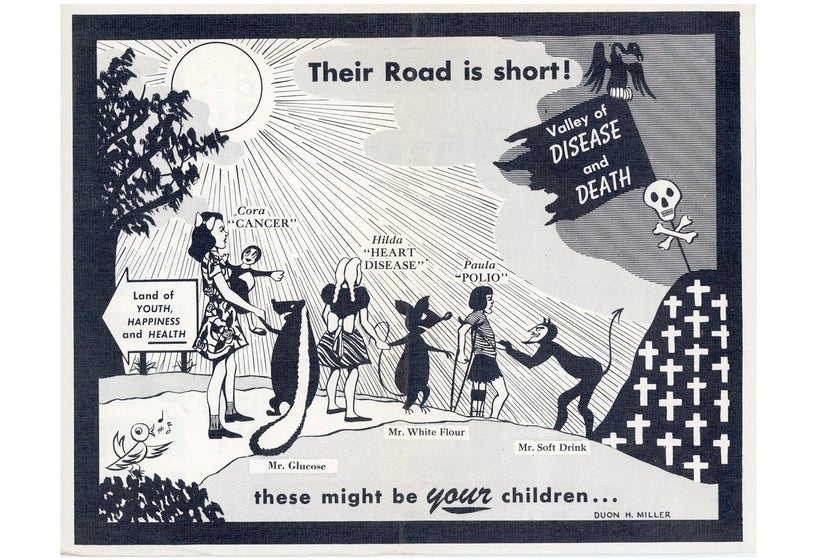
Not everyone was cheering for Jonas Salk, the March of Dimes, and the polio vaccine, however. While celebrities like Elvis Presley legitimized the vaccine in the eyes of a previously skeptical public, a few fervent anti-vaxxers rose to prominence, some using the same combination of fear mongering, pseudoscientific speculation, and conspiratorial thinking common to the smallpox era – and common, once again, in the time of COVID-19.
One of these figures, Florida businessman Duon Miller, founded a cosmetics company, then invested his own money and that of others into an organization called Polio Prevention Inc., a one-man operation that purported to fight polio with information about nutrition. Miller’s organization actually served to undermine the vaccine with a host of outrageous, logically fallacious claims about the causes of polio and the dangers of vaccination. As Keppler notes:
Like today’s COVID skeptics, Miller cherry-picked physicians who were skeptical of polio as a virus and misrepresented facts. One mailer was a rapid fire of out-of-context information: Salk “isn’t entirely satisfied with the vaccine.” Some children still got polio after being vaccinated. And just as the “real” number of COVID-19 deaths pales in comparison to vaccine deaths in some dark corners of the internet, so it was with polio in Miller’s world: “Polio ‘CRIPPLES’ and Polio ‘DEATHS’ are merely ‘Statistics’ to the ‘Charity-Brokers,’ whose record to date of ‘Cripples’ and ‘Deaths’ is TRULY DISGRACEFUL.”
Like many conspiracy theorists today, Miller’s claims contained several kernels of truth, misplaced in the service of a bizarre crusade. Research now ties excess consumption of soft drinks, white flour, and refined sugar to an increase in cancers and heart disease. In this, Miller was prescient, given that these are the some of the biggest killers in the country. But this had nothing to do with the polio virus. Miller’s uncritical thinking, mistaking large-scale correlations for causation, typifies conspiracy theories. His appeal to the welfare of children also strikes a familiar chord, but it’s unsurprising in this case, given that “polio was a disease of children,” says René F. Najera, editor of the College of Physicians of Philadelphia’s History of Vaccines project, “so people were already afraid for their children.” Comparatively, COVID-19 “has largely left children alone … so we don’t mobilize as much.”

Keppler draws many other parallels between Miller’s personal anti-polio vaccine project and the efforts today to resist the COVID-19 vaccine, all representative of American anti-intellectualism and the well-funded will to disbelieve what the science clearly demonstrates. Miller distributed mailers in schools around Florida, accepted hundreds in donations, and printed thousands of pamphlets for distribution. He even offered to get injected with the polio virus to show that it was harmless. However, “federal charges ended Miller’s crusade,” when he was charged with “sending ‘libellous, scurrilous and defamatory’ statements through the mail” in 1954, the year Salk readied nationwide trials of the vaccine. Five years later, “U.S. polio cases were about 14 percent of what they were in 1952, thanks to vaccination,” not, as Miller would have the public believe, a change in diet. “Give us proper diets,” he continued to write to newspapers, “and we’ll solve the physical imperfections of Americans young and old.” He might have been on to a good argument about nutrition just by chance, but the public had no reason to listen to his opinions about polio simply because he could afford to circulate them.
Related Content:
How Do Vaccines (Including the COVID-19 Vaccines) Work?: Watch Animated Introductions
Dying in the Name of Vaccine Freedom
Josh Jones is a writer and musician based in Durham, NC. Follow him at @jdmagness
Read More...The Incredible Story of the Hoover Dam
On September 30, 1935, a crowd of thousands watched as President Franklin Roosevelt officially opened the Hoover Dam, the largest public works project of its time. “Approximately 5 million barrels of cement and 45 pounds of reinforcement steel” went into it, History.com notes, enough to pave a four-foot-wide sidewalk around the Earth at the equator. The massive hydroelectric dam provided water to 7 surrounding states, transforming the arid American West into an agricultural center. Currently, it generates over four billion kilowatt-hours of electricity per year, “enough to serve 1.3 million people,” notes PBS.
That a project this size could be completed in just five years seems awe-inspiring enough. That it could be done during the worst years of the Great Depression, even more so. When the dam was first proposed in 1922 to deal with flooding on the Colorado River, the crisis still lay over the horizon.
A glorious post-war future seemed assured, masterminded by Hoover, the former engineer. (He did not design the dam, but brokered the deal that pushed it through Congress.) During the dam’s construction, on the other hand — a feat compared to building the pyramids in Egypt — the U.S. economy had fully hit rock bottom. Although it had been dedicated to Hoover by President Coolidge in 1928, the Hoover Dam wouldn’t come to bear his name until 1947.
In its early years, the massive, smooth white concrete curve — stretching 1,244 feet across the Black Canyon on the Arizona-Nevada Border — was simply called the Boulder Canyon Dam. It drew some 21,000 workers to divert the river through tunnels, excavate the riverbed down to bedrock, and build the enormous structure and its machinery. “Due to the strict timeframe, workers suffered from horrible work conditions in the tunnels as the heat and carbon monoxide-filled air became unbearable, leading to a strike in August of 1931,” writes Alexia Wulff at the Culture Trip.
Once they began clearing the blasted walls of the canyon, workers “hung from suspended heights of 800 feet above ground — some fell to their death or were injured by the falling rock and dangerous equipment.” Over 100 men died in this way and such deaths, and near-misses, seemed commonplace after a while. In the TED-Ed video by Alex Gendler at the top of the post, we see one jaw-dropping near-miss dramatized in animation. “Business as usual,” says the narrator. “Just another day in the construction of the Hoover Dam.”
Learn much more about the engineering marvels, and the “blood, concrete, and dynamite,” as Gendler puts it, in the short B1M video further up and the full National Geographic documentary just above. While it has been surpassed in size, the Hoover Dam remains one of the largest power plants in the country, and may even be ideal for use as a giant battery that can store excess power created by wind and solar. Even if that idea fails to pan out in coming years, the story of the dam’s construction will keep inspiring engineers and scientists to reach for big solutions, even — and perhaps especially — in the middle of a crisis.
Related Content:
Watch Venice’s New $7 Billion Flood Defense System in Action
Why Europe Has So Few Skyscrapers
Josh Jones is a writer and musician based in Durham, NC. Follow him at @jdmagness
Read More...Archaeologists Discover a 2,000-Year-Old Roman Glass Bowl in Perfect Condition

If you’re planning a trip to the Netherlands, do try to fit in Nijmegen, the country’s oldest city. Having originally cohered as a Roman military camp back in the first century B.C., it became at the end of the first century A.D. the first city in the modern-day Netherlands to receive the official designation of municipium, which made Roman citizens of all its residents. Not that Nijmegen stands today as an open-air museum of Roman times. You’re less likely to glimpse traces of its city wall or amphitheater than to come across such thoroughly modern developments as the “dynamic living and working area” of Winkelsteeg, currently under construction — and even now turning up Roman artifacts of its own.
ARTnews’ Francesca Aton reports the discovery, by archaeologists working on the Winkelsteeg excavation, of “a blue glass bowl estimated to be around 2,000 years old.” Strikingly colored by metal oxide, its craftsmanship looks impressive and its condition astonishing: “with no visible cracks or chips, the bowl remains undamaged, making it a remarkable find.
It is believed to have been made in glass workshops in German cities such as Cologne and Xanten, or possibly in Italy” — somewhere, in any case, within the Roman Empire. Priceless now, the bowl would also have been valuable in its day; Aton references a theory that “locals working at outposts along the uppermost border of Hadrian’s Wall in Scotland for the Roman army” would have earned the kind of wage needed to buy it.
In the video just above, posted last week by the government of Nijmegen, archaeologist Pepin van de Geer introduces the excavation site, which has proven a fruitful source of what Aton describes as “Roman graves, homes and wells, and objects such as dishware and jewelry.” Most of these seem to have come out of the ground if not in pieces, then looking just as ancient as they are; not so the miraculous blue glass bowl, of which we also get a view. It may strike us denizens of the 21st century as recognizable enough to enrich at once the feeling of continuity between the people of the Roman Empire and ourselves — or at least it will when we can see it for ourselves in whichever museum Nijmegen sees fit to place it.
via ARTnews
Related Content:
Elegant 2,000-Year-Old Roman Shoe Found in a Well
Archaeologists Discover an Ancient Roman Snack Bar in the Ruins of Pompeii
Roman Statues Weren’t White; They Were Once Painted in Vivid, Bright Colors
Explore the Roman Cookbook,De Re Coquinaria the Oldest Known Cookbook in Existence
Based in Seoul, Colin Marshall writes and broadcasts on cities and culture. His projects include the book The Stateless City: a Walk through 21st-Century Los Angeles and the video series The City in Cinema. Follow him on Twitter at @colinmarshall or on Facebook.
Read More...1,100 Delicate Drawings of Root Systems Reveals the Hidden World of Plants

We know that plants can inspire art. If you, personally, still require convincing on that point, just have a look at Elizabeth Twining’s Illustrations of the Natural Orders of Plants, the drawings of Ernst Heinrich Haeckel, Elizabeth Blackwell’s A Curious Herbal, and Nancy Anne Kingsbury Wollstonecraft’s Specimens of the Plants and Fruits of the Island of Cuba — not to mention the paintings of Georgia O’ Keeffe — all previously featured here on Open Culture. But those works concern themselves only with plant life as it exists above ground.
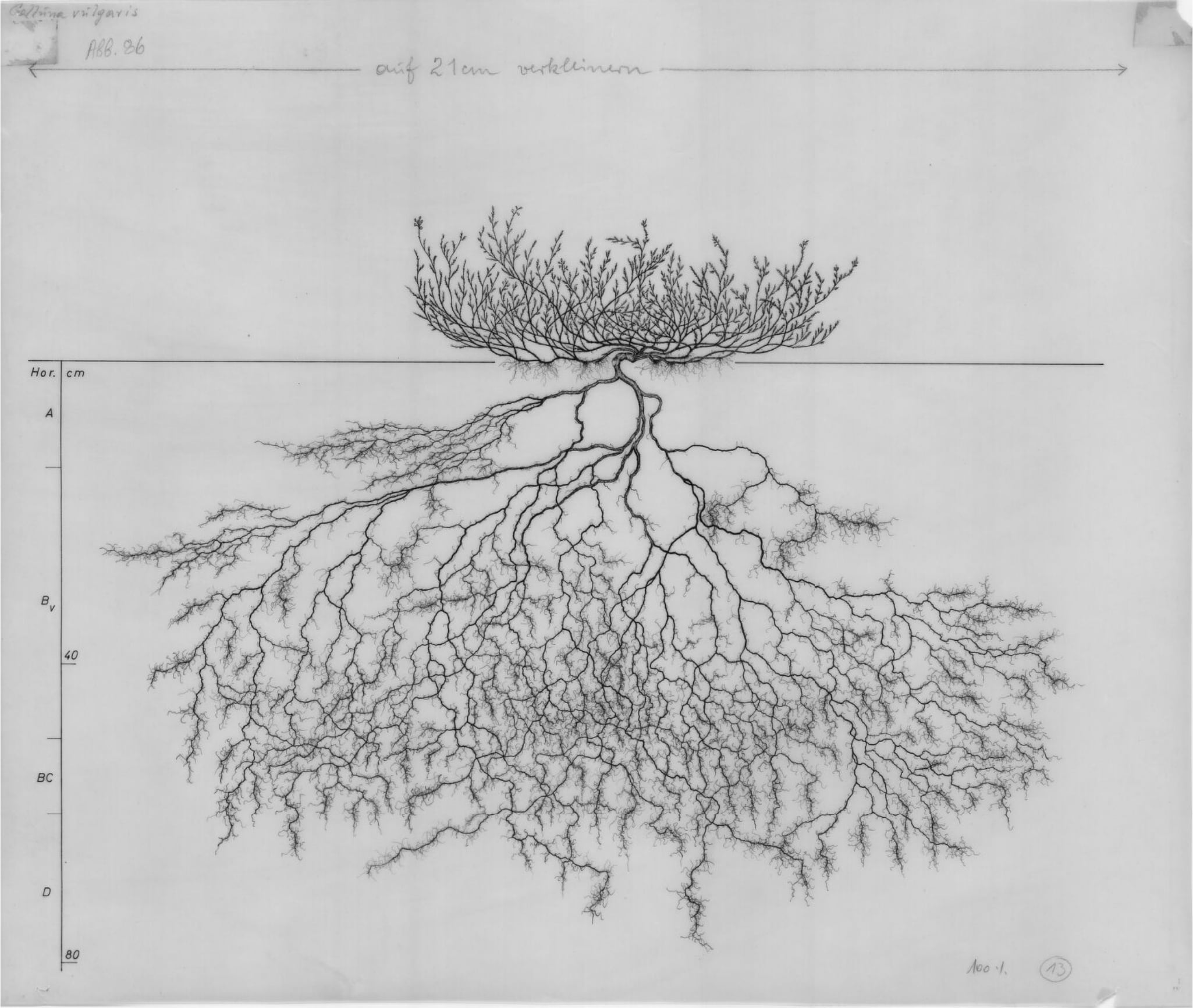
What goes on down below, underneath the soil? That you can see for yourself — and without having to pull up one of our fine flowering (or non-flowering) friends to do so — at Wageningen University’s online archive of root system drawings. “The outcome of 40 years of root system excavations in Europe,” says that site, the collection contains 1,180 diagrams of species from Abies alba (best known today as a kind of Christmas tree) to Zygophyllum xanthoxylon (a faintly scrubby-looking native of the arid and semi-arid regions of continents like Africa and Australia).

The site explains that “the drawings, their analysis and description were done by Univ. Prof. Dr. Erwin Lichtenegger (1928–2004) and Univ. Prof. Dr. Lore Kutschera (1917–2008), leader of Pflanzensoziologisches Institut, Klagenfurt, (now in Bad Goisern, Austria).”
Over the course of 40 years, writes The Washington Post’s Erin Blakemore, Lichtenegger and Kustchera “collaborated on an enormous ‘root atlas’ that maps the underground trajectories of common European plants.” Created through “a laborious system of digging up and documenting the intricate systems,” these drawings are “also art in their own right, honoring the beauty of a part of plants most never give that much thought.”

Even the least botanically aware among us knows that plants have roots, but how many of us are aware of the scale and complexity those roots can attain? “Root systems allow plants to gather the water and minerals they use to grow,” writes Blakemore. “As the root system grows, it creates more and more pathways that allow water to get into the deep subsoil, and fostering the growth of microbes that benefit other life. Strong root systems can prevent erosion, protecting the land on which they grow. And the structures allow the soil to capture carbon.” Thus root systems, never a particular locus of coolness, have the distinction of doing their part to fight climate change. And thanks to Lichtenegger and Kustchera’s drawings, they underscore the capacity of art to reveal worlds hidden to most of us. View all of the images here.

via Colossal
Related Content:
Two Million Wondrous Nature Illustrations Put Online by The Biodiversity Heritage Library
Based in Seoul, Colin Marshall writes and broadcasts on cities and culture. His projects include the book The Stateless City: a Walk through 21st-Century Los Angeles and the video series The City in Cinema. Follow him on Twitter at @colinmarshall or on Facebook.
Read More...Who Betrayed Anne Frank and Her Family?: Machine Learning, a Retired FBI Agent and a Team of Investigators May Have Finally Solved the Case
“Using new technology, recently discovered documents and sophisticated investigative techniques, an international team—led by an obsessed retired FBI agent—has [seemingly] solved the mystery that has haunted generations since World War II: Who betrayed Anne Frank and her family? And why?” That retired FBI agent, Vince Pankoke, gets interviewed by 60 Minutes above. The story behind this new investigation also gets documented in a new book, The Betrayal of Anne Frank: A Cold Case Investigation.
Related Content
Watch the Only Known Footage of Anne Frank
Anne Frank’s Diary: The Graphic Novel Adaptation
How Art Spiegelman Designs Comic Books: A Breakdown of His Masterpiece, Maus
Read More...The Origins of the Word “Gaslighting”: Scenes from the 1944 Film Gaslight
You’re not going out of your mind. You’re slowly and systematically being driven out of your mind. — Joseph Cotton to Ingrid Bergman in the 1944 film Gaslight.
Remember when the word “gaslighting” elicited knowing nods from black and white film buffs… and blank stares from pretty much everyone else?
Then along came 2016, and gaslighting entered the lexicon in a big way.
Merriam-Webster defines it as the “psychological manipulation of a person usually over an extended period of time that causes the victim to question the validity of their own thoughts, perception of reality, or memories and typically leads to confusion, loss of confidence and self-esteem, uncertainty of one’s emotional or mental stability, and a dependency on the perpetrator.”
Of course, you knew that already!
“Gaslighting” is unavoidable these days, five years after it was named 2016’s “most useful” and “likely to succeed” word by the American Dialect Society.
(“Normalize” was a runner up.)
As long as we’re playing word games, are you familiar with “denominalization”?
Also known as “verbing” or “verbification,” it’s the process whereby a noun is retooled as a verb.
Both figure prominently in Gaslight.
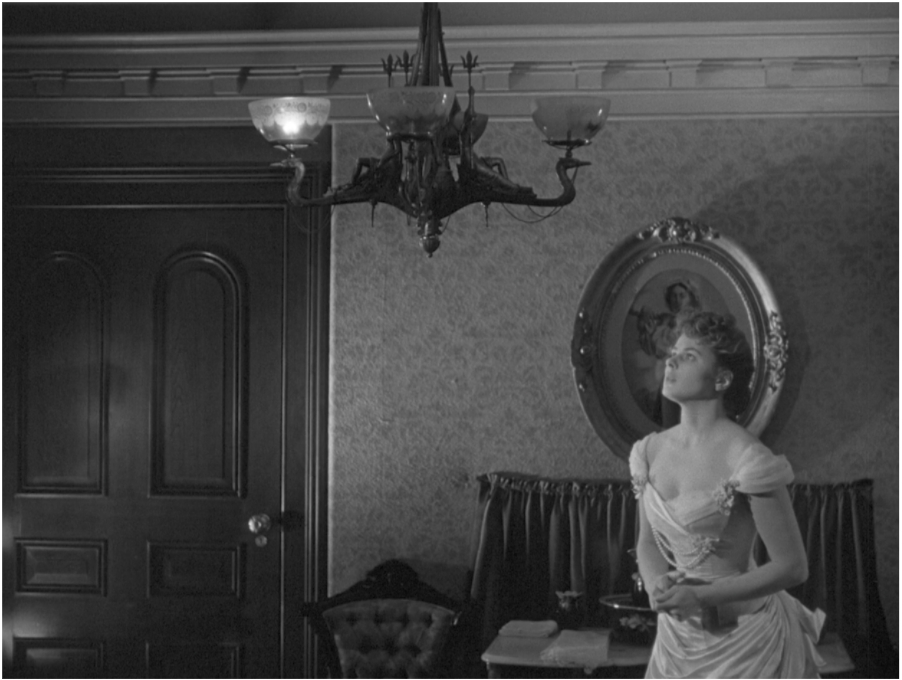
Have you seen the film?
Ingrid Bergman, playing opposite Charles Boyer, won an Academy award for her performance. A teenaged Angela Lansbury made her big screen debut.
In his review, The New York Times’ film critic Bosley Crowther steered clear of spoilers, while musing that the bulk of the theater-going public was probably already hip to the central conceit, following the successful Broadway run of Angel Street, the Patrick Hamilton thriller on which the film was based:
We can at least slip the information that the study is wholly concerned with the obvious endeavors of a husband to drive his wife slowly mad. And with Mr. Boyer doing the driving in his best dead-pan hypnotic style, while the flames flicker strangely in the gas-jets and the mood music bongs with heavy threats, it is no wonder that Miss Bergman goes to pieces in the most distressing way.
In the same review, Crowther sniped that Gaslight was “a no more illuminating title” than Angel Street.
Maybe that was true in 1944. Not anymore!
(Cunning linguists that we are, had the film retained the play’s title, 2022 may well have found us complaining that some villain tried to Angel Street us…)
In a column on production design for The Film Experience, critic Daniel Walber points out how Boyer destabilizes Bergman by fooling with their gas-powered lamps, and also how the film’s Academy Award-winning design team used the “constricting temporality” of a Victorian London lit by gas to set a foreboding mood:
Between the streetlights outside and the fixtures within, the mood is forever dimmed. The heaviness of the atmosphere brings us even closer to Paula’s mental state, trapping us with her. The detail is so precise, so committed that every flicker crawls under the skin, projecting terrible uncertainty and fear to the audience.
Readers who’ve yet to see the film may want to skip the below clip, as it does contain something close to a spoiler.
Those who’ve been on the receiving end of a vigorous gaslighting campaign?
Pass the popcorn.
Related Content:
Ingrid Bergman Remembers How Ernest Hemingway Helped Her Get the Part in For Whom the Bell Tolls
Ayun Halliday is the Chief Primatologist of the East Village Inky zine and author, most recently, of Creative, Not Famous: The Small Potato Manifesto. Follow her @AyunHalliday.
Read More...How to Decode NASA’s Message to Aliens
When NASA spent close to a billion dollars on the Voyager program, launching a pair of probes from Cape Canaveral in 1977, its primary purpose was not to find intelligent extra-terrestrial life. The program grew out of ambitions for a “Grand Tour”: four robotic probes that would visit all the planets in the outer solar system, taking advantage of a 175-year alignment of Jupiter and Saturn. A downsized version produced Voyager 1 and 2, each craft “a miniature marvel,” writes the Attic. “Weighing less than a Volkswagen, each had 65,000 parts. Six thrusters powered by plutonium. Three gyroscopes. Assorted instruments to measure gravity, radiation, magnetic fields, and more. Design and assembly took years.”
Since reaching Jupiter in 1979, the two probes have sent back astonishing images from the great gas giants and the very edges of the solar system. “By 2030, Voyager 1 and 2 will cease communications for good,” says Cory Zapatka in the Verge Science video above, “and while they won’t be able to beam information back to Earth, they’re going to continue sailing through space at almost 60,000 kilometers per hour,” reaching interstellar unknowns their makers will never see. Voyager 1 was only supposed to last 10 years. In 2012, it left the solar system, to drift, along with its twin, “endlessly among the stars of our galaxy,” Timothy Ferris writes in The New Yorker, “unless someone or something encounters them someday.”
As deep space detritus, the probes will make excellent carriers for an interstellar message in a bottle, the Voyager team reasoned. The idea prompted the creation of the Golden Record, an LP fitted to each probe containing a message from humanity to the cosmos. “Etched in copper, plated with gold, and sealed in aluminum cases, the records are expected to remain intelligible for more than a billion years, making them the longest-lasting objects ever crafted by human hands.” Produced by Ferris and overseen by Carl Sagan and a team including his future wife, Ann Druyan, the Golden Record includes the work of Mozart, Chuck Berry, folk music from around the world, the sounds of waves and whales, and one of the most universal of human sounds, laughter (likely that of Sagan himself).
The Golden Record also includes 115 images, etched into its very surface. No, they are not digital files. “There are no jpegs or tifs included on it,” says Zapatka. After all, “The Voyager’s computer systems were only 69 kilobytes large, barely enough for one image, let alone 115.” These are analog still photographs and diagrams that must be reconstructed with mathematical formulae extracted from electronic tones. The process starts with the diagrams on the record’s cover — simple icons that contain an incredible density of information. We begin with two circles joined by a line. They are hydrogen atoms, the most plentiful gas in the universe, undergoing a change that occurs spontaneously once every 10 million years.
During this rare occurrence, the hydrogen atoms emit energy at wavelengths of 21 centimeters. This measurement is used as “a constant for all the other symbols on the record.” That’s an awful lot of background knowledge required to decipher what look to the scientifically untrained eye like a pair of tiny eyes behind a pair of odd eyeglasses. But for spacefaring aliens, “how hard could that be?” says Bill Nye above in an abridged description of how to decode the Golden Record. We may never, in a billion years, know if any extra-terrestrial species ever finds the record and makes the attempt. But the Golden Record has become as much an object of fascination for humans as it is a greeting from Earth to the galaxy. Learn more from NASA here about the images encoded on the Golden Record and order your own reproduction (on LP or CD) here.
Related Content:
NASA Lets You Download Free Posters Celebrating the 40th Anniversary of the Voyager Missions
Carl Sagan Warns Congress about Climate Change (1985)
Josh Jones is a writer and musician based in Durham, NC. Follow him at @jdmagness
Read More...Support Us
We're hoping to rely on loyal readers, rather than erratic ads. Please click the Donate button and support Open Culture. You can use Paypal, Venmo, Patreon, even Crypto! We thank you!

About Us

Open Culture scours the web for the best educational media. We find the free courses and audio books you need, the language lessons & educational videos you want, and plenty of enlightenment in between.
Advertise With Us

FREE UPDATES!
GET OUR DAILY EMAIL
Get the best cultural and educational resources on the web curated for you in a daily email. We never spam. Unsubscribe at any time.
FOLLOW ON SOCIAL MEDIA

Open Culture editor Dan Colman scours the web for the best educational media. He finds the free courses and audio books you need, the language lessons & movies you want, and plenty of enlightenment in between.
Advertise With Us

