By now, you’re familiar with “Playing for Change,” a multimedia music project that brings together musicians and singers from across the globe–some well known, many others not. Their latest video features Carlos Santana playing “Oye Como Va,” a song he made famous in 1970. He’s joined by Cindy Blackman, Tito Puente, Jr. (whose father wrote the song in 1963), bassist Tal Wilkenfeld, Rubén Rada and musicians from Colombia, Panama, Uruguay, the Congo, Brazil, and beyond. For more Playing for Change videos, see the Relateds below. The one featuring John Paul Jonesperforming“When The Levee Breaks” is a personal favorite.
If you would like to support the mission of Open Culture, consider making a donation to our site. It’s hard to rely 100% on ads, and your contributions will help us continue providing the best free cultural and educational materials to learners everywhere. You can contribute through PayPal, Patreon, and Venmo (@openculture). Thanks!
Like American jazz, Japanese jazz started with earlier styles like foxtrot and ragtime. Jazz was an international music, spreading across the Atlantic to London, Paris, and Berlin and across the Pacific to Shanghai, Manilla, and Tokyo. Luxury liners crossed the ocean and their house bands ferried new styles of dance music with them. “There was precious little improvisation,” in early Japanese jazz, “but that wasn’t as big a deal, as you know, in American jazz of the 1910s or ’20s,” historian E. Taylor Atkins tells NPR.
Japan even had its own jazz age. The word first entered the country in a 1929 “popular song attached to a movie called Tokyo March,” says Atkins. “The lyrics refer to jazz, and … that’s sort of where it came into mass consciousness. It was associated with dance halls, it was associated with ‘modern girls’ and ‘modern boys’ — the Japanese version of flappers and dandies — and the urban leisure classes: excess, and dogs and cats sleeping together, and all those sorts of portents of future calamity.”
When calamity came in the form of World War II, jazz was banned in Japan as the music of the enemy. On August 15, 1945, when the Emperor went on the radio to announce Japan’s surrender, Hattori Ryoichi, “Japan’s premier jazz composer and arranger,” found himself stuck in Shanghai, “the city that since the late 1920s had served as the jazz Mecca of Asia,” Michael Bourdaghs writes in a history of Japanese pop music. “From now on,” Ryoichi supposedly toasted his fellow musicians upon hearing the news, “we can carry out our musical activities in freedom.”
How little Ryoichi could have predicted the kind of musical freedom Japanese jazz would find. But first there was a period of imitation. “In the early postwar years, Japanese musicians were essentially copying the Americans they admired,” notes Dean Van Nguyen at The Guardian. Some of the most popular bands on TV and film were comic acts like Frankie Sakai and the City Slickers, a big band formed in 1953 in imitation of Spike Jones & The City Slickers. Another popular jazz comedy act, Hajime Hana & The Crazy Cats “are significant,” writes Atkins, “for capitalizing and purveying an image of jazz musicians as clownish, slang-singing ne’er-do-wells.”
Pianist Toshiko Akiyoshi was “the first Japanese artist to break away from simply copying American artists and develop a distinctive sound and identity that incorporated Japanese harmonies and instruments,” Van Nguyen writes. By the later 60s and 70s, economic development led to a “renaissance” of Japanese jazz, writes the Sabukaru Guide to 1970’s Japanese Jazz. “The unique creative landscape in the jazz community, along with Japanese music as a whole becoming simultaneously more experimental and mainstream, led to an abundance of excellent Japanese jazz music in the 1970s.”
In the four playlists here, you can hear hours of this groundbreaking music from some of the greatest names you’ve probably never heard in Japanese jazz. These include trombonist Hiroshi Suzuki, “one of the most-revered Japanese jazz artists,” notes the blog Pink Wafer Club, “even if most listers are only familiar with his work thanks to the number of times his music has been sampled.” Suzuki’s 1975 album Cat is one of the funkiest jazz albums from any country released in the decade.
These playlists also include fusion keyboardist Mikio Masuda, saxophonist Sadao Watanabe, and other musicians who, like Akiyoshi, helped spur “young artists to evolve away from Blue Note mimicry towards free jazz, fusion, funk, spiritual, modal and bebop,” writes Van Nguyen. “These daring virtuosos implanted rock and electronic elements, or took influences from Afrobeat and flamenco music.” Their international influences reflected 1970s jazz experiments around the globe. The music also benefitted from the excellent recording quality of Japanese studios and the rise of smaller labels, which allowed for more experimental artists to record and release albums.
Find out above why “many young Japanese musicians cite the jazz innovators from this era as influences,” Sabukaru writes. Read about ten of the best 1970s Japanese jazz records here. See a huge guide to Japanese jazz from all eras at Rate Your Music, and find tracklists with timestamps for each of the playlists above at their YouTube page.
In the two videos here, see Argentine lutenist Evangelina Mascardi play passionate renditions of J.S. Bach compositions on the rich, resonant Baroque lute. In Bach’s time, lutenists were some of the most widely-admired instrumental players, and it’s easy to see why. The Baroque lute is not an easy instrument to play. Much less so were the theorbo and chitarrone, instruments like it but with longer necks for longer bass strings. We see Mascardi concentrate with utmost intensity on every note, a virtuoso on an instrument that Bach himself could not master.
Indeed, there has been significant debate over whether Bach actually composed his four pieces for solo lute for that instrument and not another. For one thing, he seems to have had a “weak grasp” of the instrument, guitarist and lutenist Cameron O’Connor writes in an examination of the evidence.
“The lute may have been an intimidating subject even for Bach.” There are several problems with authenticating existing copies of the music, and “none of the pieces in staff notation is playable on the standard Baroque lute without some transposition of the basses and changes in chord positions.”
Classical guitarist Clive Titmuss notes, “as student guitarists, we learned that J.S. Bach wrote four suites and a number of miscellaneous pieces for the lute, now played on the guitar.” However, recent scholarship seems to show that Bach, that most revered of Baroque composers, “did not write any music specifically intended for solo lute.” As O’Connor speculates, it was “the Lautenwerck, or lute harpsichord… which Bach most likely had in mind while composing many of his ‘lute’ works.” You can see it in action here.
What does this debate add to our appreciation of Mascardi’s playing? Very little, perhaps. British lutenist and Bach scholar Nigel North writes in his Linn Records Bach on the Lute set, “Instead of labouring over perpetuating the idea that the so-called lute pieces of Bach are proper lute pieces I prefer to take the works for unaccompanied Violin or Cello and make them into new works for lute, keeping (as much as possible) to the original text, musical intention, phrasing and articulation, yet transforming them in a way particular to the lute so that they are satisfying to play and to hear.”
A lutenist with the skill of North or Mascardi can transform solo Bach pieces — whether originally written for violin, cello, or lautenwerck — into the idiom of their chosen instrument. In Mascardi’s transformations here, these works sound positively transporting.
When first published in 1985, Margaret Atwood’s The Handmaid’s Tale drew acclaim for how it combined and made new the genre conventions of the dystopian, historical, and fantasy novel. But the book has enjoyed its greatest fame in the past decade, thanks in part to a 2017 adaptation on Hulu and a sequel, The Testaments, published two years thereafter. It’s even become prominent in mass culture, frequently referenced in discussions of real-life politics and society in the manner of Nineteen Eighty-Four or Fahrenheit 451.
Like George Orwell and Ray Bradbury’s famous works, The Handmaid’s Tale also seems at risk of becoming less often read than publicly referenced — and therefore, no small amount of the time, publicly misinterpreted. The only way to fortify yourself against such abuse of literature is, of course, actually to read the book. Fortunately, The Handmaid’s Taleis now widely available, unlike certain books in certain places that have been subject to bans. It is against such banning that the latest edition of Atwood’s novel stands, printed and bound using only fireproof materials.
“Across the United States and around the world, books are being challenged, banned, and even burned,” says publisher Penguin Random House. “So we created a special edition of a book that’s been challenged and banned for decades.” This uniquely “unburnable” Handmaid’s Tale “will be presented for auction by Sotheby’s New York from May 23 to June 7 with all proceeds going to benefit PEN America’s work in support of free expression.” You can bid on it at Sotheby’s site, where as of this writing the price stands at USD $70,000.
Penguin has experimented with physically metaphorical books before: the paperback edition of Nineteen Eighty-Four, for example, whose cover becomes less “censored” with use. More recently, the graphic design studio Super Terrain published Fahrenheit 451, its title long a byword for book-burning,that only becomes readable with the application of heat. But it’s Ballantine’s 1953 special edition of that novel, “bound in Johns-Manville quinterra, an asbestos material with exceptional resistance to pyrolysis,” that truly set the precedent for this one-off Handmaid’s tale. Those making bids certainly understand the book’s place in today’s cultural debates — but let’s hope they also intend to read it.
Based in Seoul, Colin Marshall writes and broadcasts on cities, language, and culture. His projects include the Substack newsletterBooks on Cities, the book The Stateless City: a Walk through 21st-Century Los Angeles and the video series The City in Cinema. Follow him on Twitter at @colinmarshall, on Facebook, or on Instagram.
Letting a beloved film director wander through the aisles of a well-stocked video store feels like such guaranteed YouTube fodder that it’s a surprise it really hasn’t been done until recently. But then I remind myself that the video store itself is a thing of the past, and to see one so well stocked, Library of Alexandria style, is news itself. For the above video, the director browsing the DVDs is none other than madcap genius Terry Gilliam. The video store is Paris’ JM Video. The chat as expected is marvelous. (Only 20 minutes? I’m sure many of us could listen to Gilliam rabbit on about his favorite films for twice, thrice that.)
Along the way, here are some things we learn:
Some of his favorite filmmakers are Stanley Kubrick, Lina Wertmuller, Federico Fellini, and one of his current friends, Albert Dupontel, the French actor-director who has used Gilliam in several of his films.
He is thanked in the credits of Tarantino’s Reservoir Dogs. Why? Because when Tarantino was at the Sundance Institute with his script, it was only Gilliam who immediately saw the brilliant screenplay for what it was, and encouraged Tarantino to stay true to himself.
He’s not a fan of Die Hard, but it was the scene where Bruce Willis talks to his wife while picking glass shards out of his foot that revealed a vulnerability in the actor. It led to Gilliam casting Bruce Willis in 12 Monkeys. Similarly, he was able to work with Brad Pitt and get him to flip his cool and handsome demeanor on its head for the manic co-starring role.
Gilliam stole the idea of multiple actors playing the same title character in The Imaginarium of Doctor Parnassus (after lead actor Heath Ledger died during shooting) from Luis Buñuel’s That Obscure Object of Desire. In that film, two women play the same character interchangeably. If it’s good enough for Buñuel…
Eisenstein’s Ivan the Terrible (parts one and two) is a “dangerous” film, because it was one of Putin’s most watched movies. (Not that we should stop watching Eisenstein.) Gilliam’s way of pronouncing Putin as “poutine” is intentional, no?
Being a fan of Monty Python was a good way of getting cast in a Gilliam film. The director knows he would have not worked with Sean Connery (in Time Bandits) or Robert DeNiro (in Brazil) if both didn’t know his work on the classic comedy. (It also helps to have producers who go golfing with A‑list actors.)
He disses Christopher Nolan (“technically brilliant” but then “the films become video games” with “no gravity”), and repeats a swipe against Spielberg’s Schindler’s List that he heard from Kubrick. (“It’s a film about success.”)
He imagines a better closing edit to Close Encounters that ends upon seeing the legs of the alien as the hatch opens. Then we would have had something to talk about on the way home, he says.
Ted Mills is a freelance writer on the arts who currently hosts the Notes from the Shed podcast and is the producer of KCRW’s Curious Coast. You can also follow him on Twitter at @tedmills, and/or watch his films here.
Above you can get a first glimpse of Moonage Daydream–a new film thatThe Guardiancalls a “glorious, shapeshifting eulogy to David Bowie.” Directed by Brett Morgen (otherwise known for Cobain: Montage of Heck), the film creates for viewers “an immersive cinematic experience” and “an audio-visual space odyssey,” using never-before-seen concert footage. Moonage Daydream “not only illuminates the enigmatic legacy of David Bowie but also serves as a guide to living a fulfilling and meaningful life in the 21st Century.”
Premiering at the Cannes Film Festival this month, the film will arrive at theaters in September, and then stream on HBO and HBO Max next spring. You can read more about the film and its production at Rolling Stone.
If you would like to support the mission of Open Culture, consider making a donation to our site. It’s hard to rely 100% on ads, and your contributions will help us continue providing the best free cultural and educational materials to learners everywhere. You can contribute through PayPal, Patreon, and Venmo (@openculture). Thanks!
Last year we told you about the plan to install a retractable floor in the Colosseum, thus restoring a feature it boasted in its ancient glory days. Though the state pledged €10 million, the budget of an ambitious renovation will surely come to many times that — but still, we may imagine, only a fraction of the money it took to build the Colosseum in the first place. In fact we have to imagine it, since we have no records of what that icon of Rome actually cost. In the video above, history Youtuber Garrett Ryan, creator of the channel Told in Stone, does so by not just marshaling all his knowledge of the ancient world but also crowdsourcing others’ knowledge of modern construction techniques and expenses.
First, Ryan must reckon the cost of the Colosseum in sestertii, the “big brass coins” common in Rome of the first century AD. “At the time the Colosseum was built,” he says, “one sestertius could buy two loaves of bread, four cups of cheap wine, or a single cup of good wine.”
The average unskilled laborer could expect to earn around four sestertii per day, and this project needed thousands of such laborers to excavate its foundation trench alone. Then came the laying of the foundation itself, followed by the building of the superstructure, which remains formidable even in the ruined state we know today. Its materials included 100,000 cubic meters of travertine — “roughly one-fiftieth, incidentally, of all travertine ever quarried by the Romans.”
A good deal of travertine also went into the Getty Center, perhaps the closest thing to a Colosseum-scale construction project in modern-day America. The Getty’s total cost came to $733 million, a price tag befitting the wealth synonymous with its name. But it still came cheaper than the Colosseum by Ryan’s estimate, or at least by most of the estimates at which he arrives. Consulting with several of his viewers experienced in architecture and construction, he calculates that building an exact replica of the Colosseum in today’s United States — taking into account the much greater efficiency of current tools, as well as the much greater cost of labor — roughly equivalent to $150,000,000 to more than $1 billion. That amount of money obviously exists in our world; whether we possess the necessary ambition is less clear. Then again, ancient Rome didn’t have Lego.
Based in Seoul, Colin Marshall writes and broadcasts on cities, language, and culture. His projects include the Substack newsletterBooks on Cities, the book The Stateless City: a Walk through 21st-Century Los Angeles and the video series The City in Cinema. Follow him on Twitter at @colinmarshall, on Facebook, or on Instagram.
It would be awfully clichéd to call Seoul, where I live, a place of contrasts between old and new. And yet that texture really does manifest everywhere in Korean life, most palpably on the streets of the capital. In my favorite neighborhoods, one passes through a variety of different eras walking down a single alley. “Third-wave” coffee shops and “newtro” bars coexist with family restaurants unchanged for decades and even small industrial workshops. Those workshops produce clothing, plumbing fixtures, printed matter, electronics, and much else besides, in many cases late into the night. For all its reputation as a high-tech “Asian Tiger,” this remains, clearly and presently, a country that makes things.
You can see just how Korea makes things on the Youtube channel All Process of World, which has drawn tens of millions of views with its videos of factories: factories making forks, bricks, sliced tuna, sheepskin jackets, bowling balls, humanoid robots. The scale of these Korean industrial operations ranges from the massive to the artisanal; some products are unique to twenty-first century life, and others have been in use for centuries.
On the traditional side, All Process of World has provided close-up views of the making of ceramic teapots, wooden window frames (as you would see in a classical Korean hanok), handheld percussive moktak to aid Buddhist monks in their chants, and even jeogori, the distinctive jackets worn with hanbok dresses.
Judging by the comments, All Process of World’s many viewers hail from around the globe. This shouldn’t come as a surprise, given Korea’s newfound worldwide popularity. But that so-called “Korean wave” owes less to the appeal of Korea’s traditional culture than its modern one, less to its rustic yet elegant pottery and brilliantly colorful formalwear than to BTS and “Gangnam Style,” Parasiteand Squid Game — whose “robot girl” appears on a rug made in one All Process of World video. Another shows us the production of an equally modern item, the face masks seen everywhere in Korea during the past two years. Just a few weeks ago, the government gave us the okay to take those masks off outdoors. While hoping for the arrival of fully post-COVID era, we’d do well to keep in mind how the past always seems to find its way into the present.
Based in Seoul, Colin Marshall writes and broadcasts on cities, language, and culture. His projects include the Substack newsletterBooks on Cities, the book The Stateless City: a Walk through 21st-Century Los Angeles and the video series The City in Cinema. Follow him on Twitter at @colinmarshall, on Facebook, or on Instagram.
When we speak of a “lost art,” we do not always mean that humans have forgotten certain production methods. Modern craftspeople can recover or reasonably approximate old techniques and materials, and produce artifacts that can be passed off as authentic by the unscrupulous. The spirit of the thing, however, can never be recovered. Try as they might, scholars and conservators will never be able to enter the mind of a Medieval scribe or manuscript illuminator. Their social world has disappeared into a distant mist; we can only dimly guess at what their lives were like.
Thus, for many years, the reception of Hieronymus Bosch — the bizarre fantasist from the Netherlands whose visions of Earth, Heaven, and Hell have amused and terrified viewers — stressed the proto-Surrealism of his work, assuming he must have had other intentions than proselytizing.
Most recent interpretation, however, has pulled in the other direction, stressing the degree to which Bosch and his contemporaries believed in a universe that was exactly as weird as he depicted it, no exaggeration necessary; emphasizing how Bosch felt an urgent need to spare viewers of his work from the fates he showed in his art.
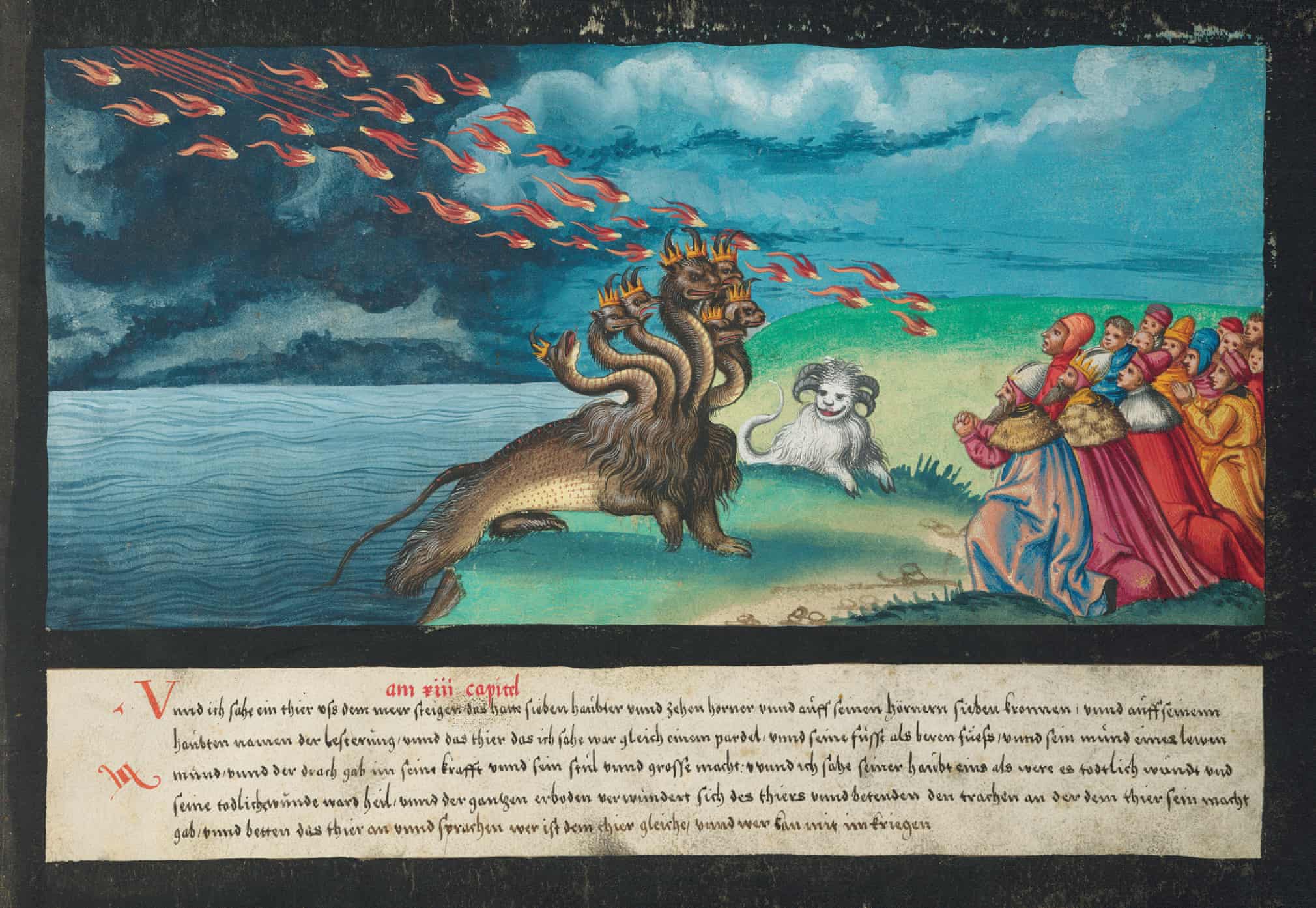
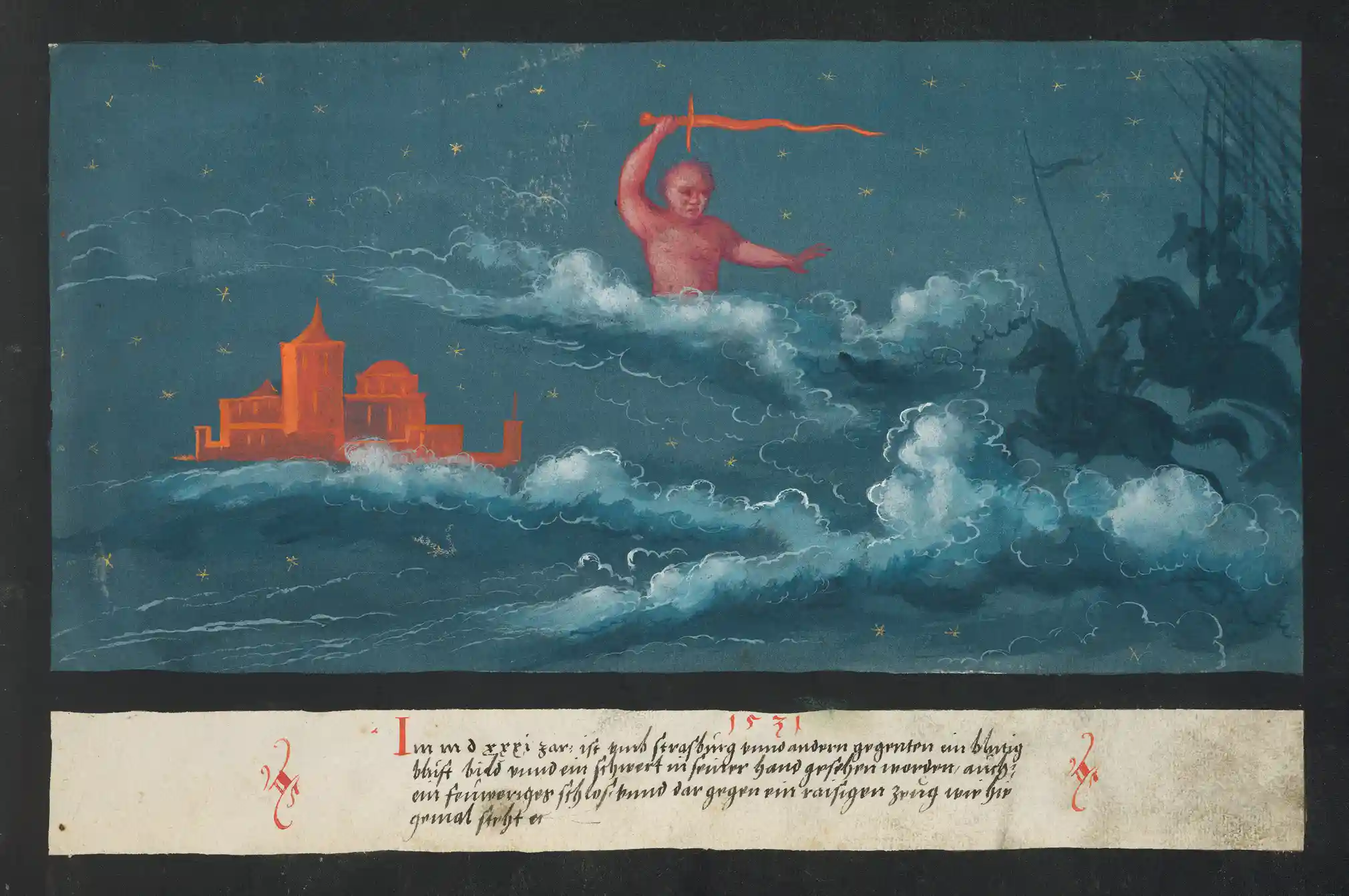
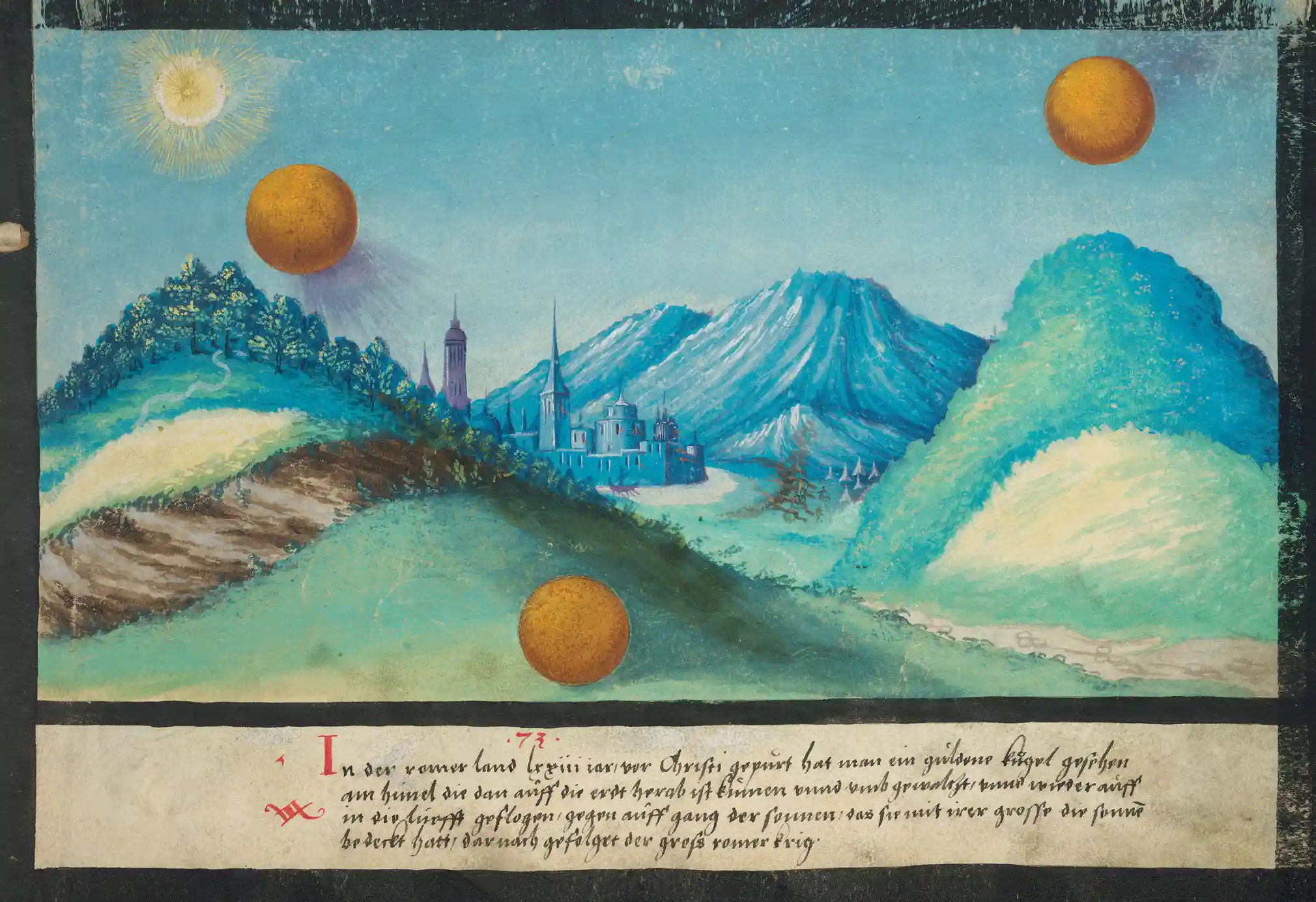
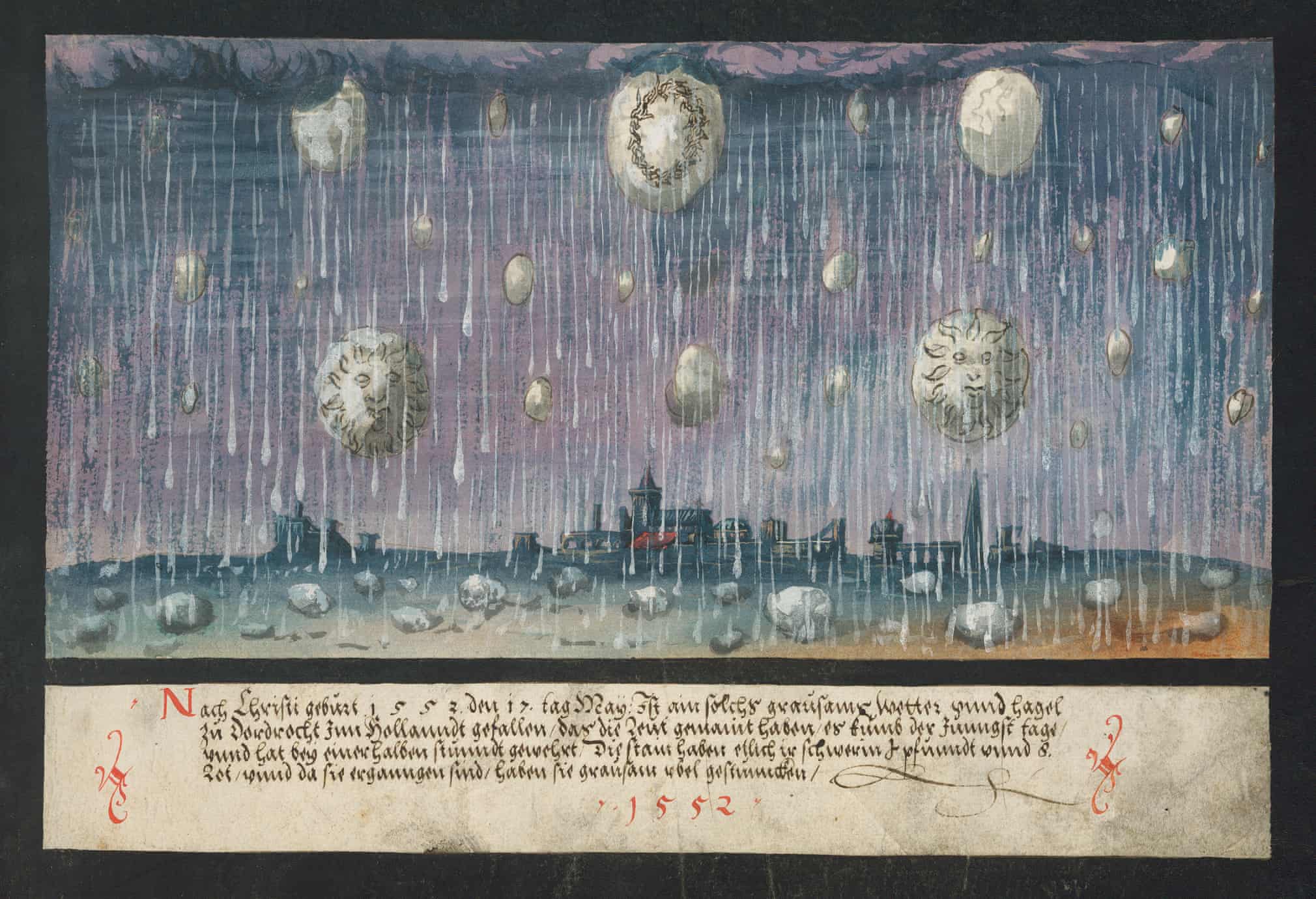
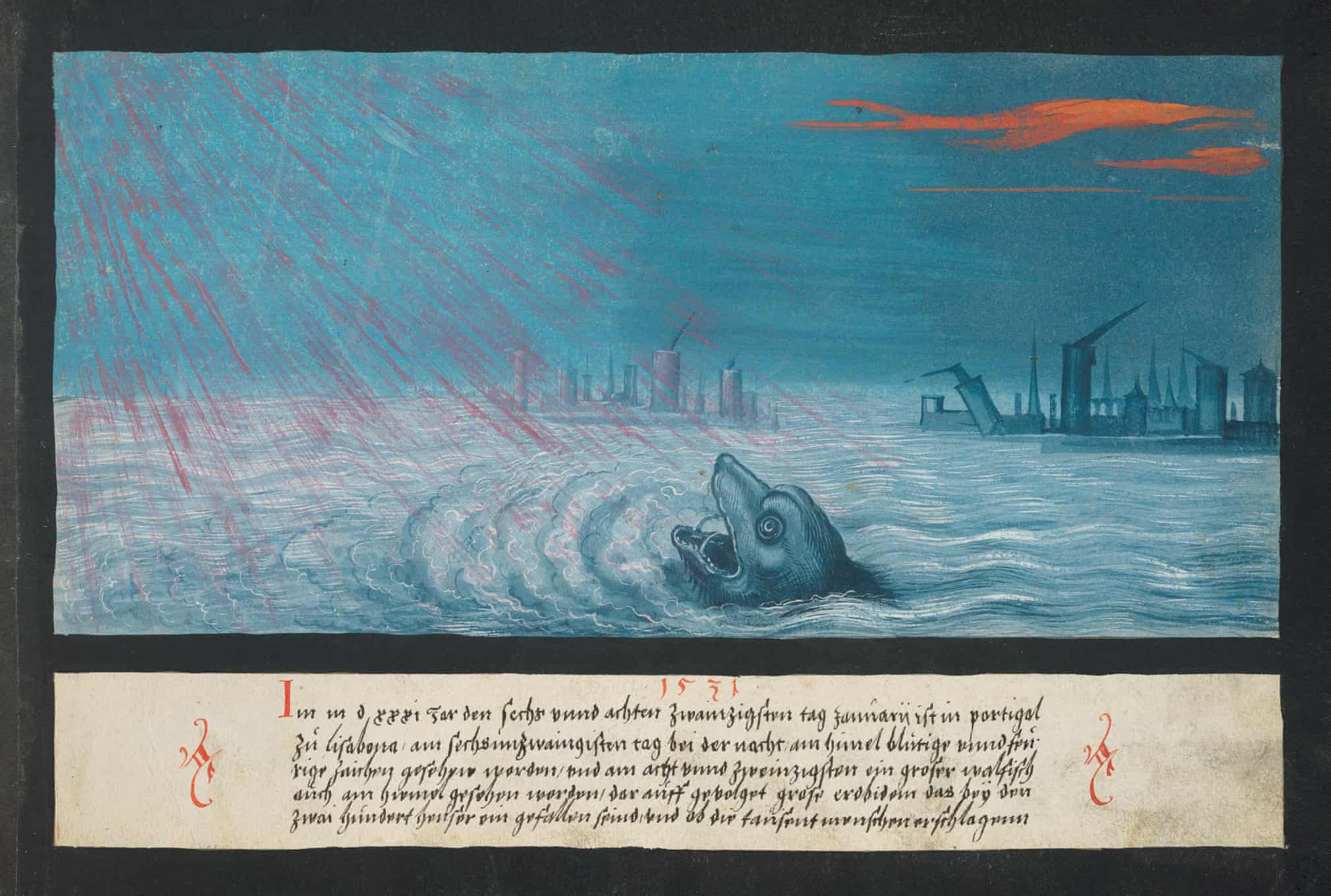
What passed through the mind of the illuminator of the manuscript shown here, the AugsburgBook of Miraculous Signs? We can never know. At best, scholars have settled on a name — artist and printmaker Hans Burgkmair the Younger — though little is known about him And we have a date, 1552, when this “curious and lavishly illustrated manuscript appeared in the Swabian Imperial Free city of Augsburg, then a part of the Holy Roman Empire, located in present-day Germany,” Maria Popova writes at the Marginalian. In the video at the top from Hochelaga, you can learn more about the “bizarre text” and the “meaning behind its unique contents” and “scenes of calamity and chaos.”
The strange book presents “in remarkable detail and wildly imaginative artwork, Medieval Europe’s growing obsessions with signs sent from ‘God,’ ” Popova writes, “a testament to the basic human propensity for magical thinking.” More specifically, The Book of Miraclesrecounts a host of Biblical signs and wonders in chronological order: from the first book of the Old Testament to the spectacular end of the New. In-between are “hallucinatory accounts of classical and contemporary celestial phenomena,” Tim Smith-Laing writes at Apollo. “The manuscript comprises nothing less than a picture chronicle of the world’s past, present and future, in 192 miracles.”
While Protestant Christianity condemned Medieval magic, “the recurrence of miracles in the Bible meant that the Protestant reformers of the sixteenth century could not reject such wonders as superstitions in the way they scorned Catholic beliefs,” Marina Warner writes at The New York Review of Books. German reformers were on high alert for the miraculous and ominous: “The sixteenth-century Zwinglian clergyman Johann Jakob Wick filled twenty-four albums with reports of such wonders in broadsheets and pamphlets,” seeing signs in the birth of a two-headed calf or “an unfortunate, flipper-handed infant.”
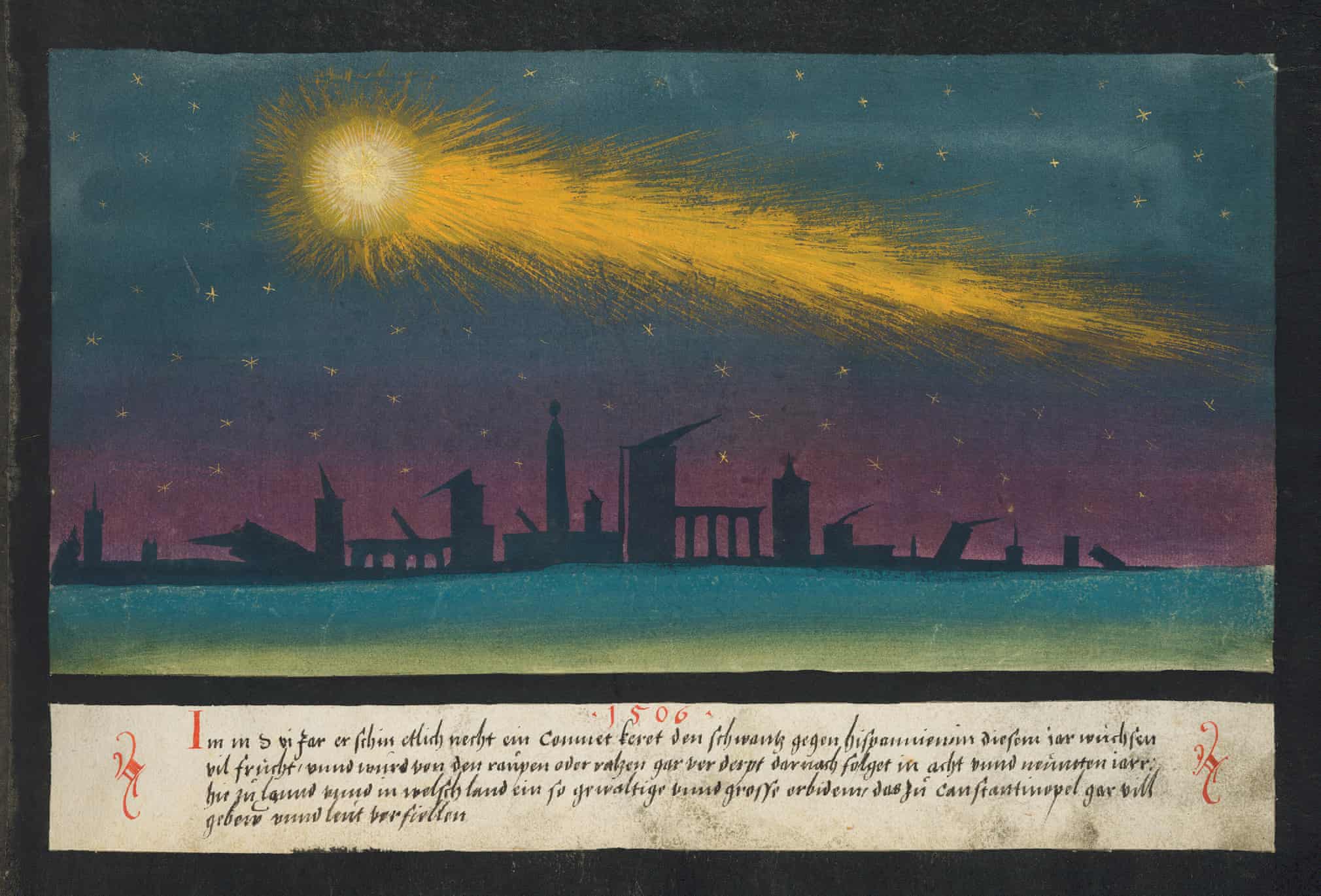
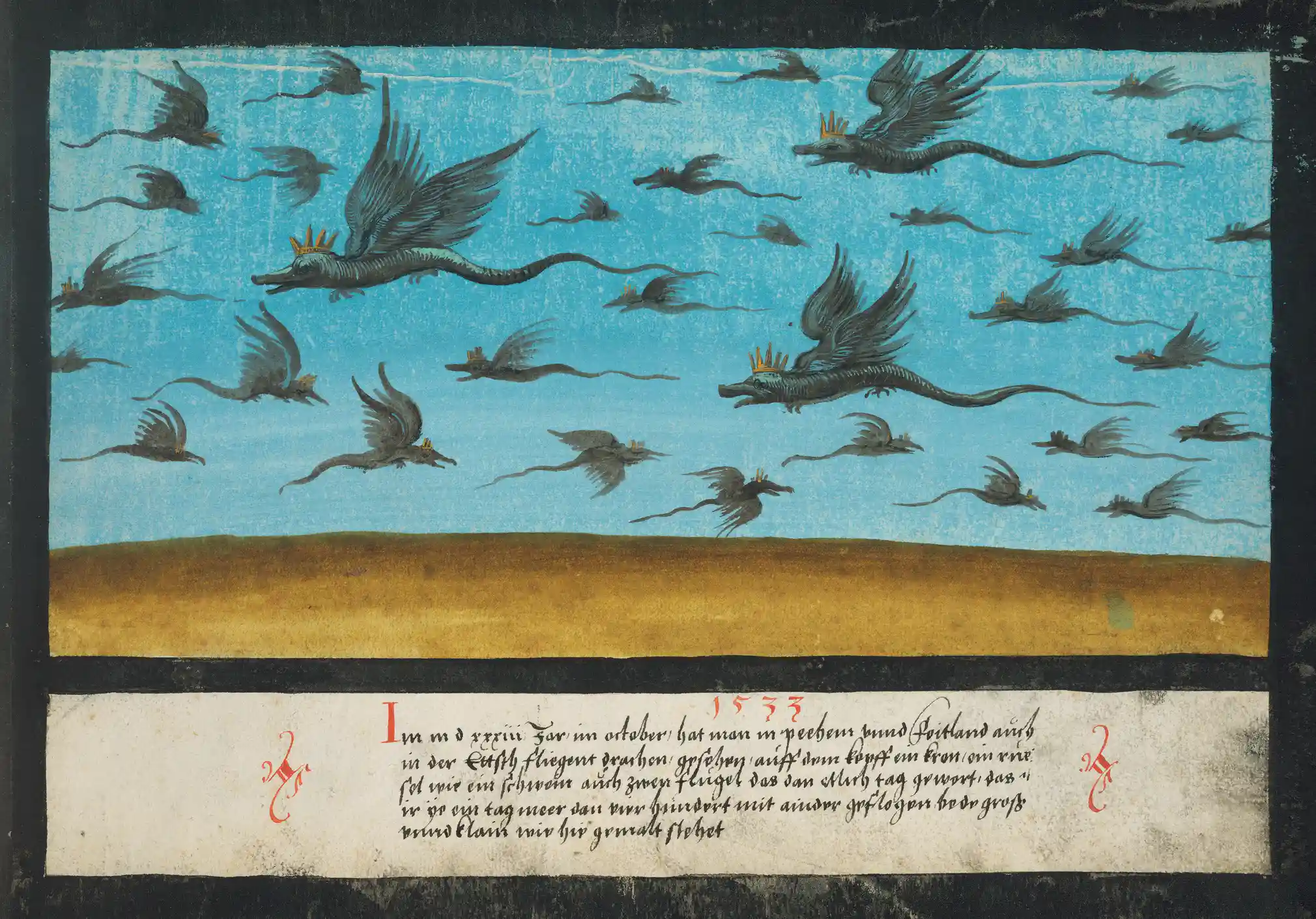
All of which is to say that we have little reason to doubt that the creator of The Book of Miracles meant the work as an earnest warning to its readers, although its wondrous images might look to us like proto-fantasy or sci-fi illustration. The book illustrates 1533 reports of flying dragons in Bohemia, an event, notes The Guardian, that “went on for several days, with over four hundred of them, both big and small, flying together.” It shows a comet appearing in 1506, one that stayed for several days and nights “and turned its tail towards Spain.” Thereby followed “a lot of fruit,” which was then “completely destroyed by caterpillars or rats,” then a violent earthquake in Constantinople.
The very tenuous connection between disparate natural phenomena, the hearsay reports of magical happenings, you can read about all of these signs and wonders in a republished version by Taschen, in English, French, and German. It is, Popova writes, “a singular shrine to some of the most eternal of human hopes and fears, and, above all, our immutable longing for grace, for mercy, for the miraculous.” See more images from The Book of Miracles at The Guardian.
Since 1990, Martin Scorsese has devoted the non-filmmaking part of his career to film preservation, whether that means the classics of Hollywood or world cinema. The over 900 restorations that he’s helped fund through the Film Foundation non-profit have been the subject of Criterion Collection box sets, special anniversary screenings and festival showings, and now a special monthly online screening room will give viewers a chance to see some familiar and not-so-familiar films that have been saved from destruction.
According to the welcome message at the Restoration Screening Room, “Presentations will take place within a 24-hour window on the second Monday of each month, along with Special Features about the films and their restoration process. Monthly programming will encompass a broad array of restorations, including classic and independent films, documentaries, and silent films from around the world.’”
As of this writing, the window has closed for its inaugural film, Powell and Pressburger’s 1945 I Know Where I’m Going! but you can still click through to see the extras that come with the film: an Introduction by Scorsese; an interview with Scorsese’s long-time editor Thelma Schoonmaker (who was also Powell’s spouse for six years until 1990 and who worked on the restoration); Kent Jones interviewing Kevin Macdonald, the grandson of Pressburger and his biographer; the Film Foundation’s Margaret Bodde interviewing Tilda Swinton, a huge fan of the film; directors Joanna Hogg and Scorsese talking about the film; a before and after look at the restoration; an image gallery; and finally a links page called “explore” that is quite overwhelming in its thoroughness.
The 4K restoration’s next stop is the Criterion Channel, so if you subscribe to that paid service, find it there. But the Film Foundation’s premieres are completely free and feature a live chat on the screening night.
In the coming months look forward to Fellini’s La Strada (June 13), Govindan Aravindan’s Kummatty (July 11), a double feature of The Chase (d. Arthur Ripley) and Detour (d. Edgar G. Ulmer) (August 8); Sarah Maldoror’s Sambizanga (Sep. 12), Marlon Brando’s One Eyed Jacks (October 10); John Huston’s Moulin Rouge (November 14); and Jonas Mekas’ Lost Lost Lost on December 12.
The site has no trailers, but we’ve got you covered:
Ted Mills is a freelance writer on the arts who currently hosts the Notes from the Shed podcast and is the producer of KCRW’s Curious Coast. You can also follow him on Twitter at @tedmills, and/or watch his films here.
The Scream is not screaming. “One of the famous in the images of art,” Edvard Munch’s most widely seen painting “has become, for us, a universal symbol of angst and anxiety.” Munch painted it in 1893, when “Europe was at the birth of the modern era, and the image reflects the anxieties that troubled the world.” However many fin-de-siècle Europeans felt like screaming for one reason or another, the central figure of The Scream isn’t one of them: “rather, it is holding its hands over its ears, to block out the scream.” So gallerist and Youtuber James Payne reveals on the latest episode of his series Great Art Explained, which doesn’t just examine Munch’s iconic work of art, but places it in the context of his career and his time.
During most of Munch’s life, “European cities were going through truly exceptional changes. Industrialization and economic shifts brought fear, obsessions, diseases, political unrest, and radicalism. Questions were being raised about society, and the changing role of man within it: about our psyche, our social responsibilities, and most radical of all, about the existence of God.” It was hardly the most suitable time or place for the mentally troubled, but then, Munch seems to have possessed more psychological fortitude than he let the public know. A savvy self-promoter, he understood the value of living like someone whose terrible perceptions keep him on the brink of total breakdown.
But then, Munch never did have it easy. “His mother and his sister both died of tuberculosis. His father and grandfather suffered from depression, and another sister, Laura, from pneumonia. His only brother would later die of pneumonia.” He found solace in art, a pursuit strongly opposed by his religious father, and eventually joined the bohemian world, a milieu that encouraged him to let his inner world shape his aesthetic. Drawing inspiration from the French Impressionists and the drama of August Strindberg, Munch eventually found his way to starting a cycle of paintings called The Frieze of Life.
It was during his work on The Frieze of Life that, according to a diary entry of January 22nd, 1892, Munch found himself walking along a fjord. “I felt tired and ill. I stopped and looked out over the fjord — the sun was setting, and the clouds turning blood red. I sensed a scream passing through nature; it seemed to me that I heard the scream. I painted this picture, painted the clouds as actual blood. The color shrieked.” The fjord was on the way back from the asylum to which his beloved younger sister had recently been confined; Payne imagines that her “screams of terror must have haunted him as he walked away.” From these grim origins, The Scream emerged to become an oft-referenced and highly relatable image — even to those who see in it nothing more than their own frustration at receiving too much e‑mail.
Based in Seoul, Colin Marshall writes and broadcasts on cities, language, and culture. His projects include the Substack newsletterBooks on Cities, the book The Stateless City: a Walk through 21st-Century Los Angeles and the video series The City in Cinema. Follow him on Twitter at @colinmarshall, on Facebook, or on Instagram.
We're hoping to rely on loyal readers, rather than erratic ads. Please click the Donate button and support Open Culture. You can use Paypal, Venmo, Patreon, even Crypto! We thank you!
Open Culture scours the web for the best educational media. We find the free courses and audio books you need, the language lessons & educational videos you want, and plenty of enlightenment in between.